EP4518328A1 - Anzeigevorrichtung, elektronische vorrichtung und betriebsverfahren dafür - Google Patents
Anzeigevorrichtung, elektronische vorrichtung und betriebsverfahren dafür Download PDFInfo
- Publication number
- EP4518328A1 EP4518328A1 EP23857699.5A EP23857699A EP4518328A1 EP 4518328 A1 EP4518328 A1 EP 4518328A1 EP 23857699 A EP23857699 A EP 23857699A EP 4518328 A1 EP4518328 A1 EP 4518328A1
- Authority
- EP
- European Patent Office
- Prior art keywords
- content
- display apparatus
- electronic device
- display
- sharing request
- Prior art date
- Legal status (The legal status is an assumption and is not a legal conclusion. Google has not performed a legal analysis and makes no representation as to the accuracy of the status listed.)
- Pending
Links
Images









Classifications
-
- A—HUMAN NECESSITIES
- A63—SPORTS; GAMES; AMUSEMENTS
- A63F—CARD, BOARD, OR ROULETTE GAMES; INDOOR GAMES USING SMALL MOVING PLAYING BODIES; VIDEO GAMES; GAMES NOT OTHERWISE PROVIDED FOR
- A63F13/00—Video games, i.e. games using an electronically generated display having two or more dimensions
- A63F13/45—Controlling the progress of the video game
- A63F13/49—Saving the game status; Pausing or ending the game
- A63F13/497—Partially or entirely replaying previous game actions
-
- A—HUMAN NECESSITIES
- A63—SPORTS; GAMES; AMUSEMENTS
- A63F—CARD, BOARD, OR ROULETTE GAMES; INDOOR GAMES USING SMALL MOVING PLAYING BODIES; VIDEO GAMES; GAMES NOT OTHERWISE PROVIDED FOR
- A63F13/00—Video games, i.e. games using an electronically generated display having two or more dimensions
- A63F13/50—Controlling the output signals based on the game progress
-
- A—HUMAN NECESSITIES
- A63—SPORTS; GAMES; AMUSEMENTS
- A63F—CARD, BOARD, OR ROULETTE GAMES; INDOOR GAMES USING SMALL MOVING PLAYING BODIES; VIDEO GAMES; GAMES NOT OTHERWISE PROVIDED FOR
- A63F13/00—Video games, i.e. games using an electronically generated display having two or more dimensions
- A63F13/85—Providing additional services to players
- A63F13/86—Watching games played by other players
-
- G—PHYSICS
- G06—COMPUTING OR CALCULATING; COUNTING
- G06F—ELECTRIC DIGITAL DATA PROCESSING
- G06F3/00—Input arrangements for transferring data to be processed into a form capable of being handled by the computer; Output arrangements for transferring data from processing unit to output unit, e.g. interface arrangements
- G06F3/14—Digital output to display device ; Cooperation and interconnection of the display device with other functional units
- G06F3/1454—Digital output to display device ; Cooperation and interconnection of the display device with other functional units involving copying of the display data of a local workstation or window to a remote workstation or window so that an actual copy of the data is displayed simultaneously on two or more displays, e.g. teledisplay
-
- H—ELECTRICITY
- H04—ELECTRIC COMMUNICATION TECHNIQUE
- H04N—PICTORIAL COMMUNICATION, e.g. TELEVISION
- H04N21/00—Selective content distribution, e.g. interactive television or video on demand [VOD]
- H04N21/20—Servers specifically adapted for the distribution of content, e.g. VOD servers; Operations thereof
- H04N21/27—Server based end-user applications
- H04N21/274—Storing end-user multimedia data in response to end-user request, e.g. network recorder
- H04N21/2743—Video hosting of uploaded data from client
-
- H—ELECTRICITY
- H04—ELECTRIC COMMUNICATION TECHNIQUE
- H04N—PICTORIAL COMMUNICATION, e.g. TELEVISION
- H04N21/00—Selective content distribution, e.g. interactive television or video on demand [VOD]
- H04N21/40—Client devices specifically adapted for the reception of or interaction with content, e.g. set-top-box [STB]; Operations thereof
- H04N21/43—Processing of content or additional data, e.g. demultiplexing additional data from a digital video stream; Elementary client operations, e.g. monitoring of home network or synchronising decoder's clock; Client middleware
-
- H—ELECTRICITY
- H04—ELECTRIC COMMUNICATION TECHNIQUE
- H04N—PICTORIAL COMMUNICATION, e.g. TELEVISION
- H04N21/00—Selective content distribution, e.g. interactive television or video on demand [VOD]
- H04N21/40—Client devices specifically adapted for the reception of or interaction with content, e.g. set-top-box [STB]; Operations thereof
- H04N21/43—Processing of content or additional data, e.g. demultiplexing additional data from a digital video stream; Elementary client operations, e.g. monitoring of home network or synchronising decoder's clock; Client middleware
- H04N21/4302—Content synchronisation processes, e.g. decoder synchronisation
- H04N21/4307—Synchronising the rendering of multiple content streams or additional data on devices, e.g. synchronisation of audio on a mobile phone with the video output on the TV screen
- H04N21/43076—Synchronising the rendering of multiple content streams or additional data on devices, e.g. synchronisation of audio on a mobile phone with the video output on the TV screen of the same content streams on multiple devices, e.g. when family members are watching the same movie on different devices
-
- H—ELECTRICITY
- H04—ELECTRIC COMMUNICATION TECHNIQUE
- H04N—PICTORIAL COMMUNICATION, e.g. TELEVISION
- H04N21/00—Selective content distribution, e.g. interactive television or video on demand [VOD]
- H04N21/40—Client devices specifically adapted for the reception of or interaction with content, e.g. set-top-box [STB]; Operations thereof
- H04N21/43—Processing of content or additional data, e.g. demultiplexing additional data from a digital video stream; Elementary client operations, e.g. monitoring of home network or synchronising decoder's clock; Client middleware
- H04N21/436—Interfacing a local distribution network, e.g. communicating with another STB or one or more peripheral devices inside the home
-
- H—ELECTRICITY
- H04—ELECTRIC COMMUNICATION TECHNIQUE
- H04N—PICTORIAL COMMUNICATION, e.g. TELEVISION
- H04N21/00—Selective content distribution, e.g. interactive television or video on demand [VOD]
- H04N21/40—Client devices specifically adapted for the reception of or interaction with content, e.g. set-top-box [STB]; Operations thereof
- H04N21/43—Processing of content or additional data, e.g. demultiplexing additional data from a digital video stream; Elementary client operations, e.g. monitoring of home network or synchronising decoder's clock; Client middleware
- H04N21/436—Interfacing a local distribution network, e.g. communicating with another STB or one or more peripheral devices inside the home
- H04N21/43615—Interfacing a Home Network, e.g. for connecting the client to a plurality of peripherals
-
- H—ELECTRICITY
- H04—ELECTRIC COMMUNICATION TECHNIQUE
- H04N—PICTORIAL COMMUNICATION, e.g. TELEVISION
- H04N21/00—Selective content distribution, e.g. interactive television or video on demand [VOD]
- H04N21/40—Client devices specifically adapted for the reception of or interaction with content, e.g. set-top-box [STB]; Operations thereof
- H04N21/43—Processing of content or additional data, e.g. demultiplexing additional data from a digital video stream; Elementary client operations, e.g. monitoring of home network or synchronising decoder's clock; Client middleware
- H04N21/436—Interfacing a local distribution network, e.g. communicating with another STB or one or more peripheral devices inside the home
- H04N21/4363—Adapting the video stream to a specific local network, e.g. a Bluetooth® network
-
- H—ELECTRICITY
- H04—ELECTRIC COMMUNICATION TECHNIQUE
- H04N—PICTORIAL COMMUNICATION, e.g. TELEVISION
- H04N21/00—Selective content distribution, e.g. interactive television or video on demand [VOD]
- H04N21/40—Client devices specifically adapted for the reception of or interaction with content, e.g. set-top-box [STB]; Operations thereof
- H04N21/43—Processing of content or additional data, e.g. demultiplexing additional data from a digital video stream; Elementary client operations, e.g. monitoring of home network or synchronising decoder's clock; Client middleware
- H04N21/436—Interfacing a local distribution network, e.g. communicating with another STB or one or more peripheral devices inside the home
- H04N21/4363—Adapting the video stream to a specific local network, e.g. a Bluetooth® network
- H04N21/43637—Adapting the video stream to a specific local network, e.g. a Bluetooth® network involving a wireless protocol, e.g. Bluetooth®, RF or wireless LAN [IEEE 802.11]
-
- H—ELECTRICITY
- H04—ELECTRIC COMMUNICATION TECHNIQUE
- H04N—PICTORIAL COMMUNICATION, e.g. TELEVISION
- H04N21/00—Selective content distribution, e.g. interactive television or video on demand [VOD]
- H04N21/40—Client devices specifically adapted for the reception of or interaction with content, e.g. set-top-box [STB]; Operations thereof
- H04N21/47—End-user applications
- H04N21/478—Supplemental services, e.g. displaying phone caller identification, shopping application
-
- H—ELECTRICITY
- H04—ELECTRIC COMMUNICATION TECHNIQUE
- H04N—PICTORIAL COMMUNICATION, e.g. TELEVISION
- H04N21/00—Selective content distribution, e.g. interactive television or video on demand [VOD]
- H04N21/40—Client devices specifically adapted for the reception of or interaction with content, e.g. set-top-box [STB]; Operations thereof
- H04N21/47—End-user applications
- H04N21/478—Supplemental services, e.g. displaying phone caller identification, shopping application
- H04N21/4781—Games
-
- H—ELECTRICITY
- H04—ELECTRIC COMMUNICATION TECHNIQUE
- H04N—PICTORIAL COMMUNICATION, e.g. TELEVISION
- H04N5/00—Details of television systems
- H04N5/76—Television signal recording
- H04N5/765—Interface circuits between an apparatus for recording and another apparatus
- H04N5/77—Interface circuits between an apparatus for recording and another apparatus between a recording apparatus and a television camera
Definitions
- the disclosure relates to a display apparatus, an electronic device, and operating methods of the display apparatus and the electronic device, and for example, to a display apparatus that enables an electronic device to effectively capture content displayed on the display apparatus and an operating method of the display apparatus.
- Users may consume various content by, for example, watching a movie or playing a game, using a display apparatus.
- users may want to capture or record a desired scene from content while watching the content using a display apparatus, and upload the captured or recorded scene using social network service applications.
- Embodiments of the disclosure provide a display apparatus, an electronic device, and operating methods of the display apparatus and the electronic device, so as to effectively capture or record content displayed on the display apparatus.
- a display apparatus includes: a display, a communication unit comprising communication circuitry, a memory in which one or more instructions are stored, and a processor configured to execute the one or more instructions stored in the memory.
- the processor may be configured to identify whether content displayed on the display is sharable content, by executing the one or more instructions.
- the processor may be configured to control the communication unit to broadcast a signal including state information indicating that the content is sharable content as the content displayed on the display is identified as sharable content, by executing the one or more instructions.
- the processor may be configured to receive a content sharing request for sharing the content from an electronic device based on the broadcast signal, by executing the one or more instructions.
- the processor may be configured to control the communication unit to transmit at least part of the content output to the display to the electronic device, in response to the content sharing request, by executing the one or more instructions.
- An electronic device includes: a display, a communication unit comprising communication circuitry, a memory in which one or more instructions are stored, and a processor configured to execute the one or more instructions stored in the memory.
- the processor may be configured to obtain an image of a display apparatus displaying content, through a camera of the electronic device, by executing the one or more instructions.
- the processor may be configured to receive a broadcast signal including state information indicating that the content displayed on the display apparatus is sharable content, by executing the one or more instructions.
- the processor may be configured to identify whether the display apparatus of the obtained image is the display apparatus transmitting the broadcast signal, based on the broadcast signal, by executing the one or more instructions.
- the processor may be configured to transmit a content sharing request for sharing the content to the display apparatus based on determining that the display apparatus of the obtained image is the display apparatus transmitting the broadcast signal, by executing the one or more instructions.
- the processor may be configured to receive, from the display apparatus, at least part of the content output to a display of the display apparatus, in response to the content sharing request, by executing the one or more instructions.
- a method of operating a display apparatus includes identifying whether content displayed on a display is sharable content.
- the method of operating the display apparatus according to an example embodiment of the disclosure includes broadcasting a signal including state information indicating that the content is sharable content according to the identifying.
- the method of operating the display apparatus according to an example embodiment of the disclosure includes receiving a content sharing request for sharing the content from an electronic device based on the broadcast signal.
- the method of operating the display apparatus according to an example embodiment of the disclosure includes transmitting at least part of the content output to the display to the electronic device, in response to the content sharing request.
- a method of operating an electronic device includes obtaining an image of a display apparatus displaying content, through a camera of the electronic device.
- the method of operating the electronic device includes receiving a broadcast signal including state information indicating that the content displayed on the display apparatus is sharable content.
- the method of operating the electronic device includes identifying whether the display apparatus of the obtained image is the display apparatus transmitting the broadcast signal, based on the broadcast signal.
- the method operating of the electronic device includes transmitting a content sharing request for sharing the content to the display apparatus according to the identifying.
- the method of operating the electronic device includes receiving, from the display apparatus, at least part of the content output to a display of the display apparatus, in response to the content sharing request.
- a computer-readable recording medium has recorded thereon at least one program executable by a processor of a display apparatus to perform a method of operating the display apparatus.
- a computer-readable recording medium has recorded thereon at least one program executable by a processor of an electronic device to perform a method of operating the electronic device.
- the content when a user attempts to capture content displayed on a display apparatus, the content may be transmitted to an electronic device using content sharing technology so that the user may capture or record the content with higher quality.
- ... unit or “... module” refers to a unit that performs at least one function or operation, and the unit may be implemented as hardware or software or as a combination of hardware and software.
- the term "user” used herein refers to a person who controls a function or an operation of a computing device or an electronic device using a control device, and may include a viewer, a manager, or an installation engineer.
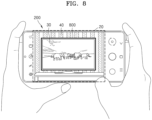
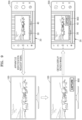
- FIG. 1 is a diagram illustrating an example where a mobile device captures content display on a display apparatus using a camera, according to the related art.
- a display apparatus 100 may display content requested by a user.
- the content displayed by the display apparatus 100 may include any of various content such as video content or game content.
- the user may want to capture a specific portion of the displayed game content.
- the user may capture a screen on which the game content is displayed by capturing an image of the display apparatus 100 using a camera of an electronic device 200.
- a screen 20 captured by the mobile device 200 may include not only an image 30 of the screen of the display apparatus 100 but also an image of an environment around the display apparatus 100, for example, an image 40 of a wall.
- the screen of the display apparatus 100 is captured in this way, the screen may be distorted or image quality may be uneven, and lighting reflected on the screen of the display apparatus 100 or even the user himself/herself may also be captured. Accordingly, it may be unsatisfactory for the user to use the obtained image of the game content in a social network service system.
- FIG. 2 is a diagram illustrating an example system for effectively capturing, by an electronic device, content displayed on a display apparatus, according to various embodiments.
- a system 10 may include the display apparatus 100 and the electronic device 200.
- the display apparatus 100 may output or display content received from various sources.
- the display apparatus 100 may include any of various types of electronic devices capable of receiving and outputting content such as, for example, and without limitation, a network TV, a smart TV, an Internet TV, a web TV, an IPTV, a PC, or the like.
- the display apparatus 100 may be referred to as a display apparatus because it receives and displays content, and may also be referred to as a content output device, an electronic device, or a computing device.
- the electronic device 200 may display content received from the display apparatus 100, and may capture or record and store a portion of the received content requested by a user.
- the electronic device 200 may include a camera to capture an image including the display apparatus 100.
- the electronic device 200 may include any of various types of electronic devices capable of executing an application and displaying content according to the user's request.
- the electronic device 200 may be referred to as an electronic device to be distinguished from the display apparatus 100, and may also be referred to as a portable device, a personal mobile device, a smart device, a computing device, or a multimedia device.
- the display apparatus 100 may display content, and may identify that the displayed content is sharable content.
- the display apparatus 100 may identify that displayed content is sharable content based on attribute information of the content.
- the display apparatus 100 may identify that the content is sharable content.
- Content with no copyright issue may include content free from a copyright issue, such as content for which copyright itself does not exists, content for which copyright has expired, or content for which copyright is limited.
- the display apparatus 100 may broadcast a signal including state information indicating that the displayed content is sharable content.
- the display apparatus 100 may broadcast a signal including state information indicating that content displayed on the display apparatus 100 is sharable content, to an unspecified number of peripheral devices through, for example, BLE communication.
- the user may operate a camera mode to capture an image displayed on a screen of the display apparatus 100 using the electronic device 200 to capture content displayed on the display apparatus 100. While the electronic device 200 operates in the camera mode, the electronic device 200 may receive a signal broadcast from the display apparatus 100.
- the electronic device 200 may transmit a content sharing request to the display apparatus 100.
- the electronic device 200 may transmit, to the display apparatus 100, a request to identify that (e.g., determine whether) the display apparatus transmitting the signal including the state information is the same as the display apparatus displaying the content, and may transmit a content sharing request to the display apparatus 100 when response information to the request is checked.
- the electronic device 200 may automatically transmit a content sharing request to the display apparatus 100 or may transmit a content sharing request to the display apparatus 100 after checking the user's intention to capture the content.
- the display apparatus 100 may transmit the content displayed on the display apparatus 100 to the electronic device 200 using content sharing technology.
- the display apparatus 100 may transmit both the video content and the graphical user interface to the electronic device 200 at once, or may filter the graphical user interface and may transmit only the video content to the electronic device 200.
- a user of the electronic device 200 may not want to capture content other than the video content, that is, content such as the graphical user interface, and thus, in this case, it is preferable to filter and transmit content such as the graphical user interface.
- the electronic device 200 may receive the content displayed on the display apparatus 100 from the display apparatus 100 using content sharing technology.
- the electronic device 200 may perform an operation of, for example, capturing or recording part of the received content, while displaying the received content on a display of the electronic device 200.
- the electronic device when the user wants to capture content displayed on the display apparatus 100 using the electronic device 200, the content displayed on the display apparatus 100 is shared with the electronic device 200, and thus, the electronic device may obtain the content displayed on the display apparatus 100 without degrading the quality of the content and may use the obtained content in various ways for personal use.
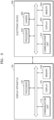
- a system may include the display apparatus 100 and the electronic device 200 that may be connected to each other through a communication network.
- the display apparatus 100 may be an apparatus for displaying an image or data according to a user's request, and may include a communication unit (e.g., including communication circuitry) 110, a display 120, a memory 130, and a processor (e.g., including processing circuitry) 140.
- a communication unit e.g., including communication circuitry
- a display 120 e.g., a liquid crystal display
- a memory 130 e.g., a memory 130
- a processor e.g., including processing circuitry
- the communication unit 110 may include various communication circuitry included in one or more modules that enable wireless communication between the display apparatus 100 and a wireless communication system or between the display apparatus 100 and a network in which another device is located. According to an embodiment of the disclosure, the communication unit 110 may perform communication with the electronic device 200 according to short-range communication technology.
- the display 120 may output an image or data processed by the display apparatus 100.
- the memory 130 may store a program for processing and control of the processor 140, and may store data input to the display apparatus 100 or output from the display apparatus 100. Also, the memory 130 may store data required to operate the display apparatus 100.
- the memory 130 may include at least one type of storage medium of a flash memory type storage unit, a hard disk type storage unit, a multimedia card micro type storage unit, a card type memory (e.g., an SD or XD memory), a random-access memory (RAM), a static random-access memory (SRAM), a read-only memory (ROM), an electrically erasable programmable read-only memory (EEPROM), a programmable read-only memory (PROM), a magnetic memory, a magnetic disk, or an optical disk.
- a flash memory type storage unit e.g., an SD or XD memory
- RAM random-access memory
- SRAM static random-access memory
- ROM read-only memory
- EEPROM electrically erasable programmable read-only memory
- PROM programmable read-only memory
- the processor 140 may include various processing circuitry and controls an overall operation of the display apparatus 100.
- the processor 140 may cause the display apparatus 100 to perform a function, by executing one or more instructions stored in the memory 130.
- the processor 140 may control operations of the display apparatus to be performed, by storing one or more instructions in an internal memory provided therein and executing the one or more instructions stored in the internal memory provided therein. That is, the processor 140 may perform a specified operation by executing at least one instruction or program stored in the internal memory provided in the processor 140 or in the memory 130.
- the processor 140 may identify that content displayed on the display 120 is sharable content, by executing one or more instructions stored in the memory 130.
- the processor 140 may control the communication unit 110 to broadcast a signal including state information indicating that the content is sharable content, by executing one or more instructions stored in the memory 130.
- the processor 140 may receive a content sharing request for sharing the content from the electronic device 200 based on the broadcast signal, by executing one or more instructions stored in the memory 130.
- the processor 140 may control the communication unit 110 to transmit at least part of the content output to the display 120 to the electronic device, in response to the content sharing request received from the electronic device 200, by executing one or more instructions stored in the memory 130.
- the processor 140 may identify that the content is the sharable content by detecting that the content is game content, by executing one or more instructions stored in the memory 130.
- the processor 140 may receive a identification request signal for identifying the display apparatus from the electronic device in response to the broadcast signal, by executing one or more instructions stored in the memory 130.
- the processor 140 may provide identification response information indicating a response together with the content, in response to the identification request signal, and may receive the content sharing request for sharing the content from the electronic device in response to the identification response information, by executing one or more instructions stored in the memory 130.
- the processor 140 may embed the identification response information in the content and may invisibly provide the identification response information, or may provide the identification response information to be visibly displayed on the content, by executing one or more instructions stored in the memory 130.
- the content sharing request may include a first type sharing request and a second type sharing request.
- the processor 140 may control both the content and the additional content output to the display to be transmitted to the electronic device, by executing one or more instructions stored in the memory 130.
- Components of the block diagram may be integrated, added, or omitted according to specifications of the display apparatus 100 that is actually implemented. For example, when necessary, two or more components may be combined into one component, or one component may be sub-divided into two or more components. Also, a function performed in each block is intended to describe embodiments of the disclosure, and its detailed operations or devices do not limit the scope of the disclosure.
- the electronic device 200 may include a communication unit (e.g., including communication circuitry) 210, a display 220, a memory 230, a camera 262, and a processor (e.g., including processing circuitry) 240.
- a communication unit e.g., including communication circuitry
- a display 220 e.g., a liquid crystal display
- a memory 230 e.g., a liquid crystal display
- a camera 262 e.g., a camera 262
- a processor e.g., including processing circuitry
- the electronic device 200 may include more elements than those illustrated in FIG. 3 , and the disclosure is not limited thereto.
- the communication unit 210 may include various communication circuitry and communicate with an external device using any of various communication technologies.
- the display 220 may output an image or data processed by the electronic device 200.
- the processor 240 may transmit, to the display apparatus, a identification request signal for identifying the display apparatus according to the detection of the object, by executing one or more instructions stored in the memory 230.
- the processor 240 may check the display apparatus by detecting identification response information from the object representing the display apparatus in response to the identification request signal, by executing one or more instructions stored in the memory 230.
- the processor 240 may control the communication unit 210 to provide a user interface for selecting photographing of the content according to the checking of the display apparatus, and as a user input that selects photographing of the content is received according to the user interface, to transmit the content sharing request for sharing the content to the display apparatus, by executing one or more instructions stored in the memory 230.
- the electronic device 200 may be any type of device that includes a processor and a memory and performs a function.
- the electronic device 200 may be a fixed or portable device.
- Examples of the electronic device 200 may include various electronic devices such as a computer (e.g., a desktop, a laptop, or a tablet), a television, a set-top box, a smartphone, a cellular phone, a game player, a music player, a video player, a medical equipment, and a home appliance.
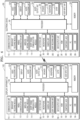
- FIG. 4 is a block diagram illustrating an example configuration of a display apparatus and an electronic device, according to various embodiments.
- FIG. 4 the same elements as those in FIG. 3 are denoted by the same reference numerals. Accordingly, when the display apparatus 100 and the electronic device 200 are described, the same description as that made with reference to FIG. 3 may not be repeated.
- the communication unit 110 may include one or more modules, each including various communication circuitry, that enable wireless communication between the display apparatus 100 and a wireless communication system or between the display apparatus 100 and a network in which another display apparatus is located.
- the communication unit 110 may include a broadcast receiving module 111, a mobile communication module 112, a wireless Internet module 113, and a short-range communication module 114.
- the communication unit 110 may be referred to as a transmitting/receiving unit.
- the broadcast receiving module 111 receives a broadcast signal and/or broadcast-related information from an external broadcast management server through a broadcast channel.
- the broadcast signal may include not only a TV broadcast signal, a radio broadcast signal, and a data broadcast signal, but also a broadcast signal in which a data broadcast signal is combined with a TV broadcast signal or a radio broadcast signal.
- the wireless Internet module 113 refers to a module for wireless Internet access, and may be internally or externally coupled to a device. Examples of wireless Internet technology may include wireless local area network (WLAN) (Wi-Fi), wireless broadband (Wibro), world interoperability for microwave access (Wimax), and high speed downlink packet access (HSDPA). Through the wireless Internet module 113, the display apparatus 100 may establish a Wi-Fi peer to peer (P2P) connection with other devices.
- WLAN wireless local area network
- Wibro wireless broadband
- Wimax world interoperability for microwave access
- HSDPA high speed downlink packet access
- P2P Wi-Fi peer to peer
- the display 120 may display an image on a screen under the control of the processor 140.
- the image displayed on the screen may be received from the communication unit 110, the input/output unit 180, and the memory 130.
- the video processing unit 125 may include various video processing circuitry and process image data to be displayed on the display 120, and may perform any of various image processing operations such as decoding, rendering, scaling, noise removal, frame rate conversion, or resolution conversion on the image data.
- the audio output unit 150 may include various audio output circuitry and output an audio included in a broadcast signal received under the control of the processor 140, an audio input through the communication unit 110 or the input/output unit 180, and an audio stored in the memory 130.
- the audio output unit 150 may include at least one of a speaker 151, a headphone output terminal 152, or a Sony/Phillips digital interface (S/PDIF) output terminal 153.
- S/PDIF Sony/Phillips digital interface
- the detection unit 160 may include various detection circuitry and detect a user's voice, image, or interaction, and may include a microphone 161, a camera unit (e.g., including a camera) 162, and a light receiving unit (e.g., including light receiving circuitry) 163.
- the microphone 161 may receive, for example, a voice uttered by the user.
- the microphone 161 may convert the received voice into an electrical signal and may output the electrical signal to the processor 140.
- the camera unit 162 may include a camera and receive an image (e.g., consecutive frames) corresponding to a motion of the user including a gesture within a camera recognition range.
- the light receiving unit 163 may include various light receiving circuitry and receives an optical signal (including a control signal) received from a remote control device.
- the light receiving unit 163 may receive an optical signal corresponding to a user input (e.g., a touch, a press, a touch gesture, a voice, or a motion) from the remote control device.
- a control signal may be extracted from the received optical signal under the control of the processor 140.
- the input/output unit 180 may include various input/output circuitry and receives a video (e.g., a moving image), an audio (e.g., voice or music), and additional information (e.g., EPG) from the outside of the display apparatus 100 under the control of the processor 140.
- the input/output unit 180 may include one of a high-definition multimedia interface (HDMI) port 181, a component jack 182, a PC port 183, and a universal serial bus (USB) port 184.
- the input/output unit 180 may include a combination of the HDMI port 841, the component jack 842, the PC port 843, and the USB port 844.
- the user input unit 190 may include various input circuitry by which the user inputs data for controlling the display apparatus 100.
- Examples of the user input unit 190 may include, but not limited to, a keypad, a dome switch, a touch pad, a jog wheel, and a jog switch.
- the memory 130 may store a program for processing and control of the processor 140, and may store data input to the display apparatus 100 or output from the display apparatus 100. Also, the memory 130 may store data required to operate the display apparatus 100.
- Programs stored in the memory 130 may be classified into a plurality of modules according to their functions.
- the processor 140 may include various processing circuitry and controls an overall operation of the display apparatus 100 and a signal flow between internal elements of the display apparatus 100, and performs a function of processing data. When there is the user's input or pre-set and stored conditions are satisfied, the processor 140 may execute an operating system (OS) and various applications stored in the memory 130.
- OS operating system
- the processor 140 may include an internal memory. In this case, at least one of data, programs, or instructions stored in the memory 130 may be stored in the internal memory (not shown) of the processor 140.
- Components of the block diagram may be integrated, added, or omitted according to specifications of the display apparatus 100 that is actually implemented. For example, when necessary, two or more components may be combined into one component, or one component may be sub-divided into two or more components. Also, a function performed in each block is intended to describe embodiments of the disclosure, and its detailed operations or devices do not limit the scope of the disclosure.
- the electronic device 200 may further include a video processing unit (e.g., including video processing circuitry) 225, an audio processing unit (e.g., including audio processing circuitry) 270, an audio output unit (e.g., including audio output circuitry) 250, a detection unit (e.g., including detection circuitry) 260, an input/output unit (e.g., including input/output circuitry) 280, and a user input unit (e.g., including user input circuitry) 290, in addition to the communication unit 210, the display 220, the memory 230, and the processor 240.
- the processor 240 may include various processing circuitry and control each element of the electronic device 200 to perform an operation.
- the communication unit 210 may include one or more modules, each of which include various communication circuitry, that enables wireless communication between the electronic device 200 and a wireless communication system or between the electronic device 200 and a network in which another display apparatus is located.
- the communication unit 210 may include a broadcast receiving module 211, a mobile communication module 212, a wireless Internet module 213, and a short-range communication module 214.
- the communication unit 210 may be referred to as a transmitting/receiving unit.
- the broadcast receiving module 211 receives a broadcast signal and/or broadcast-related information from an external broadcast management server through a broadcast channel.
- the broadcast signal may include not only a TV broadcast signal, a radio broadcast signal, and a data broadcast signal, but also a broadcast signal in which a data broadcast signal is combined with a TV broadcast signal or a radio broadcast signal.
- the mobile communication module 212 transmits and receives a wireless signal to and from at least one of a base station, an external terminal, or a server, on a mobile communication network.
- the wireless signal may include various types of data according to exchange of a voice call signal, a video call signal, or a text/multimedia message.
- the wireless Internet module 213 refers to a module for wireless Internet access, and may be internally or externally coupled to a device. Examples of wireless Internet technology may include wireless local area network (WLAN) (Wi-Fi), wireless broadband (Wibro), world interoperability for microwave access (Wimax), and high speed downlink packet access (HSDPA). Through the wireless Internet module 213, the display apparatus 100 may establish a Wi-Fi peer to peer (P2P) connection with other devices.
- WLAN wireless local area network
- Wibro wireless broadband
- Wimax world interoperability for microwave access
- HSDPA high speed downlink packet access
- P2P Wi-Fi peer to peer
- the short-range communication module 214 refers to a module for short-range communication.
- Examples of short-range communication technology may include Bluetooth, radio frequency identification (RFID), infrared data association (IrDA), ultra-wideband (UWB), and ZigBee.
- the display 220 may display an image on a screen under the control of the processor 240.
- the image displayed on the screen may be received from the communication unit 210, the input/output unit 280, and the memory 230.
- the video processing unit 225 may include various video processing circuitry and process image data to be displayed on the display 220, and may perform any of various image processing operations such as decoding, rendering, scaling, noise removal, frame rate conversion, or resolution conversion on the image data.
- the audio processing unit 270 may include various audio processing circuitry and processes audio data.
- the audio processing unit 270 may perform any of various processing operations such as decoding, amplification, or noise removal on the audio data.
- the audio output unit 250 may include various audio output circuitry and output an audio included in a broadcast signal received under the control of the processor 240, an audio input through the communication unit 210 or the input/output unit 280, and an audio stored in the memory 230.
- the audio output unit 250 may include at least one of a speaker 251, a headphone output terminal 252, or a Sony/Phillips digital interface (S/PDIF) output terminal 253.
- S/PDIF Sony/Phillips digital interface
- the detection unit 260 may include various detection circuitry and detect the user's voice, image, or interaction, and may include a microphone 261, a camera unit 262, and a light receiving unit 263.
- the microphone 261 receives a voice uttered by the user.
- the microphone 261 may convert the received voice into an electrical signal and may output the electrical signal to the processor 240.
- the camera unit 262 may receive an image (e.g., consecutive frames) corresponding to a motion of the user including a gesture within a camera recognition range.
- the light receiving unit 263 receives an optical signal (including a control signal) received from a remote control device.
- the light receiving unit 263 may receive an optical signal corresponding to a user input (e.g., a touch, a press, a touch gesture, a voice, or a motion) from the remote control device.
- a control signal may be extracted from the received optical signal under the control of the processor 240.
- the Input/output unit 280 may include various input/output circuitry and receives a video (e.g., a moving image), an audio (e.g., voice or music), and additional information (e.g., EPG) from the outside of the electronic device 200 under the control of the processor 240.
- the input/output unit 280 may include one of a high-definition multimedia interface (HDMI) port 281, a component jack 282, a PC port 283, and a USB port 284.
- HDMI high-definition multimedia interface
- the input/output unit 280 may include a combination of the HDMI port 281, the component jack 282, the PC port 283, and the USB port 284.
- the user input unit 290 may include various input circuitry by which the user inputs data for controlling the electronic device 200.
- Examples of the user input unit 990 may include, but not limited to, a keypad, a dome switch, a touch pad, a jog wheel, and a jog switch.
- the memory 230 may store a program for an operation and control of the processor 240, and may store data input to or output from the electronic device 200.
- the memory 230 may store data required to operate the electronic device 200.
- Programs stored in the memory 230 may be classified into a plurality of modules according to their functions.
- the processor 240 may include various processing circuitry and controls an overall operation of the electronic device 200 and a signal flow between internal elements of the electronic device 200, and performs a function of processing data. When there is the user's input or pre-set and stored conditions are satisfied, the processor 240 may execute an operating system (OS) and various applications stored in the memory 230.
- OS operating system
- the processor 240 may include an internal memory. In this case, at least one of data, programs, or instructions stored in the memory 230 may be stored in the internal memory (not shown) of the processor 240.
- Components of the block diagram may be integrated, added, or omitted according to specifications of the electronic device 200 that is actually implemented. For example, when necessary, two or more components may be combined into one component, or one component may be sub-divided into two or more components. Also, a function performed in each block is intended to describe embodiments of the disclosure, and its detailed operations or devices do not limit the scope of the disclosure.
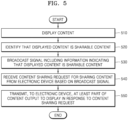
- FIG. 5 is a flowchart illustrating an example method of operating a display apparatus, according to various embodiments.
- the display apparatus 100 may display content.
- the display apparatus 100 may receive content from various content providing sources and may display the content.
- the display apparatus 100 may retrieve and display content stored in an internal memory of the display apparatus 100, may display content received from an external input device connected through a wired/wireless interface, or may display content received through the Internet or a broadcast network.
- Content displayed on the display apparatus 100 may include various types of content.
- the content may include various types of content such as moving image content, still image content, and game content.
- the display apparatus 100 may identify whether content is sharable content in order to share content, available through a content sharing operation among pieces of content displayed on the display apparatus 100, with other neighboring devices according to content sharing technology. Whether content is sharable content may be identified by checking whether the content is content free from a copyright issue. Accordingly, when it is identified whether content is sharable content, it may refer, for example, to it being identified whether the content is sharable by content sharing technology. For content free from a copyright issue, the display apparatus 100 may perform an operation of photographing or sharing according to content sharing technology. However, for content not free from a copyright issue, the display apparatus 100 may not perform an operation of photographing or sharing according to content sharing technology.
- an electronic device wishing to share the content displayed on the display apparatus 100 from among one or more electronic devices receiving the broadcast signal may transmit a content sharing request to the display apparatus 100, and the display apparatus 100 may receive the content sharing request.
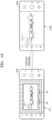
- the electronic device 200 may obtain the content displayed on a screen of the display apparatus 100 through, for example, a camera.
- the electronic device 200 may obtain an image of the screen of the display apparatus 100 through the camera by making the camera of the electronic device 200 face the screen of the display apparatus 100 using a camera application of the electronic device 200, and may display a preview image on the display of the electronic device 200.
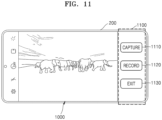
- the user interface 1100 may include a record item 1120 for recording the displayed shared content as a video for a specified period of time.
- the electronic device 200 may store content from a time when the record item 1120 is selected to a time when the record item 1120 is deselected.
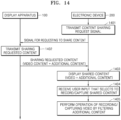
- the electronic device 200 may transmit a signal for requesting to share the content to the display apparatus 100 based on the received user input.
- the electronic device 200 may recognize the additional content in the content displayed on the electronic device 200, and may perform an operation of recording or capturing only the video content excluding the additional content.
- the display apparatus 100 does not need to perform separate additional content processing in response to a content sharing request, and additional content filtering may be performed when the electronic device 200 receives a content manipulation command from the user.
- FIG. 15 is a diagram illustrating an example where an electronic device performs filtering on additional content, according to various embodiments.
- the electronic device 200 may display the shared content 1500, that is, both the video content 1510 and the additional content 200, received from the display apparatus 100 on a display of the electronic device 200.
- the electronic device 200 may transmit a content sharing request signal to the display apparatus 100.
- Operations 701 to 709 of FIG. 7 or operations 1201 to 1211 of FIG. 12 may be performed before operation 1601.
- the display apparatus 100 may receive a content sharing request, and may transmit sharing requested content to the electronic device 200.
- the display apparatus 100 may further display various additional content in addition to video content requested to be played by a user on a display screen.
- the content additionally displayed in addition to the video content may be referred to as graphic content or additional content.
- a notification message for notifying to the user, an advertisement message, or a user interface for menu selection may be output as the additional content together with the video content.
- the notification message may include a message indicating chat text notification of a chat service or email reception, a disaster alert text message, or an alert message such as a usage environment or status of the display apparatus 100.
- the electronic device 200 may receive shared content including both the video content and the additional content, may recognize the additional content in the received content, and may only the video content excluding the recognized additional content on a display.
- the electronic device 200 may receive a user input that selects to record or capture the shared content.
- the electronic device 200 may perform an operation of recording or capturing the content displayed on the electronic device 200.
- the display apparatus 100 does not need to perform separate additional content processing in response to a content sharing request, and additional content filtering may be performed when the electronic device 200 displays shared content.
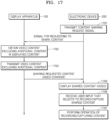
- FIG. 17 is a signal flow diagram illustrating an example method by which an electronic device receives and processes shared content, according to various embodiments.
- operation 1701 is the same as or similar to operation 1401 of FIG. 14 or operation 1601 of FIG. 16 , and thus, a repeated description may not be provided.
- the display apparatus 100 may receive a content sharing request from the electronic device 200, and may recognize at least one of additional content or video content in content displayed on a display according to the content sharing request. That is, the display apparatus 100 may obtain the video content by recognizing the video content in the content displayed on the display, or may obtain the video content by recognizing the additional content in the content displayed on the display and filtering the additional content.
- the display apparatus 100 may transmit, to the electronic device 200, the video content excluding the additional content in the content displayed on the display as shared content.
- the electronic device 200 may receive the video content excluding the additional content and may display the received video content on a display.
- the electronic device 200 may receive a user input that selects to record or capture the shared content.
- the electronic device 200 may perform an operation of recording or capturing the content displayed on the electronic device 200. According to this embodiment of the disclosure, the electronic device 200 does not need to perform separate additional content processing, and additional content filtering may be performed before the display apparatus 100 transmits shared content.
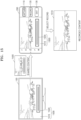
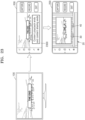
- FIG. 18 is a diagram illustrating an example where a display apparatus preforms filtering on additional content, according to various embodiments.
- the display apparatus 100 may further display the additional content 1520 in addition to the video content 1510.
- the display apparatus 100 may filter the additional content 1520 in the content 1500 including both the video content 1510 and the additional content 1520 displayed on a display, and may transmit only the video content 1510 to the electronic device 200 according to content sharing technology.
- the electronic device 200 may display the shared content, that is, the video content 1510, received from the display apparatus 100 on a display of the electronic device 200.
- the electronic device 200 When the electronic device 200 receives a command to manipulate content displayed on the display of the electronic device 200, for example, a user input that selects either the capture item 1110 or the record item 1120, the electronic device may capture or record the content displayed on the display in response to the user input.
- a command to manipulate content displayed on the display of the electronic device 200 for example, a user input that selects either the capture item 1110 or the record item 1120
- the electronic device may capture or record the content displayed on the display in response to the user input.
- FIG. 19 is a signal flow diagram illustrating an example method by which an electronic device transmits a content sharing request together with an additional content filtering request to a display apparatus, according to various embodiments.
- the electronic device 200 when the electronic device 200 transmits a content sharing request to the display apparatus 100, the electronic device 200 may selectively include additional content filtering request information in the content sharing request signal and may transmit the content sharing request.
- the display apparatus 100 receiving the content sharing request in which the additional content filtering request information is selectively included may determine whether there is the additional content filtering request information in the content sharing request signal.
- the display apparatus 100 may proceed to operation 1904.
- the display apparatus 100 may transmit content displayed on a display to the electronic device 200 without separate additional content filtering using content sharing technology.
- the display apparatus 100 may proceed to operation 1903.
- the display apparatus 100 may obtain only video content by filtering additional content in the content displayed on the display.
- only the video content excluding the additional content may be transmitted as sharing requested content to the electronic device 200.
- the electronic device 200 may receive and display the shared content.
- FIG. 20 is a signal flow diagram illustrating an example method of operating when an end command is received while an electronic device displays shared content, according to various embodiments.
- the display apparatus 100 may transmit sharing requested content to the electronic device 200 in response to a content sharing request received from the electronic device 200.
- the electronic device 200 may display content requested to be shared and received from the display apparatus 100.
- the electronic device 200 may process the shared content according to a user input. For example, when a content record command is received, the electronic device 200 may record the content, and when a content capture command is received, the electronic device 200 may capture the content.
- the electronic device 200 may receive an exit command according to a user input.
- the electronic device 200 may receive a user input that selects the exit item 1130 in the user interface 1100 as shown in FIG. 11 .
- the user may select the exit item 1130.
- the electronic device 200 may transmit a content sharing end request to the display apparatus 100. Accordingly, in operation 2006, the display apparatus 100 may stop transmitting the sharing requested content.
- the electronic device 200 may end displaying the shared content when the exit item 1130 is selected, and may return to a screen before the shared content is displayed.
- FIG. 21 is a diagram illustrating an example method by which an electronic device ends displaying shared content, according to various embodiments.
- the electronic device 200 may display shared content received from the display apparatus 100.
- the electronic device 200 may further display the user interface 1100 for controlling the shared content.
- the user may select the exit item 1130.
- the electronic device 200 may request the display apparatus 100 to stop transmitting the shared content when the exit item 1130 is selected.
- the electronic device 200 may end displaying the shared content, and may return to a screen before the shared content is displayed, that is, to a screen displaying a preview image of a screen of the display apparatus when the user performs an operation of capturing an image of the screen of the display apparatus 100 using a camera application.
- FIG. 22 is a signal flow diagram illustrating an example method operating an electronic device when playback of shared content in a display apparatus ends while an electronic device displays the shared content, according to various embodiments.
- the display apparatus 100 may transmit sharing requested content to the electronic device 200 in response to a content sharing request received from the electronic device 200.
- the electronic device 200 may display content requested to be shared and received from the display apparatus 100.
- the electronic device 200 may process/control the shared content according to a user input. For example, when a content record command is received, the electronic device 200 may record the content, and when a content capture command is received, the electronic device 200 may capture the content.
- playback of the content in the display apparatus 100 may end. Playback of the content in the display apparatus 100 may end for any of various reasons. For example, displaying of the content in the display apparatus 100 may end according to a user input that ends playing the content in the display apparatus 100. For example, playback of the content may end when a playback time of the content played in the display apparatus 100 ends.
- the display apparatus 100 may stop transmitting the content when the playback of the content ends.
- the electronic device 200 may end displaying the shared content and may return to a screen before the shared content is displayed.
- FIG. 23 is a diagram illustrating an example method by which an electronic device ends displaying shared content, according to various embodiments.
- playback of content in the display apparatus 100 may end while the electronic device 200 displays shared content received from the display apparatus 100.
- the electronic device 200 may end displaying the shared content, and may return to a screen before the shared content is displayed, that is, to a screen displaying a preview image of a screen of the display apparatus when a user performs an operation of capturing an image of the screen of the display apparatus 100 using a camera application.
- the electronic device 200 may output a message indicating that displaying of the content ends, for example, text 2300 saying ⁇ Content playback ends and content sharing ends>.
- FIG. 1 A block diagram illustrating an exemplary computing environment in accordance with the disclosure.
- FIG. 1 A block diagram illustrating an exemplary computing environment in accordance with the disclosure.
- FIG. 1 A block diagram illustrating an exemplary computing environment in accordance with the disclosure.
- FIG. 1 A block diagram illustrating an exemplary computing environment in accordance with the disclosure.
- FIG. 1 A block diagram illustrating an exemplary computing environment in accordance with the disclosure.
- FIG. 1 A block diagram illustrating an exemplary computing environment in accordance with respect to a computer.
- FIG. 1 A block diagram illustrating an exemplary computing environment in accordance with the disclosure.
- FIG. 1 A block diagram illustrating an exemplary computing environment in accordance with the disclosure.
- FIG. 1 A block diagram illustrating an exemplary computing environment in accordance with the disclosure.
- FIG. 1 A block diagram illustrating an exemplary computing environment in accordance with the disclosure.
- FIG. 1 A block diagram illustrating an exemplary computing environment in accordance with the disclosure.
- FIG. 1 A block diagram illustrating an
- Embodiments of the disclosure may be implemented as a software program including instructions stored in a non-transitory computer-readable storage medium.
- the computer is a device capable of fetching instructions stored in a storage medium and operating according to the embodiments of the disclosure based on the instructions, and may include an electronic device according to the embodiments of the disclosure.
- the computer-readable storage medium may be provided in the form of a non-transitory storage medium.
- the 'non-transitory' storage medium does not include a signal and is tangible, but may not distinguish whether data is stored semi-permanently or temporarily in the storage medium.
- control methods according to embodiments of the disclosure may be included and provided in a computer program product.
- the computer program product is a product purchasable between a seller and a purchaser.
- the computer program product may include a software program and a computer-readable storage medium in which the software program is stored.
- the computer program product may include a product in the form of a software program (e.g., a downloadable application) that is electronically distributed by a manufacturer of a device or by an electronic market (e.g., Google play store TM , or App store TM ).
- a software program e.g., a downloadable application
- an electronic market e.g., Google play store TM , or App store TM
- the storage medium may be a storage medium of a server of the manufacturer, a server of the electronic market, or a relay server that temporarily stores the software program.
- the computer program product may include a storage medium of the server or a storage medium of the device.
- the computer program product may include a storage medium of the third device.
- the computer program product may include a software program itself that is transmitted from the third party to the device, or transmitted from the serer to the device or the third device.
- one of the server, the device, and the third device may execute the computer program product to perform the method according to the embodiments of the disclosure.
- two or more of the server, the device, and the third device may execute the computer program product to perform the method according to the embodiments of the disclosure in a distributed fashion.
- the server e.g., a cloud server or an artificial intelligence (AI) server
- the server may execute the computer program product stored therein to control the device communicatively connected to the server to perform the method according to the embodiments of the disclosure.
- AI artificial intelligence
- the third device may execute the computer program product to control the device communicatively connected to the third device to perform the method according to the embodiments of the disclosure.
- the third device may download the computer program product from the server and execute the downloaded computer program product.
- the third device may execute the computer program product that is preloaded to perform the method according to the embodiments of the disclosure.
- unit used herein may be a hardware component such as a processor or a circuit, and/or a software component executed by a hardware component such as a processor.
Landscapes
- Engineering & Computer Science (AREA)
- Multimedia (AREA)
- Signal Processing (AREA)
- Theoretical Computer Science (AREA)
- Computer Networks & Wireless Communication (AREA)
- Human Computer Interaction (AREA)
- Physics & Mathematics (AREA)
- General Engineering & Computer Science (AREA)
- General Physics & Mathematics (AREA)
- Two-Way Televisions, Distribution Of Moving Picture Or The Like (AREA)
Applications Claiming Priority (2)
| Application Number | Priority Date | Filing Date | Title |
|---|---|---|---|
| KR1020220104613A KR20240026591A (ko) | 2022-08-22 | 2022-08-22 | 디스플레이 장치, 전자 장치 및 그 동작 방법 |
| PCT/KR2023/012416 WO2024043667A1 (ko) | 2022-08-22 | 2023-08-22 | 디스플레이 장치, 전자 장치 및 그 동작 방법 |
Publications (2)
| Publication Number | Publication Date |
|---|---|
| EP4518328A1 true EP4518328A1 (de) | 2025-03-05 |
| EP4518328A4 EP4518328A4 (de) | 2025-07-02 |
Family
ID=89908017
Family Applications (1)
| Application Number | Title | Priority Date | Filing Date |
|---|---|---|---|
| EP23857699.5A Pending EP4518328A4 (de) | 2022-08-22 | 2023-08-22 | Anzeigevorrichtung, elektronische vorrichtung und betriebsverfahren dafür |
Country Status (3)
| Country | Link |
|---|---|
| US (1) | US20240058708A1 (de) |
| EP (1) | EP4518328A4 (de) |
| CN (1) | CN119487858A (de) |
Family Cites Families (3)
| Publication number | Priority date | Publication date | Assignee | Title |
|---|---|---|---|---|
| US9176703B2 (en) * | 2012-06-29 | 2015-11-03 | Lg Electronics Inc. | Mobile terminal and method of controlling the same for screen capture |
| US20150381704A1 (en) * | 2014-06-27 | 2015-12-31 | Saurabh Dadu | Mechanism for file transformation and sharing across devices using camera interface |
| KR102371683B1 (ko) * | 2015-09-23 | 2022-03-08 | 삼성전자주식회사 | 컨텐츠 공유 방법 및 이를 지원하는 전자 장치 |
-
2023
- 2023-08-22 EP EP23857699.5A patent/EP4518328A4/de active Pending
- 2023-08-22 CN CN202380049740.1A patent/CN119487858A/zh active Pending
- 2023-09-15 US US18/468,164 patent/US20240058708A1/en active Pending
Also Published As
| Publication number | Publication date |
|---|---|
| US20240058708A1 (en) | 2024-02-22 |
| EP4518328A4 (de) | 2025-07-02 |
| CN119487858A (zh) | 2025-02-18 |
Similar Documents
| Publication | Publication Date | Title |
|---|---|---|
| CN111818359B (zh) | 直播互动视频的处理方法、装置、电子设备及服务器 | |
| US20230388582A1 (en) | Systems and methods for operating a set top box | |
| CN105338389B (zh) | 控制智能电视的方法和装置 | |
| CN107371044B (zh) | 电子设备互动方法、电子设备、用户终端及服务器 | |
| CN106105246B (zh) | 直播显示方法、装置及系统 | |
| CN111541930A (zh) | 直播画面的显示方法、装置、终端及存储介质 | |
| JP2016535351A (ja) | 動画情報共有方法、装置、プログラム、及び記録媒体 | |
| JP2017511553A (ja) | スクリーン投影方法、装置およびシステム、プログラム及び記録媒体 | |
| JP7161715B1 (ja) | ストリーミングデータを取り扱う方法及びサーバ | |
| KR102063463B1 (ko) | 멀티미디어 정보 재생 방법 및 시스템, 표준화 서버, 생방송 단말기 | |
| EP2995086B1 (de) | Gepaarte vorrichtungen | |
| CN106792074A (zh) | 智能电视控制方法及装置 | |
| EP2763423A1 (de) | Verfahren und Vorrichtung zur Wiedergabe von Inhalten | |
| CN112261453A (zh) | 一种传输字幕拼接图的方法、装置及存储介质 | |
| US20250386059A1 (en) | Electronic device and operating method therefor | |
| EP4518328A1 (de) | Anzeigevorrichtung, elektronische vorrichtung und betriebsverfahren dafür | |
| KR20230029438A (ko) | 디스플레이 장치 및 디스플레이 장치의 제어 방법 | |
| US12101513B2 (en) | Electronic device and method for operating same | |
| US20230262285A1 (en) | Electronic device and operation method therefor | |
| US10264330B1 (en) | Scene-by-scene plot context for cognitively impaired | |
| KR20240026591A (ko) | 디스플레이 장치, 전자 장치 및 그 동작 방법 | |
| CN114928763B (zh) | 开机状态检测处理方法、装置、电子设备及产品 | |
| KR20160102679A (ko) | 동영상 관리 서버 및 동영상 재생 장치, 이들을 이용한 등장 인물 정보 제공 방법 | |
| CN106101749A (zh) | 电视节目分享方法及装置 | |
| KR20250144766A (ko) | 전자 장치 및 그 동작 방법 |
Legal Events
| Date | Code | Title | Description |
|---|---|---|---|
| STAA | Information on the status of an ep patent application or granted ep patent |
Free format text: STATUS: THE INTERNATIONAL PUBLICATION HAS BEEN MADE |
|
| PUAI | Public reference made under article 153(3) epc to a published international application that has entered the european phase |
Free format text: ORIGINAL CODE: 0009012 |
|
| STAA | Information on the status of an ep patent application or granted ep patent |
Free format text: STATUS: REQUEST FOR EXAMINATION WAS MADE |
|
| 17P | Request for examination filed |
Effective date: 20241129 |
|
| AK | Designated contracting states |
Kind code of ref document: A1 Designated state(s): AL AT BE BG CH CY CZ DE DK EE ES FI FR GB GR HR HU IE IS IT LI LT LU LV MC ME MK MT NL NO PL PT RO RS SE SI SK SM TR |
|
| A4 | Supplementary search report drawn up and despatched |
Effective date: 20250602 |
|
| RIC1 | Information provided on ipc code assigned before grant |
Ipc: H04N 5/77 20060101ALI20250526BHEP Ipc: H04N 21/478 20110101ALI20250526BHEP Ipc: H04N 21/43 20110101ALI20250526BHEP Ipc: H04N 21/4363 20110101ALI20250526BHEP Ipc: H04N 21/436 20110101ALI20250526BHEP Ipc: H04N 21/2743 20110101AFI20250526BHEP |
|
| DAV | Request for validation of the european patent (deleted) | ||
| DAX | Request for extension of the european patent (deleted) |