EP4518380A2 - Ermöglichung von arbeitern zur verwendung einer persönlichen mobilen vorrichtung mit einer tragbaren elektronischen vorrichtung - Google Patents
Ermöglichung von arbeitern zur verwendung einer persönlichen mobilen vorrichtung mit einer tragbaren elektronischen vorrichtung Download PDFInfo
- Publication number
- EP4518380A2 EP4518380A2 EP24223047.2A EP24223047A EP4518380A2 EP 4518380 A2 EP4518380 A2 EP 4518380A2 EP 24223047 A EP24223047 A EP 24223047A EP 4518380 A2 EP4518380 A2 EP 4518380A2
- Authority
- EP
- European Patent Office
- Prior art keywords
- response
- worker
- headset
- voice
- event
- Prior art date
- Legal status (The legal status is an assumption and is not a legal conclusion. Google has not performed a legal analysis and makes no representation as to the accuracy of the status listed.)
- Pending
Links
Images




Classifications
-
- H—ELECTRICITY
- H04—ELECTRIC COMMUNICATION TECHNIQUE
- H04W—WIRELESS COMMUNICATION NETWORKS
- H04W76/00—Connection management
- H04W76/10—Connection setup
- H04W76/15—Setup of multiple wireless link connections
-
- G—PHYSICS
- G06—COMPUTING OR CALCULATING; COUNTING
- G06F—ELECTRIC DIGITAL DATA PROCESSING
- G06F3/00—Input arrangements for transferring data to be processed into a form capable of being handled by the computer; Output arrangements for transferring data from processing unit to output unit, e.g. interface arrangements
- G06F3/16—Sound input; Sound output
- G06F3/165—Management of the audio stream, e.g. setting of volume, audio stream path
-
- H—ELECTRICITY
- H04—ELECTRIC COMMUNICATION TECHNIQUE
- H04M—TELEPHONIC COMMUNICATION
- H04M1/00—Substation equipment, e.g. for use by subscribers
- H04M1/72—Mobile telephones; Cordless telephones, i.e. devices for establishing wireless links to base stations without route selection
- H04M1/724—User interfaces specially adapted for cordless or mobile telephones
- H04M1/72403—User interfaces specially adapted for cordless or mobile telephones with means for local support of applications that increase the functionality
- H04M1/72409—User interfaces specially adapted for cordless or mobile telephones with means for local support of applications that increase the functionality by interfacing with external accessories
- H04M1/72412—User interfaces specially adapted for cordless or mobile telephones with means for local support of applications that increase the functionality by interfacing with external accessories using two-way short-range wireless interfaces
-
- G—PHYSICS
- G06—COMPUTING OR CALCULATING; COUNTING
- G06F—ELECTRIC DIGITAL DATA PROCESSING
- G06F1/00—Details not covered by groups G06F3/00 - G06F13/00 and G06F21/00
- G06F1/16—Constructional details or arrangements
- G06F1/1613—Constructional details or arrangements for portable computers
- G06F1/163—Wearable computers, e.g. on a belt
-
- G—PHYSICS
- G08—SIGNALLING
- G08C—TRANSMISSION SYSTEMS FOR MEASURED VALUES, CONTROL OR SIMILAR SIGNALS
- G08C17/00—Arrangements for transmitting signals characterised by the use of a wireless electrical link
- G08C17/02—Arrangements for transmitting signals characterised by the use of a wireless electrical link using a radio link
-
- G—PHYSICS
- G10—MUSICAL INSTRUMENTS; ACOUSTICS
- G10L—SPEECH ANALYSIS TECHNIQUES OR SPEECH SYNTHESIS; SPEECH RECOGNITION; SPEECH OR VOICE PROCESSING TECHNIQUES; SPEECH OR AUDIO CODING OR DECODING
- G10L15/00—Speech recognition
- G10L15/22—Procedures used during a speech recognition process, e.g. man-machine dialogue
-
- H—ELECTRICITY
- H04—ELECTRIC COMMUNICATION TECHNIQUE
- H04M—TELEPHONIC COMMUNICATION
- H04M1/00—Substation equipment, e.g. for use by subscribers
- H04M1/60—Substation equipment, e.g. for use by subscribers including speech amplifiers
- H04M1/6033—Substation equipment, e.g. for use by subscribers including speech amplifiers for providing handsfree use or a loudspeaker mode in telephone sets
- H04M1/6041—Portable telephones adapted for handsfree use
- H04M1/6058—Portable telephones adapted for handsfree use involving the use of a headset accessory device connected to the portable telephone
- H04M1/6066—Portable telephones adapted for handsfree use involving the use of a headset accessory device connected to the portable telephone including a wireless connection
-
- H—ELECTRICITY
- H04—ELECTRIC COMMUNICATION TECHNIQUE
- H04M—TELEPHONIC COMMUNICATION
- H04M1/00—Substation equipment, e.g. for use by subscribers
- H04M1/72—Mobile telephones; Cordless telephones, i.e. devices for establishing wireless links to base stations without route selection
- H04M1/724—User interfaces specially adapted for cordless or mobile telephones
- H04M1/72484—User interfaces specially adapted for cordless or mobile telephones wherein functions are triggered by incoming communication events
-
- H—ELECTRICITY
- H04—ELECTRIC COMMUNICATION TECHNIQUE
- H04W—WIRELESS COMMUNICATION NETWORKS
- H04W4/00—Services specially adapted for wireless communication networks; Facilities therefor
- H04W4/16—Communication-related supplementary services, e.g. call-transfer or call-hold
-
- H—ELECTRICITY
- H04—ELECTRIC COMMUNICATION TECHNIQUE
- H04W—WIRELESS COMMUNICATION NETWORKS
- H04W4/00—Services specially adapted for wireless communication networks; Facilities therefor
- H04W4/80—Services using short range communication, e.g. near-field communication [NFC], radio-frequency identification [RFID] or low energy communication
-
- H—ELECTRICITY
- H04—ELECTRIC COMMUNICATION TECHNIQUE
- H04W—WIRELESS COMMUNICATION NETWORKS
- H04W76/00—Connection management
- H04W76/10—Connection setup
-
- H—ELECTRICITY
- H04—ELECTRIC COMMUNICATION TECHNIQUE
- H04W—WIRELESS COMMUNICATION NETWORKS
- H04W76/00—Connection management
- H04W76/10—Connection setup
- H04W76/14—Direct-mode setup
-
- H—ELECTRICITY
- H04—ELECTRIC COMMUNICATION TECHNIQUE
- H04W—WIRELESS COMMUNICATION NETWORKS
- H04W76/00—Connection management
- H04W76/30—Connection release
-
- H—ELECTRICITY
- H04—ELECTRIC COMMUNICATION TECHNIQUE
- H04W—WIRELESS COMMUNICATION NETWORKS
- H04W76/00—Connection management
- H04W76/30—Connection release
- H04W76/34—Selective release of ongoing connections
-
- G—PHYSICS
- G08—SIGNALLING
- G08C—TRANSMISSION SYSTEMS FOR MEASURED VALUES, CONTROL OR SIMILAR SIGNALS
- G08C2201/00—Transmission systems of control signals via wireless link
- G08C2201/90—Additional features
- G08C2201/93—Remote control using other portable devices, e.g. mobile phone, PDA, laptop
-
- G—PHYSICS
- G10—MUSICAL INSTRUMENTS; ACOUSTICS
- G10L—SPEECH ANALYSIS TECHNIQUES OR SPEECH SYNTHESIS; SPEECH RECOGNITION; SPEECH OR VOICE PROCESSING TECHNIQUES; SPEECH OR AUDIO CODING OR DECODING
- G10L15/00—Speech recognition
- G10L15/22—Procedures used during a speech recognition process, e.g. man-machine dialogue
- G10L2015/223—Execution procedure of a spoken command
-
- H—ELECTRICITY
- H04—ELECTRIC COMMUNICATION TECHNIQUE
- H04M—TELEPHONIC COMMUNICATION
- H04M2250/00—Details of telephonic subscriber devices
- H04M2250/02—Details of telephonic subscriber devices including a Bluetooth® interface
Definitions
- Example embodiments described herein relate generally to systems, methods, and apparatuses for enabling a communication between a wearable electronic device and a personal mobile device.
- Various example embodiments described herein relate to a method facilitating picking of an incoming call on a first device.
- the method includes receiving, by a processor of a wearable electronic device, a first message indicative of an initiation of an event on a first device.
- the first device is communicably coupled to a second device and the second device is communicatively coupled to the wearable electronic device.
- the method includes pausing, by the processor, a workflow operation executing on at least one of the second device and the wearable electronic device.
- the method includes receiving, by the processor, a first disconnection request from the second device.
- the first disconnection request can relate to termination of a first connection between the wearable electronic device and the second device.
- the network 120 can include, but are not limited to, a Wireless Fidelity (Wi-Fi) network, a Piconet, a Personal Area Network (PAN), Zigbee, and a Scatternet.
- Wi-Fi Wireless Fidelity
- PAN Personal Area Network
- Zigbee Zigbee
- Scatternet a short-range wireless network through which the operator devices 103-103N can communicate with each other using one or more communication protocols such as, but are not limited to, Wi-Fi, Bluetooth, Bluetooth low energy (BLE), Zigbee, Ultrasonic frequency based network, and Z-Wave.
- the operator devices 103-103N, supervisor device 106, and/or server 105 may each be implemented as a computing device, such as a personal computer and/or other networked device, such as a cellular phone, tablet computer, mobile device, point of sale terminal, inventory management terminal etc.
- a computing device such as a personal computer and/or other networked device, such as a cellular phone, tablet computer, mobile device, point of sale terminal, inventory management terminal etc.
- the depiction in FIG. 1 of "N" members is merely for illustration purposes.
- multiple or a plurality of supervisor device 106 may be connected in the system.
- any number of users, operator devices and/or supervisor devices may be included in the workflow performance system 100.
- the operator devices 103-103N can include, for example, but not limited to, an electronic device 102 (e.g. a mobile device, a PDA etc.) and a voice-controlled apparatus 101 (e.g. a headset device, a wearable head mounting device etc.).
- an operator in the work environment can use the electronic device 102 and/or the voicecontrolled apparatus 101 to perform one or more operations in the work environment.
- the operator devices 103-103N can be used by operators to execute a workflow operation that can include one or more tasks.
- the workflow operation can include a sequence or series of steps to be performed by the operator.
- one or more steps of the workflow operation can be provided in form of voice directed instructions or graphical user interface (GLTI) based instructions to the operators on the operator devices 103-103N.
- GLTI graphical user interface
- an operator can use the electronic device 102 that can be preconfigured with an application (e.g. a mobile application) to execute a workflow operation.
- an application e.g. a mobile application
- the operators can use these devices (i.e. the operator devices 103-103N, electronic devices, for example, 102) for automatic identification and data capturing of information and to improve productivity in the work environment.
- the application can be used to execute various steps of the workflow operation.
- the application can be installed on at least one of the electronic device 102 and the voice-controlled apparatus 101 and can be used to generate instructions for the operators at each step of the workflow operation. These instructions can be provided on the electronic device 102 and/or the voice-controlled apparatus 101.
- the operator devices 103-103N can be communicatively coupled over the network 120.
- the electronic device 102 can be communicatively coupled to the voice-controlled apparatus 101 via the network 120.
- the voice-controlled apparatus 101 can be communicatively coupled to the electronic device 102 over a Bluetooth communication based network.
- the electronic device 102 can exchange data and various commands with the voice-controlled apparatus 101 using the Bluetooth network.
- voice-based instructions and visual-based instructions of the task of the workflow can be provided simultaneously on the voice-controlled apparatus 101 and the electronic device 102, respectively.
- a state of execution of workflow on the electronic device 102 and/or the voice-controlled apparatus 101 can be synchronized such that, either of a voice response and/or a GLTI based input can be provided by the operator in response to the voice prompt and/or visual instruction for a same step of workflow operation to cause the workflow operation to move to a next state on both the voice-controlled apparatus 101 and the electronic device 102.
- the electronic device 102, the voice-controlled apparatus 101, the operator devices 103-103N, supervisor device 106, and/or server 105 may include one or more input devices, including but not limited to a keyboard, a number pad, a mouse, a touch-sensitive display, a navigation key, a function key, a microphone, a voice recognition component, any other mechanism capable of receiving an input from a user, or any combination thereof.
- the operator devices 103-103N, supervisor device 106, and/or server 105 may include one or more output devices, including but not limited to a display, a speaker, a haptic feedback mechanism, a printer, lights, any other mechanism capable of presenting an output to a user, or any combination thereof.
- the operator devices 103-103N, supervisor device 106, and/or server 105 may include components for monitoring and/or collecting information regarding the user or external environment in which the component is placed.
- the operator devices 103-103N, supervisor device 106, and/or server 105 may include sensors, scanners, and/or other monitoring components.
- scanners may be used to determine the presence of certain individuals or items.
- the components may include a scanner, such as an optical scanner, RFID scanner, and/or other scanner configured to read human and/or machine readable indicia physically associated with an item.
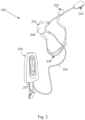
- the voice-controlled apparatus 200 can include an electronic module 204.
- some elements can be incorporated into an electronics module 204 rather than the headset 201, to provide a long battery life consistent with long work shifts.
- one or more components of circuitry 200 may be incorporated in the electronic module 204 and/or the headset 201.
- the electronics module 204 can be remotely coupled to a light-weight and comfortable headset 201 secured to a worker head via a headband 209.
- the headband 209 can be a band that is designed to fit on a worker's head, in an ear, over an ear, or otherwise designed to support the headset.
- the electronics module 204 can be used to offload several components of the headset 201 to reduce the weight of the headset 201.
- one or more of a rechargeable or long life battery, display, keypad, Bluetooth ® antenna, and printed circuit board assembly (PCBA) electronics can be included in the electronics module 204 and/or otherwise incorporated into the voice-controlled apparatus 200.
- the headset 201 can be coupled to the electronics module 204 via a communication link such as a small audio cable 206 but could instead communicate with the electronics module 204 via a wireless link.
- the headset 201 can be of a low profile.
- headset 201 can be minimalistic in appearance in some embodiments, such as a Bluetooth earpiece/headphone.
- the electronics module 204 can be configured to be used with various types of headsets 201.
- the electronics module 204 can read a unique identifier (I.D.) of the headset 201, which can be stored in the circuitry of the voice-controlled apparatus 200 (e.g., the circuitry 200) and can also be used to electronically couple the speakers and microphones to electronics module 204.
- the audio cable 206 can includes multiple conductors or communication lines for signals which can include a speaker +, speaker -, ground digital, microphone, secondary microphone, and microphone ground.
- the electronics module 204 can utilize a user configurable attachment 207, such as a plastic loop, to attach to a user. For instance, in the embodiment illustrated in FIG.
- the electronics module 204 can be mounted to a worker torso via a lapel clip and/or lanyard.
- a wireless link between the headset 201 and electronics module 204 such as a Bluetooth type of communication link
- the headset 201 can include a small lightweight battery.
- the communication link can provide wireless signals suitable for exchanging voice communications.
- voice templates for performing a speaker dependent training of a speech recognition model can be stored locally in the electronic module 204 and/or the headset 201 as part of the circuitry 200 to recognize a user's voice interactions and may convert the interaction into text based data and commands for interaction with an application running in the circuitry 200.
- the voice-controlled apparatus 200 can perform voice recognition in one embodiment utilizing the voice templates.
- first few stages of voice recognition can be performed in the voice-controlled apparatus 200, with further stages performed on a server 105.
- raw audio can be transmitted from voice-controlled apparatus 200 to the server 105 where the final stages of voice recognition can be completed.
- the voice recognition can be performed on the voice-controlled apparatus 200.
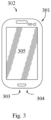
- FIG. 3 illustrates an exemplary user device according to an example embodiment.
- the user device is a handset 302 (e.g., a mobile device or tablet device).
- the handset 302 may include one or more components of circuitry as explained with regards to FIG. 1 and may include one or more of the components discussed with regards to the headset of FIG. 2 (e.g., voice templates, speech encoders, etc.).
- the handset 302 may include one or more microphones 303 and one or more speakers 304, which may be connected to a set of headphones.
- the handset 302 can also include one or more antenna.
- the microphone 303 receives speech or sound and transmits the received speech and sound to one or more components of circuitry 400 (to be shown in FIG. 4 ) in the handset 302.
- the speakers 304 receive an audio transmission from one or more components of circuitry 400 in the handset 302 and output the audio transmission in the form of speech or sound.
- the speakers 304 can also include noise cancellation.
- the handset 302 may connect with one or more other operator devices 103-103N and/or server 105 as explained with regards to FIG. 1 .
- the handset 302 may connect to a wireless headphone via a Bluetooth connection, where the wireless headphone includes a microphone and speaker for receiving speech and outputting speech or sound.
- the handset 302 can also include a user input device and output device (such as the display 305 forming an interface) to send and receive additional non-auditory information from circuitry 400, whether incorporated into the handset 302 or in other operator devices 103-103N and/or server 105.
- the display 305 of FIG. 3 may be a backlit LCD or OLED display.
- the user device also includes a sensor 301 configured to determine the location of the user device.
- the sensor 301 may include, but may not be limited to, a ground imaging sensor, an electro-optic sensor, a GPS receiver, accelerometer, and the like.
- the sensor 301 may determine a location of the user by determining GPS coordinates of the operator devices 103-103N and/or a vehicle.
- the sensor 301 may communication or interact with other components of the circuitry 400, such as processor 404, to determine whether the user is in transit, such as in transit to a desired location.
- the processor 404 may then interact with the display 305 to lock the display while the user is in transit or in motion.
- the processor 404 may also unlock the display 305 when the user is determined to not be in transit or in motion and/or has arrived at the desired location.
- One or more applications may be used to lock and unlock the display 305 depending on the status of the user and/or user device.
- the current location of the user may be obtained based on a current time and by referring to a pre-determined delivery schedule. Alternatively, a current location of the user may be obtained from a completed workflow solution task.
- the user may update an associated workflow task as "Completed” or “Delivered.”
- This information may be used by the operator devices 103-103N and/or the server 105 to identify the location of the retail store as a current location of the user.
- FIG. 3 illustrates one example of a handheld device
- various changes may be made to FIG. 3 .
- all or portions of FIG. 3 may represent or be included in other handheld devices and/or vehicle communication devices and may be used in conjunction with a headset such as the headset of FIG. 2 .
- the functional division shown in FIG. 3 is for illustration only. Various components could be combined, subdivided, or omitted and additional components could be added according to particular needs.
- the user device uses a voice-driven system, which may use speech recognition technology for communication.
- the user device may provide hands-free voice communication between the user and the user device.
- digital information may be converted to an audio format, and vice versa, to provide speech communication between the user device or an associated system and the user.
- the user device may contain digital instructions or receive digital instructions from a central computer and/or a server and may convert those instructions to audio to be heard by the user.
- the user may then reply, in a spoken language, and the audio reply or the speech input may be converted to a useable digital format to be transferred back to the central computer and/or the server.
- the user device may operate independently, in an offline mode, such that speech digitization, recognition and/or synthesis for implementing a voice-driven workflow solution may be performed by the user device itself.
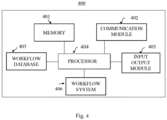
- FIG. 4 shows a schematic block diagram of circuitry 400, some or all of which may be included in, for example, the voice-controlled apparatus 101, the electronic device 102, the operator devices 103-103N, the supervisor device 106, and/or the server 105. Any of the aforementioned systems or devices may include the circuitry 400 and may be configured to, either independently or jointly with other devices in a network 120 perform the functions of the circuitry 400 described herein. As illustrated in FIG. 4 , in accordance with some example embodiments, circuitry 400 can includes various means, such as memory 401, communications module 402, processor 404, and/or input/output module 405. In some embodiments, workflow database 403 and/or workflow system 406 may also or instead be included.
- module includes hardware, software and/or firmware configured to perform one or more particular functions.
- the means of circuitry 400 as described herein may be embodied as, for example, circuitry, hardware elements (e.g., a suitably programmed processor, combinational logic circuit, and/or the like), a computer program product comprising computer-readable program instructions stored on a non-transitory computer-readable medium (e.g., memory 401) that is executable by a suitably configured processing device (e.g., processor 404), or some combination thereof.
- a suitably configured processing device e.g., processor 404
- Processor 404 may, for example, be embodied as various means including one or more microprocessors with accompanying digital signal processor(s), one or more processor(s) without an accompanying digital signal processor, one or more coprocessors, one or more multi-core processors, one or more controllers, processing circuitry, one or more computers, various other processing elements including integrated circuits such as, for example, an ASIC (application specific integrated circuit) or FPGA (field programmable gate array), or some combination thereof. Accordingly, although illustrated in FIG. 4 as a single processor, in some embodiments processor 404 comprises a plurality of processors. The plurality of processors may be embodied on a single computing device or may be distributed across a plurality of computing devices collectively configured to function as circuitry 400.
- the plurality of processors may be in operative communication with each other and may be collectively configured to perform one or more functionalities of circuitry 400 as described herein.
- processor 404 is configured to execute instructions stored in memory 401 or otherwise accessible to processor 404. These instructions, when executed by processor 404, may cause circuitry 400 to perform one or more of the functionalities of circuitry 400 as described herein.
- processor 404 may comprise an entity capable of performing operations according to embodiments of the present invention while configured accordingly.
- processor 404 when processor 404 is embodied as an ASIC, FPGA or the like, processor 404 may comprise specifically configured hardware for conducting one or more operations described herein.
- processor 404 when processor 404 is embodied as an executor of instructions, such as may be stored in memory 401, the instructions may specifically configure processor 404 to perform one or more algorithms and operations described herein, such as those discussed in connection with FIGS. 1-15 .
- Memory 401 may comprise, for example, volatile memory, non-volatile memory, or some combination thereof. Although illustrated in FIG. 4 as a single memory, memory 401 may comprise a plurality of memory components. The plurality of memory components may be embodied on a single computing device or distributed across a plurality of computing devices.
- memory 401 may comprise, for example, a hard disk, random access memory, cache memory, read only memory (ROM), erasable programmable read-only memory (EPROM) & electrically erasable programmable read-only memory (EEPROM), flash memory, magnetic cassettes, magnetic tape, magnetic disk storage or other magnetic storage devices, a compact disc read only memory (CD-ROM), digital versatile disc read only memory (DVDROM), an optical disc, circuitry configured to store information, or some combination thereof.
- Memory 401 may be configured to store information, data (including item data and/or profile data), applications, instructions, or the like for enabling circuitry 400 to carry out various functions in accordance with example embodiments of the present invention.
- memory 401 is configured to buffer input data for processing by processor 404. Additionally, or alternatively, in at least some embodiments, memory 401 is configured to store program instructions for execution by processor 404. Memory 401 may store information in the form of static and/or dynamic information. This stored information may be stored and/or used by circuitry 400 during the course of performing its functionalities.
- Communication module 402 may be embodied as any device or means embodied in circuitry, hardware, a computer program product comprising computer readable program instructions stored on a computer readable medium (e.g., memory 401) and executed by a processing device (e.g., processor 404), or a combination thereof that is configured to receive and/or transmit data from/to another device and/or network, such as, for example, a second circuitry 400 and/or the like.
- communication module 402 (like other components discussed herein) can be at least partially embodied as or otherwise controlled by processor 404.
- communication module 402 may be in communication with processor 404, such as via a bus.
- Communication module 402 may include, for example, an antenna, a transmitter, a receiver, a transceiver, network interface card and/or supporting hardware and/or firmware/software for enabling communications with another computing device. Communication module 402 may be configured to receive and/or transmit any data that may be stored by memory 401 using any protocol that may be used for communications between computing devices. Communication module 402 may additionally or alternatively be in communication with the memory 401, input/output module 405 and/or any other component of circuitry 400, such as via a bus.
- Input/output module 405 may be in communication with processor 404 to receive an indication of a user input and/or to provide an audible, visual, mechanical, or other output to a user (e.g., employee and/or customer). Some example visual outputs that may be provided to a user by circuitry 400 are discussed in connection with FIGS. 1-15 .
- input/output module 405 may include support, for example, for a keyboard, a mouse, a joystick, a display, a touch screen display, a microphone, a speaker, a RFID reader, barcode reader, biometric scanner, and/or other input/output mechanisms.
- circuitry 400 is embodied as a server or database
- aspects of input/output module 405 may be reduced as compared to embodiments where circuitry 400 is implemented as an end-user machine (e.g., remote worker device and/or employee device) or other type of device designed for complex user interactions. In some embodiments (like other components discussed herein), input/output module 405 may even be eliminated from circuitry 400.
- circuitry 400 is embodied as a server or database
- at least some aspects of input/output module 405 may be embodied on an apparatus used by a user that is in communication with circuitry 400.
- Input/output module 405 may be in communication with the memory 401, communication module 402, and/or any other component(s), such as via a bus.
- One or more than one input/output module and/or another component can be included in circuitry 400.
- the workflow database 403 and the workflow system 406 may also or instead be included and configured to perform the functionality discussed herein related to workflow and/or identifying performance status associated with an execution of the workflow.
- some or all of the functionality of generating and/or information for workflow and/or performance status associated with execution of the workflow may be performed by processor 404.
- the example processes and algorithms discussed herein can be performed by at least one processor 404, workflow database 403, and/or workflow system 406.
- non-transitory computer readable media can be configured to store firmware, one or more application programs, and/or other software, which include instructions and other computerreadable program code portions that can be executed to control each processor (e.g., processor 404, workflow database 403, and/or workflow system 406) of the components of circuitry 400 to implement various operations, including the examples shown above.
- processor e.g., processor 404, workflow database 403, and/or workflow system 406
- a series of computerreadable program code portions are embodied in one or more computer program goods and can be used, with a computing device, server, and/or other programmable apparatus, to produce machineimplemented processes.
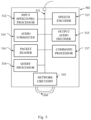
- FIG. 5 illustrates an exemplary block diagram of an electronics module 502 in accordance with some embodiments of the present disclosure.
- the components illustrated in FIG. 5 may be in addition to one or more components of the circuitry 400 shown in FIG. 4 , which may be part of the electronics module 502.
- one or more of the components illustrated in FIG. 5 may be included in the electronics module 502 and/or other parts of the voice-controlled apparatus (200, 101), the electronic device 102, operator devices 103-103N, supervisor device 106, and/or server 105.
- the electronics module 502 can include an enclosure, such as plastic case, with a connector that can mate with a complimentary mating connector (not shown) on audio cable 206 (as shown in FIG. 2 ).
- An internal path 511 can be used to communicate between multiple components within the electronics module 502 enclosure.
- the electronics module 502 can utilize a user-configurable attachment feature 509, such as a plastic loop and/or other suitable features, for at least partially facilitating attachment of the electronics module to the worker.
- an input speech pre-processor (ISPP) 512 can convert input speech into pre-processed speech feature data.
- ISPP input speech pre-processor
- an input speech encoder (ISENC) 513 can encode input speech for transmission to one or more other parts of circuitry 400 for reconstruction and playback and/or recording.
- a raw input audio sample packet formatter 514 can transmit the raw input audio to one or more other parts of circuitry 400 using an application-layer protocol to facilitate communications between the voice terminal and headset 201 as the transport mechanism.
- the formatter 514 can be abstracted to a codec type referred to as Input Audio Sample Data (IASD).
- IASD Input Audio Sample Data
- An output audio decoder (OADEC) 515 decodes encoded output speech and audio for playback in the headset 201.
- a raw output audio sample packet reader 516 can operates to receive raw audio packets from one or more other parts of circuitry 400 using the transport mechanism.
- this formatter 514 can be abstracted to a codec type referred to as Output Audio Sample Data (OASD).
- OASD Output Audio Sample Data
- a command processor 517 can adjusts the headset hardware (e.g., input hardware gain level) under control of one or more other parts of circuitry 400.
- a query processor 518 can allow one or more other parts of circuitry 400 to retrieve information regarding headset operational status and configuration.
- path 511 can also be coupled to network circuitry 519 to communicate via wired or wireless protocol with one or more other parts of circuitry 400.
- the ISPP 512, ISENC 513, and raw input audio formatter 514 can be sources of communication packets used in the transport mechanism; the OADEC 515 and raw output audio reader 516 can be packet sinks.
- the command and query processors 517, 518 are both packet sinks as well as sources (in general they generate acknowledgement or response packets).
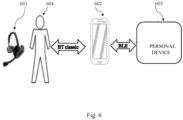
- FIG. 6 illustrates an example scenario of communication between a voice-controlled apparatus 601 (e.g. a headset device, a wearable head mounting device etc.) to be used by an operator 604, an electronic device 602 (e.g. a mobile device, a PDA etc.) and a personal device 603 (e.g. a personal mobile phone) carried by the operator 604.
- the voice-controlled apparatus 601, the electronic device 602 and the personal device 603 can be communicatively coupled to each other via a Bluetooth classic connection or BLE (Bluetooth Low Energy) protocol.
- BLE Bluetooth Low Energy
- the voice-controlled apparatus 601 can communicate with the electronic device 602 via a Bluetooth classic connection and the electronic device can communicate with the personal device 603 via a BLE protocol.
- the electronic device 602 and the personal device 603 can communicate to each other over BLE, via GATT services.
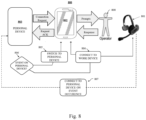
- a voice dialogue can include multiple voice prompts that can be provided by the voice-controlled apparatus 801 (referred herein as, Talkman) to the operator 808 for performing steps of the workflow operation.
- the operator 808 can perform a task required at respective step and provide a voice response to the voice prompts.
- the voice response can be indicative of a performance or non-performance of the task instructed in the voice prompt.
- the voice response can indicate any of, a confirmation, a data value, etc. indicative of performing of that step of the task of the workflow.
- the personal device 803 can send out connection request signal to the electronic device 802 and receive request acknowledgment (ACK) from the electronic device 802.
- ACK request acknowledgment
- the voice-controlled apparatus 801 can connect to the electronic device 802 (referred herein as, a work device) at step 804, for performing tasks in a workflow operation.
- the connection of the voice-controlled apparatus 801 can switch from the electronic device 802 to the personal device 803, upon occurrence of an event on personal device 803 (at step 806).
- the voice controllable apparatus 801 can now establish a connection with the personal device while the connection with the electronic device 802 is discontinued.
- the connection between the voice controllable apparatus 801 and the electronic device 802 can be discontinued temporarily upon occurrence of the event on the personal device 803.
- the event may comprise an incoming call, a text message or a notification in the personal device 803.
- the operator 808 during the workflow execution can pick up the incoming call on the personal device 803 via the voice-controlled apparatus 801.
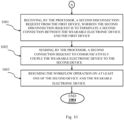
- FIGS. 9-10 illustrates a flow diagram representing a method 900 for facilitating the worker to use the personal device while executing a workflow operation, in accordance with an example embodiment.
- a wearable electronic device e.g. the voicecontrolled apparatus 801 can receive a first message indicative of an initiation of an event on a first device.
- an event referred herein can represent an incoming call, a text message or a notification received on the first device.
- the first device can communicate with a second device, via a BLE protocol, as described earlier in FIG. 6 .
- the second device can communicate with the wearable electronic device, via a Bluetooth classic connection.
- the wearable electronic device can pause the workflow operation executing on at least one of the second device and the wearable electronic device.
- the workflow operation can be an item picking operation for picking one or more items, from a storage location in the warehouse.
- the wearable electronic device can receive a first disconnection request from the second device.
- the first disconnection request can relate to termination of a first connection between the wearable electronic device with the second device.
- the method at step 905 illustrates that in response to receiving the first disconnection request, the wearable electronic device can send a first connection request to the first device to communicatively couple the wearable electronic device with the first device.
- the wearable electronic device can receive a second message indicative of completion of the event on the first device.
- the completion of the event on the first device can represent incoming call end STATE, i.e. may indicate that the incoming call on the first device ended.
- the processing control can be then transferred to step 1001, as shown in FIG. 10 .
- the wearable electronic device can receive a second disconnection request from the first device.
- the second disconnection request can relate to termination of a second connection between the wearable electronic device and the first device.
- the wearable electronic device can send a second connection request to communicatively couple the wearable electronic device to the second device.
- the wearable electronic device can resume the workflow operation on at least one of the second device and the wearable electronic device.
- the method 900 stops at step 1004.
- FIGS. 11-13 illustrate a flow or block diagram of a method of workflow operations performed by the system 800.
- the process starts at block 1100.
- a work device for example, Dolphin CT50 Handheld computer
- the work device can have a persistent connection with the personal device of the worker.
- the connection can comprise a continuous transmission of packets between the work device and the personal device.
- the event can include, for example, an incoming call, a text message or a notification in the personal device.
- the personal device of the worker can have an application (for example, Vocollect BLE app) stored in a memory of a processor that could facilitate a communication between the work device and the personal device.
- an application for example, Vocollect BLE app
- the application stored in the processor of the personal device can send instructions to the work device over a BLE protocol, as already discussed in FIG 6 .
- the work device can receive the instruction from the personal device indicating occurrence of the incoming call on the personal device.
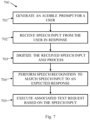
- the work device can further notify the worker via a voice prompt that an event has occurred on the personal device.
- the voice prompt can be received by an input/output module 405 of a user device 200, as shown in FIGS. 2 and 4 .
- the voice prompt can be received by a speaker 202 of a user device 200.
- the notification to the worker may not be limited to voice but can comprise a visual notification on a display of the work device.
- the work device waits till it receives a verbal response from the worker.
- the verbal response can include "Accept", "Reject", to accept or reject the incoming call on the personal device.
- the verbal response can be provided via a microphone (for example, microphone 203 shown in FIG. 2 ) of the user device 200.
- the verbal response can also include pre-determined phrases, and/or may include any speech signal input which can be parsed and recognized by a speech circuitry.
- processing control can be transferred from block 1105 to block 1106. In case, no response is received within the predetermined timeframe, the processing control can be transferred back to block 1104.
- the system 800 described in FIG. 8 can check if the verbal response received from the worker is appropriate or expected.
- the verbal response can include phrases like "Accept” or "Reject” which may be parsed and recognized by the speech circuitry.
- the processing control can be transferred to block 1201, or otherwise transferred to block 1104 if the verbal response received is not the expected one.
- an appropriate verbal response associated with block 1201 can be a verbal response from the worker comprising one or more of the words "Accept,” "Okay,” and/or any other suitable verbal verification for indicating that the worker is ready to attend the incoming call. In other words, the worker may want to accept the incoming call.
- worker's break period can be initiated, at block 1202.
- the worker in order to indicate the beginning of a break activity the worker can also report through the headset using standard break vocabulary such as "take a break” followed by the type of break the worker wishes to take (e.g., lunch break, coffee break, phone call break, etc.). Determining worker idle duration around reported break activities can be useful information for a supervisor because workers may generally cease or slow work activity before reporting break activities and/or after reporting returning from break activities.
- processing control can be transferred to block 1203 to resume the workflow operation.
- the verbal response from the worker comprises phrase "Reject" indicating that the worker is not ready to take the call, the workflow can resume from paused state.
- the work device at block 1204 can release a connection, such as Bluetooth classic connection, with the headset (for example, 601), as shown in FIG 6 .
- a connection such as Bluetooth classic connection
- the headset for example, 601
- the headset can establish a connection with the personal device 803.
- the connection of the headset 801 may switch from the work device 802 to the personal device 803.
- the worker 808 can pick up the incoming call in the personal device 803 via the headset 801 without a need to terminate the workflow execution.
- the work device waits till it receives a verbal command from the worker.
- the verbal command can include phrases like "End call” or "Vocollect end call", to end the incoming call.
- the verbal command can be provided via a microphone (for example, microphone 203 shown in FIG. 2 ) of the user device 200.
- the verbal response can include pre-determined phrases, and/or may include any speech signal input which can be parsed and recognized by a speech circuitry.
- processing control can be transferred from block 1206 to block 1301.
- the processing control can be transferred to block 1205.
- the personal device can release a connection, such as Bluetooth classic connection, with the headset (for example, 601), as shown in FIG 6 .
- the headset In response to releasing the connection with the personal device, the headset re-establishes the connection with the work device, at block 1302.
- the connection of the headset 801 can switch from the personal device 803 to the work device 802.
- Processing control can be transferred from block 1302 to block 1203, thereby, resuming the workflow operation.
- the break period of the worker can be terminated by the system.
- each of the numerous verbal prompts can comprise the speaker 202 converting or transforming an audio signal, which is provided by respective features of the system 200, to a voice-sound for being received by the worker; and the receipt of each of the verbal responses (e.g., as a precursor to blocks 1105, 1201 and/or 1205) can comprise the microphone 203 converting or transforming a voice sound, which is provided by the worker, to an electrical signal that is provided to respective features of the system 200.
- FIG. 14 illustrates a mobile handset
- other devices can be any electronic device as described in FIG. 1
- the mobile handset is merely illustrated to provide context for the embodiments of the various embodiments described herein.
- the following discussion is intended to provide a brief, general description of an example of a suitable environment in which the various embodiments can be implemented. While the description includes a general context of computer-executable instructions embodied on a machine-readable storage medium, those skilled in the art will recognize that the various embodiments also can be implemented in combination with other program modules and/or as a combination of hardware and software.
- applications can include routines, programs, components, data structures, etc., described herein in accordance with example embodiments, that can perform particular tasks or implement particular abstract data types.
- applications e.g., program modules
- routines, programs, components, data structures, etc. described herein in accordance with example embodiments, that can perform particular tasks or implement particular abstract data types.
- systems including single-processor or multiprocessor systems, minicomputers, mainframe computers, as well as personal computers, hand-held computing devices, microprocessor-based or programmable consumer electronics, and the like, each of which can be operatively coupled to one or more associated devices.
- Computer storage media can include, but is not limited to, RAM, ROM, EEPROM, flash memory or other memory technology, CD ROM, digital video disk (DVD) or other optical disk storage, magnetic cassettes, magnetic tape, magnetic disk storage or other magnetic storage devices, or any other medium which can be used to store the desired information and which can be accessed by the computer.
- a communication media typically embodies computer-readable instructions, data structures, program modules or other data in a modulated data signal such as a carrier wave or other transport mechanism and includes any information delivery media.
- modulated data signal can correspond to a signal that has one or more of its characteristics set or changed in such a manner as to encode information in the signal.
- communication media includes wired media such as a wired network or direct-wired connection, and wireless media such as acoustic, RF, infrared and other wireless media. Combinations of the any of the above may also be included within the scope of computer-readable media.
- the mobile handset can comprise a processor 1424 for controlling and processing all onboard operations and functions.
- a memory 1426 interfaces to the processor 1424 for storage of data and one or more applications 1414 (e.g., a video player software, user feedback component software, etc.).
- applications 1414 can include voice recognition of predetermined voice commands that facilitate initiation of the user feedback signals.
- the applications 1414 can be stored in the memory 1426 and/or in a firmware 1402 and executed by the processor 1424 from either or both the memory 1426 or/and the firmware 1402.
- the firmware 1402 can also store startup code for execution in initializing the mobile handset.
- Audio capabilities are provided with an audio I/O component 1428, which can include a speaker for the output of audio signals related to, for example, indication that the user pressed the proper key or key combination to initiate the user feedback signal.
- the audio I/O component 1428 also facilitates the input of audio signals through a microphone to record data and/or telephony voice data, and for inputting voice signals for telephone conversations.
- the mobile handset can also comprise a slot interface 1430 for accommodating a SIC (Subscriber Identity Component) in the form factor of a card Subscriber Identity Module (SIM) or universal SIM 1432 and interfacing the SIM card 1432 with the processor 1424.
- SIM Subscriber Identity Module
- SIM card 1432 can be manufactured into the mobile handset and updated by downloading data and software.
- the mobile handset can also process IP data traffic through the communication component 1434 to accommodate IP traffic from an IP network such as, for example, the Internet, a corporate intranet, a home network, a person area network, etc., through an ISP or broadband cable provider.
- IP network such as, for example, the Internet, a corporate intranet, a home network, a person area network, etc.
- VoIP traffic can be utilized by the mobile handset and IP-based multimedia content can be received in either an encoded or decoded format.
- a video processing component 1408 (e.g., a camera) can be provided for decoding encoded multimedia content.
- the video processing component 1408 can aid in facilitating the generation, editing and sharing of video quotes.
- the mobile handset also includes a power source 1442 in the form of batteries and/or an AC power subsystem, which power source 1442 can interface to an external power system or charging equipment (not shown) by a power I/O component 1444.
- the mobile handset can also comprise a video component 1404 for processing video content received and, for recording and transmitting video content.
- the video component 1404 can facilitate the generation, editing and sharing of video quotes.
- a location tracking component 1440 facilitates geographically locating the mobile handset. As described hereinabove, this can occur when the user initiates the feedback signal automatically or manually.
- a user input component 1412 facilitates the user initiating the quality feedback signal.
- the user input component 1412 can also facilitate the generation, editing and sharing of video quotes.
- the user input component 1412 can include such conventional input device technologies such as a keypad, keyboard, mouse, stylus pen, and/or touch screen, for example.
- a hysteresis component 1420 can facilitate the analysis and processing of hysteresis data, which is utilized to determine when to associate with the access point.
- a software trigger component 1418 can be provided that facilitates triggering of the hysteresis component 1420 when the Wi-Fi transceiver 1438 detects the beacon of the access point.
- a SIP client 1422 enables the mobile handset to support SIP protocols and register the subscriber with the SIP registrar server.
- the applications 1414 can also include a client 1416 that provides at least the capability of discovery, play and store of multimedia content, for example, music.
- the mobile handset as indicated above related to the communications component 1434, includes an indoor network radio transceiver 1438 (e.g., Wi-Fi transceiver). This function can support the indoor radio link, such as IEEE 802.11, for the dualmode GSM handset.
- the mobile handset can accommodate at least satellite radio services through a handset that can combine wireless voice and digital radio chipsets into a single handheld device.
- FIG. 15 illustrates a schematic view of another example of an electronic device 1500, in accordance with another example embodiment described herein.
- the electronic device 1500 illustrated in FIG. 15 can correspond to the electronic device 102, the operator devices 103-103N, the supervisor device 106, and/or the server 105, as described in reference to FIGS. 1-14 .
- the electronic device 1500 can provide networking and communication capabilities between a wired or wireless communication network and a server and/or communication device.
- FIG. 15 and the following discussion are intended to provide a brief, general description of a suitable computing environment in which the various aspects of the embodiments can be implemented to facilitate the establishment of a transaction between an entity and a third party. While the description above is in the general context of computer-executable instructions that can run on one or more computers, those skilled in the art will recognize that the various embodiments also can be implemented in combination with other program modules and/or as a combination of hardware and software.
- program modules include routines, programs, components, data structures, etc., that perform particular tasks or implement particular abstract data types.
- inventive methods can be practiced with other computer system configurations, including single-processor or multiprocessor computer systems, minicomputers, mainframe computers, as well as personal computers, handheld computing devices, microprocessor-based or programmable consumer electronics, and the like, each of which can be operatively coupled to one or more associated devices.
- computing devices typically include a variety of media, which can include computer-readable storage media or communications media, which two terms are used herein differently from one another as follows.
- a computer-readable storage media can be any available storage media that can be accessed by the computer and includes both volatile and nonvolatile media, removable and non-removable media.
- computer-readable storage media can be implemented in connection with any method or technology for storage of information such as computer-readable instructions, program modules, structured data, or unstructured data.
- Computer-readable storage media can include, but are not limited to, RAM, ROM, EEPROM, flash memory or other memory technology, CD ROM, digital versatile disk (DVD) or other optical disk storage, magnetic cassettes, magnetic tape, magnetic disk storage or other magnetic storage devices, or other tangible and/or non-transitory media which can be used to store desired information.
- Computer-readable storage media can be accessed by one or more local or remote computing devices, e.g., via access requests, queries or other data retrieval protocols, for a variety of operations with respect to the information stored by the medium.
- communications media can embody computer-readable instructions, data structures, program modules or other structured or unstructured data in a data signal such as a modulated data signal, e.g., a carrier wave or other transport mechanism, and includes any information delivery or transport media.
- modulated data signal or signals refers to a signal that has one or more of its characteristics set or changed in such a manner as to encode information in one or more signals.
- communication media include wired media, such as a wired network or direct-wired connection, and wireless media such as acoustic, RF, infrared and other wireless media.
- implementing various aspects described herein with regards to the end-user device can comprise the electronic device (or referred as computing device 1500) comprising a processing unit 1502, a system memory 1503 and a system bus 1501.
- the system bus 1501 can be configured to couple system components including, but not limited to, the system memory 1503 to the processing unit 1502.
- the processing unit 1502 can be any of various commercially available processors. To this end, in some examples, dual microprocessors and other multi-processor architectures can also be employed as the processing unit 1502.
- the system bus 1501 can be any of several types of bus structure that can further interconnect to a memory bus (with or without a memory controller), a peripheral bus, and a local bus using any of a variety of commercially available bus architectures.
- the system memory 1503 can comprise, read-only memory (ROM) 1505 and random-access memory (RAM) 1504.
- ROM read-only memory
- RAM random-access memory
- BIOS basic input/output system
- BIOS basic input/output system
- the RAM 1504 can also comprise a high-speed RAM such as static RAM for caching data.
- the computing device 1500 can further comprise an internal hard disk drive (HDD) 1512 (e.g., EIDE, SATA), which internal hard disk drive 1512 can also be configured for external use in a suitable chassis (not shown), a magnetic floppy disk drive (FDD) 1513, (e.g., to read from or write to a removable diskette 1514) and an optical disk drive 1515, (e.g., reading a CD-ROM disk or, to read from or write to other high capacity optical media such as the DVD).
- HDD internal hard disk drive
- FDD magnetic floppy disk drive
- optical disk drive 1515 e.g., reading a CD-ROM disk or, to read from or write to other high capacity optical media such as the DVD.
- the hard disk drive 1512, magnetic disk drive 1513 and optical disk drive 1515 can be connected to the system bus 1501 by a hard disk drive interface 1506, a magnetic disk drive interface 1507 and an optical drive interface 1508, respectively.
- the interface 1506 for external drive implementations can comprise, at least one or both of Universal Serial Bus (USB) and IEEE 1394 interface technologies. Other external drive connection technologies are within contemplation of the subject embodiments.
- the logical connections depicted include wired/wireless connectivity to a local area network (LAN) 1530 and/or larger networks, e.g., a wide area network (WAN) 1529.
- LAN local area network
- WAN wide area network
- Such LAN and WAN networking environments are commonplace in offices and companies, and facilitate enterprise-wide computer networks, such as intranets, all of which may connect to a global communications network, e.g., the Internet.
- the computing device 1500 when used in a LAN networking environment, can be connected to the LAN 1530 through a wired and/or wireless communication network interface or adapter 1511.
- the adapter 1511 may facilitate wired or wireless communication to the LAN 1530, which may also include a wireless access point disposed thereon for communicating with the wireless adapter 1511.
- the computing device 1500 when used in a WAN networking environment, can include a modem 1518, or can be connected to a communications server on the WAN 1529 or has other means for establishing communications over the WAN 1529, such as by way of the Internet.
- the modem 1518 which can be internal or external and a wired or wireless device, is connected to the system bus 1501 through the input device interface 1510.
- program modules depicted relative to the computer, or portions thereof can be stored in the remote memory/storage device 1528. It will be appreciated that the network connections shown are exemplary and other means of establishing a communications link between the computers can be used.
- the computing device 1500 can be operable to communicate with any wireless devices or entities operatively disposed in wireless communication, e.g., a printer, scanner, desktop and/or portable computer, portable data assistant, communications satellite, any piece of equipment or location associated with a wirelessly detectable tag (e.g., a kiosk, news stand, restroom), and telephone.
- any wireless devices or entities operatively disposed in wireless communication e.g., a printer, scanner, desktop and/or portable computer, portable data assistant, communications satellite, any piece of equipment or location associated with a wirelessly detectable tag (e.g., a kiosk, news stand, restroom), and telephone.
- This can further comprise at least Wi-Fi and Bluetooth TM wireless technologies.
- the communication can be a predefined structure as with a conventional network or simply an ad hoc communication between at least two devices.
- Wi-Fi Wireless Fidelity
- Wi-Fi Wireless Fidelity
- Wi-Fi is a wireless technology similar to that used in a cell phone that enables such devices, e.g., computers, to send and receive data indoors and out; anywhere within the range of a base station.
- Wi-Fi networks use radio technologies called IEEE802.11 (a, b, g, n, etc.) to provide secure, reliable, fast wireless connectivity.
- a Wi-Fi network can be used to connect computers or the plurality of electronic devices to each other, to the Internet, and to wired networks (which use IEEE802.3 or Ethernet).
- Wi-Fi networks operate in the unlicensed 2.4 and 5 GHz radio bands, at an 11 Mbps (802. 11b) or 54 Mbps (802. 11a) data rate, for example, or with products that contain both bands (dual band), so the networks can provide real-world performance similar to the basic "9BaseT" wired Ethernet networks used in many offices.
- a component may be, but is not limited to being, a process running on a processor, a processor, an object, an executable, a thread of execution, a program, and/or a computer.
- a component may be, but is not limited to being, a process running on a processor, a processor, an object, an executable, a thread of execution, a program, and/or a computer.
- an application running on a server and the server can be a component.
- One or more components may reside within a process and/or thread of execution and a component may be localized on one computer and/or distributed between two or more computers.
- components also can execute from various computer readable storage media having various data structures stored thereon.
- the components may communicate via local and/or remote processes such as in accordance with a signal having one or more data packets (e.g., data from one component interacting with another component in a local system, distributed system, and/or across a network such as the Internet with other systems via the signal).
- a component can be an apparatus with specific functionality provided by mechanical parts operated by electric or electronic circuitry that is operated by software or firmware application(s) executed by a processor, wherein the processor can be internal or external to the apparatus and executes at least a part of the software or firmware application.
- a component can be an apparatus that provides specific functionality through electronic components without mechanical parts, the electronic components can comprise a processor therein to execute software or firmware that confers at least in part the functionality of the electronic components.
- An interface can comprise input/output (I/O) components as well as associated processor, application, and/or API components.
- the disclosed subject matter may be implemented as a method, apparatus, or article of manufacture using standard programming and/or engineering techniques to produce software, firmware, hardware, or any combination thereof to control a computer to implement the disclosed subject matter.
- article of manufacture as used herein is intended to encompass a computer program accessible from any computer-readable device, computer-readable carrier, or computer-readable media.
- computer-readable media can include, but are not limited to, a magnetic storage device, e.g., hard disk; floppy disk; magnetic strip(s); an optical disk (e.g., compact disk (CD), a digital video disc (DVD), a Blu-ray Disc TM (BD)); a smart card; a flash memory device (e.g., card, stick, key drive); and/or a virtual device that emulates a storage device and/or any of the above computer-readable media.
- a magnetic storage device e.g., hard disk; floppy disk; magnetic strip(s); an optical disk (e.g., compact disk (CD), a digital video disc (DVD), a Blu-ray Disc TM (BD)); a smart card; a flash memory device (e.g., card, stick, key drive); and/or a virtual device that emulates a storage device and/or any of the above computer-readable media.
- a magnetic storage device e.g., hard disk; floppy disk
- processor can refer to substantially any computing processing unit or device comprising, but not limited to comprising, single-core processors; single-processors with software multithread execution capability; multi-core processors; multi-core processors with software multithread execution capability; multi-core processors with hardware multithread technology; parallel platforms; and parallel platforms with distributed shared memory.
- a processor can refer to an integrated circuit, an application specific integrated circuit (ASIC), a digital signal processor (DSP), a field programmable gate array (FPGA), a programmable logic controller (PLC), a complex programmable logic device (CPLD), a discrete gate or transistor logic, discrete hardware components, or any combination thereof designed to perform the functions described herein.
- ASIC application specific integrated circuit
- DSP digital signal processor
- FPGA field programmable gate array
- PLC programmable logic controller
- CPLD complex programmable logic device
- processors can exploit nano-scale architectures such as, but not limited to, molecular and quantumdot based transistors, switches and gates
- memory components described herein can be either volatile memory or nonvolatile memory or can comprise both volatile and nonvolatile memory.
- memory components or memory elements can be removable or stationary.
- memory can be internal or external to a device or component, or removable or stationary.
- Memory can comprise various types of media that are readable by a computer, such as hard-disc drives, zip drives, magnetic cassettes, flash memory cards or other types of memory cards, cartridges, or the like.
- nonvolatile memory can comprise read only memory (ROM), programmable ROM (PROM), electrically programmable ROM (EPROM), electrically erasable ROM (EEPROM), or flash memory.
- Volatile memory can comprise random access memory (RAM), which acts as external cache memory.
- RAM is available in many forms such as synchronous RAM (SRAM), dynamic RAM (DRAM), synchronous DRAM (SDRAM), double data rate SDRAM (DDR SDRAM), enhanced SDRAM (ESDRAM), Synchlink DRAM (SLDRAM), and direct Rambus RAM (DRRAM).
- SRAM synchronous RAM
- DRAM dynamic RAM
- SDRAM synchronous DRAM
- DDR SDRAM double data rate SDRAM
- ESDRAM enhanced SDRAM
- SLDRAM Synchlink DRAM
- DRRAM direct Rambus RAM
- the terms (including a reference to a "means") used to describe such components are intended to correspond, unless otherwise indicated, to any component which performs the specified function of the described component (e.g., a functional equivalent), even though not structurally equivalent to the disclosed structure, which performs the function in the herein illustrated example aspects of the embodiments.
- the embodiments comprise a system as well as a computer-readable medium having computer-executable instructions for performing the acts and/or events of the various methods.
- Computer-readable storage media can be any available storage media that can be accessed by the computer and comprises both volatile and nonvolatile media, removable and non-removable media.
- Computer-readable storage media can be implemented in connection with any method or technology for storage of information such as computer-readable instructions, program modules, structured data, or unstructured data.
- Computer-readable storage media can comprise, but are not limited to, RAM, ROM, EEPROM, flash memory or other memory technology, CD ROM, digital versatile disk (DVD) or other optical disk storage, magnetic cassettes, magnetic tape, magnetic disk storage or other magnetic storage devices, or other tangible and/or non-transitory media which can be used to store desired information.
- Computer-readable storage media can be accessed by one or more local or remote computing devices, e.g., via access requests, queries or other data retrieval protocols, for a variety of operations with respect to the information stored by the medium.
- communications media typically embody computer-readable instructions, data structures, program modules or other structured or unstructured data in a data signal such as a modulated data signal, e.g., a carrier wave or other transport mechanism, and comprises any information delivery or transport media.
- modulated data signal or signals refers to a signal that has one or more of its characteristics set or changed in such a manner as to encode information in one or more signals.
- communications media comprise wired media, such as a wired network or direct-wired connection, and wireless media such as acoustic, RF, infrared and other wireless media
- terms like "user equipment,” “user device,” “mobile device,” “mobile,” station,” “access terminal,” “terminal,” “handset,” and similar terminology generally refer to a wireless device utilized by a subscriber or user of a wireless communication network or service to receive or convey data, control, voice, video, sound, gaming, or substantially any data-stream or signalingstream.
- user equipment generally refers to a wireless device utilized by a subscriber or user of a wireless communication network or service to receive or convey data, control, voice, video, sound, gaming, or substantially any data-stream or signalingstream.
- access point can be utilized interchangeably in the subject application, and refer to a wireless network component or appliance that serves and receives data, control, voice, video, sound, gaming, or substantially any data-stream or signaling-stream from a set of subscriber stations.
- Data and signaling streams can be packetized or frame-based flows. It is noted that in the subject specification and drawings, context or explicit distinction provides differentiation with respect to access points or base stations that serve and receive data from a mobile device in an outdoor environment, and access points or base stations that operate in a confined, primarily indoor environment overlaid in an outdoor coverage area. Data and signaling streams can be packetized or frame-based flows.
- the terms “user,” “subscriber,” “customer,” “consumer,” and the like are employed interchangeably throughout the subject specification, unless context warrants particular distinction(s) among the terms. It should be appreciated that such terms can refer to human entities, associated devices, or automated components supported through artificial intelligence (e.g., a capacity to make inference based on complex mathematical formalisms) which can provide simulated vision, sound recognition and so forth.
- artificial intelligence e.g., a capacity to make inference based on complex mathematical formalisms
- wireless network and “network” are used interchangeable in the subject application, when context wherein the term is utilized warrants distinction for clarity purposes such distinction is made explicit.
- the word "exemplary” is used herein to mean serving as an example, instance, or illustration. Any aspect or design described herein as “exemplary” is not necessarily to be construed as preferred or advantageous over other aspects or designs. Rather, use of the word exemplary is intended to present concepts in a concrete fashion.
- the term “or” is intended to mean an inclusive “or” rather than an exclusive “or”. That is, unless specified otherwise, or clear from context, "X employs A or B” is intended to mean any of the natural inclusive permutations. That is, if X employs A; X employs B; or X employs both A and B, then "X employs A or B" is satisfied under any of the foregoing instances.
- the articles “a” and “an” as used in this application and the appended claims should generally be construed to mean “one or more” unless specified otherwise or clear from context to be directed to a singular form.
- references within the specification to "one embodiment,” “an embodiment,” “embodiments”, or “one or more embodiments” are intended to indicate that a particular feature, structure, or characteristic described in connection with the embodiment is comprised in at least one embodiment of the present disclosure.
- the appearance of such phrases in various places within the specification are not necessarily all referring to the same embodiment, nor are separate or alternative embodiments mutually exclusive of other embodiments. Further, various features are described which may be exhibited by some embodiments and not by others.
Landscapes
- Engineering & Computer Science (AREA)
- Computer Networks & Wireless Communication (AREA)
- Signal Processing (AREA)
- Human Computer Interaction (AREA)
- Physics & Mathematics (AREA)
- Theoretical Computer Science (AREA)
- General Physics & Mathematics (AREA)
- Audiology, Speech & Language Pathology (AREA)
- Health & Medical Sciences (AREA)
- Multimedia (AREA)
- General Engineering & Computer Science (AREA)
- Computer Hardware Design (AREA)
- Acoustics & Sound (AREA)
- General Health & Medical Sciences (AREA)
- Computational Linguistics (AREA)
- Telephone Function (AREA)
- User Interface Of Digital Computer (AREA)
Applications Claiming Priority (2)
| Application Number | Priority Date | Filing Date | Title |
|---|---|---|---|
| IN202011047277 | 2020-10-29 | ||
| EP21205020.7A EP3992773B1 (de) | 2020-10-29 | 2021-10-27 | Ermöglichung der nutzung durch arbeiter einer persönlichen mobilen vorrichtung mit einer tragbaren elektronischen vorrichtung |
Related Parent Applications (1)
| Application Number | Title | Priority Date | Filing Date |
|---|---|---|---|
| EP21205020.7A Division EP3992773B1 (de) | 2020-10-29 | 2021-10-27 | Ermöglichung der nutzung durch arbeiter einer persönlichen mobilen vorrichtung mit einer tragbaren elektronischen vorrichtung |
Publications (2)
| Publication Number | Publication Date |
|---|---|
| EP4518380A2 true EP4518380A2 (de) | 2025-03-05 |
| EP4518380A3 EP4518380A3 (de) | 2025-05-21 |
Family
ID=78709192
Family Applications (2)
| Application Number | Title | Priority Date | Filing Date |
|---|---|---|---|
| EP24223047.2A Pending EP4518380A3 (de) | 2020-10-29 | 2021-10-27 | Ermöglichung von arbeitern zur verwendung einer persönlichen mobilen vorrichtung mit einer tragbaren elektronischen vorrichtung |
| EP21205020.7A Active EP3992773B1 (de) | 2020-10-29 | 2021-10-27 | Ermöglichung der nutzung durch arbeiter einer persönlichen mobilen vorrichtung mit einer tragbaren elektronischen vorrichtung |
Family Applications After (1)
| Application Number | Title | Priority Date | Filing Date |
|---|---|---|---|
| EP21205020.7A Active EP3992773B1 (de) | 2020-10-29 | 2021-10-27 | Ermöglichung der nutzung durch arbeiter einer persönlichen mobilen vorrichtung mit einer tragbaren elektronischen vorrichtung |
Country Status (3)
| Country | Link |
|---|---|
| US (1) | US11743958B2 (de) |
| EP (2) | EP4518380A3 (de) |
| CN (1) | CN114430438A (de) |
Families Citing this family (2)
| Publication number | Priority date | Publication date | Assignee | Title |
|---|---|---|---|---|
| US12400535B2 (en) * | 2016-06-06 | 2025-08-26 | Makusafe Corp. | Device, system, and method for assessing worker risk |
| US12443167B2 (en) | 2021-10-13 | 2025-10-14 | Makusafe Corp. | Device, system and method for optimizing operation of production equipment |
Family Cites Families (21)
| Publication number | Priority date | Publication date | Assignee | Title |
|---|---|---|---|---|
| EP1100243A3 (de) * | 1999-11-12 | 2004-03-17 | Sony Corporation | Fernsprechgerät , Kommunikationsadapter , Steuerungsverfahren eines Haushaltsgeräts , und Programmaufzeichnungsmedium |
| US20020068610A1 (en) * | 2000-12-05 | 2002-06-06 | Anvekar Dinesh Kashinath | Method and apparatus for selecting source device and content delivery via wireless connection |
| JP3696192B2 (ja) * | 2002-09-27 | 2005-09-14 | 株式会社東芝 | 電子機器および同電子機器の接続先切替え方法 |
| JP2004235838A (ja) * | 2003-01-29 | 2004-08-19 | Toshiba Corp | 電子機器、同機器の接続制御方法および音声調整方法 |
| WO2006055884A2 (en) | 2004-11-19 | 2006-05-26 | Oakley, Inc. | Wireless interactive headset |
| US8073137B2 (en) * | 2006-03-06 | 2011-12-06 | Sony Ericsson Mobile Communications Ab | Audio headset |
| US7280849B1 (en) * | 2006-07-31 | 2007-10-09 | At & T Bls Intellectual Property, Inc. | Voice activated dialing for wireless headsets |
| US8140116B2 (en) * | 2009-03-06 | 2012-03-20 | Apple Inc. | Duplex audio for mobile communication device and accessory |
| US9203252B2 (en) * | 2013-11-12 | 2015-12-01 | Google Inc. | Redirecting notifications to a wearable computing device |
| US9602661B2 (en) * | 2014-05-30 | 2017-03-21 | Apple Inc. | Answer and hold with client and host |
| WO2016045088A1 (zh) * | 2014-09-26 | 2016-03-31 | 华为技术有限公司 | 控制应用程序的方法、装置和电子设备 |
| US9942696B2 (en) * | 2015-09-14 | 2018-04-10 | Telefonaktiebolaget Lm Ericsson (Publ) | Communicating event data from an event device to an action device |
| US9936278B1 (en) | 2016-10-03 | 2018-04-03 | Vocollect, Inc. | Communication headsets and systems for mobile application control and power savings |
| CN106936987B (zh) * | 2017-02-24 | 2019-12-20 | 田力 | 一种可识别蓝牙耳机语音来源的方法及设备 |
| US10897531B2 (en) * | 2017-04-11 | 2021-01-19 | Huawei Technologies Co., Ltd. | Message obtaining method and apparatus |
| US11645602B2 (en) * | 2017-10-18 | 2023-05-09 | Vocollect, Inc. | System for analyzing workflow and detecting inactive operators and methods of using the same |
| CN108541080B (zh) * | 2018-04-23 | 2020-09-22 | Oppo广东移动通信有限公司 | 第一电子设备与第二电子设备进行回连的方法及相关产品 |
| CN109151172A (zh) * | 2018-07-23 | 2019-01-04 | Oppo广东移动通信有限公司 | 音频输出控制方法及相关设备 |
| US20220321368A1 (en) * | 2019-08-29 | 2022-10-06 | Intellectual Discovery Co., Ltd. | Method, device, computer program, and recording medium for audio processing in wireless communication system |
| CN115297405A (zh) * | 2020-01-22 | 2022-11-04 | 荣耀终端有限公司 | 一种音频输出方法及终端设备 |
| US20220141912A1 (en) * | 2020-11-05 | 2022-05-05 | Plantronics, Inc. | Rapid Data Path Recovery in an Electronic Communications Device |
-
2020
- 2020-12-22 US US17/247,752 patent/US11743958B2/en active Active
-
2021
- 2021-10-25 CN CN202111242373.6A patent/CN114430438A/zh active Pending
- 2021-10-27 EP EP24223047.2A patent/EP4518380A3/de active Pending
- 2021-10-27 EP EP21205020.7A patent/EP3992773B1/de active Active
Also Published As
| Publication number | Publication date |
|---|---|
| EP3992773B1 (de) | 2025-01-01 |
| EP3992773A1 (de) | 2022-05-04 |
| EP4518380A3 (de) | 2025-05-21 |
| US20220141899A1 (en) | 2022-05-05 |
| US11743958B2 (en) | 2023-08-29 |
| CN114430438A (zh) | 2022-05-03 |
Similar Documents
| Publication | Publication Date | Title |
|---|---|---|
| US11915039B2 (en) | Enabling workers to swap between mobile devices | |
| US11900930B2 (en) | Method and apparatus for managing voice-based interaction in Internet of things network system | |
| US20230145324A1 (en) | Hotword-Based Speaker Recognition | |
| US20230237418A1 (en) | System for analyzing workflow and detecting inactive operators and methods of using the same | |
| US9787847B2 (en) | Meeting coordination system and attendee tracking for use in automated multi-media conference call system | |
| AU2018331264B2 (en) | Method and device for responding to an audio inquiry | |
| US20190013025A1 (en) | Providing an ambient assist mode for computing devices | |
| US20160162844A1 (en) | Automatic detection and analytics using sensors | |
| US20120190379A1 (en) | Intelligent Management of Location Sensor | |
| CN106201424A (zh) | 一种信息交互方法、装置及电子设备 | |
| EP3992773B1 (de) | Ermöglichung der nutzung durch arbeiter einer persönlichen mobilen vorrichtung mit einer tragbaren elektronischen vorrichtung | |
| CN114333816B (zh) | 用于改善执行工作流操作的表现的系统、方法和装置 | |
| AU2018381093A1 (en) | Methods and systems for evaluating compliance of communication of a dispatcher | |
| US20230080923A1 (en) | Systems and methods for providing real-time assistance | |
| US12184813B2 (en) | Call control instance changeover |
Legal Events
| Date | Code | Title | Description |
|---|---|---|---|
| PUAI | Public reference made under article 153(3) epc to a published international application that has entered the european phase |
Free format text: ORIGINAL CODE: 0009012 |
|
| STAA | Information on the status of an ep patent application or granted ep patent |
Free format text: STATUS: THE APPLICATION HAS BEEN PUBLISHED |
|
| AC | Divisional application: reference to earlier application |
Ref document number: 3992773 Country of ref document: EP Kind code of ref document: P |
|
| AK | Designated contracting states |
Kind code of ref document: A2 Designated state(s): AL AT BE BG CH CY CZ DE DK EE ES FI FR GB GR HR HU IE IS IT LI LT LU LV MC MK MT NL NO PL PT RO RS SE SI SK SM TR |
|
| REG | Reference to a national code |
Ref country code: DE Ref legal event code: R079 Free format text: PREVIOUS MAIN CLASS: H04W0004800000 Ipc: G06F0003160000 |
|
| PUAL | Search report despatched |
Free format text: ORIGINAL CODE: 0009013 |
|
| AK | Designated contracting states |
Kind code of ref document: A3 Designated state(s): AL AT BE BG CH CY CZ DE DK EE ES FI FR GB GR HR HU IE IS IT LI LT LU LV MC MK MT NL NO PL PT RO RS SE SI SK SM TR |
|
| RIC1 | Information provided on ipc code assigned before grant |
Ipc: H04W 4/80 20180101ALI20250414BHEP Ipc: H04M 1/60 20060101ALI20250414BHEP Ipc: G06F 1/16 20060101ALI20250414BHEP Ipc: H04W 4/16 20090101ALI20250414BHEP Ipc: H04M 1/72409 20210101ALI20250414BHEP Ipc: G06F 3/16 20060101AFI20250414BHEP |
|
| STAA | Information on the status of an ep patent application or granted ep patent |
Free format text: STATUS: REQUEST FOR EXAMINATION WAS MADE |
|
| 17P | Request for examination filed |
Effective date: 20251118 |