EP4520193A1 - Förderanordnung und verfahren zum fördern von gegenständen - Google Patents
Förderanordnung und verfahren zum fördern von gegenständen Download PDFInfo
- Publication number
- EP4520193A1 EP4520193A1 EP24198373.3A EP24198373A EP4520193A1 EP 4520193 A1 EP4520193 A1 EP 4520193A1 EP 24198373 A EP24198373 A EP 24198373A EP 4520193 A1 EP4520193 A1 EP 4520193A1
- Authority
- EP
- European Patent Office
- Prior art keywords
- conveyor
- articles
- conveyor assembly
- segment
- transfer
- Prior art date
- Legal status (The legal status is an assumption and is not a legal conclusion. Google has not performed a legal analysis and makes no representation as to the accuracy of the status listed.)
- Pending
Links
Images





Classifications
-
- B—PERFORMING OPERATIONS; TRANSPORTING
- B65—CONVEYING; PACKING; STORING; HANDLING THIN OR FILAMENTARY MATERIAL
- B65G—TRANSPORT OR STORAGE DEVICES, e.g. CONVEYORS FOR LOADING OR TIPPING, SHOP CONVEYOR SYSTEMS OR PNEUMATIC TUBE CONVEYORS
- B65G47/00—Article or material-handling devices associated with conveyors; Methods employing such devices
- B65G47/34—Devices for discharging articles or materials from conveyor
- B65G47/46—Devices for discharging articles or materials from conveyor and distributing, e.g. automatically, to desired points
- B65G47/51—Devices for discharging articles or materials from conveyor and distributing, e.g. automatically, to desired points according to unprogrammed signals, e.g. influenced by supply situation at destination
- B65G47/5104—Devices for discharging articles or materials from conveyor and distributing, e.g. automatically, to desired points according to unprogrammed signals, e.g. influenced by supply situation at destination for articles
- B65G47/5109—Devices for discharging articles or materials from conveyor and distributing, e.g. automatically, to desired points according to unprogrammed signals, e.g. influenced by supply situation at destination for articles first In - First Out systems: FIFO
- B65G47/5113—Devices for discharging articles or materials from conveyor and distributing, e.g. automatically, to desired points according to unprogrammed signals, e.g. influenced by supply situation at destination for articles first In - First Out systems: FIFO using endless conveyors
- B65G47/5118—Devices for discharging articles or materials from conveyor and distributing, e.g. automatically, to desired points according to unprogrammed signals, e.g. influenced by supply situation at destination for articles first In - First Out systems: FIFO using endless conveyors with variable accumulation capacity
- B65G47/5131—Devices for discharging articles or materials from conveyor and distributing, e.g. automatically, to desired points according to unprogrammed signals, e.g. influenced by supply situation at destination for articles first In - First Out systems: FIFO using endless conveyors with variable accumulation capacity by relative displacement between conveyors or conveyor parts and bridging means therebetween
-
- A—HUMAN NECESSITIES
- A24—TOBACCO; CIGARS; CIGARETTES; SIMULATED SMOKING DEVICES; SMOKERS' REQUISITES
- A24C—MACHINES FOR MAKING CIGARS OR CIGARETTES
- A24C5/00—Making cigarettes; Making tipping materials for, or attaching filters or mouthpieces to, cigars or cigarettes
- A24C5/32—Separating, ordering, counting or examining cigarettes; Regulating the feeding of tobacco according to rod or cigarette condition
- A24C5/322—Transporting cigarettes during manufacturing
-
- A—HUMAN NECESSITIES
- A24—TOBACCO; CIGARS; CIGARETTES; SIMULATED SMOKING DEVICES; SMOKERS' REQUISITES
- A24C—MACHINES FOR MAKING CIGARS OR CIGARETTES
- A24C5/00—Making cigarettes; Making tipping materials for, or attaching filters or mouthpieces to, cigars or cigarettes
- A24C5/35—Adaptations of conveying apparatus for transporting cigarettes from making machine to packaging machine
-
- B—PERFORMING OPERATIONS; TRANSPORTING
- B65—CONVEYING; PACKING; STORING; HANDLING THIN OR FILAMENTARY MATERIAL
- B65G—TRANSPORT OR STORAGE DEVICES, e.g. CONVEYORS FOR LOADING OR TIPPING, SHOP CONVEYOR SYSTEMS OR PNEUMATIC TUBE CONVEYORS
- B65G15/00—Conveyors having endless load-conveying surfaces, i.e. belts and like continuous members, to which tractive effort is transmitted by means other than endless driving elements of similar configuration
- B65G15/10—Conveyors having endless load-conveying surfaces, i.e. belts and like continuous members, to which tractive effort is transmitted by means other than endless driving elements of similar configuration comprising two or more co-operating endless surfaces with parallel longitudinal axes, or a multiplicity of parallel elements, e.g. ropes defining an endless surface
- B65G15/12—Conveyors having endless load-conveying surfaces, i.e. belts and like continuous members, to which tractive effort is transmitted by means other than endless driving elements of similar configuration comprising two or more co-operating endless surfaces with parallel longitudinal axes, or a multiplicity of parallel elements, e.g. ropes defining an endless surface with two or more endless belts
- B65G15/14—Conveyors having endless load-conveying surfaces, i.e. belts and like continuous members, to which tractive effort is transmitted by means other than endless driving elements of similar configuration comprising two or more co-operating endless surfaces with parallel longitudinal axes, or a multiplicity of parallel elements, e.g. ropes defining an endless surface with two or more endless belts the load being conveyed between the belts
-
- B—PERFORMING OPERATIONS; TRANSPORTING
- B65—CONVEYING; PACKING; STORING; HANDLING THIN OR FILAMENTARY MATERIAL
- B65G—TRANSPORT OR STORAGE DEVICES, e.g. CONVEYORS FOR LOADING OR TIPPING, SHOP CONVEYOR SYSTEMS OR PNEUMATIC TUBE CONVEYORS
- B65G15/00—Conveyors having endless load-conveying surfaces, i.e. belts and like continuous members, to which tractive effort is transmitted by means other than endless driving elements of similar configuration
- B65G15/30—Belts or like endless load-carriers
- B65G15/32—Belts or like endless load-carriers made of rubber or plastics
- B65G15/42—Belts or like endless load-carriers made of rubber or plastics having ribs, ridges, or other surface projections
-
- B—PERFORMING OPERATIONS; TRANSPORTING
- B65—CONVEYING; PACKING; STORING; HANDLING THIN OR FILAMENTARY MATERIAL
- B65G—TRANSPORT OR STORAGE DEVICES, e.g. CONVEYORS FOR LOADING OR TIPPING, SHOP CONVEYOR SYSTEMS OR PNEUMATIC TUBE CONVEYORS
- B65G21/00—Supporting or protective framework or housings for endless load-carriers or traction elements of belt or chain conveyors
- B65G21/16—Supporting or protective framework or housings for endless load-carriers or traction elements of belt or chain conveyors for conveyors having endless load-carriers movable in curved paths
- B65G21/18—Supporting or protective framework or housings for endless load-carriers or traction elements of belt or chain conveyors for conveyors having endless load-carriers movable in curved paths in three-dimensionally curved paths
-
- B—PERFORMING OPERATIONS; TRANSPORTING
- B65—CONVEYING; PACKING; STORING; HANDLING THIN OR FILAMENTARY MATERIAL
- B65G—TRANSPORT OR STORAGE DEVICES, e.g. CONVEYORS FOR LOADING OR TIPPING, SHOP CONVEYOR SYSTEMS OR PNEUMATIC TUBE CONVEYORS
- B65G2201/00—Indexing codes relating to handling devices, e.g. conveyors, characterised by the type of product or load being conveyed or handled
- B65G2201/02—Articles
- B65G2201/0226—Cigarettes
-
- B—PERFORMING OPERATIONS; TRANSPORTING
- B65—CONVEYING; PACKING; STORING; HANDLING THIN OR FILAMENTARY MATERIAL
- B65G—TRANSPORT OR STORAGE DEVICES, e.g. CONVEYORS FOR LOADING OR TIPPING, SHOP CONVEYOR SYSTEMS OR PNEUMATIC TUBE CONVEYORS
- B65G2207/00—Indexing codes relating to constructional details, configuration and additional features of a handling device, e.g. Conveyors
- B65G2207/24—Helical or spiral conveying path
Definitions
- the invention relates to a conveyor assembly and to a method of conveying articles.
- Variable-capacity stores for cigarettes of the type described in patent EP581143 are known in the tobacco processing industry. These stores comprise a variable-length storage path having two conveying portions wound around one another on a common axis with turns having the same inclination; and a deflection device, which is configured to move the cigarettes from one portion to the other and is movable along both portions so as to change the overall length of the storage path.
- EP838165 discloses a variable-capacity store comprising two helical conveyors arranged one above the other and connected by an intermediate element configured to transfer the products from the upper conveyor to the lower conveyor only by force of gravity.
- the two conveyors operate pneumatically.
- the stores are not very ductile as it is not possible to provide input and output stations for the cylindrical articles arranged in desired positions (for example, one at the bottom and one at the top). More in particular, according to EP581143 and EP838165 , the output of the articles is located at the bottom, a position that is not particularly convenient for the layouts of current machines (such as, for example, cigarette packer machines or combiners for combining filters and tobacco rods together) that can be found downstream of the stores.
- current machines such as, for example, cigarette packer machines or combiners for combining filters and tobacco rods together
- the articles 2 have a width (in particular, a diameter) of less than about 15 mm (in particular, up to about 13 mm). In particular, the articles 2 have a width (in particular, a diameter) of at least about 1 mm (in particular, of at least about 3 mm).
- the conveyor assembly 3 comprises at least a transfer conveyor assembly 8, which is configured to convey the articles 2 along at least a transfer segment IS of the path P from an input 9 to an output 10; the transfer segment IS has at least an intermediate segment IS' (with a variable length) partially extending upwards.
- the transfer conveyor assembly 8 is configured to convey the articles 2 along the intermediate segment IS' in a given upward direction D.
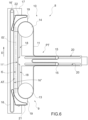
- the transfer conveyor assembly 8 comprises at least a first transporting element 11 (in particular, a belt and/or a chain), which is configured to (at least partially) accompany the articles 2 along at least part of the intermediate segment IS' in the given upward direction D and has a front face 11' configured to come into contact with at least part of the articles 2; and a second transporting element 16 (in particular, a belt and/or a chain), which is configured to (at least partially) accompany the articles 2 along at least part of the intermediate segment IS' in the given upward direction D and has a front face 16" facing the front face 11' and configured to come into contact with at least part of the articles 2.
- a first transporting element 11 in particular, a belt and/or a chain
- a second transporting element 16 in particular, a belt and/or a chain
- the front face 11' and the front face 16" have a distance of more than about 40 mm, in particular more than about 45 mm.
- the front face 11' and the front face 16" are at least about 40 mm, in particular at least about 45 mm apart.
- the front face 11' has a plurality of protuberances PR and/or a plurality of indents IN; each protuberance PR has a height (namely, an extension from a base surface BS of the front face 11' - measured perpendicularly to said base surface BS; in particular, measured perpendicularly to the given direction D) of at least about 1.5 mm (in particular, at least about 2 mm); each indent IN has a depth (relative to the base surface BS of the front face 11' - measured perpendicularly to said base surface BS; in particular, measured perpendicularly to the given direction D) of at least about 1.5 mm (in particular, at least about 2 mm).
- the front face 16" also has a plurality of protuberances PR and/or a plurality of indents IN.
- each protuberance PR has a width (hence, measured parallel to the base surface BS; in particular, measured parallel to the given direction D) of at least about 2 mm.
- each indent IN has a width (hence, measured parallel to the base surface BS; in particular, measured parallel to the given direction D) of at least about 2 mm.
- each protuberance PR has a width up to about 1.5 cm and each indent IN has a width up to about 1.5 cm.
- each protuberance PR has a height up to about 2.5 cm; each indent IN has a depth up to about 2.5 cm.
- the protuberances PR are arranged in succession along the first transporting element 11 (in particular, a belt and/or a chain), substantially in the given direction D with a distance (between one protuberance PR and the following one) of less than about 15 cm (in particular, less than 7 cm).
- the protuberances PR are arranged in succession along the first transporting element 11 (in particular, a belt and/or a chain), substantially in the given direction D with a distance (between one protuberance PR and the following one) of at least 1 cm (in particular, at least 3 cm).
- the conveyor assembly 3 comprises a moving assembly 12, which is configured to move said input 9 and/or said output 10 so as to change a length of the intermediate segment IS' .
- the conveyor assembly 3 comprises a conveyor 6 for conveying the articles 2 from the input station 4 along a segment S1 of the path P.
- the transfer conveyor assembly 8 is configured to convey the articles 2 from the conveyor 6 along the transfer segment IS (in particular, with substantially linear portions) of the path P and has the input 9, arranged in the area of the segment S1 to receive the articles 2 from the conveyor 6.
- the conveyor assembly 3 also comprises a conveyor 7 for conveying the articles 2 to the output station 5 along a segment S2 of the path P.
- the transfer conveyor assembly 8 is configured to convey the articles 2 from the conveyor 6 to the conveyor 7 along the transfer segment IS (in particular, with substantially linear portions) of the path P and has the input 10, arranged in the area of the segment S2 to feed the articles to the conveyor 7.
- the conveyors 6 and 7 are endless conveyors.
- the transfer conveyor assembly 8 is arranged between the conveyors 6 and 7.
- the transfer conveyor assembly 8 is arranged on the side of the conveyors 6 and 7.
- the transfer conveyor assembly 8 is configured to convey the articles 2 upwards.
- segment S1 (which, in particular, has a substantially helical shape) extends from the input station 4 to the input 9.
- the segment S2 (which, in particular, has a substantially helical shape) extends from the output 10 to the output station 5.
- the moving assembly 12 is configured to move the transfer conveyor assembly 8 so as to move the input 9 and the output 10 along the conveyor 6 and the conveyor 7, respectively.
- the moving assembly 12 also is (consequently) configured to change the length (of the transfer segment IS and) of the segments S1 and S2.
- the conveyor assembly 3 comprises a joining device 9', which is configured to allow the articles 2 to shift from the conveyor 6 to the transfer conveyor assembly 8 and is movable on the conveyor 6.
- the conveyor assembly 3 also comprises a joining device 10', which is configured to allow the articles 2 to shift from the transfer conveyor assembly 8 to the conveyor 7 and is movable on the conveyor 7.
- the joining device 9' comprises at least two centring elements 9", which are arranged on opposite sides of the conveyor 6 to reduce the lateral movement of the joining device 9' relative to the conveyor 6.
- the joining device 10' comprises at least two centring elements 10", which are arranged on opposite sides of the conveyor 7 to reduce the lateral movement of the joining device 10' relative to the conveyor 7.
- Each centring element 9" comprises at least a first roller (in particular, at least a roller bearing) and/or each centring element 10" comprises at least a second roller (in particular, at least a roller bearing).
- the conveying assembly 3 comprises both the joining device 9' and the joining device 10'.
- the joining devices 9' and 10' are substantially identical. To this regard, it should be pointed out that figures 11 and 12 show both the joining device 9' and the joining device 10'.
- the moving assembly 12 ( figures 1-5 ) is configured to move the transfer conveyor assembly 8 so as to move the joining device 9' and/or the joining device 10' along the conveyors 6 and 7, respectively.
- said intermediate segment IS' extends upwards, more in particular is substantially vertical.
- the intermediate segment IS' is substantially linear.
- the transporting element 11 Thanks to the presence of the transporting element 11, the risks of clogging of articles 2 along the transfer segment IS (in particular, along the intermediate segment IS') and of damaging the articles 2 while, in use, they are conveyed along the transfer segment IS (in particular, along the intermediate segment IS') are reduced. Thanks to the transporting element 11, it is also possible to feed the articles 2 from the conveyor 6 arranged at the bottom to the conveyor 7 arranged at the top.
- the transporting element 11 is configured to (at least partially) move the articles 2, moving (together with the articles) along the transfer segment IS (in particular, along the intermediate segment IS').
- the input 9 and the output 10 are movable along the conveyor 6 and the conveyor 7, respectively.
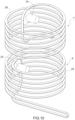
- each conveyor 6 and 7 has at least a respective turn (e.g. a helix and/or a loop).
- each conveyor 6 and 7 has a plurality of respective turns (loops).
- each conveyor 6 and 7 is wound on itself so as to have a plurality of turns (loops).
- the winding direction of the conveyor 6 is contrary to the winding direction of the conveyor 7. For example, if (looking from above) the winding direction of the conveyor 7 is clockwise, the winding direction (always looking from above) of the conveyor 6 is counterclockwise.
- the conveyor 6 has a plurality of first turn (loops) and the second conveyor 7 has a plurality of second turns (loops) having the same radius and the same distance as the first turns.
- the conveyor 6 has a plurality of turns with a constant radius and distance; the conveyor 7 has a plurality of turns with a constant radius and distance. More precisely, the conveyor 6 has at least a segment with a (cylindrical) helical shape with a constant radius and distance; the conveyor 7 has at least a segment with a (cylindrical) helical shape with a constant radius and distance.
- the store 1 (more precisely, the transfer conveyor assembly 8) comprises at least an operating assembly (of a known type and not shown) for rotating at least one of the pulleys 13 and 14 (in particular, the pulley 14). More in particular, it should be pointed out that the transfer conveyor assembly 8 is structured in such a way that the output 10 is arranged approximately in the area (more precisely, at the height) of the pulley 14 and the input 9 is arranged in the area (more precisely, at the height) of the pulley 13 (or of the sliding plane alternative to the pulley 13).
- the aforementioned actuator assembly is configured to change the distance between the joining devices 9' and 10' (and between the pulleys 13 and 14) as a function of (proportionally to) the difference between the speeds at which the conveyor 6 and the conveyor 7 convey the articles 2. More in particular, the actuator assembly is configured to change the distance between the joining devices 9' and 10' (and between the pulleys 13 and 14) with a speed that is proportional to the difference between the speeds at which the conveyor 6 and the conveyor 7 convey the articles 2.
- the passive segment PT extends between the pulleys 13 and 14 and partially around at least a further pulley 15 of the transfer conveyor assembly 8, which also includes a further actuator assembly (also known and not shown) for moving the pulley 15 (away from and towards the transfer segment IS).
- the relative movement between the pulleys 13 and 14 and the movement of the pulley 15 are connected to one another so that one compensates for the other (and the transporting element 11 always remains correctly stretched).
- the active segment AT gets shorter by a given length
- the passive segment PT gets longer by the given length and vice versa (compensating for one another).
- the further actuator assembly comprises a kinematic mechanism, which transfers, according to a defined proportional ratio (for example 1 to 1), the relative movement (more precisely, the displacement) of the pulleys 13 and 14 to the pulley 15.
- a defined proportional ratio for example 1 to 1
- the further actuator assembly comprises (is) a motor (e.g. an electric motor).
- a motor e.g. an electric motor
- the operation of the actuator assembly (for moving the joining devices 9' and 10' - and the pulleys 13 and 14) and of the further actuator assembly (for moving the pulley 15) is coordinated by a control unit.
- the transfer conveyor assembly 8 comprises at least the pulley 15 and at least two fixed pulleys (known and not shown - typically, arranged one above the other). More precisely, though not necessarily, the pulley 15 is arranged (at an intermediate height) between the two fixed pulleys and is (horizontally) movable towards and away from the fixed pulleys. The relative movement between the pulley 15 on the one hand and the fixed pulleys on the other hand compensates for the relative movement between the pulleys 13 and 14 (by lengthening the passive segment PT when the active segment AT is shortened and vice versa).
- the transfer conveyor assembly 8 comprises at least two pulleys 15 and at least three fixed pulleys (known and not shown).
- the relative movement between the pulleys 15 on the one hand and the fixed pulleys on the other hand compensates for the relative movement between the pulleys 13 and 14 (by lengthening the passive segment PT when the active segment AT shortens and vice versa).
- the transfer conveyor assembly 8 comprises at least a transporting element 16, which faces the transporting element 11 and is configured to move along the intermediate segment IS '(in particular, in coordination with the transporting element 11; more precisely, at the same speed as the transporting element 11).
- the transporting element 11 and the transporting element 16 are designed to clamp the articles 2 between them and to at least partially accompany them (move them) along the transfer segment IS (in particular, along the intermediate segment IS').
- the transporting element 16 comprises (is) a belt and/or a chain.
- the transfer conveyor assembly 8 comprises a motor (electric motor - of a known type and not shown) to operate (rotate) one of the pulleys 16' and a different motor (electric motor - of a known type and not shown) to operate (rotate) one of the pulleys 14 and 13 (in particular, the pulley 14).
- the store 1 (more precisely, the transfer conveyor assembly 8) comprises a control unit configured to operate the two electric motors in a coordinated manner so that the speeds of the transporting element 11 and of the advancing device 16 are identical to one another (even when the pulleys 13 and 14 move away from or towards one another).
- the rotation speed of the pulley 14 is decreased.
- the transporting element 16 is wound around a pair of pulleys 16'.
- one of the pulleys 16' is connected, by means of a kinematic mechanism (known and not shown), to at least one of the pulleys 14 and 13, said kinematic mechanism (connected to a motor) being configured to transfer the rotary motion from the pulleys 13 and 14 to the pulley 16' so that the speeds of the transporting element 11 and of the advancing device 16 are identical to one other.
- the transporting element 6 is configured to (at least partially) move the articles 2, moving (together with the articles) along the transfer segment IS (in particular, along the intermediate segment IS').
- the transporting element 16 the risks of clogging of articles 2 along the transfer segment IS and of damaging the articles 2 while, in use, they are conveyed along the transfer segment IS are further reduced. Thanks to the transporting element 16, it is also possible to improve the feeding of the articles 2 from the conveyor 6 arranged at the bottom to the conveyor 7 arranged at the top.
- the transfer conveyor assembly 8 comprises a plate 17, on which the aforementioned pulleys (in particular, the pulleys 13 and 14 and, if necessary, the pulley 15, the pulleys 16' and the fixed pulleys) are mounted.
- the plate 17 has slits 18, which act as a guide for the pulleys 13 and 14. In other words, in use, the pulleys 13 and 14 each slide along a respective slit 18.
- the transfer conveyor assembly 8 comprises two flat supports 19, on which the pulleys 13 and 14, respectively, are mounted (in a rotary manner). More precisely, the aforementioned actuator assembly (not shown) is configured to move the flat supports 19.
- the flat supports 19 can slide along the slits 18 or are movable along linear guides.
- the movement of the flat supports 19 can be obtained, for example, by means of linear actuators and/or kinematic mechanisms connected to other parts of the store 1.
- the plate 17 has slits 20, which act as a guide for the pulley/s 15.
- the pulley/s 15 slide/s along a respective slit 20.
- the pulleys 15 are mounted on a slider that is movable along linear guides.
- the movement of this slider can be obtained, for example, by means of linear actuators and/or kinematic mechanisms connected to other parts of the store 1.
- the joining device 9' and the joining device 10' move in the direction of the longitudinal extension of the intermediate segment IS' in an integral manner to a respective pulley 13 and 14.
- the transfer conveyor assembly 8 further comprises a deflector belt 21 arranged in the area of the pulley 13 for directing (modifying their advancing direction) the articles 2, coming from the input 9, in the intermediate segment IS'.
- the transfer conveyor assembly 8 further comprises a deflector belt 22 arranged in the area of the pulley 14 for directing (modifying their advancing direction) the articles 2, coming from the intermediate segment IS', towards the output 10.
- the deflector belts 21 and 22 are movable relative to one another, in a integral manner to the pulleys 13 and 14, respectively.
- the deflector belts 21 and 22 are each mounted on a respective flat support 19.
- the conveyors 6 and 7 are arranged in such a way that one is (at least partially) above the other.
- the conveyor 7 is (at least partially) arranged above the conveyor 6 (and the output station 5 is arranged higher than the input station 4).
- the output station 5 is arranged higher (than the input 9) and than the input station 4.
- the output station 5 is arranged higher than the output 10, which, in turn, is arranged higher than the input 9, which is arranged higher than the input station 4.
- the segments S1 and S2 are substantially coaxial to one another.
- the aforementioned intermediate segment IS' is (linear and) substantially parallel to an axis A around which the segment S1 and the segment S2 are wound.
- the transfer segment IS also has two connection portions SC1 and SC2 (which are partially transverse - in particular, perpendicular - to the intermediate segment IS'), which extend between the intermediate segment IS' and the segments S1 and S2, respectively.
- the transfer conveyor assembly 8 is configured to also convey the articles 2 along the connection portions SC1 and SC2.
- connecting portions SC1 and SC2 extend substantially horizontally.
- the transfer conveyor assembly 8 comprises conveyors with (substantially horizontal) movable transporting elements in the area of the connection portions SC1 and SC2.
- the transfer segment IS has two curved joining portions, which connect the intermediate segment IS' to the portions SC1 and SC2.
- the moving assembly 12 is configured to rotate the transfer conveyor assembly 8 around the axis A.
- the input 9 (more precisely, the joining device 9') moves (slides) along the conveyor 6
- the output 10 (more precisely, the joining device 10') moves (slides) along the conveyor 7.
- the distance between the pulleys 13 and 14 is caused to change.
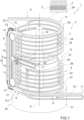
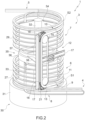
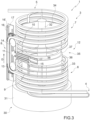
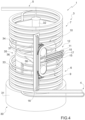
- Figures 1 to 5 show the store 1 in successive operating phases while the store 1 is filled. These figures show the information disclosed above, namely that the rotation movement is also associated with a variation in the length of the transfer segment IS, in particular of the intermediate segment IS '(in other words, a variation in the distance between the joining devices 9' and 10' - and between the pulleys 13 and 14).
- the conveyor 6 comprises at least a motorised pulley 23 and the conveyor 7 comprises at least a motorised pulley 24.
- the pulleys 23 and 24 are designed to allow a transporting element 25 and a transporting element 26, respectively, to move along the segment S1 and S2, respectively, (and along relative return segments).
- the segments S1 and the respective return segment define, together, a path closed on itself (typical of an endless conveyor).
- the segments S2 and the respective return segment define, together, a path closed on itself (typical of an endless conveyor).
- the transporting element 25 is, according to some non-limiting embodiments, a belt and/or a chain.
- the transporting element 25 is a chain. More precisely, the transporting element 25 is a chain as disclosed, for example, in US6364094 and/or WO2013141807 .
- the transporting element 26 is, according to some non-limiting embodiments, a belt and/or a chain.
- the transporting element 26 is a chain. More precisely, the transporting element 26 is a chain as disclosed, for example, in US6364094 and/or WO2013141807 .
- the transporting elements 25 and 26 allow the articles 2 to be handled delicately.
- the conveyor 6 comprises ( figure 7 ) a guide (a track) 27.
- the transporting element 25 is configured to slide on the guide 27.
- the guide 27 is provided with an indent 28, inside which a (lower) protuberance of the transporting element 25 extends. Thanks to this structure, the element 25 follows the guide 27 and moves along the segment S1. To this regard, it should be pointed out that the guide 27 extends along the path S1; more precisely, the guide 27 has the shape of the path S1 (and defines the path S1).
- the conveyor 7 comprises a guide (track) 29.
- the transporting element 26 is configured to slide on the guide 29.
- the guide 29 has a structure and function similar to the guide 27.
- the guide 29 extends along the path S2; more precisely, the guide 29 has the shape of the path S2 (and defines the path S1).
- the first centring elements 9" are arranged on opposite sides of the guide 27 and substantially in contact with the guide 27.
- the store 1 also comprises a main support structure 30 carrying the conveyors 6 and 7 (more precisely, the guides 27 and 29) and the transfer conveyor assembly 8.
- the main support structure 30 also comprises a bearing 35, which, in particular, is interposed between the support assembly 33 and the support assembly 34 and is carried by the support assembly 33.
- the bearing 35 is part of the moving assembly 12. More precisely, the bearing 35 comprises a fixed portion 36 mounted on the support assembly 33 and a movable portion 37 configured to rotate around the axis A and carrying the transfer conveyor assembly 8. More in detail, the transfer conveyor assembly 8 is mounted so as to be integral to the bearing 35 (more precisely, to the movable portion 34) by means of two arms 38.
- the moving assembly 12 comprises at least a motor (of a known type and not shown) configured to move the transfer conveyor assembly 8 (more precisely, to rotate the transfer conveyor assembly 8 around the axis A).
- the store 1 comprises sensors (encoders - of a known type and not shown) to detect the difference in speed between the conveyors 6 and 7 (more precisely, between the motorised pulleys 24 and 25) and a control unit to operate the moving assembly 12 as a function of this difference.
- the aforementioned actuator assembly (for moving the joining devices 9' and 10' - and the pulleys 13 and 14 towards and away from one another) comprises a kinematic mechanism (for example, a gear system with a worm screw) connected to the motor of the moving assembly 12 to transmit the motion (according to a particular proportion) to the joining devices 9' and 10' - and to the pulleys 13 and 14 (in order to have them move towards and away from one another).
- a kinematic mechanism for example, a gear system with a worm screw
- the transfer conveyor assembly 8 is configured to change the speed at which the length of the transfer segment IS (in particular, of the intermediate segment IS') changes as a function of the rotation speed generated by the moving assembly 12 around the rotation axis (to this regard, see, for example, WO2019073447A1 ).
- the store 1 is placed between a first machine (for example, a cigarette maker machine) and a second machine (for example, a packer machine) so as to compensate for the different speeds at which the first machine feeds the articles 2 to the store 1 and the second machine uses the articles 2 coming from the store.
- the store 1 comprises a control system connected to the first and to the second machine (for receiving information on the speeds) and configured to adjust the speed of the conveyor 6 so as to adapt it to the speed of the first machine (and to adjust the speed of the conveyor 7 so as to adapt it to the speed of the second machine).
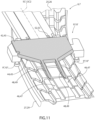
- the joining device 9' comprises a central element 42, on which, in use, the articles 2 shift from the first conveyor 6 to the transfer conveyor assembly 8.
- the centring elements 9" are arranged on opposite sides of the central element 42 (and are substantially integral to the central element 42).
- the joining device 10' comprises a central element 43, on which, in use, the articles 2 shift from the transfer conveyor assembly 8 to the second conveyor 7.
- the centring elements 10" are arranged on opposite sides of the central element 43 (and are substantially integral to the second central element 42).
- the joining device 9' comprises at least an adjustment device for adjusting the position of the centring elements 9" relative to the conveyor 6 (in particular, relative to the guide 27). In particular, in this way it is possible to adjust the position of the centring elements 9" so that they are in contact with the guide 27.
- the joining device 10' comprises at least an adjustment device for adjusting the position of the centring elements 10" relative to the conveyor 7 (in particular, relative to the guide 29). In particular, in this way it is possible to adjust the position of the centring elements 10" so that they are in contact with the guide 29.
- an adjustment device is provided for each centring element 9" and 10".
- each adjustment device comprises (is) an eccentric (which can be operated, for example, by means of a screwdriver or the like).
- the central element 42 has at least a distal portion 44 relative to the transfer conveyor assembly 8 (namely, arranged at a distal end with respect to the transfer conveyor assembly 8), which is tapered towards the conveyor 6.
- the central element 43 has at least a distal portion 45 relative to the transfer conveyor assembly 8 (namely, arranged at a distal end with respect to the transfer conveyor assembly 8), which is tapered towards the second conveyor 7.
- the central elements 42 act as chutes.
- the transporting element 25 (in particular, a belt and/or a chain) is configured to slide along at least the segment S1 and has at least a depression 46 (in particular, at least two depressions 46), which longitudinally extends along the transporting element 25.
- the transporting element 26 is configured to slide along at least the segment S2 and has at least a depression 47 (in particular, at least two depressions 47), which longitudinally extends along the transporting element 26.
- the first central element 42 has at least a tine 48 (more in particular, at least two tines), which projects on the opposite side relative to the transfer conveyor assembly 8 (in particular, from the distal portion 44) and, in particular, at least partially extends inside the depression 46.
- the central element 43 has at least two tines 49, which project on the opposite side relative to the transfer conveyor assembly 8 (in particular, from the distal portion 45) and, in particular, (each) at least partially extend inside a (respective) depression 46.
- each tine 48 and 49 is tapered towards its free end (in particular, away from the transfer conveyor assembly 8).
- the joining device 9' comprises at least a lower roller 50 (in particular, a bearing), which is arranged in contact with the conveyor 6 (in particular, in contact with the transporting element 25; in particular, is arranged between the central element 42 and the conveyor 6) and is configured to help the first joining device 9' slide on the first conveyor 6.
- the lower roller 50 has a rotation axis transverse to the segment S1.
- the joining device 10' comprises at least a lower roller 51 (in particular, a bearing), which is arranged in contact with the conveyor 7 (in particular, in contact with the transporting element 26; in particular, is arranged between the central element 43 and the conveyor 7) and is configured to help the second joining device 10' slide on the second conveyor 7.
- the lower roller 51 has a rotation axis transverse to the segment S2.
- the joining device 9' comprises at least two lower rollers 50 that are offset relative to one another (and/or staggered, in particular as regards the position along the segment S1) .
- the joining device 10' comprises at least two lower rollers 51 that are offset relative to one another (and/or staggered, in particular as regards the position along the segment S2) .
- the joining device 9' comprises at least an adjustment device for adjusting the position of the lower roller/s 50 relative to the conveyor 6 (in particular, relative to the transporting element 25).
- the joining device 10' comprises at least an adjustment device for adjusting the position of the lower roller/s 51 relative to the conveyor 7 (in particular, relative to the transporting element 26).
- an adjustment device is provided for each lower roller 50 and 51.
- each adjustment device comprises (is) an eccentric (which can be operated, for example, by means of a screwdriver or the like).
- the conveyor assembly 3 comprises a hinge 53, which is arranged between the joining device 10' and the transfer conveyor assembly 8 and is configured to allow the joining device 10' to pivot relative to the transfer conveyor assembly 8 around a respective pivoting axis (in particular, transverse to the segment S1).
- the transfer segment IS has at least an intermediate segment IS' (with a variable length), along which the transfer conveyor assembly 8 conveys the articles 2 in a given upward direction D.
- the front face 11' and the front face 16" have a distance of more than about 40 mm, in particular more than about 45 mm.
- the front face 11' and the front face 16" are at least about 40 mm, in particular at least about 45 mm apart.
- each protuberance PR has a height up to about 2.5 cm; each indent IN has a depth up to about 2.5 cm.
- the method is implemented by the conveyor assembly 3 as described above.
Landscapes
- Engineering & Computer Science (AREA)
- Mechanical Engineering (AREA)
- Intermediate Stations On Conveyors (AREA)
- Structure Of Belt Conveyors (AREA)
Applications Claiming Priority (1)
| Application Number | Priority Date | Filing Date | Title |
|---|---|---|---|
| IT102023000018324A IT202300018324A1 (it) | 2023-09-06 | 2023-09-06 | Gruppo di convogliamento e metodo di convogliamento di articoli |
Publications (1)
| Publication Number | Publication Date |
|---|---|
| EP4520193A1 true EP4520193A1 (de) | 2025-03-12 |
Family
ID=88779302
Family Applications (1)
| Application Number | Title | Priority Date | Filing Date |
|---|---|---|---|
| EP24198373.3A Pending EP4520193A1 (de) | 2023-09-06 | 2024-09-04 | Förderanordnung und verfahren zum fördern von gegenständen |
Country Status (3)
| Country | Link |
|---|---|
| EP (1) | EP4520193A1 (de) |
| CN (1) | CN119568726A (de) |
| IT (1) | IT202300018324A1 (de) |
Citations (11)
| Publication number | Priority date | Publication date | Assignee | Title |
|---|---|---|---|---|
| GB1594941A (en) * | 1976-12-22 | 1981-08-05 | Molins Ltd | Conveying rod-like articles |
| US4416368A (en) * | 1980-12-23 | 1983-11-22 | The Japan Tobacco & Salt Public Corporation | Conveyor mechanism for cylindrical articles |
| US4421223A (en) * | 1972-10-27 | 1983-12-20 | Molins Limited | Conveyor systems for cigarettes and other rod-like articles |
| EP0221683B1 (de) * | 1985-10-31 | 1991-12-04 | SKODA koncernovy podnik | Vorrichtung für den Transport von querliegenden Zigaretten |
| EP0581143A1 (de) | 1992-07-25 | 1994-02-02 | Hauni Maschinenbau Aktiengesellschaft | Fördervorrichtung für Zigaretten |
| EP0738478A2 (de) | 1995-04-18 | 1996-10-23 | G.D Societa' Per Azioni | Variierbare Kapazitätspeicher für längliche Objekte |
| EP0838165A1 (de) | 1996-10-22 | 1998-04-29 | G.D Societa' Per Azioni | Speicher mit variabler Kapazität für Produkte |
| US6364094B1 (en) | 1997-09-19 | 2002-04-02 | Flexlink Components Ag | Chain conveyor system |
| WO2013141807A1 (en) | 2012-03-20 | 2013-09-26 | Flexlink Components Ab | Conveyor chain link, conveyor chain and conveyor system comprising conveyor chain |
| WO2019073447A1 (en) | 2017-10-12 | 2019-04-18 | G.D Società per Azioni | STORE WITH VARIABLE CAPACITY |
| US20230035305A1 (en) * | 2020-01-15 | 2023-02-02 | Philip Morris Products S.A. | Method for forming pairs of packs |
-
2023
- 2023-09-06 IT IT102023000018324A patent/IT202300018324A1/it unknown
-
2024
- 2024-09-04 EP EP24198373.3A patent/EP4520193A1/de active Pending
- 2024-09-05 CN CN202411243595.3A patent/CN119568726A/zh active Pending
Patent Citations (11)
| Publication number | Priority date | Publication date | Assignee | Title |
|---|---|---|---|---|
| US4421223A (en) * | 1972-10-27 | 1983-12-20 | Molins Limited | Conveyor systems for cigarettes and other rod-like articles |
| GB1594941A (en) * | 1976-12-22 | 1981-08-05 | Molins Ltd | Conveying rod-like articles |
| US4416368A (en) * | 1980-12-23 | 1983-11-22 | The Japan Tobacco & Salt Public Corporation | Conveyor mechanism for cylindrical articles |
| EP0221683B1 (de) * | 1985-10-31 | 1991-12-04 | SKODA koncernovy podnik | Vorrichtung für den Transport von querliegenden Zigaretten |
| EP0581143A1 (de) | 1992-07-25 | 1994-02-02 | Hauni Maschinenbau Aktiengesellschaft | Fördervorrichtung für Zigaretten |
| EP0738478A2 (de) | 1995-04-18 | 1996-10-23 | G.D Societa' Per Azioni | Variierbare Kapazitätspeicher für längliche Objekte |
| EP0838165A1 (de) | 1996-10-22 | 1998-04-29 | G.D Societa' Per Azioni | Speicher mit variabler Kapazität für Produkte |
| US6364094B1 (en) | 1997-09-19 | 2002-04-02 | Flexlink Components Ag | Chain conveyor system |
| WO2013141807A1 (en) | 2012-03-20 | 2013-09-26 | Flexlink Components Ab | Conveyor chain link, conveyor chain and conveyor system comprising conveyor chain |
| WO2019073447A1 (en) | 2017-10-12 | 2019-04-18 | G.D Società per Azioni | STORE WITH VARIABLE CAPACITY |
| US20230035305A1 (en) * | 2020-01-15 | 2023-02-02 | Philip Morris Products S.A. | Method for forming pairs of packs |
Also Published As
| Publication number | Publication date |
|---|---|
| IT202300018324A1 (it) | 2025-03-06 |
| CN119568726A (zh) | 2025-03-07 |
Similar Documents
| Publication | Publication Date | Title |
|---|---|---|
| EP3694797B1 (de) | Speicher mit variabler kapazität | |
| CN1926033B (zh) | 差速驱动螺旋储存器装置 | |
| US5878865A (en) | Variable speed conveying apparatus | |
| EP3514086A1 (de) | Speicher mit variabler kapazität für zigaretten | |
| US7080730B2 (en) | Conveyor assembly | |
| CA2604340C (en) | Feeding device for a packaging machine | |
| JP2003093033A (ja) | 物品の可変容量貯蔵装置 | |
| EP4450430A2 (de) | Anordnung zum transport verschiedener arten von artikeln der rauchproduktherstellungsindustrie und zugehörige anlage | |
| EP4520193A1 (de) | Förderanordnung und verfahren zum fördern von gegenständen | |
| EP2081832B1 (de) | Höheneinstellbare einschlagmaschine | |
| EP4520194B1 (de) | Speicher mit variabler kapazität | |
| EP4520192A1 (de) | Förderanordnung und verfahren zum fördern von gegenständen | |
| US20140014477A1 (en) | Conveyor system | |
| WO2024241159A1 (en) | Conveyor assembly and method for conveying articles | |
| EP4697988A1 (de) | Speicher mit variabler kapazität | |
| GB2165812A (en) | Variable length of rod-like article conveying means | |
| CN209599975U (zh) | 纸袋排列机构 | |
| JP2005143499A (ja) | 可変容量型貯蔵装置 | |
| JP2006225121A (ja) | 製品集積方法および製品集積装置 | |
| JP3694832B2 (ja) | 物品の整列搬送装置 |
Legal Events
| Date | Code | Title | Description |
|---|---|---|---|
| PUAI | Public reference made under article 153(3) epc to a published international application that has entered the european phase |
Free format text: ORIGINAL CODE: 0009012 |
|
| STAA | Information on the status of an ep patent application or granted ep patent |
Free format text: STATUS: THE APPLICATION HAS BEEN PUBLISHED |
|
| AK | Designated contracting states |
Kind code of ref document: A1 Designated state(s): AL AT BE BG CH CY CZ DE DK EE ES FI FR GB GR HR HU IE IS IT LI LT LU LV MC ME MK MT NL NO PL PT RO RS SE SI SK SM TR |
|
| STAA | Information on the status of an ep patent application or granted ep patent |
Free format text: STATUS: REQUEST FOR EXAMINATION WAS MADE |
|
| 17P | Request for examination filed |
Effective date: 20250905 |