EP4520194A1 - Magasin à capacité variable - Google Patents
Magasin à capacité variable Download PDFInfo
- Publication number
- EP4520194A1 EP4520194A1 EP24198387.3A EP24198387A EP4520194A1 EP 4520194 A1 EP4520194 A1 EP 4520194A1 EP 24198387 A EP24198387 A EP 24198387A EP 4520194 A1 EP4520194 A1 EP 4520194A1
- Authority
- EP
- European Patent Office
- Prior art keywords
- conveyor
- articles
- transfer
- segment
- store
- Prior art date
- Legal status (The legal status is an assumption and is not a legal conclusion. Google has not performed a legal analysis and makes no representation as to the accuracy of the status listed.)
- Granted
Links
Images






Classifications
-
- A—HUMAN NECESSITIES
- A24—TOBACCO; CIGARS; CIGARETTES; SIMULATED SMOKING DEVICES; SMOKERS' REQUISITES
- A24C—MACHINES FOR MAKING CIGARS OR CIGARETTES
- A24C5/00—Making cigarettes; Making tipping materials for, or attaching filters or mouthpieces to, cigars or cigarettes
- A24C5/35—Adaptations of conveying apparatus for transporting cigarettes from making machine to packaging machine
-
- B—PERFORMING OPERATIONS; TRANSPORTING
- B65—CONVEYING; PACKING; STORING; HANDLING THIN OR FILAMENTARY MATERIAL
- B65D—CONTAINERS FOR STORAGE OR TRANSPORT OF ARTICLES OR MATERIALS, e.g. BAGS, BARRELS, BOTTLES, BOXES, CANS, CARTONS, CRATES, DRUMS, JARS, TANKS, HOPPERS, FORWARDING CONTAINERS; ACCESSORIES, CLOSURES, OR FITTINGS THEREFOR; PACKAGING ELEMENTS; PACKAGES
- B65D21/00—Nestable, stackable or joinable containers; Containers of variable capacity
- B65D21/08—Containers of variable capacity
-
- B—PERFORMING OPERATIONS; TRANSPORTING
- B65—CONVEYING; PACKING; STORING; HANDLING THIN OR FILAMENTARY MATERIAL
- B65B—MACHINES, APPARATUS OR DEVICES FOR, OR METHODS OF, PACKAGING ARTICLES OR MATERIALS; UNPACKING
- B65B19/00—Packaging rod-shaped or tubular articles susceptible to damage by abrasion or pressure, e.g. cigarettes, cigars, macaroni, spaghetti, drinking straws or welding electrodes
- B65B19/02—Packaging cigarettes
- B65B19/04—Arranging, feeding, or orientating the cigarettes
-
- B—PERFORMING OPERATIONS; TRANSPORTING
- B65—CONVEYING; PACKING; STORING; HANDLING THIN OR FILAMENTARY MATERIAL
- B65D—CONTAINERS FOR STORAGE OR TRANSPORT OF ARTICLES OR MATERIALS, e.g. BAGS, BARRELS, BOTTLES, BOXES, CANS, CARTONS, CRATES, DRUMS, JARS, TANKS, HOPPERS, FORWARDING CONTAINERS; ACCESSORIES, CLOSURES, OR FITTINGS THEREFOR; PACKAGING ELEMENTS; PACKAGES
- B65D25/00—Details of other kinds or types of rigid or semi-rigid containers
- B65D25/38—Devices for discharging contents
-
- B—PERFORMING OPERATIONS; TRANSPORTING
- B65—CONVEYING; PACKING; STORING; HANDLING THIN OR FILAMENTARY MATERIAL
- B65G—TRANSPORT OR STORAGE DEVICES, e.g. CONVEYORS FOR LOADING OR TIPPING, SHOP CONVEYOR SYSTEMS OR PNEUMATIC TUBE CONVEYORS
- B65G47/00—Article or material-handling devices associated with conveyors; Methods employing such devices
- B65G47/34—Devices for discharging articles or materials from conveyor
- B65G47/46—Devices for discharging articles or materials from conveyor and distributing, e.g. automatically, to desired points
- B65G47/51—Devices for discharging articles or materials from conveyor and distributing, e.g. automatically, to desired points according to unprogrammed signals, e.g. influenced by supply situation at destination
- B65G47/5104—Devices for discharging articles or materials from conveyor and distributing, e.g. automatically, to desired points according to unprogrammed signals, e.g. influenced by supply situation at destination for articles
- B65G47/5109—Devices for discharging articles or materials from conveyor and distributing, e.g. automatically, to desired points according to unprogrammed signals, e.g. influenced by supply situation at destination for articles first In - First Out systems: FIFO
- B65G47/5113—Devices for discharging articles or materials from conveyor and distributing, e.g. automatically, to desired points according to unprogrammed signals, e.g. influenced by supply situation at destination for articles first In - First Out systems: FIFO using endless conveyors
- B65G47/5118—Devices for discharging articles or materials from conveyor and distributing, e.g. automatically, to desired points according to unprogrammed signals, e.g. influenced by supply situation at destination for articles first In - First Out systems: FIFO using endless conveyors with variable accumulation capacity
- B65G47/5131—Devices for discharging articles or materials from conveyor and distributing, e.g. automatically, to desired points according to unprogrammed signals, e.g. influenced by supply situation at destination for articles first In - First Out systems: FIFO using endless conveyors with variable accumulation capacity by relative displacement between conveyors or conveyor parts and bridging means therebetween
-
- B—PERFORMING OPERATIONS; TRANSPORTING
- B65—CONVEYING; PACKING; STORING; HANDLING THIN OR FILAMENTARY MATERIAL
- B65G—TRANSPORT OR STORAGE DEVICES, e.g. CONVEYORS FOR LOADING OR TIPPING, SHOP CONVEYOR SYSTEMS OR PNEUMATIC TUBE CONVEYORS
- B65G2201/00—Indexing codes relating to handling devices, e.g. conveyors, characterised by the type of product or load being conveyed or handled
- B65G2201/02—Articles
- B65G2201/0226—Cigarettes
Definitions
- the invention relates to a variable-capacity store, to a method of conveying articles, in particular cylindrical articles of the tobacco processing industry, and to a plant.
- Variable-capacity stores for cigarettes of the type described in patent EP581143 are known in the tobacco processing industry. These stores comprise a variable-length storage path having two conveying portions wound around one another on a common axis with turns having the same inclination; and a deflection device, which is configured to move the cigarettes from one portion to the other and is movable along both portions so as to change the overall length of the storage path.
- EP838165 discloses a variable-capacity store comprising two helical conveyors arranged one above the other and connected by an intermediate element configured to transfer the products from the upper conveyor to the lower conveyor only by force of gravity.
- the two conveyors operate pneumatically.
- the stores are not very ductile as it is not possible to provide input and output stations for the cylindrical articles arranged in desired positions (for example, one at the bottom and one at the top). More in particular, according to EP581143 and EP838165 , the output of the articles is located at the bottom, a position that is not particularly convenient for the layouts of current machines (such as, for example, cigarette packer machines or combiners for combining filters and tobacco rods together) that can be found downstream of the stores.
- current machines such as, for example, cigarette packer machines or combiners for combining filters and tobacco rods together
- pneumatic conveyors are not very delicate with articles (in particular, cigarettes).
- this type of conveyors can not only damage the articles with relative ease, but can also lead to the detachment and dispersion of particles (for example, tobacco) from the articles themselves.
- WO2019073447A1 discloses a variable-capacity store for articles of the tobacco processing industry, comprising a conveyor assembly comprising a first conveyor having a substantially helical shape; a second conveyor with a substantially helical shape and arranged above the first conveyor; a linear transfer conveyor, designed to convey the articles from the first conveyor to the second conveyor, having a variable length.
- This type of stores suffers from some defects, among which the following ones are worth being mentioned: the fact that it is difficult to be able to precisely adjust the flow of articles leaving the store (and, hence, supplied to following machines); the system is rather rigid with regard to the direction of the articles leaving the store (and, therefore, does not give the possibility of correctly exploiting the spaces available for the positioning of following machines).
- the object of the invention is to provide a variable-capacity store, a method of conveying articles, in particular cylindrical articles of the tobacco processing industry, and a plant, which are designed to at least partially overcome the drawbacks of the prior art and, at the same time, are easy and economic to be manufactured and implemented.
- variable-capacity store a method of conveying articles (in particular, cylindrical articles of the tobacco processing industry) and a plant as claimed in the accompanying independent claims and, preferably, in any one of the claims that directly or indirectly depend on the aforesaid independent claims.
- number 1 indicates, as a whole, a variable-capacity store for articles 2.
- the store comprises a conveyor assembly 3 for conveying the articles 2 (in particular, in a mass) from an input station 4 to an output station 5 along a path P (in particular, with a variable length).
- the articles 2 are substantially cylindrical articles, more in particular of the tobacco processing industry.
- the articles 2 are cigarettes, cigarette filters, cigarette filter components (rods), tobacco rods, cartridges and/or components for electronic cigarettes.
- the articles 2 are cigarettes.
- the conveyor assembly 3 comprises a conveyor 6 for conveying the articles 2 from the input station 4 along a segment S1 of the path P; and at least a transfer conveyor assembly 8, which is configured to convey the articles 2 from the conveyor 6 along a transfer segment IS (in particular, with substantially linear portions) of the path P and has an input 9, arranged in the area of the segment S 1 to receive the articles 2 from the conveyor 6.
- the articles 2 have an oblong shape.
- the conveyor assembly 3 is designed to convey the articles 2 in a mass (namely, in contact with one another and in several layers - see for example the enlargement of the upper part of figure 1 and figure 15 ) and, more in particular, crosswise (namely, in a transverse direction, in particular perpendicular to their longitudinal extension).
- the conveyor assembly 3 also comprises a conveyor 7 for conveying the articles 2 to the output station 5 along a segment S2 of the path P.
- the transfer conveyor assembly 8 is configured to convey the articles 2 from the conveyor 6 to the conveyor 7 along the transfer segment IS (in particular, the substantially linear transfer segment) of the path P and has an input 10, arranged in the area of the segment S2 to feed the articles to the conveyor 7.
- the conveyors 6 and 7 are endless conveyors.
- the transfer conveyor assembly 8 is arranged between the conveyors 6 and 7.
- the transfer conveyor assembly 8 is arranged on the side of the conveyors 6 and 7.
- the transfer conveyor assembly 8 is configured to convey the articles 2 upwards.
- the segment S1 (which, in particular, has a substantially helical shape) extends from the input station 4 to the input 9.
- the segment S2 (which, in particular, has a substantially helical shape) extends from the output 10 to the output station 5.
- the store 1 further comprises a moving assembly 12 for moving the transfer conveyor assembly 8 so as to move said input 9 and said output 10 along the conveyor 6 and the conveyor 7, respectively.
- the moving assembly 12 also is (consequently) configured to change the length of the transfer segment IS and of the segments S 1 and S2.
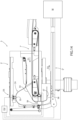
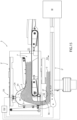
- the store 1 also comprises an unloading device 5', which is arranged in the area of the output station 5 and comprises: at least a conveyor 5", which is configured to transfer the articles 2 to a machine M arranged downstream of the store 1; a compensation area CA, which is arranged downstream of the conveyor 7 and upstream of the conveyor 5" (in particular, between the conveyor 7 and the conveyor 5") and is configured to contain a variable quantity of articles 2 (so as to at least partially compensate for capacity differences between the conveyor 7 and the conveyor 5"); and a control unit CU, which is configured to adjust the operating speed of the conveyor 5" as a function of the requests of the machine M and, in particular, the operating speed of the conveyor 7 as a function of the degree of filling of the compensation area CA (namely, how filled it is, in particular relative to its total capacity).
- an unloading device 5' which is arranged in the area of the output station 5 and comprises: at least a conveyor 5", which is configured to transfer the articles 2 to a machine M arranged downstream of the store 1
- the conveyor assembly 3 itself can be used to compensate for the different operating speeds (and/or momentary standstills) of a machine (for example, a machine for the production of articles 2 - of a known type and not shown) designed to feed the articles 2 to the input station 4 and of the machine M (for example, configured to combine the articles 2 with other components to produce a final product or to pack the articles 2).
- a machine for example, a machine for the production of articles 2 - of a known type and not shown
- the machine M for example, configured to combine the articles 2 with other components to produce a final product or to pack the articles 2).
- the compensation area CA comprises (more in particular, is) a variable-volume compensation chamber.
- control unit CU decreases the quantity (per time unit) of articles 2 fed to the unloading device 5' (by decreasing the speed of the conveyor 7) when the compensation area CA fills (beyond a certain limit).
- control unit CU increases the quantity (per time unit) of articles 2 fed to the unloading device 5' (by increasing the speed of the conveyor 7) when the compensation area CA empties (beyond a certain limit).
- control unit CU decreases the speed of the conveyor 5" when the machine M needs fewer articles 2 and increases the speed of the conveyor 5" when the machine M needs more articles 2.
- the conveyor 7 is configured to convey the articles 2 towards the unloading device 5' (in particular, towards the compensation area CA; more in particular, to the compensation area CA) in a direction D1; the conveyor 5" is configured to convey the articles 2 coming from the compensation area CA in a second direction D2 different from the direction D1 (in particular, at least partially contrary to the first direction D1).
- the unloading device 5' comprises a feeding conveyor 7', which is configured to receive the articles 2 from the conveyor 7 and to feed the articles 2 to the compensation area CA (in particular, in the direction D1); the control unit CU is configured to adjust the operating speed of the feeding conveyor 7' (and, in particular, of the conveyor 7) as a function of the degree of filling of the compensation area CA.
- control unit CU decreases the speed of the feeding conveyor 7' when the compensation area CA fills (beyond a certain limit). In addition or alternatively, vice versa, the control unit CU increases the speed of the feeding conveyor 7' when the compensation area CA empties (beyond a certain limit).
- the unloading device 5' is configured to feed the articles 2 to the machine M in a mass with a controlled height (in particular, ranging from a maximum height to a minimum height).
- the unloading device 5' comprises a detection system DS, which is configured to detect a level of the articles 2 within the compensation area CA and is connected to said control unit CU.
- the control unit CU is configured to adjust the operating speed of the feeding conveyor 7' (and, in particular, of the conveyor 7) as a function of the data detected by the detection system DS (in particular, as a function of the level of the articles within the compensation area CA).
- the detection system DS comprises at least a deformable element 54, which is configured to change its position within the compensation area CA as a consequence of the level of the articles within the compensation area CA, and a sensor 55 configured to detect the position of the deformable element 54 (e.g. the sensor 55 is a proximity sensor).
- This structure is particularly simple and functional.
- the deformable element 54 is a deformable band or a deformable wall (comprising a plurality of panels hinged to one another).
- the unloading device 5' comprises a transfer channel 56 for taking the articles 2 from the compensation area CA to the conveyor 5", which is arranged under the compensation area CA.
- the transfer channel 56 is substantially vertical.
- the unloading device 5' has a levelling wall 58, which is arranged above the conveyor 5" and is configured to limit a height of a mass of articles 2 arranged on the conveyor 5", and an output channel 57, which is connected to the transfer channel 56 and is delimited, at the bottom, by the conveyor 5" and, at the top, by the levelling wall 58.
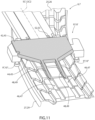
- the conveyor assembly 3 comprises a joining device 9', which is configured to allow the articles 2 to shift from the conveyor 6 to the transfer conveyor assembly 8 and is movable on the conveyor 6.
- the conveyor assembly 3 also comprises a joining device 10', which is configured to allow the articles 2 to shift from the transfer conveyor assembly 8 to the conveyor 7 and is movable on the conveyor 7.
- the joining device 9' comprises at least two centring elements 9", which are arranged on opposite sides of the conveyor 6 to reduce the lateral movement of the joining device 9' relative to the conveyor 6.
- the joining device 10' comprises at least two centring elements 10", which are arranged on opposite sides of the conveyor 7 to reduce the lateral movement of the joining device 10' relative to the conveyor 7.
- Each centring element 9" comprises at least a first roller (in particular, at least a roller bearing) and/or each centring element 10" comprises at least a second roller (in particular, at least a roller bearing).
- the conveying assembly 3 comprises both the joining device 9' and the joining device 10'.
- the joining devices 9' and 10' are substantially identical. To this regard, it should be pointed out that figures 11 and 12 show both the joining device 9' and the joining device 10'.
- the moving assembly 12 ( figures 1-5 ) is configured to move the transfer conveyor assembly 8 so as to move the joining device 9' and/or the joining device 10' along the conveyors 6 and 7, respectively.
- the transfer conveyor assembly 8 has at least an advancing device 11 configured to (at least partially) accompany the articles 2, moving (together with the articles) along an intermediate portion of the transfer segment IS.
- said intermediate portion of the transfer segment IS extends upwards, more in particular is substantially vertical.
- the advancing device 11 comprises (is) an oblong element closed on itself.
- the advancing device 11 comprises (is) a belt and/or a chain.
- the advancing device 11 Thanks to the presence of the advancing device 11, the risks of clogging of articles 2 along the transfer segment IS and of damaging the articles 2 while, in use, they are conveyed along the transfer segment IS are reduced. Thanks to the advancing device 11, it is also possible to feed the articles 2 from the conveyor 6 arranged at the bottom to the conveyor 7 arranged at the top.
- the advancing device 11 is configured to (at least partially) move the articles 2, moving (together with the articles) along the transfer segment IS.
- the transfer segment IS extends between the input 9 and the output 10 (more in particular, from the input 9 to the output 10).
- the input 9 and the output 10 are movable along the conveyor 6 and the conveyor 7, respectively.
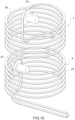
- each conveyor 6 and 7 has at least a respective turn (e.g. a helix and/or a loop).
- each conveyor 6 and 7 has a plurality of respective turns (loops).
- each conveyor 6 and 7 is wound on itself so as to have a plurality of turns (loops).
- the winding direction of the conveyor 6 is contrary to the winding direction of the conveyor 7. For example, if (looking from above) the winding direction of the conveyor 7 is clockwise, the winding direction (always looking from above) of the conveyor 6 is counterclockwise.
- the conveyor 6 has a plurality of first turn (loops) and the second conveyor 7 has a plurality of second turns (loops) having the same radius and the same distance as the first turns.
- the conveyor 6 has a plurality of turns with a constant radius and distance; the conveyor 7 has a plurality of turns with a constant radius and distance. More precisely, the conveyor 6 has at least a segment with a (cylindrical) helical shape with a constant radius and distance; the conveyor 7 has at least a segment with a (cylindrical) helical shape with a constant radius and distance.
- each turn comprises two curved end portions and two linear central portions.
- the turns extend around two drums having parallel axes (see, for example, figure 1 of EP738478 of the Applicant).
- the transfer conveyor assembly 8 comprises a pulley 13 (or, alternatively, a suitably shaped - for example, "U"-shaped - sliding plane) and a pulley 14, around which the advancing device 11 is partially wound.
- the store 1 (in particular, the transfer conveyor assembly 8; more in particular, the moving assembly 12) comprises an actuator assembly (of a known type and not shown) for moving the pulleys 13 and 14 closer to and away from one another, in particular in a direction of longitudinal extension (of the intermediate portion) of the transfer segment IS (more in particular, in a substantially vertical direction).
- the aforementioned actuator assembly comprises (is) a motor and/or kinematic mechanism connected to other parts of the store 1.
- the aforementioned actuator assembly is configured to change the distance between the pulleys 13 and 14 as a function of (proportionally to) the difference between the speeds at which the conveyor 6 and the conveyor 7 convey the articles 2. More in particular, the actuator assembly is configured to change the distance between the pulleys 13 and 14 with a speed that is proportional to the difference between the speeds at which the conveyor 6 and the conveyor 7 convey the articles 2.
- the relative movement between the pulleys 13 and 14 and the movement of the pulley 15 are connected to one another so that one compensates for the other (and the advancing device 11 always remains correctly stretched).
- the active segment AT gets shorter by a given length
- the passive segment PT gets longer by the given length and vice versa (compensating for one another).
- the transfer conveyor assembly 8 comprises at least a pulley 15 and at least two fixed pulleys (known and not shown - typically, arranged one above the other). More precisely, though not necessarily, the pulley 15 is arranged (at an intermediate height) between the two fixed pulleys and is (horizontally) movable towards and away from the fixed pulleys. The relative movement between the pulley 15 on the one hand and the fixed pulleys on the other hand compensates for the relative movement between the pulleys 13 and 14 (by lengthening the passive segment PT when the active segment AT is shortened and vice versa).
- the transfer conveyor assembly 8 comprises at least two pulleys 15 and at least three fixed pulleys (known and not shown).
- the relative movement between the pulleys 15 on the one hand and the fixed pulleys on the other hand compensates for the relative movement between the pulleys 13 and 14 (by lengthening the passive segment PT when the active segment AT shortens and vice versa).
- the advancing device 16 comprises (is) a belt and/or a chain.
- the transfer conveyor assembly 8 comprises a motor (electric motor - of a known type and not shown) to operate (rotate) one of the pulleys 16' and a different motor (electric motor - of a known type and not shown) to operate (rotate) one of the pulleys 14 and 13 (in particular, the pulley 14).
- the store 1 (more precisely, the transfer conveyor assembly 8) comprises a control unit configured to operate the two electric motors in a coordinated manner so that the speeds of the advancing devices 11 and 16 are identical to one another (even when the pulleys 13 and 14 move away from or towards one another).
- the rotation speed of the pulley 14 is decreased.
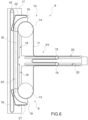
- the advancing device 16 is wound around a pair of pulleys 16' (one of them being shown in figures 1-6 and the other one being shown in figure 13 ).
- one of the pulleys 16' is connected, by means of a kinematic mechanism (known and not shown), to at least one of the pulleys 14 and 13, said kinematic mechanism (connected to a motor) being configured to transfer the rotary motion from the pulleys 13 and 14 to the pulley 16' so that the speeds of the advancing devices 11 and 16 are identical to one other.
- the advancing device 16 the risks of clogging of articles 2 along the transfer segment IS and of damaging the articles 2 while, in use, they are conveyed along the transfer segment IS are further reduced. Thanks to the advancing device 16, it is also possible improve the feeding of the articles 2 from the conveyor 6 arranged at the bottom to the conveyor 7 arranged at the top.
- the transfer conveyor assembly 8 comprises a plate 17, on which the aforementioned pulleys (in particular, the pulleys 13 and 14 and, if necessary, the pulley 15, the pulleys 16' and the fixed pulleys) are mounted.
- the plate 17 has slits 18, which act as a guide for the pulleys 13 and 14. In other words, in use, the pulleys 13 and 14 each slide along a respective slit 18.
- the transfer conveyor assembly 8 comprises two flat supports 19, on which the pulleys 13 and 14, respectively, are mounted (in a rotary manner). More precisely, the aforementioned actuator assembly (not shown) is configured to move the flat supports 19.
- the flat supports 19 can slide along the slits 18 or are movable along linear guides.
- the movement of the flat supports 19 can be obtained, for example, by means of linear actuators and/or kinematic mechanisms connected to other parts of the store 1.
- the plate 17 has slits 20, which act as a guide for the pulley/s 15.
- the pulley/s 15 slide/s along a respective slit 20.
- the pulleys 15 are mounted on respective sliders movable along linear guides.
- the movement of these sliders can be obtained, for example, by means of linear actuators and/or kinematic mechanisms connected to other parts of the store 1.
- the joining device 9' and the joining device 10' move in the direction of the longitudinal extension of the transfer segment IS in an integral manner to a respective pulley 13 and 14.
- the transfer conveyor assembly 8 further comprises a deflector belt 21 arranged in the area of the pulley 13 for directing (modifying their advancing direction) the articles 2, coming from the input 9, in the transfer segment IS.
- the transfer conveyor assembly 8 further comprises a deflector belt 22 arranged in the area of the pulley 14 for directing (modifying their advancing direction) the articles 2, coming from the transfer segment IS, towards the output 10.
- the deflector belts 21 and 22 are movable relative to one another, in a integral manner to the pulleys 13 and 14, respectively.
- the deflector belts 21 and 22 are each mounted on a respective flat support 19.
- the conveyors 6 and 7 are arranged in such a way that one is (at least partially) above the other.
- the conveyor 7 is (at least partially) arranged above the conveyor 6 (and the output station 5 is arranged higher than the input station 4).
- the output station 5 is arranged higher (than the input 9) and than the input station 4.
- the output station 5 is arranged higher than the output 10, which, in turn, is arranged higher than the input 9, which is arranged higher than the input station 4.
- the segments S1 and S2 are substantially coaxial to one another.
- the aforementioned intermediate portion of the transfer segment IS is (linear and) substantially parallel to an axis A around which the segment S1 and the segment S2 are wound.
- the segment IS also has two connection portions SC1 and SC2 (which are transverse - in particular, perpendicular - to the intermediate portion), which extend between the intermediate portion of the transfer segment IS and the segments S1 and S2, respectively.
- the transfer conveyor assembly 8 is configured to also convey the articles 2 along the connection portions SC1 and SC2.
- connecting portions SC1 and SC2 extend substantially horizontally.
- the transfer conveyor assembly 8 comprises conveyors with (substantially horizontal) movable transporting elements in the area of the connection portions SC1 and SC2.
- the moving assembly 12 is configured to rotate the transfer conveyor assembly 8 around the axis A.
- the input 9 (more precisely, the joining device 9') moves (slides) along the conveyor 6
- the output 10 (more precisely, the joining device 10') moves (slides) along the conveyor 7.
- the distance between the pulleys 13 and 14 is caused to change.
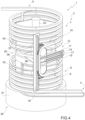
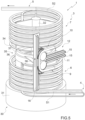
- Figures 1 to 5 show the store 1 in successive operating phases while the store 1 is filled. These figures show the information disclosed above, namely that the rotation movement is also associated with a variation in the length of the segment IS (in other words, a variation in the distance between the pulleys 13 and 14).
- the conveyor 6 comprises at least a motorised pulley 23 and the conveyor 7 comprises at least a motorised pulley 24.
- the pulleys 23 and 24 are designed to allow a transporting element 25 and a transporting element 26, respectively, to move along the segment S1 and S2, respectively, (and along relative return segments).
- the segments S1 and the respective return segment define, together, a path closed on itself (typical of an endless conveyor).
- the segments S2 and the respective return segment define, together, a path closed on itself (typical of an endless conveyor).
- the transporting element 25 is, according to some non-limiting embodiments, a belt and/or a chain.
- the transporting element 25 is a chain. More precisely, the transporting element 25 is a chain as disclosed, for example, in US6364094 and/or WO2013141807 .
- the transporting element 26 is, according to some non-limiting embodiments, a belt and/or a chain.
- the conveyor element 26 is a chain. More precisely, the transporting element 26 is a chain as disclosed, for example, in US6364094 and/or WO2013141807 .
- the transporting elements 25 and 26 allow the articles 2 to be handled delicately.
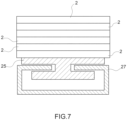
- the conveyor 6 comprises ( figure 7 ) a guide (a track) 27.
- the transporting element 25 is configured to slide on the guide 27.
- the guide 27 is provided with an indent 28, inside which a (lower) protuberance of the transporting element 25 extends. Thanks to this structure, the element 25 follows the guide 27 and moves along the segment S1. To this regard, it should be pointed out that the guide 27 extends along the path S1; more precisely, the guide 27 has the shape of the path S1 (and defines the path S1).
- the conveyor 7 comprises a guide (track) 29.
- the transporting element 26 is configured to slide on the guide 29.
- the guide 29 has a structure and function similar to the guide 27.
- the guide 29 extends along the path S2; more precisely, the guide 29 has the shape of the path S2 (and defines the path S1).
- the first centring elements 9" are arranged on opposite sides of the guide 27 and substantially in contact with the guide 27.
- centring elements 10" are arranged on opposite sides of the guide (29) and substantially in contact with the guide 29.
- the store 1 also comprises a main support structure 30 carrying the conveyors 6 and 7 (more precisely, the guides 27 and 29) and the transfer conveyor assembly 8.
- the main support structure 30 comprises a base 31 and a support column 32 (perpendicularly) projecting from the base 31.
- the column 32 extends parallel to the axis A; more in particular, the column 32 extends along the axis A (in other words, the axis A - also - is the longitudinal axis of the column 32). More precisely, the column 31 has a vertical orientation.
- the main support structure 30 also comprises a support assembly 33 fixed on the column 32 and carrying the conveyor 6 (more precisely, the guide 27) and a support assembly 34 fixed on the column 32, spaced apart from the support assembly 33 and carrying the conveyor 7 (more precisely, the guide 29).
- the main support structure 30 also comprises a bearing 35, which, in particular, is interposed between the support assembly 33 and the support assembly 34 and is carried by the support assembly 33.
- the bearing 35 is part of the moving assembly 12. More precisely, the bearing 35 comprises a fixed portion 36 mounted on the support assembly 33 and a movable portion 37 configured to rotate around the axis A and carrying the transfer conveyor assembly 8. More in detail, the transfer conveyor assembly 8 is mounted so as to be integral to the bearing 35 (more precisely, to the movable portion 34) by means of two arms 38.
- the moving assembly 12 comprises at least a motor (of a known type and not shown) configured to move the transfer conveyor assembly 8 (more precisely, to rotate the transfer conveyor assembly 8 around the axis A).
- the store 1 comprises sensors (encoders - of a known type and not shown) to detect the difference in speed between the conveyors 6 and 7 (more precisely, between the motorised pulleys 24 and 25) and a control unit to operate the moving assembly 12 as a function of this difference.
- the aforementioned actuator assembly (for moving the pulleys 13 and 14 towards and away from one another) comprises a kinematic mechanism (for example, a gear system with a worm screw) connected to the motor of the moving assembly 12 to transmit the motion (according to a particular proportion) to the pulleys 13 and 14 (in order to have them move towards and away from one another).
- a kinematic mechanism for example, a gear system with a worm screw
- the transfer conveyor assembly 8 is configured to change the speed at which the length of the transfer segment IS changes as a function of the rotation speed generated by the moving assembly 12 around the rotation axis (to this regard, see, for example, WO2019073447A1 ).
- the moving assembly 12 comprises a mechanical connection configured to move the transfer conveyor assembly 8 (more precisely, to rotate the transfer conveyor assembly 8 around the axis A) as a function of the speed differences between the conveyors 6 and 7 (more precisely, between the motorised pulleys 24 and 25).
- the store 1 is placed between a first machine (for example, a cigarette maker machine) and the machine M (for example, a packer machine) so as to compensate for the different speeds at which the first machine feeds the articles 2 to the store 1 and the machine M uses the articles 2 coming from the store.
- the store 1 comprises a control system (of which the control unit CU is part) connected to the first and to the second machine (for receiving information on the speeds) and configured to adjust the speed of the conveyor 6 so as to adapt it to the speed of the first machine (and to adjust the speed of the conveyor 7 so as to adapt it to the speed of the machine M).
- the joining device 9' comprises a central element 42, on which, in use, the articles 2 shift from the first conveyor 6 to the transfer conveyor assembly 8.
- the centring elements 9" are arranged on opposite sides of the central element 42 (and are substantially integral to the central element 42).
- the joining device 10' comprises a central element 43, on which, in use, the articles 2 shift from the transfer conveyor assembly 8 to the second conveyor 7.
- the centring elements 10" are arranged on opposite sides of the central element 43 (and are substantially integral to the second central element 42).
- the joining device 9' comprises at least an adjustment device for adjusting the position of the centring elements 9" relative to the conveyor 6 (in particular, relative to the guide 27). In particular, in this way it is possible to adjust the position of the centring elements 9" so that they are in contact with the guide 27.
- the joining device 10' comprises at least an adjustment device for adjusting the position of the centring elements 10" relative to the conveyor 7 (in particular, relative to the guide 29). In particular, in this way it is possible to adjust the position of the centring elements 10" so that they are in contact with the guide 29.
- an adjustment device is provided for each centring element 9" and 10".
- each adjustment device comprises (is) an eccentric (which can be operated, for example, by means of a screwdriver or the like).
- the central element 42 has at least a distal portion 44 relative to the transfer conveyor assembly 8 (namely, arranged at a distal end with respect to the transfer conveyor assembly 8), which is tapered towards the conveyor 6.
- the central element 43 has at least a distal portion 45 relative to the transfer conveyor assembly 8 (namely, arranged at a distal end with respect to the transfer conveyor assembly 8), which is tapered towards the second conveyor 7.
- the central elements 42 act as chutes.
- the transporting element 25 (in particular, a belt and/or a chain) is configured to slide along at least the segment S1 and has at least a depression 46 (in particular, at least two depressions 46), which longitudinally extends along the transporting element 25.
- the transporting element 26 is configured to slide along at least the segment S2 and has at least a depression 47 (in particular, at least two depressions 47), which longitudinally extends along the transporting element 26.
- the first central element 42 has at least a tine 48 (more in particular, at least two tines), which projects on the opposite side relative to the transfer conveyor assembly 8 (in particular, from the distal portion 44) and, in particular, at least partially extends inside the depression 46.
- the central element 43 has at least two tines 49, which project on the opposite side relative to the transfer conveyor assembly 8 (in particular, from the distal portion 45) and, in particular, (each) at least partially extend inside a (respective) depression 46.
- each tine 48 and 49 is tapered towards its free end (in particular, away from the transfer conveyor assembly 8).
- the joining device 9' comprises at least a lower roller 50 (in particular, a bearing), which is arranged in contact with the conveyor 6 (in particular, in contact with the transporting element 25; in particular, is arranged between the central element 42 and the conveyor 6) and is configured to help the first joining device 9' slide on the first conveyor 6.
- the lower roller 50 has a rotation axis transverse to the segment S1.
- the joining device 9' comprises at least two lower rollers 50 that are offset relative to one another (and/or staggered, in particular as regards the position along the segment S1).
- the joining device 10' comprises at least two lower rollers 51 that are offset relative to one another (and/or staggered, in particular as regards the position along the segment S2) .
- the joining device 9' comprises at least an adjustment device for adjusting the position of the lower roller/s 50 relative to the conveyor 6 (in particular, relative to the transporting element 25).
- the joining device 10' comprises at least an adjustment device for adjusting the position of the lower roller/s 51 relative to the conveyor 7 (in particular, relative to the transporting element 26).
- each adjustment device comprises (is) an eccentric (which can be operated, for example, by means of a screwdriver or the like).
- the conveyor assembly 3 comprises a hinge 52, which is arranged between the joining device 9' and the transfer conveyor assembly 8 and is configured to allow the joining device 9' to pivot relative to the transfer conveyor assembly 8 around a respective pivoting axis (in particular, transverse to the segment S1).
- the conveyor assembly 3 comprises a hinge 53, which is arranged between the joining device 10' and the transfer conveyor assembly 8 and is configured to allow the joining device 10' to pivot relative to the transfer conveyor assembly 8 around a respective pivoting axis (in particular, transverse to the segment S1).
- the store 1 offers several advantages relative to the state of the art. Among others, it should be pointed out that, in this way, it is possible to have a relatively uncomplicated structure that permits relatively simple maintenance operations. Furthermore, the store 1 is particularly flexible, for it is able to also have an output station at the top (a particularly convenient position for the layouts of the current machines), and is delicate in handling the items 2.
- the connections of the transfer conveyor assembly 8 to the conveyors 6 and 7 are stable and reliable. The risks of clogging of articles 2 and/or that these clogs are large and/or that articles 2 are damaged are also reduced.
- a plant (of the tobacco processing industry) comprising the store 1 and the machine M described above.
- the plant also comprises a first machine (for example, a machine for the production of cigarettes); the store 1 is, in these cases, arranged between the first machine and the machine M.
- An unloading device 5' is arranged in the area of the output station 5 and comprises: at least a third conveyor 5", which transfers the articles 2 to the machine M; a compensation area CA, which is arranged downstream of the conveyor 7 and upstream of the conveyor 5" (between the conveyor 7 and the conveyor 5") and contains a variable quantity of articles 2 (so as to at least partially compensate for capacity differences between the conveyor 7 and the conveyor 5"); and a control unit CU, which adjusts the operating speed of the conveyor 5" as a function of the requests of the machine M and the operating speed of the conveyor 7 as a function of a degree of filling of the compensation area CA.
- the conveyor 7 conveys the articles 2 towards the unloading device 5' (in particular, towards the compensation area CA) in a direction D1; the conveyor 5" conveys the articles 2 coming from the compensation area CA in a direction D2 different from (in particular, at least partially contrary to) the direction D1.
- the method comprises a feeding step, during which a feeding conveyor 7' receives the articles 2 from the conveyor 7 and feeds the articles 2 to the compensation area CA (in particular, in the direction D1).
- the control unit CU adjusts the operating speed of the feeding conveyor 7' as a function of the degree of filling of the compensation area CA.
- the unloading device 5' comprises a detection system DS, which detects a level of the articles within the compensation area CA and is connected to the control unit CU.
- the control unit CU adjusts the operating speed of the feeding conveyor 7' (and, in particular, of the conveyor 7) as a function of the data detected by the detection system DS (in particular, as a function of the level of the articles within the compensation area CA).
- the detection system DS comprises at least a deformable belt 54, which changes its position within the compensation area as a consequence of the level of the articles within the compensation area CA, and a sensor 55 detects the position of the deformable belt 54.
- the method is implemented by the store 1 as described above.
Landscapes
- Engineering & Computer Science (AREA)
- Mechanical Engineering (AREA)
- Intermediate Stations On Conveyors (AREA)
Applications Claiming Priority (1)
| Application Number | Priority Date | Filing Date | Title |
|---|---|---|---|
| IT102023000018318A IT202300018318A1 (it) | 2023-09-06 | 2023-09-06 | Magazzino a capacita' variabile |
Publications (2)
| Publication Number | Publication Date |
|---|---|
| EP4520194A1 true EP4520194A1 (fr) | 2025-03-12 |
| EP4520194B1 EP4520194B1 (fr) | 2026-02-18 |
Family
ID=88778514
Family Applications (1)
| Application Number | Title | Priority Date | Filing Date |
|---|---|---|---|
| EP24198387.3A Active EP4520194B1 (fr) | 2023-09-06 | 2024-09-04 | Magasin à capacité variable |
Country Status (3)
| Country | Link |
|---|---|
| EP (1) | EP4520194B1 (fr) |
| CN (1) | CN119568553A (fr) |
| IT (1) | IT202300018318A1 (fr) |
Citations (8)
| Publication number | Priority date | Publication date | Assignee | Title |
|---|---|---|---|---|
| US4717009A (en) * | 1984-08-30 | 1988-01-05 | Molins Machine Co. Inc. | Conveyor arrangement for rod-like articles |
| EP0581143A1 (fr) | 1992-07-25 | 1994-02-02 | Hauni Maschinenbau Aktiengesellschaft | Dispositif de transport de cigarettes |
| EP0738478A2 (fr) | 1995-04-18 | 1996-10-23 | G.D Societa' Per Azioni | Magazin de capacité variable pour objets allongés |
| EP0838165A1 (fr) | 1996-10-22 | 1998-04-29 | G.D Societa' Per Azioni | Réservoir à capacité variable pour produits |
| US6364094B1 (en) | 1997-09-19 | 2002-04-02 | Flexlink Components Ag | Chain conveyor system |
| EP1344463A2 (fr) * | 2002-03-12 | 2003-09-17 | Molins Plc | Transporteur pour articles en forme de tige |
| WO2013141807A1 (fr) | 2012-03-20 | 2013-09-26 | Flexlink Components Ab | Maillon de chaîne de convoyeur, chaîne de convoyeur et système de convoyeur comprenant la chaîne de convoyeur |
| WO2019073447A1 (fr) | 2017-10-12 | 2019-04-18 | G.D Società per Azioni | Magasin à capacité variable |
-
2023
- 2023-09-06 IT IT102023000018318A patent/IT202300018318A1/it unknown
-
2024
- 2024-09-04 EP EP24198387.3A patent/EP4520194B1/fr active Active
- 2024-09-06 CN CN202411253696.9A patent/CN119568553A/zh active Pending
Patent Citations (8)
| Publication number | Priority date | Publication date | Assignee | Title |
|---|---|---|---|---|
| US4717009A (en) * | 1984-08-30 | 1988-01-05 | Molins Machine Co. Inc. | Conveyor arrangement for rod-like articles |
| EP0581143A1 (fr) | 1992-07-25 | 1994-02-02 | Hauni Maschinenbau Aktiengesellschaft | Dispositif de transport de cigarettes |
| EP0738478A2 (fr) | 1995-04-18 | 1996-10-23 | G.D Societa' Per Azioni | Magazin de capacité variable pour objets allongés |
| EP0838165A1 (fr) | 1996-10-22 | 1998-04-29 | G.D Societa' Per Azioni | Réservoir à capacité variable pour produits |
| US6364094B1 (en) | 1997-09-19 | 2002-04-02 | Flexlink Components Ag | Chain conveyor system |
| EP1344463A2 (fr) * | 2002-03-12 | 2003-09-17 | Molins Plc | Transporteur pour articles en forme de tige |
| WO2013141807A1 (fr) | 2012-03-20 | 2013-09-26 | Flexlink Components Ab | Maillon de chaîne de convoyeur, chaîne de convoyeur et système de convoyeur comprenant la chaîne de convoyeur |
| WO2019073447A1 (fr) | 2017-10-12 | 2019-04-18 | G.D Società per Azioni | Magasin à capacité variable |
Also Published As
| Publication number | Publication date |
|---|---|
| EP4520194B1 (fr) | 2026-02-18 |
| IT202300018318A1 (it) | 2025-03-06 |
| CN119568553A (zh) | 2025-03-07 |
Similar Documents
| Publication | Publication Date | Title |
|---|---|---|
| EP3694797B1 (fr) | Magasin à capacité variable | |
| CN1926033B (zh) | 差速驱动螺旋储存器装置 | |
| US6422380B1 (en) | Variable-capacity buffer store for rod-shaped articles | |
| US5833045A (en) | Variable-capacity product store | |
| JP2004161492A (ja) | 実質的並行六面体形製品のための貯蔵ユニット | |
| EP3514086A1 (fr) | Magasin à capacité variable pour cigarettes | |
| JP2003093033A (ja) | 物品の可変容量貯蔵装置 | |
| EP3998877B1 (fr) | Ensemble de transport de différents types d'articles de l'industrie de la fabrication de produits à fumer et installation associée | |
| CA2604340C (fr) | Dispositif d'acheminement pour machine d'emballage | |
| EP4520194B1 (fr) | Magasin à capacité variable | |
| EP2081832B1 (fr) | Machine à hauteur réglable permettant un enveloppement sous film | |
| EP4520193A1 (fr) | Ensemble transporteur et procédé de transport d'articles | |
| EP4520192A1 (fr) | Ensemble transporteur et procédé de transport d'articles | |
| WO2024218666A1 (fr) | Dispositif de stockage à capacité variable | |
| WO2024241159A1 (fr) | Ensemble transporteur et procédé de transport d'articles | |
| CN113371451B (zh) | 一种用于卫生用品堆垛装置及堆垛方法 | |
| JP2005143499A (ja) | 可変容量型貯蔵装置 | |
| CN109532105A (zh) | 纸袋排列整理装置的传动结构 | |
| EP1516835A2 (fr) | Dispositif pour transporter des éléments parallélépipèdiques | |
| CN120774157A (zh) | 一种移动旋转布料皮带机 |
Legal Events
| Date | Code | Title | Description |
|---|---|---|---|
| PUAI | Public reference made under article 153(3) epc to a published international application that has entered the european phase |
Free format text: ORIGINAL CODE: 0009012 |
|
| STAA | Information on the status of an ep patent application or granted ep patent |
Free format text: STATUS: THE APPLICATION HAS BEEN PUBLISHED |
|
| AK | Designated contracting states |
Kind code of ref document: A1 Designated state(s): AL AT BE BG CH CY CZ DE DK EE ES FI FR GB GR HR HU IE IS IT LI LT LU LV MC ME MK MT NL NO PL PT RO RS SE SI SK SM TR |
|
| STAA | Information on the status of an ep patent application or granted ep patent |
Free format text: STATUS: REQUEST FOR EXAMINATION WAS MADE |
|
| 17P | Request for examination filed |
Effective date: 20250326 |
|
| GRAP | Despatch of communication of intention to grant a patent |
Free format text: ORIGINAL CODE: EPIDOSNIGR1 |
|
| STAA | Information on the status of an ep patent application or granted ep patent |
Free format text: STATUS: GRANT OF PATENT IS INTENDED |
|
| INTG | Intention to grant announced |
Effective date: 20250910 |
|
| GRAS | Grant fee paid |
Free format text: ORIGINAL CODE: EPIDOSNIGR3 |
|
| GRAA | (expected) grant |
Free format text: ORIGINAL CODE: 0009210 |
|
| STAA | Information on the status of an ep patent application or granted ep patent |
Free format text: STATUS: THE PATENT HAS BEEN GRANTED |
|
| AK | Designated contracting states |
Kind code of ref document: B1 Designated state(s): AL AT BE BG CH CY CZ DE DK EE ES FI FR GB GR HR HU IE IS IT LI LT LU LV MC ME MK MT NL NO PL PT RO RS SE SI SK SM TR |
|
| REG | Reference to a national code |
Ref country code: CH Ref legal event code: F10 Free format text: ST27 STATUS EVENT CODE: U-0-0-F10-F00 (AS PROVIDED BY THE NATIONAL OFFICE) Effective date: 20260218 Ref country code: GB Ref legal event code: FG4D |
|
| REG | Reference to a national code |
Ref country code: NL Ref legal event code: FP |
|
| REG | Reference to a national code |
Ref country code: IE Ref legal event code: FG4D |
|
| REG | Reference to a national code |
Ref country code: DE Ref legal event code: R096 Ref document number: 602024002643 Country of ref document: DE |