EP4520253A1 - Dispositif d'aide retinoscopique - Google Patents
Dispositif d'aide retinoscopique Download PDFInfo
- Publication number
- EP4520253A1 EP4520253A1 EP23315342.8A EP23315342A EP4520253A1 EP 4520253 A1 EP4520253 A1 EP 4520253A1 EP 23315342 A EP23315342 A EP 23315342A EP 4520253 A1 EP4520253 A1 EP 4520253A1
- Authority
- EP
- European Patent Office
- Prior art keywords
- display unit
- retinoscopic
- aid device
- optical display
- phoropter
- Prior art date
- Legal status (The legal status is an assumption and is not a legal conclusion. Google has not performed a legal analysis and makes no representation as to the accuracy of the status listed.)
- Pending
Links
Images


Classifications
-
- A—HUMAN NECESSITIES
- A61—MEDICAL OR VETERINARY SCIENCE; HYGIENE
- A61B—DIAGNOSIS; SURGERY; IDENTIFICATION
- A61B3/00—Apparatus for testing the eyes; Instruments for examining the eyes
- A61B3/10—Objective types, i.e. instruments for examining the eyes independent of the patients' perceptions or reactions
- A61B3/103—Objective types, i.e. instruments for examining the eyes independent of the patients' perceptions or reactions for determining refraction, e.g. refractometers, skiascopes
-
- A—HUMAN NECESSITIES
- A61—MEDICAL OR VETERINARY SCIENCE; HYGIENE
- A61B—DIAGNOSIS; SURGERY; IDENTIFICATION
- A61B3/00—Apparatus for testing the eyes; Instruments for examining the eyes
- A61B3/0016—Operational features thereof
-
- A—HUMAN NECESSITIES
- A61—MEDICAL OR VETERINARY SCIENCE; HYGIENE
- A61B—DIAGNOSIS; SURGERY; IDENTIFICATION
- A61B3/00—Apparatus for testing the eyes; Instruments for examining the eyes
- A61B3/0075—Apparatus for testing the eyes; Instruments for examining the eyes provided with adjusting devices, e.g. operated by control lever
-
- A—HUMAN NECESSITIES
- A61—MEDICAL OR VETERINARY SCIENCE; HYGIENE
- A61B—DIAGNOSIS; SURGERY; IDENTIFICATION
- A61B3/00—Apparatus for testing the eyes; Instruments for examining the eyes
- A61B3/0091—Fixation targets for viewing direction
-
- A—HUMAN NECESSITIES
- A61—MEDICAL OR VETERINARY SCIENCE; HYGIENE
- A61B—DIAGNOSIS; SURGERY; IDENTIFICATION
- A61B3/00—Apparatus for testing the eyes; Instruments for examining the eyes
- A61B3/02—Subjective types, i.e. testing apparatus requiring the active assistance of the patient
- A61B3/028—Subjective types, i.e. testing apparatus requiring the active assistance of the patient for testing visual acuity; for determination of refraction, e.g. phoropters
- A61B3/0285—Phoropters
Definitions
- the present disclosure relates to a retinoscopic aid device for use with a portable streak retinoscope and with an automated phoropter for testing an individual's eye.
- Retinoscopy is a standard practice for objective evaluation of patient refraction and part of standard academic cursus in optometry. It requires a retinoscope and a set of trial lenses for correcting refraction error or can be done in a phoropter.
- Such phoropter may be of a classical kind with a set of lenses of different powers that can be successively disposed along the optical paths reaching the eyes of the subject, to change the vision correction powers provided to each eye.
- the set of lenses is manually operated by the practitioner or user from the front face of the phoropter (opposed to the subject) to change of lenses disposed along the optical path of the subject's eyes and this front face also supports visual axis references able to surround the lenses disposed along the optical path.
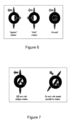
- the practitioner illuminates the subjects'eye with the retinoscope's streak through the current lens disposed along the optical path, moves this streak side to side, and observes a reflex motion or light reflex in the patient's pupil through the retinoscope to determine if the light reflex in the patient's pupil moves "with” or "against” motion of the retinoscope's streak (see figure 6 ).
- the practitioner or user moves the retinoscope's streak side to side, the light reflex in the patient's pupil moves obliquely parallel to a specific direction that allows the determination of the axis of the subject's astigmatism.
- this motion can be neutralized with the selection of lenses of different power.
- the Practitioner can use the visual axis references on the front face of the phoropter to quantify the orientation of the specific direction and deduce the astigmatism axis.
- Motorized phoropters usually have set of lenses with discrete power disposed along the optical paths reaching the eyes of the subject to change the vision correction powers provided to each eye by the change in the set of lenses.
- the change of the powers of a motorized phoropter, and the subjective tests displayed by the screen can be controlled automatically by a computer (keyboard) with the practitioner sitting aside or even being remote and not manually by the practitioner or user with the practitioner in front of the phoropter. Therefore, such motorized phoropters are usually deprived from any axis indication.
- the situation is similar for improved phoropter which usually have tunable lenses of continuous variable power disposed along the optical paths reaching the eyes of the subject to change the vision correction powers provided to each eye by the change of the power of the tunable lens.
- the present invention proposed to overcome at least partially this drawback of automated phoropters.
- the present disclosure proposes a retinoscopic aid device for use with a portable streak retinoscope and with an automated phoropter for testing an individual's eye comprising
- the base plate and the optical display unit can present a central opening of the size of an observation window of the automated phoropter allowing them to be centered around the observation window and observation of a patient's eye through the central opening and observation window.
- the optical display unit may comprise a ring of light sources, in particular LEDs, which are regularly disposed in a circle arrangement around a center, and the control unit can be configured to switch the light sources according to an illumination pattern representing the straight line mark.
- the control unit is for example configured such that only two light sources which are opposed with regard to the center may be switched on at the same time, these two switched on light sources representing the straight line mark.
- the control unit of the optical display unit may be manually operable.
- the control unit of the optical display unit comprises for example a scroll wheel unit disposed at distance to the display unit.
- the control unit of the optical display unit can also be integrated to the automated phoropter and may be configured to be controlled by a user interface of the automated phoropter.
- the control unit of the optical display unit can be integrated to the automated phoropter and may be configured to control functions of the automated phoropter in particular variation of lens power along an optical path.
- the retinoscopic aid device can further comprise a bearing arranged between the base plate and the optical display unit, the optical display unit having two light sources which are disposed in opposition with regard to the rotation center and represent the straight line mark.
- the retinoscopic aid device may further comprise a display screen, in particular an LCD screen for display of a value of the observed streak orientation and/or of a value of a power of a lens of the automated phoropter.
- a display screen in particular an LCD screen for display of a value of the observed streak orientation and/or of a value of a power of a lens of the automated phoropter.
- the at least one detachable fastener comprises for example a magnet.
- the at least one detachable fastener comprises for example a scratch fastener.
- the invention also relates to a system for optimization of human visual function comprising an automated phoropter and at least one retinoscopic aid device as defined above.
- the base plate and the optical display unit of the retinoscopic aid device presents for example a central opening of the size of an observation window of the automated phoropter allowing the retinoscopic aid device to be centered with regard to the observation window and observation of a patient's eye through the central opening and observation window.
- the invention further relates to a method for testing an individual's eye with use of a portable streak retinoscope and an automated phoropter equipped with an retinoscopic aid device as defined above, having at least the following steps :
- Figure 1 shows a schematically perspective view of a part of an automated phoropter 1 which is the refraction head 2, equipped with a retinoscopic aid device 3 according to an exemplary embodiment of the invention.
- Such kind of phoropter and display unit used in the optometry device according to the invention may be those of the device described in document EP3128894 or US20040032568 or is for example a model Vision R 800 manufactured by the applicant described in the above mentioned user manual ( https://www.essilorinstrumentsusa.com/wp-content/uploads/2019/01/Vision-R-800-User-Manual-US.pdf ).
- compact automated refraction device including in a casing, an automatic phoropter (either motorized or improved), a display element such as a screen, and an optical system allowing to change the virtual distance of observation of the screen by the subject from near vision distance (for example 40 cm) to far vision distance (for example 5-6 meters or infinity).
- Some of this compact device can offer direct view of the phoropter head or can be equipped with a monitoring window (not illustrated) located on the casing and allowing the practitioner or user to observe the pupils of the subject looking through the phoropter's lens.
- Such compact version also be improved by the features of the here disclosed invention.
- the refraction head 2 of the automated phoropter is represented from the user or practitioner side and the patient side where the individual is sitting for examination of his eyes is on the opposite side, behind the refraction head 2 as shown in figure 1 .
- the refraction head 2 comprises two halves 5A and 5B which are arranged in a sliding manner and disposed on a cross bar 7.
- Each half 5A or 5B comprises an observation window 9A or 9B through which the patient / individual will look with his eyes through the phoropter's lens being either the discrete lens that was automatically put on the optical path by the control unit of a motorized phoropter, or a tunable lens whose power is automatically set to a specific value by the control unit of an improved phoropter.
- the halves 5A and 5B are generally surrounded by a casing made of plastic with individual attached magnets or into the plastic embedded / integrated magnetic particles for attachment to halves 5A or 5B, or by a metallic casing, for example a ferromagnetic casing.
- the halves 5A and 5B can be displaced in horizontal position, parallel to the cross bar 7 in order to adjust their distance with respect to each other in a way that the patient / individual can look at the same time through each of the observation windows 9A and 9B.
- right half 5B is equipped with a detachable retinoscopic aid device 3 allowing to facilitate to determine cylindrical power and streak axis determination by retinoscopy in case of astigmatism.
- figure 1 one can see two parts 3A and 3B of the retinoscopic aid device 3.
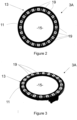
- Part 3A is shown in more detail in figures 2 and 3 and comprises a base plate 11 and an optical display unit 13 supported by the base plate 11.
- the base plate 11 and the optical display unit 13 present a central opening 15 of the size of an observation window 9A, 9B of the automated phoropter 1 allowing part 3A formed of the base plate 11 and the optical display unit 13 of the retinoscopic aid device 3 to be centered around the observation window 9A or 9B and allowing observation of a patient's eye through the central opening 15 and observation window 9A, 9B while manual examination with a streak retinoscope 17 (see figure 4 ).
- the optical display unit 13 comprises a ring of light sources 19 (only some of them are exemplary referenced in the drawing), in particular LEDs which may be powered for example by a battery and which are regular disposed in a circle arrangement around a center.
- the number of light sources 19 depends on the angular resolution which is desired to be achieved.
- the optical display unit comprises 20 light sources allowing to reach an angular resolution of 18°. In case for example an angular resolution of 5° shall be reached, the number of light sources 19 needs to be 72.
- the optical display unit 13 is configured to display an orientable straight line mark 21 (shown in figure 5 ).
- the base plate 11 is configured to be detachably fastened to the automated phoropter 1, in particular at the observation window 9A or 9B, on the practitioner or user side.
- the base plate 11 can have an extended shape corresponding to the shape of the casing and cover of the phoropter's halves 5A or 5B. In this case, one might replace the original casing of the halves 5A /5B. In other examples, with extended shape, the base plate 11 can partially cover halves 5A or 5B.
- a magnetic solution where the base plate 11 is for example made of a magnetic material and can be attached directly to the ferromagnetic part of the casing of the automated phoropter 1.
- Another solution may comprise individual magnets which are for example fixed in particular by gluing to the back side of the base plate 11 which is opposite to the side supporting the light sources 19 and whose locations corresponds to metallic parts in casing of halves 5A or 5B,
- the phoropter's casing is not metallic but for example plastic
- scratch fasteners where one element of the scratch fastener is for example fixed by gluing on the automated phoropter 1, in particular in form of a ring around the observation windows 9A and 9B and the other on the backside of the base plate 11.
- the retinoscopic aid device 1 comprises a part 3B which is a control unit configured to switch the light sources 19 according to an illumination pattern representing a virtual straight line mark 21.
- the straight line 21 that is a virtual line, is shown on figure 5 for explanation but in normal use, the practitioner or user needs to image the straight line 21 by connecting in his mind the illuminated light sources 19 by a line,
- the control unit 3B is configured such that only two light sources 19 which are opposed with regard to the center may be switched on at the same time, these two switched on light sources 19 representing two points belonging to the straight line mark 21.
- the control unit 3B can be integrated / supported by the base plate 11 of extended shape.
- the scroll wheel unit 25 can rotate as shown by arrow 23 in figure 1 .
- the display unit 13 and the control unit 3B are for example equipped with wireless communications means based for instance on well known communication protocols like Bluetooth or Zigbee (registered trademarks) or with wired communication when located on the same platform, potentially connected with the Keyboard.
- wireless communications means based for instance on well known communication protocols like Bluetooth or Zigbee (registered trademarks) or with wired communication when located on the same platform, potentially connected with the Keyboard.
- both units 3B and 13 are quite close to another and in general only a one direction communication is required to transmit control commands, one might also use for example other or simpler NFC communication protocols or data exchanges based on active or passive RFID technology.
- control unit 3B can both interact with part 3A and the phoropter's control unit, in particular in allowing control of some functions which are normally controlled by the operator via keyboard control, in particular to control variation of lens power in the case of an improved phoropter, or the automatic change of the lens (and therefore the power of the lens) to be put on the optical path in the case of a motorized phoropter.
- the scroll wheel unit 25 comprises in addition a central push button which may allow the operator to change for example between a first mode of control of part 3A in particular the display unit 13 and a second mode of control of lens power of the lens along the oprical path of the phoropter 1.
- two opposite specific light sources 19 will be illuminated or activated in order to display straight line mark 21 which orientation for example with regard to a horizontal line depends on the angular position of the scroll wheel unit 25.
- the practitioner or user will actuate the scroll wheel unit 25 to align the straight line mark 21 with the axis of the streak orientation of the light reflex in the patient's pupil as observed in the retinoscope, allowing to determine the axis of the subject's astigmatism.
- control unit 3B is detachably fixed to the automated phoropter 1 allows to ease the retinoscopic examination because as shown in figure 4 , the practitioner or user U can hold in one hand the retinoscope 17 and can control at arm length the control unit 3B.
- the control unit 3B of the optical display unit 11 may be integrated to the automated phoropter 1 and is for example configured to be controlled by a user interface in particular a keyboard unit of the automated / motorized phoropter 1.
- the retinoscopic aid device may comprise in a more sophisticated version a display screen 27, in particular an LCD screen which can communicate with the control unit 3B and displays a value for example of the orientation of the straight line mark 21 with respect to a straight vertical line in ° like shown "XX,X°".
- the display screen 27 may be detachable be fixed like the base plate 11 or the control unit 3B to the automated phoropter 1.
- the display screen 27 can be integrated / supported by the base plate 11 of extended shape.
- the display screen can also be involved and shows in the first mode described above the axis orientation optionally together with the current power of the lens along the optical path, and in the second mode of control the selected lens power.
- the optical display unit 13 has two light sources which are disposed in opposition with regard to the rotation center and represent the straight line mark and the retinoscopic aid device 3 comprises a bearing arranged between the base plate 11 and the optical display unit 13 which plays at the same time the function of the control unit 3B for changing the orientation of the straight line mark 21.
- the user when the two light sources are activated, the user can rotate the optical display unit 13 by taking it between the thumb and index finger tip during the retinoscopic examination in order to adapt the orientation of the straight line mark according to his observations.
- Such measured orientation may be then transferred either automatically or manually to the phoropter keyboard for good orientation of the cylinder before astigmatic neutralization.
- FIG 4 a practitioner or user U who has in his one hand a retinoscope 17.
- the practitioner U is positioned at arm length from the automated phoropter 1.
- a patient or individual P is looking in direction to the practitioner U through the observation windows 9A and 9B (see figure 1 ) of the automated phoropter 1.
- the controller unit 3B in particular the scroll wheel unit 25, the practitioner U can orient the straight line mark 21 (see on figure 5 ) according to his observations.
- a control command is send to the display unit 13 and in function of the angular position of the scroll wheel, the light sources 19 are activated and representing the angular position of the scroll wheel and in particular the streak image orientation observed by the practitioner U through the retinoscope 17.
- the angular position is then used to orient the phoropter cylinder, either manually on the keyboard after reading the value on display screen 27, or automatically through communication with the control unit of the phoropter 1.
- control unit 3B of the optical display unit 13 is configured to orient the straight line mark 21 of the optical display unit 13 according to a control command of the practitioner U allowing him to orient the straight line mark 21 according to the observation of the streak orientation of the portable streak retinoscope 17 when looking through the portable retinoscope 17.
- the practitioner P looks through the streak retinoscope 17 in direction of one individual's eye, the individual or patient P being looking through the automated phoropter 1, in particular through the observation windows 9A/ 9B.
- the practitioner P After neutralization of the first meridian, the practitioner P then adjusts according to his observations the straight line mark 21 of the optical display unit 13 to be orientated according the streak image orientation of the retinoscope 1 which he/she observes after 90° rotation.
- the phoropter can be equipped with two optical display units 13 for the two observation windows 9A, 9B according to the invention.
Landscapes
- Life Sciences & Earth Sciences (AREA)
- Health & Medical Sciences (AREA)
- Medical Informatics (AREA)
- Biophysics (AREA)
- Ophthalmology & Optometry (AREA)
- Engineering & Computer Science (AREA)
- Biomedical Technology (AREA)
- Heart & Thoracic Surgery (AREA)
- Physics & Mathematics (AREA)
- Molecular Biology (AREA)
- Surgery (AREA)
- Animal Behavior & Ethology (AREA)
- General Health & Medical Sciences (AREA)
- Public Health (AREA)
- Veterinary Medicine (AREA)
- Eye Examination Apparatus (AREA)
- Endoscopes (AREA)
Priority Applications (3)
| Application Number | Priority Date | Filing Date | Title |
|---|---|---|---|
| EP23315342.8A EP4520253A1 (fr) | 2023-09-06 | 2023-09-06 | Dispositif d'aide retinoscopique |
| CN202411240555.3A CN119564144A (zh) | 2023-09-06 | 2024-09-05 | 视网膜镜辅助装置 |
| US18/826,993 US20250072750A1 (en) | 2023-09-06 | 2024-09-06 | Retinoscopic aid device |
Applications Claiming Priority (1)
| Application Number | Priority Date | Filing Date | Title |
|---|---|---|---|
| EP23315342.8A EP4520253A1 (fr) | 2023-09-06 | 2023-09-06 | Dispositif d'aide retinoscopique |
Publications (1)
| Publication Number | Publication Date |
|---|---|
| EP4520253A1 true EP4520253A1 (fr) | 2025-03-12 |
Family
ID=88290686
Family Applications (1)
| Application Number | Title | Priority Date | Filing Date |
|---|---|---|---|
| EP23315342.8A Pending EP4520253A1 (fr) | 2023-09-06 | 2023-09-06 | Dispositif d'aide retinoscopique |
Country Status (3)
| Country | Link |
|---|---|
| US (1) | US20250072750A1 (fr) |
| EP (1) | EP4520253A1 (fr) |
| CN (1) | CN119564144A (fr) |
Citations (6)
| Publication number | Priority date | Publication date | Assignee | Title |
|---|---|---|---|---|
| US4834528A (en) * | 1986-08-15 | 1989-05-30 | Cornell Research Foundation, Inc. | Infrared photoretinoscope |
| WO1998013665A1 (fr) * | 1996-09-27 | 1998-04-02 | Eberhard-Karls-Universität Tübingen | Procede et dispositif de mesure d'une bosse sur une surface, notamment sur la retine d'un oeil |
| US20040032568A1 (en) | 2002-08-14 | 2004-02-19 | Kabushiki Kaisha Topcon | Subjective optometric apparatus |
| US20160073853A1 (en) * | 2013-05-15 | 2016-03-17 | Koninklijke Philips N.V. | Imaging a patient's interior |
| EP3128894A1 (fr) | 2014-04-08 | 2017-02-15 | Essilor International (Compagnie Générale D'Optique) | Réfracteur et procédé de mesure de réfraction utilisant un tel réfracteur |
| CN111419171A (zh) * | 2020-04-06 | 2020-07-17 | 苏州微清医疗器械有限公司 | 一种视力筛查仪 |
-
2023
- 2023-09-06 EP EP23315342.8A patent/EP4520253A1/fr active Pending
-
2024
- 2024-09-05 CN CN202411240555.3A patent/CN119564144A/zh active Pending
- 2024-09-06 US US18/826,993 patent/US20250072750A1/en active Pending
Patent Citations (6)
| Publication number | Priority date | Publication date | Assignee | Title |
|---|---|---|---|---|
| US4834528A (en) * | 1986-08-15 | 1989-05-30 | Cornell Research Foundation, Inc. | Infrared photoretinoscope |
| WO1998013665A1 (fr) * | 1996-09-27 | 1998-04-02 | Eberhard-Karls-Universität Tübingen | Procede et dispositif de mesure d'une bosse sur une surface, notamment sur la retine d'un oeil |
| US20040032568A1 (en) | 2002-08-14 | 2004-02-19 | Kabushiki Kaisha Topcon | Subjective optometric apparatus |
| US20160073853A1 (en) * | 2013-05-15 | 2016-03-17 | Koninklijke Philips N.V. | Imaging a patient's interior |
| EP3128894A1 (fr) | 2014-04-08 | 2017-02-15 | Essilor International (Compagnie Générale D'Optique) | Réfracteur et procédé de mesure de réfraction utilisant un tel réfracteur |
| CN111419171A (zh) * | 2020-04-06 | 2020-07-17 | 苏州微清医疗器械有限公司 | 一种视力筛查仪 |
Also Published As
| Publication number | Publication date |
|---|---|
| US20250072750A1 (en) | 2025-03-06 |
| CN119564144A (zh) | 2025-03-07 |
Similar Documents
| Publication | Publication Date | Title |
|---|---|---|
| JP5227324B2 (ja) | コンパクト眼底カメラ | |
| US8836778B2 (en) | Portable fundus camera | |
| US12588811B2 (en) | Modular platform for ocular evaluations | |
| KR101995877B1 (ko) | 눈 처방을 결정하는 장치 및 방법 | |
| US20130083185A1 (en) | Optical adapter for ophthalmological imaging apparatus | |
| JP7376491B2 (ja) | 人の眼球光学系の光学式走査を自己管理するための装置及び方法 | |
| US20210330186A1 (en) | Portable screening devices and systems for remote opthalmic diagnostics | |
| RU2634682C1 (ru) | Портативное устройство для исследования зрительных функций | |
| CN110251073A (zh) | 一种智能筛查斜视及屈光度的诊断装置 | |
| KR20180095180A (ko) | 안과용 촬영장치 | |
| EP4520253A1 (fr) | Dispositif d'aide retinoscopique | |
| WO2004036268A2 (fr) | Dispositif et procede d'auto-mesure de la pression intra-oculaire | |
| CN114903423A (zh) | 一种调节幅度和集合近点测量仪 | |
| CN116982927A (zh) | 一种多镜头眼科检查设备及方法 | |
| CN214761039U (zh) | 全自动台式眼底相机系统 | |
| CN210842986U (zh) | 一种自动定位瞳孔位置的验光装置 | |
| JP2846633B2 (ja) | 屈折力検査装置 | |
| KR101133255B1 (ko) | 동공반사 및 안저검사 훈련용 시뮬레이터 | |
| TW202033151A (zh) | 自動化個人視覺追蹤器 | |
| CN214906728U (zh) | 一种斜视检测装置 | |
| CN222955415U (zh) | 一种眼部检测装置 | |
| JPH11128169A (ja) | 検眼装置 | |
| US20240180417A1 (en) | Vision test system for subjective refraction measurement | |
| US20240138676A1 (en) | Camera for diagnosing ophthalmic and control method for the same | |
| Truong | Design and Rapid Prototyping of Portable Ophthalmic Measurement Instruments for Frequent Self-monitoring of Eye Conditions |
Legal Events
| Date | Code | Title | Description |
|---|---|---|---|
| PUAI | Public reference made under article 153(3) epc to a published international application that has entered the european phase |
Free format text: ORIGINAL CODE: 0009012 |
|
| STAA | Information on the status of an ep patent application or granted ep patent |
Free format text: STATUS: THE APPLICATION HAS BEEN PUBLISHED |
|
| AK | Designated contracting states |
Kind code of ref document: A1 Designated state(s): AL AT BE BG CH CY CZ DE DK EE ES FI FR GB GR HR HU IE IS IT LI LT LU LV MC ME MK MT NL NO PL PT RO RS SE SI SK SM TR |
|
| STAA | Information on the status of an ep patent application or granted ep patent |
Free format text: STATUS: REQUEST FOR EXAMINATION WAS MADE |
|
| 17P | Request for examination filed |
Effective date: 20250911 |