EP4520456A2 - Procédé de fabrication d'une liaison par liaison de matière entre un insert et un matériau coulé et un produit intermédiaire - Google Patents
Procédé de fabrication d'une liaison par liaison de matière entre un insert et un matériau coulé et un produit intermédiaire Download PDFInfo
- Publication number
- EP4520456A2 EP4520456A2 EP24198906.0A EP24198906A EP4520456A2 EP 4520456 A2 EP4520456 A2 EP 4520456A2 EP 24198906 A EP24198906 A EP 24198906A EP 4520456 A2 EP4520456 A2 EP 4520456A2
- Authority
- EP
- European Patent Office
- Prior art keywords
- insert
- layer
- protective layer
- melt
- casting
- Prior art date
- Legal status (The legal status is an assumption and is not a legal conclusion. Google has not performed a legal analysis and makes no representation as to the accuracy of the status listed.)
- Pending
Links
Images


Classifications
-
- B—PERFORMING OPERATIONS; TRANSPORTING
- B22—CASTING; POWDER METALLURGY
- B22D—CASTING OF METALS; CASTING OF OTHER SUBSTANCES BY THE SAME PROCESSES OR DEVICES
- B22D19/00—Casting in, on, or around objects which form part of the product
- B22D19/0081—Casting in, on, or around objects which form part of the product pretreatment of the insert, e.g. for enhancing the bonding between insert and surrounding cast metal
-
- B—PERFORMING OPERATIONS; TRANSPORTING
- B22—CASTING; POWDER METALLURGY
- B22D—CASTING OF METALS; CASTING OF OTHER SUBSTANCES BY THE SAME PROCESSES OR DEVICES
- B22D19/00—Casting in, on, or around objects which form part of the product
- B22D19/04—Casting in, on, or around objects which form part of the product for joining parts
Definitions
- the invention lies in the field of foundry technology. It relates to methods for producing a material-to-material connection between an insert and casting material, in particular aluminum. It also relates to an intermediate product for use in a casting process.
- aluminum offers extensive potential for lightweight construction.
- the material is used as a cast and wrought alloy, particularly in automotive body construction.
- Assembled aluminum constructions consisting of complex-shaped cast structures and simple sheet/profile structures joined together in a conventional manner are established.
- the insert can be made of identical, similar material (e.g., aluminum insert in aluminum casting, steel insert in cast iron or cast steel, etc.), or dissimilar material.
- the connection between the casting and insert can be achieved through force, form, or material bonding, as well as through combinations of these basic mechanisms.
- connection The requirements for the connection vary depending on the intended use of the assembly to be produced, especially in the Transfer of forces, heat, and/or electrical energy. In all cases, but especially when transferring heat or electrical energy, a material-to-material bond is preferred. Accordingly, the composite casting of molten aluminum material with solid aluminum semi-finished material as an insert – with the goal of a material-to-material bond – represents a challenge that has not yet been satisfactorily solved technically.
- a problem here is the corrosion protection layer of aluminum oxide (Al 2 O 3 ) that forms naturally on aluminum surfaces even upon contact with small amounts of oxygen.
- a firmly adhering oxide layer forms, which, due to its high strength and a melting point of approximately 2,000°C, acts as a "barrier layer" on the insert to be cast and hinders the melting of the aluminum semi-finished product upon contact with the aluminum melt.
- the melted or melted semi-finished product of the insert now has direct contact with the molten metal and can form a material bond.
- the filling of the casting mold and thus the pouring or encapsulation of the insert takes place comparatively quickly within less up to approximately 100 milliseconds.
- the process is characterized by a more spraying, droplet-distributed filling of the mold, rather than a laminar melt flow. This means that the flowing effect for temperature transfer from the melt to the insert can be comparatively lower.
- die casting usually produces components with thin walls between 2 - 10 mm, which means that less volume of molten metal is available for temperature transfer from the melt to the insert.
- DE 10 2020 206 009 A1 relates to a method for coating a component made of a base material, which has a cover layer, in particular a closed one, made of a first cover material, with a coating material.
- the coating material is applied to the component in the form of powder particles by means of a process gas stream by cold gas spraying, wherein the process gas stream is adjusted such that it contains both first powder particles, which, due to their speed, each remove a portion of the cover material, and second particles, which, due to their speed, experience deformation upon impact with the surface of the component and weld to the component surface, penetrating the oxide layer and creating a bond between the sprayed-on material and the insert.
- the new surface thus consists of the sprayed-on material, for which materials with a low tendency to oxidation are selected, which also support the formation of the bond during casting.
- the process results in an intermediate layer between the casting and the insert, which differs in its properties from both materials and can have a negative impact on the overall component behavior.
- EP 0 854 763 B1 The aim of this study is to increase the strength of the intermetallic bond between an engine component made of an aluminum-based alloy and a reinforcement made of austenitic cast iron. To this end, the reinforcement is annealed in a decarburizing atmosphere prior to the Alfin process, which is known in the art, in order to obtain an Alfin layer largely free of graphite flakes.
- the EP 0 498 719 A1 describes a two-step coating process: applying an oxidation-resistant metal followed by another layer, which is to be dissolved or dissolved during the aluminum casting process. Ultimately, the described solution aims to form a bond-forming layer between the insert and the casting material as an intermediate layer.
- Zinc or zincate coatings ( US 5 293 923 A , DE 10 2007 026 005 A1 ) pursue the technological approach of deliberately leaving this coating as an adhesion promoter layer between the joining partners in the composite casting.
- this coating As an adhesion promoter layer between the joining partners in the composite casting.
- the formation of a bond-forming layer between the insert and the casting material is pursued as an intermediate layer.
- document US 5 273 099 A shows a method for joining aluminum composite parts.
- a chemical film containing potassium and fluorine is formed on an aluminum member, or a flux containing potassium and fluorine is applied to an aluminum member.
- the coated aluminum member, along with a disposable pattern in a predetermined assembled state, is embedded in a mold containing molding sand.
- a molten aluminum alloy is then poured into the mold, forming an aluminum alloy casting.
- document US 4 643 241 A shows a process for producing an aluminum composite material, which is to be integrally formed by bonding aluminum or an aluminum alloy to an aluminum or aluminum alloy member formed in advance into a specified shape by the internal cooling method, etc.
- the method includes the steps of forming a chemical conversion coating of pentafluoroaluminate (K2AlF5) by bringing a solution containing potassium ions and fluorine ions into contact with the surface of the aluminum member.
- K2AlF5 pentafluoroaluminate
- a method for producing a material-to-material bond between a cast part and an insert, by which the above-mentioned deficiencies are at least partially remedied comprises, for example, the features mentioned in claim 1.
- the deficiencies mentioned above can be attributed in particular to This can be remedied by removing a barrier layer on the insert and using a protective layer on an insert that completely or at least partially prevents the formation of a new barrier layer, which is designed as a "sacrificial layer".
- a protective layer is applied to a surface of the insert.
- the insert which has the protective layer, is brought into contact with the casting material in the form of a melt.
- the protective layer is removed by contact with the melt, so that the surface of the insert is exposed again.
- the casting material comes into direct contact with the surface of the insert.
- the casting material forms the material-to-material bond with this surface.
- An intermediate product according to the application for use in a casting process is formed from an element provided as an insert with a protective layer arranged on a surface of the element provided as an insert.
- the surface of the insert on which the protective layer is applied is, for example, oxide-free or low-oxide.
- Aluminum in particular, is prone to oxidation in process-relevant atmospheres. Therefore, inserts often initially have an oxide layer as a barrier layer. This barrier layer is then removed to expose the surface of the purest possible non-oxidized aluminum ("core material” or "insert material”), which is later intended to form a direct, material-to-material bond with the melt.
- barrier layers are also conceivable, such as hydroxide layers.
- inserts should also be free of other types of barrier layers that would impede a direct, material-to-material bond between the core material and the melt.
- a direct material-fit The aim is to bond the insert material or core material to the casting material, in particular without a bonding layer (intermetallic phase or similar) arranged in between.
- the barrier layer can be removed in a preparatory step of the process, for example, by mechanical ablation, galvanic treatment, laser processing, or plasma treatment. After removal of the barrier layer, the protective layer is then applied, which primarily protects against further oxidation.
- the protective layer can be, for example, a sol-gel layer (preferably containing silicon) and/or a plasma polymer layer (preferably containing silicon) and/or synthetic resin and/or epoxy resin and/or a polyelectrolyte multilayer (PEM) and/or a self-assembling monolayer (SAM) and/or polymer layer (which preferably contain nitrogen and/or sulfur and/or phosphorus) and/or metallic layer (which have been deposited by means of a brewing process and/or alternative electroplating processes and/or).
- a sol-gel layer preferably containing silicon
- a plasma polymer layer preferably containing silicon
- synthetic resin and/or epoxy resin and/or a polyelectrolyte multilayer (PEM) and/or a self-assembling monolayer (SAM) and/or polymer layer (which preferably contain nitrogen and/or sulfur and/or phosphorus) and/or metallic layer (which have been deposited by means of a brewing process and/or alternative electroplating processes and/or).
- the protective layer is preferably applied to the insert immediately after the possible removal of the barrier layer and covers the reactive surface of the insert.
- the protective layer can prevent further reaction with the process-relevant atmosphere.
- the removal of the barrier layer and/or application of the protective layer preferably takes place in a protective environment that protects against atmospheric oxygen, for example, in an inert gas such as argon or within a liquid, e.g., aqueous (weakly acidic pH ⁇ 4 or alkaline pH ⁇ 10). Both steps preferably take place in the same environment.
- the removal of the barrier layer and/or application of the protective layer is carried out using inline and/or online monitoring, preferably using optical, chemical, or electrochemical methods. This monitoring serves to ensure the quality of the insert's surface properties.
- the insert including the protective layer, is subjected to a casting process.
- the reactive surface of the insert is released again so that a melt can come into contact with the barrier-free or barrier-poor surface of the insert and the formation of a material-tight connection is enabled.
- the insert with the protective coating is brought into contact with the casting material in the form of a melt.
- the insert can be completely surrounded by the melt, for example.
- the surface of the insert can only come into contact with the melt in certain areas.
- the protective layer is preferably removed by contact with the melt, so that the surface of the insert is exposed again.
- the melt acting on the protective layer in such a way that it decomposes, and/or evaporates, and/or detaches, and/or washes away, and/or alloys with the protective layer.
- the components are selected such that the melting, vapor, or decomposition points of the protective layer are below the solidus temperature of the core material of the insert.
- the present application also discloses methods in which a substance, preferably containing chloride or fluoride, is applied to the barrier layer.
- a substance preferably containing chloride or fluoride
- This substance during the casting process, particularly under heat, leads to chemical decomposition of the barrier layer, thus exposing the surface of the insert, which comes into contact with the melt in situ before reoxidation of the insert surface occurs.
- the barrier layer to which the substance was applied can be decomposed and/or evaporated and/or detached and/or washed away, for example, by the action of the melt.
- the melt is preferably an aluminum melt.
- the melt can also be an aluminum alloy and, for example, silicon and/or Contain zinc and/or copper and/or magnesium.
- the melt may also contain zinc, magnesium, copper, iron or steel, nickel, titanium, or another metallic element, as well as alloys based on these elements.
- the melt, especially aluminum melt exhibits a typical melting temperature during casting, depending on the alloy; for aluminum alloys, this temperature is approximately in the range of 550–850°C.
- the melt can then come into direct contact with the barrier-free or barrier-poor surface of the insert and finally the casting material can form the material-to-material bond with this surface.
- the insert may, for example, comprise aluminum. In particular, it may consist of aluminum or an aluminum alloy. Alternatively or additionally, the insert may also comprise or consist of magnesium and/or iron or steel and/or copper and/or titanium and/or zinc, or an alloy of these materials.
- the invention can be used with particular advantage for aluminum-aluminum joints, i.e. the melt and insert are made of aluminum.
- the melt can be brought into contact with the insert, in particular the surface of the insert, in particular during a die-casting process.
- the insert together with the protective layer on its surface, is preheated.
- the insert with the protective layer can then be brought into contact with the melt in a heated state. This can, for example, promote the dissolution or detachment process of the protective layer and/or the formation of the cohesive bond.
- a subsequent heat treatment is carried out on the insert and the cast material arranged thereon.
- the material connection between these two components of the composite component can be achieved by the heat treatment. created and/or promoted and/or matured. This means that it is possible that the material-to-material bond is created, promoted or matured subsequently, whereby the process for forming the material-to-material bond does not take place or does not take place sufficiently or is not completed during the recasting, but is initiated and/or completed in the post-processing step.
- An intermediate product for use in a casting process is formed from an element provided as an insert, wherein a protective layer according to the application is arranged on a surface of the element provided as an insert.
- the protective layer is, for example, in direct contact with the surface of the element intended as an insert, which is free of a barrier layer and in particular is oxide-free or low in oxide.
- Fig. 1a shows an insert 1 that is to be joined to a cast material.
- the insert 1 can be an aluminum semi-finished product.
- Fig. 1a shows an initial state in which an entire surface 1' of the insert 1 is covered with a barrier layer 4 of natural aluminum oxide. This barrier layer 4 is removed in a preparatory step. The removal occurs, for example, via a mechanical-abrasive or a chemical-galvanic or a laser-based or plasma-based cleaning process.
- Fig. 1b shows the process by which the barrier layer 4 of natural aluminum oxide was removed from the surface 1' of the insert 1. This exposes "bare” and oxide-free or low-oxide aluminum on the surface 1'.
- the removal process takes place in the absence of atmospheric oxygen, as shown here as an example in a protective environment 6, for example a protective gas atmosphere of argon or similar, or in a fluidic protective environment.
- a protective environment 6 for example a protective gas atmosphere of argon or similar, or in a fluidic protective environment.
- Fig. 1c shows that in order to permanently prevent new oxidation, a protective layer 3 is applied to the surface 1' of the insert 1 in a protective environment 6.
- This protective layer 3 preferably does not form a bond to the base material of the insert 1, but is preferably diffusion-tight and thus prevents the contact of atmospheric oxygen and other covering layer-forming elements with the surface 1'.
- the application is therefore preferably immediately after process step 1 under the same protective environment 6 from the previous process step, in which the barrier layer 4 is removed.
- the protective layer 3 is formed, for example, from a sol-gel layer, preferably a silicon-containing sol-gel layer and/or from a plasma polymer layer, preferably a silicon-containing plasma polymer layer and/or from synthetic resin and/or from epoxy resin and/or from a polyelectrolyte multilayer (PEM) and/or from a self-assembling monolayer (SAM) and/or from a polymer layer, preferably containing nitrogen and/or sulfur and/or phosphorus and/or from a metallic layer.
- PEM polyelectrolyte multilayer
- SAM self-assembling monolayer
- the protective layer 3 is formed, for example, in a brewing process and/or in an electroplating process and/or by deposition.
- Fig. 1d Illustrates that the protective layer 3 serving as an oxidation protection layer remains on the insert 1, so that the insert can be removed from the protective environment 6, for example, the protective gas or protective fluid, for storage and transport and transported in the air.
- This is therefore an intermediate product for use in a casting process, wherein the intermediate product contains the insert 1 and wherein the protective layer 3 is arranged on a surface 1' of the insert 1 element.
- This intermediate product can therefore be produced as a supplier part and subsequently fed directly into the casting process.
- Fig. 1e to 1j illustrate the formation of the material-locking connection:
- the coated (possibly preheated) insert 1 together with the protective layer 3 on its surface 1' is inserted into a casting tool 5 ( Fig. 1e ).
- Fig. 1f illustrates that the insert 1 is completely or preferably partially cast with a melt 2' (e.g., aluminum melt) in the casting tool 5.
- a melt 2' e.g., aluminum melt
- a pressure-assisted casting process is preferably provided, in particular a die casting process, but it can also be a low-pressure casting process or a gravity casting process. It is also conceivable that the insert is only cast in certain areas.
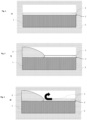
- Fig. 1g to 1i illustrate that the thermal and/or mechanical action of the melt, for example, causes the protective layer 3 to peel off or peel off from the surface 1' of the insert 1, whereby the bare, barrier-layer-poor or barrier-layer-free, in particular low-oxide or oxide-free aluminum is exposed again (hence the alternative term "sacrificial layer").
- the exposed aluminum surface Due to the high speed of mold filling in the die-casting process and, if necessary, an actively created absence of atmospheric oxygen due to a vacuum in the mold, the exposed aluminum surface has no reaction time to form a new barrier layer.
- the molten aluminum 2' can thus establish direct contact with the aluminum surface 1' and enable the surface of the insert to melt or melt to form a material-tight connection.
- the components of the protective layer 3 are at least partially and preferably completely detached from the insert and transported or washed into the casting or onto its surface ( Fig. 1g ).
- the protective layer can be flushed into overflows.
- the protective layer 3 can also be melted and/or dissolved and alloyed with the aluminum melt or remain as a dissolved foreign substance in the aluminum casting ( Fig. 1h ).
- the protective layer 3 can alternatively or additionally change into the gaseous state due to the thermal action of the molten aluminum 2' and be sucked off parallel to the filling of the casting mold 5 ( Fig. 1i ).
- Fig. 1j shows the cast composite component in which the melt has solidified into an aluminum casting material 2 containing the insert 1.
- a subsequent heat treatment may be carried out.
- a subsequent heat treatment of the composite component may be provided to subsequently create, promote, or mature the material bond. This means that it is conceivable that the process for forming the material bond could be carried out during the casting process ( Fig. 1f and 1g or 1h or 1i) does not take place or does not take place sufficiently or is not completed, but is triggered and/or completed in the post-processing step.
Landscapes
- Engineering & Computer Science (AREA)
- Mechanical Engineering (AREA)
- Molds, Cores, And Manufacturing Methods Thereof (AREA)
- Pressure Welding/Diffusion-Bonding (AREA)
Applications Claiming Priority (1)
| Application Number | Priority Date | Filing Date | Title |
|---|---|---|---|
| DE102023208719.7A DE102023208719A1 (de) | 2023-09-08 | 2023-09-08 | Verfahren zur Herstellung einer stoffschlüssigen Verbindung zwischen einem Einlegeteil und Gussmaterial und Zwischenprodukt |
Publications (2)
| Publication Number | Publication Date |
|---|---|
| EP4520456A2 true EP4520456A2 (fr) | 2025-03-12 |
| EP4520456A3 EP4520456A3 (fr) | 2025-03-19 |
Family
ID=92711035
Family Applications (1)
| Application Number | Title | Priority Date | Filing Date |
|---|---|---|---|
| EP24198906.0A Pending EP4520456A3 (fr) | 2023-09-08 | 2024-09-06 | Procédé de fabrication d'une liaison par liaison de matière entre un insert et un matériau coulé et un produit intermédiaire |
Country Status (2)
| Country | Link |
|---|---|
| EP (1) | EP4520456A3 (fr) |
| DE (1) | DE102023208719A1 (fr) |
Citations (9)
| Publication number | Priority date | Publication date | Assignee | Title |
|---|---|---|---|---|
| US4643241A (en) | 1984-07-26 | 1987-02-17 | Kabushiki Kaisha Toyota Chuo Kenkyusho | Method of preparing composite aluminum material |
| EP0498719A1 (fr) | 1991-02-05 | 1992-08-12 | Montupet S.A. | Insert pour pièce coulée composite |
| US5273099A (en) | 1989-05-18 | 1993-12-28 | Aisin Seiki Kabushiki Kaisha | Composite aluminum member joining process |
| US5293923A (en) | 1992-07-13 | 1994-03-15 | Alabi Muftau M | Process for metallurgically bonding aluminum-base inserts within an aluminum casting |
| US5377742A (en) | 1992-03-04 | 1995-01-03 | Pechiney Recherche | Process for obtaining bimaterial parts by casting an alloy around an insert coated with a metal film |
| DE19736790A1 (de) | 1997-08-23 | 1999-02-25 | Honsel Gusprodukte Gmbh | Verbundgießverfahren |
| EP0854763B1 (fr) | 1995-10-11 | 1999-09-01 | Mahle GmbH | Procede de production d'une liaison intermetallique |
| DE102007026005A1 (de) | 2007-06-04 | 2008-02-14 | Daimler Ag | Beschichtete Bauteile aus AI-Legierungen zum Eingießen in Leichtmetalllegierungen und deren Herstellungsverfahren |
| DE102020206009A1 (de) | 2020-05-13 | 2021-11-18 | Fraunhofer-Gesellschaft zur Förderung der angewandten Forschung eingetragener Verein | Verfahren zur Erzeugung einer stoffschlüssigen Verbindung im Verbundguss |
Family Cites Families (5)
| Publication number | Priority date | Publication date | Assignee | Title |
|---|---|---|---|---|
| DE4212716A1 (de) * | 1992-04-16 | 1993-10-21 | Ks Aluminium Technologie Ag | Verfahren zur Herstellung von Zylindern oder Zylinderblöcken |
| DE19745725A1 (de) * | 1997-06-24 | 1999-01-07 | Ks Aluminium Technologie Ag | Verfahren zum Herstellen eines Verbundgussteils |
| DE102010055162A1 (de) * | 2010-12-18 | 2012-06-21 | Mahle International Gmbh | Beschichtung sowie beschichtetes Eingussbauteil |
| DE102011108126A1 (de) * | 2011-07-21 | 2013-01-24 | Universität Siegen | Gussbauteil, Karosseriebauteil und Verfahren zu dessen Herstellung |
| DE102012104820B4 (de) * | 2012-06-04 | 2014-10-09 | Actech Gmbh | Verfahren zur Herstellung von Verbundgussteilen |
-
2023
- 2023-09-08 DE DE102023208719.7A patent/DE102023208719A1/de active Pending
-
2024
- 2024-09-06 EP EP24198906.0A patent/EP4520456A3/fr active Pending
Patent Citations (9)
| Publication number | Priority date | Publication date | Assignee | Title |
|---|---|---|---|---|
| US4643241A (en) | 1984-07-26 | 1987-02-17 | Kabushiki Kaisha Toyota Chuo Kenkyusho | Method of preparing composite aluminum material |
| US5273099A (en) | 1989-05-18 | 1993-12-28 | Aisin Seiki Kabushiki Kaisha | Composite aluminum member joining process |
| EP0498719A1 (fr) | 1991-02-05 | 1992-08-12 | Montupet S.A. | Insert pour pièce coulée composite |
| US5377742A (en) | 1992-03-04 | 1995-01-03 | Pechiney Recherche | Process for obtaining bimaterial parts by casting an alloy around an insert coated with a metal film |
| US5293923A (en) | 1992-07-13 | 1994-03-15 | Alabi Muftau M | Process for metallurgically bonding aluminum-base inserts within an aluminum casting |
| EP0854763B1 (fr) | 1995-10-11 | 1999-09-01 | Mahle GmbH | Procede de production d'une liaison intermetallique |
| DE19736790A1 (de) | 1997-08-23 | 1999-02-25 | Honsel Gusprodukte Gmbh | Verbundgießverfahren |
| DE102007026005A1 (de) | 2007-06-04 | 2008-02-14 | Daimler Ag | Beschichtete Bauteile aus AI-Legierungen zum Eingießen in Leichtmetalllegierungen und deren Herstellungsverfahren |
| DE102020206009A1 (de) | 2020-05-13 | 2021-11-18 | Fraunhofer-Gesellschaft zur Förderung der angewandten Forschung eingetragener Verein | Verfahren zur Erzeugung einer stoffschlüssigen Verbindung im Verbundguss |
Non-Patent Citations (2)
| Title |
|---|
| PINTORE, M.: "Gießtechnische Herstellung und technologische Charakterisierung von Kupfer-Aluminium-Schichtverbunden", 2020, TUM UNIVERSITY PRESS |
| SCHWANKL, M.: "Al-Al-Verbundguss - Technologische Grundlagen und", 2017, FAU UNIVERSITY PRESS |
Also Published As
| Publication number | Publication date |
|---|---|
| DE102023208719A1 (de) | 2025-03-13 |
| EP4520456A3 (fr) | 2025-03-19 |
Similar Documents
| Publication | Publication Date | Title |
|---|---|---|
| DE10043105B4 (de) | Metallurgische Bindung beschichteter Einsätze innerhalb von Metallgußteilen | |
| EP1124660B1 (fr) | Bloc-cylindres, procede de fabrication des chemises de cylindre correspondantes et procede de fabrication du bloc-cylindres avec ces chemises de cylindre | |
| DE102016114580B4 (de) | Verfahren zum formen eines zweimetall-gussstücks | |
| EP0229954B1 (fr) | Procédé de fabrication d'éléments de construction intégraux en aluminium hautement résistant | |
| DE102013213790A1 (de) | Verfahren zur Herstellung einer Bremsscheibe sowie Bremsscheibe | |
| DE102007026005A1 (de) | Beschichtete Bauteile aus AI-Legierungen zum Eingießen in Leichtmetalllegierungen und deren Herstellungsverfahren | |
| DE3614475A1 (de) | Verfahren zur herstellung eines verbundbauteils | |
| CH659483A5 (de) | Metallische giessform und verfahren zu deren herstellung. | |
| DE69225163T2 (de) | Eingiessteil für Verbundgussstück | |
| DE69002691T2 (de) | Metallpulversprühbeschichtungswerkstoff, Verfahren zu seiner Herstellung und Verwendung. | |
| DE102009030426A1 (de) | Verfahren zum Herstellen eines Verbundbauteils | |
| EP2049288A2 (fr) | Fondant et procédé pour réduire des couches d'oxyde sur des surfaces métalliques | |
| EP4520456A2 (fr) | Procédé de fabrication d'une liaison par liaison de matière entre un insert et un matériau coulé et un produit intermédiaire | |
| EP2343143A2 (fr) | Procédé de fabrication de composants en métaux réfractaires | |
| DE2657271C2 (de) | Verfahren zum Herstellen eines rohrförmigen Körpers aus verschleißfestem Metall | |
| DE102004010763C5 (de) | Verbundbauteil | |
| DE102006041901A1 (de) | Eingussverfahren zur Herstellung von metallischen Verbundbauteilen | |
| EP2110465B1 (fr) | Procédé destiné à la fabrication d'un composant métallique ainsi que composant fabriqué de cette manière | |
| DE102024202939A1 (de) | Verfahren und Gießvorrichtung zur Herstellung einer stoffschlüssigen Verbindung zwischen einem Einlegeteil und einem Gussmaterial | |
| WO2018096055A1 (fr) | Revêtement pour matériau de support, partie centrale pour la fabrication d'un élément composite, élément composite et procédé de fabrication d'un élément composite | |
| DE102004031164B4 (de) | Eingusskörper mit Außenbeschichtung zur Herstellung von Verbundkörpern | |
| DE102024202938A1 (de) | Verfahren und Gießvorrichtung zur Herstellen einer stoffschlüssigen Verbindung zwischen einem Einlegeteil und einem Gussmaterial | |
| DE102020206009A1 (de) | Verfahren zur Erzeugung einer stoffschlüssigen Verbindung im Verbundguss | |
| AT504923A1 (de) | Verbundgussteil | |
| DE102011108126A1 (de) | Gussbauteil, Karosseriebauteil und Verfahren zu dessen Herstellung |
Legal Events
| Date | Code | Title | Description |
|---|---|---|---|
| PUAI | Public reference made under article 153(3) epc to a published international application that has entered the european phase |
Free format text: ORIGINAL CODE: 0009012 |
|
| STAA | Information on the status of an ep patent application or granted ep patent |
Free format text: STATUS: THE APPLICATION HAS BEEN PUBLISHED |
|
| PUAL | Search report despatched |
Free format text: ORIGINAL CODE: 0009013 |
|
| AK | Designated contracting states |
Kind code of ref document: A2 Designated state(s): AL AT BE BG CH CY CZ DE DK EE ES FI FR GB GR HR HU IE IS IT LI LT LU LV MC ME MK MT NL NO PL PT RO RS SE SI SK SM TR |
|
| AK | Designated contracting states |
Kind code of ref document: A3 Designated state(s): AL AT BE BG CH CY CZ DE DK EE ES FI FR GB GR HR HU IE IS IT LI LT LU LV MC ME MK MT NL NO PL PT RO RS SE SI SK SM TR |
|
| RIC1 | Information provided on ipc code assigned before grant |
Ipc: B22D 19/04 20060101ALI20250213BHEP Ipc: B22D 19/00 20060101AFI20250213BHEP |
|
| STAA | Information on the status of an ep patent application or granted ep patent |
Free format text: STATUS: REQUEST FOR EXAMINATION WAS MADE |
|
| 17P | Request for examination filed |
Effective date: 20250919 |