EP4521038A1 - Zirkulationsvorrichtung für heizmedium - Google Patents
Zirkulationsvorrichtung für heizmedium Download PDFInfo
- Publication number
- EP4521038A1 EP4521038A1 EP24197790.9A EP24197790A EP4521038A1 EP 4521038 A1 EP4521038 A1 EP 4521038A1 EP 24197790 A EP24197790 A EP 24197790A EP 4521038 A1 EP4521038 A1 EP 4521038A1
- Authority
- EP
- European Patent Office
- Prior art keywords
- heating medium
- opening degree
- compressor
- temperature
- refrigerant
- Prior art date
- Legal status (The legal status is an assumption and is not a legal conclusion. Google has not performed a legal analysis and makes no representation as to the accuracy of the status listed.)
- Granted
Links
Images

Classifications
-
- F—MECHANICAL ENGINEERING; LIGHTING; HEATING; WEAPONS; BLASTING
- F25—REFRIGERATION OR COOLING; COMBINED HEATING AND REFRIGERATION SYSTEMS; HEAT PUMP SYSTEMS; MANUFACTURE OR STORAGE OF ICE; LIQUEFACTION SOLIDIFICATION OF GASES
- F25B—REFRIGERATION MACHINES, PLANTS OR SYSTEMS; COMBINED HEATING AND REFRIGERATION SYSTEMS; HEAT PUMP SYSTEMS
- F25B13/00—Compression machines, plants or systems, with reversible cycle
-
- F—MECHANICAL ENGINEERING; LIGHTING; HEATING; WEAPONS; BLASTING
- F25—REFRIGERATION OR COOLING; COMBINED HEATING AND REFRIGERATION SYSTEMS; HEAT PUMP SYSTEMS; MANUFACTURE OR STORAGE OF ICE; LIQUEFACTION SOLIDIFICATION OF GASES
- F25B—REFRIGERATION MACHINES, PLANTS OR SYSTEMS; COMBINED HEATING AND REFRIGERATION SYSTEMS; HEAT PUMP SYSTEMS
- F25B25/00—Machines, plants or systems, using a combination of modes of operation covered by two or more of the groups F25B1/00 - F25B23/00
- F25B25/005—Machines, plants or systems, using a combination of modes of operation covered by two or more of the groups F25B1/00 - F25B23/00 using primary and secondary systems
-
- F—MECHANICAL ENGINEERING; LIGHTING; HEATING; WEAPONS; BLASTING
- F25—REFRIGERATION OR COOLING; COMBINED HEATING AND REFRIGERATION SYSTEMS; HEAT PUMP SYSTEMS; MANUFACTURE OR STORAGE OF ICE; LIQUEFACTION SOLIDIFICATION OF GASES
- F25B—REFRIGERATION MACHINES, PLANTS OR SYSTEMS; COMBINED HEATING AND REFRIGERATION SYSTEMS; HEAT PUMP SYSTEMS
- F25B49/00—Arrangement or mounting of control or safety devices
- F25B49/02—Arrangement or mounting of control or safety devices for compression type machines, plants or systems
-
- F—MECHANICAL ENGINEERING; LIGHTING; HEATING; WEAPONS; BLASTING
- F25—REFRIGERATION OR COOLING; COMBINED HEATING AND REFRIGERATION SYSTEMS; HEAT PUMP SYSTEMS; MANUFACTURE OR STORAGE OF ICE; LIQUEFACTION SOLIDIFICATION OF GASES
- F25B—REFRIGERATION MACHINES, PLANTS OR SYSTEMS; COMBINED HEATING AND REFRIGERATION SYSTEMS; HEAT PUMP SYSTEMS
- F25B2313/00—Compression machines, plants or systems with reversible cycle not otherwise provided for
- F25B2313/003—Indoor unit with water as a heat sink or heat source
-
- F—MECHANICAL ENGINEERING; LIGHTING; HEATING; WEAPONS; BLASTING
- F25—REFRIGERATION OR COOLING; COMBINED HEATING AND REFRIGERATION SYSTEMS; HEAT PUMP SYSTEMS; MANUFACTURE OR STORAGE OF ICE; LIQUEFACTION SOLIDIFICATION OF GASES
- F25B—REFRIGERATION MACHINES, PLANTS OR SYSTEMS; COMBINED HEATING AND REFRIGERATION SYSTEMS; HEAT PUMP SYSTEMS
- F25B2313/00—Compression machines, plants or systems with reversible cycle not otherwise provided for
- F25B2313/004—Outdoor unit with water as a heat sink or heat source
-
- F—MECHANICAL ENGINEERING; LIGHTING; HEATING; WEAPONS; BLASTING
- F25—REFRIGERATION OR COOLING; COMBINED HEATING AND REFRIGERATION SYSTEMS; HEAT PUMP SYSTEMS; MANUFACTURE OR STORAGE OF ICE; LIQUEFACTION SOLIDIFICATION OF GASES
- F25B—REFRIGERATION MACHINES, PLANTS OR SYSTEMS; COMBINED HEATING AND REFRIGERATION SYSTEMS; HEAT PUMP SYSTEMS
- F25B2313/00—Compression machines, plants or systems with reversible cycle not otherwise provided for
- F25B2313/031—Sensor arrangements
- F25B2313/0312—Pressure sensors near the indoor heat exchanger
-
- F—MECHANICAL ENGINEERING; LIGHTING; HEATING; WEAPONS; BLASTING
- F25—REFRIGERATION OR COOLING; COMBINED HEATING AND REFRIGERATION SYSTEMS; HEAT PUMP SYSTEMS; MANUFACTURE OR STORAGE OF ICE; LIQUEFACTION SOLIDIFICATION OF GASES
- F25B—REFRIGERATION MACHINES, PLANTS OR SYSTEMS; COMBINED HEATING AND REFRIGERATION SYSTEMS; HEAT PUMP SYSTEMS
- F25B2339/00—Details of evaporators; Details of condensers
- F25B2339/04—Details of condensers
- F25B2339/047—Water-cooled condensers
-
- F—MECHANICAL ENGINEERING; LIGHTING; HEATING; WEAPONS; BLASTING
- F25—REFRIGERATION OR COOLING; COMBINED HEATING AND REFRIGERATION SYSTEMS; HEAT PUMP SYSTEMS; MANUFACTURE OR STORAGE OF ICE; LIQUEFACTION SOLIDIFICATION OF GASES
- F25B—REFRIGERATION MACHINES, PLANTS OR SYSTEMS; COMBINED HEATING AND REFRIGERATION SYSTEMS; HEAT PUMP SYSTEMS
- F25B2500/00—Problems to be solved
- F25B2500/26—Problems to be solved characterised by the startup of the refrigeration cycle
-
- F—MECHANICAL ENGINEERING; LIGHTING; HEATING; WEAPONS; BLASTING
- F25—REFRIGERATION OR COOLING; COMBINED HEATING AND REFRIGERATION SYSTEMS; HEAT PUMP SYSTEMS; MANUFACTURE OR STORAGE OF ICE; LIQUEFACTION SOLIDIFICATION OF GASES
- F25B—REFRIGERATION MACHINES, PLANTS OR SYSTEMS; COMBINED HEATING AND REFRIGERATION SYSTEMS; HEAT PUMP SYSTEMS
- F25B2600/00—Control issues
- F25B2600/25—Control of valves
- F25B2600/2513—Expansion valves
-
- F—MECHANICAL ENGINEERING; LIGHTING; HEATING; WEAPONS; BLASTING
- F25—REFRIGERATION OR COOLING; COMBINED HEATING AND REFRIGERATION SYSTEMS; HEAT PUMP SYSTEMS; MANUFACTURE OR STORAGE OF ICE; LIQUEFACTION SOLIDIFICATION OF GASES
- F25B—REFRIGERATION MACHINES, PLANTS OR SYSTEMS; COMBINED HEATING AND REFRIGERATION SYSTEMS; HEAT PUMP SYSTEMS
- F25B2700/00—Sensing or detecting of parameters; Sensors therefor
- F25B2700/19—Pressures
- F25B2700/193—Pressures of the compressor
- F25B2700/1931—Discharge pressures
-
- F—MECHANICAL ENGINEERING; LIGHTING; HEATING; WEAPONS; BLASTING
- F25—REFRIGERATION OR COOLING; COMBINED HEATING AND REFRIGERATION SYSTEMS; HEAT PUMP SYSTEMS; MANUFACTURE OR STORAGE OF ICE; LIQUEFACTION SOLIDIFICATION OF GASES
- F25B—REFRIGERATION MACHINES, PLANTS OR SYSTEMS; COMBINED HEATING AND REFRIGERATION SYSTEMS; HEAT PUMP SYSTEMS
- F25B2700/00—Sensing or detecting of parameters; Sensors therefor
- F25B2700/21—Temperatures
- F25B2700/2115—Temperatures of a compressor or the drive means therefor
- F25B2700/21152—Temperatures of a compressor or the drive means therefor at the discharge side of the compressor
-
- F—MECHANICAL ENGINEERING; LIGHTING; HEATING; WEAPONS; BLASTING
- F25—REFRIGERATION OR COOLING; COMBINED HEATING AND REFRIGERATION SYSTEMS; HEAT PUMP SYSTEMS; MANUFACTURE OR STORAGE OF ICE; LIQUEFACTION SOLIDIFICATION OF GASES
- F25B—REFRIGERATION MACHINES, PLANTS OR SYSTEMS; COMBINED HEATING AND REFRIGERATION SYSTEMS; HEAT PUMP SYSTEMS
- F25B2700/00—Sensing or detecting of parameters; Sensors therefor
- F25B2700/21—Temperatures
- F25B2700/2116—Temperatures of a condenser
- F25B2700/21161—Temperatures of a condenser of the fluid heated by the condenser
-
- F—MECHANICAL ENGINEERING; LIGHTING; HEATING; WEAPONS; BLASTING
- F25—REFRIGERATION OR COOLING; COMBINED HEATING AND REFRIGERATION SYSTEMS; HEAT PUMP SYSTEMS; MANUFACTURE OR STORAGE OF ICE; LIQUEFACTION SOLIDIFICATION OF GASES
- F25B—REFRIGERATION MACHINES, PLANTS OR SYSTEMS; COMBINED HEATING AND REFRIGERATION SYSTEMS; HEAT PUMP SYSTEMS
- F25B2700/00—Sensing or detecting of parameters; Sensors therefor
- F25B2700/21—Temperatures
- F25B2700/2116—Temperatures of a condenser
- F25B2700/21162—Temperatures of a condenser of the refrigerant at the inlet of the condenser
Definitions
- the present disclosure relates to a heating medium circulation apparatus.
- Japanese Patent Laid-Open No. 2000-346449 discloses a technique that sets an initial opening degree of a decompression device to an opening degree depending on the outside air temperature at startup of a compressor and maintains the set initial opening degree constant for a predetermined time from the startup regardless of a discharge temperature of the compressor, thereby ensuring a sufficient refrigerant circulation amount at the startup of the compressor and shortening the startup time of the compressor.
- the present disclosure provides a heating medium circulation apparatus that can improve the reliability of a compressor.
- a heating medium circulation apparatus in the present disclosure includes: a refrigerant circuit including a compressor, a use side heat exchanger, a decompression device, and a heat source side heat exchanger connected in order; a heating medium circuit through which a heating medium cooled or heated by a refrigerant from the compressor in the use side heat exchanger circulates; a heating medium temperature sensor that detects a temperature of the heating medium flowing into the use side heat exchanger; and a control device that controls the decompression device.
- the control device sets an opening degree of the decompression device at startup of the compressor to a first opening degree, the first opening degree being set larger as the temperature of the heating medium detected by the heating medium temperature sensor increases.
- the heating medium circulation apparatus in the present disclosure performs control so that the opening degree of the decompression device at startup of the compressor increases as the temperature of the heating medium flowing into the use side heat exchanger increases.
- the refrigerant that has absorbed heat from the heating medium and vaporized in the use side heat exchanger is not excessively decompressed by the decompression device, and excessive rise of the discharge temperature of the compressor can be prevented.
- the reliability of the compressor can be improved.
- Japanese Patent Laid-Open No. 2000-346449 discloses a configuration in which the initial opening degree of the decompression device decreases as the outside air temperature decreases, it does not describe how to set the initial opening degree of the decompression device in relation to the temperature of water flowing into a refrigerant-to-water heat exchanger.
- the initial opening degree of the decompression device is set small without depending on the temperature of the water flowing into the refrigerant-to-water heat exchanger.
- the refrigerant that has absorbed heat from the water and vaporized flows out of the refrigerant-to-water heat exchanger.
- the superheat degree of the refrigerant flowing out of the refrigerant-to-water heat exchanger increases.
- the present disclosure provides a heating medium circulation apparatus that can improve the reliability of a compressor.
- FIG. 1 is a diagram showing the configuration of a heating medium circulation apparatus 100.
- the heating medium circulation apparatus 100 includes an outdoor unit 200, and an indoor unit 300.
- the outdoor unit 200 includes a refrigerant circuit 1, a part of a heating medium circuit 2, and a control device 3.
- the indoor unit 300 includes a part of the heating medium circuit 2.
- the refrigerant circuit 1 is a vapor compression refrigeration cycle in which a compressor 10, a use side heat exchanger 11, a decompression device 12, and a heat source side heat exchanger 13 are connected in order through a refrigerant pipe 14.
- propane which is a flammable refrigerant, is used as a refrigerant circulating through the refrigerant circuit 1.
- the refrigerant circuit 1 is provided with a four-way valve 15 for performing switching between heating operation that generates hot water and cooling operation that generates cold water.
- solid line arrows indicate a flowing direction of the refrigerant during heating operation
- dot-dash line arrows indicate a flowing direction of the refrigerant during cooling operation.
- the heating medium circuit 2 is a circuit in which the use side heat exchanger 11, an indoor side heat exchanger 20, and a pump 21 that functions as a carrier device for a heating medium are connected in order through a heating medium pipe 22. Water or an antifreeze solution is used as the heating medium circulating through the heating medium circuit 2.
- dash-dot-dot line arrows indicate a flowing direction of the heating medium.
- the heating medium circulation apparatus 100 includes a heating medium temperature sensor 4, a condensation temperature sensor 5 for the refrigerant, an outside air temperature sensor 6, a discharge temperature sensor 7, a first superheat degree detection sensor 8, and a second superheat degree detection sensor 9.
- the first superheat degree detection sensor 8 is an example of "first superheat degree detection unit”.
- the second superheat degree detection sensor 9 is an example of "second superheat degree detection unit”.
- the heating medium temperature sensor 4 is a sensor that detects the temperature of the heating medium flowing into the use side heat exchanger 11 (hereinbelow, referred to as "heating medium inlet temperature” as appropriate).
- the heating medium temperature sensor 4 is provided downstream of the pump 21 and upstream of the use side heat exchanger 11 in the heating medium pipe 22, based on the flowing direction of the heating medium.
- the condensation temperature sensor 5 is a sensor that detects the condensation temperature of the refrigerant passing through the use side heat exchanger 11, that is, the saturation temperature of the refrigerant discharged by the compressor 10.
- the condensation temperature sensor 5 is provided downstream of the compressor 10 and upstream of the decompression device 12 in the refrigerant pipe 14, based on the flowing direction of the refrigerant. Note that the installation position of the condensation temperature sensor 5 is not limited to the position in FIG. 1 and may be any position between the compressor 10 and the decompression device 12, based on the flowing direction of the refrigerant during heating operation.
- the outside air temperature sensor 6 is a sensor that detects the outside air temperature around a location where the outdoor unit 200 is installed.
- the outside air temperature sensor 6 is installed at a predetermined position on the outdoor unit 200.
- the outside air temperature sensor 6 may be installed inside the outdoor unit 200 or outside the outdoor unit 200.
- the discharge temperature sensor 7 is a sensor that detects the discharge temperature of the compressor 10 during heating operation.
- the discharge temperature of the compressor 10 is the temperature of the refrigerant discharged by the compressor 10.
- the discharge temperature sensor 7 is provided upstream of the use side heat exchanger 11 and downstream of the compressor 10, based on the flowing direction of the refrigerant during heating operation.
- the first superheat degree detection sensor 8 is a sensor that detects the superheat degree of the suction temperature of the compressor 10 during heating operation.
- the suction temperature of the compressor 10 is the temperature of the refrigerant suctioned by the compressor 10.
- the first superheat degree detection sensor 8 is equipped with a sensor that detects the suction temperature of the compressor 10 and a sensor that detects the pressure of the refrigerant suctioned by the compressor 10, and calculates the superheat degree from the difference between the detected suction temperature and the saturation temperature of the detected pressure.
- the saturation temperature is derived from the formula of refrigerant properties.
- the first superheat degree detection sensor 8 is provided downstream of the heat source side heat exchanger 13 and upstream of the compressor 10, based on the flowing direction of the refrigerant during heating operation.
- the second superheat degree detection sensor 9 is a sensor that detects the superheat degree of the discharge temperature of the compressor 10 during heating operation.
- the second superheat degree detection sensor 9 is equipped with a sensor that detects the discharge temperature of the compressor 10 and a sensor that detects the pressure of the refrigerant discharged by the compressor 10, and calculates the superheat degree from the difference between the detected discharge temperature and the saturation temperature of the detected pressure.
- the saturation temperature is derived from the formula of refrigerant properties.
- the second superheat degree detection sensor 9 is provided upstream of the use side heat exchanger 11 and downstream of the compressor 10, based on the flowing direction of the refrigerant during heating operation.
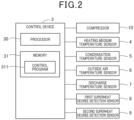
- FIG. 2 is a diagram showing the configuration of the control device 3.
- the control device 3 includes a processor 30 such as a central processing unit (CPU) or a micro processing unit (MPU), a memory 31, and an interface circuit to which other devices and sensors are connected.
- the control device 3 performs various functions of the control device 3 by the processor 30 reading and executing a control program 311 stored in the memory 31.
- the control program 311 is a program for controlling the heating medium circulation apparatus 100.
- the memory 31 is a memory that stores programs and data.
- the memory 31 stores the control program 311 and other data to be processed by the processor 30.
- the memory 31 has a nonvolatile storage area.
- the memory 31 also has a volatile storage area and constitutes a work area of the processor 30.
- the memory 31 is composed of, for example, a read only memory (ROM) and a random access memory (RAM).
- FIG. 2 shows a configuration in which the compressor 10, the heating medium temperature sensor 4, the condensation temperature sensor 5, the outside air temperature sensor 6, the discharge temperature sensor 7, the first superheat degree detection sensor 8, and the second superheat degree detection sensor 9 are connected to the control device 3.
- the devices connected to the control device 3 are not limited to these devices, and another device such as a motor that drives a fan may also be connected to the control device 3.
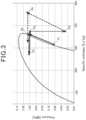
- control device 3 of the present embodiment performs the operation described below. First, the mechanism by which the discharge temperature of the compressor 10 excessively rises at startup of the compressor 10 will be described with reference to FIG. 3 .
- FIG. 3 is a Mollier diagram showing the state of the refrigerant.
- the heating medium circulation apparatus 100 of the present embodiment performs the following operation.
- the first opening degree is an opening degree that is set at startup of the compressor 10.
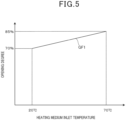
- a graph GF1 shows the relationship between the first opening degree and the heating medium inlet temperature. As shown in the graph GF1, the first opening degree is set larger as the heating medium inlet temperature increases.
- the control device 3 may make a determination by performing a calculation based on a predetermined algorithm or by referring to a table in which the magnitude of the first opening degree is determined for each heating medium inlet temperature.
- a first switching condition is that the temperature of the refrigerant flowing into the use side heat exchanger 11 falls below the heating medium inlet temperature.
- the control device 3 determines whether the first switching condition is satisfied based on a detected value of the heating medium temperature sensor 4 and a detected value of the condensation temperature sensor 5. More specifically, the control device 3 determines whether the temperature detected by the condensation temperature sensor 5 has fallen below the heating medium inlet temperature detected by the heating medium temperature sensor 4 after setting the opening degree of the decompression device 12 to the first opening degree. Then, when the control device 3 determines that the temperature of the refrigerant flowing into the use side heat exchanger 11 has fallen below the heating medium inlet temperature, the control device 3 determines that the first switching condition is satisfied.
- a second switching condition is that the superheat degree of the refrigerant suctioned by the compressor 10 falls below a predetermined threshold.
- An example of the predetermined threshold is 2 K (Kelvin).
- the control device 3 determines whether the second switching condition is satisfied based on a detected value of the first superheat degree detection sensor 8. More specifically, the control device 3 determines whether the superheat degree detected by the first superheat degree detection sensor 8 has fallen below the predetermined threshold after setting the opening degree of the decompression device 12 to the first opening degree. When the control device 3 determines that the superheat degree detected by the first superheat degree detection sensor 8 has fallen below the predetermined threshold, the control device 3 determines that the second switching condition is satisfied.
- a third switching condition is that the superheat degree of the refrigerant discharged by the compressor 10 exceeds a predetermined threshold.
- An example of the predetermined threshold is 5 K (Kelvin).
- the control device 3 determines whether the third switching condition is satisfied based on a detected value of the second superheat degree detection sensor 9. More specifically, the control device 3 determines whether the superheat degree detected by the second superheat degree detection sensor 9 has exceeded the predetermined threshold after setting the opening degree of the decompression device 12 to the first opening degree. When the control device 3 determines that the superheat degree detected by the second superheat degree detection sensor 9 has exceeded the predetermined threshold, the control device 3 determines that the third switching condition is satisfied.
- a fourth switching condition is that a first preset time elapses after startup of the compressor 10.
- the first preset time is a predetermined time and increases as the heating medium inlet temperature increases.
- the control device 3 determines the first preset time corresponding to the heating medium inlet temperature detected by the heating medium temperature sensor 4. The determination of the first preset time may be performed by performing a calculation based on a predetermined algorithm or by referring to a table in which the first preset time is determined in accordance with the heating medium inlet temperature. After determining the first preset time, the control device 3 determines whether the determined first preset time has elapsed after startup of the compressor 10. When the control device 3 determines that the first preset time has elapsed, the control device 3 determines that the fourth switching condition is satisfied.
- the first preset time is 3 minutes when the heating medium inlet temperature is +20°C and 7 minutes when the heating medium inlet temperature is +70°C
- a fifth switching condition is that a second preset time elapses after startup of the compressor 10.
- the second preset time is a predetermined time and increases as the outside air temperature decreases.
- the control device 3 determines the second preset time corresponding to the outside air temperature detected by the outside air temperature sensor 6. The determination of the second preset time may be performed by performing a calculation based on a predetermined algorithm or by referring to a table in which the second preset time is determined in accordance with the outside air temperature. After determining the second preset time, the control device 3 determines whether the determined second preset time has elapsed after startup of the compressor 10. When the control device 3 determines that the second preset time has elapsed, the control device 3 determines that the fifth switching condition is satisfied.
- the second preset time is 7 minutes when the outside air temperature is -20°C and 1 minute when the outside air temperature is +20°C.
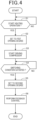
- step S4 an affirmative determination may be made when any one of the above-mentioned first to fifth switching conditions is satisfied or when any multiple ones of the above-mentioned first to fifth switching conditions are satisfied.
- step S4 when the control device 3 determines that the switching condition is not satisfied (step S4: NO), the control device 3 performs the determination of step S4 again.
- step S4 determines that the switching condition is satisfied (step S4: YES)
- the control device 3 sets the opening degree of the decompression device 12 to the second opening degree based on a detected value of the heating medium temperature sensor 4 (step S5).
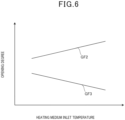
- FIG. 6 is a chart for explaining the second opening degree.
- the vertical axis represents the opening degree of the decompression device 12.
- a direction indicated by an arrow is the positive direction.
- the horizontal axis represents the heating medium inlet temperature.
- a direction indicated by an arrow is the positive direction.
- a graph GF2 shows the relationship between the first opening degree and the heating medium inlet temperature.
- a graph GF3 shows the relationship between the second opening degree and the heating medium inlet temperature.
- the second opening degree is an opening degree that is set after the first opening degree after the compressor 10 starts up. As shown in FIG. 6 , the second opening degree is set smaller as the heating medium inlet temperature increases. In addition, as shown in FIG. 6 , the second opening degree is smaller than the first opening degree.
- control device 3 may make a determination by performing a calculation based on a predetermined algorithm or by referring to a table in which the magnitude of the second opening degree is determined for each heating medium inlet temperature.
- control device 3 after the control device 3 sets the opening degree of the decompression device 12 to the second opening degree, the control device 3 feedback-controls the opening degree of the decompression device 12 so that the discharge temperature detected by the discharge temperature sensor 7 becomes a target temperature (step S6). Data of the target temperature of the discharge temperature is stored in the memory 31.
- the heating medium circulation apparatus 100 includes the refrigerant circuit 1 including the compressor 10, the use side heat exchanger 11, the decompression device 12, and the heat source side heat exchanger 13 that are connected in order.
- the heating medium circulation apparatus 100 also includes the heating medium circuit 2 through which the heating medium cooled or heated by the refrigerant from the compressor 10 in the use side heat exchanger 11 circulates.
- the heating medium circulation apparatus 100 also includes the heating medium temperature sensor 4 that detects the temperature of the heating medium flowing into the use side heat exchanger 11.
- the heating medium circulation apparatus 100 also includes the control device 3 that controls the decompression device 12.
- the control device 3 sets the opening degree of the decompression device 12 at startup of the compressor 10 to the first opening degree, the first opening degree being set larger as the temperature of the heating medium detected by the heating medium temperature sensor 4 increases.
- the control is performed so that the opening degree of the decompression device 12 at startup of the compressor 10 increases as the temperature of the heating medium flowing into the use side heat exchanger 11 increases.
- the refrigerant that has absorbed heat from the heating medium and vaporized in the use side heat exchanger 11 is not excessively decompressed by the decompression device 12, and excessive rise of the discharge temperature of the compressor 10 can be prevented.
- the reliability of the compressor 10 can be improved.
- the control device 3 sets the opening degree of the decompression device 12 to the second opening degree, the second opening degree being set smaller as the temperature of the heating medium detected by the heating medium temperature sensor 4 increases.
- the control device 3 increases the degree of decompression of the decompression device 12 by setting the opening degree of the decompression device 12 to the second opening degree when the switching condition is satisfied after the compressor 10 starts up.
- the temperature of the refrigerant passing through the use side heat exchanger 11 can be made higher than the temperature of the heating medium after the timing when the possibility of excessive rise of the discharge temperature is reduced, and efficient heat exchange can be performed in the use side heat exchanger 11.
- the heating medium circulation apparatus 100 includes the discharge temperature sensor 7 that detects the discharge temperature of the compressor 10.
- the control device 3 sets the opening degree of the decompression device 12 at the first opening degree until the switching condition is satisfied. After setting the opening degree of the decompression device 12 to the second opening degree, the control device 3 controls the decompression device 12 so that the discharge temperature of the compressor 10 becomes the target temperature based on the detected value of the discharge temperature sensor 7.
- the control device 3 maintains the opening degree of the decompression device 12 at the first opening degree until the switching condition is satisfied, thereby making it possible to effectively preventing excessive rise of the discharge temperature of the compressor 10 until the switching condition is satisfied.
- the control device 3 sets the opening degree of the decompression device 12 to the second opening degree. Accordingly, since the opening degree of the decompression device 12 is set to the second opening degree at an appropriate timing when the possibility of excessive rise of the discharge temperature of the compressor 10 is reduced, the system efficiency of the heating medium circulation apparatus 100 is further improved. Thus, the energy saving performance in the heating medium circulation apparatus 100 can be further improved.
- the heating medium circulation apparatus 100 includes the first superheat degree detection sensor 8 that detects the superheat degree of the refrigerant suctioned by the compressor 10.
- the switching condition is that the superheat degree detected by the first superheat degree detection sensor 8 falls below the predetermined threshold.
- the control device 3 sets the opening degree of the decompression device 12 to the second opening degree when the superheat degree of the refrigerant suctioned by the compressor 10 falls below the predetermined threshold. Accordingly, since the opening degree of the decompression device 12 is set to the second opening degree at an appropriate timing when the possibility of excessive rise of the discharge temperature of the compressor 10 is reduced, the system efficiency of the heating medium circulation apparatus 100 is further improved. Thus, the energy saving performance in the heating medium circulation apparatus 100 can be further improved.
- the heating medium circulation apparatus 100 includes the second superheat degree detection sensor 9 that detects the superheat degree of the refrigerant discharged by the compressor 10.
- the switching condition is that the superheat degree detected by the second superheat degree detection sensor 9 exceeds the predetermined threshold.
- the solubility of the refrigerant in lubricating oil of the compressor 10 is large.
- the solubility in the lubricating oil is large, the refrigerant inside the refrigerant circuit tends to be insufficient and the superheat degree of the refrigerant suctioned by the compressor 10 increases, thereby making it easier for the discharge temperature of the compressor 10 to excessively rise.
- the control device 3 can perform switching to the second opening degree at an appropriate timing when the discharge temperature of the compressor 10 is less likely to excessively rise.
- the reliability of the compressor 10 can be further improved.
- the switching condition is that the predetermined time elapses after startup of the compressor 10.
- the predetermined time increases as the temperature of the heating medium flowing into the use side heat exchanger 11 increases.
- the time for which the opening degree of the decompression device 12 is set at the first opening degree is increased as the heating medium inlet temperature increases.
- the refrigerant can be decompressed with the amount of decompression reduced until the superheat degree of the refrigerant that has passed through the use side heat exchanger 11 becomes small, and excessive rise of the discharge temperature of the compressor 10 can be more prevented.
- the reliability of the compressor 10 can be further improved.
- the switching condition is that the predetermined time elapses after startup of the compressor 10.
- the predetermined time increases as the outside air temperature decreases.
- the temperature of the shell of the compressor 10 decreases as the outside air temperature decreases, and the time from when the compressor 10 starts up to when the temperature of the refrigerant flowing through the use side heat exchanger 11 becomes higher than the temperature of the heating medium increases.
- the control device 3 increases the time for which the opening degree of the decompression device 12 is set at the first opening degree as the outside air temperature decreases. Accordingly, the refrigerant can be decompressed with the amount of decompression reduced until the superheat degree of the refrigerant that has passed through the use side heat exchanger 11 becomes small, and excessive rise of the discharge temperature of the compressor 10 can be more prevented.
- the reliability of the compressor 10 can be further improved.
- the first embodiment has been described as an example of the technique disclosed in the present application.
- the technique in the present disclosure is not limited thereto and also applicable to embodiments with changes, replacements, additions, omissions, and the like.
- the constituent elements described above in the first embodiment can be combined to constitute a new embodiment.
- other embodiments will be described as examples.
- the heating medium inlet temperature has been described as an example of the parameter for determining the first opening degree and the second opening degree.
- the outside air temperature may be included as the parameter for determining the first opening degree and the second opening degree. That is, in the other embodiment, the control device 3 sets the first opening degree larger as the outside air temperature detected by the outside air temperature sensor 6 decreases and sets the second opening degree smaller as the outside air temperature detected by the outside air temperature sensor 6 decreases.
- the first opening degree that is set when the heating medium inlet temperature is ⁇ °C is A% in the first embodiment
- the first opening degree that is set when the heating medium inlet temperature is ⁇ °C is set to an opening degree larger than A% as the outside air temperature decreases
- the first opening degree that is set when the heating medium inlet temperature is ⁇ °C is set to an opening degree smaller than A% as the outside air temperature increases.
- the heating medium inlet temperature is 20°C
- the first opening degree is set to 70%, following the graph GF1 in FIG. 5 .
- the first opening is set to an opening degree larger than 70% as the outside air temperature decreases.
- the first opening degree is set to 85%, following the graph GF1 in FIG. 5 .
- the first opening degree is set to an opening degree smaller than 85% as the outside air temperature increases (e.g., when the outside air temperature is -20°C, the first opening degree is set to 85%, and when the outside air temperature is +20°C, the first opening is set to 70%).
- the second opening degree that is set when the heating medium inlet temperature is ⁇ °C is B% in the first embodiment
- the second opening degree that is set when the heating medium inlet temperature is ⁇ °C is set to an opening degree smaller than B% as the outside air temperature decreases
- the second opening degree that is set when the heating medium inlet temperature is ⁇ °C is set to an opening degree larger than B% as the outside air temperature increases.
- control device 3 sets the first opening degree larger as the outside air temperature detected by the outside air temperature sensor 6 decreases and sets the second opening degree smaller as the outside air temperature detected by the outside air temperature sensor 6 decreases.
- the temperature of the shell of the compressor 10 decreases, and the temperature of the refrigerant flowing into the use side heat exchanger 11 further drops. That is, as the outside air temperature decreases, the temperature difference between the refrigerant and the heating medium in the use side heat exchanger 11 increases, and the superheat degree of the refrigerant flowing out of the use side heat exchanger 11 increases, thereby further increasing the possibility of excessive rise of the discharge temperature of the compressor 10.
- the first opening degree is set larger as the outside air temperature decreases, excessive decompression in the decompression device 12 can be prevented in accordance with the outside air temperature.
- the refrigerant is more largely decompressed by the decompression device 12 as the outside air temperature decreases after the second opening degree is set, the pressure of the refrigerant suctioned by the compressor 10 decreases, and the temperature of the refrigerant passing through the heat source side heat exchanger 13 becomes lower than the temperature of a heat source, which enables the refrigerant to efficiently absorb heat from the heat source.
- the first to fifth switching conditions have been described as examples of the switching condition for switching to the second opening degree.
- the switching condition for switching to the second opening degree may be any one or more of the first to fifth switching conditions. That is, in the other embodiment, the switching condition for switching to the second opening degree may be some of the first to the fifth switching conditions.
- the heating medium circulation apparatus 100 only needs to be equipped with a sensor necessary for determination on whether the switching condition is satisfied, and does not need to be equipped with all of the heating medium temperature sensor 4, the condensation temperature sensor 5, the outside air temperature sensor 6, the discharge temperature sensor 7, the first superheat degree detection sensor 8, and the second superheat degree detection sensor 9.
- the first superheat degree detection sensor 8 has been described as an example of the first superheat degree detection unit
- the second superheat degree detection sensor 9 has been described as an example of the second superheat degree detection unit
- the processor 30 may function as the first superheat degree detection unit and the second superheat degree detection unit.
- the heating medium circulation apparatus 100 is equipped with a sensor that detects the suction temperature of the compressor 10 and a sensor that detects the pressure of the refrigerant suctioned by the compressor 10 instead of the first superheat degree detection sensor 8 and is equipped with a sensor that detects the pressure of the refrigerant discharged by the compressor 10 instead of the second superheat degree detection sensor 9.
- the processor 30 in this case detects each superheat degree based on a detected value of the discharge temperature sensor 7 and detected values of the sensors included instead of the first superheat degree detection sensor 8 and the second superheat degree detection sensor 9.
- the processor 30 may be composed of a single processor or multiple processors. These processors may be hardware programmed to implement the corresponding functional part. That is, these processors may be composed of, for example, an application specific integrated circuit (ASIC) or a field programmable gate array (FPGA).
- ASIC application specific integrated circuit
- FPGA field programmable gate array
- control device 3 shown in FIG. 2 is an example, and the specific implementation mode is not limited to any particular mode. That is, it is not necessary to implement hardware corresponding to each part on an individual basis, and a single processor may execute a program to implement the function of each part.
- some of the functions implemented by software in the above-mentioned embodiments may be implemented by hardware, or some of the functions implemented by hardware may be implemented by software.
- step units of the operation shown in FIG. 4 are divided in accordance with the main processing details to facilitate understanding of the operation, and the operation is not limited by the way of dividing the processing units or names thereof. Division to more step units may be performed in accordance with the processing details. In addition, division may be performed in such a manner that one step unit includes more processes. In addition, the order of the steps may be interchanged as appropriate to the extent that it does not interfere with the gist of the present disclosure.
- a heating medium circulation apparatus including: a refrigerant circuit including a compressor, a use side heat exchanger, a decompression device, and a heat source side heat exchanger connected in order; a heating medium circuit through which a heating medium cooled or heated by a refrigerant from the compressor in the use side heat exchanger circulates; a heating medium temperature sensor that detects a temperature of the heating medium flowing into the use side heat exchanger; and a control device that controls the decompression device, in which the control device sets an opening degree of the decompression device at startup of the compressor to a first opening degree, the first opening degree being set larger as the temperature of the heating medium detected by the heating medium temperature sensor increases.
- the control is performed so that the opening degree of the decompression device at startup of the compressor increases as the temperature of the heating medium flowing into the use side heat exchanger increases.
- the refrigerant that has absorbed heat from the heating medium and vaporized in the use side heat exchanger is not excessively decompressed by the decompression device, and excessive rise of the discharge temperature of the compressor can be prevented.
- the reliability of the compressor can be improved.
- the degree of decompression of the decompression device can be increased at the timing when the temperature difference between the heating medium and the refrigerant becomes small in the use side heat exchanger and the possibility of excessive rise of the discharge temperature of the compressor is reduced. Accordingly, the temperature of the refrigerant passing through the use side heat exchanger can be made higher than the temperature of the heating medium after the timing when the possibility of excessive rise of the discharge temperature of the compressor is reduced, and efficient heat exchange can be performed in the use side heat exchanger. Thus, it is possible to improve the reliability of the compressor and improve the energy saving performance in the heating medium circulation apparatus.
- the heating medium circulation apparatus further including a discharge temperature sensor that detects a discharge temperature of the compressor, in which the control device sets the opening degree of the decompression device at the first opening degree until the switching condition is satisfied, and controls the decompression device so that the discharge temperature of the compressor becomes a target temperature based on a detected value of the discharge temperature sensor after setting the opening degree of the decompression device to the second opening degree.
- the heating medium circulation apparatus according to technique 2 or 3, further including an outside air temperature sensor that detects an outside air temperature, in which the control device sets the first opening degree larger as the outside air temperature detected by the outside air temperature sensor decreases and sets the second opening degree smaller as the outside air temperature detected by the outside air temperature sensor decreases.
- the first opening degree is set larger as the outside air temperature decreases, excessive decompression in the decompression device can be prevented in accordance with the outside air temperature.
- the refrigerant is more largely decompressed by the decompression device as the outside air temperature decreases after the second opening degree is set, the pressure of the refrigerant suctioned by the compressor decreases, and the temperature of the refrigerant passing through the heat source side heat exchanger becomes lower than the temperature of a heat source, which enables the refrigerant to efficiently absorb heat from the heat source.
- the heating medium circulation apparatus according to any one of techniques 2 to 4, further including a condensation temperature sensor that detects a condensation temperature of the refrigerant passing through the use side heat exchanger, in which the switching condition is that the temperature detected by the condensation temperature sensor exceeds the temperature detected by the heating medium temperature sensor.
- the opening degree of the decompression device can be set to the second opening degree at an appropriate timing when the possibility of excessive rise of the discharge temperature of the compressor is reduced, the system efficiency of the heating medium circulation apparatus is further improved.
- the energy saving performance in the heating medium circulation apparatus can be further improved.
- the heating medium circulation apparatus according to any one of techniques 2 to 5, further including a first superheat degree detection unit that detects a superheat degree of the refrigerant suctioned by the compressor, in which the switching condition is that the superheat degree detected by the first superheat degree detection unit falls below a predetermined threshold.
- the opening degree of the decompression device can be set to the second opening degree at an appropriate timing when the possibility of excessive rise of the discharge temperature of the compressor is reduced, the system efficiency of the heating medium circulation apparatus is further improved.
- the energy saving performance in the heating medium circulation apparatus can be further improved.
- switching to the second opening degree can be performed at the timing when the solubility of the refrigerant in the lubricating oil is small and the discharge temperature of the compressor is less likely to excessively rise.
- the reliability of the compressor can be further improved.
- the time for which the opening degree of the decompression device is set at the first opening degree can be increased as the temperature of the heating medium flowing into the use side heat exchanger increases.
- the refrigerant can be decompressed with the amount of decompression reduced until the superheat degree of the refrigerant that has passed through the use side heat exchanger becomes small, and excessive rise of the discharge temperature of the compressor can be more prevented.
- the reliability of the compressor can be further improved.
- the time for which the opening degree of the decompression device is set at the first opening degree is increased as the outside air temperature decreases. Accordingly, the refrigerant can be decompressed with the amount of decompression reduced until the superheat degree of the refrigerant that has passed through the use side heat exchanger becomes small, and excessive rise of the discharge temperature of the compressor can be more prevented. Thus, the reliability of the compressor can be further improved.
- the heating medium circulation apparatus can be used in an apparatus in which a heating medium and a refrigerant exchange heat, such as a hot water supply heater.
Landscapes
- Engineering & Computer Science (AREA)
- Physics & Mathematics (AREA)
- Mechanical Engineering (AREA)
- Thermal Sciences (AREA)
- General Engineering & Computer Science (AREA)
- Air Conditioning Control Device (AREA)
Applications Claiming Priority (1)
| Application Number | Priority Date | Filing Date | Title |
|---|---|---|---|
| JP2023142705A JP2025035577A (ja) | 2023-09-04 | 2023-09-04 | 熱媒体循環装置 |
Publications (2)
| Publication Number | Publication Date |
|---|---|
| EP4521038A1 true EP4521038A1 (de) | 2025-03-12 |
| EP4521038B1 EP4521038B1 (de) | 2025-11-26 |
Family
ID=92633781
Family Applications (1)
| Application Number | Title | Priority Date | Filing Date |
|---|---|---|---|
| EP24197790.9A Active EP4521038B1 (de) | 2023-09-04 | 2024-09-02 | Zirkulationsvorrichtung für heizmedium |
Country Status (2)
| Country | Link |
|---|---|
| EP (1) | EP4521038B1 (de) |
| JP (1) | JP2025035577A (de) |
Citations (4)
| Publication number | Priority date | Publication date | Assignee | Title |
|---|---|---|---|---|
| JP2000346449A (ja) | 1999-06-01 | 2000-12-15 | Matsushita Electric Ind Co Ltd | ヒートポンプ給湯機 |
| US20100205987A1 (en) * | 2007-11-30 | 2010-08-19 | Mitsubishi Electric Corporation | Refrigeration cycle apparatus |
| EP2589901A2 (de) * | 2011-11-04 | 2013-05-08 | Panasonic Corporation | Kühlzyklusvorrichtung und Heißwassergenerator |
| EP3594587A1 (de) * | 2017-03-09 | 2020-01-15 | Mitsubishi Electric Corporation | Wärmepumpenvorrichtung zur warmwasserversorgung |
-
2023
- 2023-09-04 JP JP2023142705A patent/JP2025035577A/ja active Pending
-
2024
- 2024-09-02 EP EP24197790.9A patent/EP4521038B1/de active Active
Patent Citations (4)
| Publication number | Priority date | Publication date | Assignee | Title |
|---|---|---|---|---|
| JP2000346449A (ja) | 1999-06-01 | 2000-12-15 | Matsushita Electric Ind Co Ltd | ヒートポンプ給湯機 |
| US20100205987A1 (en) * | 2007-11-30 | 2010-08-19 | Mitsubishi Electric Corporation | Refrigeration cycle apparatus |
| EP2589901A2 (de) * | 2011-11-04 | 2013-05-08 | Panasonic Corporation | Kühlzyklusvorrichtung und Heißwassergenerator |
| EP3594587A1 (de) * | 2017-03-09 | 2020-01-15 | Mitsubishi Electric Corporation | Wärmepumpenvorrichtung zur warmwasserversorgung |
Also Published As
| Publication number | Publication date |
|---|---|
| EP4521038B1 (de) | 2025-11-26 |
| JP2025035577A (ja) | 2025-03-14 |
Similar Documents
| Publication | Publication Date | Title |
|---|---|---|
| JP5452138B2 (ja) | 冷凍空調装置 | |
| EP2458305A1 (de) | Wärmepumpenvorrichtung | |
| JP6494790B2 (ja) | 冷凍サイクル装置 | |
| EP3460357A1 (de) | Kältemittelkreislaufsystem und verfahren zur steuerung eines kühlmittelkreislaufsystems | |
| JP6778884B2 (ja) | 冷凍サイクル装置 | |
| EP3199889A1 (de) | Klimaanlage | |
| JP3915770B2 (ja) | ヒートポンプ給湯機 | |
| EP3575712B1 (de) | Kühlsystem | |
| JP5481838B2 (ja) | ヒートポンプサイクル装置 | |
| JPH0849930A (ja) | 熱ポンプ装置 | |
| EP4521038A1 (de) | Zirkulationsvorrichtung für heizmedium | |
| JP2008190757A (ja) | 冷凍装置 | |
| JP5052631B2 (ja) | ヒートポンプ式温水供給装置 | |
| JP6704505B2 (ja) | ヒートポンプ給湯装置 | |
| JP6076583B2 (ja) | ヒートポンプ | |
| CN119654527B (zh) | 二级冷冻装置 | |
| WO2024250179A1 (en) | Super-high temperature heat pump | |
| EP4215841A1 (de) | Kältekreislaufvorrichtung, klimaanlage damit und verfahren zur steuerung der kältekreislaufvorrichtung | |
| JP7601171B1 (ja) | 冷凍サイクル装置及び冷凍サイクル装置の制御方法 | |
| JP2011202905A (ja) | 冷凍サイクル装置及びその起動制御方法 | |
| JPH11153362A (ja) | 冷却装置 | |
| JP6381712B2 (ja) | 冷凍サイクル装置 | |
| JP2011226724A (ja) | 冷凍サイクル装置及びその起動制御方法 | |
| EP4692674A1 (de) | Kältekreislaufvorrichtung | |
| US20250020377A1 (en) | Heat pump system and method for controlling the same |
Legal Events
| Date | Code | Title | Description |
|---|---|---|---|
| PUAI | Public reference made under article 153(3) epc to a published international application that has entered the european phase |
Free format text: ORIGINAL CODE: 0009012 |
|
| STAA | Information on the status of an ep patent application or granted ep patent |
Free format text: STATUS: THE APPLICATION HAS BEEN PUBLISHED |
|
| AK | Designated contracting states |
Kind code of ref document: A1 Designated state(s): AL AT BE BG CH CY CZ DE DK EE ES FI FR GB GR HR HU IE IS IT LI LT LU LV MC ME MK MT NL NO PL PT RO RS SE SI SK SM TR |
|
| STAA | Information on the status of an ep patent application or granted ep patent |
Free format text: STATUS: REQUEST FOR EXAMINATION WAS MADE |
|
| 17P | Request for examination filed |
Effective date: 20250318 |
|
| GRAP | Despatch of communication of intention to grant a patent |
Free format text: ORIGINAL CODE: EPIDOSNIGR1 |
|
| STAA | Information on the status of an ep patent application or granted ep patent |
Free format text: STATUS: GRANT OF PATENT IS INTENDED |
|
| INTG | Intention to grant announced |
Effective date: 20250617 |
|
| GRAS | Grant fee paid |
Free format text: ORIGINAL CODE: EPIDOSNIGR3 |
|
| GRAA | (expected) grant |
Free format text: ORIGINAL CODE: 0009210 |
|
| STAA | Information on the status of an ep patent application or granted ep patent |
Free format text: STATUS: THE PATENT HAS BEEN GRANTED |
|
| AK | Designated contracting states |
Kind code of ref document: B1 Designated state(s): AL AT BE BG CH CY CZ DE DK EE ES FI FR GB GR HR HU IE IS IT LI LT LU LV MC ME MK MT NL NO PL PT RO RS SE SI SK SM TR |
|
| REG | Reference to a national code |
Ref country code: CH Ref legal event code: F10 Free format text: ST27 STATUS EVENT CODE: U-0-0-F10-F00 (AS PROVIDED BY THE NATIONAL OFFICE) Effective date: 20251126 Ref country code: GB Ref legal event code: FG4D |
|
| REG | Reference to a national code |
Ref country code: IE Ref legal event code: FG4D |
|
| REG | Reference to a national code |
Ref country code: DE Ref legal event code: R096 Ref document number: 602024001415 Country of ref document: DE |
|
| REG | Reference to a national code |
Ref country code: NL Ref legal event code: MP Effective date: 20251126 |
|
| PG25 | Lapsed in a contracting state [announced via postgrant information from national office to epo] |
Ref country code: ES Free format text: LAPSE BECAUSE OF FAILURE TO SUBMIT A TRANSLATION OF THE DESCRIPTION OR TO PAY THE FEE WITHIN THE PRESCRIBED TIME-LIMIT Effective date: 20251126 |
|
| REG | Reference to a national code |
Ref country code: LT Ref legal event code: MG9D |
|
| PG25 | Lapsed in a contracting state [announced via postgrant information from national office to epo] |
Ref country code: NO Free format text: LAPSE BECAUSE OF FAILURE TO SUBMIT A TRANSLATION OF THE DESCRIPTION OR TO PAY THE FEE WITHIN THE PRESCRIBED TIME-LIMIT Effective date: 20260226 |
|
| PG25 | Lapsed in a contracting state [announced via postgrant information from national office to epo] |
Ref country code: FI Free format text: LAPSE BECAUSE OF FAILURE TO SUBMIT A TRANSLATION OF THE DESCRIPTION OR TO PAY THE FEE WITHIN THE PRESCRIBED TIME-LIMIT Effective date: 20251126 Ref country code: HR Free format text: LAPSE BECAUSE OF FAILURE TO SUBMIT A TRANSLATION OF THE DESCRIPTION OR TO PAY THE FEE WITHIN THE PRESCRIBED TIME-LIMIT Effective date: 20251126 Ref country code: AT Free format text: LAPSE BECAUSE OF FAILURE TO SUBMIT A TRANSLATION OF THE DESCRIPTION OR TO PAY THE FEE WITHIN THE PRESCRIBED TIME-LIMIT Effective date: 20251126 |
|
| REG | Reference to a national code |
Ref country code: AT Ref legal event code: MK05 Ref document number: 1861414 Country of ref document: AT Kind code of ref document: T Effective date: 20251126 |
|
| PG25 | Lapsed in a contracting state [announced via postgrant information from national office to epo] |
Ref country code: NL Free format text: LAPSE BECAUSE OF FAILURE TO SUBMIT A TRANSLATION OF THE DESCRIPTION OR TO PAY THE FEE WITHIN THE PRESCRIBED TIME-LIMIT Effective date: 20251126 |
|
| PG25 | Lapsed in a contracting state [announced via postgrant information from national office to epo] |
Ref country code: RS Free format text: LAPSE BECAUSE OF FAILURE TO SUBMIT A TRANSLATION OF THE DESCRIPTION OR TO PAY THE FEE WITHIN THE PRESCRIBED TIME-LIMIT Effective date: 20260226 |
|
| PG25 | Lapsed in a contracting state [announced via postgrant information from national office to epo] |
Ref country code: IS Free format text: LAPSE BECAUSE OF FAILURE TO SUBMIT A TRANSLATION OF THE DESCRIPTION OR TO PAY THE FEE WITHIN THE PRESCRIBED TIME-LIMIT Effective date: 20260326 |