EP4521092A1 - Banc d'essai experimental mobile pour tester un élément de construction linéaire sous l'action de hautes températures - Google Patents
Banc d'essai experimental mobile pour tester un élément de construction linéaire sous l'action de hautes températures Download PDFInfo
- Publication number
- EP4521092A1 EP4521092A1 EP24465523.9A EP24465523A EP4521092A1 EP 4521092 A1 EP4521092 A1 EP 4521092A1 EP 24465523 A EP24465523 A EP 24465523A EP 4521092 A1 EP4521092 A1 EP 4521092A1
- Authority
- EP
- European Patent Office
- Prior art keywords
- mobile
- longitudinal
- burner
- inferior
- experimental stand
- Prior art date
- Legal status (The legal status is an assumption and is not a legal conclusion. Google has not performed a legal analysis and makes no representation as to the accuracy of the status listed.)
- Granted
Links
Images


Classifications
-
- G—PHYSICS
- G01—MEASURING; TESTING
- G01M—TESTING STATIC OR DYNAMIC BALANCE OF MACHINES OR STRUCTURES; TESTING OF STRUCTURES OR APPARATUS, NOT OTHERWISE PROVIDED FOR
- G01M99/00—Subject matter not provided for in other groups of this subclass
- G01M99/002—Thermal testing
Definitions
- the present invention reveals a mobile experimental stand for testing a linear structural element under the action of high temperatures, that can occur for example, during a fire, designed for obtaining a controlled environment around the structural element.
- ovens were proposed for testing the concrete linear structural elements, as the one presented in the patent CN11006851 0A , in which the specimen to be analyzed is introduced and connected to the exterior, using some intermediate elements, to a device which allows the application of some compressive actions along the structural element.
- a stand similar to an oven has been proposed ( CN209927757U ), on top of which the slab and wall to be analyzed are positioned, in a T-shape.
- the structural elements can be loaded with the desired load.
- Beam or " linear structural element” is to be understood as a building element or other material known in the field, made from wood, steel, reinforced concrete, composite materials...etc., usually in a prismatical shape with a length larger compared to the other dimensions, typically used to ensure the resistance of a building.
- the prism is a geometrical body bounded by a prismatic surface and two parallel planes that intersect its generatrix. The prismatic surface determines on the two parallel planes, two polygons called the “bases” of the prism. The faces of the prism distinct (different) from the bases are called the “lateral faces” of the prism. The segments that are cut by two lateral faces of the prism are called the "lateral edges" of the prism.
- the prism When the lateral edges of the prism are orthogonal on the base plane, the prism is "right". The distance between the bases of the prism is the “height" of the prism. In the case of the right prism, the lateral edge is equal to the height.
- the central longitudinal axis of the beam/linear structural element/burner/burner's nozzle or any other part of the mobile experimental stand is defined as an imaginary line that passes through the centroids of the two right prism bases.
- these beams or linear structural elements have a substantially regular quadrilateral prism shape (right), for example, a cuboid that has two bases or ends surfaces in the shape of a regular polygon, two "lateral sides left, and right respectively” and two “faces inferior, and superior respectively".
- the end surfaces or the bases of the prism/linear structural element/burner/burner's nozzle or any other part of the mobile experimental stand will be called “anterior or front base” and “posterior or back base” respectively in the context of the present invention.
- “superior”, “top” or “above” will reference a first point or a side found closer to the superior side of the beam/linear structural element/burner/burner's nozzle or of any part of the mobile experimental stand relative to a second reference point, while the second point will be located “inferior”, “bottom” or respectively “below”, relative to the first point or to that specific side.
- the lateral parts/faces of the beam/linear structural element/burner/burner's nozzle or any side of the mobile experimental stand will be the left and right extremities, taking into account the top and bottom parts as described above.
- the distance from the "anterior or front base” to the “posterior or back base” of the linear structural element/burner/burner's nozzle or of any part of the mobile experimental stand defines the "length" of the linear structural element/burner/burner's nozzle or any part of the mobile experimental stand.
- the "longitudinal axis" passes through the beam/linear structural element/burner/burner's nozzle or any other part of the mobile experimental stand from its anterior or front end surface to its posterior or back end surface, as it is defined above or preferably, passes through at least the side of the linear structural element/burner/burner's nozzle or of any part of the mobile experimental stand, etc. comprising one of its end surfaces.
- the "central transverse axis" of the beam/linear structural element/burner/burner's nozzle or any other part of the mobile experimental stand is defined as an imaginary line that passes through the centroid of the cross-sections along a transverse axis of the beam/linear structural element/burner/burner's nozzle or any other part of the mobile experimental stand.
- the "transverse axis” passes through the beam/linear structural element/burner/burner's nozzle or any other part of the mobile experimental stand from left to right or from a lateral side/face to the other lateral side/face, as it is defined above and it is always orthogonal to the relevant section on the longitudinal axis.
- the purpose of the present invention is to overcome the above-mentioned drawbacks and this is achieved by disclosing a mobile experimental stand for testing a linear structural element, having a length of approximately 1 ⁇ 4 m, to high temperatures around 600° C to 800° C, as it is defined in claim 1.
- Advantageous embodiments of the present invention will appear from the corresponding dependent claims.
- the present invention discloses a mobile experimental stand for testing a linear structural element, having a length of approximately 1 m to 4 m, to temperatures from 600° C to 800° C that comprises:
- the current invention by overcoming the problems of the known state of the art, has multiple obvious advantages.
- the components of the stand according to the present invention can be easily moved and replicated, such as to adapt lengthwise to the element to be analyzed or to concentrate on a specific area, depending on the purpose of the experiment.
- the heating of the linear elements is done through some burners connected to gas cylinders, and the mobility of the system is given by the two guide rails, on which the subassembly that supports the burner moves.
- the subassembly provides mobility to the burner also in the vertical direction, so that it can be positioned closer or further relative to the surface of the beam, depending on the analysis which is to be done.
- Other advantages of the current invention are:
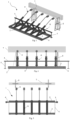
- FIG. 1 - 4 a perspective view of an embodiment of the experimental stand (1) of the present invention is described for testing a linear structural element (7) having a length of approximately 1 ⁇ 4 m, to temperatures between 600°C ⁇ 800°C.
- the heating of the linear element (7) is done by using one or several burners (B) connected to gas cylinders (not represented in the figures).
- the burner (B) can be any type of burner known in the state of the art comprising: a burner head having one or several nozzles for the flame, a burner's valve for supplying gas to the burner, an activation handle of the burner with butterfly and bow for controlling the gas flow, reduction/joint for connecting the gas cylinder and a gas hose.
- the stand (1) comprises at least one main body (A), arranged transversally on two inferior guide rails (3) parallel to each other and each placed on a runway beam (2), the two runway beams (2) being connected at their ends by a stiffener (6), having preferably a width of approximately 100 mm and a length of approximately 700 mm (see fig. 8 ).
- the stiffener (6) is preferably manufactured from zinc coated sheet, cold rolled, having a thickness of 2 mm, because this zinc coated sheet ensures a long-lasting resistance of the parts made from this material.
- the stiffener (6) is preferably configured with a fastening system at its ends, for example the flange connection systems. These kind of systems which use flanges are easy to manufacture, have a low cost and are used at a large scale.
- the two runway beams (2) are preferably manufactured from wood to ensure an uniform distribution of the load within the whole assembly. Most preferably, these runway beams (2) are made from glue-laminated timber (multi-layered), ideal for a long-lasting stand, with reduced weight and having a high load carrying capacity, behaving very well to vibrations.
- the beams (2) can be also connected between them by one or more additional stiffeners (6) for gaining an increased stability of the stand (1).
- additional stiffeners (6) are mounted at a distance of approximately 500 mm one relative to the other or relative to an adjacent stiffener (6) (not represented in the figures).
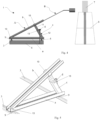
- Each main body (A) comprises three basic components (see fig. 5 ) namely:
- the inferior longitudinal element (a), the mobile (b), and the extensible element (c) thus form a triangular profile, and the mobile element (b) is configured to extend itself beyond said yoke (10) for supporting a burner (B).
- the final position of the burner (B) is set by the extensible element (c) of the main body (A).
- the extensible element (c) further comprises a subassembly (d) (see fig. 7 ) mounted on a lateral surface of the extensible element (c) for supporting each main body (A) in a vertical position on a superior guide rail (4) supported at both its ends by means of a vertical supporting element of a rail (5).
- a subassembly (d) (see fig. 7 ) mounted on a lateral surface of the extensible element (c) for supporting each main body (A) in a vertical position on a superior guide rail (4) supported at both its ends by means of a vertical supporting element of a rail (5).
- the extensible element (c) comprises two longitudinal metal parts (11, 12), that are made hollow, preferably having a rectangular section with a wall thickness of 1.5 mm, namely a fixed longitudinal metal part (12) and a mobile longitudinal metal part (11), that can move inside the interior of the fixed longitudinal metal part (12) and having together in an extended position a maximum length (L) in which:
- the maximum length (L) of the extensible element (c) is chosen preferably in the interval of approximately 350 mm and 650 mm, and the holes of the mobile longitudinal metal part (11) are equidistantly spaced relative to each other, preferably at a distance of 50 mm.
- the blocking element (13) can be preferably an assembly bolt-nut, sockets, rivets, gaggers, screw spindles or any other type of blocking or fixing element.
- the two longitudinal metal parts (11, 12) are preferably manufactured from cold-rolled steel, because this material has precise dimensional limits, a superior quality of the surface and improved mechanical properties.
- the inferior (a) and mobile (b) longitudinal elements together with the extensible element (c) are connected between them at their ends, preferably by means of some blocking elements (13).
- the inferior longitudinal element (a) and the mobile longitudinal element (b) are preferably cold rolled "U" profiles, made from zinc coated sheet, and most preferably from Dx51D+Z275 zinc coated sheet of 1.5 ⁇ 2 mm thickness and height of 60 mm. This Z275 zinc coated sheet ensures a long-lasting resistance of the elements made from this material.
- the elements made from this sheet covered/treated with this degree of zinc resist very well to corrosion caused by water, snow, ice, dust, sun or other external factors and can be successfully used both at the interior and exterior.
- the mobile longitudinal element (b) has a length preferably chosen in the interval 700 mm and 800 mm and comprises two longitudinal slits (b1), preferably with rectangular section and placed at a distance of approximately 150 mm up to 200 mm, respectively at 350 mm up to 400 mm relative to the first end of the inferior longitudinal element (a), along the mobile longitudinal element (b) for accomodating an activation handle of the burner (B) or a burner's (B) valve for supplying gas to the burner and at least two openings (b2), preferably with a rectangular section, located on one side and on the other of each longitudinal slit (b1) for installing a fastening system of the burner (B) in a desired working position for testing the linear structural element (7), according to figure 9 .
- the burner (B) can therefore be placed in at least two desired positions relative to the structural element (7), depending on the position of the activation handle of the burner (B) or of the burner's (B) valve for supplying gas to the burner inside one of the longitudinal slits (b1) as it is represented in figures 10-11 .
- the testing of the linear structural element (7), mounted on a supporting element (8), by applying heat is done at an angle in the interval of approximately 25 up to 45 degrees measured between a longitudinal central axis of a burner's (B) nozzle and a plane which is parallel to the left/right lateral sides of the linear structural element (7), on a point on the inferior surface of the linear structural element (7) or on an inferior surface of it depending on the requirement ( fig. 11 ).
- the fastening system of the burner (B) (either of the activation handle of the burner or of the burner's (B) valve for supplying gas to the burner, in a desired working position for testing the linear structural element (7)), is installed in the two slits (b2) located on one lateral side and on the other lateral side of each longitudinal slit (b1).
- This fastening system of the burner (B) can preferably be a system of loops, cogged strips, clips, clamps, heat-shrink wiring termination and fixing elements or other similar systems.
- the main body (A) or the plurality of main bodies (A) will be fixed in the desired position using the inferior wheels with blocking system (9), that run on the two inferior guide rails (3).
- the extensible element (c) having an adjustable length will be fixed so that the burner (B) will reach the desired position relative to the structural element (7), as it was described above, the burner (B) being thereafter activated.
- the adjustment in height between the runway beams (2) and the burner (B) can be done from approximately 400 mm up to 700 mm, thus the position of the burner (B) on the vertical may be varied using the extensible element (c).
- the testing of the linear structural elements (7) is done at high temperatures of approximately 600° C ⁇ 800° C, having the possibility to duplicate and reposition the application points of the heat, depending on the requirements.
Landscapes
- Physics & Mathematics (AREA)
- General Physics & Mathematics (AREA)
- Investigating Or Analyzing Materials Using Thermal Means (AREA)
Applications Claiming Priority (1)
| Application Number | Priority Date | Filing Date | Title |
|---|---|---|---|
| ROA202300487A RO138719A2 (ro) | 2023-09-06 | 2023-09-06 | Stand experimental mobil pentru supunerea grinzilor la acţiunea temperaturilor înalte |
Publications (3)
| Publication Number | Publication Date |
|---|---|
| EP4521092A1 true EP4521092A1 (fr) | 2025-03-12 |
| EP4521092C0 EP4521092C0 (fr) | 2026-03-04 |
| EP4521092B1 EP4521092B1 (fr) | 2026-03-04 |
Family
ID=91664610
Family Applications (1)
| Application Number | Title | Priority Date | Filing Date |
|---|---|---|---|
| EP24465523.9A Active EP4521092B1 (fr) | 2023-09-06 | 2024-05-22 | Banc d'essai experimental mobile pour tester un élément de construction linéaire sous l'action de hautes températures |
Country Status (2)
| Country | Link |
|---|---|
| EP (1) | EP4521092B1 (fr) |
| RO (1) | RO138719A2 (fr) |
Citations (10)
| Publication number | Priority date | Publication date | Assignee | Title |
|---|---|---|---|---|
| US896774A (en) * | 1908-02-11 | 1908-08-25 | Jeremy Russell Totman | Grass-burning machine. |
| RO84767A2 (fr) | 1982-04-06 | 1984-07-17 | Institutul De Sudura Si Incercari De Materiale,Ro | Four pour le chauffage des eprouvettes soumises aux essais mecaniques |
| RO86951A2 (fr) | 1983-12-15 | 1985-05-20 | Intreprinderea "11 Iunie",Ro | Four de chauffage |
| RO92590A (fr) | 1983-12-16 | 1987-09-30 | Institut Fur Bau Und Grobkermik,Dd | Procede et four-tunnel pour la cuisson des pieces ceramiques |
| US4860727A (en) * | 1988-06-16 | 1989-08-29 | Eads Mark E | Mobile rail heater and method for expanding rails |
| RO123613B1 (ro) | 2008-10-27 | 2014-08-29 | Romtoroidal S.R.L. | Cuptor de încălzire |
| CN109187064A (zh) * | 2018-09-11 | 2019-01-11 | 抚顺抚运安仪救生装备有限公司 | 空气呼吸器抗火焰吞噬试验系统 |
| CN208818579U (zh) | 2018-07-05 | 2019-05-03 | 华侨大学 | 一种火灾下梁-板子结构抗倒塌性能的测试装置 |
| CN110068510A (zh) | 2019-05-21 | 2019-07-30 | 郑州大学 | 一种火灾高温中混凝土热应力测试装置 |
| CN209927757U (zh) | 2019-04-23 | 2020-01-10 | 西南交通大学 | 一种钢筋混凝土构件抗火性能试验装置 |
-
2023
- 2023-09-06 RO ROA202300487A patent/RO138719A2/ro unknown
-
2024
- 2024-05-22 EP EP24465523.9A patent/EP4521092B1/fr active Active
Patent Citations (10)
| Publication number | Priority date | Publication date | Assignee | Title |
|---|---|---|---|---|
| US896774A (en) * | 1908-02-11 | 1908-08-25 | Jeremy Russell Totman | Grass-burning machine. |
| RO84767A2 (fr) | 1982-04-06 | 1984-07-17 | Institutul De Sudura Si Incercari De Materiale,Ro | Four pour le chauffage des eprouvettes soumises aux essais mecaniques |
| RO86951A2 (fr) | 1983-12-15 | 1985-05-20 | Intreprinderea "11 Iunie",Ro | Four de chauffage |
| RO92590A (fr) | 1983-12-16 | 1987-09-30 | Institut Fur Bau Und Grobkermik,Dd | Procede et four-tunnel pour la cuisson des pieces ceramiques |
| US4860727A (en) * | 1988-06-16 | 1989-08-29 | Eads Mark E | Mobile rail heater and method for expanding rails |
| RO123613B1 (ro) | 2008-10-27 | 2014-08-29 | Romtoroidal S.R.L. | Cuptor de încălzire |
| CN208818579U (zh) | 2018-07-05 | 2019-05-03 | 华侨大学 | 一种火灾下梁-板子结构抗倒塌性能的测试装置 |
| CN109187064A (zh) * | 2018-09-11 | 2019-01-11 | 抚顺抚运安仪救生装备有限公司 | 空气呼吸器抗火焰吞噬试验系统 |
| CN209927757U (zh) | 2019-04-23 | 2020-01-10 | 西南交通大学 | 一种钢筋混凝土构件抗火性能试验装置 |
| CN110068510A (zh) | 2019-05-21 | 2019-07-30 | 郑州大学 | 一种火灾高温中混凝土热应力测试装置 |
Also Published As
| Publication number | Publication date |
|---|---|
| RO138719A2 (ro) | 2025-03-28 |
| EP4521092C0 (fr) | 2026-03-04 |
| EP4521092B1 (fr) | 2026-03-04 |
Similar Documents
| Publication | Publication Date | Title |
|---|---|---|
| US4659054A (en) | Lightweight concrete form having a detachable equipment rail | |
| CA1292626C (fr) | Methode d'assemblage ou de demantelage d'un batiment fait d'elements, plus particulierement un mur ou un plafond, ainsi que la construction par elements du genre | |
| EP4521092B1 (fr) | Banc d'essai experimental mobile pour tester un élément de construction linéaire sous l'action de hautes températures | |
| EP2760288B1 (fr) | Installation de cuisson automatisée | |
| CN114197799B (zh) | 一种展览馆内饰节能石板干挂结构及安装方法 | |
| CN109915446B (zh) | 一种支架组合 | |
| DE3843067C2 (de) | Verfahren zur Wärmerückgewinnung bei einem Bausystem in Skelettbauweise | |
| CN219909942U (zh) | 住宅楼小型开间新型钢筋混凝土楼板模板支撑机构 | |
| CN213653917U (zh) | 一种环保型建筑装饰幕墙 | |
| EP4108402B1 (fr) | Chambre destinée à durcir des matériaux de construction | |
| KR20180069783A (ko) | 콘크리트 거푸집 시스템 | |
| DE202009003040U1 (de) | Schneidvorrichtung für Wärmedämmbahn | |
| GB2580389A (en) | Securing system | |
| US4271737A (en) | Movable insulation puncher | |
| DE102014111967A1 (de) | Modularer Brennofen | |
| CN211037864U (zh) | 钢筋绑扎台架 | |
| CN118728137A (zh) | 一种多向可调临时支撑防倾装置及其使用方法 | |
| RU2085683C1 (ru) | Здание | |
| CN220738082U (zh) | 一种板材喷漆用夹持设备 | |
| CA1144059A (fr) | Poinconneuse mobile de panneaux isolants | |
| DE816143C (de) | Loesbare Befestigung von plattenfoermigen Innenraumverkleidungen an gebaeudefesten Teilen | |
| JP2688058B2 (ja) | 鉄骨の耐火被覆構造 | |
| RU2166039C1 (ru) | Деревометаллическая балка-стойка | |
| EP0731234B1 (fr) | Passe-toiture pour cheminée métallique | |
| DE2944904A1 (de) | Umsetzbares trennwandsystem in achsrasterbauweise |
Legal Events
| Date | Code | Title | Description |
|---|---|---|---|
| PUAI | Public reference made under article 153(3) epc to a published international application that has entered the european phase |
Free format text: ORIGINAL CODE: 0009012 |
|
| STAA | Information on the status of an ep patent application or granted ep patent |
Free format text: STATUS: THE APPLICATION HAS BEEN PUBLISHED |
|
| AK | Designated contracting states |
Kind code of ref document: A1 Designated state(s): AL AT BE BG CH CY CZ DE DK EE ES FI FR GB GR HR HU IE IS IT LI LT LU LV MC ME MK MT NL NO PL PT RO RS SE SI SK SM TR |
|
| STAA | Information on the status of an ep patent application or granted ep patent |
Free format text: STATUS: REQUEST FOR EXAMINATION WAS MADE |
|
| 17P | Request for examination filed |
Effective date: 20250827 |
|
| GRAP | Despatch of communication of intention to grant a patent |
Free format text: ORIGINAL CODE: EPIDOSNIGR1 |
|
| STAA | Information on the status of an ep patent application or granted ep patent |
Free format text: STATUS: GRANT OF PATENT IS INTENDED |
|
| INTG | Intention to grant announced |
Effective date: 20251028 |
|
| GRAS | Grant fee paid |
Free format text: ORIGINAL CODE: EPIDOSNIGR3 |
|
| GRAA | (expected) grant |
Free format text: ORIGINAL CODE: 0009210 |
|
| STAA | Information on the status of an ep patent application or granted ep patent |
Free format text: STATUS: THE PATENT HAS BEEN GRANTED |
|
| AK | Designated contracting states |
Kind code of ref document: B1 Designated state(s): AL AT BE BG CH CY CZ DE DK EE ES FI FR GB GR HR HU IE IS IT LI LT LU LV MC ME MK MT NL NO PL PT RO RS SE SI SK SM TR |
|
| REG | Reference to a national code |
Ref country code: CH Ref legal event code: F10 Free format text: ST27 STATUS EVENT CODE: U-0-0-F10-F00 (AS PROVIDED BY THE NATIONAL OFFICE) Effective date: 20260304 Ref country code: GB Ref legal event code: FG4D |
|
| REG | Reference to a national code |
Ref country code: CH Ref legal event code: R17 Free format text: ST27 STATUS EVENT CODE: U-0-0-R10-R17 (AS PROVIDED BY THE NATIONAL OFFICE) Effective date: 20260316 |
|
| REG | Reference to a national code |
Ref country code: DE Ref legal event code: R096 Ref document number: 602024003004 Country of ref document: DE |
|
| REG | Reference to a national code |
Ref country code: IE Ref legal event code: FG4D |
|
| U01 | Request for unitary effect filed |
Effective date: 20260331 |
|
| U07 | Unitary effect registered |
Designated state(s): AT BE BG DE DK EE FI FR IT LT LU LV MT NL PT RO SE SI Effective date: 20260408 |