EP4521108A2 - Bestimmung des betriebszustandes eines sensors durch sensorabfrage - Google Patents
Bestimmung des betriebszustandes eines sensors durch sensorabfrage Download PDFInfo
- Publication number
- EP4521108A2 EP4521108A2 EP24214312.1A EP24214312A EP4521108A2 EP 4521108 A2 EP4521108 A2 EP 4521108A2 EP 24214312 A EP24214312 A EP 24214312A EP 4521108 A2 EP4521108 A2 EP 4521108A2
- Authority
- EP
- European Patent Office
- Prior art keywords
- sensor
- response
- gas
- mode
- sensors
- Prior art date
- Legal status (The legal status is an assumption and is not a legal conclusion. Google has not performed a legal analysis and makes no representation as to the accuracy of the status listed.)
- Pending
Links
Images




Classifications
-
- G—PHYSICS
- G01—MEASURING; TESTING
- G01N—INVESTIGATING OR ANALYSING MATERIALS BY DETERMINING THEIR CHEMICAL OR PHYSICAL PROPERTIES
- G01N27/00—Investigating or analysing materials by the use of electric, electrochemical, or magnetic means
- G01N27/26—Investigating or analysing materials by the use of electric, electrochemical, or magnetic means by investigating electrochemical variables; by using electrolysis or electrophoresis
- G01N27/403—Cells and electrode assemblies
- G01N27/404—Cells with anode, cathode and cell electrolyte on the same side of a permeable membrane which separates them from the sample fluid, e.g. Clark-type oxygen sensors
-
- G—PHYSICS
- G01—MEASURING; TESTING
- G01N—INVESTIGATING OR ANALYSING MATERIALS BY DETERMINING THEIR CHEMICAL OR PHYSICAL PROPERTIES
- G01N33/00—Investigating or analysing materials by specific methods not covered by groups G01N1/00 - G01N31/00
- G01N33/0004—Gaseous mixtures, e.g. polluted air
- G01N33/0006—Calibrating gas analysers
-
- G—PHYSICS
- G01—MEASURING; TESTING
- G01N—INVESTIGATING OR ANALYSING MATERIALS BY DETERMINING THEIR CHEMICAL OR PHYSICAL PROPERTIES
- G01N33/00—Investigating or analysing materials by specific methods not covered by groups G01N1/00 - G01N31/00
- G01N33/0004—Gaseous mixtures, e.g. polluted air
- G01N33/0009—General constructional details of gas analysers, e.g. portable test equipment
- G01N33/0027—General constructional details of gas analysers, e.g. portable test equipment concerning the detector
- G01N33/0031—General constructional details of gas analysers, e.g. portable test equipment concerning the detector comprising two or more sensors, e.g. a sensor array
-
- G—PHYSICS
- G01—MEASURING; TESTING
- G01N—INVESTIGATING OR ANALYSING MATERIALS BY DETERMINING THEIR CHEMICAL OR PHYSICAL PROPERTIES
- G01N33/00—Investigating or analysing materials by specific methods not covered by groups G01N1/00 - G01N31/00
- G01N33/0004—Gaseous mixtures, e.g. polluted air
- G01N33/0009—General constructional details of gas analysers, e.g. portable test equipment
- G01N33/0073—Control unit therefor
-
- G—PHYSICS
- G01—MEASURING; TESTING
- G01N—INVESTIGATING OR ANALYSING MATERIALS BY DETERMINING THEIR CHEMICAL OR PHYSICAL PROPERTIES
- G01N33/00—Investigating or analysing materials by specific methods not covered by groups G01N1/00 - G01N31/00
- G01N33/0004—Gaseous mixtures, e.g. polluted air
- G01N33/0009—General constructional details of gas analysers, e.g. portable test equipment
- G01N33/0011—Sample conditioning
- G01N33/0016—Sample conditioning by regulating a physical variable, e.g. pressure or temperature
Definitions
- Gas sensors such as electrochemical sensors have been proven over many decades to be effective in detecting gases such as toxic gases in workplace environments.
- the low cost, speed of response and selectivity of, for example, electrochemical gas sensors are just a few of the characteristics that have made such sensors attractive for safety products.
- one of the necessary requirements for use electrochemical gas sensor and other gas sensors has been frequent calibration.
- the sensitivity of an electrochemical sensor is influenced by the water content of its electrolyte, which changes over the seasons of the year, geographical location, etc. as a result of fluctuations in ambient relative humidity. Such relative humidity fluctuations lead to lower sensitivities in dry regions or during dry seasons and higher sensitivities in wetter region or during wetter seasons.
- Prudence thus dictates that gas detection instrumentation, including electrochemical gas sensors and/or other gas sensors, be tested regularly for functionality. For example, frequent calibration with a test gas having a known concentration of the analyte or target gas (including a non-zero and zero concentrations) has been required to adjust for the sensitivity changes discussed above. It is a common practice to, for example, perform a "bump check,” or functionality check on portable gas detection instrumentation on a daily basis. The purpose of this test is to ensure the functionality of the entire gas detection system, commonly referred to as an instrument. A periodic bump check or functionality check may also be performed on a permanent gas detection instrument to, for example, extend the period between full calibrations.
- Gas detection systems include at least one gas sensor, electronic circuitry (including a power supply) to drive the sensor, interpret its response and display its response to the user.
- the systems further include a housing to enclose and protect such components.
- a bump check typically includes: a) applying a test gas of interest (usually including a known concentration of the target or analyte gas the instrument is intended to detect or a simulant therefor to which the instrument is responsive); b) collecting and interpreting the sensor response; and c) indicating to the end user the functional state of the system (that is, whether or not the instrument is properly functioning).
- bump tests were performed regularly and, typically, daily. Bump checks provide a relatively high degree of assurance to the user that the gas detection device is working properly.
- the bump check exercises all the necessary functionalities of all parts of the gas detection device in the same manner necessary to detect an alarm level of a hazardous gas.
- the bump check ensures that there is efficient gas delivery from the outside of the instrument, through any transport paths (including, for example, any protection and/or diffusion membranes) to contact the active sensor components.
- the bump check also ensures that the detection aspect of the sensor itself is working properly and that the sensor provides the proper response function or signal.
- the bump check further ensures that the sensor is properly connected to its associated power supply and electronic circuitry and that the sensor signal is being interpreted properly.
- the bump check ensures that the indicator(s) or user interface(s) (for example, a display and/or an annunciation functionality) of the gas detection instrument is/are functioning as intended.
- bump checks have a number of significant drawbacks. For example, such bump checks are time consuming, especially in facilities such as industrial facilities that include many gas detection systems or instruments.
- the bump check also requires the use of expensive and potentially hazardous calibration or test gases.
- the bump check also requires a specialized gas delivery system, usually including a pressurized gas bottle, a pressure reducing regulator, and tubing and adapters to correctly supply the calibration or test gas to the instrument.
- the requirement of a specialized gas delivery system often means that the opportunity to bump check a personal gas detection device is limited in place and time by the availability of the gas delivery equipment.
- Such a system may, for example, include electronic interrogation of a sensor in the absence of a test gas.
- the fluctuations in sensitivity of an electrochemical gas sensor arising from moisture loss or gain in a number of sensors occurs gradually but in a predictable manner as the average relative humidity slowly changes.
- the sensor response to an electronic interrogation in the absence of or without application of a test gas including a known concentration of the analyte gas or a substitute therefor) changes in a similar manner.
- An electronic interrogation may, for example, be used to measure sensitivity changes and correct for them.
- Such electronic interrogation techniques and resulting corrections for electrochemical gas sensors are, for example, disclosed in U.S.
- Patent Nos. 7,413,645 , 7,959,777 , 9,784,755 , and 9,528,957 and in U.S. Patent Application Publication Nos. 2013/0186777 and 2017/0219515 , the disclosures of which are incorporated herein by reference.
- an electrical signal such as a potential pulse is typically applied to a sensing element or component of the sensor and the resulting response is measured and recorded.
- a response may, for example, be measured in the form of, for example, a maximum peak (current) value (MPV) or and/or another parameter.
- MPV maximum peak
- Changes from the calibration values may be correlated to changes in sensor sensitivity.
- a method of operating a gas sensor for a gas analyte including a sensing component includes, in a first mode, interrogating the sensor by periodically applying an electrical signal to the sensing component of the sensor, measuring sensor response to the electrical signal which is indicative of a sensitivity of the sensor each time the electrical signal is applied to the sensing component, determining whether one or more thresholds have been exceeded based upon the sensor response determined each time the electrical signal is applied to the sensing component, and entering a second mode, different from the first mode in analysis of the sensor response to the periodically applied electrical signals, if one or more thresholds are exceeded.
- the sensor response to the periodically applied electrical signals in the second mode is analyzed to determine if the sensor response to the periodically applied electrical signals is stabilizing.
- the method may, for example, further including determining a rate of change of the sensor response during the second mode to determine if the sensor response to the periodically applied electrical signals is stabilizing.
- at least one of a magnitude and a direction of the rate of change of the sensor response is determined.
- the method further includes changing the one or more thresholds after determining that the sensor response to the periodically applied electrical signals has stabilized. There is no need to apply any test gas during electronic sensor interrogation. In that regard, the sensor response may be determined without application of a test gas to the sensor.
- at least one of a magnitude and a direction of the rate of change of the sensor response is determined.
- the sensor may, for example, be an electrochemical gas sensor and the sensing component may, for example, be a working electrode of the electrochemical gas sensor.
- a value for the sensor response may, for example, be determined on the basis of at least one defined parameter of the sensor response.
- the at least one defined parameter of the sensor response is selected from the group of a maximum current peak value, an area under a current curve, a minimum peak value, a peak-to-peak value, a reverse area under the curve, a baseline value of the sensor response or functions or one or more thereof (for example, products, ratios or more complex functions of one or more of such parameters).
- the value for the sensor response at each of the periodically applied electronic interrogations may, for example, be a change in the value at least one defined parameter of the sensor response measure at each of the periodically applied electronic interrogations from a value thereof determined at a calibration of the sensor.
- the one or more threshold values for the sensor response are determined by tracking a value of the sensor response over time and determining an upper threshold and a lower threshold of nominal behavior for the sensor. In a number of embodiments, the one or more threshold values for the sensor response are determined by tracking the sensor response over time for a plurality of like sensors and determining a group upper threshold and a group lower threshold of nominal behavior for the plurality of sensors. In a number of embodiments in which group thresholds are determined, one or more other threshold values are determined by tracking the sensor response of each of the plurality of like sensors over time and determining an individual upper threshold and an individual lower threshold of nominal behavior for each of the plurality of like sensors. The second mode may, for example, be entered for each of the plurality of like sensors based upon a comparison the sensor response of each of the plurality of like sensors to the group upper threshold and the group lower threshold as well as to the individual upper threshold and the individual lower threshold.
- the sensors of the plurality of like sensors hereof may, for example, exhibit at least one common characteristic other than being a like sensor.
- the at least one common characteristic may, for example, be a geographical area of deployment or a range of time of manufacture. Groups and subgroups of like sensor may be established in a number of embodiments.
- data from the sensor is transmitted to a remote processor system for processing and/or analysis.
- data or information from a second gas sensor for a second gas analyte different from the gas analyte or data from a third sensor for an environmental condition is transmitted to the gas sensor.
- a system in another aspect, includes a sensor including a sensing component having at least one property sensitive to an analyte, and circuity in operative connection with the sensing component.
- the circuitry is configured, in a first mode, to interrogate the sensor by periodically applying an electrical signal to the sensing component, measuring a sensor response to the electrical signal which is indicative of a sensitivity of the sensor each time the electrical signal is applied to the sensing component, and compare the sensor response to one or more threshold values.
- the circuitry is further configured to determine, based upon the comparison of sensor response to the one or more threshold values, whether to enter a second mode, different from the first mode in analysis of sensor response to the periodically applied electrical signals, if one or more thresholds are exceeded.
- the circuitry is configured to analyze the sensor response to the periodically applied electrical signals in the second mode to determine if the sensor response to the periodically applied electrical signals is stabilizing.
- the circuitry may, for example, be further configured to determine a rate of change of the sensor response during the second mode to determine if the sensor response to the periodically applied electrical signals is stabilizing. At least one of a magnitude and a direction of the rate of change of the sensor response may, for example, be determined.
- the circuitry is further configured to change the one or more thresholds after determining that the sensor response to the periodically applied electrical signals has stabilized.
- the circuitry may, for example, be configured to determine the sensor response without application of a test gas to the sensor.
- the senor is an electrochemical gas sensor and the sensing component is a working electrode of the electrochemical gas sensor.
- a value for the sensor response is determined on the basis of at least one defined parameter of the sensor response.
- the at least one defined parameter of the sensor response is selected from the group of a maximum current peak value, an area under a current curve, a minimum peak value, a peak-to-peak value, a reverse area under the curve, a baseline value of the sensor response, or a function or functions of one or more thereof described above.
- the value for the sensor response at each of the periodically applied electronic interrogations may, for example, be a change in the value at least one defined parameter of the sensor response measure at each of the periodically applied electronic interrogations from a value thereof determined at a calibration of the sensor.
- the one or more threshold values for the sensor response are determined by tracking a value of the sensor response over time and determining an upper threshold and a lower threshold of nominal behavior for the sensor. In a number of embodiments, the one or more threshold values for the sensor response are determined by tracking the sensor response over time for a plurality of like sensors and determining a group upper threshold and a group lower threshold of nominal behavior for the plurality of sensors.
- Each of the plurality of like sensors may, for example, include a communication system to transmit data regarding the sensor response to the periodically applied electronic interrogations and to receive data regarding the group upper threshold and the group lower threshold of nominal behavior for the plurality of sensors.
- one or more other threshold values are determined by tracking the sensor response of each of the plurality of like sensors over time and determining an individual upper threshold and an individual lower threshold of nominal behavior for each of the plurality of like sensors.
- the second mode may, for example, be entered for each of the plurality of like sensors based upon a comparison the sensor response of each of the plurality of like sensors to the group upper threshold and the group lower threshold as well as to the individual upper threshold and the individual lower threshold.
- each of the plurality of like sensors has at least one common characteristic other than being a like sensor.
- the at least one common characteristic may, for example, be a geographical area of deployment or a range of time of manufacture.
- Data from the sensor(s) may, for example, be transmitted to a remote processor system for processing and/or analysis.
- Data or information from a second gas sensor for a second gas analyte different from the gas analyte or data from a third sensor for an environmental condition is transmitted to the gas sensor.
- a method of operating a system including a plurality of like gas sensors includes, in a first mode, interrogating each of the plurality of like gas sensors by periodically applying an electrical signal to the sensing component of the sensor, determining a sensor response to the electrical signal which is indicative of a sensitivity for each of the plurality of like gas sensors each time the electrical signal is applied to the sensing component thereof, and analyzing the sensor response of each of the plurality of like gas sensors to the periodically applied electrical signals based upon a nominal response of the plurality of like gas sensors to the periodically applied electrical signals determined over time.
- the method may, for example, further include determining whether to enter a second mode, different from the first mode in analysis of the sensor response to the periodically applied electrical signals, for each of the plurality of like gas sensors based upon comparison of the sensor response of each of the plurality of like gas sensors to the nominal response of the plurality of like gas sensors in the first mode.
- the method may be further characterized as described above.
- a system in still a further aspect, includes a plurality of like gas sensors, wherein each of the plurality of like gas sensors includes a sensing component and electronic circuity in operative connection with the sensing component.
- the electronic circuitry is configured, in a first mode, to interrogate each of the plurality of like gas sensors by periodically applying an electrical signal to the sensing component of the sensor, to determine a sensor response to the electrical signal which is indicative of a sensitivity for each of the plurality of like gas sensors each time the electrical signal is applied to the sensing component thereof, and to analyze the sensor response to the periodically applied electrical signals based upon a nominal response of the plurality of like gas sensors to the periodically applied electrical signals determined over time.
- the electronic circuity of each of the plurality of like sensors may, for example, be further configured to determine whether to enter a second mode, different from the first mode in analysis of the sensor response to the periodically applied electrical signals, based upon comparison of the sensor response to the nominal response of the plurality of like gas sensors in the first mode.
- the system may be further characterized as described above.
- processor includes a plurality of such processors and equivalents thereof known to those skilled in the art, and so forth
- the processor is a reference to one or more such processors and equivalents thereof known to those skilled in the art, and so forth. Recitation of ranges of values herein are merely intended to serve as a shorthand method of referring individually to each separate value falling within the range. Unless otherwise indicated herein, and each separate value, as well as intermediate ranges, are incorporated into the specification as if individually recited herein. All methods described herein can be performed in any suitable order unless otherwise indicated herein or otherwise clearly contraindicated by the text.
- circuitry includes, but is not limited to, hardware, firmware, software or combinations of each to perform a function(s) or an action(s). For example, based on a desired feature or need. a circuit may include a software controlled microprocessor, discrete logic such as an application specific integrated circuit (ASIC), or other programmed logic device. A circuit may also be fully embodied as software. As used herein, “circuit” is considered synonymous with “logic.”
- logic includes, but is not limited to, hardware, firmware, software or combinations of each to perform a function(s) or an action(s), or to cause a function or action from another component. For example, based on a desired application or need, logic may include a software controlled microprocessor, discrete logic such as an application specific integrated circuit (ASIC), or other programmed logic device. Logic may also be fully embodied as software.
- processor includes, but is not limited to, one or more of virtually any number of processor systems or stand-alone processors, such as microprocessors, microcontrollers, central processing units (CPUs), and digital signal processors (DSPs), in any combination.
- the processor may be associated with various other circuits that support operation of the processor, such as random access memory (RAM), read-only memory (ROM), programmable read-only memory (PROM), erasable programmable read only memory (EPROM), clocks, decoders, memory controllers, or interrupt controllers, etc.
- RAM random access memory
- ROM read-only memory
- PROM programmable read-only memory
- EPROM erasable programmable read only memory
- clocks decoders
- memory controllers or interrupt controllers, etc.
- These support circuits may be internal or external to the processor or its associated electronic packaging.
- the support circuits are in operative communication with the processor.
- the support circuits are not necessarily shown separate from the processor in block diagrams or other drawings
- controller includes, but is not limited to, any circuit or device that coordinates and controls the operation of one or more input and/or output devices.
- a controller may, for example, include a device having one or more processors, microprocessors, or central processing units capable of being programmed to perform functions.
- logic includes, but is not limited to. hardware, firmware, software or combinations thereof to perform a function(s) or an action(s), or to cause a function or action from another element or component. Based on a certain application or need, logic may, for example, include a software controlled microprocess, discrete logic such as an application specific integrated circuit (ASIC), or other programmed logic device. Logic may also be fully embodied as software. As used herein, the term “logic” is considered synonymous with the term “circuit.”
- the term "software,” as used herein includes, but is not limited to, one or more computer readable or executable instructions that cause a computer or other electronic device to perform functions, actions, or behave in a desired manner.
- the instructions may be embodied in various forms such as routines, algorithms, modules or programs including separate applications or code from dynamically linked libraries.
- Software may also be implemented in various forms such as a stand-alone program, a function call, a servlet, an applet, instructions stored in a memory, part of an operating system or other type of executable instructions. It will be appreciated by one of ordinary skill in the art that the form of software is dependent on, for example, requirements of a desired application, the environment it runs on, or the desires of a designer/programmer or the like.
- a number of embodiments hereof are discussed in connection with electrochemical gas sensors and electronic interrogation thereof. However, the devices, systems and methods hereof are applicable to any type of sensor in which diagnostic testing or electronic interrogation of a sensing component is performed.
- an electrical signal is applied to a sensing component of the sensor which interacts with the target or analyte gas.
- an electrical signal may be applied to a working electrode of an electrochemical sensor which includes an electrocatalyst which catalyzes a reduction or oxidation reaction with the analyte gas.
- an electrical signal may be applied to a sensing element of a combustible gas sensor which may or may not include a catalyst which facilitates combustion of an analyte gas (for example, by providing a reaction pathway with a lower activation energy than a non-catalyzed reaction) upon heating of the sensing element to a suitable temperature.
- electrochemical gas sensor devices, systems and/or methods for electronic interrogation may allow for a return to a normal (gas sensing) mode operation for the electrochemical sensors hereof that is under 10 seconds, under 5 seconds or even under 1 second.
- the devices, systems and methods for electronic interrogation of sensor not only allow an instrument including one or more sensors to remain "online", but also provide for active, automatic sensor status monitoring as a background operation, without the requirement of user initiation.
- the electronic interrogations hereof occur periodically.
- the term periodically refers to electronic interrogation which occur from time to time or multiple times over time but not necessarily at a fixed interval or frequency.
- the frequency of the electronic interrogations may be constant or may vary. Providing for sensor interrogation at a frequency of, for example, several times an hour can provide for nearly constant sensor life and health status monitoring.
- the gas to be measured typically passes from the surrounding atmosphere or environment into a sensor housing through a gas porous or gas permeable membrane to a first electrode or working electrode (sometimes called a sensing electrode) where a chemical reaction occurs.
- a complementary chemical reaction occurs at a second electrode known as a counter electrode (or an auxiliary electrode).
- the electrochemical sensor produces an analytical signal via the generation of a current arising directly from the oxidation or reduction of the analyte gas (that is, the gas to be detected) at the working electrode.
- a comprehensive discussion of electrochemical gas sensors is also provided in Cao, Z. and Stetter, J.R., "The Properties and Applications of Amperometric Gas Sensors," Electroanalysis, 4(3), 253 (1992 ), the disclosure of which is incorporated herein by reference.
- the working and counter electrode combination produces an electrical signal that is (1) related to the concentration of the analyte gas and (2) sufficiently strong to provide a signal-to-noise ratio suitable to distinguish between concentration levels of the analyte gas over the entire range of interest.
- the current flow between the working electrode and the counter electrode must be measurably proportional to the concentration of the analyte gas over the concentration range of interest.
- an electrochemical sensor In addition to a working electrode and a counter electrode, an electrochemical sensor often includes a third electrode, commonly referred to as a reference electrode.
- a reference electrode is used to maintain the working electrode at a known voltage or potential.
- the reference electrode should be physically and chemically stable in the electrolyte.
- Electrode connection between the working electrode and the counter electrode is maintained through the electrolyte.
- Functions of the electrolyte include: (1) to efficiently carry the ionic current; (2) to solubilize the analyte gas; (3) to support both the counter and the working electrode reactions; and (4) to form a stable reference potential with the reference electrode.
- Criteria for an electrolyte may, for example, include the following: (1) electrochemical inertness; (2) ionic conductivity; (3) chemical inertness; (4) temperature stability; (5) low cost; (6) low toxicity; (7) low flammability; and (8) appropriate viscosity.
- the electrodes of an electrochemical cell provide a surface at which an oxidation or a reduction (a redox) reaction occurs to provide a mechanism whereby the ionic conduction of the electrolyte solution is coupled with the electron conduction of the electrode to provide a complete circuit for a current.
- the measurable current arising from the cell reactions of the electrochemical cell is directly proportional to the extent of reaction occurring at the electrode.
- the counter electrode and/or the working electrode of the electrochemical cell generally include an appropriate electrocatalyst on the surface thereof to support the reaction rate.
- the volume of solution very close to the working electrode surface is a very highly ordered structure. This structure is important to understanding electrode processes.
- the volume of solution very close to the electrode surface is variously referred to as the diffusion layer, diffuse layer, and or the Helmholtz layer or plane.
- the magnitudes of the resistance and capacitance present in an electrochemical cell are a result of the nature and identities of the materials used in its fabrication.
- the resistance of the electrolyte is a result of the number and types of ions dissolved in the solvent.
- the capacitance of the electrode is primarily a function of the effective surface area of the electrocatalyst. In an ideal world, these quantities are invariant.
- the solution resistance present in an amperometric gas sensor that utilizes an aqueous (water-based) electrolyte may change, for example, as a result of exposure to different ambient relative humidity levels. As water transpires from the sensor, the chemical concentration of the ionic electrolyte increases. This concentration change can lead to increases or decreases in the resistivity of the electrolyte, depending on the actual electrolyte used.
- FIG. 1A illustrates a schematic diagram of a representative embodiment of an electrochemical sensor 10 which may be used in the devices, systems and methods hereof.
- Sensor 10 includes a housing 20 having a gas inlet 30 for entry of one or more target gases or analyte gases into sensor 10.
- electrolyte saturated wick materials 40a, 40b and 40c separate a working electrode 50 from a reference electrode 70 and a counter electrode 80 within sensor 10 and/or provide ionic conduction therebetween via the electrolyte 44 within housing 20 and absorbed within wick materials 40a, 40b and 40c.
- Electronic circuitry 100 as known in the art is provided, for example, to maintain a desired potential difference between working electrode 50 and reference electrode 70, to vary or pulse the potential difference as described herein, and to process an output signal from sensor 10.
- working electrode 50 may be formed by, for example, depositing a first layer of catalyst 54 on a diffusion membrane 52 (using, for example, catalyst deposition techniques known in the sensor arts). Gas readily transfers or transports (via, for example, diffusion) through diffusion membrane 52, but electrolyte 44 does not readily transfer or transport therethrough.
- Working electrode 50 may be attached (for example, via heat sealing) to an inner surface of a top, cap or lid 22 of housing 20.
- Electronic circuitry 100 may, for example, include a processor or controller system 102 including one or more processors or microprocessors to control various aspects of the operation of sensor 10.
- a memory system 104 may be placed in operative or communicative connection with processor system 102 and may store software for control of sensor 10 and/or analysis of the output thereof as described herein.
- a user interface system (including, for example, a display, speaker etc.) may also be placed in operative or communicative connection with processor system 102.
- a communication system 108 such as a transceiver may be placed in operative or communicative connection with processor system 102 for wired and/or wireless communication.
- a power source 110 (for example, a battery system) may provide power for electronic circuitry 100.
- Figure 1B illustrates schematically an embodiment of a portion or part of electronic or control circuitry 100 used in a number of studies of the sensors hereof.
- the portion of electronic circuitry 100 illustrated in Figure 1B is sometimes referred to as a potentiostatic circuit.
- a predetermined potential difference or voltage is maintained between reference electrode 70 and sensing or working electrode 50 to control the electrochemical reaction and to deliver an output signal proportional to the current produced by the sensor.
- working electrode 50 responds to the analyte or target gas by either oxidizing or reducing the gas.
- the redox reaction creates a current flow that is proportional to the gas concentration. Current is supplied to sensor 10 through counter electrode 80.
- a redox reaction opposite to that of the reaction at the working electrode takes place at counter electrode 80, completing the circuit with working electrode 50.
- the potential of counter electrode 80 is allowed to float. When gas is detected, the cell current rises and counter electrode 80 polarizes with respect to reference electrode 70. The potential on counter electrode 80 is not important, as long as the circuit provides sufficient voltage and current to maintain the correct potential of working electrode 50.
- the measuring circuit for electrical/electronic circuitry 100 includes a single stage operational amplifier or op amp IC1.
- the sensor current is reflected across a gain resistor 120 (having a resistance of 5k ⁇ in the illustrated embodiment), generating an output voltage.
- a load resistor 122 (having a resistance of 56 ⁇ in the illustrated embodiment) may be chosen, for example, via a balance between the fastest response time and best signal-to-noise ratio.
- a control operational amplifier IC2 provides the potentiostatic control and provides the current to counter electrode 80 to balance the current required by working electrode 50.
- the inverting input into IC2 is connected to the reference electrode but does not draw any significant current from the reference electrode.
- a non-faradaic current may be induced (for example, via application of energy to working electrode 50).
- an electrical signal may be applied to working electrode 50 such that a step change in potential is created which generates a non-faradaic current.
- the generated non-faradaic current can be used to monitor the sensor operational status, functionality or health as a result of the charging of the electrodes.
- the sensor is subsequently returned to its normal bias potential or potential range for normal operation in sensing a target or analyte gas.
- the process of returning the sensor to its operating bias or operating potential difference (which may be zero) produces a current peak (a charge build-up) in the opposite direction.
- the current peak arising on return to the operating potential difference can take many seconds to dissipate.
- Information regarding sensor health, operational status or operational state may be obtained from a response to an electronic interrogation measured in the form of, for example, (i) a maximum peak value (MPV), which is the maximum current observed upon the application of the potential pulse; (ii) an area under the curve (AUC), which is the integrated current response of the working electrode after the application of the potential pulse (this is equivalent to the charging response of the sensor; (iii) minimum peak value (mPV), which is the minimum current obtained upon removal or reversal of the potential pulse, ordinarily as the difference in current observed immediately after and immediately before the removal or reversal of the potential pulse, though it can also be tabulated and used as the difference between the minimum current and the baseline; (iv) peak-to-peak value (PP), which is the algebraic difference between the maximum and minimum observed currents; (v) reverse area under the curve (rAUC), or, more accurately, the area under the reverse curve, which is the charging current obtained by integrating the current response after the removal or reversal of the potential
- sensing component for example, a working electrode of an electrochemical gas sensor or a sensing element of a combustible gas sensor
- sensor/sensor device is typically determined by relating such parameters and/or other parameters to changes in sensitivity of the sensor.
- Sensitivity refers to the ratio of the output signal (for example, current) and the physical quantity measured (for example, concentration of analyte or target gas).
- Measuring/analyzing single data points or multiple data points over short time spans provides a response/current versus time curve as, for example illustrated in Figures 1C and 1D for a representative electrochemical gas sensor for hydrogen sulfide or H 2 S.
- a rapid discharge of even relatively large current peaks arising when inducing a non-faradaic current in sensor 10 (or another sensor hereof) and/or in returning sensor 10 (or another sensor hereof) to its operating potential difference may be achieved via active control of sensor electronic circuitry or electronics 100 (for example, by decreasing a load resistance in electronic circuitry 100 between working electrode 50 and the point at which the output/response is measured after the test potential difference has been applied).
- the load resistance between working electrode 50 and the output of operational amplifier IC1 is decreased to a low value. Subsequently, the load resistance between working electrode 50 and the output of operational amplifier IC1 is restored to its normal or operational load resistance (or to within an operation range of load resistance) after the charge is substantially dissipated or fully dissipated.
- load resistor 122 (see Figure 1B ) is bypassed to decrease the load resistance between working electrode 50 and the inverting terminal of operational amplifier IC1.
- a bypass circuit 124 may, for example, be provided to bypass load resistor 122.
- a field effect transistor (FET) 126 was used as a switch in a bypass circuit 124 to controllably effect a bypass or short circuit around load resistor 122.
- FET field effect transistor
- MOSFET metal-oxide-semiconductor FET or MOSFET was used.
- Figures 1C and 1D illustrate the output of a representative sensor 10 including a working electrode 50 designed to detect hydrogen sulfide or H 2 S.
- working electrode 50 was formed by depositing an iridium catalyst on a diffusion membrane
- reference electrode 70 was formed by depositing an iridium catalyst on a diffusion membrane
- counter electrode 80 was formed by depositing an iridium catalyst on a diffusion membrane.
- the bias potential or operating potential difference of the sensor was 0 mV.
- FIG.C at a time represented by point A, an electronic interrogation procedure is initiated. After 0.5 seconds (represented by point B), a test potential difference is applied. In the illustrated studies, a test potential of +10 mV was applied.
- a maximum peak value (MPV) of output was recorded 1/16 th of a second after application of the test potential as represented by point C. At that time, the potential was also returned to the operating potential difference of 0 mV.
- FET 126 was activated at generally the same time or contemporaneously with return of the potential to the operating potential difference.
- the significantly lower load resistance causes a significant negative current spike (which would be viewed as a very high negative gas ppm reading in the normal mode of operation).
- the rapid discharge which occurs upon bypassing load resistor 122 returns the sensor output to the baseline in a very short period of time (that is, in less than 1 second).
- the scale is expanded in Figure 1D to better illustrates this result.
- MPV maximum peak (current) value
- MPV is used to characterize the sensing element/working electrode of an electrochemical sensor.
- a rapid discharge of even relatively large current peaks arising when inducing a non-faradaic current in sensor 10 (or another electrochemical sensor hereof) and/or in returning sensor 10 (or another sensor hereof) to its operating potential difference may be achieved via active control of sensor electronics/electronic circuitry 100 (for example, by decreasing a load resistance in electronic circuitry 100 between working electrode 50 and the point at which the output/response is measured after the test potential difference has been applied).
- the load resistance between working electrode 50 and the output of operational amplifier IC1 is decreased to a low value.
- the load resistance between working electrode 50 and the output of operational amplifier IC1 is restored to its normal or operational load resistance (or to within an operation range of load resistance) after the charge is substantially dissipated or fully dissipated.
- a potential pulse is typically applied to the sensing component of the sensor and the resulting response is recorded, for example, in the form of a maximum peak (current) value and/or one or more other parameters.
- These responses may be compared to values taken during a previous gas test/pulse cycle. Changes from calibration values are correlated to changes in operational status/sensor sensitivity. In this way, a sensor's health at the time of interrogation is evaluated. The sensitivity may then be adjusted to correct for such changes.
- Such methodologies provide a real-time status of the sensor's health at the time of the interrogation but do not address future sensor performance.
- multiple, consecutive interrogation events are performed in a first mode or first interrogation mode to, for example, determine if a sensor response to the electronic interrogation is outside of nominal behavior. For example, changes in value one or more variables based upon or determined from one or more parameters such as MPV, AUC and/or other parameters may be used to evaluate when a sensor is need of further/altered analysis and/or maintenance. If, for example, a sensor's response to interrogation is outside of a nominal, normal or expected variation (for example, expected variation as a result of normal, gradual changes in relative humidity), that sensor may be identified or flagged as needing attention.
- a nominal, normal or expected variation for example, expected variation as a result of normal, gradual changes in relative humidity
- a second mode, second interrogation mode or observe mode is entered.
- analysis of the response of the sensor to electronic interrogation is different than in the first mode.
- the sampling rate of one or more parameters may be altered and/or the identity of the one or more parameters measured may change in the second mode.
- a determination is made over one or more periods of time in the second mode from the measured response to periodic electronic interrogations (that is, multiple electronic interrogations over time) if the response of the sensor to the electronic interrogations is stable or stabilizing.
- a rate of change in a measured variable may, for example, be determined over one or more periods of time in the second mode to determine if the sensor response is stabilizing.
- a determination regarding sensor response stability may be used to determine, for example, if sensor setting should be changed (for example, changing nominal response range, changing sensitivity compensation; etc.), if a recalibration of the sensor is needed or if the sensor needs to be replaced.
- sensor setting for example, changing nominal response range, changing sensitivity compensation; etc.
- a recalibration of the sensor is needed or if the sensor needs to be replaced.
- a sensor's health or operational status that is, sensitivity
- its future health is estimated using an aggregate of health measurements (that is, measured responses to electronic interrogations).
- the nominal range of sensor response to electronic interrogation may be derived in a number of ways.
- a straightforward manner of determining the nominal range of response is to track the response of the sensor over a period of time to determine nominal or normal variation.
- Limits for example, an upper threshold and a lower threshold
- Limits may then be set to identify or flag deviations in sensor behavior. Such limits may, for example, be redetermined over time as further electronic interrogations are carried out.
- the nominal limits or thresholds and whether such nominal limits have been exceeded (thereby triggering entry of the second mode) hereof may, for example, be determined via software stored in memory system 104 and executable by processor system 102.
- An example is displayed in Figure 2 , wherein the change in MPV value from the initial calibration point (at time of manufacture) is plotted over 80+ days.
- a sensor exhibiting the nominal behavior is labeled sensor 10a(i).
- the average over the 80+ days of the study of Figure 2 is 26 counts with a standard deviation of 107 counts.
- Limits or thresholds may, for example, be established using, a multiple of the standard deviation (for example, between ⁇ 1 to ⁇ 3 sigma). In the illustrated embodiment, limits were established using ⁇ 3 times the standard deviation to capture 99.7% of the nominal distribution. Such limits (upper and lower thresholds) are denoted by the upper and lower dashed traces in Figure 2 .
- delta MPV is tracked over time and compared to the nominal delta MPV values (that is, the upper and lower thresholds of nominal delta MPV values).
- the system may, for example, enter the second mode or observe mode wherein analysis of the response of the electronic interrogation is different than in the first mode.
- the rate of change of the delta MPV may be tracked over one or more time periods in the second mode to determine if the sensor response to the electronic interrogations is stabilizing.
- electronic interrogation continues as described above and the delta MPV is still tracked, but the rate of change of the delta MPV ( d ⁇ MPV/ dt ) is also tracked.
- FIG. 2 Two representative examples of tracking the rate of change of the delta MPV are illustrated in Figure 2 .
- the data trace of sensor 10a(ii) indicates that the sensor has experienced a step change in MPV value.
- the rate of change is monitored in the second mode of operation as described above.
- an alert or notification may (but need not) be provided to the user to alert the user that the sensor has entered into the second mode.
- Providing a second mode or observe mode as described herein may provide significant benefits by decreasing the interaction required of a user as compared to currently available sensors by reducing unnecessary interactive maintenance.
- the senor may, for example, change compensation, increase the frequency of pulse/electronic interrogation tests, measure one or more additional parameters, change the range of nominal sensor response, etc. in the second mode.
- change compensation increase the frequency of pulse/electronic interrogation tests, measure one or more additional parameters, change the range of nominal sensor response, etc. in the second mode.
- Such action may, for example, be automated or not require user intervention.
- a response to electronic interrogation may stabilize within the original range of nominal response or within a different or offset range of nominal response.
- One or more limits or thresholds for acceptable response/nominal response for a sensor may be defined. If a sensor stabilizes to a response range outsize of such a limit or threshold, the sensor may, for example, be flagged for service or replacement.
- the rate of change stabilizes, and the system predicts that the future state of sensor 10a(ii), while offset from the original range or nominal response, will be stable within a new, acceptable nominal range.
- the system may, for example, trigger a "recalibrate sensor” indication or alert and/or re-set the system in its new state.
- the sensor may, for example, determine delta MPV from a new “anchor” value determined during the new calibration.
- the sensor may also (alternatively or additionally) continue to determine delta MPV from the calibration at the time of manufacture.
- the data trace of sensor 10a(iii) indicates a catastrophic failure of sensor 10a(iii).
- the rate of change may, for example, be monitored over one or more time periods in the second mode to determine if the sensor's response to electronic interrogation becomes stable.
- the sensor response (delta MPV in this example) continues to rapidly change and the system predicts that sensor 10a(iii) will rapidly move out of its useful state for gas detection.
- the system may, for example, trigger a "replace sensor" alert.
- a quantitation may be performed, and an alert provided to take the sensor out of operation either permanently or for a period of time (for example, 24 hours or a number of days) if a repair is possible.
- a period of time for example, 24 hours or a number of days
- Group” nominal ranges of response to electronic interrogation may also be determined using a data distribution over a population of sensors (for example, a plurality of like sensors) which may, for example, share at least one common characteristic other than being a like sensor.
- the population of sensors may, for example, share the same local environment and/or a common range of manufacture date/time.
- Such sensors could be units all used at the same location of a particular customer or all units used in a larger area (a city or county for instance).
- the distribution could also, for example, be based on sensor manufacture date code and cover a global and/or a localized population. Groups and subgroups of like sensor may be established based upon differing shared or common characteristics. The results from each unit may be compiled, and the distribution of the entire population may be used as the nominal data set.
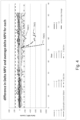
- Figure 3 illustrates a representative example of data from 15 sensors in the same local environment. As described above, the change in MPV value from the initial calibration point is plotted for all sensors over 80+ days. The average over the 80+ days was 5 counts with a standard deviation of 117 counts.
- group limits or thresholds may, for example, be established using a multiple of sigma. In the illustrated embodiment, group upper and lower thresholds were established using ⁇ 3 times the standard deviation to capture 99.7% of the nominal distribution. Group limits may, for example, be determined via a processor system external to the plurality of like sensors which is in communication with each of the plurality of like sensors to received data/information therefrom.
- the determined group limits may, for example, be transmitted from the external processing system to each of the plurality of like sensor. Such group limits are denoted by upper and lower dashed lines in Figure 3 .
- the sensor system can enter a second mode or observe mode. As described above, in a number of embodiments, the rate of change of the delta MPV can be tracked for a sensor in the second mode to determine if sensor response will stabilize. Similar to Figure 2 , two examples are provided in Figure 3 for a sensor step change (sensor 10a(ii)) and a catastrophic sensor failure (sensor 10(iii)).
- a sensor that is flagged by the population treatment discussed in connection with Figure 3 may still be operating nominally when compared to its own history (that is, upon comparison of the sensor response to one or more electronic interrogations to individual limits or thresholds determined for the individual sensor).
- the treatment discussed in connection with Figure 3 can be combined with the single sensor treatment discussed in connection with Figure 2 .
- sensor 10a(iv) shows a few instances of dropping below the -3 standard deviation/threshold line for the group/plurality of like sensors being monitored.
- Sensor 10a(iv) may, for example, be identified of flagged for a follow-up single treatment or evaluation.
- Figure 5 illustrates a single sensor treatment (as described, for example, in connection with Figure 2 above) for sensor 10a(iv).
- sensor 10a(iv) briefly drops below the -3 standard deviation limit for the individual sensor but recovers.
- data analysis other than determination of whether a measured value is outside of a nominal range may be performed.
- a common characteristic that is, a common characteristic other than being a like sensor; for example, geographic location, manufacture date range, etc.
- data analysis other than determination of whether a measured value is outside of a nominal range may be performed.
- One may, for example, expect (based upon data from a sensor population) that a particular sensor should be stabilizing or following a certain trend, but the particular sensor may be exhibit output that is different from its peers or other sensors in the monitored population.
- differences may, for example, be exhibited in manner other than output of a particular value/parameter (for example, MPV or delta MPV) outside of a threshold range (for example, outside +/- 3 std. deviation).
- One may, for example, determine/analyze the magnitude of response, the magnitude of the rate of change and/or the direction of change of each sensor relative to peers.
- sensor 10a(v) is exhibiting a rate of change in delta MPV that is opposite that of the other sensors in the studied population.
- Sensor 10a(v) may, for example, be identified or flagged and placed in a second or observe mode for further/alternative analysis and/or evaluation based on such a trend, which is different from its peers, even though the delta MPV behavior is within in the nominal range for the population of sensor and/or for individual sensor 10a(v).
- a particular sensor in the case that it is determined in the second mode that, for example, a particular sensor should be recalibrated and/or that its nominal range of response should be offset by at least a defined or predetermined amount from the nominal range of a population/plurality of like sensors of which the particular sensor is a member, it may, for example, be determined that the particular sensor should no longer be tracked as a member of the population/plurality of like sensors.
- the particular sensor stabilizes within the nominal range of the population/plurality of like sensors or only slightly offset therefrom, it may, for example, be determined that the particular sensor should be continued to be tracked as a member of the population/plurality of like sensors and it's response may continue to be considered in determining the group nominal thresholds for the population/plurality of like sensors.
- a sensor response or response trend different from its peers or other sensors in the monitored population/plurality of like sensors may not be an indication that the sensor at issue is malfunctioning but may be an indication that the sensor should not be a member of the monitored population/plurality of like sensors.
- Such a different response may, for example, result from a different microenvironment in a particular location.
- the sensor of the monitored population/plurality of like sensor exhibiting a different response/trend may be located within a structure at a particular location, while the other sensors of the population/plurality of like sensors may be positioned out of doors.
- the sensor of the monitored population/plurality of like sensor exhibiting a different response/trend may be located within direct sunlight while the other sensors of the population/plurality of like sensors are not.
- a response of a sensor that differs from that of its peers in a population/plurality of like sensor may trigger an investigation of whether the sensor in properly included in the population/plurality of like sensors. It may, for example, be determined that the sensor under investigation should be monitored only individually or within another population/plurality of like sensors.
- tracking the response to periodic electronic interrogations of a population/plurality of like sensors may, for example, provide information regarding a systemic issue with the sensors of the population/plurality of like sensors.
- Such sensors may, for example, have been manufactured in a determined date/time or manufacture code range. Certain defects (for example, a defect in electrolyte composition) may not be discovered at the time of manufacture but may result in anomalous response to electronic interrogations thereafter. Tracking of the response of such a plurality of like sensors to electronic interrogation may, for example, result in detection of a systemic problem with the sensors even before such a defect becomes otherwise apparent.
- Changes in maximum peak value and/or one or more other parameter from the time of manufacture of a sensor (and/or from another starting or anchor point, such as a subsequent calibration) until later in a sensor's life may be analyzed to, for example, determine what type of environmental conditions the sensor has experienced over that historical period (for example, low humidity or drying conditions). Based on such historical data, one may change one or more parameters of sensor operation.
- a software algorithm stored in memory and executable by one or more processors may, for example, apply a different temperature compensation.
- An algorithm may, for example, apply a different sensitivity compensation based on such historical data.
- An algorithm hereof (based on such historical data) may, for example, be used to alter nominal response range based on such historical data.
- Data from sensors that that are not like sensors or sensors that have very different characteristics than one or more sensors being monitored/analyzed may also be used in determining the operational status of the sensor(s) in the devices, systems and methods hereof.
- Such sensors that are not like sensors may, for example, be sensors that are for an analyte other than the sensor(s) for which the operational status is being determined.
- Such sensors that are not like sensors may, for example, be a different type of sensor (for example, a combustible gas sensor in the case that the like sensors are electrochemical gas sensors).
- sensors for environmental conditions such as pressure sensors, humidity sensors, altitude sensors or altimeters, etc. may also or alternatively be used in determining operational status.
- Data from temperature and/or humidity sensors may, for example, be used in determining appropriate nominal ranges for a measured parameter (for example, delta MPV as described in representative examples hereof).
- Different settings may be established for sensor locations that are cold and dry than those that are hot and humid.
- Altitude may, for example, be related to an oxygen concentration which affects the output of oxygen sensors as well as combustible gas sensors. At high altitude, the concentration of oxygen is lower than at sea level (fewer molecules of oxygen are present per unit volume). Below sea level, for example, in an underground mine, the environment may be rich in oxygen.
- an oxygen sensor may be used to determine the combustible gas sensor(s) is/are operating in a condition of oxygen deficiency or oxygen excess over a particular time period.
- Such an oxygen sensor may, for example, be an electrochemical gas sensor.
- sensors for inhibitors and/or poisons for combustible gas sensors for example, sulfur-containing compounds, halogens, silicon-containing compounds etc. may be sensed by, for example, electrochemical and/or other sensors.
- a combustible gas sensor or other sensor may, for example, be used to detect interferent gases for the electrochemical gas sensor(s).
- Alcohols may, for example, be detected via a combustible gas sensor.
- Speciation as disclosed, for example, U.S. Patent No. 10,234,412 , the disclosure of which is incorporated herein by reference, may be used in detecting a species of alcohol.
- Alcohols may affect certain electrochemical gas sensor such as carbon monoxide or CO sensors. Even a small increase in a combustible gas sensor output may be associated in time with anomalous output from an electrochemical gas sensor for CO sensor or even with such a sensor going offline.
- Alkenes may also be detected via combustible gas sensors. Alkenes are similarly interferents for electrochemical gas sensors for CO. Using data from one or more combustible gas sensors, one may determine if an alkene us present which is causing a response in one or more CO sensors.
- the timespan of history or data from one or more gas sensors, pressure sensors, humidity sensors, temperature sensors etc. may be analyzed to determine how such a data history may be affecting the performance of one or more sensor monitored under the methodologies hereof.
- Location data for example, from GPS or other systems
- the location of a monitored sensor or sensors in a facility may, for example, be correlated with gas test data, anomalies, alarms, up-scale readings, down-scale readings etc. Determination and/or analysis of nonstandard conditions or occurrences can be associated with the output of a monitored sensor or sensors.
- gas sensors may include one or more filters to, for example, limit or prevent gas sensing elements from coming into contact with or being exposed to an inhibitor, poison, interferent etc. Changes in the transport properties of such filters upon exposure to such an inhibitor, poison, interferent etc. may affect sensor response. Sensors sensitive to an inhibitor, poison, interferent etc. for a sensor or sensors being monitored using a methodology hereof may, for example, be used in interpreting output trends in such sensor(s). Likewise, such sensors sensitive to an inhibitor, poison, interferent etc. may be used to monitor or track the operational status of a filter for a sensor or sensors being monitored using a methodology hereof.
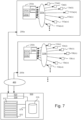
- Figure 7 illustrates a representative embodiment of a system for collection, communication and analysis of data from one or multiple sensors which may, for example, be located at a single facility or distributed over multiple facilities.
- a facility 200a for example, an oil refinery, off-shore drilling rig, manufacturing facility, industrial chemical plant etc.
- a facility 200a includes one or more sensor 10a(i) through 10a(vii) hereof
- one or more other facilities represented by facility 200b includes one or more other sensors 10b(i) through 10b(vii) hereof.
- seven sensors are illustrated in each of facilities 200a and 200b, facilities may include fewer or more sensors. Some facilities may, for example, include 100 or more sensors.
- each sensor 10a(i) hereof includes a communication system (for example, transceiver) which may be wired or wireless.
- Data from sensors 10a(i) through 10a(vii) may, for example, be communicated directly to a remote processing system 500, which is discussed further below.
- Data from sensors 10a(i) through 10a(vii) may alternatively be transmitted to remote system 500 via a local system 250a.
- data may, for example, be communicated from sensors 10a(i) through 10a(vii) to local system 250a via local network 220a which may, for example, include a 4 to 20 milliamp (mA) transmission system as known in the art, an ethernet-based network, and/or a wireless network.
- mA milliamp
- Data may, for example, be collected and transmitted in real-time to remote system 500 for analysis. Data transfer may be performed in a continuous or a discontinuous/batch manner. For example, raw sensor data or processed sensor data may be transmitted by local system 250a to remote system 500 for processing (or further processing) and/or analysis by remote system 500. Remote system 500 can received data from many local systems 250a, 250b etc. (that is, from many different facilities).
- Local system 250a may, for example, include a processing system 252a (including, for example, one or more processors or microprocessors), an associated memory system 254a in communicative connection with processor system 252a and a communication system 256a in communicate connection with processor system 252a.
- Processing/analysis may, for example, be distributed in the processing systems of the sensors, the local systems and remote system 500 (for example, in determining group upper thresholds and lower thresholds). Transmission from sensors 10a(i) through 10a(vii) and/or local system 250a to remote system 500 occur through a network 400 which may include wired and/or wireless communication protocols (for example, via cell phone transmission protocols, internet transmission protocols, data via telephone wire protocols etc.)
- Remote system 500 may, for example, include a central processing system or a distributed processing system that may, for example, include one or more computers, servers or server systems 510.
- Computer(s), server(s) or server system(s) 510 may, for example, include one or more processors or processor systems 512 which are in communicative connection with one or more memory or storage systems 514 as known in the computer arts.
- Memory system(s) 514 may include one or more databases 516 stored therein.
- Local systems 250a, 250b etc. may communicate with a communication system or systems 520 of remote system 500 through one or more wired or wireless communication channels 400 (for example, landline telephones, wireless telephones, a broadband internet connection and/or other communication channel(s)) as described above.
- Software stored in memory system(s) 514 or in one or more other memory system in communicative connection with processor(s) 512 may be used to process or analyze data from local systems 250a, 250b etc.
Landscapes
- Chemical & Material Sciences (AREA)
- Life Sciences & Earth Sciences (AREA)
- Health & Medical Sciences (AREA)
- Engineering & Computer Science (AREA)
- Analytical Chemistry (AREA)
- General Physics & Mathematics (AREA)
- Pathology (AREA)
- Physics & Mathematics (AREA)
- Immunology (AREA)
- Biochemistry (AREA)
- General Health & Medical Sciences (AREA)
- Combustion & Propulsion (AREA)
- Food Science & Technology (AREA)
- Medicinal Chemistry (AREA)
- Molecular Biology (AREA)
- Chemical Kinetics & Catalysis (AREA)
- Electrochemistry (AREA)
- Investigating Or Analyzing Materials By The Use Of Electric Means (AREA)
- Investigating Or Analyzing Materials By The Use Of Fluid Adsorption Or Reactions (AREA)
Applications Claiming Priority (3)
| Application Number | Priority Date | Filing Date | Title |
|---|---|---|---|
| US201862738190P | 2018-09-28 | 2018-09-28 | |
| PCT/US2019/053458 WO2020069317A1 (en) | 2018-09-28 | 2019-09-27 | Determination of sensor operational status via sensor interrogation |
| EP19790355.2A EP3857217B1 (de) | 2018-09-28 | 2019-09-27 | Bestimmung des betriebszustandes eines sensors durch sensorabfrage |
Related Parent Applications (2)
| Application Number | Title | Priority Date | Filing Date |
|---|---|---|---|
| EP19790355.2A Division-Into EP3857217B1 (de) | 2018-09-28 | 2019-09-27 | Bestimmung des betriebszustandes eines sensors durch sensorabfrage |
| EP19790355.2A Division EP3857217B1 (de) | 2018-09-28 | 2019-09-27 | Bestimmung des betriebszustandes eines sensors durch sensorabfrage |
Publications (2)
| Publication Number | Publication Date |
|---|---|
| EP4521108A2 true EP4521108A2 (de) | 2025-03-12 |
| EP4521108A3 EP4521108A3 (de) | 2025-05-21 |
Family
ID=68290345
Family Applications (2)
| Application Number | Title | Priority Date | Filing Date |
|---|---|---|---|
| EP19790355.2A Active EP3857217B1 (de) | 2018-09-28 | 2019-09-27 | Bestimmung des betriebszustandes eines sensors durch sensorabfrage |
| EP24214312.1A Pending EP4521108A3 (de) | 2018-09-28 | 2019-09-27 | Bestimmung des betriebszustandes eines sensors durch sensorabfrage |
Family Applications Before (1)
| Application Number | Title | Priority Date | Filing Date |
|---|---|---|---|
| EP19790355.2A Active EP3857217B1 (de) | 2018-09-28 | 2019-09-27 | Bestimmung des betriebszustandes eines sensors durch sensorabfrage |
Country Status (7)
| Country | Link |
|---|---|
| US (3) | US11680933B2 (de) |
| EP (2) | EP3857217B1 (de) |
| JP (2) | JP7465866B2 (de) |
| CN (2) | CN117554453A (de) |
| AU (1) | AU2019346634B2 (de) |
| CA (1) | CA3114429C (de) |
| WO (1) | WO2020069317A1 (de) |
Families Citing this family (10)
| Publication number | Priority date | Publication date | Assignee | Title |
|---|---|---|---|---|
| WO2020069317A1 (en) | 2018-09-28 | 2020-04-02 | Msa Technology, Llc | Determination of sensor operational status via sensor interrogation |
| KR102661642B1 (ko) * | 2019-08-14 | 2024-04-29 | 삼성전자주식회사 | 전자 장치 및 전자 장치의 제어 방법 |
| US11944755B2 (en) * | 2020-04-21 | 2024-04-02 | GE Precision Healthcare LLC | Methods and system for oxygen sensor prognostics in a medical gas flow device |
| DE102020115804A1 (de) * | 2020-06-16 | 2021-12-16 | Dräger Safety AG & Co. KGaA | Elektrochemische Sensoranordnung, Atemalkoholmessgerät und Verfahren zum Bestimmen einer Vitalität von Elektroden eines elektrochemischen Sensors |
| US20220011282A1 (en) * | 2020-07-08 | 2022-01-13 | Aeroqual Ltd. | Method for Electrochemical Gas Sensor Diagnostics |
| WO2022177909A1 (en) * | 2021-02-16 | 2022-08-25 | Ecolab Usa Inc. | Creping process performance tracking and control |
| CN115236135B (zh) * | 2021-04-23 | 2023-08-22 | 中国石油化工股份有限公司 | 用于气体传感器的基线校准方法、控制装置和气体传感器 |
| US12174166B2 (en) | 2021-10-07 | 2024-12-24 | Msa Technology, Llc | Assignment and de-assignment in portable devices via a charger |
| US12326431B2 (en) | 2022-12-17 | 2025-06-10 | Msa Technology, Llc | Gas detector device control based upon accessory identification |
| CN118896638B (zh) * | 2024-08-05 | 2025-01-28 | 广东深莱特科技股份有限公司 | 一种3d透视烘干传感器的性能检测方法及系统 |
Citations (7)
| Publication number | Priority date | Publication date | Assignee | Title |
|---|---|---|---|---|
| US7413645B2 (en) | 2004-05-05 | 2008-08-19 | Mine Safety Appliances Company | Devices, systems and methods for testing gas sensors and correcting gas sensor output |
| US20130186777A1 (en) | 2011-10-14 | 2013-07-25 | Towner B. Scheffler | Sensor interrogation |
| US20140273263A1 (en) | 2013-03-12 | 2014-09-18 | Mark F. Zanella, Sr. | Diagnostics for catalytic structures and combustible gas sensors including catalytic structures |
| US9528957B2 (en) | 2011-10-14 | 2016-12-27 | Msa Technology, Llc | Sensor interrogation |
| US20170219515A1 (en) | 2016-02-02 | 2017-08-03 | Msa Technology, Llc | Sensor interrogation with fast recovery |
| US9784755B2 (en) | 2011-10-14 | 2017-10-10 | Msa Technology, Llc | Sensor interrogation |
| US10234412B2 (en) | 2016-11-04 | 2019-03-19 | Msa Technology, Llc | Identification of combustible gas species via pulsed operation of a combustible gas sensor |
Family Cites Families (16)
| Publication number | Priority date | Publication date | Assignee | Title |
|---|---|---|---|---|
| ATE394665T1 (de) | 2005-04-01 | 2008-05-15 | Mettler Toledo Ag | Verfahren und vorrichtung zur funktionskontrolle eines sensors |
| US7581390B2 (en) * | 2006-04-26 | 2009-09-01 | Cummins Inc. | Method and system for improving sensor accuracy |
| US8478377B2 (en) * | 2006-10-04 | 2013-07-02 | Dexcom, Inc. | Analyte sensor |
| US7751864B2 (en) * | 2007-03-01 | 2010-07-06 | Roche Diagnostics Operations, Inc. | System and method for operating an electrochemical analyte sensor |
| JP4898550B2 (ja) | 2007-05-21 | 2012-03-14 | ホーチキ株式会社 | ガス警報器 |
| US20130331676A1 (en) * | 2012-06-08 | 2013-12-12 | Medtronic Minimed, Inc. | Application of electrochemical impedance spectroscopy in sensor systems, devices, and related methods |
| JP6045099B2 (ja) * | 2012-09-25 | 2016-12-14 | 理研計器株式会社 | 間欠駆動型可燃性ガス検出装置 |
| US20150164382A1 (en) | 2013-12-16 | 2015-06-18 | Medtronic Minimed, Inc. | Use of electrochemical impedance spectroscopy (eis) in continuous glucose monitoring |
| WO2015127085A1 (en) | 2014-02-19 | 2015-08-27 | Ino Therapeutics Llc | Methods for compensating long term sensitivity drift of electrochemical gas sensors exposed to nitric oxide |
| US11988662B2 (en) * | 2015-12-07 | 2024-05-21 | Nanohmics, Inc. | Methods for detecting and quantifying gas species analytes using differential gas species diffusion |
| US20170184527A1 (en) * | 2015-12-28 | 2017-06-29 | Medtronic Minimed, Inc. | Sensor systems, devices, and methods for continuous glucose monitoring |
| WO2018160650A1 (en) * | 2017-02-28 | 2018-09-07 | Vaon, Llc | Bimetal doped-metal oxide-based chemical sensors |
| US10948469B2 (en) | 2017-05-17 | 2021-03-16 | Msa Technology, Llc | Dynamic comparative diagnostics for catalytic structures and combustible gas sensors including catalytic structures |
| US10627379B2 (en) | 2017-05-17 | 2020-04-21 | Msa Technology, Llc | Comparative diagnostics for catalytic structures and combustible gas sensors including catalytic structures |
| WO2020069317A1 (en) | 2018-09-28 | 2020-04-02 | Msa Technology, Llc | Determination of sensor operational status via sensor interrogation |
| US11333646B2 (en) * | 2019-06-05 | 2022-05-17 | General Electric Company | Gas sensor system and method |
-
2019
- 2019-09-27 WO PCT/US2019/053458 patent/WO2020069317A1/en not_active Ceased
- 2019-09-27 JP JP2021517358A patent/JP7465866B2/ja active Active
- 2019-09-27 CA CA3114429A patent/CA3114429C/en active Active
- 2019-09-27 CN CN202311512238.8A patent/CN117554453A/zh active Pending
- 2019-09-27 AU AU2019346634A patent/AU2019346634B2/en active Active
- 2019-09-27 US US16/585,684 patent/US11680933B2/en active Active
- 2019-09-27 EP EP19790355.2A patent/EP3857217B1/de active Active
- 2019-09-27 EP EP24214312.1A patent/EP4521108A3/de active Pending
- 2019-09-27 CN CN201980078370.8A patent/CN113167762B/zh active Active
-
2023
- 2023-04-27 US US18/140,292 patent/US12188915B2/en active Active
-
2024
- 2024-04-01 JP JP2024059061A patent/JP7827773B2/ja active Active
- 2024-11-13 US US18/945,653 patent/US20250067714A1/en active Pending
Patent Citations (8)
| Publication number | Priority date | Publication date | Assignee | Title |
|---|---|---|---|---|
| US7413645B2 (en) | 2004-05-05 | 2008-08-19 | Mine Safety Appliances Company | Devices, systems and methods for testing gas sensors and correcting gas sensor output |
| US7959777B2 (en) | 2004-05-05 | 2011-06-14 | Mine Safety Appliances Company | Devices, systems and methods for testing gas sensors and correcting gas sensor output |
| US20130186777A1 (en) | 2011-10-14 | 2013-07-25 | Towner B. Scheffler | Sensor interrogation |
| US9528957B2 (en) | 2011-10-14 | 2016-12-27 | Msa Technology, Llc | Sensor interrogation |
| US9784755B2 (en) | 2011-10-14 | 2017-10-10 | Msa Technology, Llc | Sensor interrogation |
| US20140273263A1 (en) | 2013-03-12 | 2014-09-18 | Mark F. Zanella, Sr. | Diagnostics for catalytic structures and combustible gas sensors including catalytic structures |
| US20170219515A1 (en) | 2016-02-02 | 2017-08-03 | Msa Technology, Llc | Sensor interrogation with fast recovery |
| US10234412B2 (en) | 2016-11-04 | 2019-03-19 | Msa Technology, Llc | Identification of combustible gas species via pulsed operation of a combustible gas sensor |
Also Published As
| Publication number | Publication date |
|---|---|
| US20230258617A1 (en) | 2023-08-17 |
| US12188915B2 (en) | 2025-01-07 |
| CN117554453A (zh) | 2024-02-13 |
| AU2019346634B2 (en) | 2024-02-01 |
| CA3114429A1 (en) | 2020-04-02 |
| EP3857217B1 (de) | 2025-02-12 |
| US20250067714A1 (en) | 2025-02-27 |
| WO2020069317A1 (en) | 2020-04-02 |
| CN113167762B (zh) | 2023-11-03 |
| JP7465866B2 (ja) | 2024-04-11 |
| JP7827773B2 (ja) | 2026-03-10 |
| EP3857217A1 (de) | 2021-08-04 |
| JP2024096744A (ja) | 2024-07-17 |
| US20200103387A1 (en) | 2020-04-02 |
| US11680933B2 (en) | 2023-06-20 |
| AU2019346634A1 (en) | 2021-05-13 |
| CN113167762A (zh) | 2021-07-23 |
| CA3114429C (en) | 2024-05-21 |
| EP4521108A3 (de) | 2025-05-21 |
| JP2022502651A (ja) | 2022-01-11 |
Similar Documents
| Publication | Publication Date | Title |
|---|---|---|
| US12188915B2 (en) | Determination of sensor operational status via sensor interrogation | |
| CA3005273C (en) | Sensor interrogation with fast recovery | |
| EP2239562B1 (de) | Überprüfung elektrochemischer Gassensoren | |
| AU2020290902B2 (en) | Interrogation of capillary-limited sensors | |
| US20130193004A1 (en) | Sensor interrogation | |
| US20260043768A1 (en) | Interrogation and output correction of capillary-limited oxygen sensors |
Legal Events
| Date | Code | Title | Description |
|---|---|---|---|
| PUAI | Public reference made under article 153(3) epc to a published international application that has entered the european phase |
Free format text: ORIGINAL CODE: 0009012 |
|
| STAA | Information on the status of an ep patent application or granted ep patent |
Free format text: STATUS: THE APPLICATION HAS BEEN PUBLISHED |
|
| AC | Divisional application: reference to earlier application |
Ref document number: 3857217 Country of ref document: EP Kind code of ref document: P |
|
| AK | Designated contracting states |
Kind code of ref document: A2 Designated state(s): AL AT BE BG CH CY CZ DE DK EE ES FI FR GB GR HR HU IE IS IT LI LT LU LV MC MK MT NL NO PL PT RO RS SE SI SK SM TR |
|
| REG | Reference to a national code |
Ref country code: DE Ref legal event code: R079 Free format text: PREVIOUS MAIN CLASS: G01N0033000000 Ipc: G01N0027404000 |
|
| PUAL | Search report despatched |
Free format text: ORIGINAL CODE: 0009013 |
|
| AK | Designated contracting states |
Kind code of ref document: A3 Designated state(s): AL AT BE BG CH CY CZ DE DK EE ES FI FR GB GR HR HU IE IS IT LI LT LU LV MC MK MT NL NO PL PT RO RS SE SI SK SM TR |
|
| RIC1 | Information provided on ipc code assigned before grant |
Ipc: G01N 33/00 20060101ALI20250415BHEP Ipc: G01N 27/404 20060101AFI20250415BHEP |
|
| STAA | Information on the status of an ep patent application or granted ep patent |
Free format text: STATUS: REQUEST FOR EXAMINATION WAS MADE |
|
| 17P | Request for examination filed |
Effective date: 20251120 |
|
| STAA | Information on the status of an ep patent application or granted ep patent |
Free format text: STATUS: EXAMINATION IS IN PROGRESS |
|
| 17Q | First examination report despatched |
Effective date: 20260309 |