EP4521421A1 - Matériau de protection contre les rayonnements, dispositif de protection contre les rayonnements et procédé de fabrication d'un dispositif de protection contre les rayonnements - Google Patents
Matériau de protection contre les rayonnements, dispositif de protection contre les rayonnements et procédé de fabrication d'un dispositif de protection contre les rayonnements Download PDFInfo
- Publication number
- EP4521421A1 EP4521421A1 EP23195386.0A EP23195386A EP4521421A1 EP 4521421 A1 EP4521421 A1 EP 4521421A1 EP 23195386 A EP23195386 A EP 23195386A EP 4521421 A1 EP4521421 A1 EP 4521421A1
- Authority
- EP
- European Patent Office
- Prior art keywords
- metal
- radiation protection
- protection device
- layer
- containing layer
- Prior art date
- Legal status (The legal status is an assumption and is not a legal conclusion. Google has not performed a legal analysis and makes no representation as to the accuracy of the status listed.)
- Pending
Links
Images


Classifications
-
- G—PHYSICS
- G21—NUCLEAR PHYSICS; NUCLEAR ENGINEERING
- G21F—PROTECTION AGAINST X-RADIATION, GAMMA RADIATION, CORPUSCULAR RADIATION OR PARTICLE BOMBARDMENT; TREATING RADIOACTIVELY CONTAMINATED MATERIAL; DECONTAMINATION ARRANGEMENTS THEREFOR
- G21F3/00—Shielding characterised by its physical form, e.g. granules, or shape of the material
- G21F3/02—Clothing
-
- G—PHYSICS
- G21—NUCLEAR PHYSICS; NUCLEAR ENGINEERING
- G21F—PROTECTION AGAINST X-RADIATION, GAMMA RADIATION, CORPUSCULAR RADIATION OR PARTICLE BOMBARDMENT; TREATING RADIOACTIVELY CONTAMINATED MATERIAL; DECONTAMINATION ARRANGEMENTS THEREFOR
- G21F1/00—Shielding characterised by the composition of the materials
- G21F1/02—Selection of uniform shielding materials
- G21F1/10—Organic substances; Dispersions in organic carriers
- G21F1/103—Dispersions in organic carriers
- G21F1/106—Dispersions in organic carriers metallic dispersions
-
- G—PHYSICS
- G21—NUCLEAR PHYSICS; NUCLEAR ENGINEERING
- G21F—PROTECTION AGAINST X-RADIATION, GAMMA RADIATION, CORPUSCULAR RADIATION OR PARTICLE BOMBARDMENT; TREATING RADIOACTIVELY CONTAMINATED MATERIAL; DECONTAMINATION ARRANGEMENTS THEREFOR
- G21F1/00—Shielding characterised by the composition of the materials
- G21F1/02—Selection of uniform shielding materials
- G21F1/08—Metals; Alloys; Cermets, i.e. sintered mixtures of ceramics and metals
- G21F1/085—Heavy metals or alloys
-
- G—PHYSICS
- G21—NUCLEAR PHYSICS; NUCLEAR ENGINEERING
- G21F—PROTECTION AGAINST X-RADIATION, GAMMA RADIATION, CORPUSCULAR RADIATION OR PARTICLE BOMBARDMENT; TREATING RADIOACTIVELY CONTAMINATED MATERIAL; DECONTAMINATION ARRANGEMENTS THEREFOR
- G21F1/00—Shielding characterised by the composition of the materials
- G21F1/12—Laminated shielding materials
- G21F1/125—Laminated shielding materials comprising metals
-
- G—PHYSICS
- G21—NUCLEAR PHYSICS; NUCLEAR ENGINEERING
- G21F—PROTECTION AGAINST X-RADIATION, GAMMA RADIATION, CORPUSCULAR RADIATION OR PARTICLE BOMBARDMENT; TREATING RADIOACTIVELY CONTAMINATED MATERIAL; DECONTAMINATION ARRANGEMENTS THEREFOR
- G21F3/00—Shielding characterised by its physical form, e.g. granules, or shape of the material
- G21F3/02—Clothing
- G21F3/03—Aprons
-
- G—PHYSICS
- G21—NUCLEAR PHYSICS; NUCLEAR ENGINEERING
- G21F—PROTECTION AGAINST X-RADIATION, GAMMA RADIATION, CORPUSCULAR RADIATION OR PARTICLE BOMBARDMENT; TREATING RADIOACTIVELY CONTAMINATED MATERIAL; DECONTAMINATION ARRANGEMENTS THEREFOR
- G21F3/00—Shielding characterised by its physical form, e.g. granules, or shape of the material
- G21F3/02—Clothing
- G21F3/035—Gloves
Definitions
- the invention relates to a novel radiation protection material and a radiation protection device, in particular for shielding against X-rays, their production, and their uses.
- the material is preferably used as a layer.
- the layer can also be a coating of another material (fabric or fiber).
- Radiation shielding devices are used to protect people from harmful high-energy radiation. They are made of special materials that attenuate or block the radiation. These devices are placed between the radiation source and the person being protected to minimize radiation exposure. Examples include lead aprons for patients and medical staff or leaded glass windows in X-ray rooms, which absorb and scatter radiation to reduce the risk to people outside the examination area.
- Suitable metals are often incorporated into a matrix.
- This matrix can also be a binder.
- a common binder for this purpose is natural rubber, e.g., plastisol.
- plastisol is a dispersion of a powdered thermoplastic polymer, optionally with pigments, fillers, and additives such as blowing agents, in a liquid plasticizer.
- plastisol has the disadvantage that the radiation shielding materials and devices are heavy and have a high Shore 00 hardness. Furthermore, articles made of plastisol are very difficult to recycle.
- the WO2022/002811 A3 describes the production of a metal-containing layer for the manufacture of X-ray aprons, which contains polyurethane as a binder, whereby the metal-containing layer is applied using a screen printing process.
- Ideal radiation protection materials from which radiation protection devices, especially X-ray protection devices (such as clothing and aprons), can be made should be light and flexible, i.e., have the lowest possible Shore hardness and at the same time have a sufficiently good radiation protection effect.
- the invention is therefore based on the object of providing radiation protection materials and devices that offer the aforementioned advantages and are also easy to manufacture. When the materials are processed into radiation protection clothing, wearing comfort should also be improved.
- the radiation protection materials and devices were easy to dispose of and, in particular, recyclable.
- Metals can be used in elemental, ionic or complexed form to produce the material and can be present in the material.
- another metal or metal mixture can be used instead of or together with lead, selected from tungsten (T), bismuth (Bi), tin (Sn), antimony (Sb), and barium (Ba), alone or as mixtures and/or alloys, elemental or ionic (e.g., in the form of metal oxides) or in complexed form.
- Possible mixtures include, for example, tungsten and/or bismuth and/or barium and/or antimony and/or tin and/or their compounds, such as barium sulfate.
- Radiation protection materials usually contain only lead in elemental, ionic or complexed form.
- metals according to the invention are, for example, tungsten (T), bismuth (Bi), tin (Sn), antimony (Sb) and barium (Ba) alone or as mixtures and/or alloys, elemental or ionic (e.g. in the form of metal oxides) or as metal complexes.
- thermoplastic elastomers or thermoplastic elastomer mixtures are suitable for the production of metal-containing materials, particularly as coatings, and that a stable bond is created. They are used as binders.
- the metal-containing material is very well suited for coating fabrics or fibers, opening up a wide range of applications.
- the metal-containing material, or - when used in the form of a layer - the metal-containing layer has a very advantageous low Shore 00 hardness, and the binder structure has a low density, resulting in a sufficiently soft and stable metal-containing material that is easy to process and also recyclable.
- the low density is advantageous because the weight of the Processed products are low.
- the radiation protection property is achieved by the selection of metals in the metal layer.
- the inventors have found that it is particularly advantageous to use a combination of the appropriate metal and its metal oxide.
- the invention thus also provides a lead-reduced material containing at least two of the following metals (in elemental form and/or in at least one ionic form and/or in complexed form), the metals being selected from lead (Pb), bismuth (Bi), tin (Sn), antimony (Sb) and barium (Ba), and radiation protection devices made therefrom, which are to be used in particular for protection against X-rays.
- the metals being selected from lead (Pb), bismuth (Bi), tin (Sn), antimony (Sb) and barium (Ba), and radiation protection devices made therefrom, which are to be used in particular for protection against X-rays.
- the invention further provides a lead-free material containing at least one of the following metals (in elemental form and/or in at least one ionic form and/or in complexed form), the metals being selected from bismuth (Bi), tin (Sn), antimony (Sb) and barium (Ba), and radiation protection devices made therefrom, which are to be used in particular for protection against X-rays.
- metals in elemental form and/or in at least one ionic form and/or in complexed form
- the metals being selected from bismuth (Bi), tin (Sn), antimony (Sb) and barium (Ba), and radiation protection devices made therefrom, which are to be used in particular for protection against X-rays.
- the invention also relates to the manufacture of radiation protection devices in which the material is present as a coating or the material is present in a single or multiple sandwich structure (e.g. as an intermediate layer).
- Hotmelt adhesives are solvent-free, polymer-based adhesives that are solid at room temperature. They are applied in a hot, molten state or processed.
- hot melt adhesives consist of a base polymer (which can be in various forms) and additives. These additives include resins (e.g., rosin, terpenes, hydrocarbon resins), waxes, stabilizers, antioxidants, and plasticizers. Other chemicals may also be present to impart other desired properties to the hot melt adhesive.
- the base polymers of the hot melt adhesives usable according to the invention include: polyamides (PA), polyethylenes (PE), polypropylenes (PP), atactic polypropylenes (a-PP), polyolefins, amorphous polyolefins (APAO), ethylene-vinyl acetate (EVA), ethylene-vinyl acetate copolymers EVAC, polyesters, polyester elastomers (TPE-E), polyurethane elastomers (TPE-U), copolyamide elastomers (TPE-A), vinylpyrrolidone/vinyl acetate copolymers, styrene block copolymers, e.g. SEBS, polyethylene and polystyrene.
- PA polyamides
- PE polyethylenes
- PP polypropylenes
- a-PP atactic polypropylenes
- APAO amorphous polyolefins
- EVA ethylene-vinyl
- hotmelts containing atactic polypropylenes (a-PP) or styrene block copolymers e.g. SEBS.
- Solvent-free, polymer-based hot melt adhesives can be processed quickly and cost-effectively. They are more tacky than solvent-based hot melt adhesives and emit fewer volatile organic compounds during processing.
- the melting points of these hot melts are usually between 80 and 220 °C.
- Hotmelts preferred according to the invention contain atactic polypropylenes or styrene block copolymers, e.g. SEBS, as base polymer.
- SEBS styrene block copolymers
- the inventors have found that during the production of the material a metal concentration sufficient for the radiation effect is achieved if the metallic component(s) are pre-dispersed with a component of the elastomer or hotmelt and only after this Pre-dispersion the remaining components of the binder (e.g. hot melts) are added to the mixture.
- the metallic component(s) are pre-dispersed with a component of the elastomer or hotmelt and only after this Pre-dispersion the remaining components of the binder (e.g. hot melts) are added to the mixture.
- the metal and/or the metallic compound is predispersed with a-PP or SEBS and then the remaining components of the corresponding hotmelt are added.
- the inventive predispersion of the metal with the base component of the hot melt not only achieves sufficient concentration, but also gives the material its soft character. At the same time, no significant voids or aggregates form in the final product.
- the metal-containing material can be used as a coating material.
- This metal-containing layer can be applied to a carrier, located on a carrier, or located between two carriers or carrier webs.
- the carriers coated with the composition according to the invention can be multilayered and have additional coatings (e.g., additional antibacterial metal layers can be present).
- hot melt as a binder is preferable and has the additional advantage that if the material is applied to at least one carrier (this can be a fabric, textile or similar), the carrier can be freely selected depending on the subsequent use.
- microfiber as the carrier, for example, increases the comfort for the person wearing the radiation protection device (e.g., X-ray apron). It is also advantageous if the carrier is easy to clean.
- the backing no longer necessarily needs to be made of a very dense and tear-resistant material (such as polyester fabric), since hotmelt, unlike the commonly used plastisol, is non-toxic. Therefore, tearing of the backing does not lead to toxic exposure.
- a very dense and tear-resistant material such as polyester fabric
- the invention therefore also relates to a radiation protection device comprising at least one metal-containing layer, wherein the metal content of the metal-containing layer is at least 50% by weight, wherein the binder of the metal-containing layer is a hot melt adhesive.
- the metal-containing layer is arranged between two carrier layers, one of these carrier layers can advantageously be made of polyester.
- the other layer can be made of polyester or a fabric such as microfiber, TPU, PP nonwoven, or PE nonwoven.
- the carriers can be in the form of carrier webs, so that the radiation protection device is manufactured as a web product.
- the invention relates to a radiation protection material (in particular an X-ray protection device) consisting at least of a binder and at least one metal, wherein the at least one metal in its elemental and/or in at least one ionic form is preferably selected from lead (Pb), tungsten (T), bismuth (Bi), tin (Sn), antimony (Sb) and barium (Ba) in elemental, ionic and/or complexed form, wherein the metal content of the at least one metal is greater than or equal to 50 wt. % and the density of the binder structure is less than or equal to 1.1 g/cm 3 and has a Shore 00 hardness of maximum 100.
- a radiation protection material in particular an X-ray protection device
- the at least one metal in its elemental and/or in at least one ionic form is preferably selected from lead (Pb), tungsten (T), bismuth (Bi), tin (Sn), antimony (Sb) and barium (B
- the radiation protection material is preferably processed in the form of layers, wherein a layer according to the invention also means a coating, ie a layer applied to a carrier or a fiber.
- Radiation protection devices are preferably produced from the radiation protection material.
- the invention relates to a radiation protection material (in particular X-ray protection device) as described in embodiment [A), wherein the at least one metal is present in elemental form or in ionic form (e.g. as metal oxide, sulfate, carbonate), e.g. Pb, Pb 2+ ions, T, T ions, Bi, Bi 3+ ions, Bi 2 O 3 , Sn, Sn 2+ ions, SnO, Sb, Sb 3+ ions Sb 2 O 3 , Ba, Ba 2+ ions BaO or mixtures thereof.
- the at least one metal is present in elemental form or in ionic form (e.g. as metal oxide, sulfate, carbonate), e.g. Pb, Pb 2+ ions, T, T ions, Bi, Bi 3+ ions, Bi 2 O 3 , Sn, Sn 2+ ions, SnO, Sb, Sb 3+ ions Sb 2 O 3 , Ba, Ba 2+ ions BaO
- the invention relates to the radiation protection material or the radiation protection device (in particular the X-ray protection material or the X-ray protection device) as defined in embodiment [A], wherein the binder is selected from hot melt adhesive, thermoplastic elastomer, thermoplastic elastomer mixture and the binder structure of the metal-containing material or the layer has a density of at most 1.1 g/cm 3 or whose density lies in one of the following ranges 0.85 g/cm 3 to 1.1 g/cm 3 , 0.85 g/cm 3 to 1.05 g/cm 3 , 0.85 g/cm 3 to 1 g/cm 3 , 0.85 g/cm 3 to 0.95 g/cm 3 , 0.85 g/cm 3 to 0.9 g/cm 3 ,
- the invention relates to a radiation protection material or a radiation protection device (in particular an X-ray protection material or an X-ray protection device) as defined in one of the preceding embodiments, wherein a holtmelt based on a-PP or SEBS is used as binder.
- the invention relates to a radiation protection material or a radiation protection device (in particular an X-ray protection material or an X-ray protection device) as defined in one of the preceding embodiments, wherein the ratio between metal content and binder content is within the ranges disclosed in this application, for example 70% metal content and 30% binder content.
- the invention relates to the radiation protection material or a radiation protection device (in particular X-ray protection material or device) as defined in one of the preceding embodiments, in which the binder structure of the material or - if the material is processed as a layer - of the metal-containing layer has a Shore 00 hardness in the range of approximately 25-95 g/cm 3 , in particular of approximately 25-65 g/cm 3 , of approximately 30-65 g/cm 3 or of approximately 45-80 g/cm 3 .
- the Shore 00 hardness can also be as follows: less than or equal to 95 g/cm 3 , less than or equal to 90 g/cm 3 , less than or equal to 85 g/cm 3 , less than or equal to 80 g/cm 3 , less than or equal to 75 g/cm 3 , less than or equal to 70 g/cm 3 , less than or equal to 65 g/cm 3 .
- it may be greater than or equal to 25 g/cm 3 , greater than or equal to 30 g/cm 3 , greater than or equal to 35 g/cm 3 , greater than or equal to 40 g/cm 3 , greater than or equal to 45 g/cm 3 , greater than or equal to 50 g/cm 3 , greater than or equal to 55 g/cm 3 , or greater than or equal to 60 g/cm 3 .
- the invention relates to the radiation protection material or a radiation protection device (in particular X-ray protection material or device) as described in one of the preceding embodiments, in which the elemental metal has the following maximum grain size: 110 ⁇ m, 100 ⁇ m, 90 ⁇ m, 80 ⁇ m, 70 ⁇ m, 60 ⁇ m, 50 ⁇ m, 40 ⁇ m or if the minimum grain size is 40 ⁇ m, 50 ⁇ m, 60 ⁇ m, 70 ⁇ m, 80 ⁇ m, 90 ⁇ m, 100 ⁇ m.
- the metallic layer contains metals in ionic or oxidized form, the following maximum grain sizes are advantageous according to the invention: 10 ⁇ m, 1 ⁇ m, approx. 500nm.
- the invention relates to the radiation protection material or a radiation protection device (in particular, X-ray protection material or device) as described in one of the preceding embodiments, in which the metal content of the elemental metal has the following minimum grain size: 140 mesh, 170 mesh, 200 mesh, 250 mesh, 300 mesh, 350 mesh, 400 mesh. Likewise, it is advantageous if the maximum grain size is 400 mesh, 350 mesh, 300 mesh, 250 mesh, 200 mesh, 170 mesh, 140 mesh.
- the value is in a range of 300-350 mesh.
- the invention relates to a radiation protection device as described in one of the preceding embodiments, comprising one or more carriers (also in the form of carrier webs).
- the invention relates to the radiation protection material or the radiation protection device (in particular X-ray protection material or X-ray protection device) as described in one of the preceding embodiments, wherein, in particular when the material is used as a layer, the solid portion of the metal-containing layer comprises metal particles in elemental form with an average diameter in the range of 5-100 ⁇ m, 20-80 ⁇ m or 40-60 ⁇ m.
- the radiation protection device then consists of a metal-containing layer applied to the carrier or sandwiched between at least two carriers.
- the carrier(s) can be freely selected depending on the application. Materials such as microfiber, TPU, or PP fleece are conceivable. or PE fleece. If two carriers are used, the materials of the carriers can also be different. For example, it is conceivable to produce a radiation protection device with a sandwich structure in which the metal-containing layer is arranged between the PE fleece and the microfiber.
- the material according to the invention represents a radiation protection device which is completely or partially processed into a radiation protection apron (preferably an X-ray protection apron).
- the radiation protection device can be part of an X-ray apron or an X-ray apron.
- the metal-containing coating can preferably be applied firmly using an extrusion process.
- These embodiments of the invention are particularly advantageous for X-ray aprons.
- antimony and/or tin and/or barium and/or their oxides can be included in the metal-containing coating for radiation protection.
- the present invention also has the advantage that seams can be subsequently welded, for example with a laminating process along the seams.
- a further advantage of the present invention is that the material (i.e., the metals and the hot melt adhesive) is easily separable and therefore easily recycled and reused. During the manufacture of clothing or textiles, cutting residues can be melted down and recycled for processing.
- the material i.e., the metals and the hot melt adhesive
- the metal-containing layer comprises elemental metal particles, metal oxides, or metal salts.
- the carrier i.e., the fabric layer or textile fabric, can also comprise a fabric layer whose fibers are coated with the coating according to the invention or provided with the metal-containing layer.
- Embodiment 1 Radiation protection device (10) with at least one metal-containing layer (14a, 14b) with a metal portion and a binder structure (18), wherein the metal portion of the metal-containing layer (14a, 14b) is more than 50 wt. %, characterized in that the binder structure (18) of the metal-containing layer (14a, 14b) has a Shore 00 hardness of less than or equal to 100 and/or the binder structure (18) of the metal-containing layer (14a, 14b) has a density of less than or equal to 1.1 g/cm 3 .
- Embodiment 2 The radiation protection device (10) according to embodiment 1, characterized in that the binder of the binder structure (18) of the metal-containing layer (14a, 14b) comprises a hot melt adhesive.
- Embodiment 4 The radiation protection device (10) according to one of the preceding embodiments, characterized in that the binder structure (18) of the metal-containing layer (14a, 14b) has a Shore 00 hardness of at most 25, preferably at most 30, more preferably at most 35, more preferably at most 40, more preferably at most 45, more preferably at most 50, more preferably at most 55, more preferably at most 60.
- Embodiment 5 The radiation protection device (10) according to one of the preceding embodiments, characterized in that at least 25% of the metal portion of the metal-containing layer (14a, 14b) is in the form of a metal oxide, preferably at least 30%, more preferably at least 35%, at least 40%, at least 45%, at least 50%, at least 55% or at least 60% of the metal portion of the metal-containing layer (14a, 14b) is in the form of a metal oxide.
- Embodiment 6 The radiation protection device (10) according to one of the preceding embodiments, characterized in that a maximum of 80% of the metal portion of the metal-containing layer (14a, 14b) is in the form of a metal oxide, preferably a maximum of 75%, more preferably a maximum of 70%, a maximum of 65%, a maximum of 60%, a maximum of 55%, a maximum of 50%, a maximum of 45% of the metal portion of the metal-containing layer (14a, 14b) is in the form of a metal oxide.
- a maximum of 80% of the metal portion of the metal-containing layer (14a, 14b) is in the form of a metal oxide, preferably a maximum of 75%, more preferably a maximum of 70%, a maximum of 65%, a maximum of 60%, a maximum of 55%, a maximum of 50%, a maximum of 45% of the metal portion of the metal-containing layer (14a, 14b) is in the form of a metal oxide.
- Embodiment 9 The radiation protection device (10) according to one of the preceding embodiments, characterized in that the metal portion of the metal-containing layer (14a, 14b) comprises metallic metal-containing particles with a grain size of at least 140 mesh, preferably of at least 170 mesh, more preferably of at least 200 mesh, of at least 250 mesh, of at least 300 mesh, of at least 350 mesh, and of at least 400 mesh.
- Embodiment 10 The radiation protection device (10) according to one of the preceding embodiments, characterized in that the metal portion of the metal-containing layer (14a, 14b) comprises metallic metal-containing particles with a grain size of at most 400 mesh, preferably of at most 350 mesh, more preferably of at most 300 mesh, of at most 250 mesh, of at most 200 mesh, of at most 170 mesh, and of at most 140 mesh.
- Embodiment 11 The radiation protection device (10) according to one of the preceding embodiments, characterized in that the metal-containing layer (14a, 14b) has a metal content or a solid content of at least 50 wt. %, preferably of at least 55 wt. %, more preferably of at least 60 wt. %, of at least 65 wt. %, of at least 70 wt. %, of at least 75 wt. %, of at least 80 wt. %, of at least 85 wt. %, of at least 90 wt. %, of at least 92 wt.
- the metal-containing layer (14a, 14b) has a metal content or a solid content of at least 50 wt. %, preferably of at least 55 wt. %, more preferably of at least 60 wt. %, of at least 65 wt. %, of at least 70 wt. %, of at least 75 wt. %
- Embodiment 12 The radiation protection device (10) according to one of the preceding embodiments, characterized in that the solid portion of the metal-containing layer (14a, 14b) comprises metallic metal-containing particles with an average diameter in the range of 5 ⁇ m to 100 ⁇ m, preferably in the range of 20 ⁇ m to 80 ⁇ m and more preferably in the range of 40 ⁇ m to 60 ⁇ m.
- Embodiment 13 Radiation protection device (10) according to one of the preceding embodiments, wherein the metal-containing layer (14a, 14b) comprises bismuth and/or antimony and/or tin and/or barium and/or their ions.
- Embodiment 14 Radiation protection device (10) according to one of the preceding embodiments, characterized in that the metal-containing layer (14a, 14b) comprises O 2- ions.
- Embodiment 15 Radiation protection device (10) according to embodiment 13 or 14, wherein the proportion of bismuth and/or antimony and/or tin and/or barium and/or their ions comprises at least 50 wt.% of the metal-containing layer (14a, 14b), preferably at least 55 wt.%, more preferably at least 60 wt.%, 65 wt.%, at least 70 wt.%, at least 75 wt.%, at least 80 wt.%, at least 85 wt.%, at least 90 wt.%, at least 92 wt.% of the metal-containing layer (14a, 14b).
- Embodiment 16 Radiation protection device (10) according to one of the preceding embodiments, wherein the metal-containing layer (14a, 14b) is applied in a firmly adhering manner to a carrier or a carrier material or a fabric web (12, 12a, 12b).
- Embodiment 17 Radiation protection device (10) according to one of the preceding embodiments, wherein the metal-containing layer (14a, 14b) is applied firmly to a carrier or a carrier material or a fabric web (12, 12a, 12b) using a powder coating process and/or calendering process and/or a laminating process.
- Embodiment 18 Radiation protection device (10) according to one of the preceding embodiments, wherein the radiation protection device (10) is formed in multiple layers, wherein the radiation protection device (10) is formed, for example, by a multi-stage powder coating process and/or calendering process and/or a process combined therefrom.
- Embodiment 19 The radiation protection device (10) according to one of the preceding embodiments, characterized in that the radiation protection device can be applied to a carrier material.
- Embodiment 20 The radiation protection device (10) according to one of the preceding embodiments, characterized in that the radiation protection device has at least one coating layer, each with a metallic active coating structure and a binder structure binding the active coating structure, wherein the proportion of the active coating structure is in the range from 50 wt.% to 90 wt.% of the coating layer, and wherein the proportion of the binder structure of the same coating layer is in the range from 8 wt.% to 50 wt.% of the coating layer.
- Embodiment 21 The radiation protection device (10) according to embodiment 20, characterized in that the at least one coating layer has a layer thickness in the range of 0.1 millimeters to 2 millimeters, preferably 0.9 millimeters.
- Embodiment 22 Carrier and/or carrier material and/or fabric web comprising a radiation protection device according to one of the preceding embodiments.
- Embodiment 23 Radiation protection clothing (100), in particular an apron, protective clothing, surgical clothing, work clothing and/or glove, comprising a radiation protection device (10) according to one of embodiments 1 to 21 and/or one or more layers of a carrier and/or a carrier material and/or a fabric web according to embodiment 22.
- a radiation protection device 10 according to one of embodiments 1 to 21 and/or one or more layers of a carrier and/or a carrier material and/or a fabric web according to embodiment 22.
- Embodiment 24 Textile in or on which a radiation protection device according to one of embodiments 1 to 21 is arranged as an insert and/or overlay and/or produced using at least one fabric web according to embodiment 22.
- Embodiment 25 Protective lamella for an X-ray device, wherein the protective lamellas comprise a radiation protection device according to one of embodiments 1 to 21 and/or at least one carrier and/or a carrier material and/or a fabric web according to claim 22.
- Embodiment 26 Method for producing a radiation protection device according to any one of embodiments 1 to 21 and/or a carrier and/or a carrier material and/or a fabric web according to embodiment 22.
- Embodiment 27 Method for producing a material for a radiation protection device according to one of embodiments 1 to 21 and/or a carrier and/or a carrier material and/or a fabric web according to embodiment 22, characterized in that the metal portion is predispersed with a first constituent of the binder and the metal portion predispersed with the first constituent of the binder is dispersed with the other constituents of the binder.
- Embodiment 29 Method according to one of embodiments 26 to 28, characterized in that the hot melt adhesive comprises an a-PP.
- Embodiment 30 Method according to one of embodiments 26 to 29, characterized in that the hot melt adhesive comprises a block copolymer, for example SEBS.
- a block copolymer for example SEBS.
- Embodiment 31 Method according to one of embodiments 26 to 30, characterized in that the material is calendered with a transfer roller.
- Embodiment 32 Method according to one of embodiments 26 to 30, wherein the material of the metal-containing layer is applied in a firmly adhering manner using a powder coating process and/or calendering process and/or an injection molding process and/or a blow molding process and/or a laminating process.
- Embodiment 33 Method according to one of embodiments 26 to 32, wherein the metallic layer is printed onto a carrier and/or a carrier material and/or a fabric web.
- Embodiment 34 Method according to one of embodiments 26 to 33 for producing the metallic layer of a radiation protection device according to one of embodiments 1 to 21 or a carrier and/or a carrier material and/or a fabric web according to embodiment 22, wherein the metallic layer is applied to a part of a textile or an X-ray protection device and/or an overlay or an insert for the textile or X-ray protection device.
- Embodiment 35 Use of the radiation protection device according to one of embodiments 1 to 21 or a carrier and/or a carrier material and/or a Fabric panel according to embodiment 22 as an insert or overlay for an X-ray protection device and/or textile.
- the embodiments of the invention can advantageously be combined with one another. This applies to the above-mentioned embodiments of the invention as well as to the following embodiments of the invention.
- Hotmelts are materials in which the elastic polymer chains can be processed as thermoplastic materials in a purely physical process involving high shear forces, heat, and subsequent cooling. Although no chemical crosslinking through time-consuming and temperature-intensive vulcanization, as with elastomers, is required, the resulting parts still exhibit rubber-elastic properties due to their special molecular structure.
- Hot melts are less thermally and dynamically resilient than standard elastomers. Hot melts are not a "successor product" to conventional elastomers, but rather a complement that combines the processing advantages of thermoplastic materials (thermoplastics) with the material properties of elastomers.
- Hot melt adhesives can be extruded, injection molded, or blow molded. Adherent application can be achieved by nozzles, extrusion, melt blowing, spiral spraying, screen printing, and slot die coating.
- a powder coating process is understood to mean a process in which the powder is evenly sprinkled onto a substrate. The powder is heated until it melts. A layer of fabric is then applied under pressure and temperature, for example, in a gap between a pair of rollers.
- the hot melt adhesive can advantageously be provided in the form of microgranules. It has been found that it is advantageous to use microgranules with a particle size of no more than 1000 ⁇ m in at least one spatial dimension.
- the particle size of such hotmelt microgranules is in a range from 10 ⁇ m to 1000 ⁇ m, or in a range from 50 ⁇ m to 500 ⁇ m, or in a range from 0.1 ⁇ m to 300 ⁇ m, or in a range from 20 ⁇ m to 400 ⁇ m.
- microgranules results in time and cost advantages, especially because they have very good flow properties, excellent melting properties and also enable dust-free processing.
- a hot melt adhesive can also be applied to a carrier layer using a calendering process.
- the hot melt adhesive can also be extruded.
- the hot melt adhesive can be injection molded.
- the hot melt adhesive can be blow molded.
- silicone can be used as a (further) binder in addition to the hot melt, particularly in the injection molding process.
- the hot melts can be divided into the following product groups, whereby a distinction is made between copolymers and elastomer alloys according to their internal structure.
- Copolymers are used either as random or as block copolymers.
- the above-mentioned special properties of hot melts as binders for the metallic layer surprisingly enable the introduction of the high metal content into the metallic layer and the application of the metallic layer by means of a powder coating process or calendering process or an extrusion process or an injection molding process (if the carrier material is previously introduced into the mold) or a blow molding process onto a carrier material.
- the metal-containing coating may comprise at least lead and/or tungsten and/or bismuth and/or antimony and/or tin and/or barium and/or their oxides, so that the metal-containing coating can be used as a radiation protection device for X-ray radiation.
- the metals or their oxides can be used alone or in combination.
- antimony can be included in the metal-containing coating for radiation protection.
- copper, zinc, or tin, and their ions or oxides can (but are not required) be included in the metal-containing coating or in another metal-containing coating to ensure sterility against contaminants.
- the material according to the invention or, if it is used as a layer form, the metal-containing layer or coating can have a metal content or a solid content of at most 80% by weight, 75% by weight, 70% by weight, 69% by weight, or 68% by weight.
- the material according to the invention or, if used in layer form, the metal-containing layer or coating may have a metal content or a solid content of at least 50 wt.%, 55 wt.%, 60 wt.%, 65 wt.%, 70 wt.%, 75 wt.%, 80 wt.%, 85 wt.%, 90 wt.%, 92 wt.% or 93 wt.%.
- the material according to the invention or, if used as a layered form, the metal-containing layer or coating has a metal content or a solid content of a maximum of 93 wt.%, 90 wt.% or 85 wt.%
- the solids content is understood to mean the portion which forms the metal-containing coating after setting.
- the solid content also includes the O 2- ions and the counter ions if metal salts or complexed metal compounds are used.
- the material according to the invention or, if used in layer form, the metal-containing layer or coating may comprise elemental bismuth and/or its ions.
- the material according to the invention or, if used in layer form, the metal-containing layer or coating may comprise elemental antimony and/or its ions.
- the material according to the invention or, if used in layer form, the metal-containing layer or coating may comprise elemental tin and/or its ions.
- the material according to the invention or, if used in layer form, the metal-containing layer or coating may comprise elemental barium and/or its ions.
- the layer is used as a coating of a material as described here, then it can be formed over the entire surface of at least one side of the material, i.e. the coating covers the outside and/or inside over the entire surface.
- the coating can cover only a partial area or areas or a section or sections of the exterior and/or interior.
- the covered areas or sections should preferably be selected such that the areas or sections on both sides complement each other to provide full-surface shielding, which is required for the intended use of the radiation protection device.
- areas can be provided with metallic coatings containing different metals or metal oxides.
- dyes or color pigments can also be provided.
- patterns and/or labels and/or symbols can be provided on the radiation protection device, which can serve, for example, as a means of differentiation.
- the radiation protection device could be provided with an identification for use to ensure that the radiation protection device is used for the correct application.
- the radiation protection device can comprise several metal-containing layers and/or material layers with a metal-containing layer.
- the radiation protection device can have a first material layer and/or several material layers, of which at least one is provided with a metal-containing layer.
- metal e.g., bismuth
- a metal-containing layer with a high metal content and a soft character can be applied to a carrier material, something previously unknown and not expected based on the state of the art.
- the hotmelt may comprise a-PP as a polymer component.
- the hot melt may additionally or alternatively comprise SEBS as a polymer component.
- the hotmelt may additionally or alternatively comprise at least one other polymer component.
- the hot melt may comprise other components.
- another component of the hot melt can be added during pre-dispersion.
- other components of the hot melt can be added during pre-dispersion.
- a further constituent of the hotmelt can be added after predispersion and before dispersing the metal component predispersed with the first constituent of the hotmelt with the at least one further constituent of the hotmelt.
- further constituents of the hotmelt can be added after predispersion and before dispersing the metal component predispersed with the first constituent of the hotmelt with the at least one further constituent of the hotmelt.
- a further constituent of the hotmelt can be added during dispersing the metal component predispersed with the first constituent of the hotmelt with the at least one further constituent of the hotmelt.
- further other components of the hotmelt can be added when dispersing the metal portion predispersed with the first component of the hotmelt with the at least one further component of the hotmelt.
- the predispersion can be carried out with low shear.
- dispersion can be carried out with low shear.
- the metal-containing material can be calendered.
- the metal-containing material can be calendered with a transfer roller.
- the metal-containing material can be calendered with a transfer roll, whereby only a portion of the material on the transfer roll is transferred by the transfer roll.
- the transfer roll is not run empty.
- the metal-containing material can be transferred to a carrier material.
- the carrier material can be, for example, a microfiber fabric.
- the metal-containing material can be extruded.
- the metal-containing material can be extruded using a planetary roller extruder.
- planetary roller extruders are advantageous because less shear forces and less pressure are exerted on the material, thus reducing the risk of re-agglomeration.
- the metal-containing material can be fed to a calender.
- the metal-containing material can be fed to a 4-roll calender.
- the metal-containing material can be smoothed.
- the metal-containing material can be smoothed with a calender.
- the metal-containing material can be smoothed with a 4-roll calender.
- the applied metal-containing coating can have a layer thickness of 10 ⁇ m to 50 ⁇ m.
- the layer thickness can be 25 ⁇ m.
- the radiation protection device can have a lead equivalent of at least 0.17.
- the radiation protection device can have a lead equivalent of at least 0.20.
- the radiation protection device can have a lead equivalent of at least 0.23.
- the radiation protection device can have a lead equivalent of at least 0.25.
- a protective lamella for an X-ray device is also specified, wherein the protective lamella comprises at least one radiation protection device or fabric sheet according to the invention.
- This embodiment has the advantage over the prior art that a relatively high lead equivalent value can be provided, which eliminates the need to sew two layers of lamellae together.
- a lead equivalent value of 0.35 can be achieved with a radiation protection device thickness of 0.8 mm or a layer thickness of the metal-containing layer of 0.8 mm.
- a lead equivalent value of 0.175 can be achieved with a radiation protection device thickness of 0.4 mm or a layer thickness of the metal-containing layer of 0.4 mm, since the lead equivalent value is proportional to the thickness.
- Such protective slats can be used, for example, in X-ray machines used during airport security checks. These are used to scan checked suitcases or hand luggage, for example.
- the slats can be welded or laminated together, which is faster and easier than the conventional sewing method and creates a more durable product.
- a protective layer can be applied firmly to the metal-containing layer.
- the protective layer can be made transparent.
- the protective layer can be single-colored or multi-colored. According to the invention, the protective layer can be provided with a design and/or lettering.
- the protective layer can be formed as a metal-containing coating.
- the present invention further relates to a fabric web with a radiation protection device according to the invention.
- the present invention further relates to radiation protection clothing comprising a radiation protection device according to the invention and/or one or more layers comprising a radiation protection device according to the invention and/or one or more fabric panels comprising a radiation protection device according to the invention.
- the radiation protection clothing can be an apron, protective clothing, surgical clothing, work clothing, and/or a glove.
- the radiation protection device can comprise one or more metal-containing layers.
- Each metal-containing layer can have at least two different structural components, namely an active coating structure and a binder structure.
- This metal-containing layer can be applied as a coating to any substrate material with strong adhesion, thus achieving a high level of effectiveness with minimal weight.
- the active coating structure comprises a metallic base composition, wherein the element(s) of this base composition is/are selected according to a required effect.
- the element(s) of this base composition is/are selected according to a required effect.
- lead and/or bismuth and/or antimony and/or tin and/or barium and/or lead and/or their oxides and/or an alloy of bismuth and/or antimony and/or tin and/or barium and/or lead and/or their oxides can act as a radiation protection layer.
- the metallic active elements can be mixed together in a single metal-containing layer and/or separated into a separate metal-containing layer.
- the binder structure therefore has the primary function of binding the particles of the active coating structure so that the latter can fulfil its function, namely radiation protection.
- the proportion of the active coating structure of the at least one metal-containing layer is between fifty percent by weight and sixty-eight percent by weight of the metal-containing layer, and for the proportion of the binder structure of the metal-containing layer to be between two percent by weight and ten percent by weight of the metal-containing layer.
- Such a small proportion of the binder structure may be surprising, but tests have shown that this creates a sufficient binding effect, allowing the focus to be on the functionally fulfilling active coating structure.
- the metal-containing layer can be applied firmly to the carrier material using an extrusion process.
- the radiation protection device can comprise two or more metal-containing layers applied to one another in a firmly adhering manner. These metal-containing layers can have different or identical compositions. If the metal-containing layers have different compositions, different functions of different active coating structures can be utilized, for example. Accordingly, an active coating structure with copper can be provided as the outermost coating layer for disinfection, wherein one or more coating layers with lead and/or bismuth and/or antimony and/or tin and/or barium and/or their oxides can be arranged between this coating layer and the carrier material for radiation protection. This makes it possible to create a radiation protection device that is both self-disinfecting and simultaneously radiation-protective.
- the at least one coating layer can have a layer thickness of between 0.1 millimeters and 2 millimeters, preferably 0.8 millimeters.
- the at least one metal-containing layer can have a layer thickness of between ten micrometers and three hundred micrometers. It has been found that this makes it possible to provide a radiation protection device that is weight-optimized and yet still has an effective function.
- the respective layer thickness can be varied in the case of multiple metal-containing layers.
- the effective function can be adjusted as needed, taking into account coating material costs.
- the active coating structure may comprise barium, antimony, tin, bismuth, their oxides, and/or an alloy thereof. It may also comprise lead and its oxides if 100% lead-containing or lead-reduced materials and devices are to be manufactured.
- Barium has a density of 3.62 g/cm ⁇ 3 at 20 degrees Celsius, making it a light metal. With a Mohs hardness of 1.25, it is comparatively soft and also the softest of the alkaline earth metals.
- Bismuth also known as bismuth, has a density of 9.78 g/cm ⁇ 3 at twenty degrees Celsius.
- a radiation protection device can be used, for example, for X-ray aprons.
- more than one coating layer with the above alloy configuration is used to ensure that radiation that has passed through an outer coating layer is intercepted by one or more underlying coating layers.
- the outermost coating layer can comprise a decontaminating metal, for example, copper or an alloy thereof. This can thus represent a lightweight replacement for the otherwise very heavy and bulky lead apron as an X-ray apron.
- the alternative to the lead apron thus offers the advantage of lower weight and optional self-disinfection.
- the metal-containing layer closest to the carrier material can optionally be selected in such a way that the metallic active coating structure interacts with the carrier material so that certain active functions can be promoted or that undesired active functions are neutralized by an appropriately selected metal-containing layer can.
- the proportion of microactive particles can be between one and six percent by weight of the total binder structure per metal-containing layer. It has been found that such a distribution enables a beneficial effect of the microactive particles without significantly negatively affecting the binding effect of the binder structure.
- the proportion of micro-active particles in the metal-containing layers can vary. This increases the usability of the radiation protection device and the ability to influence the effects of individual metal-containing layers of the radiation protection device.
- micro-active particles can be present primarily in the lower metal-containing layers. This reduces costs due to the reduced use of micro-active particles, whereby the effect of the micro-active particles is only utilized in the deeper metal-containing layers, so that in the overlying metal-containing layers, the function of the binder structure can be focused exclusively on the binding effect.
- the proportion of micro-active particles in a metal-containing layer located further away from the carrier material can be smaller than in a metal-containing layer located closer to the carrier material.
- At least 80 percent of the particles of the active coating structure can have an average cross-section of between 10 micrometers and 100 micrometers. It has been found that this allows for optimal active function.
- At least 80 percent of the particles of the active coating structure can have an average cross-section of 20 micrometers up to and including 80 micrometers. It has been found that this allows for a particularly optimal active function.
- the device comprising a radiation protection device according to at least one of the aforementioned features.
- the device can be a protective mask or a wearable apron element.
- the device for covering a body portion can also be designed as a jumpsuit, neck brace, jacket, vest, trousers, dungarees, gloves, boots or even rubber boots. Or it can also be made from the manufactured material.
- the device for covering a body portion it is possible for the device for covering a body portion to be subsequently attached to a piece of clothing, for example sewn on, or for the piece of clothing to have the device for covering a body portion inert.
- the metallic layer can be arranged as an insert and/or overlay in or on a textile.
- the metallic layer can preferably comprise bismuth.
- the binder can be a hot melt.
- lead and/or barium and/or antimony and/or tin and/or their oxides can be provided in the metal-containing coating for radiation protection.
- the metal-containing layer can be applied firmly to a carrier or a carrier material or a fabric using a powder coating process and/or calendering process.
- the carrier can be left with the metal-containing layer and the metal-containing layer can be arranged with the carrier as an insert and/or overlay in or on a textile.
- the metal-containing layer can also be applied directly to A part of the textile and/or a layer or insert for the textile can be applied or arranged using a powder coating and/or calendering process. The part of the textile and/or the layer or insert then serves as a carrier for the metal-containing layer.
- the invention offers the advantage that high elasticity can still be achieved even with a high metal content (pure metal or their compounds).
- the weight percentages are always specified, with the ratio of metal content to binder content being in the range of 7:3, or 70% metal and 30% binder.
- the at least one metal-containing layer or layers can be applied or applied in a firmly adhering manner to a carrier or a carrier material or a fabric web, for example by means of a powder coating process and/or calendering process and/or a laminating process.
- the at least one metal-containing layer or layers can be applied in a firmly adhering manner between at least two carrier materials or fabric webs, for example by means of a powder coating process and/or calendering process and/or a laminating process.
- the carrier material or fabric web can comprise TPU. This applies to all embodiments of the invention, including the embodiments with a carrier material or fabric web, or the embodiments with a carrier material or fabric web on both sides of the at least one metal-containing layer or the plurality of metal-containing layers.
- the metal-containing layer or the plurality of metal-containing layers can have a thickness of more than 0.1 mm.
- the metal-containing layer or the plurality of metal-containing layers can have a minimum thickness of 0.2 mm, 0.3 mm, 0.4 mm, 0.5 mm, 0.6 mm, 0.7 mm or 0.8.
- the metal-containing layer or the plurality of metal-containing layers can have a maximum thickness of 2 mm, 1.8 mm, 1.6 mm, 1.5 mm, 1.4 mm, 1.3 mm, 1.3 mm, 1.1 mm, 1 mm or 0.9 mm
- the layer thickness is preferably in the range of 0.8 to 0.9 mm, in particular approximately 0.8 mm.
- the carrier material or fabric web can have a minimum thickness of 50 ⁇ m, 60 ⁇ m, 70 ⁇ m, 80 ⁇ m or 90 ⁇ m.
- the carrier material or fabric web can have a maximum thickness of 150 ⁇ m, 140 ⁇ m, 130 ⁇ m, 120 ⁇ m or 110 ⁇ m.
- the layer thickness of the carrier material or fabric is preferably in the range of 90-110 ⁇ m, in particular approximately 100 ⁇ m.
- the radiation protection device can be or become multi-layered.
- the radiation protection device can be or become multi-layered, for example, using a coextrusion process.
- One or more layers can be the carrier material or fabric, which can be or become multi-layered, for example, on one side or on both sides.
- the layered composite can, for example, comprise outer layers comprising TPU. At least one layer or more layers can be or become multi-layered with hotmelt in the middle.
- the metal component or the majority of the metal component, can preferably be provided there.
- a metal component can also be provided in the outer layers.
- the radiation protection device can be designed such that it can be applied to a carrier material.
- the invention thus also relates to a radiation protection device for textiles comprising a metallic layer containing a metal component (lead and/or bismuth and/or antimony and/or tin and/or barium and/or their oxides) and a binder.
- a radiation protection device for textiles comprising a metallic layer containing a metal component (lead and/or bismuth and/or antimony and/or tin and/or barium and/or their oxides) and a binder.
- a radiation protection device for textiles comprising a metallic layer containing a metal component (lead and/or bismuth and/or antimony and/or tin and/or barium and/or their oxides) and a binder.
- the binder may comprise, for example, polyurethane. Regarding the relative proportions, reference is made to the proportions mentioned in the present disclosure. For example, approximately 70% bismuth may be provided.
- the textile may be an X-ray protective textile, for example, an X-ray apron.
- barium and/or antimony and/or tin and/or their oxides may be provided in the metallic layer for radiation protection.
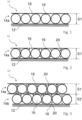
- Fig. 1 to Fig. 4 each show an embodiment of a radiation protection device 10 according to the invention, which can be applied to a carrier material or a fabric web 12 or with a carrier material or a fabric web 12 to which one or more metal-containing layers 14a, 14b are applied.
- the radiation protection device 10 has at least one metal-containing layer 14a, 14b, each with a metallic active coating structure 16 and a binder structure 18 binding the active coating structure 16; wherein the proportion of the active coating structure 16 of the at least one metal-containing layer 14a, 14b is between 60% by weight and 80% by weight, preferably 68% by weight, of the metal-containing layer 14a, 14b; and wherein the proportion of the binder structure 18 of the same metal-containing layer 14a, 14b is between 20% by weight and 40% by weight, preferably 32% by weight, of the metal-containing layer 14a, 14b.
- the proportion of the binder structure 18 of the at least one metal-containing layer 14a, 14b is between twenty percent by weight and forty percent by weight of the entire metal-containing layer 14a, 14b.
- the metal-containing layer 14a, 14b consists only of the active coating structure 16 and the binder structure 18.
- the binder structure 18 comprises hotmelt or a mixture of different hotmelts and possibly another component, such as silicone, as a binder.
- the radiation protection device 10 has two metal-containing layers 14a, 14b applied to one another in a firmly adhering manner.
- the actual number depends on the requirements.
- Several metal-containing layers are advantageous if, for example, high radiation protection is required.
- Radiation could, with increased probability, penetrate between the particles of the one metal-containing layer 14a of the active coating structure 16. Due to the active coating structures 16 of the two metal-containing layers 14a, 14b, radiation that has penetrated the first metal-containing layer 14a can be intercepted by the second metal-containing layer 14b.
- the protective effect increases with the number of metal-containing layers. However, attention must be paid to the quantity and thus the weight of the layers in order to create a lightweight and at the same time inexpensive radiation protection device 10.
- Fig. 3 schematically shown that the two coating layers 14a, 14b have a respective layer thickness S1, S2 between inclusive ten micrometers up to including three hundred micrometers. This is self-explanatory and is shown significantly enlarged.
- the active coating structure 16 comprises one or more of the metals barium, bismuth, lead, antimony, tin, their oxides and/or an alloy thereof or their ions.
- the binder structure 18 comprises micro-active particles 20, in particular metals or their ions.
- the examples of implementation of the Fig. 2 to Fig. 4 schematically proposes that the proportion of microactive particles 20 is between one percent by weight and six percent by weight of the total binder structure 18 per coating layer 14a, 14b.
- the embodiment of the Fig. 3 provides that the radiation protection device 10 is at least blasted, ground and/or polished on its surface remote from the carrier material 12.
- the examples of the Fig. 2 to Fig. 4 schematically provide that at least eighty percent of the particles of the active coating structure 16 have an average cross-section of 10 micrometers up to and including 100 micrometers. Furthermore, the embodiments of the Fig. 2 to Fig. 4 schematically proposes that at least eighty percent of the particles of the active coating structure 16 have an average cross-section of between twenty micrometers and eighty micrometers inclusive.
- Fig. 5 and Fig. 6 each show an embodiment of a radiation protection device 10 according to the invention, wherein one or more metal-containing layers 14a, 14b are arranged between a carrier material or a fabric web 12a and a further carrier material or a further fabric web 12b.
- the same reference numerals denote the same or similar features. The description of the designs of the Figures 1 to 4 is referred to.
- the one or more metal-containing layers 14a, 14b can be arranged between two fabric webs 12a, 12b made of polyester.
- the one or more metal-containing layers 14a, 14b can be arranged between a fabric web 12a made of polyester and a fabric web 12b made of microfiber or TPU.
- the one or more metal-containing layers 14a, 14b can be arranged between two fabric webs 12a, 12b made of microfiber or TPU.
- Fig. 7 shows a schematic view of radiation protection clothing 100 comprising one or more radiation protection devices according to an embodiment of the invention.
- An upper body garment is shown. Accordingly, other suitable garments may also be provided depending on the task and purpose of the application.
Landscapes
- Engineering & Computer Science (AREA)
- Physics & Mathematics (AREA)
- General Engineering & Computer Science (AREA)
- High Energy & Nuclear Physics (AREA)
- Chemical & Material Sciences (AREA)
- Dispersion Chemistry (AREA)
- Metallurgy (AREA)
- Ceramic Engineering (AREA)
- Laminated Bodies (AREA)
Priority Applications (2)
| Application Number | Priority Date | Filing Date | Title |
|---|---|---|---|
| EP23195386.0A EP4521421A1 (fr) | 2023-09-05 | 2023-09-05 | Matériau de protection contre les rayonnements, dispositif de protection contre les rayonnements et procédé de fabrication d'un dispositif de protection contre les rayonnements |
| US18/825,270 US20250079031A1 (en) | 2023-09-05 | 2024-09-05 | Radiation protection material, radiation protection device, and method for manufacturing a radiation protection device |
Applications Claiming Priority (1)
| Application Number | Priority Date | Filing Date | Title |
|---|---|---|---|
| EP23195386.0A EP4521421A1 (fr) | 2023-09-05 | 2023-09-05 | Matériau de protection contre les rayonnements, dispositif de protection contre les rayonnements et procédé de fabrication d'un dispositif de protection contre les rayonnements |
Publications (1)
| Publication Number | Publication Date |
|---|---|
| EP4521421A1 true EP4521421A1 (fr) | 2025-03-12 |
Family
ID=87933853
Family Applications (1)
| Application Number | Title | Priority Date | Filing Date |
|---|---|---|---|
| EP23195386.0A Pending EP4521421A1 (fr) | 2023-09-05 | 2023-09-05 | Matériau de protection contre les rayonnements, dispositif de protection contre les rayonnements et procédé de fabrication d'un dispositif de protection contre les rayonnements |
Country Status (2)
| Country | Link |
|---|---|
| US (1) | US20250079031A1 (fr) |
| EP (1) | EP4521421A1 (fr) |
Citations (6)
| Publication number | Priority date | Publication date | Assignee | Title |
|---|---|---|---|---|
| EP0127241B1 (fr) * | 1983-05-23 | 1988-01-07 | Mitsubishi Cable Industries, Ltd. | Empilage de couches de plomb pour protéger un milieu contre une source nocive |
| KR20130054182A (ko) * | 2011-11-14 | 2013-05-24 | 케이와 인코포레이티드 | 방사능 방호 시트 및 방사능 방호 시트의 제조 방법 |
| US20140158918A1 (en) * | 2012-12-10 | 2014-06-12 | Duracote Corporation | Ionizing radiation barriers and methods of making same |
| CN106827735A (zh) * | 2017-02-06 | 2017-06-13 | 北京邦维高科特种纺织品有限责任公司 | 一种防毒阻燃电磁屏蔽复合材料、制备方法及制品 |
| US20210098144A1 (en) * | 2019-01-16 | 2021-04-01 | Dr-Vu Co., Ltd. | Method for manufacturing lead-free radiation shielding sheet and lead-free radiation shielding sheet |
| WO2022002811A2 (fr) | 2020-06-28 | 2022-01-06 | Innomotion AG | Dispositif stérile conçu pour recouvrir la peau humaine et procédé pour produire un dispositif stérile |
-
2023
- 2023-09-05 EP EP23195386.0A patent/EP4521421A1/fr active Pending
-
2024
- 2024-09-05 US US18/825,270 patent/US20250079031A1/en active Pending
Patent Citations (6)
| Publication number | Priority date | Publication date | Assignee | Title |
|---|---|---|---|---|
| EP0127241B1 (fr) * | 1983-05-23 | 1988-01-07 | Mitsubishi Cable Industries, Ltd. | Empilage de couches de plomb pour protéger un milieu contre une source nocive |
| KR20130054182A (ko) * | 2011-11-14 | 2013-05-24 | 케이와 인코포레이티드 | 방사능 방호 시트 및 방사능 방호 시트의 제조 방법 |
| US20140158918A1 (en) * | 2012-12-10 | 2014-06-12 | Duracote Corporation | Ionizing radiation barriers and methods of making same |
| CN106827735A (zh) * | 2017-02-06 | 2017-06-13 | 北京邦维高科特种纺织品有限责任公司 | 一种防毒阻燃电磁屏蔽复合材料、制备方法及制品 |
| US20210098144A1 (en) * | 2019-01-16 | 2021-04-01 | Dr-Vu Co., Ltd. | Method for manufacturing lead-free radiation shielding sheet and lead-free radiation shielding sheet |
| WO2022002811A2 (fr) | 2020-06-28 | 2022-01-06 | Innomotion AG | Dispositif stérile conçu pour recouvrir la peau humaine et procédé pour produire un dispositif stérile |
Also Published As
| Publication number | Publication date |
|---|---|
| US20250079031A1 (en) | 2025-03-06 |
Similar Documents
| Publication | Publication Date | Title |
|---|---|---|
| DE69712498T2 (de) | Verfahren zur einstellung der wasserdampfdurchlässigkeit von polyolefinfolie | |
| DE69935870T2 (de) | Wasserdichter reissverschluss und dessen herstellungsverfahren | |
| DE69609822T2 (de) | Schutzvliesschichtstoff | |
| DE69728551T2 (de) | Verfahren zum herstellen eines textilartigen mikroporösen verbundmaterials aus einem faserigen vliesstoff und einer thermoplastischen folie | |
| DE69624719T2 (de) | Mehrschichtiger, atmungsfähiger film sowie verfahren zu dessen herstellung | |
| DE69513037T2 (de) | Vliesstoffe von bandförmigen fasernmaterial und herstellungsverfahren | |
| DE19802242C2 (de) | Stich- und Kugelschutzkleidung | |
| DE69903960T2 (de) | Atmungsfähiges, wasserdichtes laminat und verfahren zu dessen herstellung | |
| DE69528720T2 (de) | Gewebter oder nicht gewebter Stoff oder Verbundprodukt aus monoaxial orientierten Polypropylenmaterial und Verfahren zur Herstellung | |
| DE2436134A1 (de) | Nichtgewebtes stoffartiges material und verfahren zu seiner herstellung | |
| EP3715114A1 (fr) | Sac d'emballage d'un tissu composite en matière plastique | |
| DE10161276B4 (de) | Elastisches Folienlaminat aus drei verbundenen Kunstoff-Folien | |
| DE3828406A1 (de) | Laminatmaterial, insbesonder fuer schutzbekleidung | |
| DE20208918U1 (de) | Bleifreies Strahlenschutzmaterial | |
| EP2605908A1 (fr) | Matériau composite comportant un matériau de revêtement | |
| DE102004015613A1 (de) | Strahlenschutzmaterial auf Silikonbasis | |
| DE1464620A1 (de) | Biegsames Material zur Absperrung ionisierender Strahlungen | |
| DE3436065A1 (de) | Opake polypropylenfolie mit lichtdurchlaessigen bereichen, verfahren zu ihrer herstellung und ihre verwendung | |
| EP3560709B1 (fr) | Procédé de fabrication de stratifiés imprimés de tissus non tissés et de film | |
| EP4521421A1 (fr) | Matériau de protection contre les rayonnements, dispositif de protection contre les rayonnements et procédé de fabrication d'un dispositif de protection contre les rayonnements | |
| DE69728575T2 (de) | Anisotrope elastische folien und bahnen | |
| DE3404701C2 (fr) | ||
| DE2536409A1 (de) | Verfahren zur aufbereitung von mit kunststoff beschichteten gewebeabfaellen | |
| CH710216A2 (de) | Matte oder Band. | |
| EP1773581A1 (fr) | Stratifie elastique |
Legal Events
| Date | Code | Title | Description |
|---|---|---|---|
| PUAI | Public reference made under article 153(3) epc to a published international application that has entered the european phase |
Free format text: ORIGINAL CODE: 0009012 |
|
| STAA | Information on the status of an ep patent application or granted ep patent |
Free format text: STATUS: THE APPLICATION HAS BEEN PUBLISHED |
|
| AK | Designated contracting states |
Kind code of ref document: A1 Designated state(s): AL AT BE BG CH CY CZ DE DK EE ES FI FR GB GR HR HU IE IS IT LI LT LU LV MC ME MK MT NL NO PL PT RO RS SE SI SK SM TR |
|
| RIN1 | Information on inventor provided before grant (corrected) |
Inventor name: STOIAN, CHRISTIAN |
|
| STAA | Information on the status of an ep patent application or granted ep patent |
Free format text: STATUS: REQUEST FOR EXAMINATION WAS MADE |
|
| 17P | Request for examination filed |
Effective date: 20250910 |