EP4521790A1 - Eas-entdeckungsverfahren, vorrichtung und netzwerkvorrichtung - Google Patents
Eas-entdeckungsverfahren, vorrichtung und netzwerkvorrichtung Download PDFInfo
- Publication number
- EP4521790A1 EP4521790A1 EP23777926.9A EP23777926A EP4521790A1 EP 4521790 A1 EP4521790 A1 EP 4521790A1 EP 23777926 A EP23777926 A EP 23777926A EP 4521790 A1 EP4521790 A1 EP 4521790A1
- Authority
- EP
- European Patent Office
- Prior art keywords
- network
- network function
- message
- eas
- information
- Prior art date
- Legal status (The legal status is an assumption and is not a legal conclusion. Google has not performed a legal analysis and makes no representation as to the accuracy of the status listed.)
- Pending
Links
Images




Classifications
-
- H—ELECTRICITY
- H04—ELECTRIC COMMUNICATION TECHNIQUE
- H04W—WIRELESS COMMUNICATION NETWORKS
- H04W8/00—Network data management
- H04W8/02—Processing of mobility data, e.g. registration information at HLR [Home Location Register] or VLR [Visitor Location Register]; Transfer of mobility data, e.g. between HLR, VLR or external networks
- H04W8/06—Registration at serving network Location Register, VLR or user mobility server
- H04W8/065—Registration at serving network Location Register, VLR or user mobility server involving selection of the user mobility server
-
- H—ELECTRICITY
- H04—ELECTRIC COMMUNICATION TECHNIQUE
- H04W—WIRELESS COMMUNICATION NETWORKS
- H04W48/00—Access restriction; Network selection; Access point selection
- H04W48/16—Discovering, processing access restriction or access information
-
- H—ELECTRICITY
- H04—ELECTRIC COMMUNICATION TECHNIQUE
- H04L—TRANSMISSION OF DIGITAL INFORMATION, e.g. TELEGRAPHIC COMMUNICATION
- H04L61/00—Network arrangements, protocols or services for addressing or naming
- H04L61/45—Network directories; Name-to-address mapping
- H04L61/4505—Network directories; Name-to-address mapping using standardised directories; using standardised directory access protocols
- H04L61/4511—Network directories; Name-to-address mapping using standardised directories; using standardised directory access protocols using domain name system [DNS]
-
- H—ELECTRICITY
- H04—ELECTRIC COMMUNICATION TECHNIQUE
- H04L—TRANSMISSION OF DIGITAL INFORMATION, e.g. TELEGRAPHIC COMMUNICATION
- H04L67/00—Network arrangements or protocols for supporting network services or applications
- H04L67/50—Network services
- H04L67/51—Discovery or management thereof, e.g. service location protocol [SLP] or web services
-
- H—ELECTRICITY
- H04—ELECTRIC COMMUNICATION TECHNIQUE
- H04L—TRANSMISSION OF DIGITAL INFORMATION, e.g. TELEGRAPHIC COMMUNICATION
- H04L67/00—Network arrangements or protocols for supporting network services or applications
- H04L67/50—Network services
- H04L67/52—Network services specially adapted for the location of the user terminal
-
- H—ELECTRICITY
- H04—ELECTRIC COMMUNICATION TECHNIQUE
- H04W—WIRELESS COMMUNICATION NETWORKS
- H04W8/00—Network data management
- H04W8/02—Processing of mobility data, e.g. registration information at HLR [Home Location Register] or VLR [Visitor Location Register]; Transfer of mobility data, e.g. between HLR, VLR or external networks
- H04W8/06—Registration at serving network Location Register, VLR or user mobility server
-
- H—ELECTRICITY
- H04—ELECTRIC COMMUNICATION TECHNIQUE
- H04W—WIRELESS COMMUNICATION NETWORKS
- H04W8/00—Network data management
- H04W8/02—Processing of mobility data, e.g. registration information at HLR [Home Location Register] or VLR [Visitor Location Register]; Transfer of mobility data, e.g. between HLR, VLR or external networks
- H04W8/08—Mobility data transfer
-
- H—ELECTRICITY
- H04—ELECTRIC COMMUNICATION TECHNIQUE
- H04W—WIRELESS COMMUNICATION NETWORKS
- H04W8/00—Network data management
- H04W8/22—Processing or transfer of terminal data, e.g. status or physical capabilities
Definitions
- the disclosure relates to a field of wireless technology, in particular to a method for discovering an edge application server (EAS), an apparatus for discovering an EAS, and a network device.
- EAS edge application server
- the purpose of the disclosure is to provide a method for discovering an edge application server (EAS), an apparatus for discovering an EAS and a network device, for implementing cross-network discovery and access of the EAS.
- EAS edge application server
- Embodiments of the disclosure provide a method for discovering an EAS, which is performed by a first network function.
- the method includes: sending, by the first network device, a first message to a second network function.
- sending, by the first network device, the first message to the second network function includes: in an EAS searching or relocating process, sending, by the first network device, the first message to the second network function based on first information.
- the method after sending, by the first network device, the first message to the second network function, the method includes:
- the method includes: in an EAS searching process, receiving a third message sent by a third network function.
- the method includes: receiving, by the third network function, a fourth message that matches a first rule, and sending, by the third network function, the third message to the first network function.
- the first rule is a domain name system (DNS) message processing rule.
- DNS domain name system
- sending, by the first network function, the first message to the second network function includes: sending, by the first network function, the first message to the second network function according to the third message.
- the first rule includes at least one of:
- sending, by the first network function, the first message to the second network function includes: in the EAS relocating process, in response to a second rule being met, sending, by the first network function, the first message to the second network function.
- the second rule includes at least one of:
- the method includes: in an EAS searching process, screening networks based on the first information, and selecting an EAS that can provide services for a terminal.
- the first message includes at least one of following information:
- the first information includes at least one of:
- the method includes: obtaining the serving network and/or the federation capability identifier during a protocol data unit (PDU) session establishment process of the terminal.
- PDU protocol data unit
- the method includes: receiving, by the first network function, the federation information sent by the second network function through a fifth message.
- the federation information includes at least one of:
- the federation information is provided by an application function (AF) to the second network function.
- AF application function
- the method in an EAS searching or relocating process, after receiving the second message sent by the second network function, the method further includes: in a PDU session change process, inserting a local PDU session anchor (L-PSA) as needed.
- L-PSA local PDU session anchor
- the method in an EAS searching or relocating process, after receiving the second message sent by the second network function, the method further includes: carrying EAS information in a PDU session modification command.
- the second message includes at least one of the following information:
- Embodiments of the disclosure provide a method for an EAS, which is performed by a second network function.
- the method includes:
- the method includes: receiving a seventh message sent by the fourth network function, the seventh message including EAS information.
- the method includes: sending a second message to the first network function, the second message including EAS information.
- obtaining the address information of the fourth network function includes: obtaining the address information of the fourth network function according to second information.
- the second information is network pre-configured information for searching for address information of a cross-network network exposure function (NEF).
- NEF cross-network network exposure function
- the method includes:
- the ninth message includes the address information of the fourth network function.
- the first message includes at least one of the following information:
- the seventh message includes at least one of the following information:
- the eighth message includes at least one of the following information:
- Embodiments of the disclosure provide a method for discovering an EAS, which is performed by a fourth network function.
- the method includes:
- the method includes: receiving an eleventh message sent by the sixth network function, the eleventh message including the EAS information.
- the method includes: sending a seventh message to the second network function NEF1, the seventh message including the EAS information.
- the sixth message and the tenth message each includes at least one of the following information:
- the eleventh message includes at least one of the following information:
- Embodiments of the disclosure provide a method for an EAS, which is performed by a sixth network function.
- the method includes:
- the method includes: sending an eleventh message to the fourth network function, the eleventh message including the EAS information.
- obtaining the EAS information according to the tenth message includes: obtaining the EAS information according to the tenth message after a seventh network function performs DNS query for a DNS server.
- the method includes: determining, by the sixth network function, the DNS server according to third information.
- the third information includes at least one of:
- the tenth information includes at least one of:
- Embodiments of the disclosure provide a method for discovering an EAS, which is performed by a fifth network function.
- the method includes:
- the ninth message includes address information of a fourth network function.
- the eighth message includes at least one of:
- the method includes: in an EAS searching or relocating process, sending reselected network indication information to a terminal based on first information.
- the method further includes: receiving a first message sent by a second network function.
- the method further includes: receiving, by the second network function, a second message and matching the second message with a first rule, and sending the first message to the first network function.
- sending, by the first network function, the reselected network indication information to the terminal based on the first information includes: sending, by the first network function, the reselected network indication information to the terminal based on the first information after receiving the first message.
- the first rule includes at least one of:
- sending the reselected network indication information to the terminal based on the first information includes: in the EAS relocating process, in response to conditions of a second rule being met, sending the reselected network indication information to the terminal based on the first information.
- the second rule includes at least one of:
- the method includes: selecting an EAS by screening a network list based on the first information.
- the first information includes at least one of:
- the method includes: obtaining the serving network and/or the federation capability identifier during a PDU session establishment process of the terminal.
- the method includes: receiving, by the first network function, the federation information sent by a third network function through a third message.
- the federation information includes at least one of:
- the federation information is provided by an AF to the second network function.
- Embodiments of the disclosure provide a method for discovering an EAS, which is performed by a terminal.
- the method includes: in an EAS searching or relocating process, receiving reselected network indication information sent by a first network function.
- the method includes: establishing a PDU session with a network indicated by the reselected network indication information, and performing EAS accessing.
- Embodiments of the disclosure provide a network device, the network device being a first network function, including a transceiver, configured to: send a first message to a second network function.
- Embodiments of the disclosure provide a network device, the network device being a second network function, including a transceiver, configured to:
- Embodiments of the disclosure provide a network device, the network device being a fourth network function, including a transceiver, configured to:
- Embodiments of the disclosure provide a network device, the network device being a sixth network function, including a transceiver, configured to:
- Embodiments of the disclosure provide a network device, the network device being a fifth network function, including a transceiver, configured to:
- Embodiments of the disclosure provide a network device, the network device being a first network function, including a transceiver, configured to: in an EAS searching or relocating process, send reselected network indication information to a terminal based on first information.
- a transceiver configured to: in an EAS searching or relocating process, send reselected network indication information to a terminal based on first information.
- Embodiments of the disclosure provide a terminal, including a transceiver, configured to: in an EAS searching or relocating process, receive reselected network indication information sent by a first network function.
- Embodiments of the disclosure provide an apparatus for discovering an EAS, applicable for a first network function, including: a first transceiver unit, configured to send a first message to a second network function.
- Embodiments of the disclosure provide an apparatus for discovering an EAS, applicable for a second network function, including:
- Embodiments of the disclosure provide an apparatus for discovering an EAS, applicable for a fourth network function, including:
- Embodiments of the disclosure provide an apparatus for discovering an EAS, applicable for a sixth network function, including:
- Embodiments of the disclosure provide an apparatus for discovering an EAS, applicable for a fifth network function, including:
- Embodiments of the disclosure provide an apparatus for discovering an EAS, applicable for a first network function, including: a first transceiver unit, configured to: in an EAS searching or relocating process, send reselected network indication information to a terminal based on first information.
- Embodiments of the disclosure provide an apparatus for discovering an EAS, applicable for a terminal, including: a second transceiver unit, configured to: in an EAS searching or relocating process, receive reselected network indication information sent by a first network function.
- Embodiments of the disclosure provide a network device, including: a transceiver, a processor, a memory, and programs or instructions stored on the memory and executable by the processor. When the programs or instructions are executed by the processor, the method for discovering as described in any one of the above embodiments is implemented.
- Embodiments of the disclosure provide a readable storage medium having programs or instructions stored thereon. When the programs or instructions are executed by a processor, the steps of the method for discovering as described in any one of the above embodiments are implemented.
- the first network function can send the first message to the second network function through the first information for requesting a cross-network EAS, thereby realizing cross-network discovery and access of the EAS.
- sequence numbers of the following processes do not imply the order of execution, and the execution order of the processes should be determined by its function and internal logic and should not constitute any limitation on the implementation of the embodiments of the disclosure.
- the embodiments of the disclosure provide a method for discovering an EAS.
- a first network function sends a first message to a second network function to request a cross-network EAS, thereby achieving cross-network discovery and access of the EAS.
- FIG. 1 is an application system that adopts the method for discovering an EAS described in the embodiments of the disclosure.
- the application system includes at least two networks, which may also be referred to as including at least two operator networks.
- a core network of each network operator includes multiple network functions, such as application function (AF), access and mobility management function (AMF), session management function (SMF), network exposure function (NEF), user plane function (UPF), edge application server discovery function (EASDF), data network (DN) and EAS, etc.
- a user equipment (UE) is connected to the network functions of the core network via a radio access network (RAN).
- RAN radio access network
- a UE of a first network can search for or discover an EAS of a second network through a network function of the first network, or relocate an EAS in a second network through a network function of the first network, thereby achieving cross-network discovery and access of the EAS.
- the method is performed by a first network function. As shown in FIG. 2 , the method includes the following steps.
- the first network function SMF1 sends a first message to a second network function NEF1.
- sending, by the first network function SMF1, the first message to the second network function NEF1 includes: in an EAS searching or relocating process, sending, by the first network function SMF1, the first message to the second network function NEF1 based on first information.
- the first network function can send the first message to the second network function through the first information to request a cross-network EAS, thereby realizing cross-network discovery and access of the EAS.
- the first network function and the second network function are network functions of the first network.
- the first network function is an SMF
- the second network function is an NEF.
- the first network function may be represented by SMF1
- the second network function may be represented by NEF1.
- the first information includes at least one of:
- the operator latency list is provided by an application, which provides an end-to-end delay from a server to a terminal in each network for the SMF to select and use.
- the first network function SMF1 screens networks based on the first information and selects an EAS that can provide services to the terminal.
- the first network function SMF1 selects the optimal EAS that can provide services to the terminal.
- the first message includes at least one of the following information:
- the PLMN identifier in the first message is a network identifier of a requested second network.
- the first network function SMF1 sends the first message to the second network function NEF1, and the second network function NEF1 can send a request message to a network function of the second network, such as an NEF of the second network, to search for or discover an EAS of the second network or relocate an EAS in the second network.
- the method further includes: receiving a second message sent by the second network function NEF1, in which the second message includes EAS information.
- the second message is a response message to the first message.
- the first message is a federation event exposure request (Nnef_FederationEventExposure request) message
- the second message is a federation event exposure response (Nnef_FederationEventExposure response) message.
- the method further includes: receiving a third message sent by a third network function.
- the third network function receives a fourth message, matches the fourth message with a first rule, and sends the third message to the first network function SMF1.
- the first network function SMF1 After receiving the third message, the first network function SMF1 sends the first message to the second network function NEF1 based on the first information.
- the first rule is a domain name system (DNS) message processing rule.
- DNS domain name system
- the first rule includes at least one of:
- the third network function may be an EASDF.
- the third network function may be represented by EASDF1.
- the fourth message is a DNS query request message
- the third message is a DNS message
- the terminal sends a fourth message (i.e., a DNS query request) to the third network function EASDF1, the third network function EASDF1 matches the fourth message with the rule and sends a third message (i.e., a DNS request) to the first network function SMF1.
- the first network function SMF1 sends a first message to the second network function NEF1 based on the third message (i.e., the DNS request) and the first information. That is, a federation event exposure request (Nnef_FederationEventExposure request) is sent.
- sending the first message to the second network function NEF1 includes: in an EAS relocating process, in response to a second rule being met, sending, by the first network function SMF1, the first message to the second network function NEF1.
- the second rule includes at least one of:
- the method further includes: in response to determining that the UE is moving, triggering, by the first network function SMF1, insertion of a local protocol data unit (PDU) session anchor (L-PSA) and EAS redirection; and/or, triggering EAS redirection through an AF.
- PDU protocol data unit
- L-PSA local protocol data unit session anchor
- EAS redirection through an AF.
- the AF detects that a serving state of the terminal does not meet a requirement, the AF triggers the EAS redirection.
- the first network function SMF1 determines, according to the location of the terminal, that there is no EAS in the first network that can provide an edge application service; and/or, determines, according to pre-obtained information, that there is an EAS in the second network that can provide an edge application service to the terminal
- the first network function SMF1 sends the first message, i.e., a federation event exposure request (Nnef_FederationEventExposure request)
- Nnef_FederationEventExposure request a federation event exposure request
- the method for discovering described in the embodiment of the disclosure is used to realize cross-network discovery and access of the EAS.
- the method includes the following steps.
- a terminal completes PDU session establishment in a first network.
- session management (SM) context information of the PDU session establishment process carries the serving network and/or the federation capability identifier of the terminal.
- the serving network includes but is not limited to a PLMN ID.
- PDU stands for protocol data unit.
- EASDF selection is performed.
- the UE sends a fourth message (i.e., a DNS query request) to a third network function EASDF 1.
- a fourth message i.e., a DNS query request
- the third network function EASDF1 matches the fourth message with a first rule according to the fourth message, and sends a third message to the first network function SMF1, in which the third message is a DNS message.
- the first rule includes at least one of:
- the first network function SMF1 sends a first message to the second network function NEF1 based on first information. That is, the first network function SMF1 sends a federation event exposure request (Nnef_FederationEventExposure request).
- the first network function SMF1 generates a network list containing screened out networks of other operators that can provide services to the terminal based on at least one of federation information, a federation capability identifier of the terminal and a serving network in the first information.
- the operator network (second network) with the shortest latency is selected from the network list of other operators to provide services to the terminal.
- the federation event exposure request (Nnef_FederationEventExposure request) is invoked and sent to the second network function NEF1.
- the federation event exposure request includes at least one of the following information:
- the second network function NEF1 obtains address information of a fourth network function according to the first message.
- the fourth network function is a network function of the second network.
- the fourth network function is an NEF, and to distinguish it from the network functions of the first network, the fourth network function can be represented by NEF2.
- the second network function NEF1 may obtain the address information of the fourth network function NEF2 through the following steps S305 and S306.
- the second network function NEF1 sends an eighth message to a fifth network function, in which the eighth message is used to request to query the address information of the fourth network function NEF2.
- the fifth network function may be a Federation NRF connected between the NEF1 of the first network and the NEF2 of the second network, and is used for querying address information of NEFs of multiple networks.
- the eighth message includes at least one of the following information:
- the second network function NEF1 receives a ninth message sent by the fifth network function, in which the ninth message is a response message to the eighth message.
- the ninth message includes the address information of the fourth network function NEF2.
- the fifth network function Federation NRF searches for address information of an NEF of a corresponding network according to the requested PLMN identifier in the eighth message. That is, the fifth network function Federation NRF determines the address information of the fourth network function NEF2, and sends a third response message to the second network function NEF1, which is used to carry the address information of the fourth network function NEF2.
- the second network function NEF1 may also obtain the address information of the fourth network function NEF2 according to the second information instead of through the fifth network function Federation NRF.
- the second information is network pre-configured information, which is used to search for address information of a cross-network NEF.
- address information of NEFs of networks other than the first network can be preconfigured on the NEF of the first network, i.e., preconfigured on the second network function NEF1.
- the second network function NEF1 can directly obtain the address information of the fourth network function NEF2.
- the second network function NEF1 sends a sixth message to the fourth network function NEF2 to request to obtain accessible EAS information.
- the second network function NEF1 sends the sixth message by invoking an event exposure request (Nnef_EventExposure request).
- the sixth message includes at least one of the following information:
- the fourth network function NEF2 receives the sixth message, determines that the sixth message is a joint application access request sent by the first network according to an external group identifier in the sixth message, and then sends a tenth message to a sixth network function for requesting to obtain EAS information.
- the sixth network function is an SMF of the second network, and to distinguish it from the network functions of the first network, optionally, the sixth network function may be represented by SMF2.
- the fourth network function NEF2 sends the tenth message by invoking an event exposure request (Nsmf_EventExposure request).
- the tenth message includes at least one of the following information:
- the sixth network function SMF2 obtains the accessible EAS information according to the tenth message.
- the sixth network function SMF2 obtains the accessible EAS information after performing DNS query on a DNS server through a seventh network function.
- the sixth network function SMF2 determines the DNS server according to third information.
- the third information includes at least one of:
- the seventh network function is an EASDF of the second network, and to distinguish it from the network functions of the first network, the seventh network function is represented by EASDF2.
- the sixth network function SMF2 performs EDI query according to at least one of the location of the terminal, the application identifier, the PLMN identifier or the external group identifier in the tenth message. After determining the DNS server, the sixth network function SMF2 performs DNS query on the determined DNS server through the seventh network function EASDF2 to obtain the accessible EAS information.
- the eleventh message is a response message to the tenth message.
- the EAS information includes an internet protocol (IP) address and/or a FQDN.
- IP internet protocol
- the eleventh message is an event exposure response (Nsmf_EventExposure response) message.
- the fourth network function NEF2 sends a seventh message to the second network function NEF1, in which the seventh message includes the EAS information.
- the seventh message is a response message to the sixth message.
- the seventh message is an event exposure response (Nnef_EventExposure response) message
- the fourth network function NEF2 sends the accessible EAS information to the second network function NEF1 by invoking the event exposure response (Nnef_EventExposure response) message.
- the second network function NEF1 sends a second message to the first network function SMF1, in which the second message is a response message to the first message, including the EAS information.
- the second message is the Nnef_FederationEventExposure response.
- the first network function SMF1 sends a twelfth message to the third network function EASDF1, in which the twelfth message includes an EAS message.
- the twelfth message is a response message to the third message.
- the first network function SMF1 also triggers a ULCL/BP insertion process as needed.
- the twelfth message is a DNS context notification response (Neasdf_DNSContext_Notify Response) message.
- the third network function EASDF1 sends the accessible EAS information to the terminal, so that the terminal can access the EAS of the second network according to the EAS information.
- the first network function in an EAS searching process, sends the first request message to the second network function by using the first information to request for a cross-network EAS, thereby realizing cross-network discovery and access of the EAS.
- the method for discovering described in the embodiment of the disclosure is used to realize discovery and access of a cross-network EAS.
- the method includes the following steps.
- an EAS redirection event is triggered.
- a first network function SMF1 triggers insertion of L-PSA and EAS redirection.
- EAS redirection is triggered through an AF, e.g., when the AF detects that a serving state of the terminal does not meet requirements, the AF triggers the EAS redirection.
- the first network function SMF1 sends a first message to a second network function NEF1 according to first information.
- the first network function SMF1 when a second rule is met, sends the first message to the second network function NEF1.
- the second rule includes at least one of:
- the first network does not provide the edge application service.
- the edge application service of the application is not provided at this location, because no EAS is deployed here or the IP is unreachable.
- the first message is a federation event exposure request (Nnef_FederationEventExposure request)
- the first network function SMF1 invokes the federation event exposure request (Nnef_FederationEventExposure request) to request to update the EAS.
- the federation event service request message (first message) includes at least one of the following information:
- the second network function NEF1 obtains address information of a fourth network function according to the first message.
- the fourth network function is a network function of the second network.
- the fourth network function is an NEF, and to distinguish it from the network functions of the first network, the fourth network function can be represented by NEF2.
- the second network function NEF1 may obtain the address information of the fourth network function NEF2 through the following steps S403 and S404.
- the second network function NEF1 sends an eighth message to a fifth network function, in which the eighth message is used to request to query the address information of the fourth network function NEF2.
- the fifth network function may be a Federation NRF connected between the NEF1 of the first network and the NEF2 of the second network, and is used for querying the address information of NEFs of multiple networks.
- the eighth message includes at least one of the following information:
- the second network function NEF1 receives a ninth message sent by the fifth network function, in which the ninth message is a response message to the eighth message.
- the ninth message includes the address information of the fourth network function NEF2.
- the fifth network function Federation NRF searches for the address information of the NEF of the corresponding network according to the PLMN identifier requested in the eighth message. That is, the fifth network function Federation NRF determines the address information of the fourth network function NEF2, and sends a third response message to the second network function NEF1, which is used to carry the address information of the fourth network function NEF2.
- the second network function NEF1 may also obtain the address information of the fourth network function NEF2 according to the second information instead of through the fifth network function Federation NRF.
- the second information is network pre-configured information, which is used to search for address information of a cross-network NEF.
- the address information of NEFs of networks other than the first network can be preconfigured on the NEF of the first network, i.e., preconfigured on the second network function NEF1.
- the second network function NEF1 can directly obtain the address information of the fourth network function NEF2.
- the second network function NEF1 sends a sixth message to the fourth network function NEF2 to request to obtain accessible EAS information.
- the second network function NEF1 sends the sixth message by invoking an event exposure request (Nnef_EventExposure request).
- the sixth message includes at least one of the following information:
- the fourth network function NEF2 receives the sixth message, determines that the sixth message is a joint application access request sent by the first network according to an external group identifier in the sixth message, and then sends a tenth message to a sixth network function to request to obtain EAS information.
- the sixth network function is an SMF of the second network, and to distinguish it from the network functions of the first network, optionally, the sixth network function may be represented by SMF2.
- the fourth network function NEF2 sends the tenth message by invoking an event exposure request (Nsmf_EventExposure request).
- the tenth message includes at least one of the following information:
- the sixth network function SMF2 obtains the accessible EAS information according to the tenth message.
- the sixth network function SMF2 obtains the accessible EAS information after the seventh network function performs DNS query for a DNS server.
- the sixth network function SMF2 determines the DNS server according to third information.
- the third information includes at least one of:
- the seventh network function is an EASDF of the second network. To distinguish it from the network functions of the first network, the seventh network function may be represented by EASDF2.
- the sixth network function SMF2 performs EDI query according to at least one of the location of the terminal, the application identifier, the PLMN identifier or the external group identifier in the tenth message.
- the seventh network function EASDF2 performs DNS query for the determined DNS server to obtain the accessible EAS information.
- the sixth network function SMF2 sends an eleventh message to the fourth network function NEF2, in which the eleventh message includes the EAS information.
- the eleventh message is a response message to the tenth message.
- the EAS information includes an IP address and/or a FQDN.
- the eleventh message is an event exposure response (Nsmf_EventExposure response) message.
- the fourth network function NEF2 sends a seventh message to the second network function NEF1, in which the seventh message includes the EAS information.
- the seventh message is a response message to the sixth message.
- the seventh message is an event exposure response (Nnef_EventExposure response) message.
- the fourth network function NEF2 sends the accessible EAS information to the second network function NEF1 by invoking the event exposure response (Nnef_EventExposure response) message.
- the second network function NEF1 sends a second message to the first network function SMF1, in which the second message is a response message to the first message and includes the EAS information.
- the source EAS is an EAS that has been accessed before the EAS redirection event is triggered
- the target EAS is an EAS corresponding to the EAS information returned by the first response message.
- the method for discovering according to the embodiment of the disclosure further includes: obtaining the serving network and/or the federation capability identifier during a PDU session establishment process of the terminal.
- the described method for discovering includes: Receiving, by the first network function SMF1, the federation information sent by the second network function NEF1 through the fifth message.
- the federation information includes at least one of:
- the federation information is provided by the AF to the second network function NEF.
- the process of obtaining federation information by an SMF includes the following steps.
- an AF provides the federation information to an NEF.
- the federation information refers to relevant information provided by an operator in a federation platform, which may be an address and deployment information of the NEF, a list of edge applications supported within each operator and their location information.
- the federation information includes at least one of:
- the NEF sends the federation information to the SMF.
- the federation information is sent to the SMF by invoking a federation providing message, a federation parameter providing message, a federation information providing message, etc.
- the SMF stores the federation information and returns a first response message to the NEF.
- the NEF sends a second response message to the AF.
- An embodiment of the disclosure also provides a method for an EAS, which is performed by a second network function NEF1. As shown in FIG. 6 , the method includes the following steps.
- step S610 a first message sent by a first network function SMF1 is received
- the method includes: receiving a seventh message sent by the fourth network function NEF2, the seventh message including the EAS information.
- the method includes: sending a second message to the first network function SMF 1, the second message including the EAS information.
- obtaining the address information of the fourth network function NEF2 includes: obtaining address information of the fourth network function NEF2 according to second information.
- the second information is network pre-configured information for searching for address information of a cross-network NEF.
- the method includes:
- the ninth message includes the address information of the fourth network function NEF2.
- the first message includes at least one of the following information:
- the seventh message includes at least one of the following information:
- the eighth message includes at least one of the following information:
- the embodiment of the disclosure also provides a method for an EAS, which is performed by a fourth network function NEF2. As shown in FIG. 7 , the method includes the following steps.
- a sixth message sent by a second network function NEF1 is received for requesting to obtain EAS information; and/or, a tenth message is sent to a sixth network function SMF2 for requesting to obtain EAS information.
- the method includes: receiving an eleventh message sent by the sixth network function SMF2, the eleventh message including the EAS information.
- the method includes: sending the seventh message to the second network function NEF1, the seventh message including the EAS information.
- the sixth message and the tenth message each includes at least one of the following information:
- the eleventh message includes at least one of the following information:
- the embodiment of the disclosure also provides a method for discovering an EAS, which is performed by a sixth network function SMF2. As shown in FIG. 8 , the method includes the following steps.
- a tenth message sent by a fourth network function NEF2 is received for requesting to obtain EAS information; and/or, EAS information is obtained according to the tenth message.
- the method includes: sending an eleventh message to the fourth network function NEF2, the eleventh message including the EAS information.
- obtaining the EAS information according to the tenth message includes: obtaining the EAS information according to the tenth message after a seventh network function EASDF2 performs DNS query for a DNS server.
- the method includes: determining the DNS server according to third information.
- the third information includes at least one of:
- the tenth information includes at least one of:
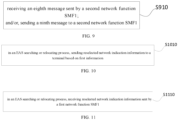
- the embodiment of the disclosure also provides a method for discovering an EAS, which is performed by a fifth network function Federation NRF. As shown in FIG. 9 , the method includes the following steps.
- step S910 an eighth message sent by a second network function SMF1 is received; and/or, a ninth message is sent to a second network function SMF1.
- the ninth message includes address information of a fourth network function NEF2.
- the eighth information includes at least one of:
- a first network function uses first information to send a reselected network indication to a terminal to instruct the terminal to access another network by performing network reselection, thereby realizing cross-network discovery and access of an EAS.
- the method is performed by the first network function SMF1. As shown in FIG. 10 , the method includes the following steps.
- reselected network indication information is sent to a terminal based on first information.
- the reselected network indication information includes network information of a reselected network.
- the reselected network indication information is used to indicate relevant information of a network to which the terminal needs to be re-accessed, which may be at least one of a PLMN identifier (ID), single network slice selection assistance information (S-NSSAI), network slice selection assistance information (NSSAI) and a data network name (DNN).
- ID PLMN identifier
- S-NSSAI single network slice selection assistance information
- NSSAI network slice selection assistance information
- DNN data network name
- the first network function uses the first information to send the reselected network indication information to the terminal, to instruct the terminal to access to another network through network reselection, thereby realizing cross-network discovery and access of an EAS.
- the first network function is a network function of a first network.
- the first network function is an SMF, and in order to distinguish it from network functions of a second network, the first network function may be represented by SMF1.
- the method further includes: receiving a first message sent by a second network function.
- the second network function When receiving a second message, the second network function matches the second message with a first rule and sends the first message to the first network function SMF1.
- sending, by the first network function, the reselected network indication information to the terminal based on the first information includes: sending, by the first network function, the reselected network indication information to the terminal based on the first information after receiving the first message.
- the first rule includes at least one of:
- the second network function may be an EASDF.
- the second network function may be represented by EASDF1.
- the first message and the second message are DNS query messages.
- the terminal in an EAS searching process, sends the second message (i.e., the DNS query message) to the second network function EASDF1.
- the second network function EASDF1 matches the second message with the first rule and sends the first message to the first network function SMF1.
- the first network function SMF1 sends the reselected network indication information to the UE based on the first information and according to the first message.
- sending the reselected network indication information to the terminal based on the first information includes: in the EAS relocating process, in response to conditions of a second rule being satisfied, sending the reselected network indication information to the terminal based on the first information.
- the second rule includes at least one of:
- the first network function SMF1 when it is detected that the second rule is met, the first network function SMF1 sends the reselected network indication information to the terminal based on the first information.
- the method includes: in response to an EAS redirection condition being satisfied, obtaining re-directable EAS information and/or a list of PLMN IDs sent by an AF.
- the first information includes at least one of:
- the method includes: obtaining the serving network and/or the federation capability identifier during a PDU session establishment process of the terminal.
- the method includes: receiving, by the first network function SMF1, the federation information sent by a third network function NEF1 through a third message.
- the federation information includes at least one of:
- the federation information is provided by an AF to the second network function NEF.
- the specific implementation in which the AF provides the federation information to the second network function NEF, and then the NEF sends the federation information to the SMF can be seen in FIG. 5 , which will not be described in detail here.
- the method for discovering described in the second embodiment of the disclosure is used to implement cross-network discovery and access of an EAS.
- the method includes the following steps.
- a terminal completes PDU session establishment in a first network.
- SM context information of the PDU session establishment process carries a serving network and/or a federation capability identifier of the terminal.
- the serving network includes but is not limited to a PLMN ID.
- the terminal After selecting an EASDF1 (a second network function) of the first network, the terminal sends a second message to the second network function EASDF1.
- the second message is a DNS query request.
- the second network function EASDF1 matches the second message with a first rule according to the second message, and sends a first message to a first network function SMF1.
- the first message may be a DNS message.
- the SMF sends a response message to the first message to the second network function EASDF 1.
- the first rule includes at least one of:
- the first network function SMF1 sends reselected network indication information to the terminal based on first information.
- the reselected network indication information includes network information of a reselected network.
- the first network function SMF1 screens out a network list containing networks of other operators that can provide services to the terminal based on at least one of federation information, a federation capability identifier of the terminal or a serving network in the first information. According to a latency list of each operator fed back by the AF, the operator network (second network) with the shortest latency is selected from the network list of other operators to provide services to the terminal.
- a reselected network indication is sent to the terminal.
- the reselected network indication includes network information of a reselected network, such as a PLMN ID of the reselected network, so that the terminal can establish a PDU session with the reselected network (second network) corresponding to the network information, and search for or discover a suitable EAS through an EASDF2 of the second network.
- the terminal establishes a PDU session with a network (second network) corresponding to the network information and searches for or discovers the suitable EAS through the EASDF2 of the second network.
- a network second network
- the terminal searches for or discovers the suitable EAS through the EASDF2 by sending a DNS request message to the EASDF2, the specific implementation of which is not described in detail herein.
- the first network function SMF 1 can screen out a second network that can provide an EAS service to the terminal based on the first information, and send a reselected network indication to the terminal to instruct the terminal to establish the PDU session with the network corresponding to the network information indicated by the reselected network indication, to search for or discover the EAS, thereby realizing discovery or access of a cross-network EAS.
- the method for discovering described in the second embodiment of the disclosure is used to implement discovery and access of a cross-network EAS.
- the method includes the following steps.
- an EAS redirection event is triggered, e.g., when a first network function SMF1 detects that the UE is moving; and/or, EAS redirection is triggered by an AF, e.g., when the AF detects that a serving state of the terminal does not meet requirements, the AF triggers the EAS redirection.
- the AF when the EAS redirection event is triggered, the AF also sends first notification information to the first network function SMF1.
- the first notification information includes accessible EAS information and/or a list of PLMN IDs.
- the method further includes: sending, by the first network function SMF1, location report information to the AF for reporting a current location of the terminal.
- the AF sends the first notification information to the first network function SMF1 according to the location report information sent by the first network function SMF1.
- the first network function SMF1 sends reselected network indication information to a terminal based on first information.
- the reselected network indication information includes network information of a reselected network.
- a reselected network indication is sent to the terminal.
- the reselected network indication includes network information of a reselected network, such as a PLMN ID of the reselected network, so that the terminal can establish a PDU session with the reselected network (second network) corresponding to the network information, and access the corresponding EAS.
- the terminal attaches to the second network according to the reselected network indication information.
- the terminal accesses an EAS of the second network through the PDU session established in the second network.
- the first network function uses the first information to achieve discovery and access of a cross-network EAS by sending the reselected network indication to the terminal, to instruct the terminal to access another network by means of network reselection.
- step S1110 in an EAS searching or relocating process, reselected network indication information sent by a first network function SMF1 is received.
- the method includes: establishing a PDU session with a network indicated by the reselected network indication information, and performing EAS accessing.
- FIGS. 12 and 13 The specific implementation of the method for discovering applied to the terminal described in the embodiment of the disclosure can be referred to FIGS. 12 and 13 , which will not be described in detail herein.
- the embodiment of the disclosure also provides a network device, which is a first network function.
- the network device includes a transceiver, configured to: send a first message to a second network function.
- sending, by the first network function, the first message to the second network function NEF1 includes: in an EAS searching or relocating process, sending, by the first network function, the first message to the second network function based on first information.
- the transceiver after sending, by the first network function, the first message to the second network function, the transceiver is further configured to:
- the transceiver is further configured to: in an EAS searching process, receive a third message sent by a third network function.
- the transceiver is further configured to: receive, by the third network function, a fourth message and matches the fourth message with a first rule, and then send the third message to the first network function.
- the first rule is a DNS message processing rule.
- sending, by the first network device, the first message to the second network function includes: sending, by the first network device, the first message to the second network function according to the third message.
- the first rule includes at least one of:
- sending, by the first network device, the first message to the second network function includes: in an EAS relocating process, in response to a second rule being met, sending, by the first network device, the first message to the second network function.
- the second rule includes at least one of:
- the transceiver is configured to: in an EAS searching process, screen networks based on the first information, and select an EAS that can provide services to a terminal.
- the first message includes at least one of the following information:
- the first information includes at least one of:
- the transceiver is further configured to: obtain the serving network and/or the federation capability identifier in a PDU session establishment process of the terminal.
- the method further includes: receiving, by the first network function, the federation information sent by the second network function through a fifth message.
- the federation information includes at least one of:
- the federation information is provided by an AF to the second network function NEF.
- the transceiver in an EAS searching or relocating process, after receiving the second message sent by the second network function, the transceiver is further configured to: in a PDU session change process, insert an L-PSA as needed.
- the transceiver in an EAS searching or relocating process, after receiving the second message sent by the second network function, the transceiver is further configured to: carry EAS information in a PDU session modification command.
- the second message includes at least one of the following information:
- the embodiment of the disclosure also provides a network device, which is a second network function.
- the network device includes a transceiver, configured to:
- the transceiver is further configured to: receive a seventh message sent by the fourth network function, the seventh message including the EAS information.
- the transceiver is further configured to: send a second message to the first network function, the second message including the EAS information.
- obtaining the address information of the fourth network function includes: obtaining the address information of the fourth network function according to second information.
- the second information is network pre-configured information for searching for address information of a cross-network NEF.
- the transceiver is further configured to:
- the ninth message includes the address information of the fourth network function.
- the first message includes at least one of the following information:
- the seventh message includes at least one of the following information:
- the eighth message includes at least one of the following information:
- the embodiment of the disclosure also provides a network device, which is a fourth network function.
- the network device includes a transceiver, configured to:
- the transceiver is further configured to: receive an eleventh message sent by the sixth network function, the eleventh message including the EAS information.
- the transceiver is further configured to: sending a seventh message to the second network function NEF1, the seventh message including the EAS information.
- the sixth message and the tenth message each includes at least one of the following information:
- the eleventh message includes at least one of the following information:
- the embodiment of the disclosure also provides a network device, which is a sixth network function.
- the network device includes a transceiver, configured to:
- the transceiver is further configured to: send an eleventh message to the fourth network function, the eleventh message including the EAS information.
- obtaining the EAS information according to the tenth message includes: obtaining the EAS information according to the tenth message after a seventh network function performs DNS query for a DNS server.
- the transceiver is further configured to: determine, by the sixth network function, the DNS server according to third information.
- the third information includes at least one of:
- the tenth information includes at least one of:
- the embodiment of the disclosure also provides a network device, which is a fifth network function.
- the network device includes a transceiver, configured to:
- the ninth message includes address information of a fourth network function.
- the eighth information includes at least one of:
- the embodiment of the disclosure also provides a network device, which is a first network function.
- the network device includes a transceiver, configured to: in an EAS searching or relocating process, send reselected network indication information to a terminal based on first information.
- the transceiver in the EAS searching process, is further configured to: receive a first message sent by a second network function.
- the transceiver in the EAS searching process, is further configured to: receive, by the second network function, a second message and matching the second message with a first rule, and sending the first message to the first network function.
- sending, by the first network function, the reselected network indication information to the terminal based on the first information includes: sending, by the first network function, the reselected network indication information to the terminal based on the first information after receiving the first message.
- the first rule includes at least one of:
- sending the reselected network indication information to the terminal based on the first information includes: in the EAS relocating process, in response to conditions of a second rule being satisfied, sending the reselected network indication information to the terminal based on the first information.
- the second rule includes at least one of:
- the transceiver is further configured to: select an EAS by screening a network list based on the first information.
- the first information includes at least one of:
- the transceiver is further configured to: obtain the serving network and/or the federation capability identifier in a PDU session establishment process of the terminal.
- the transceiver is further configured to: receive, by the first network function, the federation information sent by a third network function through a third message.
- the federation information includes at least one of:
- the federation information is provided by an AF to the second network function.
- the embodiment of the disclosure also provides a terminal.
- the terminal includes a transceiver, configured to: in an EAS searching or relocating process, receive reselected network indication information sent by a first network function.
- the terminal also includes a processor, configured to: establish a PDU session with a network indicated by the reselected network indication information, and perform EAS accessing.
- the embodiment of the disclosure also provides an apparatus for discovering an EAS, which is applicable for a first network function.
- the apparatus includes: a first transceiver unit, configured to send a first message to a second network function.
- the apparatus for discovering in the embodiment of the disclosure corresponds to specific implementations of the method for discovering applied to the first network function in embodiments of the disclosure, which will not be described in detail herein.
- the embodiment of the disclosure also provides an apparatus for discovering an EAS, which is applicable for a second network function.
- the apparatus includes:
- the apparatus for discovering in the embodiment of the disclosure corresponds to specific implementations of the method for discovering applied to the second network function in embodiments of the disclosure, which will not be described in detail herein.
- the embodiment of the disclosure also provides an apparatus for discovering an EAS, which is applicable for a fourth network function.
- the apparatus includes:
- the apparatus for discovering in the embodiment of the disclosure corresponds to specific implementations of the method for discovering applied to the fourth network function in embodiments of the disclosure, which will not be described in detail herein.
- the embodiment of the disclosure also provides an apparatus for discovering an EAS, which is applicable for a sixth network function.
- the apparatus includes:
- the apparatus for discovering in the embodiment of the disclosure corresponds to specific implementations of the method for discovering applied to the sixth network function in embodiments of the disclosure, which will not be described in detail herein.
- the embodiment of the disclosure also provides an apparatus for discovering an EAS, which is applicable for a fifth network function.
- the apparatus includes:
- the apparatus for discovering in the embodiment of the disclosure corresponds to specific implementations of the method for discovering applied to the fifth network function in embodiments of the disclosure, which will not be described in detail herein.
- the embodiment of the disclosure also provides an apparatus for discovering an EAS, which is applicable for a first network function.
- the apparatus includes: a first transceiver unit, configured to: in an EAS searching or relocating process, send reselected network indication information to a terminal based on first information.
- the apparatus for discovering in the embodiment of the disclosure corresponds to specific implementations of the method for discovering applied to the first network function in the second embodiment of the disclosure, which will not be described in detail herein.
- the embodiment of the disclosure also provides an apparatus for discovering an EAS, which is applicable for a terminal.
- the apparatus includes: a second transceiver unit, configured to: in an EAS searching or relocating process, receive reselected network indication information sent by a first network function.
- the apparatus for discovering in the embodiment of the disclosure corresponds to specific implementations of the method for discovering applied to the terminal in the second embodiment of the disclosure, which will not be described in detail herein.
- the embodiment of the disclosure also provides a network device, including: a transceiver, a processor, a memory, and programs or instructions stored on the memory and executable by the processor.
- a network device including: a transceiver, a processor, a memory, and programs or instructions stored on the memory and executable by the processor.
- the network device may be any of the network functions or terminals described above, and the specific implementation of the method for discovering executed by the corresponding processor may be referred to the above detailed descriptions and will not be described herein.
- the embodiment of the disclosure also provides a readable storage medium having programs or instructions stored thereon.
- programs or instructions When the programs or instructions are executed by a processor, the steps in the method for discovering an EAS as described above are implemented, the same technical effects can be achieved, which will not be repeated herein to avoid repetition.
- the processor is a processor in the network device described in the above embodiments.
- the readable storage medium includes a computer-readable storage medium, such as a Read-Only Memory (ROM), a Random Access Memory (RAM), a magnetic disc or a compact disc.
- ROM Read-Only Memory
- RAM Random Access Memory
- magnetic disc or a compact disc.
- terminals described in this specification include, but are not limited to, smartphones, tablets and the like. Many functional components described are referred to as modules, in order to emphasize their implementation independence.
- Modules in embodiments of the disclosure may be implemented in software to be executed by various types of processors.
- an identified module of executable code may include one or more physical or logical blocks of computer instructions, which, by way of example, may be constructed as objects, procedures, or functions. Nevertheless, the executable code of the identified module does not need to be physically located together, but may include different instructions stored in different bits which, when logically combined, constitute the module and fulfil the prescribed purpose of the module.
- the executable code module may be a single instruction or multiple instructions, and may even be distributed over a number of different code segments, among different programs, and cross a number of memory devices.
- operating data may be identified within the module and may be implemented in any suitable form and organized within any suitable type of data structure. The operating data may be collected as a single dataset, or may be distributed at different locations (including on different memory devices), and may exist, at least in part, only as electronic signals on a system or network.
- a module When a module can be implemented by software, taking into account the level of existing hardware technology, the module can be implemented by software. Without considering the cost, technical personnel in this field can build corresponding hardware circuits to implement corresponding functions.
- the hardware circuits include conventional very large scale integration (VLSI) circuits or gate arrays and existing semiconductors such as logic chips, transistors, or other discrete components.
- VLSI very large scale integration
- a module may also be implemented in programmable hardware devices such as field programmable gate arrays, programmable array logic, programmable logic devices or the like.
Landscapes
- Engineering & Computer Science (AREA)
- Computer Networks & Wireless Communication (AREA)
- Signal Processing (AREA)
- Databases & Information Systems (AREA)
- Computer Security & Cryptography (AREA)
- Mobile Radio Communication Systems (AREA)
Applications Claiming Priority (2)
| Application Number | Priority Date | Filing Date | Title |
|---|---|---|---|
| CN202210326264.0A CN116939573A (zh) | 2022-03-29 | 2022-03-29 | Eas的发现方法、装置及网络设备 |
| PCT/CN2023/082835 WO2023185553A1 (zh) | 2022-03-29 | 2023-03-21 | Eas的发现方法、装置及网络设备 |
Publications (2)
| Publication Number | Publication Date |
|---|---|
| EP4521790A1 true EP4521790A1 (de) | 2025-03-12 |
| EP4521790A4 EP4521790A4 (de) | 2026-01-28 |
Family
ID=88199254
Family Applications (1)
| Application Number | Title | Priority Date | Filing Date |
|---|---|---|---|
| EP23777926.9A Pending EP4521790A4 (de) | 2022-03-29 | 2023-03-21 | Eas-entdeckungsverfahren, vorrichtung und netzwerkvorrichtung |
Country Status (5)
| Country | Link |
|---|---|
| US (1) | US20250212100A1 (de) |
| EP (1) | EP4521790A4 (de) |
| JP (1) | JP2025511089A (de) |
| CN (1) | CN116939573A (de) |
| WO (1) | WO2023185553A1 (de) |
Families Citing this family (2)
| Publication number | Priority date | Publication date | Assignee | Title |
|---|---|---|---|---|
| CN120358267A (zh) * | 2024-01-19 | 2025-07-22 | 华为技术有限公司 | 通信方法、装置及系统 |
| WO2025187671A1 (ja) * | 2024-03-05 | 2025-09-12 | 三菱電機株式会社 | 通信システム |
Family Cites Families (3)
| Publication number | Priority date | Publication date | Assignee | Title |
|---|---|---|---|---|
| CN115735405A (zh) * | 2020-05-21 | 2023-03-03 | Idac控股公司 | 对边缘计算网络的发现、选择和最佳访问 |
| CN113840293B (zh) * | 2021-08-18 | 2023-04-18 | 华为技术有限公司 | 获取边缘服务的方法和装置 |
| CN114125808B (zh) * | 2021-11-29 | 2023-10-27 | 中国联合网络通信集团有限公司 | 一种边缘应用服务器的发现方法及装置 |
-
2022
- 2022-03-29 CN CN202210326264.0A patent/CN116939573A/zh active Pending
-
2023
- 2023-03-21 JP JP2024557775A patent/JP2025511089A/ja active Pending
- 2023-03-21 US US18/852,231 patent/US20250212100A1/en active Pending
- 2023-03-21 EP EP23777926.9A patent/EP4521790A4/de active Pending
- 2023-03-21 WO PCT/CN2023/082835 patent/WO2023185553A1/zh not_active Ceased
Also Published As
| Publication number | Publication date |
|---|---|
| US20250212100A1 (en) | 2025-06-26 |
| WO2023185553A9 (zh) | 2024-11-07 |
| JP2025511089A (ja) | 2025-04-15 |
| EP4521790A4 (de) | 2026-01-28 |
| WO2023185553A1 (zh) | 2023-10-05 |
| CN116939573A (zh) | 2023-10-24 |
Similar Documents
| Publication | Publication Date | Title |
|---|---|---|
| EP4383779B1 (de) | Föderations-steuerungs-netzelement zur ermittlung eines edge-konfigurationsservers | |
| EP3820192B1 (de) | Kommunikationsverfahren, zugangsnetzwerkvorrichtung und endgerätevorrichtung | |
| US12143809B2 (en) | Network function database, mobile communication network component, method for selecting a network function and method for registering a network function | |
| WO2021031065A1 (en) | A method of registration with access and mobility management function re-allocation | |
| EP3836515A1 (de) | Kommunikationsverfahren und kommunikationsvorrichtung | |
| EP3787341B1 (de) | Verfahren zur auswahl einer sitzungsverwaltungseinheit zum bedienen einer drahtloskommunikationsvorrichtung | |
| JP7635255B2 (ja) | Pduセッションの確立のための方法および装置 | |
| EP4521790A1 (de) | Eas-entdeckungsverfahren, vorrichtung und netzwerkvorrichtung | |
| WO2020220319A1 (en) | Session management function selection | |
| US20250203680A1 (en) | Using dnai to identify a smf supporting connection to a local dn | |
| US20250113169A1 (en) | Systems and methods for communications among network functions | |
| CN115529641A (zh) | 用于迁移上下文的方法和装置 | |
| EP3720193A1 (de) | Mobilkommunikationsnetzwerkkomponente und verfahren zum anfordern eines dienstes | |
| HK40117334A (en) | Eas discovery method, apparatus and network device | |
| EP4354828B1 (de) | V-easdf beim heimgerouteten roaming | |
| EP4203541B1 (de) | Benutzerebenenfunktionszerlegung | |
| US20240171963A1 (en) | Method, device and computer program product for wireless communication | |
| US20240098674A1 (en) | Method, device and computer program product for wireless communication | |
| US20260113361A1 (en) | Method and apparatus of selecting a network function of session management | |
| WO2023193128A1 (en) | Method for network selection based on slice information | |
| KR102502560B1 (ko) | 셀 선택 방법, 방송 메시지의 송신 방법, 단말 및 네트워크 기기 | |
| WO2025016968A1 (en) | Enhancement on the smf selection based on subscription | |
| HK40115934A (en) | Offload processing method, and device and storage medium | |
| CN121645448A (zh) | 一种服务发现方法、设备、装置及存储介质 |
Legal Events
| Date | Code | Title | Description |
|---|---|---|---|
| STAA | Information on the status of an ep patent application or granted ep patent |
Free format text: STATUS: THE INTERNATIONAL PUBLICATION HAS BEEN MADE |
|
| PUAI | Public reference made under article 153(3) epc to a published international application that has entered the european phase |
Free format text: ORIGINAL CODE: 0009012 |
|
| STAA | Information on the status of an ep patent application or granted ep patent |
Free format text: STATUS: REQUEST FOR EXAMINATION WAS MADE |
|
| 17P | Request for examination filed |
Effective date: 20241028 |
|
| AK | Designated contracting states |
Kind code of ref document: A1 Designated state(s): AL AT BE BG CH CY CZ DE DK EE ES FI FR GB GR HR HU IE IS IT LI LT LU LV MC ME MK MT NL NO PL PT RO RS SE SI SK SM TR |
|
| REG | Reference to a national code |
Ref country code: HK Ref legal event code: DE Ref document number: 40117334 Country of ref document: HK |
|
| DAV | Request for validation of the european patent (deleted) | ||
| DAX | Request for extension of the european patent (deleted) | ||
| REG | Reference to a national code |
Ref country code: DE Ref legal event code: R079 Free format text: PREVIOUS MAIN CLASS: H04W0008060000 Ipc: H04L0067510000 |
|
| A4 | Supplementary search report drawn up and despatched |
Effective date: 20260108 |
|
| RIC1 | Information provided on ipc code assigned before grant |
Ipc: H04L 67/51 20220101AFI20251223BHEP Ipc: H04W 8/06 20090101ALI20251223BHEP Ipc: H04L 67/52 20220101ALI20251223BHEP |