EP4521807A1 - Indication de messagerie de dispositif sans fil de capacité sans fil - Google Patents
Indication de messagerie de dispositif sans fil de capacité sans fil Download PDFInfo
- Publication number
- EP4521807A1 EP4521807A1 EP24198490.5A EP24198490A EP4521807A1 EP 4521807 A1 EP4521807 A1 EP 4521807A1 EP 24198490 A EP24198490 A EP 24198490A EP 4521807 A1 EP4521807 A1 EP 4521807A1
- Authority
- EP
- European Patent Office
- Prior art keywords
- access point
- electronic device
- information
- frame
- computer system
- Prior art date
- Legal status (The legal status is an assumption and is not a legal conclusion. Google has not performed a legal analysis and makes no representation as to the accuracy of the status listed.)
- Pending
Links
Images
Classifications
-
- H—ELECTRICITY
- H04—ELECTRIC COMMUNICATION TECHNIQUE
- H04W—WIRELESS COMMUNICATION NETWORKS
- H04W24/00—Supervisory, monitoring or testing arrangements
- H04W24/02—Arrangements for optimising operational condition
-
- H—ELECTRICITY
- H04—ELECTRIC COMMUNICATION TECHNIQUE
- H04W—WIRELESS COMMUNICATION NETWORKS
- H04W76/00—Connection management
- H04W76/10—Connection setup
-
- H—ELECTRICITY
- H04—ELECTRIC COMMUNICATION TECHNIQUE
- H04W—WIRELESS COMMUNICATION NETWORKS
- H04W48/00—Access restriction; Network selection; Access point selection
- H04W48/20—Selecting an access point
-
- H—ELECTRICITY
- H04—ELECTRIC COMMUNICATION TECHNIQUE
- H04W—WIRELESS COMMUNICATION NETWORKS
- H04W88/00—Devices specially adapted for wireless communication networks, e.g. terminals, base stations or access point devices
- H04W88/08—Access point devices
-
- H—ELECTRICITY
- H04—ELECTRIC COMMUNICATION TECHNIQUE
- H04W—WIRELESS COMMUNICATION NETWORKS
- H04W24/00—Supervisory, monitoring or testing arrangements
- H04W24/08—Testing, supervising or monitoring using real traffic
-
- H—ELECTRICITY
- H04—ELECTRIC COMMUNICATION TECHNIQUE
- H04W—WIRELESS COMMUNICATION NETWORKS
- H04W48/00—Access restriction; Network selection; Access point selection
- H04W48/08—Access restriction or access information delivery, e.g. discovery data delivery
- H04W48/14—Access restriction or access information delivery, e.g. discovery data delivery using user query or user detection
-
- H—ELECTRICITY
- H04—ELECTRIC COMMUNICATION TECHNIQUE
- H04W—WIRELESS COMMUNICATION NETWORKS
- H04W8/00—Network data management
- H04W8/22—Processing or transfer of terminal data, e.g. status or physical capabilities
- H04W8/24—Transfer of terminal data
-
- H—ELECTRICITY
- H04—ELECTRIC COMMUNICATION TECHNIQUE
- H04W—WIRELESS COMMUNICATION NETWORKS
- H04W84/00—Network topologies
- H04W84/02—Hierarchically pre-organised networks, e.g. paging networks, cellular networks, WLAN [Wireless Local Area Network] or WLL [Wireless Local Loop]
- H04W84/10—Small scale networks; Flat hierarchical networks
- H04W84/12—WLAN [Wireless Local Area Networks]
Definitions
- the described embodiments relate to techniques for indicating the wireless capability of an electronic device (such as a station or client) to a computer network device (such as an access point).
- Many electronic devices are capable of wirelessly communicating with other electronic devices.
- these electronic devices can include a networking subsystem that implements a network interface for: a cellular network (UMTS, LTE, 5G Core or 5GC, etc.), a wireless local area network (e.g., a wireless network such as described in the Institute of Electrical and Electronics Engineers (IEEE) 802.11 standard or Bluetooth TM from the Bluetooth Special Interest Group of Kirkland, Washington), and/or another type of wireless network.
- UMTS UMTS, LTE, 5G Core or 5GC, etc.
- IEEE Institute of Electrical and Electronics Engineers
- Bluetooth Bluetooth Special Interest Group of Kirkland, Washington
- many electronic devices communicate with each other via wireless local area networks (WLANs) using an IEEE 802.11-compatible communication protocol (which is sometimes collectively referred to as ⁇ Wi-Fi').
- WLANs wireless local area networks
- ⁇ Wi-Fi' IEEE 802.11-compatible communication protocol
- a Wi-Fi-based WLAN includes one or more access points or APs (which are sometimes referred to as basic service sets or BSSs) that communicate wirelessly with each other and with other electronic devices using Wi-Fi, and that provide access to another network (such as the Internet) via IEEE 802.3 (which is sometimes referred to as ⁇ Ethernet').
- BSSs basic service sets
- IEEE 802.3 which is sometimes referred to as ⁇ Ethernet'
- a computer network device such as an access point
- determines whether an electronic device (which is sometimes referred to as a 'client' or a 'station') is compatible with a particular IEEE 802.11 standard. For example, when an electronic device is compatible with a more-recent IEEE 802.11 standard than an access point, the access point may discard capability information that is provided by the electronic device to the access point.
- This access point includes an interface circuit that communicates with an electronic device and a computer system. During operation, the access point receives, associated with the electronic device, a frame with information specifying a capability of the electronic device, where the capability comprises whether the electronic device is compatible with an IEEE 802.11 standard, and where the access point is unable to interpret the information. Then, the access point provides, addressed to the computer system, the information.
- the frame may be received during association between the electronic device and the access point.
- the frame may include an association request.
- the frame may include a probe request.
- the information is communicated after association, such as in an Action frame or a protected frame.
- the information may be included in an information element (IE).
- the IE may include a high-efficiency field in the frame.
- the information may include one or more reserved bits in the frame.
- the electronic device may be compatible with a more-recent IEEE 802.11 standard than the access point.
- the computer system may include a controller of the access point. More generally, the computer system may include a cloud-based computer system.
- the access point may provide, addressed to the computer system, an identifier of the electronic device.
- the identifier may include a media access control (MAC) address of the electronic device.
- the access point may provide one or more attributes of the electronic device, such as: a manufacturer of the electronic device, a model of the electronic device, an operating system of the electronic device, etc.
- Another embodiment provides the electronic device.
- Another embodiment provides the computer system.
- Another embodiment provides a computer-readable storage medium with program instructions for use with the access point, the electronic device or the computer system.
- the program instructions When executed by the access point, the electronic device or the computer system, the program instructions cause the access point, the electronic device or the computer system to perform at least some of the aforementioned operations or counterparts to at least some of the aforementioned operations in one or more of the preceding embodiments.
- Another embodiment provides a method, which may be performed by the access point, the electronic device or the computer system. This method includes at least some of the aforementioned operations or counterparts to at least some of the aforementioned operations in one or more of the preceding embodiments.
- an access point may receive, associated with an electronic device, a frame with information specifying a capability of the electronic device, where the capability includes whether the electronic device is compatible with an IEEE 802.11 standard or a Wi-Fi Alliance generation, and the access point is unable to interpret the information. Then, the access point may provide, addressed to a computer system (such as a cloud-based controller of the access point), the information. In some embodiments, the access point may provide, addressed to the computer system, an identifier of the electronic device and/or one or more attributes of the electronic device.
- these communication techniques may allow the access point (or the computer network device) to provide situational awareness to the computer system (and, more generally, an operator of the access point or a WLAN that includes the access point).
- This capability may allow the access point and/or the WLAN to be upgraded in a timely manner (such as when electronic devices that are compatible with a more-recent IEEE 802.11 standard than the access point) become available and in use. Consequently, the communication techniques may help ensure that the access point and/or the WLAN have appropriate capabilities to match those of the electronic device and, thus, clients or customers that use the access point and/or the WLAN.
- a wireless communication protocol such as: a wireless communication protocol that is compatible with an IEEE 802.11 standard (which is sometimes referred to as 'Wi-Fi ® ,' from the Wi-Fi Alliance of Austin, Texas), Bluetooth or Bluetooth low energy (BLE), an IEEE 802.15.4 standard (which is sometimes referred to as Zigbee), a low-power wide-area network (LoRaWAN), a cellular-telephone network or data network communication protocol (such as a third generation or 3G communication protocol, a fourth generation or 4G communication protocol, e.g., Long Term Evolution or LTE or 5GC (from the 3rd Generation Partnership Project of Sophia Antipolis, Valbonne, France), LTE Advanced or LTE-A, a fifth generation or 5G communication protocol, or other present or future developed advanced cellular communication protocol), and/or another type of wireless interface (such as another wireless-local-area-network interface).
- IEEE 802.11 which is sometimes referred to as 'Wi-Fi ® ,' from the Wi-Fi Alliance of Austin,
- an IEEE 802.11 standard may include one or more of: IEEE 802.11a, IEEE 802.11b, IEEE 802.11g, IEEE 802.11-2007, IEEE 802.11n, IEEE 802.11-2012, IEEE 802.11-2016, IEEE 802.11ac, IEEE 802.1 1ax, IEEE 802.1 1ba, IEEE 802.1 1be, or other present or future developed IEEE 802.11 technologies.
- the disclosed communication techniques may be compatible with one or more Wi-Fi Alliance generations, such as Wi-Fi 5, Wi-Fi 6, Wi-Fi 7 or a future Wi-Fi Alliance generation.
- an access point, a radio node, a base station or a switch in the wireless network and/or the cellular-telephone network may communicate with a local or remotely located computer (such as a controller) using a wired communication protocol, such as a wired communication protocol that is compatible with an IEEE 802.3 standard (which is sometimes referred to as ⁇ Ethernet'), e.g., an Ethernet II standard.
- a wired communication protocol such as a wired communication protocol that is compatible with an IEEE 802.3 standard (which is sometimes referred to as ⁇ Ethernet'), e.g., an Ethernet II standard.
- IEEE 802.3 which is sometimes referred to as ⁇ Ethernet'
- Ethernet II e.g., an Ethernet II standard.
- Wi-Fi and Ethernet are used as illustrative examples.
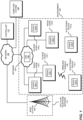
- FIG. 1 presents a block diagram illustrating an example of communication in an environment 106 with one or more electronic devices 110 (such as cellular telephones, portable electronic devices, stations or clients, another type of electronic device, etc.) via a macrocell in a cellular-telephone network 114 (which may include a base station 108), one or more access points 116 (which may communicate using Wi-Fi) in a WLAN and/or one or more radio nodes 118 (which may communicate using LTE) in another cellular-telephone network (such as a small-scale network or a small cell).
- electronic devices 110 such as cellular telephones, portable electronic devices, stations or clients, another type of electronic device, etc.
- a macrocell in a cellular-telephone network 114 which may include a base station 108
- one or more access points 116 which may communicate using Wi-Fi
- WLAN wireless local area network
- radio nodes 118 which may communicate using LTE
- another cellular-telephone network such as a small-scale network or a small cell.
- the one or more radio nodes 118 may include: an Evolved Node B (eNodeB), a Universal Mobile Telecommunications System (UMTS) NodeB and radio network controller (RNC), a New Radio (NR) gNB or gNodeB (which communicates with a network with a cellular-telephone communication protocol that is other than LTE), etc.
- eNodeB Evolved Node B
- UMTS Universal Mobile Telecommunications System
- RNC radio network controller
- NR New Radio
- gNB New Radio
- gNodeB which communicates with a network with a cellular-telephone communication protocol that is other than LTE
- an access point, a radio node or a base station are sometimes referred to generically as a ⁇ computer network device.
- one or more base stations (such as base station 108), access points 116, and/or radio nodes 118 may be included in one or more wireless networks, such as: a WLAN and/or a cellular-telephone network
- access points 116 and/or radio nodes 118 may communicate with each other and/or controller 112 (which may be a local or a cloud-based controller that manages and/or configures access points 116, radio nodes 118 and/or a computer network device (CND) 128, or that provides cloud-based storage and/or analytical services) using a wired communication protocol (such as Ethernet) via network 120 and/or 122.
- controller 112 which may be a local or a cloud-based controller that manages and/or configures access points 116, radio nodes 118 and/or a computer network device (CND) 128, or that provides cloud-based storage and/or analytical services
- a wired communication protocol such as Ethernet
- access points 116 and/or radio nodes 118 may communicate with computer system 130 (which may include one or more computers at one or more locations) using the wired communication protocol.
- access points 116 and/or radio nodes 118 may communicate with each other, controller 112 and/or computer system 130 using wireless communication (e.g., one of access points 116 may be a mesh access point in a mesh network).
- networks 120 and 122 may be the same or different networks.
- networks 120 and/or 122 may an LAN, an intra-net or the Internet.
- network 120 may include one or more routers and/or switches (such as computer network device 128).
- electronic devices 110, controller 112, access points 116, radio nodes 118, computer network device 128, and/or computer system 130 may include subsystems, such as a networking subsystem, a memory subsystem and a processor subsystem.
- electronic devices 110, access points 116 and radio nodes 118 may include radios 124 in the networking subsystems. More generally, electronic devices 110, access points 116 and radio nodes 118 can include (or can be included within) any electronic devices with the networking subsystems that enable electronic devices 110, access points 116 and radio nodes 118 to wirelessly communicate with one or more other electronic devices.
- This wireless communication can comprise transmitting access on wireless channels to enable electronic devices to make initial contact with or detect each other, followed by exchanging subsequent data/management frames (such as connection requests and responses) to establish a connection, configure security options, transmit and receive frames or packets via the connection, etc.
- data/management frames such as connection requests and responses
- access points 116 and/or radio nodes 118 and electronic devices 110 may wired or wirelessly communicate while: transmitting access requests and receiving access responses on wireless channels, detecting one another by scanning wireless channels, establishing connections (for example, by transmitting connection requests and receiving connection responses), and/or transmitting and receiving frames or packets (which may include information as payloads).
- wireless signals 126 may be transmitted by radios 124 in, e.g., access points 116 and/or radio nodes 118 and electronic devices 110.
- radio 124-1 in access point 116-1 may transmit information (such as one or more packets or frames) using wireless signals 126.
- These wireless signals are received by radios 124 in one or more other electronic devices (such as radio 124-2 in electronic device 110-1). This may allow access point 116-1 to communicate information to other access points 116 and/or electronic device 110-1.
- wireless signals 126 may convey one or more packets or frames.
- processing a packet or a frame in access points 116 and/or radio nodes 118 and electronic devices 110 may include: receiving the wireless signals with the packet or the frame; decoding/extracting the packet or the frame from the received wireless signals to acquire the packet or the frame; and processing the packet or the frame to determine information contained in the payload of the packet or the frame.
- the wireless communication in FIG. 1 may be characterized by a variety of performance metrics, such as: a data rate for successful communication (which is sometimes referred to as 'throughput'), an error rate (such as a retry or resend rate), a mean-squared error of equalized signals relative to an equalization target, intersymbol interference, multipath interference, a signal-to-noise ratio, a width of an eye pattern, a ratio of number of bytes successfully communicated during a time interval (such as 1-10 s) to an estimated maximum number of bytes that can be communicated in the time interval (the latter of which is sometimes referred to as the 'capacity' of a communication channel or link), and/or a ratio of an actual data rate to an estimated data rate (which is sometimes referred to as ⁇ utilization'). While instances of radios 124 are shown in components in FIG. 1 , one or more of these instances may be different from the other instances of radios 124.
- a data rate for successful communication which is sometimes
- an access point (such as access point 116-1) may provide information to controller 112 and/or computer system 130.
- electronic device 110-1 may provide, to access point 116-1, a frame with the information specifying a capability of electronic device 110-1.
- the frame may include a probe request or an association request.
- the information may indicate a capability of electronic device 110-1, such as whether electronic device 110-1 is compatible with an IEEE 802.11 standard.
- the information may be included in an IE and/or the IE may include a high-efficiency field in the frame. Additionally, the information may include one or more reserved bits in the frame.
- the frame is provided to access point 116-1 during association.
- access point 116-1 may be unable to interpret the information.
- electronic device 110-1 may be compatible with a more-recent IEEE 802.11 standard than access point 116-1. Consequently, access point 116-1 may provide the information to controller 112 and/or computer system 130.
- access point 116-1 may provide, addressed to controller 112 and/or computer system 130, an identifier of electronic device 110-1.
- the identifier may include a MAC address of electronic device 110-1.
- access point 116-1 may provide one or more attributes of electronic device 110-1, such as: a manufacturer of electronic device 110-1, a model of electronic device 110-1, an operating system of electronic device 110-1, etc.
- wireless communication between components in FIG. 1 uses one or more bands of frequencies, such as, but not limited to: 900 MHz, 2.4 GHz, 5 GHz, 6 GHz, 7 GHz, 60 GHz, the citizens Broadband Radio Spectrum or CBRS (e.g., a frequency band near 3.5 GHz), and/or a band of frequencies used by LTE or another cellular-telephone communication protocol or a data communication protocol.
- the communication between electronic devices may use multi-user transmission (such as orthogonal frequency division multiple access or OFDMA) and/or multiple input, multiple output (MIMO) communication.
- OFDMA orthogonal frequency division multiple access
- MIMO multiple input, multiple output
- FIG. 1 Although we describe the network environment shown in FIG. 1 as an example, in alternative embodiments, different numbers or types of electronic devices may be present. For example, some embodiments comprise more or fewer electronic devices. As another example, in another embodiment, different electronic devices are transmitting and/or receiving packets or frames.
- FIG. 1 illustrates controller 112 and computer system 130 as separate components, in other embodiments these components may be combined into a single component.
- computer system 130 may be a controller.
- the information may be communicated in a frame after association.
- the information may be communicated in an Action frame or a protected frame.
- the information may include a generational capabilities indication.
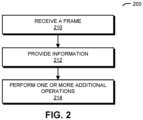
- FIG. 2 presents an example of a method 200 for providing information, which may be performed by an access point, such as access point 116-1.
- the access point receives, associated with the electronic device, a frame (operation 210) with information specifying a capability of the electronic device, where the capability comprises whether the electronic device is compatible with an IEEE 802.11 standard, and where the access point is unable to interpret the information. Then, the access point provides, addressed to a computer system, the information (operation 212).
- the frame may be received during association between the electronic device and the access point.
- the frame may include an association request.
- the frame may include a probe request.
- the information may be included in an IE.
- the IE may include a high-efficiency field in the frame.
- the information may include one or more reserved bits in the frame.
- the electronic device may be compatible with a more-recent IEEE 802.11 standard than the access point.
- the computer system may include a controller of the access point. More generally, the computer system may include a cloud-based computer system.
- the access point may optionally perform one or more additional operations (operation 214).
- the access point may provide, addressed to the computer system, an identifier of the electronic device.
- the identifier may include a MAC address of the electronic device.
- the access point may provide one or more attributes of the electronic device, such as: a manufacturer of the electronic device, a model of the electronic device, an operating system of the electronic device, etc. Note that the identifier and/or the one or more attributes may be included in the frame and/or in a second frame, which is different from the frame.
- method 200 there may be additional or fewer operations. Furthermore, the order of the operations may be changed, and/or two or more operations may be combined into a single operation.
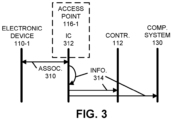
- FIG. 3 presents a drawing illustrating an example of communication between access point 116-1, electronic device 110-1 and controller 112 or computer system 130.
- Electronic device 110-1 may associate 310 with access point 116-1. For example, during association 310, electronic device 110-1 may provide an association request or a probe request to an interface circuit 312 in access point 110-1.
- electronic device 110-1 may provide a frame to interface circuit 312.
- This frame may include information 314 specifying a capability of electronic device 110-1.
- the capability may include whether electronic device 110-1 is compatible with an IEEE 802.11 standard (such as IEEE 802.1 The or IEEE 802.11bn), and where access point 116-1 is unable to interpret information 314.
- access point 116-1 may not be compatible with an IEEE 802.11 standard used by electronic device 110-1, such that the frame includes fields that access point 116-1 cannot interpret or decode. Consequently, interface circuit 312 may provide, addressed to controller 112 or computer system 130, information 314 (e.g., in a packet or another frame).
- FIG. 3 illustrates communication between components using unidirectional or bidirectional communication with lines having single arrows or double arrows
- the communication in a given operation in this figure may involve unidirectional or bidirectional communication.
- FIG. 3 illustrates operations being performed sequentially or at different times, in other embodiments at least some of these operations may, at least in part, be performed concurrently or in parallel.
- the association request from a client may eliminate advanced IEs from their association request.
- the clients see that high efficiency (HE) and extremely high efficiency (EHT) elements are missing from the access point beacon and/or probe response and then eliminate those elements from their association request.
- HE high efficiency
- EHT extremely high efficiency
- current practice is to look at earlier received probe requests to try to match advanced IEs in the earlier probe requests and their MAC addresses with the MAC addresses of currently associating clients.
- an IE may be included in an association request and/or a probe request.
- This IE may indicate the capabilities (such as compatibility with a particular IEEE 802.11 standard) of an electronic device. For example, one or more bits may be set in a bitmap or bitmask that is included in the association request and/or the probe request.
- Wi-Fi # (where # denotes a non-zero integer) may encompass a wide variety of separate standards capabilities all brought together under one umbrella term, such as Wi-Fi 6, Wi-Fi 7, etc.
- the IE in the communication techniques may not include or specify all the details of, e.g., the Wi-Fi 6 capabilities.
- the IE may not change from standards release to standards release. Instead, it may be the same IE and only the data indicating the capabilities of a client may change with each release.
- the communication technique may allow the software in the access point to only be written once to pass along the data in the IE to the aggregation service (such as a cloud-based computer system). Each time a new standard is released, the same access-point software may still work. Only the aggregator software processing may be changed to reinterpret the newest standard information.
- the network operator may want to detect or determine the client capabilities, so they can upgrade equipment at the right time.
- a station or client has higher capabilities than an access point (such as a Wi-Fi 5 access point and a Wi-Fi 6 station)
- the access point may not be able to interpret IEs that specify the capabilities of the station or client. Instead, the access point may ignore these IEs.
- an IE may be used during association (such as in an association request) or a probe request to indicate or specify the IEEE 802.11 standard capabilities of the station or client.
- the access point may not be able to understand or interpret this IE.
- the access point may provide information specifying the IEEE 802.11 standard capabilities of the station or client to a cloud-based computer system, such as a controller of the access point (which may configure and/or manage the access point) or an analytics service.
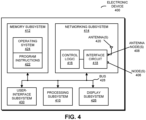
- FIG. 4 presents a block diagram illustrating an example of an electronic device 400 in accordance with some embodiments, such as one of: base station 108, one of electronic devices 110, controller 112, one of access points 116, one of radio nodes 118, or computer system 130.
- This electronic device includes processing subsystem 410, memory subsystem 412, and networking subsystem 414.
- Processing subsystem 410 includes one or more devices configured to perform computational operations.
- processing subsystem 410 can include one or more microprocessors, graphics processing units (GPUs), ASICs, microcontrollers, programmable-logic devices, and/or one or more digital signal processors (DSPs).
- Memory subsystem 412 includes one or more devices for storing data and/or instructions for processing subsystem 410 and networking subsystem 414.
- memory subsystem 412 can include DRAM, static random access memory (SRAM), and/or other types of memory.
- instructions for processing subsystem 410 in memory subsystem 412 include: one or more program modules or sets of instructions (such as program instructions 422 or operating system 424, such as Linux, UNIX, Windows Server, or another customized and proprietary operating system), which may be executed by processing subsystem 410.
- program modules or sets of instructions such as program instructions 422 or operating system 424, such as Linux, UNIX, Windows Server, or another customized and proprietary operating system
- the one or more computer programs, program modules or instructions may constitute a computer-program mechanism.
- instructions in the various modules in memory subsystem 412 may be implemented in: a high-level procedural language, an object-oriented programming language, and/or in an assembly or machine language.
- the programming language may be compiled or interpreted, e.g., configurable or configured (which may be used interchangeably in this discussion), to be executed by processing subsystem 410.
- memory subsystem 412 can include mechanisms for controlling access to the memory.
- memory subsystem 412 includes a memory hierarchy that comprises one or more caches coupled to a memory in electronic device 400. In some of these embodiments, one or more of the caches is located in processing subsystem 410.
- memory subsystem 412 is coupled to one or more high-capacity mass-storage devices (not shown).
- memory subsystem 412 can be coupled to a magnetic or optical drive, a solid-state drive, or another type of mass-storage device.
- memory subsystem 412 can be used by electronic device 400 as fast-access storage for often-used data, while the mass-storage device is used to store less frequently used data.
- Networking subsystem 414 includes one or more devices configured to couple to and communicate on a wired and/or wireless network (i.e., to perform network operations), including: control logic 416, an interface circuit 418 and one or more antennas 420 (or antenna elements).
- control logic 416 an interface circuit 418
- antennas 420 or antenna elements.
- FIG. 4 includes one or more antennas 420
- electronic device 400 includes one or more nodes, such as antenna nodes 408, e.g., a metal pad or a connector, which can be coupled to the one or more antennas 420, or nodes 406, which can be coupled to a wired or optical connection or link.
- electronic device 400 may or may not include the one or more antennas 420.
- networking subsystem 414 can include a Bluetooth networking system, a cellular networking system (e.g., a 3G/4G/5G network such as UMTS, LTE, etc.), a universal serial bus (USB) networking system, a coaxial interface, a High-Definition Multimedia Interface (HDMI) interface, a networking system based on the standards described in IEEE 802.11 (e.g., a Wi-Fi ® networking system), an Ethernet networking system, and/or another networking system.
- a Bluetooth networking system e.g., a 3G/4G/5G network such as UMTS, LTE, etc.
- USB universal serial bus
- HDMI High-Definition Multimedia Interface
- a transmit or receive antenna pattern (or antenna radiation pattern) of electronic device 400 may be adapted or changed using pattern shapers (such as directors or reflectors) and/or one or more antennas 420 (or antenna elements), which can be independently and selectively electrically coupled to ground to steer the transmit antenna pattern in different directions.
- pattern shapers such as directors or reflectors
- antennas 420 or antenna elements
- the one or more antennas may have 2 N different antenna pattern configurations.
- a given antenna pattern may include amplitudes and/or phases of signals that specify a direction of the main or primary lobe of the given antenna pattern, as well as so-called ⁇ exclusion regions' or ⁇ exclusion zones' (which are sometimes referred to as 'notches' or ⁇ nulls').
- an exclusion zone of the given antenna pattern includes a low-intensity region of the given antenna pattern. While the intensity is not necessarily zero in the exclusion zone, it may be below a threshold, such as 3dB or lower than the peak gain of the given antenna pattern.
- the given antenna pattern may include a local maximum (e.g., a primary beam) that directs gain in the direction of electronic device 400 that is of interest, and one or more local minima that reduce gain in the direction of other electronic devices that are not of interest. In this way, the given antenna pattern may be selected so that communication that is undesirable (such as with the other electronic devices) is avoided to reduce or eliminate adverse effects, such as interference or crosstalk.
- Networking subsystem 414 includes processors, controllers, radios/antennas, sockets/plugs, and/or other devices used for coupling to, communicating on, and handling data and events for each supported networking system.
- mechanisms used for coupling to, communicating on, and handling data and events on the network for each network system are sometimes collectively referred to as a ⁇ network interface' for the network system.
- electronic device 400 may use the mechanisms in networking subsystem 414 for performing simple wireless communication between the electronic devices, e.g., transmitting advertising or beacon frames and/or scanning for advertising frames transmitted by other electronic devices as described previously.
- Bus 428 may include an electrical, optical, and/or electro-optical connection that the subsystems can use to communicate commands and data among one another. Although only one bus 428 is shown for clarity, different embodiments can include a different number or configuration of electrical, optical, and/or electro-optical connections among the subsystems.
- electronic device 400 includes a display subsystem 426 for displaying information on a display, which may include a display driver and the display, such as a liquid-crystal display, a multi-touch touchscreen, etc.
- electronic device 400 may include a user-interface subsystem 430, such as: a mouse, a keyboard, a trackpad, a stylus, a voice-recognition interface, and/or another human-machine interface.
- user-interface subsystem 430 may include or may interact with a touch-sensitive display in display subsystem 426.
- Electronic device 400 can be (or can be included in) any electronic device with at least one network interface.
- electronic device 400 can be (or can be included in): a desktop computer, a laptop computer, a subnotebook/netbook, a server, a tablet computer, a cloud-based computing system, a smartphone, a cellular telephone, a smartwatch, a wearable electronic device, a consumer-electronic device, a portable computing device, an access point, a transceiver, a router, a switch, communication equipment, an eNodeB, a controller, test equipment, and/or another electronic device.
- electronic device 400 may include one or more additional processing subsystems, memory subsystems, networking subsystems, and/or display subsystems. Additionally, one or more of the subsystems may not be present in electronic device 400. Moreover, in some embodiments, electronic device 400 may include one or more additional subsystems that are not shown in FIG. 4 . Also, although separate subsystems are shown in FIG. 4 , in some embodiments some or all of a given subsystem or component can be integrated into one or more of the other subsystems or component(s) in electronic device 400. For example, in some embodiments instructions 422 is included in operating system 424 and/or control logic 416 is included in interface circuit 418.
- circuits and components in electronic device 400 may be implemented using any combination of analog and/or digital circuitry, including: bipolar, PMOS and/or NMOS gates or transistors.
- signals in these embodiments may include digital signals that have approximately discrete values and/or analog signals that have continuous values.
- components and circuits may be single-ended or differential, and power supplies may be unipolar or bipolar.
- An integrated circuit (which is sometimes referred to as a ⁇ communication circuit') may implement some or all of the functionality of networking subsystem 414 and/or of electronic device 400.
- the integrated circuit may include hardware and/or software mechanisms that are used for transmitting wireless signals from electronic device 400 and receiving signals at electronic device 400 from other electronic devices.
- radios are generally known in the art and hence are not described in detail.
- networking subsystem 414 and/or the integrated circuit can include any number of radios. Note that the radios in multiple-radio embodiments function in a similar way to the described single-radio embodiments.
- networking subsystem 414 and/or the integrated circuit include a configuration mechanism (such as one or more hardware and/or software mechanisms) that configures the radio(s) to transmit and/or receive on a given communication channel (e.g., a given carrier frequency).
- a configuration mechanism such as one or more hardware and/or software mechanisms
- the configuration mechanism can be used to switch the radio from monitoring and/or transmitting on a given communication channel to monitoring and/or transmitting on a different communication channel.
- an output of a process for designing the integrated circuit, or a portion of the integrated circuit, which includes one or more of the circuits described herein may be a computer-readable medium such as, for example, a magnetic tape, an optical, a magnetic disk or a solid-state disk.
- the computer-readable medium may be encoded with data structures or other information describing circuitry that may be physically instantiated as the integrated circuit or the portion of the integrated circuit.
- data structures are commonly written in: Caltech Intermediate Format (CIF), Calma GDS II Stream Format (GDSII) or Electronic Design Interchange Format (EDIF), OpenAccess (OA), or Open Artwork System Interchange Standard (OASIS).
Landscapes
- Engineering & Computer Science (AREA)
- Computer Networks & Wireless Communication (AREA)
- Signal Processing (AREA)
- Computer Security & Cryptography (AREA)
- Mobile Radio Communication Systems (AREA)
Applications Claiming Priority (2)
| Application Number | Priority Date | Filing Date | Title |
|---|---|---|---|
| US202363536552P | 2023-09-05 | 2023-09-05 | |
| US202463566473P | 2024-03-18 | 2024-03-18 |
Publications (1)
| Publication Number | Publication Date |
|---|---|
| EP4521807A1 true EP4521807A1 (fr) | 2025-03-12 |
Family
ID=92675975
Family Applications (1)
| Application Number | Title | Priority Date | Filing Date |
|---|---|---|---|
| EP24198490.5A Pending EP4521807A1 (fr) | 2023-09-05 | 2024-09-04 | Indication de messagerie de dispositif sans fil de capacité sans fil |
Country Status (2)
| Country | Link |
|---|---|
| US (1) | US20250081254A1 (fr) |
| EP (1) | EP4521807A1 (fr) |
Citations (3)
| Publication number | Priority date | Publication date | Assignee | Title |
|---|---|---|---|---|
| US20140337950A1 (en) * | 2013-05-07 | 2014-11-13 | Futurewei Technologies, Inc. | Method and Apparatus for Secure Communications in a Wireless Network |
| US10159039B2 (en) * | 2017-04-19 | 2018-12-18 | Fortinet, Inc. | Steering wireless local area network (WLAN) clients |
| US10687338B1 (en) * | 2017-07-10 | 2020-06-16 | Cisco Technology, Inc. | Adaptive wireless network feature support |
-
2024
- 2024-08-20 US US18/809,595 patent/US20250081254A1/en active Pending
- 2024-09-04 EP EP24198490.5A patent/EP4521807A1/fr active Pending
Patent Citations (3)
| Publication number | Priority date | Publication date | Assignee | Title |
|---|---|---|---|---|
| US20140337950A1 (en) * | 2013-05-07 | 2014-11-13 | Futurewei Technologies, Inc. | Method and Apparatus for Secure Communications in a Wireless Network |
| US10159039B2 (en) * | 2017-04-19 | 2018-12-18 | Fortinet, Inc. | Steering wireless local area network (WLAN) clients |
| US10687338B1 (en) * | 2017-07-10 | 2020-06-16 | Cisco Technology, Inc. | Adaptive wireless network feature support |
Also Published As
| Publication number | Publication date |
|---|---|
| US20250081254A1 (en) | 2025-03-06 |
Similar Documents
| Publication | Publication Date | Title |
|---|---|---|
| US12284722B2 (en) | WLAN steering based on capabilities | |
| US11265800B2 (en) | Dynamic wireless-client distribution across radio bands | |
| US11711752B2 (en) | Backwards compatibility using selective probe-response suppression | |
| US12598596B2 (en) | Channel selection based on multi-hop neighboring-access-point feedback | |
| EP4171131A1 (fr) | Détection alternative de dispositifs électroniques multibandes | |
| US12342261B2 (en) | Automated establishing of a hidden transmitted basic service set | |
| US20220417837A1 (en) | Selectively providing unsolicited probe responses in a band of frequencies | |
| US12349047B2 (en) | Cross-subnet controller discovery via a proxy | |
| US20230328633A1 (en) | Selective Providing of a Personalized Selective Service Set Identifier | |
| EP4521807A1 (fr) | Indication de messagerie de dispositif sans fil de capacité sans fil | |
| US11765599B2 (en) | Make-before-break grant switching | |
| US20230018858A1 (en) | Multiple coexisting personal area networks having different handshaking | |
| US12192771B2 (en) | Collaborative wireless intrusion protection system | |
| US12474960B2 (en) | Processing of controller-state-message queries | |
| US20230291638A1 (en) | Zero-Touch Provisioning of an Access Point by a Switch | |
| US12219666B2 (en) | Coordinated testing of groups of proximate access points in a network | |
| US12368704B2 (en) | Certificate-based connections reflecting a network architecture | |
| US11627638B2 (en) | Integrated system with an access point powered by a radio node | |
| US20230084534A1 (en) | Network-traffic-flow visualization using parallel sets | |
| US20240031338A1 (en) | Controller-enabled discovery of sd-wan edge devices | |
| EP4199438A1 (fr) | Attribution d'identifiants de réseau vxlan et de plans de données | |
| WO2023028464A1 (fr) | Établissement automatique d'un ensemble de services de base transmis cachés |
Legal Events
| Date | Code | Title | Description |
|---|---|---|---|
| PUAI | Public reference made under article 153(3) epc to a published international application that has entered the european phase |
Free format text: ORIGINAL CODE: 0009012 |
|
| STAA | Information on the status of an ep patent application or granted ep patent |
Free format text: STATUS: THE APPLICATION HAS BEEN PUBLISHED |
|
| AK | Designated contracting states |
Kind code of ref document: A1 Designated state(s): AL AT BE BG CH CY CZ DE DK EE ES FI FR GB GR HR HU IE IS IT LI LT LU LV MC ME MK MT NL NO PL PT RO RS SE SI SK SM TR |
|
| RAP1 | Party data changed (applicant data changed or rights of an application transferred) |
Owner name: RUCKUS IP HOLDINGS LLC |
|
| STAA | Information on the status of an ep patent application or granted ep patent |
Free format text: STATUS: REQUEST FOR EXAMINATION WAS MADE |
|
| 17P | Request for examination filed |
Effective date: 20250902 |