EP4521832A1 - Procédé et appareil permettant de former une séquence de données, ainsi que support de stockage et appareil électronique - Google Patents
Procédé et appareil permettant de former une séquence de données, ainsi que support de stockage et appareil électronique Download PDFInfo
- Publication number
- EP4521832A1 EP4521832A1 EP23799203.7A EP23799203A EP4521832A1 EP 4521832 A1 EP4521832 A1 EP 4521832A1 EP 23799203 A EP23799203 A EP 23799203A EP 4521832 A1 EP4521832 A1 EP 4521832A1
- Authority
- EP
- European Patent Office
- Prior art keywords
- frequency domain
- resource blocks
- domain resource
- groups
- data
- Prior art date
- Legal status (The legal status is an assumption and is not a legal conclusion. Google has not performed a legal analysis and makes no representation as to the accuracy of the status listed.)
- Pending
Links
Images



Classifications
-
- H—ELECTRICITY
- H04—ELECTRIC COMMUNICATION TECHNIQUE
- H04W—WIRELESS COMMUNICATION NETWORKS
- H04W72/00—Local resource management
- H04W72/04—Wireless resource allocation
- H04W72/044—Wireless resource allocation based on the type of the allocated resource
- H04W72/0453—Resources in frequency domain, e.g. a carrier in FDMA
-
- H—ELECTRICITY
- H04—ELECTRIC COMMUNICATION TECHNIQUE
- H04L—TRANSMISSION OF DIGITAL INFORMATION, e.g. TELEGRAPHIC COMMUNICATION
- H04L27/00—Modulated-carrier systems
- H04L27/26—Systems using multi-frequency codes
- H04L27/2601—Multicarrier modulation systems
- H04L27/2602—Signal structure
- H04L27/26025—Numerology, i.e. varying one or more of symbol duration, subcarrier spacing, Fourier transform size, sampling rate or down-clocking
-
- H—ELECTRICITY
- H04—ELECTRIC COMMUNICATION TECHNIQUE
- H04L—TRANSMISSION OF DIGITAL INFORMATION, e.g. TELEGRAPHIC COMMUNICATION
- H04L27/00—Modulated-carrier systems
- H04L27/26—Systems using multi-frequency codes
- H04L27/2601—Multicarrier modulation systems
- H04L27/2602—Signal structure
- H04L27/2604—Multiresolution systems
-
- H—ELECTRICITY
- H04—ELECTRIC COMMUNICATION TECHNIQUE
- H04L—TRANSMISSION OF DIGITAL INFORMATION, e.g. TELEGRAPHIC COMMUNICATION
- H04L27/00—Modulated-carrier systems
- H04L27/26—Systems using multi-frequency codes
- H04L27/2601—Multicarrier modulation systems
- H04L27/2626—Arrangements specific to the transmitter only
- H04L27/2627—Modulators
- H04L27/2628—Inverse Fourier transform modulators, e.g. inverse fast Fourier transform [IFFT] or inverse discrete Fourier transform [IDFT] modulators
- H04L27/2633—Inverse Fourier transform modulators, e.g. inverse fast Fourier transform [IFFT] or inverse discrete Fourier transform [IDFT] modulators using partial FFTs
-
- H—ELECTRICITY
- H04—ELECTRIC COMMUNICATION TECHNIQUE
- H04L—TRANSMISSION OF DIGITAL INFORMATION, e.g. TELEGRAPHIC COMMUNICATION
- H04L27/00—Modulated-carrier systems
- H04L27/26—Systems using multi-frequency codes
- H04L27/2601—Multicarrier modulation systems
- H04L27/2626—Arrangements specific to the transmitter only
- H04L27/2627—Modulators
- H04L27/2634—Inverse fast Fourier transform [IFFT] or inverse discrete Fourier transform [IDFT] modulators in combination with other circuits for modulation
-
- H—ELECTRICITY
- H04—ELECTRIC COMMUNICATION TECHNIQUE
- H04L—TRANSMISSION OF DIGITAL INFORMATION, e.g. TELEGRAPHIC COMMUNICATION
- H04L5/00—Arrangements affording multiple use of the transmission path
- H04L5/0001—Arrangements for dividing the transmission path
- H04L5/0003—Two-dimensional division
- H04L5/0005—Time-frequency
- H04L5/0007—Time-frequency the frequencies being orthogonal, e.g. OFDM(A) or DMT
-
- H—ELECTRICITY
- H04—ELECTRIC COMMUNICATION TECHNIQUE
- H04L—TRANSMISSION OF DIGITAL INFORMATION, e.g. TELEGRAPHIC COMMUNICATION
- H04L5/00—Arrangements affording multiple use of the transmission path
- H04L5/003—Arrangements for allocating sub-channels of the transmission path
- H04L5/0044—Allocation of payload; Allocation of data channels, e.g. PDSCH or PUSCH
-
- H—ELECTRICITY
- H04—ELECTRIC COMMUNICATION TECHNIQUE
- H04L—TRANSMISSION OF DIGITAL INFORMATION, e.g. TELEGRAPHIC COMMUNICATION
- H04L5/00—Arrangements affording multiple use of the transmission path
- H04L5/0091—Signalling for the administration of the divided path, e.g. signalling of configuration information
- H04L5/0094—Indication of how sub-channels of the path are allocated
-
- H—ELECTRICITY
- H04—ELECTRIC COMMUNICATION TECHNIQUE
- H04W—WIRELESS COMMUNICATION NETWORKS
- H04W72/00—Local resource management
- H04W72/04—Wireless resource allocation
- H04W72/044—Wireless resource allocation based on the type of the allocated resource
- H04W72/0457—Variable allocation of band or rate
-
- H—ELECTRICITY
- H04—ELECTRIC COMMUNICATION TECHNIQUE
- H04L—TRANSMISSION OF DIGITAL INFORMATION, e.g. TELEGRAPHIC COMMUNICATION
- H04L5/00—Arrangements affording multiple use of the transmission path
- H04L5/003—Arrangements for allocating sub-channels of the transmission path
- H04L5/0048—Allocation of pilot signals, i.e. of signals known to the receiver
Definitions
- the embodiments of the present disclosure relate to the field of communications, and in particular, to a method and apparatus for forming data sequence, a storage medium and an electronic apparatus.
- the Fifth Generation New Radio (5G NR) communication technology uses a Cyclic Prefix Orthogonal Frequency Division Multiplexing (CP-OFDM) system as a basic waveform.
- CP-OFDM Cyclic Prefix Orthogonal Frequency Division Multiplexing
- the performance of the CP-OFDM system is sensitive to frequency offset and time offset between adjacent sub-bands, and this is mainly because the significant frequency spectrum leakage of the CP-OFDM system, thereby easily causing inter-sub-band interference.
- different numerologies may be used between two adjacent sub-bands, which damages the orthogonality between the sub-carriers and brings the new problem of interference.
- Aiming at how to solve the interference problem one straightforward method is to insert a guard bandwidth between two transmission bands with different numerologies, but this will lead to the wastage of frequency resources.
- the embodiments of the present disclosure provide a data sequence forming method and apparatus, a storage medium, and an electronic device, so as to at least solve the problem in the related art that interference easily occurs between sub-bands when data sequences are filtered.
- N frequency domain resource blocks are divided into two groups of frequency domain resource blocks, and the two groups are distributed alternately.
- Fig. 1 is a hardware structural block diagram of a computer terminal for an optional data sequence forming method according to an embodiment of the present disclosure.
- the computer terminal may include one or more (only one is shown in Fig. 1 ) processors 102 (the processors 102 may include, but are not limited to, a processing apparatus such as a microprocessor MCU or a programmable logic device FPGA) and a memory 104 configured to store data, wherein the computer terminal may further include a transmission device 106 configured to have a communication function, and an input/output device 108.
- Fig. 1 is merely exemplary, which does not limit the structure of the computer terminal.
- the computer terminal may further include components more or less than that shown in Fig. 1 , or have a configuration different from that shown in Fig. 1 .
- the memory 104 may be configured to store a computer program, for example, a software program and a module of application software, such as a computer program corresponding to the data sequence forming method in the embodiments of the present disclosure.
- the processor 102 runs the computer program stored in the memory 104, so as to execute various function applications and data processing, i.e. to implement the described method.
- the memory 104 may include a high-speed random access memory, and may also include a non-volatile memory, such as one or more magnetic storage apparatuses, flash memory, or other non-volatile solid-state memory.
- the memory 104 may further include a memory configured remotely relative to the processor 102, and the remote memory may be connected to a mobile terminal over a network. Examples of the described network include, but are not limited to, the Internet, intranets, local area networks, mobile communication networks, and combinations thereof.
- the transmission device 106 is configured to receive or transmit data via a network. Specific examples of the described network may include a wireless network provided by a communication provider of the mobile terminal.
- the transmission device 106 includes a Network Interface Controller (NIC) that may be coupled to other network devices via a base station to communicate with the Internet.
- the transmission device 106 may be a Radio Frequency (RF) module configured to wirelessly communicate with the Internet.
- NIC Network Interface Controller
- RF Radio Frequency
- Step S204 data to be transmitted on the L(m) frequency domain resource blocks in each group is processed respectively to form L(m) groups of data sequences.
- Data to be transmitted on the L(m) frequency domain resource blocks in each group is processed respectively to form L(m) groups of data sequences.
- N frequency domain resource blocks are divided into two groups of frequency domain resource blocks, and the two groups can be distributed alternately.
- the bandwidth of the frequency domain resource blocks in different groups may be different, and windowing or filtering may be performed by using waveform functions with different parameters; the bandwidth of the frequency domain resource blocks in the same group is more likely to be equal, which facilitates performing unified windowing or filtering by using the same waveform function, and reduces the processing complexity.
- the alternate distribution method allows the interval between adjacent frequency domain resource blocks in the same group to be equal and greater than the bandwidth of the frequency domain resource blocks, and furthermore, allows the reciprocal of the time domain data interval of data to be transmitted on each resource block in the same group, after being subjected to an over-sampled inverse Fourier transform, to be equal to the interval between adjacent resource blocks in the group. In this way, interference between adjacent frequency domain resource blocks in the same group can be avoided, thereby solving the problem in the related art that interference easily occurs between sub-bands when data sequences are filtered.
- N frequency domain resource blocks used for transmitting data to be transmitted are divided into two groups
- N frequency domain resource blocks are divided into two groups because: (1) the bandwidth of the frequency domain resource blocks in different groups may be different, and windowing or filtering may be performed by using waveform functions with different parameters; (2) the bandwidth of the frequency domain resource blocks in the same group is more likely to be equal, which facilitates performing unified windowing or filtering by using the same waveform function, and reduces the processing complexity; and (3) two groups can be distributed alternately, and the method allows the interval between adjacent frequency domain resource blocks in the same group to be equal and greater than the bandwidth of the frequency domain resource blocks; alternatively, the method allows the reciprocal of the time domain data interval of data to be transmitted on each resource block in the same group, after being subjected to an over-sampled inverse Fourier transform, to be equal to the interval between adjacent resource blocks in the group, thereby avoiding interference between adjacent frequency domain resource blocks in the same group.
- step S204 "data to be transmitted on the L(m) frequency domain resource blocks in each group is processed respectively to form L(m) groups of data sequences", wherein the processing comprises inverse Fourier transform.
- the inverse Fourier transform is over-sampled inverse Fourier transform.
- the number of Inverse Fast Fourier Transform (IFFT) points or the number of Inverse Discrete Fourier Transform (IDFT) points of the inverse Fourier transform is greater than or equal to k(n).
- the number of IFFT points may also be referred to as IFFT size.
- the number of IFFT points is less than the sum of the number of the sub-carriers comprised in the N frequency domain resource blocks.
- inverse Fourier transform is performed on a certain frequency domain resource block, and a zero frequency position during the inverse Fourier transform operation falls within the range of this frequency domain resource block. Zero frequency positions of different frequency domain resource blocks during inverse Fourier transform operations are different.
- inverse Fourier transform is performed on a certain frequency domain resource block, and a zero frequency position (or a zero sub-carrier) during the inverse Fourier transform operation is located at one of k(n) sub-carriers of each resource block.
- the data to be transmitted is subjected to inverse Fourier transform to form a group of data sequences
- the data to be transmitted on the L(m) frequency domain resource blocks is subjected to inverse Fourier transform respectively to form L(m) groups of data sequences.
- FFT Fast Fourier Transform
- DFT Discrete Fourier Transform
- the method further comprises: the L(m) groups of data sequences are processed to form one group of data sequences; two groups of data sequences corresponding to the two groups of frequency domain resource blocks are processed to form a combined group of data sequences; and the combined group of data sequences is transmitted.
- each group forms one group of data sequences.
- L(m) groups of data sequences are processed to form one group of data sequences, this processing comprises inverse Fourier transform, wherein the inverse Fourier transform is an over-sampled inverse Fourier transform, and the number of IFFT points of the inverse Fourier transform is greater than L(m).
- this inverse Fourier transform comprises: performing inverse Fourier transform once on every L(m) pieces of data, wherein every L(m) pieces of data are respectively from L(m) groups of data sequences. For example, the L(m) groups of data sequences are arranged in L(m) rows respectively, L(m) pieces of data are then extracted according to columns, and an inverse Fourier transform is performed once on every extracted L(m) pieces of data.
- inverse Fourier transform is performed, that is to say, the processing of L(m) groups of data sequences further comprises adding multiple groups of zero data sequences, and then performing the inverse Fourier transform.
- one group of data sequences refers to one group of time domain data sequences, and is formed by serially connecting multiple time domain data sequences generated by the inverse Fourier transform.
- two groups of data sequences corresponding to the two groups of frequency domain resource blocks are processed to form a combined group of data sequences, and this processing comprises: performing an addition operation on the two groups of data sequences to form one group of data sequences.
- N frequency domain resource blocks used for transmitting data to be transmitted are divided into two groups, as the bandwidth of the frequency domain resource blocks in different groups may be different, windowing or filtering may be performed by using waveform functions with different parameters; in addition, the bandwidth of the frequency domain resource blocks in the same group is more likely to be equal, which facilitates performing unified windowing or filtering by using the same waveform function, and reduces the processing complexity; further, two groups can be distributed alternately, and the method allows the interval between adjacent frequency domain resource blocks in the same group to be equal and greater than the bandwidth of the frequency domain resource blocks; alternatively, the method allows the reciprocal of the time domain data interval of data to be transmitted on each resource block in the same group, after being subjected to an over-sampled inverse Fourier transform, to be equal to the interval between adjacent resource blocks in the group, thereby avoiding interference between adjacent frequency domain resource blocks in the same group.
- the method further comprises, before the addition operation, performing a point multiplication operation on at least one group of data sequences.
- the sequence to be multiplied by point multiplication is a sequence in which the modulus thereof is equal while the phase changes sequentially.
- the method further comprises, before the addition operation, performing a windowing operation or a filtering operation on each group of data sequences.
- the two groups are subjected to a windowing operation or a filtering operation by using filtering functions with different parameters.
- the step that the group of data sequences is transmitted further comprises filtering the group of data sequences.
- step that the group of data sequences is transmitted further comprises filtering each frequency domain resource block by using the same waveform function.
- the filtering is single-phase filtering or multi-phase filtering.
- the filtering functions used for multi-phase filtering comprise: a root raised cosine function, a raised cosine function, a rectangular function, an Isotropic Orthogonal Transform Algorithm (IOTA) function, or a 1+D function.
- IOTA Isotropic Orthogonal Transform Algorithm
- the step that the group of data sequences is transmitted further comprises performing a windowing operation on the group of data sequences.
- the step that the group of data sequences is transmitted further comprises, by means of a windowing operation or a multi-phase filtering operation, filtering each frequency domain resource block by using the same waveform function.
- the data to be transmitted comprises constellation point modulated data and also reference signal data.
- the bandwidth of the frequency domain resource blocks in different groups may be different, windowing or filtering may be performed by using waveform functions with different parameters; the bandwidth of the frequency domain resource blocks in the same group is more likely to be equal, which facilitates performing unified windowing or filtering by using the same waveform function, and reduces the processing complexity.
- the alternate distribution method allows the interval between adjacent frequency domain resource blocks in the same group to be equal and greater than the bandwidth of the frequency domain resource blocks, and furthermore, allows the reciprocal of the time domain data interval of data to be transmitted on each resource block in the same group, after being subjected to an over-sampled inverse Fourier transform, to be equal to the interval between adjacent resource blocks in the group.
- the method further comprises: the N frequency domain resource blocks are distributed continuously in the frequency domain.
- the method further comprises: the L(m) frequency domain resource blocks in each group are discontinuous in the frequency domain, but the frequency spectrum interval between adjacent frequency domain resource blocks is equal.
- the method further comprises: there is at least one group of frequency domain resource blocks, among the two groups of frequency domain resource blocks, in which the bandwidth of the frequency domain resource blocks is 1/w of the frequency spectrum interval between adjacent frequency domain resource blocks in the group, where w is a positive integer.
- the method further comprises: there is at least one group of frequency domain resource blocks, among the two groups of frequency domain resource blocks, on which the time domain interval between adjacent data of the data sequences is equal to the reciprocal of the frequency spectrum interval between adjacent resource blocks in the group.
- the method further comprises: sub-carrier intervals of the N frequency domain resource blocks are all equal.
- the method further comprises: among the L(m) frequency domain resource blocks in each group, the number of sub-carriers comprised in the frequency domain resource blocks is equal.
- the method further comprises: among the two groups of frequency domain resource blocks, the bandwidth of the frequency domain resource blocks in each group is equal.
- the method further comprises: among the two groups of frequency domain resource blocks, the bandwidth of the frequency domain resource blocks in different groups is not equal.
- the method further comprises: among the two groups of frequency domain resource blocks, the bandwidth of the frequency domain resource blocks in different groups is equal.
- the method further comprises: sub-carrier intervals of the N frequency domain resource blocks are all equal.
- the method further comprises: among the L(m) frequency domain resource blocks in each group, the number of sub-carriers comprised in the frequency domain resource blocks is equal.
- the method further comprises: among the two groups of frequency domain resource blocks, the bandwidth of the frequency domain resource blocks in each group is equal.
- the method further comprises: among the two groups of frequency domain resource blocks, the bandwidth of the frequency domain resource blocks in different groups is not equal.
- the method further comprises: among the two groups of frequency domain resource blocks, the bandwidth of the frequency domain resource blocks in different groups is equal.
- n represents the number of frequency domain resource block
- m represents the number of a group
- L(m) represents the number of resource blocks in the mth group.
- n(1) and n(2) represent the number of group 1 and group 2 of frequency domain resource blocks, respectively.
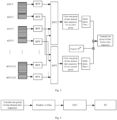
- Fig. 3 is a schematic diagram of an optional data sequence forming method according to Example 1.
- the N frequency domain resource blocks are divided into two groups, intersection exists in the frequency domain ranges where the two groups of frequency domain resource blocks are located, and the two groups of frequency domain resource blocks are distributed alternately in the frequency domain.
- the alternate distribution may be the sequential distribution of a first group of frequency domain resource blocks, a second group of frequency domain resource blocks, a first group of frequency domain resource blocks, a second group of frequency domain resource blocks, ...
- Fig. 3 is a schematic diagram of an optional data sequence forming method according to Example 1.
- Data to be transmitted on the L(m) frequency domain resource blocks in each group is processed to form L(m) groups of data sequences.
- inverse Fourier transform is performed on the data to be transmitted on all L(m) frequency domain resource blocks in each group, this inverse Fourier transform may be IFFT or IDFT, and each group forms L(m) groups of data sequences. That is to say, in this example, inverse Fourier transform is performed on the data to be transmitted on the N frequency domain resource blocks respectively to form L(m) groups of data sequences.
- This inverse Fourier transform is an over-sampled inverse Fourier transform or a non-over-sampled inverse Fourier transform, the number of IFFT points or the number of IDFT points of the inverse Fourier transform is greater than or equal to 4, and the corresponding zero frequency in the inverse Fourier transform operation is within the range of the frequency domain resource block.
- the L(m) groups of data sequences of each group are then processed such that each group forms one group of data sequences.
- inverse Fourier transform is performed on L(1) groups of data sequences of the first group to form one group of data sequences S1; and inverse Fourier transform is performed on L(2) groups of data sequences of the second group to form one group of data sequences S2.
- the inverse Fourier transform comprises: performing inverse Fourier transform once on every L(m) pieces of data, wherein every L(m) piece of data are respectively from L(m) groups of data sequences.
- the L(m) groups of data sequences are arranged in L(m) rows respectively, L(m) pieces of data are then extracted according to columns, and inverse Fourier transform is performed once on every extracted L(m) pieces of data.
- Performing inverse Fourier transform once on every L(m) pieces of data further comprises performing inverse Fourier transform after adding multiple pieces of zero data to every L(m) pieces of data, wherein the number of IFFT points of the inverse Fourier transform is greater than L(m).
- Performing inverse Fourier transform once on every L(m) pieces of data forms one time domain data sequence, and time domain data sequences generated by multiple times of inverse Fourier transform are serially connected to form a data sequence S1 or S2.
- the data sequence S1 and the data sequence S2 are then processed to form one group of data sequences.
- the method for processing the data sequence S1 and the data sequence S2 comprises, but is not limited to: performing an addition operation on the data sequence S1 and the data sequence S2 to form one group of time domain data sequences.
- the method further comprises: performing a filtering or windowing operation on the time domain data sequences.
- the filtering is multi-phase filtering, and the multi-phase filtering uses the same waveform function, that is to say, the bandwidths of N frequency domain resource blocks are the same, such that the same waveform function is used for the frequency domain resource blocks.
- Fig. 4 is another schematic diagram of an optional data sequence forming method according to Example 2.
- the N frequency domain resource blocks are divided into two groups, intersection exists in the frequency domain ranges where the two groups of frequency domain resource blocks are located, and the two groups of frequency domain resource blocks are distributed alternately in the frequency domain.
- Fig. 4 is another schematic diagram of an optional data sequence forming method according to Example 1.
- This inverse Fourier transform is an over-sampled inverse Fourier transform or a non-over-sampled inverse Fourier transform, the number of IFFT points or the number of IDFT points of the inverse Fourier transform is greater than or equal to 4, and the corresponding zero frequency in the inverse Fourier transform operation is within the range of the frequency domain resource block.
- the L(m) groups of data sequences of each group are then processed such that each group forms one group of data sequences.
- inverse Fourier transform is performed on L(1) groups of data sequences of the first group to form one group of data sequences S1; and inverse Fourier transform is performed on L(2) groups of data sequences of the second group to form one group of data sequences S2.
- This inverse Fourier transform comprises: performing inverse Fourier transform once on every L(m) pieces of data, wherein every L(m) piece of data are respectively from L(m) groups of data sequences.
- the L(m) groups of data sequences are arranged in L(m) rows respectively, L(m) pieces of data are then extracted according to columns, and inverse Fourier transform is performed once on every extracted L(m) pieces of data.
- Performing inverse Fourier transform once on every L(m) pieces of data further comprises performing inverse Fourier transform after adding multiple pieces of zero data to every L(m) pieces of data, wherein the number of IFFT points of the inverse Fourier transform is greater than L(m).
- Performing inverse Fourier transform once on every L(m) pieces of data forms one time domain data sequence, and time domain data sequences generated by multiple times of inverse Fourier transform are serially connected to form a data sequence S1 or S2.
- the data sequence S1 and the data sequence S2 are then processed to form one group of data sequences.
- the method for processing the data sequence S1 and the data sequence S2 comprises, but is not limited to: filtering or windowing the data sequence S1, filtering or windowing the data sequence 2, a point multiplication operation, and an addition operation.
- the bandwidths of the first group and the second group of frequency domain resource blocks are the same, the waveform functions used when the multi-phase filtering operation is performed on the data sequences S1 and S2 respectively are the same.
- the point multiplication operation may be a point multiplication operation performed on the data sequence S1, or a point multiplication operation performed on the data sequence S2.
- Fig. 5 is still another schematic diagram of an optional data sequence forming method according to Example 3.
- the N frequency domain resource blocks are divided into two groups, and the bandwidth of the frequency domain resource blocks in each group is equal. Intersection exists in the frequency domain ranges where the two groups of frequency domain resource blocks are located, and the two groups of frequency domain resource blocks are distributed alternately in the frequency domain.
- Fig. 5 is still another schematic diagram of an optional data sequence forming method according to Example 3.
- the number of sub-carriers comprised in each resource block in the first group is 12, and the number of sub-carriers comprised in each resource block in the second group is 4.
- Data to be transmitted on the L(m) frequency domain resource blocks in each group is processed to form L(m) groups of data sequences.
- IFFT or IDFT inverse Fourier transform
- each group forms L(m) groups of data sequences. That is to say, in this example, inverse Fourier transform is performed on the data to be transmitted on the N frequency domain resource blocks respectively to form N groups of data sequences.
- the inverse Flourier transform is an over-sampled inverse Flourier transform
- the number of IFFT points of the inverse Flourier transform for the first group is 16, and the number of IFFT points of the inverse Flourier transform for the second group is 8, and the corresponding zero frequency in the inverse Fourier transform operation is within the range of the frequency domain resource block.
- the L(m) groups of data sequences of each group are then processed such that each group forms one group of data sequences.
- inverse Fourier transform is performed on L(1) groups of data sequences of the first group to form one group of data sequences S1; and inverse Fourier transform is performed on L(2) groups of data sequences of the second group to form one group of data sequences S2.
- the inverse Fourier transform comprises: performing an inverse Fourier transform once on every L(m) pieces of data, wherein every L(m) piece of data are respectively from L(m) groups of data sequences.
- Performing the inverse Fourier transform once on every L(m) pieces of data further comprises adding multiple groups of zero data, and then performing the inverse Fourier transform, wherein the number of IFFT points of the inverse Fourier transform is greater than L(m).
- Performing the inverse Fourier transform once on every L(m) pieces of data forms one time domain data sequence, and time domain data sequences generated by multiple times of inverse Fourier transform are serially connected to form a data sequence S1 or S2.
- the data sequence S1 and the data sequence S2 are then processed to form one group of data sequences, wherein the processing comprises: filtering the data sequence S1, filtering the data sequence 2, a point multiplication operation, and an addition operation.
- the multi-phase filtering operation is performed on the data sequences S1 and S2 respectively, and the waveform functions used are different, that is, the waveform function parameters are different (for example, different waveform function types, or the same waveform function type with different specific parameters).
- the point multiplication operation may be a point multiplication operation performed on the data sequence S1, or a point multiplication operation performed on the data sequence S2.
- the group of time domain data sequences is transmitted.
- Transmitting a group of time domain data sequences further comprises: as shown in Fig. 6, Fig. 6 is a schematic diagram of an optional method for transmitting a group of time domain data sequences according to Example 4; and in Fig. 6 , after windowing or filtering the group of time domain data sequences, Digital-to-Analog Converter (DAC) and Radio Frequency (RF) processes are performed.
- DAC Digital-to-Analog Converter
- RF Radio Frequency
- the computer software product is stored in a storage medium (such as a ROM/RAM, a magnetic disk, or an optical disk), and includes several instructions for causing a terminal device (which may be a mobile phone, a computer, a server, or a network device) to execute the methods described in the embodiments of the present disclosure.
- a storage medium such as a ROM/RAM, a magnetic disk, or an optical disk
- module is a combination of software and/or hardware capable of realizing a predetermined function.
- apparatus described in the following embodiment is preferably implemented by software, implementation by hardware or a combination of software and hardware is also possible and conceived.
- Fig. 7 is a structural block diagram of an optional data sequence forming apparatus according to an embodiment of the present disclosure.
- a processing module 74 configured to process data to be transmitted on the L(m) frequency domain resource blocks in each group respectively to form L(m) groups of data sequences.
- Data to be transmitted on the L(m) frequency domain resource blocks in each group is processed respectively to form L(m) groups of data sequences.
- N frequency domain resource blocks are divided into two groups of frequency domain resource blocks, and the multiple groups can be distributed alternately.
- the bandwidth of the frequency domain resource blocks in different groups may be different, and windowing or filtering may be performed by using waveform functions with different parameters; the bandwidth of the frequency domain resource blocks in the same group is more likely to be equal, which facilitates performing unified windowing or filtering by using the same waveform function, and reduces the processing complexity.
- the alternate distribution method allows the interval between adjacent frequency domain resource blocks in the same group to be equal and greater than the bandwidth of the frequency domain resource blocks, and furthermore, allows the reciprocal of the time domain data interval of data to be transmitted on each resource block in the same group, after being subjected to an over-sampled inverse Fourier transform, to be equal to the interval between adjacent resource blocks in the group. In this way, interference between adjacent frequency domain resource blocks in the same group can be avoided, thereby solving the problem in the related art that interference easily occurs between sub-bands when data sequences are filtered.
- the processing module 74 is further configured to process the data to be transmitted on the L(m) frequency domain resource blocks to form L(m) groups of data sequences, wherein the processing comprises inverse Fourier transform.
- the inverse Flourier transform is an over-sampled inverse Fourier transform.
- the number of IFFT (or IDFT) points of the inverse Fourier transform is greater than or equal to k(n).
- the number of IFFT points is less than the sum of the number of the sub-carriers comprised in the N frequency domain resource blocks.
- inverse Fourier transform is performed on a certain frequency domain resource block, and a zero frequency position during the inverse Fourier transform operation falls within the range of this frequency domain resource block. Zero frequency positions of different frequency domain resource blocks during inverse Fourier transform operations are different.
- inverse Fourier transform is performed on a certain frequency domain resource block, and a zero frequency position (or a zero sub-carrier) during the inverse Fourier transform operation is located at one of k(n) sub-carriers of each resource block.
- the data to be transmitted is subjected to inverse Fourier transform to form a group of data sequences
- the data to be transmitted on the L(m) frequency domain resource blocks is subjected to inverse Fourier transform respectively to form L(m) groups of data sequences.
- a Fourier transform operation FFT (or DFT) is also comprised.
- the inverse Fourier transform comprises: performing inverse Fourier transform once on every L(m) pieces of data, wherein every L(m) piece of data are respectively from L(m) groups of data sequences.
- the L(m) groups of data sequences are arranged in L(m) rows respectively, L(m) pieces of data are then extracted according to columns, and inverse Fourier transform is performed once on every extracted L(m) pieces of data.
- the processing of L(m) groups of data sequences further comprises adding multiple groups of zero data sequences, and then performing the inverse Fourier transform.
- one group of data sequences refers to one group of time domain data sequences, and is formed by serially connecting multiple time domain data sequences generated by the inverse Fourier transform.
- the processing module 74 is further configured to process the L(m) groups of data sequences to form one group of data sequences, process two groups of data sequences corresponding to the two groups of frequency domain resource blocks to form a combined group of data sequences, and transmit the combined group of data sequences.
- each group forms one group of data sequences.
- the processing comprises: performing an addition operation on the two groups of data sequences to form one group of data sequences.
- the processing module 74 is further configured to perform a point multiplication operation on at least one group of data sequences before performing the addition operation on the two groups of data sequences to form one group of data sequences.
- the sequence to be multiplied by point multiplication is a sequence in which the modulus thereof is equal while the phase changes sequentially.
- processing module 74 is further configured to perform a windowing operation or a filtering operation on each group of data sequences before performing the addition operation on the two groups of data sequences.
- the operation that the group of data sequences is transmitted further comprises filtering the group of data sequences.
- the operation that the group of data sequences is transmitted further comprises filtering each frequency domain resource block by using the same waveform function.
- the filtering is single-phase filtering or multi-phase filtering.
- the filtering functions used for multi-phase filtering comprise: a root raised cosine function, a raised cosine function, a rectangular function, an Isotropic Orthogonal Transform Algorithm (IOTA) function, or a 1+D function.
- IOTA Isotropic Orthogonal Transform Algorithm
- the operation that the group of data sequences is transmitted further comprises performing a windowing operation on the group of data sequences.
- the operation that the group of data sequences is transmitted further comprises, by means of a windowing operation or a multi-phase filtering operation, filtering each frequency domain resource block by using the same waveform function.
- the data to be transmitted comprises constellation point modulated data and also reference signal data.
- the N frequency domain resource blocks are distributed continuously in the frequency domain.
- the L(m) frequency domain resource blocks in each group are discontinuous in the frequency domain, but the frequency spectrum interval between adjacent frequency domain resource blocks is equal.
- the method further comprises: there is at least one group of frequency domain resource blocks, among the two groups of frequency domain resource blocks, on which the time domain interval between adjacent data of the data sequences is equal to the reciprocal of the frequency spectrum interval between adjacent resource blocks in the group.
- sub-carrier intervals of the N frequency domain resource blocks are all equal.
- the number of sub-carriers comprised in the frequency domain resource blocks is equal.
- the bandwidth of the frequency domain resource blocks in each group is equal.
- the bandwidth of the frequency domain resource blocks in different groups is not equal.
- the bandwidth of the frequency domain resource blocks in different groups is equal.
- sub-carrier intervals of the N frequency domain resource blocks are all equal.
- the number of sub-carriers comprised in the frequency domain resource blocks is equal.
- the bandwidth of the frequency domain resource blocks in each group is equal.
- the bandwidth of the frequency domain resource blocks in different groups is not equal.
- the bandwidth of the frequency domain resource blocks in different groups is equal.
- the described various modules may be implemented by software or hardware.
- the latter may be implemented in the following manner, but is not limited thereto: all the modules are located in a same processor; alternatively, the described various modules are located in different processors in an arbitrary combination.
- the embodiments of the present disclosure further provide a computer-readable storage medium, the computer-readable storage medium storing a computer program, wherein the computer program is configured to execute the steps in any one of the described method embodiments when running.
- the computer-readable storage medium may include, but is not limited to, any medium that can store a computer program, such as a USB flash disk, a Read-Only Memory (ROM), a Random Access Memory (RAM), a mobile hard disk, a magnetic disk, or an optical disk.
- a computer program such as a USB flash disk, a Read-Only Memory (ROM), a Random Access Memory (RAM), a mobile hard disk, a magnetic disk, or an optical disk.
- the embodiments of the present disclosure further provide an electronic device, comprising a memory and a processor, wherein the memory stores a computer program, and the processor is configured to run the computer program so as to execute the steps in any of the described method embodiments.
- the electronic device may further comprise a transmission device and an input/output device, wherein the transmission device is connected to the processor, and the input/output device is connected to the processor.
- modules or various steps in the embodiments of the present disclosure can be implemented by a universal computing apparatus, and the various modules or steps can be integrated on a single computing apparatus or distributed over a network formed by a plurality of computing apparatuses, and can be implemented by program codes executable by the computing apparatus, such that the modules or steps can be stored in a storage apparatus and executed by the computing apparatus, and the shown or described steps can be executed in sequences different from those described here in some cases, or the various modules or steps can be implemented by manufacturing the modules or steps into various integrated circuit modules respectively, or manufacturing multiple modules or steps among the various modules or steps into a single integrated circuit module.
- the present disclosure is not limited to any particular combination of hardware and software.
Landscapes
- Engineering & Computer Science (AREA)
- Signal Processing (AREA)
- Computer Networks & Wireless Communication (AREA)
- Physics & Mathematics (AREA)
- Mathematical Physics (AREA)
- Discrete Mathematics (AREA)
- General Physics & Mathematics (AREA)
- Compression, Expansion, Code Conversion, And Decoders (AREA)
- Mobile Radio Communication Systems (AREA)
Applications Claiming Priority (2)
| Application Number | Priority Date | Filing Date | Title |
|---|---|---|---|
| CN202210482314.4A CN117082623A (zh) | 2022-05-05 | 2022-05-05 | 数据序列的形成方法、装置、存储介质及电子装置 |
| PCT/CN2023/090919 WO2023213217A1 (fr) | 2022-05-05 | 2023-04-26 | Procédé et appareil permettant de former une séquence de données, ainsi que support de stockage et appareil électronique |
Publications (2)
| Publication Number | Publication Date |
|---|---|
| EP4521832A1 true EP4521832A1 (fr) | 2025-03-12 |
| EP4521832A4 EP4521832A4 (fr) | 2025-08-13 |
Family
ID=88646260
Family Applications (1)
| Application Number | Title | Priority Date | Filing Date |
|---|---|---|---|
| EP23799203.7A Pending EP4521832A4 (fr) | 2022-05-05 | 2023-04-26 | Procédé et appareil permettant de former une séquence de données, ainsi que support de stockage et appareil électronique |
Country Status (5)
| Country | Link |
|---|---|
| US (1) | US20250310941A1 (fr) |
| EP (1) | EP4521832A4 (fr) |
| KR (1) | KR20240161828A (fr) |
| CN (1) | CN117082623A (fr) |
| WO (1) | WO2023213217A1 (fr) |
Families Citing this family (1)
| Publication number | Priority date | Publication date | Assignee | Title |
|---|---|---|---|---|
| CN120415986A (zh) * | 2024-02-01 | 2025-08-01 | 中兴通讯股份有限公司 | 数据传输方法、网络设备及存储介质 |
Family Cites Families (8)
| Publication number | Priority date | Publication date | Assignee | Title |
|---|---|---|---|---|
| CN101150553A (zh) * | 2006-09-19 | 2008-03-26 | 中兴通讯股份有限公司 | 一种基于正交频分复用系统的资源块分配方法 |
| CN101854638A (zh) * | 2009-03-30 | 2010-10-06 | 中兴通讯股份有限公司 | 一种资源块分组波束赋形的方法和装置 |
| US10200229B2 (en) * | 2015-01-16 | 2019-02-05 | Telefonaktiebolaget Lm Ericsson (Publ) | Method and apparatus for extracting resource block from signal |
| CN108306841B (zh) * | 2017-01-11 | 2022-02-11 | 中兴通讯股份有限公司 | 用于ofdm通信的信号设计方法及系统、发射机、接收机 |
| CN112469126B (zh) * | 2019-09-09 | 2022-10-21 | 北京东土科技股份有限公司 | 实时通信方法、装置、计算机设备及存储介质 |
| CN111901877A (zh) * | 2020-05-08 | 2020-11-06 | 中兴通讯股份有限公司 | 一种资源分配方法、设备和存储介质 |
| CN114071740B (zh) * | 2020-08-06 | 2025-06-20 | 北京紫光展锐通信技术有限公司 | 上行复用时频资源的确定方法及装置 |
| CN115883306A (zh) * | 2021-09-29 | 2023-03-31 | 中兴通讯股份有限公司 | 数据传输方法、数据调制方法、电子设备和存储介质 |
-
2022
- 2022-05-05 CN CN202210482314.4A patent/CN117082623A/zh active Pending
-
2023
- 2023-04-26 EP EP23799203.7A patent/EP4521832A4/fr active Pending
- 2023-04-26 KR KR1020247035044A patent/KR20240161828A/ko active Pending
- 2023-04-26 US US18/863,080 patent/US20250310941A1/en active Pending
- 2023-04-26 WO PCT/CN2023/090919 patent/WO2023213217A1/fr not_active Ceased
Also Published As
| Publication number | Publication date |
|---|---|
| CN117082623A (zh) | 2023-11-17 |
| KR20240161828A (ko) | 2024-11-12 |
| EP4521832A4 (fr) | 2025-08-13 |
| US20250310941A1 (en) | 2025-10-02 |
| WO2023213217A1 (fr) | 2023-11-09 |
Similar Documents
| Publication | Publication Date | Title |
|---|---|---|
| EP4412167A1 (fr) | Procédé de transmission de données, procédé de modulation de données, dispositif électronique et support de stockage | |
| EP4521833A1 (fr) | Procédé et appareil de transmission de données, support d'enregistrement et appareil électronique | |
| EP4376369B1 (fr) | Procédé de traitement de signal basé sur une séquence et appareil de traitement de signal | |
| EP4503532A1 (fr) | Procédé et appareil de transmission de séquence de données, support d'enregistrement et appareil électronique | |
| EP4521817A1 (fr) | Procédé et dispositif de traitement de données, support de stockage et dispositif électronique | |
| EP4395251A1 (fr) | Procédé de transmission de données, procédé de modulation de données, dispositif électronique, et support de stockage | |
| EP4521832A1 (fr) | Procédé et appareil permettant de former une séquence de données, ainsi que support de stockage et appareil électronique | |
| US11165550B2 (en) | Resource mapping method and communication device | |
| EP4507430A1 (fr) | Procédé et dispositif de transmission de données, support de stockage et dispositif électronique | |
| EP4683279A1 (fr) | Procédé et appareil de transmission de données, et support de stockage | |
| WO2026016497A1 (fr) | Procédé de transmission de données | |
| CN121644298A (zh) | 数据调制方法 | |
| CN119728365A (zh) | 数据传输方法、设备及存储介质 | |
| WO2026016478A1 (fr) | Procédé de transmission de données | |
| WO2025161524A1 (fr) | Procédé de transmission de données, support de stockage et dispositif électronique | |
| CN119728367A (zh) | 数据传输方法、设备及存储介质 | |
| CN119728370A (zh) | 数据传输方法、设备及存储介质 | |
| WO2025066404A1 (fr) | Procédé de transmission de données, dispositif et support de stockage | |
| CN106961407B (zh) | 一种数据调制、解调方法和数据调制、解调装置 | |
| CN119728369A (zh) | 数据传输方法、设备及存储介质 |
Legal Events
| Date | Code | Title | Description |
|---|---|---|---|
| STAA | Information on the status of an ep patent application or granted ep patent |
Free format text: STATUS: THE INTERNATIONAL PUBLICATION HAS BEEN MADE |
|
| PUAI | Public reference made under article 153(3) epc to a published international application that has entered the european phase |
Free format text: ORIGINAL CODE: 0009012 |
|
| STAA | Information on the status of an ep patent application or granted ep patent |
Free format text: STATUS: REQUEST FOR EXAMINATION WAS MADE |
|
| 17P | Request for examination filed |
Effective date: 20241114 |
|
| AK | Designated contracting states |
Kind code of ref document: A1 Designated state(s): AL AT BE BG CH CY CZ DE DK EE ES FI FR GB GR HR HU IE IS IT LI LT LU LV MC ME MK MT NL NO PL PT RO RS SE SI SK SM TR |
|
| REG | Reference to a national code |
Ref country code: DE Ref legal event code: R079 Free format text: PREVIOUS MAIN CLASS: H04W0072040000 Ipc: H04L0027260000 |
|
| A4 | Supplementary search report drawn up and despatched |
Effective date: 20250715 |
|
| DAV | Request for validation of the european patent (deleted) | ||
| DAX | Request for extension of the european patent (deleted) | ||
| RIC1 | Information provided on ipc code assigned before grant |
Ipc: H04L 27/26 20060101AFI20250709BHEP Ipc: H04L 5/00 20060101ALI20250709BHEP Ipc: H04W 72/04 20230101ALI20250709BHEP |