EP4523908A1 - Film adhésif - Google Patents
Film adhésif Download PDFInfo
- Publication number
- EP4523908A1 EP4523908A1 EP23803410.2A EP23803410A EP4523908A1 EP 4523908 A1 EP4523908 A1 EP 4523908A1 EP 23803410 A EP23803410 A EP 23803410A EP 4523908 A1 EP4523908 A1 EP 4523908A1
- Authority
- EP
- European Patent Office
- Prior art keywords
- composite oxide
- based composite
- film layer
- molybdenum
- rare earth
- Prior art date
- Legal status (The legal status is an assumption and is not a legal conclusion. Google has not performed a legal analysis and makes no representation as to the accuracy of the status listed.)
- Pending
Links
Images


Classifications
-
- C—CHEMISTRY; METALLURGY
- C09—DYES; PAINTS; POLISHES; NATURAL RESINS; ADHESIVES; COMPOSITIONS NOT OTHERWISE PROVIDED FOR; APPLICATIONS OF MATERIALS NOT OTHERWISE PROVIDED FOR
- C09J—ADHESIVES; NON-MECHANICAL ASPECTS OF ADHESIVE PROCESSES IN GENERAL; ADHESIVE PROCESSES NOT PROVIDED FOR ELSEWHERE; USE OF MATERIALS AS ADHESIVES
- C09J7/00—Adhesives in the form of films or foils
- C09J7/20—Adhesives in the form of films or foils characterised by their carriers
-
- C—CHEMISTRY; METALLURGY
- C09—DYES; PAINTS; POLISHES; NATURAL RESINS; ADHESIVES; COMPOSITIONS NOT OTHERWISE PROVIDED FOR; APPLICATIONS OF MATERIALS NOT OTHERWISE PROVIDED FOR
- C09J—ADHESIVES; NON-MECHANICAL ASPECTS OF ADHESIVE PROCESSES IN GENERAL; ADHESIVE PROCESSES NOT PROVIDED FOR ELSEWHERE; USE OF MATERIALS AS ADHESIVES
- C09J7/00—Adhesives in the form of films or foils
- C09J7/20—Adhesives in the form of films or foils characterised by their carriers
- C09J7/22—Plastics; Metallised plastics
-
- C—CHEMISTRY; METALLURGY
- C09—DYES; PAINTS; POLISHES; NATURAL RESINS; ADHESIVES; COMPOSITIONS NOT OTHERWISE PROVIDED FOR; APPLICATIONS OF MATERIALS NOT OTHERWISE PROVIDED FOR
- C09J—ADHESIVES; NON-MECHANICAL ASPECTS OF ADHESIVE PROCESSES IN GENERAL; ADHESIVE PROCESSES NOT PROVIDED FOR ELSEWHERE; USE OF MATERIALS AS ADHESIVES
- C09J7/00—Adhesives in the form of films or foils
- C09J7/20—Adhesives in the form of films or foils characterised by their carriers
- C09J7/22—Plastics; Metallised plastics
- C09J7/25—Plastics; Metallised plastics based on macromolecular compounds obtained otherwise than by reactions involving only carbon-to-carbon unsaturated bonds
-
- A—HUMAN NECESSITIES
- A01—AGRICULTURE; FORESTRY; ANIMAL HUSBANDRY; HUNTING; TRAPPING; FISHING
- A01N—PRESERVATION OF BODIES OF HUMANS OR ANIMALS OR PLANTS OR PARTS THEREOF; BIOCIDES, e.g. AS DISINFECTANTS, AS PESTICIDES OR AS HERBICIDES; PEST REPELLANTS OR ATTRACTANTS; PLANT GROWTH REGULATORS
- A01N59/00—Biocides, pest repellants or attractants, or plant growth regulators containing elements or inorganic compounds
- A01N59/16—Heavy metals; Compounds thereof
-
- A—HUMAN NECESSITIES
- A01—AGRICULTURE; FORESTRY; ANIMAL HUSBANDRY; HUNTING; TRAPPING; FISHING
- A01P—BIOCIDAL, PEST REPELLANT, PEST ATTRACTANT OR PLANT GROWTH REGULATORY ACTIVITY OF CHEMICAL COMPOUNDS OR PREPARATIONS
- A01P1/00—Disinfectants; Antimicrobial compounds or mixtures thereof
-
- B—PERFORMING OPERATIONS; TRANSPORTING
- B32—LAYERED PRODUCTS
- B32B—LAYERED PRODUCTS, i.e. PRODUCTS BUILT-UP OF STRATA OF FLAT OR NON-FLAT, e.g. CELLULAR OR HONEYCOMB, FORM
- B32B27/00—Layered products comprising a layer of synthetic resin
- B32B27/18—Layered products comprising a layer of synthetic resin characterised by the use of special additives
-
- B—PERFORMING OPERATIONS; TRANSPORTING
- B32—LAYERED PRODUCTS
- B32B—LAYERED PRODUCTS, i.e. PRODUCTS BUILT-UP OF STRATA OF FLAT OR NON-FLAT, e.g. CELLULAR OR HONEYCOMB, FORM
- B32B7/00—Layered products characterised by the relation between layers; Layered products characterised by the relative orientation of features between layers, or by the relative values of a measurable parameter between layers, i.e. products comprising layers having different physical, chemical or physicochemical properties; Layered products characterised by the interconnection of layers
- B32B7/04—Interconnection of layers
- B32B7/06—Interconnection of layers permitting easy separation
-
- B—PERFORMING OPERATIONS; TRANSPORTING
- B32—LAYERED PRODUCTS
- B32B—LAYERED PRODUCTS, i.e. PRODUCTS BUILT-UP OF STRATA OF FLAT OR NON-FLAT, e.g. CELLULAR OR HONEYCOMB, FORM
- B32B7/00—Layered products characterised by the relation between layers; Layered products characterised by the relative orientation of features between layers, or by the relative values of a measurable parameter between layers, i.e. products comprising layers having different physical, chemical or physicochemical properties; Layered products characterised by the interconnection of layers
- B32B7/04—Interconnection of layers
- B32B7/12—Interconnection of layers using interposed adhesives or interposed materials with bonding properties
-
- C—CHEMISTRY; METALLURGY
- C01—INORGANIC CHEMISTRY
- C01G—COMPOUNDS CONTAINING METALS NOT COVERED BY SUBCLASSES C01D OR C01F
- C01G39/00—Compounds of molybdenum
-
- C—CHEMISTRY; METALLURGY
- C01—INORGANIC CHEMISTRY
- C01G—COMPOUNDS CONTAINING METALS NOT COVERED BY SUBCLASSES C01D OR C01F
- C01G39/00—Compounds of molybdenum
- C01G39/006—Compounds containing molybdenum, with or without oxygen or hydrogen, and containing two or more other elements
-
- C—CHEMISTRY; METALLURGY
- C08—ORGANIC MACROMOLECULAR COMPOUNDS; THEIR PREPARATION OR CHEMICAL WORKING-UP; COMPOSITIONS BASED THEREON
- C08J—WORKING-UP; GENERAL PROCESSES OF COMPOUNDING; AFTER-TREATMENT NOT COVERED BY SUBCLASSES C08B, C08C, C08F, C08G or C08H
- C08J5/00—Manufacture of articles or shaped materials containing macromolecular substances
- C08J5/18—Manufacture of films or sheets
-
- C—CHEMISTRY; METALLURGY
- C09—DYES; PAINTS; POLISHES; NATURAL RESINS; ADHESIVES; COMPOSITIONS NOT OTHERWISE PROVIDED FOR; APPLICATIONS OF MATERIALS NOT OTHERWISE PROVIDED FOR
- C09J—ADHESIVES; NON-MECHANICAL ASPECTS OF ADHESIVE PROCESSES IN GENERAL; ADHESIVE PROCESSES NOT PROVIDED FOR ELSEWHERE; USE OF MATERIALS AS ADHESIVES
- C09J7/00—Adhesives in the form of films or foils
- C09J7/20—Adhesives in the form of films or foils characterised by their carriers
- C09J7/29—Laminated material
-
- B—PERFORMING OPERATIONS; TRANSPORTING
- B32—LAYERED PRODUCTS
- B32B—LAYERED PRODUCTS, i.e. PRODUCTS BUILT-UP OF STRATA OF FLAT OR NON-FLAT, e.g. CELLULAR OR HONEYCOMB, FORM
- B32B2264/00—Composition or properties of particles which form a particulate layer or are present as additives
- B32B2264/10—Inorganic particles
- B32B2264/102—Oxide or hydroxide
-
- B—PERFORMING OPERATIONS; TRANSPORTING
- B32—LAYERED PRODUCTS
- B32B—LAYERED PRODUCTS, i.e. PRODUCTS BUILT-UP OF STRATA OF FLAT OR NON-FLAT, e.g. CELLULAR OR HONEYCOMB, FORM
- B32B2307/00—Properties of the layers or laminate
- B32B2307/70—Other properties
- B32B2307/732—Dimensional properties
- B32B2307/737—Dimensions, e.g. volume or area
- B32B2307/7375—Linear, e.g. length, distance or width
- B32B2307/7376—Thickness
-
- B—PERFORMING OPERATIONS; TRANSPORTING
- B32—LAYERED PRODUCTS
- B32B—LAYERED PRODUCTS, i.e. PRODUCTS BUILT-UP OF STRATA OF FLAT OR NON-FLAT, e.g. CELLULAR OR HONEYCOMB, FORM
- B32B2307/00—Properties of the layers or laminate
- B32B2307/70—Other properties
- B32B2307/748—Releasability
-
- B—PERFORMING OPERATIONS; TRANSPORTING
- B32—LAYERED PRODUCTS
- B32B—LAYERED PRODUCTS, i.e. PRODUCTS BUILT-UP OF STRATA OF FLAT OR NON-FLAT, e.g. CELLULAR OR HONEYCOMB, FORM
- B32B2405/00—Adhesive articles, e.g. adhesive tapes
-
- C—CHEMISTRY; METALLURGY
- C01—INORGANIC CHEMISTRY
- C01P—INDEXING SCHEME RELATING TO STRUCTURAL AND PHYSICAL ASPECTS OF SOLID INORGANIC COMPOUNDS
- C01P2004/00—Particle morphology
- C01P2004/60—Particles characterised by their size
- C01P2004/61—Micrometer sized, i.e. from 1-100 micrometer
-
- C—CHEMISTRY; METALLURGY
- C08—ORGANIC MACROMOLECULAR COMPOUNDS; THEIR PREPARATION OR CHEMICAL WORKING-UP; COMPOSITIONS BASED THEREON
- C08K—Use of inorganic or non-macromolecular organic substances as compounding ingredients
- C08K3/00—Use of inorganic substances as compounding ingredients
- C08K3/18—Oxygen-containing compounds, e.g. metal carbonyls
- C08K3/20—Oxides; Hydroxides
- C08K3/22—Oxides; Hydroxides of metals
- C08K2003/221—Oxides; Hydroxides of metals of rare earth metal
-
- C—CHEMISTRY; METALLURGY
- C08—ORGANIC MACROMOLECULAR COMPOUNDS; THEIR PREPARATION OR CHEMICAL WORKING-UP; COMPOSITIONS BASED THEREON
- C08K—Use of inorganic or non-macromolecular organic substances as compounding ingredients
- C08K3/00—Use of inorganic substances as compounding ingredients
- C08K3/18—Oxygen-containing compounds, e.g. metal carbonyls
- C08K3/20—Oxides; Hydroxides
- C08K3/22—Oxides; Hydroxides of metals
- C08K2003/221—Oxides; Hydroxides of metals of rare earth metal
- C08K2003/2213—Oxides; Hydroxides of metals of rare earth metal of cerium
-
- C—CHEMISTRY; METALLURGY
- C08—ORGANIC MACROMOLECULAR COMPOUNDS; THEIR PREPARATION OR CHEMICAL WORKING-UP; COMPOSITIONS BASED THEREON
- C08K—Use of inorganic or non-macromolecular organic substances as compounding ingredients
- C08K3/00—Use of inorganic substances as compounding ingredients
- C08K3/18—Oxygen-containing compounds, e.g. metal carbonyls
- C08K3/20—Oxides; Hydroxides
- C08K3/22—Oxides; Hydroxides of metals
- C08K2003/2255—Oxides; Hydroxides of metals of molybdenum
-
- C—CHEMISTRY; METALLURGY
- C08—ORGANIC MACROMOLECULAR COMPOUNDS; THEIR PREPARATION OR CHEMICAL WORKING-UP; COMPOSITIONS BASED THEREON
- C08K—Use of inorganic or non-macromolecular organic substances as compounding ingredients
- C08K3/00—Use of inorganic substances as compounding ingredients
- C08K3/01—Use of inorganic substances as compounding ingredients characterized by their specific function
- C08K3/015—Biocides
-
- C—CHEMISTRY; METALLURGY
- C08—ORGANIC MACROMOLECULAR COMPOUNDS; THEIR PREPARATION OR CHEMICAL WORKING-UP; COMPOSITIONS BASED THEREON
- C08K—Use of inorganic or non-macromolecular organic substances as compounding ingredients
- C08K3/00—Use of inorganic substances as compounding ingredients
- C08K3/18—Oxygen-containing compounds, e.g. metal carbonyls
- C08K3/20—Oxides; Hydroxides
- C08K3/22—Oxides; Hydroxides of metals
-
- C—CHEMISTRY; METALLURGY
- C09—DYES; PAINTS; POLISHES; NATURAL RESINS; ADHESIVES; COMPOSITIONS NOT OTHERWISE PROVIDED FOR; APPLICATIONS OF MATERIALS NOT OTHERWISE PROVIDED FOR
- C09J—ADHESIVES; NON-MECHANICAL ASPECTS OF ADHESIVE PROCESSES IN GENERAL; ADHESIVE PROCESSES NOT PROVIDED FOR ELSEWHERE; USE OF MATERIALS AS ADHESIVES
- C09J2301/00—Additional features of adhesives in the form of films or foils
- C09J2301/10—Additional features of adhesives in the form of films or foils characterized by the structural features of the adhesive tape or sheet
- C09J2301/12—Additional features of adhesives in the form of films or foils characterized by the structural features of the adhesive tape or sheet by the arrangement of layers
- C09J2301/122—Additional features of adhesives in the form of films or foils characterized by the structural features of the adhesive tape or sheet by the arrangement of layers the adhesive layer being present only on one side of the carrier, e.g. single-sided adhesive tape
-
- C—CHEMISTRY; METALLURGY
- C09—DYES; PAINTS; POLISHES; NATURAL RESINS; ADHESIVES; COMPOSITIONS NOT OTHERWISE PROVIDED FOR; APPLICATIONS OF MATERIALS NOT OTHERWISE PROVIDED FOR
- C09J—ADHESIVES; NON-MECHANICAL ASPECTS OF ADHESIVE PROCESSES IN GENERAL; ADHESIVE PROCESSES NOT PROVIDED FOR ELSEWHERE; USE OF MATERIALS AS ADHESIVES
- C09J2301/00—Additional features of adhesives in the form of films or foils
- C09J2301/40—Additional features of adhesives in the form of films or foils characterized by the presence of essential components
- C09J2301/41—Additional features of adhesives in the form of films or foils characterized by the presence of essential components additives as essential feature of the carrier layer
-
- C—CHEMISTRY; METALLURGY
- C09—DYES; PAINTS; POLISHES; NATURAL RESINS; ADHESIVES; COMPOSITIONS NOT OTHERWISE PROVIDED FOR; APPLICATIONS OF MATERIALS NOT OTHERWISE PROVIDED FOR
- C09J—ADHESIVES; NON-MECHANICAL ASPECTS OF ADHESIVE PROCESSES IN GENERAL; ADHESIVE PROCESSES NOT PROVIDED FOR ELSEWHERE; USE OF MATERIALS AS ADHESIVES
- C09J2400/00—Presence of inorganic and organic materials
- C09J2400/10—Presence of inorganic materials
- C09J2400/12—Ceramic
- C09J2400/123—Ceramic in the substrate
-
- C—CHEMISTRY; METALLURGY
- C09—DYES; PAINTS; POLISHES; NATURAL RESINS; ADHESIVES; COMPOSITIONS NOT OTHERWISE PROVIDED FOR; APPLICATIONS OF MATERIALS NOT OTHERWISE PROVIDED FOR
- C09J—ADHESIVES; NON-MECHANICAL ASPECTS OF ADHESIVE PROCESSES IN GENERAL; ADHESIVE PROCESSES NOT PROVIDED FOR ELSEWHERE; USE OF MATERIALS AS ADHESIVES
- C09J2483/00—Presence of polysiloxane
-
- C—CHEMISTRY; METALLURGY
- C09—DYES; PAINTS; POLISHES; NATURAL RESINS; ADHESIVES; COMPOSITIONS NOT OTHERWISE PROVIDED FOR; APPLICATIONS OF MATERIALS NOT OTHERWISE PROVIDED FOR
- C09J—ADHESIVES; NON-MECHANICAL ASPECTS OF ADHESIVE PROCESSES IN GENERAL; ADHESIVE PROCESSES NOT PROVIDED FOR ELSEWHERE; USE OF MATERIALS AS ADHESIVES
- C09J2483/00—Presence of polysiloxane
- C09J2483/006—Presence of polysiloxane in the substrate
Definitions
- the present invention relates to an adhesive film.
- an antibacterial film which exhibits antibacterial performance and is adhered to an object when used is known.
- the antibacterial film has a base formed of resin, a hard coat layer that includes an antibacterial agent and is formed on one surface side of the base, and an adhesive layer formed on the other surface side of the base.
- the antibacterial agent is formed by an antibacterial metal such as silver, a silver complex, copper, zinc, or titanium oxide being carried on a carrier such as calcium phosphate, silica gel, glass, or calcium silicate.
- Ceramics formed of composite oxide including rare earth, molybdenum (Mo), etc. are known as a new type of inorganic material that exhibits antibacterial performance and antiviral performance.
- examples of such kinds of ceramics include La-Mo-based composite oxide (for example, La 2 Mo 2 O 9 ) containing lanthanum (La) as rare earth.
- An object of the present invention is to provide an adhesive film which has rare earth molybdenum-based composite oxide exposed, on an opposite side to one surface side on which an adhesive layer is disposed, at the other surface on the opposite side, in order to exhibit functions.
- the present invention can provide the adhesive film in which the rare earth molybdenum-based composite oxide is exposed at the other surface on the side opposite to the one surface side on which the adhesive layer is disposed, so as to exhibit functions.
- FIG. 1 is a cross-sectional view schematically showing the adhesive film 1 according to Embodiment 1.
- the adhesive film 1 of the present embodiment mainly includes a film layer 2 and an adhesive layer 3, as shown in FIG. 1 .
- the film layer 2 is a film-like layer that includes a La-Mo-based composite oxide 4 and a base 5.
- the adhesive layer 3 is disposed on one surface 2a of the film layer 2.
- a large amount of the powdery (particulate) La-Mo-based composite oxide 4 is exposed at a surface 2b (that is, the other surface 2b, opposite surface 2b) on an opposite side to the one surface 2a side of the film layer 2.
- the powdery La-Mo-based composite oxide 4 is dispersed also inside the film layer 2 (inside the base 5).
- the powdery La-Mo-based composite oxide 4 dispersed in the base 5 is obtained as a result of mixing a predetermined amount of the powdery La-Mo-based composite oxide 4 in a raw material of the base 5 while the film layer 2 is produced, in order to expose the La-Mo-based composite oxide 4 at the surface of the film layer 2 at a predetermined exposed area rate.
- the La-Mo-based composite oxide 4 is an example of rare earth molybdenum-based composite oxide.
- the rare earth molybdenum-based composite oxide is composite oxide that includes a rare earth element and molybdenum (Mo).
- the rare earth element is not particularly limited as long as the object of the present invention is not impaired, and examples of the rare earth element include lanthanum (La) and cerium (Ce).
- rare earth molybdenum-based composite oxide examples include La-Mo-W-based composite oxides and Ce-Mo-based composite oxides in addition to the La-Mo-based composite oxide 4.
- the rare earth molybdenum-based composite oxide preferably includes at least one selected from the group consisting of La-Mo-based composite oxide, La-Mo-W-based composite oxide, and Ce-Mo-based composite oxide.
- La-Mo-based composite oxide La-Mo-W-based composite oxide
- Ce-Mo-based composite oxide Ce-Mo-based composite oxide.
- One of these composite oxides may be used alone, or two or more of them may be used in combination as long as the object of the present invention is not impaired.
- the La-Mo-based composite oxide is composite oxide (lanthanum ⁇ molybdenum composite oxide) that includes lanthanum (La) and molybdenum (Mo).
- La-Mo-based composite oxide La-Mo-based composite oxide that includes La 2 Mo 2 O 9 as a main phase (main crystal phase) is preferable.
- the La-Mo-based composite oxide may be formed merely of La 2 Mo 2 O g , or may include lanthanum ⁇ molybdenum composite oxide other than La 2 Mo 2 O g , as a sub-phase (sub-crystal-phase).
- the lanthanum ⁇ molybdenum composite oxide other than La 2 Mo 2 O 9 may include at least one selected from the group consisting of La 2 Mo 3 O 12 , La 6 Mo 1 O 12 , La 7 Mo 7 O 30 , La 2 Mo 4 O 15 , La 2 MoO 6 , La 4 MoO 9 , and LaMo 2 O 5 .
- at least one selected from the group consisting of La 2 Mo 3 O 12 , La 6 MoO 12 , La 7 Mo 7 O 30 , and LaMo 2 O 5 is particularly preferably included.
- the La-Mo-W-based composite oxide is composite oxide (lanthanum ⁇ molybdenum ⁇ tungsten composite oxide) that includes lanthanum (La), molybdenum (Mo), and tungsten (W).
- La-Mo-W-based composite oxide is not particularly limited as long as the object of the present invention is not impaired, and examples of the La-Mo-W-based composite oxide include La 2 MoWO 9 , La 2 Mo x W 2-x O g (0 ⁇ x ⁇ 2), La 2 Mo 1.5 W 0.5 O 9 , and La 2 MO 0.5 W 1.5 O 9 . One of them may be used alone, or two or more of them may be used in combination.
- the Ce-Mo-based composite oxide is composite oxide (cerium ⁇ molybdenum composite oxide) that includes cerium (Ce) and molybdenum (Mo).
- Ce-Mo-based composite oxide is not particularly limited as long as the object of the present invention is not impaired, and examples of the Ce-Mo-based composite oxide include Ce 2 Mo 3 O 13 , Ce(MoO 4 ) 2 , Ce 2 MoO 6 , Ce 2 (MoO 4 ) 3 , Ce 2 Mo 4 O 15 , Ce 5 (MoO 4 ) 8 , Ce 6 (MoO 4 ) 8 (Mo 2 O 7 ), and Ce e Mo 12 O 49 . One of them may be used alone, or two or more of them may be used in combination.
- the rare earth molybdenum-based composite oxide such as La-Mo-based composite oxide can be identified by analyzing an X-ray diffraction spectrum obtained by powder X-ray diffractometry (XRD: X-ray diffraction) (for example, comparison with known X-ray diffraction spectrum data).
- XRD powder X-ray diffractometry
- the rare earth molybdenum-based composite oxide is used in the form of powder (particles) in the film layer.
- "powder of rare earth molybdenum-based composite oxide” or “powdery rare earth molybdenum-based composite oxide” may be referred to as "rare earth molybdenum-based composite oxide powder”.
- "powder of La-Mo-based composite oxide” or “powdery La-Mo-based composite oxide” may be referred to as "La-Mo-based composite oxide powder”.
- the median particle diameter of the rare earth molybdenum-based composite oxide powder is not particularly limited as long as the object of the present invention is not impaired. However, the median particle diameter is, for example, preferably 50 nm or more and 10 ⁇ m or less.
- the median particle diameter of the rare earth molybdenum-based composite oxide powder is obtained as a particle diameter (D50) at the cumulative frequency of 50% as measured by a laser diffraction type particle-size-distribution measuring device.
- the rare earth molybdenum-based composite oxide powder is produced, for example, through a preparation step and a first sintering step.
- a case where the La-Mo-based composite oxide powder is produced will be described as an example.
- the preparation step is a step of mixing a lanthanum compound and a molybdenum compound and preparing mixed powder.
- the lanthanum compound is a compound that includes lanthanum (La) and is required for producing the La-Mo-based composite oxide, and examples of the lanthanum compound include La(OH) 3 , La 2 O 3 , and La 2 (CO 3 ) 3 .
- La(OH) 3 La(OH) 3
- La 2 O 3 La 2 O 3
- La 2 (CO 3 ) 3 La(OH) 3
- La(OH) 3 is preferable.
- the molybdenum compound is a compound that includes molybdenum (Mo) and is required for producing the La-Mo-based composite oxide, and examples of the molybdenum compound include MoO 3 , MoO 2 , MoO, Mo(OH) 3 , and Mo(OH) 5 .
- MoO 3 molybdenum
- MoO 2 molybdenum
- MoO 3 molybdenum compound
- Mo(OH) 5 may be used as the molybdenum compound.
- MoO 3 is preferable.
- the lanthanum compound and the molybdenum compound are each in the form of powder, and may be mixed with each other in the form of powders, or may be mixed by wet-mixing by adding a solvent such as lower alcohol (ethanol) to the powders.
- the lanthanum compound and the molybdenum compound may be mixed by, for example, wet-mixing in which alumina balls (alumina pebbles) or the like are used.
- the mixture (wet mixture) obtained by the wet-mixing may be dried as appropriate by drying in hot water, spray drying, or the like.
- the first sintering step is a step of sintering the mixed powder in order to cause reaction between the lanthanum compound and the molybdenum compound in the mixed powder obtained in the preparation step.
- the mixed powder is sintered, for example, in a temperature condition of 500°C or higher and 700°C or lower for two hours or longer.
- the first sintering step need not be performed in a specific synthetic air atmosphere, and is performed in a normal atmosphere at atmospheric pressure.
- the lanthanum compound and the molybdenum compound in the mixed powder react with each other to obtain the La-Mo-based composite oxide including La 2 Mo 2 O g , etc.
- the obtained La-Mo-based composite oxide is processed, as necessary, into a powdery (particulate) form having the median particle diameter in a predetermined range in a pulverizing step.
- the pulverizing step is a step of pulverizing the La-Mo-based composite oxide having been subjected to the first sintering, by using a medium-stirring pulverizer such as a bead mill, and thus obtaining powdery La-Mo-based composite oxide (having the median particle diameter in a predetermined range.
- the conditions such as the pulverizing time are set as appropriate such that the median particle diameter of the La-Mo-based composite oxide is obtained in a predetermined range.
- the La-Mo-based composite oxide powder is obtained.
- the obtained La-Mo-based composite oxide powder may be granulated as necessary.
- the La-Mo-based composite oxide powder is subjected to wet mixing and pulverizing by using alumina balls or the like while a solvent such as ethanol is added, and a slurry is thus prepared, and a dried product of the slurry is caused to pass through a sieve having a predetermined mesh opening size, so that the La-Mo-based composite oxide powder that is granulated so as to have a predetermined size, is obtained.
- a product (pulverized product) obtained by sintering the La-Mo-based composite oxide powder and thereafter pulverizing the obtained sintered body may be used as "La-Mo-based composite oxide powder" used for the film layer 2.
- the sintered body is obtained by, for example, forming the La-Mo-based composite oxide powder which has yet to be sintered, into a predetermined shape, and sintering the obtained formed body in a predetermined temperature condition (for example, 900°C or higher).
- the sintering step performed for sintering the La-Mo-based composite oxide powder is referred to as "second sintering step".
- the second sintering step can be performed in an air atmosphere.
- the La-Mo-based composite oxide obtained after the second sintering step may be prepared so as to be formed into powdery (particulate) form having the median particle diameter in a predetermined range, as necessary, in a pulverizing step.
- the lanthanum compound, the molybdenum compound, and the tungsten compound are mixed to prepare the mixed powder in the preparation step.
- the tungsten compound include WO 3 , WO 2 , and W 2 O 3 .
- the tungsten compound is preferably WO 3 .
- the molybdenum compound the same molybdenum compound as used for producing the La-Mo-based composite oxide powder is used.
- the cerium compound and the molybdenum compound are mixed to prepare the mixed powder in the preparation step.
- the cerium compound include CeO 2 , cerium nitrate, cerium chloride, cerium sulfate, cerium hydroxide, cerium carbonate, and cerium acetate.
- the cerium compound is preferably CeO 2 .
- the molybdenum compound the same molybdenum compound as used for producing the La-Mo-based composite oxide powder is used.
- the steps such as the first sintering step and the pulverizing step are performed as in the production of the La-Mo-based composite oxide powder as described above.
- the rare earth molybdenum-based composite oxide such as the La-Mo-based composite oxide exhibits an antibacterial function (antibacterial activity) and an antiviral function (antiviral activity) in both a powdery form before sintering and a powdery form after sintering.
- a method for evaluating the antiviral performance of the rare earth molybdenum-based composite oxide, and the like will be described below.
- the rare earth molybdenum-based composite oxide is antibacterial against Staphylococcus aureus (Gram-positive bacterium), Escherichia coli (Gram-negative bacterium), and the like.
- the rare earth molybdenum-based composite oxide is assumed to be antibacterial against Klebsiella pneumoniae, methicillin-resistant Staphylococcus aureus, Staphylococcus epidermidis, Pseudomonas aeruginosa, multidrug-resistant Pseudomonas aeruginosa, and the like.
- the rare earth molybdenum-based composite oxide is antiviral against bacteriophage Q ⁇ , bacteriophage ⁇ 6, and the like.
- Bacteriophage Q ⁇ has no envelope, and is known as substitute virus for norovirus.
- Bacteriophage ⁇ 6 has an envelope, and is known as substitute virus for influenza virus.
- the rare earth molybdenum-based composite oxide is assumed to be antiviral against feline calicivirus (substitute for human norovirus), human influenza virus, classical swine fever virus, bovine viral diarrhea virus, border disease virus, giraffe pestivirus, coronavirus, avian influenza virus, and the like.
- the base is a main material of the film layer and holds the rare earth molybdenum-based composite oxide so as to expose the rare earth molybdenum-based composite oxide at the surface of the film layer.
- the rare earth molybdenum-based composite oxide is dispersed in the base during the production, so that a part of the rare earth molybdenum-based composite oxide is exposed at the surface of the film layer (base).
- a material to be used for the base is selected as appropriate, taking into consideration that, for example, the material can be processed into a film-like shape, and the rare earth molybdenum-based composite oxide can be dispersed in the material so as to expose a part of the rare earth molybdenum-based composite oxide at the surface.
- the material to be used for the base include glass and resin.
- the resin to be used for the base is not particularly limited as long as the object of the present invention is not impaired, and examples of the resin include silicone resin, thermosetting elastomer (silicone rubber and the like), thermoplastic elastomer, polyolefin-based resin such as polyethylene (PE), polypropylene (PP), and ethylene-propylene copolymers, acrylic resin, polyester-based resin such as polyethylene terephthalate (PET) and polybutylene terephthalate (PBT), polystyrene-based resin, acrylonitrile ⁇ butadiene ⁇ styrene (ABS) resin, thermoplastic resin such as modified polyphenylene ether, polyphenylene sulfide, polyamide, polycarbonate, and polyacetal, and thermosetting resin such as phenol resin, epoxy resin, melamine resin, and urea resin.
- the resin include silicone resin, thermosetting elastomer (silicone rubber and the like), thermoplastic elastomer, polyolefin
- the film layer (base) is required to be flexible. Therefore, in such a case, a material of the base is preferably resin because, for example, resin has excellent flexibility in a state of being processed into a film-like shape. In a case where resin is used for the base of the film layer, the film layer is not always required to be flexible.
- the rare earth molybdenum-based composite oxide is adjusted so as to be exposed at a predetermined exposed area rate.
- the exposed area rate of the rare earth molybdenum-based composite oxide is not particularly limited as long as the object of the present invention is not impaired, and is, for example, preferably 4% or more.
- the upper limit value of the exposed area rate of the rare earth molybdenum-based composite oxide is not particularly limited as long as the object of the present invention is not impaired, and may be, for example, set to be 50% or less, preferably 40% or less, and more preferably 30% or less. A method for calculating the exposed area rate of the rare earth molybdenum-based composite oxide will be described below.
- a proportion (%) of the rare earth molybdenum-based composite oxide contained in the film layer is adjusted as appropriate such that the exposed area rate of the rare earth molybdenum-based composite oxide is in a predetermined range.
- the base is resin (for example, silicone resin)
- a proportion (%) of the rare earth molybdenum-based composite oxide contained in the film layer may be set to be 20% or more and 70% or less.
- the film layer may contain a known additive such as an antiaging agent, a colorant (pigment, dye, and the like), an ultraviolet absorber, an antioxidant, a softener, a crosslinking agent, a curing retarder, a curing accelerator, a surfactant, a filler, a solvent, a catalyst, an adhesive, natural rubber, and synthetic rubber to the extent that the object of the present invention is not impaired.
- a known additive such as an antiaging agent, a colorant (pigment, dye, and the like), an ultraviolet absorber, an antioxidant, a softener, a crosslinking agent, a curing retarder, a curing accelerator, a surfactant, a filler, a solvent, a catalyst, an adhesive, natural rubber, and synthetic rubber to the extent that the object of the present invention is not impaired.
- the thickness of the film layer is not particularly limited as long as the object of the present invention is not impaired, and may be, for example, set to be 10 ⁇ m or more and 400 ⁇ m or less.
- the film layer may be produced such that a predetermined amount of the rare earth molybdenum-based composite oxide powder is exposed at least at the surface 2b.
- a specific example of a method for producing such a film layer will be described below.
- the adhesive layer is obtained by forming an adhesive having adhesive strength (pressure-sensitive adhesive strength) into a layer-like shape.
- a kind of an adhesive used for the adhesive layer is not particularly limited, and examples of the adhesive include known adhesives such as acrylic adhesives, rubber-based adhesives, vinyl alkyl ether-based adhesives, silicone-based adhesives, polyester-based adhesives, polyamide-based adhesives, urethane-based adhesives, fluorine-based adhesives, and epoxy-based adhesives.
- One of these adhesives may be used alone, or two or more of them may be used in combination.
- the adhesive film 1 may include a release liner 6 in order to protect one surface (adhesive surface) 3a of the adhesive layer until used.
- a release liner is not particularly limited, and can be selected as appropriate from among known release liners (for example, release liner formed of a plastic film), and used.
- the adhesive layer is stacked on the film layer such that the other surface 3b is adhered to the surface 2a of the film layer 2.
- the thickness of the adhesive layer is not particularly limited as long as the object of the present invention is not impaired, and may be, for example, set to be 1 ⁇ m or more and 30 ⁇ m or less.
- the adhesive film 1 of the present embodiment can exhibit antibacterial performance and antiviral performance exerted by the rare earth molybdenum-based composite oxide such as the La-Mo-based composite oxide that exists mainly at the surface 2a of the film layer 2 in a state where the adhesive film 1 is adhered to an object by utilizing the adhesive surface 3a of the adhesive layer 3.
- the rare earth molybdenum-based composite oxide such as the La-Mo-based composite oxide that exists mainly at the surface 2a of the film layer 2 in a state where the adhesive film 1 is adhered to an object by utilizing the adhesive surface 3a of the adhesive layer 3.
- FIG. 2 is a cross-sectional view schematically showing the adhesive film 1A according to Embodiment 2.
- the adhesive film 1A of the present embodiment includes a film layer 2A and the adhesive layer 3, as shown in FIG. 2 , similarly to Embodiment 1 described above.
- the film layer 2A is a film-like layer that includes the La-Mo-based composite oxide 4 and a base 5A, as in Embodiment 1, and the adhesive layer 3 is disposed on one surface 2Aa of the film layer 2A, as in Embodiment 1.
- the release liner 6 is adhered to the adhesive layer 3 before the adhesive film 1A is used, as in Embodiment 1.
- the powdery La-Mo-based composite oxide 4 is fixed to a surface 2Ab of the base 5A formed in a film-like shape. That is, in the film layer 2A, on the surface 2Ab of the base 5A, the powdery La-Mo-based composite oxide 4 is disposed so as to form one layer, or is formed so as to be spread into a layer-like shape as a whole although one layer is not formed.
- the La-Mo-based composite oxide 4 is an example of the rare earth molybdenum-based composite oxide as in Embodiment 1, and the same composite oxide as in Embodiment 1 can be used. Basically, the same base as in Embodiment 1 can be used as the base 5A as long as the rare earth molybdenum-based composite oxide such as the powdery La-Mo-based composite oxide 4 can be fixed to the surface 2Ab.
- the rare earth molybdenum-based composite oxide such as the La-Mo-based composite oxide is adjusted so as to be exposed at a predetermined exposed area rate.
- the exposed area rate of the rare earth molybdenum-based composite oxide is not particularly limited as long as the object of the present invention is not impaired, and is, for example, preferably 4% or more.
- the upper limit value of the exposed area rate of the rare earth molybdenum-based composite oxide is not particularly limited as long as the object of the present invention is not impaired, and may be, for example, such an exposed area rate as to fully fill the surface 2Ab with the rare earth molybdenum-based composite oxide (that is, the exposed area rate of the rare earth molybdenum-based composite oxide is 100%, or 100% or less).
- the upper limit value of the exposed area rate of the rare earth molybdenum-based composite oxide may be set to be similar to the value in Embodiment 1 described above.
- the rare earth molybdenum-based composite oxide such as the powdery La-Mo-based composite oxide 4 is not proactively dispersed in the base 5A.
- the film layer 2A may contain various known additives as in Embodiment 1 to the extent that the object of the present invention is not impaired.
- the thickness of the film layer 2A is not particularly limited as long as the object of the present invention is not impaired, and may be, for example, set to be 10 ⁇ m or more and 400 ⁇ m or less.
- the film layer 2A may have such a structure that the thickness of the film layer 2A is set to be more than 10 ⁇ m, and the La-Mo-based composite oxide 4 is disposed so as to be distant from the surface 2Ab of the film layer 2A merely by 10 ⁇ m or less in the thickness direction.
- the film layer 2A of the present embodiment may be produced so as to fix a predetermined amount of the rare earth molybdenum-based composite oxide powder to the surface of the base 5A, and further expose a predetermined amount of the rare earth molybdenum-based composite oxide powder at least at the surface 2Ab.
- a specific example of a method for producing the film layer 2A having such a structure will be described below.
- the adhesive film 1A of the present embodiment can exhibit antibacterial performance and antiviral performance exerted by the rare earth molybdenum-based composite oxide such as the La-Mo-based composite oxide 4 that exists mainly at the surface 2Aa of the film layer 2A in a state where the adhesive film 1A is adhered to an object by utilizing the adhesive surface 3a of the adhesive layer 3.
- the rare earth molybdenum-based composite oxide such as the La-Mo-based composite oxide 4 that exists mainly at the surface 2Aa of the film layer 2A in a state where the adhesive film 1A is adhered to an object by utilizing the adhesive surface 3a of the adhesive layer 3.
- the rare earth molybdenum-based composite oxide is exposed at the surface 2b, 2Ab at a predetermined rate, and the functions (antibacterial performance, antiviral performance, and the like) of the rare earth molybdenum-based composite oxide can thus be expected.
- the antibacterial performance and antiviral performance exerted by the rare earth molybdenum-based composite oxide in the adhesive film 1, 1A can be estimated by obtaining an eluted amount of the rare earth molybdenum-based composite oxide as described below.
- the adhesive film 1, 1A of Embodiment 1, 2 can be adhered to an object by utilizing the adhesive layer when used.
- La(OH) 3 was prepared as the lanthanum compound
- MoO 3 was prepared as the molybdenum compound.
- the lanthanum compound in a solid phase and the molybdenum compound in a solid phase were mixed with each other.
- the mixed powder was sintered in a temperature condition of 550°C in an air atmosphere for ten hours, to obtain sintered powder formed of a reaction product of the lanthanum compound and the molybdenum compound.
- the operation described below was performed in order to granulate the obtained sintered powder.
- the sintered powder and a predetermined amount of ethanol were put in a resin pot, and the mixture was subjected to wet mixing and pulverizing by using alumina pebbles, to obtain a slurry.
- the obtained slurry was dried in a temperature condition of 80°C for about two hours, and the obtained dried product was caused to pass through a sieve having a mesh opening size of 250 ⁇ m, to obtain La-Mo-based composite oxide powder as granulated powder.
- the granulated La-Mo-based composite oxide powder was powderpress-molded by using a predetermined pressing machine (molding pressure: 98 MPa), and was thereafter subjected to cold isostatic pressing at a pressure of 150 MPa, to obtain a molded body.
- the molded body was sintered in a temperature condition of 900°C in an air atmosphere for ten hours, to obtain a sintered body.
- the obtained sintered body was roughly pulverized in a mortar, and was thereafter subjected to wet pulverization by using alumina pebbles, to obtain La-Mo-based composite oxide powder formed of the sintered pulverized product.
- the particle diameter of the obtained La-Mo-based composite oxide powder was obtained as a median particle diameter (D50) in terms of volume by laser diffractometry.
- the median particle diameter (D50) of the La-Mo-based composite oxide powder was obtained by using a laser diffraction type particle-size-distribution measuring device (Type "LA-950" manufactured by HORIBA, Ltd.). As a result, the median particle diameter was 0.5 ⁇ m.
- a predetermined amount of the La-Mo-based composite oxide powder was mixed with thermosetting silicone resin in an uncured state by using a kneader, to obtain a mixed composition in the form of paste.
- the mixed composition was applied so as to be thinly spread over a release sheet, and the obtained composition-applied product was thereafter heated under a predetermined temperature condition, and was thus semi-cured.
- the semi-cured composition-applied product was further heated under a predetermined temperature condition, so that a film layer (proportion of the La-Mo-based composite oxide contained: 66 mass%) in which the thermosetting silicone resin was used as the base, and furthermore, a predetermined amount of the La-Mo-based composite oxide powder was dispersed in the base, was obtained.
- the film layer was produced in the same manner as in Example 1 except that the proportion of the La-Mo-based composite oxide contained in the film layer was changed to 36 mass%.
- the La-Mo-based composite oxide powder which was the same as in Example 1, and thermosetting silicone resin in an uncured state were prepared.
- the thermosetting silicone resin in the uncured state was kneaded by a kneader without putting therein the La-Mo-based composite oxide powder, and was formed into a paste-like form.
- the obtained uncured thermosetting silicone resin in the form of paste was applied so as to be thinly spread over a release sheet, and the obtained resin-applied product was thereafter heated under a predetermined temperature condition, and thus semi-cured.
- the La-Mo-based composite oxide powder was placed so as to cover the surface of the semi-cured resin-applied product.
- the film layer was produced in the same manner as in Example 1 except that a proportion of the La-Mo-based composite oxide contained in the film layer was changed to 23 mass%.
- the film layer was produced in the same manner as in Example 3 except that powder of anatase-type titanium oxide (a-TiO 2 ) was used instead of a predetermined amount of the La-Mo-based composite oxide powder.
- a-TiO 2 anatase-type titanium oxide
- La(OH) 3 was prepared as the lanthanum compound
- MoO 3 was prepared as the molybdenum compound
- WO 3 was prepared as the tungsten compound.
- the lanthanum compound in a solid phase, the molybdenum compound in a solid phase, and the tungsten compound in a solid phase were mixed with each other.
- the mixed powder was sintered in a temperature condition of 700°C in an air atmosphere for ten hours, to obtain sintered powder formed of a reaction product of the lanthanum compound, the molybdenum compound, and the tungsten compound.
- the obtained sintered powder was granulated in the same method as in Example 1.
- the median particle diameter (D50) of the obtained La-Mo-W-based composite oxide powder was 0.81 ⁇ m.
- the film layer was produced in the same manner as in Example 1 except that the La-Mo-based composite oxide powder was changed to the La-Mo-W-based composite oxide powder.
- the film layer (proportion of the La-Mo-W-based composite oxide contained: 66 mass%) in which the thermosetting silicone resin was used as the base, and furthermore, a predetermined amount of the La-Mo-W-based composite oxide powder was dispersed in the base, was obtained.
- the film layer was produced in the same manner as in Example 5 except that a proportion of the La-Mo-W-based composite oxide contained in the film layer was changed to 23 mass%.
- the La-Mo-W-based composite oxide powder which was the same as in Example 5, and thermosetting silicone resin in an uncured state were prepared.
- the thermosetting silicone resin in the uncured state was kneaded by a kneader without putting therein the La-Mo-W-based composite oxide powder, and was formed into a paste-like form.
- the obtained uncured thermosetting silicone resin in the form of paste was applied so as to be thinly spread over a release sheet, and the obtained resin-applied product was thereafter heated under a predetermined temperature condition, and thus semi-cured.
- the La-Mo-W-based composite oxide powder was placed so as to cover the surface of the semi-cured resin-applied product.
- the La-Mo-W-based composite oxide powder in such a state was pressed toward the surface of the semi-cured resin-applied product, by using a predetermined tool, and the La-Mo-W-based composite oxide powder was thus pressed against and fixed to the surface. Thereafter, the resin-applied product was heated under a predetermined temperature condition, so that a film layer in which the thermosetting silicone resin was used as the base, and furthermore, a predetermined amount of the La-Mo-W-based composite oxide powder was fixed to the surface of the base, was obtained.
- CeO 2 was prepared as the cerium compound
- MnO 3 was prepared as the molybdenum compound.
- the mixed powder was sintered in a temperature condition of 550°C in an air atmosphere for 12 hours, to obtain sintered powder formed of a reaction product of the cerium compound and the molybdenum compound.
- the obtained sintered powder was granulated in the same method as in Example 1.
- the median particle diameter (D50) of the obtained Ce-Mo-based composite oxide powder was 0.94 ⁇ m.
- the film layer was produced in the same manner as in Example 1 except that the La-Mo-based composite oxide powder was changed to the Ce-Mo-based composite oxide powder.
- the film layer (proportion of the Ce-Mo-based composite oxide contained: 66 mass%) in which the thermosetting silicone resin was used as the base, and furthermore, a predetermined amount of the Ce-Mo-based composite oxide powder was dispersed in the base, was obtained.
- the film layer was produced in the same manner as in Example 8 except that a proportion of the Ce-Mo-based composite oxide contained in the film layer was changed to 23 mass%.
- Example 1 As the film thickness of the film layer of each of Example 1 and the like, an average value of measurement values obtained by measuring the film thickness at ten points with use of a contact-type film thickness meter (product name "LITEMATIC (registered trademark) VL-50A” manufactured by Mitutoyo Corporation), was used. Table 1 indicates the result.
- the exposed area rate of the rare earth molybdenum-based composite oxide such as the La-Mo-based composite oxide at the surface of the film layer of each of Example 1 and the like was obtained through the following procedure. Firstly, an image of the surface of the film layer was taken by using a scanning electron microscope (SEM) in conditions of the acceleration voltage: 5 kV and the magnification: 100 times, and an SEM image (backscattered electron image) of the surface of the film layer was obtained. The obtained SEM image was binarized while the threshold value of brightness was adjusted so as to allow a particle (powder) and a region between particles to be distinguished from each other, by using predetermined image analysis software (ImageJ, U.S. National Institutes of Health). The threshold value was determined by Yen's method. The obtained binarized image was used to calculate the exposed area rate (%) of the rare earth molybdenum-based composite oxide at the surface of the film layer. Table 1 indicates the result.
- SEM scanning electron microscope
- FIG. 3 to FIG. 6 show the obtained SEM images.
- Each of photographs of (A) shown in FIG. 3 to FIG. 6 represents an SEM image taken at a magnification of 100 times
- each of photographs of (B) represents an SEM image taken at a magnification of 500 times.
- the rare earth molybdenum-based composite oxide such as the La-Mo-based composite oxide was taken from the film layer of each of Example 1 and the like, and a structure of the obtained rare earth molybdenum-based composite oxide was identified according to the X-ray diffraction spectrum.
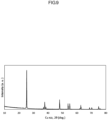
- FIG. 7 shows an X-ray diffraction spectrum derived from the La-Mo-based composite oxide which was obtained from the film layer of Example 1.
- FIG. 8 shows an X-ray diffraction spectrum derived from the La-Mo-based composite oxide which was obtained from the film layer of Example 3. The measurement was performed by powder X-ray diffractometry.
- Measurement device powder X-ray diffractometer (device name "Smart lab” manufactured by Rigaku Corporation)
- FIG. 9 shows an X-ray diffraction spectrum derived from a-TiO 2 which was obtained from the film layer of Comparative example 1.
- an eluted amount of metal ions was measured as follows. A square cut piece having one side of 50 mm was cut out from the obtained film layer, and the cut piece was immersed in 100 ml of ultrapure water in a predetermined container. Subsequently, in a state where the cut piece was immersed in the ultrapure water, the ultrapure water in the container was stirred by a glass rod for one minute, and the container in this state was thereafter left as it was for 24 hours. A supernatant liquid was collected from the container having been left as it was for 24 hours, and used as a measurement sample.
- Log(UD) represents a logarithmic value (average value) of the number of phages for the time of action (six hours) in an unprocessed test product.
- Log(TD) represents a logarithmic value (average value) of the number of phages for the time of action (six hours) in a processed test product. The number of samples for each test product was three.
- the infectivity titer (pfu/sample) was counted.
- the lower limit of detection (definition) in the antiviral performance evaluation was as follows.
- N 0 represents an infectivity titer obtained when zero hours elapsed
- N represents an infectivity titer obtained when t hours elapsed
- the common logarithm of N/N 0 is represented by log(N/N 0 ).
- Time t represents a time of action.
- Table 1 indicates the result (antiviral activity value VD) of the antiviral performance evaluation in Example 3. Also for the film layer of Comparative example 1, the same antiviral performance evaluation was performed.
- Production method Film layer Proportion of rare earth Mo-based composite oxide contained (mass%) Exposed area rate of rare earth Mo-based composite oxide (%) Eluted amount (ppm) Antiviral activity value (after elapse of six hours) Oxide Base Thickness ( ⁇ m) La Ce Mo (+W) Ex. 1 kneaded La 2 Mo 2 O 9 silicone 350 66 20 0.89 1.1 Ex. 2 kneaded La 2 Mo 2 O 9 silicone 350 36 10 0.29 0.59 Ex. 3 fixed to surface La 2 Mo 2 O 9 silicone 350 - 100 5.80 4.3 5.5 Ex.
- Examples 1, 2, 4 to 6, 8, and 9 correspond to Embodiment 1 described above, and Examples 3 and 7 corresponded to Embodiment 2.
- Table 1 the film layer production method corresponding to Embodiment 1 is indicated as “kneaded”, and the film layer production method corresponding to Embodiment 2 is indicated as "fixed to surface”.
- the La-Mo-based composite oxide powder was dispersed at the proportion of 66 mass% in the thermosetting silicone resin serving as the base.
- the thickness of the film layer was 350 ⁇ m, and the exposed area rate of the La-Mo-based composite oxide at the surface of the film layer was 20%.
- the SEM image in FIG. 3 it was confirmed that a large amount of the La-Mo-based composite oxide powder was dotted at the surface of the film layer of Example 1.
- the La-Mo-based composite oxide powder existing at the surface of the film layer was analyzed by XRD, the X-ray diffraction spectrum shown in FIG. 7 indicated that the La-Mo-based composite oxide included La 2 MoO 6 .
- the film layer of Example 1 the eluted amount of lanthanum was 0.89 ppm and the eluted amount of molybdenum was 1.1 ppm. Therefore, the film layer of Example 1 was sufficiently expected to exhibit the antibacterial performance and antiviral performance exerted by the La-Mo-based composite oxide existing at the surface and the like.
- the La-Mo-based composite oxide powder was dispersed at the proportion of 36 mass% in the thermosetting silicone resin serving as the base.
- the thickness of the film layer was 350 ⁇ m, and the exposed area rate of the La-Mo-based composite oxide at the surface of the film layer was 10%.
- SEM image in FIG. 4 it was confirmed that a large amount of the La-Mo-based composite oxide powder was dotted at the surface of the film layer of Example 2 although the amount was slightly less than that of Example 1.
- the X-ray diffraction spectrum obtained from the La-Mo-based composite oxide existing at the surface of the film layer of Example 2 was substantially similar to that of Example 1, and the detailed description thereof is omitted.
- the film layer of Example 2 the eluted amount of lanthanum was 0.29 ppm and the eluted amount of molybdenum was 0.59 ppm. Therefore, the film layer of Example 2 was sufficiently expected to exhibit the antibacterial performance and the antiviral performance exerted by the La-Mo-based composite oxide existing at the surface and the like.
- the film layer of Example 3 had the thickness of 350 ⁇ m (that is, larger than 10 ⁇ m), and the La-Mo-based composite oxide powder was disposed so as to be distant, merely by 10 ⁇ m or less, from the surface on the side on which the La-Mo-based composite oxide powder was disposed.
- the La-Mo-based composite oxide powder existing at the surface of the film layer was analyzed by XRD, it was confirmed from the X-ray diffraction spectrum shown in FIG. 8 that the La-Mo-based composite oxide included La 2 MoO 6 .
- the eluted amount of lanthanum was 5.8 ppm and the eluted amount of molybdenum was 4.3 ppm.
- the film layer of Example 3 was sufficiently expected to exhibit the antibacterial performance and the antiviral performance exerted by the La-Mo-based composite oxide existing at the surface and the like. As indicated in Table 1, the antiviral activity value of the film layer of Example 3 was 5.5, and it was confirmed that the antiviral activity value of Example 3 was more excellent than that of Comparative example 1.
- the La-Mo-based composite oxide powder was dispersed at the proportion of 23 mass% in the thermosetting silicone resin serving as the base.
- the thickness of the film layer was 350 ⁇ m, and the exposed area rate of the La-Mo-based composite oxide at the surface of the film layer was 4.1%.
- SEM image in FIG. 6 it was confirmed that a large amount of the La-Mo-based composite oxide powder was dotted at the surface of the film layer of Example 4 although the amount was less than those of Examples 1 and 2.
- the X-ray diffraction spectrum obtained from the La-Mo-based composite oxide existing at the surface of the film layer of Example 4 was substantially similar to that of Example 1, and the detailed description thereof is omitted.
- the film layer of Example 4 the eluted amount of lanthanum was 0.03 ppm and the eluted amount of molybdenum was 0.26 ppm. Therefore, the film layer of Example 4 was sufficiently expected to exhibit the antibacterial performance and the antiviral performance exerted by the La-Mo-based composite oxide existing at the surface and the like.
- the film layer of Comparative example 1 was sufficiently expected to exhibit the antibacterial performance and the antiviral performance exerted by the La-Mo-based composite oxide existing at the surface and the like.
- the antiviral activity value was 0.6. This was because, since the antiviral performance was evaluated in a dark place, a-TiO 2 as the photocatalyst was not able to function.
- the La-Mo-W-based composite oxide powder was dispersed at the proportion of 66 mass% in the thermosetting silicone resin serving as the base.
- the thickness of the film layer was 350 ⁇ m, and the exposed area rate of the La-Mo-W-based composite oxide at the surface of the film layer was 24%.
- the La-Mo-W-based composite oxide powder existing at the surface of the film layer was analyzed by XRD, it was found from the X-ray diffraction spectrum that the La-Mo-W-based composite oxide included La 2 MoWO 9 .
- the eluted amount of lanthanum was 0.44 ppm and the total of eluted amounts of molybdenum and tungsten was 0.56 ppm.
- the film layer of Example 5 having such a configuration was sufficiently expected to exhibit the antibacterial performance and the antiviral performance exerted by the La-Mo-W-based composite oxide powder existing at the surface and the like.
- the La-Mo-W-based composite oxide powder was dispersed at the proportion of 23 mass% in the thermosetting silicone resin serving as the base.
- the thickness of the film layer was 350 ⁇ m, and the exposed area rate of the La-Mo-W-based composite oxide at the surface of the film layer was 7.3%. It was confirmed that a large amount of the La-Mo-W-based composite oxide powder was dotted at the surface of the film layer of Example 6 although the amount was slightly less than that of Example 5.
- the X-ray diffraction spectrum obtained from the La-Mo-W-based composite oxide existing at the surface of the film layer of Example 6 was substantially similar to that of Example 5, and the detailed description thereof is omitted.
- the film layer of Example 6 the eluted amount of lanthanum was 0.04 ppm and the eluted amount of molybdenum was 0.15 ppm. Therefore, the film layer of Example 6 was sufficiently expected to exhibit the antibacterial performance and the antiviral performance exerted by the La-Mo-W-based composite oxide existing at the surface and the like.
- the La-Mo-W-based composite oxide powder was fixed to the surface of the film-shaped thermosetting silicone resin serving as the base.
- the thickness of the film layer was 350 ⁇ m, and the exposed area rate of the La-Mo-W-based composite oxide at the surface of the film layer was 100%. That is, in Example 7, the La-Mo-W-based composite oxide powder was formed into a thin-layer-like form on one surface of the film-shaped base so as to cover the surface.
- the film layer of Example 7 had the thickness of 350 ⁇ m (that is, larger than 10 ⁇ m), and the La-Mo-W-based composite oxide powder was disposed so as to be distant, merely by 10 ⁇ m or less, from the surface on the side on which the La-Mo-W-based composite oxide powder was disposed.
- the La-Mo-W-based composite oxide powder existing at the surface of the film layer was analyzed by XRD, it was confirmed from the X-ray diffraction spectrum that the La-Mo-W-based composite oxide included La 2 MoWO 9 .
- the film layer of Example 7 the eluted amount of lanthanum was 2.5 ppm and the total of eluted amounts of molybdenum and tungsten was 4.1 ppm. Therefore, the film layer of Example 7 was sufficiently expected to exhibit the antibacterial performance and the antiviral performance exerted by the La-Mo-W-based composite oxide existing at the surface and the like.
- the Ce-Mo-based composite oxide powder was dispersed at the proportion of 66 mass% in the thermosetting silicone resin serving as the base.
- the thickness of the film layer was 350 ⁇ m, and the exposed area rate of the Ce-Mo-based composite oxide at the surface of the film layer was 14%.
- the Ce-Mo-based composite oxide powder existing at the surface of the film layer was analyzed by XRD, it was found from the X-ray diffraction spectrum that the Ce-Mo-based composite oxide included Ce 2 Mo 3 O 13 .
- the eluted amount of cerium was 0.09 ppm and the eluted amount of molybdenum was 1 ppm.
- the film layer of Example 8 having such a configuration was sufficiently expected to exhibit the antibacterial performance and the antiviral performance exerted by the Ce-Mo-based composite oxide powder existing at the surface and the like.
- the Ce-Mo-based composite oxide powder was dispersed at the proportion of 23 mass% in the thermosetting silicone resin serving as the base.
- the thickness of the film layer was 350 ⁇ m, and the exposed area rate of the Ce-Mo-based composite oxide at the surface of the film layer was 9%. It was confirmed that a large amount of the Ce-Mo-based composite oxide powder was dotted at the surface of the film layer of Example 9 although the amount was slightly less than that of Example 8.
- the X-ray diffraction spectrum obtained from the Ce-Mo-based composite oxide existing at the surface of the film layer of Example 9 was substantially similar to that of Example 8, and the detailed description thereof is omitted.
- the eluted amount of cerium was 0.04 ppm and the eluted amount of molybdenum was 0.57 ppm.
- the film layer of Example 9 having such a configuration was sufficiently expected to exhibit the antibacterial performance and the antiviral performance exerted by the Ce-Mo-based composite oxide powder existing at the surface and the like.
- the adhesive film was obtained by stacking an adhesive layer (silicone resin or acrylic resin, thickness: 10 ⁇ m) formed on a release liner, on the film layer of each of Examples 1 to 9.
Landscapes
- Chemical & Material Sciences (AREA)
- Organic Chemistry (AREA)
- Life Sciences & Earth Sciences (AREA)
- Engineering & Computer Science (AREA)
- Chemical Kinetics & Catalysis (AREA)
- Health & Medical Sciences (AREA)
- Manufacturing & Machinery (AREA)
- Inorganic Chemistry (AREA)
- Polymers & Plastics (AREA)
- Medicinal Chemistry (AREA)
- Zoology (AREA)
- Environmental Sciences (AREA)
- Wood Science & Technology (AREA)
- Plant Pathology (AREA)
- Pest Control & Pesticides (AREA)
- Agronomy & Crop Science (AREA)
- Dentistry (AREA)
- General Health & Medical Sciences (AREA)
- Materials Engineering (AREA)
- General Chemical & Material Sciences (AREA)
- Inorganic Compounds Of Heavy Metals (AREA)
- Laminated Bodies (AREA)
Applications Claiming Priority (2)
| Application Number | Priority Date | Filing Date | Title |
|---|---|---|---|
| JP2022076996 | 2022-05-09 | ||
| PCT/JP2023/016093 WO2023218928A1 (fr) | 2022-05-09 | 2023-04-24 | Film adhésif |
Publications (1)
| Publication Number | Publication Date |
|---|---|
| EP4523908A1 true EP4523908A1 (fr) | 2025-03-19 |
Family
ID=88730353
Family Applications (1)
| Application Number | Title | Priority Date | Filing Date |
|---|---|---|---|
| EP23803410.2A Pending EP4523908A1 (fr) | 2022-05-09 | 2023-04-24 | Film adhésif |
Country Status (6)
| Country | Link |
|---|---|
| US (1) | US20250136844A1 (fr) |
| EP (1) | EP4523908A1 (fr) |
| JP (1) | JPWO2023218928A1 (fr) |
| KR (1) | KR20240119107A (fr) |
| CN (1) | CN119095726A (fr) |
| WO (1) | WO2023218928A1 (fr) |
Families Citing this family (1)
| Publication number | Priority date | Publication date | Assignee | Title |
|---|---|---|---|---|
| WO2025126690A1 (fr) * | 2023-12-11 | 2025-06-19 | 日本特殊陶業株式会社 | Matériau antibactérien et antiviral, comprimé cru, corps fritté, article, composition de barbotine et agent de revêtement |
Family Cites Families (12)
| Publication number | Priority date | Publication date | Assignee | Title |
|---|---|---|---|---|
| JPH11192673A (ja) * | 1998-01-05 | 1999-07-21 | Nissha Printing Co Ltd | 抗菌防臭シートとその製造方法 |
| JP2008308645A (ja) * | 2007-06-18 | 2008-12-25 | Sumitomo Electric Ind Ltd | 抗菌性塗料とそれを用いて形成される抗菌性物品、抗菌性フィルムおよび抗菌性テープ |
| JP2016088916A (ja) * | 2014-11-10 | 2016-05-23 | 株式会社Nbcメッシュテック | 抗ウイルス・抗菌性貼付けテープ |
| JP2017047659A (ja) | 2015-09-04 | 2017-03-09 | 昭和電工株式会社 | 抗菌シート |
| EP3825292A4 (fr) * | 2018-07-18 | 2022-04-20 | Tokyo Institute of Technology | Céramique à base d'oxydes complexes, procédé de production associé, et article |
| JP7469153B2 (ja) * | 2020-06-22 | 2024-04-16 | 日本特殊陶業株式会社 | ランタン・モリブデン複合酸化物粉末の製造方法及び焼結体の製造方法 |
| JP7617588B2 (ja) * | 2020-06-22 | 2025-01-20 | 国立大学法人東京科学大学 | ランタン・モリブデン複合酸化物、抗菌性焼結体及び抗ウイルス性焼結体 |
| WO2022050390A1 (fr) * | 2020-09-04 | 2022-03-10 | 凸版印刷株式会社 | Film antiviral, sac d'emballage et joint |
| JP2022043763A (ja) * | 2020-09-04 | 2022-03-16 | 日本特殊陶業株式会社 | スプレー用組成物、及びスプレー製品 |
| JP2022043764A (ja) * | 2020-09-04 | 2022-03-16 | 日本特殊陶業株式会社 | 抗菌・抗ウイルス性膜、抗菌・抗ウイルス性膜の製造方法、及び膜付き製品 |
| KR102405654B1 (ko) * | 2020-10-05 | 2022-06-07 | 주식회사 오지피테크 | 폴리염화비닐계 항균 필름, 이를 위한 마스터 배치 및 항균 필름의 제조 방법 |
| WO2023176781A1 (fr) * | 2022-03-17 | 2023-09-21 | 日本特殊陶業株式会社 | Composition de bouillie et agent de revêtement |
-
2023
- 2023-04-24 EP EP23803410.2A patent/EP4523908A1/fr active Pending
- 2023-04-24 CN CN202380014864.6A patent/CN119095726A/zh active Pending
- 2023-04-24 JP JP2024520357A patent/JPWO2023218928A1/ja active Pending
- 2023-04-24 KR KR1020247022332A patent/KR20240119107A/ko active Pending
- 2023-04-24 WO PCT/JP2023/016093 patent/WO2023218928A1/fr not_active Ceased
- 2023-04-24 US US18/837,217 patent/US20250136844A1/en active Pending
Also Published As
| Publication number | Publication date |
|---|---|
| US20250136844A1 (en) | 2025-05-01 |
| KR20240119107A (ko) | 2024-08-06 |
| JPWO2023218928A1 (fr) | 2023-11-16 |
| CN119095726A (zh) | 2024-12-06 |
| WO2023218928A1 (fr) | 2023-11-16 |
Similar Documents
| Publication | Publication Date | Title |
|---|---|---|
| US11851344B2 (en) | Complex oxide ceramic, method for producing same, and article | |
| JP7469153B2 (ja) | ランタン・モリブデン複合酸化物粉末の製造方法及び焼結体の製造方法 | |
| EP4523908A1 (fr) | Film adhésif | |
| KR101136665B1 (ko) | 복합 유전체 재료 | |
| EP2324914A1 (fr) | Catalyseur et procédé pour la pyrolyse de substances organiques et procédé de fabrication d un tel catalyseur | |
| JP7640621B2 (ja) | 電波吸収体及びコンパウンド | |
| KR102873218B1 (ko) | 란탄·몰리브덴 복합 산화물, 항균성 소결체 및 항바이러스성 소결체 | |
| EP3846185B1 (fr) | Procédé de production de poudre de ferrite hexagonale de type magnétoplumbite et procédé de production d'un absorbeur d'ondes radio | |
| KR102621282B1 (ko) | 전파 흡수체 | |
| EP3846183B1 (fr) | Poudre de ferrite hexagonale de type magnétoplumbite, procédé de production associé et absorbeur d'ondes radio | |
| JP7273953B2 (ja) | 電波吸収体 | |
| CN104658624A (zh) | 辐射屏蔽电子封装材料及其制备方法 | |
| WO2002046120A1 (fr) | Composants optiques ceramiques et procede de fabrication correspondant | |
| KR101410114B1 (ko) | 지르콘산 바륨을 포함하는 재료 및 그 제조 방법 | |
| EP4321494A1 (fr) | Matériau céramique, corps cru, compact fritté et article | |
| WO2024004762A1 (fr) | Céramique d'oxyde composite ce-mo, comprimé à vert, corps fritté et article | |
| EP3932868A1 (fr) | Particules contenant un composé d'acide titanique, procédé de production de particules contenant un composé d'acide titanique, et matériau de frottement | |
| EP4512776A1 (fr) | Particules de niobate, méthode de production de particules de niobate, composition de résine et corps moulé | |
| JP2025092958A (ja) | 複合基材、及び複合基材の製造方法 | |
| US20240158255A1 (en) | Ceramic sintered body, infrared stealth material, and method for manufacturing ceramic sintered body | |
| WO2011112547A2 (fr) | Dispositif rfid comportant un oxyde céramique à base de baryum à faibles pertes |
Legal Events
| Date | Code | Title | Description |
|---|---|---|---|
| STAA | Information on the status of an ep patent application or granted ep patent |
Free format text: STATUS: THE INTERNATIONAL PUBLICATION HAS BEEN MADE |
|
| PUAI | Public reference made under article 153(3) epc to a published international application that has entered the european phase |
Free format text: ORIGINAL CODE: 0009012 |
|
| STAA | Information on the status of an ep patent application or granted ep patent |
Free format text: STATUS: REQUEST FOR EXAMINATION WAS MADE |
|
| 17P | Request for examination filed |
Effective date: 20241104 |
|
| AK | Designated contracting states |
Kind code of ref document: A1 Designated state(s): AL AT BE BG CH CY CZ DE DK EE ES FI FR GB GR HR HU IE IS IT LI LT LU LV MC ME MK MT NL NO PL PT RO RS SE SI SK SM TR |
|
| DAV | Request for validation of the european patent (deleted) | ||
| DAX | Request for extension of the european patent (deleted) |