EP4524254A1 - Sonde fluorescente pour détecter une hydrolase liée à un peptide - Google Patents
Sonde fluorescente pour détecter une hydrolase liée à un peptide Download PDFInfo
- Publication number
- EP4524254A1 EP4524254A1 EP23803610.7A EP23803610A EP4524254A1 EP 4524254 A1 EP4524254 A1 EP 4524254A1 EP 23803610 A EP23803610 A EP 23803610A EP 4524254 A1 EP4524254 A1 EP 4524254A1
- Authority
- EP
- European Patent Office
- Prior art keywords
- group
- fluorescent probe
- compound
- carbon atoms
- substituted
- Prior art date
- Legal status (The legal status is an assumption and is not a legal conclusion. Google has not performed a legal analysis and makes no representation as to the accuracy of the status listed.)
- Pending
Links
Images



Classifications
-
- C—CHEMISTRY; METALLURGY
- C12—BIOCHEMISTRY; BEER; SPIRITS; WINE; VINEGAR; MICROBIOLOGY; ENZYMOLOGY; MUTATION OR GENETIC ENGINEERING
- C12Q—MEASURING OR TESTING PROCESSES INVOLVING ENZYMES, NUCLEIC ACIDS OR MICROORGANISMS; COMPOSITIONS OR TEST PAPERS THEREFOR; PROCESSES OF PREPARING SUCH COMPOSITIONS; CONDITION-RESPONSIVE CONTROL IN MICROBIOLOGICAL OR ENZYMOLOGICAL PROCESSES
- C12Q1/00—Measuring or testing processes involving enzymes, nucleic acids or microorganisms; Compositions therefor; Processes of preparing such compositions
- C12Q1/34—Measuring or testing processes involving enzymes, nucleic acids or microorganisms; Compositions therefor; Processes of preparing such compositions involving hydrolase
- C12Q1/37—Measuring or testing processes involving enzymes, nucleic acids or microorganisms; Compositions therefor; Processes of preparing such compositions involving hydrolase involving peptidase or proteinase
-
- C—CHEMISTRY; METALLURGY
- C09—DYES; PAINTS; POLISHES; NATURAL RESINS; ADHESIVES; COMPOSITIONS NOT OTHERWISE PROVIDED FOR; APPLICATIONS OF MATERIALS NOT OTHERWISE PROVIDED FOR
- C09B—ORGANIC DYES OR CLOSELY-RELATED COMPOUNDS FOR PRODUCING DYES, e.g. PIGMENTS; MORDANTS; LAKES
- C09B11/00—Diaryl- or thriarylmethane dyes
- C09B11/28—Pyronines ; Xanthon, thioxanthon, selenoxanthan, telluroxanthon dyes
-
- C—CHEMISTRY; METALLURGY
- C07—ORGANIC CHEMISTRY
- C07D—HETEROCYCLIC COMPOUNDS
- C07D311/00—Heterocyclic compounds containing six-membered rings having one oxygen atom as the only hetero atom, condensed with other rings
- C07D311/02—Heterocyclic compounds containing six-membered rings having one oxygen atom as the only hetero atom, condensed with other rings ortho- or peri-condensed with carbocyclic rings or ring systems
- C07D311/78—Ring systems having three or more relevant rings
- C07D311/80—Dibenzopyrans; Hydrogenated dibenzopyrans
- C07D311/82—Xanthenes
-
- C—CHEMISTRY; METALLURGY
- C07—ORGANIC CHEMISTRY
- C07D—HETEROCYCLIC COMPOUNDS
- C07D493/00—Heterocyclic compounds containing oxygen atoms as the only ring hetero atoms in the condensed system
- C07D493/02—Heterocyclic compounds containing oxygen atoms as the only ring hetero atoms in the condensed system in which the condensed system contains two hetero rings
- C07D493/10—Spiro-condensed systems
-
- C—CHEMISTRY; METALLURGY
- C07—ORGANIC CHEMISTRY
- C07F—ACYCLIC, CARBOCYCLIC OR HETEROCYCLIC COMPOUNDS CONTAINING ELEMENTS OTHER THAN CARBON, HYDROGEN, HALOGEN, OXYGEN, NITROGEN, SULFUR, SELENIUM OR TELLURIUM
- C07F7/00—Compounds containing elements of Groups 4 or 14 of the Periodic Table
- C07F7/02—Silicon compounds
- C07F7/08—Compounds having one or more C—Si linkages
- C07F7/0803—Compounds with Si-C or Si-Si linkages
- C07F7/081—Compounds with Si-C or Si-Si linkages comprising at least one atom selected from the elements N, O, halogen, S, Se or Te
- C07F7/0812—Compounds with Si-C or Si-Si linkages comprising at least one atom selected from the elements N, O, halogen, S, Se or Te comprising a heterocyclic ring
- C07F7/0816—Compounds with Si-C or Si-Si linkages comprising at least one atom selected from the elements N, O, halogen, S, Se or Te comprising a heterocyclic ring said ring comprising Si as a ring atom
-
- C—CHEMISTRY; METALLURGY
- C09—DYES; PAINTS; POLISHES; NATURAL RESINS; ADHESIVES; COMPOSITIONS NOT OTHERWISE PROVIDED FOR; APPLICATIONS OF MATERIALS NOT OTHERWISE PROVIDED FOR
- C09B—ORGANIC DYES OR CLOSELY-RELATED COMPOUNDS FOR PRODUCING DYES, e.g. PIGMENTS; MORDANTS; LAKES
- C09B11/00—Diaryl- or thriarylmethane dyes
- C09B11/04—Diaryl- or thriarylmethane dyes derived from triarylmethanes, i.e. central C-atom is substituted by amino, cyano, alkyl
- C09B11/10—Amino derivatives of triarylmethanes
- C09B11/24—Phthaleins containing amino groups ; Phthalanes; Fluoranes; Phthalides; Rhodamine dyes; Phthaleins having heterocyclic aryl rings; Lactone or lactame forms of triarylmethane dyes
-
- C—CHEMISTRY; METALLURGY
- C09—DYES; PAINTS; POLISHES; NATURAL RESINS; ADHESIVES; COMPOSITIONS NOT OTHERWISE PROVIDED FOR; APPLICATIONS OF MATERIALS NOT OTHERWISE PROVIDED FOR
- C09K—MATERIALS FOR MISCELLANEOUS APPLICATIONS, NOT PROVIDED FOR ELSEWHERE
- C09K11/00—Luminescent materials, e.g. electroluminescent or chemiluminescent
- C09K11/06—Luminescent materials, e.g. electroluminescent or chemiluminescent containing organic luminescent materials
-
- C—CHEMISTRY; METALLURGY
- C12—BIOCHEMISTRY; BEER; SPIRITS; WINE; VINEGAR; MICROBIOLOGY; ENZYMOLOGY; MUTATION OR GENETIC ENGINEERING
- C12Q—MEASURING OR TESTING PROCESSES INVOLVING ENZYMES, NUCLEIC ACIDS OR MICROORGANISMS; COMPOSITIONS OR TEST PAPERS THEREFOR; PROCESSES OF PREPARING SUCH COMPOSITIONS; CONDITION-RESPONSIVE CONTROL IN MICROBIOLOGICAL OR ENZYMOLOGICAL PROCESSES
- C12Q1/00—Measuring or testing processes involving enzymes, nucleic acids or microorganisms; Compositions therefor; Processes of preparing such compositions
- C12Q1/34—Measuring or testing processes involving enzymes, nucleic acids or microorganisms; Compositions therefor; Processes of preparing such compositions involving hydrolase
-
- C—CHEMISTRY; METALLURGY
- C12—BIOCHEMISTRY; BEER; SPIRITS; WINE; VINEGAR; MICROBIOLOGY; ENZYMOLOGY; MUTATION OR GENETIC ENGINEERING
- C12Q—MEASURING OR TESTING PROCESSES INVOLVING ENZYMES, NUCLEIC ACIDS OR MICROORGANISMS; COMPOSITIONS OR TEST PAPERS THEREFOR; PROCESSES OF PREPARING SUCH COMPOSITIONS; CONDITION-RESPONSIVE CONTROL IN MICROBIOLOGICAL OR ENZYMOLOGICAL PROCESSES
- C12Q1/00—Measuring or testing processes involving enzymes, nucleic acids or microorganisms; Compositions therefor; Processes of preparing such compositions
- C12Q1/34—Measuring or testing processes involving enzymes, nucleic acids or microorganisms; Compositions therefor; Processes of preparing such compositions involving hydrolase
- C12Q1/44—Measuring or testing processes involving enzymes, nucleic acids or microorganisms; Compositions therefor; Processes of preparing such compositions involving hydrolase involving esterase
-
- C—CHEMISTRY; METALLURGY
- C12—BIOCHEMISTRY; BEER; SPIRITS; WINE; VINEGAR; MICROBIOLOGY; ENZYMOLOGY; MUTATION OR GENETIC ENGINEERING
- C12Y—ENZYMES
- C12Y304/00—Hydrolases acting on peptide bonds, i.e. peptidases (3.4)
- C12Y304/11—Aminopeptidases (3.4.11)
- C12Y304/11002—Membrane alanyl aminopeptidase (3.4.11.2), i.e. aminopeptidase N
-
- C—CHEMISTRY; METALLURGY
- C12—BIOCHEMISTRY; BEER; SPIRITS; WINE; VINEGAR; MICROBIOLOGY; ENZYMOLOGY; MUTATION OR GENETIC ENGINEERING
- C12Y—ENZYMES
- C12Y304/00—Hydrolases acting on peptide bonds, i.e. peptidases (3.4)
- C12Y304/14—Dipeptidyl-peptidases and tripeptidyl-peptidases (3.4.14)
- C12Y304/14005—Dipeptidyl-peptidase IV (3.4.14.5)
-
- G—PHYSICS
- G01—MEASURING; TESTING
- G01N—INVESTIGATING OR ANALYSING MATERIALS BY DETERMINING THEIR CHEMICAL OR PHYSICAL PROPERTIES
- G01N21/00—Investigating or analysing materials by the use of optical means, i.e. using sub-millimetre waves, infrared, visible or ultraviolet light
- G01N21/62—Systems in which the material investigated is excited whereby it emits light or causes a change in wavelength of the incident light
- G01N21/63—Systems in which the material investigated is excited whereby it emits light or causes a change in wavelength of the incident light optically excited
- G01N21/64—Fluorescence; Phosphorescence
- G01N21/6428—Measuring fluorescence of fluorescent products of reactions or of fluorochrome labelled reactive substances, e.g. measuring quenching effects, using measuring "optrodes"
-
- G—PHYSICS
- G01—MEASURING; TESTING
- G01N—INVESTIGATING OR ANALYSING MATERIALS BY DETERMINING THEIR CHEMICAL OR PHYSICAL PROPERTIES
- G01N33/00—Investigating or analysing materials by specific methods not covered by groups G01N1/00 - G01N31/00
- G01N33/48—Biological material, e.g. blood, urine; Haemocytometers
- G01N33/50—Chemical analysis of biological material, e.g. blood, urine; Testing involving biospecific ligand binding methods; Immunological testing
- G01N33/52—Use of compounds or compositions for colorimetric, spectrophotometric or fluorometric investigation, e.g. use of reagent paper and including single- and multilayer analytical elements
-
- G—PHYSICS
- G01—MEASURING; TESTING
- G01N—INVESTIGATING OR ANALYSING MATERIALS BY DETERMINING THEIR CHEMICAL OR PHYSICAL PROPERTIES
- G01N33/00—Investigating or analysing materials by specific methods not covered by groups G01N1/00 - G01N31/00
- G01N33/48—Biological material, e.g. blood, urine; Haemocytometers
- G01N33/50—Chemical analysis of biological material, e.g. blood, urine; Testing involving biospecific ligand binding methods; Immunological testing
- G01N33/53—Immunoassay; Biospecific binding assay; Materials therefor
- G01N33/536—Immunoassay; Biospecific binding assay; Materials therefor with immune complex formed in liquid phase
- G01N33/542—Immunoassay; Biospecific binding assay; Materials therefor with immune complex formed in liquid phase with steric inhibition or signal modification, e.g. fluorescent quenching
-
- G—PHYSICS
- G01—MEASURING; TESTING
- G01N—INVESTIGATING OR ANALYSING MATERIALS BY DETERMINING THEIR CHEMICAL OR PHYSICAL PROPERTIES
- G01N33/00—Investigating or analysing materials by specific methods not covered by groups G01N1/00 - G01N31/00
- G01N33/48—Biological material, e.g. blood, urine; Haemocytometers
- G01N33/50—Chemical analysis of biological material, e.g. blood, urine; Testing involving biospecific ligand binding methods; Immunological testing
- G01N33/58—Chemical analysis of biological material, e.g. blood, urine; Testing involving biospecific ligand binding methods; Immunological testing involving labelled substances
- G01N33/582—Chemical analysis of biological material, e.g. blood, urine; Testing involving biospecific ligand binding methods; Immunological testing involving labelled substances with fluorescent label
-
- C—CHEMISTRY; METALLURGY
- C09—DYES; PAINTS; POLISHES; NATURAL RESINS; ADHESIVES; COMPOSITIONS NOT OTHERWISE PROVIDED FOR; APPLICATIONS OF MATERIALS NOT OTHERWISE PROVIDED FOR
- C09K—MATERIALS FOR MISCELLANEOUS APPLICATIONS, NOT PROVIDED FOR ELSEWHERE
- C09K2211/00—Chemical nature of organic luminescent or tenebrescent compounds
- C09K2211/10—Non-macromolecular compounds
- C09K2211/1003—Carbocyclic compounds
- C09K2211/1007—Non-condensed systems
-
- C—CHEMISTRY; METALLURGY
- C09—DYES; PAINTS; POLISHES; NATURAL RESINS; ADHESIVES; COMPOSITIONS NOT OTHERWISE PROVIDED FOR; APPLICATIONS OF MATERIALS NOT OTHERWISE PROVIDED FOR
- C09K—MATERIALS FOR MISCELLANEOUS APPLICATIONS, NOT PROVIDED FOR ELSEWHERE
- C09K2211/00—Chemical nature of organic luminescent or tenebrescent compounds
- C09K2211/10—Non-macromolecular compounds
- C09K2211/1003—Carbocyclic compounds
- C09K2211/1014—Carbocyclic compounds bridged by heteroatoms, e.g. N, P, Si or B
-
- C—CHEMISTRY; METALLURGY
- C09—DYES; PAINTS; POLISHES; NATURAL RESINS; ADHESIVES; COMPOSITIONS NOT OTHERWISE PROVIDED FOR; APPLICATIONS OF MATERIALS NOT OTHERWISE PROVIDED FOR
- C09K—MATERIALS FOR MISCELLANEOUS APPLICATIONS, NOT PROVIDED FOR ELSEWHERE
- C09K2211/00—Chemical nature of organic luminescent or tenebrescent compounds
- C09K2211/10—Non-macromolecular compounds
- C09K2211/1018—Heterocyclic compounds
-
- C—CHEMISTRY; METALLURGY
- C09—DYES; PAINTS; POLISHES; NATURAL RESINS; ADHESIVES; COMPOSITIONS NOT OTHERWISE PROVIDED FOR; APPLICATIONS OF MATERIALS NOT OTHERWISE PROVIDED FOR
- C09K—MATERIALS FOR MISCELLANEOUS APPLICATIONS, NOT PROVIDED FOR ELSEWHERE
- C09K2211/00—Chemical nature of organic luminescent or tenebrescent compounds
- C09K2211/10—Non-macromolecular compounds
- C09K2211/1018—Heterocyclic compounds
- C09K2211/1022—Heterocyclic compounds bridged by heteroatoms, e.g. N, P, Si or B
-
- G—PHYSICS
- G01—MEASURING; TESTING
- G01N—INVESTIGATING OR ANALYSING MATERIALS BY DETERMINING THEIR CHEMICAL OR PHYSICAL PROPERTIES
- G01N21/00—Investigating or analysing materials by the use of optical means, i.e. using sub-millimetre waves, infrared, visible or ultraviolet light
- G01N21/62—Systems in which the material investigated is excited whereby it emits light or causes a change in wavelength of the incident light
- G01N21/63—Systems in which the material investigated is excited whereby it emits light or causes a change in wavelength of the incident light optically excited
- G01N21/64—Fluorescence; Phosphorescence
- G01N21/6428—Measuring fluorescence of fluorescent products of reactions or of fluorochrome labelled reactive substances, e.g. measuring quenching effects, using measuring "optrodes"
- G01N2021/6439—Measuring fluorescence of fluorescent products of reactions or of fluorochrome labelled reactive substances, e.g. measuring quenching effects, using measuring "optrodes" with indicators, stains, dyes, tags, labels, marks
-
- G—PHYSICS
- G01—MEASURING; TESTING
- G01N—INVESTIGATING OR ANALYSING MATERIALS BY DETERMINING THEIR CHEMICAL OR PHYSICAL PROPERTIES
- G01N2333/00—Assays involving biological materials from specific organisms or of a specific nature
- G01N2333/90—Enzymes; Proenzymes
- G01N2333/914—Hydrolases (3)
- G01N2333/948—Hydrolases (3) acting on peptide bonds (3.4)
-
- G—PHYSICS
- G01—MEASURING; TESTING
- G01N—INVESTIGATING OR ANALYSING MATERIALS BY DETERMINING THEIR CHEMICAL OR PHYSICAL PROPERTIES
- G01N2800/00—Detection or diagnosis of diseases
- G01N2800/70—Mechanisms involved in disease identification
- G01N2800/7023—(Hyper)proliferation
- G01N2800/7028—Cancer
Definitions
- the present invention relates to a fluorescent probe for detecting a peptide bond hydrolase.
- An enzyme activity detection method at a single enzyme level using a microdevice has been widely used for the purpose of clarifying individual biochemical parameters of an enzyme, detecting the presence of a specific protein with high sensitivity using the individual biochemical parameters as a reporter protein, and the like.
- the research group of the present inventors has hitherto performed profiling based on detection and activity of an enzyme in blood at a single molecule level using a group of microdevice-compatible enzyme fluorescent probes for activity detection, and found new relevance to a disease.
- the enzyme activity detection method at a single enzyme level using a microdevice by sufficiently diluting a biological sample and adding the biological sample to the microdevice, a state in which one molecule or less of enzyme is present in one well can be created, and so-called multicolor analysis in which fluorescent probes of a plurality of colors having different reactivity between enzymes are simultaneously reacted, fluorescence increases at a plurality of wavelengths in each well are measured, and the enzyme in the well is specified from a combination thereof is theoretically possible.
- a probe emitting red fluorescence (red fluorescent probe) or a probe emitting green fluorescence (green fluorescent probe) that can be practically used has not been found yet.
- An object of the present invention is to provide a fluorescent probe that can be used in an enzyme activity detection method.
- a fluorescent probe that can also be used in an enzyme activity detection method using a microdevice can be provided by introducing a specific water-soluble substituent into a compound having a rhodamine skeleton and further setting a LogP value of the compound to a specific range, thereby completing the present invention.
- the present invention it is possible to provide a red fluorescent probe and a green fluorescent probe that can be used in an enzyme activity detection method, and the present invention is particularly advantageous in that these fluorescent probes can be used in an enzyme activity detection method using a microdevice.
- the fluorescent probe of the present invention can be effectively used for detection of pancreatic cancer or the like.
- the fluorescent probe of the present invention for example, by using the fluorescent probe of the present invention, it is possible to provide a method for diagnosing pancreatic cancer by detecting single-molecule enzyme activity of DPP4 in blood and detecting single-molecule enzyme activity of CD13 in blood.
- halogen atom means a fluorine atom, a chlorine atom, a bromine atom, or an iodine atom.
- alkyl may be any aliphatic hydrocarbon group that is linear, branched, cyclic, or in a combination thereof.
- the number of carbon atoms in the alkyl group is not particularly limited, but is, for example, 1 to 4 (C 1-4 ), 1 to 6 (C 1-6 ), 1 to 10 (C 1-10 ), 1 to 15 (C 1-15 ), or 1 to 20 (C 1-20 ).
- the number of carbon atoms is specified, it means an “alkyl” having the number of carbon atoms within that numerical range.
- C 1-8 alkyls include methyl, ethyl, n-propyl, isopropyl, n-butyl, isobutyl, sec-butyl, tert-butyl, n-pentyl, isopentyl, neo-pentyl, n-hexyl, isohexyl, n-heptyl, n-octyl, and the like.
- an alkyl group may have one or more optional substituents.
- substituents include, but are not limited to, an alkoxy group, a halogen atom, an amino group, a mono- or di-substituted amino group, a substituted silyl group, and acyl.
- an alkyl group has two or more substituents, they may be the same as or different from each other.
- the alkyl moiety of other substituents for example, an alkoxy group, an arylalkyl group, or the like including an alkyl moiety.
- substituents include, but are not limited to, an alkyl group, an alkoxy group, a hydroxyl group, a carboxyl group, a halogen atom, a sulfo group, an amino group, an alkoxycarbonyl group, and an oxo group.
- substituents include, but are not limited to, an alkyl halide group and a dialkylamino group.
- aryl may be either a monocyclic aromatic hydrocarbon group or a condensed polycyclic aromatic hydrocarbon group, and may be an aromatic heterocyclic ring containing one or more heteroatoms (such as an oxygen atom, a nitrogen atom, or a sulfur atom) as ring forming atoms.
- the aromatic heterocyclic ring may also be referred to as “heteroaryl” or “heteroaromatic”.
- the aryl may be attached at all possible positions, whether it is a monocyclic ring or a condensed ring.
- Non-limiting examples of the monocyclic aryl include a phenyl group (Ph), a thienyl group (2- or 3-thienyl group), a pyridyl group, a furyl group, a thiazolyl group, an oxazolyl group, a pyrazolyl group, a 2-pyrazinyl group, a pyrimidinyl group, a pyrrolyl group, an imidazolyl group, a pyridazinyl group, a 3-isothiazolyl group, a 3-isoxazolyl group, a 1,2,4-oxadiazole-5-yl group, and a 1,2,4-oxadiazole-3-yl group.
- Non-limiting examples of the condensed polycyclic aryl include a 1-naphthyl group, a 2-naphthyl group, 1-indenyl group, 2-indenyl group, a 2,3-dihydroindene-1-yl group, a 2,3-dihydroindene-2-yl group, a 2-anthryl group, an indazolyl group, a quinolyl group, an isoquinolyl group, a 1,2-dihydroisoquinolyl group, a 1,2,3,4-tetrahydroisoquinolyl group, an indolyl group, an isoindolyl group, a phthalazinyl group, a quinoxalinyl group, a benzofuranyl group, a 2,3-dihydrobenzofuran-1-yl group, a 2,3-dihydrobenzofuran-2-yl group, a 2,3-dihydrobenzothioph
- an aryl group may have one or more optional substituents on the ring thereof.
- substituents include, but are not limited to, an alkoxy group, a halogen atom, an amino group, a mono- or di-substituted amino group, a substituted silyl group, and acyl.
- an aryl group has two or more substituents, they may be the same as or different from each other.
- the aryl moiety of other substituents for example, an aryloxy group, an arylalkyl group, or the like
- substituents for example, an aryloxy group, an arylalkyl group, or the like
- alkoxy group is a structure in which the above alkyl group is bonded to an oxygen atom, and examples thereof include saturated alkoxy group that is linear, branched, cyclic, or in a combination thereof.
- Preferred examples thereof include a methoxy group, an ethoxy group, a n-propoxy group, an isopropoxy group, a cyclopropoxy group, a n-butoxy group, an isobutoxy group, a s-butoxy group, a t-butoxy group, a cyclobutoxy group, a cyclopropylmethoxy group, a n-pentyloxy group, a cyclopentyloxy group, a cyclopropylethyloxy group, a cyclobutylmethyloxy group, a n-hexyloxy group, a cyclohexyloxy group, a cyclopropylpropyloxy group, a cyclobutyle
- alkylene is a divalent group composed of a linear or branched saturated hydrocarbon, and examples thereof include methylene, 1-methylmethylene, 1,1-dimethylmethylene, ethylene, 1-methylethylene, 1-ethylethylene, 1,1-dimethylethylene, 1,2-dimethylethylene, 1,1-diethylethylene, 1,2-diethylethylene, 1-ethyl-2-methylethylene, trimethylene, 1-methyltrimethylene, 2-methyltrimethylene, 1,1-dimethyltrimethylene, 1,2-dimethyltrimethylene, 2,2-dimethyltrimethylene, 1-ethyltrimethylene, 2-ethyltrimethylene, 1,1-diethyltrimethylene, 1,2-diethyltrimethylene, 2,2-diethyltrimethylene, 2-ethyl-2-methyltrimethylene, tetramethylene, 1-methyltetramethylene, 2-methyltetramethylene, 1,1-dimethyltetramethylene, 1,2-dimethyltetramethylene, 1,2-di
- a fluorescent probe for detecting a hydrolase the fluorescent probe containing a compound represented by General Formula (II) below or a salt thereof.
- One mode of the present invention is a fluorescent probe for detecting a hydrolase, the fluorescent probe containing a compound represented by General Formula (I) below or a salt thereof.
- the compound satisfying the above-described requirements, or a salt thereof is also referred to as the "compound of the present invention”
- the fluorescent probe containing the compound of the present invention is also referred to as the "fluorescent probe of the present invention”.
- the compound of the present invention can be specified by a MiLogP value or a LogP value which is an index of lipophilicity.
- the MiLogP value of the compound of the present invention can be set to 2.56 or less, or less than 2.47, and is preferably 2.40 or less, 2.30 or less, 2.20 or less, 2.10 or less, 2.00 or less, 1.90 or less, 1.80 or less, 1.70 or less, or 1.64 or less, and more preferably 1.60 or less, 1.50 or less, 1.40 or less, 1.34 or less, 1.30 or less, 1.22 or less, 1.20 or less, 1.10 or less, or 1.00 or less (particularly preferably 0 or less).
- the lower limit value of the MiLogP value of the compound of the present invention is not particularly specified, but is, for example, about -3.1 or more.
- the MiLogP value can be set to 2.40 or less, 2.30 or less, 2.20 or less, 2.10 or less, 2.00 or less, 1.90 or less, 1.80 or less, or 1.70 or less, preferably 1.60 or less, 1.50 or less, 1.40 or less, 1.30 or less, 1.20 or less, 1.10 or less, or 1.00 or less (more preferably 0 or less), and the lower limit value of the MiLogP value can be set to, for example, about -3.1 or more.
- the MiLogP value can be set to 2.56 or less, 2.50 or less, 2.40 or less, 2.30 or less, 2.20 or less, 2.10 or less, 2.00 or less, 1.90 or less, 1.80 or less, 1.70 or less, or 1.64 or less, preferably 1.60 or less, 1.50 or less, 1.40 or less, 1.34 or less, 1.30 or less, 1.22 or less, 1.20 or less, or 1.10 or less (more preferably 1.00 or less), and the lower limit value of the MiLogP value can be set to, for example, about - 3.1 or more or 0 or more.
- the MiLogP value of the enzymolysate of the compound of the present invention can also be specified in the same manner as described above.
- the enzymolysate of the compound of the present invention may have, for example, a structure of Formula (III), and the structure of Formula (III) includes a structure of a fluorescent mother nucleus.
- the LogP value of the compound of the present invention can be set to less than 1.17, 1.16 or less, 1.15 or less, 1.14 or less, 1.13 or less, 1.12 or less, 1.11 or less, or 1.10 or less, and is preferably 1.09 or less, 1.08 or less, 1.07 or less, 1.06 or less, 1.05 or less, 1.04 or less, 1.03 or less, or 1.02 or less, and more preferably 1.01 or less, 1.0 or less, 0.9 or less, 0.8 or less, 0.7 or less, 0.6 or less, or 0.5 or less (particularly preferably 0.46 or less or 0.42 or less).
- the lower limit value of the LogP value of the compound of the present invention is not particularly specified, and the smaller the lower limit value, the higher the water solubility, but is, for example, about -3 or more.
- the LogP value of the enzymolysate of the compound of the present invention can also be specified in the same manner as described above.
- the enzymolysate of the compound of the present invention may have, for example, a structure of Formula (III), and the structure of Formula (III) includes a structure of a fluorescent mother nucleus.
- the fluorescent probe of the present invention can be preferably used as a fluorescent probe for a microdevice.
- the compound of the present invention it is important to essentially have at least one water-soluble substituent selected from the group consisting of a carboxyl group (-CO 2 H), a phosphate group (-PO 3 H 2 ), and a sulfonate group (-SO 3 H).
- the mother nucleus is limited to a xanthene skeleton, and a rhodamine skeleton having higher lipophilicity than the xanthene skeleton has not been studied.
- rhodamine and Si rhodamine have high lipophilicity
- a fluorescent probe using these compounds for example, an OFF-ON type fluorescent probe emitting fluorescence by reacting with a target enzyme
- a microdevice such as a multi-well chamber type microdevice
- leakage of the fluorescent probe from an aqueous solution in a well of the device into an organic solvent used for sealing outside the device more easily occurs when the device is enclosed, and it has been considered that rhodamine and Si rhodamine are not suitable for measurement requiring high quantitativity and sensitivity.
- the water solubility of the enzyme recognition site is high (such as a phosphate ester), but in many of the fluorescent probes for detection of enzymes and the like that hydrolyze peptide bonds, glycoside bonds, and the like that are intended by the invention of the present application, the lipophilicity of the enzyme recognition site is high (such as a peptide), so that leakage of the fluorescent probe into an organic solvent becomes more problematic.
- the present inventors have found that the above problems can be solved by introducing a specific water-soluble substituent into the molecular skeleton of rhodamine, Si-based rhodamine, or the like in the fluorescent probe of the present invention.
- the present inventors have also found that by introducing a specific water-soluble substituent into the molecular skeleton of rhodamine and setting a MiLogP value and/or a LogP value, which is an index of lipophilicity as the compound molecule, within a specific range, excellent applicability to a microdevice is achieved.
- a specific water-soluble substituent into the molecular skeleton of rhodamine and setting a MiLogP value and/or a LogP value, which is an index of lipophilicity as the compound molecule, within a specific range, excellent applicability to a microdevice is achieved.
- a fluorescent probe having a rhodamine skeleton it has become possible to provide a fluorescent probe that
- a fluorescent probe for detecting a hydrolase for a microdevice the fluorescent probe containing a compound having at least one water-soluble substituent selected from the group consisting of -CO 2 H, -PO 3 H 2 , and -SO 3 H and represented by General Formula (II), or a salt thereof, in which a MiLogP value is less than 2.47 and/or a LogP value is 1.09 or less.
- a fluorescent probe for detecting a hydrolase for a microdevice the fluorescent probe containing a compound having at least one water-soluble substituent selected from the group consisting of -CO 2 H, -PO 3 H 2 , and -SO 3 H and represented by General Formula (I), or a salt thereof, in which a MiLogP value is less than 2.47 and/or a LogP value is 1.09 or less.
- the ring A is an aromatic ring which is phenyl (benzene ring) or a 5- or 6-membered heteroaryl.
- the 5- or 6-membered heteroaryl is an aromatic heterocyclic ring containing one to three heteroatoms such as oxygen, nitrogen, and sulfur, and examples thereof include, but are not limited to, pyrrole, furan, thiophene, imidazole, pyrazole, triazole, pyridine, pyran, thiopyran, pyrazine, pyrimidine, pyridazine, 1,2-dioxine, 1,4-dioxine, 1,2-dithiine, 1,4-dithiine, and triazine.
- the aromatic ring is preferably phenyl (benzene ring), pyrrole, thiophene, furan, or pyridine.
- R 1 is bonded to a carbon atom on an X atom-containing ring structure to which ring A is directly bonded to form a spiro ring, a bond - - - as 1 and a bond - - - as 2 represent a single bond, and Q1 represents a ring structure of Formula (i), or a bond - - - as 1 represents a double bond, a bond - - - as 2 represents a single bond, and Q1 represents a ring structure of Formula (ii).
- the "X atom-containing ring structure” is a xanthene ring when X is an oxygen atom, but in the present invention, the "xanthene skeleton" is used to mean that X also includes a ring structure other than an oxygen atom.
- R is selected from the group consisting of - CO 2 H, -PO 3 H 2 , -SO 3 H, -L-CO 2 H, -L-PO 3 H 2 , and -L-SO 3 H.
- L represents a linker. That is, in the compounds represented by General Formulas (I) and (II) or salts thereof, the water-soluble substituent selected from the group consisting of -CO 2 H, -PO 3 H 2 , and -SO 3 H may be bonded to the aromatic ring directly or through a linker.
- the linker of L is selected from the group consisting of an alkyl group having 1 to 10 carbon atoms, preferably 1 to 6 carbon atoms, which may have a substituent (provided that, one or more of -CH 2 - of the alkyl group may be substituted by -O-, -S-, - NH-, or -CO-), an aryl group (including a heteroaryl group), a cycloalkyl group, an alkenyl group having 1 to 10 carbon atoms, preferably 1 to 6 carbon atoms, an alkoxy group having 1 to 10 carbon atoms, preferably 1 to 6 carbon atoms, an alkoxycarbonyl group (-CO-OR'), an alkylamino group (-NHR', -NR' 2 ), an ester group (-O-CO-R'), an amide group (-NHCOR', -CONHR', -CONR' 2 ), a polyethylene glycol chain, and a group formed by optionally
- an amide can be suitably used from the viewpoint of ease of synthesis, but any of the above can be used from the viewpoint of physical properties of the fluorescent probe, and preferably, an alkyl group having 1 to 6 carbon atoms which may have a substituent, an amide group (more preferably -CONHR' or -CONR' 2 ), or a phenyl group can be used.
- R is preferably -CO 2 H, -SO 3 H, -L-CO 2 H, or -L-SO 3 H, and R is more preferably -SO 3 H or -L-SO 3 H.
- n is an integer of 0 to 5.
- the water-soluble substituent can be introduced into the aromatic ring directly or through a linker.
- n is 1 to 5, more preferably 1 to 3.
- the water-soluble substituent is introduced only into the aromatic ring directly or through a linker, and n is 1 to 3 or 1 to 2.
- R When n is 2 or more, R may be the same or different.
- R 1 represents a monovalent substituent optionally present on the aromatic ring. When there are two or more monovalent substituents, they may be the same or different.
- the fact that R 1 is optionally present on the aromatic ring means that both a case where R 1 is present on the aromatic ring and a case where R 1 is not present on the aromatic ring are included.
- the type of the monovalent substituent represented by R 1 is not particularly limited, and for example, is preferably selected from the group consisting of an alkyl group having 1 to 6 carbon atoms, an alkenyl group having 1 to 6 carbon atoms, an alkynyl group having 1 to 6 carbon atoms, an alkoxy group having 1 to 6 carbon atoms, a hydroxyl group, an alkoxycarbonyl group, a halogen atom, and an amino group.
- These monovalent substituents may further have one or two or more arbitrary substituents.
- one or two or more halogen atoms, hydroxyl groups, amino groups, alkoxy groups, and the like may exist in the alkyl group represented by R 1 , and for example, the alkyl group represented by R 1 may be a halogenated alkyl group, a hydroxyalkyl group, an aminoalkyl group, or the like.
- the monovalent substituent represented by R 1 is introduced into the aromatic ring separately from R (selected from the group consisting of -CO 2 H, -PO 3 H 2 , -SO 3 H, - L-CO 2 H, -L-PO 3 H 2 , and -L-SO 3 H) described above, when n is 0, R 1 may or may not be present, and when n is 1 or more, R 1 may or may not be present.
- the aromatic ring is a phenyl group (benzene ring)
- n 1
- the monovalent substituent can be present on one to four benzene rings
- n 2
- the monovalent substituent can be present on one to three benzene rings.
- R 1 together with a carbon atom on the ring A to which R 1 is bonded, a carbon atom (spiro atom) on the X atom-containing ring structure to which the ring A is bonded, and a part of the ring A, may form a 5- or 6-membered carbocyclic or heterocyclic ring (spiro ring).
- R 1 is absent or an alkyl group having 1 to 6 carbon atoms, preferably a methyl group or an ethyl group.
- R 1 one alkyl group having 1 to 6 carbon atoms, preferably, methyl group, is present on the aromatic ring.
- the alkyl group having 1 to 6 carbon atoms, preferably methyl group is preferably bonded to the 2-position of the aromatic ring (the para-position when the aromatic ring is a benzene ring) with respect to the position where the alkyl group is bonded to the xanthene ring.
- R 2 and R 3 each independently represent a hydrogen atom, a substituted or unsubstituted alkyl group having 1 to 6 carbon atoms, a halogen atom, the water-soluble substituent, or an alkyl group having the water-soluble substituent and having 1 to 6 carbon atoms.
- R 2 and R 3 are each independently a hydrogen atom or a halogen atom, and more preferably, both R 2 and R 3 are a hydrogen atom.
- R 2 and R 3 are each independently a hydrogen atom, a water-soluble substituent selected from -CO 2 H, -PO 3 H 2 , or -SO 3 H, or an alkyl group having the water-soluble substituent and having 1 to 6 carbon atoms.
- R 4 and R 5 each independently represent a hydrogen atom, a substituted or unsubstituted alkyl group having 1 to 6 carbon atoms, a halogen atom, the water-soluble substituent, or an alkyl group having the water-soluble substituent and having 1 to 6 carbon atoms, and the details thereof are the same as those described for R 2 and R 3 .
- R 4 and R 5 are each independently a hydrogen atom or a halogen atom, and more preferably, both R 4 and R 5 are a hydrogen atom.
- R 4 and R 5 are each independently a hydrogen atom, a water-soluble substituent selected from -CO 2 H, -PO 3 H 2 , or -SO 3 H, or an alkyl group having the water-soluble substituent and having 1 to 6 carbon atoms.
- R 6 and R 7 are each independently a hydrogen atom, a substituted or unsubstituted alkyl group having 1 to 6 carbon atoms, a halogen atom, the water-soluble substituent, or an alkyl group having the water-soluble substituent and having 1 to 6 carbon atoms, and the details thereof are the same as those described for R 2 and R 3 .
- R 6 and R 7 are each independently a hydrogen atom or a halogen atom, and more preferably, both R 4 and R 5 are a hydrogen atom.
- R 6 and R 7 are each independently a hydrogen atom, a water-soluble substituent selected from -CO 2 H, -PO 3 H 2 , or -SO 3 H, or an alkyl group having the water-soluble substituent and having 1 to 6 carbon atoms.
- R 8 and R 9 are each independently a hydrogen atom, a substituted or unsubstituted alkyl group having 1 to 6 carbon atoms, a substituted or unsubstituted alkenyl group having 1 to 6 carbon atoms, or an alkyl group having the water-soluble substituent and having 1 to 10 carbon atoms, preferably 1 to 6 carbon atoms (this alkyl group may be substituted with an aryl group, and the aryl group may be substituted with the water-soluble substituent) or an alkenyl group having the water-soluble substituent and having 1 to 10 carbon atoms, preferably 1 to 6 carbon atoms (this alkenyl group may be substituted with an aryl group, and the aryl group may be substituted with the water-soluble substituent).
- R 8 and R 9 may together form a 4- to 7-membered heterocyclyl containing a nitrogen atom to which R 8 and R 9 are attached.
- R 8 or R 9 , or both of R 8 and R 9 , together with R 5 or R 7 each may form a 5- to 7-membered heterocyclyl or heteroaryl containing a nitrogen atom to which R 8 or R 9 is attached, and further, the heterocyclyl or heteroaryl may have a substituent selected from the group consisting of alkyl having 1 to 6 carbon atoms, alkenyl having 2 to 6 carbon atoms, alkynyl having 2 to 6 carbon atoms, an aralkyl group having 6 to 10 carbon atoms, and an alkyl-substituted alkenyl group having 6 to 10 carbon atoms.
- one to three additional heteroatoms selected from the group consisting of an oxygen atom, a nitrogen atom, and a sulfur atom may be contained.
- the water-soluble substituent may be bonded to these heterocyclyl and heteroaryl directly or through the substituent.
- both R 8 and R 9 are a hydrogen atom.
- R 11 is a hydrogen atom, a substituted or unsubstituted alkyl group having 1 to 6 carbon atoms, a substituted or unsubstituted alkenyl group having 1 to 6 carbon atoms, an alkyl group having the water-soluble substituent and having 1 to 10 carbon atoms, preferably 1 to 6 carbon atoms (this alkyl group may be substituted with an aryl group, and the aryl group may be substituted with the water-soluble substituent), or an alkenyl group having the water-soluble substituent and having 1 to 10 carbon atoms, preferably 1 to 6 carbon atoms (this alkenyl group may be substituted with an aryl group, and the aryl group may be substituted with the water-soluble substituent).
- R a and R b are each independently a substituted or unsubstituted alkyl group having 1 to 6 carbon atoms or a substituted or unsubstituted aryl group.
- R a and R b are each independently preferably an alkyl group having 1 to 3 carbon atoms, and more preferably, both R a and R b are a methyl group.
- One or two or more halogen atoms, hydroxyl groups, amino groups, alkoxy groups, and the like may exist in the alkyl groups represented by R a and R b , and for example, the alkyl groups may be a halogenated alkyl group, a hydroxyalkyl group, or the like.
- R a and/or R b is an aryl group
- the aryl group may be either a monocyclic aromatic group or a fused aromatic group, and the aryl ring may contain one or two or more ring-constituting heteroatoms (for example, a nitrogen atom, an oxygen atom, a sulfur atom, or the like).
- the aryl group is preferably a phenyl group.
- One or two or more substituents may be present on the aryl ring.
- the substituent for example, one or two or more halogen atoms, hydroxyl groups, amino groups, alkoxy groups, and the like may be present.
- the alkyl group and the aryl group defined as R a and R b may be substituted with a water-soluble substituent selected from -CO 2 H, -PO 3 H 2 , or -SO 3 H.
- R c is a substituted or unsubstituted alkyl group having 1 to 6 carbon atoms or a substituted or unsubstituted phenyl group.
- the alkyl group or phenyl group defined as R c may be substituted with the water-soluble substituent.
- R d is a substituted or unsubstituted aryl group, which is the same or different.
- the aryl group defined as R d may be substituted with the water-soluble substituent.
- X is an oxygen atom or Si(R a )(R b ).
- R 0 and R 10 are each independently selected from a partial structure of an amino acid, a partial structure of a carboxylic acid, T-O-, or a saturated or unsaturated 5- or 6-membered carbocyclic or heterocyclic group.
- T is a saccharide, a partial structure of a saccharide, or a saccharide having a self-cleaving linker, and the partial structure of a saccharide of T, together with O to which T is bonded, constitutes a saccharide or a part of a saccharide.
- Examples of the saturated or unsaturated 5- or 6-membered carbocyclic or heterocyclic group include an aryl group and a 5- or 6-membered saturated heterocyclic group containing one or two heteroatoms as ring member atoms.
- the heteroatoms used herein can be selected from a nitrogen atom, an oxygen atom, and a sulfur atom, and when there are two heteroatoms, the heteroatoms may be the same or different.
- Non-limiting examples of the saturated heterocyclic ring include a morpholine ring.
- amino acid any compound can be used as long as it has both an amino group and a carboxyl group, and the amino acid includes natural and non-natural compounds.
- the amino acid may be any of a neutral amino acid, a basic amino acid, and an acidic amino acid, it is possible to use amino acids which themselves function as a transmitter such as a neurotransmitter, and amino acids which are constituents of polypeptide compounds such as physiologically active peptides (including dipeptides, tripeptides, tetrapeptides and oligopeptides) or proteins, and the amino acid may be, for example, an ⁇ amino acid, a ⁇ amino acid, a ⁇ amino acid, or the like.
- an optically active amino acid as the amino acid.
- the amino acid either a D- or a L-amino acid may be used, and it may be preferable to select an optically active amino acid that functions in a living body.
- amino acid residue refers to a structure corresponding to the remaining partial structure obtained by removing a hydroxyl group from a carboxyl group of an amino acid.
- the amino acid residue includes an ⁇ -amino acid residue, a ⁇ -amino acid residue, or a ⁇ -amino acid residue.
- peptide refers to a structure in which two or more amino acids are linked by a peptide bond.
- the partial structure of the amino acid of R 0 and R 10 is represented by Formula (A) below:
- R 1a is selected from the group consisting of a group constituting a side chain of a natural amino acid (glycine, alanine, leucine, isoleucine, valine, lysine, cysteine, threonine, arginine, asparagine, aspartic acid, glutamine, glutamic acid, serine, histidine, phenylalanine, methionine, tryptophan, tyrosine, or proline), a group constituting a side chain of a non-natural amino acid (such as citrulline or norvaline), and a substituted or unsubstituted alkyl group.
- a natural amino acid glycine, alanine, leucine, isoleucine, valine, lysine, cysteine, threonine, arginine, asparagine, aspartic acid, glutamine, glutamic acid, serine, histidine, phenylalanine, methionine, try
- R 2a is a hydrogen atom or an N terminal protecting group, for example, an acetyl group (-COCH 3 ) or succinamide (-CO-C 2 H 4 -COOH).
- R 0 or R 10 is represented by Formula (A)
- R is represented by Formula (A)
- the compounds represented by General Formulas (I) and (II) or salts thereof can be used as a fluorescent probe for detection of activity of an aminopeptidase.
- R 3a is selected from the group consisting of a group constituting a side chain of a natural amino acid (glycine, alanine, leucine, isoleucine, valine, lysine, cysteine, threonine, arginine, asparagine, aspartic acid, glutamine, glutamic acid, serine, histidine, phenylalanine, methionine, tryptophan, tyrosine, or proline), a group constituting a side chain of a non-natural amino acid (such as citrulline or norvaline), and a substituted or unsubstituted alkyl group.
- a natural amino acid glycine, alanine, leucine, isoleucine, valine, lysine, cysteine, threonine, arginine, asparagine, aspartic acid, glutamine, glutamic acid, serine, histidine, phenylalanine, methionine, try
- R 4a represents a group constituting a side chain of a natural amino acid (glycine, alanine, leucine, isoleucine, valine, lysine, cysteine, threonine, arginine, asparagine, aspartic acid, glutamine, glutamic acid, serine, histidine, phenylalanine, methionine, tryptophan, tyrosine, or proline), such as hydrogen or a methyl group.
- R 4a also includes a group constituting a side chain of a non-natural amino acid (such as citrulline or norvaline).
- R 4a also includes a group other than a group constituting a side chain of a natural amino acid or a non-natural amino acid, for example, an alkyl group having various substituents.
- Formula (B) represents a structure in which Formula (B) is bonded to an amino group, an amino group subjected to N-acetylation or the like, a structure in which an amino group and an amino acid (N terminal may be subjected to acetylation or the like) are bonded to each other, or a peptide in which an amino group and a plurality of amino acids are bonded by a peptide bond (N terminal may be subjected to acetylation or the like).
- R 0 or R 10 is represented by Formula (B)
- the compound represented by General Formula (I) or (II) or a salt thereof can be used as a fluorescent probe for detection of activity of a peptidase or a protease.
- R 0 or R 10 is represented by Formula (C)
- the compounds represented by General Formulas (I) and (II) or salts thereof can be used as a fluorescent probe for detection of activity of ⁇ -glutamyl transpeptidase (GGT).
- the moieties of NH-CO-R 0 and -NH-CO-R 10 bonded to the benzene ring of the tricyclic structure (particularly xanthene ring) of General Formulas (I) and (II) are represented by any of the following:
- ** represents a site bonded to a benzene ring.
- R 5a represents a hydrocarbon group which may have a carboxyl group at the terminal, and *** represents a site bonded to a benzene ring of a xanthene skeleton.
- the carboxylic acid is preferably a saturated fatty acid, an unsaturated fatty acid, or a dicarboxylic acid.
- the saturated fatty acid is preferably acetic acid (CH 3 CO 2 H), butyric acid (CH 3 CH 2 CO 2 H), palmitic acid (CH 3 (CH 2 ) 14 CO 2 H, or the like.
- the unsaturated fatty acid is preferably oleic acid.
- the dicarboxylic acid is preferably succinic acid (HO 2 C-CH 2 -CH 2 -CO 2 H).
- R 0 or R 10 is the partial structure of a carboxylic acid
- the compound represented by General Formula (I) or (II) or a salt thereof can be used as a fluorescent probe for detection of activity of an amidase.
- R 5a in the composite group of R 5a -CO-NH-*** may be a hydrocarbon group having a site to be reduced by an oxidoreductase (*** represents a site bonded to a benzene ring of a xanthene skeleton).
- Examples of the site to be reduced by an oxidoreductase include a quinone moiety, and when the quinone moiety is reduced by an oxidoreductase to form phenol, it attacks the amide moiety to cleave the amide, and a fluorescent dye is liberated, so that enzyme activity can be detected.
- Examples of the compound of the present invention in which such R 0 or R 10 is a partial structure of a carboxylic acid are shown below.
- T is a saccharide, a partial structure of a saccharide, or a saccharide having a self-cleaving linker, and the partial structure of a saccharide of T, together with O to which T is bonded, constitutes a saccharide or a part of a saccharide.
- saccharide examples include ⁇ -D-glucose, ⁇ -D-galactose, ⁇ -L-galactose, ⁇ -D-xylose, ⁇ -D-mannose, ⁇ -D-fucose, ⁇ -L-fucose, ⁇ -L-fucose, ⁇ -D-arabinose, ⁇ -L-arabinose, ⁇ -D-N-acetylglucosamine, and ⁇ -D-N-acetylgalactosamine, and ⁇ -D-galactose and ⁇ -D-galactose and ⁇ -D-galactose and ⁇ -D-N-acetylglucosamine are preferable.
- the self-cleaving linker means a linker that spontaneously cleaves and decomposes, and examples thereof include carbamate, urea, a p-aminobenzyloxy group, and an ester group.
- the self-cleaving linker is well-known, and can be used in the present invention.
- Non-limiting examples of the self-cleaving linker include sugar hydrolase probes ( J. Am. Chem. Soc. 2013, 135(1), 409-414 ).
- the compound of the present invention essentially has at least one water-soluble substituent selected from the group consisting of a carboxyl group (-CO 2 H), a phosphate group (-PO 3 H 2 ), and a sulfonate group (-SO 3 H).
- the water-soluble substituent can be introduced into the aromatic ring of A directly or through a linker and the water-soluble substituent can be introduced into the xanthene skeleton directly or through a linker (Mode C).
- the water-soluble substituent can be introduced into a cyclohexyl ring or a cycloaryl ring formed through a nitrogen atom bonded to the xanthene skeleton directly or through another substituent (Mode D), and the water-soluble substituent can be introduced only into a cyclohexyl ring or a cycloaryl ring formed through a nitrogen atom bonded to the xanthene skeleton directly or through another substituent (Mode E).
- the compound of the present invention has a MiLogP value of less than 2.47 or a LogP value of 1.09 or less, which is an index of lipophilicity.
- the MiLogP value is less than 2.47 or the LogP value is 1.09 or less, the microdevice applicability of the compound of the present invention is favorable.
- the LogP value is a partition coefficient of octanol/water, represents a ratio of equilibrium concentrations of substances dissolved between two phases of octanol and water, and is an index indicating whether the component is hydrophobic (lipid-soluble) or hydrophilic (water-soluble).
- the LogP value is a value measured at room temperature (25°C), and the details of the measurement method will be described in Examples.
- the LogP value can also be estimated based on the chemical structure.
- Software and programs for estimating the LogP value are available to those skilled in the art, and in the present invention, for example, the LogP value can be estimated using a program provided by Molinspiration Cheminformatics.
- the LogP value thus obtained is referred to as a MiLogP value in the present invention.
- One preferred mode of the fluorescent probe of the present invention is a fluorescent probe containing at least one compound of compounds represented by General Formulas (Ia) to (Ie) below or a salt thereof.
- Another preferred mode of the fluorescent probe of the present invention is a fluorescent probe containing a compound represented by General Formula (If) below or a salt thereof.
- R 4 to R 9 and R 0 are as defined in General Formulas (I) and (II).
- the compound of the present invention also includes stereoisomers thereof such as tautomers, geometric isomers (for example, E-form, Z-form, and the like), and enantiomers. That is, when one or two or more asymmetrical carbons are contained in the compound of the present invention, it can take either an (R)-form or (S)-form, each independently, in accordance with the stereochemistry of asymmetrical carbons, and sometimes exists as an enantiomer or diastereomer or other such stereoisomer of the derivative. Therefore, stereoisomers of a pure form, any mixtures of stereoisomers, racemates, and the like can be used as active ingredients of the fluorescent probe of the present invention, and are all encompassed within the scope of the present invention.
- stereoisomers thereof such as tautomers, geometric isomers (for example, E-form, Z-form, and the like), and enantiomers. That is, when one or two or more asymmetrical carbons are contained in the compound of the present
- the fluorescent probe of the present invention is suitably used for detecting a hydrolase.
- hydrolase examples include a peptide bond hydrolase and an O-glycosyl compound hydrolase.
- the peptide bond hydrolase includes an amidase, an aminopeptidase, a peptidase, and a protease.
- Examples of the peptide bond hydrolase that can be detected by the fluorescent probe of the present invention include, but are not limited to, aminopeptidase N, ⁇ -glutamyl transpeptidase, dipeptidyl peptidase, elastase, fatty acid amide hydrolase, caspase, acyl amino acid releasing enzyme, fibroblast activation protein, and SUMO specific protease.
- O-glycosyl compound hydrolase examples include, but are not limited to, ⁇ -galactosidase and ⁇ -GlcNAcase.
- hydrolases There are enzymes exhibiting a plurality of enzyme activities depending on reaction conditions, and even such enzymes are treated as hydrolases in the present invention as long as they have hydrolase activity.
- a transferase such as ⁇ -glutamyltransferase is a hydrolase because it exhibits hydrolase activity in a reverse reaction.
- a method of using the fluorescent probe of the present invention is not particularly limited, and the fluorescent probe can be used in the same manner as a conventionally known fluorescent probe.
- the compound of the present invention or a salt thereof may be dissolved in an aqueous medium such as physiological saline or a buffer solution, a mixture of an aqueous medium and a water-miscible organic solvent such as ethanol, acetone, ethylene glycol, dimethyl sulfoxide, or dimethylformamide, or the like, this solution may be added to an appropriate buffer solution containing cells and tissues, and a fluorescence spectrum is measured.
- the fluorescent probe of the present invention may be used in the form of a composition in combination with an appropriate additive.
- the fluorescent probe of the present invention can be combined with an additive such as a buffering agent, a solubilizing agent, or a pH adjusting agent.
- the fluorescent probe of the present invention can be suitably used in an enzyme activity detection method using a microdevice. Therefore, by providing the fluorescent probe of the present invention in a well of a microdevice, the fluorescent probe can be used in a method for detecting enzyme activity of a target hydrolase in a biological sample.
- the microdevice includes a microchamber type device, a liposome, a droplet, and the like.
- microdevice will be described using a microchamber type device as an example.
- the material for the microdevice is not particularly limited, and examples thereof include glass materials, silicon, and plastics containing a dendritic polymer or copolymer.
- glass materials include soda lime glass, Pyrex (registered trademark) glass, Vycor (registered trademark) glass, and quartz glass.
- the resin polymer include poly(vinyl chloride), poly(vinyl alcohol), poly(methyl methacrylate), poly(vinyl acetate-co-maleic anhydride), poly(dimethylsiloxane) monomethacrylate, a cyclic olefin polymer, a fluorocarbon polymer, polystyrene, polypropylene, and polyethyleneimine.
- the copolymer include poly(vinyl acetate-co-maleic anhydride), poly(styrene-co-maleic anhydride), and poly(ethylene-co-acrylic acid) or derivatives thereof.
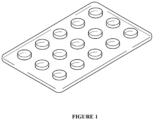
- Examples of the shape of the microdevice include a multi-well plate in which an arbitrary number of wells (for example, microwells) are arranged as illustrated in Fig. 1 .
- the number of wells is, for example, 1 or more and 10,000,000 or less, for example, 10 or more and 500,000 or less, for example, about 100,000, or the like, per plate.
- the pore diameter of the well of the microdevice may be, for example, 10 nm or more and 10 ⁇ m or less, may be, for example, 100 nm or more and 10 ⁇ m or less, and may be, for example, 1 ⁇ m or more and 10 ⁇ m or less.
- the depth of the well of the microdevice may be, for example, 10 nm or more and 100 ⁇ m or less, may be, for example, 100 nm or more and 80 ⁇ m or less, and may be, for example, 200 nm or more and 70 ⁇ m or less.
- one molecule of the target enzyme can be captured in the well, and the enzyme activity of each molecule of the enzyme in the biological sample can be detected.
- the microdevice may include one kind of the above-described fluorescent probe of the present invention in one well.
- the amount of the fluorescent probe of the present invention contained in one well of the microdevice may be, for example, 100 nM or more and 1000 ⁇ M or less, may be, for example, 1 ⁇ M or more and 1000 ⁇ M or less, and may be, for example, 10 ⁇ M or more and 1000 ⁇ M or less.
- a solution containing a biological sample is added to the microdevice.
- Sealing oil is then added dropwise to enclose the target enzyme in the biological sample in the wells of the microdevice.
- the fluorescent probe of the present invention may be added to the solution containing a biological sample.
- Still another implementation of the present invention is a method for detecting activity of a plurality of enzymes in a biological sample using one or more kinds of the compound of the present invention (hereinafter, also referred to as the "detection method 1 of the present invention").
- a microdevice can be suitably used.
- the microdevice used in the detection method 1 of the present invention includes the above-described compound of the present invention.
- the material and shape of the microdevice that can be used in the detection method 1 of the present invention are as described in detail for the fluorescent probe of the present invention.
- the microdevice may include one kind of the compound of the present invention in one well.
- the amount of the fluorescent probe of the present invention contained in one well of the microdevice may be, for example, 100 nM or more and 1000 ⁇ M or less, may be, for example, 1 ⁇ M or more and 1000 ⁇ M or less, and may be, for example, 10 ⁇ M or more and 1000 ⁇ M or less.
- a solution containing a biological sample is added to the microdevice.
- Sealing oil is then added dropwise to enclose the enzyme in the biological sample in the wells of the microdevice.
- the fluorescent probe of the present invention may be added to the solution containing a biological sample.
- a method for detecting activity of a plurality of enzymes in a biological sample comprising bringing the biological sample (for example, a biological sample, a biopsy sample, a body fluid sample, and an aqueous solution which are isolated from a subject) into contact with the compound of Formula (I) or the compound of Formula (II).
- the biological sample may be a blood sample (for example, a serum sample or a plasma sample).
- This method may further include measuring the fluorescence of the compound after contacting the compound and the aqueous solution. When the compound emits fluorescence, the presence or absence of the fluorescence indicates the presence of the enzyme in the aqueous solution, and the intensity of the fluorescence indicates the intensity of the activity of the enzyme in the aqueous solution.
- One mode of the detection method 1 of the present invention is a method for detecting peptide bond hydrolase activity in a biological sample, the method comprising bringing the compound of the present invention into contact with a plurality of enzymes.
- contacting is performed in the presence of serum.
- enzyme activity of a plurality of enzymes in a biological sample can be detected.
- the detection method 1 of the present invention will be described in detail below.
- a solution containing a biological sample is added to a microdevice including the compound of the present invention or the compound group (library) of the present invention.
- the biological sample include a biological sample, a biopsy sample, a body fluid sample, and an aqueous solution which are isolated from a subject.
- the biological sample may be a blood sample (for example, a serum sample or a plasma sample).
- the pH of the solution containing a biological sample any value may be selected.
- the pH of the solution can be set to a value close to that in the living body, and in this case, the pH may be, for example, 6.0 or more and 8.0 or less.
- the pH of the solution can also be made acidic so as to reach an optimum pH.
- a solution containing a biological sample and a solution containing the fluorescent probe of the present invention may be separately prepared, the ratio of the biological sample and the fluorescent probe may be appropriately adjusted and mixed, and the mixed solution may be added to the microdevice.
- the protein concentration of the biological sample may be usually, for example, 1 pM or more and 100 pM or less, and may be, for example, 10 pM or more and 100 pM or less, as the concentration of a "target protein".
- the upper limit of the total protein concentration in the sample may be, for example, about 10 ⁇ M.
- a method for measuring the protein concentration of a biological sample for example, a method using an antibody antigen reaction (for example, ELISA method or the like) can be used as a method for measuring the concentration of a "target protein".
- a method for measuring the total protein concentration in a sample include colorimetric methods using a reaction between a protein and a reagent (such as a bicinchoninic acid (BCA) method, Bradford method, Lowry method, and a biuret method).
- BCA bicinchoninic acid
- the biological sample may be diluted using various aqueous solvents or the like so as to have the above concentration.
- aqueous solvent examples include water, physiological saline, phosphate buffered saline (PBS), tris buffered saline (TBS), and HEPES buffered saline, but are not limited thereto.
- the sealing oil is then added dropwise to enclose the enzyme in the biological sample in the wells of the microdevice.
- the sealing oil may be any known sealing oil that is usually used for enclosing a sample in a microdevice, and examples thereof include fluorine-based oil (such as FC-40) and aliphatic hydrocarbon (such as hexadecane).
- fluorescence in the well of the microdevice is detected using a fluorescence scanner, a fluorescence microscope, or the like.
- the enzyme activity can be evaluated from the detected fluorescence intensity.
- What enzyme is contained in the well of the microdevice in which the enzyme activity is detected can be determined, for example, by comparison with an enzyme activity pattern with a separately prepared target protein.
- the detection method 1 of the present invention can further include observing a fluorescence response using a fluorescence imaging means.
- a fluorometer having a wide measurement wavelength can be used, but the fluorescence response can also be visualized using a fluorescence imaging means capable of displaying the fluorescence response as a two-dimensional image.
- the fluorescence imaging means By using the fluorescence imaging means, the fluorescence response can be two-dimensionally visualized, so that the target enzyme can be instantly visually recognized.
- a fluorescence imaging device a device known in the art can be used. In some cases, it is also possible to detect a reaction between the sample to be measured and the fluorescent probe by a change in ultraviolet-visible absorption spectrum (for example, a change in absorbance at a specific absorption wavelength).
- the fluorescence intensity of one kind of the fluorescent probe of the present invention can be detected with respect to one molecule of the plurality of enzymes in the biological sample, and the enzyme activities of one molecule of the plurality of enzymes can be compared.
- the enzyme activity of one molecule of enzyme can be measured by preparing a well (for example, a plurality of wells) containing one molecule of enzyme and a plurality of fluorescent probes.
- the fluorescent probe of the present invention can be used as a fluorescent probe for detection of one or more kinds of hydrolase activity depending on the kind of the functional group introduced as R 0 or R 10 , and the fluorescent probe of the present invention can be further used for detection of a biomarker specific to a predetermined disease to diagnose the disease.
- Still another implementation of the present invention is a method for diagnosing a disease state by detecting single-molecule hydrolase activity using the fluorescent probe of the present invention (hereinafter, also referred to as the "diagnostic method of the present invention").
- Non-limiting examples of the diagnostic method of the present invention are shown below.
- Still another implementation of the present invention is a method for detecting activity of CD13 in a biological sample, the method comprising bringing the compound of the present invention (hereinafter, also referred to as "Compound A of the present invention"), in which -CO-R 0 or -CO-R 10 is an alanine, lysine, arginine, or methionine residue in General Formula (I) or (II), into contact with a biological sample in an aqueous solution, an increase in fluorescence intensity in the aqueous solution indicating the presence of activity of CD13.
- Compound A of the present invention in which -CO-R 0 or -CO-R 10 is an alanine, lysine, arginine, or methionine residue in General Formula (I) or (II
- Still another implementation of the present invention is a method for diagnosing pancreatic cancer (hereinafter, also referred to as the "diagnostic method 1 of the present invention"), the method comprising detecting, by a microdevice, single-molecule enzyme activity of CD13 in a biological sample obtained from a subject, using a fluorescent probe containing the compound of the present invention, in which -CO-R 0 or -CO-R 10 is an alanine, lysine, arginine, or methionine residue in General Formula (I) or (II).
- Still another mode of the present invention is a method for diagnosing pancreatic cancer or a method for predicting a possibility that a subject from which a biological sample is derived has pancreatic cancer (hereinafter, also referred to as the "diagnostic or prediction method 1 of the present invention"), the method comprising (a) bringing, by a microdevice, a biological sample obtained from a subject into contact with a fluorescent probe containing the compound of the present invention, in which - CO-R 0 or -CO-R 10 is an alanine, lysine, arginine, or methionine residue in General Formula (I) or (II), and (b) measuring a fluorescence intensity of the biological sample brought into contact with the fluorescent probe.
- the diagnostic method 1 of the present invention and the diagnostic or prediction method 1 of the present invention are based on the detection of the enzyme activity of one molecule of CD13 by Compound A of the present invention.
- Still another implementation of the present invention is a method for detecting activity of DPP4 in a biological sample, the method comprising bringing the compound of the present invention (hereinafter, also referred to as "Compound B of the present invention"), in which CO-R 0 or -CO-R 10 is -Pro-Xaa (Pro represents a proline residue and Xaa represents an amino acid residue such as glycine, serine, or glutamic acid) in General Formula (I) or (II), into contact with a biological sample in an aqueous solution, an increase in fluorescence intensity in the aqueous solution indicating the presence of activity of DPP4.
- Compound B of the present invention in which CO-R 0 or -CO-R 10 is -Pro-Xaa (Pro represents a proline residue and Xaa represents an amino acid residue such as glycine, serine, or glutamic acid) in General Formula (I) or (II)
- Still another implementation of the present invention is a method for diagnosing pancreatic cancer (hereinafter, also referred to as the "diagnostic method 2 of the present invention"), the method comprising detecting, by a microdevice, single-molecule enzyme activity of DPP4 in a biological sample obtained from a subject, using a fluorescent probe containing the compound of the present invention, in which -CO-R 0 or -CO-R 10 is -Pro-Xaa (Pro represents a proline residue and Xaa represents an amino acid residue such as glycine, serine, or glutamic acid) in General Formula (I) or (II).
- Another mode of the present invention is a method for diagnosing pancreatic cancer or a method for predicting a possibility that a subject from which a biological sample is derived has pancreatic cancer (hereinafter, also referred to as the "diagnostic or prediction method 2 of the present invention"), the method comprising (a) bringing, by a microdevice, a biological sample obtained from a subject into contact with a fluorescent probe containing the compound of the present invention, in which -CO-R 0 or -CO-R 10 is -Pro-Xaa (Pro represents a proline residue and Xaa represents an amino acid residue such as glycine, serine, or glutamic acid) in General Formula (I) or (II), and (b) measuring a fluorescence intensity of the biological sample brought into contact with the fluorescent probe.
- the diagnostic method 2 of the present invention and the diagnostic or prediction method 2 of the present invention are based on the detection of the enzyme activity of one molecule of DPP4 by Compound B of the present invention.
- Still another mode of the present invention is a method for diagnosing pancreatic cancer, the method comprising: detecting, by a microdevice, single-molecule enzyme activity of CD13 in a biological sample obtained from a subject, using a fluorescent probe containing the compound of the present invention, in which -CO-R 0 or -CO-R 10 is an alanine, lysine, arginine, or methionine residue in General Formula (I) or (II); and detecting, by a microdevice, single-molecule enzyme activity of DPP4 in a biological sample obtained from a subject, using a fluorescent probe containing the compound of the present invention, in which -CO-R 0 or -CO-R 10 is -Pro-Xaa (Pro represents a proline residue and Xaa represents an amino acid residue such as glycine, serine, or glutamic acid) in General Formula (I) or (II).
- the diagnostic method 1 (or 2) of the present invention and the diagnostic or prediction method 1 (or 2) of the present invention can be performed by preparing a solution containing a biological sample and Compound A (or B) of the present invention, adding the solution to a microdevice, enclosing the added solution in each well, incubating the microdevice in which the solution is enclosed, and then measuring the fluorescence intensity of each well with a fluorescence microscope.
- the diagnostic method 1 of the present invention and the diagnostic or prediction method 1 of the present invention are performed, for example, as follows, but are not limited thereto.
- Compound A of the present invention is diluted with an assay buffer to a predetermined concentration (for example, 100 ⁇ M).
- the composition of the assay buffer can be appropriately determined, and can be, for example, 100 mM HEPES-NaOH (pH 7.4), 1 mM MgCl 2 , 1 mM CaCl 2 , 3 mM Triton X-100.
- a biological sample preferably a blood sample (for example, a serum sample or a plasma sample) collected from a subject (including both of a patient with pancreatic cancer and a healthy subject) is diluted with the above assay buffer (for example, about 10,000 times), and mixed with a diluted solution of Compound A of the present invention at a predetermined ratio (for example, equal amount).
- a blood sample for example, a serum sample or a plasma sample
- a predetermined ratio for example, equal amount
- the mixed solution of both was added to a microdevice, followed by the addition of sealing oil to enclose the solution in each well.
- the number of wells in which the detected fluorescence intensity is equal to or higher than a predetermined intensity (for example, 2,500 AU or more), that is, the number of wells in which CD13 is considered to be enclosed is measured.
- an ROC curve for determination based on the result of CD13 activity measurement using Compound A of the present invention is created, and the possibility of pancreatic cancer is determined by the ROC curve.
- the diagnostic method 2 of the present invention and the diagnostic or prediction method 2 of the present invention are performed, for example, as follows, but are not limited thereto.
- Compound B of the present invention is diluted with an assay buffer to a predetermined concentration (for example, 100 ⁇ M).
- the composition of the assay buffer can be appropriately determined, and can be 100 mM HEPES-NaOH (pH 7.4), 1 mM MgCl 2 , 1 mM CaCl 2 , 3 mM Triton X-100.
- a biological sample preferably a blood sample (for example, a serum sample or a plasma sample) collected from a subject (including both of a patient with pancreatic cancer and a healthy subject) is diluted with the above assay buffer (for example, about 2,500 times), and mixed with a diluted solution of Compound B of the present invention at a predetermined ratio (for example, equal amount).
- a blood sample for example, a serum sample or a plasma sample
- a predetermined ratio for example, equal amount
- the mixed solution of both was added to a microdevice, followed by the addition of sealing oil to enclose the solution in each well.
- microdevice in which the solution is enclosed is incubated under predetermined conditions (for example, 25°C for 2 hours), and then the fluorescence intensity of each well is measured with a fluorescence microscope.
- the histogram created based on the fluorescence intensity of each well is approximated to a curve including two normal distributions.
- a well having a fluorescence intensity higher than the minimum value of the approximate curve is defined as a high activity group
- a well having a fluorescence intensity lower than the minimum value of the approximate curve is defined as a low activity group
- the ratio of the high activity group to the total of these groups is measured.
- an ROC curve for determination based on the result of DPP4 activity measurement using Compound B of the present invention is created, and the possibility of pancreatic cancer is determined by the ROC curve.
- Non-limiting examples of Compound A of the present invention include the following compounds.
- Non-limiting examples of Compound B of the present invention include the following compounds.
- Still another implementation of the present invention is a compound represented by any one of Formulas (1) to (5) below or a salt thereof (hereinafter, also referred to as "Compound 2 of the present invention”).
- R 0 is selected from a partial structure of an amino acid, a partial structure of a carboxylic acid, or T-O-.
- the partial structure of an amino acid constitutes an amino acid, an amino acid residue, a peptide, or a part of an amino acid.
- T is a saccharide, a partial structure of a saccharide, or a saccharide having a self-cleaving linker, and the partial structure of a saccharide of T, together with O to which T is bonded, constitutes a saccharide or a part of a saccharide.
- Still another implementation of the present invention is a compound represented by Formula (6) below or a salt thereof (hereinafter, also referred to as "Compound 3 of the present invention").
- R 0 is selected from a partial structure of an amino acid, a partial structure of a carboxylic acid, or T-O-.
- the partial structure of an amino acid constitutes an amino acid, an amino acid residue, a peptide, or a part of an amino acid.
- T is a saccharide, a partial structure of a saccharide, or a saccharide having a self-cleaving linker, and the partial structure of a saccharide of T, together with O to which T is bonded, constitutes a saccharide or a part of a saccharide.
- the compounds represented by Formulas (1) to (6) also include their stereoisomers such as tautomers, geometric isomers (for example, E-form, Z-form, and the like), and enantiomers. That is, when one or two or more asymmetrical carbons are contained in the compounds represented by Formulas (1) to (6), it can take either an (R)-form or (S)-form, each independently, in accordance with the stereochemistry of asymmetrical carbons, and sometimes exists as an enantiomer or diastereomer or other such stereoisomer of the derivative.
- the method for producing the compounds represented by Formulas (1) to (6) is not particularly limited, but synthesis methods for typical compounds among the compounds included in Formulas (1) to (6) were specifically shown in Examples of the present specification. Those skilled in the art can produce the compounds included in Formulas (1) to (6) by suitably changing or modifying the starting raw materials, reaction reagents, reaction conditions, and the like as necessary while referring to Examples and the following schemes of the present specification.
- a compound represented by General Formula (III) or a salt thereof is useful, for example, as an intermediate for producing the compound of the present invention. That is, according to the present invention, there is provided use of the compound represented by General Formula (III) or a salt thereof, for producing the compound of the present invention.
- a compound represented by General Formula (IV) or a salt thereof is useful, for example, as an intermediate for producing the compound of the present invention. That is, according to the present invention, there is provided use of the compound represented by General Formula (IV) or a salt thereof, for producing the compound of the present invention.
- a compound represented by General Formula (V) or a salt thereof is also provided.
- This compound is useful, for example, as an intermediate for producing the compound of the present invention. That is, according to the present invention, there is provided use of the compound represented by General Formula (V) or a salt thereof, for producing the compound of the present invention.
- A preferably represents phenyl or thiophenyl.
- R preferably represents -COOH or -SO 3 H.
- A is a phenyl group
- R preferably represents -SO 3 H.
- A is a thiophenyl group
- R preferably represents -COOH.
- n is preferably 1.
- R 8 and R 9 preferably represent a hydrogen atom.
- X preferably represents an oxygen atom or Si(-CH 3 ) 2 .
- More preferred examples of the compound represented by General Formula (V) or a salt thereof include a compound in which A represents phenyl or thiophenyl, R represents -COOH or -SO 3 H, n is 1, R 8 and R 9 represent a hydrogen atom, X represents an oxygen atom or Si(-CH 3 ) 2 , or a salt thereof.
- Particularly preferred examples of the compound represented by General Formula (V) or a salt thereof include a compound in which A represents phenyl or thiophenyl, R represents -COOH or -SO 3 H, n is 1, R 8 and R 9 represent a hydrogen atom, X represents an oxygen atom or Si(-CH 3 ) 2 , when A is a phenyl group, R represents -SO 3 H, and when A is a thiophenyl group, R represents - COOH, or a salt thereof.
- the selection method of the present invention includes at least preparing one or more fluorescent probes of the present invention and selecting a fluorescent probe satisfying the conditions (A), (B), and (C). Since (A), (B), and (C) are indices for evaluating the suitability in a microdevice, a fluorescent probe selected by the selection method of the present invention can be particularly preferably used as a fluorescent probe for a microdevice.
- a solubility measurement test (25°C) in sealing oil is performed, and a case where the solubility of a test compound in hexadecane is 0.4 ⁇ M or less or 0.3 ⁇ M or less, preferably 0.2 ⁇ M or less, can be determined that (A) is satisfied.
- the solubility measurement test in sealing oil can be performed by measuring the concentration of the test compound transferred to hexadecane when 1 ⁇ L of a 10 mM DMSO solution of the test compound is added with respect to 100 ⁇ L of hexadecane as sealing oil, and the mixture is sonicated and suspended at room temperature (25°C) for 1 minute.
- the solubility measurement test in sealing oil of (A) can be performed specifically according to Example 19.
- a fluorescence intensity measurement test in a microdevice is performed, and a case where a ratio of a fluorescence intensity of a well edge region to a fluorescence intensity of a well center region is 0.7 or less or 0.6 or less, preferably 0.5 or less, can be determined that (B) is satisfied.
- the fluorescence intensity measurement in a microdevice can be performed by adding a test compound to a microdevice, photographing an image of a well in which the compound is encapsulated with a microscope, and measuring a ratio of the fluorescence intensity of the edge region to the fluorescence intensity of the center region.
- the radius of the well is regarded as 1
- the center region and the edge region can be specified by the following ratio.
- the enzymolysis test of the test compound in a microdevice and a cuvette is performed to calculate a signal/noise ratio, and a case where a ratio of a signal/noise ratio (first ratio) of the enzymolysate in the microdevice to a signal/noise ratio (second ratio) of the enzymolysate in the cuvette is 0.2 or more, 0.3 or more, or 0.4 or more, preferably 0.5 or more, can be determined that (C) is satisfied.
- the fluorescence spectra before and after the enzyme reaction are compared, and the ratio of the fluorescence intensity at a wavelength at which the fluorescence intensity is maximized can be calculated as the signal/noise ratio of the enzymolysate.
- the measurement and calculation of the ratio of the signal/noise ratios in the microdevice of (C) and the cuvette can be performed specifically according to Example 21.
- Reagents and solvents for organic synthesis were supplied from Tokyo Chemical Industry Co., Ltd. (TCI), Wako Pure Chemical Industries, Ltd., or Aldrich Chemical Company, and were used without further purification.
- Mass spectra were measured with JEOL JMS-T100LP AccuTOF TM LC-plus4G.
- sHMRG-based peptidase and protease probes (PB101 to PB111) shown in Table 1 below were synthesized by the following procedures using a compound (Compound 4) obtained by reducing sHMRG.
- the solvent was distilled off under reduced pressure, the residue was purified by column chromatography (silica; dichloromethane/methanol), and the solvent was evaporated. Subsequently, the obtained residue was dissolved in methanol, and cooled to 0°C, 8.3 mg (0.22 mmol) of sodium borohydride was then added portionwise, and the mixture was stirred. Next, the mixture was extracted with dichloromethane, washed with saturated saline, and then dehydrated with sodium sulfate. Thereafter, the solvent was distilled off under reduced pressure.
- sSiR-based peptidase and protease probes (PB201 to PB211) shown in Table 3 were synthesized by the following procedures using a compound (Compound 9 or Compound 12) obtained by reducing sSiR.
- This synthetic method is performed with reference to Tetrahedron, 2005, 61, 12, 3097-3105 .
- 4-Sulfophthalic acid, resorcinol, and methanesulfonic acid are mixed, heated at 130°C, and stirred. Water is added to the reaction solution, and the precipitated solid is washed with water and dried under reduced pressure to obtain a compound of interest.
- Compound 16 The synthesis of Compound 16 is performed with reference to J. Am. Chem. Soc. 2013, 135, 16, 6002-6005 .
- Compound 15, Fmoc-protected amino acid, HATU, and DIEA are dissolved in DMF and stirred to condense the amino acid. Thereafter, piperidine is added and stirred to deprotect the Fmoc group, and then trifluoroacetic acid is added and stirred to deprotect the amino acid side chain.
- the reaction solution is purified by MPLC, and the eluent is evaporated. Thereafter, the product is freeze-dried under reduced pressure to obtain a compound of interest.
- MOMCl represents chloromethyl methyl ether (Cl-CH 3 -O-CH 3 ), and -MOM represents a residue of chloromethyl methyl ether (-CH 3 -O-CH 3 ).
- the compounds are arranged in the order of the measured value of logP value, which is an index of lipophilicity, from left to right; however, in the case of a compound having high lipophilicity (specifically, LogP > 1.01), a donut-shaped fluorescence image is obtained by adsorption to a microdevice, and it is suggested that the compound is not suitable for an assay using a microdevice.
- the leftmost compound had two sulfonic acids, but had very high lipophilicity due to the substitution of four benzyl groups, and this also provided a donut-shaped fluorescence image, and in the measurement using a confocal microscope, leakage to the outside of the device was also observed, and thus applicability to a microdevice was low.
- the MiLogP value was almost correlated with the actually measured LogP value. That is, it is considered that the compound of the present invention can be specified not only by the LogP value but also by the MiLogP value.
- the MiLogP value was calculated, and the results thereof were as follows.
- the fluorescent probe is recognized to be suitable for use in an enzyme activity assay in a microdevice, it was shown that the MiLogP value can be used as an index for determining the suitability of the compound of the present invention as a fluorescent probe in a microdevice.
- the assay of enzyme activity was performed using Ala-sHMRG having the following structure.
- the assay protocol is shown below.
- the assay of enzyme activity was performed using Leu-sHMRG having the following structure.
- the assay protocol is shown below.
- the assay of enzyme activity was performed using Met-sHMRG having the following structure.
- the assay protocol is shown below.
- the assay of enzyme activity was performed using Tyr-sHMRG having the following structure.
- the assay protocol is shown below.
- the assay of enzyme activity was performed using Lys-sHMRG having the following structure.
- the assay protocol is shown below.
- the assay of enzyme activity was performed using gGlu-sHMRG having the following structure.
- the assay protocol is shown below.
- the assay of enzyme activity was performed using GP-sHMRG having the following structure.
- the assay protocol is shown below.
- the assay of enzyme activity was performed using Ac-Ala-sHMRG having the following structure.
- the assay protocol is shown below.
- the assay of enzyme activity was performed using Suc-AAPA-sHMRG having the following structure.
- the assay protocol is shown below.
- the assay of enzyme activity was performed using Ala-sSiR having the following structure.
- the assay protocol is shown below.
- the assay of enzyme activity was performed using Trp-sSiR having the following structure.
- the assay protocol is shown below.
- the assay of enzyme activity was performed using Glu-sSiR having the following structure.
- the assay protocol is shown below.
- the assay of enzyme activity was performed using Arg-sSiR having the following structure.
- the assay protocol is shown below.
- the assay of enzyme activity was performed using Ac-GP-sSiR having the following structure.
- the assay protocol is shown below.
- the assay of enzyme activity was performed using Ac-LRGG-sSiR having the following structure.
- the assay protocol is shown below.
- the assay of enzyme activity was performed using EP-sSiR having the following structure.
- the assay protocol is shown below.
- an ROC curve for determination based on the enzyme activity of CD13 determined based on the proportion of wells with a luminance of 2500 AU or more is created, and when a threshold is subtracted at the time when the number of wells of a signal is 3%, the sensitivity is 27% and the specificity is 100% (the right view of Fig. 3 ). It is possible to determine pancreatic cancer by such an ROC curve.
- an ROC curve for determination based on the enzyme activity of DPP4 determined based on the proportion of the high activity group is created, and when a threshold is subtracted at the time when the proportion of the high activity group is 55%, the sensitivity is 37% and the specificity is 97% (the right view of Fig. 4 ). It is possible to determine pancreatic cancer by such an ROC curve.
- UPLC ultra performance liquid chromatography
- solutions having a plurality of concentrations were prepared and measured for each compound, then a calibration curve was prepared ( Fig. 5 ), and the calculation was performed according to the calibration curve.
- the peak area was calculated for Glu-sSiR at 500 nm, for GP-sHMRG at 450 nm, and for the compound "Tetra-benzyl" at 650 nm, respectively.
- Glu-sSiR (PB206): The peak area was 1637 ⁇ 524 (average value ⁇ standard deviation) by three tests, and thus the solubility in hexadecane was calculated to be 0.30 ⁇ 0.096 ⁇ M.
- GP-sHMRG (PB109): The peak area was 740 ⁇ 74 (average value ⁇ standard deviation) by three tests, and thus the solubility in hexadecane was calculated to be 0.27 ⁇ 0.026 ⁇ M.
- the degree of adsorption to the well wall surface was measured as follows. That is, these compounds were diluted with an assay buffer so as to be each 10 ⁇ M, and each solution was then added to a microdevice, followed by the addition of sealing oil to enclose the solution in each well. After incubation at 25°C for 1 hour, images of the compound encapsulated wells were photographed with a microscope.
- the composition of the assay buffer is 100 mM HEPES-NaOH (pH 7.4), 1 mM MgCl 2 , 1 mM CaCl 2 , 250 ⁇ M Triton X-100.
- the fluorescence intensity of the center region was 552 ⁇ 60 (average value ⁇ standard deviation), the fluorescence intensity of the edge portion was 581 ⁇ 71 (average value ⁇ standard deviation), and the ratio (edge/center) was 1.05
- the fluorescence intensity of the center region was 1,880 ⁇ 178 (average value ⁇ standard deviation)
- the fluorescence intensity of the edge portion was 1,087 ⁇ 106 (average value ⁇ standard deviation)
- the ratio (edge/center) was 0.58
- the fluorescence intensity of the center region was 483 ⁇ 33 (average value ⁇ standard deviation)
- the fluorescence intensity of the edge portion was 300 ⁇ 23 (average value ⁇ standard deviation)
- the ratio (edge/center) was 0.62 ( Fig. 6 ).
- the signal/noise ratios of the enzymolysates before and after the enzyme reaction in the cuvette and the microdevice were each measured as follows.
- the composition of the assay buffer is 100 mM HEPES-NaOH (pH 7.4), 1 mM MgCl 2 , 1 mM CaCl 2 , 100 mM DTT, 150 mM Triton X-100.
- Glu-sSiR was diluted with an assay buffer so as to be 10 ⁇ M, then added to a quartz cuvette, and the fluorescence spectrum before the enzyme reaction was measured with a fluorometer (excitation wavelength: 570 nm). Thereafter, aminopeptidase A was added so that the concentration in the solution was 170 ng/mL, the solution was incubated at 25°C for 11 hours, and then the fluorescence spectrum was measured. The fluorescence spectra before and after the enzyme reaction were compared, the ratio of the values at a wavelength at which the fluorescence intensity was maximized was calculated as the signal/noise ratio of the enzymolysate, the ratio was 32 times (@616 nm) (see Fig. 7A ).
- GP-sHMRG was diluted with an assay buffer so as to be 10 ⁇ M, then added to a quartz cuvette, and the fluorescence spectrum before the enzyme reaction was measured with a fluorometer (excitation wavelength: 500 nm). Thereafter, dipeptidyl peptidase was added so that the concentration in the solution was 17 ng/mL, the solution was incubated at 25°C for 9 hours, and then the fluorescence spectrum was measured. The fluorescence spectra before and after the enzyme reaction were compared, the ratio of the values at a wavelength at which the fluorescence intensity was maximized was calculated as the signal/noise ratio of the enzymolysate, the ratio was 481 times (@527 nm) (see Fig. 7B ).
- Glu-sSiR For Glu-sSiR, three kinds of solutions of (i) only an assay buffer, (ii) 30 ⁇ M of Glu-sSiR, and (iii) 30 ⁇ M of Glu-sSiR and 0.2 ng/mL of aminopeptidase A were prepared, and each solution was added to a microdevice, followed by the addition of sealing oil to enclose the solution in each well. The microdevice in which the solution was enclosed was incubated at 37°C for 4 hours, and then the fluorescence intensity of each well was measured with a fluorescence microscope.
- GP-sHMRG For GP-sHMRG, three kinds of solutions of (iv) only an assay buffer, (v) 30 ⁇ M of GP-sHMRG, and (vi) 30 ⁇ M of GP-sHMRG and 0.2 ng/mL of dipeptidyl peptidase were prepared, and each solution was added to a microdevice, followed by the addition of sealing oil to enclose the solution in each well. The microdevice in which the solution was enclosed was incubated at 25°C for 2 hours, and then the fluorescence intensity of each well was measured with a fluorescence microscope.
- the ratio of the signal/noise ratio in the microdevice to the signal/noise ratio in the cuvette was 0.26 for Glu-sSiR and 0.59 for GP-sHMRG.
- the signal/noise ratio in the microdevice was inferior to the cuvette, but was not significantly deteriorated. Since Glu-sSiR and GP-sHMRG are recognized to be suitable for use in the enzyme activity assay in a microdevice in Examples 12 and 7, it was shown that the ratio of the signal/noise ratios in the cuvette and the microdevice can be an index of suitability in the microdevice.
Landscapes
- Chemical & Material Sciences (AREA)
- Organic Chemistry (AREA)
- Health & Medical Sciences (AREA)
- Life Sciences & Earth Sciences (AREA)
- Engineering & Computer Science (AREA)
- Immunology (AREA)
- General Health & Medical Sciences (AREA)
- Wood Science & Technology (AREA)
- Zoology (AREA)
- Biochemistry (AREA)
- Molecular Biology (AREA)
- Physics & Mathematics (AREA)
- Analytical Chemistry (AREA)
- Proteomics, Peptides & Aminoacids (AREA)
- Microbiology (AREA)
- Biotechnology (AREA)
- Hematology (AREA)
- Genetics & Genomics (AREA)
- Bioinformatics & Cheminformatics (AREA)
- General Engineering & Computer Science (AREA)
- Urology & Nephrology (AREA)
- Biomedical Technology (AREA)
- General Physics & Mathematics (AREA)
- Biophysics (AREA)
- Pathology (AREA)
- Cell Biology (AREA)
- Food Science & Technology (AREA)
- Medicinal Chemistry (AREA)
- Materials Engineering (AREA)
- Nuclear Medicine, Radiotherapy & Molecular Imaging (AREA)
- Optics & Photonics (AREA)
- Chemical Kinetics & Catalysis (AREA)
- Measuring Or Testing Involving Enzymes Or Micro-Organisms (AREA)
- Investigating Or Analysing Materials By The Use Of Chemical Reactions (AREA)
Applications Claiming Priority (2)
| Application Number | Priority Date | Filing Date | Title |
|---|---|---|---|
| JP2022079082 | 2022-05-12 | ||
| PCT/JP2023/017768 WO2023219136A1 (fr) | 2022-05-12 | 2023-05-11 | Sonde fluorescente pour détecter une hydrolase liée à un peptide |
Publications (1)
| Publication Number | Publication Date |
|---|---|
| EP4524254A1 true EP4524254A1 (fr) | 2025-03-19 |
Family
ID=88730357
Family Applications (1)
| Application Number | Title | Priority Date | Filing Date |
|---|---|---|---|
| EP23803610.7A Pending EP4524254A1 (fr) | 2022-05-12 | 2023-05-11 | Sonde fluorescente pour détecter une hydrolase liée à un peptide |
Country Status (6)
| Country | Link |
|---|---|
| US (1) | US20250313879A1 (fr) |
| EP (1) | EP4524254A1 (fr) |
| JP (1) | JPWO2023219136A1 (fr) |
| CN (1) | CN119213139A (fr) |
| AU (1) | AU2023268261A1 (fr) |
| WO (1) | WO2023219136A1 (fr) |
Family Cites Families (7)
| Publication number | Priority date | Publication date | Assignee | Title |
|---|---|---|---|---|
| DE19843873A1 (de) * | 1998-09-25 | 2000-03-30 | Univ Halle Wittenberg | Verfahren zur Bestimmung von Proteaseaktivitäten auf Zelloberflächen |
| US8460862B2 (en) * | 2009-03-11 | 2013-06-11 | Marker Gene Technologies | Enzyme substrates for visualizing acidic organelles |
| EP2857830B1 (fr) * | 2012-05-30 | 2021-08-25 | The University of Tokyo | Sonde fluorescente pour la détection haute sensibilité de liquide pancréatique et procédé de détection de liquide pancréatique |
| JP7008339B2 (ja) | 2017-02-17 | 2022-01-25 | 国立大学法人 東京大学 | ペプチダーゼ活性検出用赤色蛍光プローブ |
| WO2021173865A2 (fr) * | 2020-02-25 | 2021-09-02 | Bambu Vault Llc | Composés pour la détection de pathogènes viraux |
| EP3960817A1 (fr) * | 2020-08-28 | 2022-03-02 | Max-Planck-Gesellschaft zur Förderung der Wissenschaften e.V. | Colorants fluorescents photoactivables avec des groupes d'encagement hydrophiles et leur utilisation |
| JP7390624B2 (ja) | 2020-11-16 | 2023-12-04 | パナソニックIpマネジメント株式会社 | 掃除機 |
-
2023
- 2023-05-11 JP JP2024520488A patent/JPWO2023219136A1/ja active Pending
- 2023-05-11 CN CN202380040102.3A patent/CN119213139A/zh active Pending
- 2023-05-11 AU AU2023268261A patent/AU2023268261A1/en active Pending
- 2023-05-11 US US18/863,482 patent/US20250313879A1/en active Pending
- 2023-05-11 WO PCT/JP2023/017768 patent/WO2023219136A1/fr not_active Ceased
- 2023-05-11 EP EP23803610.7A patent/EP4524254A1/fr active Pending
Also Published As
| Publication number | Publication date |
|---|---|
| WO2023219136A1 (fr) | 2023-11-16 |
| US20250313879A1 (en) | 2025-10-09 |
| AU2023268261A1 (en) | 2024-11-28 |
| JPWO2023219136A1 (fr) | 2023-11-16 |
| CN119213139A (zh) | 2024-12-27 |
Similar Documents
| Publication | Publication Date | Title |
|---|---|---|
| JP6351511B2 (ja) | 非対称Siローダミン及びロドールの合成 | |
| JP5228190B2 (ja) | パーオキシナイトライト蛍光プローブ | |
| Li et al. | 1, 8-Naphthalimide-based dual-response fluorescent probe for highly discriminating detection of cys and H2S | |
| CN109438319B (zh) | 一种检测亮氨酸氨肽酶的化合物及其制备方法和应用 | |
| EP3391056B1 (fr) | Substrats de peroxydase à fraction chromogène | |
| Li et al. | Novel coumarin-based sensitive and selective fluorescent probes for biothiols in aqueous solution and in living cells | |
| US20230104281A1 (en) | Fluorescent rhodamine dyes with enhanced cell permeability | |
| CN110041311A (zh) | 一种荧光探针分子ml-fp及其制备方法和应用 | |
| CN113637048B (zh) | 一种γ-谷氨酰转肽酶的双光子荧光探针及其制备方法和应用 | |
| Wang et al. | A near-infrared fluorescent probe based on chloroacetate modified naphthofluorescein for selectively detecting cysteine/homocysteine and its application in living cells | |
| EP4524254A1 (fr) | Sonde fluorescente pour détecter une hydrolase liée à un peptide | |
| JP7628233B2 (ja) | Enpp活性検出用蛍光プローブ | |
| WO2022260135A1 (fr) | Procédé de production d'une bibliothèque de sondes fluorescentes à l'aide d'une extraction en phase solide et procédé de mesure de l'activité enzymatique l'utilisant | |
| US12055546B2 (en) | Fluorescent probe for detecting carboxypeptidase activity | |
| JP2018145126A (ja) | カルボキシペプチダーゼ活性検出用蛍光プローブ | |
| EP3551637B1 (fr) | Composé pour la détection de hno dans des systèmes biologiques | |
| WO2023167282A1 (fr) | Sonde raman activable de type à fonction o | |
| HK40118471A (zh) | 用於检测肽键水解酶的荧光探针 | |
| EP4488379A1 (fr) | Procédé de détection de l'activité enzymatique et sonde fluorescente utilisée dans cette méthode | |
| US20220341922A1 (en) | Fluorescent probe for use in detection of brain tumor | |
| HK40118716A (zh) | 酶活性检测方法及所述方法中使用的荧光探针 | |
| He et al. | Design and synthesis of fluorescent probes specific for pantetheinase and their application in bioimaging | |
| US20190270888A1 (en) | Novel oxidation color developable compound and oxidation color development reagent | |
| WO2023167333A1 (fr) | Imagerie par fluorescence de cellules cancéreuses | |
| WO2021153772A1 (fr) | Sonde fluorescente bleue pour la détection d'aldéhyde déshydrogénase 1a1 |
Legal Events
| Date | Code | Title | Description |
|---|---|---|---|
| STAA | Information on the status of an ep patent application or granted ep patent |
Free format text: STATUS: THE INTERNATIONAL PUBLICATION HAS BEEN MADE |
|
| PUAI | Public reference made under article 153(3) epc to a published international application that has entered the european phase |
Free format text: ORIGINAL CODE: 0009012 |
|
| STAA | Information on the status of an ep patent application or granted ep patent |
Free format text: STATUS: REQUEST FOR EXAMINATION WAS MADE |
|
| 17P | Request for examination filed |
Effective date: 20241104 |
|
| AK | Designated contracting states |
Kind code of ref document: A1 Designated state(s): AL AT BE BG CH CY CZ DE DK EE ES FI FR GB GR HR HU IE IS IT LI LT LU LV MC ME MK MT NL NO PL PT RO RS SE SI SK SM TR |
|
| DAV | Request for validation of the european patent (deleted) | ||
| DAX | Request for extension of the european patent (deleted) |