EP4524320A1 - Procédé de stockage de récolte fraîche, procédé de traitement d'un mélange de récolte encastré, procédé de fabrication d'un mélange de matière fibreuse et systèmes pour la mise en oeuvre de ce procédé - Google Patents
Procédé de stockage de récolte fraîche, procédé de traitement d'un mélange de récolte encastré, procédé de fabrication d'un mélange de matière fibreuse et systèmes pour la mise en oeuvre de ce procédé Download PDFInfo
- Publication number
- EP4524320A1 EP4524320A1 EP23196851.2A EP23196851A EP4524320A1 EP 4524320 A1 EP4524320 A1 EP 4524320A1 EP 23196851 A EP23196851 A EP 23196851A EP 4524320 A1 EP4524320 A1 EP 4524320A1
- Authority
- EP
- European Patent Office
- Prior art keywords
- storage container
- mixture
- crop
- storage
- digestion
- Prior art date
- Legal status (The legal status is an assumption and is not a legal conclusion. Google has not performed a legal analysis and makes no representation as to the accuracy of the status listed.)
- Withdrawn
Links
Images
Classifications
-
- D—TEXTILES; PAPER
- D21—PAPER-MAKING; PRODUCTION OF CELLULOSE
- D21B—FIBROUS RAW MATERIALS OR THEIR MECHANICAL TREATMENT
- D21B1/00—Fibrous raw materials or their mechanical treatment
- D21B1/02—Pretreatment of the raw materials by chemical or physical means
- D21B1/021—Pretreatment of the raw materials by chemical or physical means by chemical means
-
- A—HUMAN NECESSITIES
- A23—FOODS OR FOODSTUFFS; TREATMENT THEREOF, NOT COVERED BY OTHER CLASSES
- A23B—PRESERVATION OF FOODS, FOODSTUFFS OR NON-ALCOHOLIC BEVERAGES; CHEMICAL RIPENING OF FRUIT OR VEGETABLES
- A23B7/00—Preservation of fruit or vegetables; Chemical ripening of fruit or vegetables
- A23B7/14—Preserving or ripening with chemicals not covered by group A23B7/08 or A23B7/10
- A23B7/153—Preserving or ripening with chemicals not covered by group A23B7/08 or A23B7/10 in the form of liquids or solids
- A23B7/154—Organic compounds; Microorganisms; Enzymes
-
- D—TEXTILES; PAPER
- D21—PAPER-MAKING; PRODUCTION OF CELLULOSE
- D21B—FIBROUS RAW MATERIALS OR THEIR MECHANICAL TREATMENT
- D21B1/00—Fibrous raw materials or their mechanical treatment
- D21B1/38—Conserving the finely-divided cellulosic material
-
- D—TEXTILES; PAPER
- D21—PAPER-MAKING; PRODUCTION OF CELLULOSE
- D21C—PRODUCTION OF CELLULOSE BY REMOVING NON-CELLULOSE SUBSTANCES FROM CELLULOSE-CONTAINING MATERIALS; REGENERATION OF PULPING LIQUORS; APPARATUS THEREFOR
- D21C1/00—Pretreatment of the finely-divided materials before digesting
- D21C1/06—Pretreatment of the finely-divided materials before digesting with alkaline reacting compounds
-
- D—TEXTILES; PAPER
- D21—PAPER-MAKING; PRODUCTION OF CELLULOSE
- D21C—PRODUCTION OF CELLULOSE BY REMOVING NON-CELLULOSE SUBSTANCES FROM CELLULOSE-CONTAINING MATERIALS; REGENERATION OF PULPING LIQUORS; APPARATUS THEREFOR
- D21C3/00—Pulping cellulose-containing materials
- D21C3/02—Pulping cellulose-containing materials with inorganic bases or alkaline reacting compounds, e.g. sulfate processes
-
- D—TEXTILES; PAPER
- D21—PAPER-MAKING; PRODUCTION OF CELLULOSE
- D21C—PRODUCTION OF CELLULOSE BY REMOVING NON-CELLULOSE SUBSTANCES FROM CELLULOSE-CONTAINING MATERIALS; REGENERATION OF PULPING LIQUORS; APPARATUS THEREFOR
- D21C5/00—Other processes for obtaining cellulose, e.g. cooking cotton linters ; Processes characterised by the choice of cellulose-containing starting materials
Definitions
- the invention relates to methods and a system for storing a fresh harvested crop, for treating a stored harvested crop mixture and for producing a fiber mixture according to the independent claims.
- the object of the present invention is to overcome the disadvantages of the prior art.
- the pH measurement it is always possible to carry out the pH measurement at the same temperature, for example, at 20°C. If necessary, the sample to be measured can be tempered before the measurement.
- the dry matter content in the storage container is preferably a maximum of 15 percent, which can be adjusted by adding water if necessary.
- the pH value in the storage container can be adjusted over a period of storage by selecting the base or by further adding of base is maintained at at least 8.5, more preferably at least 9.0, during the storage period.
- preliminary tests can be used to determine whether the combination of harvested material and base has a stable pH value over the desired storage period or at least a pH value above a desired limit of, for example, 8.0.
- the pH value can be monitored during the storage period and, if necessary, adjusted upwards if it has dropped to, for example, 8.0, 8.5, or 9.0.
- the pH value is adjusted to at least 11.0 or at least 12.0 at the beginning of storage.
- a maximum pH of 13.5 preferably a maximum of 13.0, is adjusted.
- the crop mixture is preferably removed from the storage container.
- the first partial dewatering therefore preferably does not take place in the storage container, but in a separate device for carrying out the first partial dewatering ("first dewatering device").
- first dewatering device a separate device for carrying out the first partial dewatering
- the crop mixture is transferred from the storage container to the first dewatering device. pumped.
- the fresh harvest is preferably a non-preserved harvest, which in particular has not been dried or ensiled for a longer period of time.
- the fresh harvested material is preserved, as already described, exclusively by storage at an initial pH of at least 10.0, with this pH preferably being maintained above 8.0 during the storage period.
- Other preservation methods such as silage or drying are preferably not used.
- the "initial" pH value refers to the pH value present immediately after the addition of the base and the harvested material to the storage container, i.e., in particular within the first day after the addition of the base and the harvested material, preferably within the first 6 hours after the addition of the base and the harvested material, and particularly preferably within 60 minutes after the addition of the base and the harvested material.
- This pH value can also be gradually adjusted during the aforementioned period, for example, by adding additional base.
- the harvested crop can be introduced into the storage container with an initial amount of base. After a certain period of time, during which the harvested crop mixture is stirred in the storage container, preferably using an agitator installed in the storage container, so that a stable pH value can be established, the pH value can be determined. If it is too low, it can be increased, if necessary several times, by adding more base.
- the fresh harvested crop is preferably placed in the storage container shortly after harvesting, which can be done, for example, by mowing.
- the fresh harvested crop can essentially be placed in the storage container immediately after harvesting, ie in particular be introduced into the storage container without further treatment steps.
- "Promptly" can encompass a period of several hours to a few days, preferably a period of significantly less than one day, and particularly preferably a period of a few hours after harvest.
- a herbaceous plant is a plant that is essentially non-lignified, i.e., exhibits essentially no secondary growth.
- Particularly preferred within the scope of the present invention are the following plants: the plant genus Miscanthus (a genus within the grass family), the plant species Silphium perfoliatum (silphium perfoliatum), the plant genus Hemp (a genus within the hemp family), or the plant genus Hops (a genus within the hemp family).
- plants from the banana family and nettles (a genus within the nettle family) can be considered.
- Particularly preferred within the scope of the present invention are primarily or exclusively the above-ground plant parts of the herbaceous plant.
- the base to be introduced into the storage container can be a solid or a liquid.
- alkali or alkaline earth metal hydroxides can be considered as a solid or an aqueous solution.
- Other bases such as metal oxides or carbonates, can also be considered.
- Other bases are also possible, and mixtures of several bases can also be used as solids or liquids.
- the storage container may be considered to add water or an aqueous solution in addition to the base.
- the pH value in the storage container may be at least 8.0, more preferably 8.5, and even more preferably at least 9.0 throughout the entire storage period. In all cases, the pH value preferably below 13.5, more preferably below 13.0.
- the storage container may include an agitator.
- dewatering preferably always means solid-liquid separation, which can be achieved by various means. Any device for solid-liquid separation known to those skilled in the art can be used.
- the "first" partial drainage can also be the only drainage.
- at least a second partial drainage can be performed.
- Storage at an initial pH of 11 and at least 8.0 throughout the storage period can offer several advantages. Firstly, storage in this alkaline pH range allows for the preservation of the harvested material, which can remain in the storage container for up to 12 months without spoiling or otherwise becoming unprocessable. It may be envisaged that after the initial introduction of the harvested material into the storage container, a second batch or portion of a fresh harvested material is introduced into the storage container. This second batch or portion could, for example, come from a later harvest, which takes place a few days or weeks after the harvest that produced the previously brought-in harvested material (the first batch or portion, so to speak).
- An unpleasant odor can occur, for example, if storage is carried out at a pH value that is too low.
- Microbial processes are usually the reason for the formation of unpleasant smelling substances, whereby these microbial processes do not take place or only to a very reduced extent at pH values above 8.0 and especially above 8.5 and especially 9.0.
- the mixture after digestion is referred to as a fiber mixture. This applies even if the crop mixture has already been partially digested due to the alkaline storage conditions, which is conceivable within the scope of the present invention.
- the dry matter content of the crop mixture can range between 1 percent and 15 percent, for example.
- the dry matter content is preferably as high as possible to achieve high throughput and efficiency.
- the dry matter content should be below a pumpability limit.
- the pumpability limit is typically around 15% dry matter content. Dry matter contents during storage can be considered between 5 and 15 percent, between 5 and 15 percent, between 9 and 15 percent, between 11 and 14 percent, and preferably around 12 percent. If the crop mixture is transferred from the storage container to the first dewatering device by another means than a pump, higher dry matter contents during storage can also be considered.
- the dry matter content of the crop mixture after the first partial dewatering is preferably between 15 and 35 percent, for example between 20 and 30 percent.
- the basic liquid phase resulting from the initial partial dewatering is returned to the storage tank. Before this return, the basic liquid phase can optionally be treated. Treatment may involve filtration and/or the addition of a base and/or other steps. Furthermore, the basic liquid phase can be temporarily stored in a tank prior to this return.
- This decomposition is preferably a targeted decomposition in a device or facility designed for this purpose.
- a second partial dewatering of the crop mixture can take place.
- the liquid phase can be returned to the storage tank and optionally treated before being returned.
- the digestion can involve steam explosion or consist of steam pressure digestion.
- steam pressure digestion the crop mixture to be digested is heated in a suitable pressure-stable container under alkaline conditions, and the pressure is then rapidly reduced, disrupting the cell structures of the mixture.
- the harvested material is already partially digested by the base.
- this is not mandatory; partial digestion during alkaline storage is therefore optional.
- the partially dewatered crop mixture is temporarily stored in a buffer container before digestion, i.e. before the targeted digestion after the first partial dewatering.
- the present invention further comprises a process for producing a fiber material from a fiber mixture, which as above described.
- the crop mixture used for production was therefore preferably stored as described above and then optionally treated as also described above, for example dewatered.
- a fiber material is preferably a material containing or consisting of fibers.
- a material is understood here to be a material in the broadest sense. In particular, it is a substance that is neither an animal feed, a foodstuff, nor an active ingredient.
- a fiber material can be, for example, paper, cardboard, a fiber composite material, an insulating material, an MDF board, or the like. In general, it can refer to all materials manufactured by producers in the wood-based materials industry, as well as other fiber goods and fiber molded parts.
- the crop mixture from the storage container according to the present invention can be fed essentially directly to the first dewatering and subsequently digested.
- the present invention also encompasses the system described below. Features previously described with respect to the method also apply equally to the system, and vice versa.
- a system for storing a fresh harvested crop comprises a storage container and a device for performing a first partial dewatering (hereinafter usually referred to as the "first dewatering device").
- the system is configured to perform the method steps according to at least one variant of the storage method described above.
- the system may comprise a return device connecting the first drainage device to the storage container and a The return device serves to return the separated basic liquid phase to the storage container.
- the return device may comprise a tank for storing the basic liquid phase if it is not to be returned to the storage container immediately, but rather at a later time. Individual or all return devices may comprise such a tank.
- the system may comprise a device for performing a second partial dewatering and digestion (“dewatering and digestion device”), which is arranged downstream of the first dewatering device.
- dewatering and digestion device a device for performing a second partial dewatering and digestion
- the system may comprise a return device which connects the dewatering and digestion device to the storage container and serves to return the separated liquid phase to the storage container.
- the system can be referred to as a system for storing fresh crops, a system for treating stored crops, or a system for producing a fiber mixture.
- the system can also include the facilities necessary for dewatering and pulping.
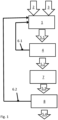
- a system comprises a storage container 1. Downstream of the storage container 1, a device for performing a first partial dewatering (“first dewatering device”) 4, a buffer container 7 and a device for performing a second partial dewatering and digestion (“dewatering and digestion device”) 8, 8.1, 8.2 are arranged, in the following order.
- first dewatering device a device for performing a first partial dewatering
- buffer container 7 a device for performing a second partial dewatering and digestion
- dewatering and digestion device 8.1, 8.2
- a first return device 6.1 connects the first dewatering device 4 with the storage tank 1.
- a second return device 6.2 connects the dewatering and digestion device 8, 8.1 with the storage tank 1. Both return devices 6.1, 6.2 serve to return the separated basic liquid phase to the storage tank 1.
- the fresh harvest of the herbaceous plant 2 and the base 3 are first introduced into the storage container 1.
- the harvest mixture comprising at least the harvest and the base is then stored at a pH of at least 10.0 initially and at least 8.0 during the storage period.
- the initial pH is at least 11.0 or at least 12.0.
- the "initial" pH refers to the pH immediately after the introduction of the base and harvest into the storage container 1.
- the pH during the storage period is at least 8.5, even more preferably at least 9.0. Storage can last up to 12 months, thus covering the entire production year.
- the harvest is transferred along arrow 5.1 into the first dewatering device 4.
- the first partial dewatering produces a basic liquid phase and a partially dewatered crop mixture.
- Dewatering is a solid-liquid separation. Any device known to those skilled in the art for solid-liquid separation can be used.
- the separated basic liquid phase is returned to storage tank 1 via the first return device 6.1.
- the partially dewatered residue i.e., the partially dewatered crop mixture, which now has a higher dry matter content, is transferred along arrow 5.2 to buffer tank 7 and temporarily stored there. Intermediate storage in buffer tank 7 typically lasts a maximum of a few hours.
- the crop mixture is transferred along arrow 5.3 into the dewatering and digestion device 8.
- partial dewatering takes place again.
- the separated liquid phase is mixed with
- the partially dewatered residue, which is referred to as a fibre mixture after the pulping is returned to the storage container 1 by means of the return device 6.2.
- the partially dewatered residue, which is referred to as a fibre mixture after the pulping is conveyed along the arrow 5.4 into the Figures 1 and 2 further processing not shown.
- the return devices 6.1, 6.2 or the return of the separated liquid phase into the storage container 1 have the advantage that no - sometimes strongly - basic liquids have to be disposed of and reduce the use of raw materials, in particular the base.
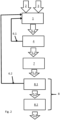
- the embodiment according to Figure 2 differs from that according to Figure 1 insofar as the dewatering and pulping device 8 is divided into two separate units 8.1, 8.2. After partial dewatering in the first unit 8.1, the partially dewatered crop mixture is transferred to the second stage 8.2 along the arrow 5.5. In this second stage 8.2, pulping, i.e., the production of the fiber mixture, takes place.
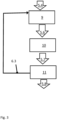
- FIG 3 shows further processing and thus follows the one in the Figures 1 and 2
- the steps shown are: Figure 3 the production of a fiber mixture for the production of paper, cardboard, paperboard or the like.
- the processed fiber mixture is fed along arrow 5.4 into a pulper 9, i.e. a container for dissolving the fiber mixture, particularly for paper or cardboard production.
- a pulper 9 i.e. a container for dissolving the fiber mixture, particularly for paper or cardboard production.
- the fiber mixture is fed along arrow 5.6 into a refiner 10, i.e. a device for mechanical comminution, particularly for paper or cardboard production.
- the fiber mixture is transferred along arrow 5.7 into a device for carrying out a third, at least partial, dewatering 11.
- the material transport according to arrow 5.8 can, for example, be followed by known steps of paper production.
- the arrows 5.1, ..., 5.8 define a direction partly called "downstream".
- Material transport along arrows 5.1, ..., 5.8 can be either passive or active. If the material in question is pumpable, suitable pumps can be used. This applies, for example, to transport along arrow 5.1. Otherwise, other conveying devices can be considered. Pumps and other conveying devices for active material transport, as well as devices for passive material transport, are known from the state of the art.
- the buffer container 7 can be optional.
- an active conveying or passive material transport can transport or convey the crop mixture directly from the first dewatering device 4 to the dewatering and digestion device 8.
- the core of the present invention preferably lies in the arrangement comprising the storage container 1 and the first dewatering device 4, as well as the method performed therein.
- the steps and devices following arrow 5.2 are thus preferred, but optional.
- the liquid phase to be transported to storage tank 1 can be treated. Preparation may include, for example, filtration and/or addition of a base and/or other steps.
- the digestion which takes place in the dewatering and digestion device 8 may preferably comprise or consist of a steam pressure digestion.
- a direct transfer of the crop mixture from the storage container 1 to the dewatering and digestion device 8 can be considered.
- the first dewatering device 4 and the buffer container 7 are omitted.
- only the first dewatering device 4 can be omitted, so that the crop mixture is transferred from the storage container 1 to the buffer container 7 and then to the dewatering and digestion device 8.
- the transfer of the crop mixture can be carried out, for example, by a pump, a feed screw, or another suitable device.
- Both return devices 6.1, 6.2 may comprise a tank for storing the basic liquid phase if this is not to be returned to the storage container 1 immediately but at a later time.
- Storage container 2 Addition of fresh harvest of a herbaceous plant 3
- Addition of a base 4 Device for carrying out a first partial drainage (first drainage device) 5
- Return device 7 Buffer tank 8 Device for carrying out a second partial dewatering and digestion (dewatering and digestion device) 9
Landscapes
- Engineering & Computer Science (AREA)
- Chemical & Material Sciences (AREA)
- Life Sciences & Earth Sciences (AREA)
- Mechanical Engineering (AREA)
- Chemical Kinetics & Catalysis (AREA)
- General Chemical & Material Sciences (AREA)
- Microbiology (AREA)
- Wood Science & Technology (AREA)
- Zoology (AREA)
- Food Science & Technology (AREA)
- Polymers & Plastics (AREA)
- Inorganic Chemistry (AREA)
- Packages (AREA)
Priority Applications (1)
| Application Number | Priority Date | Filing Date | Title |
|---|---|---|---|
| EP23196851.2A EP4524320A1 (fr) | 2023-09-12 | 2023-09-12 | Procédé de stockage de récolte fraîche, procédé de traitement d'un mélange de récolte encastré, procédé de fabrication d'un mélange de matière fibreuse et systèmes pour la mise en oeuvre de ce procédé |
Applications Claiming Priority (1)
| Application Number | Priority Date | Filing Date | Title |
|---|---|---|---|
| EP23196851.2A EP4524320A1 (fr) | 2023-09-12 | 2023-09-12 | Procédé de stockage de récolte fraîche, procédé de traitement d'un mélange de récolte encastré, procédé de fabrication d'un mélange de matière fibreuse et systèmes pour la mise en oeuvre de ce procédé |
Publications (1)
| Publication Number | Publication Date |
|---|---|
| EP4524320A1 true EP4524320A1 (fr) | 2025-03-19 |
Family
ID=88018193
Family Applications (1)
| Application Number | Title | Priority Date | Filing Date |
|---|---|---|---|
| EP23196851.2A Withdrawn EP4524320A1 (fr) | 2023-09-12 | 2023-09-12 | Procédé de stockage de récolte fraîche, procédé de traitement d'un mélange de récolte encastré, procédé de fabrication d'un mélange de matière fibreuse et systèmes pour la mise en oeuvre de ce procédé |
Country Status (1)
| Country | Link |
|---|---|
| EP (1) | EP4524320A1 (fr) |
Citations (5)
| Publication number | Priority date | Publication date | Assignee | Title |
|---|---|---|---|---|
| US20070119561A1 (en) * | 2004-06-09 | 2007-05-31 | Klaus Doelle | Method and apparatus of the prepartion of a fibrous stock suspension |
| US20100176354A1 (en) * | 2007-07-02 | 2010-07-15 | Herbert Costard | High-strength fibrous material consisting of natural fibres, method for the production thereof, and use of same for producing composite materials |
| DE102009047205A1 (de) * | 2009-11-26 | 2011-06-01 | Berger, Friedhelm, Dr. | Konservierung von Pflanzenmaterial |
| DE102021100606A1 (de) * | 2021-01-14 | 2022-07-14 | Energiepark Hahnennest GmbH & Co. KG | Verfahren zur Herstellung eines Faserstoffgemischs |
| US20230002971A1 (en) * | 2019-11-29 | 2023-01-05 | Leinich Beteiligungen Gmbh | Method and plant for obtaining cellulose fibres |
-
2023
- 2023-09-12 EP EP23196851.2A patent/EP4524320A1/fr not_active Withdrawn
Patent Citations (5)
| Publication number | Priority date | Publication date | Assignee | Title |
|---|---|---|---|---|
| US20070119561A1 (en) * | 2004-06-09 | 2007-05-31 | Klaus Doelle | Method and apparatus of the prepartion of a fibrous stock suspension |
| US20100176354A1 (en) * | 2007-07-02 | 2010-07-15 | Herbert Costard | High-strength fibrous material consisting of natural fibres, method for the production thereof, and use of same for producing composite materials |
| DE102009047205A1 (de) * | 2009-11-26 | 2011-06-01 | Berger, Friedhelm, Dr. | Konservierung von Pflanzenmaterial |
| US20230002971A1 (en) * | 2019-11-29 | 2023-01-05 | Leinich Beteiligungen Gmbh | Method and plant for obtaining cellulose fibres |
| DE102021100606A1 (de) * | 2021-01-14 | 2022-07-14 | Energiepark Hahnennest GmbH & Co. KG | Verfahren zur Herstellung eines Faserstoffgemischs |
Similar Documents
| Publication | Publication Date | Title |
|---|---|---|
| DE3249608T1 (de) | Verfahren zur Herstellung von Trockenfutter und Fett aus tierischen Rohstoffen | |
| EP1576195B1 (fr) | Production d'extraits de matiere biologique | |
| DE69816478T2 (de) | Verfahren zur herstellung von zellstoff | |
| EP4065764A1 (fr) | Procédé et installation destinés à l'obtention de fibres de cellulose | |
| DE102023124539A1 (de) | Verfahren zur Lagerung eines frischen Ernteguts, Verfahren zur Behandlung eines eingelagerten Erntegut-Gemischs, Verfahren zur Herstellung eines Faserstoffs-Gemischs, sowie Systeme zur Durchführung dieser Verfahren | |
| AT394584B (de) | Verfahren zum vorbereiten eines zellstoffbreies | |
| EP1174145A2 (fr) | Extraction d'agents actifs de plantes | |
| AT523202B1 (de) | Verfahren und anlage zur gewinnung von zellulosefasern | |
| DE2052667A1 (de) | Verfahren zur Behandlung von Abwasserschlamm | |
| DE102021100606A1 (de) | Verfahren zur Herstellung eines Faserstoffgemischs | |
| DE836737C (de) | Verfahren zum Behandeln von zum Einsilieren bestimmtem, frisch geschnittenem Gras und anderen Futterpflanzen zwecks Konservierung | |
| DE102004028782A1 (de) | Extraktion von Inhaltsstoffen aus Rübenschnitzeln | |
| DE3340662C2 (fr) | ||
| DE1461013A1 (de) | Verfahren zum Kuehlen von Faserstoffaufschwemmungen beim Mahlen und Feinstmahlen | |
| DE1567350C3 (de) | Verfahren zur Verzuckerung von Holz | |
| DE553966C (de) | Verfahren zur Herstellung von Zellstoff | |
| DE69013656T2 (de) | Unter Druck kontinuierlicher Reaktor zur Imprägnierung und Hydrolyse des lignocellulosischen Substrates, Verfahren und Einrichtung zur Herstellung einer Mischung von Zucker auf Xylosebasis. | |
| DE69428376T2 (de) | Verfahren zur hydrolyse von materialien, die zellulose und/oder stärke enthalten | |
| DE2811208A1 (de) | Verfahren zum aufschliessen von stroh | |
| DE69519095T2 (de) | Mechanisches verarbeitungsverfahren für holzartige produkte, das dadurch erhaltene produkt und seine verwendung | |
| DE686453C (de) | Verfahren zur Gewinnung von Wirkstoffen (Extrakte, Alkaloide) aus Arzneipflanzen | |
| DE3509712C2 (fr) | ||
| DE102024127986A1 (de) | Verfahren zur Herstellung von Einstreu, Verfahren zum Ausstatten eines Tierstalls und Einstreu für die Tierhaltung | |
| EP4271881A1 (fr) | Procédé de production de produits à base de biomasse non ligneuse comme matière première | |
| DE505738C (de) | Verfahren zur Gewinnung von leicht verdaulichen Futterstoffen aus Stroh, Schilf und aehnlichen Pflanzenstoffen |
Legal Events
| Date | Code | Title | Description |
|---|---|---|---|
| PUAI | Public reference made under article 153(3) epc to a published international application that has entered the european phase |
Free format text: ORIGINAL CODE: 0009012 |
|
| STAA | Information on the status of an ep patent application or granted ep patent |
Free format text: STATUS: THE APPLICATION HAS BEEN PUBLISHED |
|
| AK | Designated contracting states |
Kind code of ref document: A1 Designated state(s): AL AT BE BG CH CY CZ DE DK EE ES FI FR GB GR HR HU IE IS IT LI LT LU LV MC ME MK MT NL NO PL PT RO RS SE SI SK SM TR |
|
| STAA | Information on the status of an ep patent application or granted ep patent |
Free format text: STATUS: THE APPLICATION IS DEEMED TO BE WITHDRAWN |
|
| 18D | Application deemed to be withdrawn |
Effective date: 20250920 |