EP4524480A1 - Verifizierung für eine wärmetauscheranordnung - Google Patents
Verifizierung für eine wärmetauscheranordnung Download PDFInfo
- Publication number
- EP4524480A1 EP4524480A1 EP23197595.4A EP23197595A EP4524480A1 EP 4524480 A1 EP4524480 A1 EP 4524480A1 EP 23197595 A EP23197595 A EP 23197595A EP 4524480 A1 EP4524480 A1 EP 4524480A1
- Authority
- EP
- European Patent Office
- Prior art keywords
- heat exchange
- controller
- segments
- adjusters
- segment
- Prior art date
- Legal status (The legal status is an assumption and is not a legal conclusion. Google has not performed a legal analysis and makes no representation as to the accuracy of the status listed.)
- Pending
Links
Images
Classifications
-
- F—MECHANICAL ENGINEERING; LIGHTING; HEATING; WEAPONS; BLASTING
- F24—HEATING; RANGES; VENTILATING
- F24D—DOMESTIC- OR SPACE-HEATING SYSTEMS, e.g. CENTRAL HEATING SYSTEMS; DOMESTIC HOT-WATER SUPPLY SYSTEMS; ELEMENTS OR COMPONENTS THEREFOR
- F24D19/00—Details
- F24D19/10—Arrangement or mounting of control or safety devices
- F24D19/1006—Arrangement or mounting of control or safety devices for water heating systems
- F24D19/1009—Arrangement or mounting of control or safety devices for water heating systems for central heating
- F24D19/1015—Arrangement or mounting of control or safety devices for water heating systems for central heating using a valve or valves
- F24D19/1018—Radiator valves
-
- F—MECHANICAL ENGINEERING; LIGHTING; HEATING; WEAPONS; BLASTING
- F24—HEATING; RANGES; VENTILATING
- F24F—AIR-CONDITIONING; AIR-HUMIDIFICATION; VENTILATION; USE OF AIR CURRENTS FOR SCREENING
- F24F11/00—Control or safety arrangements
- F24F11/70—Control systems characterised by their outputs; Constructional details thereof
- F24F11/80—Control systems characterised by their outputs; Constructional details thereof for controlling the temperature of the supplied air
- F24F11/83—Control systems characterised by their outputs; Constructional details thereof for controlling the temperature of the supplied air by controlling the supply of heat-exchange fluids to heat-exchangers
- F24F11/84—Control systems characterised by their outputs; Constructional details thereof for controlling the temperature of the supplied air by controlling the supply of heat-exchange fluids to heat-exchangers using valves
-
- F—MECHANICAL ENGINEERING; LIGHTING; HEATING; WEAPONS; BLASTING
- F24—HEATING; RANGES; VENTILATING
- F24H—FLUID HEATERS, e.g. WATER OR AIR HEATERS, HAVING HEAT-GENERATING MEANS, e.g. HEAT PUMPS, IN GENERAL
- F24H15/00—Control of fluid heaters
- F24H15/10—Control of fluid heaters characterised by the purpose of the control
- F24H15/104—Inspection; Diagnosis; Trial operation
-
- F—MECHANICAL ENGINEERING; LIGHTING; HEATING; WEAPONS; BLASTING
- F24—HEATING; RANGES; VENTILATING
- F24H—FLUID HEATERS, e.g. WATER OR AIR HEATERS, HAVING HEAT-GENERATING MEANS, e.g. HEAT PUMPS, IN GENERAL
- F24H15/00—Control of fluid heaters
- F24H15/20—Control of fluid heaters characterised by control inputs
- F24H15/212—Temperature of the water
-
- F—MECHANICAL ENGINEERING; LIGHTING; HEATING; WEAPONS; BLASTING
- F24—HEATING; RANGES; VENTILATING
- F24H—FLUID HEATERS, e.g. WATER OR AIR HEATERS, HAVING HEAT-GENERATING MEANS, e.g. HEAT PUMPS, IN GENERAL
- F24H15/00—Control of fluid heaters
- F24H15/30—Control of fluid heaters characterised by control outputs; characterised by the components to be controlled
- F24H15/305—Control of valves
-
- F—MECHANICAL ENGINEERING; LIGHTING; HEATING; WEAPONS; BLASTING
- F24—HEATING; RANGES; VENTILATING
- F24H—FLUID HEATERS, e.g. WATER OR AIR HEATERS, HAVING HEAT-GENERATING MEANS, e.g. HEAT PUMPS, IN GENERAL
- F24H15/00—Control of fluid heaters
- F24H15/40—Control of fluid heaters characterised by the type of controllers
- F24H15/414—Control of fluid heaters characterised by the type of controllers using electronic processing, e.g. computer-based
- F24H15/421—Control of fluid heaters characterised by the type of controllers using electronic processing, e.g. computer-based using pre-stored data
-
- G—PHYSICS
- G05—CONTROLLING; REGULATING
- G05D—SYSTEMS FOR CONTROLLING OR REGULATING NON-ELECTRIC VARIABLES
- G05D23/00—Control of temperature
- G05D23/19—Control of temperature characterised by the use of electric means
- G05D23/1927—Control of temperature characterised by the use of electric means using a plurality of sensors
- G05D23/193—Control of temperature characterised by the use of electric means using a plurality of sensors sensing the temperaure in different places in thermal relationship with one or more spaces
- G05D23/1932—Control of temperature characterised by the use of electric means using a plurality of sensors sensing the temperaure in different places in thermal relationship with one or more spaces to control the temperature of a plurality of spaces
- G05D23/1934—Control of temperature characterised by the use of electric means using a plurality of sensors sensing the temperaure in different places in thermal relationship with one or more spaces to control the temperature of a plurality of spaces each space being provided with one sensor acting on one or more control means
-
- F—MECHANICAL ENGINEERING; LIGHTING; HEATING; WEAPONS; BLASTING
- F24—HEATING; RANGES; VENTILATING
- F24D—DOMESTIC- OR SPACE-HEATING SYSTEMS, e.g. CENTRAL HEATING SYSTEMS; DOMESTIC HOT-WATER SUPPLY SYSTEMS; ELEMENTS OR COMPONENTS THEREFOR
- F24D2220/00—Components of central heating installations excluding heat sources
- F24D2220/02—Fluid distribution means
- F24D2220/0271—Valves
-
- F—MECHANICAL ENGINEERING; LIGHTING; HEATING; WEAPONS; BLASTING
- F24—HEATING; RANGES; VENTILATING
- F24D—DOMESTIC- OR SPACE-HEATING SYSTEMS, e.g. CENTRAL HEATING SYSTEMS; DOMESTIC HOT-WATER SUPPLY SYSTEMS; ELEMENTS OR COMPONENTS THEREFOR
- F24D2220/00—Components of central heating installations excluding heat sources
- F24D2220/04—Sensors
- F24D2220/042—Temperature sensors
-
- F—MECHANICAL ENGINEERING; LIGHTING; HEATING; WEAPONS; BLASTING
- F24—HEATING; RANGES; VENTILATING
- F24F—AIR-CONDITIONING; AIR-HUMIDIFICATION; VENTILATION; USE OF AIR CURRENTS FOR SCREENING
- F24F11/00—Control or safety arrangements
- F24F11/62—Control or safety arrangements characterised by the type of control or by internal processing, e.g. using fuzzy logic, adaptive control or estimation of values
- F24F11/63—Electronic processing
- F24F11/64—Electronic processing using pre-stored data
Definitions
- the present invention relates to a controller, for a control system for controlling a heat exchange arrangement with a number of indoor heat exchange segments, wherein the number is at least two, wherein the control system comprises, respectively for each of the number of heat exchange segments, a corresponding heat exchange adjuster for individually adjusting a heat exchange output provided by the heat exchange segment, and at least one corresponding sensor for providing an individual measurement signal indicative of the heat exchange output provided by the heat exchange segment and/or a temperature in a room at the corresponding heat exchange segment, wherein the controller is configured to be operatively coupled to the heat exchange adjusters and the sensors, to store assignments between the heat exchange adjusters and the individual measurement signals, and to control the heat exchange adjusters individually based on the respective assigned measurement signals.
- the present invention further relates to a monitoring system for a control system for controlling a heat exchange arrangement with a number of heat exchange segments, wherein the number is at least two, wherein the control system comprises, for each of the number of heat exchange segments, a corresponding heat exchange adjuster for individually adjusting a heat exchange output provided by the respective heat exchange segment, wherein the monitoring system comprises, respectively for each of the number of heat exchange segments, at least one corresponding sensor for providing an individual measurement signal indicative of the heat exchange output provided by the heat exchange segment and/or a temperature in a room at the corresponding heat exchange segment, for example at least one corresponding room temperature sensor.
- the present invention relates further to a control system for controlling a heat exchange arrangement with a number of heat exchange segments, wherein the number is at least two, wherein the control system comprises, for example the number of heat exchange segments, a heat exchange adjuster for individually adjusting a heat exchange output provided by the respective heat exchange segment, wherein the heat exchange adjusters are actuators of flow valves for the heat exchange segments.
- the present invention relates further to a method for automatically determining, checking, and/or correcting assignments between heat exchange adjusters and individual measurement signals in a control system for controlling a heat exchange system with a number of heat exchange segments, wherein the number is at least two, providing in the control system, for each of the number of heat exchange segments,
- Each heat exchange adjuster may include (especially consist of) an actuator, e.g. for adjusting a flow of a heat exchange medium to the corresponding heat exchange segment through a corresponding flow valve.
- the heat exchange adjusters may include (especially may be) actuators of floor heating valves with a valve drive controllable by the controller.
- Each actuator may include at least one wax motor and/or an electric motor.
- the temperature at the corresponding heat change segment may be a floor, wall, ceiling, and/or room temperature adjacent to the heat exchange segment.
- Each of the number of heat exchange elements may be arranged at a different room, for example in a building, ship, or alike.
- Heat exchange segments are, for example, floor heating an/or cooling elements, wall heating and/or cooling elements, cooling ceilings, and the like.
- the heat exchange adjusters After an installation process of the heat exchange segments, the heat exchange adjusters, and the sensors and manually programming the assignments, it needs to be determined whether the heat exchange segments, more precisely the heat exchange adjusters, are correctly installed and assigned (paired) with the correct temperature sensors.
- an installing person controls each heat exchange segment in turn individually. To do so, the installing person provides an input to the controller, such that the controller provides a control signal to one of the heat exchange adjusters such that the corresponding heat exchange segment generates a heat exchange output and hence causes a temperature change in the room with this corresponding heat exchange segment.
- the heat exchange output should detected by the assigned sensor, which provides respective data to the controller.
- the assigned sensor may detect a temperature change in response to said control signal. This indicates that the assignment is correct.
- the check In order to ensure reliable correlation between the control signal to the individual following temperature change, the check must be performed individually for each heat exchange segment one after the other. As an example, initially all flow valves are closed and then the actuators are triggered one after another to open. Only one flow valve may be open at the same time.. Thus, only one of the heat exchange segments is performing a heat exchange at a time. The correctness of the assignments must be verified for all assignments, i.e. for each heat exchange adjuster and each sensor.
- heat exchange system is a slow system, such that a long time is required until the installing person can reliably detect determine whether the correct heat exchange segment was triggered.
- a time period is up to several hours, depending on the size of the heat exchange segment, length of a supply line etc.
- the time delay is quite long.
- the installing person can take notes, e.g. by taking a picture using a heat sensitive camera. After the installing person finished documenting the correct assignment of the heat exchange adjuster and the sensor for an individual heat exchange segment, he can continue with the next heat exchange segment.
- the heat exchange adjusters and the heat exchange segments can be arranged in different parts of a building.
- the heat exchange segments are provided in a living room, kitchen, and bathroom, whereas the heat exchange adjusters are arranged in a technique room in the basement.
- the heat exchange segments and the heat exchange adjusters are connected via labeled pipes.
- the labels can be removed or destroyed during an installation process. Therefore, there might be uncertainties whether all pipes are installed to the correct heat exchange segments respectively heat exchange adjusters.
- the installing person needs to go to the heat exchange segment he just triggered, respective the room, verify that the presently triggered heat exchange adjuster is coupled to the correct heat exchange segment and repeat these steps until it is verified that each heat exchange segment is coupled to a corresponding heat exchange adjuster.
- the senor for a first heat exchange segment in a first room might be inadvertently assigned to the heat exchange adjuster for a second room. If the installing person triggers that a temperature in the first room shall be increased, the controller controls the heat exchange adjuster for the second room to increase the heat exchange output.
- the incorrect assignment can be recognized by determining that the temperature in the first room has not increased after some time and/or by determining that the temperature in the second room rises instead.
- the verification of the assignments requires a long period of time, during which the installing person is bound to one heat exchange segment.
- the objective of the present invention is to provide a controller, a monitoring system, a control system, and a method allowing easy verification of a correct configuration of a heat exchanger system.
- the controller includes a verification functionality for automatically determining checking, and/or correcting the assignments between the heat exchange adjusters and the measurement signals. Since the verification of the assignments is performed automatically, the installing person is not bound to the specific heat exchange system but can perform other tasks meanwhile. The verification functionality can take place over night since no persons required to manually take notes, pictures, or alike. Since the verification process is performed automatically by the controller, only little manpower is required to provide the assessment whether the assignments between heat exchange adjusters and the sensors are correct.
- the controller may (be configured to) correlate the corresponding respective sensors (measurement signals) and the respective heat exchange adjuster automatically and to correct the assignments accordingly.
- heat exchange systems usually comprise sensors for providing individual measurement signals for the heat exchange output, there is no need to provide further sensors. Existing sensors can be used to determine, check, and/or correct the correct assignments between the heat exchange adjusters and the measurement signals from the sensors.
- the respective at least one corresponding sensor may include a temperature sensor, e.g. a room temperature sensor and/or an infrared temperature sensor.
- the heat exchange arrangement is a floor heating arrangement with a number of floor heating segments.
- Each of the number of floor heating segments may be arranged in a different room of a structure, e.g. of a building, motorhome, or a ship.
- the controller is, for the automatic verification functionality, configured to, for at least the number minus one of the number of the heat exchange segments,
- the controller may include, e.g. store instructions for the (at least one) test scheme.
- the test scheme can be predetermined.
- the test scheme can be partly predetermined and comprise random aspects.
- the test scheme can include randomizing aspects, e.g. for unique target temperature values and/or unique triggering times for the individual heat exchange segments.
- the test scheme my include boundary conditions for the randomizing aspects to ensure that a unique allocation of the individual measurement signals to the control of the individual heat exchange adjusters ensured, e.g. a minimum temperature difference between all randomized individual target temperature values, a minimum time difference between subsequently triggering different heat exchange adjusters, or the like.
- different (e.g. unique) target temperature values may mean different (e.g. unique) target temperature values that shall be reached at the individual temperature sensors. This might be indicated shortly as different (e.g. unique) target temperature values for the sensors (at least at the number minus one of the sensors).
- triggering may mean controlling the actuator to change a state of the flow valve (e.g. from a closed to fully open state).
- the test scheme may be adapted to consider external effects. External effects can be environmental influences such as sun light, wind, humidity etc. Furthermore, the heat exchange segments might not provide an exact heat exchange output but might overshoot or stay below the target temperature value. Thus, the test scheme might comprise a tolerances. The tolerances can be for example 2%, 1.5%, 1 % or 0,5%. Based on the tolerances, the acceptable final temperature can vary in a range between a minimum value and a maximum value, wherein the minimum value corresponds to a lower tolerance, while the maximum value corresponds to a higher tolerance.
- the test scheme may comprise a number of steps: Gathering information of the heat exchange segments, of the individual measurement signals of each sensor, assigning the information of the heat exchange segments with the individual measurement signals, and verifying that the heat exchange segments are assigned to corresponding heat exchange adjusters.
- control system comprises, respectively for each of the heat exchange segments, a corresponding thermostat, the thermostat comprising at least one corresponding sensor for providing the individual measurement signal being indicative of the temperature in a room at the corresponding heat exchange segment.
- the thermostats may allow the users to set user-targets for the temperatures at the respective thermostats.
- the thermostats may provide the user-targets to the controller.
- the controller may be configured to regulate the heat exchange adjuster for the individual heat exchange segment based on the user-targets for the temperature at the assigned thermostat and the individual measurement signals received from the assigned thermostats (which may be indicative of actual temperatures at the respective thermostats), respectively.
- the controller may set target temperature values on its own, e.g. according to the test scheme.
- the controller is, for the automatic verification functionality, configured to, for at least the number minus one of the number of heat exchange segments,
- the controller detects, while performing the verification functionality, that there is at least a minimum correlation between an individual measurement signal and the individual distinguishable control (output) for one of the heat exchange adjusters, it determines or confirms the assignment between said individual measurement signal (and hence the corresponding sensor) and said heat exchange adjusters.
- the controller detect, while performing the verification functionality, that there is less than the minimum correlation between the individual measurement signal and the individual distinguishable control (output) for one of the heat exchange adjusters, it determines no assignment between said individual measurement signal (and hence the corresponding sensor) and said heat exchange adjusters or, if such an assignment is stored, it determines that this pre-stored assignment is incorrect.
- the distinguishing control of the heat exchange adjusters can, for example, include one of, several of, or all of the following:
- Generating different heat exchange outputs per time may include setting (with the heat exchange adjusters) different flow rates, temperatures, and/pressures of a heat exchange medium provided to the heat exchange segments.
- the controller is, for the automatic verification functionality configured to, for at least the number minus one of the number of the heat exchange segments, set the corresponding target temperature to a unique target temperature value, and check whether a time average of the temperature indicated by the assigned measurement signal reaches a target range around the corresponding unique target temperature value.
- the target temperature values are different for different heat exchange segments.
- the target temperature values may differ from each other by at least two Kelvin. Since a heat exchange output of each heat exchange segment is different from every other heat exchange segment within the heat exchange system during the verification process, the heat exchange output of each heat exchange segment can be reached simultaneously.
- the output of each of the heat exchange segment is measured by the sensor, which is compared to the unique target temperature value of the respective heat exchange segment. If the sensor for the individual heat exchange segment indicates that the heat exchange output at this individual heat exchange segment is actually in accordance with the corresponding unique target temperature intended for this individual heat exchange segment, the controller determines that the correct heat exchange adjuster is assigned with this respective heat exchange segment (or at least with the corresponding sensor). Thus, it takes less effort to determine an assignment of the heat exchange segments to the corresponding heat exchange adjusters.
- the controller is, for the automatic verification functionality, configured to, for at least the number minus one of the number of the heat exchange segments, control the corresponding heat exchange adjusters to
- the corresponding sensors can determine a change in room temperature at different times.
- the heat exchange segments can be assigned to heat exchange adjusters.
- controller is, for the automatic verification functionality configured to, for at least the number minus one of the number of the heat exchange segments, )
- the term temperature gradient may relate to a change in temperature over time, especially over a predefined period of time.
- the controller may derive the respective temperature gradient based on the respective measurement signal (which is indicative of the temperature).
- controller is, for the automatic verification functionality configured to, for at least the number minus one of the number of the heat exchange segments,
- the sensor can be an optical temperature sensor, e.g. an infrared temperature sensor, or a wired temperature sensor, e.g. a thermal element.
- an optical temperature sensor e.g. an infrared temperature sensor
- a wired temperature sensor e.g. a thermal element.
- the controller is configured for at least temporary communication with an external device and for one of, several of, or all of the following:
- an external device e.g. a smartphone, a table, a notebook or alike
- Using an external device allows the installing person to easily communicate with the controller and perform certain tasks as starting the automatic verification process, or analyzing the results.
- the results can be used for example for documentation or alike. Since the external device is just temporarily connected to the controller, the external device can be used for different activities in the meantime.
- the controller comprises a data storage and (is configured to) store(s), in the data storage, at least one of the following:
- the stored information allows a documented verification, which is replicable and understandable for outstanding persons, such as clients.
- the controller can comprise for example a verification unit, which determines, checks, and/or corrects the assignments between the heat exchanger adjusters and inputs of the individual measurement signals (hence the sensors).
- the above objective is solved by a monitoring system according to the offset, wherein the monitoring system comprises the above described controller.
- the monitoring system can also be used as a verification functionality, resulting in a multiple-use purpose, as e.g. monitoring the heat exchange arrangement and verification of the correct assignment of the heat exchange segments and the heat exchange adjusters. This multiple-use purpose results in a low personal workload since the monitoring system does not need to be replaced or changed in any manner.
- the monitoring system (and hence the control system) comprises for one of, several of, or all of the number of heat exchange segments (e.g. floor heating segments), two different corresponding sensors for providing, respectively, an individual measurement signal indicative of the heat exchange output provided by the heat exchange segment and/or the temperature in the building at the corresponding heat exchange segment, e.g. a room temperature sensor (as described above).
- the controller may be operatively coupled to receive the measurement signals from both sensors and may be configured to store assignments between the two measurement signals and a single one of the number of the number of heat exchange adjusters.
- the controller may be configured to automatically determine, check, and/or correct the assignments between the corresponding heat exchange adjuster and one of or both of the measurement signals from the two corresponding sensors.
- the two different corresponding sensors may be formed in one device, e.g. in a thermostat.
- the heat exchange arrangement is a floor heating arrangement, wherein the number of heat exchange segments are floor heating segments, for example in different rooms, wherein the sensor arrangement comprises, respectively for each of the number of floor heating segments, a corresponding floor temperature sensor and/or a corresponding room temperature sensor.
- the sensor arrangement may comprise, for each of the number of floor heating segments, a corresponding thermostat.
- the thermostat comprises the room temperature sensor and/or the floor temperature sensor.
- the thermostat can comprise both, the room temperature sensor, and the floor temperature sensor.
- a suitable thermostat is disclosed in EP 1 640 669 A1 .
- it is in particular important to verify a correct pairing of the individual heat exchange segments (e.g. individual heating circuits), especially the heat exchange adjusters (e.g. actuators of flow valves for the individual heating circuits) for the individual heat exchange segments on the one hand and the corresponding temperatures sensors at the individual heat exchange segments at the other hand. An incorrect pairing can result in incorrect behavior of the heat exchange arrangement.
- the floor temperature sensors are infrared temperature sensors and/or wired temperature sensors.
- An infrared temperature sensor is a sensor which relies on infrared radiation, which is used to determine a temperature of a surface of the floor at the corresponding heat exchange segment.
- a wired sensor is, for example, a thermal-element (or thermocouple) which is arranged in the floor at the corresponding heat exchange segment. Each of the sensors can be used to determine the temperature of the floor.
- the measurement signals are indicative of absolute individual temperatures adjacent to the respective heat exchange segments and/or of present heat flows provided by the respective heat exchange segments as measurands
- the controller is configured to check, in the verification functionality, temporal developments of absolute values and/or gradients of the measurands in response to control signals provided to the heat exchange adjusters for changing the heat exchange outputs provided by the heat exchange segments at different times.
- Using the measurands of the (floor) temperature sensors allows an assessment whether the heat exchange segments are in operation (e.g. by detecting that the floor temperature gradient is increased after the corresponding heat exchange segment is triggered, e.g. by opening the flow valve for this heat exchange segment) and/or whether the target temperature value is reached within a predetermined period of time.
- the actual temperature and/or the temperature gradient at the heat exchange segment is measured using the corresponding sensor and correlated with the control / intended behavior of the heat exchange adjuster, for which the (possible or manually programmed) assignment shall be checked.
- the reaction of the temperature sensors to the unique control of the heat exchange adjusters allows for determining the correct assignments between the individual (floor) temperature sensors and the heat exchange adjusters.
- control system as described in the offset, wherein the control system comprises the above described monitoring system, wherein the controller is configured to control the actuators of the flow valves for the heat exchange segments.
- a heat exchange output can be measured, such that the measurands can be used to assess whether the heat exchange segments are assigned to the corresponding heat exchange adjuster. If a heat exchange segment is assigned to a wrong heat exchange adjuster, the assignment can be corrected by the controller without changing a hardware installment of pipes, heat exchange segments, heat exchange adjusters and/or their couplings.
- the controller can be configured to control the flow valves respectively heat exchange adjusters based on the measurement signals received from the thermostats (in normal operation different from the verification functionality).
- the controller may be configured to regulate the heat exchange adjuster for the individual heat exchange segment based on the user-targets for the temperature at the assigned thermostat and the individual measurement signals received from the assigned thermostats (which may be indicative of actual temperatures at the respective thermostats), respectively. Consequently, the individual heat exchange segment (floor heating segment) outputs the heat exchange output (either heating or cooling) based on the actual temperature and the user-target.
- the test scheme may constitute a verification scheme, to assess the assignments between the measurement signals (hence the sensors) and the heat exchange adjusters, e.g. the actuators of the flow valves for the heat exchange segments, or alike.
- the heat exchange segments may be split into two groups, and the above method is performed for each group of heat exchange segments.
- the method is performed in groups, one the another.
- Each of the group comprises a number of heat exchange segments, wherein the numbers are integer numbers between five and twenty, preferably odd numbers between five (included) and twelve. This allows a high reliability of the verification. This allows, for example, that the different target temperatures values have to be "unique" only with regard to the same group.
- the term "verification” means determining, checking, and/or correcting the assignments between heat exchange adjusters and heat exchange segments.
- the method further comprises that the controller automatically analyzes the responses and automatically generates a report regarding the assignments or that the controller transmits the responses (e.g. in form of the measurement signals collected during performing the test scheme) to an external device, wherein the external device includes and/or receives, from the controller, information regarding the test scheme, and wherein the external device automatically analyzes the responses and automatically generates a report regarding the assignments.
- the installing person can assess whether the assignments between the heat exchange adjusters and the sensors are correct or wrong. Further, the report is a documentation of the assignments which the installing person can use to document the correct installment and configuration of the heat exchange arrangement without further effort, e.g. taking thermal pictures or alike.
- the heat exchange segments are floor heat exchange segments, wherein the sensors are infrared temperature sensors, and wherein the test scheme comprises
- the test scheme may include that initially all flow valves are closed (i.e. for each of the heat exchange segments, there is zero flow/no flow of heat exchange medium). Then, one heat exchange after another is triggered to cause a maximum flow of the heat exchange medium to the corresponding heat exchange segment (corresponding flow valve is fully opened). There can be a minimum time difference between subsequent flow changes for different heat exchange segments. Hence, the temperature / temperatures suddenly changes for only one sensor each time. This allow the respective sensor to the heat adjuster that has just been triggered, respectively, in an easy manner.
- the heat exchange adjusters are triggered to open one after each other during the test scheme such that always only one of the flow valves is open at the same time at the maximum.
- Floor heat exchange segments are used on floor heating systems for heating a floor.
- the controller To verify the correct assignment of the heat exchange segments and the heat exchange adjusters, the controller provides a unique target temperature value (for the temperatures at at least the number minus one of the sensors) and/or unique trigger times (for at least the number minus one of the heat exchange adjusters) to initiate a corresponding heat exchange output of the heat exchange segments.
- the infrared floor temperature sensors measure the floor temperatures.
- the floor temperature at an individual floor heat exchange segment may change faster than the room temperature at the individual floor heat exchange segment when the corresponding heat exchange adjuster is controlled to change (e.g. increase) the heat exchange output.
- the local floor temperature might be less influenced by some effects than the room temperature, e.g. if rooms between adjacent rooms are open or if different floor heat exchange segments are installed in one large room.
- the heat exchange system is a floor heating system, wherein the controller automatically determines, checks and/or corrects the assignments between the heat exchange adjusters and the sensors based on unique target temperature values and/or different trigger times for the heat exchange adjusters, wherein the sensors are infrared floor temperature sensors.
- the controller may be configured for automatically correcting wrong assignments.
- the individual measurement signal is provided over a predetermined time period, preferably 24 hours. Based on the individual measurement signal over a period of 24 hours, the measurement signals can be statistically processed, e.g. an average, median and/or mean can be calculated. As a result, environmental aspects, e.g. weather, sunshine, wind or alike, do less affect the analyzation of the responses. Therefore, the analyze is precise.
- the external device is disconnected from the controller over major part of the time period, wherein the external device is preferably disconnected in a middle section of the time period.
- the external device can be used in a different application or at a different heat exchange arrangement for verification purposes.
- the external device is connected to the controller during an initiating process of the verification of the assignment of the heat exchange segments and the corresponding heat exchange adjuster. After the verification was started, the external device is disconnected and can be used differently.
- each controller comprises an identification, which is used to identify the respective heat exchange arrangement such that a mistake of identification is prevented.
- the external device is turned off to save energy.
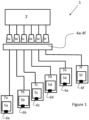
- Fig. 1 A heat exchange arrangement.
- the Fig. 1 shows a heat exchange arrangement 1 comprising a controller 2, heat exchange adjusters 3a-3f, flow valve comprising a manifold, wherein a heat exchange medium is flowing through the manifold comprising valves 4a-4f, wherein the valves 4a-4f are adjusted by the heat exchange adjusters 3a-3f.
- the heat exchange arrangement 1 comprises six heat exchange segments 5a-5f and six corresponding sensors 6a-6f (one for each heat exchange segment 5a-5f).
- the heat exchange arrangement 1 is a floor heating arrangement 1, wherein the heat exchange segments 5a-5f are floor heating segments 5a-5f, wherein each heat exchange segment 5a-5f is arranged in a corresponding room 7a-7f of a building.
- the installing person inputs assignments between the sensors 6a-6f and the heat exchange adjusters 3a-3f.
- the controller 2 stores the assignments in a memory (data storage).
- the assignments shall ensure that each of the sensors 6a-6f is correctly paired with the heat exchange adjuster 3a-3f for the heat exchange segment 5a-5f in the same room 7a-7f. However, the correctness of the manual assignments (the pairing) should be checked and documented.
- the controller 2 is operatively connected to the heat exchange adjusters 3a-3f.
- the heat exchange adjusters 3a-3f adjust the flow rates of the flow valves 4a-4f, such that each of the heat exchange segments 5a-5f is provided with the desired heat carrying medium. This allows influencing the temperatures in the respective room 7a-7f.
- the sensors 6a-6f provide individual measurement signals for each room 7a-7f.
- the sensors 6a-6f are, for example, room temperature sensors, floor temperature sensors, or a combination of a room temperature sensor and a floor temperature sensor, which determine the temperature of elements adjacent to the heat exchange segment 5a-5f. To do so, the sensors 6a-6f are, for example, infrared temperature sensors and/or wired temperature sensors, especially infrared floor temperature sensors and/or wired floor temperature sensors.
- the floor temperature sensors are more responsive and sensitive regarding a heat exchange output provided by the heat exchange segments 5a-5f compared to a room temperature sensors.
- the sensors 6a-6f determine the temperatures (e.g. the floor temperatures) at the corresponding heat exchange segments 5a-5f, wherein the corresponding sensor 6a-6f and heat exchange segment 5a-5f are arranged in the same room 7a-7f, respectively.
- the infrared temperature sensors determine a surface temperature of the respective floor, wall, ceiling or alike, while the wired sensors determine temperatures below a surface of the floor, wall, ceiling, or of the room air.
- the information provided by one the sensors 6a-6f is called (individual) measurement signal, respectively.
- the temperature sensed by the corresponding sensor 6a-6f is indicative of the heat exchange output provided by this individual heat exchange segment 5a-5f.
- a monitoring system comprising the controller 2 and the sensors 6a-6f is able to monitor the respective room temperatures and provide adjustment signals to the heat exchange adjusters 3a-3f which control the flow valves 4a-4f.
- the heat exchange adjusters 3a-3f can be wax motors and/or electromagnetic motors, for example.
- Each of the heat exchange adjusters 3a-3f can set the corresponding flow valve 4a-4f at least to a closed state and a fully open state.
- several of, or all of the heat exchange adjusters 3a-3f can be configured to set the corresponding flow valve(s) to different opening degrees.
- the controller 2 performs a test scheme. To do so, the controller 2 sets a unique individual target temperature value for each room 7a-7f. Such target temperature values are for example 18°C, 20°C, 22°C, 24°C, 26°C and 28°C.
- the target temperature values should be sufficiently different from initial temperatures in the rooms 7a-7f after all flow valves 4a-4f have been closed for at least a predetermined period of time. Just for example, it might be assumed that the initial temperatures are 10 °C, respectively.
- the target temperature values should be below 29°C in order to prevent damaging the building, in particular the floor.
- Each of the unique individual target temperature values can be differ by at least 1 °C, maybe by at least 2°C, from the most similar unique individual target temperature values to assure that tolerances do not lead to a misinterpretation of sensor data.
- the room temperatures may be monitored by the sensors 6a-6f over a period of time, for example for 24 hours. During this period, the heat exchange segments 5a-5f should provide a desired heat exchange output resulting in the desired room temperature.
- the controller 2 controls the individual heat exchange adjusters 3a-3f in order to reach the respective target temperature values. For example, the controller 2 may compare the present temperature indicated by the individual measurement signal from the individual sensor 6a-6f with the target temperature value that shall be reached at this individual sensor 6a-6f, respectively. As long as the present temperature is too low, the controller 2 triggers the heat exchange adjuster 3a-3d to which this individual sensor 6a-6f is assigned in order to open the corresponding flow valve 4a-4f.
- a heat exchange medium e.g.
- warm water is supplied to the corresponding heat exchange segment 5a-5f, which in turn provides a heat exchange output at the corresponding room 7a-7f, e.g. in the form of heating the floor of this room 7a-7f.
- the controller 2 controls the corresponding heat exchange adjuster 3a-3f to close the corresponding valve 4a-4f. Hence, the heat exchange output at the corresponding heat exchange segment 5a-5f is stopped.
- the individual measurement signals provided by the sensors 6a-6f for each room can be determined at intervals, and/or can be statistically processed, e.g. to determine an average, a median and/or alike. After the period of 24 hours, the statistically processed individual measurement signals are compared to the target temperature values for each room 7a-7f. If the target temperature value and the corresponding measured temperature in the respective room are identical, or at least close (e.g. in accordance with a predetermined criterion, e.g. within a predetermined tolerance range), the respective heat exchange segment 5a-5f coupled to the corresponding heat exchange adjuster 3a-3f is correctly assigned in the controller 2 with the correct sensor 6a-6f. If the target temperature value and the measured temperature is not within certain tolerances after a predetermined time with respect to an individual sensor 6a-6f, the assignment for this individual sensor 6a-6f is not correct.
- a predetermined criterion e.g. within a predetermined tolerance range
- the first sensor 6a in the first room 7a is incorrectly assigned with the second heat exchange adjuster 3b for the second heat exchange segment 5b in the second room 7b.
- the second sensor 6b in the second room 7b is wrongly assigned with the first heat exchange adjuster 3a for the first heat exchange segment 5a in the first room 7a.
- the controller sets the (first) unique target temperature value for the first sensor 6a to 18 °C and the (second) unique target temperature value for the second sensor 6b to 24 °C. Assuming the same triggering times and heating rates in the two rooms 7a, 7b, the temperatures in both rooms 7a, 7b will reach 18 °C after some time.
- the controller 2 controls the wrongly assigned second heat exchange adjuster 3b to close the corresponding second flow valve 4b.
- the second heat exchange segment 5b stops providing heat exchange output (i.e. heating) to the second room 7b.
- the second sensor 6b which is installed in the second room 7b.
- the temperature measured by the second sensor 6b will never reach the first unique target temperature value of 24 °C but will remain at 18 °C.
- the controller 2 will instead ongoingly control the first exchange adjuster 3a to maintain the first flow valve 4a open and hence heat first room 7a (instead of the second room 7b).
- the temperature at the first room 7a increases further far beyond the second unique target temperature value of 18 °C.
- the controller 2 determines after the predefined time that the assignments of the sensors 6a and 6b are incorrect, respectively.
- the controller 2 may correct the assignment automatically.
- the controller 2 may also automatically correct the assignments by assigning the first sensor 6a with the first heat exchange adjuster 3a and the second sensor 6b with the second heat exchange adjuster 3b.
- each of the sensors 6a-6f is assigned with (paired with) the correct heat exchange adjuster 3a-3f, it is sufficient to provide an assessment for the number of heat exchange adjusters 3a-3f minus one. This is based on the fact that there is exactly one sensor 6a-6f and exactly one heat exchange adjuster 3a-3f for each one of the heat exchange segments 5a-5f. Exactly one of the sensor 6a-6f is assigned with exactly one of the heat exchange adjusters 3a-3f. If the assignment is wrong for one heat exchange adjuster 3a-3f, the assignment for another heat exchange adjuster 3a-3f must be wrong, too. However, the verification is even more reliable if each and every assignment is explicitly verified.
- two or more sensors 6a-6f are installed at this heat exchange segment 5a-5f and in the same room 7a-7f. These two or more sensors 6a-6f should be assigned to the heat exchange adjuster 3a-3f of said at least one of the heat exchange segment 5a-5f.
- the present invention is also applicable for such embodiments.
- the verification process is performed automatically without further input of a person. If there are more than seven heat exchange segments 5a-5f (and respectively heat exchange adjusters 3a-3f), the heat exchange segments 5a-5f (respectively heat exchange adjusters 3a-3f) are split into two groups, while for each of the groups the verification process is performed. Groups of maximum six heat exchange segments 5a-5f (respectively heat exchange adjusters 3a-3f) are desired.
- the controller 2 comprises a data storage, which stores the unit target temperature values, the assignments between the heat exchange adjusters 3a-3f, and the measurement signals received during performing the test scheme.
- the controller 2 may starts the verification functionality in response to a corresponding input from the external device and/or transmit results regarding the assignments obtained by the verification functionality to the external device (not shown).
- the external device e.g. a smartphone, notebook, tablet or alike, can be used to initiate the verifying process and to receive the results of the verifying process from the controller 2.
- the external device is at least temporarily in data connection with the controller 2.
- the external device is connected to the controller 2 to initiate the verifying process, and to obtain the results or information required to determine the correctness of the assignments in the controller 2 between the inputs for the measurement signals from the sensors 6a-6f and the control output to the heat exchange adjusters 3a-3f.
- information in form of data may be stored in the data storage of the controller 2.
- the data storage may store instructions regarding the test scheme.
- the person can assess whether the coupling respectively assignment of the heat exchange segments 5a-5f and the corresponding heat exchange adjusters 3a-3f is correct and use this information for documentation purposes.
- the controller 2 is comprised in a control system for controlling the heat exchange arrangement 1.
- the control arrangement controls the heat exchange adjusters 3a-3f and thus the flow valves 4.
- the system may include at least the controller 2, the heat exchange adjusters 3a-3f, and the sensors 6a-6f.
- the system may also comprise the flow valves 4a-4f. It is possible that flow valves 4a-4f include the heat exchange adjusters 3a-3f.
- the sensors 6a-6f are comprised in a sensor arrangement, which can comprise further sensors.
- the sensors 6a-6f can be included in thermostats.
- the thermostats allow the users to set user-targets for the temperatures at the respective thermostats (in normal operation different from the automatic verification functionality).
- the thermostats transmit the user-targets to the controller 2.
- the controller 2 regulates the assigned heat exchange adjuster 3a-3f for the individual heat exchange segment 5a-5f based on the user-target for the temperature at the assigned thermostat and the individual measurement signal received from the temperature sensor 6a-6f in the thermostat.
- the controller 2 is optionally configured to determine the assignments completely itself (without requiring manual first input of the assignments). To do so, the controller 2 provides a control signal to a first heat exchange adjuster 3a. Subsequently, one of the heat exchange segments 5a-5f will provide a heat exchange output which is detectable by the respective sensor 6a-6f. Based on the sensor output, the controller 2 assigns the first heat exchange adjuster 3a with the corresponding sensor 6a. In a next step, the controller 2 provides a control signal to another heat exchange adjuster 3b and repeats the process.
- the controller 2 applies a test scheme in which it triggers the heat exchange adjusters 3a-3f one after another to open their respective flow valve 4a-4f.
- the controller 2 may avoid that more than one of the flow valves 4a-4f is open at the same time during the test scheme.
- the controller 2 monitors the individual measurement signals from the sensors 6a-6f.
- the individual heat exchanger adjuster 3a-3f is triggered, the heat exchange medium starts to flow into the corresponding heat exchange segment 5a-5f.
- the floor temperature at the corresponding heat exchange segment 5a-5f then increases quickly, whereas the floor temperatures at the other heat exchange segments 5a-5f remain substantially the same.
- the controller 2 may detect the significant temperature increase indicated by the corresponding measurement signal from the sensor 6a-6f which observes the floor temperature at the sole heat exchange segment 5a-5f that currently provides heating. Alternatively or in addition, the controller 2 may detect that a temperature gradient over time that is derived from this measurement signal exceeds a predetermined threshold and/or exceeds an average of the temperature gradients derived from the other measurement signals during a same time period. Based on the detection, the controller 2 assigns the measurement signal responding to the triggering (in the form of the increasing temperature / high temperature gradient over time) to the currently triggered heat exchange adjuster 3a-3f.
- the same approaches can be used with room temperature sensors but the room temperature may respond slower to the opening of the respective flow valve 4a-4d than the floor temperature.
- the heat exchange arrangement 1 includes thermostats with both a floor temperature sensor (e.g. as sensors 6a-6f) and a room temperature sensor in the same device (not shown), it may be sufficient to determine and/or check the assignments for the floor temperature sensors since the room temperature sensor of the same device is naturally at the same location as the floor temperature sensor.
- a floor temperature sensor e.g. as sensors 6a-6f
- a room temperature sensor in the same device
Landscapes
- Engineering & Computer Science (AREA)
- Mechanical Engineering (AREA)
- General Engineering & Computer Science (AREA)
- Physics & Mathematics (AREA)
- Chemical & Material Sciences (AREA)
- Combustion & Propulsion (AREA)
- Thermal Sciences (AREA)
- Computer Hardware Design (AREA)
- Health & Medical Sciences (AREA)
- Biomedical Technology (AREA)
- Remote Sensing (AREA)
- General Physics & Mathematics (AREA)
- Automation & Control Theory (AREA)
- Air Conditioning Control Device (AREA)
Priority Applications (1)
| Application Number | Priority Date | Filing Date | Title |
|---|---|---|---|
| EP23197595.4A EP4524480A1 (de) | 2023-09-15 | 2023-09-15 | Verifizierung für eine wärmetauscheranordnung |
Applications Claiming Priority (1)
| Application Number | Priority Date | Filing Date | Title |
|---|---|---|---|
| EP23197595.4A EP4524480A1 (de) | 2023-09-15 | 2023-09-15 | Verifizierung für eine wärmetauscheranordnung |
Publications (1)
| Publication Number | Publication Date |
|---|---|
| EP4524480A1 true EP4524480A1 (de) | 2025-03-19 |
Family
ID=88092850
Family Applications (1)
| Application Number | Title | Priority Date | Filing Date |
|---|---|---|---|
| EP23197595.4A Pending EP4524480A1 (de) | 2023-09-15 | 2023-09-15 | Verifizierung für eine wärmetauscheranordnung |
Country Status (1)
| Country | Link |
|---|---|
| EP (1) | EP4524480A1 (de) |
Citations (5)
| Publication number | Priority date | Publication date | Assignee | Title |
|---|---|---|---|---|
| EP1640669A1 (de) | 2004-09-24 | 2006-03-29 | Danfoss A/S | Raumbeheizungseinrichtung |
| DE102012020750B4 (de) * | 2012-10-23 | 2017-02-16 | Michael Sparn | Verfahren zur Optimierung eines thermischen und eines hydraulischen Abgleichs in einer Temperieranlage |
| EP3425291A1 (de) * | 2017-07-07 | 2019-01-09 | REHAU AG + Co | Verfahren zur zuordnung eines heizkreis-temperaturfühlers eines heiz- und/oder kühlsystems zum betreffenden heizkreis oder zur überprüfung der zuordnung eines heizkreis-temperaturfühlers eines heiz- und/oder kühlsystems zum betreffenden heizkreis |
| EP3034955B1 (de) * | 2014-12-18 | 2021-02-17 | Robert Bosch GmbH | Verfahren zum durchführen eines automatisierten hydraulischen abgleich einer heinzungsanlage |
| DE102021110134A1 (de) * | 2021-04-21 | 2022-10-27 | Viessmann Climate Solutions Se | Verfahren, steuerung, system und computerprogramm-produkt zum steuern einer heizungs- und/oder klimaanlage |
-
2023
- 2023-09-15 EP EP23197595.4A patent/EP4524480A1/de active Pending
Patent Citations (5)
| Publication number | Priority date | Publication date | Assignee | Title |
|---|---|---|---|---|
| EP1640669A1 (de) | 2004-09-24 | 2006-03-29 | Danfoss A/S | Raumbeheizungseinrichtung |
| DE102012020750B4 (de) * | 2012-10-23 | 2017-02-16 | Michael Sparn | Verfahren zur Optimierung eines thermischen und eines hydraulischen Abgleichs in einer Temperieranlage |
| EP3034955B1 (de) * | 2014-12-18 | 2021-02-17 | Robert Bosch GmbH | Verfahren zum durchführen eines automatisierten hydraulischen abgleich einer heinzungsanlage |
| EP3425291A1 (de) * | 2017-07-07 | 2019-01-09 | REHAU AG + Co | Verfahren zur zuordnung eines heizkreis-temperaturfühlers eines heiz- und/oder kühlsystems zum betreffenden heizkreis oder zur überprüfung der zuordnung eines heizkreis-temperaturfühlers eines heiz- und/oder kühlsystems zum betreffenden heizkreis |
| DE102021110134A1 (de) * | 2021-04-21 | 2022-10-27 | Viessmann Climate Solutions Se | Verfahren, steuerung, system und computerprogramm-produkt zum steuern einer heizungs- und/oder klimaanlage |
Similar Documents
| Publication | Publication Date | Title |
|---|---|---|
| US11112137B2 (en) | HVAC performance monitoring system | |
| US7448435B2 (en) | System and method for controlling a multi-zone heating or cooling system | |
| US20190195523A1 (en) | Variable Differential Variable Delay Thermostat | |
| US9476623B2 (en) | Multiple-unit air conditioning apparatus | |
| US6711471B2 (en) | Zone of greatest demand controller, apparatus, and method | |
| RU2559690C2 (ru) | Способ и устройство регулировки температуры в группе комнат здания | |
| CN108224690B (zh) | 用于平衡建筑物内的温度的系统和方法 | |
| US9335063B2 (en) | Detection of damper motor mechanically disconnected from damper assembly | |
| US20240263825A1 (en) | A method of commissioning physical hvac devices of an hvac system for an hvac application | |
| RU2709974C1 (ru) | Система регулирования температуры | |
| JP6885234B2 (ja) | 全館空調システム | |
| CN111006306B (zh) | 一种多联机 | |
| US20180180301A1 (en) | Temperature synchronization in a smart thermal management system | |
| CN109812929B (zh) | 空气调节系统 | |
| KR20210022866A (ko) | 지역난방 방식 공동주택 난방 시스템의 점검방법 | |
| KR20050073637A (ko) | 난방구역별 온도조절이 가능한 개별난방시스템 | |
| EP4610576A1 (de) | Steuerungssystem und -verfahren für eine vielzahl von thermostaten | |
| WO2005073639A1 (ja) | 設備機器の制御装置 | |
| KR20220079286A (ko) | 유량 제어를 통한 난방 관리 시스템 및 이를 이용한 난방 관리 방법 | |
| EP3901711B1 (de) | Fernwartung | |
| US20240295329A1 (en) | Device for controlling set heating temperature, heating system, and method for determining insulation rating thereof | |
| JP4678734B2 (ja) | 温水暖房システム及びその試運転制御方法 | |
| US20200408422A1 (en) | Automated temperature control of heating radiators | |
| JPWO2020121363A1 (ja) | 冷凍システムの接続関係判定装置、冷凍システムおよびプログラム | |
| JP2020125880A (ja) | 暖房システム |
Legal Events
| Date | Code | Title | Description |
|---|---|---|---|
| PUAI | Public reference made under article 153(3) epc to a published international application that has entered the european phase |
Free format text: ORIGINAL CODE: 0009012 |
|
| STAA | Information on the status of an ep patent application or granted ep patent |
Free format text: STATUS: THE APPLICATION HAS BEEN PUBLISHED |
|
| AK | Designated contracting states |
Kind code of ref document: A1 Designated state(s): AL AT BE BG CH CY CZ DE DK EE ES FI FR GB GR HR HU IE IS IT LI LT LU LV MC ME MK MT NL NO PL PT RO RS SE SI SK SM TR |
|
| STAA | Information on the status of an ep patent application or granted ep patent |
Free format text: STATUS: REQUEST FOR EXAMINATION WAS MADE |
|
| 17P | Request for examination filed |
Effective date: 20250826 |