EP4524643A1 - Vorrichtung zur erzeugung schmaler strahlen - Google Patents
Vorrichtung zur erzeugung schmaler strahlen Download PDFInfo
- Publication number
- EP4524643A1 EP4524643A1 EP23803406.0A EP23803406A EP4524643A1 EP 4524643 A1 EP4524643 A1 EP 4524643A1 EP 23803406 A EP23803406 A EP 23803406A EP 4524643 A1 EP4524643 A1 EP 4524643A1
- Authority
- EP
- European Patent Office
- Prior art keywords
- light
- concentrating means
- narrow beam
- ray
- ray concentrating
- Prior art date
- Legal status (The legal status is an assumption and is not a legal conclusion. Google has not performed a legal analysis and makes no representation as to the accuracy of the status listed.)
- Pending
Links
Images







Classifications
-
- G—PHYSICS
- G02—OPTICS
- G02B—OPTICAL ELEMENTS, SYSTEMS OR APPARATUS
- G02B5/00—Optical elements other than lenses
- G02B5/001—Axicons, waxicons, reflaxicons
-
- G—PHYSICS
- G02—OPTICS
- G02B—OPTICAL ELEMENTS, SYSTEMS OR APPARATUS
- G02B19/00—Condensers, e.g. light collectors or similar non-imaging optics
- G02B19/0004—Condensers, e.g. light collectors or similar non-imaging optics characterised by the optical means employed
- G02B19/0028—Condensers, e.g. light collectors or similar non-imaging optics characterised by the optical means employed refractive and reflective surfaces, e.g. non-imaging catadioptric systems
-
- G—PHYSICS
- G02—OPTICS
- G02B—OPTICAL ELEMENTS, SYSTEMS OR APPARATUS
- G02B17/00—Systems with reflecting surfaces, with or without refracting elements
- G02B17/08—Catadioptric systems
- G02B17/0804—Catadioptric systems using two curved mirrors
- G02B17/0808—Catadioptric systems using two curved mirrors on-axis systems with at least one of the mirrors having a central aperture
-
- G—PHYSICS
- G02—OPTICS
- G02B—OPTICAL ELEMENTS, SYSTEMS OR APPARATUS
- G02B19/00—Condensers, e.g. light collectors or similar non-imaging optics
- G02B19/0033—Condensers, e.g. light collectors or similar non-imaging optics characterised by the use
- G02B19/0047—Condensers, e.g. light collectors or similar non-imaging optics characterised by the use for use with a light source
-
- G—PHYSICS
- G02—OPTICS
- G02B—OPTICAL ELEMENTS, SYSTEMS OR APPARATUS
- G02B19/00—Condensers, e.g. light collectors or similar non-imaging optics
- G02B19/0033—Condensers, e.g. light collectors or similar non-imaging optics characterised by the use
- G02B19/0047—Condensers, e.g. light collectors or similar non-imaging optics characterised by the use for use with a light source
- G02B19/0052—Condensers, e.g. light collectors or similar non-imaging optics characterised by the use for use with a light source the light source comprising a laser diode
-
- G—PHYSICS
- G02—OPTICS
- G02B—OPTICAL ELEMENTS, SYSTEMS OR APPARATUS
- G02B27/00—Optical systems or apparatus not provided for by any of the groups G02B1/00 - G02B26/00, G02B30/00
- G02B27/09—Beam shaping, e.g. changing the cross-sectional area, not otherwise provided for
- G02B27/0927—Systems for changing the beam intensity distribution, e.g. Gaussian to top-hat
-
- G—PHYSICS
- G02—OPTICS
- G02B—OPTICAL ELEMENTS, SYSTEMS OR APPARATUS
- G02B27/00—Optical systems or apparatus not provided for by any of the groups G02B1/00 - G02B26/00, G02B30/00
- G02B27/09—Beam shaping, e.g. changing the cross-sectional area, not otherwise provided for
- G02B27/0938—Using specific optical elements
- G02B27/095—Refractive optical elements
Definitions
- the present invention relates to a narrow beam generating device.
- an integrated photonics module which includes one or more light sources such as lasers, a beam shaping optical element, a coupling optical element, a MEMS scanner, and one or more mechanical components such as an optical frame, to facilitate installation and maintain optical arrangement (see, for example, Patent Document 1).
- LBS laser beam steering
- beams that scan the retina preferably have an extremely small diameter (e.g., about 20 ⁇ m).
- an extremely small diameter e.g., about 20 ⁇ m.
- the spot beams which have extremely small beam diameters in specific distances, have large beam diameters at positions before and after the focal distance. Accordingly, since the distance for images to reach the retina in the glasses-type display devices is different for each wearer of the glasses due to individual differences, there was an issue that a fine adjustment mechanism was necessary for adjusting the distance.
- the present invention has been made in view of the above-stated circumstances, and an object of the present invention is to provide a narrow beam generating device that can generate a linear narrow beam having a diameter of a prescribed size or less, on the basis of light emitted from any light source, independent of the distance from an emission position.
- the present invention can provide a narrow beam generating device that can generate a linear narrow beam having a diameter of a prescribed size or less, on the basis of light emitted from any light source, independent of the distance from an emission position.
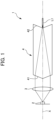
- a narrow beam generating device 1 includes a light source 2, a collimator optical element 3 as the light condensing means, and an optical element 4.
- the optical element 4 is an optical element formed by integrating a convex axicon surface 41 that is the first ray concentrating means and a concave axicon surface 42 that is the second ray concentrating means.
- the collimator optical element 3 and the optical element 4 are located so that their optical axes are roughly equal to an optical axis X.
- the optical axes of the collimator optical element 3 and the optical element 4 do not necessarily need to be in the center of the optical axis X, and there may be some axis deviation.
- a narrow beam L1 is generated with a position immediately after light emission from the concave axicon surface 42 of the optical element 4 as a start point.
- the size of a diameter of the narrow beam L1 is principally constant independent of the distance from an emission position, and the length of the narrow beam L1 is infinity in principle.
- the applications of the narrow beam generating device 1 that can generate the narrow beam L1 are not particularly limited, and the narrow beam generating device 1 is applicable to various types of projectors, displays, laser processing devices, lighting devices, optical communication devices, optical memory devices, optical information processing devices, and the like.
- the beam diameter of the narrow beam L1 can be a prescribed size or less
- the narrow beam L1 is hardly divergent at a given length (up to infinity in principle) in an optical axis X direction
- the beam diameter of narrow beam L1 is mostly constant independent of the distance from the emission position. This makes it unnecessary to adjust the focal position.
- the narrow beam generating device 1 is preferably applicable to retinal scan displays.
- the beam diameter of the narrow beam L1 can be, for example, 50 ⁇ m or less, 20 ⁇ m or less, and 10 ⁇ m or less.
- the narrow beam generating device 1 In the case of applying the narrow beam generating device 1 to photolithography, in addition to the above application, direct drawing of high-definition photo masks can be realized without a precise focus mechanism. In the case of applying the narrow beam generating device 1 to laser processing devices, laser processed holes, which had to be tapered in the past, can be formed to have a uniform depth. Furthermore, the energy of the narrow beam L1 per end surface area is very high as compared with conventional lasers, and therefore when the narrow beam generating device 1 is applied to shearing devices, sufficient processing can be performed even with a laser oscillator that has a smaller output than conventional lasers. In addition, when the narrow beam generating device 1 is applied to sensing technology, high-resolution sensing is possible without depending on the sensing distance. In the case of coupling the narrow beam generating device 1 and an optical fiber, there is a possibility that the coupling efficiency for inputting light to single-mode optical fibers can be improved to 90% or more, as compared with conventional coupling efficiency of about 30%.
- the light source 2 may be any light source, such as a semiconductor laser (LD), an LED, or a surface light source.
- the light source 2 is not particularly limited, and any light source can be used since neither spatial coherence nor temporal coherence is required.
- the light source 2 may be able to adjust and modulate the light intensity by a light source driver that serves as a power source, or the like.
- the light source 2 may include a plurality of light sources emitting the same or different wavelengths. For example, a light source that combines light of R, G, and B using a plurality of light sources may be adopted.
- the collimator optical element 3 as the light condensing means is an optical element on which light emitted from the light source 2 is incident.
- the collimator optical element 3 converts the incident light into parallel light that is parallel to the optical axis X, and emits the parallel light.
- Examples of the collimator optical element 3 as the light condensing means may include collimator lenses, mirrors, and diffraction optical elements (DOE).
- DOE diffraction optical elements
- the diffraction optical elements which have a fine uneven structure on the surface, can spatially branch light by utilizing the diffraction phenomenon of light and output the light with a desired pattern and shape.
- a plurality of collimator optical elements 3 is also provided in accordance with the number of the light sources 2 .
- collimator optical systems are used for light sources with divergent characteristics, though in the case of light sources without divergent characteristics, light may be made incident on subsequent optical systems directly or by using beam expanders without using the collimator optical systems, depending on the subsequent optical systems.
- the light condensing means is not limited to a means for generating perfect collimated light, and any light condensing means may be used as long as divergent light rays from the light source are condensed within a prescribed three-dimensional angle range.
- the optical element 4 is an optical element on which the parallel light generated by the collimator optical element 3 is incident.
- the optical element 4 includes the convex axicon surface 41 that is the first ray concentrating means and the concave axicon surface 42 that is the second ray concentrating means different in shape from the convex axicon surface 41.
- Both the convex axicon surface 41 and the concave axicon surface 42 are refractive surfaces that are odd-order aspherical.
- the parallel light is incident on the convex axicon surface 41, and the narrow beam L1 is emitted from the vertex of the concave axicon surface 42. As shown in FIG.
- the convex axicon surface 41 and the concave axicon surface 42 are located so that their vertices of the axicon surfaces are on the optical axis X.
- the convex axicon surface 41 is located facing an incident side of the parallel light and the concave axicon surface 42 is located facing an emission side of the parallel light.
- the convex axicon surface 41 and the concave axicon surface 42 are a straight conical surface and a straight conical inner surface with the same vertex angle.
- the narrow beam generating device 1 is configured to be compact as compared with, for example, the case where the first ray concentrating means and the second ray concentrating means are both convex axicon surfaces.
- the convex axicon surface 41 has a function of concentrating the parallel light generated by the collimator optical element 3 into an area narrower than the incident light flux.
- the concave axicon surface 42 is located at the position where the rays are concentrated by the convex axicon surface 41. Specifically, the vertex of the conical inner surface of the concave axicon surface 42 is located in the vicinity of a portion farthest from the position where the parallel light is concentrated by the convex axicon surface 41 (the position where a Bessel beam is generated).
- the optical element 4 is an optical element constituted of a material having light transparency, such as glass, and is configured by integrating the convex axicon surface 41 that is the first ray concentrating means and the concave axicon surface 42 that is the second ray concentrating means.
- an optical element having the convex axicon surface 41 and an optical element having the concave axicon surface 42 may be installed as separate optical elements, though these optical elements are preferably configured as an integrated optical element, like the optical element 4. This makes it unnecessary to adjust the positions of the convex axicon surface 41 and the concave axicon surface 42 as compared with the case where separate optical elements are installed, and therefore the narrow beam L1 having a desired beam diameter can be generated with high accuracy.
- the configuration of the narrow beam generating device 1 can be simplified.
- FIG. 8 shows the results of an optical simulation performed using the narrow beam generating device 1 according to the first embodiment and optical design software ZEMAX (registered trademark) (manufactured by ZEMAX Development Corporation).
- FIG. 8 shows the results of outputting irradiance distribution in the above optical simulation, with detectors installed on a plane perpendicular to the optical axis X at respective positions where distance D from the concave axicon surface 42 was 100 mm, 500 mm, and 1000 mm.
- vertical and horizontal axes correspond to a detector size (20 ⁇ m on each side) (unit: mm)
- Table 1 shows the details of each component of the narrow beam generating device 1 according to the first embodiment.
- Z represents a displacement amount (sag amount) of a surface parallel to the optical axis
- H represents the height of an incident ray
- R represents a curvature radius of a base surface
- K represents a conic constant
- ⁇ n represents an aspherical coefficient relative to n-th power of H.
- the surface interval (mm) in Table 1 indicates an interval to a next surface on the optical axis X in an incident direction.
- the refractive index in Table 1 refers to the refractive index (relative refractive index) of a medium on the emission side relative to the refractive index of the medium on the incident side.
- the narrow beams generated by the narrow beam generating device 1 have diameters maintained to be a prescribed diameter of a few ⁇ m or less independent of the distance from the emission position.
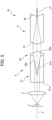
- a narrow beam generating device 1a includes the light source 2, the collimator optical element 3 as the light condensing means, and an optical element 4a.
- the optical element 4a includes an axicon mirror 41a and an axicon mirror 42a.
- the components other than the optical element 4a in the narrow beam generating device 1a are the same as those of the narrow beam generating device 1 according to the first embodiment.
- the first ray concentrating means and the second ray concentrating means are constituted of reflective surfaces that are odd-order aspherical. This makes it possible to generate a narrow beam L2 having stable characteristics independent of the wavelength of the incident light.
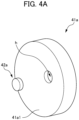
- the axicon mirror 41a has a concave axicon surface 41a1 as the first ray concentrating means, and the axicon mirror 42a has a convex axicon surface 42a1 as the second ray concentrating means.
- Both the concave axicon surface 41a1 and the convex axicon surface 42a1 are reflective surfaces that are odd-order aspherical.
- Parallel light generated by the collimator optical element 3 is incident on the concave axicon surface 41a1, and reflected light concentrated and reflected by the concave axicon surface 41a1 is incident on the convex axicon surface 42a1.
- the reflected light concentrated and reflected by the convex axicon surface 42a1 is then concentrated and emitted as a narrow beam L2 through a hole portion h formed in the axicon mirror 41a.
- the concave axicon surface 41a1 and the convex axicon surface 42a1 are located so that their respective vertices of the axicon surfaces are on the optical axis X.
- the concave axicon surface 41a1 is located facing the incident side of the parallel light generated by the collimator optical element 3, and the convex axicon surface 42a1 is located between the collimator optical element 3 and the concave axicon surface 41a1 so as to face the concave axicon surface 41a1.
- the concave axicon surface 41a1 and the convex axicon surface 42a1 are a straight conical surface or a straight conical inner surface with the same vertex angle, and the convex axicon surface 42a1 is smaller in bottom area than the concave axicon surface 41a1.
- the concave axicon surface 41a1 has a function of reflecting the parallel light generated by the collimator optical element 3 and concentrating the parallel light into an area narrower than the incident light flux.
- the vertex of the convex axicon surface 42a1 is located at the position where the parallel light is concentrated by the concave axicon surface 41a1.
- outermost rays of the light flux incident with some extent on the concave axicon surface 41a1 are concentrated by the concave axicon surface 41a1 and are incident on the convex axicon surface 42a1.
- the rays concentrated by reflection are then emitted from the vertex of the convex axicon surface 42a1 as the narrow beam L2 parallel to the optical axis X. Since the outermost rays are concentrated in the vicinity of the optical axis X, the narrow beam L2 with strong light intensity is emitted.
- the hole portion h is formed at the position corresponding to the vertex of the conical inner surface of the concave axicon surface 41a1, as shown in FIGS. 4A and 4B .
- the hole portion h is a hole portion that allows the narrow beam L2 emitted from the vertex of the convex axicon surface 42a1 to pass through, and the diameter of the hole portion h is sufficiently larger than the diameter of the narrow beam L2.
- the diameter of the hole portion h is not particularly limited, and can be equal to or less than a projected shape of the axicon mirror 42a in an optical axis X direction, for example.
- the narrow beam generating device 1a is configured so that the axicon mirror 41a includes the hole portion h and the narrow beam L2, emitted from the axicon mirror 42a, is emitted through the hole portion h. This allows the narrow beam generating device 1a to have a compact configuration.
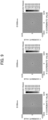
- FIG. 9 shows the results of an optical simulation performed using the narrow beam generating device 1a according to the second embodiment and the optical design software ZEMAX (registered trademark) (manufactured by ZEMAX Development Corporation).
- FIG. 9 shows the results of outputting irradiance distribution in the above optical simulation, with detectors installed on a plane perpendicular to the optical axis X at respective positions where distance D from the hole portion h was 100 mm, 500 mm, and 1000 mm.
- vertical and horizontal axes correspond to a detector size (20 ⁇ m on each side) (unit: mm)
- Both the conical inner surface of the concave axicon surface 41a1 and the conical surface of the convex axicon surface 42a1 had vertex angles of 20 degrees, the distance between the vertex angles was 3 mm, the diameter of a bottom surface of the conical inner surface of the concave axicon surface 41a1 was 6 mm, and the diameter of a bottom surface of the conical surface of the convex axicon surface 42a1 was 1 mm.
- Table 2 below shows the details of each component of the narrow beam generating device 1a according to the second embodiment.
- the narrow beams generated by the narrow beam generating device 1a have a diameter maintained to be a prescribed diameter of a few ⁇ m or less, independent of the distance from the emission position.
- a narrow beam generating device 1b includes, as shown in FIG. 5 , the light source 2, the collimator optical element 3 as the light condensing means, a critical angle axicon element 5, and the optical element 4.
- the components other than the critical angle axicon element 5 in the narrow beam generating device 1b are the same as those of the narrow beam generating device 1 according to the first embodiment.
- the narrow beam generating device 1b is configured so that the critical angle axicon element 5 as the annular light condensing means (annular light condensing element) is located between the collimator optical element 3 and the optical element 4.
- the critical angle axicon element 5 as the annular light condensing means (annular light condensing element)
- the only light that contributes to the generation of the narrow beam is the light in the vicinity of an outer circumference of the optical element 4 as viewed from the optical axis X direction. Therefore, it is possible to generate the narrow beam, though it cannot be said that use efficiency of the incident light is high.
- the critical angle axicon element 5 has a function of concentrating and emitting the parallel light emitted from the collimator optical element 3 as annular light in the vicinity of the outer circumference of the optical element 4 as viewed from the direction of the optical axis X direction.
- the narrow beam generating device 1b can achieve the improved use efficiency of the incident light as compared with the narrow beam generating device 1 without the critical angle axicon element 5.
- the critical angle axicon element 5 is constituted of an optical element 51 that is the first optical element and an optical element 52 that is the second optical element located in order from the incident side.
- the optical element 51 has a plane 51a located on the incident side so that the parallel light emitted from the collimator optical element 3 is perpendicularly incident thereon, and also has a concave axicon surface 51b that is a straight conical inner surface on the emission side.
- the optical element 52 has a convex axicon surface 52a that is a straight conical surface with the same vertex angle as the concave axicon surface 51b on the incident side, and also has a convex axicon surface 52b on the emission side.
- the concave axicon surface 51b and the convex axicon surface 52a are located in contact with each other.
- the concave axicon surface 51b and the convex axicon surface 52a may be bonded so as to allow light transmission, with an adhesive having appropriate optical characteristics.
- the refractive index of a material constituting the optical element 51 is different from the refractive index of the material constituting the optical element 52.
- the refractive index of the materials constituting the optical element 51 and the optical element 52 and the vertex angles of the concave axicon surface 51b and the convex axicon surface 52a are set so that the light emitted from the optical element 51 propagates along the convex axicon surface 52a.
- the light incident on the optical element 52 from the optical element 51 is refracted according to Snell's law on the concave axicon surface 51b (convex axicon surface 52a) that is a boundary surface.
- the refractive index of the material constituting the optical element 51 is N
- the refractive index of the material constituting the optical element 52 is N'
- light incident on the concave axicon surface 51b at an incidence angle ⁇ is refracted at an angle ⁇ ' that satisfies the following equation (2).
- the incidence angle ⁇ is substantially equal to 1/2 of the vertex angle of the concave axicon surface 51b and the convex axicon surface 52a.
- N ⁇ sin ⁇ N ' ⁇ sin ⁇ '
- the incidence angle ⁇ exceeds a so-called critical angle ⁇ c
- the light incident on the optical element 52 from the optical element 51 is totally reflected on the concave axicon surface 51b (convex axicon surface 52a) that is the boundary surface.
- the incidence angle ⁇ critical angle ⁇ c
- the incident light on the optical element 52 from the optical element 51 propagates along the convex axicon surface 52a.
- the relation between the refractive index N and the refractive index N' satisfies the following equation (3).
- the optical element 51 and the optical element 52 are configured so that the critical angle ⁇ c, calculated from the refractive index of each of the materials constituting the optical element 51 and the optical element 52, is substantially equal to 1/2 of the vertex angles of the concave axicon surface 51b and the convex axicon surface 52a, the light emitted from the optical element 51 can propagate along the convex axicon surface 52a.
- the light that has propagated along the convex axicon surface 52a in the optical element 52 is concentrated by the convex axicon surface 52b and emitted as annular parallel light.
- the annular parallel light emitted from the convex axicon surface 52b comes incident in the vicinity of the outer circumference of the optical element 4 as viewed from the optical axis X direction.
- the light incident on the optical element 4 is concentrated by the convex axicon surface 41 and is concentrated and emitted as the narrow beam L3 that is parallel to the optical axis X, from the vertex of the concave axicon surface 42.
- FIG. 10 shows the results of an optical simulation performed using the narrow beam generating device 1b according to the third embodiment and the optical design software ZEMAX (registered trademark) (manufactured by ZEMAX Development Corporation).
- FIG. 10 shows the results of outputting irradiance distribution in the above optical simulation, with detectors installed on a plane perpendicular to the optical axis X at positions where distance D from the concave axicon surface 42 was 100 mm, 500 mm, and 1000 mm.
- vertical and horizontal axes correspond to a detector size (20 ⁇ m on each side) (unit: mm)
- Table 3 shows the details of each component of the narrow beam generating device 1b according to the third embodiment.
- the diameters of the narrow beams generated by the narrow beam generating device 1b were 7.0 ⁇ m, 9.2 ⁇ m, and 12.0 ⁇ m when the distance D from the emission position was 100 mm, 500 mm, and 1000 mm, respectively. From the results, it was confirmed that the narrow beams with a diameter of 12 ⁇ m or less could be obtained when the distance D from the emission position was at least 1000 mm or less.
- the amount of light that forms the narrow beams was 87% of the incident light, which confirmed that the use efficiency of the incident light was about 100 times better than that of the narrow beam generating device 1 according to the first embodiment.
- a narrow beam generating device 1c includes, as shown in FIG. 6 , the light source 2, the collimator optical element 3 as the light condensing means, and an optical element 4b.
- the optical element 4b is constituted of an optical element 41b and an optical element 42b.
- the optical element 41b has a plane 41b1 located on the incident side so that the parallel light emitted from the collimator optical element 3 is perpendicularly incident thereon, and also has a convex axicon surface 41b2 that is a straight conical surface on the emission side.
- the optical element 42b has a concave axicon surface 42b1 that is a straight conical inner surface with the same vertex angle as the convex axicon surface 41b2 on the incident side, and also has an aspherical surface 42b2 on the emission side.
- the convex axicon surface 41b2 and the concave axicon surface 42b1 are located in contact with each other.
- the convex axicon surface 41b2 and the concave axicon surface 42b1 may be bonded so as to allow light transmission, with an adhesive having appropriate optical characteristics.
- the convex axicon surface 41b2 and the concave axicon surface 42b1 function as the first ray concentrating means.
- the optical element 4b has a configuration similar to the critical angle axicon element 5.
- the optical element 41b and the optical element 42b are constituted of light transmissive members different in refractive index, and the optical element 41b and the optical element 42b are configured so that the critical angle ⁇ c, calculated from the refractive index of each of the materials constituting the optical element 41b and the optical element 42b, is substantially equal to 1/2 of the vertex angles of the convex axicon surface 41b2 and the concave axicon surface 42b1. Therefore, the parallel light incident on the optical element 41b from the plane 41b1 is concentrated when the parallel light propagates along the concave axicon surface 42b1 in the optical element 42b.
- the narrow beam generating device 1c has the aspherical surface 42b2 as the second ray concentrating means.
- the aspherical surface 42b2 is located at the position where the rays are concentrated by the convex axicon surface 41b2 and the concave axicon surface 42b1 as the first ray concentrating means.
- the light concentrated by the convex axicon surface 41b2 and the concave axicon surface 42b1 is concentrated and emitted as a narrow beam L4 parallel to the optical axis X, from the vertex of the aspherical surface 42b2.
- the aspherical surface 42b2 is a refractive surface that is an odd-order aspherical surface having an axicon effect and introduced with a cubic term.
- Using the odd-order aspherical surface as the second ray concentrating means has the advantages of being less susceptible to influence of eccentricity, having a high degree of design freedom, and being easy to manufacture, as described below.
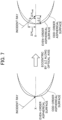
- FIG. 7 is a schematic view for comparing the influence of the eccentricity of incident rays when the rays are incident on an odd-order aspherical surface and an even-order aspherical surface.
- An odd-order aspherical surface Zodd and an even-order aspherical surface Zeven are defined, for example, by following equations (4) and (5), respectively.
- H refers to an incident height.
- Zodd H + H 3 + H 5
- Zeven H 2 + H 4 + H 6
- the second ray concentrating means such as the aspherical surface 42b2
- the second ray concentrating means needs to emit the rays concentrated in a narrow area in parallel and in the same direction. Accordingly, it is required to design the aspherical surface that is the second ray concentrating means so that a shape change amount remains within a relatively narrow range.
- Examples of the shape for meeting the above requirement may include axicon surfaces.
- the shape of the axicon surfaces is expressed, for example, by an equation (6) below. In the equation (6) below, ⁇ refers to a vertex inclination angle, and H refers to an incident height.
- Zaxicon tan ⁇ ⁇ H
- a shape change dispersion value by the incident height H is 0, which means that the smaller the shape change dispersion value, the closer to the characteristics of the axicon surface. Therefore, the odd-order aspherical surfaces smaller in shape change dispersion value than the even-order aspherical surfaces are more advantageous for increasing the degree of design freedom and maintaining the axicon effect. Since primary differential values of the aspherical shape distribution determines the emission direction of the rays, reducing a fluctuation amount of the primary differential values can reduce variation of the emitted rays in a propagation direction.
- the odd-order aspherical surfaces since tip shapes of the odd-order aspherical surfaces are more obtuse than those of the aspherical surfaces, the odd-order aspherical surfaces have an advantage of being easy to manufacture. Particularly, the odd-order aspherical surfaces introduced with high-order terms have a larger advantage of being easy to manufacture.
- FIG. 11 shows the results of an optical simulation performed using the narrow beam generating device 1c according to the fourth embodiment and the optical design software ZEMAX (registered trademark) (manufactured by ZEMAX Development Corporation).
- FIG. 11 shows the results of outputting irradiance distribution in the above optical simulation, with detectors installed on a plane perpendicular to the optical axis X at respective positions where distance D from the aspherical surface 42b2 was 100 mm, 500 mm, and 1000 mm.
- vertical and horizontal axes correspond to a detector size (20 ⁇ m on each side) (unit: mm)
- Table 4 shows the details of each component of the narrow beam generating device 1c according to the fourth embodiment.
- the beam diameters of the narrow beams generated by the narrow beam generating device 1c had very small diameters of about 2 ⁇ m on each of the detectors. It was confirmed based on this result that the narrow beams with a diameter of a prescribed size or less could be generated even when a higher-order odd-order aspherical surface was used as the second ray concentrating means.
- the narrow beam generating device 1b is configured with the critical angle axicon element 5 located between the collimator optical element 3 and the optical element 4.
- the present invention is not limited to the configuration described above. The same effects can be obtained by locating the critical angle axicon element 5 between the collimator optical element 3 and the optical element 4a according to the second embodiment.
Landscapes
- Physics & Mathematics (AREA)
- General Physics & Mathematics (AREA)
- Optics & Photonics (AREA)
- Lenses (AREA)
- Optical Elements Other Than Lenses (AREA)
Applications Claiming Priority (2)
| Application Number | Priority Date | Filing Date | Title |
|---|---|---|---|
| JP2022079234A JP7154669B1 (ja) | 2022-05-13 | 2022-05-13 | 細径ビーム生成装置 |
| PCT/JP2023/016072 WO2023218924A1 (ja) | 2022-05-13 | 2023-04-24 | 細径ビーム生成装置 |
Publications (1)
| Publication Number | Publication Date |
|---|---|
| EP4524643A1 true EP4524643A1 (de) | 2025-03-19 |
Family
ID=83658116
Family Applications (1)
| Application Number | Title | Priority Date | Filing Date |
|---|---|---|---|
| EP23803406.0A Pending EP4524643A1 (de) | 2022-05-13 | 2023-04-24 | Vorrichtung zur erzeugung schmaler strahlen |
Country Status (6)
| Country | Link |
|---|---|
| US (1) | US20250314867A1 (de) |
| EP (1) | EP4524643A1 (de) |
| JP (1) | JP7154669B1 (de) |
| CN (1) | CN119213350A (de) |
| CA (1) | CA3256616A1 (de) |
| WO (1) | WO2023218924A1 (de) |
Family Cites Families (7)
| Publication number | Priority date | Publication date | Assignee | Title |
|---|---|---|---|---|
| US2882784A (en) * | 1955-10-24 | 1959-04-21 | Dominic S Toffolo | Conical refractor |
| US4325612A (en) * | 1981-05-06 | 1982-04-20 | Clegg John E | Reflective beam concentrator |
| US4333713A (en) * | 1981-05-06 | 1982-06-08 | Clegg John E | Conical beam concentrator |
| US4577937A (en) * | 1984-10-01 | 1986-03-25 | Clegg John E | Conical beam concentrator |
| US5113244A (en) * | 1991-02-06 | 1992-05-12 | General Dynamics Corporation, Electronics Division | Fiber optic combiner/splitter |
| JPH10239632A (ja) | 1997-02-24 | 1998-09-11 | Moritex Corp | レーザパターン投影器 |
| JP3632392B2 (ja) | 1997-08-14 | 2005-03-23 | 富士ゼロックス株式会社 | 網膜ディスプレイ装置 |
-
2022
- 2022-05-13 JP JP2022079234A patent/JP7154669B1/ja active Active
-
2023
- 2023-04-24 WO PCT/JP2023/016072 patent/WO2023218924A1/ja not_active Ceased
- 2023-04-24 US US18/865,563 patent/US20250314867A1/en active Pending
- 2023-04-24 CN CN202380039252.2A patent/CN119213350A/zh active Pending
- 2023-04-24 CA CA3256616A patent/CA3256616A1/en active Pending
- 2023-04-24 EP EP23803406.0A patent/EP4524643A1/de active Pending
Also Published As
| Publication number | Publication date |
|---|---|
| JP7154669B1 (ja) | 2022-10-18 |
| WO2023218924A1 (ja) | 2023-11-16 |
| US20250314867A1 (en) | 2025-10-09 |
| CN119213350A (zh) | 2024-12-27 |
| JP2023167776A (ja) | 2023-11-24 |
| CA3256616A1 (en) | 2025-06-12 |
Similar Documents
| Publication | Publication Date | Title |
|---|---|---|
| US9568311B2 (en) | Optical system for shaping a laser beam and laser system having such an optical system | |
| KR102107159B1 (ko) | 개선된 패키지 휘도를 위한 수동 정렬된 단일 요소 텔레스코프 | |
| US7830608B2 (en) | Multiple emitter coupling devices and methods with beam transform system | |
| US7413311B2 (en) | Speckle reduction in laser illuminated projection displays having a one-dimensional spatial light modulator | |
| US6765725B1 (en) | Fiber pigtailed high power laser diode module with high brightness | |
| CN103175515A (zh) | 用于产生线状激光标记的激光系统 | |
| US20070268572A1 (en) | Multiple emitter coupling devices and methods with beam transform system | |
| JPH08240793A (ja) | 球面収差の無い屈折楕円光学面 | |
| KR102902835B1 (ko) | 디퓨저 기기 | |
| US8789956B2 (en) | Optical system for shaping a laser beam and laser system having such an optical system | |
| EP0604791A1 (de) | Katoptrische Kopplung an eine optische Faser | |
| US20260066611A1 (en) | Optoelectronic light source and data glasses | |
| US5953162A (en) | Segmented GRIN anamorphic lens | |
| EP4524643A1 (de) | Vorrichtung zur erzeugung schmaler strahlen | |
| US12298526B2 (en) | Laser system for generating a linear laser marking | |
| US20180292662A1 (en) | Rectangular beam shaper having monolithic body of refractive material | |
| KR100384422B1 (ko) | 빔 셰이핑 광학 처리 장치 | |
| JP7739942B2 (ja) | レーザ装置 | |
| US20040008936A1 (en) | Coupler utilizing a diffractive optical element for coupling light to an optical waveguide | |
| Negel et al. | Controlling the thermally induced focal shift in laser processing heads | |
| US20250035900A1 (en) | Optical System for Generating a 360° Laser Line | |
| JP5170521B2 (ja) | 光学系のアライメント装置および方法 | |
| EP3730994B1 (de) | Parallele lichterzeugungsvorrichtung | |
| RU2715083C1 (ru) | Оптическая система формирования и наведения лазерного пучка | |
| Chen et al. | Improvements in size, weight, and cost of laser modules for AR/VR/MR using stamped reflective optics |
Legal Events
| Date | Code | Title | Description |
|---|---|---|---|
| STAA | Information on the status of an ep patent application or granted ep patent |
Free format text: STATUS: THE INTERNATIONAL PUBLICATION HAS BEEN MADE |
|
| PUAI | Public reference made under article 153(3) epc to a published international application that has entered the european phase |
Free format text: ORIGINAL CODE: 0009012 |
|
| STAA | Information on the status of an ep patent application or granted ep patent |
Free format text: STATUS: REQUEST FOR EXAMINATION WAS MADE |
|
| 17P | Request for examination filed |
Effective date: 20241024 |
|
| AK | Designated contracting states |
Kind code of ref document: A1 Designated state(s): AL AT BE BG CH CY CZ DE DK EE ES FI FR GB GR HR HU IE IS IT LI LT LU LV MC ME MK MT NL NO PL PT RO RS SE SI SK SM TR |
|
| DAV | Request for validation of the european patent (deleted) | ||
| DAX | Request for extension of the european patent (deleted) |