EP4524670A1 - Procédé assisté par ordinateur pour fournir un modèle numérique d'un équipement de chantier - Google Patents
Procédé assisté par ordinateur pour fournir un modèle numérique d'un équipement de chantier Download PDFInfo
- Publication number
- EP4524670A1 EP4524670A1 EP23197416.3A EP23197416A EP4524670A1 EP 4524670 A1 EP4524670 A1 EP 4524670A1 EP 23197416 A EP23197416 A EP 23197416A EP 4524670 A1 EP4524670 A1 EP 4524670A1
- Authority
- EP
- European Patent Office
- Prior art keywords
- equipment
- piece
- construction site
- modification
- data
- Prior art date
- Legal status (The legal status is an assumption and is not a legal conclusion. Google has not performed a legal analysis and makes no representation as to the accuracy of the status listed.)
- Pending
Links
Images


Classifications
-
- G—PHYSICS
- G06—COMPUTING OR CALCULATING; COUNTING
- G06F—ELECTRIC DIGITAL DATA PROCESSING
- G06F30/00—Computer-aided design [CAD]
- G06F30/10—Geometric CAD
- G06F30/13—Architectural design, e.g. computer-aided architectural design [CAAD] related to design of buildings, bridges, landscapes, production plants or roads
-
- G—PHYSICS
- G06—COMPUTING OR CALCULATING; COUNTING
- G06F—ELECTRIC DIGITAL DATA PROCESSING
- G06F30/00—Computer-aided design [CAD]
- G06F30/20—Design optimisation, verification or simulation
- G06F30/27—Design optimisation, verification or simulation using machine learning, e.g. artificial intelligence, neural networks, support vector machines [SVM] or training a model
-
- G—PHYSICS
- G06—COMPUTING OR CALCULATING; COUNTING
- G06Q—INFORMATION AND COMMUNICATION TECHNOLOGY [ICT] SPECIALLY ADAPTED FOR ADMINISTRATIVE, COMMERCIAL, FINANCIAL, MANAGERIAL OR SUPERVISORY PURPOSES; SYSTEMS OR METHODS SPECIALLY ADAPTED FOR ADMINISTRATIVE, COMMERCIAL, FINANCIAL, MANAGERIAL OR SUPERVISORY PURPOSES, NOT OTHERWISE PROVIDED FOR
- G06Q10/00—Administration; Management
- G06Q10/06—Resources, workflows, human or project management; Enterprise or organisation planning; Enterprise or organisation modelling
- G06Q10/063—Operations research, analysis or management
-
- G—PHYSICS
- G06—COMPUTING OR CALCULATING; COUNTING
- G06Q—INFORMATION AND COMMUNICATION TECHNOLOGY [ICT] SPECIALLY ADAPTED FOR ADMINISTRATIVE, COMMERCIAL, FINANCIAL, MANAGERIAL OR SUPERVISORY PURPOSES; SYSTEMS OR METHODS SPECIALLY ADAPTED FOR ADMINISTRATIVE, COMMERCIAL, FINANCIAL, MANAGERIAL OR SUPERVISORY PURPOSES, NOT OTHERWISE PROVIDED FOR
- G06Q10/00—Administration; Management
- G06Q10/10—Office automation; Time management
-
- G—PHYSICS
- G06—COMPUTING OR CALCULATING; COUNTING
- G06Q—INFORMATION AND COMMUNICATION TECHNOLOGY [ICT] SPECIALLY ADAPTED FOR ADMINISTRATIVE, COMMERCIAL, FINANCIAL, MANAGERIAL OR SUPERVISORY PURPOSES; SYSTEMS OR METHODS SPECIALLY ADAPTED FOR ADMINISTRATIVE, COMMERCIAL, FINANCIAL, MANAGERIAL OR SUPERVISORY PURPOSES, NOT OTHERWISE PROVIDED FOR
- G06Q30/00—Commerce
- G06Q30/018—Certifying business or products
-
- G—PHYSICS
- G06—COMPUTING OR CALCULATING; COUNTING
- G06Q—INFORMATION AND COMMUNICATION TECHNOLOGY [ICT] SPECIALLY ADAPTED FOR ADMINISTRATIVE, COMMERCIAL, FINANCIAL, MANAGERIAL OR SUPERVISORY PURPOSES; SYSTEMS OR METHODS SPECIALLY ADAPTED FOR ADMINISTRATIVE, COMMERCIAL, FINANCIAL, MANAGERIAL OR SUPERVISORY PURPOSES, NOT OTHERWISE PROVIDED FOR
- G06Q50/00—Information and communication technology [ICT] specially adapted for implementation of business processes of specific business sectors, e.g. utilities or tourism
- G06Q50/04—Manufacturing
-
- G—PHYSICS
- G06—COMPUTING OR CALCULATING; COUNTING
- G06Q—INFORMATION AND COMMUNICATION TECHNOLOGY [ICT] SPECIALLY ADAPTED FOR ADMINISTRATIVE, COMMERCIAL, FINANCIAL, MANAGERIAL OR SUPERVISORY PURPOSES; SYSTEMS OR METHODS SPECIALLY ADAPTED FOR ADMINISTRATIVE, COMMERCIAL, FINANCIAL, MANAGERIAL OR SUPERVISORY PURPOSES, NOT OTHERWISE PROVIDED FOR
- G06Q50/00—Information and communication technology [ICT] specially adapted for implementation of business processes of specific business sectors, e.g. utilities or tourism
- G06Q50/10—Services
- G06Q50/26—Government or public services
-
- G—PHYSICS
- G06—COMPUTING OR CALCULATING; COUNTING
- G06Q—INFORMATION AND COMMUNICATION TECHNOLOGY [ICT] SPECIALLY ADAPTED FOR ADMINISTRATIVE, COMMERCIAL, FINANCIAL, MANAGERIAL OR SUPERVISORY PURPOSES; SYSTEMS OR METHODS SPECIALLY ADAPTED FOR ADMINISTRATIVE, COMMERCIAL, FINANCIAL, MANAGERIAL OR SUPERVISORY PURPOSES, NOT OTHERWISE PROVIDED FOR
- G06Q2220/00—Business processing using cryptography
Definitions
- the present invention relates to a computer-aided method for providing a digital model of a construction site facility, in particular for real-time monitoring of the construction site facility, a system for providing such a digital model of a construction site facility and a corresponding computer program element.
- Such equipment can include, for example, a scaffolding system, such as a facade scaffold, a formwork system, or the like.
- a construction site facility within the meaning of the present disclosure may be understood as a scaffold, for example a facade scaffold, a formwork system or the like.
- Construction site equipment is to be understood broadly and also includes sub-areas/sections of such construction site equipment.
- Construction site equipment within the meaning of the present disclosure is characterized in particular by the fact that it is erected, modified, or dismantled in a construction site environment using a plurality of equipment elements, for example scaffolding components.
- Such construction site equipment can be flexibly adapted to a particular construction site situation or to current work sections. In practice, it regularly occurs that a scaffold section of a scaffold that is no longer required is dismantled while a new scaffold section is being erected elsewhere at the same time.
- One of the findings underlying the present disclosure is that installation elements of a construction site facility can be identified during assembly, modification, or dismantling due to clearly identifiable sensor characteristics, both with regard to their use as such and with regard to their position within the construction site facility. If, for example, a horizontal bar of a scaffold is installed and then finally fastened/secured by means of a safety/hammer blow on a safety wedge, this results in a characteristic acoustic profile for the installation or removal of such a horizontal bar. For example, further analysis can also determine the distance at which the horizontal bar was installed from a corresponding acoustic sensor, so that a conclusion can also be drawn about the installation position of the horizontal bar.
- This object data comprises at least information about the equipment elements that can generally be used in a respective construction site equipment.
- the object data of the furnishing elements or the construction site equipment may also include geometric data of these, so that the evaluation model can access this object data when providing the digital model of the construction site equipment.
- Deviations from a specified procedure during the assembly, modification, or dismantling of the construction site equipment and/or from a specified positioning of a particular equipment element can be detected. This can be achieved, for example, through the use of an analysis and/or monitoring model. Such an analysis and/or monitoring model can, for example, be provided as a trained algorithm. If a deviation is detected by the analysis and/or monitoring model, automated Control, alarm, and/or instruction data are generated and transmitted to predetermined devices/recipients.
- a message can be sent to an operator or supervisor, instructing them to inspect this specific piece of equipment. For example, if the transmitted acoustic profile for the installation of a horizontal transom only includes one safety blow/hammer blow, it can be assumed that this horizontal transom was installed incorrectly if two safety blows/hammer blows are required for its installation.
- furnishing element is to be understood broadly in this context and includes all components/elements that are or can be used for the assembly, modification, or dismantling of construction site facilities.
- use of a furnishing element refers to both the use of a furnishing element as such and the positioning of the furnishing element within the construction site facilities. The evaluation model should therefore not only determine that a specific furnishing element was used, but also where the furnishing element was used within the construction site facilities.
- real-time is to be understood broadly in this context and encompasses a period of up to 60 minutes, preferably a period of up to 30 minutes, and particularly preferably a period of up to 15 minutes.
- the specified period is measured from the actual installation, modification, or dismantling of a furnishing element until the corresponding adaptation of the digital model.
- providing is to be understood broadly here and includes, but is not limited to, any provision, reception, retrieval, measurement, calculation, determination, transmission of data.
- Data can be provided by a user via a user interface, presented/displayed to a user via a display, and/or received from other devices, queried by other devices, measured by other devices, calculated, determined by other devices and/or transmitted by other devices.
- data is to be understood broadly here and refers to any type of digital data.
- Data can include single numbers/numerical values, a plurality of numbers/numerical values, a plurality of numbers/numerical values arranged in a list, two-dimensional maps, or three-dimensional maps.
- data is not limited to these.
- the data can also be provided in different formats.
- Other equipment that can be detected during construction, modification, or dismantling, or whose corresponding sensor data can be processed includes, for example, scaffolding lifts, transport equipment, storage equipment, and the like.
- such other equipment can also be understood as non-stationary equipment that is only temporarily installed on the construction site.
- acoustic data can be evaluated to determine which piece of equipment is involved, and position data and/or video data can also be evaluated to determine the specific installation position of the piece of equipment in the construction site facility.
- the evaluation model comprises at least one trained algorithm configured to provide the digital model of the construction site facility based on the sensor data.
- the term "trained algorithm” used here is to be understood broadly.
- the algorithm can be a machine learning algorithm.
- the algorithm can include decision trees, Naive Bayes classifications, "nearest neighbors,” neural networks, convolutional or recurrent neural networks, transformers, generative adversarial networks, support vector machines, linear regression, logistic regression, random forest, gradient boosting algorithms, and/or a diffusion model.
- Such an algorithm, in particular a machine learning algorithm is referred to as "intelligent" because it can be "trained.”
- the algorithm can be trained using training datasets.
- a training dataset comprises training input data and corresponding training output data.
- the training data may, for example, comprise sensor data and at least one assignment of a corresponding device element.
- the sensor data may be the training input data.
- the device elements may be the training output data.
- the training output data of a training data set is the result expected by the algorithm when it receives the training input data of the same training data set as input. The deviation between this expected result and the result actually achieved by the algorithm is observed and evaluated, for example, using a "loss function.”
- This loss function is used as feedback for the Adjusting the parameters of the algorithm's internal processing chain is used. For example, the parameters can be adjusted with the optimization goal of minimizing the loss function values that result when all training input data are fed into the algorithm and the result is compared with the corresponding training output data.
- the result of this training is that, with a relatively small number of training data sets as "ground truth,” the algorithm is able to perform its task well with a number of input data sets many orders of magnitude larger.
- the evaluation model is configured to provide the digital model of the construction site facility based on the position data in combination with further sensor data.
- the construction site equipment is a scaffolding system comprising at least the following equipment elements: frame elements, post elements, cross bars, horizontal bars, diagonal braces, decking elements, and longitudinal bars.
- equipment elements for example, different specific sensor data can be recorded and stored in a database that the evaluation model can access for analysis.
- the evaluation model can be provided as a trained algorithm that has been trained with different specific sensor data.
- the evaluation model in the embodiment can be trained as a trained algorithm with different sensor data in order to determine a respective equipment element and its position.
- Such an algorithm can be trained, for example, with acoustic data, video data, image data, acceleration data, weight data, vibration data, and/or combinations thereof.
- the evaluation model has access to information about the number of equipment elements provided in the construction site facility, with this information being processed when providing the digital model. For example, it can be predefined/specified that A scaffolding system requires a specific number of horizontal beams, so that this can be taken into account by the evaluation model. This makes it possible to reduce the required computing power, as such a specification can significantly reduce the potential alternatives as to which fixture element is involved.
- instruction data for at least one operator is output based on the digital model, wherein the instruction data is based on a predetermined assembly, dismantling, or reconstruction process of the construction site facility and/or a predetermined assembly, dismantling, or reconstruction process for a facility element.
- a predetermined assembly, dismantling, or reconstruction process of the construction site facility and/or a predetermined assembly, dismantling, or reconstruction process for a facility element For example, existing implementation regulations, standards, etc. can be used here.
- validation data is output based on the digital model, wherein the validation data is based on a predetermined assembly, dismantling, or reconstruction process of the construction site facility and/or a predetermined assembly, dismantling, or reconstruction process for a facility element.
- validation data is to be understood broadly here and includes, in particular, Data that records or confirms compliance with the corresponding specifications during the assembly, dismantling, or reconstruction of the construction site facility and/or the facility element. Appropriate measures can be taken in this regard to prevent subsequent changes to the validation data.
- blockchain applications can be used here.
- material control data is output based on the digital model, wherein the material control data is based on a predetermined assembly, dismantling, or reconstruction process for the construction site facility and/or a predetermined assembly, dismantling, or reconstruction process for a facility element.
- material control data is to be understood broadly in this case and includes, in particular, data relating to the material flows on, to, or in the construction site facility. For example, this can be used to request material for specific positions on or in the construction site facility.
- the sensor data for the assembly, disassembly, or reconstruction of the construction site facility are recorded and provided, and in a second step, the digital model of the construction site facility is provided by applying the evaluation model and the sensor data.
- the digital model of the construction site facility is provided in a machine-readable format, for example, in "JavaScript Object Notation (JSON)” or “Extensible Markup Language (xml)” format.
- JSON JavaScript Object Notation
- xml Extensible Markup Language
- the provision of the digital model is not limited to a 3D representation. Rather, the digital model can be provided in any data format.
- a further aspect of the present disclosure relates to a use of sensor data and/or an evaluation model in a method described above and/or in a system described above for providing a digital model of a construction site facility.
- Another aspect of the present disclosure relates to a computer program element comprising instructions that, when executed on computing devices of a computing environment, are configured to perform the steps described above in a system described above.
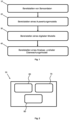
- Figure 1 shows a computer-aided method for providing a digital model of a construction site facility, in particular for real-time monitoring of the construction site facility, wherein the construction site facility is constructed by facility elements.
- sensor data comprises information specific to the use of a particular piece of equipment during the assembly, disassembly, or modification of the construction site equipment.
- the sensor data may comprise data acquired during the installation, modification, or removal of a piece of equipment.
- the sensor data may be corresponding acoustic data, image data, video data, position data, movement data, acceleration data, vibration data, weight data, load and/or strain data.
- an evaluation model is provided that is configured to provide a digital model of the construction site facility based on the sensor data.
- the evaluation model can, for example, be database-based and/or have a and the sensor data trained algorithm.
- the evaluation model can process the sensor data as input data and specify as output data which facility element is involved and at which position the facility element is arranged within the construction site facility.
- a digital model of the construction site facility is provided by applying the evaluation model and the provided sensor data.
- the digital model is preferably provided or updated in real time, so that real-time monitoring of the construction site facility is possible during assembly, modification, or dismantling.
- various sensors can be provided at a construction site to record the sensor data; this sensor data can then be transmitted in particular to a central processing unit on which the evaluation model is stored and executed.
- the sensor data can, for example, be transmitted to the central processing unit in real time, so that the current state of the construction site facility or the respective facility elements can also be provided in real time as a digital model.
- an analysis and/or monitoring model can be provided that is configured to detect deviations from a specified use of the equipment element and a use during the assembly, dismantling, or reconstruction of the construction site equipment. Furthermore, it is possible to generate control, alarm, and/or instruction data upon detection of a deviation. This data can then be transmitted, for example, to a predefined device recipient group. If, for example, it is determined that a equipment element has been installed incorrectly, a corresponding message can be transmitted to a supervisor and/or an operator.
- Figure 2 shows a system 50 for providing a digital model of a construction site facility, in particular for real-time monitoring of the construction site facility.
- the system 50 comprises and Processing circuit 60, a storage medium 70, and a data interface 80.
- the storage medium 70 comprises a computer program containing instructions that, when executed, cause the processing circuit 60 to perform a method for providing a digital model of a construction site facility.
- the data interface 80 is configured to receive the sensor data and the evaluation model.
- FIG 3 shows a construction site facility 100 in the form of a scaffolding system 100. As in Figure 3 As can be clearly seen, operators are carrying out activities at different locations on the scaffolding system 100. These areas are marked with the reference numerals 110, 120 and 130 and are shown in the Figures 4 to 6 shown again enlarged.
- a vertical post element 200 is arranged on a so-called scaffold spindle/foot spindle 210 by the operator.
- different sensors or sensor data can be used as sensor data by which the use of the vertical post element 200 can be determined by the evaluation model.
- a weight sensor could be arranged in the scaffold spindle 210, which determines the weight applied to the scaffold spindle 210 and provides it as sensor data.
- the weights of the respective furnishing elements here for example the components of the scaffolding system 100, could be stored in the evaluation model, so that based on the detected weight, it can be concluded that the furnishing element arranged on the scaffold spindle 210 is the vertical post element 200.
- the vertical stile element 200 can be added to the scaffold spindle 210 in the digital model of the scaffolding system 100.
- further sensors or sensor data can be used.
- the movements of the operator could be recorded by a camera system, in which case the evaluation model is set up to evaluate the movements of the operator and thereby to adapt the used To close the device elements.
- the present disclosure is not limited to the acquisition or evaluation of specific sensor data.
- FIG 5 shows the area 120 from Figure 3 In this area, for example , a ladder module 220 is arranged by an operator in the scaffolding system 100.
- a ladder module 220 is arranged by an operator in the scaffolding system 100.
- different sensors and sensor data can also be used here.
- vibration data provided by vibration sensors arranged at different positions in the scaffolding system 100 could be evaluated by the evaluation model.
- a vibration pattern specific to the ladder module 220 can be recorded and evaluated. In this example, too, additional sensor data can be recorded and evaluated.
- Figure 6 shows the area 130 from Figure 3 In this area , a horizontal beam 230 is positioned by an operator in the scaffolding system 100.
- acoustic data could be collected to detect the horizontal beam 230 and evaluated by the evaluation model. This is because the positioning of the horizontal beam 230 is associated with a specific acoustic pattern, which the evaluation model can use to determine the use of the horizontal beam 230.
- control data can be generated to transport equipment elements to a specific position in the scaffolding system 100.
- validation data can also be generated, for example.
- Such validation data can be used, for example, to confirm that there are no deviations from a specified assembly sequence for the construction site equipment.
- This validation data can be protected against manipulation, for example, using a blockchain.
Landscapes
- Engineering & Computer Science (AREA)
- Business, Economics & Management (AREA)
- Physics & Mathematics (AREA)
- Theoretical Computer Science (AREA)
- General Physics & Mathematics (AREA)
- Strategic Management (AREA)
- Human Resources & Organizations (AREA)
- Economics (AREA)
- Marketing (AREA)
- Entrepreneurship & Innovation (AREA)
- Tourism & Hospitality (AREA)
- General Business, Economics & Management (AREA)
- Geometry (AREA)
- Computer Hardware Design (AREA)
- Evolutionary Computation (AREA)
- Development Economics (AREA)
- Operations Research (AREA)
- Primary Health Care (AREA)
- General Engineering & Computer Science (AREA)
- Educational Administration (AREA)
- Quality & Reliability (AREA)
- Health & Medical Sciences (AREA)
- General Health & Medical Sciences (AREA)
- Medical Informatics (AREA)
- Architecture (AREA)
- Computer Vision & Pattern Recognition (AREA)
- Manufacturing & Machinery (AREA)
- Data Mining & Analysis (AREA)
- Software Systems (AREA)
- Game Theory and Decision Science (AREA)
- Finance (AREA)
- Accounting & Taxation (AREA)
- Artificial Intelligence (AREA)
- Civil Engineering (AREA)
- Structural Engineering (AREA)
- Computational Mathematics (AREA)
- Mathematical Analysis (AREA)
- Mathematical Optimization (AREA)
- Pure & Applied Mathematics (AREA)
- Management, Administration, Business Operations System, And Electronic Commerce (AREA)
Priority Applications (2)
| Application Number | Priority Date | Filing Date | Title |
|---|---|---|---|
| EP23197416.3A EP4524670A1 (fr) | 2023-09-14 | 2023-09-14 | Procédé assisté par ordinateur pour fournir un modèle numérique d'un équipement de chantier |
| PCT/EP2024/075658 WO2025056766A1 (fr) | 2023-09-14 | 2024-09-13 | Procédé assisté par ordinateur pour fournir un modèle numérique d'un dispositif de site de construction |
Applications Claiming Priority (1)
| Application Number | Priority Date | Filing Date | Title |
|---|---|---|---|
| EP23197416.3A EP4524670A1 (fr) | 2023-09-14 | 2023-09-14 | Procédé assisté par ordinateur pour fournir un modèle numérique d'un équipement de chantier |
Publications (1)
| Publication Number | Publication Date |
|---|---|
| EP4524670A1 true EP4524670A1 (fr) | 2025-03-19 |
Family
ID=88093596
Family Applications (1)
| Application Number | Title | Priority Date | Filing Date |
|---|---|---|---|
| EP23197416.3A Pending EP4524670A1 (fr) | 2023-09-14 | 2023-09-14 | Procédé assisté par ordinateur pour fournir un modèle numérique d'un équipement de chantier |
Country Status (2)
| Country | Link |
|---|---|
| EP (1) | EP4524670A1 (fr) |
| WO (1) | WO2025056766A1 (fr) |
Citations (4)
| Publication number | Priority date | Publication date | Assignee | Title |
|---|---|---|---|---|
| DE102017217125A1 (de) * | 2017-09-26 | 2019-03-28 | Robert Bosch Gmbh | Verfahren zur Überwachung eines Baumaterials |
| US20200386605A1 (en) * | 2017-05-30 | 2020-12-10 | Versatile Natures Ltd. | Method for tracking lifting events at a construction site |
| US20200410209A1 (en) * | 2019-09-14 | 2020-12-31 | Ron Zass | Exploring construction site images by construction stages |
| US20230236608A1 (en) * | 2022-01-24 | 2023-07-27 | Nanyang Technological University | Method and system for inspecting a building construction site using a mobile robotic system |
Family Cites Families (2)
| Publication number | Priority date | Publication date | Assignee | Title |
|---|---|---|---|---|
| DE102019218381A1 (de) * | 2019-11-27 | 2021-05-27 | Peri Gmbh | Unterstützung von Arbeiten an Schalungen und Gerüsten |
| DE102021119210A1 (de) * | 2021-07-24 | 2023-01-26 | ibatec GmbH | Vorrichtung zur Überwachung von Strukturen |
-
2023
- 2023-09-14 EP EP23197416.3A patent/EP4524670A1/fr active Pending
-
2024
- 2024-09-13 WO PCT/EP2024/075658 patent/WO2025056766A1/fr active Pending
Patent Citations (4)
| Publication number | Priority date | Publication date | Assignee | Title |
|---|---|---|---|---|
| US20200386605A1 (en) * | 2017-05-30 | 2020-12-10 | Versatile Natures Ltd. | Method for tracking lifting events at a construction site |
| DE102017217125A1 (de) * | 2017-09-26 | 2019-03-28 | Robert Bosch Gmbh | Verfahren zur Überwachung eines Baumaterials |
| US20200410209A1 (en) * | 2019-09-14 | 2020-12-31 | Ron Zass | Exploring construction site images by construction stages |
| US20230236608A1 (en) * | 2022-01-24 | 2023-07-27 | Nanyang Technological University | Method and system for inspecting a building construction site using a mobile robotic system |
Also Published As
| Publication number | Publication date |
|---|---|
| WO2025056766A1 (fr) | 2025-03-20 |
Similar Documents
| Publication | Publication Date | Title |
|---|---|---|
| EP3282399B1 (fr) | Procede de reconnaissance ameliore d'anomalies de processus d'une installation technique et systeme de diagnostic correspondant | |
| WO2015082669A1 (fr) | Procédé informatisé et système de surveillance et détermination d'état automatiques de sections entières d'une unité de processus | |
| EP4051851B1 (fr) | Procédé et système assistés par ordinateur pour déterminer et visualiser les flux de force dans un échafaudage | |
| EP3546314A1 (fr) | Procédé et dispositif d'identification de défaillances pour un système technique | |
| EP2221697B1 (fr) | Procédé de test d'un appareil de commande et dispositif de test | |
| WO2023006888A1 (fr) | Intégration d'évaluation de risque de collision entre un dispositif robotique et un opérateur humain | |
| EP3731043B1 (fr) | Procédé d'évaluation de la sécurité, programme informatique, support d'enregistrement lisible par machine et dispositif d'évaluation de la sécurité | |
| DE102009002432A1 (de) | Verfahren zur rückkopplungsbasierten Optimierung eines Messdatenlebenszyklus bei Fügeprozessen in der Fertigung | |
| EP3582050B1 (fr) | Procédé d'analyse d'une cause d'au moins un écart | |
| EP4524670A1 (fr) | Procédé assisté par ordinateur pour fournir un modèle numérique d'un équipement de chantier | |
| EP3828363B1 (fr) | Aide aux travaux sur coffrages et échafaudages | |
| DE10146901A1 (de) | Verfahren und System zur Bearbeitung von Fehlerhypothesen | |
| DE10133670A1 (de) | Verfahren zur automatischen Erzeugung einer Wissensbasis für ein Diagnosesystem | |
| DE102020204983A1 (de) | System zum Bereitstellen von trainierten KI-Modellen für verschiedene Anwendungen | |
| WO2021018741A1 (fr) | Procédé et dispositif de planification de maintenance sur au moins une machine | |
| EP3553679A1 (fr) | Procédé de diagnostic de panne assisté par ordinateur pour un système technique | |
| EP3895091B1 (fr) | Procédé de remplacement d'un composant dans une installation de transport de personnes ainsi que dispositif à utiliser selon ledit procédé | |
| WO2023036610A1 (fr) | Évaluation et/ou commande d'un processus de travail robotisé | |
| DE102015001567A1 (de) | Vorrichtung und Verfahren zur Erfassung, Überprüfung und Speicherung von Prozessdaten aus mindestens zwei Prozessschritten | |
| EP3816840A1 (fr) | Procédé et dispositif de sélection et de positionnement assistés par ordinateur d'éléments de raccordement pour partie en béton | |
| EP3980850B1 (fr) | Génération de données actives en tenant compte des incertitudes | |
| EP3611689A1 (fr) | Procédé et dispositif de mesure destinés à l'analyse de la stabilité dimensionnelle d'un composant par rapport à l'environnement de montage | |
| EP4113484A1 (fr) | Système et procédé de génération d'un programme de soudage pour un dispositif de soudage | |
| DE102022113987A1 (de) | Erfassungseinrichtung für die Erfassung einer geometrischen Veränderung einer Industrieanlage | |
| DE102024209608A1 (de) | Verfahren und Vorrichtung zum Anpassen eines Systems zur Objektdetektion |
Legal Events
| Date | Code | Title | Description |
|---|---|---|---|
| PUAI | Public reference made under article 153(3) epc to a published international application that has entered the european phase |
Free format text: ORIGINAL CODE: 0009012 |
|
| STAA | Information on the status of an ep patent application or granted ep patent |
Free format text: STATUS: THE APPLICATION HAS BEEN PUBLISHED |
|
| AK | Designated contracting states |
Kind code of ref document: A1 Designated state(s): AL AT BE BG CH CY CZ DE DK EE ES FI FR GB GR HR HU IE IS IT LI LT LU LV MC ME MK MT NL NO PL PT RO RS SE SI SK SM TR |
|
| STAA | Information on the status of an ep patent application or granted ep patent |
Free format text: STATUS: REQUEST FOR EXAMINATION WAS MADE |
|
| 17P | Request for examination filed |
Effective date: 20250918 |