EP4524852A1 - Verfahren und vorrichtung zur verarbeitung von logistikwegen, vorrichtung und speichermedium - Google Patents
Verfahren und vorrichtung zur verarbeitung von logistikwegen, vorrichtung und speichermedium Download PDFInfo
- Publication number
- EP4524852A1 EP4524852A1 EP24183592.5A EP24183592A EP4524852A1 EP 4524852 A1 EP4524852 A1 EP 4524852A1 EP 24183592 A EP24183592 A EP 24183592A EP 4524852 A1 EP4524852 A1 EP 4524852A1
- Authority
- EP
- European Patent Office
- Prior art keywords
- plant area
- instruction
- stocking
- current pickup
- delivery vehicle
- Prior art date
- Legal status (The legal status is an assumption and is not a legal conclusion. Google has not performed a legal analysis and makes no representation as to the accuracy of the status listed.)
- Pending
Links
Images

Classifications
-
- G—PHYSICS
- G06—COMPUTING OR CALCULATING; COUNTING
- G06Q—INFORMATION AND COMMUNICATION TECHNOLOGY [ICT] SPECIALLY ADAPTED FOR ADMINISTRATIVE, COMMERCIAL, FINANCIAL, MANAGERIAL OR SUPERVISORY PURPOSES; SYSTEMS OR METHODS SPECIALLY ADAPTED FOR ADMINISTRATIVE, COMMERCIAL, FINANCIAL, MANAGERIAL OR SUPERVISORY PURPOSES, NOT OTHERWISE PROVIDED FOR
- G06Q10/00—Administration; Management
- G06Q10/08—Logistics, e.g. warehousing, loading or distribution; Inventory or stock management
-
- G—PHYSICS
- G06—COMPUTING OR CALCULATING; COUNTING
- G06Q—INFORMATION AND COMMUNICATION TECHNOLOGY [ICT] SPECIALLY ADAPTED FOR ADMINISTRATIVE, COMMERCIAL, FINANCIAL, MANAGERIAL OR SUPERVISORY PURPOSES; SYSTEMS OR METHODS SPECIALLY ADAPTED FOR ADMINISTRATIVE, COMMERCIAL, FINANCIAL, MANAGERIAL OR SUPERVISORY PURPOSES, NOT OTHERWISE PROVIDED FOR
- G06Q10/00—Administration; Management
- G06Q10/08—Logistics, e.g. warehousing, loading or distribution; Inventory or stock management
- G06Q10/083—Shipping
-
- G—PHYSICS
- G06—COMPUTING OR CALCULATING; COUNTING
- G06Q—INFORMATION AND COMMUNICATION TECHNOLOGY [ICT] SPECIALLY ADAPTED FOR ADMINISTRATIVE, COMMERCIAL, FINANCIAL, MANAGERIAL OR SUPERVISORY PURPOSES; SYSTEMS OR METHODS SPECIALLY ADAPTED FOR ADMINISTRATIVE, COMMERCIAL, FINANCIAL, MANAGERIAL OR SUPERVISORY PURPOSES, NOT OTHERWISE PROVIDED FOR
- G06Q10/00—Administration; Management
- G06Q10/08—Logistics, e.g. warehousing, loading or distribution; Inventory or stock management
- G06Q10/087—Inventory or stock management, e.g. order filling, procurement or balancing against orders
-
- G—PHYSICS
- G06—COMPUTING OR CALCULATING; COUNTING
- G06Q—INFORMATION AND COMMUNICATION TECHNOLOGY [ICT] SPECIALLY ADAPTED FOR ADMINISTRATIVE, COMMERCIAL, FINANCIAL, MANAGERIAL OR SUPERVISORY PURPOSES; SYSTEMS OR METHODS SPECIALLY ADAPTED FOR ADMINISTRATIVE, COMMERCIAL, FINANCIAL, MANAGERIAL OR SUPERVISORY PURPOSES, NOT OTHERWISE PROVIDED FOR
- G06Q10/00—Administration; Management
- G06Q10/08—Logistics, e.g. warehousing, loading or distribution; Inventory or stock management
- G06Q10/087—Inventory or stock management, e.g. order filling, procurement or balancing against orders
- G06Q10/0875—Itemisation or classification of parts, supplies or services, e.g. bill of materials
-
- G—PHYSICS
- G06—COMPUTING OR CALCULATING; COUNTING
- G06Q—INFORMATION AND COMMUNICATION TECHNOLOGY [ICT] SPECIALLY ADAPTED FOR ADMINISTRATIVE, COMMERCIAL, FINANCIAL, MANAGERIAL OR SUPERVISORY PURPOSES; SYSTEMS OR METHODS SPECIALLY ADAPTED FOR ADMINISTRATIVE, COMMERCIAL, FINANCIAL, MANAGERIAL OR SUPERVISORY PURPOSES, NOT OTHERWISE PROVIDED FOR
- G06Q30/00—Commerce
- G06Q30/06—Buying, selling or leasing transactions
- G06Q30/0601—Electronic shopping [e-shopping]
- G06Q30/0633—Managing shopping lists, e.g. compiling or processing purchase lists
- G06Q30/0635—Managing shopping lists, e.g. compiling or processing purchase lists replenishment orders; recurring orders
-
- Y—GENERAL TAGGING OF NEW TECHNOLOGICAL DEVELOPMENTS; GENERAL TAGGING OF CROSS-SECTIONAL TECHNOLOGIES SPANNING OVER SEVERAL SECTIONS OF THE IPC; TECHNICAL SUBJECTS COVERED BY FORMER USPC CROSS-REFERENCE ART COLLECTIONS [XRACs] AND DIGESTS
- Y02—TECHNOLOGIES OR APPLICATIONS FOR MITIGATION OR ADAPTATION AGAINST CLIMATE CHANGE
- Y02P—CLIMATE CHANGE MITIGATION TECHNOLOGIES IN THE PRODUCTION OR PROCESSING OF GOODS
- Y02P90/00—Enabling technologies with a potential contribution to greenhouse gas [GHG] emissions mitigation
- Y02P90/30—Computing systems specially adapted for manufacturing
Definitions
- the present disclosure relates to the technical field of logistics, and particularly to the technical fields of logistics distribution and intelligent dispatching.
- B2B Business-to-Business
- B2B Business-to-Business
- the logistics distribution system is used to dispatch vehicles to pick up goods from sellers and deliver the goods to buyers, which is an important link that affects the delivery efficiency of the entire order.
- the present disclosure provides a method and apparatus for processing a logistics waybill, a device and a storage medium to solve or alleviate one or more technical problems in the prior art.
- the present disclosure provides a method for processing a logistics waybill, including:
- the present disclosure provides an apparatus for processing a logistics waybill, including:
- an electronic device in a third aspect, includes:
- a non-transitory computer-readable storage medium storing computer instructions.
- the computer instructions are used to cause the computer to perform the method according to any one of embodiments of the present disclosure.
- the beneficial effects of the technical solution provided by the disclosure at least include: improving the efficiency of collaboration between the logistics link and other production and sales links, making the delivery of the entire product order more convenient and efficient.
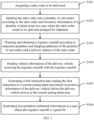
- Fig. 1 is a schematic flowchart of a method for processing a logistics waybill provided by an embodiment of the present disclosure. As shown in Fig. 1 , the method at least includes the following steps.
- the sales order to be delivered may be acquired from a sales system, and the order information of the sales order (also referred to as a product order) to be delivered may include one or more target products, and there are differences in product specifications, process parameters, and the like of various target products.
- each of the plurality of sub-orders includes a shipment quantity and a shipping address of the corresponding plant area.
- the sales order needs to be split and arranged for shipment, it means that the sales order needs to be split and arranged for shipment from a plurality of plant areas.
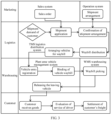
- the reason for splitting and arranging for shipment may be that the demand for one type of target product in the sales order is too large, or there are too many types of products, and one plant area cannot fully deliver all the target products in the entire sales order. It may also be that a single plant area that can provide all target products is too far away and the transportation cost is too high, then other plant areas closer to the delivery place can be arranged to deliver part of the target products separately, that is, the waybill distribution as shown in Fig. 2 .
- the plant area may be a production plant area or a warehousing plant area that is independent of the production plant area.
- the production plant area will be equipped with a warehousing area, or it may also be that a plurality of production plant areas correspond to one warehousing plant area. Therefore, a plant area may be understood as a park that can produce or store target products and ship them.
- the plant area is usually equipped with an access control equipment for managing incoming and outgoing vehicles.
- planning and obtaining a logistics waybill may be understood as obtaining the spatial and quantitative distribution of goods that require logistics distribution according to the shipping addresses and shipment quantities of a plurality of sub-orders, so as to plan the number, model, and route sequence of delivery vehicles to obtain a logistics waybill corresponding to each of the sub-orders, thereby maximizing the transportation efficiency of delivery vehicles and reducing logistics costs.
- a plurality of sub-orders may correspond to one logistics waybill, and one sub-order may also correspond to a plurality of logistics orders, that is, arranging vehicles for the waybill as shown in Fig. 2 .
- the logistics waybill After the logistics waybill is generated, it can be directly assigned to the corresponding vehicle and driver, or it may be published to the logistics distribution system, where the driver picks the logistics waybill on his own account, i.e., the driver takes the order as shown in Fig. 2 .
- the third-party logistics capacity may be easily mobilized. Buyers may also register their own vehicles on the platform, so that they can obtain support from the corresponding system in other links when picking up goods on their own.
- the vehicle information of the delivery vehicle that receives the logistics waybill is bound with the logistics waybill, thereby facilitating the management of the delivery vehicles and allowing the delivery vehicles to obtain information-based support and collaboration.
- S105 generating a first instruction and sending the first instruction to a current pickup plant area based on position information of the delivery vehicle before the delivery vehicle arrives at the current pickup plant area.
- the location information of the delivery vehicle may be obtained through a positioning apparatus on the vehicle, or through a mobile terminal of the driver of the delivery vehicle.
- the first instruction is used to instruct the current pickup plant area to prepare for the arrival of the delivery vehicle, so as to improve the efficiency of picking up goods by the delivery vehicle at the current pickup plant area, for example, arranging the platform location and preparing corresponding goods in advance.
- the logistics waybill is signed for means that the delivery vehicle delivers all the target products in the logistics waybill to the designated delivery address and the logistics waybill is signed for by the buyer's personnel, i.e., electronically signing for as shown in Fig. 2 .
- the signing is completed, one or more sub-orders corresponding to the logistics waybill can be settled, that is, the reconciliation settlement as shown in Fig. 2 .
- the reconciliation and settlement information may include reconciliation and settlement information between the seller and the buyer, and may also include reconciliation and settlement information of the logistics carrier, thereby facilitating automatic settlement of freight charges.
- a sales order is split into a plurality of sub-orders, and a corresponding logistics waybill is planned and generated to achieve coordinated shipments from a plurality of plant areas; at the same time, the efficiency of collaboration between the logistics link and other links is improved, making the delivery of the entire product order more convenient and efficient.
- splitting the sales order into a plurality of sub-orders according to the sales order and inventory information of a plurality of plant areas in the case where the sales order needs to be split and arranged for shipment in S102 further includes:
- the target product in the sales order may be one type or a plurality of types.
- the splitting and arranging for shipment are performed according to the quantity demanded for each type of target product and the inventory quantities corresponding to a plurality of plant areas.
- a priority shipping rule need to be considered.
- Common priority shipping rule includes the following rules.
- FIFO First-in-first-out rule
- Last-in-first-out (LIFO) rule the products that have recently arrived at the warehouse are shipped out first. This approach may result in older products remaining in the warehouse, but is sometimes used in tax planning.
- Shipping out according to order priorities may be decided based on the priorities of customer's orders. An urgent order or an order from an important customer may obtain a higher priority.
- Products of different types or characteristics may have different shipping priorities. For example, high value-added products may be prioritized for shipping because they may contribute more to the profit of the enterprise.
- the enterprise may prioritize the shipping out of products with smaller remaining inventory to reduce inventory backlog.
- the shipping plan may be adjusted based on the data to ensure that the products are already prepared before the peak demand season.
- Shipping out according to geographical location if the enterprise has a plurality of warehouses or plant areas, which warehouse is used to ship out the product is decided based on the geographical location of the product from the customer. This can reduce logistics costs and shipping time.
- the production date or batch number of products can be used to determine which products should be shipped out first to ensure freshness and compliance of the products.
- planning and obtaining a logistics waybill according to the shipment quantities and shipping addresses of a plurality of sub-orders and a delivery address of the sales order in S 103 further includes:
- the basic steps of determining the optimal vehicle combination may include the following steps.
- binding the vehicle information of the delivery vehicle receiving the logistics waybill with the logistics waybill in S 104 further includes:
- the account information of the driver is associated with the logistics waybill. Binding the vehicle information with the logistics waybill only within the task date makes it easier for the driver to change the vehicle information before the task date. For example, when the driver's vehicle breaks down, the vehicle is replaced by another vehicle of the same size or model in the fleet.
- the task date may be pre-specified in the logistics waybill, or may be further selected by the driver within the date range specified in the logistics waybill.
- the delivery time specified in the logistics waybill is any day between May 3 and May 10, from which the driver may select one day as the task date.
- the vehicle information at least includes a license plate number of the vehicle, and may further includes specific information such as the type, color, and the like of the vehicle.
- generating a first instruction and sending the first instruction to a current pickup plant area based on position information of the delivery vehicle before the delivery vehicle arrives at the current pickup plant area in S105 includes:
- estimating the travel time required for the delivery vehicle to arrive at the current pickup plant area in the logistics waybill may be performed directly according to the distance between the delivery vehicle and the current pickup plant area, or may be further accurately performed according to the route between the above two and the traffic flow information of the route, the number of traffic lights and historical traffic data.
- the warehousing system may comprehensively determine the first time length required to ship out all products to be shipped in the logistics waybill to the platform according to the specific storage locations of all products to be shipped in the logistics waybill, the quantity of goods in each storage location, and the turnaround time required to complete the shipping at each storage location.
- the second time required to complete the pre-shipping task may also be estimated.
- a stocking instruction is generated and sent to the warehousing system of the current pickup plant area.
- the stocking instruction is used to instruct the warehousing system to generate a corresponding shipping task to ship out the products to be shipped in the logistics waybill.
- the timing of generating and sending the stocking instruction is appropriate, the products to be shipped have already been stacked on the platform when the delivery vehicle enters the current shipping plant area, so that the delivery vehicle can start loading without waiting, thereby maximizing the pickup efficiency of delivery vehicle.
- generating a stocking instruction according to the travel time and stocking time, and sending the stocking instruction to the warehousing system of the current pickup plant area in S1053 includes: in a case where the second time length is 0 and the travel time is less than a first threshold, generating a first stocking instruction and sending the first stocking instruction to the warehousing system of the current pickup plant area, where the first stocking instruction has a first-level priority.
- the second time length being 0 indicates that the outbound assembly line of the current warehousing system is idle.
- the travel time of the delivery vehicle is less than the first threshold, the products to be shipped can be shipped out of the warehouse in advance and stacked on the platform, letting the goods wait for the delivery vehicle to arrive.
- the first threshold is used to control the time length of occupying the platform by the goods in advance.
- the first threshold may be adjusted according to the density degree of all logistics orders that need to be shipped out on the day and the occupancy ratio of the current platform. For example, when logistics orders are dense and the platform is busy, the first threshold may be 1 hour or less. On the contrary, when the platform is relatively idle, the first threshold may be set to 3 hours or longer.
- generating a stocking instruction according to the travel time and stocking time, and sending the stocking instruction to the warehousing system of the current pickup plant area in S1053, includes: in a case where the second time length is not 0, generating a second stocking instruction according to a product of the travel time and the stocking time and a preset coefficient, and sending the second stocking instruction to the warehousing system of the current pickup plant area, where the second stocking instruction has a second-level priority.
- the second time length being not 0 indicates that the outbound assembly line of the warehousing system is continuing to work. At this time, it is necessary to notify the warehouse system to ship out goods when the travel time of the delivery vehicle is approximately equal to the stocking time, which can not only reduce the waiting time of the delivery vehicles, but also avoid affecting the entry and exit tasks of other logistics waybills.
- the preset coefficient may be any value between 0.7 and 1.3. For example, the preset coefficient is 1.2, assuming that the stocking time is 30 minutes, then when the travel time is less than 36 minutes, a second stocking instruction is generated and sent to the current pickup plant area.
- the preset coefficient may be adjusted according to the occupancy ratio of the platform in the current plant area. For example, if the occupancy ratio of the platform is high and the platform relatively busy, the preset coefficient may be adjusted lower to allow delivery vehicles to wait appropriately.
- the second-level priority of the second stocking instruction may be higher than the first-level priority of the first stocking instruction.
- generating a stocking instruction according to the travel time and stocking time, and sending the stocking instruction to the warehousing system of the current pickup plant area in S1053, includes:
- the fourth stocking instruction may be generated and sent to the warehousing system of the current pickup plant area.
- the fourth stocking instruction has a fourth-level priority, and the fourth-level priority is higher than the third-level priority.
- the warehousing system may sort the shipping tasks according to the priorities of shipping tasks, and shipping tasks with the same priority are sorted according to the time when the shipping tasks are generated.
- generating a first instruction and sending the first instruction to a current pickup plant area based on position information of the delivery vehicle before the delivery vehicle arrives at the current pickup plant area in S105 includes:
- a temporary passage instruction is generated and sent to the plant area vehicle management system of the current pickup plant area, so that the plant area vehicle management system generates a temporary access permit for the delivery vehicle, and the access control equipment can automatically lift the pole to release the delivery vehicle when the delivery vehicle arrives at the entrance of the current pickup plant area, which eliminates the need for the driver to get off the vehicle to register, and improves the efficiency of picking up goods.
- the method for processing a logistics waybill of the embodiment of the present disclosure further includes the steps of:
- the completion of picking up may be determined according to pickup completion information generated by a delivery person of the warehouse after the loading is completed, and leaving the plant area may be determined according to shipping message generated by the plant area vehicle management system after the license plate number of the delivery vehicle is scanned by the access control equipment at the exit of the plant area. After the delivery vehicle picks up the goods and leaves the plant area, the temporary access permit is deleted.
- step S105 If there is a next pickup plant area in the logistics waybill, updating the next pickup plant area to be the current pickup plant area, and re-executing step S105, or any of the steps S1051 to S1055.
- the complete delivery process of a sales order includes the following steps.
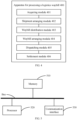
- Fig. 4 is a schematic structural diagram of an apparatus for processing a logistics waybill according to an embodiment of the present disclosure. As shown in Fig. 4 , the apparatus at least includes:
- the shipment arranging module 402 is configured to:
- the waybill distribution module 403 is configured to:
- the waybill arranging module 404 is configured to:
- the dispatching module 405 includes:
- the instruction generation sub-module is configured to: in a case where the second time length is 0 and the travel time is less than a first threshold, generate a first stocking instruction and sending the first stocking instruction to the warehousing system of the current pickup plant area, where the first stocking instruction has a first-level priority.
- the instruction generation sub-module is configured to: in a case where the second time length is not 0, generate a second stocking instruction according to a product of the travel time and the stocking time and a preset coefficient, and send the second stocking instruction to the warehousing system of the current pickup plant area, where the second stocking instruction has a second-level priority.
- the instruction generation sub-module is configured to:
- the dispatching module 405 is configured to:
- the apparatus for processing a logistics order of the embodiment of the present disclosure further includes an updating module configured to:
- Fig. 5 is a block diagram of an electronic device according to an embodiment of the present disclosure.
- the electronic device includes: a memory 510 and a processor 520.
- the memory 510 stores a computer program that can run on the processor 520.
- the numbers of memory 510 and processor 520 may respectively be one or more.
- the memory 510 may store one or more computer programs.
- the one or more computer programs when executed by the electronic device, cause the electronic device to perform the method provided by the method embodiment.
- the electronic device may further include: a communication interface 530, configured to communicate with an external device for interactive transmission of data.
- the bus may be an Industry Standard Architecture (ISA) bus, a Peripheral Component Interconnect (PCI) bus, or an Extended Industry Standard Architecture (EISA) bus, etc.
- ISA Industry Standard Architecture
- PCI Peripheral Component Interconnect
- EISA Extended Industry Standard Architecture
- the bus may be divided into an address bus, a data bus, a control bus, and the like. For ease of presentation, only one thick line is used in Fig. 5 , but it does not mean that there is only one bus or one type of bus.
- the memory 510, the processor 520 and the communication interface 530 are integrated on one chip, the memory 510, the processor 520 and the communication interface 530 may complete the mutual communication through the internal interface.
- the above-mentioned processor may be a Central Processing Unit (CPU), and it may also be other general-purpose processor, a Digital Signal Processor (DSP), an Application Specific Integrated Circuit (ASIC), a Field Programmable Gate Array (FPGA) or other programmable logic device, a discrete gate or transistor logic device, a discrete hardware component, or the like.
- the general-purpose processor may be a microprocessor or any conventional processor, etc. It is worth noting that the processor may be a processor that supports Advanced RISC Machines (ARM) architecture.
- the above-mentioned memory may include a read-only memory and a random access memory, and may further include a non-volatile random access memory.
- the memory may be a volatile memory or non-volatile memory, or may include both volatile and non-volatile memory.
- the non-volatile memory may include a Read-Only Memory (ROM), a Programmable ROM (PROM), an Erasable PROM (EPROM), an Electrically EPROM (EEPROM) or a flash memory.
- the volatile memory may include a Random Access Memory (RAM), which is used as an external cache.
- RAM Random Access Memory
- SRAM Static RAM
- DRAM Dynamic Random Access Memory
- SDRAM Synchronous DRAM
- DDR SDRAM Double Data Date SDRAM
- ESDRAM Enhanced SDRAM
- SLDRAM Synchronous link DRAM
- DR RAM Direct RAMBUS RAM
- the computer program product includes one or more computer instructions.
- the computer may be a general-purpose computer, a special purpose computer, a computer network, or other programmable device.
- the computer instructions may be stored in a computer-readable storage medium, or be transmitted from one computer-readable storage medium to another, e.g., the computer instructions may be transmitted from a website, computer, server, or data center to another website, computer, server or data center through wired (such as coaxial cable, optical fiber, Digital Subscriber Line (DSL)) or wireless (such as infrared, Bluetooth, microwave, etc.) means.
- the computer-readable storage medium may be any available medium that can be accessed by a computer, or a data storage device such as a server integrated with one or more available media or data center.
- the available media may be a magnetic media (such as floppy disk, hard disk, magnetic tape), an optical media (such as Digital Versatile Disc (DVD)) or a semiconductor media (such as Solid State Disk (SSD)), etc.
- a magnetic media such as floppy disk, hard disk, magnetic tape
- an optical media such as Digital Versatile Disc (DVD)
- DVD Digital Versatile Disc
- SSD Solid State Disk
- the program may be stored in a computer readable storage medium.
- the above-mentioned storage medium may be a read-only memory, a magnetic disk or an optical disk, etc.
- A/B may represent A or B.
- the term "and/or" herein only describes an association relation of associated objects, which indicates that there may be three kinds of relations, for example, A and/or B may indicate that only A exists, or both A and B exist, or only B exists.
- first and second are only for purpose of description, and cannot be construed to indicate or imply the relative importance or implicitly point out the number of technical features indicated. Therefore, the feature defined with “first” or “second” may explicitly or implicitly include one or more features. In the description of the embodiments of the present disclosure, “multiple” means two or more, unless otherwise specified.
Landscapes
- Business, Economics & Management (AREA)
- Economics (AREA)
- Engineering & Computer Science (AREA)
- Marketing (AREA)
- Strategic Management (AREA)
- Theoretical Computer Science (AREA)
- General Physics & Mathematics (AREA)
- Development Economics (AREA)
- General Business, Economics & Management (AREA)
- Physics & Mathematics (AREA)
- Human Resources & Organizations (AREA)
- Quality & Reliability (AREA)
- Tourism & Hospitality (AREA)
- Operations Research (AREA)
- Entrepreneurship & Innovation (AREA)
- Accounting & Taxation (AREA)
- Finance (AREA)
- Management, Administration, Business Operations System, And Electronic Commerce (AREA)
Applications Claiming Priority (1)
| Application Number | Priority Date | Filing Date | Title |
|---|---|---|---|
| CN202311182628.3A CN117291484A (zh) | 2023-09-13 | 2023-09-13 | 物流运单的处理方法、装置、设备及存储介质 |
Publications (1)
| Publication Number | Publication Date |
|---|---|
| EP4524852A1 true EP4524852A1 (de) | 2025-03-19 |
Family
ID=89243571
Family Applications (1)
| Application Number | Title | Priority Date | Filing Date |
|---|---|---|---|
| EP24183592.5A Pending EP4524852A1 (de) | 2023-09-13 | 2024-06-21 | Verfahren und vorrichtung zur verarbeitung von logistikwegen, vorrichtung und speichermedium |
Country Status (4)
| Country | Link |
|---|---|
| US (1) | US20250086566A1 (de) |
| EP (1) | EP4524852A1 (de) |
| JP (1) | JP7805408B2 (de) |
| CN (1) | CN117291484A (de) |
Citations (3)
| Publication number | Priority date | Publication date | Assignee | Title |
|---|---|---|---|---|
| US20030172007A1 (en) * | 2002-03-06 | 2003-09-11 | Helmolt Hans-Ulrich Von | Supply chain fulfillment coordination |
| CA2478555A1 (en) * | 2002-03-06 | 2003-09-12 | Sap Aktiengesellschaft | Supply chain fulfillment coordination |
| US20150235173A1 (en) * | 2014-02-18 | 2015-08-20 | David R. Hall | Automated Tracking-Number Based Administration of Access Codes |
Family Cites Families (15)
| Publication number | Priority date | Publication date | Assignee | Title |
|---|---|---|---|---|
| US20020019759A1 (en) * | 2000-06-16 | 2002-02-14 | Sundararajan Arunapuram | Transportation planning, execution, and freight payments managers and related methods |
| US6915268B2 (en) * | 2000-07-28 | 2005-07-05 | Odyssey Logistics & Technology Corporation | Transport logistics systems and methods |
| JP2002145418A (ja) * | 2000-11-13 | 2002-05-22 | Jsr Corp | 自動在庫引当方法及び自動在庫引当プログラムを記憶した記憶媒体 |
| JP3873103B2 (ja) * | 2001-04-26 | 2007-01-24 | 株式会社日立プラントテクノロジー | 物流システム |
| JP2003321122A (ja) * | 2002-05-08 | 2003-11-11 | Fujikura Ltd | 電線の物流システム、該物流システムにおける電線の管理出荷方法 |
| JP2004272802A (ja) * | 2003-03-11 | 2004-09-30 | Cosmo Sekiyu Lubricants Kk | シャトル便による製品の配送方法及びシャトル便配送システム |
| JP2004299861A (ja) * | 2003-03-31 | 2004-10-28 | Honda Motor Co Ltd | 製品出荷管理システム |
| JP6123605B2 (ja) * | 2013-09-20 | 2017-05-10 | 株式会社ダイフク | 物流システム |
| US10776748B2 (en) * | 2015-02-18 | 2020-09-15 | Cargo Chief Acquisition Inc. | Communication analysis for obtaining loads |
| US11080652B2 (en) * | 2016-11-03 | 2021-08-03 | Flexport, Inc. | Method and system for supply chain management |
| CN111226243A (zh) * | 2017-06-30 | 2020-06-02 | 清楚目的地有限公司 | 用于公开和集成多个供应链和递送网络以优化容量使用的系统和方法 |
| CN110033337B (zh) * | 2018-01-11 | 2024-05-21 | 北京京东尚科信息技术有限公司 | 订单生产的方法和装置 |
| US20250029055A1 (en) * | 2021-03-24 | 2025-01-23 | Hyundai Motor Company | Method and system for managing delivery |
| CN116992988A (zh) * | 2022-04-21 | 2023-11-03 | 北京京东振世信息技术有限公司 | 运单量拆分方法、装置、电子设备和计算机可读介质 |
| CN115187179B (zh) * | 2022-09-09 | 2023-01-13 | 北京和能人居科技有限公司 | 装车方案生成方法、装置、电子设备及计算机存储介质 |
-
2023
- 2023-09-13 CN CN202311182628.3A patent/CN117291484A/zh active Pending
-
2024
- 2024-06-21 EP EP24183592.5A patent/EP4524852A1/de active Pending
- 2024-07-09 US US18/767,299 patent/US20250086566A1/en active Pending
- 2024-09-04 JP JP2024152227A patent/JP7805408B2/ja active Active
Patent Citations (3)
| Publication number | Priority date | Publication date | Assignee | Title |
|---|---|---|---|---|
| US20030172007A1 (en) * | 2002-03-06 | 2003-09-11 | Helmolt Hans-Ulrich Von | Supply chain fulfillment coordination |
| CA2478555A1 (en) * | 2002-03-06 | 2003-09-12 | Sap Aktiengesellschaft | Supply chain fulfillment coordination |
| US20150235173A1 (en) * | 2014-02-18 | 2015-08-20 | David R. Hall | Automated Tracking-Number Based Administration of Access Codes |
Also Published As
| Publication number | Publication date |
|---|---|
| CN117291484A (zh) | 2023-12-26 |
| JP7805408B2 (ja) | 2026-01-23 |
| US20250086566A1 (en) | 2025-03-13 |
| JP2025041552A (ja) | 2025-03-26 |
Similar Documents
| Publication | Publication Date | Title |
|---|---|---|
| CN111033539B (zh) | 用于订单规定路线的机器人库存更新 | |
| US20250021901A1 (en) | Supply Chain Management System and Method | |
| CN108734328B (zh) | 用于调度无人分拣系统中自动导引运输车的方法和装置 | |
| US8386397B1 (en) | System and method for constraint-based reduction of a solution space for vehicle routing | |
| JP3875672B2 (ja) | 共同配送情報管理システム | |
| US20200134557A1 (en) | Logistical service for processing modular delivery requests | |
| JP2019073394A (ja) | 運送システムのための分散型台帳技術 | |
| CN113159561A (zh) | 一种货运调度方法、计算机可读存储介质及计算机设备 | |
| CN111080242A (zh) | 一种智能物流管理系统及方法 | |
| KR20160106305A (ko) | 리얼 타임 택배 위치 추적 방법 및 그 위치 추적 시스템 | |
| CN113642775A (zh) | 一种成品仓发货管理方法、装置及计算机设备 | |
| CN114693004A (zh) | 物流优化方法和装置 | |
| EP4524852A1 (de) | Verfahren und vorrichtung zur verarbeitung von logistikwegen, vorrichtung und speichermedium | |
| CN117196431A (zh) | 一种用于供应链的园区运力管理方法、设备及介质 | |
| CN111932173A (zh) | 一种干线运输的方法、装置及可读存储介质 | |
| Billing et al. | A multiperiod auto-carrier transportation problem with probabilistic future demands | |
| JP2003233896A (ja) | 配車計画立案方法および装置 | |
| US20250086691A1 (en) | Order processing method, electronic device and storage medium | |
| US11501246B1 (en) | Server and related method for managing parcel delivery | |
| CN114445000B (zh) | 一种物流订单跟踪方法、装置、电子设备及存储介质 | |
| JP4263496B2 (ja) | 出荷管理方法及びコンピュータ | |
| CN117495237B (zh) | 货运集散系统的管理方法、设备和可读存储介质 | |
| CN110796423A (zh) | 中转时效工单处理方法、装置和设备 | |
| KR101738489B1 (ko) | 온라인 투 오프라인 기반의 화물운송 중계 장치 | |
| KR101747887B1 (ko) | 수입 컨테이너 관리 서버 및 이를 이용한 수입 컨테이너의 반납지 변경료 인보이스 관리 서비스 방법 |
Legal Events
| Date | Code | Title | Description |
|---|---|---|---|
| PUAI | Public reference made under article 153(3) epc to a published international application that has entered the european phase |
Free format text: ORIGINAL CODE: 0009012 |
|
| STAA | Information on the status of an ep patent application or granted ep patent |
Free format text: STATUS: REQUEST FOR EXAMINATION WAS MADE |
|
| 17P | Request for examination filed |
Effective date: 20240621 |
|
| AK | Designated contracting states |
Kind code of ref document: A1 Designated state(s): AL AT BE BG CH CY CZ DE DK EE ES FI FR GB GR HR HU IE IS IT LI LT LU LV MC ME MK MT NL NO PL PT RO RS SE SI SK SM TR |