EP4524980A1 - Computerprogramm, informationsverarbeitungsvorrichtung, informationsverarbeitungsverfahren und lernmodellerzeugungsverfahren - Google Patents
Computerprogramm, informationsverarbeitungsvorrichtung, informationsverarbeitungsverfahren und lernmodellerzeugungsverfahren Download PDFInfo
- Publication number
- EP4524980A1 EP4524980A1 EP23846049.7A EP23846049A EP4524980A1 EP 4524980 A1 EP4524980 A1 EP 4524980A1 EP 23846049 A EP23846049 A EP 23846049A EP 4524980 A1 EP4524980 A1 EP 4524980A1
- Authority
- EP
- European Patent Office
- Prior art keywords
- pain
- information
- patient
- learning model
- prediction
- Prior art date
- Legal status (The legal status is an assumption and is not a legal conclusion. Google has not performed a legal analysis and makes no representation as to the accuracy of the status listed.)
- Pending
Links
Images








Classifications
-
- G—PHYSICS
- G16—INFORMATION AND COMMUNICATION TECHNOLOGY [ICT] SPECIALLY ADAPTED FOR SPECIFIC APPLICATION FIELDS
- G16H—HEALTHCARE INFORMATICS, i.e. INFORMATION AND COMMUNICATION TECHNOLOGY [ICT] SPECIALLY ADAPTED FOR THE HANDLING OR PROCESSING OF MEDICAL OR HEALTHCARE DATA
- G16H70/00—ICT specially adapted for the handling or processing of medical references
- G16H70/20—ICT specially adapted for the handling or processing of medical references relating to practices or guidelines
-
- A—HUMAN NECESSITIES
- A61—MEDICAL OR VETERINARY SCIENCE; HYGIENE
- A61B—DIAGNOSIS; SURGERY; IDENTIFICATION
- A61B5/00—Measuring for diagnostic purposes; Identification of persons
- A61B5/48—Other medical applications
- A61B5/4824—Touch or pain perception evaluation
-
- G—PHYSICS
- G16—INFORMATION AND COMMUNICATION TECHNOLOGY [ICT] SPECIALLY ADAPTED FOR SPECIFIC APPLICATION FIELDS
- G16H—HEALTHCARE INFORMATICS, i.e. INFORMATION AND COMMUNICATION TECHNOLOGY [ICT] SPECIALLY ADAPTED FOR THE HANDLING OR PROCESSING OF MEDICAL OR HEALTHCARE DATA
- G16H10/00—ICT specially adapted for the handling or processing of patient-related medical or healthcare data
- G16H10/20—ICT specially adapted for the handling or processing of patient-related medical or healthcare data for electronic clinical trials or questionnaires
-
- G—PHYSICS
- G16—INFORMATION AND COMMUNICATION TECHNOLOGY [ICT] SPECIALLY ADAPTED FOR SPECIFIC APPLICATION FIELDS
- G16H—HEALTHCARE INFORMATICS, i.e. INFORMATION AND COMMUNICATION TECHNOLOGY [ICT] SPECIALLY ADAPTED FOR THE HANDLING OR PROCESSING OF MEDICAL OR HEALTHCARE DATA
- G16H10/00—ICT specially adapted for the handling or processing of patient-related medical or healthcare data
- G16H10/60—ICT specially adapted for the handling or processing of patient-related medical or healthcare data for patient-specific data, e.g. for electronic patient records
-
- G—PHYSICS
- G16—INFORMATION AND COMMUNICATION TECHNOLOGY [ICT] SPECIALLY ADAPTED FOR SPECIFIC APPLICATION FIELDS
- G16H—HEALTHCARE INFORMATICS, i.e. INFORMATION AND COMMUNICATION TECHNOLOGY [ICT] SPECIALLY ADAPTED FOR THE HANDLING OR PROCESSING OF MEDICAL OR HEALTHCARE DATA
- G16H20/00—ICT specially adapted for therapies or health-improving plans, e.g. for handling prescriptions, for steering therapy or for monitoring patient compliance
-
- G—PHYSICS
- G16—INFORMATION AND COMMUNICATION TECHNOLOGY [ICT] SPECIALLY ADAPTED FOR SPECIFIC APPLICATION FIELDS
- G16H—HEALTHCARE INFORMATICS, i.e. INFORMATION AND COMMUNICATION TECHNOLOGY [ICT] SPECIALLY ADAPTED FOR THE HANDLING OR PROCESSING OF MEDICAL OR HEALTHCARE DATA
- G16H20/00—ICT specially adapted for therapies or health-improving plans, e.g. for handling prescriptions, for steering therapy or for monitoring patient compliance
- G16H20/10—ICT specially adapted for therapies or health-improving plans, e.g. for handling prescriptions, for steering therapy or for monitoring patient compliance relating to drugs or medications, e.g. for ensuring correct administration to patients
-
- G—PHYSICS
- G16—INFORMATION AND COMMUNICATION TECHNOLOGY [ICT] SPECIALLY ADAPTED FOR SPECIFIC APPLICATION FIELDS
- G16H—HEALTHCARE INFORMATICS, i.e. INFORMATION AND COMMUNICATION TECHNOLOGY [ICT] SPECIALLY ADAPTED FOR THE HANDLING OR PROCESSING OF MEDICAL OR HEALTHCARE DATA
- G16H20/00—ICT specially adapted for therapies or health-improving plans, e.g. for handling prescriptions, for steering therapy or for monitoring patient compliance
- G16H20/40—ICT specially adapted for therapies or health-improving plans, e.g. for handling prescriptions, for steering therapy or for monitoring patient compliance relating to mechanical, radiation or invasive therapies, e.g. surgery, laser therapy, dialysis or acupuncture
-
- G—PHYSICS
- G16—INFORMATION AND COMMUNICATION TECHNOLOGY [ICT] SPECIALLY ADAPTED FOR SPECIFIC APPLICATION FIELDS
- G16H—HEALTHCARE INFORMATICS, i.e. INFORMATION AND COMMUNICATION TECHNOLOGY [ICT] SPECIALLY ADAPTED FOR THE HANDLING OR PROCESSING OF MEDICAL OR HEALTHCARE DATA
- G16H40/00—ICT specially adapted for the management or administration of healthcare resources or facilities; ICT specially adapted for the management or operation of medical equipment or devices
- G16H40/60—ICT specially adapted for the management or administration of healthcare resources or facilities; ICT specially adapted for the management or operation of medical equipment or devices for the operation of medical equipment or devices
- G16H40/63—ICT specially adapted for the management or administration of healthcare resources or facilities; ICT specially adapted for the management or operation of medical equipment or devices for the operation of medical equipment or devices for local operation
-
- G—PHYSICS
- G16—INFORMATION AND COMMUNICATION TECHNOLOGY [ICT] SPECIALLY ADAPTED FOR SPECIFIC APPLICATION FIELDS
- G16H—HEALTHCARE INFORMATICS, i.e. INFORMATION AND COMMUNICATION TECHNOLOGY [ICT] SPECIALLY ADAPTED FOR THE HANDLING OR PROCESSING OF MEDICAL OR HEALTHCARE DATA
- G16H40/00—ICT specially adapted for the management or administration of healthcare resources or facilities; ICT specially adapted for the management or operation of medical equipment or devices
- G16H40/60—ICT specially adapted for the management or administration of healthcare resources or facilities; ICT specially adapted for the management or operation of medical equipment or devices for the operation of medical equipment or devices
- G16H40/67—ICT specially adapted for the management or administration of healthcare resources or facilities; ICT specially adapted for the management or operation of medical equipment or devices for the operation of medical equipment or devices for remote operation
-
- G—PHYSICS
- G16—INFORMATION AND COMMUNICATION TECHNOLOGY [ICT] SPECIALLY ADAPTED FOR SPECIFIC APPLICATION FIELDS
- G16H—HEALTHCARE INFORMATICS, i.e. INFORMATION AND COMMUNICATION TECHNOLOGY [ICT] SPECIALLY ADAPTED FOR THE HANDLING OR PROCESSING OF MEDICAL OR HEALTHCARE DATA
- G16H50/00—ICT specially adapted for medical diagnosis, medical simulation or medical data mining; ICT specially adapted for detecting, monitoring or modelling epidemics or pandemics
- G16H50/20—ICT specially adapted for medical diagnosis, medical simulation or medical data mining; ICT specially adapted for detecting, monitoring or modelling epidemics or pandemics for computer-aided diagnosis, e.g. based on medical expert systems
-
- G—PHYSICS
- G16—INFORMATION AND COMMUNICATION TECHNOLOGY [ICT] SPECIALLY ADAPTED FOR SPECIFIC APPLICATION FIELDS
- G16H—HEALTHCARE INFORMATICS, i.e. INFORMATION AND COMMUNICATION TECHNOLOGY [ICT] SPECIALLY ADAPTED FOR THE HANDLING OR PROCESSING OF MEDICAL OR HEALTHCARE DATA
- G16H50/00—ICT specially adapted for medical diagnosis, medical simulation or medical data mining; ICT specially adapted for detecting, monitoring or modelling epidemics or pandemics
- G16H50/30—ICT specially adapted for medical diagnosis, medical simulation or medical data mining; ICT specially adapted for detecting, monitoring or modelling epidemics or pandemics for calculating health indices; for individual health risk assessment
-
- G—PHYSICS
- G16—INFORMATION AND COMMUNICATION TECHNOLOGY [ICT] SPECIALLY ADAPTED FOR SPECIFIC APPLICATION FIELDS
- G16H—HEALTHCARE INFORMATICS, i.e. INFORMATION AND COMMUNICATION TECHNOLOGY [ICT] SPECIALLY ADAPTED FOR THE HANDLING OR PROCESSING OF MEDICAL OR HEALTHCARE DATA
- G16H50/00—ICT specially adapted for medical diagnosis, medical simulation or medical data mining; ICT specially adapted for detecting, monitoring or modelling epidemics or pandemics
- G16H50/70—ICT specially adapted for medical diagnosis, medical simulation or medical data mining; ICT specially adapted for detecting, monitoring or modelling epidemics or pandemics for mining of medical data, e.g. analysing previous cases of other patients
-
- G—PHYSICS
- G16—INFORMATION AND COMMUNICATION TECHNOLOGY [ICT] SPECIALLY ADAPTED FOR SPECIFIC APPLICATION FIELDS
- G16H—HEALTHCARE INFORMATICS, i.e. INFORMATION AND COMMUNICATION TECHNOLOGY [ICT] SPECIALLY ADAPTED FOR THE HANDLING OR PROCESSING OF MEDICAL OR HEALTHCARE DATA
- G16H70/00—ICT specially adapted for the handling or processing of medical references
- G16H70/60—ICT specially adapted for the handling or processing of medical references relating to pathologies
-
- G—PHYSICS
- G16—INFORMATION AND COMMUNICATION TECHNOLOGY [ICT] SPECIALLY ADAPTED FOR SPECIFIC APPLICATION FIELDS
- G16H—HEALTHCARE INFORMATICS, i.e. INFORMATION AND COMMUNICATION TECHNOLOGY [ICT] SPECIALLY ADAPTED FOR THE HANDLING OR PROCESSING OF MEDICAL OR HEALTHCARE DATA
- G16H80/00—ICT specially adapted for facilitating communication between medical practitioners or patients, e.g. for collaborative diagnosis, therapy or health monitoring
Definitions
- the present invention relates to a computer program, an information processing device, an information processing method, and a learning model generation method.
- Patent Literature 1 discloses a medical information management system that includes a plurality of medical department servers that provides medical information stored in a database of a plurality of medical departments in a medical institution and a specific disease treatment integrated server that acquires specific disease medical information from the medical department server and provides the integrated specific disease medical information from an integrated database, in which a treatment progressing status can be grasped with high immediacy by making it possible to refer to medical information of specific diseases such as cancer in all treatment methods combining a surgery, radiation therapy, chemotherapy, and palliative care and registered related information of the specific diseases in a wide range.
- specific diseases such as cancer in all treatment methods combining a surgery, radiation therapy, chemotherapy, and palliative care and registered related information of the specific diseases in a wide range.
- Patent Literature 1 JP 2010-3135 A
- PPI palliative prognostic index
- the present invention has been made in view of the above circumstances, and an object of the present invention is to provide a computer program, an information processing device, an information processing method, and a learning model generation method that can assist an appropriate pain treatment.
- an appropriate pain treatment can be assisted.
- Fig. 1 is a diagram illustrating an example of a configuration of a pain treatment assistance system according to the present embodiment.
- the pain treatment assistance system as an information processing system includes a pain treatment assistance device 50 as an information processing device.
- the pain treatment assistance system may include a patient terminal device 10, a device 20, an assistant terminal device 30, and a doctor terminal device 40.
- the patient terminal device 10, the assistant terminal device 30, and the doctor terminal device 40 are connected to the pain treatment assistance device 50 via a communication network 1.
- the device 20 may have a configuration that is wirelessly or wiredly connected to the patient terminal device 10 or may have a configuration that is connected to the pain treatment assistance device 50 via the communication network 1.
- the device 20 is not essential, and for example, a configuration may include only input from the patient terminal device 10.
- the patient terminal device 10 is a terminal device carried or held by a patient
- the assistant terminal device 30 is a terminal device carried or held by an assistant such as a family member or a caregiver of the patient.
- the caregiver may be a family member or a caregiver at a care provider.
- the patient terminal device 10 and the assistant terminal device 30 can include a smartphone, a tablet, a personal computer, or the like including a display panel, an operation panel, a microphone, a speaker, or the like.
- an app for using the pain treatment assistance system is introduced.
- the app may be a Web app or a downloaded app.
- the device 20 is a measuring instrument that measures vital data of the patient and may be a wearable terminal or a stationary type.
- the device 20 can measure the vital data such as a body temperature, a heart rate, brain waves, or electrodermal activity (EDA).
- EDA electrodermal activity
- the vital data is not limited to these, and may include any data assumed to be related to pain caused by the patient's disease.
- a blood pressure, a pulse pressure, pulse waves, a blood sugar level, a weight, the number of steps, an activity amount, or the like may be included in the vital data.
- the doctor terminal device 40 is a terminal device used by a doctor in a medical institution or the like.
- the doctor terminal device 40 can include a personal computer or the like including a display panel, an operation panel, or the like.
- a medical worker such as a public health nurse or a nurse may use the doctor terminal device 40 under guidance of the doctor.
- An application for example, Web app or the like for using the pain treatment assistance system is introduced in the doctor terminal device 40.
- Fig. 2 is a diagram illustrating an example of a configuration of the pain treatment assistance device 50.
- the pain treatment assistance device 50 includes a control unit 51 that controls an entire device, a communication unit 52, a memory 53, a pain related information DB 54, a medical information DB 55, a pain treatment assistance information DB 56, a literature information DB 57, an assistance information generation unit (generation unit) 58, and a storage unit 59.
- the pain treatment assistance device 50 may distribute processing functions and include a plurality of devices.
- a database such as the pain related information DB 54, the medical information DB 55, the pain treatment assistance information DB 56, or the literature information DB 57 may be built in the pain treatment assistance device 50 or may be incorporated into an external data server.
- the storage unit 59 may be incorporated into an external data server.
- the storage unit 59 can include, for example, a hard disk, a semiconductor memory, or the like, and stores a computer program 60 (program product), a learning model 61, and necessary information.
- the computer program 60 may be downloaded from an external device via the communication unit 52 and stored in the storage unit 59.
- the computer program 60 recorded in a recording medium for example, optically readable disk storage medium such as CD-ROM
- a recording medium reading unit and stored in the storage unit 59 or the computer program 60 may be read by the recording medium reading unit and developed in the memory 53.
- the control unit 51 may be configured by incorporating a required number of central processing units (CPUs), micro-processing units (MPUs), graphics processing units (GPUs), or the like.
- the control unit 51 can execute processing defined by the computer program 60. That is, the processing executed by the control unit 51 corresponds to processing executed in accordance with the computer program 60.
- the control unit 51 can execute functions of the assistance information generation unit 58, by executing the computer program 60.
- the assistance information generation unit 58 may include hardware or software or may be implemented by a combination of hardware and software.
- the control unit 51 can execute processing using the learning model 61. Note that the control unit 51 has functions as a first acquisition unit, a second acquisition unit, a generation unit, and an output unit.
- the communication unit 52 includes a communication module and can exchange necessary information with the patient terminal device 10, the assistant terminal device 30, and the doctor terminal device 40 via the communication network 1. Furthermore, the communication unit 52 may exchange necessary information with the device 20.
- the memory 53 may include a semiconductor memory, such as a static random access memory (SRAM), a dynamic random access memory (DRAM), or a flash memory. Loading the computer program 60 into the memory 53 enables the control unit 51 to execute the computer program 60.
- SRAM static random access memory
- DRAM dynamic random access memory
- flash memory a flash memory
- Fig. 3 is a diagram illustrating information collection by a pain management assistance device 50.
- the pain management assistance device 50 acquires pain related information related to pain caused by a patient's disease from the patient terminal device 10, the device 20, and the assistant terminal device 30 via the communication unit 52.
- the pain related information is repeatedly transmitted from the patient terminal device 10, the device 20, and the assistant terminal device 30 as appropriate.
- the patient may transmit the pain related information once in a period from a previous hospital visit to a next hospital visit or may transmit the pain related information a plurality of times according to a length of the period.
- the acquired pain related information is classified for each patient and for each acquired time point and stored in the pain related information DB 54.
- the pain treatment assistance device 50 acquires medical information related to medical care of the patient from the doctor terminal device 40 via the communication unit 52.
- the acquired medical information is classified for each patient and for each medical care time point and stored in the medical information DB 55.
- Figs. 4A to 4C are diagrams illustrating an example of information in a database.
- Fig. 4A illustrates an example of information in the pain related information DB 54.
- the pain related information can be classified into a pain evaluation index (evaluation index used to evaluate pain), vital data, medication information, and a physical condition.
- the pain related information transmitted from the patient terminal device 10 and the device 20 includes at least one of the pain evaluation index, the vital data, the medication information, and the physical condition. Note that the classification is an example and is not limited to the example in Fig. 4A .
- the pain evaluation index includes an intensity of pain, a change in the pain, a timing of the pain, or the like.
- the pain evaluation index can be transmitted from the patient terminal device 10 to the pain treatment assistance device 50, for example, when the patient activates the app of the patient terminal device 10 and answers a question regarding the intensity of the pain, the change in the pain, the timing of the pain, or the like.
- the vital data includes the body temperature, the heart rate, the brain waves, the EDA, the pulse waves, or the like that changes in response to the pain.
- the blood pressure, the pulse pressure, the blood sugar level, the weight, the number of steps, the activity amount, or the like may be included.
- the vital data can be acquired using the device 20.
- the medication information includes a medicine type, a dosage, a medicine taking period, a medicine taking time (timing), whether or not to take the medicine, or the like.
- the medication information may include not only a medicine that is currently taken but also a medicine that has been taken in the past.
- the physical condition includes an activity amount, a sleep time, sleepiness, lassitude, delirium, constipation, voice, facial expression, or the like. It is possible to include an item that can evaluate whether or not a disorder occurs due to the pain, the medicine, medical conditions, or the like.
- the pain related information includes at least one of the pain evaluation index (evaluation index used to evaluate pain), the vital data, the medication information, and the physical condition.
- the patient can accurately tell pain and symptoms that the patient feels at a necessary timing and a necessary frequency, in a period from a previous examination to a next examination.
- Fig. 4B illustrates an example of information in the medical information DB 55.
- the medical information can be classified into diagnosis information, examination information, prescription information, treatment information, and disease prognosis prediction information.
- the medical information transmitted from the doctor terminal device 40 includes at least one of the diagnosis information, the examination information, the prescription information, the treatment information, and the disease prognosis prediction information. Note that the classification is an example and is not limited to the example in Fig. 4B .
- the diagnosis information includes findings by interview, inspection, palpation, or percussion at the time of examination, an electronic chart, or the like.
- the examination information includes a blood test, a urine test, an image test, or the like.
- the prescription information includes a medicine type and a dosage prescribed by a doctor. Furthermore, the medicine taking period may be included.
- the treatment information includes a treatment method and a treatment period. Note that not only a literal treatment but also medicine prescription are included in a pain treatment.
- the disease prognosis prediction information includes a palliative prognostic index (PPI).
- the PPI is a representative index as an index used to predict a short-term life prognosis (in weeks), and a score obtained by adding scores of a palliative performance scale (PPS), an ingestion dose, an edema, resting dyspnea, and a delirium. As the score increases, predicted prognosis is shorter.
- PPS palliative performance scale
- the medical information includes at least one of the diagnosis information, the examination information, the treatment information, the prescription information, and the disease prognosis prediction information.
- Fig. 4C illustrates an example of information in the literature information DB 57.
- the literature information can be classified into a guideline and a paper.
- the guideline is a guideline regarding the pain treatment, and includes, for example, a guideline indicating what type of pain treatment is recommended for a symptom and pain of the patient.
- the paper is a paper regarding the pain treatment and includes, for example, objective information indicating what type of pain treatment is effective for the symptom and the pain of the patient.
- the literature information DB 57 is appropriately updated, and the latest information is recorded.
- Fig. 5 is a diagram illustrating provision of pain treatment assistance information by the pain treatment assistance device 50.
- the pain treatment assistance device 50 (control unit 51) transmits the pain treatment assistance information generated by processing to be described later, to the patient terminal device 10, the assistant terminal device 30, and the doctor terminal device 40.
- a transmission timing may be a necessary timing and a necessary frequency. Note that, in the pain treatment assistance information to be provided to the patient side, information that is better to be provided to an assistant of the patient may be transmitted to the assistant terminal device 30. Furthermore, in the pain treatment assistance information to be provided to the patient side, information that is better not to be provided to the patient and to be provided only to a family member may be transmitted to the assistant terminal device 30, instead of being transmitted to the patient terminal device 10.
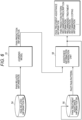
- Fig. 6 is a diagram illustrating a first example of processing for generating the pain treatment assistance information by the pain treatment assistance device 50.
- the control unit 51 reads pain related information of a specific patient from the pain related information DB 54 and inputs the read pain related information into the learning model 61.
- the pain related information of the specific patient is time-series data at a single or a plurality of time points. For example, not only current pain related information of the specific patient but also pain related information at a past time point going back from the current time point may be included.
- the control unit 51 can generate a pain related information vector by performing a vectorization operation for generating a primary vector for the pain related information of the patient and input the generated pain related information vector into the learning model 61. Note that the pain related information vector may be generated for each of the plurality of time points. Note that, although not illustrated, a past pain pattern of the pain treatment assistance information DB 56 may be input into the learning model 61.
- the learning model 61 is generated (learned) to output pain prediction information (pain prediction information) in a case where the pain related information is input.
- the pain related information is time-series data and includes, for example, pain related information within a period of about one month, three months, six months, or 12 months in the past going back from the present.
- the pain prediction information is information indicating pain within a required period from the current point to the future (for example, one month, three months, six months, 12 months, or the like).
- the learning model 61 may, for example, output the pain prediction information from the present to one month later based on the pain related information for past three months or may output the pain prediction information from the present to three month later, based on the pain related information for past six months.
- the degree (degree) of the pain can be expressed, for example, in several stages such as 10 stages from one to 10 or five stages from one to five. It can be assumed that the pain of the patient be stronger as a numerical value increases.
- the learning model 61 can use, for example, a support vector machine (SVM), a decision tree, a random forest, an adaboost, a neural network (for example, recurrent neural network (RNN), long short term memory (LSTM), transformer, or the like), or the like.
- SVM support vector machine
- RNN recurrent neural network
- LSTM long short term memory
- the control unit 51 reads a past pain pattern of the patient, recorded in the pain treatment assistance information DB 56.
- the pain pattern is information regarding pain in the past, and is information indicating a transition of a degree of pain, similarly to the pain prediction information.
- a difference between the pain prediction information and the past pain pattern is that the former is a transition of a degree of pain in a period from the present to the future, whereas the latter is a transition of a degree of pain in a period from the present to the past.
- the control unit 51 inputs the read past pain pattern and the pain prediction information acquired from the learning model 61, into the assistance information generation unit 58.
- the assistance information generation unit 58 generates the pain treatment assistance information based on the pain prediction information and the past pain pattern that have been input.
- the assistance information generation unit 58 stores the generated pain treatment assistance information in the pain treatment assistance information DB 56.
- the pain treatment assistance information includes, for example, a pain prediction pattern, recommended prescription information and recommended treatment information used to assist the doctor who examines the patient, recommended coping information used to assist the patient, or the like. It is sufficient that the pain treatment assistance information include at least one of the recommended prescription information and the recommended treatment information used to assist the doctor.
- the pain prediction pattern be, for example, information that is generated based on the pain prediction information and indicates a temporal transition of a degree of pain of the patient from the past to the future.
- the pain prediction pattern can be displayed by an appropriate method such as graph display or tabular display.
- the recommended prescription information is information for assisting the doctor and includes information used to determine recommended prescription in medicine prescription for the patient.
- the recommended treatment information is information for assisting the doctor and includes information used to determine a recommended treatment method among treatment methods other than the medicine prescription for the patient.
- the recommended coping information is information for assisting the patient and, for example, is information that enables the patient side to cope with the pain even in a case where there is no doctor's intervention such as the examination by the doctor, by notifying at least one of the patient or the family member or the caregiver in advance of the information in a case where the pain is expected in the future.
- the assistance information generation unit 58 may generate the pain treatment assistance information on a rule basis, for example, using a table indicating a correspondence relationship between the pain prediction information and the past pain pattern, and the pain treatment assistance information.
- the table may indicate the correspondence relationship between the pain prediction information and the past pain pattern, and the pain treatment assistance information.
- the assistance information generation unit 58 can be configured by a model using a machine-learned algorithm and can use, for example, a support vector machine (SVM), a decision tree, a random forest, an adaboost, a neural network, or the like.
- SVM support vector machine
- control unit 51 can acquire the pain related information regarding the pain of the patient, input the acquired pain related information into the learning model 61 that outputs the pain prediction information in a case where the pain related information is input and acquire the pain prediction information of the patient, generate the pain treatment assistance information for the patient based on the acquired pain prediction information, and output the generated pain treatment assistance information.
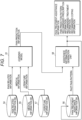
- Fig. 7 is a diagram illustrating a second example of the processing for generating the pain treatment assistance information by the pain treatment assistance device 50.
- a difference from the first example illustrated in Fig. 6 is a point that the medical information and the literature information, in addition to the pain related information, are input into the learning model 61.
- the control unit 51 reads medical information of a specific patient from the medical information DB 55 and inputs the read medical information into the learning model 61.
- the medical information of the specific patient is time-series data at a single or a plurality of time points. For example, not only current medical information of the specific patient but also medical information at a past time point going back from the current time point may be included.
- the control unit 51 can perform the vectorization operation for generating the primary vector for the medical information, generate a medical information vector, and input the generated medical information vector into the learning model 61.
- the medical information vector may be generated for each of the plurality of time points.
- the learning model 61 may, for example, output the pain prediction information from the present to one month later based on the pain related information for past three months and the medical information or may output the pain prediction information from the present to three month later, based on the pain related information for past six months and the medical information. Note that these periods are examples, and the present invention is not limited to these. Note that, although not illustrated, a past pain pattern of the pain treatment assistance information DB 56 may be input into the learning model 61.
- the control unit 51 reads the literature information from the literature information DB 57 and inputs the read literature information into the learning model 61.
- the control unit 51 can perform the vectorization operation for generating the primary vector for the literature information, generate a literature information vector, and input the generated literature information vector into the learning model 61.
- the literature information include, for example, information necessary for associating the type of history information such as the symptom history of the patient, the history of the vital data, the examination history, the medication history, or the treatment history, with how the situation of the pain of the patient changes in the future. For example, if there is a paper indicating how pain changes in the future when a specific medicine is taken, the paper can be used as the literature information.
- the guideline can be used as the literature information.
- the learning model 61 can output the pain prediction information of the patient. It is expected that accuracy of an index output by the learning model 61 is improved by increasing the number of types of information to be input into the learning model 61.
- control unit 51 reads the literature information from the literature information DB 57 and inputs the read literature information into the learning model 61.
- the control unit 51 can perform the vectorization operation for generating the primary vector for the literature information, generate a literature information vector, and input the generated literature information vector into the learning model 61. It is expected that accuracy of an index output by the learning model 61 is improved by increasing the number of types of information to be input into the learning model 61.
- control unit 51 may input the acquired medical information into the learning model 61 that outputs the pain prediction information and acquire the pain prediction information of the patient.
- control unit 51 may input the acquired literature information into the learning model 61 that outputs the pain prediction information and acquire the pain prediction information of the patient.
- Fig. 8 is a diagram illustrating a third example of the processing for generating the pain treatment assistance information by the pain treatment assistance device 50.
- a difference from the second example illustrated in Fig. 7 is a point that the pain related information of the patient, the medical information, and the literature information are input into the assistance information generation unit 58, in addition to the pain prediction information and the past pain pattern.
- a past pain pattern of the pain treatment assistance information DB 56 may be input into the learning model 61.
- the assistance information generation unit 58 may generate the pain treatment assistance information on a rule basis, for example, using a table indicating a correspondence relationship between the pain prediction information, the past pain pattern, the pain related information of the patient, the medical information, and the literature information, and the pain treatment assistance information.
- the table may indicate the correspondence relationship between the pain prediction information, the past pain pattern, the pain related information of the patient, the medical information, and the literature information, and the pain treatment assistance information.
- the assistance information generation unit 58 can be configured by the model using the machine-learned algorithm and can use, for example, a support vector machine (SVM), a decision tree, a random forest, an adaboost, a neural network, or the like.
- SVM support vector machine
- the assistance information generation unit 58 can be configured by the model using the machine-learned algorithm and can use, for example, a support vector machine (SVM), a decision tree, a random forest, an adaboost, a neural network, or the like.
- SVM support vector machine
- Fig. 9 is a diagram illustrating an example of a method for generating the learning model 61.
- the pain treatment assistance device 50 generate the learning model 61.
- a learning processing device other than the pain treatment assistance device 50 may generate the learning model 61, and the pain treatment assistance device 50 may acquire the generated learning model 61.
- the control unit 51 acquires training data (second training data) including the pain related information regarding the pain of the plurality of patients, the medical information, the literature information regarding the pain treatment, and the pain prediction information of the plurality of patients.
- These pieces of training data include disease progress information and pain change information of the plurality of patients.
- the pain related information and the medical information are time-series data and include, for example, pain related information within a period of about one month, three months, six months, or 12 months in the past going back from the present.
- the literature information include, for example, information necessary for associating the type of history information such as the symptom history of the patient, the history of the vital data, the examination history, the medication history, or the treatment history, with how the situation of the pain of the patient changes in the future. For example, if there is a paper indicating how pain changes in the future when a specific medicine is taken or when a specific treatment is performed, the paper can be used as the literature information.
- the guideline can be used as the literature information.
- the control unit 51 can generate the learning model 61 so as to output the pain prediction information in a case where the pain related information, the medical information, and the literature information regarding the pain treatment are input, based on the acquired training data.
- the learning model 61 may be generated to output the pain prediction information from the present to one month later based on the pain related information for past three months and the medical information or may be generated to output the pain prediction information from the present to three month later, based on the pain related information for past six months and the medical information.
- the pain related information, the medical information, and the literature information are included in the input data for learning.
- the control unit 51 may generate the learning model 61 so as to output the pain prediction information.
- inference accuracy of the learning model 61 is improved if at least one of the medical information and the literature information is included in the input data for learning.
- the control unit 51 can output the pain treatment assistance information to the doctor terminal device 40, the patient terminal device 10, or the assistant terminal device 30.
- the pain treatment assistance information is displayed on the display panel of the doctor terminal device 40, and the doctor can perform an input operation or a selection operation according to displayed content.
- the pain treatment assistance information is displayed on the display panel of the patient terminal device 10 or the assistant terminal device 30, and the patient, the family member or the caregiver, or the like can perform the input operation or the selection operation according to the displayed content.
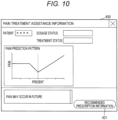
- Fig. 10 is a diagram illustrating a first example of pain treatment assistance information 400 on a doctor side.
- patient information patient ID, patient name, or the like
- a dosage status medicine type, dosage, medicine taking period, or the like
- a treatment status treatment method, treatment period, or the like
- the pain prediction pattern is displayed as a line graph, and a transition of the pain of the patient from the past to the future can be seen.
- the doctor can read that, in the pain treatment of the patient up to the present, although the pain is once alleviated at the current time, it is expected that the pain gradually increases in the future.
- control unit 51 outputs the pain prediction pattern of the patient to the doctor terminal device 40.
- Fig. 11 is a diagram illustrating a second example of pain treatment assistance information 410 on the doctor side.
- the pain treatment assistance information 410 includes the recommended prescription information.
- recommended prescription information recommended content is displayed together with the patient information.
- a recommendation 1 "Take XX tablets of medicine ⁇ " is displayed, and it is recommended to take a specific medicine.
- recommendation 2 "Change medicine ⁇ to ⁇ " is displayed, and a change of the medicine is recommended.
- “Either one of measures is recommended” is displayed, and this urges to adopt prescription recommended by the doctor.
- the recommended prescription information illustrated in Fig. 11 can be stored in the storage unit 59 as a table associated with a plurality of pain prediction patterns in advance.
- pieces of recommended prescription information R1, R2, R3,... are associated with pain prediction patterns P1, P2, P3,....
- the control unit 51 can select a pain prediction pattern closest to the pain prediction pattern of the patient as illustrated in Fig. 10 from the table and specify the recommended prescription information associated with the selected pain prediction pattern.
- a pain occurrence frequency and period in the future can be predicted according to the pain prediction pattern of the patient, and the doctor can present analgesics suitable for the patient, in advance.
- the patient takes the predicted analgesics the pain predicted to occur in the future does not occur, and it is possible to improve quality of life (QOL) of the patient. In this way, it is possible to assist an appropriate pain treatment.
- QOL quality of life
- Fig. 12 is a diagram illustrating a third example of pain treatment assistance information 420 on the doctor side. As compared with the first example in Fig. 10 , in the third example, pain transitions while the remains at a high value from the past to the present. The doctor can read that the pain treatment on the patient up to the present does not alleviate the pain.
- Fig. 13 is a diagram illustrating a fourth example of pain treatment assistance information 430 on the doctor side.
- the pain treatment assistance information 430 includes a recommended treatment method.
- recommended content is displayed together with the patient information.
- a treatment method AA is displayed, and as a recommendation 2, a treatment method BB is displayed.
- “Experienced doctor is introduced in a case where there is no record of implementation of recommended treatment method” is displayed.
- doctor operates a "doctor list display" icon 431
- introduction information of doctors having experience in the recommended treatment method is displayed in a list format.
- the introduction information can include, for example, information such as a medical institution name, a name of a doctor, an experienced treatment method, or a contact address. Furthermore, it is also possible to contact a required doctor by operating a "contact" icon or the like.
- the recommended treatment method as illustrated in Fig. 13 can be stored in the storage unit 59 as a table associated with a plurality of pain prediction patterns in advance. For example, recommended treatment methods T1, T2, T3,... are associated with the pain prediction patterns P1, P2, P3,....
- the control unit 51 can select a pain prediction pattern closest to the pain prediction pattern of the patient as illustrated in Fig. 12 from the table and specify the recommended treatment method associated with the selected pain prediction pattern.
- Fig. 14 is a diagram illustrating a first example of pain treatment assistance information 100 on the patient side.
- the pain prediction pattern is displayed.
- the pain prediction pattern is displayed as a line graph, and a transition of the pain of the patient from the past to the future can be seen. The patient can read that, although the pain is once alleviated at the current time, it is expected that the pain gradually increases in the future.
- control unit 51 outputs the pain prediction pattern of the patient to the patient terminal device 10 and the assistant terminal device 30.
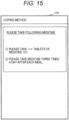
- Fig. 15 is a diagram illustrating a second example of pain treatment assistance information 110 on the patient side.
- the pain treatment assistance information 110 includes the coping method (recommended coping information).
- the recommended coping information as illustrated in Fig. 15 can be stored in the storage unit 59 as a table associated with the plurality of pain prediction patterns in advance.
- pieces of recommended prescription information S1, S2, S3,... are associated with the pain prediction patterns P1, P2, P3,....
- the control unit 51 can select a pain prediction pattern closest to the pain prediction pattern of the patient as illustrated in Fig. 14 from the table and specify the recommended coping information associated with the selected pain prediction pattern.
- the doctor may determine, in advance, the pieces of recommended prescription information S1, S2, S3,... associated with the pain prediction patterns P1, P2, P3,....
- the patient can know an occurrence frequency and period of the pain in the future, in advance. Then, by performing necessary coping methods, according to the coping method recommended by the pain treatment assistance device 50, it is possible to prevent the occurrence of the pain in advance, and the quality of life (QOL) of the patient can be improved.
- the patient can perform the necessary coping method at home, without visiting the hospital. In this way, it is possible to assist an appropriate pain treatment. Note that, in a case where it is not preferable to directly notify the patient of the pain treatment assistance information on the patient side, it is sufficient to transmit the pain treatment assistance information to the assistant terminal device 30, instead of the patient terminal device 10.
- the present embodiment it is possible to predict pain that may occur in the patient in the future, from the state of the patient, and it is possible to perform the pain treatment for alleviating the pain on the patient in advance. Since preventive measures can be taken in this way, the pain of the patient can be reduced.
- Fig. 16 is a diagram illustrating an example of a processing procedure by the pain treatment assistance device 50.
- the control unit 51 acquires the pain related information of the patient (S11) and stores the acquired pain related information in the pain related information DB 54 (database) (S12).
- the pain related information can be repeatedly acquired at a required timing for each patient. For example, it can be acquired once or a plurality of times within a period from the time of the previous hospital visit to the time of the next hospital visit.
- the control unit 51 acquires the medical information of the patient (S13) and stores the acquired medical information in the medical information DB 55 (database) (S14).
- the medical information can be acquired not only at the time of examination but also when the doctor determines that the medical information is needed.
- the control unit 51 inputs the pain related information of the patient, the medical information, and the literature information regarding the pain treatment into the learning model 61 and acquires the pain prediction information of the patient, output by the learning model 61 (S15).
- the control unit 51 reads the past pain pattern of the patient from the pain treatment assistance information DB 56 (database) (S16).
- the control unit 51 generates the pain treatment assistance information including the pain prediction pattern of the patient, based on the past pain pattern of the patient read from the pain treatment assistance information DB 56 and the pain prediction information of the patient acquired from the learning model 61 (S17).
- the pain treatment assistance information is generated based on the pain related information of the patient, the medical information, and the literature information, in addition to the past pain pattern and the pain prediction information.
- the control unit 51 stores the generated pain treatment assistance information in the pain treatment assistance information DB 56 (database) (S18), outputs the generated pain treatment assistance information (S19), and ends the processing.
- Fig. 17 is a diagram illustrating an example of a procedure for generating the learning model 61.
- the control unit 51 acquires the training data including the pain related information regarding the pain of the plurality of patients, the medical information, the pain prediction information, and the literature information regarding the pain treatment (S31). In a case of inputting the pain related information of each patient, the medical information, and the literature information regarding the pain treatment, based on the acquired training data, the control unit 51 generates the learning model 61 so as to output the pain prediction information of each patient (S32).
- the control unit 51 stores the generated learning model 61 in the storage unit 59 (S33) and ends the processing.
Landscapes
- Health & Medical Sciences (AREA)
- Engineering & Computer Science (AREA)
- Medical Informatics (AREA)
- Public Health (AREA)
- General Health & Medical Sciences (AREA)
- Epidemiology (AREA)
- Primary Health Care (AREA)
- Biomedical Technology (AREA)
- Pathology (AREA)
- Data Mining & Analysis (AREA)
- Databases & Information Systems (AREA)
- Life Sciences & Earth Sciences (AREA)
- Bioethics (AREA)
- Medicinal Chemistry (AREA)
- Bioinformatics & Cheminformatics (AREA)
- Chemical & Material Sciences (AREA)
- Business, Economics & Management (AREA)
- General Business, Economics & Management (AREA)
- Surgery (AREA)
- Pain & Pain Management (AREA)
- Hospice & Palliative Care (AREA)
- Urology & Nephrology (AREA)
- Psychiatry (AREA)
- Physics & Mathematics (AREA)
- Nuclear Medicine, Radiotherapy & Molecular Imaging (AREA)
- Biophysics (AREA)
- Heart & Thoracic Surgery (AREA)
- Molecular Biology (AREA)
- Animal Behavior & Ethology (AREA)
- Veterinary Medicine (AREA)
- Medical Treatment And Welfare Office Work (AREA)
Applications Claiming Priority (2)
| Application Number | Priority Date | Filing Date | Title |
|---|---|---|---|
| JP2022118143 | 2022-07-25 | ||
| PCT/JP2023/022147 WO2024024315A1 (ja) | 2022-07-25 | 2023-06-14 | コンピュータプログラム、情報処理装置、情報処理方法及び学習モデル生成方法 |
Publications (2)
| Publication Number | Publication Date |
|---|---|
| EP4524980A1 true EP4524980A1 (de) | 2025-03-19 |
| EP4524980A4 EP4524980A4 (de) | 2025-08-20 |
Family
ID=89706203
Family Applications (1)
| Application Number | Title | Priority Date | Filing Date |
|---|---|---|---|
| EP23846049.7A Pending EP4524980A4 (de) | 2022-07-25 | 2023-06-14 | Computerprogramm, informationsverarbeitungsvorrichtung, informationsverarbeitungsverfahren und lernmodellerzeugungsverfahren |
Country Status (5)
| Country | Link |
|---|---|
| US (1) | US20250174365A1 (de) |
| EP (1) | EP4524980A4 (de) |
| JP (1) | JPWO2024024315A1 (de) |
| CN (1) | CN119604940A (de) |
| WO (1) | WO2024024315A1 (de) |
Families Citing this family (1)
| Publication number | Priority date | Publication date | Assignee | Title |
|---|---|---|---|---|
| CN120853931B (zh) * | 2025-07-14 | 2026-04-14 | 首都医科大学附属北京世纪坛医院 | 一种基于机器学习的疼痛分析及治疗方案生成方法及系统 |
Family Cites Families (8)
| Publication number | Priority date | Publication date | Assignee | Title |
|---|---|---|---|---|
| JP2010003135A (ja) | 2008-06-20 | 2010-01-07 | Yokogawa Electric Corp | 診療情報管理システム |
| WO2014169060A1 (en) * | 2013-04-09 | 2014-10-16 | Wager Tor | Fmri-based neurologic signature of physical pain |
| US11004563B2 (en) * | 2018-05-22 | 2021-05-11 | International Business Machines Corporation | Adaptive pain management and reduction based on monitoring user conditions |
| US20210398672A1 (en) * | 2018-10-29 | 2021-12-23 | Northwestern University | Big Data-Driven Personalized Management of Chronic Pain |
| EP3928328A4 (de) * | 2019-02-22 | 2022-11-02 | Pear Therapeutics (US), Inc. | Systeme und verfahren zur behandlung von migränesymptomen |
| JP7559228B2 (ja) * | 2020-05-29 | 2024-10-01 | ウエスト バージニア ユニバーシティー ボード オブ ガバナーズ オン ビハーフ オブ ウエスト バージニア ユニバーシティー | 携帯型モニタリング装置からのパラメータの時系列を介したユーザの疼痛に対する評価 |
| WO2022217051A1 (en) * | 2021-04-09 | 2022-10-13 | University Of Pittsburgh - Of The Commonwealth System Of Higher Education | Efficiently training and evaluating patient treatment prediction models |
| JP7229491B1 (ja) * | 2021-12-27 | 2023-02-28 | 株式会社日立ソリューションズ東日本 | 学習装置および推定システム |
-
2023
- 2023-06-14 WO PCT/JP2023/022147 patent/WO2024024315A1/ja not_active Ceased
- 2023-06-14 CN CN202380056131.9A patent/CN119604940A/zh active Pending
- 2023-06-14 JP JP2024536839A patent/JPWO2024024315A1/ja active Pending
- 2023-06-14 EP EP23846049.7A patent/EP4524980A4/de active Pending
-
2025
- 2025-01-23 US US19/035,631 patent/US20250174365A1/en active Pending
Also Published As
| Publication number | Publication date |
|---|---|
| US20250174365A1 (en) | 2025-05-29 |
| CN119604940A (zh) | 2025-03-11 |
| JPWO2024024315A1 (de) | 2024-02-01 |
| WO2024024315A1 (ja) | 2024-02-01 |
| EP4524980A4 (de) | 2025-08-20 |
Similar Documents
| Publication | Publication Date | Title |
|---|---|---|
| Mathkor et al. | Multirole of the internet of medical things (IoMT) in biomedical systems for managing smart healthcare systems: An overview of current and future innovative trends | |
| US20250166850A1 (en) | Non-transient computer-readable medium for generating pain treatment assistant information using a learning model | |
| US20240136072A1 (en) | System and method for determining veracity of patient diagnoses within one or more electronic health records | |
| JP2017174407A (ja) | 患者の診断を支援するシステムおよび方法 | |
| Susanto | Electronic health system: sensors emerging and intelligent technology approach | |
| CN108024718A (zh) | 健康信息(数据)医学收集、处理和反馈的连续性系统和方法 | |
| US20250174365A1 (en) | Non-transient computer-readable medium, information processing device, information processing method, and learning model generation method | |
| Warke | Designing interactive technological interventions for menopausal women: designing and developing interactive technology tools to help aging women navigate information about stages of menopause to increase self-awareness of biopsychosocial changes and manage lifestyle for an improved quality of life | |
| Morey et al. | Artificial intelligence to predict billing code levels of emergency department encounters | |
| US20250160762A1 (en) | Non-transient computer-readable medium, information processing device, information processing method, and learning model generation method | |
| Novak et al. | The pulse of artificial intelligence in cardiology: a comprehensive evaluation of state-of-the-art large language models for potential use in clinical cardiology | |
| JP2021039683A (ja) | 診療支援方法、診療支援システム、学習モデルの生成方法、および、診療支援プログラム | |
| JP7605217B2 (ja) | 医療計画支援システム、医療計画支援方法、及び、医療計画支援プログラム | |
| CN119650088A (zh) | 疾病综合预测方法、装置、电子设备、存储介质及系统 | |
| Alhomod et al. | Patient empowerment via mobile personal health records and mobile health applications: a review of the current use | |
| EP4524979A1 (de) | Computerprogramm, schmerzmanagementunterstützungsvorrichtung und schmerzmanagementunterstützungsverfahren | |
| Khan et al. | A Prospective Study of Federated Machine Learning in Medical Science | |
| JP7807126B1 (ja) | 治療計画作成支援システム | |
| Cimino et al. | Capturing Clinician Reasoning in Electronic Health Records: An Exploratory Study of Under-Treated Essential Hypertension | |
| JP7799266B1 (ja) | 検索拡張生成を用いた治療計画、治療評価、治療指示作成支援システム | |
| JP7766380B1 (ja) | 治療計画、治療評価、治療指示作成支援システム | |
| Toapanta Bernabé et al. | Effectiveness validation of Physical Exercise Routines for Hypertensive Patients using Wearable Devices and Machine Learning | |
| JP7666593B2 (ja) | テキストデータ生成方法 | |
| US20260074029A1 (en) | System and method for clinical trials | |
| Dinara et al. | EMPATHY IN THE ERA OF DIGITAL MEDICINE: CAN ALGORITHMS REPLACE HUMAN CONTACT? |
Legal Events
| Date | Code | Title | Description |
|---|---|---|---|
| STAA | Information on the status of an ep patent application or granted ep patent |
Free format text: STATUS: THE INTERNATIONAL PUBLICATION HAS BEEN MADE |
|
| PUAI | Public reference made under article 153(3) epc to a published international application that has entered the european phase |
Free format text: ORIGINAL CODE: 0009012 |
|
| STAA | Information on the status of an ep patent application or granted ep patent |
Free format text: STATUS: REQUEST FOR EXAMINATION WAS MADE |
|
| 17P | Request for examination filed |
Effective date: 20241207 |
|
| AK | Designated contracting states |
Kind code of ref document: A1 Designated state(s): AL AT BE BG CH CY CZ DE DK EE ES FI FR GB GR HR HU IE IS IT LI LT LU LV MC ME MK MT NL NO PL PT RO RS SE SI SK SM TR |
|
| A4 | Supplementary search report drawn up and despatched |
Effective date: 20250718 |
|
| RIC1 | Information provided on ipc code assigned before grant |
Ipc: G16H 20/00 20180101AFI20250714BHEP Ipc: G16H 20/10 20180101ALI20250714BHEP Ipc: G16H 20/40 20180101ALI20250714BHEP Ipc: G16H 40/63 20180101ALI20250714BHEP Ipc: G16H 40/67 20180101ALI20250714BHEP Ipc: G16H 50/20 20180101ALI20250714BHEP Ipc: G16H 50/30 20180101ALI20250714BHEP Ipc: G16H 50/70 20180101ALI20250714BHEP Ipc: G16H 70/20 20180101ALI20250714BHEP Ipc: G16H 70/60 20180101ALI20250714BHEP Ipc: G16H 80/00 20180101ALI20250714BHEP Ipc: A61B 5/00 20060101ALI20250714BHEP Ipc: G16H 10/20 20180101ALI20250714BHEP |
|
| DAV | Request for validation of the european patent (deleted) | ||
| DAX | Request for extension of the european patent (deleted) |