EP4525099A2 - Cellule électrochimique pour centrale électrique ionique - Google Patents
Cellule électrochimique pour centrale électrique ionique Download PDFInfo
- Publication number
- EP4525099A2 EP4525099A2 EP23731725.0A EP23731725A EP4525099A2 EP 4525099 A2 EP4525099 A2 EP 4525099A2 EP 23731725 A EP23731725 A EP 23731725A EP 4525099 A2 EP4525099 A2 EP 4525099A2
- Authority
- EP
- European Patent Office
- Prior art keywords
- anode
- electrodes
- cathode
- electrochemical cell
- electrolyte
- Prior art date
- Legal status (The legal status is an assumption and is not a legal conclusion. Google has not performed a legal analysis and makes no representation as to the accuracy of the status listed.)
- Pending
Links
Images



Classifications
-
- H—ELECTRICITY
- H01—ELECTRIC ELEMENTS
- H01M—PROCESSES OR MEANS, e.g. BATTERIES, FOR THE DIRECT CONVERSION OF CHEMICAL ENERGY INTO ELECTRICAL ENERGY
- H01M4/00—Electrodes
- H01M4/86—Inert electrodes with catalytic activity, e.g. for fuel cells
- H01M4/96—Carbon-based electrodes
Definitions
- the object of the present invention is an electrochemical cell that is adaptable to tubular structures for an ion power plant which produces a significant voltage increase. Electrodes of electrochemical cells ensure that a circulating electrolyte maintains equal kinetics at all the interfaces thereof, in addition to regulating the distance between the anodes and cathodes as the anode wears due to corrosion. Moreover, they facilitate the electrode exchange process to replace the anode, given that the electrodes can be easily opened and removed.
- the energy generated by the Volta effect is known, which is based on the fact that a potential difference always occurs on the contact surface of two different metals, which gives rise to charge separation.
- the Volta effect is established between the metals in such a way that one of them has a positive charge and the other has an equivalent negative charge.
- voltaic batteries or primary batteries, and common batteries
- Volta effect generating electricity from a process known as the oxidation-reduction process.
- Any chemical reaction in which one or more electrons are transferred between reactants causing a change in the oxidation states thereof is known as an oxidation-reduction reaction.
- voltaic batteries are made up of intercalated zinc and copper discs in which the flow of electrons from an anode, formed by a reducing substance (which oxidises), to the cathode, formed by an oxidising substance (which is reduced), is used to generate electricity.
- a reducing substance which oxidises
- an oxidising substance which is reduced
- a galvanic cell or battery is essentially a tin that acts as a cathode, the content of which is a paste of chemical products separated by a membrane, the purpose of which is to temporarily keep the cathode and anode depolarised, producing a flow of electrons called electric current.
- This phenomenon is called electrochemical reaction, and it ends once the possible chemical reactions of the chemicals that make up said paste have been used up inside the cell separated by a membrane, finally polarising the electrodes in the short term, the process being progressively controlled by the slowest stage according to the Tafel equation, which relates the rate of an electrochemical reaction to the overpotential.
- the Tafel equation describes how electric current through an electrode depends on the voltage difference between the electrode and the electrolyte for a simple, unimolecular redox reaction.
- the galvanic cell or battery becomes useless, and thus the entire assembly is discarded, including the anodic part, with all the metallic energy thereof, and the cathodic part, which causes long-term damage to the environment, contaminating aquifers, especially cells with lead and mercury inside.
- the operation of the ion power plant is based on the use of two elements located inside a cell for electricity generation, being at least the metallic anode, both being submerged in the same electrolyte without membranes separating said elements, one of the submerged elements acting as an active or anodic end and the other as a noble or cathodic end.
- the electrochemical cell of the invention comprises electrodes, the electrochemical cell being intercalated in a closed circuit through which an electrolyte flows.
- the electrolyte is preferably seawater or water and common salt.
- the electrodes of the electrochemical cell are an interconnected anode and cathode without the use of separating membranes and using a single aqueous electrolyte, such as seawater.
- the cell also comprises terminals, connected to the electrodes, which allow several electrochemical cells to be connected to each other, preferably in series.
- the cell comprises an electrical connection between the anode and the cathode, which passes through the anode-cathode separator, connecting both elements.
- the cell comprises electrode separators, arranged between electrodes, which electrically isolate them from each other, but allow the electrolyte to pass through.
- the electrodes are rectangular, with two long sides and two short sides, arranged so that the long sides are parallel to the flow of the electrolyte.
- the anodes and cathodes are disc-shaped.
- the discs are positioned perpendicular to the flow of the electrolyte.
- the anode-cathode separators are also disc-shaped and comprise an orifice through which the electrolyte can flow, with a flow perpendicular to the surface of the electrodes.
- the electrochemical cell when the electrochemical cell is the disc-type, it may additionally comprise a cylindrical casing, in which the electrodes are arranged parallel to each other.
- the tubular cell for an ion power plant does not polarise by the action of the kinetics of the electrolyte on the surface of the electrodes, and the electrodes thereof do not short-circuit by the action of the electrode separators and the anode-cathode separators.
- the electrochemical cell in addition to being able to work with metallic cathodes and anodes, can work with other compounds, mainly carbon atoms.
- This technology which generates current by favouring oxidation of the anodes, preferably aluminium, can also work by galvanisation, as an electric accumulator, since they can be reversibly charged and discharged when stored in the porous structure of the carbon nanotubes that preferably make up the cathode ions thereof in the Al-3 anion state (cathode galvanisation) to reversibly release the charge in the opposite direction on demand and return to the ion state once the electronic charge has been released, reducing said anions now in the ion state on the anodic surface.
- the cell can also function as a chlorinator cell by supplying current during the charging processes when part of the composition of the electrolyte is sodium chloride.
- the cell reduces the amperage of the series when the voltage increases and, consequently, reduces the section of the bridge circuits necessary between the cell terminals.
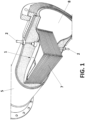
- a preferred embodiment of the electrochemical cell (1) for an ion power plant, object of the present invention, is described below with the help of figures 1 to 8 .
- the electrochemical cell (1) which is shown in figure 1 inserted in a closed circuit through which an electrolyte flows, comprises two or more electrodes.
- Each of the electrodes of the electrochemical cell (1) comprises an anode (3) and a cathode (4) interconnected without using separating membranes and using a single aqueous electrolyte, such as seawater or saltwater.
- the electrochemical cell (1) further comprises terminals (2), represented in figure 1 , connected to the electrodes, which allow several electrochemical cells (1) to be connected to each other, preferably in series.
- the electrochemical cell (1) further comprises anode-cathode separators (6), located between the anode (3) and the cathode (4) of each of the electrodes, separating them.
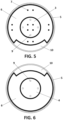
- the electrochemical cell (1) comprises electrode separators (7), shown in figures 1 and 5 , arranged between electrodes, which electrically isolate them, but allow the electrolyte to pass between them.
- the electrodes as shown in figure 1 , the anodes (3) and the cathodes (4) are rectangular, with two long sides and two short sides, arranged such that the long sides are parallel to the flow of the electrolyte.
- the anodes (3) and cathodes (4) are disc-shaped.
- the discs are positioned perpendicular to the flow of the electrolyte.
- Figure 5 represents a top plan view of the outer body of the open electrochemical cell (1), in the case when the electrodes are disc-shaped, wherein the pipe (1) is represented.
- anode-cathode separator (6) which electrically isolates them.
- the electrochemical cell (1) comprises electrode separators (7) which, in this case are plastic separator pins so that the electrodes do not collide with each other.
- anode-cathode separators (6) comprise an orifice through which the electrolyte can flow, with a flow perpendicular to the surface of the electrodes.
- Figure 5 shows a top view of the electrochemical cell (1) in which the anode (3) is shown electrically joined to the cathode (4), which is reflected in figure 6 , by an electrical connection (9) that passes through the anode-cathode separator (6).
- Figure 7 represents a side view of an electrode of a disc-shaped electrochemical cell (1).
- the electrochemical cell (1) when the electrochemical cell (1) is the disc-type, it may additionally comprise a cylindrical casing (11), in which the electrodes are arranged parallel to each other.
- the cylindrical casing (11) comprises an electrolyte inlet (12) and an electrolyte outlet (13).
- the electrochemical cell (1) additionally comprises a compaction element (14), such as a spring, which keeps the electrodes close to each other. In this way, the electrolyte flows forced through the electrode interface, the electrodes being pressed against each other, but separated by the electrode separators (7).
- the cathode (4) is a carbon nanotube composite according to patent document EP3795536 .
- the cathode (4) comprises unidirectional fibres of carbon nanotubes, fibreglass, woven into nanotube fibres, and a microporous insulating polymer sheathing, located around the carbon nanotube fibres that tubularly encapsulate said fibres.
- the electrical connection (9) between the anode and cathode is preferably stainless steel.
Landscapes
- Chemical & Material Sciences (AREA)
- Chemical Kinetics & Catalysis (AREA)
- Electrochemistry (AREA)
- General Chemical & Material Sciences (AREA)
- Hybrid Cells (AREA)
- Electrolytic Production Of Non-Metals, Compounds, Apparatuses Therefor (AREA)
Applications Claiming Priority (3)
| Application Number | Priority Date | Filing Date | Title |
|---|---|---|---|
| ES202200038A ES2956289A1 (es) | 2022-05-12 | 2022-05-12 | Celda tubular para central eléctrica iónica |
| ES202200064A ES2959276B2 (es) | 2022-07-26 | 2022-07-26 | Celda electroquimica de discos |
| PCT/ES2023/070301 WO2023218112A2 (fr) | 2022-05-12 | 2023-05-11 | Cellule électrochimique pour centrale électrique ionique |
Publications (1)
| Publication Number | Publication Date |
|---|---|
| EP4525099A2 true EP4525099A2 (fr) | 2025-03-19 |
Family
ID=86851606
Family Applications (1)
| Application Number | Title | Priority Date | Filing Date |
|---|---|---|---|
| EP23731725.0A Pending EP4525099A2 (fr) | 2022-05-12 | 2023-05-11 | Cellule électrochimique pour centrale électrique ionique |
Country Status (2)
| Country | Link |
|---|---|
| EP (1) | EP4525099A2 (fr) |
| WO (1) | WO2023218112A2 (fr) |
Family Cites Families (4)
| Publication number | Priority date | Publication date | Assignee | Title |
|---|---|---|---|---|
| ES1158584Y (es) | 2016-04-05 | 2016-09-09 | Ramirez Alberto Andrés Santana | Central eléctrica iónica |
| ES2692145A1 (es) * | 2017-05-29 | 2018-11-30 | Alberto Andres SANTANA RAMIREZ | Módulo metálico generador eléctrico |
| US20210319926A1 (en) * | 2018-05-14 | 2021-10-14 | Alberto Andres SANTANA RAMIREZ | Method for the Production of Conductive Micro-Wires by Means of Carbonisation for the Production of Electrodes |
| US20220332619A1 (en) * | 2019-09-17 | 2022-10-20 | Fmc Technologies, Inc. | Power storage and salt water cleaning system |
-
2023
- 2023-05-11 EP EP23731725.0A patent/EP4525099A2/fr active Pending
- 2023-05-11 WO PCT/ES2023/070301 patent/WO2023218112A2/fr not_active Ceased
Also Published As
| Publication number | Publication date |
|---|---|
| WO2023218112A2 (fr) | 2023-11-16 |
| WO2023218112A3 (fr) | 2024-03-07 |
Similar Documents
| Publication | Publication Date | Title |
|---|---|---|
| US8236463B2 (en) | Magnetic current collector | |
| US9748595B2 (en) | High-energy-density, aqueous, metal-polyiodide redox flow batteries | |
| CN102144321A (zh) | 氧化还原流通单元电池 | |
| CA2892173C (fr) | Cellule electrochimique anaerobie aluminium-eau | |
| JP6865436B2 (ja) | 電気化学デバイス | |
| KR20220104199A (ko) | 수전해 방법 및 장치 | |
| CN107017450A (zh) | 铝空气电池 | |
| KR20170126436A (ko) | 구리계 플로우 배터리 | |
| US8692517B2 (en) | Non-diffusion liquid energy storage device | |
| WO2019066651A1 (fr) | Batterie à flux redox pour conversion de chaleur en énergie | |
| JP3315508B2 (ja) | 電解液再調整装置付電解液流通型電池 | |
| WO2015101914A1 (fr) | Appareil pour la production d'hydrogène utilisant de l'eau de mer sans dégagement de chlore et procédé correspondant | |
| EP4525099A2 (fr) | Cellule électrochimique pour centrale électrique ionique | |
| KR101514881B1 (ko) | 이차전지용 전해액 제조방법 | |
| NL2014744B1 (en) | Hybrid battery and electrolyser. | |
| CN105431974B (zh) | 金属电极盒和金属空气电池 | |
| WO2023049751A1 (fr) | Système de réduction d'ions ferriques pour permettre un rééquilibrage d'électrolyte à l'intérieur d'une batterie à flux de fer | |
| JP2008117721A (ja) | 二次電池 | |
| JP2007305501A (ja) | 電解液還流型電池 | |
| JP6807626B2 (ja) | セルスタック、積層電池、電解槽、及び透析槽 | |
| CZ38010U1 (en) | A flow electrochemical cell with three electrodes and three separated electrode chambers | |
| JP2008117720A (ja) | 二次電池 | |
| KR100685907B1 (ko) | 무기물질을이용한 전극제조 방법 | |
| JP2809936B2 (ja) | 電力貯蔵用電池装置 | |
| WO2024191943A1 (fr) | Batterie sodium-hydro économique utilisant des poches d'élément pour contenir un électrolyte d'élément |
Legal Events
| Date | Code | Title | Description |
|---|---|---|---|
| STAA | Information on the status of an ep patent application or granted ep patent |
Free format text: STATUS: UNKNOWN |
|
| STAA | Information on the status of an ep patent application or granted ep patent |
Free format text: STATUS: THE INTERNATIONAL PUBLICATION HAS BEEN MADE |
|
| PUAI | Public reference made under article 153(3) epc to a published international application that has entered the european phase |
Free format text: ORIGINAL CODE: 0009012 |
|
| STAA | Information on the status of an ep patent application or granted ep patent |
Free format text: STATUS: REQUEST FOR EXAMINATION WAS MADE |
|
| 17P | Request for examination filed |
Effective date: 20241212 |
|
| AK | Designated contracting states |
Kind code of ref document: A2 Designated state(s): AL AT BE BG CH CY CZ DE DK EE ES FI FR GB GR HR HU IE IS IT LI LT LU LV MC ME MK MT NL NO PL PT RO RS SE SI SK SM TR |
|
| DAV | Request for validation of the european patent (deleted) | ||
| DAX | Request for extension of the european patent (deleted) |