EP4525183A1 - Séparateur pour batterie secondaire et batterie secondaire le comprenant - Google Patents
Séparateur pour batterie secondaire et batterie secondaire le comprenant Download PDFInfo
- Publication number
- EP4525183A1 EP4525183A1 EP23803789.9A EP23803789A EP4525183A1 EP 4525183 A1 EP4525183 A1 EP 4525183A1 EP 23803789 A EP23803789 A EP 23803789A EP 4525183 A1 EP4525183 A1 EP 4525183A1
- Authority
- EP
- European Patent Office
- Prior art keywords
- separator
- secondary battery
- vinylidene fluoride
- meth
- based polymer
- Prior art date
- Legal status (The legal status is an assumption and is not a legal conclusion. Google has not performed a legal analysis and makes no representation as to the accuracy of the status listed.)
- Pending
Links
Images

Classifications
-
- H—ELECTRICITY
- H01—ELECTRIC ELEMENTS
- H01M—PROCESSES OR MEANS, e.g. BATTERIES, FOR THE DIRECT CONVERSION OF CHEMICAL ENERGY INTO ELECTRICAL ENERGY
- H01M50/00—Constructional details or processes of manufacture of the non-active parts of electrochemical cells other than fuel cells, e.g. hybrid cells
- H01M50/40—Separators; Membranes; Diaphragms; Spacing elements inside cells
- H01M50/409—Separators, membranes or diaphragms characterised by the material
- H01M50/449—Separators, membranes or diaphragms characterised by the material having a layered structure
- H01M50/457—Separators, membranes or diaphragms characterised by the material having a layered structure comprising three or more layers
-
- H—ELECTRICITY
- H01—ELECTRIC ELEMENTS
- H01M—PROCESSES OR MEANS, e.g. BATTERIES, FOR THE DIRECT CONVERSION OF CHEMICAL ENERGY INTO ELECTRICAL ENERGY
- H01M50/00—Constructional details or processes of manufacture of the non-active parts of electrochemical cells other than fuel cells, e.g. hybrid cells
- H01M50/40—Separators; Membranes; Diaphragms; Spacing elements inside cells
- H01M50/409—Separators, membranes or diaphragms characterised by the material
- H01M50/411—Organic material
- H01M50/414—Synthetic resins, e.g. thermoplastics or thermosetting resins
- H01M50/426—Fluorocarbon polymers
-
- H—ELECTRICITY
- H01—ELECTRIC ELEMENTS
- H01M—PROCESSES OR MEANS, e.g. BATTERIES, FOR THE DIRECT CONVERSION OF CHEMICAL ENERGY INTO ELECTRICAL ENERGY
- H01M10/00—Secondary cells; Manufacture thereof
- H01M10/05—Accumulators with non-aqueous electrolyte
- H01M10/052—Li-accumulators
- H01M10/0525—Rocking-chair batteries, i.e. batteries with lithium insertion or intercalation in both electrodes; Lithium-ion batteries
-
- H—ELECTRICITY
- H01—ELECTRIC ELEMENTS
- H01M—PROCESSES OR MEANS, e.g. BATTERIES, FOR THE DIRECT CONVERSION OF CHEMICAL ENERGY INTO ELECTRICAL ENERGY
- H01M50/00—Constructional details or processes of manufacture of the non-active parts of electrochemical cells other than fuel cells, e.g. hybrid cells
- H01M50/40—Separators; Membranes; Diaphragms; Spacing elements inside cells
- H01M50/409—Separators, membranes or diaphragms characterised by the material
- H01M50/411—Organic material
- H01M50/414—Synthetic resins, e.g. thermoplastics or thermosetting resins
- H01M50/417—Polyolefins
-
- H—ELECTRICITY
- H01—ELECTRIC ELEMENTS
- H01M—PROCESSES OR MEANS, e.g. BATTERIES, FOR THE DIRECT CONVERSION OF CHEMICAL ENERGY INTO ELECTRICAL ENERGY
- H01M50/00—Constructional details or processes of manufacture of the non-active parts of electrochemical cells other than fuel cells, e.g. hybrid cells
- H01M50/40—Separators; Membranes; Diaphragms; Spacing elements inside cells
- H01M50/409—Separators, membranes or diaphragms characterised by the material
- H01M50/411—Organic material
- H01M50/414—Synthetic resins, e.g. thermoplastics or thermosetting resins
- H01M50/42—Acrylic resins
-
- H—ELECTRICITY
- H01—ELECTRIC ELEMENTS
- H01M—PROCESSES OR MEANS, e.g. BATTERIES, FOR THE DIRECT CONVERSION OF CHEMICAL ENERGY INTO ELECTRICAL ENERGY
- H01M50/00—Constructional details or processes of manufacture of the non-active parts of electrochemical cells other than fuel cells, e.g. hybrid cells
- H01M50/40—Separators; Membranes; Diaphragms; Spacing elements inside cells
- H01M50/409—Separators, membranes or diaphragms characterised by the material
- H01M50/411—Organic material
- H01M50/414—Synthetic resins, e.g. thermoplastics or thermosetting resins
- H01M50/423—Polyamide resins
-
- H—ELECTRICITY
- H01—ELECTRIC ELEMENTS
- H01M—PROCESSES OR MEANS, e.g. BATTERIES, FOR THE DIRECT CONVERSION OF CHEMICAL ENERGY INTO ELECTRICAL ENERGY
- H01M50/00—Constructional details or processes of manufacture of the non-active parts of electrochemical cells other than fuel cells, e.g. hybrid cells
- H01M50/40—Separators; Membranes; Diaphragms; Spacing elements inside cells
- H01M50/409—Separators, membranes or diaphragms characterised by the material
- H01M50/431—Inorganic material
- H01M50/434—Ceramics
-
- H—ELECTRICITY
- H01—ELECTRIC ELEMENTS
- H01M—PROCESSES OR MEANS, e.g. BATTERIES, FOR THE DIRECT CONVERSION OF CHEMICAL ENERGY INTO ELECTRICAL ENERGY
- H01M50/00—Constructional details or processes of manufacture of the non-active parts of electrochemical cells other than fuel cells, e.g. hybrid cells
- H01M50/40—Separators; Membranes; Diaphragms; Spacing elements inside cells
- H01M50/409—Separators, membranes or diaphragms characterised by the material
- H01M50/443—Particulate material
-
- H—ELECTRICITY
- H01—ELECTRIC ELEMENTS
- H01M—PROCESSES OR MEANS, e.g. BATTERIES, FOR THE DIRECT CONVERSION OF CHEMICAL ENERGY INTO ELECTRICAL ENERGY
- H01M50/00—Constructional details or processes of manufacture of the non-active parts of electrochemical cells other than fuel cells, e.g. hybrid cells
- H01M50/40—Separators; Membranes; Diaphragms; Spacing elements inside cells
- H01M50/409—Separators, membranes or diaphragms characterised by the material
- H01M50/446—Composite material consisting of a mixture of organic and inorganic materials
-
- H—ELECTRICITY
- H01—ELECTRIC ELEMENTS
- H01M—PROCESSES OR MEANS, e.g. BATTERIES, FOR THE DIRECT CONVERSION OF CHEMICAL ENERGY INTO ELECTRICAL ENERGY
- H01M50/00—Constructional details or processes of manufacture of the non-active parts of electrochemical cells other than fuel cells, e.g. hybrid cells
- H01M50/40—Separators; Membranes; Diaphragms; Spacing elements inside cells
- H01M50/409—Separators, membranes or diaphragms characterised by the material
- H01M50/449—Separators, membranes or diaphragms characterised by the material having a layered structure
-
- H—ELECTRICITY
- H01—ELECTRIC ELEMENTS
- H01M—PROCESSES OR MEANS, e.g. BATTERIES, FOR THE DIRECT CONVERSION OF CHEMICAL ENERGY INTO ELECTRICAL ENERGY
- H01M50/00—Constructional details or processes of manufacture of the non-active parts of electrochemical cells other than fuel cells, e.g. hybrid cells
- H01M50/40—Separators; Membranes; Diaphragms; Spacing elements inside cells
- H01M50/409—Separators, membranes or diaphragms characterised by the material
- H01M50/449—Separators, membranes or diaphragms characterised by the material having a layered structure
- H01M50/451—Separators, membranes or diaphragms characterised by the material having a layered structure comprising layers of only organic material and layers containing inorganic material
-
- H—ELECTRICITY
- H01—ELECTRIC ELEMENTS
- H01M—PROCESSES OR MEANS, e.g. BATTERIES, FOR THE DIRECT CONVERSION OF CHEMICAL ENERGY INTO ELECTRICAL ENERGY
- H01M50/00—Constructional details or processes of manufacture of the non-active parts of electrochemical cells other than fuel cells, e.g. hybrid cells
- H01M50/40—Separators; Membranes; Diaphragms; Spacing elements inside cells
- H01M50/46—Separators, membranes or diaphragms characterised by their combination with electrodes
- H01M50/461—Separators, membranes or diaphragms characterised by their combination with electrodes with adhesive layers between electrodes and separators
-
- H—ELECTRICITY
- H01—ELECTRIC ELEMENTS
- H01M—PROCESSES OR MEANS, e.g. BATTERIES, FOR THE DIRECT CONVERSION OF CHEMICAL ENERGY INTO ELECTRICAL ENERGY
- H01M50/00—Constructional details or processes of manufacture of the non-active parts of electrochemical cells other than fuel cells, e.g. hybrid cells
- H01M50/40—Separators; Membranes; Diaphragms; Spacing elements inside cells
- H01M50/489—Separators, membranes, diaphragms or spacing elements inside the cells, characterised by their physical properties, e.g. swelling degree, hydrophilicity or shut down properties
-
- Y—GENERAL TAGGING OF NEW TECHNOLOGICAL DEVELOPMENTS; GENERAL TAGGING OF CROSS-SECTIONAL TECHNOLOGIES SPANNING OVER SEVERAL SECTIONS OF THE IPC; TECHNICAL SUBJECTS COVERED BY FORMER USPC CROSS-REFERENCE ART COLLECTIONS [XRACs] AND DIGESTS
- Y02—TECHNOLOGIES OR APPLICATIONS FOR MITIGATION OR ADAPTATION AGAINST CLIMATE CHANGE
- Y02E—REDUCTION OF GREENHOUSE GAS [GHG] EMISSIONS, RELATED TO ENERGY GENERATION, TRANSMISSION OR DISTRIBUTION
- Y02E60/00—Enabling technologies; Technologies with a potential or indirect contribution to GHG emissions mitigation
- Y02E60/10—Energy storage using batteries
Definitions
- the present disclosure relates to a separator for a secondary battery and a secondary battery including the same.
- lithium batteries are becoming important to meet the miniaturization and high performance of various devices.
- discharge capacity, energy density, and cycle characteristics of lithium batteries are becoming important for application in fields such as electric vehicles.
- Lithium batteries with a large discharge capacity per unit volume, high energy density, and high capacity, as well as excellent lifespan characteristics and safety, are required to meet the applications described above.
- a separator is arranged between a positive electrode and a negative electrode to prevent a short circuit.
- An electrode assembly including a positive electrode, a negative electrode, and a separator arranged between the positive electrode and the negative electrode is wound to have a jelly roll shape, and the jelly roll is rolled to improve the adhesion between the positive electrode / negative electrode and the separator in the electrode assembly.
- the interface resistance between the positive electrode and the separator and the interface resistance between the negative electrode and the separator increases, and thus, as the charge and discharge cycle of the lithium battery is repeated, the capacity and high rate charge and discharge characteristics of the lithium battery may deteriorate.
- One aspect is to provide a separator for a secondary battery with improved adhesion and stability.
- Another aspect is to provide a secondary battery with high capacity, excellent capacity and lifespan characteristics, and improved safety, including the separator described above.
- the second vinylidene fluoride-based polymer particles are selected from
- a separator for a secondary battery wherein the first vinylidene fluoride-based polymer particles and the second vinylidene fluoride-based polymer particles have a size of 200 nm to 1 ⁇ m.
- a secondary battery including a positive electrode, a negative electrode, and the above-described separator provided therebetween.
- the separator for a secondary battery contains an adhesive layer with improved adhesion, ensuring excellent adhesion and good air permeability after the adhesion process, and having excellent adhesion between the separator and the electrodes after charging and discharging, thereby preventing deformation of the shape of the battery. Therefore, it is possible to provide a secondary battery with improved capacity, lifespan, and safety by using the separator.
- Lithium secondary batteries generally have a separator arranged between a positive electrode and a negative electrode and are subjected to a heat press process at a certain temperature and pressure. Through this hot press process, the adhesion of the interfaces between the positive electrode and the separator and between the negative electrode and the separator increases, thereby maintaining the shape of the battery. When the adhesion is insufficient, the interface with the electrode is lifted, which fundamentally causes a continuous decrease in capacity according to the cycle of the lithium polymer battery and a deterioration of high rate charging and discharging characteristics, and reduces the safety of the battery, thereby requiring improvement thereon.
- the present inventors completed a separator for a secondary battery, the separator having an adhesive layer using first vinylidene fluoride-based polymer particles and second vinylidene fluoride-based polymer particles together, having different solation temperatures.
- an adhesive layer it is possible to secure excellent adhesion and air permeability after the adhesion process of the secondary battery, to improve the adhesion of the adhesive layer to the inorganic layer, and to provide a separator with low resistance.
- VDF vinylidene fluoride
- HFP hexafluoropropylene
- the second vinylidene fluoride-based polymer particles are selected from i) polyvinylidene fluoride particles having a solation temperature of 100 °C or higher, and ii) a second copolymer having a solation temperature of 100 °C or higher and containing a vinylidene fluoride (VDF) repeating unit and a hexafluoropropylene (HFP) repeating unit, wherein the content of the HFP repeating units in the second copolymer is 3 mol% or less.
- VDF vinylidene fluoride
- HFP hexafluoropropylene
- the first vinylidene fluoride-based polymer particles and the second vinylidene fluoride-based polymer particles each have a size of 200 nm to 1 ⁇ m.
- the content of the second vinylidene fluoride-based polymer particles is 10 to 90 parts by weight, 20 to 90 parts by weight, 20 to 80 parts by weight, 30 to 80 parts by weight, 40 to 80 parts by weight, 50 to 80 parts by weight, or 50 to 75 parts by weight, based on 100 parts by weight of total weight of the first vinylidene fluoride-based polymer particles and the second vinylidene fluoride-based polymer particles.
- the weight ratio of the first vinylidene fluoride-based polymer particles and the second vinylidene fluoride-based polymer particles is 5:5 to 2:8.
- the strength of adhesion to the electrode facing the adhesive layer may be further increased due to the presence of the functional groups described above.
- the solation temperature of the first vinylidene fluoride-based polymer particles is 70 to 85 °C, for example, 80 to 82 °C.
- the solation temperature of the first vinylidene fluoride-based polymer particles may serve as an adhesive during the high-temperature pressing process of the battery.
- HFP hexafluoropropylene
- the vinylidene fluoride (VDF) repeating unit may be included in an amount of 79 to 87 mol%, or 80 to 86 mol%, or 82 to 85 mol%.
- VDF vinylidene fluoride
- HFP hexafluoropropylene
- the solation temperature of the polyvinylidene fluoride particles is 100 to 150 °C, and when the solation temperature is within the ranges above, the polyvinylidene fluoride particles can serve as an organic filler, thereby maintaining good air permeability even after the high-temperature pressing process.
- the solation temperature of the second copolymer particles is 100 °C to 150 °C, or 100 to 140 °C.
- the second vinylidene fluoride-based polymer particles are polyvinylidene fluoride (homopolymer) or have a content of the HFP repeating unit of 3 mol% or less, 2 mol% or less, or 1 mol% or less.
- the vinylidene fluoride (VDF) repeating units may be included in an amount of 97 mol% or more, for example, 97 to 99 mol%.
- the second copolymer when the vinylidene fluoride (VDF) repeating unit and the hexafluoropropylene (HFP) repeating unit are included in the ranges above, respectively, the second copolymer may secure excellent adhesion and electrolyte impregnation.
- VDF vinylidene fluoride
- HFP hexafluoropropylene
- the total content of the first vinylidene fluoride-based polymer particles and the second vinylidene fluoride-based polymer particles is 10 to 98 parts by weight, based on 100 parts by weight of total weight of the adhesive layer.
- the content of the first vinylidene fluoride-based polymer particles is within the range described above, the interface resistance between the separator and the electrode is reduced, and thus, a separator with improved adhesion can be manufactured.
- the adhesion is excellent, but resistance may increase due to a rapid increase in air permeability after the high-temperature pressing process.
- the adhesive layer contains only the second vinylidene fluoride-based polymer particles, the increase in air permeability after the high-temperature pressing process is low, but the adhesion may be reduced.
- the first vinylidene fluoride-based polymer particles and the second vinylidene fluoride-based polymer particles each have a size of 200 nm to 1 ⁇ m, 200 nm to 800 nm, 200 to 600 nm, 200 to 500 nm, or 200 to 300 nm.
- the first vinylidene fluoride-based polymer particles and the second vinylidene fluoride-based polymer particles each have a size within the range described above, it is possible to prevent the air permeability characteristics from deteriorating due to the blocking of the pores of the inorganic layer and the porous substrate.
- the term "size" refers to a particle diameter when the particle to be measured is spherical, and refers to a major axis length when the particle is non-spherical.
- the particle diameter is, for example, an average particle diameter
- the major axis length is, for example, an average major axis length.
- the average particle diameter and average major axis length represent an average value of the measured particle diameters and the measured major axis lengths, respectively.
- the size of a particle may be evaluated by using a particle size analyzer, a scanning electron microscope, or a transmission electron microscope.
- a particle size analyzer for example, HORIBA, LA-950 laser particle size analyzer may be used.
- the average particle diameter is, for example, an average particle diameter observed with a scanning electron microscope (SEM), and may be calculated as an average value of the particle diameters of about 10 to 30 particles by using an SEM image.
- SEM scanning electron microscope
- the average particle diameter represents D50.
- D50 refers to an average diameter of particles whose cumulative volume corresponds to 50 vol% in the particle size distribution, and refers to a value of the particle diameter corresponding to 50 % from the smallest particle when the total number of particles is 100% in the particle size distribution curve accumulated in the order of the smallest particle size to the largest particle size.
- D50 may be measured by using a particle size analyzer.
- D50 may be easily obtained by measurement with a measuring device using dynamic light-scattering, data analysis, counting the number of particles corresponding to each particle size range, and then calculation therefrom.
- the first vinylidene fluoride-based polymer particles and the second vinylidene fluoride-based polymer particles each have a weight average molecular weight of 50,000 to 500,000, for example, 150,000 to 450,000, for example, 300,000 to 450,000.
- first vinylidene fluoride-based polymer particles and the second vinylidene fluoride-based polymer particles each have a weight average molecular weight within the ranges above, the adhesion of the separator is improved.
- the first vinylidene fluoride-based polymer particles and the second vinylidene fluoride-based polymer particles are aqueous particles.
- the particles may be easily dispersed or dissolved in water, and thus, an adhesive layer may be formed by using an aqueous slurry, thereby making a non-aqueous organic solvent environmentally friendly.
- the adhesive layer may further contain an additional adhesive binder such as fluorine-based resin, polyacrylic acid-based compounds, or any combination thereof.
- the content of this additional adhesive binder is 0.1 to 5 parts by weight, 0.1 to 3 parts by weight, 0.5 to 3 parts by weight, or 0.5 to 2 parts by weight, based on the total weight of the adhesive layer.
- the total content of the additional adhesive binder is within the ranges above, the binding force between the electrode and the separator can be effectively controlled to be stronger.
- the adhesive binder may also serve as a dispersant.
- the weight average molecular weight of the polyacrylic acid-based compounds is 50,000 to 500,000, for example, 150,000 to 450,000, for example, 300,000 to 450,000.
- the weight average molecular weight of the polyacrylic acid-based compounds is within the ranges above, the adhesion of the separator is improved.
- the polyacrylic acid-based compounds include, for example, polyacrylic acid, polymethylacrylic acid, polyethylacrylic acid, polybutylacrylic acid, polyhexylacrylic acid, polyhydroxyethyl methacrylic acid, polyaminoacrylic acid, or any combination thereof.
- the polyacrylic acid-based compounds may include AQC commercially available from Sumitomo Corporation.
- the fluorine-based resin serves as a binder to fix inorganic particles onto a porous substrate and simultaneously provides excellent adhesion between the porous substrate and one side of the adhesive layer and between the electrode and the other side of the adhesive layer.
- the fluorine-based resin which is a binder, has an average particle diameter of 100 to 300 nm.
- the adhesive layer has very excellent adhesion to the porous substrate.
- the binder has high heat resistance, and thus, the network-structured matrix form thereof may be maintained.
- the fluorine-based resin has a glass transition temperature (Tg) of 50 °C or higher and a weight average molecular weight of 200,000 to 3,000,000 g/mol, 200,000 to 2,000,000 g/mol, or 300,000 to 1,200,000 g/mol.
- Tg glass transition temperature
- the weight average molecular weight may be an average molecular weight measured by using gel permeation chromatography with polystyrene standards.
- the separator may have excellent adhesion.
- the fluorine-based resin is polyvinylidene fluoride, a polyvinylidene fluoride-hexafluoropropylene copolymer, a polyvinylidene fluoride-trichloroethylene copolymer, a polyvinylidene fluoride-chlorotrifluoroethylene copolymer, or any combination thereof.
- the (meth)acrylic binder is polyacrylate, polymethacrylate, polybutylacrylate, polyacrylonitrile, or any combination thereof.
- the vinylidene fluoride repeating unit may be included in an amount of 90 mol% to 99.5 mol%, 93 mol% to 99 mol%, or 95 mol% to 99 mol%.
- the vinylidene fluoride repeating unit may secure excellent adhesion and electrolyte impregnation.
- the crystallinity of the fluorine-based resin may be 35 % to 45 %, for example, 38 % to 45 %, or 40 % to 45 %.
- the adhesive layer further includes the (meth)acrylic binder
- the mixed weight ratio of the total weight of the first particles and the second particles and the (meth)acrylic binder is 0.01:1 to 1:1, or 0.25:1 to 0.75:1.
- the adhesive layer may further include, for example, one or more selected from the group consisting of polyvinylpyrrolidone, polyvinyl acetate, polyethylene oxide, cellulose acetate, cellulose acetate butyrate, cellulose acetate propionate, cyanoethylpullulan, cyanoethyl polyvinyl alcohol, cyanoethyl cellulose, cyanoethyl sucrose, pullulan, carboxyl methyl cellulose, and an acrylonitrile-styrene-butadiene copolymer.
- the secondary battery is, for example, a lithium secondary battery.
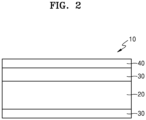
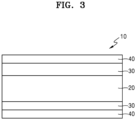
- a separator 10 for a secondary battery includes a porous substrate 20 and an inorganic layer 30 disposed on both sides of the porous substrate 20.
- the inorganic layer 30 is disposed on both sides of the porous substrate 20, but the inorganic layer 30 may be disposed on one side of the porous substrate, as shown in FIG. 3 .
- an adhesive layer 40 is disposed on the inorganic layer 30.
- the adhesive layer 40 contains first vinylidene fluoride-based polymer particles and second vinylidene fluoride-based polymer particles, having different solation temperatures.
- the separator 10 can exhibit excellent adhesion and air permeability even after the adhesion process.
- the adhesive layer 40 has a thickness of 0.01 ⁇ m to 10 ⁇ m, 0.01 ⁇ m to 4 ⁇ m, 0.1 ⁇ m to 3 ⁇ m, 0.1 ⁇ m to 2 ⁇ m, or 0.1 ⁇ m to 1 ⁇ m. Excellent adhesion is exhibited when the thickness of the adhesive layer is within the ranges above.
- the thickness of the adhesive layer is measured by using a film thickness gauge or using an image obtained after observation with a scanning electron microscope (SEM).
- an inorganic layer 30 may be further formed on the other side of the porous substrate 20.
- the inorganic layer 30 disposed on the other side of the porous substrate 20 may have a composition the same as or different from that of the inorganic layer 40 disposed on the one side of the porous substrate 20.
- a separator according to another embodiment may have a stacked structure in which the adhesive layer 40 is disposed on the other side of the porous substrate 20.
- the inorganic particles contained in the inorganic layer 40 are not particularly limited, and inorganic particles commonly used in the art may be used.
- Specific examples of the inorganic particles usable in the present disclosure may include one or more selected from Al 2 O 3 , SiO 2 , B 2 O 3 , Ga 2 O 3 , TiO 2 , SnO 2 , boehmite, BaSO 4 , MgO, Mg(OH) 2 , clay, ZnO, CaO, CeO 2 , NiO, GaO, ZrO2, Y 2 O 3 , SrTiO 3 , and BaTiO 3 . These may be used alone or in a combination of two or more thereof. More specifically, Al 2 O 3 (alumina) may be used.
- the size of the inorganic particle is, for example, 1 ⁇ m to 20 ⁇ m, 2 ⁇ m to 15 ⁇ m, or 3 ⁇ m to 12 ⁇ m.
- size refers to an average particle diameter when the particle is spherical, and refers to a major axis length when the particle is non-spherical.
- the average particle diameter refers to D50 based on volume.
- the average particle diameter is measured by using measurement devices, for example, using a laser diffraction method or a dynamic light scattering method.
- the average particle diameter is measured by using, for example, a laser scattering particle size distribution meter (e.g., HORIBA, LA-920), and is a value of the median diameter (D50) of particles whose the cumulative volume corresponds to 50 vol% from the smallest particle in the particle size distribution curve.
- the size of the inorganic particles may be evaluated by using a scanning electron microscope or a transmission electron microscope.
- the average particle diameter is, for example, an average particle diameter observed with a scanning electron microscope (SEM), and may be calculated as an average value of the particle diameters of about 10 to 30 particles by using an SEM image.
- inorganic particles having the size described above it is possible to prevent the dispersibility and coating processability of the inorganic particles in the inorganic layer from deteriorating, and to appropriately adjust the thickness of the inorganic layer, thereby enhancing mechanical properties.
- the size of the pores created in the separator is adjusted appropriately to reduce the possibility of internal short circuits occurring during charging and discharging of the battery.
- the content of the inorganic particles in the inorganic layer is 50 to 95 parts by weight, 60 to 95 parts by weight, or 75 to 95 parts by weight, based on 100 parts by weight of total weight of the inorganic layer.
- heat shrinkage of the separator can be effectively suppressed.
- the heat dissipation characteristics of the inorganic particles can be sufficiently exhibited and heat shrinkage of the separator can be effectively suppressed.
- the inorganic layer 30 constituting the separator 10 is a heat-resistant layer, and thus, the no shrinkage and fracture occurs at high temperatures and the adhesion to the substrate is improved.
- the thickness of the inorganic layer 30 is 0.01 ⁇ m to 10 ⁇ m, 0.1 to 5 ⁇ m, 1 ⁇ m to 5 ⁇ m, 1 ⁇ m to 3 ⁇ m, or 1 ⁇ m to 2 ⁇ m.
- the inorganic layer 30 contains inorganic particles and a binder.
- a crosslinkable binder, a non-crosslinkable binder, or any combination thereof may be used.
- the binder is, for example, a non-crosslinkable binder, and non-limiting examples thereof may include a polyvinylidene fluoride (PVdF)-based polymer, polymethyl methacrylate, polyacrylonitrile, polyvinylpyrrolidone, polyvinylacetate, polyethylene oxide, cellulose acetate, cellulose acetate butylate, cellulose acetate propionate, cyanoethylpullulan, cyanoethylpolyvinyl alcohol, cyanoethyl cellulose, cyanoethyl sucrose, pullulan, carboxyl methyl cellulose, an acrylonitrile-butadiene-styrene copolymer, poly(acrylic acid-co-acrylamide-co-2-acrylamido-2-methylprop
- the vinylidene fluoride-based polymer may be, for example, polyvinylidene fluoride, a vinylidene fluoride copolymer, or mixtures thereof.
- the vinylidene fluoride copolymer refers to a polymer including 5 wt% or less of repeating units other than vinylidene fluoride repeating units.
- the vinylidene fluoride copolymer may be, for example, a vinylidene fluoride-hexafluoropropylene copolymer.
- the inorganic layer may further include a crosslinkable binder.
- a crosslinkable binder By additionally including a non-crosslinkable binder in the inorganic layer, adhesion to the substrate or electrode and heat resistance can be further improved.
- a crosslinkable binder refers to a substance that may produce a binder having a crosslinked structure by causing a crosslinking reaction.
- the crosslinkable binder may be selected from monomers, oligomers, polymers, or mixtures thereof, having one or more crosslinkable functional groups.
- the monomers, oligomers or polymers having one or more functional groups have, for example, one or more functional groups selected from the group consisting of an acrylate group, a vinyl group, a hydroxy group, an epoxy group, an oxane group, an oxetane group, a carboxyl group, an amine group, an oxazoline group, an ester group, and an isocyanate group.
- the monomers, oligomers or polymers having one or more functional groups has 2 or more, 3 or more, or 4 or more functional groups.
- the crosslinkable binder may include, for example, one or more acrylates selected from the group consisting of: alkyl (meth)acrylates such as methyl methacrylate and methyl acrylate; bifunctional (meth)acrylates such as ethylene glycol di(meth)acrylate, propylene glycol di(meth)acrylate, polyethylene glycol di(meth)acrylate, polypropylene glycol di(meth)acrylate, di(meth)acrylate of a polyoxyethylene/polyoxypropylene copolymer, butanediol di(meth)acrylate, and hexamethylene glycol di(meth)acrylate; trifunctional (meth)acrylates such as trimethylol propane tri(meth)acrylate, glycerin tri(meth)acrylate, tri(meth)acrylate of ethylene oxide adduct of glycerin, tri(meth)acrylate of propylene oxide adduct of glycerin, and tri(meth)
- the crosslinkable binder may include, for example, vinylpyrrolidone, vinylcaprolactam, vinylimidazole, vinyl-methylacetamide, ethylvinylether, propylvinylether, butylvinylether, pentylvinylether, hexylvinylether, heptylvinylether, octylvinylether, nonylvinylether, decylvinylether, cyclohexylvinylether, ethylhexylvinylether, dodecylvinylether, octadecylvinylether, and the like.
- the crosslinkable binder may include, for example, biphenol, bisphenol A, methanediol, ethanediol, propanediol, butanediol, pentanediol, hexanediol, heptanediol, octanediol, nonanediol, decanediol, and the like.
- Examples of the monomers, oligomers or polymers having one or more epoxy groups may include: diepoxyalkanes such as diepoxyethane, diepoxypropane, diepoxybutane, diepoxypentane, diepoxyhexane, diepoxyheptane, diepoxyoctane, diepoxynonane, and diepoxydodecane; glycidyl ethers such as bisphenol A diglycidyl ether, bisphenol F diglycidyl ether, brominated bisphenol A diglycidyl ether, phenol novolak glycidyl ether, and cresol novolak glycidyl ether; glycidyl esters such as hexahydrophthalic acid glycidyl ester, and dimer acid glycidyl ester; glycidyl amines such as glycidyl isocyanurate and tetraglycidyl diamin
- the crosslinkable binder may include 4,4'-diphenylenemethane diisocyanate, toluene diisocyanate, tolylene diisocyanate, naphthylene diisocyanate, 4,4'-dicyclohexylenemethane diisocyanate, cyclohexylene diisocyanate, 3,3'-dimethylphenylene diisocyanate, diphenylmethane diisocyanate, 3,3'-dimethyldiphenylenemethane diisocyanate, 4,6'-xylylene diisocyanate, 4,4'-dicyclohexylmethane diisocyanate, 3,5,5-trimethylcyclohexylene diisocyanate, 1,6-hexamethylene diisocyanate, 2,2,4-trimethylhexamethylene diisocyanate, m-xylene diisocyanate, trimethylxylene diisocyanate, p-phenylene diisocyanate,
- a compound represented by Formula 1 may be used as the crosslinkable binder: wherein, in Formula 1, X 1 to X 3 are each an oxyethylene group, X 4 is an oxyethylene group, or an alkyl group having 1 to 10 carbon atoms, R 1 to R 4 is each independently any one functional group selected from the group consisting of a (meth)acrylate group, a hydroxy group, a carboxyl group, an ester group, a cyanate group, an isocyanate group, an amino group, a thiol group, an alkoxy group having 1 to 10 carbon atoms, a vinyl group, and a heterocyclic group, a 1 to a 4 are each an integer of 1 to 10, n 1 to n 3 are each an integer of 0 to 10, and at least one of n 1 to n 4 is an integer of 1 to 10, provided that when X 4 is the oxyethylene group, n 4 is an integer of 1 to 10 and m is 1, and when X 4 is the alkyl group
- the heterocyclic group may be one selected from the group consisting of a heterocycloalkyl group having 2 to 20 carbon atoms, a heterocycloalkenyl group having 3 to 20 carbon atoms, a heterocycloalkynyl group having 3 to 20 carbon atoms, and a heteroaryl group having 6 to 20 carbon atoms, and may include heteroatoms selected from N, O, and S.
- the heterocyclic group may include, for example, an epoxy group, an oxetane group, and the like.
- the compound of Formula 1 may include compounds of Formula 2 or 3: wherein, in Formulae 2 and 3, R 5 may be an alkyl group having 1 to 10 carbon atoms, n 5 to n 7 may each be an integer of 1 to 5, and a 5 to a 12 may each be an integer of 1 to 10.
- the compound of Formula 1 may include, for example, ethoxylated pentaerythritol tetraacrylate or ethoxylated trimethylolpropane triacrylate.
- a non-crosslinkable acrylic binder may be used as the binder contained in the inorganic layer.
- the content of the non-crosslinkable binder in the inorganic layer is 1 to 10 parts by weight, or 1 to 5 parts by weight, based on 100 parts by weight of total weight of the inorganic layer.
- heat shrinkage resistance and fracture resistance characteristics are excellent.
- the inorganic particles contained in the inorganic layer may be surface-treated to react with the crosslinkable binder.
- the inorganic particles may be surface-treated with functional groups capable of reacting with the functional groups of the crosslinkable binder.
- a crosslinking reaction may occur due to the reaction between the functional groups of the inorganic particles and the functional groups of the crosslinkable binder, and a crosslinking reaction between the functional groups of the inorganic particles may also occur, thereby improving the bonding strength between the inorganic particles and the crosslinkable binder, and improving adhesion to the substrate or coating density.
- the inorganic particles may be surface-treated to have an acrylate group.
- a binder containing an aqueous crosslinkable reactive acrylamide-based copolymer may be used as the crosslinkable binder further contained in the inorganic layer.
- the aqueous crosslinkable reactive acrylamide-based copolymer contains two or more crosslinkable reactive groups which are crosslinkable with each other. Being usable in a one-component form without a crosslinking agent, the two or more crosslinkable reactive groups may undergo a crosslinking reaction with each other through a self-condensation reaction. Through this, an inorganic layer of a separator may be formed, thus making it possible to provide a separator with high heat resistance characteristics.
- the crosslinkable reactive group may include: at least one first functional group selected from a carboxyl group, an amine group, and an isocyanate group; and at least one second functional group selected from a hydroxy group, an epoxy group, and an oxazoline group, and a crosslinking reaction may occur between the first functional group and the second functional group.
- the crosslinkable reactive group may include a carboxyl group and a hydroxy group.
- the equivalence ratio of the first functional group and the second functional group may be in the range of 30:70 to 70:30.
- the equivalent ratio of the first functional group and the second functional group may be in the range of, for example, 35:65 to 65:35, 40:60 to 60:40, or 45:55 to 55:45, for example, about 50:50.
- a crosslinking reaction between the first functional group and the second functional group may proceed smoothly.
- the acrylamide-based copolymer include (N-substituted) amide-based monomers
- the (N-substituted) amide-based monomers may include one or more selected from the group consisting of (meth)acrylamide, N,N-dialkyl(meth)acrylamide such as N,N-dimethyl(meth)acrylamide, N,N-diethyl(meth)acrylamide, N,N-dipropyl(meth)acrylamide, N,N-diisopropyl(meth)acrylamide, N,N-di(n-butyl)(meth)acrylamide, N,N-di(t-butyl)(meth)acrylamide, etc., N-ethyl(meth)acrylamide, N-isopropyl(meth)acrylamide, N-butyl (meth)acrylamide, N-n-butyl (meth)acrylamide, N-methylol (meth)acrylamide, N
- the content of the (N-substituted) amide-based monomers is 30 to 90 mol%, 40 to 80 mol%, or 50 to 70 mol%, based on the total moles of monomer components constituting the acrylamide-based copolymer.
- a decomposition temperature characteristic of 200 °C or higher may be exhibited.
- the acrylamide-based copolymer may include: (N-substituted) amide-based monomers; and one or two or more acrylic monomers selected from the group consisting of a carboxyl group-containing monomer, a (meth)acrylic acid alkyl-based monomer, a hydroxyl group-containing monomer, an isocyanate group-containing monomer, an oxazoline group-containing monomer, a hydroxyl group-containing monomer, a polyfunctional (meth)acrylate-based monomer, an acid anhydride group-containing monomer, a sulfonic acid group-containing monomer, a phosphoric acid group-containing monomer, a succinimide-based monomer, a maleimide-based monomer, an itaconimide-based monomer, a cyano-containing monomer, an aminoalkyl (meth)acrylate-based monomer, an alkoxyalkyl (meth)acrylate-based monomer, an epoxy group-
- two or more functional groups capable of crosslinking with each other may exist in the (N-substituted) amide-based monomers and the acrylic monomers, or may exist only in the acrylic monomers.
- acrylic monomers may include: a carboxyl group-containing monomer such as acrylic acid, (meth)acrylic acid, carboxyethyl acrylate, carboxypentyl acrylate, itaconic acid, maleic acid, fumaric acid, crotonic acid, isocrotonic acid, etc.; an alkyl (meth)acrylate-based monomer such as an alkyl (meth)acrylate-based monomer having a linear or branched alkyl group having 1 to 20 carbon atoms in the ester portion thereof, specifically, for example, methyl (meth)acrylate, ethyl (meth)acrylate, n-propyl (meth)acrylate, isopropyl (meth)acrylate, n-butyl (meth)acrylate, isobutyl (meth)acrylate, t-butyl (meth)acrylate, pentyl (meth)acrylate, isopentyl (meth)acrylate, he
- the molar ratio of the (N-substituted) amide-based monomers and the acrylic monomers is in the range of 1:99 to 99:1, 20:80 to 80:20, 30:70 to 70:30, 40: 60 to 60:40, or 50:50.
- the molar ratio of the (N-substituted) amide-based monomers and the acrylic monomers is within the ranges above, it is possible to form a coating layer of a separator with improved heat resistance.
- the weight average molecular weight of the acrylamide-based copolymer is 100,000 to 1,000,000 g/mol, 150,000 to 800,000 g/mol, 200,000 to 700,000 g/mol, or 300,000 to 600,000 g/mol.
- weight average molecular weight of the acrylamide-based copolymer is within the ranges above, it is possible to manufacture a separator having a low shrinkage rate when stored at high temperatures.
- the acrylamide-based copolymer may have a glass transition temperature of 150 °C or higher, 150 °C to 300 °C, 170 °C to 280 °C, or 190 °C to 250 °C.
- the glass transition temperature of the acrylamide-based copolymer is within the ranges above, it is possible to form the separator having high heat resistance.
- the acrylamide-based copolymer may include, for example, an acrylic acid-acrylamide-(2-acrylamido)-(2-methylpropanesulfonic acid) copolymer, an aqueous crosslinkable reactive polyacrylamide-acrylic acid-hydroxyethylacrylic copolymer, or any combination thereof.
- the acrylamide-based copolymer may further include one or more non-acrylic monomers.
- the acrylamide-based copolymer may further include one or more non-acrylic monomers.
- non-acrylic monomers may be used without particular limitation as long as the monomers are copolymerizable monomers other than the acrylic monomers described above.
- Copolymerizable non-acrylic monomers may be, for example, vinyl esters, nitrogen-containing heterocyclic monomers, N-vinylcarboxylic acid amides, lactam monomers, olefin monomers, vinyl ether-based monomers, aromatic vinyl compounds, olefins or dienes, vinyl ethers, vinyl chloride, sulfonic acid group-containing monomers, imide group-containing monomers, isocyanate group-containing monomers, etc., and one or more thereof may be selected.
- non-acrylic monomers may include: vinyl esters such as vinyl acetate, vinyl propionate, etc.; nitrogen-containing heterocyclic monomers such as N-vinyl-2-pyrrolidone, N-methylvinylpyrrolidone, N-vinylpyridine, N-vinylpiperidone, N-vinylpyrimidine, N-vinylpiperazine, N-vinylpyrazine, N-vinylpyrrole, N-vinylimidazole, N-vinyloxazole, N-(meth)acryloyl-2-pyrrolidone, N-(meth)acryloyl piperidine, N-(meth)acryloylpyrrolidine , N-vinylmorpholine, N-vinyl-2-piperidone, N-vinyl-3-morpholinone, N-vinyl-2-caprolactam, N-vinyl-1,3-oxazin-2-one, N-vinyl-3,5-morpho
- the content of the non-acrylic monomers included in the acrylamide-based copolymer is not particularly limited, provide that the non-acrylic monomers do not impair the aqueous crosslinking reaction characteristics of the acrylamide-based copolymer and the high heat resistance characteristics of the separator.
- the non-acrylic monomers may be included in a range of 0.1 to 30 mol%, based on the total moles of monomer components constituting the acrylamide-based copolymer.
- the content of the acrylamide-based copolymer is 10 to 100 wt%, 30 to 95 wt%, 50 to 90 wt%, or 60 to 80 wt%, based on the total weight of the binder. In the above ranges, it is possible to provide a composition for forming an inorganic layer of a separator with improved heat resistance and adhesion to a substrate.
- the weight ratio of the crosslinkable binder and the non-crosslinkable binder may be 8:2 to 2:8, specifically 3:7 to 7:3.
- the non-crosslinkable binder having the weight ratio within the ranges above it is possible to manufacture a separator with improved adhesion and heat resistance.
- the thickness of the porous substrate is 1 ⁇ m to 100 ⁇ m, 1 to 40 ⁇ m, 1 ⁇ m to 30 ⁇ m, 5 ⁇ m to 20 ⁇ m, 5 ⁇ m to 15 ⁇ m, or 5 ⁇ m to 10 ⁇ m.
- a separator having an appropriate thickness that is thick enough to prevent short circuit between the positive electrode and negative electrode of the battery but not thick enough to increase the internal resistance of the battery.
- the porosity of the porous substrate included in the separator is 5 % to 95 %, 30 % to 80 %, for example, 40 % to 60 %, and the air permeability may be 250 sec/100 cc or less, for example, 200 sec/100 cc or less, for example, 150 sec/100 cc or less.
- the pore size of the porous substrate in the separator may be 0.01 ⁇ m to 50 ⁇ m, 0.01 ⁇ m to 20 ⁇ m, or 0.01 ⁇ m to 10 ⁇ m.
- the porous substrate may be a polymer film formed from any one polymer selected from the group consisting of, without limitation, polyolefins such as polyethylene and polypropylene, polyesters such as polyethylene terephthalate and polybutylene terephthalate, polyacetal, polyamide, polyimide, polycarbonate, polyetheretherketone, polyaryletherketone, polyetherimide, polyamideimide, polybenzimidazole, polyethersulfone, polyphenylene oxide, cyclic olefin copolymer, polyphenylene sulfide, and polyethylene naphthalate, or a mixture of two or more thereof.
- polyolefins such as polyethylene and polypropylene
- polyesters such as polyethylene terephthalate and polybutylene terephthalate
- polyacetal polyamide, polyimide, polycarbonate, polyetheretherketone, polyaryletherketone, polyetherimide, polyamideimide, polybenzimidazole, polyether
- the porous substrate may be a polyolefin-based substrate, and the polyolefin-based substrate has an excellent shut down function, which can contribute to improving the safety of the battery.
- the polyolefin-based substrate may be, for example, selected from the group consisting of a polyethylene single film, a polypropylene single film, a polyethylene/polypropylene double film, a polypropylene/polyethylene/polypropylene triple film, and a polyethylene/polypropylene/polyethylene triple film.
- the polyolefin-based resin may include a non-olefin resin in addition to the olefin resin, or may include a copolymer of olefin and non-olefin monomers.
- a separator may be manufactured by preparing a slurry containing inorganic particles, a first binder, and optionally inorganic particles, applying the slurry onto a porous substrate, and then performing drying and rolling processes.
- the method of applying the slurry is not particularly limited, and any method available in the art may be used.
- the separator may be formed by methods such as printing, compression, press fitting, roller application, blade application, brush application, dipping application, spray application, or stream application.
- pretreatment such as sulfonation treatment, graft treatment, corona discharge treatment, ultraviolet irradiation treatment, plasma treatment, or spatter etching treatment may be optionally performed to improve adhesion with the adhesive layer.
- a secondary battery including: a positive electrode; negative electrode; a separator according to one embodiment, which is arranged between the positive electrode and the negative electrode; and an electrolyte.
- the binder used to manufacture the negative electrode may be the same as the coating composition included in the adhesive layer of the separator.
- the contents of the positive active material, conductive material, common binder, and solvent are at levels commonly used in lithium batteries. Depending on the use and configuration of the lithium battery, one or more of the conductive material, common binder, and solvent may be omitted.
- the binder used to manufacture the positive electrode may be the same as the adhesive layer composition included in the adhesive layer of the separator.
- the separator may be prepared separately and arranged between the positive electrode and the negative electrode.
- the separator may be prepared by winding the electrode assembly including the positive electrode/separator/negative electrode in the form of a jelly roll, accommodating the jelly roll in a battery case or pouch, pre-charging the jelly roll while thermally softening the jelly roll under pressure with accommodated in the battery case or pouch, hot rolling the charged jelly roll, cold rolling the charged jelly roll, and subjecting the charged jelly roll to a formation process, which is charging and discharging the charged jelly roll under pressure.
- the electrolyte may be in a liquid or gel state.
- the electrolyte may be an organic electrolyte solution.
- the electrolyte may be solid.
- the electrolyte may be boron oxide, lithium oxynitride, or the like, but is not limited thereto, and any solid electrolyte available in the art may be used.
- the solid electrolyte may be formed onto the negative electrode by using methods such as sputtering and the like.
- the organic electrolyte solution may be prepared.
- the organic electrolyte solution may be manufactured by dissolving lithium salts in an organic solvent.
- the organic solvent may be any organic solvent commonly used in the art.
- the organic solvent is propylene carbonate, ethylene carbonate, fluoroethylene carbonate, butylene carbonate, dimethyl carbonate, diethyl carbonate, methylethyl carbonate, methylpropyl carbonate, ethylpropyl carbonate, methylisopropyl carbonate, dipropyl carbonate, dibutyl carbonate, methyl propionate, ethyl propionate, propyl propionate, benzonitrile, acetonitrile, tetrahydrofuran, 2-methyltetrahydrofuran, ⁇ -butyrolactone, dioxolane, 4-methyldioxolane, N, N-dimethyl formamide, dimethyl acetamide, dimethyl sulfoxide, dioxane, 1,2-dimethoxyethane, sulfolane, dichloroethane, chlorobenzene, nitrobenzene, di
- the lithium salts any lithium salts available in the art may be used.
- the lithium salts are LiPF 6 , LiBF 4 , LiSbF 6 , LiAsF 6 , LiClO 4 , LiCF 3 SO 3 , Li(CF 3 SO 2 ) 2 N, Li(FSO 2 ) 2 N, LiC 4 F 9 SO 3 , LiAlO 2 , LiAlCl 4 , LiN(C x F 2x+1 SO 2 )(C y F 2y+1 SO 2 ) (wherein x and y is each a natural number), LiCl, Lil, or mixtures thereof.
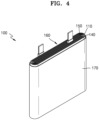
- FIG. 4 is an exploded perspective view of a lithium battery according to one embodiment.
- a lithium secondary battery 100 includes an electrode assembly 160 and a case 170 in which the electrode assembly 160 is embedded, the electrode assembly being obtained from winding a separator 110 according to one embodiment between a positive electrode 140 and a negative electrode 150.
- the electrode assembly 160 may be, for example, in the form of a jelly roll which is formed by winding the positive electrode 140 and the negative electrode 150 with the separator 110 therebetween. As another example, the electrode assembly 160 may be in the form of a stack in which the separator 110 is stacked multiple times between the positive electrode 140 and the negative electrode 150.
- the positive electrode 140, negative electrode 150, and the separator 110 are impregnated with an electrolyte solution (not shown).
- the lithium secondary battery may be a lithium ion battery.
- the lithium battery may be a lithium polymer battery.
- the lithium secondary battery may be cylindrical, prismatic, or pouch-shaped.
- lithium batteries are suitable to be used in an electric vehicle (EV).
- EV electric vehicle
- PHEV plug-in hybrid electric vehicle
- the reaction was conducted for 12 hours while maintaining the temperature of the reaction solution stably between 65 °C and 70 °C. After cooling the reaction solution to room temperature, the pH of the reaction solution was adjusted to 7 to 8 by using 25% aqueous ammonia solution. In this way, poly(acrylic acid-co-acrylamide-co-2-acrylamido-2-methylpropanesulfonic acid) sodium salt was prepared.
- the molar ratio of acrylic acid, acrylamide, and 2-acrylamido-2-methylpropanesulfonic acid was 10:85:5.
- About 10 mL of the reaction solution (reaction product) was taken and non-volatile components of the reaction solution were measured, and the result was 9.5 % (theoretical value: 10 %).
- Example 1 Separator having stacked structure of adhesive layer/inorganic layer/porous substrate/inorganic layer/adhesive layer
- boehmite (Nabaltec, Japan) with an average size of 300 nm was ground in a beadmill for 2 hours, and an inorganic dispersion of 40 wt% of the ground boehmite (70 wt% of water) was obtained.
- the prepared composition for forming an inorganic layer was applied by using a gravure coating method onto one side of polyethylene single layer substrate film having a thickness of : 5.5 ⁇ m, which is as a porous substrate, and then, dried for 10 seconds under the conditions of a drying temperature of 70 °C and a wind speed of 15 m/sec to thereby manufacture a separator having an inorganic layer with a coating thickness of 2 ⁇ m.
- first PVdF particles in Table 1, (a-1) first PVdF particles in Table 1, (a-1)
- second PVdF particles in Table 1, (b-1) second vinylidene fluoride-based polymer
- AQC Sumittomo
- This adhesive layer composition was applied onto a 7.5 ⁇ m thick ceramic separator, which has been primarily coated, to form an adhesive layer with a thickness of 1 ⁇ m to thereby manufacture a separator.
- the density of the adhesive layer coated on both sides of the ceramic separator is 1.0 g/m2.
- An inorganic layer and an adhesive layer were each formed on the other side of the porous substrate according to the methods described above to thereby manufacture a separator having a stacked structure of adhesive layer/inorganic layer/porous substrate/inorganic layer/adhesive layer.
- An adhesive layer and a separator were manufactured in the same manner as in Example 1, except that, when preparing the adhesive layer composition, the weight ratio of the first PVdF particles (a-1) to the second PVdF particles (b-1) was 1:3 instead of 1:1.
- Comparative Example 1 Separator having stacked structure of adhesive layer/inorganic layer/porous substrate/inorganic layer/adhesive layer
- An adhesive layer composition was formed to form an adhesive layer and a separator having the formed adhesive layer were manufactured in the same manner as in Example 1, except that, when preparing the adhesive layer composition, PVdF particles (c) and the second PVdF particles (b-1) were mixed at a weight ratio of 1:1, instead of mixing the first PVdF particles (a-1) and second PVdF particles (b-1) at a weight ratio of 1:1.
- An adhesive layer composition was formed to form an adhesive layer and a separator having the formed adhesive layer were manufactured in the same manner as in Example 1, except that, when preparing the adhesive layer composition, first PVdF particles (a-2) and second PVdF particles (b-2) were mixed at a weight ratio of 1:1, instead of mixing the first PVdF particles (a-1) and the second PVdF particles (b-1) at a weight ratio of 1:1.
- An adhesive layer composition was formed to form an adhesive layer and a separator having the formed adhesive layer were manufactured in the same manner as in Example 1, except that, when preparing the adhesive layer composition, only the first PVdF particles (a-1) were added and mixed, instead of mixing the first PVdF particles (a-1) and the second PVdF particles (b-1) at a weight ratio of 1:1.
- An adhesive layer composition was formed to form an adhesive layer and a separator having the formed adhesive layer were manufactured in the same manner as in Example 1, except that, when preparing the adhesive layer composition, only the PVdF particles (c) were added and mixed, instead of mixing the first PVdF particles (a-1) and the second PVdF particles (b-1) at a weight ratio of 1:1.
- An adhesive layer composition was formed to form an adhesive layer and a separator having the formed adhesive layer were manufactured in the same manner as in Example 1, except that, when preparing the adhesive layer composition, only the second PVdF particles (b-1) were added and mixed, instead of mixing the first PVdF particles (a-1) and the second PVdF particles (b-1) at a weight ratio of 1:1.
- Table 1 Classification PVDF a-1 a-2 b-1 b-2 c Solation temperature (°C) 80 80 100 100 100 82 Content of HFP repeating unit (mol%) 15 15 0 0 17 Content of maleic acid repeating unit (mol%) 1 1 0 0 0 Particle size (D50) (nm) 260 130 250 100 230
- PVDF a-1 and a-2 were obtained commercially as XPH-883 from Solvay
- PVDF c was obtained commercially as RC10,279 from Arkema
- PVDF b-1 and b-2 were obtained commercially as XPH-838 LCS from Solvay.
- solation temperature of each PVDF was evaluated according to the following method.
- An electrolyte solution (1 M LiBF 4 in propylene carbonate (PC)) was added to and mixed with each PVDF to pretreat the PVDF.
- the PVDF and the electrolyte solution were mixed at a weight ratio of 1:5.
- the pretreated PVDF was measured by DSC(Differential Scanning Calorimetry). The measurement with DSC was performed at 25 °C to 150 °C, and the scan rate was 10 °C/min.
- the solation temperature of PVDF evaluated according to this method represents the actual behavior temperature of PVdF under the electrolyte solution.
- Table 2 summarizes the compositions of PVDF used in the adhesive layer compositions of Examples 1-2, Reference Example 1, and Comparative Examples 1-4. Table 2 Example 1 Example 2 Comparati ve Example 1 Referenc e Example 1 Compar ative Example 2 Compar ative Example 3 Com parat ive Exa mple 4 First PVdF a-1 a-1 c a-2 a-1 c Second PVdF b-1 b-1 b-1 b-2 - b-1 First PVdF 1 1 1 1 1 1 - Second PVdF 1 3 1 1 1 1 1
- a negative electrode was manufactured according to the following process.
- a positive electrode was manufactured according to the following process.
- 97 wt% of LiCoO 2 , 1.5 wt% of carbon black powder as a conductive material, and 1.5 wt% of polyvinylidene fluoride (PVdF) were mixed, and the mixture was added to N-methyl-2-pyrrolidone solvent and stirred by using a mechanical stirrer for 30 minutes to thereby prepare a positive active material slurry.
- the slurry was applied onto a 20 ⁇ m thick aluminum current collector by using a doctor blade, dried in a hot air dryer at 100 °C for 0.5 hours, dried again for 4 hours under the conditions of vacuum and 120 °C, and then roll-pressed, to thereby manufacture a positive electrode.
- the separator obtained according to Example 1 was arranged between the positive electrode and negative electrode manufactured as described above, and then, a winding process was applied thereto, to thereby prepare an electrode assembly jelly roll.
- the jelly roll was inserted into a pouch, an electrolyte solution was injected thereinto, and then the pouch was vacuum sealed.
- the electrolyte solution used was 1.3 M LiPF 6 dissolved in a mixed solvent of ethylene carbonate (EC), ethylmethyl carbonate (EMC), and diethyl carbonate (DEC) at a volume ratio of 3:5:2.
- EC ethylene carbonate
- EMC ethylmethyl carbonate
- DEC diethyl carbonate
- the jelly roll inserted into the pouch was pressed at a temperature of 80 °C for 3 minutes with a pressure of 11.7 kgf/cm 2 to thereby manufacture a lithium battery.
- a lithium battery was manufactured in the same manner as in Manufacture Example 1, except that the separator of Example 2 was used instead of the separator of Example 1.
- Lithium batteries were manufactured in the same manner as in Manufacture Example 1, except that the separators of Comparative Examples 1 to 4 were used instead of the separator of Example 1.
- a lithium battery was manufactured in the same manner as in Manufacture Example 1, except that the separator of Reference Example 1 was used instead of the separator of Example 1.
- the unit thickness of the each separator was measured by using an air permeability meter (Asahi Seiko OKEN Type Air Permeation Tester: EGO1-55-1MR) according to the following method.
- setting conditions were as follows: a measurement pressure was 0.05 mPa; a cylinder pressure was 2.5 kg/cm 2 ; a set time was 10 seconds; and an average of DATA was obtained by measuring the air permeability 10 times or more for the specimen having a length of 1 m at 10 cm intervals.
- ⁇ air permeability (sec/100 cc) represents a value which is obtained by subtracting the initial air permeability from the air permeability after adhesion.
- a positive electrode was arranged on one side of the each separator manufactured in Example 1, Example 2, Comparative Example 1, Reference Example 1, and Comparative Examples 2 to 4, and a polyethylene non-woven fabric was arranged on the other side of the separator and adhesion was carried out under the conditions of 300 kgf/cm at about 80 °C for 1 hour to thereby manufacture a unit cell.
- the unit cell was provided with an electrolyte solution.
- As the electrolyte solution 1M LiBF 4 dissolved in propylene carbonate (PC) was used.
- LiCoO 2 , polyvinylidene fluoride, and carbon black as a conductive material were mixed to prepare a mixture, and uniformly dispersed by removing air bubbles from the mixture by using a mixer to thereby prepare a slurry for forming a positive active material layer.
- the slurry prepared according to the process above was coated onto an aluminum foil by using a doctor blade to form a thin electrode plate, which was then dried at 135 °C for 3 hours or more and then was subjected to rolling and vacuum drying processes to thereby manufacture a positive electrode.
Landscapes
- Chemical & Material Sciences (AREA)
- Chemical Kinetics & Catalysis (AREA)
- Electrochemistry (AREA)
- General Chemical & Material Sciences (AREA)
- Engineering & Computer Science (AREA)
- Inorganic Chemistry (AREA)
- Materials Engineering (AREA)
- Composite Materials (AREA)
- Ceramic Engineering (AREA)
- Manufacturing & Machinery (AREA)
- Cell Separators (AREA)
Applications Claiming Priority (2)
| Application Number | Priority Date | Filing Date | Title |
|---|---|---|---|
| KR1020220056871A KR20230157182A (ko) | 2022-05-09 | 2022-05-09 | 이차전지용 분리막 및 이를 포함하는 이차전지 |
| PCT/KR2023/006230 WO2023219366A1 (fr) | 2022-05-09 | 2023-05-08 | Séparateur pour batterie secondaire et batterie secondaire le comprenant |
Publications (2)
| Publication Number | Publication Date |
|---|---|
| EP4525183A1 true EP4525183A1 (fr) | 2025-03-19 |
| EP4525183A4 EP4525183A4 (fr) | 2026-04-15 |
Family
ID=88730674
Family Applications (1)
| Application Number | Title | Priority Date | Filing Date |
|---|---|---|---|
| EP23803789.9A Pending EP4525183A4 (fr) | 2022-05-09 | 2023-05-08 | Séparateur pour batterie secondaire et batterie secondaire le comprenant |
Country Status (5)
| Country | Link |
|---|---|
| US (1) | US20250329872A1 (fr) |
| EP (1) | EP4525183A4 (fr) |
| KR (1) | KR20230157182A (fr) |
| CN (1) | CN119174045A (fr) |
| WO (1) | WO2023219366A1 (fr) |
Cited By (1)
| Publication number | Priority date | Publication date | Assignee | Title |
|---|---|---|---|---|
| EP4651292A3 (fr) * | 2024-04-30 | 2025-11-26 | Samsung Sdi Co., Ltd. | Séparateur pour batterie au lithium rechargeable et batterie au lithium rechargeable le comprenant |
Families Citing this family (5)
| Publication number | Priority date | Publication date | Assignee | Title |
|---|---|---|---|---|
| KR20250117029A (ko) * | 2024-01-26 | 2025-08-04 | 엘지전자 주식회사 | 이차전지 제조 장치 및 제조 방법 |
| KR102932081B1 (ko) | 2024-04-04 | 2026-03-05 | 경북대학교 산학협력단 | 분리막의 제조방법, 이를 이용하여 제조된 분리막 및 이를 포함하는 이차전지 |
| KR20250158899A (ko) * | 2024-04-30 | 2025-11-07 | 삼성에스디아이 주식회사 | 리튬 이차 전지용 분리막 및 이를 포함하는 리튬 이차 전지 |
| WO2025227544A1 (fr) * | 2024-04-30 | 2025-11-06 | 惠州亿纬动力电池有限公司 | Élément de batterie et batterie au lithium l'utilisant |
| US20250392001A1 (en) * | 2024-06-20 | 2025-12-25 | Lg Energy Solution, Ltd. | Electrochemical device separator, manufacturing method thereof, and electrochemical device including the same |
Family Cites Families (9)
| Publication number | Priority date | Publication date | Assignee | Title |
|---|---|---|---|---|
| KR101998832B1 (ko) * | 2015-08-25 | 2019-09-27 | 주식회사 엘지화학 | 접착층을 포함하는 전기화학소자용 복합 분리막 및 이를 포함하는 전기화학소자 |
| US10734627B2 (en) * | 2016-04-01 | 2020-08-04 | Lg Chen, Ltd. | Separator comprising an adhesion layer for an electrochemical device and an electrode assembly comprising the same |
| KR101829748B1 (ko) * | 2017-04-13 | 2018-02-19 | 삼성에스디아이 주식회사 | 접착층을 포함하는 분리막 및 이를 이용한 이차 전지 |
| JP6665345B2 (ja) * | 2017-11-30 | 2020-03-13 | 帝人株式会社 | 非水系二次電池用セパレータ及び非水系二次電池 |
| WO2019130994A1 (fr) * | 2017-12-27 | 2019-07-04 | 帝人株式会社 | Séparateur pour batteries secondaires non aqueuses et batterie secondaire non aqueuse |
| US12562319B2 (en) * | 2018-09-12 | 2026-02-24 | Lg Chem, Ltd. | Separator for electrochemical device and method for manufacturing the same |
| HUE063695T2 (hu) * | 2019-06-04 | 2024-01-28 | Teijin Ltd | Elválasztóelem nemvizes újratölthetõ telephez, valamint nemvizes újratölthetõ telep |
| KR20220024179A (ko) * | 2019-06-25 | 2022-03-03 | 알케마 인코포레이티드 | 리튬 이온 전지를 위한 플루오로중합체로 코팅된 분리막 |
| US20230178851A1 (en) * | 2020-05-29 | 2023-06-08 | Lg Energy Solution, Ltd. | Separator for electrochemical device and electrochemical device comprising same |
-
2022
- 2022-05-09 KR KR1020220056871A patent/KR20230157182A/ko active Pending
-
2023
- 2023-05-08 EP EP23803789.9A patent/EP4525183A4/fr active Pending
- 2023-05-08 CN CN202380039482.9A patent/CN119174045A/zh active Pending
- 2023-05-08 WO PCT/KR2023/006230 patent/WO2023219366A1/fr not_active Ceased
- 2023-05-08 US US18/863,587 patent/US20250329872A1/en active Pending
Cited By (1)
| Publication number | Priority date | Publication date | Assignee | Title |
|---|---|---|---|---|
| EP4651292A3 (fr) * | 2024-04-30 | 2025-11-26 | Samsung Sdi Co., Ltd. | Séparateur pour batterie au lithium rechargeable et batterie au lithium rechargeable le comprenant |
Also Published As
| Publication number | Publication date |
|---|---|
| WO2023219366A1 (fr) | 2023-11-16 |
| CN119174045A (zh) | 2024-12-20 |
| KR20230157182A (ko) | 2023-11-16 |
| EP4525183A4 (fr) | 2026-04-15 |
| US20250329872A1 (en) | 2025-10-23 |
Similar Documents
| Publication | Publication Date | Title |
|---|---|---|
| EP4525183A1 (fr) | Séparateur pour batterie secondaire et batterie secondaire le comprenant | |
| KR102856253B1 (ko) | 세퍼레이터, 이를 채용한 리튬이차전지, 및 이의 제조방법 | |
| KR101785267B1 (ko) | 리튬전지 | |
| KR101504812B1 (ko) | 리튬 이온 이차 전지 전극용 바인더, 이들 전극용 바인더를 사용하여 얻어지는 슬러리, 이들 슬러리를 사용하여 얻어지는 전극 및 이들 전극을 사용하여 얻어지는 리튬 이온 이차 전지 | |
| KR20230126985A (ko) | 분리막, 그 제조방법 및 이를 포함한 리튬 전지 | |
| KR102862242B1 (ko) | 세퍼레이터 코팅용 조성물, 이를 이용한 세퍼레이터의 제조 방법, 세퍼레이터 및 이를 채용한 리튬 전지 | |
| KR102210881B1 (ko) | 세퍼레이터 및 이를 채용한 리튬전지 | |
| EP4343950A1 (fr) | Séparateur pour batterie secondaire et batterie secondaire le comprenant | |
| KR102209823B1 (ko) | 세퍼레이터 및 이를 채용한 리튬전지 | |
| EP4293747A1 (fr) | Composition d'anode, anode de batterie secondaire au lithium la comprenant et batterie secondaire au lithium comprenant l'anode | |
| KR20140106301A (ko) | 2차전지용 바인더, 이를 채용한 음극과 리튬전지 | |
| CN111448691A (zh) | 非水系电池电极用粘合剂、非水系电池电极用浆料、非水系电池电极和非水系电池 | |
| KR102924315B1 (ko) | 세퍼레이터 코팅용 조성물, 이를 이용한 세퍼레이터의 제조 방법, 세퍼레이터 및 이를 채용한 리튬 전지 | |
| US12562436B2 (en) | Separator and lithium battery employing same | |
| KR20220155021A (ko) | 세퍼레이터 코팅용 조성물, 이를 이용한 세퍼레이터의 제조 방법, 세퍼레이터 및 이를 채용한 리튬 전지 | |
| KR102812770B1 (ko) | 세퍼레이터 코팅용 조성물, 이를 이용한 세퍼레이터의 제조 방법, 세퍼레이터 및 이를 채용한 리튬 전지 | |
| KR20240144806A (ko) | 이차전지용 분리막 및 이를 포함하는 이차전지 | |
| KR101805544B1 (ko) | 2차전지용 바인더 조성물, 이를 채용한 음극과 리튬전지 | |
| KR101805543B1 (ko) | 2차전지용 바인더 조성물, 이를 채용한 음극과 리튬전지 | |
| EP4365983B1 (fr) | Composition d'anode, anode pour batterie secondaire au lithium la comprenant et batterie secondaire au lithium comprenant l'anode | |
| KR101814736B1 (ko) | 2차전지용 바인더 조성물, 이를 채용한 음극과 리튬전지 | |
| US20250391923A1 (en) | Elastic sheet for all-solid-state battery, and all-solid-state battery comprising same | |
| WO2024205129A1 (fr) | Séparateur pour batterie secondaire et batterie secondaire le comprenant |
Legal Events
| Date | Code | Title | Description |
|---|---|---|---|
| STAA | Information on the status of an ep patent application or granted ep patent |
Free format text: STATUS: THE INTERNATIONAL PUBLICATION HAS BEEN MADE |
|
| PUAI | Public reference made under article 153(3) epc to a published international application that has entered the european phase |
Free format text: ORIGINAL CODE: 0009012 |
|
| STAA | Information on the status of an ep patent application or granted ep patent |
Free format text: STATUS: REQUEST FOR EXAMINATION WAS MADE |
|
| 17P | Request for examination filed |
Effective date: 20240805 |
|
| AK | Designated contracting states |
Kind code of ref document: A1 Designated state(s): AL AT BE BG CH CY CZ DE DK EE ES FI FR GB GR HR HU IE IS IT LI LT LU LV MC ME MK MT NL NO PL PT RO RS SE SI SK SM TR |
|
| DAV | Request for validation of the european patent (deleted) | ||
| DAX | Request for extension of the european patent (deleted) | ||
| REG | Reference to a national code |
Ref country code: DE Ref legal event code: R079 Free format text: PREVIOUS MAIN CLASS: H01M0050457000 Ipc: H01M0050460000 |
|
| A4 | Supplementary search report drawn up and despatched |
Effective date: 20260312 |
|
| RIC1 | Information provided on ipc code assigned before grant |
Ipc: H01M 50/46 20210101AFI20260306BHEP Ipc: H01M 50/457 20210101ALI20260306BHEP Ipc: H01M 50/426 20210101ALI20260306BHEP Ipc: H01M 50/446 20210101ALI20260306BHEP Ipc: H01M 50/489 20210101ALI20260306BHEP Ipc: H01M 10/0525 20100101ALI20260306BHEP Ipc: H01M 50/417 20210101ALI20260306BHEP Ipc: H01M 50/42 20210101ALI20260306BHEP Ipc: H01M 50/423 20210101ALI20260306BHEP Ipc: H01M 50/434 20210101ALI20260306BHEP Ipc: H01M 50/443 20210101ALI20260306BHEP Ipc: H01M 50/451 20210101ALI20260306BHEP |