EP4525271A1 - Reichweitenerhöhung von iot geräten - Google Patents
Reichweitenerhöhung von iot geräten Download PDFInfo
- Publication number
- EP4525271A1 EP4525271A1 EP24197447.6A EP24197447A EP4525271A1 EP 4525271 A1 EP4525271 A1 EP 4525271A1 EP 24197447 A EP24197447 A EP 24197447A EP 4525271 A1 EP4525271 A1 EP 4525271A1
- Authority
- EP
- European Patent Office
- Prior art keywords
- radio
- reflection coefficient
- radio transmission
- backscattering
- energy
- Prior art date
- Legal status (The legal status is an assumption and is not a legal conclusion. Google has not performed a legal analysis and makes no representation as to the accuracy of the status listed.)
- Pending
Links
Images


Classifications
-
- H—ELECTRICITY
- H02—GENERATION; CONVERSION OR DISTRIBUTION OF ELECTRIC POWER
- H02J—ELECTRIC POWER NETWORKS; CIRCUIT ARRANGEMENTS OR SYSTEMS FOR SUPPLYING OR DISTRIBUTING ELECTRIC POWER; SYSTEMS FOR STORING ELECTRIC ENERGY
- H02J50/00—Circuit arrangements or systems for wireless supply or distribution of electric power
- H02J50/80—Circuit arrangements or systems for wireless supply or distribution of electric power involving the exchange of data, concerning supply or distribution of electric power, between transmitting devices and receiving devices
-
- H—ELECTRICITY
- H04—ELECTRIC COMMUNICATION TECHNIQUE
- H04L—TRANSMISSION OF DIGITAL INFORMATION, e.g. TELEGRAPHIC COMMUNICATION
- H04L1/00—Arrangements for detecting or preventing errors in the information received
- H04L1/12—Arrangements for detecting or preventing errors in the information received by using return channel
- H04L1/16—Arrangements for detecting or preventing errors in the information received by using return channel in which the return channel carries supervisory signals, e.g. repetition request signals
- H04L1/18—Automatic repetition systems, e.g. Van Duuren systems
-
- H—ELECTRICITY
- H02—GENERATION; CONVERSION OR DISTRIBUTION OF ELECTRIC POWER
- H02J—ELECTRIC POWER NETWORKS; CIRCUIT ARRANGEMENTS OR SYSTEMS FOR SUPPLYING OR DISTRIBUTING ELECTRIC POWER; SYSTEMS FOR STORING ELECTRIC ENERGY
- H02J50/00—Circuit arrangements or systems for wireless supply or distribution of electric power
- H02J50/001—Energy harvesting or scavenging
-
- H—ELECTRICITY
- H02—GENERATION; CONVERSION OR DISTRIBUTION OF ELECTRIC POWER
- H02J—ELECTRIC POWER NETWORKS; CIRCUIT ARRANGEMENTS OR SYSTEMS FOR SUPPLYING OR DISTRIBUTING ELECTRIC POWER; SYSTEMS FOR STORING ELECTRIC ENERGY
- H02J50/00—Circuit arrangements or systems for wireless supply or distribution of electric power
- H02J50/20—Circuit arrangements or systems for wireless supply or distribution of electric power using microwaves or radio frequency waves
-
- H—ELECTRICITY
- H04—ELECTRIC COMMUNICATION TECHNIQUE
- H04B—TRANSMISSION
- H04B5/00—Near-field transmission systems, e.g. inductive or capacitive transmission systems
- H04B5/70—Near-field transmission systems, e.g. inductive or capacitive transmission systems specially adapted for specific purposes
- H04B5/79—Near-field transmission systems, e.g. inductive or capacitive transmission systems specially adapted for specific purposes for data transfer in combination with power transfer
-
- H—ELECTRICITY
- H04—ELECTRIC COMMUNICATION TECHNIQUE
- H04W—WIRELESS COMMUNICATION NETWORKS
- H04W24/00—Supervisory, monitoring or testing arrangements
- H04W24/02—Arrangements for optimising operational condition
Definitions
- Various example embodiments relate to range extension of ambient internet of things devices.
- Ambient Internet of Things (AloT) devices come in a variety of different types including those that use backscattering to reflect desired parts of an energising radio signal to an AloT access point and comprise a chargeable energy storage such as a battery or capacitor.
- the energy storage may enable communication with a greater range in case that the AloT device can use the stored energy for operating its processing equipment (and may include minimum energy to activate backscattering transmission) and reflect as much radio energy as possible to the access point, also called reader.
- the energy storage needs to be charged in advance. Since the AloT devices might not be conveniently chargeable by anyone and charging connectors incur expense and some structural requirements, separate charging is not always possible.
- the AloT device without an energy storage, the AloT device must continuously receive at least as much energy as needed to run its processing equipment and reflect enough radio energy to the access point. Hence, effective range of a battery-less AloT device may significantly suffer. Moreover, the radio conditions are also prone to fluctuate through a number of reasons. Even if the AloT could sufficiently operate at a given range for a portion of required time, loss of connectivity and perhaps entire operating power of processing equipment of the AloT may prevent desired operation of the AloT device.
- a computer program comprising computer executable program instructions configured to cause performing any method of the third or fourth example aspect.
- the computer program may be stored in a computer readable memory medium.
- the memory medium may comprise a digital data storage such as a data disc or diskette, optical storage, magnetic storage, holographic storage, opto-magnetic storage, phase-change memory, resistive random-access memory, magnetic random-access memory, solid-electrolyte memory, ferroelectric random-access memory, organic memory, or polymer memory.
- the memory medium may be formed into a device without other substantial functions than storing memory or it may be formed as part of a device with other functions, including but not limited to a memory of a computer, a chip set, and a sub assembly of an electronic device.
- an apparatus comprising at least one processor and at least one memory storing instructions that, when executed by the processor, cause the apparatus to perform the method of the third or fourth example aspect.
- an apparatus comprising means for performing the method of the third example aspect.
- a device comprising means for performing the method of the fourth example aspect.
- an apparatus comprising
- a device comprising
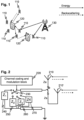
- Fig. 1 shows an architectural drawing of a system.
- a number of ambient internet of things devices 110 or devices in short, reside in some environment. These devices may be standalone parts or fixed or embedded to various goods or items, such as parcels, vehicles, household appliances, mobile phones, generally anything.
- RFID radio frequency identifier
- NFC near field communication
- the ambient loT, AloT, devices may be capable of co-operating with modern 3GPP cellular networks and covered by specifications of new 3GPP standards.
- the AloT device may be referred to as a tag.
- Fig. 1 further shows a number of compatible network apparatuses including monostatic or bistatic access points 120, and an illuminator 130 configured to illuminate devices with energising radio signals without necessarily reading any radio signals communicated by the devices.
- the illuminator may be, for example, a network node, such as a gNB.
- the access points may include, for example, user equipment, UE.
- the access point may also act as an illuminator.
- UE may act as the illuminator as well.
- An access point may be configured with monostatic configuration, wherein the same access point is configured to illuminate the AloT device and read signals backscattered by the AloT devices.
- Access points may be configured with bistatic configuration, wherein a first access point or an illuminator is configured to perform the illumination and a second access point configured to read the backscattering signals.
- Fig. 1 shows an example of an access point configured to operate as a monostatic access point for given devices.
- at least some of the access points 120 are capable of simultaneously operating in the monostatic configuration for a first set of AloT devices 110 and in the bistatic configuration for a second set of AloT devices 110 as a reader or as an illuminator.
- Fig. 1 also shows an example of an access point configured to operate as a bistatic element for other devices.
- Fig. 2 shows a simplified backscattering circuitry comprised in an AloT device of an example embodiment.
- An antenna 210 is provided for receiving an energising radio signal and backscattering outgoing data.
- a channel coding and modulation block 220 controls forming of the backscattering by controlling a switch 230 that is here drawn as being controllable to connect the antenna with one of a plurality of impedances.
- the plurality of impedances may comprise, for example, a first impedance Z1 240, a second impedance Z2 250, a third impedance Z3 260, and a fourth impedance Z4 270, and possibly further impedances.
- the backscattering circuitry has exactly three impedances, e.g., Z1 and Z2 and Z3, and the switch 230 is configured to connect the antenna with one of the three impedances.
- the backscattering has exactly two impedances Z1 and Z2.
- the backscattering circuitry is adaptable to operate with two or more different radio reflection coefficients, RC, by selectively connecting to one of a plurality of different antennas.
- Fig. 2 shows for illustration purpose another antenna 210'.
- the antennas 210, 210' may differ by their gain in a frequency band used for the backscattering.
- any of the devices 110, access points 120, and illuminators may be compatible with a 3GPP technical recommendation TR 22.840: Study of Ambient loT. That recommendation particularly lists following types of Ambient AloT devices:
- Type A and Type B both are passive energy harvesting loT devices without and with an energy storage, respectively.
- the energy storage can be used to amplify the signal and extend transmission range. This can be used either by using an amplifier at the device or just dynamically adjusting the reflection coefficient.
- adding an amplifier to an AloT device increases cost and size of the AloT device.
- an illumination signal is used to power the AloT device as well as to enable backscattering information.
- the backscattering modulates the energising RF signal incident on the AloT device by reflection with a level of antenna mismatch that is adjusted to alter an RC circuit as illustrated in Fig. 2 .
- passively communicating devices may perform energy harvesting (EH) from the ambient RF signals for supporting its circuit operation.
- the AloT device is switched between absorbing and reflecting states by switching between two separate loads such that the absorbing state indicates bit '0' transmission and the reflecting state indicates the bit '1'.
- a radio reflection coefficient 0 means all energy is absorbed/harvested by the AloT device while 1 means that energy is reflected by a radio reflection coefficient 0 ⁇ ⁇ ⁇ 1.
- the AloT device requires (1- ⁇ ) fraction of the illumination signal power P to power its circuit.
- the AloT device is configured to have more than two different states that are needed for channel coding and modulation with backscattering. For example, there may be provided an increased radio reflection coefficient that is closer to one than in normal backscattering.
- the AloT device is configurable to at least an energy harvesting state in which the radio reflection coefficient is as close to zero as possible; a normal operation state in which the radio reflection coefficient higher but clearly below one to allow sufficient energy harvesting for various circuitries, such as processing and volatile memory circuitries; and a range extending state in which the radio reflection coefficient is as close to zero as possible so as to reach maximum range for outgoing data that is backscattered.
- switch state 1 corresponds to a situation that the switch is connected to Z1
- switch state 2 corresponds to a situation that the switch is connected to Z2.
- backscattering refers herein to varying reflection of energising radio signals regardless of that whether the receiver of backscattered signals is the same apparatus that emitted the energising radio signals (monostatic case) or a different apparatus (bistatic case).
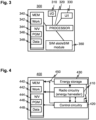
- Fig. 3 shows a block diagram of an apparatus 300 according to an embodiment of the invention.
- the apparatus 300 of Fig. 3 may be usable as the access point 120 that can communicate with ambient internet of things devices 110.
- the apparatus 300 comprises a memory 340 including a work memory 342 and a non-volatile memory 344 that contains computer program code 346 and data, such as pre-configured rules or configuration information.
- the apparatus 300 further comprises a processor 320 for controlling the operation of the apparatus 300 using the computer program code 346, a communication unit 310, such as a new radio capable of 5G cellular communications, for communicating with user equipment and cellular network.
- the communication unit 310 comprises, for example, a local area network (LAN) port; a wireless local area network (WLAN) unit; Bluetooth unit; cellular data communication unit; or satellite data communication unit.
- the communication unit 310 further comprises a proximity communication circuitry that is capable of communicating with ambient internet of things devices.
- the communication unit 310 further comprises a radio energiser for wirelessly energising devices capable of wirelessly harvesting energy from energising radio signals.
- the processor 320 comprises, for example, any one or more of: a master control unit (MCU); a microprocessor; a digital signal processor (DSP); an application specific integrated circuit (ASIC); a field programmable gate array; and a microcontroller.
- the processor may function as a controller of the apparatus.
- the apparatus 300 further comprises a user interface 330, comprising, e.g., any one or more of a display, touch screen, button, microphone, speaker, fingerprint reader.
- the apparatus 300 further comprises a programmable subscriber identity module or a slot for receiving a subscriber identity module, 350.
- Fig. 4 shows a simplified block diagram of a device 400 that may be capable of operating as an ambient internet of thigs device of an example embodiment.
- the device 400 may be a type B AloT device, which comprises an energy storage and which relies on backscattering transmission.
- the device 400 does not have independent transmission signal generation.
- the device 400 comprises a memory 440 including a work memory 442 and a non-volatile memory 444 that contains computer program code 446 and data, such as pre-configured rules or configuration information.
- the device 400 further comprises a control circuitry 420 for controlling the operation of the device 400 using the computer program code 446.
- the device further comprises a radio circuitry 410, that is capable of communicating with backscattering based on incoming radio transmissions, and to harvest energy from radio signals to energise the device 400.
- the processing circuitry 420 comprises, for example, any one or more of: a master control unit (MCU); a microprocessor; a digital signal processor (DSP); an application specific integrated circuit (ASIC); a field programmable gate array; and a microcontroller.
- the device 400 further comprises an energy storage 430.
- the energy storage 430 comprises a rechargeable battery.
- the energy storage 430 comprises a capacitor.
- At least part of harvested energy is stored into the energy storage 430.
- the device 400 may use the harvested energy for backscattering while storing energy to the storage 430, or while not storing energy to the energy storage 430.
- the device 400 may comprise a controllable switch 450 that is controllable by the control circuitry to either connect or disconnect the memory 440 from the energy storage.
- potential power transfer connections are drawn by a double line.
- power may be transferred from the radio circuitry 410 to the memory whenever the radio circuitry 410 is capable of wirelessly harvesting energy with a sufficient voltage.
- the AloT device such as a tag may radiate around some energy of the radio transmission in the backscattering.
- the AloT device may additionally or alternatively harvest some energy with the radio circuitry 410 from the radio transmission. Some of the harvested energy may be used simultaneously by various circuitries of the AloT device while a remaining portion may be stored into the energy storage 430. In an example embodiment, the entire harvested energy is stored into the energy storage 430 before using.
- a two-stage range extension is provided for an AloT device type B. A first stage provides for attempting to fully absorb/harvest energy by setting a small radio reflection coefficient ⁇ (close to zero) and storing harvested energy in the energy storage 430.
- This stored energy can later be used to power and operate a circuitry or circuitries of the AloT device in a second stage, where backscattering is provided by setting a larger radio reflection coefficient ⁇ >> 0 or ⁇ ⁇ 1 and minimum energy to energise transmission can be used from the storage. This increased ⁇ will help increasing reflected power and range extension for type B backscattering devices.
- a very small energy storage is required for the device of type B.
- This energy storage should be able to hold enough energy to operate the circuitry or circuitries of the AloT device for a short period of time, such that backscattering can be performed by using relatively large radio reflection coefficient ⁇ . It is understood that any excess stored energy may not be needed for the AloT device as the AloT device cannot use it to boost its transmission power anyway in absence of active transmission capability, such as amplification of radio signals.
- the access point attempts to communicate with the AloT device without any knowledge of a) an amount of energy stored in the energy storage of the AloT device, b) a rate with which energy can be stored in the energy storage in the AloT device, and c) an amount of remaining capacity of the energy storage. If the AloT device is not successful to transfer information by backscattering such that the access point would detect the transfer of the information by the backscattering, the access point determines a duration of the first stage without such knowledge and then attempts communicating with the AloT device again. On a failure of the AloT device to transfer the information by the backscattering, the access point may attempt a longer or another duration and again attempt communicating until a set maximum time or number of attempts. In an example embodiment, the detecting of the transfer of the information by the backscattering comprise detecting whether an external reader has received the transferred information.
- the access point is responsible for informing the AloT device on dynamically setting its radio reflection coefficient ⁇ and AloT device just follows instructions based on the signal it receives.
- the access point is any device connected to the network, e.g., a 3GPP device, including a gNB, a smartphone, etc.
- a monostatic configuration or a bistatic configuration may be used.
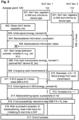
- Fig. 5 shows a simplified signalling chart of an example embodiment to help explaining some example embodiments.
- the network apparatus is the illuminator, which is, for example, a 5G node B, gNB.
- Two AloT device type B devices 110, 110' are shown in Fig. 5 , as a first AloT device 110 and a second AloT device 110'.
- a procedure is mainly explained between the access point 120 and the second device 110'. It should be understood that the second device as well as any further devices may receive illumination signals and use for absorbing and storing energy.
- Fig. 5 presents 501. Registering the AloT devices with the network.
- the AloT devices inform the network of their device type (e.g., type B in this case).
- the network gains knowledge about availability of an energy storage at the AloT devices the operation with which is next described for some example embodiments.
- the network may in parallel co-operate with devices of other types.
- the network includes any devices that operate with 3GPP, e.g., the gNB.
- the registration information may be stored in a register, but capability information of the AloT devices is available in the network. 502.
- the access point obtains capability information of the AloT devices. In case that the registration was performed through the access point, the access point may simply obtain and maintain this knowledge.
- the access point is informed by the network of identifiers of the AloT devices, and the access point obtains the capability information of the AloT devices from a register.
- the access point may obtain the capability information by pulling or be provisioned with the capability information by the network. 503.
- the normal backscattering mode means backscattering without a range extension process. Notice: if the illuminator is not co-hosted with the access point, the then access point may control the illuminator with commands or requests sent to the illuminator.
- both the first AloT device 110 and a second AloT devices 110' receive the energising radio transmission.
- both the first AloT device 110 and the second AloT device 110' may even receive the energising radio transmission with same power level. However, they may and typically do reside at different distance or at least with a different radio signal attenuation because of different intermediate absorbing or reflecting objects so that their radio output is received differently by the access point, as is the case in this drawing. 504.
- the first AloT device 110 normally backscatters information on receiving the initial radio transmission. This information is successfully communicated readable to the access point 120. 505.
- the second AloT device 110' also normally backscatters information on receiving the initial radio transmission but resides farther apart of the access point 120 such that the access point does not receive the backscattered information 120.
- the access point 120 knows that the range of the second AloT device 110' may not suffice.
- some AloT devices may fail to receive the initial radio transmission sufficiently to even attempt backscattering information, in which case they would simply not backscatter anything.
- the access point 120 may detect that it has not received backscattering signal for a predetermined time period.
- the access point 120 may determine that backscattering by device 110' has failed, or that the device has performed the backscattering, but the range is not long enough. Alternatively, if another access point is communicating with the device, an indication may be received from that another access point that no backscattering has been received from the device 110'. 506.
- the transmission of the initial radio transmission and attempting to read responsive backscattering signals is performed k times, wherein k is a finite integer, such as 1, 2, 3, 4, 5, 6, 7, 8, 9, or 10. The value of k may be greater than 1, or greater than 5, for example. With k greater than 1, temporary radio path problems may be overcome. 507.
- a range extension process is started.
- the access point 120 lacks knowledge of internal power requirements (e.g., for processing) of the AloT devices 110, 110', of their radio attenuation with regard to a source of energising radio signals (the source being, e.g., the access point itself, or an illuminator) and to the access point, capacities of their energy storages, etc.. Hence, the access point 120 cannot predetermine how long time it will take before each of the AloT devices can backscatter with a greater radio reflection coefficient.
- the range extension process comprises a charging phase and a communication phase after the charging phase.
- the access point 120 uses a counter to control the incremental boost procedure.
- the access point 120 sets an initial value of a counter N for the illuminator to send energy signals N-1 times to be followed by a backscattering signal sent by the AloT device (here by the second AloT device 110'). 508.
- the access point 120 sends a first radio transmission to the AloT devices or particularly to the second AloT device 110'.
- the access point sends an indication of intended AloT device(s) concerned by these instructions, such as an ID_list to let a group of AloT devices know that the energising radio transmission is available for harvesting energy to the energy storage.
- the intended AloT device (as well as possible other AloT devices not intended to participate in this incremental energy boost) does not perform any backscattering in this step so there is no transmission by the backscattering by the AloT device in question.
- the first AloT device 110 is energised or illuminated by a radio transmission or radio transmissions by the access point or network apparatus 120, or by another network device. These radio transmissions may be referred to as energising radio transmissions.
- the energising radio transmissions are provided to enable the AloT device to wirelessly harvest energy to its energy storage. As the energising radio transmission or transmissions continue for the duration of energy harvesting, this a wide arrow is drawn. 510.
- the second AloT device 110' decreases its radio reflection coefficient to zero or close to zero so as to harvest energy to its energy storage for operation of circuits of the AloT device later without need or with reduced need to consume power of the energising radio transmission when the AloT device should communicate with the network. 511. If N>2, steps 508 to 510 are repeated N-1 times before next step. 512.
- the second AloT device 110' uses its stored energy to operate one or more of its circuitries, such as a processing circuitry. This reduces required power draw from the received energising signal.
- the second AloT device 110' sets a higher value of radio reflection coefficient 0 ⁇ ⁇ ⁇ 1 for backscattering without loss of operability, such as 1 or as close to 1 as possible with the second AloT device 110'.
- the second AloT device 110' can use maximum possible value of ⁇ to allow more reflection, thereby increasing its reflected power. In an example embodiment, if the stored energy is insufficient to operate the circuit, the second AloT device 110' uses an intermediate value of ⁇ with which the second AloT device 110' can harvest sufficiently energy to energise the circuit and while using remaining radio reflectivity for backscattering. 514. Backscattering by the AloT device with the increased radio reflection coefficient. 515.
- next initialisation step 507 is adapted based on the last value of N with which the reception of information from the AloT device was successful. 517. The process ends for this time to be repeated when the access point 120 should next time communicate with a proximate AloT device that should reside in the range of the access point 120.
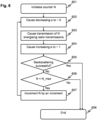
- Fig. 6 shows a simplified flow chart of a method an example embodiment.
- the method of Fig. 6 may be used, for example, in conjunction with some example embodiments disclosed with reference to Fig. 5.
- Fig. 5 may be performed by the access point 120, such as the gNB that is assumed to be a joint illuminator/access point.
- the method comprises a charging phase in which the AloT device 110 charges its energy storage as commanded by the access point 120, until instructed by the access point 120 to enhance radio reflectivity for enhanced backscattering in a subsequent communication phase.
- the access point initialises the aforementioned counter N.
- the initialisation is performed always by setting N to a constant initial value.
- the initialisation comprises setting a different initialisation value on a subsequent run.
- the different initialisation value is the last successful value of N, so as to accelerate reaching a success with the range extension process.
- the different initialisation value is an intermediate value chosen between 1 and the last successful value of N.
- the intermediate value is an average of 1 and the last successful value of N, when rounded up or down.
- the different initialisation value is that of the last successful value of N until a given portion of attempts succeed on a first attempt, and then a smaller initialisation value is used.
- the smaller initialisation value is the aforementioned average. In an example embodiment, the smaller initialisation value is a portion of the last successful value of N. In an example embodiment, the portion is at most 80 % or 90 % of N. In an example embodiment, the portion is at least 50 % or 70% of N.
- the access point causes transmission of the signal 508 to command the energised AloT device or devices to decrease their radio reflection coefficients as close to zero as possible and to harvest more energy to their own energy storage.
- the access point causes transmission of N energising radio transmissions for harvesting by the AloT device or devices in a state in which no backscattering is expected.
- N energising radio transmissions instead of specifically causing transmission of N energising radio transmissions, a corresponding pause of N durations can be made to allow the AloT device to harvest energy from energising radio signals.
- Such energising radio signals are sent in an example embodiment independently of the access point.
- the N energising radio transmission there is no gap between the N energising radio transmission so that a single radio transmission can be seen made the duration of N time periods.
- the duration in which the energising radio transmission(s) is (are) made may be referred to a harvesting period.
- an energising radio transmission is used interchangeably with a radio transmission that continues for a given duration regardless of whether there is a gap or break between consecutive radio transmissions.
- the energised AloT device or devices may gain a dynamically modifiable and generally incrementing dose of energy so as to harvest sufficient energy for extending their range using stored energy to power at least some circuitries and so enable use of increased radio reflection coefficient as described in the foregoing.
- Fig. 6 it is the access point that controls the duration of the energy harvesting so the AloT devices need not be informed of that how many energising radio transmissions will be provided. Instead, in step 604 the access point sends a command to the AloT to increase the radio reflection coefficient as close to 1 for improving likelihood of successfully backscattering information to the access point.
- the access point checks whether information was successfully backscattered by the AloT device or devices. If yes, the process goes to end 608. Otherwise, the process continues in step 606.
- step 606 the access point verifies whether N has not met a termination condition, e.g., whether N is smaller than maximum value of N, N_max. If the termination condition is not yet met, the process continues in step 607, otherwise the AloT device or devices from which no backscattering is successfully received, is or are deemed to be out of coverage and the process goes to end 608.
- a termination condition e.g., whether N is smaller than maximum value of N, N_max. If the termination condition is not yet met, the process continues in step 607, otherwise the AloT device or devices from which no backscattering is successfully received, is or are deemed to be out of coverage and the process goes to end 608.
- the steps 605 and 606 are combined. This is mentioned as an example of room for variations without intending to exclude other variations available to persons ordinarily skilled in the art.
- the access point increments N by an increment delta.
- the increment is a constant, such as 1.
- the increment is variable, such as a portion of N or a N times a factor x, wherein x is greater than 0 and possibly greater than 1. The process then resumes to step 602.
- the access point is responsible for initiating the decreasing of the radio reflection coefficient ⁇ and AloT device itself determines when to increase the radio reflection coefficient for enhanced backscattering.
- Fig. 7 shows a simplified signalling chart of an example embodiment to help explaining some example embodiments.
- the network apparatus is the illuminator, which is, for example, a 5G node B, gNB or UE.
- Two AloT device type B devices 110, 110' are shown in Fig. 7 , as a first AloT device 110 and a second AloT device 110'.
- a procedure is mainly explained between the access point 120 and the second device 110'.
- the second AloT device as well as any further AloT devices may receive illumination signals and use those for absorbing and storing energy.
- Fig. 7 shows step 701, registering the AloT devices with the network.
- the AloT devices inform the network of their device type (e.g., type B in this case).
- the network gains knowledge about availability of an energy storage at the AloT devices the operation with which is next described for some example embodiments.
- the network may in parallel co-operate with devices of other types.
- the network includes any devices that operate with 3GPP, e.g., the gNB or UE.
- the registration information may be stored in a register, but capability information of the AloT devices is available in the network.
- the access point obtains capability information of the AloT devices.
- the access point may simply obtain and maintain this knowledge.
- the access point is informed by the network of identifiers of the AloT devices, and the access point obtains the capability information of the AloT devices from a register.
- the access point may obtain the capability information by pulling or be provisioned with the capability information by the network.
- the normal backscattering mode means backscattering without a range extension process.
- the access point may control the illuminator with commands or requests sent to the illuminator. In sake of simplicity, it is here assumed that the access point and the illuminator are co-hosted, or the access point can control the illuminator.
- the normal backscattering mode means backscattering without a range extension process.
- the access point may control the illuminator with commands or requests sent to the illuminator.
- the access point and the illuminator are co-hosted, or the access point can control the illuminator.
- both the first AloT device 110 and a second AloT devices 110' receive the radio transmission.
- both the first AloT device 110 and the second AloT device 110' may even receive the radio transmission with same power level. However, they may and typically do reside at different distance or at least with a different radio signal attenuation because of different intermediate absorbing or reflecting objects so that their radio output is received differently by the access point, as is the case in this drawing.
- step 704 the first AloT device 110 normally backscatters information on receiving the initial radio transmission. This information is successfully communicated readable to the access point 120.
- the second AloT device 110' also normally backscatters information on receiving the initial radio transmission but resides farther apart of the access point 120 such that the access point 120 does not receive the backscattered information.
- the access point 120 knows that the range of the second AloT device 110' may not suffice.
- some AloT devices may fail to receive the initial radio transmission sufficiently to even attempt backscattering information, in which case they would simply not backscatter anything.
- the access point 120 may detect that it has not received backscattering signal for a predetermined time period. Based on that, the access point 120 may determine that backscattering by the second AloT device 110' has failed, or that the device has performed the backscattering, but the range is not long enough.
- an indication may be received from that another access point that no backscattering has been received from the device 110'.
- step 706 the transmission of the initial radio transmission and attempting to read responsive backscattering signals is performed k times, wherein k is a finite integer, such as 1, 2, 3, 4, 5, 6, 7, 8, 9, or 10.
- k is a finite integer, such as 1, 2, 3, 4, 5, 6, 7, 8, 9, or 10.
- the value of k may be greater than 1, or greater than 5, for example. With k greater than 1, temporary radio path problems may be overcome.
- the access point 120 sends a first radio transmission to the AloT devices or particularly to the second AloT device 110'.
- the access point sends an indication of intended AloT device(s) concerned by these instructions, such as an ID_list to let a group of AloT devices know that the radio transmission is available for harvesting energy to the energy storage. Note that the intended AloT device (as well as possible other AloT devices not intended to participate in this incremental energy boost) does not perform any backscattering in this step so there is no transmission by backscattering by the AloT device in question.
- step 708 the second AloT device 110' reduces its radio reflection coefficient to zero or close to zero so as to harvest energy to its energy storage for operation of circuits of the AloT device later without need or with reduced need to consume power of the radio transmission when the AloT device should communicate with the network.
- the first AloT device 110 is energised or illuminated by a radio transmission or radio transmissions by the access point or network apparatus 120, or by another network device.
- These radio transmissions may be referred to as energising radio transmissions.
- the energising radio transmissions are provided to enable the AloT device to wirelessly harvest energy to its energy storage. As the energising radio transmission or transmissions continue for the duration of energy harvesting, this a wide arrow is drawn.
- the second AloT device 110' harvests energy to its energy storage from the energising radio transmission or radio transmissions.
- the second AloT device 110' continues to absorb/harvest energy until a storage threshold is reached.
- This storage threshold may reflect an amount of energy that the second AloT device 110' needs for operating its circuitry or circuitries while backscattering with an increased radio reflection coefficient. Storing energy beyond this threshold may not be helpful for range extension in the absence of a power-consuming active transmission circuitry, so the energy storage may not be charged even to its full capacity. Hence, the degradation of the energy storage by aging may not immediately impair operation of the second AloT device 110'.
- step 711 the second AloT device 110' determines that there is sufficiently energy in the energy storage and sets the radio reflection coefficient ⁇ as close to 1 as possible for increased backscattering.
- the second AloT device 110' backscatters information to the access point.
- this information comprises explicit indication that the second AloT device 110' is ready to communicate.
- this information comprises an implicit indication that the second AloT device 110' is ready to communicate.
- the explicit indication is provided such that the second AloT device 110' sends a short message, e.g., Tx_request, to let access point know that the second AloT device 110' is now ready to backscatter with an increased radio power, as results from using the increased radio reflection coefficient ⁇ .
- the explicit indication is modulated on the next radio transmission received from the access point.
- the access point may stop the radio transmissions, at least if solely transmitted for energising the second AloT device 110'.
- the implicit indication is provided such that the second AloT device 110' simply backscatters information directly using the radio transmissions, before otherwise informing the access point of becoming ready to communicate. If the access point successfully receives the implicit indication, the access point may cause stopping of further radio transmissions.
- the access point may indicate allowed slots for given AloT devices by their IDs to use for backscattering so as to avoid collisions if there are a plurality of AloT devices that could otherwise simultaneously transmit implicit indications.
- the access point causes termination of the energising radio transmissions on meeting a termination condition so as to avoid excessive energising radio transmissions.
- the termination condition may be monitored as in step 808. This step is unnecessary, if the second AloT device 110' has successfully backscattered information to the access point.
- Fig. 8 shows a simplified flow chart of a method an example embodiment. The method of Fig. 8 may be used, for example, in conjunction with some example embodiments disclosed with reference to Fig. 7 .
- step 801 the access point attempts to communicate with the AloT device or devices.
- the access point causes, e.g., as in step 708, the AloT device(s) to decrease the radio reflection coefficient ⁇ to zero or close to zero to begin harvesting of energy.
- the access point causes transmission of energising radio transmissions to the AloT device(s).
- step 805 the access point checks whether the AloT device or devices has or have successfully backscattered an explicit request to stop the energising radio transmissions. If yes, the process continues to step 806, otherwise the process continues to step 807.
- step 806 the access point transmits one last radio transmission and receives information backscattered by the AloT device as a response.
- the last radio transmission of the charging phase is to indicate to the AloT device that the access point has received the explicit request and the AloT device is expected to perform backscattering.
- step 809 which may be considered as the end of range extension procedure.
- step 807 the access point checks whether the AloT device or devices have successfully backscattered an implicit request to end the charging phase by backscattering information as a response to receiving the radio transmission. If yes, the process continues to end 809, otherwise the process continues to step 808.
- the access point becomes aware that the AloT device has enough energy at least for some time.
- the access point may stop sending the radio transmissions for range extension and start to communicate with the AloT device.
- the access point may assume that the AloT device or devices have wirelessly harvested a sufficient amount of energy in their energy storages and increased the radio reflection coefficient ⁇ at or close to 1 so as to enhance the backscattering and enable the access point or a separate reader to receive outgoing information transmitted by the AloT devices by backscattering.
- the access point cannot know whether some particular AloT device has increased the radio reflection of its backscattering or whether that AloT has simply come closer to its recipient or closer to the origin of the radio transmission that is being backscattered or whether radio attenuation has decreased.
- the access point checks whether a termination condition has not yet been met, e.g., whether a number of sent energising radio transmission N is smaller than a maximum value of N, N ⁇ N_max.
- N may be considered as a number of time periods indicating duration of an energising radio transmission.
- the process resumes to step 803, otherwise the process continues to end 809.
- the maximum value of N is configured to avoid sending infinite number of energising radio transmissions in case the access points does not receive either the explicit indication or implicit indication.
- step 809 the process ends.
- the AloT devices continue to operate with the increased radio reflection coefficient ⁇ at or close to 1 so that the backscattering is performed with a higher radio power.
- the AloT devices resume to their default radio reflectivity by resetting ⁇ to a default value, e.g., at 0.7 or 0.8, for balancing between backscattering range and capability to harvest energy for internal use, e.g., by the circuitry or circuitries of the AloT devices.
- the AloT devices keep using the increased ⁇ , such as ⁇ 1, until the energy storage is depleted, and then resume to their default radio reflectivity.
- the AloT device or devices is or are energised by a series of radio transmissions.
- the radio transmission is a continuous radio transmission without gaps.
- Figs. 9a and 9b show a simplified flow chart of a method an example embodiment.
- the method of Figs. 9a and 9b may be used, for example, in conjunction with some example embodiments disclosed with reference to Fig. 6 .
- the method comprises 901. Causing sending an initial radio transmission to a device, wherein the device is an ambient internet of things device with an energy storage and wherein the device is capable of transmitting data by backscattering a radio transmission. 902. Causing detecting that the device has failed to transfer data by the backscattering and performing a range extension process comprising a first part, a second part following the first part, and a third part following the second part. 903.
- the first part comprising causing sending, to the device, a first radio transmission comprising instructions to decrease a radio reflection coefficient for enhanced wireless energy harvesting. 904.
- the second part comprising allowing the device to wirelessly harvest energy to its energy storage from an energising radio transmission with the decreased radio reflection coefficient for a given energy harvesting duration.
- the third part comprising causing sending to the device a second radio transmission comprising instructions to increase the radio reflection coefficient for enhancing a range of the backscattering.
- the third part comprising causing attempting to communicate with the device after the sending of the second radio transmission. 907.
- the third part comprising, on failing with the attempt to communicate with the device after the sending of the second radio transmission, repeating the first, second, and third parts.
- the method may further comprise any one or more of following: 908.
- Initialising an attempt counter N to an initialising value responsively to the detecting that the device has failed to transfer data by the backscattering.
- 909. Increasing a value of the attempt counter on the failing with the attempt to communicate with the device after the sending of the second radio transmission.
- 910. Performing the increasing of the value of the attempt counter with a non-linear increment, optionally according to a predefined pattern.
- N may be set as 1, 3, 6 and 10, or such that a new increment is the previous increment multiplied by a factor such as 2.0 or 1.5.
- the increasing of the value of the attempt counter is performed with a non-linear increment. 911.
- the adapting of the initialising value of the attempt counter comprising setting the initialising value of attempt counter to a value of the attempt counter with which the attempting to communicate with the device succeeded.
- the adapting of the initialising value of the attempt counter comprising setting the initialising value to an intermediate value that is between one and a value of the attempt counter with which the attempting to communicate with the device succeeded.
- Fig. 10 shows a simplified flow chart of a method an example embodiment.
- the method of Fig. 10 may be used, for example, in conjunction with some example embodiments disclosed with reference to Fig. 8 .
- the method comprises 1001. Receiving by a device an initial radio transmission. 1002. Transmitting by the device data to an apparatus by backscattering the initial radio transmission. 1003. Receiving by the device a first radio transmission comprising instructions to decrease a radio reflection coefficient to increase wireless energy harvesting to an energy storage of the device, the energy storage comprising a battery or a capacitor. 1004. Decreasing by the device the radio reflection coefficient according to the received instructions to increase wireless energy harvesting to the energy storage. 1005. Wirelessly harvesting energy by the device to the energy storage with the decreased radio reflection coefficient. 1006. After the wirelessly harvesting energy to the energy storage, increasing by the device the radio reflection coefficient and backscattering by the device outgoing data with the increased radio reflection coefficient.
- the method may further comprise any one or more of following: 1007. Detecting that the energy storage is sufficiently charged with the wireless energy harvesting. In an example embodiment, the detecting that the energy storage is sufficiently charged with the wireless energy harvesting comprises detecting that a charging threshold is met. In an example embodiment, the charging threshold is a constant threshold. In an example embodiment, the charging threshold is a dynamic threshold that depends on one or more charging criteria. In an example embodiment, the charging criteria comprise an amount of outgoing data that should be sent by backscattering.
- the charging criteria comprise an expected backscattering duration such that for a longer backscattering duration, the energy storage may be charged closer to a maximum capacity and for a shorter backscattering duration, the threshold may be lowered for a shorter energy harvesting duration. 1008.
- Increasing the radio reflection coefficient to backscatter outgoing data based on the detecting that the energy storage is sufficiently charged with the wireless energy harvesting.
- Receiving a second radio transmission comprising instructions to increase the radio reflection coefficient to decrease wireless energy harvesting. 1010.
- an apparatus such as a network apparatus or an access point, or in a controller of the apparatus, the process comprising: 1101.
- Causing sending an initial transmission toa device wherein the device is an ambient internet of things device with an energy storage and wherein the device is capable of transmitting data by backscattering a radio transmission.
- the causing of the sending of the initial transmission comprises instructing an internal access point to perform the sending of the initial transmission.
- the causing of the communication comprises instructing an external access point to perform the sending of the initial transmission.
- the caused sending of the initial transmission is performed by a radio communication suitable for the ambient internet of things device. 1102.
- the first radio transmission is sent by an internal access point.
- the first radio transmission is sent by an external access point.
- the first radio transmission is suitable for the ambient internet of things device. 1104.
- the second radio transmission is sent by an internal access point.
- the second radio transmission is sent by an external access point.
- the second radio transmission is suitable for the ambient internet of things device. 1105. Causing attempting to detect that the at least one device has succeeded to transfer data by the backscattering.
- Detecting that the at least one device has failed to transfer data by the backscattering is to be understood so that the device might have transmitted the data but the reader device has not succeeded to receive the data, e.g. due to inefficient backscattering. Thus, the data is not actually transferred from the device to the reader.
- the process may be performed or caused by a controller of the apparatus.
- the controller comprises at least one processor.
- the controller comprises at least one memory.
- the apparatus is a 5G node B, gNB.
- the apparatus comprises a network interface configured to communicate with a cellular network and to receive a device communication request from the cellular network.
- the controller is further configured to detect the device communication request, and to responsively cause a first attempt of communicating with the device by the proximity communication circuitry.
- the apparatus is a UE.
- the process may further comprise any one or more of the following: 1106.
- 1106. Repeating the causing of the sending of the first radio transmission comprising instructions to decrease the radio reflection coefficient and the sending of the second radio transmission comprising instructions to increase the radio reflection coefficient until detecting that the at least one device has succeeded to transfer data by the backscattering or until detecting that a maximum number of repetitions has been performed.
- the detecting that the at least on device has succeeded to transfer data by the backscattering comprising detecting reception of data from the at least one device after sending a radio transmission to the at least one device. 1108.
- the detecting that the at least on device has succeeded to transfer data by the backscattering comprising receiving information from an ambient internet of things access point that the ambient internet of things access point has succeeded to receive data from the device after the apparatus has sent a radio transmission to the device.
- the ambient internet of things access point may be operable independently of the apparatus that performs step 901. 1109. Determining, after detecting that the at least one device has succeeded to transfer data by the backscattering, for a subsequent communication attempt with the at least one device, instructions to decrease the radio reflection coefficient factor to increase wireless energy harvesting based on previous instructions. 1110.
- the detecting that the device has failed to transfer data by the backscattering comprising detecting a failure of receiving data from the device during the sending of the initial radio transmission to the device. 1111.
- the detecting that the device has failed to transfer data by the backscattering comprising receiving information from an ambient internet of things access point that the ambient internet of things access point has failed to receive data from the device during the sending of the radio transmission to the device.
- the ambient internet of things access point may be operable independently of the apparatus that performs step 901. 1112.
- the energising radio transmission intended for energy harvesting with the decreased or low radio reflection coefficient being one continuous transmission.
- the energising radio transmission intended for energy harvesting with the decreased or low radio reflection coefficient are transmitted as a plurality of discontinuous transmissions.
- the process further comprises synchronising the first attempt with discontinuous wireless energising of the device.
- the process further comprises, in the repeating of the causing of the sending of the first radio transmission and of the second radio transmission, waiting for a harvesting duration between the first a second radio transmissions.
- the process further comprises extending the harvesting duration by a varying extension, such as a progressive extension.
- the process further comprises extending the harvesting duration by a fixed duration or maintained unchanged.
- the extending of the harvesting duration is independent of the device, i.e., same for all devices.
- the process further comprises performing an initialising before attempting to communicate with the ambient internet of things device for a first time.
- the initialising comprises setting the harvesting duration to a minimum duration.
- the initialising comprises setting the harvesting duration to the latest harvesting duration with which communication with the device has succeeded.
- the initialising comprises setting the harvesting duration to an intermediate duration that is between the minimum duration and the latest harvesting duration with which communication with the device has succeeded.
- the intermediate duration is an average of the minimum duration and the latest harvesting duration with which communication with the device has succeeded.
- the intermediate duration is a sum of the minimum duration and the latest harvesting duration with which communication with the device has succeeded, multiplied by at least: 0.25; 0.3; 0.35; 0.4; or 0.45.
- the process further comprises specifically directing the first radio transmission to the device using at least an identifier of the device.
- the energy harvesting is increased from a zero level. That is, in some cases, e.g., because of hardware or positioning of the AloT device, or both, there may be no energy harvesting present before increasing the energy harvesting with the increase of the radio reflection coefficient. In an example embodiment, the energy harvesting is increased from a level greater than zero.
- the extension of the harvesting duration is defined specifically for the device.
- the properties of the device are learned and used to customised energising of the device.
- the process further comprises receiving a device communication request from a cellular network. In an example embodiment, the process further comprises detecting the device communication request, and responsively causing the first attempt of communicating with the ambient internet of things device.
- the reduced radio reflection coefficient is as small as possible, e.g., at most 0.5 %, 1 % or 5 %.
- the increased radio reflection coefficient is as great as possible, e.g., at least 95 %, 99 %, or 99.5 %.
- a process in a device such as an ambient internet of things device, such as the device 400 of Fig. 4 , the process comprising 1201.
- Receiving a first radio transmission comprising instructions to decrease a radio reflection coefficient to increase wireless energy harvesting.
- Receiving a second radio transmission comprising instructions to increase the radio reflection coefficient to decrease wireless energy harvesting.
- the process may further comprise any one or more of the following: 1206. Detecting an insufficient amount of energy in the energy storage for continued operation with the increased radio reflection coefficient. 1207. Responsively to the detecting that there is the insufficient amount of energy for continued operation with the increased radio reflection coefficient, causing setting the radio reflection coefficient to an intermediate value below the increased radio reflection coefficient and above that for the temporarily decreasing of the radio reflection coefficient. 1208. Causing an attempt to transfer data to the apparatus by the backscattering, before receiving the first radio transmission comprising instructions to decrease the radio reflection coefficient to increase wireless energy harvesting.
- an apparatus such as a network apparatus or an access point, or in a controller of the apparatus, the process comprising 1301.
- a device that is an ambient internet of things device that comprises an energy storage and that is capable of transmitting the information by backscattering.
- the causing of the communicating with the device comprises instructing an internal access point to transmit or receive the information.
- the causing of the communicating with the device comprises instructing an external access point to perform transmitting or receiving of the information.
- receiving of the information comprises demodulating or decoding information backscattered by the ambient internet of things device. 1302. Causing detecting that the device has failed to transfer data by backscattering. 1303.
- a first radio transmission comprising instructions to decrease a radio reflection coefficient to increase wireless energy harvesting to the energy storage.
- the first radio transmission is sent by an internal access point.
- the first radio transmission is sent by an external access point.
- the first radio transmission is suitable for the ambient internet of things device. 1304.
- the process may be performed or caused by a controller of the apparatus.
- the controller comprises at least one processor.
- the controller comprises at least one memory.
- the apparatus is a 5G node B, gNB.
- the apparatus comprises a network interface configured to communicate with a cellular network and to receive a device communication request from the cellular network.
- the controller is further configured to detect the device communication request, and to responsively cause the first attempt of communicating with the device by the proximity communication circuitry.
- the apparatus is a UE.
- the process further comprises specifically directing one or more communications to the device using at least an identifier of the device.
- the energy harvesting is increased from a zero level. That is, in some cases, e.g., because of hardware or positioning of the AloT device, or both, there may be no energy harvesting present before increasing the energy harvesting with the increase of the radio reflection coefficient. In an example embodiment, the energy harvesting is increased from a level greater than zero.
- the process further comprises receiving a device communication request from a cellular network. In an example embodiment, the process further comprises detecting the device communication request, and responsively causing the first attempt of communicating with the ambient internet of things device.
- the reduced radio reflection coefficient is as small as possible, e.g., at most 0.5 %, 1 % or 5 %.
- the increased radio reflection coefficient is as great as possible, e.g., at least 95 %, 99 %, or 99.5 %.
- an apparatus such as an ambient internet of things device, such as the device 400 of Fig. 4 , the process comprising 1401.
- Receiving a first radio transmission comprising instructions to decrease a radio reflection coefficient to increase wireless energy harvesting to an energy storage.
- 1402. Decreasing the radio reflection coefficient according to the received instructions to increase the wireless energy harvesting.
- 1403. Wirelessly harvesting energy to the energy storage with the decreased radio reflection coefficient.
- wireless harvesting of energy to the energy storage may be performed also before decreasing the radio reflection coefficient and the decreasing the radio reflection coefficient increases a rate with which the energy storage is charged.
- operating power may be supplied to the one or more circuitries with operating power from the energy storage.
- the supplying of the operating power provides all the operating power of the supplied circuitry or circuitries.
- the supplying of the operating power provides a portion of the operating power required by the circuitry or circuitries, while another portion of the operating power is obtained by wireless harvesting. That is, the energy storage may remove a need or at least reduce the need of wireless harvesting of energy.
- the process may further comprise any one or more of the following: 1406. Detecting that that the energy storage has insufficient energy for continuing operation with the increased radio reflection coefficient. 1407. Responsively to the detecting that there is insufficient energy for continued operation with the increased radio reflection coefficient, causing setting the radio reflection coefficient to an intermediate value below the increased radio reflection coefficient and above the decreased radio reflection coefficient. 1408. Causing an attempt to transfer data to the apparatus by backscattering, before receiving the first radio transmission comprising instructions to decrease the radio reflection coefficient to increase wireless energy harvesting. 1409. Providing by the outgoing data an explicit indication that the device is ready to communicate with the increased radio reflection coefficient.
- circuitry may refer to one or more or all of the following:
- circuitry also covers an implementation of merely a hardware circuit or processor (or multiple processors) or portion of a hardware circuit or processor and its (or their) accompanying software and/or firmware.
- circuitry also covers, for example and if applicable to the particular claim element, a baseband integrated circuit or processor integrated circuit for a mobile device or a similar integrated circuit in server, a cellular network device, or other computing or network device.
- a technical effect of one or more of the example embodiments disclosed herein is that range of ambient internet of things devices may be increased.
- Another technical effect of one or more of the example embodiments disclosed herein is that the range of the ambient internet of things devices may be increased using local energy storage only where necessary so avoiding unnecessary delays when the ambient internet of things devices are readily capable of communicating by backscattering an energising radio transmission.
- Yet another technical effect of one or more of the example embodiments disclosed herein is that increasing the range of the ambient internet of things devices through increased radio reflection coefficient avoids a need to increase radio power of the energising radio transmission, so avoiding increase of radio interference and energy consumption.
- Still further technical effect of one or more of the example embodiments disclosed herein is that very little resources are needed to for the increase of the range, and overall energy efficiency may be enhanced.
- Embodiments may be implemented in software, hardware, application logic or a combination of software, hardware, and application logic.
- the software, application logic and/or hardware may reside on the network apparatus, on a controller of the network apparatus, on the AloT device, or on the control circuitry of the AloT device. If desired, part of the software, application logic and/or hardware may reside on the network apparatus, part of the software, application logic and/or hardware may reside on the AloT device, and part of the software, application logic and/or hardware may reside on an external access point or illuminator.
- the application logic, software, or an instruction set is maintained on any one of various conventional computer-readable media.
- a "computer-readable medium” may be any non-transitory media or means that can contain, store, communicate, propagate, or transport the instructions for use by or in connection with an instruction execution system, apparatus, or device, such as a computer, with one example of a computer described and depicted in Fig. 3 or 4 .
- a computer-readable medium may comprise a computer-readable storage medium that may be any media or means that can contain or store the instructions for use by or in connection with an instruction execution system, apparatus, or device, such as a computer.
- the term non-transitory as used herein is a limitation of the medium itself (i.e., tangible, not a signal) as opposed to a limitation on data storage persistency (e.g., random access memory vs. read only memory).
- the different functions discussed herein may be performed in a different order and/or concurrently with each other. Furthermore, if desired, one or more of the before-described functions may be optional or may be combined.
Landscapes
- Engineering & Computer Science (AREA)
- Computer Networks & Wireless Communication (AREA)
- Power Engineering (AREA)
- Signal Processing (AREA)
- Mobile Radio Communication Systems (AREA)
Applications Claiming Priority (1)
| Application Number | Priority Date | Filing Date | Title |
|---|---|---|---|
| FI20235975 | 2023-09-01 |
Publications (1)
| Publication Number | Publication Date |
|---|---|
| EP4525271A1 true EP4525271A1 (de) | 2025-03-19 |
Family
ID=92632995
Family Applications (1)
| Application Number | Title | Priority Date | Filing Date |
|---|---|---|---|
| EP24197447.6A Pending EP4525271A1 (de) | 2023-09-01 | 2024-08-30 | Reichweitenerhöhung von iot geräten |
Country Status (2)
| Country | Link |
|---|---|
| US (1) | US20250080280A1 (de) |
| EP (1) | EP4525271A1 (de) |
Citations (3)
| Publication number | Priority date | Publication date | Assignee | Title |
|---|---|---|---|---|
| US6100790A (en) * | 1994-03-04 | 2000-08-08 | Ncr Corporation | Modulated backscatter wireless communication system having an extended range |
| EP4164143A1 (de) * | 2021-10-08 | 2023-04-12 | Fundación Imdea Networks | Hf-rückstreuungssystem basierend auf lichttreue |
| US20230254886A1 (en) * | 2022-02-10 | 2023-08-10 | Qualcomm Incorporated | Energy-state feedback for efficient wireless power transfer to iot devices |
-
2024
- 2024-08-30 US US18/821,089 patent/US20250080280A1/en active Pending
- 2024-08-30 EP EP24197447.6A patent/EP4525271A1/de active Pending
Patent Citations (3)
| Publication number | Priority date | Publication date | Assignee | Title |
|---|---|---|---|---|
| US6100790A (en) * | 1994-03-04 | 2000-08-08 | Ncr Corporation | Modulated backscatter wireless communication system having an extended range |
| EP4164143A1 (de) * | 2021-10-08 | 2023-04-12 | Fundación Imdea Networks | Hf-rückstreuungssystem basierend auf lichttreue |
| US20230254886A1 (en) * | 2022-02-10 | 2023-08-10 | Qualcomm Incorporated | Energy-state feedback for efficient wireless power transfer to iot devices |
Also Published As
| Publication number | Publication date |
|---|---|
| US20250080280A1 (en) | 2025-03-06 |
Similar Documents
| Publication | Publication Date | Title |
|---|---|---|
| KR102709851B1 (ko) | Sar에 기반하여 송신 전력을 백-오프하는 전자 장치 및 그 동작 방법 | |
| US10091638B2 (en) | Systems and methods for reducing connection latency | |
| US10243403B2 (en) | Power transmitting apparatus, power receiving apparatus, wireless power transfer system, control method, and storage medium | |
| US10070287B2 (en) | Method and apparatus for energy adaptive resource allocation in energy harvesting network | |
| US20150098348A1 (en) | Wireless communicaton device, wireless communication system, wireless communication method, and wireless apparatus | |
| KR101848931B1 (ko) | 무선 충전 장치 및 방법 | |
| CN121220174A (zh) | 用于反向散射通信的装置 | |
| EP4525271A1 (de) | Reichweitenerhöhung von iot geräten | |
| US20110287803A1 (en) | Wirless security messaging model | |
| US20250080169A1 (en) | Range extension of ambient internet of things devices | |
| US20250081114A1 (en) | Range extension of ambient internet of things devices | |
| US7792777B2 (en) | Method, apparatus and computer program for registering a respective target network system state from each one of a plurality of programs | |
| EP3113374B1 (de) | Reduzierung der anlaufzeit einer zweiten kommunikationseinheit | |
| US11057833B2 (en) | Cross-layer sleep control in a wireless device | |
| US20220015032A1 (en) | Preventing peak current draw in a wireless device | |
| KR101851026B1 (ko) | 무선 충전 장치 및 방법 | |
| EP1817895A2 (de) | System und verfahren zum optimieren des stromverbrauchs in einem drahtlosen gerät | |
| KR20250164404A (ko) | 무선 통신 시스템에서 엠비언트 IoT 디바이스로 신호를 송신하기 위한 판독기를 선택하는 방법 및 이를 위한 장치 | |
| GB2640924A (en) | CW repetition for AIOT systems | |
| WO2025233732A1 (en) | Cw repetition for aiot systems | |
| GB2643032A (en) | AIoT random access procedure with multiple readers | |
| WO2024245613A1 (en) | Apparatus, method and computer program for optimizing operation of a wireless energy harvesting radio device | |
| CN120359806A (zh) | 小数据传输过程中用于无线功率余量报告的触发机制 | |
| KR20260047946A (ko) | 무선 통신 시스템에서 엠비언트 IoT 디바이스가 데이터 유닛을 분할 전송하는 방법 및 이를 위한 장치 | |
| KR20250148278A (ko) | 엠비언트 IoT 기기를 지원하는 중간 노드의 운용 방법 및 이를 위한 장치 |
Legal Events
| Date | Code | Title | Description |
|---|---|---|---|
| PUAI | Public reference made under article 153(3) epc to a published international application that has entered the european phase |
Free format text: ORIGINAL CODE: 0009012 |
|
| STAA | Information on the status of an ep patent application or granted ep patent |
Free format text: STATUS: THE APPLICATION HAS BEEN PUBLISHED |
|
| AK | Designated contracting states |
Kind code of ref document: A1 Designated state(s): AL AT BE BG CH CY CZ DE DK EE ES FI FR GB GR HR HU IE IS IT LI LT LU LV MC ME MK MT NL NO PL PT RO RS SE SI SK SM TR |
|
| STAA | Information on the status of an ep patent application or granted ep patent |
Free format text: STATUS: REQUEST FOR EXAMINATION WAS MADE |
|
| 17P | Request for examination filed |
Effective date: 20250919 |