EP4525542A2 - Umkehrrichtungsprotokoll in einem sdma-kontext - Google Patents
Umkehrrichtungsprotokoll in einem sdma-kontext Download PDFInfo
- Publication number
- EP4525542A2 EP4525542A2 EP25152861.8A EP25152861A EP4525542A2 EP 4525542 A2 EP4525542 A2 EP 4525542A2 EP 25152861 A EP25152861 A EP 25152861A EP 4525542 A2 EP4525542 A2 EP 4525542A2
- Authority
- EP
- European Patent Office
- Prior art keywords
- reverse direction
- frame
- frames
- data
- permission information
- Prior art date
- Legal status (The legal status is an assumption and is not a legal conclusion. Google has not performed a legal analysis and makes no representation as to the accuracy of the status listed.)
- Pending
Links
Images




Classifications
-
- H—ELECTRICITY
- H04—ELECTRIC COMMUNICATION TECHNIQUE
- H04W—WIRELESS COMMUNICATION NETWORKS
- H04W72/00—Local resource management
- H04W72/04—Wireless resource allocation
- H04W72/044—Wireless resource allocation based on the type of the allocated resource
- H04W72/0446—Resources in time domain, e.g. slots or frames
-
- H—ELECTRICITY
- H04—ELECTRIC COMMUNICATION TECHNIQUE
- H04B—TRANSMISSION
- H04B7/00—Radio transmission systems, i.e. using radiation field
- H04B7/02—Diversity systems; Multi-antenna system, i.e. transmission or reception using multiple antennas
- H04B7/028—Spatial transmit diversity using a single antenna at the transmitter
-
- H—ELECTRICITY
- H04—ELECTRIC COMMUNICATION TECHNIQUE
- H04B—TRANSMISSION
- H04B7/00—Radio transmission systems, i.e. using radiation field
- H04B7/02—Diversity systems; Multi-antenna system, i.e. transmission or reception using multiple antennas
- H04B7/04—Diversity systems; Multi-antenna system, i.e. transmission or reception using multiple antennas using two or more spaced independent antennas
- H04B7/0413—MIMO systems
- H04B7/0452—Multi-user MIMO systems
-
- H—ELECTRICITY
- H04—ELECTRIC COMMUNICATION TECHNIQUE
- H04B—TRANSMISSION
- H04B7/00—Radio transmission systems, i.e. using radiation field
- H04B7/02—Diversity systems; Multi-antenna system, i.e. transmission or reception using multiple antennas
- H04B7/04—Diversity systems; Multi-antenna system, i.e. transmission or reception using multiple antennas using two or more spaced independent antennas
- H04B7/06—Diversity systems; Multi-antenna system, i.e. transmission or reception using multiple antennas using two or more spaced independent antennas at the transmitting station
- H04B7/0613—Diversity systems; Multi-antenna system, i.e. transmission or reception using multiple antennas using two or more spaced independent antennas at the transmitting station using simultaneous transmission
- H04B7/0615—Diversity systems; Multi-antenna system, i.e. transmission or reception using multiple antennas using two or more spaced independent antennas at the transmitting station using simultaneous transmission of weighted versions of same signal
- H04B7/0617—Diversity systems; Multi-antenna system, i.e. transmission or reception using multiple antennas using two or more spaced independent antennas at the transmitting station using simultaneous transmission of weighted versions of same signal for beam forming
-
- H—ELECTRICITY
- H04—ELECTRIC COMMUNICATION TECHNIQUE
- H04B—TRANSMISSION
- H04B7/00—Radio transmission systems, i.e. using radiation field
- H04B7/02—Diversity systems; Multi-antenna system, i.e. transmission or reception using multiple antennas
- H04B7/04—Diversity systems; Multi-antenna system, i.e. transmission or reception using multiple antennas using two or more spaced independent antennas
- H04B7/06—Diversity systems; Multi-antenna system, i.e. transmission or reception using multiple antennas using two or more spaced independent antennas at the transmitting station
- H04B7/0697—Diversity systems; Multi-antenna system, i.e. transmission or reception using multiple antennas using two or more spaced independent antennas at the transmitting station using spatial multiplexing
-
- H—ELECTRICITY
- H04—ELECTRIC COMMUNICATION TECHNIQUE
- H04W—WIRELESS COMMUNICATION NETWORKS
- H04W72/00—Local resource management
- H04W72/04—Wireless resource allocation
- H04W72/044—Wireless resource allocation based on the type of the allocated resource
- H04W72/046—Wireless resource allocation based on the type of the allocated resource the resource being in the space domain, e.g. beams
-
- H—ELECTRICITY
- H04—ELECTRIC COMMUNICATION TECHNIQUE
- H04W—WIRELESS COMMUNICATION NETWORKS
- H04W74/00—Wireless channel access
- H04W74/002—Transmission of channel access control information
- H04W74/006—Transmission of channel access control information in the downlink, i.e. towards the terminal
-
- H—ELECTRICITY
- H04—ELECTRIC COMMUNICATION TECHNIQUE
- H04W—WIRELESS COMMUNICATION NETWORKS
- H04W74/00—Wireless channel access
- H04W74/04—Scheduled access
- H04W74/06—Scheduled access using polling
-
- H—ELECTRICITY
- H04—ELECTRIC COMMUNICATION TECHNIQUE
- H04W—WIRELESS COMMUNICATION NETWORKS
- H04W74/00—Wireless channel access
- H04W74/08—Non-scheduled access, e.g. ALOHA
- H04W74/0808—Non-scheduled access, e.g. ALOHA using carrier sensing, e.g. carrier sense multiple access [CSMA]
- H04W74/0816—Non-scheduled access, e.g. ALOHA using carrier sensing, e.g. carrier sense multiple access [CSMA] with collision avoidance
-
- H—ELECTRICITY
- H04—ELECTRIC COMMUNICATION TECHNIQUE
- H04W—WIRELESS COMMUNICATION NETWORKS
- H04W84/00—Network topologies
- H04W84/02—Hierarchically pre-organised networks, e.g. paging networks, cellular networks, WLAN [Wireless Local Area Network] or WLL [Wireless Local Loop]
- H04W84/10—Small scale networks; Flat hierarchical networks
- H04W84/12—WLAN [Wireless Local Area Networks]
Definitions
- the present invention relates to a communication apparatus and method, a computer program, and a communication system whereby throughput is improved for an entire plurality of users by applying space-division multiple access (SDMA) in which wireless resources on a spatial axis are shared among a plurality of users. More particularly, the present invention relates to a communication apparatus and method, a computer program, and a communication system whereby an RD (Reverse Direction) protocol is adopted and spatially multiplexed frames in an exclusive channel usage period (TXOP) are made more efficient.
- SDMA space-division multiple access
- Wireless communication eliminates the burden of wiring work for wired communication of the past, and is additionally catered for usage as a technology that realizes mobile communication.
- IEEE The Institute of Electrical and Electronics Engineers 802.11 may be cited as an established standard regarding wireless LANs (Local Area Networks). IEEE 802.11a/g is already widely prevalent.
- an access control protocol based on carrier sense such as CSMA/CA (Carrier Sense Multiple Access with Collision Avoidance) is implemented, with each station being configured to avoid carrier collisions during random channel access.
- CSMA/CA Carrier Sense Multiple Access with Collision Avoidance
- a station that has produced a transmission request first monitors the medium state for a given frame interval DIFS (Distributed Inter Frame Space), and if no transmitted signal exists during this space, the station conducts a random backoff. In the case where no transmission signal exists in this space as well, the station obtains an exclusive channel usage transmission opportunity (TXOP), and is able to transmit a frame.
- TXOP exclusive channel usage transmission opportunity
- “virtual carrier sensing” may be cited as a methodology for resolving the hidden terminal problem in wireless communication.
- duration information for reserving the medium is stated in a received frame not addressed to the receiving station, that station predicts that the medium will be in use for a period corresponding to the duration information, or in other words virtually senses the carrier, and sets a transmission pause period (NAV: Network Allocation Vector).
- NAV Network Allocation Vector
- orthogonal frequency-division multiplexing is used in the 2.4 GHZ band or the 5 GHz band to support a modulation method that achieves a maximum communication rate (physical layer data rate) of 54 Mbps.
- MIMO Multi-Input Multi-Output
- MIMO is a communication method that realizes spatially multiplexed streams by providing a plurality of antenna elements at both the transmitter end and the receiver end (as is commonly known).
- high throughput (HT) exceeding 100 Mbps can be achieved with IEEE 802.11n, even greater speeds are being demanded as the information size of transmitted content increases.
- the IEEE 802.11ac Working Group is attempting to formulate a wireless LAN standard whose data transfer rate exceeds 1 Gbps by using the frequency band below 6 GHz.
- space-division multiple access methods whereby wireless resources on a spatial axis are shared by a plurality of users, such as multi-user MIMO (MU-MIMO) or SDMA (Space-Division Multiple Access), are effective.
- MU-MIMO multi-user MIMO
- SDMA Space-Division Multiple Access
- an RD (Reverse Direction) protocol is adopted in order to make data transmission in an exclusive channel usage period (TXOP) more efficient.
- TXOP exclusive channel usage period
- the station that has obtained an exclusive channel usage right transmits a data frame.
- the RD protocol two roles called the RD initiator and the RD responder are defined.
- the RD responder is subsequently able to transmit a data frame in the reverse direction (uplink) addressed to the RD initiator in the same TXOP (see PTL 2, for example).
- a communication system conducting space-division multiple access can improve throughput for multiple users overall (discussed above), but it is thought that spatially multiplexed frames in a TXOP can be more even more efficient by applying the RD protocol defined in IEEE 802.11n.
- an access point takes the role of an RD initiator, and a plurality of terminals take the role of RD responders, for example.
- the access point when data frames are sent from the plurality of terminals plurality of terminals to the access point by uplink, the access point will be unable to separate users unless the respective stations multiplex their frames at the same time.
- a plurality of RD responders requires frames to be sent to an access point at the same time, and additionally requires it to be configured such that even if a plurality of frames with different lengths are sent from an upper layer, the lengths of the frames ultimately sent from the PHY layer are made to be uniform.
- An object of the present invention is to provide a superior communication apparatus and method, a computer program, and a communication system able to optimally communicate by applying space-division multiple access in which wireless resources on a spatial axis are shared among a plurality of users.
- a further object of the present invention is to provide a superior communication apparatus and method, a computer program, and a communication system able to make spatially multiplexed frames in a TXOP more efficient by adopting an RD protocol.
- a further object of the present invention is to provide a superior communication apparatus and method, a computer program, and a communication system able to realize space-division multiple access wherein a plurality of RD responders make their frame lengths equal to each other and transmit them to an RD initiator at the same time.
- system refers to the logical assembly of a plurality of apparatus (or function modules realizing specific functions), and it is not particularly specified whether or not respective apparatus or function modules exist within a single housing.
- the present invention it is possible to provide a superior communication apparatus and method, a computer program, and a communication system able to optimally communicate by applying space-division multiple access in which wireless resources on a spatial axis are shared among a plurality of users.
- the RD protocol defined in IEEE 802.11n is applied to a communication system that conducts space-division multiple access.
- frame transmission can be subsequently conducted in the reverse direction from respective terminals, and thus spatially multiplexed frames in a TXOP can be made more efficient.
- the timings at which transmission of reverse direction frames is started after the respective frame recipient stations finish receiving a frame become different, and the plurality of reverse direction frames stop being multiplexed at the same time.
- Fig. 1 schematically illustrates a configuration of a communication system in accordance with an embodiment of the present invention.
- the illustrated communication system is composed of a station STA0 which operates as an access point (AP) and a plurality of stations STA1, STA2, and STA3 which operate as terminals (MTs).
- AP access point
- MTs terminals
- Each of the stations STA1, STA2, and STA3 contain the station STA0 in their respective communication ranges, and each is able to directly communicate with STA0 (in other words, the respective stations STA1, STA2, and STA3 are placed subordinate to STA0 acting as an access point to constitute a BSS (Basic Service Set)).
- BSS Basic Service Set
- the respective stations STA1, STA2, and STA3 acting as terminals are not required to exist within each other's communication ranges, and hereinafter direct communication between terminals will not be discussed.
- STA0 acting as an access point consists of a communication apparatus which is provided with a plurality of antennas and which conducts space-division multiple access with an adaptive array antenna.
- STA0 allocates wireless resources on a spatial axis to multiple users, and multiplexes frame communication.
- STA0 is a communication apparatus that conforms to a new standard such as IEEE 802.11ac, conducting one-to-many frame communication by multiplexing two or more frames addressed to different recipient stations on the same time axis and by separating, by source, frames addressed to STA0 itself which two or more stations have multiplexed on the same time axis and sent.
- the stations STA1, STA2, and STA3 acting as terminals consist of communication apparatus which are provided with a plurality of antennas and which conduct space-division multiple access with an adaptive array antenna.
- STA1, STA2, and STA3 conduct user separation only when receiving and do not conduct user separation when transmitting, or in other words transmit frame multiplexing, they are not required to be equipped with as many antennas as the access point.
- at least some of the terminals may be communication apparatus which conform to a legacy standard such as IEEE 802.11a.
- the communication system illustrated in Fig. 1 is a communication apparatus in which communication devices of the new standard and communication devices of the legacy standard are mixed.
- Fig. 2 illustrates an exemplary configuration of a communication apparatus able to apply space-division multiple access to conduct multiplexing for multiple users.
- the station STA0 which operates as an access point or the subset of stations compatible with space-division multiple access from among the stations STA1 to STA3 which act as terminals are taken to be provided with the configuration illustrated in Fig. 2 and to communicate according to a new standard.
- the illustrated communication apparatus is composed of N transmit/receive signal branches 20-1, 20-2, ..., 20-N provided with antenna elements 21-1, 21-2, ..., 21-N, and a data processor 25, connected to each of the transmit/receive signal branches 20-1, 20-2, ..., 20-N, that processes transmit/receive data (where N is an integer equal to or greater than 2).
- This plurality of antenna elements 21-1, 21-2, ..., 21-N is able to function as an adaptive array antenna by applying suitable adaptive array antenna weights to each antenna element.
- the station STA0 acting as an access point conducts space-division multiple access with an adaptive array antenna, and by having many antenna elements, it is possible to increase the number of terminals that can be accommodated by multiple access.
- the respective antenna elements 21-1, 21-2, ..., 21-N are connected to transmit signal processors 23-1, 23-2, ..., 23-N and receive signal processors 24-1, 24-2, ..., 24-N via duplexers 22-1, 22-2, ..., 22-N.
- Each of the transmit signal processors 23-1, 23-2, ..., 23-N performs given signal processing such as coding and modulation on a transmit digital baseband signal supplied from the data processor 25. After that, D/A conversion is performed, and the result is additionally upconverted to an RF (Radio Frequency) signal and power-amplified. Then, these transmit RF signals are supplied to the antenna elements 21-1, 21-2, ..., 21-N via the duplexers 22-1, 22-2, ..., 22-N, and broadcast over the air.
- RF Radio Frequency
- the signals are low-noise-amplified and then down-converted to analog baseband signals. After that, D/A conversion is performed, and given signal processing such as decoding and demodulation is additionally performed.
- the data processor 25 spatially separates received digital signals input from the respective receive signal processors 24-1, 24-2, ..., 24-N by multiplying each signal by a receive adaptive array antenna weight. Once the transmit data from each user, or in other words the individual stations STA1, STA2, and STA3, is reconstructed, the data processor 25 passes the data to an upper-layer application.
- the received "spatial separation" referred to herein is taken to include the meaning of both user separation which spatially separates each user transmitting a frame at the same time, and channel separation which separates a spatially multiplexed MIMO channel into the original plurality of streams.
- the data processor 25 controls the respective transmit signal processors 23-1, 23-2, ..., 23-N and the respective receive signal processors 24-1, 24-2, ..., 24-N such that transmit adaptive array antenna weights are applied to transmit data that has been divided among the respective transmit/receive signal branches 20-1, 20-2, ..., 20-N, and also such that receive adaptive array antenna weights are applied to received data from the respective transmit/receive signal branches 20-1, 20-2, ..., 20-N.
- the data processor 25 learns the adaptive array antenna weights prior to space-division multiple access with the respective stations STA1, STA2, and STA3. For example, adaptive array antenna weights can be learned by using a given adaptive algorithm such as RLS (Recursive Least Square) on a training signal (discussed later) consisting of established sequences received from the respective peers STA1 to STA3.
- RLS Recursive Least Square
- the data processor 25 executes processes in respective layers of a communication protocol for a media access control (MAC) method implemented by the communication system illustrated in Fig. 1 , for example.
- the respective transmit/receive signal branches 20-1, 20-2, ..., 20-N execute processing that corresponds to the PHY layer, for example.
- frames sent from an upper layer are adjusted to have a given length when ultimately sent from the PHY layer.
- frame length control is not particularly limited to being conducted by the data processor 25 or one of the respective transmit/receive signal branches 20-1, 20-2, ..., 20-N.
- the stations STA1, STA2, and STA3 acting as terminals are provided with a plurality of antennas and conduct space-division multiple access with an adaptive array antenna.
- STA1, STA2, and STA3 conduct user separation only when receiving and do not conduct user separation when transmitting, or in other words transmit frame multiplexing, they are not required to be equipped with as many antennas as the access point.
- Fig. 3 illustrates an exemplary configuration of a communication apparatus conforming to a legacy standard such as IEEE 802.11a without applying space-division multiple access.
- a station among the stations STA1 to STA3 which operate as terminals, that is provided with the configuration illustrated in Fig. 3 and which communicates according to a legacy standard.
- the illustrated communication apparatus is composed of a transmit/receive signal branch 30 provided with an antenna element 31, and a data processor 35, connected to this transmit/receive signal branch 30, that processes transmit/receive data. Also, in the transmit/receive signal branch 30, the antenna element 31 is connected to a transmit signal processor 33 and a receive signal processor 34 via a duplexer 32.
- the data processor 35 generates transmit data in response to a transmission request from an upper-layer application, and outputs it to the transmit/receive signal branch 30.
- the transmit signal processor 33 performs given signal processing such as coding and modulation on a transmit digital baseband signal. After that, D/A conversion is performed, and the result is additionally upconverted into an RF signal and power-amplified. Then, this transmit RF signal is supplied to the antenna element 31 via the duplexer 32 and broadcast over the air.
- the receive signal processor 34 when a received RF signal is supplied from the antenna element 31 via the duplexer 32, the signal is low-noise-amplified and then downconverted to an analog baseband signal. After that, D/A conversion is performed, and given signal processing such as decoding and demodulation is additionally performed. Once the original transmitted data is reconstructed from the received digital signal input from the receive signal processor 34, the data processor 35 passes the data to an upper-layer application.
- STA0 acting as an access point is able to function as an adaptive array antenna by applying adaptive array antenna weights to the plurality of antenna elements 21-1, 21-2, ..., 21-N, and is thereby able to create directionality with respect to the respective stations STA1 to STA3.
- STA0 is able to spatially separate and receive respective frames sent at the same time from the respective stations STA1 to STA3.
- adaptive array antenna weights must be learned in advance.
- STA0 may learn adaptive array antenna weights by acquiring a transfer function from training signals consisting of established sequences respectively received from the stations STA1 to STA3.
- STA0 may learn adaptive array antenna weights directly by using a given adaptive algorithm such as RLS on training signals individually received from a plurality of peers.
- STA0 needs the respective stations STA1 to STA3 to transmit training signals in order to learn adaptive array antenna weights. Also, in a communication environment where communication apparatus that only follow a legacy standard also exist, training signals must be transmitted while avoiding interference due to the communication apparatus that only follow the legacy standard, similarly to how ordinary frame exchange sequences must be carried out while avoiding carrier collisions. In other words, STA0 need to learn adaptive array antenna weights while preserving backwards compatibility with the legacy standard.
- Fig. 4 illustrates an exemplary communication sequence for learning adaptive array antenna weights on the basis of training signals.
- the station to conduct learning transmits a training request (TRQ) frame requesting transmission of a training signal, and respective nearby stations that receive the TRQ frame respectively reply with a training frame containing an established sequence used for learning.
- TRQ training request
- the station STA4 in Fig. 4 although not included in Fig. 1 , is a station that conforms to a legacy standard, and is taken to be a hidden terminal existing within the communication range of at least one of the stations STA0 to STA3.
- STA0 acting as an access point conducts physical carrier sensing in advance to confirm that the medium is clear, and after additionally conducting a backoff, is able to acquire a period TXOP during which STA0 can use the channel exclusively.
- the access point uses this TXOP to transmit a TRQ frame. Since adaptive array antenna weights have not been learned at this point (in other words, the plurality of antenna elements 21-1, 21-2, ..., 21-N are not functioning are an adaptive array antenna), the TRQ frame is sent nondirectionally.
- the TRQ frame includes fields in accordance with the legacy standard IEEE 802.11, and is taken to state duration information, which requests that stations to which the TRQ is not addressed (hidden terminals) set a NAV counter value corresponding to the period until the signal transmission sequence ends (in the illustrated example, until ACK transmission is completed).
- STA4 which conforms to the legacy standard, receives the above TRQ frame which does not include STA4 itself as a recipient, STA4 sets a NAV counter value on the basis of the duration information stated in the frame, and refrains from transmission operations.
- a TRQ frame sent from STA0 will reach the respective stations STA1 to STA3.
- SIFS Short Inter Frame Space
- the respective stations STA1 to STA3 respectively reply with training frames (Training 1, Training 2, Training 3) containing established sequences which can be used for adaptive array antenna learning.
- a training frame in order to learn adaptive array antenna weights while preserving backwards compatibility with a legacy standard, a training frame consists of a leading field that obeys the legacy standard IEEE 802.11, and a trailing field that is not backwards-compatible with the legacy standard and which includes an established sequence for training.
- spoofing is performed to cause nearby stations conforming to the legacy standard to mistakenly believe that the training frame will continue until the time at which subsequent ACK transmission is completed. This spoofing is performed in order to cause such nearby stations to refrain from transmission operations throughout the period lasting until the signal transmission sequence ends.
- Japanese Unexamined Patent Application Publication No. 2008-252867 previously granted to the Applicant, for example.
- the respective stations STA1 to STA3 are configured to transmit training frames simultaneously.
- STA0 stands by to receive training frames respectively sent from the recipients STA1 to STA3 to which the TRQ frame was respectively addressed.
- STA0 has still not conducted adaptive array antenna learning, and thus it is necessary for STA0 to use one of the antenna elements to simultaneously receive a plurality of training frames.
- STA0 it becomes possible for STA0 to avoid collisions and receive the leading, backwards-compatible field parts of the simultaneously sent training frames in the case where the following three conditions are satisfied.
- condition (1) is known to be resilient to multipath fading.
- condition (2) can be satisfied by having the respective stations STA1, STA2, and STA3 carry out frequency correction when receiving a TRQ frame from STA0. By carrying out frequency correction, the delay times at which the training frames simultaneously sent from the respective stations STA1, STA2, and STA3 arrive at STA0 are guaranteed to fall within the guard interval.
- condition (3) if the relevant fields in the respective stations STA1, STA2, and STA3 identical stated contents, they can be handled similarly to ordinary multipath, and it becomes possible to simultaneously receive training frames using a single antenna element.
- STA0 uses the plurality of antenna elements 21-1, 21-2, ..., 21-N to receive the trailing fields of the training frames which are not backwards-compatible with the legacy standard and which contain established sequences for training.
- STA0 is able to spatially separate the individual sequences.
- the established sequences naturally become longer as the number of stations conducting multiple access by space-division increases, due to the need to distinguish them individually.
- STA0 uses a given adaptive algorithm such as the RLS algorithm to learn adaptive array antenna weights on the basis of the respective established sequences. Thereafter, the plurality of antenna elements 21-1, 21-2, ..., 21-N provided in STA0 function as an adaptive array antenna, and it becomes possible for STA0 to conduct space-division multiple access.
- a given adaptive algorithm such as the RLS algorithm
- STA0 After a given frame interval SIFS has elapsed since completely receiving the training frames from the respective stations STA1, STA2, and STA3, STA0 respectively transmits data frames (DATA 0-1, DATA 0-2, DATA 0-3) individually addressed to the respective stations STA1, STA2, and STA3.
- STA0 is able to apply space-division multiplexing to a plurality of data frames and transmit them simultaneously.
- STA4 which obeys the legacy standard
- STA4 receives one of the above data frames not addressed to STA4 itself
- STA4 sets a NAV counter value on the basis of information stated in the frame's duration, and refrains from transmission operations.
- STA4 which obeys the legacy standard
- receives one of the above ACK frames not addressed to STA4 itself STA4 sets a NAV counter value on the basis of information stated in the frame's duration, and refrains from transmission operations.
- an STA0 conducting space-division multiple access is able to optimally learn adaptive array antenna weights, and furthermore, after learning weights STA0 is able to improve one-to-many throughput, or in other words overall throughput for multiple users, by sharing wireless resources on a spatial axis among a plurality of users and multiplexing and transmitting a plurality of data frames addressed to multiple users.
- FIG. 5 illustrates a modification applying an RD protocol to the exemplary communication sequence illustrated in Fig. 4 .
- uplink and downlink data transfer is conducted in a single TXOP due to data frames being simultaneously sent to an access point from the respective stations STA1 to STA3.
- STA0 acting as the access point is taken to be the RD initiator, while the respective terminals STA1 to STA3 are taken to be RD responders.
- STA0 acting as the access point Upon conducting advance carrier sense and a backoff to acquire a TXOP, STA0 acting as the access point first transmits a TRQ frame.
- the respective stations STA1 to STA3 respectively and simultaneously reply with training frames (Training 1, Training 2, Training 3) containing established sequences which can be used for adaptive array antenna learning.
- training frames Training 1, Training 2, Training 3
- STA0 uses a given adaptive algorithm such as the RLS algorithm to learn adaptive array antenna weights on the basis of the established sequences included in the respective training frames. Thereafter, the plurality of antenna elements 21-1, 21-2, ..., 21-N provided in STA0 function as an adaptive array antenna, and it becomes possible for STA0 to conduct space-division multiple access.
- a given adaptive algorithm such as the RLS algorithm to learn adaptive array antenna weights on the basis of the established sequences included in the respective training frames.
- STA0 respectively transmits downlink frames, or in other words data frames (DATA 0-1, DATA 0-2, DATA 0-3) individually addressed to the respective stations STA1, STA2, and STA3.
- data frames DATA 0-1, DATA 0-2, DATA 0-3 individually addressed to the respective stations STA1, STA2, and STA3.
- STA0 indicates an RDG (RD Grant) for the respective stations STA1, STA2, and STA3 in the MAC frame of each data frame (DATA 0-1, DATA 0-2, DATA 0-3).
- RDG RD Grant
- the respective stations STA1, STA2, and STA3 Upon recognizing that reverse direction, or in other words uplink, data transfer using the RD protocol has been permitted or granted, the respective stations STA1, STA2, and STA3 simultaneously reply with ACK frames (ACK 1-0, ACK 2-0, ACK 3-0) after a given frame interval SIFS has elapsed since completely receiving the data frames. Furthermore, the respective stations STA1, STA2, and STA3 subsequently and respectively transmit reverse direction data frames (DATA 1-0, DATA 2-0, DATA 3-0) addressed to STA0.
- ACK frames ACK 1-0, ACK 2-0, ACK 3-0
- the plurality of antenna elements 21-1, 21-2, ..., 21-N are already functioning as an adaptive antenna, and thus STA0 is able to spatially separate the plurality of simultaneously received reverse direction data frames (DATA 1-0, DATA 2-0, DATA 3-0) for each user. Then, STA0 simultaneously replies with ACK frames addressed to the respective stations STA1, STA2, and STA3 after a given frame interval SIFS has elapsed since completely receiving the respective data frames.
- Fig. 5 it is drawn such that the reverse direction data frames (DATA 1-0, DATA 2-0, DATA 3-0) simultaneously sent from the respective stations STA1, STA2, and STA3 according to the RD protocol have identical frame lengths.
- a variable-length frame format is implemented, and each user's frame lengths are expected to be different when passed from an upper layer.
- the frame lengths of the respective data frames ultimately output from the PHY layer of the respective stations STA1, STA2, and STA3 are still different, then unstable operation with respect to AGC will occur at STA0 receiving them as the amount of frame multiplexing increases or decreases while receiving the data frames.
- the respective stations STA1, STA2, and STA3 that simultaneously transmit data frames to STA0 by uplink in accordance with the RD protocol are configured to output the individual reverse direction data frames (DATA 1-0, DATA 2-0, DATA 3-0) with uniform frame lengths when ultimately outputting the frames from the PHY layer.
- the frame lengths can be adjusted at the PHY layer output stage by suitably padding the frames with short frame lengths.
- frame “length” referred to herein is taken to include the meaning of time-wise length, number of symbols, number of bits, and data size. Also, frame padding may be conducted taking bits or symbols as minimum units.
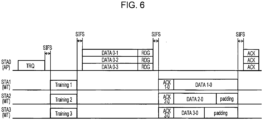
- Fig. 6 illustrates an exemplary communication sequence for the case of a station STA0 which operates as an access point being the data source and respective stations STA1 to STA3 which operate as terminals being data recipients, wherein an RD protocol is applied and the frame lengths are made the same for data frames sent in the reverse direction by the respective stations STA1 to STA3.
- STA0 acting as the access point Upon conducting advance carrier sense and a backoff to acquire a TXOP, STA0 acting as the access point first transmits a TRQ frame.
- the respective stations STA1 to STA3 respectively and simultaneously reply with training frames (Training 1, Training 2, Training 3) containing established sequences which can be used for adaptive array antenna learning.
- training frames Training 1, Training 2, Training 3
- STA0 uses a given adaptive algorithm such as the RLS algorithm to learn adaptive array antenna weights on the basis of the established sequences included in the respective training frames (Training 1, Training 2, Training 3). Thereafter, the plurality of antenna elements 21-1, 21-2, ..., 21-N provided in STA0 function as an adaptive array antenna, and it becomes possible for STA0 to conduct space-division multiple access.
- a given adaptive algorithm such as the RLS algorithm to learn adaptive array antenna weights on the basis of the established sequences included in the respective training frames (Training 1, Training 2, Training 3).
- the plurality of antenna elements 21-1, 21-2, ..., 21-N provided in STA0 function as an adaptive array antenna, and it becomes possible for STA0 to conduct space-division multiple access.
- STA0 respectively transmits downlink frames, or in other words data frames (DATA 0-1, DATA 0-2, DATA 0-3) individually addressed to the respective stations STA1, STA2, and STA3.
- data frames DATA 0-1, DATA 0-2, DATA 0-3 individually addressed to the respective stations STA1, STA2, and STA3.
- STA0 indicates an RDG (RD Grant) for the respective stations STA1, STA2, and STA3 in the MAC frame of each data frame (DATA 0-1, DATA 0-2, DATA 0-3).
- RDG RD Grant
- the respective stations STA1, STA2, and STA3 Upon recognizing that reverse direction, or in other words uplink, data transfer using the RD protocol has been permitted or granted, the respective stations STA1, STA2, and STA3 simultaneously reply with ACK frames (ACK 1-0, ACK 2-0, ACK 3-0) after a given frame interval SIFS has elapsed since completely receiving the data frames. Furthermore, the respective stations STA1, STA2, and STA3 subsequently and respectively transmit reverse direction data frames (DATA 1-0, DATA 2-0, DATA 3-0) addressed to STA0.
- ACK frames ACK 1-0, ACK 2-0, ACK 3-0
- the respective stations STA1, STA2, and STA3 conducts a frame length adjustment process such that the frame length of the data frame ultimately output from each station's own PHY layer is a fixed length.
- one example of a processing method for making respective frame lengths the same is padding the data part of frames which do not satisfy a given length.
- DATA 2-0 and DATA 3-0 are respectively padded, both being shorter than DATA 1-0.
- the bits or symbols used for padding are preferably established among the communication apparatus exchanging padded frames.
- the padding area is disposed in a block after the data part, but the principal matter of the present invention is not limited to a specific padding method.
- a method that disposes the padding area in a block before the data part a method that finely divides up the padding area and disposes padding positions distributed throughout the data part, and additionally, a method that disposes padding positions evenly distributed inside the data part, or a method that disposes padding positions unevenly distributed inside the data part may be cited.
- the plurality of antenna elements 21-1, 21-2, ..., 21-N are already functioning as an adaptive antenna, and thus STA0 is able to spatially separate the plurality of simultaneously received reverse direction data frames (DATA 1-0, DATA 2-0, DATA 3-0) for each user. Then, STA0 removes the padded symbols from the separated data frames, and decodes the data. Also, STA0 simultaneously replies with ACK frames addressed to the respective stations STA1, STA2, and STA3 after a given frame interval SIFS has elapsed since completely receiving the respective data frames.
- the multiplexed data frames addressed to the respective stations STA1, STA2, and STA3 do not have identical frame lengths, if the respective stations STA1, STA2, and STA3 try to initiate uplink data frame transfer based on the times at which they respectively received the data frames at their own stations, the reverse direction data frames (DATA 1-0, DATA 2-0, DATA 3-0) will not be multiplexed at the same time. As a result, the access point STA0 will become unable to conduct user separation.
- the respective stations STA1, STA2, and STA3 that simultaneously transmit data frames to STA0 by uplink in accordance with the RD protocol are configured to transmit their individual reverse direction data frames (DATA 1-0, DATA 2-0, DATA 3-0) at the same time, regardless of the times at which the frames indicating the individual RDGs are received. Also, the individual reverse direction data frames (DATA 1-0, DATA 2-0, DATA 3-0) are taken to have fixed frame lengths.
- the respective stations STA1, STA2, and STA3 must recognize each other's times at which the data frames (DATA 1-0, DATA 2-0, DATA 3-0) are sent by uplink.
- a method that additionally reports information on frame transmitting times by the respective stations STA1, STA2, and STA3 when the access point STA0 indicates RDGs may be cited, for example.
- Fig. 7 illustrates an exemplary communication sequence for the case of a station STA0 which operates as an access point being the data source and respective stations STA1 to STA3 which operate as terminals being data recipients, wherein an RD protocol is applied and the respective stations STA1 to STA3 transmit reverse direction data frames at the same time.
- STA0 acting as the access point Upon conducting advance carrier sense and a backoff to acquire a TXOP, STA0 acting as the access point first transmits a TRQ frame.
- the respective stations STA1 to STA3 respectively and simultaneously reply with training frames (Training 1, Training 2, Training 3) containing established sequences which can be used for adaptive array antenna learning.
- training frames Training 1, Training 2, Training 3
- STA0 uses a given adaptive algorithm such as the RLS algorithm to learn adaptive array antenna weights on the basis of the established sequences included in the respective training frames. Thereafter, the plurality of antenna elements 21-1, 21-2, ..., 21-N provided in STA0 function as an adaptive array antenna, and it becomes possible for STA0 to conduct space-division multiple access.
- a given adaptive algorithm such as the RLS algorithm to learn adaptive array antenna weights on the basis of the established sequences included in the respective training frames.
- STA0 respectively transmits downlink frames, or in other words data frames (DATA 0-1, DATA 0-2, DATA 0-3) individually addressed to the respective stations STA1, STA2, and STA3.
- data frames DATA 0-1, DATA 0-2, DATA 0-3 individually addressed to the respective stations STA1, STA2, and STA3.
- STA0 indicates an RDG (RD Grant) for the respective stations STA1, STA2, and STA3 in the MAC frame of each data frame (DATA 0-1, DATA 0-2, DATA 0-3).
- RDG RD Grant
- the respective data frames that STA0 transmits to the respective stations STA1, STA2, and STA3 have different frame lengths as illustrated, with DATA 2-0 and DATA 3-0 being shorter than DATA 1-0.
- the respective stations STA1, STA2, and STA3 Upon recognizing that reverse direction, or in other words uplink, data transfer using the RD protocol has been permitted or granted, the respective stations STA1, STA2, and STA3 conduct a frame length adjustment process such that the data frames ultimately output from the PHY layer of the respective stations have fixed frame lengths. As discussed earlier, the respective data frames that STA0 transmits to the respective stations STA1, STA2, and STA3 have different frame lengths, and the individual reception end times do not match. However, the respective stations STA1, STA2, and STA3 are configured to simultaneously reply with ACK frames (ACK 1-0, ACK 2-0, ACK 3-0) at the same time reported in conjunction with the RDGs. Furthermore, the respective stations STA1, STA2, and STA3 subsequently and respectively transmit reverse direction data frames (DATA 1-0, DATA 2-0, DATA 3-0) addressed to STA0.
- ACK frames ACK 1-0, ACK 2-0, DATA 3-0
- the plurality of antenna elements 21-1, 21-2, ..., 21-N are already functioning as an adaptive antenna, and thus STA0 is able to spatially separate the plurality of simultaneously received reverse direction data frames (DATA 1-0, DATA 2-0, DATA 3-0) for each user. Then, STA0 removes the padded symbols from the separated data frames and decodes the data. Also, STA0 simultaneously replies with ACK frames addressed to the respective stations STA1, STA2, and STA3 after a given frame interval SIFS has elapsed since completely receiving the respective data frames.
- Fig. 8 illustrates a processing sequence in flowchart form wherein, given the communication sequences illustrated in Figs. 5 to 7 , the communication apparatus illustrated in Fig. 2 operates as an access point (STAO) and transmits multiplexed frames addressed to a plurality of stations at the same time.
- STAO access point
- RD protocol is applied with the access point fulfilling the role of RD initiator.
- the processing routine activates in response to a data transmission request being produced in an upper layer, or to an uplink data reception request being produced.
- the access point conducts physical carrier sensing in advance to determine that the medium is clear, and additionally conducts a backoff, etc. to acquire a TXOP. Then, the access point transmits a training request (TRQ) frame to one or more terminals (STA1 to STA3) to which the access point wants to transmit multiplexed data (or from which the access point wants to receive data by uplink) (step S1).
- TRQ training request
- the access point stands by to receive training frames sent in reply from the respective training request recipients (STA1 to STA3) (step S2).
- SIFS Short Inter Frame Space
- step S3 No when the access point was not able to receive a training frame from any of the training request recipients (STA1 to STA3) (step S3, No), the process proceeds to a TRQ frame retransmit process.
- STA1 to STA3 the access point was not able to receive a training frame from any of the training request recipients (STA1 to STA3) (step S3, No)
- the process proceeds to a TRQ frame retransmit process.
- detailed description of a frame retransmit processing sequence is omitted.
- the access point uses established sequences for learning that are respectively included in the received training frames to learn adaptive array antenna weights.
- the access point checks whether or not there is an uplink data reception request with respect to a terminal from which a training frame could be received, or whether or not there is room in the TXOP (step S4).
- the access point when there is no uplink data reception request or when there is a data reception request but no room in the TXOP (step S4, No), the access point multiplexes and transmits frames without indicating an RDG after a given frame interval SIFS has elapsed since completely receiving the training frames.
- the overall processing routine ends.
- the access point is able to apply space-division multiplexing to data frames addressed to a plurality of terminals and transmit them simultaneously.
- the access point since learning was not conducted for terminals from which a training frame could not be received, and since it is unclear whether such terminals even exist within communicable range, it is configured such that the access point refrains from transmitting data frames thereto.
- the access point may adjust the respective frames to be multiplexed and sent such that their frame lengths become uniform.
- the access point when there is an uplink data reception request and also room in the TXOP (step S4, Yes), the access point includes an RDG field specifying transmit opportunity grant start time, transmit opportunity grant end time, and frame length in the data frames addressed to the respective terminals (step S5), and transmits them at the same time (step S6).
- the access point is able to apply space-division multiplexing to data frames addressed to a plurality of terminals and transmit them simultaneously. Also, the access point may adjust the respective frames to be multiplexed and sent such that their frame lengths become uniform.
- the access point stands by to receive ACK frames and data frames simultaneously sent from the respective terminals (step S7). Then, once the data frames are received, the access point replies with ACK frames after a given frame interval SIFS has elapsed.
- the overall processing routine ends.
- Fig. 9 illustrates a processing sequence in flowchart format wherein, given the communication sequences illustrated in Figs. 5 to 7 , the communication apparatus illustrated in Fig. 2 operates as one of the terminals (STA1 to STA3) and transmits multiplexed frames addressed to a plurality of stations at the same time.
- STA1 to STA3 the terminals
- RD protocol is applied with the terminal fulfilling the role of RD responder.
- step S11 After a given frame interval SIFS has elapsed since completely receiving a TRQ frame from an access point (step S11, Yes), the terminal replies to the access point with a training frame (step S12).
- step S13 the terminal stands by to receive a data frame sent from the access point (step S14).
- the terminal Upon receiving the downlink data frame from the access point, the terminal checks whether or not an RDG field indicating a transmit opportunity grant has been added (step S15).
- step S15 the terminal replies to the access point with an ACK frame after a given frame interval SIFS has elapsed since completely receiving the data frame.
- the processing routine ends.
- the terminal additionally checks whether or not there exists transmit uplink data addressed to the access point which is the source of the data frame (step S16).
- step S16, No When transmit uplink data addressed to the access point does not exist (step S16, No), the terminal replies to the access point with an ACK frame after a given frame interval SIFS has elapsed since completely receiving the data frame.
- the processing routine ends.
- step S16 the terminal consecutively transmits an ACK frame and an uplink data frame to the access point after a given frame interval SIFS has elapsed since completely receiving the data frame. At this point, the terminal transmits the data frame while respecting the transmit start time and the frame length specified in the RDG field (step S17). The processing routine ends.
Landscapes
- Engineering & Computer Science (AREA)
- Computer Networks & Wireless Communication (AREA)
- Signal Processing (AREA)
- Mobile Radio Communication Systems (AREA)
- Radio Transmission System (AREA)
- Time-Division Multiplex Systems (AREA)
Applications Claiming Priority (5)
| Application Number | Priority Date | Filing Date | Title |
|---|---|---|---|
| JP2009113871A JP5391816B2 (ja) | 2009-05-08 | 2009-05-08 | 通信装置及び通信方法、コンピューター・プログラム、並びに通信システム |
| EP19195098.9A EP3595396B1 (de) | 2009-05-08 | 2010-03-17 | Umkehrrichtungsprotokoll in einem sdma-kontext |
| EP22195982.8A EP4181610B1 (de) | 2009-05-08 | 2010-03-17 | Umkehrrichtungsprotokoll in einem sdma-kontext |
| EP10772132.6A EP2429250B1 (de) | 2009-05-08 | 2010-03-17 | Kommunikationsvorrichtung, kommunikationsverfahren, computerpogramm und kommunikationssystem |
| PCT/JP2010/054580 WO2010128608A1 (ja) | 2009-05-08 | 2010-03-17 | 通信装置及び通信方法、コンピューター・プログラム、並びに通信システム |
Related Parent Applications (3)
| Application Number | Title | Priority Date | Filing Date |
|---|---|---|---|
| EP22195982.8A Division EP4181610B1 (de) | 2009-05-08 | 2010-03-17 | Umkehrrichtungsprotokoll in einem sdma-kontext |
| EP10772132.6A Division EP2429250B1 (de) | 2009-05-08 | 2010-03-17 | Kommunikationsvorrichtung, kommunikationsverfahren, computerpogramm und kommunikationssystem |
| EP19195098.9A Division EP3595396B1 (de) | 2009-05-08 | 2010-03-17 | Umkehrrichtungsprotokoll in einem sdma-kontext |
Publications (2)
| Publication Number | Publication Date |
|---|---|
| EP4525542A2 true EP4525542A2 (de) | 2025-03-19 |
| EP4525542A3 EP4525542A3 (de) | 2025-04-09 |
Family
ID=43050116
Family Applications (4)
| Application Number | Title | Priority Date | Filing Date |
|---|---|---|---|
| EP19195098.9A Active EP3595396B1 (de) | 2009-05-08 | 2010-03-17 | Umkehrrichtungsprotokoll in einem sdma-kontext |
| EP25152861.8A Pending EP4525542A3 (de) | 2009-05-08 | 2010-03-17 | Umkehrrichtungsprotokoll in einem sdma-kontext |
| EP22195982.8A Active EP4181610B1 (de) | 2009-05-08 | 2010-03-17 | Umkehrrichtungsprotokoll in einem sdma-kontext |
| EP10772132.6A Active EP2429250B1 (de) | 2009-05-08 | 2010-03-17 | Kommunikationsvorrichtung, kommunikationsverfahren, computerpogramm und kommunikationssystem |
Family Applications Before (1)
| Application Number | Title | Priority Date | Filing Date |
|---|---|---|---|
| EP19195098.9A Active EP3595396B1 (de) | 2009-05-08 | 2010-03-17 | Umkehrrichtungsprotokoll in einem sdma-kontext |
Family Applications After (2)
| Application Number | Title | Priority Date | Filing Date |
|---|---|---|---|
| EP22195982.8A Active EP4181610B1 (de) | 2009-05-08 | 2010-03-17 | Umkehrrichtungsprotokoll in einem sdma-kontext |
| EP10772132.6A Active EP2429250B1 (de) | 2009-05-08 | 2010-03-17 | Kommunikationsvorrichtung, kommunikationsverfahren, computerpogramm und kommunikationssystem |
Country Status (13)
| Country | Link |
|---|---|
| US (6) | US9264119B2 (de) |
| EP (4) | EP3595396B1 (de) |
| JP (1) | JP5391816B2 (de) |
| KR (1) | KR101649773B1 (de) |
| CN (2) | CN104717751B (de) |
| AU (1) | AU2010245581A1 (de) |
| BR (1) | BRPI1016116B1 (de) |
| CA (1) | CA2759902A1 (de) |
| MX (1) | MX2011011602A (de) |
| RU (1) | RU2541506C2 (de) |
| TW (1) | TWI446742B (de) |
| WO (1) | WO2010128608A1 (de) |
| ZA (1) | ZA201107841B (de) |
Families Citing this family (31)
| Publication number | Priority date | Publication date | Assignee | Title |
|---|---|---|---|---|
| JP5316208B2 (ja) | 2009-05-08 | 2013-10-16 | ソニー株式会社 | 通信装置及び通信方法、コンピューター・プログラム、並びに通信システム |
| JP5391816B2 (ja) | 2009-05-08 | 2014-01-15 | ソニー株式会社 | 通信装置及び通信方法、コンピューター・プログラム、並びに通信システム |
| CN102843785B (zh) | 2011-06-25 | 2015-04-08 | 华为技术有限公司 | 无线局域网中逆向协议传输的方法及装置 |
| JP5559753B2 (ja) * | 2011-08-01 | 2014-07-23 | 日本電信電話株式会社 | 基地局装置および無線通信方法 |
| CN103037531B (zh) * | 2011-10-09 | 2018-03-16 | 中兴通讯股份有限公司 | 一种无线站点接入信道的方法及系统 |
| JP6218305B2 (ja) * | 2013-03-26 | 2017-10-25 | 日本電信電話株式会社 | 無線通信方法及び無線通信装置 |
| US9860174B2 (en) | 2013-08-28 | 2018-01-02 | Qualcomm Incorporated | Methods and apparatus for acknowledgment of multi-user uplink wireless transmissions |
| WO2015127616A1 (zh) | 2014-02-27 | 2015-09-03 | 华为技术有限公司 | 无线局域网数据的传输方法及装置 |
| US9485334B2 (en) * | 2014-03-12 | 2016-11-01 | Qualcomm Incorporated | Response time relaxation for high efficiency WLAN |
| WO2015163336A1 (ja) | 2014-04-21 | 2015-10-29 | 株式会社 東芝 | 無線通信用集積回路 |
| EP3934353B1 (de) | 2014-04-21 | 2026-03-18 | International Semiconductor Group | Basis stationen und drahtkommunikationsverfahren |
| US9860921B2 (en) * | 2014-05-30 | 2018-01-02 | Electronics And Telecommunications Research Institute | Method and apparatus for transmitting and receiving data based on aggressive spatial reuse |
| CN106576248B (zh) | 2014-08-21 | 2020-03-06 | 日本电信电话株式会社 | 无线通信系统、无线通信方法、协作控制装置、终端装置、以及许可频带基站装置 |
| JP6331967B2 (ja) | 2014-10-27 | 2018-05-30 | ソニー株式会社 | 通信装置および通信方法 |
| EP3678439B1 (de) * | 2014-10-28 | 2021-12-01 | Sony Group Corporation | Kommunikationsvorrichtung und kommunikationsverfahren |
| JP6430856B2 (ja) | 2015-02-24 | 2018-11-28 | 日本電信電話株式会社 | 無線通信システムおよび無線通信方法 |
| EP3267740B1 (de) | 2015-03-06 | 2021-07-28 | Sony Group Corporation | Kommunikationssteuerungsvorrichtung, kommunikationsvorrichtung, kommunikationssteuerungsverfahren, kommunikationsverfahren und programm |
| CN106658739B (zh) * | 2015-07-13 | 2020-01-31 | 中国移动通信集团公司 | 一种多ue上行子帧聚合传输方法、装置和系统 |
| JP6652468B2 (ja) * | 2015-09-10 | 2020-02-26 | 株式会社東芝 | 無線通信装置および無線通信方法 |
| US10911185B2 (en) | 2015-09-10 | 2021-02-02 | Kabushiki Kaisha Toshiba | Wireless communication device and wireless communication method |
| US20170181187A1 (en) * | 2015-12-16 | 2017-06-22 | Qualcomm Incorporated | Methods and apparatus for negotiating processing time for multiple user uplink |
| US9992741B2 (en) | 2016-01-11 | 2018-06-05 | Intel IP Corporation | Device and method of providing grant frame for bandwidth scheduling |
| JP2017152983A (ja) | 2016-02-25 | 2017-08-31 | ソニー株式会社 | 情報処理装置、通信システム、情報処理方法およびプログラム |
| US10623533B2 (en) * | 2018-01-12 | 2020-04-14 | Marvell Asia Pte, Ltd. | Methods and apparatus for generation of physical layer protocol data units |
| US11552828B2 (en) | 2018-05-04 | 2023-01-10 | Semiconductor Components Industries, Llc | Beamformer solicited sounding |
| US11394441B2 (en) * | 2018-05-04 | 2022-07-19 | On Semiconductor Connectivity Solutions, Inc. | Beamformer solicited sounding |
| JP7316774B2 (ja) * | 2018-10-19 | 2023-07-28 | キヤノン株式会社 | 通信装置およびその制御方法 |
| EP3952392A4 (de) * | 2019-03-26 | 2022-08-17 | Sony Group Corporation | Kommunikationssteuerungsvorrichtung und -verfahren sowie drahtloskommunikationsvorrichtung und -verfahren |
| US12058750B2 (en) * | 2020-03-11 | 2024-08-06 | Qualcomm Incorporated | Transmission opportunity handling for multi-link communications |
| EP4301003B1 (de) * | 2021-05-20 | 2025-09-10 | Guangdong Oppo Mobile Telecommunications Corp., Ltd. | Drahtloskommunikationsverfahren, stationsvorrichtung und zugangspunktvorrichtung |
| US12578998B2 (en) | 2023-01-10 | 2026-03-17 | Bank Of America Corporation | Methods and systems for dynamic allocation of aggregated resource transfers in a distributed network |
Citations (5)
| Publication number | Priority date | Publication date | Assignee | Title |
|---|---|---|---|---|
| US6721302B1 (en) | 2000-11-17 | 2004-04-13 | Nokia Corporation | Apparatus, and associated method, for communicating packet data in a SDMA (Space-Division, Multiple-Access) communication scheme |
| JP2004328570A (ja) | 2003-04-28 | 2004-11-18 | Sony Corp | 通信システム及び通信方法、並びに通信装置 |
| US20050138199A1 (en) | 2003-12-23 | 2005-06-23 | Qinghua Li | Parallel wireless communication apparatus, method, and system |
| JP2006352711A (ja) | 2005-06-17 | 2006-12-28 | Toshiba Corp | 無線通信装置 |
| JP2008252867A (ja) | 2007-03-05 | 2008-10-16 | Sony Corp | 無線通信システム、無線通信装置及び無線通信方法、並びにコンピュータ・プログラム |
Family Cites Families (34)
| Publication number | Priority date | Publication date | Assignee | Title |
|---|---|---|---|---|
| US5119504A (en) * | 1990-07-19 | 1992-06-02 | Motorola, Inc. | Position aided subscriber unit for a satellite cellular system |
| US6898436B2 (en) | 2002-02-14 | 2005-05-24 | Qualcomm Incorporated | Communication device for joining a user to a group call in a group communication network |
| US7630403B2 (en) * | 2002-03-08 | 2009-12-08 | Texas Instruments Incorporated | MAC aggregation frame with MSDU and fragment of MSDU |
| CN102014100B (zh) * | 2002-10-25 | 2013-03-06 | 高通股份有限公司 | 用于无线电通信系统的数据检测和解调 |
| US7324429B2 (en) | 2002-10-25 | 2008-01-29 | Qualcomm, Incorporated | Multi-mode terminal in a wireless MIMO system |
| US8320301B2 (en) * | 2002-10-25 | 2012-11-27 | Qualcomm Incorporated | MIMO WLAN system |
| WO2004075502A2 (en) | 2003-02-19 | 2004-09-02 | Matsushita Electric Industrial Co. Ltd. | Receiving apparatus and method for digital multi-carrier transmission |
| US7733846B2 (en) * | 2003-08-26 | 2010-06-08 | Alcatel-Lucent Usa Inc. | Method and control channel for uplink signaling in a communication system |
| US8284752B2 (en) * | 2003-10-15 | 2012-10-09 | Qualcomm Incorporated | Method, apparatus, and system for medium access control |
| KR101029803B1 (ko) | 2003-12-01 | 2011-04-20 | 엘지전자 주식회사 | Dmb 수신기의 비터비 디코딩 장치 및 방법 |
| RU2363107C2 (ru) * | 2004-06-01 | 2009-07-27 | Квэлкомм Инкорпорейтед | Системы и способы пакетной передачи обслуживания в системе беспроводной связи |
| CN1993944A (zh) * | 2004-06-02 | 2007-07-04 | 高通股份有限公司 | 无线网络中的调度方法与装置 |
| ATE383048T1 (de) * | 2004-06-15 | 2008-01-15 | Matsushita Electric Industrial Co Ltd | Auf priorität basierte behandlung von datenübertragungen |
| KR20070032719A (ko) * | 2004-06-24 | 2007-03-22 | 코닌클리즈케 필립스 일렉트로닉스 엔.브이. | Tdd/tdma 무선 수퍼프레임, tdd/tdma수퍼프레임을 전송하기 위한 시스템, 수퍼프레임 전송 방법 |
| KR100678939B1 (ko) * | 2004-08-27 | 2007-02-07 | 삼성전자주식회사 | 인프라스트럭처 모드의 무선 네트워크 환경에 있어서,무선 데이터 전송 방법 |
| CN1797987B (zh) * | 2004-12-30 | 2011-02-16 | 都科摩(北京)通信技术研究中心有限公司 | 自适应调度的mimo通信系统及其自适应用户调度方法 |
| US20060153227A1 (en) | 2005-01-12 | 2006-07-13 | Samsung Electronics Co., Ltd. | Apparatus and method for transmitting information data in a wireless communication system |
| JP4591104B2 (ja) * | 2005-02-09 | 2010-12-01 | ソニー株式会社 | 無線通信装置、無線通信方法およびプログラム |
| WO2007001267A1 (en) * | 2005-06-20 | 2007-01-04 | Mitsubishi Electric Research Laboratories | An efficient protocol for reverse direction data transmission |
| JP2007258904A (ja) | 2006-03-22 | 2007-10-04 | Sony Corp | 無線通信装置 |
| JP2007295549A (ja) * | 2006-03-31 | 2007-11-08 | Matsushita Electric Ind Co Ltd | Mimo受信装置およびmimo通信システム |
| US7804800B2 (en) * | 2006-03-31 | 2010-09-28 | Intel Corporation | Efficient training schemes for MIMO based wireless networks |
| JP4775288B2 (ja) * | 2006-04-27 | 2011-09-21 | ソニー株式会社 | 無線通信システム、無線通信装置及び無線通信方法 |
| US8102802B2 (en) * | 2006-05-08 | 2012-01-24 | Motorola Mobility, Inc. | Method and apparatus for providing downlink acknowledgments and transmit indicators in an orthogonal frequency division multiplexing communication system |
| US9450711B2 (en) * | 2008-04-02 | 2016-09-20 | Qualcomm Incorporated | Method and apparatus for extended reverse direction grant in a wireless local area network (WLAN) |
| US20100290449A1 (en) * | 2008-08-20 | 2010-11-18 | Qualcomm Incorporated | Preamble extensions |
| CN102369674B (zh) * | 2009-03-31 | 2014-07-23 | 马维尔国际贸易有限公司 | 用于无线通信的方法、装置及系统 |
| WO2010118383A1 (en) * | 2009-04-10 | 2010-10-14 | Marvell World Trade Ltd. | Signaling for multi-dimension wireless resource allocation |
| JP5649011B2 (ja) * | 2009-04-13 | 2015-01-07 | マーベル ワールド トレード リミテッド | Wlan用の物理層フレーム形式 |
| JP5391816B2 (ja) * | 2009-05-08 | 2014-01-15 | ソニー株式会社 | 通信装置及び通信方法、コンピューター・プログラム、並びに通信システム |
| JP5316208B2 (ja) | 2009-05-08 | 2013-10-16 | ソニー株式会社 | 通信装置及び通信方法、コンピューター・プログラム、並びに通信システム |
| CN102498687B (zh) * | 2009-08-12 | 2015-09-09 | 马维尔国际贸易有限公司 | 用于无线通信的方法、装置及系统 |
| CA2772266C (en) * | 2009-08-26 | 2015-10-27 | Lg Electronics Inc. | Method and apparatus for multiple frame transmission for supporting mu-mimo |
| US10383141B2 (en) * | 2009-09-23 | 2019-08-13 | Qualcomm Incorporated | Uplink SDMA transmit opportunity scheduling |
-
2009
- 2009-05-08 JP JP2009113871A patent/JP5391816B2/ja active Active
-
2010
- 2010-03-17 AU AU2010245581A patent/AU2010245581A1/en not_active Abandoned
- 2010-03-17 US US13/318,368 patent/US9264119B2/en active Active
- 2010-03-17 EP EP19195098.9A patent/EP3595396B1/de active Active
- 2010-03-17 WO PCT/JP2010/054580 patent/WO2010128608A1/ja not_active Ceased
- 2010-03-17 CA CA2759902A patent/CA2759902A1/en not_active Abandoned
- 2010-03-17 EP EP25152861.8A patent/EP4525542A3/de active Pending
- 2010-03-17 CN CN201510087460.7A patent/CN104717751B/zh active Active
- 2010-03-17 EP EP22195982.8A patent/EP4181610B1/de active Active
- 2010-03-17 KR KR1020117025949A patent/KR101649773B1/ko active Active
- 2010-03-17 BR BRPI1016116-3A patent/BRPI1016116B1/pt active IP Right Grant
- 2010-03-17 EP EP10772132.6A patent/EP2429250B1/de active Active
- 2010-03-17 RU RU2011144381/07A patent/RU2541506C2/ru active
- 2010-03-17 MX MX2011011602A patent/MX2011011602A/es active IP Right Grant
- 2010-03-17 CN CN201080019207.3A patent/CN102415184B/zh active Active
- 2010-03-23 TW TW099108530A patent/TWI446742B/zh active
-
2011
- 2011-10-26 ZA ZA2011/07841A patent/ZA201107841B/en unknown
-
2016
- 2016-01-14 US US14/996,019 patent/US9585151B2/en active Active
-
2017
- 2017-01-24 US US15/414,004 patent/US9930662B2/en active Active
-
2018
- 2018-02-12 US US15/894,496 patent/US10306631B2/en active Active
-
2019
- 2019-04-17 US US16/386,547 patent/US10631293B2/en active Active
-
2020
- 2020-03-19 US US16/823,819 patent/US11039437B2/en active Active
Patent Citations (5)
| Publication number | Priority date | Publication date | Assignee | Title |
|---|---|---|---|---|
| US6721302B1 (en) | 2000-11-17 | 2004-04-13 | Nokia Corporation | Apparatus, and associated method, for communicating packet data in a SDMA (Space-Division, Multiple-Access) communication scheme |
| JP2004328570A (ja) | 2003-04-28 | 2004-11-18 | Sony Corp | 通信システム及び通信方法、並びに通信装置 |
| US20050138199A1 (en) | 2003-12-23 | 2005-06-23 | Qinghua Li | Parallel wireless communication apparatus, method, and system |
| JP2006352711A (ja) | 2005-06-17 | 2006-12-28 | Toshiba Corp | 無線通信装置 |
| JP2008252867A (ja) | 2007-03-05 | 2008-10-16 | Sony Corp | 無線通信システム、無線通信装置及び無線通信方法、並びにコンピュータ・プログラム |
Also Published As
Similar Documents
| Publication | Publication Date | Title |
|---|---|---|
| US11039437B2 (en) | Communication apparatus, communication method, and communication system | |
| EP3512241B1 (de) | Kommunikationsvorrichtung und kommunikationsverfahren | |
| EP2449837B1 (de) | Verfahren und vorrichtung für anfragenachrichtenübermittlung an mehrere stationen | |
| EP3461021B1 (de) | Kommunikationsvorrichtungen und -verfahren | |
| EP3407661B1 (de) | Kommunikationssystem, gerätekommunikation, kommunikationsverfahren und entsprechendes computerprogramm | |
| WO2010128619A1 (ja) | 通信装置及び通信方法、コンピューター・プログラム、並びに通信システム | |
| WO2010128620A1 (ja) | 通信装置及び通信方法、コンピューター・プログラム、並びに通信システム |
Legal Events
| Date | Code | Title | Description |
|---|---|---|---|
| PUAI | Public reference made under article 153(3) epc to a published international application that has entered the european phase |
Free format text: ORIGINAL CODE: 0009012 |
|
| STAA | Information on the status of an ep patent application or granted ep patent |
Free format text: STATUS: REQUEST FOR EXAMINATION WAS MADE |
|
| REG | Reference to a national code |
Ref country code: DE Ref legal event code: R079 Free format text: PREVIOUS MAIN CLASS: H04W0074000000 Ipc: H04W0074060000 |
|
| PUAL | Search report despatched |
Free format text: ORIGINAL CODE: 0009013 |
|
| 17P | Request for examination filed |
Effective date: 20250120 |
|
| AC | Divisional application: reference to earlier application |
Ref document number: 2429250 Country of ref document: EP Kind code of ref document: P Ref document number: 3595396 Country of ref document: EP Kind code of ref document: P Ref document number: 4181610 Country of ref document: EP Kind code of ref document: P |
|
| AK | Designated contracting states |
Kind code of ref document: A2 Designated state(s): AT BE BG CH CY CZ DE DK EE ES FI FR GB GR HR HU IE IS IT LI LT LU LV MC MK MT NL NO PL PT RO SE SI SK SM TR |
|
| AK | Designated contracting states |
Kind code of ref document: A3 Designated state(s): AT BE BG CH CY CZ DE DK EE ES FI FR GB GR HR HU IE IS IT LI LT LU LV MC MK MT NL NO PL PT RO SE SI SK SM TR |
|
| RIC1 | Information provided on ipc code assigned before grant |
Ipc: H04W 72/044 20230101ALN20250306BHEP Ipc: H04W 84/12 20090101ALN20250306BHEP Ipc: H04W 74/00 20090101ALI20250306BHEP Ipc: H04B 7/0452 20170101ALI20250306BHEP Ipc: H04W 74/06 20090101AFI20250306BHEP |
|
| RAP3 | Party data changed (applicant data changed or rights of an application transferred) |
Owner name: SONY GROUP CORPORATION |