EP4527332A1 - Medizinische vorrichtung mit monolithischem wirbelsäulenrahmen - Google Patents
Medizinische vorrichtung mit monolithischem wirbelsäulenrahmen Download PDFInfo
- Publication number
- EP4527332A1 EP4527332A1 EP24201695.4A EP24201695A EP4527332A1 EP 4527332 A1 EP4527332 A1 EP 4527332A1 EP 24201695 A EP24201695 A EP 24201695A EP 4527332 A1 EP4527332 A1 EP 4527332A1
- Authority
- EP
- European Patent Office
- Prior art keywords
- crown
- spine
- longitudinal axis
- spines
- recesses
- Prior art date
- Legal status (The legal status is an assumption and is not a legal conclusion. Google has not performed a legal analysis and makes no representation as to the accuracy of the status listed.)
- Pending
Links
Images






Classifications
-
- A—HUMAN NECESSITIES
- A61—MEDICAL OR VETERINARY SCIENCE; HYGIENE
- A61B—DIAGNOSIS; SURGERY; IDENTIFICATION
- A61B18/00—Surgical instruments, devices or methods for transferring non-mechanical forms of energy to or from the body
- A61B18/04—Surgical instruments, devices or methods for transferring non-mechanical forms of energy to or from the body by heating
- A61B18/12—Surgical instruments, devices or methods for transferring non-mechanical forms of energy to or from the body by heating by passing a current through the tissue to be heated, e.g. high-frequency current
- A61B18/14—Probes or electrodes therefor
- A61B18/1492—Probes or electrodes therefor having a flexible, catheter-like structure, e.g. for heart ablation
-
- A—HUMAN NECESSITIES
- A61—MEDICAL OR VETERINARY SCIENCE; HYGIENE
- A61B—DIAGNOSIS; SURGERY; IDENTIFICATION
- A61B18/00—Surgical instruments, devices or methods for transferring non-mechanical forms of energy to or from the body
- A61B18/04—Surgical instruments, devices or methods for transferring non-mechanical forms of energy to or from the body by heating
- A61B18/08—Surgical instruments, devices or methods for transferring non-mechanical forms of energy to or from the body by heating by means of electrically-heated probes
- A61B18/082—Probes or electrodes therefor
-
- A—HUMAN NECESSITIES
- A61—MEDICAL OR VETERINARY SCIENCE; HYGIENE
- A61B—DIAGNOSIS; SURGERY; IDENTIFICATION
- A61B18/00—Surgical instruments, devices or methods for transferring non-mechanical forms of energy to or from the body
- A61B18/04—Surgical instruments, devices or methods for transferring non-mechanical forms of energy to or from the body by heating
- A61B18/12—Surgical instruments, devices or methods for transferring non-mechanical forms of energy to or from the body by heating by passing a current through the tissue to be heated, e.g. high-frequency current
- A61B18/14—Probes or electrodes therefor
-
- A—HUMAN NECESSITIES
- A61—MEDICAL OR VETERINARY SCIENCE; HYGIENE
- A61B—DIAGNOSIS; SURGERY; IDENTIFICATION
- A61B17/00—Surgical instruments, devices or methods
- A61B2017/00526—Methods of manufacturing
-
- A—HUMAN NECESSITIES
- A61—MEDICAL OR VETERINARY SCIENCE; HYGIENE
- A61B—DIAGNOSIS; SURGERY; IDENTIFICATION
- A61B18/00—Surgical instruments, devices or methods for transferring non-mechanical forms of energy to or from the body
- A61B2018/00053—Mechanical features of the instrument of device
- A61B2018/0016—Energy applicators arranged in a two- or three dimensional array
-
- A—HUMAN NECESSITIES
- A61—MEDICAL OR VETERINARY SCIENCE; HYGIENE
- A61B—DIAGNOSIS; SURGERY; IDENTIFICATION
- A61B18/00—Surgical instruments, devices or methods for transferring non-mechanical forms of energy to or from the body
- A61B2018/00053—Mechanical features of the instrument of device
- A61B2018/00214—Expandable means emitting energy, e.g. by elements carried thereon
- A61B2018/00267—Expandable means emitting energy, e.g. by elements carried thereon having a basket shaped structure
-
- A—HUMAN NECESSITIES
- A61—MEDICAL OR VETERINARY SCIENCE; HYGIENE
- A61B—DIAGNOSIS; SURGERY; IDENTIFICATION
- A61B18/00—Surgical instruments, devices or methods for transferring non-mechanical forms of energy to or from the body
- A61B2018/00053—Mechanical features of the instrument of device
- A61B2018/00273—Anchoring means for temporary attachment of a device to tissue
- A61B2018/00279—Anchoring means for temporary attachment of a device to tissue deployable
-
- A—HUMAN NECESSITIES
- A61—MEDICAL OR VETERINARY SCIENCE; HYGIENE
- A61B—DIAGNOSIS; SURGERY; IDENTIFICATION
- A61B18/00—Surgical instruments, devices or methods for transferring non-mechanical forms of energy to or from the body
- A61B2018/00315—Surgical instruments, devices or methods for transferring non-mechanical forms of energy to or from the body for treatment of particular body parts
- A61B2018/00345—Vascular system
- A61B2018/00351—Heart
- A61B2018/00357—Endocardium
-
- A—HUMAN NECESSITIES
- A61—MEDICAL OR VETERINARY SCIENCE; HYGIENE
- A61B—DIAGNOSIS; SURGERY; IDENTIFICATION
- A61B18/00—Surgical instruments, devices or methods for transferring non-mechanical forms of energy to or from the body
- A61B2018/00571—Surgical instruments, devices or methods for transferring non-mechanical forms of energy to or from the body for achieving a particular surgical effect
- A61B2018/00577—Ablation
-
- A—HUMAN NECESSITIES
- A61—MEDICAL OR VETERINARY SCIENCE; HYGIENE
- A61B—DIAGNOSIS; SURGERY; IDENTIFICATION
- A61B18/00—Surgical instruments, devices or methods for transferring non-mechanical forms of energy to or from the body
- A61B2018/00636—Sensing and controlling the application of energy
- A61B2018/00773—Sensed parameters
- A61B2018/00839—Bioelectrical parameters, e.g. ECG, EEG
-
- A—HUMAN NECESSITIES
- A61—MEDICAL OR VETERINARY SCIENCE; HYGIENE
- A61B—DIAGNOSIS; SURGERY; IDENTIFICATION
- A61B18/00—Surgical instruments, devices or methods for transferring non-mechanical forms of energy to or from the body
- A61B18/02—Surgical instruments, devices or methods for transferring non-mechanical forms of energy to or from the body by cooling, e.g. cryogenic techniques
- A61B2018/0231—Characteristics of handpieces or probes
-
- A—HUMAN NECESSITIES
- A61—MEDICAL OR VETERINARY SCIENCE; HYGIENE
- A61B—DIAGNOSIS; SURGERY; IDENTIFICATION
- A61B18/00—Surgical instruments, devices or methods for transferring non-mechanical forms of energy to or from the body
- A61B18/04—Surgical instruments, devices or methods for transferring non-mechanical forms of energy to or from the body by heating
- A61B18/12—Surgical instruments, devices or methods for transferring non-mechanical forms of energy to or from the body by heating by passing a current through the tissue to be heated, e.g. high-frequency current
- A61B18/14—Probes or electrodes therefor
- A61B2018/1467—Probes or electrodes therefor using more than two electrodes on a single probe
-
- A—HUMAN NECESSITIES
- A61—MEDICAL OR VETERINARY SCIENCE; HYGIENE
- A61B—DIAGNOSIS; SURGERY; IDENTIFICATION
- A61B18/00—Surgical instruments, devices or methods for transferring non-mechanical forms of energy to or from the body
- A61B18/04—Surgical instruments, devices or methods for transferring non-mechanical forms of energy to or from the body by heating
- A61B18/12—Surgical instruments, devices or methods for transferring non-mechanical forms of energy to or from the body by heating by passing a current through the tissue to be heated, e.g. high-frequency current
- A61B18/14—Probes or electrodes therefor
- A61B2018/1475—Electrodes retractable in or deployable from a housing
-
- A—HUMAN NECESSITIES
- A61—MEDICAL OR VETERINARY SCIENCE; HYGIENE
- A61B—DIAGNOSIS; SURGERY; IDENTIFICATION
- A61B18/00—Surgical instruments, devices or methods for transferring non-mechanical forms of energy to or from the body
- A61B18/18—Surgical instruments, devices or methods for transferring non-mechanical forms of energy to or from the body by applying electromagnetic radiation, e.g. microwaves
- A61B18/20—Surgical instruments, devices or methods for transferring non-mechanical forms of energy to or from the body by applying electromagnetic radiation, e.g. microwaves using laser
- A61B18/22—Surgical instruments, devices or methods for transferring non-mechanical forms of energy to or from the body by applying electromagnetic radiation, e.g. microwaves using laser the beam being directed along or through a flexible conduit, e.g. an optical fibre; Couplings or hand-pieces therefor
- A61B2018/2255—Optical elements at the distal end of probe tips
- A61B2018/2285—Optical elements at the distal end of probe tips with removable, replacable, or exchangable tips
-
- A—HUMAN NECESSITIES
- A61—MEDICAL OR VETERINARY SCIENCE; HYGIENE
- A61B—DIAGNOSIS; SURGERY; IDENTIFICATION
- A61B5/00—Measuring for diagnostic purposes; Identification of persons
- A61B5/15—Devices for taking samples of blood
- A61B5/150007—Details
- A61B5/150374—Details of piercing elements or protective means for preventing accidental injuries by such piercing elements
- A61B5/150381—Design of piercing elements
- A61B5/150473—Double-ended needles, e.g. used with pre-evacuated sampling tubes
- A61B5/150496—Details of construction of hub, i.e. element used to attach the double-ended needle to a piercing device or sampling device
-
- A—HUMAN NECESSITIES
- A61—MEDICAL OR VETERINARY SCIENCE; HYGIENE
- A61B—DIAGNOSIS; SURGERY; IDENTIFICATION
- A61B5/00—Measuring for diagnostic purposes; Identification of persons
- A61B5/15—Devices for taking samples of blood
- A61B5/150007—Details
- A61B5/150374—Details of piercing elements or protective means for preventing accidental injuries by such piercing elements
- A61B5/150381—Design of piercing elements
- A61B5/150503—Single-ended needles
- A61B5/150519—Details of construction of hub, i.e. element used to attach the single-ended needle to a piercing device or sampling device
-
- A—HUMAN NECESSITIES
- A61—MEDICAL OR VETERINARY SCIENCE; HYGIENE
- A61B—DIAGNOSIS; SURGERY; IDENTIFICATION
- A61B5/00—Measuring for diagnostic purposes; Identification of persons
- A61B5/15—Devices for taking samples of blood
- A61B5/150007—Details
- A61B5/150374—Details of piercing elements or protective means for preventing accidental injuries by such piercing elements
- A61B5/150534—Design of protective means for piercing elements for preventing accidental needle sticks, e.g. shields, caps, protectors, axially extensible sleeves, pivotable protective sleeves
- A61B5/15058—Joining techniques used for protective means
- A61B5/150595—Joining techniques used for protective means by snap-lock (i.e. based on axial displacement)
-
- A—HUMAN NECESSITIES
- A61—MEDICAL OR VETERINARY SCIENCE; HYGIENE
- A61B—DIAGNOSIS; SURGERY; IDENTIFICATION
- A61B5/00—Measuring for diagnostic purposes; Identification of persons
- A61B5/15—Devices for taking samples of blood
- A61B5/150007—Details
- A61B5/150374—Details of piercing elements or protective means for preventing accidental injuries by such piercing elements
- A61B5/150534—Design of protective means for piercing elements for preventing accidental needle sticks, e.g. shields, caps, protectors, axially extensible sleeves, pivotable protective sleeves
- A61B5/15058—Joining techniques used for protective means
- A61B5/150603—Joining techniques used for protective means by rotation, e.g. bayonet or screw
-
- A—HUMAN NECESSITIES
- A61—MEDICAL OR VETERINARY SCIENCE; HYGIENE
- A61B—DIAGNOSIS; SURGERY; IDENTIFICATION
- A61B5/00—Measuring for diagnostic purposes; Identification of persons
- A61B5/24—Detecting, measuring or recording bioelectric or biomagnetic signals of the body or parts thereof
- A61B5/25—Bioelectric electrodes therefor
- A61B5/279—Bioelectric electrodes therefor specially adapted for particular uses
- A61B5/28—Bioelectric electrodes therefor specially adapted for particular uses for electrocardiography [ECG]
- A61B5/283—Invasive
- A61B5/287—Holders for multiple electrodes, e.g. electrode catheters for electrophysiological study [EPS]
-
- A—HUMAN NECESSITIES
- A61—MEDICAL OR VETERINARY SCIENCE; HYGIENE
- A61B—DIAGNOSIS; SURGERY; IDENTIFICATION
- A61B5/00—Measuring for diagnostic purposes; Identification of persons
- A61B5/68—Arrangements of detecting, measuring or recording means, e.g. sensors, in relation to patient
- A61B5/6846—Arrangements of detecting, measuring or recording means, e.g. sensors, in relation to patient specially adapted to be brought in contact with an internal body part, i.e. invasive
- A61B5/6847—Arrangements of detecting, measuring or recording means, e.g. sensors, in relation to patient specially adapted to be brought in contact with an internal body part, i.e. invasive mounted on an invasive device
- A61B5/6852—Catheters
- A61B5/6858—Catheters with a distal basket, e.g. expandable basket
-
- A—HUMAN NECESSITIES
- A61—MEDICAL OR VETERINARY SCIENCE; HYGIENE
- A61B—DIAGNOSIS; SURGERY; IDENTIFICATION
- A61B5/00—Measuring for diagnostic purposes; Identification of persons
- A61B5/68—Arrangements of detecting, measuring or recording means, e.g. sensors, in relation to patient
- A61B5/6846—Arrangements of detecting, measuring or recording means, e.g. sensors, in relation to patient specially adapted to be brought in contact with an internal body part, i.e. invasive
- A61B5/6847—Arrangements of detecting, measuring or recording means, e.g. sensors, in relation to patient specially adapted to be brought in contact with an internal body part, i.e. invasive mounted on an invasive device
- A61B5/6852—Catheters
- A61B5/6859—Catheters with multiple distal splines
-
- A—HUMAN NECESSITIES
- A61—MEDICAL OR VETERINARY SCIENCE; HYGIENE
- A61B—DIAGNOSIS; SURGERY; IDENTIFICATION
- A61B5/00—Measuring for diagnostic purposes; Identification of persons
- A61B5/68—Arrangements of detecting, measuring or recording means, e.g. sensors, in relation to patient
- A61B5/6846—Arrangements of detecting, measuring or recording means, e.g. sensors, in relation to patient specially adapted to be brought in contact with an internal body part, i.e. invasive
- A61B5/6867—Arrangements of detecting, measuring or recording means, e.g. sensors, in relation to patient specially adapted to be brought in contact with an internal body part, i.e. invasive specially adapted to be attached or implanted in a specific body part
- A61B5/6869—Heart
-
- A—HUMAN NECESSITIES
- A61—MEDICAL OR VETERINARY SCIENCE; HYGIENE
- A61M—DEVICES FOR INTRODUCING MEDIA INTO, OR ONTO, THE BODY; DEVICES FOR TRANSDUCING BODY MEDIA OR FOR TAKING MEDIA FROM THE BODY; DEVICES FOR PRODUCING OR ENDING SLEEP OR STUPOR
- A61M25/00—Catheters; Hollow probes
- A61M25/0009—Making of catheters or other medical or surgical tubes
- A61M25/001—Forming the tip of a catheter, e.g. bevelling process, join or taper
-
- A—HUMAN NECESSITIES
- A61—MEDICAL OR VETERINARY SCIENCE; HYGIENE
- A61M—DEVICES FOR INTRODUCING MEDIA INTO, OR ONTO, THE BODY; DEVICES FOR TRANSDUCING BODY MEDIA OR FOR TAKING MEDIA FROM THE BODY; DEVICES FOR PRODUCING OR ENDING SLEEP OR STUPOR
- A61M25/00—Catheters; Hollow probes
- A61M25/0009—Making of catheters or other medical or surgical tubes
- A61M25/0014—Connecting a tube to a hub
-
- A—HUMAN NECESSITIES
- A61—MEDICAL OR VETERINARY SCIENCE; HYGIENE
- A61M—DEVICES FOR INTRODUCING MEDIA INTO, OR ONTO, THE BODY; DEVICES FOR TRANSDUCING BODY MEDIA OR FOR TAKING MEDIA FROM THE BODY; DEVICES FOR PRODUCING OR ENDING SLEEP OR STUPOR
- A61M25/00—Catheters; Hollow probes
- A61M25/0021—Catheters; Hollow probes characterised by the form of the tubing
- A61M25/0023—Catheters; Hollow probes characterised by the form of the tubing by the form of the lumen, e.g. cross-section, variable diameter
- A61M25/0026—Multi-lumen catheters with stationary elements
- A61M25/003—Multi-lumen catheters with stationary elements characterized by features relating to least one lumen located at the distal part of the catheter, e.g. filters, plugs or valves
-
- A—HUMAN NECESSITIES
- A61—MEDICAL OR VETERINARY SCIENCE; HYGIENE
- A61M—DEVICES FOR INTRODUCING MEDIA INTO, OR ONTO, THE BODY; DEVICES FOR TRANSDUCING BODY MEDIA OR FOR TAKING MEDIA FROM THE BODY; DEVICES FOR PRODUCING OR ENDING SLEEP OR STUPOR
- A61M25/00—Catheters; Hollow probes
- A61M25/0067—Catheters; Hollow probes characterised by the distal end, e.g. tips
- A61M25/0068—Static characteristics of the catheter tip, e.g. shape, atraumatic tip, curved tip or tip structure
-
- A—HUMAN NECESSITIES
- A61—MEDICAL OR VETERINARY SCIENCE; HYGIENE
- A61M—DEVICES FOR INTRODUCING MEDIA INTO, OR ONTO, THE BODY; DEVICES FOR TRANSDUCING BODY MEDIA OR FOR TAKING MEDIA FROM THE BODY; DEVICES FOR PRODUCING OR ENDING SLEEP OR STUPOR
- A61M25/00—Catheters; Hollow probes
- A61M25/0067—Catheters; Hollow probes characterised by the distal end, e.g. tips
- A61M25/0074—Dynamic characteristics of the catheter tip, e.g. openable, closable, expandable or deformable
-
- A—HUMAN NECESSITIES
- A61—MEDICAL OR VETERINARY SCIENCE; HYGIENE
- A61M—DEVICES FOR INTRODUCING MEDIA INTO, OR ONTO, THE BODY; DEVICES FOR TRANSDUCING BODY MEDIA OR FOR TAKING MEDIA FROM THE BODY; DEVICES FOR PRODUCING OR ENDING SLEEP OR STUPOR
- A61M25/00—Catheters; Hollow probes
- A61M25/0067—Catheters; Hollow probes characterised by the distal end, e.g. tips
- A61M25/008—Strength or flexibility characteristics of the catheter tip
-
- A—HUMAN NECESSITIES
- A61—MEDICAL OR VETERINARY SCIENCE; HYGIENE
- A61M—DEVICES FOR INTRODUCING MEDIA INTO, OR ONTO, THE BODY; DEVICES FOR TRANSDUCING BODY MEDIA OR FOR TAKING MEDIA FROM THE BODY; DEVICES FOR PRODUCING OR ENDING SLEEP OR STUPOR
- A61M25/00—Catheters; Hollow probes
- A61M25/0067—Catheters; Hollow probes characterised by the distal end, e.g. tips
- A61M25/0082—Catheter tip comprising a tool
Definitions
- the present technology relates generally to medical devices, and in particular medical probes with electrodes, and further relates to, but not exclusively, medical probes suitable for use to map and/or ablate tissue.
- Cardiac arrhythmias such as atrial fibrillation (AF) occur when regions of cardiac tissue abnormally conduct electric signals to adjacent tissue. This disrupts the normal cardiac cycle and causes asynchronous rhythm. Certain procedures exist for treating arrhythmia, including surgically disrupting the origin of the signals causing the arrhythmia and disrupting the conducting pathway for such signals. By selectively ablating cardiac tissue by application of energy via a catheter, it is sometimes possible to cease or modify the propagation of unwanted electrical signals from one portion of the heart to another.
- AF atrial fibrillation
- RF ablation can have certain risks related to thermal heating which can lead to tissue charring, burning, steam pop, phrenic nerve palsy, pulmonary vein stenosis, and esophageal fistula.
- Cryoablation is an alternative approach to RF ablation that generally reduces thermal risks associated with RF ablation. Maneuvering cryoablation devices and selectively applying cryoablation, however, is generally more challenging compared to RF ablation; therefore, cryoablation is not viable in certain anatomical geometries which may be reached by electrical ablation devices.
- IRE irreversible electroporation
- Some ablation approaches use irreversible electroporation (IRE) to ablate cardiac tissue using nonthermal ablation methods.
- IRE delivers short pulses of high voltage to tissues and generates an unrecoverable permeabilization of cell membranes. Delivery of IRE energy to tissues using multi-electrode probes was previously proposed in the patent literature. Examples of systems and devices configured for IRE ablation are disclosed in U.S. Patent Pub. No. 2021/0169550A1 , 2021/0169567A1 , 2021/0169568A1 , 2021/0161592A1 , 2021/0196372A1 , 2021/0177503A1 , and 2021/0186604A1 , each of which are incorporated herein by reference.
- Basket-style catheters are typically formed from multiple pieces of metal cut from a sheet, which requires assembly to form the basket. Moreover, typical basket catheters provide a spheroidal configuration only when expanded. Accordingly, there is a need for improved techniques to form an end effector of a basket catheter with fewer components as well as different configurations in the expanded and collapsed configurations.
- the monolithic framework can include cylindrical stock.
- the cylindrical stock can include a crown and a plurality of spines.
- the crown extends along a longitudinal axis, defines a crown lumen, and defines a plurality of crown recesses that are configured to connect to an annulus.
- the spines extend along the longitudinal axis and are configured to bow outwardly relative to the longitudinal axis. Each spine extends from the crown to a spine terminal end and is configured to connect to a connecting hub.
- the end effector can include a monolithic framework, an annulus, a connecting hub, and one or more electrodes.
- the monolithic framework can include cylindrical stock that includes a crown and a plurality of spines.
- the crown extends along a longitudinal axis and defines a plurality of crown recesses.
- the spines extend along the longitudinal axis and are configured to bow outwardly relative to the longitudinal axis.
- the spines are movable between a collapsed configuration and an expanded configuration.
- the annulus is connected to the crown recesses.
- the connecting hub is connected to the spines.
- the one or more electrodes is connected to each spine.
- a generally cylindrical stock is formed to include a crown and a plurality of spines.
- the crown extends along a longitudinal axis, defines a crown lumen that is aligned with a stock lumen defined by the generally cylindrical stock, and defines a plurality of crown recesses configured to connect to an annulus.
- the spines extend along the longitudinal axis. Each spine extends from the crown to a spine terminal end and is configured to connect to a connecting hub. The spines are heat set such that they bow outwardly relative to the longitudinal axis.
- vasculature of a "patient,” “host,” “user,” and “subject” can be vasculature of a human or any animal.
- an animal can be a variety of any applicable type, including, but not limited thereto, mammal, veterinarian animal, livestock animal or pet type animal, etc.
- the animal can be a laboratory animal specifically selected to have certain characteristics similar to a human (e.g., rat, dog, pig, monkey, or the like).
- the subject can be any applicable human patient, for example.
- doctor can include a doctor, surgeon, technician, scientist, or any other individual or delivery instrumentation associated with delivery of a multi-electrode catheter for the treatment of drug refractory atrial fibrillation to a subject.
- IRE irreversible electroporation
- PEF pulsed electric field
- PFA pulsed field ablation
- Ablating or ablation as it relates to the devices and corresponding systems of this disclosure is used throughout this disclosure in reference to non-thermal ablation of cardiac tissue for certain conditions including, but not limited to, arrhythmias, atrial flutter ablation, pulmonary vein isolation, supraventricular tachycardia ablation, and ventricular tachycardia ablation.
- the term “ablate” or “ablation” also includes known methods, devices, and systems to achieve various forms of bodily tissue ablation as understood by a person skilled in
- bipolar and unipolar when used to refer to ablation schemes describe ablation schemes which differ with respect to electrical current path and electric field distribution.
- Bipolar refers to ablation scheme utilizing a current path between two electrodes that are both positioned at a treatment site; current density and electric flux density is typically approximately equal at each of the two electrodes.
- Unipolar refers to ablation scheme utilizing a current path between two electrodes where one electrode having a high current density and high electric flux density is positioned at a treatment site, and a second electrode having comparatively lower current density and lower electric flux density is positioned remotely from the treatment site.
- tubular As discussed herein, the terms “tubular”, “tube” and “shaft” are to be construed broadly and are not limited to a structure that is a right cylinder or strictly circumferential in cross-section or of a uniform cross-section throughout its length.
- the tubular/shaft structures are generally illustrated as a substantially right cylindrical structure.
- the tubular/shaft structures may have a tapered or curved outer surface without departing from the scope of the present disclosure.
- the present disclosure is related to systems, method or uses and devices for IRE ablation of cardiac tissue to treat cardiac arrhythmias.
- Ablative energies are typically provided to cardiac tissue by a tip portion of a catheter which can deliver ablative energy alongside the tissue to be ablated.
- Some example catheters include three-dimensional structures at the tip portion and are configured to administer ablative energy from various electrodes positioned on the three-dimensional structures. Ablative procedures incorporating such example catheters can be visualized using fluoroscopy.
- a thermal technique such as radio frequency (RF) energy and cryoablation
- RF radio frequency
- cryoablation to correct a malfunctioning heart
- cardiac electropotentials need to be measured at various locations of the myocardium.
- temperature measurements during ablation provide data enabling the efficacy of the ablation.
- the electropotentials and the temperatures are measured before, during, and after the actual ablation.
- RF approaches can have risks that can lead to tissue charring, burning, steam pop, phrenic nerve palsy, pulmonary vein stenosis, and esophageal fistula.
- Cryoablation is an alternative approach to RF ablation that can reduce some thermal risks associated with RF ablation.
- maneuvering cryoablation devices and selectively applying cryoablation is generally more challenging compared to RF ablation; therefore, cryoablation is not viable in certain anatomical geometries which may be reached by electrical ablation devices.
- the present disclosure can include electrodes configured for irreversible electroporation (IRE), RF ablation, and/or cryoablation.
- IRE can be referred to throughout this disclosure interchangeably as pulsed electric field (PEF) ablation and pulsed field ablation (PFA).
- PEF pulsed electric field
- PFA pulsed field ablation
- IRE as discussed in this disclosure is a non-thermal cell death technology that can be used for ablation of atrial arrhythmias.
- biphasic voltage pulses are applied to disrupt cellular structures of myocardium. The biphasic pulses are non-sinusoidal and can be tuned to target cells based on electrophysiology of the cells.
- IRE In contrast, to ablate using RF, a sinusoidal voltage waveform is applied to produce heat at the treatment area, indiscriminately heating all cells in the treatment area. IRE therefore has the capability to spare adjacent heat sensitive structures or tissues which would be of benefit in the reduction of possible complications known with ablation or isolation modalities. Additionally, or alternatively, monophasic pulses can be utilized.
- Electroporation can be induced by applying a pulsed electric field across biological cells to cause reversable (temporary) or irreversible (permanent) creation of pores in the cell membrane.
- the cells have a transmembrane electrostatic potential that is increased above a resting potential upon application of the pulsed electric field. While the transmembrane electrostatic potential remains below a threshold potential, the electroporation is reversable, meaning the pores can close when the applied pulse electric field is removed, and the cells can self-repair and survive. If the transmembrane electrostatic potential increases beyond the threshold potential, the electroporation is irreversible, and the cells become permanently permeable.
- the cells die due to a loss of homeostasis and typically die by apoptosis.
- cells of differing types have differing threshold potential. For instance, heart cells have a threshold potential of approximately 500 V/cm, whereas for bone it is 3000 V/cm. These differences in threshold potential allow IRE to selectively target tissue based on threshold potential.
- the technology of this disclosure includes systems and methods for applying electrical signals from catheter electrodes positioned in the vicinity of myocardial tissue to generate a generate ablative energy to ablate the myocardial tissue.
- the systems and methods can be effective to ablate targeted tissue by inducing irreversible electroporation.
- the systems and methods can be effective to induce reversible electroporation as part of a diagnostic procedure. Reversible electroporation occurs when the electricity applied with the electrodes is below the electric field threshold of the target tissue allowing cells to repair. Reversible electroporation does not kill the cells but allows a physician to see the effect of reversible electroporation on electrical activation signals in the vicinity of the target location.
- Example systems and methods for reversible electroporation is disclosed in U.S. Patent Publication 2021/0162210 , the entirety of which is incorporated herein by reference.
- the pulsed electric field, and its effectiveness to induce reversible and/or irreversible electroporation, can be affected by physical parameters of the system and biphasic pulse parameters of the electrical signal.
- Physical parameters can include electrode contact area, electrode spacing, electrode geometry, etc. Examples presented herein generally include physical parameters adapted to effectively induce reversible and/or irreversible electroporation.
- Biphasic pulse parameters of the electrical signal can include voltage amplitude, pulse duration, pulse interphase delay, inter-pulse delay, total application time, delivered energy, etc.
- parameters of the electrical signal can be adjusted to induce both reversible and irreversible electroporation given the same physical parameters. Examples of various systems and methods of ablation including IRE are presented in U.S.
- System 10 includes multiple catheters, which are percutaneously inserted by physician 24 through the patient's 23 vascular system into a chamber or vascular structure of a heart 12.
- a delivery sheath catheter is inserted into the left or right atrium near a desired location in heart 12.
- a plurality of catheters can be inserted into the delivery sheath catheter so as to arrive at the desired location.
- the plurality of catheters may include catheters dedicated for sensing Intracardiac Electrogram (IEGM) signals, catheters dedicated for ablating and/or catheters dedicated for both sensing and ablating.
- IEGM Intracardiac Electrogram
- An example medical device/probe e.g., a catheter 14, that is configured for sensing IEGM is illustrated herein.
- Physician 24 brings a distal tip of catheter 14 (i.e., a basket assembly 28 in this case) into contact with the heart wall for sensing a target site in heart 12.
- a catheter 14 with a distal basket assembly can be referred to as a basket catheter.
- physician 24 would similarly bring a distal end of an ablation catheter to a target site for ablating.
- Catheter 14 is an exemplary catheter that includes one and preferably multiple electrodes 26 optionally distributed over a plurality of spines 104 at basket assembly 28 and configured to sense the IEGM signals.
- electrodes 26 can be configured to deliver ablation energy (IRE and/or RF) to tissue in heart 12.
- the electrodes 26 can also be used to determine the location of the end effector 100 and/or to measure a physiological property such as local surface electrical potentials at respective locations on tissue in heart 12.
- the electrodes 26 can be biased such that a greater portion of the electrode 26 faces outwardly from the end effector 100 such that the electrodes 26 deliver a greater amount of electrical energy outwardly away from the end effector 100 (i.e., toward the heart 12 tissue) than inwardly toward the end effector 100.
- Examples of materials ideally suited for forming electrodes 26 include gold, platinum, and palladium (and their respective alloys). These materials also have high thermal conductivity which allows the minimal heat generated on the tissue (i.e., by the ablation energy delivered to the tissue) to be conducted through the electrodes to the back side of the electrodes (i.e., the portions of the electrodes on the inner sides of the spines), and then to the blood pool in heart 12.
- Catheter 14 may additionally include a position sensor embedded in or near basket assembly 28 for tracking position and orientation of basket assembly 28.
- position sensor is a magnetic based position sensor including three magnetic coils for sensing three-dimensional (3D) position and orientation.
- Magnetic based position sensor may be operated together with a location pad 25 including a plurality of magnetic coils 32 configured to generate magnetic fields in a predefined working volume.
- Real time position of basket assembly 28 of catheter 14 may be tracked based on magnetic fields generated with location pad 25 and sensed by magnetic based position sensor. Details of the magnetic based position sensing technology are described in U.S. Patent Nos. 5,391,199 ; 5,443,489 ; 5,558,091 ; 6,172,499 ; 6,239,724 ; 6,332,089 ; 6,484,118 ; 6,618,612 ; 6,690,963 ; 6,788,967 ; 6,892,091 , each of which are incorporated herein by reference.
- System 10 includes one or more electrode patches 38 positioned for skin contact on patient 23 to establish location reference for location pad 25 as well as impedance-based tracking of electrodes 26.
- impedance-based tracking electrical current is directed toward electrodes 26 and sensed at electrode skin patches 38 so that the location of each electrode can be triangulated via the electrode patches 38. Details of the impedance-based location tracking technology are described in US Patent Nos. 7,536,218 ; 7,756,576 ; 7,848,787 ; 7,869,865 ; and 8,456,182 , each of which are incorporated herein by reference.
- a recorder 11 displays electrograms 21 captured with body surface ECG electrodes 18 and intracardiac electrograms (IEGM) captured with electrodes 26 of catheter 14.
- Recorder 11 may include pacing capability for pacing the heart rhythm and/or may be electrically connected to a standalone pacer.
- System 10 may include an ablation energy generator 50 that is adapted to conduct ablative energy to one or more of electrodes at a distal tip of a catheter configured for ablating.
- Energy produced by ablation energy generator 50 may include, but is not limited to, radiofrequency (RF) energy or pulsed-field ablation (PFA) energy, including monopolar or bipolar high-voltage DC pulses as may be used to effect irreversible electroporation (IRE), or combinations thereof.
- RF radiofrequency
- PFA pulsed-field ablation
- IRE irreversible electroporation
- Patient interface unit (PIU) 30 is an interface configured to establish electrical communication between catheters, electrophysiological equipment, power supply and a workstation 55 for controlling operation of system 10.
- Electrophysiological equipment of system 10 may include for example, multiple catheters, location pad 25, body surface ECG electrodes 18, electrode patches 38, ablation energy generator 50, and recorder 11.
- PIU 30 additionally includes processing capability for implementing real-time computations of location of the catheters and for performing ECG calculations.
- Workstation 55 includes memory, processor unit with memory or storage with appropriate operating software loaded therein, and user interface capability. Workstation 55 may provide multiple functions, optionally including (1) modeling the endocardial anatomy in three-dimensions (3D) and rendering the model or anatomical map 20 for display on a display device 27, (2) displaying on display device 27 activation sequences (or other data) compiled from recorded electrograms 21 in representative visual indicia or imagery superimposed on the rendered anatomical map 20, (3) displaying real-time location and orientation of multiple catheters within the heart chamber, and (5) displaying on display device 27 sites of interest such as places where ablation energy has been applied.
- One commercial product embodying elements of the system 10 is available as the CARTO TM 3 System, available from Biosense Webster, Inc., 31 Technology Drive, Suite 200, Irvine, CA 92618 USA.
- FIG. 2 is a schematic pictorial illustration showing a perspective view of a distal tip 28 of a medical device 14, such as a medical probe.
- the medical device 14 includes, at its distal tip 28, an end effector 100.
- the end effector 100 in the presently described example takes the form of a basket assembly that includes at least one spine 104.
- Spines 104 may have elliptical (e.g., circular) or rectangular (that may appear to be flat) cross-sections, and include a flexible, resilient material (e.g., a shape-memory alloy such as nickel-titanium, also known as Nitinol) forming a strut.
- a shape-memory alloy such as nickel-titanium, also known as Nitinol
- the end effector 100 is connected to the rest of the medical probe 14 via an elongated shaft or tube 144.
- the elongated shaft 144 can be tubular in form and flexible, with certain portions being more flexible than others. For example, a tip portion can be made more flexible than the rest to allow the end effector 100 to be easily deflected.
- the elongated shaft 144 can be formed from a flexible, biocompatible electrically insulative material such as polyamide-polyether (Pebax) copolymers, polyethylene terephthalate (PET), urethanes, polyimide, parylene, silicone, etc.
- insulative material can include biocompatible polymers including, without limitation, polyetheretherketone (PEEK), polyglycolic acid (PGA), poly(lactic-co-glycolic acid) copolymer (PLGA), polycaprolactive (PCL), poly(3-hydroxybutyrate-co-3 -hydroxyvalerate) (PHBV), poly-L-lactide, polydioxanone, polycarbonates, and polyanhydrides with the ratio of certain polymers being selected to control the degree of inflammatory response.
- PEEK polyetheretherketone
- PGA polyglycolic acid
- PLGA poly(lactic-co-glycolic acid) copolymer
- PCL polycaprolactive
- PHBV poly(3-hydroxybutyrate-co-3 -hydroxyvalerate)
- poly-L-lactide polydioxanone
- polycarbonates and polyanhydrides with the ratio of certain polymers being selected to control the degree of inflammatory response.
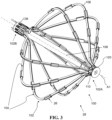
- the spines 104 may be formed integrally with a distal hub (referred to herein as crown 110), as seen in FIG. 3 , so as to form a unitary/monolithic spine framework 102.
- the crown 110 extends along a longitudinal axis A1.
- the framework 104 can be formed from a planar or cylindrical tube stock of material using any suitable method.
- the framework 102 can be formed by cutting, laser cutting, stamping, combinations thereof, etc. Further discussion on a method of manufacturing the framework is provided below with respect to FIGs. 8 and 9 .
- the coil 116 can comprise a single axis sensor (SAS). In other examples, the coil 116 can comprise a dual axis sensor (DAS) or a triple axis sensor (TAS).
- the coil 116 can comprise a conductive material wound in a coil or a coil formed into a flexible circuit.
- the coil 116 can comprise electrical leads for conduction of current induced on the coil to the patient interface unit 30.
- insulative material can include biocompatible polymers including, without limitation, polyetheretherketone (PEEK), polyglycolic acid (PGA), poly(lactic-co-glycolic acid) copolymer (PLGA), polycaprolactive (PCL), poly(3-hydroxybutyrate-co-3-hydroxyvalerate) (PHBV), poly-L-lactide, polydioxanone, polycarbonates, and polyanhydrides with the ratio of certain polymers being selected to control the degree of inflammatory response.
- PEEK polyetheretherketone
- PGA polyglycolic acid
- PLGA poly(lactic-co-glycolic acid) copolymer
- PCL polycaprolactive
- PHBV poly(3-hydroxybutyrate-co-3-hydroxyvalerate)
- poly-L-lactide polydioxanone
- polycarbonates polyanhydrides with the ratio of certain polymers being selected to control the degree of inflammatory response.
- jacket 106 is shown to be tubular in these figures, the jacket 106 can be shaped, scalloped, ribbed, ridged, concaved, convexed, or otherwise configured such that the overall profile of jacket 106 yields physical and/or mechanical properties, such as rigidity and flexion along multiple axes, required by the end effector 100, mentioned above.
- a flexible sleeve 146 is provided over proximal end of the end effector 100 and an irrigation manifold 120 ( FIG. 3 ), which is discussed in greater detail below.
- the spine(s) 104 are movable between an expanded configuration and a collapsed configuration.
- the elongated shaft 144 connects the end effector 100 to a handle that, in use, the operator 24 can manipulate.
- a connector tube 108 is connected to the crown 110.
- the connector tube 108 is used to facilitate the expanding and collapsing of the spines 104.
- the connector tube 108 can be translated along the longitudinal axis A1 to expand/collapse the spines 104.
- one or more spines 104 can bow radially outwardly from the longitudinal axis A1.
- the connector tube 108 can additionally or alternatively be used to route irrigation fluid therethrough.
- the spines 104, elongated shaft 144, crown 110, and connector tube 108 are arranged generally along the longitudinal axis A1 when the elongated shaft 144 is unbent. Moreover, a sleeve 146 is provided over a proximal end of the end effector 100 increase the atraumaticity thereof.
- FIG. 3 is a schematic pictorial illustration showing a perspective view of the end effector 100, with the sleeve 146 and coil 116 removed for clarity.
- the framework 102 has a distal end 102A (that includes the crown 110) and a proximal end 102B.
- the crown 110 connects with the annulus 120 in a manner discussed in greater detail below with respect to FIGs. 4A , 4B, and 4C .
- the proximal end 102B is connected with a connecting hub 136 and covered with the sleeve 146 to, as mentioned above, increase the atraumaticity of the end effector 100.
- the connecting hub 136 can be substantially cylindrical in form and maintains the positions of the ends of the spines 104 with respect to one another, and is discussed in greater detail with respect to FIGs. 6A, 6B , and 7 .
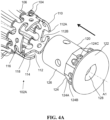
- FIG. 4A is a schematic pictorial illustration showing a detail perspective view of the framework distal end 102A with the annulus 120 detached therefrom.
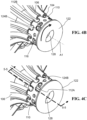
- FIG. 4B is a schematic pictorial illustration showing a detail perspective view of the framework distal end 102A with the annulus 120 partially assembled thereto.
- FIG. 4C is a schematic pictorial illustration showing a detail perspective view of the framework distal end 102A with the annulus 120 partially assembled thereto.
- the crown 110 defines a crown lumen 118 coaxial and/or parallel with the longitudinal axis A1. Additionally, defined in a terminal end 114 of the crown 110 are a plurality of crown recesses 112 disposed circumferentially about the longitudinal axis A1. In some examples, the recesses 112 have an entry section 112A and a receiving section 112B, extending generally perpendicular to the entry section, that form an L-shape to lock the annulus 120, which is discussed in greater detail below. Further, between adjacent L-shaped recesses 112 are a plurality of cylindrical crown holes 116.
- the annulus 120 is generally tubular in form and includes an atraumatic tip 122, a connecting portion 124 connected to the tip 122, a tube portion 126 connected to the connecting portion 124, and a lumen 128 therethrough.
- the lumen 128 permits various medical devices, such as a guidewire and/or mapping catheter, to pass through the annulus 120.
- the connecting portion 124 includes adjacent/proximal sets of locking protrusions 124B and annulus holes 124C. Further, the connecting portion 124 includes a polygonal cross-sectional shape.
- the crown 110 and annulus 120 have complementary designs to allow easy fixation of the annulus 120 to the crown 110.
- the tube portion 126 and the connecting portion 124 are inserted into the crown lumen 118 when being assembled.
- the locking protrusions 124B enter the recesses 112 through the entry section 112A ( FIG. 4B ).
- the annulus 120 is rotated about the longitudinal axis A1 (e.g., clockwise), as denoted by the directional arrow in FIG. 4B .
- FIG. 4C depicts the annulus 120 following rotation thereof to a locking position.
- the polygonal connecting portion 124 frictionally engages an inner surface of the crown 110 to aid in retention.
- the reverse steps can be employed.
- FIG. 5 is a schematic pictorial illustration showing a cross-sectional view of the framework distal end 102A and the annulus 120 cut relative to line 5-5 in FIG. 4C .
- the crown holes 116 align with the annulus holes 124C.
- This alignment enables a fastener, e.g., a screw, a rivet, a solder, or the like, to pass through the crown hole 116 to connect with the annulus hole 124C.
- the connector tube 108 (which defines a connector tube lumen 108A) slides within the tube portion 126 to axially align with the annulus 120.
- FIG. 6A is a schematic pictorial illustration showing a detail perspective view of a proximal end of the end effector 100, with the connecting hub 136 detached from the framework proximal end 102B.
- FIG. 6B is a schematic pictorial illustration showing a detail perspective view of a proximal end of the end effector 100, with the connecting hub 136 connected to the framework proximal end 102B.
- the spines 104 have proximal ends 130 that are shaped to connect to the connecting hub 136.
- each spine 104 defines a plurality of spine recesses 132 in at least one lateral side of the spine 104 (e.g., the recesses 132 can be defined in both lateral sides of the spine 104, as shown). Further, at least one spine hole 134 is defined through each spine end 130 that is directed perpendicularly to the longitudinal axis A1. As seen particularly in FIG. 6A , the spine holes 134 are disposed between pairs/sets of the spine recesses 132 defined on the opposing lateral sides of the spine proximal ends 130.
- the connecting hub 136 includes complementarily shaped hub reliefs 138 that are shaped to receive a respective shaped proximal end 130 of the spines 130.
- Each hub relief includes one or more relief protrusions 140 and one or more relief holes 142.
- the spine recesses 132 interface with the relief protrusions 140 when the proximal ends 130 are set into place.
- FIG. 6B illustrates, as denoted by the directional arrows, the proximal ends 130 being aligned and moved radially inwardly towards the longitudinal axis A1 (compare with FIG. 6A which depicts A1) to connect with the connecting hub reliefs 138.
- FIG. 7 is a schematic pictorial illustration showing a cross-sectional view of the framework proximal end 102B connected to the connecting hub 136, cut relative to line 7-7 in FIG. 6B .
- the spine holes 134 axially align with the relief holes 142. This alignment enables a fastener, e.g., a screw, a rivet, a solder, or the like, to pass through the crown hole spines hole 134 to connect with the respective relief hole 142.
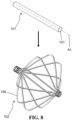
- FIG. 8 is a schematic pictorial illustration showing a generally cylindrical stock 101 formed into a monolithic framework 102, with a plurality of jackets 104 formed and/or positioned over the spines 104 of the framework 102.
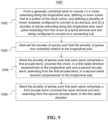
- FIG. 9 is a flow chart showing a method 1000 of manufacturing the monolithic framework 102 in accordance with the generalized procedure shown in FIG. 8 .
- a method of manufacturing the monolithic framework 102 may include the following steps.
- a generally cylindrical stock 101 (see the upper portion of FIG. 8 ) is formed to include a crown 110 extending along the longitudinal axis A1, defining a crown lumen 118 that is contiguous with a portion of the stock lumen 101', and defining a plurality of crown recesses 112 configured to connect to an annulus 120 (Step 1002).
- the generally cylindrical stock is also formed to include a plurality of spines 104 extending along the longitudinal axis A1, each spine 104 extending from the crown 110 to a spine terminal end 130 and being configured to connect to a connecting hub 136 (Step 1002).
- the spines 104 are heat set such that they spine 104 bow outwardly relative to the longitudinal axis A1 (see the lower portion of FIG. 8 ) (Step 1004).
- the forming step to form the crown 110 and/or the spines 104 includes at least one of mechanical cutting, laser cutting, stamping, or combinations thereof.
- the generally cylindrical stock 101 can be cut along the longitudinal axis A1 to form the spines 104, and the distal end of the stock 101 (which is not cut as how the spines 104 are formed) can be cut to define the previously discussed crown recesses 112 as well as crown holes 116. Steps 1006 and 1008 are discussed in greater detail with respect to FIGs. 10-12 below.
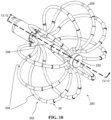
- FIG. 10 is a schematic pictorial illustration showing a perspective view of another configuration of end effector 200 of a medical device 14.
- FIG. 11 is a schematic pictorial illustration showing a perspective view of the end effector 200, with a proximal sleeve and coil removed for clarity (similar to FIG. 3 in relation to FIG. 2 for the first configuration of end effector 100).
- FIG. 10 is a schematic pictorial illustration showing a perspective view of another configuration of end effector 200 of a medical device 14.
- FIG. 11 is a schematic pictorial illustration showing a perspective view of the end effector 200, with a proximal sleeve and coil removed for clarity (similar to FIG. 3 in relation to FIG. 2 for the first configuration of end effector 100).
- FIG. 10 is a schematic pictorial illustration showing a perspective view of another configuration of end effector 200 of a medical device 14.
- FIG. 11 is a schematic pictorial illustration showing a perspective view of the end effector 200, with a proximal
- the end effector 200 in the presently described example takes the form of a basket assembly that includes at least one spine 204.
- the spines 204 may have elliptical (e.g., circular) or rectangular (that may appear to be flat) cross-sections, and include a flexible, resilient material (e.g., a shape-memory alloy such as nickel-titanium, also known as Nitinol) forming a strut.
- the spines 204 may be formed integrally with a crown 210, so as to form a unitary/monolithic spine framework.
- the crown 210 can share similar features as that of the previously described crown 110 to connect with an annulus 220.
- proximal ends 230 of the spines 204 can include features similar to those of the previously described spines 104 to connect with a connecting hub 236.
- a connector tube 208 is connected to the crown 210.
- the connector tube 208 is used to facilitate the expanding and collapsing of the spines 104.
- the connector tube 208 can be translated along the longitudinal axis A1 to expand/collapse the spines 204.
- one or more spines 204 can bow radially outwardly from the longitudinal axis A1.
- the spines 204, crown 210, and connector tube 208 are arranged generally along the longitudinal axis A1.
- FIG. 12 is a schematic pictorial illustration showing a cross-sectional view of the end effector 200 cut relative to line 12-12 in FIG. 10 .
- the monolithic framework in a collapsed configuration ( FIG. 12 ), is generally spheroidal in shape.
- the spines 204 are actuate to move to an expanded configuration via, for example, the connecting tube 208, the distal end of the framework is pulled towards the proximal end so as to form a petal-like structure.
- the petal structure allows for the electrodes 26 to ablate at the entry to the pulmonary vein, while the spheroidal structure allows for the electrodes 26 to ablate deep in the pulmonary vein.
- each spine 204 has a series of bends. Specifically, each spine includes a first arcuate bend 204A, a second arcuate bend 204B, and a third arcuate bend 204C.
- the first arcuate bend 204A extends from and is disposed proximal the crown 210 and is bent in a first radial direction R1 relative to the crown 210.
- the first radial direction R1 is about an axis that is perpendicular to the longitudinal axis A1.
- the first arcuate bend 204A is bent over a first angle ⁇ 1 .
- the first angle ⁇ 1 falls in the range of approximately one-hundred twenty degrees to approximately one-hundred eighty degrees.
- the second arcuate bend 204B extends from the first arcuate bend 204A in a second radial direction R1.
- the second radial direction R2 is about the same axis as the first radial direction R1 that is perpendicular to the longitudinal axis A1, but in the opposite direction.
- the second arcuate bend 204B is bent over a second angle ⁇ 2 .
- the second angle ⁇ 2 falls in the range of approximately two-hundred forty degrees to approximately two-hundred seventy degrees.
- the third arcuate bend 204C extends from the second arcuate bend 204B and is proximal the spine terminal ends 230.
- the third acuate bend 204C is bent in the first radial direction R1.
- the third arcuate bend 204C is bent over a third angle ⁇ 3 .
- the third angle ⁇ 3 falls in the range of approximately sixty degrees to approximately one-hundred fifty degrees.
- the spines 204 further have a proximal half and a distal half, the dividing point being defined at approximately the center point (see where ⁇ 2 is marked in FIG. 12 ) of the second arcuate bend 204B along the longitudinal axis A1.
- the electrodes 26 are disposed only on the distal half for the ablative purposes noted above.
- the method 1000 may further include the steps of bending the plurality of spines 204 such that each spine 204 has a first arcuate bend 204A (Step 1006), bending the plurality of spines 204 such that each spine 204 has a second arcuate bend 204B (Step 1006), and bending the plurality of spines 204 such that each spine 204 has a third arcuate bend 204C (Step 1008). These steps can be performed prior to heat setting the spines 204, which biases the spines 204 to the spheroidal configuration.
Landscapes
- Health & Medical Sciences (AREA)
- Life Sciences & Earth Sciences (AREA)
- Surgery (AREA)
- Engineering & Computer Science (AREA)
- Plasma & Fusion (AREA)
- Medical Informatics (AREA)
- Otolaryngology (AREA)
- Physics & Mathematics (AREA)
- Cardiology (AREA)
- Biomedical Technology (AREA)
- Heart & Thoracic Surgery (AREA)
- Nuclear Medicine, Radiotherapy & Molecular Imaging (AREA)
- Molecular Biology (AREA)
- Animal Behavior & Ethology (AREA)
- General Health & Medical Sciences (AREA)
- Public Health (AREA)
- Veterinary Medicine (AREA)
- Surgical Instruments (AREA)
Applications Claiming Priority (1)
| Application Number | Priority Date | Filing Date | Title |
|---|---|---|---|
| US18/473,169 US20250099168A1 (en) | 2023-09-22 | 2023-09-22 | Medical device with a monolithic spine framework |
Publications (1)
| Publication Number | Publication Date |
|---|---|
| EP4527332A1 true EP4527332A1 (de) | 2025-03-26 |
Family
ID=92894791
Family Applications (1)
| Application Number | Title | Priority Date | Filing Date |
|---|---|---|---|
| EP24201695.4A Pending EP4527332A1 (de) | 2023-09-22 | 2024-09-20 | Medizinische vorrichtung mit monolithischem wirbelsäulenrahmen |
Country Status (5)
| Country | Link |
|---|---|
| US (1) | US20250099168A1 (de) |
| EP (1) | EP4527332A1 (de) |
| JP (1) | JP2025051753A (de) |
| CN (1) | CN119679495A (de) |
| IL (1) | IL315753A (de) |
Citations (25)
| Publication number | Priority date | Publication date | Assignee | Title |
|---|---|---|---|---|
| US5391199A (en) | 1993-07-20 | 1995-02-21 | Biosense, Inc. | Apparatus and method for treating cardiac arrhythmias |
| US5558091A (en) | 1993-10-06 | 1996-09-24 | Biosense, Inc. | Magnetic determination of position and orientation |
| US6172499B1 (en) | 1999-10-29 | 2001-01-09 | Ascension Technology Corporation | Eddy current error-reduced AC magnetic position measurement system |
| US6239724B1 (en) | 1997-12-30 | 2001-05-29 | Remon Medical Technologies, Ltd. | System and method for telemetrically providing intrabody spatial position |
| US6332089B1 (en) | 1996-02-15 | 2001-12-18 | Biosense, Inc. | Medical procedures and apparatus using intrabody probes |
| US6484118B1 (en) | 2000-07-20 | 2002-11-19 | Biosense, Inc. | Electromagnetic position single axis system |
| US6618612B1 (en) | 1996-02-15 | 2003-09-09 | Biosense, Inc. | Independently positionable transducers for location system |
| US6690963B2 (en) | 1995-01-24 | 2004-02-10 | Biosense, Inc. | System for determining the location and orientation of an invasive medical instrument |
| US6892091B1 (en) | 2000-02-18 | 2005-05-10 | Biosense, Inc. | Catheter, method and apparatus for generating an electrical map of a chamber of the heart |
| US7536218B2 (en) | 2005-07-15 | 2009-05-19 | Biosense Webster, Inc. | Hybrid magnetic-based and impedance-based position sensing |
| US7756576B2 (en) | 2005-08-26 | 2010-07-13 | Biosense Webster, Inc. | Position sensing and detection of skin impedance |
| US7848787B2 (en) | 2005-07-08 | 2010-12-07 | Biosense Webster, Inc. | Relative impedance measurement |
| US7869865B2 (en) | 2005-01-07 | 2011-01-11 | Biosense Webster, Inc. | Current-based position sensing |
| US8456182B2 (en) | 2008-09-30 | 2013-06-04 | Biosense Webster, Inc. | Current localization tracker |
| US20150342532A1 (en) * | 2013-04-11 | 2015-12-03 | Biosense Webster (Israel) Ltd. | High electrode density basket catheter |
| EP3241493B1 (de) * | 2016-05-06 | 2019-02-20 | Biosense Webster (Israel) Ltd. | Körbchenförmiger katheter mit verbesserter distaler nabe |
| US20210162210A1 (en) | 2019-12-03 | 2021-06-03 | Biosense Webster (Israel) Ltd. | Using reversible electroporation on cardiac tissue |
| US20210161592A1 (en) | 2019-12-03 | 2021-06-03 | Biosense Webster (Israel) Ltd. | Pulse Generator for Irreversible Electroporation |
| US20210169568A1 (en) | 2019-12-09 | 2021-06-10 | Biosense Webster (Israel) Ltd. | Oriented irreversible-electroporation (ire) pulses to compensate for cell size and orientation |
| US20210169567A1 (en) | 2019-12-09 | 2021-06-10 | Biosense Webster (Israel) Ltd. | Irreversible-electroporation (ire) balloon catheter with membrane-insulated high-voltage balloon wires |
| US20210169550A1 (en) | 2019-12-05 | 2021-06-10 | Biosense Webster (Israel) Ltd. | Generating and interleaving of irreversible-electroporation and radiofrequnecy ablation (ire/rfa) waveforms |
| US20210177503A1 (en) | 2019-12-11 | 2021-06-17 | Biosense Webster (Israel) Ltd. | Regulating delivery of irreversible electroporation pulses according to transferred energy |
| US20210186604A1 (en) | 2019-12-24 | 2021-06-24 | Biosense Webster (Israel) Ltd. | Irreversible electroporation (ire) based on field, contact force and time |
| US20210196372A1 (en) | 2019-12-31 | 2021-07-01 | Biosense Webster (Israel) Ltd. | Using irrigation on irreversible-electroporation (ire) electrodes to prevent arcing |
| DE202023102282U1 (de) * | 2022-04-28 | 2023-09-01 | Biosense Webster (Israel) Ltd. | Korbkatheter mit Kleeblattstruktur zum bereitstellen einer vorbestimmten seitlichen Steifigkeit und axialen Dehnung |
Family Cites Families (5)
| Publication number | Priority date | Publication date | Assignee | Title |
|---|---|---|---|---|
| US11826172B2 (en) * | 2014-05-06 | 2023-11-28 | St. Jude Medical, Cardiology Division, Inc. | Electrode support structure assembly |
| JP2017522923A (ja) * | 2014-06-03 | 2017-08-17 | ボストン サイエンティフィック サイムド,インコーポレイテッドBoston Scientific Scimed,Inc. | 非外傷性の遠位チップを備えた電極アセンブリ |
| US10492820B2 (en) * | 2015-10-16 | 2019-12-03 | Ethicon Llc | Ultrasonic surgical instrument with removable shaft assembly portion |
| CN111278497B (zh) * | 2017-11-28 | 2024-01-12 | 圣犹达医疗用品心脏病学部门有限公司 | 管腔控制导管 |
| CN118697424A (zh) * | 2018-11-16 | 2024-09-27 | 美敦力瓦斯科尔勒公司 | 组织去除导管 |
-
2023
- 2023-09-22 US US18/473,169 patent/US20250099168A1/en active Pending
-
2024
- 2024-09-18 IL IL315753A patent/IL315753A/en unknown
- 2024-09-19 CN CN202411306204.8A patent/CN119679495A/zh active Pending
- 2024-09-20 JP JP2024163556A patent/JP2025051753A/ja active Pending
- 2024-09-20 EP EP24201695.4A patent/EP4527332A1/de active Pending
Patent Citations (27)
| Publication number | Priority date | Publication date | Assignee | Title |
|---|---|---|---|---|
| US5443489A (en) | 1993-07-20 | 1995-08-22 | Biosense, Inc. | Apparatus and method for ablation |
| US5391199A (en) | 1993-07-20 | 1995-02-21 | Biosense, Inc. | Apparatus and method for treating cardiac arrhythmias |
| US5558091A (en) | 1993-10-06 | 1996-09-24 | Biosense, Inc. | Magnetic determination of position and orientation |
| US6690963B2 (en) | 1995-01-24 | 2004-02-10 | Biosense, Inc. | System for determining the location and orientation of an invasive medical instrument |
| US6332089B1 (en) | 1996-02-15 | 2001-12-18 | Biosense, Inc. | Medical procedures and apparatus using intrabody probes |
| US6618612B1 (en) | 1996-02-15 | 2003-09-09 | Biosense, Inc. | Independently positionable transducers for location system |
| US6788967B2 (en) | 1997-05-14 | 2004-09-07 | Biosense, Inc. | Medical diagnosis, treatment and imaging systems |
| US6239724B1 (en) | 1997-12-30 | 2001-05-29 | Remon Medical Technologies, Ltd. | System and method for telemetrically providing intrabody spatial position |
| US6172499B1 (en) | 1999-10-29 | 2001-01-09 | Ascension Technology Corporation | Eddy current error-reduced AC magnetic position measurement system |
| US6892091B1 (en) | 2000-02-18 | 2005-05-10 | Biosense, Inc. | Catheter, method and apparatus for generating an electrical map of a chamber of the heart |
| US6484118B1 (en) | 2000-07-20 | 2002-11-19 | Biosense, Inc. | Electromagnetic position single axis system |
| US7869865B2 (en) | 2005-01-07 | 2011-01-11 | Biosense Webster, Inc. | Current-based position sensing |
| US7848787B2 (en) | 2005-07-08 | 2010-12-07 | Biosense Webster, Inc. | Relative impedance measurement |
| US7536218B2 (en) | 2005-07-15 | 2009-05-19 | Biosense Webster, Inc. | Hybrid magnetic-based and impedance-based position sensing |
| US7756576B2 (en) | 2005-08-26 | 2010-07-13 | Biosense Webster, Inc. | Position sensing and detection of skin impedance |
| US8456182B2 (en) | 2008-09-30 | 2013-06-04 | Biosense Webster, Inc. | Current localization tracker |
| US20150342532A1 (en) * | 2013-04-11 | 2015-12-03 | Biosense Webster (Israel) Ltd. | High electrode density basket catheter |
| EP3241493B1 (de) * | 2016-05-06 | 2019-02-20 | Biosense Webster (Israel) Ltd. | Körbchenförmiger katheter mit verbesserter distaler nabe |
| US20210162210A1 (en) | 2019-12-03 | 2021-06-03 | Biosense Webster (Israel) Ltd. | Using reversible electroporation on cardiac tissue |
| US20210161592A1 (en) | 2019-12-03 | 2021-06-03 | Biosense Webster (Israel) Ltd. | Pulse Generator for Irreversible Electroporation |
| US20210169550A1 (en) | 2019-12-05 | 2021-06-10 | Biosense Webster (Israel) Ltd. | Generating and interleaving of irreversible-electroporation and radiofrequnecy ablation (ire/rfa) waveforms |
| US20210169568A1 (en) | 2019-12-09 | 2021-06-10 | Biosense Webster (Israel) Ltd. | Oriented irreversible-electroporation (ire) pulses to compensate for cell size and orientation |
| US20210169567A1 (en) | 2019-12-09 | 2021-06-10 | Biosense Webster (Israel) Ltd. | Irreversible-electroporation (ire) balloon catheter with membrane-insulated high-voltage balloon wires |
| US20210177503A1 (en) | 2019-12-11 | 2021-06-17 | Biosense Webster (Israel) Ltd. | Regulating delivery of irreversible electroporation pulses according to transferred energy |
| US20210186604A1 (en) | 2019-12-24 | 2021-06-24 | Biosense Webster (Israel) Ltd. | Irreversible electroporation (ire) based on field, contact force and time |
| US20210196372A1 (en) | 2019-12-31 | 2021-07-01 | Biosense Webster (Israel) Ltd. | Using irrigation on irreversible-electroporation (ire) electrodes to prevent arcing |
| DE202023102282U1 (de) * | 2022-04-28 | 2023-09-01 | Biosense Webster (Israel) Ltd. | Korbkatheter mit Kleeblattstruktur zum bereitstellen einer vorbestimmten seitlichen Steifigkeit und axialen Dehnung |
Also Published As
| Publication number | Publication date |
|---|---|
| IL315753A (en) | 2025-04-01 |
| US20250099168A1 (en) | 2025-03-27 |
| JP2025051753A (ja) | 2025-04-04 |
| CN119679495A (zh) | 2025-03-25 |
Similar Documents
| Publication | Publication Date | Title |
|---|---|---|
| EP4268748A2 (de) | Spülnabe für einen ablationskatheter | |
| EP4494589A1 (de) | Elektrodenbefestigungen für korbkatheter | |
| US20250099168A1 (en) | Medical device with a monolithic spine framework | |
| US20250099160A1 (en) | Medical device with an end effector including connecting hubs and an electrode array | |
| EP4527333A1 (de) | Medizinische vorrichtung mit einem bewässerungsverteiler | |
| EP4464270A1 (de) | Elektroden und elektrodenkonfigurationen für einen korbkatheter | |
| EP4473928A1 (de) | Expandierbare korbanordnungen und expandierbare korbanordnungen mit elektrodendrahtzugentlastung | |
| EP4382060B1 (de) | Elektroden für korbkatheter | |
| EP4678129A1 (de) | Elektrode mit haltemerkmalen zur verwendung mit einer medizinischen sonde | |
| EP4574071A2 (de) | Vereinfachte korbkatheter mit mehreren streben | |
| EP4541303A1 (de) | Flexible schaltungselektroden für lasso-katheter | |
| EP4520283A2 (de) | Medizinische vorrichtung mit einem korb und einem gehäuse | |
| EP4578413A1 (de) | Medizinische sonde zur navigation in blutgefässen mit kleinem durchmesser | |
| EP4393378A2 (de) | Systeme und verfahren für mapping- und ablationskatheter mit zylindrischem käfig mit flexiblen schaltungen | |
| EP4574074A1 (de) | Mapping- und ablationskatheter |
Legal Events
| Date | Code | Title | Description |
|---|---|---|---|
| PUAI | Public reference made under article 153(3) epc to a published international application that has entered the european phase |
Free format text: ORIGINAL CODE: 0009012 |
|
| STAA | Information on the status of an ep patent application or granted ep patent |
Free format text: STATUS: THE APPLICATION HAS BEEN PUBLISHED |
|
| AK | Designated contracting states |
Kind code of ref document: A1 Designated state(s): AL AT BE BG CH CY CZ DE DK EE ES FI FR GB GR HR HU IE IS IT LI LT LU LV MC ME MK MT NL NO PL PT RO RS SE SI SK SM TR |
|
| STAA | Information on the status of an ep patent application or granted ep patent |
Free format text: STATUS: REQUEST FOR EXAMINATION WAS MADE |
|
| 17P | Request for examination filed |
Effective date: 20250926 |