EP4527510A2 - Procédé pour la récupération de déchets métalliques dans des récipients collecteurs - Google Patents
Procédé pour la récupération de déchets métalliques dans des récipients collecteurs Download PDFInfo
- Publication number
- EP4527510A2 EP4527510A2 EP25156306.0A EP25156306A EP4527510A2 EP 4527510 A2 EP4527510 A2 EP 4527510A2 EP 25156306 A EP25156306 A EP 25156306A EP 4527510 A2 EP4527510 A2 EP 4527510A2
- Authority
- EP
- European Patent Office
- Prior art keywords
- collection container
- composition
- scrap
- information
- production
- Prior art date
- Legal status (The legal status is an assumption and is not a legal conclusion. Google has not performed a legal analysis and makes no representation as to the accuracy of the status listed.)
- Pending
Links
Images


Classifications
-
- C—CHEMISTRY; METALLURGY
- C22—METALLURGY; FERROUS OR NON-FERROUS ALLOYS; TREATMENT OF ALLOYS OR NON-FERROUS METALS
- C22B—PRODUCTION AND REFINING OF METALS; PRETREATMENT OF RAW MATERIALS
- C22B1/00—Preliminary treatment of ores or scrap
- C22B1/005—Preliminary treatment of scrap
-
- B—PERFORMING OPERATIONS; TRANSPORTING
- B07—SEPARATING SOLIDS FROM SOLIDS; SORTING
- B07C—POSTAL SORTING; SORTING INDIVIDUAL ARTICLES, OR BULK MATERIAL FIT TO BE SORTED PIECE-MEAL, e.g. BY PICKING
- B07C5/00—Sorting according to a characteristic or feature of the articles or material being sorted, e.g. by control effected by devices which detect or measure such characteristic or feature; Sorting by manually actuated devices, e.g. switches
- B07C5/36—Sorting apparatus characterised by the means used for distribution
- B07C5/38—Collecting or arranging articles in groups
-
- C—CHEMISTRY; METALLURGY
- C22—METALLURGY; FERROUS OR NON-FERROUS ALLOYS; TREATMENT OF ALLOYS OR NON-FERROUS METALS
- C22B—PRODUCTION AND REFINING OF METALS; PRETREATMENT OF RAW MATERIALS
- C22B21/00—Obtaining aluminium
- C22B21/0038—Obtaining aluminium by other processes
- C22B21/0069—Obtaining aluminium by other processes from scrap, skimmings or any secondary source aluminium, e.g. recovery of alloy constituents
-
- C—CHEMISTRY; METALLURGY
- C22—METALLURGY; FERROUS OR NON-FERROUS ALLOYS; TREATMENT OF ALLOYS OR NON-FERROUS METALS
- C22B—PRODUCTION AND REFINING OF METALS; PRETREATMENT OF RAW MATERIALS
- C22B7/00—Working up raw materials other than ores, e.g. scrap, to produce non-ferrous metals and compounds thereof; Methods of a general interest or applied to the winning of more than two metals
-
- G—PHYSICS
- G05—CONTROLLING; REGULATING
- G05B—CONTROL OR REGULATING SYSTEMS IN GENERAL; FUNCTIONAL ELEMENTS OF SUCH SYSTEMS; MONITORING OR TESTING ARRANGEMENTS FOR SUCH SYSTEMS OR ELEMENTS
- G05B19/00—Program-control systems
- G05B19/02—Program-control systems electric
- G05B19/418—Total factory control, i.e. centrally controlling a plurality of machines, e.g. direct or distributed numerical control [DNC], flexible manufacturing systems [FMS], integrated manufacturing systems [IMS] or computer integrated manufacturing [CIM]
- G05B19/41865—Total factory control, i.e. centrally controlling a plurality of machines, e.g. direct or distributed numerical control [DNC], flexible manufacturing systems [FMS], integrated manufacturing systems [IMS] or computer integrated manufacturing [CIM] characterised by job scheduling, process planning, material flow
-
- G—PHYSICS
- G05—CONTROLLING; REGULATING
- G05B—CONTROL OR REGULATING SYSTEMS IN GENERAL; FUNCTIONAL ELEMENTS OF SUCH SYSTEMS; MONITORING OR TESTING ARRANGEMENTS FOR SUCH SYSTEMS OR ELEMENTS
- G05B19/00—Program-control systems
- G05B19/02—Program-control systems electric
- G05B19/04—Program control other than numerical control, i.e. in sequence controllers or logic controllers
- G05B19/042—Program control other than numerical control, i.e. in sequence controllers or logic controllers using digital processors
-
- Y—GENERAL TAGGING OF NEW TECHNOLOGICAL DEVELOPMENTS; GENERAL TAGGING OF CROSS-SECTIONAL TECHNOLOGIES SPANNING OVER SEVERAL SECTIONS OF THE IPC; TECHNICAL SUBJECTS COVERED BY FORMER USPC CROSS-REFERENCE ART COLLECTIONS [XRACs] AND DIGESTS
- Y02—TECHNOLOGIES OR APPLICATIONS FOR MITIGATION OR ADAPTATION AGAINST CLIMATE CHANGE
- Y02P—CLIMATE CHANGE MITIGATION TECHNOLOGIES IN THE PRODUCTION OR PROCESSING OF GOODS
- Y02P10/00—Technologies related to metal processing
- Y02P10/20—Recycling
Definitions
- the present invention relates to a method for collecting metal scrap, in particular aluminum scrap, in collection containers, in which metal scrap of a first material processed in the production plant with a predetermined first composition and metal scrap of a second material processed in the production plant with a predetermined second composition are generated at one or more production scrap generation points of a production plant, and in which a first quantity of the metal scrap of the first material and a second quantity of the metal scrap of the second material are fed to a collection container and collected therein.
- the invention further relates to a system for collecting metal scrap in collection containers, comprising a collection container system which is designed to successively provide various collection containers at a production scrap collection point of a production plant in such a way that the metal scrap accumulating at the production scrap collection point is collected in the respective collection container provided.
- production scrap is generated at various points of origin and collected in collection containers. It is desirable to reuse this production scrap in a closed-loop system by melting it down to produce the product in which it was generated.
- the object of the present invention is to provide a method and a system for collecting metal scrap, in particular aluminum scrap, in collection containers, with which the amount of sorted production scrap not suitable for recycling can be reduced and thus a more efficient recycling of the scrap is achieved.
- This object is achieved according to the invention in a method for collecting metal scrap, in particular aluminum scrap, in collection containers, in which metal scrap of a first material processed in the production plant with a predetermined first composition and metal scrap of a second material processed in the production plant with a predetermined second composition are generated at one or more production scrap generation points of a production plant, and in which a first quantity of the metal scrap of the first material and a second quantity of the metal scrap of the second material are fed to a collection container and collected therein, in that first quantity information about a measure of the first quantity and second quantity information about a measure of the second quantity are determined, and collection container composition information about the composition of all the metal scrap collected in the collection container is calculated as a function of predetermined first composition information about the first composition, predetermined second composition information about the second composition, and the first and second quantity information.
- the production facility is, in particular, a metal processing facility that generates metal scrap during its operation.
- the The production plant is a plant for processing aluminium products, in particular aluminium strips.
- a production scrap generation point is, in particular, a location within the production facility where metal scrap is regularly or continuously generated during the operation of the production facility.
- This metal scrap can, for example, be cutting or punching waste that arises during a cutting or punching step in the production facility.
- metal scrap may arise, particularly from the edge trimming shears for the aluminum strips or from the shears for cutting the aluminum strips to length.
- it may be necessary to temporarily join two consecutive strips together for a processing step. The joined area is then removed and accumulates as metal scrap.
- metal scrap can also arise in the form of rejects, for example at a quality control station in a production plant where defective metal parts are separated out as metal scrap.
- Metal scrap can be generated in individual pieces, for example, as punching waste from aluminum sheets or scrap from aluminum strips. Furthermore, metal scrap can also be generated continuously, particularly in strip form, for example, as trimming scrap from aluminum strips.
- metal scrap of a first and a second material is generated.
- Many production plants process different materials, especially different alloys of a material, such as aluminum alloys.
- the different materials can be processed consecutively in the production facility. For example, a first material can be processed in the production facility for two hours, followed by a second material.
- a first aluminum strip made of a first aluminum alloy can be processed first, followed by a second aluminum strip made of a second aluminum alloy.
- the materials processed in the production facility vary, particularly in terms of their composition.
- the production facility may use aluminum sheets or strips made of different aluminum alloys or even different aluminum classes, so that metal scrap made of different aluminum alloys or different aluminum classes may be generated at the production scrap generation site.
- Examples of aluminum alloys include, in particular, those listed in DIN EN 573-3, such as EN AW-1050A, EN AW 1060, etc., EN AW-5005, EN AW-5006, etc., EN AW-6003, EN AW-6005, etc.
- Aluminum classes are understood to be groups of several similar aluminum alloys. The aluminum classes that come into consideration are primarily the aluminum groups 1xxx, 2xxx, 3xxx, etc. Narrower aluminum classes are also possible, such as 10xx, 11xx, 12xx, etc., 20xx, 21xx, 22xx, etc.
- Aluminum classes defined for recycling purposes are also referred to as "scrap classes," since the metal scrap is collected and used separately according to these "scrap classes.”
- the first composition of the first material and the second composition of the second material are predetermined.
- the composition of the materials is typically known in advance, since specifications and/or Composition certificates are available which list composition information about the composition of the material in question.
- the composition information about the composition of a material can, for example, include content ranges for one or more alloying elements within which the actual content of the respective material lies. Such content ranges can, for example, be specified by a material specification. Additionally or alternatively, the composition information can also include content values for one or more alloying elements which correspond to the actual content of the respective material. Such content values can, for example, be specified by a certificate for the material in which its composition was determined by an alloy analysis carried out beforehand, for example on the melt.
- the composition information may in particular contain information on the content of one or more of the following minor alloying elements: Fe, Si, Mg, Mn, Cu, Cr, Ti, Zn, Ni, V, B.
- Information on the content of the main alloying component Al may, but does not have to, be included.
- the first and second compositions can, in particular, be specified in a production plan of the production facility.
- a production plan contains information about the sequence of materials processed in the production facility, such as a sequence of aluminum strips processed consecutively in the production facility.
- a first quantity of metal scrap of the first material and a second quantity of metal scrap of the second material are fed into a collection container.
- metal scrap of different materials is fed into the same collection container, in particular metal scrap of different Aluminum alloys or even metal scrap from different aluminum classes.
- the first quantity and the second quantity can be fed into the collection container, in particular one after the other. This is particularly the case when the first material and the second material are processed one after the other in the production plant. If an aluminum strip made of a first material and a second material are processed one after the other in an aluminum strip manufacturing and/or processing plant, a quantity of metal scrap of the first material and then a quantity of metal scrap of the second material enter the collection container. This can occur, in particular, when a material change occurs in the production plant.
- first and second quantities are fed into the collection container at essentially the same time. This may be particularly the case if two materials are processed simultaneously in a production facility, for example, a production facility with two parallel processing lines, and the resulting metal scrap is fed into a collection container.
- the collection containers can be designed in the form of containers, buckets or any other shape and preferably have a capacity in the range of 500 up to 25000 kg, preferably from 500 to 5000 kg, in particular from 1000 to 4000 kg.
- First quantity information is determined regarding a measure of the first quantity
- second quantity information is determined regarding a measure of the second quantity.
- the measure can, in particular, be the weight. Accordingly, the weight of the first quantity is preferably determined as the first quantity information, and the weight of the second quantity is preferably determined as the second quantity information.
- the first and second quantity information determine how much metal scrap of the first material and how much metal scrap of the second material was fed into the collection container.
- a collection container composition information about the composition of the total metal scrap collected in the collection container is calculated.
- the method takes particular advantage of the fact that, when operating a production facility as described above, composition information about the composition of the materials processed in the production facility is typically available, such as through predetermined specifications or analysis results from previously conducted analyses, the results of which can be stated, for example, in a certificate for the material.
- composition information is calculated, in particular, without a separate analysis of the entire metal scrap collected in the collection container.
- the process also allows for better utilization of the collection container capacity, as it requires fewer changes of the collection container for pure separation. This allows, for example, the number of collection containers required to be kept on hand to be reduced, which can be more economical.
- the collection container composition information the contents of one or more alloying elements of the total metal scrap collected in the collection container are calculated.
- x can, for example, be selected from the following list: Fe, Si, Mg, Mn, Cu, Cr, Ti, Zn, Ni, V, B.
- the predetermined maximum value can be used, for example, as the value for c x,1 or c x,2 to calculate the corresponding content for the collection container composition information using the above formula (1) in order to be able to estimate the content in the entire scrap in the collection container upwards.
- the above-mentioned object is further achieved in a system for collecting metal scrap in collection containers with a collection container system which is designed to successively provide different collection containers at a production scrap accumulation point of a production plant in such a way that the metal scrap accumulating at the production scrap accumulation point is collected in the respective collection container provided, according to the invention in that the system has a determination device which is designed to provide quantity information about a measure of a to determine the quantity of metal scrap of a material processed in the production plant fed into the collection container, and that the system has a calculation device which is designed to calculate, when quantities of metal scrap of various materials processed in the production plant with predetermined compositions are fed into a collection container, collection container composition information about the composition of the entire metal scrap collected in the collection container depending on the quantity information determined for the quantities and on predetermined composition information about the predetermined compositions.
- This system allows the implementation of the previously described method for collecting metal scrap and therefore has the same advantages. Accordingly, the described system is preferably used to implement the previously described method.
- the further use of the collection container is controlled depending on the collection container composition information.
- the collection container can be used depending on the collection container composition information. If the collection container composition information indicates, for example, that it falls into a predetermined scrap class, the collection container or the metal scrap contained therein can be used in a recycling system for this scrap class, in particular, it can be melted down to produce an alloy corresponding to this scrap class.
- the collection container composition information is assigned to the collection container.
- the system has an assignment device that is configured to assign the calculated collection container composition information to the respective collection container.
- the assignment of the collection container composition information to the respective collection container is preferably carried out by assigning the collection container composition information to an identifier designating the collection container, for example a number. This can be done electronically, for example in a table, so that the collection container composition information can be used directly further. In principle, however, it is also conceivable to perform the assignment by labeling or signaging the collection container.
- a collection container quantity information item regarding the amount of all metal scrap collected in the collection container is calculated based on the first and second quantity information items and assigned to the collection container.
- the collection container quantity information represents the further processing of the material contained in the collection container. Scrap is available without requiring a separate determination, such as by weighing.
- the calculation device is configured to calculate collection container quantity information about the quantity of all metal scrap collected in the collection container depending on the first and second quantity information, and the system has an assignment device configured to assign the calculated collection container quantity information to the respective collection container.
- the assignment of the collection container quantity information can be carried out analogously to the assignment of the collection container composition information.
- the weight of the first quantity is determined as the first quantity information
- the weight of the second quantity is determined as the second quantity information. This is particularly advantageous when the contents of the first and second composition information are given in wt. %.
- the weight of the first quantity and the weight of the second quantity can be determined by weighing. Weighing can be achieved, for example, by placing the collection container on a weighing device during the collection of metal scrap, so that the weight of the first or second quantity can be determined based on the change in weight when the first or second quantity is added.
- a feed device for feeding the metal scrap accumulating at the production scrap collection point into the collection container with a weighing device, for example a belt scale can be provided.
- the weight of the first and second quantities is determined separately from one another, so that the weight of the first and second quantities are known independently of one another.
- the first quantity information in particular the weight of the first quantity
- the second Quantity information in particular the weight of the second quantity
- the first quantity information is determined depending on the specified production parameters of the production plant. It has been recognized that the amount of metal scrap generated at a production scrap generation site can often be easily predicted and calculated based on the production parameters. For example, when trimming an aluminum strip, the production parameters usually indicate the width of the edge cut off from the aluminum strip, the feed rate of the aluminum strip, and the thickness of the aluminum strip. From this, the scrap volume generated per unit of time can be easily calculated, and the scrap weight generated per unit of time can be determined based on the generally known material density.
- the proportion of offcuts remaining after punching is also typically known from the production parameters, so that the scrap weight generated per unit of time can be determined from the number of pieces processed and the offcuts. It has been determined that the weight of the first and second quantities can often be calculated much more accurately based on the production parameters of the production plant than would be possible with a weighing device on the collection container. In addition, the production parameters are usually known, so no additional weighing device is necessary.
- the first material and the second material are processed sequentially in the production plant. This is particularly the case in production plants for the manufacture or processing of strips, in particular aluminum strips, where aluminum strips made of different alloys or even different alloy classes are processed sequentially.
- the first and second materials are strip-shaped.
- the metal scrap can be generated, in particular, in the form of trimming scrap from the edge trimming of an aluminum strip.
- "Seam scrap" from individual strips joined for heat or etching treatment, which, after treatment, be separated again, or cut-to-length scrap can be generated at a production scrap collection point.
- metal scrap is fed into the collection container several times consecutively or continuously, and the collection container composition information is calculated several times consecutively or continuously.
- the collection container composition information can be calculated and thus updated at regular intervals, e.g., every 1 second.
- the collection container composition information is compared with a predefined composition specification.
- information is assigned to the collection container depending on the result of the comparison.
- the composition specification comprises at least one specification, in particular a predefined minimum and/or maximum content, for at least one alloying element.
- the composition specification comprises specifications for multiple alloying elements.
- the composition specification may, in particular, correspond to the specifications for one of the aluminum alloys defined in DIN EN 573-3. Furthermore, the composition specification may correspond to an aluminum class, such as of the aluminum group 5xxx or 6xxx or a narrower aluminum class such as 12xx or 51xx. Since the recycling of aluminum alloys primarily depends on upper limits for certain minor alloying elements, the specifications for at least some, or possibly all, minor alloying elements in the composition specification can also be limited to maximum contents, so that a content between zero and the respective maximum content is specified in each case.
- the comparison it is checked whether the collection container composition information corresponds to the previously defined composition specification. For this purpose, the specifications of the composition information for individual alloying elements are compared with the contents of the corresponding alloying elements from the collection container composition information.
- the collection container is then preferably assigned information, in particular an assignment to a scrap class or a declaration as "mixed scrap.”
- a scrap class as a composition specification
- the corresponding collection container is assigned to the corresponding scrap class used as the composition specification and can be returned to the recycling system or left there.
- a negative comparison i.e., if the collection container composition information does not correspond to the composition specification, it can be specified, for example, that the corresponding collection container is declared as "mixed scrap" and removed from the recycling system.
- each collection container can be assigned information about whether its composition information corresponds to the composition specification or not. This allows, for example, the subsequent recycling of the metal scrap collected in the collection containers Select only collection containers that have passed the relevant comparison. This allows for a subsequent targeted selection of collection containers that meet certain composition requirements, such as Fe content ⁇ 0.5 wt.%. Accordingly, the further use of the collection container is preferably dependent on the information assigned to it.
- the comparison can be performed with a specified tolerance range, so that, for example, the result of the comparison is still considered positive if the collection container composition information meets the specifications of the composition specification extended by a specified tolerance range. For example, if the composition specification includes a specification of "Fe content ⁇ 0.50 wt.%" and a tolerance range of 0.04 wt.% is specified, an Fe content of 0.54 wt.% still meets the specification. As an alternative to specifying a tolerance range, the original composition specification could also already contain a specification of "Fe content ⁇ 0.54 wt.%.”
- the collection container composition information is compared with a currently specified composition specification. If the comparison shows that the currently specified composition specification is no longer met, another composition specification that satisfies the collection container composition information is selected from a set of specified composition specifications and used as the new current composition specification.
- the set of composition specifications can, in particular, correspond to a previously defined set of scrap classes.
- the collection container composition information fails the comparison with the specified scrap class, a different scrap class can be selected that is fulfilled by the collection container composition information.
- This allows the The collection container is assigned a different composition specification or the collection container is assigned to a different scrap class, and is not declared as "mixed scrap” simply because it no longer meets the current composition specification.
- the collection container is only declared as "mixed scrap” when the collection container composition information does not match any scrap class from the defined set of scrap classes.
- the first composition specification can, for example, be selected depending on the composition of the metal scrap initially fed into the collection container. Unlike the prior art, in which the entire collection container is declared as "mixed scrap" and excluded from direct recycling if scrap of a different scrap class that no longer meets the first composition specification is fed into the collection container, the first composition specification in the previously described embodiment is not necessarily final, but can be adjusted during the filling of the collection container to avoid a blanket declaration as "mixed scrap" as far as possible.
- the collection container composition information can also be used in the system, in particular, to control the collection container system. Accordingly, in one embodiment, the system comprises a control device configured to control the collection container system depending on the collection container composition information calculated for a collection container.
- the collection container composition information is compared with a predetermined composition specification, and the supply of metal scrap to the collection container is interrupted as soon as the comparison shows that the composition specification is no longer met.
- the control device of the system can be configured to control the collection container system accordingly. In this way, the scrap in the collection container can be prevented from deviating even further from the composition specification. If the collection container composition information is still within a predetermined tolerance range around the composition specification, the collection container can even be assigned to a scrap class associated with the composition specification.
- the scrap is preferably diverted as immediately as possible to another collection container, for example by exchanging the collection containers, in order to disrupt the operation of the production plant as little as possible.
- predicted collection container composition information is calculated based on the current collection container composition information and a predetermined production plan of the production plant. In this way, it is possible to monitor whether the metal scrap generated during future production would lead to a deviation of the collection container composition from the specified composition.
- the production plan contains information about the upcoming planned production at the production facility, especially about the composition of the materials to be used next in the production facility. This makes it possible to calculate forecasted collection container composition information using the production plan.
- an interruption time for interrupting the supply of scrap metal to the collection container is determined depending on the predicted collection container composition information and a composition specification.
- the control device of the system can be configured to control the collection container system accordingly.
- the supply can be interrupted in a timely manner before the collection container composition information deviates from the composition specification.
- the supply is then also interrupted at the determined interruption time.
- the feeding of scrap metal into the collection container is resumed at a resumption time after the interruption time, wherein the resumption time is determined depending on a predetermined production plan of the production plant and the composition specification.
- the control device of the system can be configured to control the collection container system accordingly. This enables the continued filling of collection containers after an interruption, so that the collection container volumes can be better utilized.
- a further embodiment provides for the supply of scrap to the collection container to be stopped only when the collection container contains a predetermined minimum amount of scrap. Intermittent interruptions in the supply followed by subsequent resumption may preferably be permitted.
- the composition specification is specified depending on a predefined production plan of the production plant. This allows the composition of the upcoming production, in particular the composition of the metal scrap generated during the upcoming production, to be taken into account when selecting the composition specification. For example, if the production plant is planning to process 5xxx materials, an appropriate scrap class for 5xxx scrap can be selected in this way.
- a further collection container is selected from a plurality of further collection containers, each with associated collection container composition information, such that the total amount of metal scrap collected in the collection container and in the selected further collection container meets the predetermined composition requirement, and the metal scrap collected in the collection container and in the selected further collection container are combined with each other.
- the metal scrap from the collection containers can be combined by placing it all in a mixed collection container.
- the mixed collection container can be the original collection container, the additional collection container, or another collection container.
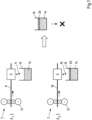
- Fig. 1 illustrates an example of a prior art method for collecting metal scrap in collection containers.
- metal scrap 6 of a material 8 processed in the production plant 2 is generated at a production scrap generation point 4 of a production plant 2, which is fed to a collection container 10 at the production scrap generation point 4 and collected therein.
- the production plant 2 is a production plant for the manufacture and/or processing of aluminum strip, namely a rolling mill, as symbolized by the rolling stand 12.
- the material 8 processed in the production plant 2 is accordingly an aluminum strip 8 made of an aluminum alloy.
- the production scrap collection point 4 is the area of a trimming shear with which the edges of the rolled aluminum strip 8 are trimmed.
- the metal scrap 6 can accordingly arise as a continuous strip cut from the aluminum strip 8.
- a comminution device is provided which comminutes the long strip into smaller pieces before they are fed to the collection container 10.
- Fig. 1 shows how, at a first production time t 1 , an aluminum strip 8 made of a first aluminum alloy, for example, a 5xxx alloy, is processed and aluminum scrap 6 of the corresponding composition is produced at the trimming shear 4. At this time, the collection container 10 contains exclusively a quantity of aluminum scrap 14 with this composition.
- a first aluminum alloy for example, a 5xxx alloy
- the collection container 10 now contains a quantity Metal scrap 14 of the first aluminum alloy and a quantity of metal scrap 20 of the second aluminum alloy.
- the entire contents of the collection container 10 can be analyzed separately. However, this is a rather complex process.
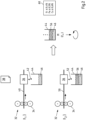
- Fig. 2 shows a first embodiment of a method according to the invention on a production plant 32 for processing aluminum strips.
- the production plant 32 can be, as in Fig. 2
- the rolling mill 34 illustrated is a rolling mill for aluminum strips.
- the method can also be carried out on other production plants for aluminum strips or on other production plants for materials other than aluminum strips, such as production plants for processing aluminum sheets.
- the production plant 32 has a production scrap collection point 36, which in the present example is located at a trimming shear.
- other production scrap collection points are also conceivable.
- the production plan 38 specifies in particular the sequence of the aluminum strips to be processed one after the other and contains information on the composition and, if applicable, on other properties of the strips (e.g. (initial) thickness, (initial) width, etc.) as well as production parameters for the processing of the strips (e.g. rolling degrees, trimming width, feed speed, etc.).
- the production plan 38 can be a It can be a data record stored in one place; however, the production plan information can also be present in different places, for example in different data records.
- the production plan 38 contains composition information ⁇ c x,1 ⁇ about the first composition, where c x,1 denotes the content of an alloy component x in the first composition and ⁇ c x,1 ⁇ denotes a set of contents of various alloy components x .
- the production plan 38 can, for example, specify the contents of the most important secondary alloying elements (in particular Si, Fe, Cu, Mn, Mg, Cr, Ni, Zn, Ti, Ga, V). It is also conceivable that the production plan 38 contains a reference to separately stored composition information instead of the composition information, for example a reference to a material certificate.
- metal scrap 42 with the first composition is generated at the production scrap collection point 36 and is fed to a collection container 44 located at the production scrap collection point 36 and collected there.
- the collection container 44 accordingly contains a first quantity 46 of metal scrap of the first material, in this case, the first aluminum strip 40.
- the second aluminum strip 50 listed in the production plan 38 is processed from a second aluminum alloy.
- the production plan 38 contains corresponding composition information ⁇ c x,2 ⁇ about the composition of the second aluminum strip.
- metal scrap 52 of the second composition is generated and is fed to the collection container 44 and collected there.
- the collection container 44 now also contains a second quantity 56 of the metal scrap of the second material, in this case the second aluminum strip 50.
- Fig. 2 the weight m 1 of the first quantity 46 and the weight m 2 of the second quantity 56 are determined. This can be done by weighing or based on specified production parameters.
- m 1 and m 2 can be determined from the production parameters stored in production plan 38, namely the width of the edge strip of the aluminum strip 40 or 50 cut off at the trimming shear, the thickness of the aluminum strip 40 or 50, and the feed rate of the aluminum strip 40 or 50 at the trimming shear. From the aforementioned production parameters and the known density of the aluminum strip 40 or 50, the weight of the resulting scrap quantity per unit of time can be determined. By summing or integrating this value over the processing time of the respective aluminum strip 40 or 50, the current weight m 1 of the first quantity and the current weight m 2 of the second quantity can be calculated.
- composition information ⁇ c x,2 ⁇ and ⁇ c x,2 ⁇ known from the production plan 38 and the determined weights m 1 and m 2 a collection container composition information ⁇ C x ⁇ about the composition of all the scrap collected in the collection container 44 can then be calculated using formula (1).
- the collection container 44 or the metal scrap contained therein can be assigned to a scrap class by comparison with a composition specification 60, which specifies limit values for various alloying elements, and can be further processed according to this scrap class. Unlike the State-of-the-art methods in Fig. 1 the collecting container 44 can thus be left in the circulation system (in Fig. 2 symbolized by the circular arrow).
- the collection container composition information ⁇ C x ⁇ and a collection container quantity information M determined from the summation of m 1 and m 2 are assigned to the collection container 44, so that this information is available for the further processing of the metal scrap in the collection container 44.
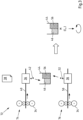
- Fig. 3 shows a second embodiment of the method according to the invention.
- the elements of Fig. 2 corresponding elements are provided with the same reference numerals.
- the production plant 72 comprises two production lines 74, 76, which in the present example are two rolling lines.
- the production lines 74, 76 each have a production scrap collection point 36 at a respective trimming shear.
- a first aluminum strip 40 made of a first aluminum alloy is processed in the first production line 74
- a second aluminum strip 50 made of a second aluminum alloy is processed simultaneously in the second production line 76, so that metal scrap 42 of the first aluminum strip 40 and metal scrap 52 of the second aluminum strip 50 are generated at the production scrap collection points 36.
- the resulting metal scrap is fed to a common collection container 44 and collected there.
- the weight m 1 of the first quantity 46 of the metal scrap of the first aluminum strip 40 currently located in the collection container 4 and the weight m 2 of the second quantity 56 of the metal scrap of the second aluminum strip 50 currently located in the collection container 4 are determined. calculated.
- the quantities 46 and 56 are schematically drawn side by side; in fact, the quantities are mixed in the collecting container 44.
- the collection container composition information ⁇ Cx ⁇ of the total metal scrap currently in the collection container 44 can be determined according to formula (1). This enables, as in Fig. 2 described an allocation of the collection container 44 to a scrap class as well as the corresponding further processing in the recycling system.
- Fig. 4 shows a third embodiment of the method according to the invention. The method is carried out on the production plant 32 from Fig. 2 carried out.
- FIG. 4 In the process shown, several collection containers 82, 84, 86 are provided, which can be exchanged during production at the production facility 32 (arrow 88).
- the collection containers 82, 84, 86 with the exchange mechanism 88 form a collection container system 89.
- three aluminum strips 40, 50, 90 made of different aluminum alloys are processed successively at the production plant 32.
- the first aluminum strip 40 is processed in the production plant 32, so that aluminum scrap 42 with a first composition corresponding to the alloy of the first aluminum strip 40 is produced at the production scrap collection point 36, for which composition information ⁇ c x,1 ⁇ is stored in the production plan 38.
- the second aluminum strip 50 is processed in the production plant 32, so that at the production scrap collection point 36 aluminum scrap 52 with an alloy of the second aluminum strip 50 corresponding second composition, for which composition information ⁇ c x,2 ⁇ is stored in the production plan 38.
- the third aluminum strip 90 is processed in the production plant 32, so that aluminum scrap 92 with a third composition corresponding to the alloy of the third aluminum strip 90 is produced at the production scrap collection point 36, for which composition information ⁇ c x,3 ⁇ is stored in the production plan 38.
- the weight of the current quantity of metal scrap from one of the aluminum strips 40, 50, 90 that has been fed to a respective one of the collection containers 82, 84, 86 is determined based on the production parameters contained in the production plan 38. Using these determined weights and the composition information contained in the production plan 38, current collection container composition information can be determined for each of the collection containers 82, 84, 86 and compared with a respective composition specification.
- the collection container 82 is initially positioned at the production scrap collection point 36, so that the aluminum scrap 42 is fed to this collection container 82, while the other collection containers 84, 86 are parked, for example, in a waiting position.
- the comparison of the composition specification for the first collection container 82 with the collection container composition information calculated for the first collection container reveals that the collection container composition information deviates from the composition specification.
- the supply of metal scrap to the collection container 82 is interrupted by replacing it with the collection container 84 (see time t 2 ). The metal scrap 52 then continues to be collected in the second collection container 84.
- the production plan 38 can alternatively be used to determine a predicted collection container composition information and thus an interruption time at which the supply of metal scrap to the collection container 82 is interrupted.
- the second collection container 84 can be replaced by the first collection container (see time ts). In this way, the capacity of the first collection container 82 can also be better utilized.
- the first collection container 82 thus ultimately contains a quantity 46 of the metal scrap 42, a (small) quantity 56 of the metal scrap 52, and a quantity 96 of the metal scrap 96.
- the second collection container 84 contains a quantity 56' of the metal scrap 56 and a (small) quantity 96' of the metal scrap 92.
- the first and second collection containers 82, 84 can then be assigned to a respective scrap class based on the respectively calculated collection container composition information ⁇ C x,1 ⁇ and ⁇ C X.2 ⁇ , respectively, and can be used accordingly.
- composition specification for a collection container 44 is adapted depending on the collection container composition information.
- Fig. 5a The collection container 44 is shown, to which, at a production scrap collection point, a first quantity 46 of metal scrap from a first aluminum strip with a first composition is initially fed, followed by a second quantity 56 of metal scrap from a second aluminum strip with a second composition.
- the current collection container composition information is calculated in the manner already explained above.
- Table 100 located below the collection container 44 shows how the calculated collection container composition information changes during the filling of the collection container 44.
- the rows ⁇ C x (t 1 ) ⁇ and ⁇ C x (t 2 ) ⁇ show, as examples, the contents of the secondary alloy components Si, Fe, and Cu in the collection container composition information at the time of production t 1 and t 2 , respectively (see Fig. 2 ).
- ⁇ C x (t 1 ) ⁇ corresponds to the composition of the first aluminum strip, since the collection container only contains scrap from this Contains aluminum strip.
- the collection container contains quantities 46 and 56, so that the contents of ⁇ C x (t 2 ) ⁇ are calculated according to formula (1).
- the current collection container composition information is compared with a current composition specification "Scrap Class 3" from a set of specified composition specifications "Scrap Class 1", “Scrap Class 2", ...
- the current composition specification is shown in Table 102 and the set of composition specifications is shown in Table 104.
- the collection container composition information meets the current composition specification "scrap class 3" at both times t 1 and t 2 .
- Fig. 5b now shows a case in which a second aluminum strip with a different composition is used in the production plant 32, whereby the collection container composition information at time tz, at which, in addition to the quantity 46, a quantity 56" of metal scrap from the second aluminum strip with the different composition is also contained, has changed significantly, so that the current composition specification "scrap class 3" is no longer met.
- a different composition specification (“scrap class 1", arrow 106) is selected from the set of composition specifications (table 104) that satisfies the current collection container composition information.
- the collection container 44 can also be assigned to a scrap class in this case and kept in circulation.
Landscapes
- Engineering & Computer Science (AREA)
- Chemical & Material Sciences (AREA)
- Manufacturing & Machinery (AREA)
- Organic Chemistry (AREA)
- Metallurgy (AREA)
- Mechanical Engineering (AREA)
- Materials Engineering (AREA)
- Life Sciences & Earth Sciences (AREA)
- Environmental & Geological Engineering (AREA)
- General Life Sciences & Earth Sciences (AREA)
- Geology (AREA)
- Automation & Control Theory (AREA)
- General Physics & Mathematics (AREA)
- Physics & Mathematics (AREA)
- Quality & Reliability (AREA)
- General Engineering & Computer Science (AREA)
- Geochemistry & Mineralogy (AREA)
- Manufacture And Refinement Of Metals (AREA)
Applications Claiming Priority (2)
| Application Number | Priority Date | Filing Date | Title |
|---|---|---|---|
| DE102019114515.5A DE102019114515A1 (de) | 2019-05-29 | 2019-05-29 | Verfahren für das sammeln von metallschrotten in sammelbehältern |
| EP20174644.3A EP3744863B1 (fr) | 2019-05-29 | 2020-05-14 | Procédé destiné à la collecte de déchets métalliques dans des réservoirs de collecte |
Related Parent Applications (1)
| Application Number | Title | Priority Date | Filing Date |
|---|---|---|---|
| EP20174644.3A Division EP3744863B1 (fr) | 2019-05-29 | 2020-05-14 | Procédé destiné à la collecte de déchets métalliques dans des réservoirs de collecte |
Publications (2)
| Publication Number | Publication Date |
|---|---|
| EP4527510A2 true EP4527510A2 (fr) | 2025-03-26 |
| EP4527510A3 EP4527510A3 (fr) | 2025-06-18 |
Family
ID=70736698
Family Applications (2)
| Application Number | Title | Priority Date | Filing Date |
|---|---|---|---|
| EP20174644.3A Active EP3744863B1 (fr) | 2019-05-29 | 2020-05-14 | Procédé destiné à la collecte de déchets métalliques dans des réservoirs de collecte |
| EP25156306.0A Pending EP4527510A3 (fr) | 2019-05-29 | 2020-05-14 | Procédé pour la récupération de déchets métalliques dans des récipients collecteurs |
Family Applications Before (1)
| Application Number | Title | Priority Date | Filing Date |
|---|---|---|---|
| EP20174644.3A Active EP3744863B1 (fr) | 2019-05-29 | 2020-05-14 | Procédé destiné à la collecte de déchets métalliques dans des réservoirs de collecte |
Country Status (2)
| Country | Link |
|---|---|
| EP (2) | EP3744863B1 (fr) |
| DE (1) | DE102019114515A1 (fr) |
Families Citing this family (1)
| Publication number | Priority date | Publication date | Assignee | Title |
|---|---|---|---|---|
| DE102023135118A1 (de) * | 2023-12-14 | 2025-06-18 | Cleansort Gmbh | Verfahren und Vorrichtung zum legierungsabhängigen Sortieren von Sortiergut |
Citations (1)
| Publication number | Priority date | Publication date | Assignee | Title |
|---|---|---|---|---|
| WO2017108908A9 (fr) | 2015-12-23 | 2017-10-19 | Hydro Aluminium Rolled Products Gmbh | Procédé et dispositif pour le recyclage de ferrailles |
Family Cites Families (3)
| Publication number | Priority date | Publication date | Assignee | Title |
|---|---|---|---|---|
| US8203459B2 (en) * | 2007-02-21 | 2012-06-19 | MJK Holdings, LLC | Security systems and methods for continuously monitoring the weight of a container |
| DE102012024816B4 (de) * | 2011-12-19 | 2014-04-03 | ProASSORT GmbH | Verfahren zum Assortieren von Rohstoffen |
| DE102016108745A1 (de) * | 2016-05-11 | 2017-11-16 | Hydro Aluminium Rolled Products Gmbh | Verfahren und Vorrichtung für das legierungsabhängige Sortieren von Metallschrott, insbesondere Aluminiumschrott |
-
2019
- 2019-05-29 DE DE102019114515.5A patent/DE102019114515A1/de active Pending
-
2020
- 2020-05-14 EP EP20174644.3A patent/EP3744863B1/fr active Active
- 2020-05-14 EP EP25156306.0A patent/EP4527510A3/fr active Pending
Patent Citations (1)
| Publication number | Priority date | Publication date | Assignee | Title |
|---|---|---|---|---|
| WO2017108908A9 (fr) | 2015-12-23 | 2017-10-19 | Hydro Aluminium Rolled Products Gmbh | Procédé et dispositif pour le recyclage de ferrailles |
Also Published As
| Publication number | Publication date |
|---|---|
| EP4527510A3 (fr) | 2025-06-18 |
| EP3744863B1 (fr) | 2025-02-19 |
| EP3744863C0 (fr) | 2025-02-19 |
| EP3744863A1 (fr) | 2020-12-02 |
| DE102019114515A1 (de) | 2020-12-03 |
Similar Documents
| Publication | Publication Date | Title |
|---|---|---|
| EP3393687B1 (fr) | Procédé et dispositif pour le recyclage de ferrailles | |
| DE102014013160B4 (de) | Verfahren und Vorrichtung zur Sortierung von wiederverwertbaren Rohstoffstücken | |
| EP3378616B1 (fr) | Traitement des produits alimentaires | |
| EP3256919B1 (fr) | Formation de familles d'équipements pour un système d'usinage comportant une machine-outil | |
| EP0134910B1 (fr) | Procédé de découpage par électroérosion d'une chute d'une pièce ayant des surfaces parallèles | |
| EP1324845B1 (fr) | Procede permettant de faire fonctionner une installation dans l'industrie des matieres premieres | |
| EP3744863B1 (fr) | Procédé destiné à la collecte de déchets métalliques dans des réservoirs de collecte | |
| DE4114510A1 (de) | Verfahren zum funkenerosiven schneiden und drahterosionsmaschine, insbesondere zur durchfuehrung des verfahrens | |
| DE69605753T2 (de) | Vorrichtung zum Schneiden von Walzprodukten | |
| DE102022123793A1 (de) | Verfahren und System zum Erzeugen eines Schachtelungsplans von aus einem Werkstück auszuschneidenden Werkstückteilen auf dem Werkstück | |
| EP0650209A1 (fr) | Procédé hydrométallurgique pour le traitement de batteries épuisées | |
| DE2814171A1 (de) | Verfahren zur herstellung einer metallischen abschmelz- bzw. schweisselektrode mit vertikaler achse zum um- oder wiedereinschmelzen nach dem elektro-schlackeverfahren und zur herstellung eines metallblocks mit entlang seiner achse sich fortlaufend aendernder chemischer zusammensetzung | |
| DE19807159C1 (de) | Verfahren und Vorrichtung zum automatischen Ausscheiden der vorderen und hinteren Enden von in Umformpressen verarbeiteten Materialstangen | |
| EP2791450B1 (fr) | Procédé et dispositif de changement d'écarteurs | |
| EP4603197A1 (fr) | Procédé et dispositif de tri d'objets à trier en fonction de l'alliage | |
| DE102015011804B3 (de) | Zwei Verfahren zur Behandlung von stofflichen Rückständen | |
| WO2026008497A1 (fr) | Procédé de découpe de composants dans des pièces à travailler en forme de panneau | |
| EP3452242A1 (fr) | Procédé et dispositif de fabrication d'un objet tridimensionnel | |
| DE2917316C2 (de) | Vorrichtung zum selektiven Abtrennen nicht ferromagnetischer Metalle aus einem Gemenge zerkleinerten Schrottes von nahezu einheitlicher Größe | |
| EP4530946A1 (fr) | Procédé de fonctionnement d'un palier à plaques d'une installation de division de plaques, installation automatique d'un palier à plaques ainsi que palier à plaques | |
| DE102022125632A1 (de) | Verfahren zur Behandlung von Schüttgut aus überwiegend metallischen Gegenständen und Vorrichtung zur Durchführung eines solchen Verfahrens | |
| DE1565770B2 (de) | Verfahren zur kompensation von aenderungen der elektrolytleitfaehigkeit bei der elektrolytischen metallabtragung, sowie einrichtung zur durchfuehrung des verfahrens | |
| DE102024126250A1 (de) | Vorrichtung und Verfahren zur generativen Fertigung und 3D-Druckteil | |
| EP4609954A1 (fr) | Procédé de fonctionnement d'une installation de broyage de matériaux | |
| DE1565770C3 (de) | Verfahren zur Kompensation von Änderungen der Elektrolytleitfähigkeit bei der elektrolytischen Metallabtragung, sowie Einrichtung zur Durchführung des Verfahrens |
Legal Events
| Date | Code | Title | Description |
|---|---|---|---|
| PUAI | Public reference made under article 153(3) epc to a published international application that has entered the european phase |
Free format text: ORIGINAL CODE: 0009012 |
|
| STAA | Information on the status of an ep patent application or granted ep patent |
Free format text: STATUS: THE APPLICATION HAS BEEN PUBLISHED |
|
| AC | Divisional application: reference to earlier application |
Ref document number: 3744863 Country of ref document: EP Kind code of ref document: P |
|
| AK | Designated contracting states |
Kind code of ref document: A2 Designated state(s): AL AT BE BG CH CY CZ DE DK EE ES FI FR GB GR HR HU IE IS IT LI LT LU LV MC MK MT NL NO PL PT RO RS SE SI SK SM TR |
|
| REG | Reference to a national code |
Ref country code: DE Ref legal event code: R079 Free format text: PREVIOUS MAIN CLASS: B07C0005380000 Ipc: G05B0019418000 |
|
| PUAL | Search report despatched |
Free format text: ORIGINAL CODE: 0009013 |
|
| AK | Designated contracting states |
Kind code of ref document: A3 Designated state(s): AL AT BE BG CH CY CZ DE DK EE ES FI FR GB GR HR HU IE IS IT LI LT LU LV MC MK MT NL NO PL PT RO RS SE SI SK SM TR |
|
| RIC1 | Information provided on ipc code assigned before grant |
Ipc: G05B 19/042 20060101ALI20250509BHEP Ipc: C22B 21/00 20060101ALI20250509BHEP Ipc: C22B 7/00 20060101ALI20250509BHEP Ipc: C22B 1/00 20060101ALI20250509BHEP Ipc: B07C 5/38 20060101ALI20250509BHEP Ipc: G05B 19/418 20060101AFI20250509BHEP |
|
| STAA | Information on the status of an ep patent application or granted ep patent |
Free format text: STATUS: REQUEST FOR EXAMINATION WAS MADE |
|
| 17P | Request for examination filed |
Effective date: 20251216 |