EP4528376A1 - Élément optique destiné à être utilisé en lithographie euv - Google Patents
Élément optique destiné à être utilisé en lithographie euv Download PDFInfo
- Publication number
- EP4528376A1 EP4528376A1 EP23198239.8A EP23198239A EP4528376A1 EP 4528376 A1 EP4528376 A1 EP 4528376A1 EP 23198239 A EP23198239 A EP 23198239A EP 4528376 A1 EP4528376 A1 EP 4528376A1
- Authority
- EP
- European Patent Office
- Prior art keywords
- optical element
- optical surface
- optical
- lithographic apparatus
- radiation
- Prior art date
- Legal status (The legal status is an assumption and is not a legal conclusion. Google has not performed a legal analysis and makes no representation as to the accuracy of the status listed.)
- Withdrawn
Links
Images




Classifications
-
- G—PHYSICS
- G03—PHOTOGRAPHY; CINEMATOGRAPHY; ANALOGOUS TECHNIQUES USING WAVES OTHER THAN OPTICAL WAVES; ELECTROGRAPHY; HOLOGRAPHY
- G03F—PHOTOMECHANICAL PRODUCTION OF TEXTURED OR PATTERNED SURFACES, e.g. FOR PRINTING, FOR PROCESSING OF SEMICONDUCTOR DEVICES; MATERIALS THEREFOR; ORIGINALS THEREFOR; APPARATUS SPECIALLY ADAPTED THEREFOR
- G03F7/00—Photomechanical, e.g. photolithographic, production of textured or patterned surfaces, e.g. printing surfaces; Materials therefor, e.g. comprising photoresists; Apparatus specially adapted therefor
- G03F7/70—Microphotolithographic exposure; Apparatus therefor
- G03F7/708—Construction of apparatus, e.g. environment aspects, hygiene aspects or materials
- G03F7/70858—Environment aspects, e.g. pressure of beam-path gas, temperature
- G03F7/70883—Environment aspects, e.g. pressure of beam-path gas, temperature of optical system
-
- G—PHYSICS
- G02—OPTICS
- G02B—OPTICAL ELEMENTS, SYSTEMS OR APPARATUS
- G02B5/00—Optical elements other than lenses
- G02B5/08—Mirrors
- G02B5/0891—Ultraviolet [UV] mirrors
-
- G—PHYSICS
- G02—OPTICS
- G02B—OPTICAL ELEMENTS, SYSTEMS OR APPARATUS
- G02B7/00—Mountings, adjusting means, or light-tight connections, for optical elements
- G02B7/18—Mountings, adjusting means, or light-tight connections, for optical elements for prisms; for mirrors
-
- G—PHYSICS
- G03—PHOTOGRAPHY; CINEMATOGRAPHY; ANALOGOUS TECHNIQUES USING WAVES OTHER THAN OPTICAL WAVES; ELECTROGRAPHY; HOLOGRAPHY
- G03F—PHOTOMECHANICAL PRODUCTION OF TEXTURED OR PATTERNED SURFACES, e.g. FOR PRINTING, FOR PROCESSING OF SEMICONDUCTOR DEVICES; MATERIALS THEREFOR; ORIGINALS THEREFOR; APPARATUS SPECIALLY ADAPTED THEREFOR
- G03F7/00—Photomechanical, e.g. photolithographic, production of textured or patterned surfaces, e.g. printing surfaces; Materials therefor, e.g. comprising photoresists; Apparatus specially adapted therefor
- G03F7/70—Microphotolithographic exposure; Apparatus therefor
- G03F7/70058—Mask illumination systems
- G03F7/702—Reflective illumination, i.e. reflective optical elements other than folding mirrors, e.g. extreme ultraviolet [EUV] illumination systems
-
- G—PHYSICS
- G03—PHOTOGRAPHY; CINEMATOGRAPHY; ANALOGOUS TECHNIQUES USING WAVES OTHER THAN OPTICAL WAVES; ELECTROGRAPHY; HOLOGRAPHY
- G03F—PHOTOMECHANICAL PRODUCTION OF TEXTURED OR PATTERNED SURFACES, e.g. FOR PRINTING, FOR PROCESSING OF SEMICONDUCTOR DEVICES; MATERIALS THEREFOR; ORIGINALS THEREFOR; APPARATUS SPECIALLY ADAPTED THEREFOR
- G03F7/00—Photomechanical, e.g. photolithographic, production of textured or patterned surfaces, e.g. printing surfaces; Materials therefor, e.g. comprising photoresists; Apparatus specially adapted therefor
- G03F7/70—Microphotolithographic exposure; Apparatus therefor
- G03F7/708—Construction of apparatus, e.g. environment aspects, hygiene aspects or materials
- G03F7/70808—Construction details, e.g. housing, load-lock, seals or windows for passing light in or out of apparatus
- G03F7/70825—Mounting of individual elements, e.g. mounts, holders or supports
-
- G—PHYSICS
- G03—PHOTOGRAPHY; CINEMATOGRAPHY; ANALOGOUS TECHNIQUES USING WAVES OTHER THAN OPTICAL WAVES; ELECTROGRAPHY; HOLOGRAPHY
- G03F—PHOTOMECHANICAL PRODUCTION OF TEXTURED OR PATTERNED SURFACES, e.g. FOR PRINTING, FOR PROCESSING OF SEMICONDUCTOR DEVICES; MATERIALS THEREFOR; ORIGINALS THEREFOR; APPARATUS SPECIALLY ADAPTED THEREFOR
- G03F7/00—Photomechanical, e.g. photolithographic, production of textured or patterned surfaces, e.g. printing surfaces; Materials therefor, e.g. comprising photoresists; Apparatus specially adapted therefor
- G03F7/70—Microphotolithographic exposure; Apparatus therefor
- G03F7/708—Construction of apparatus, e.g. environment aspects, hygiene aspects or materials
- G03F7/70908—Hygiene, e.g. preventing apparatus pollution, mitigating effect of pollution or removing pollutants from apparatus
- G03F7/70941—Stray fields and charges, e.g. stray light, scattered light, flare, transmission loss
-
- G—PHYSICS
- G03—PHOTOGRAPHY; CINEMATOGRAPHY; ANALOGOUS TECHNIQUES USING WAVES OTHER THAN OPTICAL WAVES; ELECTROGRAPHY; HOLOGRAPHY
- G03F—PHOTOMECHANICAL PRODUCTION OF TEXTURED OR PATTERNED SURFACES, e.g. FOR PRINTING, FOR PROCESSING OF SEMICONDUCTOR DEVICES; MATERIALS THEREFOR; ORIGINALS THEREFOR; APPARATUS SPECIALLY ADAPTED THEREFOR
- G03F7/00—Photomechanical, e.g. photolithographic, production of textured or patterned surfaces, e.g. printing surfaces; Materials therefor, e.g. comprising photoresists; Apparatus specially adapted therefor
- G03F7/70—Microphotolithographic exposure; Apparatus therefor
- G03F7/708—Construction of apparatus, e.g. environment aspects, hygiene aspects or materials
- G03F7/70983—Optical system protection, e.g. pellicles or removable covers for protection of mask
Definitions
- the present invention relates to an optical element for an EUV lithographic apparatus, an EUV lithographic apparatus comprising the optical element, a method of manufacturing a device including use of the optical element, and a method of exposing an optical element in an EUV lithographic apparatus.
- a lithographic apparatus is a machine that applies a desired pattern onto a substrate, usually onto a target portion of the substrate.
- a lithographic apparatus can be used, for example, in the manufacture of integrated circuits (ICs).
- a patterning device which is alternatively referred to as a mask or a reticle, may be used to generate a circuit pattern to be formed on an individual layer of the IC.
- This pattern can be transferred onto a target portion (e.g., comprising part of, one, or several dies) on a substrate (e.g., a silicon wafer). Transfer of the pattern is typically via imaging onto a layer of radiation-sensitive material (resist) provided on the substrate.
- a single substrate will contain a network of adjacent target portions that are successively patterned.
- EUV radiation is electromagnetic radiation having a wavelength within the range of 10-20 nm, for example within the range of 13-14 nm. It has further been proposed that EUV radiation with a wavelength of less than 10 nm could be used, for example within the range of 5-10 nm such as 6.7 nm or 6.8 nm. Such radiation is termed extreme ultraviolet radiation or soft x-ray radiation.
- Possible sources include, for example, laser-produced plasma sources, discharge plasma sources, or sources based on synchrotron radiation provided by an electron storage ring, or a free electron laser
- a lithographic apparatus may comprise a plurality of optical elements.
- Optical elements comprise optical surfaces which are exposed to EUV radiation during the operation of the lithographic apparatus.
- the environment within the lithographic apparatus may comprise Hydrogen at a low pressure. Pulses of EUV radiation generated by the lithographic apparatus may excite hydrogen molecules within the environment surrounding the optical elements, such that plasma is formed. Energetic ions from the plasma may impact optical surfaces, causing damage thereto. This can decrease the lifetime of the optical components within the lithographic apparatus.
- the present invention is directed to extending the lifetime of optical elements within a lithographic apparatus. This is achieved by providing an optical element which is less susceptible to damage from energetic ions present in the environment surrounding the optical element.
- optical surface an optical element is grounded through an electrical connection with a frame of the lithographic apparatus.
- the inventors of the present invention have discovered that optical surfaces may be made to be less susceptible to damage from ions in the plasma if they are electrically isolated.
- an optical element for an EUV lithographic apparatus comprising: an optical surface configured to receive radiation; a support member that is electrically conductive; and a spacer that is electrically insulating and configured to electrically isolate the optical surface, wherein a capacitance between surfaces separated by the spacer is less than 1 ⁇ F.
- an EUV lithographic apparatus comprising: an optical element; a grounded frame; and a radiation source configured to generate the pulse of radiation.
- a method of exposing an optical element in an EUV lithographic apparatus comprising: providing the optical element on a grounded frame of the EUV lithographic apparatus, wherein an optical surface of the optical element is configured to receive EUV radiation, and the optical surface is electrically isolated by an electrically insulating spacer; generating a pulse of radiation with a radiation source; exposing the optical surface with the pulse of radiation; and accumulating positive charge on the optical surface whilst the optical surface is exposed to the pulse of radiation.
- the EUV radiation incident on an optical surface may cause electrons to be ejected from therefrom.
- the ejection of electrons from the optical surfaces may bring the optical surface to a positive potential. Consequently, positive ions within the EUV plasma may be repelled from the optical surface. Consequently, fewer positive ions will collide with the optical surface, and the positive ions that do collide with the optical surface will have a lower energy. This means that the damage caused to the optical surface by the ions is decreased.
- Figure 1 schematically depicts a lithographic apparatus 100 including a radiation source SO according to one embodiment of the invention.
- the apparatus 100 comprises:
- the illumination system IL may include various types of optical components, such as refractive, reflective, magnetic, electromagnetic, electrostatic or other types of optical components, or any combination thereof, for directing, shaping, or controlling radiation.
- optical components such as refractive, reflective, magnetic, electromagnetic, electrostatic or other types of optical components, or any combination thereof, for directing, shaping, or controlling radiation.
- the support structure MT holds the patterning device MA in a manner that depends on the orientation of the patterning device, the design of the lithographic apparatus, and other conditions, such as for example whether or not the patterning device is held in a vacuum environment.
- the support structure MT can use mechanical, vacuum, electrostatic or other clamping techniques to hold the patterning device MA.
- the support structure MT may be a frame or a table, for example, which may be fixed or movable as required.
- the support structure MT may ensure that the patterning device MA is at a desired position, for example with respect to the projection system PS.
- patterning device should be broadly interpreted as referring to any device that can be used to impart a radiation beam B with a pattern in its cross-section such as to create a pattern in a target portion C of the substrate W.
- the pattern imparted to the radiation beam B may correspond to a particular functional layer in a device being created in the target portion C, such as an integrated circuit.
- patterning devices include masks, programmable mirror arrays, and programmable liquid-crystal display (LCD) panels.
- Masks are well known in lithography, and include mask types such as binary, alternating phase-shift, and attenuated phase-shift, as well as various hybrid mask types.
- An example of a programmable mirror array employs a matrix arrangement of small mirrors, each of which can be individually tilted so as to reflect an incoming radiation beam in different directions. The tilted mirrors impart a pattern in a radiation beam, which is reflected by the mirror matrix.
- the projection system PS may include various types of optical components, such as refractive, reflective, magnetic, electromagnetic, electrostatic or other types of optical components, or any combination thereof, as appropriate for the exposure radiation being used, or for other factors such as the use of a vacuum. It may be desired to use a vacuum for EUV radiation since other gases may absorb too much radiation. A vacuum environment may therefore be provided to the whole beam path with the aid of a vacuum wall and vacuum pumps.
- the lithographic apparatus 100 is of a reflective type (e.g., employing a reflective mask).
- the lithographic apparatus 100 may be of a type having two (dual stage) or more substrate tables WT (and/or two or more support structures MT).
- the additional substrate tables WT (and/or the additional support structures MT) may be used in parallel, or preparatory steps may be carried out on one or more substrate tables WT (and/or one or more support structures MT) while one or more other substrate tables WT (and/or one or more other support structures MT) are being used for exposure.
- the illumination system IL receives an extreme ultraviolet radiation beam from the radiation source SO.
- the radiation source SO may be a laser produced plasma (LPP) source, a discharge produced plasma (DPP) source, a free electron laser (FEL) or any other radiation source that is capable of generating EUV radiation.
- Methods to produce EUV light include, but are not necessarily limited to, converting a material into a plasma state that has at least one element, e.g., xenon, lithium or tin, with one or more emission lines in the EUV range.
- LPP laser produced plasma
- the required plasma can be produced by irradiating a fuel, such as a droplet, stream or cluster of material having the required line-emitting element, with a laser beam.
- the laser may be an infrared (IR) laser.
- An IR mirror (not shown) may be provided in the radiation source SO.
- the IR mirror may be configured and arranged to direct and focus the IR laser onto a target (i.e. the fuel).
- An IR mirror may be configured and arranged to direct and focus a laser pre-pulse. Additionally or alternatively, the same or different IR mirror may be configured and arranged to direct and focus a laser main pulse.
- the laser pre-pulse may irradiate a droplet of fuel before the laser main pulse is activated.
- the laser pre-pulse may cause the shape of the droplet of fuel to be distorted such that it transitions from a droplet to a thin plate, wherein the thin plate has a wider diameter than the droplet in a plane that is perpendicular to the direction in which the laser pre-pule and the laser main pulse propagate.
- the laser main pulse may irradiate the fuel. Because the fuel is in the form of a thin plate rather than a droplet, a greater proportion of the laser main pulse may be absorbed by the fuel. Thus, the generation of the EUV radiation becomes more efficient.
- the radiation source SO may be filled by gas at a pressure that is less than atmospheric pressure. This may that mitigate or delay contamination of the source optics by vapor and ions of the fuel. This gas may be partially ionized in operation, for example, by the laser or by discharge-produced plasma. In such a case IR optical elements within the source may be exposed simultaneously to EUV radiation and to plasma.
- the radiation source SO may be part of an EUV radiation system including a laser, not shown in Figure 1 , for providing the laser beam exciting the fuel.
- the resulting plasma emits output radiation, e.g., EUV radiation, which is collected using a radiation collector, disposed in the radiation source SO.
- the laser and the radiation source SO may be separate entities, for example when a COz laser is used to provide the laser beam for fuel excitation.
- the IR laser is not considered to form part of the lithographic apparatus 100 and the radiation beam B is passed from the laser to the radiation source SO with the aid of a beam delivery system comprising, for example, suitable directing mirrors and/or a beam expander.
- the source may be an integral part of the radiation source SO, for example when the source is a discharge produced plasma EUV generator, often termed as a DPP source.
- the illumination system IL may comprise an adjuster for adjusting the angular intensity distribution of the radiation beam. Generally, at least the outer and/or inner radial extent (commonly referred to as ⁇ -outer and ⁇ -inner, respectively) of the intensity distribution in a pupil plane of the illumination system IL can be adjusted.
- the illumination system IL may comprise various other components, such as facetted field and pupil mirror devices.
- the illumination system IL may be used to condition the radiation beam B, to have a desired uniformity and intensity distribution in its cross-section.
- the radiation beam B is incident on the patterning device (e.g., mask) MA, which is held on the support structure (e.g., mask table) MT, and is patterned by the patterning device MA.
- the radiation beam B After being reflected from the patterning device (e.g., mask) MA, the radiation beam B passes through the projection system PS, which focuses the radiation beam B onto a target portion C of the substrate W.
- the substrate table WT can be moved accurately, e.g., so as to position different target portions C in the path of the radiation beam B.
- the first positioner PM and another position sensor PS 1 can be used to accurately position the patterning device (e.g., mask) MA with respect to the path of the radiation beam B.
- the patterning device (e.g., mask) MA and the substrate W may be aligned using mask alignment marks M1, M2 and substrate alignment marks P1, P2.
- a controller 500 controls the overall operations of the lithographic apparatus 100 and in particular performs an operation process described further below.
- Controller 500 can be embodied as a suitably-programmed general purpose computer comprising a central processing unit, volatile and non-volatile storage means, one or more input and output devices such as a keyboard and screen, one or more network connections and one or more interfaces to the various parts of the lithographic apparatus 100. It will be appreciated that a one-to-one relationship between controlling computer and lithographic apparatus 100 is not necessary.
- one computer can control multiple lithographic apparatuses 100.
- multiple networked computers can be used to control one lithographic apparatus 100.
- the controller 500 may also be configured to control one or more associated process devices and substrate handling devices in a lithocell or cluster of which the lithographic apparatus 100 forms a part.
- the controller 500 can also be configured to be subordinate to a supervisory control system of a lithocell or cluster and/or an overall control system of a fab.
- FIG. 2 shows the lithographic apparatus 100 in more detail, including the radiation source SO, the illumination system IL, and the projection system PS.
- the radiation source SO is configured to generate an EUV radiation beam B and to supply the EUV radiation beam B to the lithographic apparatus LA.
- the lithographic apparatus LA comprises an illumination system IL, a support structure MT configured to support a patterning device MA (e.g., a mask), a projection system PS and a substrate table WT configured to support a substrate W.
- a patterning device MA e.g., a mask
- the EUV radiation beam B interacts with the patterning device MA. As a result of this interaction, a patterned EUV radiation beam B' is generated.
- the projection system PS is configured to project the patterned EUV radiation beam B' onto the substrate W.
- the projection system PS may comprise a plurality of mirrors 28, 30 which are configured to project the patterned EUV radiation beam B' onto the substrate W held by the substrate table WT.
- the projection system PS may apply a reduction factor to the patterned EUV radiation beam B', thus forming an image with features that are smaller than corresponding features on the patterning device MA. For example, a reduction factor of 4 or 8 may be applied.
- the projection system PS is illustrated as having only two mirrors 28,30 in Figure 1 , the projection system PS may include a different number of mirrors (e.g. six or eight mirrors).
- a region in which the substrate table (e.g., the wafer table) WT is disposed may be referred to as the substrate region WR.
- the substrate region WR may be adjacent to the projection system PS.
- the patterned EUV radiation beam B' may propagate from the projection system PS to the substrate region WR through an opening 32.
- the opening may be covered by a membrane (not shown).
- the membrane may be referred to as a dynamic gas lock membrane (i.e. a DGL membrane).
- the DGL membrane may form a physical barrier between the substrate region WR and the projection system PS. This may prevent contaminants that are outgassed from a layer of photoresist on the substrate W from travelling into the projection system PS.
- the DGL membrane may allow the passage therethrough of EUV radiation.
- the DGL membrane may limit the passage therethrough of IR and DUV radiation. If IR and DUV are allowed to propagate to the substrate W, the pattern imparted to the substrate W may be distorted.
- the substrate W may include previously formed patterns. Where this is the case, the lithographic apparatus LA aligns the image, formed by the patterned EUV radiation beam B', with a pattern previously formed on the substrate W.
- a relative vacuum i.e. a small amount of gas (e.g. hydrogen) at a pressure well below atmospheric pressure, may be provided in the radiation source SO, in the illumination system IL, in the projection system PS, and/or in the wafer region WR.
- gas e.g. hydrogen
- the radiation source SO may be a laser produced plasma (LPP) source, a discharge produced plasma (DPP) source, a free electron laser (FEL) or any other radiation source that is capable of generating EUV radiation.
- LPP laser produced plasma
- DPP discharge produced plasma
- FEL free electron laser
- the EUV radiation within the lithographic apparatus may excite the Hydrogen present therein to form a hydrogen plasma.
- Hydrogen ions in the environment within the lithographic apparatus may include H + ions, H 2 + ions and H 3 + ions.
- the environment within the lithographic apparatus, and particularly within the illumination system IL and the projection system PS, may include H 3 O + ions and N 2 H + ions.
- the environment within the lithographic apparatus, and particularly within the substrate region WR may include N 2 H + ions, H 3 O + ions and H 2 F + ions. These ions may be formed when impurities in the environment within the lithographic apparatus, such as HzO, N 2 , HF, capture H + ions.
- Other ions that may be present in the lithographic apparatus may include CH 3 + ions and C x H y + ions.
- Hydrogen ions with energy exceeding approximately 10 eV, may cause damage via implantation, accumulation of Hydrogen bubbles and blistering/delamination of thin films.
- Heavier ions such as H 3 O+, N 2 H+, H 2 F+, with energy exceeding approximately 10 eV, may cause EUV transmission or reflection loss as they implant and accumulate within thin layers and absorb EUV more readily than the original materials of the optical elements.
- damage can affect EUV reflecting components (EUV mirrors), EUV transmitting components (DGL membrane), and IR reflecting components (mirrors guiding pre-pulse or main-pulse laser beams in EUV LPP sources).
- positive ions within the lithographic apparatus can cause damage to surfaces within the lithographic apparatus. This damage may be particularly significant to optical surfaces. The damage can decrease the lifetime of optical components (i.e. components on which the optical surfaces are formed) within the lithographic apparatus.
- the present invention seeks to reduce the damage caused by positive ions to an optical surface within the lithographic apparatus by reducing the number of positive ions incident on the optical surface and/or reducing the energy of the positive ions that impact the optical surface.
- An optical surface may be a surface which is exposed to EUV radiation when the lithographic apparatus is in use.
- An optical element may be a component comprising the optical surface.
- the optical surface may be a surface which is designed in consideration of its interaction with EUV radiation.
- the optical surface may be a surface with optical power. That is, the optical surface may be a surface which is configured to manipulate a beam of EUV radiation.
- the optical surface may be a surface which is configured to reflect a beam of EUV radiation.
- the optical surface may be a reflective surface.
- the reflective surface may be a surface which is configured to reflect a beam of radiation in the illumination system IL.
- the reflective surface may be a surface of the field facet mirror 22 or a surface of the pupil facet mirror 24.
- an optical surface may be a surface of the collector mirror CO within the EUV source.
- the optical surface may be a surface which does not need to be exposed to EUV radiation to perform its functionality, but may nevertheless be exposed to EUV radiation as a matter of course due to its positioning within the lithographic apparatus.
- an optical surface may be a surface of an infrared (IR) reflective element, such as an IR mirror in the EUV source.
- IR infrared
- the optical surface may be an alignment mark.
- Ground may be any of a number of reference potentials.
- the potential of the frame of the EUV lithographic apparatus is typically used as the ground potential.
- optical surfaces in a lithographic apparatus may be grounded. Grounding may occur as a result of an electrical connection, i.e. electrically conductive path, between the optical surface and the frame of the lithographic apparatus.
- a grounded optical element 150 is depicted in Figure 3 .
- the optical element 150 may comprise an optical surface 151 and a support member 152.
- the optical surface 151 and the support member 152 may be physically connected.
- the optical surface 151 may be formed on the support member 152.
- the optical surface 151 may be electrically connected to the support member 152 via a very low resistance or inductance.
- the support member 152 may be formed from a thermally conductive material.
- the thermally conductive material from which the support member 152 is formed may also be electrically conductive.
- the support member 152 may be formed of a metal, e.g. copper.
- the optical element 150 may be mounted, directly or indirectly, on the frame 153 of the lithographic apparatus.
- the frame 153 may be grounded.
- the support member 152 may be physically and electrically connected to the frame 153 of the lithographic apparatus with a very small resistance and/or inductance therebetween. Consequently, a resistance and/or inductance between the optical surface 151 and the frame 153 of the lithographic apparatus may be very small.
- other components may be interposed between the support member 152 and the frame 153 of the lithographic apparatus, but the resistance and/or inductance between the optical surface 151 and the frame 153 of the lithographic apparatus may remain at a very small value.
- the term "grounded" may mean that an electrical connection is present between a component and the earth. However, this is not essential. For example, a component may be referred to as grounded if it is connected to a large conductor. For instance, a component may be considered to be grounded if it is electrically connected to the frame 153 of the lithographic apparatus, even if the frame 153 itself is not electrically connected to the earth.
- EUV radiation may be generated in pulses. Each pulse may last for approximately 100 ns.
- the hydrogen plasma may exist within the lithographic apparatus during each pulse of EUV radiation, and for a period of time after each pulse of EUV radiation has terminated. The period of time may be approximately 10... 100 ⁇ s.
- a component or surface may be considered to be grounded if it can be significantly discharged during a pulse of radiation. That is, a component or surface may be considered to be grounded if it can be significantly discharged in less than approximately 100 ns.
- Embodiments of the present invention are directed to providing an optical surface 151 which is able to take on a positive potential during operation of a lithographic apparatus, at least during EUV pulse and shortly thereafter.
- an optical element 150 in which the optical surface 151 is electrically isolated.
- the optical surface 151 may therefore be referred to as floating, or electrically floating. If the optical surface 151 is floating, the ejection of electrons from the optical surface 151 may cause the optical surface 151 to become positively charged. This is because it may not be possible for the electrons ejected from the optical surface 151 to be quickly replaced.
- the positive charge Q, induced by EUV photo-effect on the optical surface 151 may lead to a positive potential building-up on the optical surface 151.
- the capacitance may be between the optical surface and the frame 153 of the lithographic apparatus.
- the magnitude of the positive potential to which the optical surface 151 is brought may be dependent on the capacitance between the frame 153 of the lithographic apparatus and the optical surface. This relationship is shown in Equation 2 , where V is the potential between the optical surface 151 and the frame 153 of the lithographic apparatus; Q is the charge of the optical surface 151 (relative to the frame 153 of the lithographic apparatus); and C is the capacitance between optical surface 151 and the frame 153 of the lithographic apparatus.
- the voltage may be limited to approximately 50 V to approximately 80V. This may be cause the absorbed EUV photon energy (92 eV) is divided between kinetic energy of escaping electron (e*V), and the work function of optical surface (which may range from approximately 5eV to approximately 15eV) and ionization of a single atom from the optical surface (approximately 10 eV to approximately 30 eV).
- a component or surface may be floating if the component is not grounded.
- a component or surface may be floating if the component or surface is not connected to any conductive components which may be considered to be a ground, or which are themselves grounded.
- a component or surface may be considered to be floating if the component or surface is electrically isolated.
- the terms "floating" and "isolated” are used in the context of the timescales of an EUV pulse. That is, an optical surface 151 may be considered to be floating if, when electrons are ejected therefrom by virtue of the photoelectric effect during a pulse of EUV radiation, it can acquire and maintain a charge for the duration of the pulse of EUV radiation. That is, a component or surface may be considered to be floating if it is not significantly discharged in at least approximately 100 ns. For example the surface is considered to be floating if it discharges less than 10% in 100 ns.
- An optical surface 151 may be made to be floating and/or electrically isolated by providing a spacer 155 to the optical element 150.
- the spacer 155 may be electrically insulating.
- An optical element 150 comprising a spacer 155 is depicted in Figures 4A and 4B .
- the spacer 155 may electrically isolate the optical surface 151. This may be achieved by interposing the spacer 155 between the optical surface 151 and the frame 153 of the lithographic apparatus.
- the exact location of the spacer 155 may not be particularly limited.
- the spacer 155 may be disposed between the optical surface 151 and the support member 152 (as depicted in Figure 4A ).
- the spacer 155 may be disposed between the support member 152 and the grounded frame 153 (as depicted in Figure 4B ).
- the optical surface 151 may be isolated from other components within the lithographic apparatus.
- the optical surface 151 may not be electrically connected to any power source or equivalent. No significant potential (relative to the grounded frame 153) may be imposed on the optical surface 151.
- the potential of the optical surface 151 relative to the frame 153 of the lithographic apparatus may be substantially a function of the charge accumulated on the optical surface 151 and the capacitance between the optical surface 151 and the frame 153 of the lithographic apparatus.
- the electrical isolation of the optical surface 151 within the optical element 150 may be such that, during the pulse of EUV radiation and for the period of time thereafter, the potential of the optical surface 151 is greater than 1 V, preferably greater than 5 V and further preferably greater than 10 V, relative to the frame 153 of the lithographic apparatus. That is, the lithographic apparatus may be configured such that the exposure of an optical surface 151 to a pulse of EUV radiation causes the optical surface 151 to have a potential of greater than 1 V, preferably greater than 5 V and further preferably greater than 10 V during the pulse of EUV radiation.
- the potential to which the optical surface 151 is brought is inversely proportional to the capacitance between the optical surface 151 and the grounded frame 153.
- a lower capacitance between the optical surface 151 and the grounded frame 153 results in the optical surface 151 being brought to a higher potential.
- a larger potential is desirable, because it means that positive ions within the environment of the lithographic apparatus will be repelled to a greater extent. Consequently, a lower capacitance between the optical surface 151 and the frame 153 of the lithographic apparatus may be desirable.
- the capacitance between the optical surface 151 and the grounded frame 153 is less than 1000 ⁇ F, preferably less than 100 ⁇ F, and more preferably less than 1 ⁇ F. Such a capacitance may ensure that, when the optical surface 151 is charged by the beam of EUV radiation, the potential of the optical surface 151 relative to the frame 153 of the lithographic apparatus is sufficient to effectively repel positive ions in the environment within the lithographic apparatus from the optical surface 151.
- a capacitance between the optical surface 151 and the grounded frame 153 of less than 1 ⁇ F may ensure that the charging of the optical surface 151 by the pulse of EUV radiation is sufficient to bring the optical surface 151 to a potential of greater than 1 V, preferably greater than 5 V and further preferably greater than 10 V.
- the capacitance between optical surface 151 and the frame 153 of the lithographic apparatus may preferably be less than 0.1 ⁇ F, preferably less than 0.05 ⁇ F, and preferably less than 0.01 ⁇ F.
- a lower capacitance may mean that if the optical surface 151 is charged by a given amount, the optical surface 151 is brought to a higher potential, and thus can more effectively repel positive ions within the lithographic apparatus.
- a lower capacitance may also mean that, if the optical surface 151 is not charged as anticipated (e.g. if the quantum efficiency of the photoelectric effect is less than anticipated), the optical surface 151 may still brought to the desired potential.
- the majority of the capacitance between the optical surface 151 and the grounded frame 153 may be between the surfaces which are separated by the spacer 155. If other capacitors exist in between the optical surface 151 and the frame 153 of the lithographic apparatus, the overall capacitance between the optical surface 151 and the grounded frame 153 would decrease. This is because the capacitors would be in series. When capacitors are arranged in series, the overall capacitance is less than any of the capacitances of the individual capacitors. That is, if there are capacitances in the optical element 150 in addition to the capacitance between the surfaces separated by the spacer 155, the overall capacitance will be reduced.
- the capacitance between the optical surface 151 and the grounded frame 153 may be between the surfaces which are separated by the spacer 155
- embodiments of the present invention may be appropriately defined with reference to the surfaces which are separated by the spacer 155.
- the capacitance between the surfaces separated by the spacer 155 may be less than 1 ⁇ F.
- the capacitance between the surfaces separated by the spacer 155 is less than 0.1 ⁇ F, preferably less than 0.05 ⁇ F, and further preferably less than 0.01 ⁇ F.
- the terms “isolated” and “floating” are used in the context of the timescale of the EUV pulses in the lithographic apparatus. Consequently, the resistance or inductance between the optical surface 151 and the frame 153 of the lithographic apparatus may be such that the optical surface 151 is isolated or floating on this timescale.
- a resistance between the optical surface 151 and the grounded frame 153 may be greater than 1 ⁇ , preferably greater than 5 ⁇ , further preferably greater than 10 ⁇ , and further preferably greater than 100 ⁇ .
- an inductance between the optical surface 151 and grounded frame 153 may be greater than 10 nH, preferably greater than 50 nH, further preferably greater than 100 nH and further preferably greater than 1000 nH.
- the spacer 155 may have a dielectric breakdown strength which is greater than the potential to which the optical surface 151 is brought, relative to the frame 153 of the lithographic apparatus.
- the spacer 155 may have a dielectric breakdown strength of greater than 50 V, preferably greater than 90 V, and further preferably greater than 100 V.
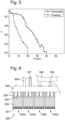
- Figure 5 depicts an example of ion energy distribution function (EDF) of hydrogen ions incident on an element within a lithographic apparatus that is illuminated with an EUV radiation pulse for a grounded optical surface 151 of an optical element 150 (solid line) and a floating optical surface 151 of an optical element 150 (dashed line).
- the floating optical surface 151 may be electrically isolated by an insulating spacer 155.
- Figure 5 depicts a plot of ion flux to the surface F on the y-axis (with units of 1/(cm 2 pulse x EUV) and ion energy (in eV) on the x-axis. The data plotted was calculated for a case of EUV pulses illuminating optical elements at 50 kHz in an environment comprising Hydrogen with a pressure of 5 Pa.
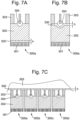
- FIG. 6 depicts a typical segmented mirror 300 not in accordance with embodiments of the present invention.
- the segmented mirror 300 comprises a plurality facets 300a-300d.
- the facets 300a-300d may also be referred to as segments.
- Each facet 300a-300d may comprise a reflective multi-layer stack 301 and a support member 302, as described above.
- the support member 302 may be a metal substrate, or electrically conducting substrate.
- the optical surface may be formed by the multi-layer stack 301.
- Each facet 300a-300d may be mounted on a base 305.
- Each facet 300a-300d may be connected to the base 305 via a heat sink 303 and a tilt mechanism 304.
- the heat sink 303 may be thermally and electrically conductive.
- Figure 7C depicts a segmented mirror 300 with a spacer 340 interposed between each facet and its corresponding tilt mechanism 300a-300d and the base 305. That is, a single spacer 340 may be provided to electrically isolate the multi-layer stacks 301 of each of the facets 300a-300d. A first surface of the spacer 340 may be connected to at least one of the heat sink 303 and the tilt mechanism 304 of each of the plurality of facets 300a-300d. A second surface of the spacer 340 may be connected to the base. The spacer 340 may be configured such that the heat sinks 303 and the tilt mechanisms 304 of each facet 300a-300d are not directly connected to the base 305.
- the spacer may be interposed between each the base 305 and the grounded frame 308.
- the spacer may be interposed between the base 305 and the mechanical interface 309.
- the collector CO may be a grazing incidence collector.
- a grazing incidence collector may comprise an upstream radiation collector side 251 and a downstream radiation collector side 252.
- a grazing incidence collector may be a nested collector with reflectors 253, 254, 255.
- the reflectors 253, 254, 255 may mounted on a support element, which itself may be mounted onto the frame of the lithographic apparatus. Consequently, the reflectors 253, 254, 255 may be electrically connected to the grounded frame via the support element. That is, the reflectors 253, 254, 255 may be grounded.
- the optical element may be a membrane arrangement.
- the membrane arrangement may be a dynamic gas lock (DGL) membrane arrangement.
- DGL dynamic gas lock
- Figure 8 depicts a portion of the projection PS system and a portion of the wafer region WR.
- the opening is to allow the passage of patterned EUV radiation from the projection system PS to the wafer region WR, so that the substrate W can be exposed to the patterned beam of radiation.
- a membrane system 400 may be provided such that a membrane arrangement 410 covers the opening.
- EUV radiation may pass through the membrane arrangement 410 to propagate from the projection system to the wafer region WR.
- the environment within the wafer region WR may comprise hydrogen at a low pressure (e.g. a few Pa).
- the environment within the wafer region WR may be contaminated by EUV-induced resist outgassing.
- the membrane arrangement 410 may prevent propagation of outgassed contaminants towards the optics in the projecting system PS.
- the membrane arrangement 410 may be configured to allow the passage of EUV radiation therethrough, but to filter out of band (OOB) radiation, such as DUV and IR radiation.
- OOB out of band
- the membrane arrangement 410 may comprise a membrane, such as a multi-layer membrane.
- the membrane 410 may comprise at least one electrically conducting layer, for example a metallic layer with a thickness of at least few nm.
- the clamping system may comprise the membrane arrangement 410, one or more one or more clamping arms 401 and a bracket 402.
- the membrane arrangement 410 may be clamped into place by one or more clamping arms 401.
- the one or more one or more clamping arms 401 may be provided on the bracket 402.
- the one or more clamping arms 401 may clamp the membrane arrangement 410 such that the membrane arrangement 410 is clamped to the bracket 402.
- the one or more one or more clamping arms 401 may be a single clamping arm 401 which extends circumferentially around the membrane arrangement 410.
- the one or more one or more clamping arms 401 may comprise a plurality of clamping arms 401 distributed circumferentially around the membrane arrangement 410.
- the bracket 402 may be connected to a grounded frame 450 of the lithographic apparatus.
- the one or more clamping arms 401 and the bracket 402 may be electrically conductive.
- the one or more clamping arms 401 and the bracket 402 may be formed of a metal or a metal alloy.
- the membrane arrangement 410 may comprise an EUV transparent core layer 412.
- the core layer 412 may have a thickness of between 5nm and 25 nm, preferably between 10 nm and 13 nm.
- the core layer may be formed of a material substantially comprising polycrystalline silicon (poly-Si).
- poly-Si polycrystalline silicon
- On a first surface of the core layer 412 there may be a metallization layer 411.
- the metallization layer may be formed substantially of ruthenium or an alloy comprising molybdenum and ruthenium.
- a cap layer 413 may be disposed on a second surface of the core layer 412.
- the second surface of the core layer 412 may be opposite to the first surface of the core layer 412.
- the cap layer may be formed of a material substantially comprising silicon oxide (SiOz) or zirconium oxide (ZrOz).
- the membrane arrangement 410 may also comprise a frame 414.
- the frame may have a thickness (i.e. a dimension in the vertical direction as depicted in Figure 9 ) of greater than approximately 100 ⁇ m and less than approximately 1,000 ⁇ m.
- the metallization layer 411 is grounded. This may be because the metallization layer 411 is electrically connected to the grounded frame 450 of the lithographic apparatus. That is a resistance or inductance between the metallization layer 411 and the grounded frame 450 may be small.
- the metallization layer 411 may be electrically connected to the grounded frame 450 via clamping components in the clamping system 400. In the example depicted in Figure 8 , the metallization layer 411 is electrically connected to the grounded frame 450 via the one or more clamping arms 401 and the bracket 402. Consequently, when the membrane arrangement 410 is exposed to EUV radiation, the membrane arrangement 410 (and specifically the metallization layer 411) cannot acquire a positive charge and cannot be brought to a positive potential.
- heavy, positively charged molecular ions may be implanted into the cap layer 413 or 411. This may create compressive stresses in the cap layer 413 or 411. This may reduce the tension in the membrane arrangement 410, causing it to become less effective. Further, the ions may become implanted in the cap layer 413 or 411 and may increase the amount of EUV radiation absorbed by the cap layer 413 or 411. Further, hydrogen ions (e.g. H + ions) may be implanted into the cap layer 413 or 411. This may lead to outgassing of silicon or damage to the core layer 412. Further, hydrogen ions (e.g. H + ions) may be implanted into the metallization layer 411. This may lead to degradation of the metallization layer 411, through mechanisms such as de-wetting and hole formation.
- the membrane arrangement 410 By bringing the membrane arrangement 410 to a positive potential during pulses of EUV radiation, the amount of positive ions that are implanted into the metallization layer 411 and the cap layer 413 may be reduced.
- the membrane arrangement 410 (and, specifically, the metallization layer 411) may be brought to a positive potential by the pulses of EUV radiation if the metallization layer 411 is electrically isolated from the frame 450 of the lithographic apparatus.
- FIGS 10A to 10D depict components of a clamping system 400 which may result in the metallization layer 411 being electrically isolated from the grounded frame.
- the electrical isolation may mean that the metallization layer 411 is floating.
- Figure 10 depicts a membrane arrangement 410 with a patterned metallization layer.
- the metallization layer 411 may be patterned such that the metallization does not cover all of the first surface of the core layer 412.
- the metallization layer 411 may cover a central (radially inward) region of the EUV transparent core layer 410, but not an outer (radially outward) region of the EUV transparent core layer 412.
- the metallization layer 411 may cover some, but not all, of the outer region.
- the area of the core layer 410 which is not covered by the metallization layer 411 may correspond to the areas where the one or more clamping arms 401 come into contact with the membrane arrangement 410.
- the metallization layer 411 may not become electrically connected to the frame 450 via the one or more clamping arms 401.
- the exact arrangement of the metallization layer 411 on the core layer 410 is not particularly limited, as long as the one or more clamping arms 401 can clamp the membrane arrangement 400 without contacting the metallization layer 411. Consequently, the metallization layer 411 can be electrically isolated.
- Figure 10B depicts a configuration in which one or more spacers 405 are provided onto the metallization layer 411. These spacers 405 may take the form of insulative pads. The spacers 405 may be disposed in a radially outward region of the metallization layer 411. The spacers 405 may be disposed in a region corresponding to where the one or more clamping arms 401 come into contact with the membrane arrangement 410. When the membrane arrangement 410 is clamped by the one or more clamping arms 401, the one or more clamping arms 401 may come into contact with the spacers 405, rather than the metallization layer 411.
- the spacer 405 may be interposed between the one or more clamping arms 401 and the metallization layer 410. Therefore, the one or more clamping arms 401 may be able to clamp the membrane arrangement 410 without coming directly into contact with the metallization layer 411. This may mean that the metallization layer is electrically isolated.
- the spacers 405 may be formed of any suitable dielectric material.
- the spacers 405 may be formed of SiO 2 .
- a thickness of the spacers 405 may be a dimension in a direction parallel to the plane of the metallization layer 411. The spacers 405 may be effective when the thickness of the spacers is greater than 100 nm.
- the thickness of the spacers 405 for use in a membrane system 400 may be less than the thickness of spacers used in other embodiments, such as in a segmented mirror. This is because the area of the surfaces separated by the spacers 405 used in a membrane system 400 may be smaller than the area of the surfaces separated by spacers in a segmented mirror.
- Figures 10A and 10B show embodiments of membrane arrangements 410 that may be used with known clamps.
- Figures 10C and 10D show embodiments of clamps that may be used with known membrane arrangements.
- the spacers 405 may be provided to the one or more clamping arms (not shown). Specifically, the spacers may be provided to the surfaces of the one or more clamping arms which would typically come into contact with the metallization layer 411. Consequently, when the membrane arrangement 410 is clamped, the spacers 405 may be interposed between the one or more clamping arms 401 and the metallization layer 411, as described above.
- Figures 10C and 10D depict configurations in which a spacer is provided to the clamping system. Specifically, Figure 10C depicts a configuration in which a spacer 404 is provided between the bracket 402 and the grounded frame 450. Figure 10D depicts a configuration in which a spacer 404 is provided between the clamping arm 401 and the bracket 402. Consequently, the metallization layer may be electrically isolated from the grounded frame 450.
- one or more of the clamping components may be a non-conducting component. Consequently, the metallization layer 411 may be electrically isolated from the grounded frame 450 without the provision of a spacer.
- at least one of the one or more clamping arms 401 and the bracket 402 may be non-conductive components.
- at least one of the one or more clamping arms 401 and the bracket 402 may be formed from an insulative material.
- an insulative coating may be provided to at least one of the one or more clamping arms 401 and the bracket 402.
- the one or more non-conductive clamping components may have a dielectric breakdown strength of greater than 100 V.
- an IR (infrared) mirror may be provided in the radiation source SO.
- the IR mirror may be configured and arranged to direct and focus the IR laser onto a target (i.e. the fuel).
- the IR mirror must have a line-of-sight to the position where EUV radiation is generated (i.e. the point where the EUV fuel is excited). This means that the IR mirror will be exposed to EUV radiation during the operation of the lithographic apparatus.
- the IR mirror 510 in a source module 500 is depicted in Figure 11 .
- the configuration depicted in Figure 11 may not be in accordance with the present invention.
- the IR mirror 510 may comprise a reflective surface 513 formed on a support member 511.
- the support member 511 may be conductive.
- the support member 511 may be similar to the other support members described above.
- the IR mirror 510 may mounted onto a frame of the lithographic apparatus by a mechanical interface 552.
- the IR mirror 510 may be connected to cooling lines 551, which are configured to provide cooling liquid to the IR mirror 510 so that the temperature of the IR mirror 150 can be regulated.
- the reflective surface 513 may be electrically connected to the frame of the lithographic apparatus via the support member 512 and at least one of the mechanical interface 552 and the cooling lines 551. This may mean that the reflective surface 513 is not brought to a positive potential when the reflective surface 513 is exposed to EUV radiation.
- a spacer 512 may be provided to the IR mirror 510.
- the spacer 512 may electrically isolate the reflective surface 513 from the frame of the lithographic apparatus.
- Figure 12 depicts a configuration in which the spacer 512 is interposed between the support member 511 and the reflective surface 513.
- the spacer 512 may be formed on the support member 511 and the reflective surface 513 may be formed on the spacer 512.
- embodiments of the present invention are not limited to this configuration, and the spacer may be provided in other positions, as long as the position of the spacer is such that the reflective surface 513 is electrically isolated from the frame of the lithographic apparatus.
- the spacer 512 may be provided between the support member 511 and the mechanical interfaces 552, and/or between the mechanical interfaces 552 and the frame of the lithographic apparatus.
- the spacer 512 may have similar properties to the spacers described in relation to the other embodiments in this specification.
- a spacer may be provided to an alignment mark to electrically isolate a reflective surface of the alignment mark from the frame of the lithographic apparatus.
- alignment marks may be referred to as fiducials. Fiducials may be used in reticle alignment processes.
- a spacer may be implemented within an alignment mark in a similar way as described with reference to the segmented mirror, the collector, the membrane arrangement and the IR mirror.
- the spacer may be interposed between a reflective surface of the alignment mark and the frame of the lithographic apparatus.
- the optical element 150 depicted in Figures 4A and 4B may be an alignment mark.
- a positive bias voltage may be applied to the optical surface. This may be achieved by electrically connecting the optical surface to a power supply. This electrical connection may be made only when the EUV radiation is not present. That is, the electrical connection will not be made whilst the optical surface is exposed to EUV radiation.
- the magnitude of the voltage may be greater than 1 V, preferably greater than 2V, and preferably greater than 5 V.
- the magnitude of the voltage may be less than 100 V, preferably less than 20 V, and preferably less than 15 V.
- Embodiments include a number of modifications and variations to the above-described techniques.
- a lithographic apparatus in accordance with embodiments of the present invention may be used for the manufacture of ICs.
- lithographic apparatus in the manufacture of ICs
- lithographic apparatus described herein may have other applications. Possible other applications include the manufacture of integrated optical systems, guidance and detection patterns for magnetic domain memories, flat-panel displays, liquid-crystal displays (LCDs), thin-film magnetic heads, etc.
- embodiments of the invention may be implemented in hardware, firmware, software, or any combination thereof. Embodiments of the invention may also be implemented by instructions stored on a machine-readable medium, which may be read and executed by one or more processors.
- a machine-readable medium may include any mechanism for storing or transmitting information in a form readable by a machine (e.g., a computing device).
- a machine-readable medium may include read only memory (ROM); random access memory (RAM); magnetic storage media; optical storage media; flash memory devices; electrical, optical, acoustical or other forms of propagated signals (e.g. carrier waves, infrared signals, digital signals, etc.), and others.
- firmware, software, routines, instructions may be described herein as performing certain actions.
- Embodiments of the invention may form part of a mask inspection apparatus, a metrology apparatus, or any apparatus that measures or processes an object such as a wafer (or other substrate) or mask (or other patterning device). These apparatus may be generally referred to as lithographic tools.
Landscapes
- Physics & Mathematics (AREA)
- General Physics & Mathematics (AREA)
- Health & Medical Sciences (AREA)
- Epidemiology (AREA)
- Public Health (AREA)
- Engineering & Computer Science (AREA)
- Environmental & Geological Engineering (AREA)
- Life Sciences & Earth Sciences (AREA)
- Atmospheric Sciences (AREA)
- Optics & Photonics (AREA)
- Toxicology (AREA)
- Exposure And Positioning Against Photoresist Photosensitive Materials (AREA)
- Exposure Of Semiconductors, Excluding Electron Or Ion Beam Exposure (AREA)
Priority Applications (4)
| Application Number | Priority Date | Filing Date | Title |
|---|---|---|---|
| EP23198239.8A EP4528376A1 (fr) | 2023-09-19 | 2023-09-19 | Élément optique destiné à être utilisé en lithographie euv |
| CN202480059511.2A CN121866511A (zh) | 2023-09-19 | 2024-08-23 | 用于euv光刻的光学元件 |
| PCT/EP2024/073766 WO2025061415A1 (fr) | 2023-09-19 | 2024-08-23 | Élément optique destiné à être utilisé dans la lithographie euv |
| TW113134163A TW202518180A (zh) | 2023-09-19 | 2024-09-10 | 用於euv微影之光學元件 |
Applications Claiming Priority (1)
| Application Number | Priority Date | Filing Date | Title |
|---|---|---|---|
| EP23198239.8A EP4528376A1 (fr) | 2023-09-19 | 2023-09-19 | Élément optique destiné à être utilisé en lithographie euv |
Publications (1)
| Publication Number | Publication Date |
|---|---|
| EP4528376A1 true EP4528376A1 (fr) | 2025-03-26 |
Family
ID=88098538
Family Applications (1)
| Application Number | Title | Priority Date | Filing Date |
|---|---|---|---|
| EP23198239.8A Withdrawn EP4528376A1 (fr) | 2023-09-19 | 2023-09-19 | Élément optique destiné à être utilisé en lithographie euv |
Country Status (4)
| Country | Link |
|---|---|
| EP (1) | EP4528376A1 (fr) |
| CN (1) | CN121866511A (fr) |
| TW (1) | TW202518180A (fr) |
| WO (1) | WO2025061415A1 (fr) |
Citations (2)
| Publication number | Priority date | Publication date | Assignee | Title |
|---|---|---|---|---|
| US20190243258A1 (en) * | 2016-05-23 | 2019-08-08 | Carl Zeiss Smt Gmbh | Projection exposure system for semiconductor lithography, comprising elements for plasma conditioning |
| US20220283428A1 (en) * | 2019-08-19 | 2022-09-08 | Asml Netherlands B.V. | Micromirror arrays |
Family Cites Families (1)
| Publication number | Priority date | Publication date | Assignee | Title |
|---|---|---|---|---|
| US20040051984A1 (en) * | 2002-06-25 | 2004-03-18 | Nikon Corporation | Devices and methods for cooling optical elements in optical systems, including optical systems used in vacuum environments |
-
2023
- 2023-09-19 EP EP23198239.8A patent/EP4528376A1/fr not_active Withdrawn
-
2024
- 2024-08-23 CN CN202480059511.2A patent/CN121866511A/zh active Pending
- 2024-08-23 WO PCT/EP2024/073766 patent/WO2025061415A1/fr active Pending
- 2024-09-10 TW TW113134163A patent/TW202518180A/zh unknown
Patent Citations (2)
| Publication number | Priority date | Publication date | Assignee | Title |
|---|---|---|---|---|
| US20190243258A1 (en) * | 2016-05-23 | 2019-08-08 | Carl Zeiss Smt Gmbh | Projection exposure system for semiconductor lithography, comprising elements for plasma conditioning |
| US20220283428A1 (en) * | 2019-08-19 | 2022-09-08 | Asml Netherlands B.V. | Micromirror arrays |
Also Published As
| Publication number | Publication date |
|---|---|
| WO2025061415A1 (fr) | 2025-03-27 |
| TW202518180A (zh) | 2025-05-01 |
| CN121866511A (zh) | 2026-04-14 |
Similar Documents
| Publication | Publication Date | Title |
|---|---|---|
| EP2948818B1 (fr) | Pince électrostatique | |
| EP2764408B1 (fr) | Porte-substrat, appareil de lithographie et procédé d'utilisation d'un porte-substrat | |
| US9429857B2 (en) | Electrostatic clamp, lithographic apparatus and method | |
| US8724081B2 (en) | Lithographic apparatus and method | |
| JP6253647B2 (ja) | 静電クランプ、リソグラフィ装置及び方法 | |
| US20130070218A1 (en) | System for removing contaminant particles, lithographic apparatus, method for removing contaminant particles and method for manufacturing a device | |
| US9366973B2 (en) | Lithographic apparatus and device manufacturing method | |
| JP4987966B2 (ja) | 放射生成デバイス、リソグラフィ装置、デバイス製造方法およびそれによって製造したデバイス | |
| WO2015120923A1 (fr) | Procédé de serrage d'articles et appareil lithographique | |
| CN101595430A (zh) | 在euv源中用于碎片抑制的屏蔽电极 | |
| CN101569243B (zh) | 减少等离子体辐射源中的快离子 | |
| EP2839506B1 (fr) | Organe de serrage électrostatique | |
| EP4528376A1 (fr) | Élément optique destiné à être utilisé en lithographie euv | |
| US20260079410A1 (en) | A patterning device voltage biasing system for use in euv lithography | |
| WO2025261699A1 (fr) | Agencement pour appareil lithographique | |
| WO2024149536A1 (fr) | Système et procédé de décharge de dispositif de formation de motifs | |
| WO2024132381A1 (fr) | Appareil lithographique et procédé de fabrication de dispositif | |
| CN120958388A (zh) | 用于在光刻中使用的静电夹具 | |
| NL2006602A (en) | Lithographic apparatus and device manufacturing method. | |
| NL2008609A (en) | A chuck, a chuck control system, a lithography apparatus and a method of using a chuck. |
Legal Events
| Date | Code | Title | Description |
|---|---|---|---|
| PUAI | Public reference made under article 153(3) epc to a published international application that has entered the european phase |
Free format text: ORIGINAL CODE: 0009012 |
|
| STAA | Information on the status of an ep patent application or granted ep patent |
Free format text: STATUS: THE APPLICATION HAS BEEN PUBLISHED |
|
| AK | Designated contracting states |
Kind code of ref document: A1 Designated state(s): AL AT BE BG CH CY CZ DE DK EE ES FI FR GB GR HR HU IE IS IT LI LT LU LV MC ME MK MT NL NO PL PT RO RS SE SI SK SM TR |
|
| STAA | Information on the status of an ep patent application or granted ep patent |
Free format text: STATUS: THE APPLICATION IS DEEMED TO BE WITHDRAWN |
|
| 18D | Application deemed to be withdrawn |
Effective date: 20250927 |