EP4528721A1 - Dispositif électronique pour effectuer une reconnaissance vocale, et son procédé de commande - Google Patents
Dispositif électronique pour effectuer une reconnaissance vocale, et son procédé de commande Download PDFInfo
- Publication number
- EP4528721A1 EP4528721A1 EP23865772.0A EP23865772A EP4528721A1 EP 4528721 A1 EP4528721 A1 EP 4528721A1 EP 23865772 A EP23865772 A EP 23865772A EP 4528721 A1 EP4528721 A1 EP 4528721A1
- Authority
- EP
- European Patent Office
- Prior art keywords
- data
- command
- context data
- commands
- similarity
- Prior art date
- Legal status (The legal status is an assumption and is not a legal conclusion. Google has not performed a legal analysis and makes no representation as to the accuracy of the status listed.)
- Pending
Links
Images




Classifications
-
- G—PHYSICS
- G10—MUSICAL INSTRUMENTS; ACOUSTICS
- G10L—SPEECH ANALYSIS TECHNIQUES OR SPEECH SYNTHESIS; SPEECH RECOGNITION; SPEECH OR VOICE PROCESSING TECHNIQUES; SPEECH OR AUDIO CODING OR DECODING
- G10L15/00—Speech recognition
- G10L15/22—Procedures used during a speech recognition process, e.g. man-machine dialogue
-
- G—PHYSICS
- G06—COMPUTING OR CALCULATING; COUNTING
- G06F—ELECTRIC DIGITAL DATA PROCESSING
- G06F3/00—Input arrangements for transferring data to be processed into a form capable of being handled by the computer; Output arrangements for transferring data from processing unit to output unit, e.g. interface arrangements
- G06F3/16—Sound input; Sound output
- G06F3/167—Audio in a user interface, e.g. using voice commands for navigating, audio feedback
-
- G—PHYSICS
- G06—COMPUTING OR CALCULATING; COUNTING
- G06F—ELECTRIC DIGITAL DATA PROCESSING
- G06F40/00—Handling natural language data
- G06F40/20—Natural language analysis
- G06F40/237—Lexical tools
- G06F40/247—Thesauruses; Synonyms
-
- G—PHYSICS
- G06—COMPUTING OR CALCULATING; COUNTING
- G06F—ELECTRIC DIGITAL DATA PROCESSING
- G06F40/00—Handling natural language data
- G06F40/30—Semantic analysis
-
- G—PHYSICS
- G10—MUSICAL INSTRUMENTS; ACOUSTICS
- G10L—SPEECH ANALYSIS TECHNIQUES OR SPEECH SYNTHESIS; SPEECH RECOGNITION; SPEECH OR VOICE PROCESSING TECHNIQUES; SPEECH OR AUDIO CODING OR DECODING
- G10L15/00—Speech recognition
- G10L15/08—Speech classification or search
- G10L15/18—Speech classification or search using natural language modelling
- G10L15/1815—Semantic context, e.g. disambiguation of the recognition hypotheses based on word meaning
-
- G—PHYSICS
- G10—MUSICAL INSTRUMENTS; ACOUSTICS
- G10L—SPEECH ANALYSIS TECHNIQUES OR SPEECH SYNTHESIS; SPEECH RECOGNITION; SPEECH OR VOICE PROCESSING TECHNIQUES; SPEECH OR AUDIO CODING OR DECODING
- G10L15/00—Speech recognition
- G10L15/08—Speech classification or search
- G10L15/18—Speech classification or search using natural language modelling
- G10L15/183—Speech classification or search using natural language modelling using context dependencies, e.g. language models
- G10L15/187—Phonemic context, e.g. pronunciation rules, phonotactical constraints or phoneme n-grams
-
- G—PHYSICS
- G10—MUSICAL INSTRUMENTS; ACOUSTICS
- G10L—SPEECH ANALYSIS TECHNIQUES OR SPEECH SYNTHESIS; SPEECH RECOGNITION; SPEECH OR VOICE PROCESSING TECHNIQUES; SPEECH OR AUDIO CODING OR DECODING
- G10L15/00—Speech recognition
- G10L15/22—Procedures used during a speech recognition process, e.g. man-machine dialogue
- G10L2015/223—Execution procedure of a spoken command
-
- G—PHYSICS
- G10—MUSICAL INSTRUMENTS; ACOUSTICS
- G10L—SPEECH ANALYSIS TECHNIQUES OR SPEECH SYNTHESIS; SPEECH RECOGNITION; SPEECH OR VOICE PROCESSING TECHNIQUES; SPEECH OR AUDIO CODING OR DECODING
- G10L15/00—Speech recognition
- G10L15/22—Procedures used during a speech recognition process, e.g. man-machine dialogue
- G10L2015/226—Procedures used during a speech recognition process, e.g. man-machine dialogue using non-speech characteristics
- G10L2015/228—Procedures used during a speech recognition process, e.g. man-machine dialogue using non-speech characteristics of application context
Definitions
- Embodiments of the disclosure relate to an electronic apparatus performing speech recognition and a method for controlling the same, and more particularly, to an electronic apparatus performing speech recognition by using context data, and a method for controlling the same.
- a user in order for the electronic apparatus to perform the speech recognition, a user needs to utter a voice including a call keyword (or a wake-up signal), and the electronic apparatus may then perform an operation for the speech recognition by recognizing the above-mentioned call keyword.
- the electronic apparatus may then perform an operation for the speech recognition by recognizing the above-mentioned call keyword.
- the user even in a case where the user gives a simple command (for example, "turn on the TV” or "turn on the light") at home, the user needs to utter the call keyword followed by an utterance of the simple command, which may be inconvenient.
- an electronic apparatus including: at least one sensor; a memory storing a plurality of context data each corresponding to one of a plurality of commands; a microphone; and at least one processor configured to: acquire text data corresponding to a voice command received through the microphone, identify a first command, among the plurality of commands, based on a comparison between the acquired text data and the plurality of commands, identify first context data, among the plurality of context data, corresponding to the identified first command, acquire a control signal corresponding to the identified first command based on a comparison between the first context data corresponding to the identified first command and second context data acquired through the at least one sensor corresponding to the voice command, and perform an operation based on the control signal.
- a method for controlling an electronic apparatus which performs speech recognition including: acquiring text data corresponding to a voice command; identifying a first command, among a plurality of commands, based on a comparison between the acquired text data and the plurality of commands; identifying first context data, among a plurality of context data, corresponding to the identified first command, each of the plurality of context corresponding to one of a plurality of commands; acquiring a control signal corresponding to the identified first command based on a comparison between the first context data corresponding to the identified first command and second context data acquired through at least one sensor corresponding to the voice command; and performing an operation based on the control signal.
- an expression “have”, “may have”, “include”, “may include” or the like indicates the existence of a corresponding feature (for example, a numerical value, a function, an operation or a component such as a part), and does not exclude the existence of an additional feature.
- any component for example, a first component
- another component for example, a second component
- any component may be directly coupled to another component or may be coupled to another component through still another component (for example, a third component).
- a "module”, a “unit”, an “interface” or a “ ⁇ er/ ⁇ or” may perform at least one function or operation, and be implemented by hardware or software or be implemented by a combination of hardware and software.
- a plurality of “modules” or a plurality of “ ⁇ ers/ ⁇ ors” may be integrated in at least one module and implemented by at least one processor (not shown) except for a “module” or a “ ⁇ er/or” that needs to be implemented by specific hardware.
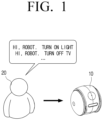
- FIG. 1 is a diagram for explaining a method for controlling an electronic apparatus according to one or more embodiments.
- an electronic apparatus 10 may perform an operation corresponding to a voice command received from a user 20.
- the electronic apparatus 10 may perform an operation corresponding to the voice command uttered by the user 20.
- the electronic apparatus 10 may be implemented in a different types of electronic apparatus, which may perform speech recognition.
- the electronic apparatus 10 may be implemented as a mobile robot and travel in a driving space.
- the disclosure is not limited thereto, and the electronic apparatus 10 may be implemented, for example, in various apparatuses such as a smart television (TV), a tablet personal computer (PC), a monitor, a smartphone, a desktop computer, and a laptop computer.
- the electronic apparatus 100 according to one or more embodiments of the disclosure is not limited to the above-mentioned apparatuses, and the electronic apparatus 100 may be implemented as the electronic apparatus 100 having two or more functions of the above-mentioned apparatuses.
- the electronic apparatus 10 may receive a voice command from the user 20.
- the voice command may be a phrase: "Hi, robot. Turn on the light”.
- the electronic apparatus 10 may operate a speech recognition mode of the electronic apparatus 10 based on the call keyword, and may perform an operation corresponding to the received voice command.
- the user 20 may repeatedly input the same user command to the electronic apparatus 10.
- the electronic apparatus 10 may repeatedly receive a voice command corresponding to "Turn on the TV" at 8:00 PM.
- the electronic apparatus 10 may repeatedly receive a voice command corresponding to "Turn off the light” at 11:00 PM.
- the electronic apparatus 10 may repeatedly receive a voice command corresponding to "Recommend the recipe" when the electronic apparatus 10 is located at a kitchen in a home.
- the electronic apparatus 10 may perform a corresponding operation only when the call keyword is received. As such, it may be inconvenient for the user to repeat input of the call keywords one by one even in case of requesting such a simple command.
- the disclosure provides various embodiments of performing a corresponding operation by using the electronic apparatus and context data of the user in case that the voice command is received even though no separate call keyword is input.
- FIG. 2 is a block diagram showing a configuration of the electronic apparatus according to one or more embodiments.
- the electronic apparatus 100 may include at least one sensor 110, a memory 120, a microphone 130, and at least one processor 140.
- At least one sensor 110 may include a plurality of sensors of various types.
- the sensor 110 may measure a physical quantity or detect an operation state of the electronic apparatus 100, and convert the measured or detected information into an electrical signal.
- the sensor 110 may include a camera, and the camera may include a lens that focuses visible light and other optical signals received after being reflected by an object to an image sensor, and the image sensor which may detect visible light and other optical signals.
- the image sensor may include a two-dimensional (2D) pixel array divided into a plurality of pixels.
- the camera may be implemented as a depth camera.
- the sensor 110 may include a thermal image sensor that reads a shape as well as a distance sensor such as a light detection and ranging (LiDAR) sensor or a time of flight (TOF) sensor.
- LiDAR light detection and ranging
- TOF time of flight
- the sensor 110 may detect the operation state of the electronic apparatus 100 and/or an external environment state of the electronic apparatus 100.
- the sensor 110 may include one or more sensors configured to detect the operation state (e.g., power or temperature) of the electronic apparatus 100 and/or the external environment state (e.g., ambient temperature, humidity, or user state) of the electronic apparatus 100.
- the sensor 110 may include at least one of a temperature sensor capable of acquiring temperature data, a humidity sensor capable of acquiring humidity data, a gesture sensor, a gyro sensor, a pressure sensor, a proximity sensor, a bio sensor, an illuminance sensor, and a fine dust sensor capable of calculating concentration of fine dust around the electronic apparatus 100.
- the sensor 110 may include a motion sensor detecting motion of the electronic apparatus 100.
- the memory 120 may store data.
- the memory 120 may store data necessary for the electronic apparatus 100 according to various embodiments of the disclosure.
- the memory 120 may be implemented in the form of a memory embedded in the electronic apparatus 100, or may be implemented in the form of a memory detachable from the electronic apparatus 100, based on a data storing purpose.
- data for driving the electronic apparatus 100 may be stored in the memory embedded in the electronic apparatus 100
- data for an extension function of the electronic apparatus 100 may be stored in the memory detachable from the electronic apparatus 100.
- the memory embedded in the electronic apparatus 100 may be implemented as at least one of a volatile memory (for example, a dynamic random access memory (DRAM), a static RAM (SRAM), or a synchronous dynamic RAM (SDRAM)), a nonvolatile memory (for example, an one time programmable read only memory (OTPROM), a programmable ROM (PROM), an erasable and programmable ROM (EPROM), an electrically erasable and programmable ROM (EEPROM), a mask ROM, or a flash ROM), a flash memory (for example, a NAND flash or a NOR flash), a hard drive, or a solid state drive (SSD)).
- a volatile memory for example, a dynamic random access memory (DRAM), a static RAM (SRAM), or a synchronous dynamic RAM (SDRAM)
- a nonvolatile memory for example, an one time programmable read only memory (OTPROM), a programmable ROM (PROM), an erasable and programm
- the memory detachable from the electronic apparatus 100 may be implemented in the form of a memory card (for example, a compact flash (CF), a secure digital (SD), a micro secure digital (Micro-SD), a mini secure digital (Mini-SD), an extreme digital (xD), or a multimedia card (MMC)), or an external memory which may be connected to a universal serial bus (USB) port (for example, a USB memory).
- a memory card for example, a compact flash (CF), a secure digital (SD), a micro secure digital (Micro-SD), a mini secure digital (Mini-SD), an extreme digital (xD), or a multimedia card (MMC)
- USB universal serial bus
- the memory 120 may store context data corresponding to a plurality of commands.
- the memory 120 may store a plurality of context data, each corresponding to one of the plurality of commands. That is, each of the plurality of commands may be associated with corresponding context data in the memory 120.
- a first command, among the plurality of commands may be associated with first context data stored in the memory 120
- a second command, among the plurality of commands may be associated with second context data stored in the memory 120.
- the command may indicate data for text corresponding to a request (or intent) of the user, and the request of the user may indicate a command requesting execution of a specific service.
- the user may input "Turn on the TV”
- the command may be a text corresponding to "Turn on the TV”
- the request of the user that corresponds to "Turn on the TV” may be a control command to turn on a television (TV) among one or more electronic apparatuses.
- TV television
- such classification is an example, and may be implemented in various ways based on a system implementation method.
- the context data may include not only context data of the electronic apparatus 100 but also context data of the user. This configuration is described in detail with reference to FIG. 5 .
- the microphone 130 may indicate a module that acquires audio and converts the audio into an electrical signal.
- the microphone 130 may be a condenser microphone, a ribbon microphone, a moving coil microphone, a piezoelectric element microphone, a carbon microphone, or a micro electro mechanical system (MEMS) microphone.
- MEMS micro electro mechanical system
- the microphone may be implemented using an omnidirectional method, a bi-directional method, a uni-directional method, a sub-cardioid method, a super-cardioid method, or a hyper-cardioid method.
- the microphone 130 may receive a voice command. According to one or more embodiments, the microphone 130 may acquire audio corresponding to a voice command and convert the same into an audio signal.
- the processor 140 may be electrically connected to the sensor 110, the memory 120, and the microphone 130 to control an overall operation of the electronic apparatus 100.
- the processor 140 may include one or more processors.
- the processor 140 may perform an operation of the electronic apparatus 100 according to the various embodiments of the disclosure by executing at least one command stored in the memory 120.
- the processor 140 may be implemented as a digital signal processor (DSP) processing a digital video signal, a microprocessor, a graphics processing unit (GPU), an artificial intelligence (AI) processor, or a neural processing unit (NPU), or a timing controller (T-CON).
- DSP digital signal processor
- the processor may include at least one of a central processing unit (CPU), a micro controller unit (MCU), a micro processing unit (MPU), a controller, an application processor (AP), a communication processor (CP), or an advanced RISC machine (ARM) processor, or may be defined by this term.
- the processor 140 may be implemented in a system-on-chip (SoC) or a large scale integration (LSI) in which a processing algorithm is embedded, or may be implemented in the form of an application specific integrated circuit (ASIC) or a field programmable gate array (FPGA).
- SoC system-on-chip
- LSI large scale integration
- ASIC application specific integrated circuit
- FPGA field programmable gate array
- the processor 140 may be implemented as the digital signal processor (DSP), the microprocessor, or the time controller (T-CON).
- DSP digital signal processor
- the processor may include at least one of the central processing unit (CPU), the micro controller unit (MCU), the micro processing unit (MPU), the controller, the application processor (AP), the communication processor (CP), or the advanced RISC machine (ARM) processor, or may be defined by this term.
- the processor 140 may be implemented in the system-on-chip (SoC) or the large scale integration (LSI) in which the processing algorithm is embedded, or may be implemented in the form of the field programmable gate array (FPGA).
- SoC system-on-chip
- LSI large scale integration
- FPGA field programmable gate array
- the processor 140 may acquire a text corresponding to a voice command. According to one or more embodiments, the processor 140 may acquire the text corresponding to the received voice command when the voice command is received through the microphone 130. For example, in case that the voice command corresponding to "turn on the light" is received from the user through the microphone 130, the processor 140 may acquire the text corresponding to the received "turn on the lights.”
- the processor 140 may identify the command based on the acquired text. According to one or more embodiments, the processor 140 may identify whether the acquired text is similar to any of the plurality of commands stored in the memory 120. According to one or more embodiments, the processor 140 may identify whether a command, among the plurality of commands, having similarity satisfying a first threshold value or more with the acquired text exists. For example, in a case, in which, a text (acquired text) corresponding to "turn on the light" is received, the processor 140 may compare the acquired text with texts corresponding to the plurality of commands stored in the memory 120 and acquire similarities between the acquired text and the texts based on the comparison. The processor 140 may then identify at least one command having the similarity satisfying a first threshold value or more among the similarities between the acquired text and the texts corresponding to each of the plurality of commands.
- the similarity between the acquired text and the texts responding to the plurality of commands stored in the memory 120 may be similarity between phonemes included in each of the acquired text and the texts responding to the plurality of commands stored in the memory 120.
- the processor 140 may identify the acquired text and the plurality of commands by phoneme units, and compare phonemes in the acquired text with phonemes in the texts corresponding to the plurality of commands stored in the memory 120.
- the processor 140 may calculate the similarity of each of the plurality of commands with the acquired text based on a ratio of the number of phonemes that match the phonemes in the acquired text among the phonemes included in the respective command. According to one or more embodiments, this configuration is described in detail with reference to FIG. 4 .
- the context data may include position data of the electronic apparatus 100, state data of the electronic apparatus 100, environment data of the electronic apparatus 100, or the context data of the user. Accordingly, different types of context data, each corresponding to the plurality of commands may be stored in the memory. In case that any one of the plurality of commands is identified, the processor 140 may identify the context data corresponding to the identified command based on the data stored in the memory 120. According to one or more embodiments, this configuration is described in detail with reference to FIG. 5 .
- the processor 140 may acquire current context data.
- the current context data may be the context data at time when the voice command is received.
- the context data may include, but is not limited to utterance time of the user.
- the processor 140 may acquire the current context data through at least one sensor 110.
- the disclosure is not limited thereto, and as such, the processor 140 may acquire the current context data based on the received voice command. That is, the current context data may include context data acquired through at least one sensor 110, and context data acquired based on the received voice command.
- the processor 140 may identify similarity between the acquired current context data and the context data corresponding to the identified command.
- the processor 140 may acquire a control signal corresponding to the identified command based on the identified similarity, and perform an operation based on the identified command.
- the processor 140 may compare the context data (referred to as “current context data”) acquired through the sensor 110 and the context data (referred to as “command context data”) corresponding to the identified command from the memory 120 for each type, and acquire the similarity between the current context data and the command context data corresponding to the identified command. In case that the similarity between the current context data and command context data corresponding to the identified command satisfies a second threshold value or more, the processor 140 may acquire the control signal corresponding to the identified command and perform the operation corresponding the control signal.
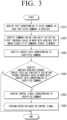
- FIG. 3 is a flowchart for explaining a method for controlling an electronic apparatus according to one or more embodiments.
- the method may include acquiring a text corresponding to a voice command is received (S310). For example, in a case, in which, a voice command corresponding to a phrase "What time is it?" is received as a voice command without including a separate call keyword (or a wake-up sound) from a user through the microphone 130, the processor 140 may acquire a text corresponding to the phrase "What time is it?".
- the method may include identifying a command, among the plurality of commands stored in the memory 120, having a similarity with the acquired text satisfying a first threshold value or more (S320).
- the processor 140 may acquire a plurality of similarities (e.g., a plurality of similarity values), each corresponding to the plurality of commands.
- each of the plurality of similarity values may be acquired by comparing the acquired text corresponding to the phrase "What time is it?" with a stored text corresponding to each of the plurality of commands stored in the memory 120.
- the processor 140 may identify the text corresponding to "What time is it?" and "What time is it?", which is a command having the similarity of the first critical value or more, from each other based on the acquired similarity.
- the method may include identifying context data corresponding to the identified command (S330).
- the processor 140 may identify the context data corresponding to the identified command "What time is it?" based on data stored in the memory 120.
- the context data corresponding to the identified command may be the context data of the electronic apparatus 100 and/or the context data of the user at time in which the voice command corresponding to "What time is it?" is previously received from the user. That is, the commands stored in the memory 120 and the context data corresponding the stored commands may be history data for commands and contexts, previously acquired from the user.
- the context data corresponding the stored commands may be referred to as "stored context data". A method of updating the data stored in the memory 120 based on such a user history is described in detail with reference to FIGS. 9 and 10 .
- the method may include identifying whether the current context data corresponding to the received voice command is similar to the stored context data corresponding to the identified command (S340). For example, the method may include identifying whether a similarity (e.g., a similarity value) between the current context data and the stored context data satisfies a second threshold value or more. That is, the method may include identifying whether the similarity value based on a comparison between the current context data and the stored context data is equal to or greater than the second threshold value.
- a similarity e.g., a similarity value
- the processor 140 may compare a plurality of data of different types included in context data acquired through the sensor 110 or the voice command, current context data including context data acquired using the voice command, and the plurality of data of different types included in the context data corresponding to the identified command for each corresponding type to identify whether the context data corresponding to the identified command has the similarity satisfying the second threshold value or more.
- the acquired current context data may include the current time data, temperature data, position data of the electronic apparatus 100, and position data of the user, acquired through the sensor 110.
- the processor 140 may acquire the similarity by comparing data on each of the current time, temperature, position of the electronic apparatus 100, and the position of the user, included in the acquired current context data, with data on each of the current time, temperature, position of the electronic apparatus 100, and the position of the user, included in the context data corresponding to the identified command for each type.
- the processor 140 may acquire the similarity by performing the comparison only based on data of at least some types among the plurality of data of different types included in the context data.
- a weight value corresponding to each type of the plurality of data may be stored in the memory 120, and the weight value may have a different value based on the type. According to one or more embodiments, this configuration is described in detail with reference to FIG. 6 .
- the method may include acquiring a control signal corresponding to the identified command (S350) in case that the current context data is identified as having the similarity satisfying the second threshold value or more with the stored context data corresponding to the identified command (Y).
- the processor 140 may acquire a control signal corresponding to a current time search command as the control signal corresponding to the identified "What time is it?".
- the method may include performing an operation based on the control signal (S360).
- the processor 140 may search for the current time based on a control signal corresponding to the acquired current time search command, and provide the user with data on the searched current time.
- the electronic apparatus 100 may identify a command corresponding to the voice command by using the context data, and perform an operation corresponding thereto. As a result, user convenience may be increased.
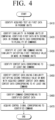
- FIG. 4 is a flowchart showing a method of acquiring the control signal corresponding to the command according to one or more embodiments.
- the processor 140 may identify the similarity based on the number of phonemes matching the phonemes of the first data among a total number of phonemes each corresponding to the plurality of commands by comparing the first data in the identified phoneme units with the plurality of second data in the phoneme units each of the plurality of second data corresponding to the plurality of commands stored in the memory 120. In this case, the processor 140 may compare corresponding phonemes with each other based on the order of phonemes. For example, the processor 140 may acquire the similarity by comparing a plurality of phonemes including "t", "e", "i", and "m” included in the acquired text with at least one phoneme included in each of the plurality of commands.
- the method may include identifying at least one command having the similarity of the first critical value or more in the phoneme units (S430). For example, the method may include identifying that a similarity value between the at least one command and the acquired text in phoneme units is greater than or equal to the first threshold value.
- the processor 140 may compare the phonemes included in the text with the phonemes included in each of the plurality of commands to identify the similarity in the phoneme units each corresponding to the plurality of commands, and identify at least one command whose identified similarity is the first critical value or more among the plurality of commands.
- the processor 140 may identify "What time is it?" as a command having the similarity satisfying the first threshold value or more in the phoneme units with the acquired text "What time is it?".
- the disclosure is not limited to the above example, and the plurality of commands each having the first threshold value or more may be provided.
- the method may include identifying context data corresponding to at least one command (S440).
- the processor 140 may acquire the context data, e.g., state data of the electronic apparatus 100, position data of the electronic apparatus 100, the gender data of the utterer, and the position data of the user, corresponding to the identified command "What time is it?" based on the data stored in the memory 120.
- the method may include identifying context data having the similarity satisfying a second threshold value or more with the acquired current context data among the context data corresponding to at least one command (S450).
- the processor 140 may acquire the similarity by comparing the state data of the electronic apparatus 100, the position data of the electronic apparatus 100, the gender data of the utterer, and the position data of the user, acquired through the sensor 110, with the state data of the electronic apparatus 100, the position data of the electronic apparatus 100, the gender data of the utterer, and the position data of the user, corresponding to the command "What time is it?" for each corresponding type.
- the processor 140 may identify the context data whose acquired similarity is the second critical value or more.
- the method may include identifying the command corresponding to the identified context data (S460).
- the processor 140 may identify a command corresponding to "What time is it?" from at least one command in case that the context data including the state data of the electronic apparatus 100 , the position data of the electronic apparatus 100, the gender data of the utterer, and the position data of the user, which correspond to the command "What time is it?" is identified as having the similarity of the second critical value more with the context data including the acquired state data of the electronic apparatus 100, position data of the electronic apparatus 100, gender data of the utterer, and position data of the user.
- the method may include acquiring the control signal corresponding to the identified command (S470).
- the processor 140 may acquire a control signal corresponding to the current time search command as a control signal corresponding to the identified "What time is it?".
- the electronic apparatus 100 may analyze the acquired text in the phoneme units to identify the control signal corresponding to the voice command, and then perform the operation based thereon. Accordingly, the electronic apparatus 100 may provide a service with high accuracy.
- the plurality of commands and the context data corresponding thereto may be stored in the memory 120.
- the context data each corresponding to the commands may include the position data of the electronic apparatus 100, the state data of the electronic apparatus 100, the environment data of the electronic apparatus 100, and the context data of the user.
- the disclosure is not limited thereto, and may include intent data and priority data, corresponding to the command.
- the state data of the electronic apparatus may include operation state of the electronic apparatus.
- the processor 140 may identify the command corresponding to the received voice command, and the processor 140 may identify the context data corresponding to the identified command based on the time in which the voice command is received.
- the processor 140 may store the identified command and the context data corresponding thereto in the memory 120.
- the processor 140 may acquire the command and context data corresponding to the voice command and store the same in the memory 120 to thus update the command and the context data, stored in the memory 120.
- the processor 140 may acquire a voice command after a call keyword and context data corresponding to the voice command and store the command and the context data in the memory 120.
- the position data of the electronic apparatus 100 may be data on a relative position of the electronic apparatus 100 in the driving space.
- the position data of the electronic apparatus 100 may be data on a subspace (e.g., an area or a region) where the electronic apparatus 100 is located among the plurality of subspaces (e.g., rooms) included in the driving space.
- the state data of the electronic apparatus 100 may be data on the remaining battery power of the electronic apparatus 100.
- the environment data of the electronic apparatus 100 may include the temperature data, the humidity data, and the fine dust concentration data, acquired from the sensor 110 included in the electronic apparatus 100, is not limited thereto, and may include the time data.
- the time data may indicate time data other than date data, for example, time data such as 6:00 pm or 8:30 am.
- the context data of the user may include intent data of the command and the priority data corresponding thereto.
- intent of the command may be any one of a control command, unknown intent, or chitchat (or simple conversation), but is not limited thereto.
- the priority data corresponding to the intent data may be, for example, first priority for the intent of the control command, second priority for the unknown intent, and third priority for the chitchat, but is not limited thereto.
- the plurality of commands and the context data including the plurality of data of different types corresponding thereto may be stored in the memory 120.
- FIG. 5 is a diagram showing the data stored in the memory 120 for convenience of description.
- FIG. 5 shows that the context data including the plurality of data of different types are sequentially listed, which is provided for convenience of description, and an order of the plurality of data may be different based on a user setting or the like.
- a lookup table 500 in which the plurality of commands and the context data corresponding the plurality of commands are mapped may be stored in the memory 120.
- the disclosure is not limited to a lookup table, and as such, according to another embodiment, the plurality of commands and the context data may be stored in a another manner.
- the plurality of commands and the context data may be associated with each other in memory based various data storage methods.
- the command "What time is it?" and context data 510 including the plurality of data of different types corresponding thereto may be stored in the lookup table 500.
- the context data 510 including the command and the plurality of data of different types corresponding to the command may include the data on the number of uses, a type of subspace where the electronic apparatus is located, a classification based on voice characteristics of the utterer (e.g., the gender of the utterer), the utterance time, the movement path of the user, the temperature, the humidity, the fine dust, the intent, the priority, the remaining battery power, and the command, based on the left side of the drawing.
- “90” may indicate that the command "What time is it?" is used 90 times in the corresponding context.
- "ALL” may indicate that the commands are received in all the subspaces in the driving space.
- “Male” may indicate that the gender of the utterer is male.
- “12:00” may indicate time corresponding to the utterance time.
- the context data including the plurality of commands and the plurality of data of different types corresponding thereto may be mapped in the lookup table 500.
- the command "What time is it?" and the context data 510 corresponding thereto may be stored in the lookup table, and the command "Recommend the recipe” and context data 520 thereto may also be stored in the lookup table.
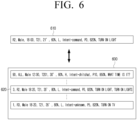
- the processor 140 may first acquire context data 610 at time in which the voice command is received through the sensor 110. For example, the voice command corresponding to "Turn on the light” may be received.
- the processor 140 may identify that the electronic apparatus 100 is located in a subspace "R2" through the sensor 110, identify the utterance time as "18:00", identify the movement path of the user as "T21”, identify the temperature corresponding to the utterance time as "21°”, identify the humidity corresponding to the utterance time as "60%”; identify the relative concentration of the fine dust corresponding to the utterance time as "L”, identify the data on the remaining battery power as "B20%” as the remaining battery power of the electronic apparatus 100 corresponding to the utterance time is 20%.
- the processor 140 may acquire "Male” as the gender data by identifying that the gender of the utterer is male by using the received voice command, and identify “Intent-command” as the intent data by identifying the intent of the user as the control command based on the text corresponding to the voice command.
- the processor may identify "P0" as priority corresponding to the identified intent data. According to one or more embodiments, "P0" may correspond to the first priority, and is not limited thereto.
- the processor 140 may compare the plurality of data of different types included in the context data with each other, and acquire the similarity corresponding to each of the plurality of data of different types, and identify an average value of the similarity corresponding to each of the different acquired types as the similarity of the context data corresponding to the command "Turn on the light"
- the processor 140 may identify a weight corresponding to each type of the plurality of data, and identify the similarity of the context data based on the identified weight. For example, the weight value corresponding to each type of the plurality of data may be pre-stored in the memory 120.
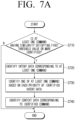
- FIG. 7A is a for explaining a method of identifying context data based on intent data according to one or more embodiments
- FIG. 7B is a diagram for explaining a method of identifying context data based on intent data according to one or more embodiments.
- the processor 140 may identify a first command and a second command, having the similarity of the first threshold value or more with a text corresponding to the voice command, based on a lookup table 700 stored in the memory 120.
- the processor 140 may identify the intent data each corresponding to the identified first command and second command based on the context data each corresponding to the commands stored in the memory 120. For example, the processor 140 may identify the context data 720 (or first context data) corresponding to the identified first command and the context data 730 (or second context data) corresponding to the second command among the context data each corresponding to the plurality of commands mapped in the lookup table 700 stored in the memory 120. Next, the processor 140 may identify "Intent-chitchat" and "Intent-unknown", respectively, by the intent data included in the context data 720 corresponding to the identified first command and the context data 730 corresponding to the second command.
- the method may include identifying one of at least one command based on each priority of the identified intent data (S730).
- the processor 140 may identify, as "P5" and "P10", the priority data each corresponding to "Intent-chitchat” and "Intent-unknown", which are the intent data included in the first context data 720 corresponding to the identified first command and the second context data 730 corresponding to the identified second command, and identify the second command corresponding to the second context data 730 having higher priority among the commands.
- control method may include identifying the context data corresponding to the identified command (S740).
- the processor 140 may identify the second context data 730 corresponding to the second command.
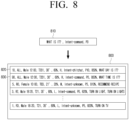
- FIG. 8 is a diagram for explaining a method of identifying the command based on the intent data for each phrase according to one or more embodiments.
- the processor 140 may identify one of the commands stored in the memory 120 based on a phrase (or a text) corresponding to the voice command and the intent data therefor.
- the processor 140 may acquire the phrase and intent data corresponding to the voice command in case that the acquired current context data is identified as having the similarity satisfying the second threshold value or more with the stored context data corresponding to at least one command.
- the processor 140 may first identify an acquired text "What is it?" and the command "What day is it?" and “What time is it?", each having the similarity satisfying the first threshold value or more. Next, the processor 140 may identify the context data having the similarity satisfying the second threshold value or more with the acquired current context data among the identified commands based on the data stored in the memory 120. In this case, the processor 140 may identify that each of the first context data 820 and the second context data 830 has the similarity satisfying the second threshold value or more.
- the processor 140 may acquire a phrase corresponding to the voice command "What is it?" and "Intent-command" which is intent data corresponding thereto. Meanwhile, the processor 140 may also acquire intent data including the priority data "P0" corresponding to the intent data "Intent-command” That is, the processor 140 may acquire a plurality of data 810 including the intent data and the priority data corresponding to the intent data.
- the processor 140 may identify one of at least one command by comparing the acquired phrase and intent data with the intent data for each phrase corresponding to each of the plurality of commands stored in the memory 120. For example, the processor 140 may compare "Intent-command" which is the intent data corresponding to the acquired "What is it?" with the intent data included in each of the first context data 820 and the second context data 830 to identify “Intent-command” which is the intent data corresponding to phrase "What is it?" in the acquired text from the voice command and the phrase "What time is it?" which is the command corresponding to the second context data including the same intent data.
- the electronic apparatus 100 may identify the user command by using the intent of the user that is included in the voice command. Accordingly, the electronic apparatus 100 may thus provide the response with the higher accuracy.
- the processor 140 may delete at least one of the plurality of commands from the memory 120 based on at least one of the use history or priority of the plurality of commands stored in the memory 120. According to one or more embodiments, the processor 140 may delete identified any one command and context data corresponding thereto from the memory 120 in case that the number of uses is identified as less than a predetermined value based on the use history of any one of the plurality of commands. Alternatively, the processor 140 may delete a command having the lowest priority and context data corresponding thereto, based on the data on the priorities of the plurality of commands.
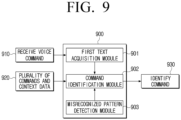
- FIG. 9 is a block diagram for explaining a first speech recognition module according to one or more embodiments.
- the processor 140 may identify a command corresponding to the acquired text among the plurality of commands stored in the memory 120 by using the first speech recognition module.
- the processor 140 may input the received voice command to the first speech recognition module 900.
- the first speech recognition module 900 may acquire the text corresponding to the voice command by inputting the input voice command to the first text acquisition module 901.
- the command identification module 902 may identify a command corresponding to the acquired text (930) based on the plurality of commands and the context data corresponding thereto stored in the memory 120 (920). For example, the command identification module 902 may identify the context data corresponding to the identified command in case that the command having the similarity of the first threshold value or more with the acquired text is identified among the plurality of commands stored in the memory 120, and identify the current context data as the command corresponding to the acquired text in case that the acquired current context data is identified as having the similarity of the second threshold value or more with the context data corresponding to the identified command.
- the misrecognized pattern detection module 903 may be a module that identifies a text having similarity of a predetermined value or more with each of the plurality of commands stored in the memory 120 or detects (or identifies) a text identified as the same command as the command. According to one or more embodiments, the misrecognized pattern detection module 903 may identify, as "What time is it?" in case that a text "What times it?" similar to "What time is it?" is input. Alternatively, the misrecognized pattern detection module may identify, as "Tell me the current time” in case that "Tell me the current time” identified as the same command as "What time is it?" is input.
- the processor 140 may update the memory 120 to include data on the identified text in case that the command corresponding to the text having the similarity of the predetermined value or more with each of the plurality of commands stored through the misrecognition pattern detection module 903 or the text which is the same command as each of the plurality of commands is identified.
- the command corresponding to the text having the similarity of the predetermined value or more with a text of the first command may be identified.
- the processor 140 may store data for identifying the identified command as the first command in the memory 120.
- the processor 140 may identify a command including a text identified as the same command as the first command, and update the memory 120 for data on the identified command to be included in data on the first command.
- the processor 140 may identify an identified command as the first command in case that the identified command is received.
- FIG. 10 is a block diagram for explaining a second speech recognition module according to one or more embodiments.
- the processor 140 may acquire the command corresponding to the user voice command by using the second speech recognition module to store the acquired command and context data corresponding to the acquired command in the memory 120. That is, the second speech recognition module may update the context data stored in the memory 120.
- the processor 140 may first receive the voice command (1010). Next, according to one or more embodiments, the processor 140 may identify the call keyword in case that the call keyword is included in the voice command (1020).
- a second speech recognition module 1000 may include a second text acquisition module 1002 and a natural language understanding module 1001.
- the second text acquisition module 1002 may be a module that outputs a text corresponding to the acquired voice command, and implemented as a learning neural network model.
- the second text acquisition module 1002 may be a module different from the first text acquisition module 901, and the second text acquisition module 1002 may receive the voice in conversational units and acquire the same as a text.
- the processor 140 may acquire the context data based on the sensor 110 or the received voice command, and acquire the text corresponding to the voice command and the corresponding intent data of the user, received through the second speech recognition module 1000.
- the processor 140 may store the acquired context data, the acquired text, and the corresponding intent data (1030) of the user in the memory 120.
- the processor 140 may perform the speech recognition on the voice command by using the second speech recognition module in case that the command having the similarity satisfying the first threshold value or more with the acquired text is not identified using the first speech recognition module.
- the processor 140 may acquire the text corresponding to the voice command by performing the speech recognition on the voice command by using the second speech recognition module 1000 in case that the command having the similarity satisfying the first threshold value or more is not identified even though the first speech recognition module 900 is used to identify the similarity between the acquired text and the plurality of commands stored in the memory 120.
- the processor 140 may identify the command having the similarity satisfying the first threshold value or more by comparing the acquired text with the data stored in the memory 120 by using the second speech recognition module 1000.
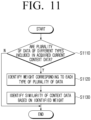
- the method may first include identifying whether a plurality of data of different types are included in the acquired current context data (S1110).
- the method may include identifying the weight corresponding to each type of the plurality of data (S1120) in case that the plurality of data of different types are included in the acquired current context data (Y).
- the processor 140 may acquire the state data of the electronic apparatus 100 through the sensor 110, for example, the data on the remaining battery power of the electronic apparatus 100.
- the processor 140 may acquire the environmental data of the electronic apparatus 100 through the sensor 110, for example, the data on at least one of the temperature, the humidity, the illumination, the fine dust concentration, or the current time.
- the processor 140 may acquire the context data of the user, for example, the data on the gender of the user or the position of the user. In this case, the processor 140 may identify the weight corresponding to each type of the plurality of data based on the data stored in the memory 120.
- the method may include identifying the similarity of the context data based on the identified weight (S1130).
- the processor 140 may identify the weight corresponding to each of the plurality of data based on the data stored in the memory 120.
- the processor 140 may compare the plurality of data of different types included in the current context data and the plurality of data of different types included in the context data corresponding to the command, respectively, to identify the similarity corresponding to each of the plurality of data of different types (e.g., position of the subspace, gender of the utterer, or time corresponding to the utterance time), and identify the similarity of the context data each corresponding to the plurality of commands by multiplying the similarity corresponding to each of the plurality of identified data by the weight value corresponding to each similarity.
- the processor 140 may compare the plurality of data of different types included in the current context data and the plurality of data of different types included in the context data corresponding to the command, respectively, to identify the similarity corresponding to each of the plurality of data of different types (e.g., position of the subspace, gender of the utterer, or time corresponding to the utterance time), and identify the similarity of the context data each corresponding to the plurality of commands by multiplying the similarity corresponding to each
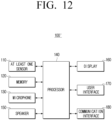
- FIG. 12 is a block diagram showing a detailed configuration of an electronic apparatus according to one or more embodiments.
- an electronic apparatus 100' may include sensor 110, a memory 120, a microphone 130, a processor 140, a speaker 150, a display 160, a user interface 170, and a communication interface 180.
- sensor 110 a memory 120
- a processor 140 a processor 140
- speaker 150 a speaker 150
- display 160 a display 160
- user interface 170 a user interface 170
- communication interface 180 a communication interface 180. The description omits detailed descriptions of components overlapping the components shown in FIG. 2 among the components shown in FIG. 12 .
- the speaker 150 may include a tweeter for high-pitched audio playback, a midrange for midrange audio playback, a woofer for low-pitched audio playback, a subwoofer for extremely low-pitched audio playback, an enclosure for controlling resonance, a crossover network that divides a frequency of the electrical signal input to the speaker for each band, or the like.
- the speaker 150 may output the audio signal to the outside of the electronic apparatus 100'.
- the speaker 150 may output multimedia playback, recording playback, various notification sounds, voice messages, or the like.
- the electronic apparatus 100' may include an audio output device such as the speaker 150, or an output device such as an audio output terminal.
- the speaker 150 may provide acquired data, processed/produced information based on the acquired data, a response result to the user voice, an operation result to the user voice, or the like, in a form of the voice.
- the display 160 may be implemented as a display including a self-light emitting element or a display including a non self-light emitting element and a backlight.
- the display may be implemented in various types of displays such as a liquid crystal display (LCD), an organic light emitting diode (OLED) display, a light emitting diode (LED) display, a micro light emitting diode (micro LED) display, a mini LED display, a plasma display panel (PDP), a quantum dot (QD) display, a quantum dot light-emitting diode (QLED) display.
- LCD liquid crystal display
- OLED organic light emitting diode
- LED light emitting diode
- micro LED micro light emitting diode
- mini LED a mini LED display
- PDP plasma display panel
- QD quantum dot
- QLED quantum dot light-emitting diode
- the display 160 may also include a driving circuit, a backlight unit, or the like, which may be implemented in a form such as an a-si thin film transistor (TFT), a low temperature poly silicon (LTPS) TFT, or an organic TFT (OTFT). Meanwhile, the display 160 may be implemented as a touch screen combined with a touch sensor, a flexible display, a rollable display, a three-dimensional (3D) display, a display in which a plurality of display modules are physically connected with each other, or the like.
- the processor 140 may control the display 160 to output an acquired output image according to various embodiments described above.
- the output image may be a high-resolution image of 4K, 8K or higher.
- the user interface 170 is a component for the electronic apparatus 100' to perform interaction with the user.
- the user interface 170 may include at least one of a touch sensor, a motion sensor, a button, a jog dial, a switch, a microphone, or a speaker, and is not limited thereto.
- the electronic apparatus may identify the command corresponding to the voice command by using the context data even though no separate call keyword is received in case that the voice command is received, and perform the operation corresponding thereto. Accordingly, the electronic apparatus may provide a prompt service in response to the request of the user for performing the simple operation.
- the various embodiments described above may be implemented by software including an instruction stored in a machine-readable storage medium (according to one or more embodiments, a computer-readable storage medium).
- a machine may be an apparatus that invokes the stored instruction from the storage medium and may be operated based on the invoked instruction, and may include a display device (e.g., display device A) according to the disclosed embodiments.
- the instruction is executed by the processor, the processor may directly perform a function corresponding to the instruction or other components may perform the function corresponding to the instruction under control of the processor.
- the instruction may include codes provided or executed by a compiler or an interpreter.
- the machine-readable storage medium may be provided in the form of a non-transitory storage medium.
- the term "non-transitory" indicates that the storage medium is tangible without including a signal, and does not distinguish whether data are semi-permanently or temporarily stored in the storage medium.
- the methods according to the various embodiments described above may be included and provided in a computer program product.
- the computer program product may be traded as a product between a seller and a purchaser.
- the computer program product may be distributed in a form of the machine-readable storage medium (according to one or more embodiments, a compact disc read only memory (CD-ROM)) or online through an application store (according to one or more embodiments, PlayStoreTM).
- an application store accordinging to one or more embodiments, PlayStoreTM.
- at least a part of the computer program product may be at least temporarily stored or temporarily provided in a storage medium such as a memory of a server of a manufacturer, a server of an application store or a relay server.
Landscapes
- Engineering & Computer Science (AREA)
- Physics & Mathematics (AREA)
- Audiology, Speech & Language Pathology (AREA)
- Health & Medical Sciences (AREA)
- Computational Linguistics (AREA)
- Theoretical Computer Science (AREA)
- Multimedia (AREA)
- Human Computer Interaction (AREA)
- Acoustics & Sound (AREA)
- Artificial Intelligence (AREA)
- General Health & Medical Sciences (AREA)
- General Engineering & Computer Science (AREA)
- General Physics & Mathematics (AREA)
- User Interface Of Digital Computer (AREA)
Applications Claiming Priority (3)
| Application Number | Priority Date | Filing Date | Title |
|---|---|---|---|
| KR20220116473 | 2022-09-15 | ||
| KR1020220135926A KR20240037791A (ko) | 2022-09-15 | 2022-10-20 | 음성 인식을 수행하는 전자 장치 및 이의 제어 방법 |
| PCT/KR2023/013137 WO2024058474A1 (fr) | 2022-09-15 | 2023-09-04 | Dispositif électronique pour effectuer une reconnaissance vocale, et son procédé de commande |
Publications (2)
| Publication Number | Publication Date |
|---|---|
| EP4528721A1 true EP4528721A1 (fr) | 2025-03-26 |
| EP4528721A4 EP4528721A4 (fr) | 2025-07-09 |
Family
ID=90244316
Family Applications (1)
| Application Number | Title | Priority Date | Filing Date |
|---|---|---|---|
| EP23865772.0A Pending EP4528721A4 (fr) | 2022-09-15 | 2023-09-04 | Dispositif électronique pour effectuer une reconnaissance vocale, et son procédé de commande |
Country Status (3)
| Country | Link |
|---|---|
| US (1) | US12603089B2 (fr) |
| EP (1) | EP4528721A4 (fr) |
| CN (1) | CN119654673A (fr) |
Families Citing this family (1)
| Publication number | Priority date | Publication date | Assignee | Title |
|---|---|---|---|---|
| EP4528721A4 (fr) * | 2022-09-15 | 2025-07-09 | Samsung Electronics Co Ltd | Dispositif électronique pour effectuer une reconnaissance vocale, et son procédé de commande |
Family Cites Families (26)
| Publication number | Priority date | Publication date | Assignee | Title |
|---|---|---|---|---|
| US9858925B2 (en) | 2009-06-05 | 2018-01-02 | Apple Inc. | Using context information to facilitate processing of commands in a virtual assistant |
| BR102012024861B1 (pt) | 2011-09-30 | 2021-02-09 | Apple Inc. | sistema para desambiguar entrada de usuário para realizar uma tarefa |
| US9794134B2 (en) * | 2012-11-16 | 2017-10-17 | Apple Inc. | System and method for negotiating control of a shared audio or visual resource |
| WO2015073019A1 (fr) | 2013-11-15 | 2015-05-21 | Intel Corporation | Système et procédé permettant de gérer un dictionnaire dynamique de reconnaissance vocale |
| KR102292546B1 (ko) | 2014-07-21 | 2021-08-23 | 삼성전자주식회사 | 컨텍스트 정보를 이용하는 음성 인식 방법 및 장치 |
| JP6322765B2 (ja) * | 2014-08-02 | 2018-05-09 | アップル インコーポレイテッド | コンテキスト特化ユーザインターフェース |
| KR102299330B1 (ko) | 2014-11-26 | 2021-09-08 | 삼성전자주식회사 | 음성 인식 방법 및 그 전자 장치 |
| US9775113B2 (en) | 2014-12-11 | 2017-09-26 | Mediatek Inc. | Voice wakeup detecting device with digital microphone and associated method |
| KR102453603B1 (ko) | 2015-11-10 | 2022-10-12 | 삼성전자주식회사 | 전자 장치 및 그 제어 방법 |
| KR102642666B1 (ko) | 2016-02-05 | 2024-03-05 | 삼성전자주식회사 | 음성인식 장치 및 방법, 음성인식시스템 |
| KR102389625B1 (ko) | 2017-04-30 | 2022-04-25 | 삼성전자주식회사 | 사용자 발화를 처리하는 전자 장치 및 이 전자 장치의 제어 방법 |
| US11972339B2 (en) | 2018-03-23 | 2024-04-30 | Google Llc | Controlling a robot based on free-form natural language input |
| US10943606B2 (en) | 2018-04-12 | 2021-03-09 | Qualcomm Incorporated | Context-based detection of end-point of utterance |
| FR3080926B1 (fr) | 2018-05-04 | 2020-04-24 | Spoon | Procede de commande d'une pluralite d'effecteurs d'un robot |
| US11087740B2 (en) * | 2018-11-27 | 2021-08-10 | Rovi Guides, Inc. | Systems and methods for training a control system based on prior audio inputs |
| CN114207710A (zh) | 2019-10-15 | 2022-03-18 | 谷歌有限责任公司 | 检测和/或登记热命令以由自动助理触发响应动作 |
| EP3841459B1 (fr) | 2019-11-08 | 2023-10-04 | Google LLC | Utilisation de corrections, de fonctions automatisées d'assistant, pour l'apprentissage de modèles d'apprentissage machine sur dispositif |
| US11158308B1 (en) * | 2019-11-27 | 2021-10-26 | Amazon Technologies, Inc. | Configuring natural language system |
| US11551685B2 (en) * | 2020-03-18 | 2023-01-10 | Amazon Technologies, Inc. | Device-directed utterance detection |
| KR20220045741A (ko) | 2020-10-06 | 2022-04-13 | 주식회사 케이티 | 연속 상황을 판단하여 음성 인식 서비스를 제공하는 장치, 방법 및 컴퓨터 프로그램 |
| KR102458830B1 (ko) | 2020-11-16 | 2022-10-26 | 주식회사 솔트룩스 | 사용자 중심의 음성 대화 시스템 |
| US11538478B2 (en) * | 2020-12-07 | 2022-12-27 | Amazon Technologies, Inc. | Multiple virtual assistants |
| US11967319B2 (en) | 2020-12-22 | 2024-04-23 | Direct Cursus Technology L.L.C | Method and electronic device for processing a spoken utterance |
| US11721347B1 (en) * | 2021-06-29 | 2023-08-08 | Amazon Technologies, Inc. | Intermediate data for inter-device speech processing |
| US12175976B2 (en) * | 2022-08-24 | 2024-12-24 | Amazon Technologies, Inc. | Multi-assistant device control |
| EP4528721A4 (fr) * | 2022-09-15 | 2025-07-09 | Samsung Electronics Co Ltd | Dispositif électronique pour effectuer une reconnaissance vocale, et son procédé de commande |
-
2023
- 2023-09-04 EP EP23865772.0A patent/EP4528721A4/fr active Pending
- 2023-09-04 CN CN202380057989.7A patent/CN119654673A/zh active Pending
- 2023-10-27 US US18/384,607 patent/US12603089B2/en active Active
Also Published As
| Publication number | Publication date |
|---|---|
| EP4528721A4 (fr) | 2025-07-09 |
| CN119654673A (zh) | 2025-03-18 |
| US20240096322A1 (en) | 2024-03-21 |
| US12603089B2 (en) | 2026-04-14 |
Similar Documents
| Publication | Publication Date | Title |
|---|---|---|
| US11114099B2 (en) | Method of providing voice command and electronic device supporting the same | |
| KR102528466B1 (ko) | 복수 화자의 음성 신호 처리 방법 및 그에 따른 전자 장치 | |
| CN106030440B (zh) | 智能循环音频缓冲器 | |
| US10825453B2 (en) | Electronic device for providing speech recognition service and method thereof | |
| CN113168837A (zh) | 用于处理语音的人声数据的方法和设备 | |
| US11030991B2 (en) | Method and device for speech processing | |
| KR102697371B1 (ko) | 음성 명령에 응답하여 컨텐츠를 표시하기 위한 방법 및 그 전자 장치 | |
| KR20210050747A (ko) | 음성 처리 방법 및 음성 처리 장치 | |
| US11915700B2 (en) | Device for processing user voice input | |
| US11468123B2 (en) | Co-reference understanding electronic apparatus and controlling method thereof | |
| US20200326832A1 (en) | Electronic device and server for processing user utterances | |
| US20170157766A1 (en) | Machine object determination based on human interaction | |
| CN112840313A (zh) | 电子设备及其控制方法 | |
| US11386304B2 (en) | Electronic device and method of controlling the same | |
| US12603089B2 (en) | Electronic apparatus performing speech recognition and method for controlling thereof | |
| US11710498B2 (en) | Electronic device and control method therefor | |
| KR102773338B1 (ko) | 전자 장치 및 전자 장치의 제어 방법 | |
| KR20240037791A (ko) | 음성 인식을 수행하는 전자 장치 및 이의 제어 방법 | |
| WO2016206646A1 (fr) | Procédé et système pour pousser un dispositif de machine à générer une action | |
| US20220288788A1 (en) | Robot and method for controlling same | |
| KR20200021409A (ko) | 전자 장치 및 그 제어 방법 | |
| WO2023239469A1 (fr) | Systèmes et processus de reconnaissance automatique de la parole | |
| KR20190128516A (ko) | 전자 장치 및 그 동작방법 | |
| KR20240056194A (ko) | 전자 장치 및 이의 제어 방법 | |
| US20240274128A1 (en) | Electronic device and control method thereof |
Legal Events
| Date | Code | Title | Description |
|---|---|---|---|
| STAA | Information on the status of an ep patent application or granted ep patent |
Free format text: STATUS: THE INTERNATIONAL PUBLICATION HAS BEEN MADE |
|
| PUAI | Public reference made under article 153(3) epc to a published international application that has entered the european phase |
Free format text: ORIGINAL CODE: 0009012 |
|
| STAA | Information on the status of an ep patent application or granted ep patent |
Free format text: STATUS: REQUEST FOR EXAMINATION WAS MADE |
|
| 17P | Request for examination filed |
Effective date: 20241217 |
|
| AK | Designated contracting states |
Kind code of ref document: A1 Designated state(s): AL AT BE BG CH CY CZ DE DK EE ES FI FR GB GR HR HU IE IS IT LI LT LU LV MC ME MK MT NL NO PL PT RO RS SE SI SK SM TR |
|
| REG | Reference to a national code |
Ref country code: DE Ref legal event code: R079 Free format text: PREVIOUS MAIN CLASS: G10L0015220000 Ipc: G10L0015180000 |
|
| A4 | Supplementary search report drawn up and despatched |
Effective date: 20250605 |
|
| RIC1 | Information provided on ipc code assigned before grant |
Ipc: G06F 40/247 20200101ALI20250530BHEP Ipc: G06F 3/16 20060101ALI20250530BHEP Ipc: G10L 15/22 20060101ALI20250530BHEP Ipc: G10L 15/18 20130101AFI20250530BHEP |
|
| DAV | Request for validation of the european patent (deleted) | ||
| DAX | Request for extension of the european patent (deleted) | ||
| STAA | Information on the status of an ep patent application or granted ep patent |
Free format text: STATUS: EXAMINATION IS IN PROGRESS |