EP4529057A1 - Datenverarbeitungsverfahren, elektronische vorrichtung und computerlesbares speichermedium - Google Patents
Datenverarbeitungsverfahren, elektronische vorrichtung und computerlesbares speichermedium Download PDFInfo
- Publication number
- EP4529057A1 EP4529057A1 EP23806678.1A EP23806678A EP4529057A1 EP 4529057 A1 EP4529057 A1 EP 4529057A1 EP 23806678 A EP23806678 A EP 23806678A EP 4529057 A1 EP4529057 A1 EP 4529057A1
- Authority
- EP
- European Patent Office
- Prior art keywords
- network coding
- data packet
- network
- coding mode
- source data
- Prior art date
- Legal status (The legal status is an assumption and is not a legal conclusion. Google has not performed a legal analysis and makes no representation as to the accuracy of the status listed.)
- Pending
Links
Images







Classifications
-
- H—ELECTRICITY
- H04—ELECTRIC COMMUNICATION TECHNIQUE
- H04L—TRANSMISSION OF DIGITAL INFORMATION, e.g. TELEGRAPHIC COMMUNICATION
- H04L1/00—Arrangements for detecting or preventing errors in the information received
- H04L1/004—Arrangements for detecting or preventing errors in the information received by using forward error control
- H04L1/0076—Distributed coding, e.g. network coding, involving channel coding
-
- H—ELECTRICITY
- H03—ELECTRONIC CIRCUITRY
- H03M—CODING; DECODING; CODE CONVERSION IN GENERAL
- H03M13/00—Coding, decoding or code conversion, for error detection or error correction; Coding theory basic assumptions; Coding bounds; Error probability evaluation methods; Channel models; Simulation or testing of codes
- H03M13/29—Coding, decoding or code conversion, for error detection or error correction; Coding theory basic assumptions; Coding bounds; Error probability evaluation methods; Channel models; Simulation or testing of codes combining two or more codes or code structures, e.g. product codes, generalised product codes, concatenated codes, inner and outer codes
-
- H—ELECTRICITY
- H03—ELECTRONIC CIRCUITRY
- H03M—CODING; DECODING; CODE CONVERSION IN GENERAL
- H03M13/00—Coding, decoding or code conversion, for error detection or error correction; Coding theory basic assumptions; Coding bounds; Error probability evaluation methods; Channel models; Simulation or testing of codes
- H03M13/29—Coding, decoding or code conversion, for error detection or error correction; Coding theory basic assumptions; Coding bounds; Error probability evaluation methods; Channel models; Simulation or testing of codes combining two or more codes or code structures, e.g. product codes, generalised product codes, concatenated codes, inner and outer codes
- H03M13/2906—Coding, decoding or code conversion, for error detection or error correction; Coding theory basic assumptions; Coding bounds; Error probability evaluation methods; Channel models; Simulation or testing of codes combining two or more codes or code structures, e.g. product codes, generalised product codes, concatenated codes, inner and outer codes using block codes
-
- H—ELECTRICITY
- H03—ELECTRONIC CIRCUITRY
- H03M—CODING; DECODING; CODE CONVERSION IN GENERAL
- H03M13/00—Coding, decoding or code conversion, for error detection or error correction; Coding theory basic assumptions; Coding bounds; Error probability evaluation methods; Channel models; Simulation or testing of codes
- H03M13/65—Purpose and implementation aspects
- H03M13/6508—Flexibility, adaptability, parametrability and configurability of the implementation
- H03M13/6513—Support of multiple code types, e.g. unified decoder for LDPC and turbo codes
-
- H—ELECTRICITY
- H04—ELECTRIC COMMUNICATION TECHNIQUE
- H04L—TRANSMISSION OF DIGITAL INFORMATION, e.g. TELEGRAPHIC COMMUNICATION
- H04L1/00—Arrangements for detecting or preventing errors in the information received
- H04L1/0001—Systems modifying transmission characteristics according to link quality, e.g. power backoff
- H04L1/0009—Systems modifying transmission characteristics according to link quality, e.g. power backoff by adapting the channel coding
-
- H—ELECTRICITY
- H04—ELECTRIC COMMUNICATION TECHNIQUE
- H04L—TRANSMISSION OF DIGITAL INFORMATION, e.g. TELEGRAPHIC COMMUNICATION
- H04L1/00—Arrangements for detecting or preventing errors in the information received
- H04L1/0001—Systems modifying transmission characteristics according to link quality, e.g. power backoff
- H04L1/0014—Systems modifying transmission characteristics according to link quality, e.g. power backoff by adapting the source coding
-
- H—ELECTRICITY
- H04—ELECTRIC COMMUNICATION TECHNIQUE
- H04L—TRANSMISSION OF DIGITAL INFORMATION, e.g. TELEGRAPHIC COMMUNICATION
- H04L1/00—Arrangements for detecting or preventing errors in the information received
- H04L1/0001—Systems modifying transmission characteristics according to link quality, e.g. power backoff
- H04L1/0023—Systems modifying transmission characteristics according to link quality, e.g. power backoff characterised by the signalling
-
- H—ELECTRICITY
- H04—ELECTRIC COMMUNICATION TECHNIQUE
- H04L—TRANSMISSION OF DIGITAL INFORMATION, e.g. TELEGRAPHIC COMMUNICATION
- H04L1/00—Arrangements for detecting or preventing errors in the information received
- H04L1/004—Arrangements for detecting or preventing errors in the information received by using forward error control
- H04L1/0041—Arrangements at the transmitter end
-
- H—ELECTRICITY
- H04—ELECTRIC COMMUNICATION TECHNIQUE
- H04L—TRANSMISSION OF DIGITAL INFORMATION, e.g. TELEGRAPHIC COMMUNICATION
- H04L1/00—Arrangements for detecting or preventing errors in the information received
- H04L1/004—Arrangements for detecting or preventing errors in the information received by using forward error control
- H04L1/0056—Systems characterized by the type of code used
- H04L1/0057—Block codes
-
- H—ELECTRICITY
- H04—ELECTRIC COMMUNICATION TECHNIQUE
- H04L—TRANSMISSION OF DIGITAL INFORMATION, e.g. TELEGRAPHIC COMMUNICATION
- H04L1/00—Arrangements for detecting or preventing errors in the information received
- H04L1/004—Arrangements for detecting or preventing errors in the information received by using forward error control
- H04L1/0056—Systems characterized by the type of code used
- H04L1/0064—Concatenated codes
- H04L1/0065—Serial concatenated codes
-
- H—ELECTRICITY
- H04—ELECTRIC COMMUNICATION TECHNIQUE
- H04L—TRANSMISSION OF DIGITAL INFORMATION, e.g. TELEGRAPHIC COMMUNICATION
- H04L1/00—Arrangements for detecting or preventing errors in the information received
- H04L1/004—Arrangements for detecting or preventing errors in the information received by using forward error control
- H04L1/0075—Transmission of coding parameters to receiver
-
- H—ELECTRICITY
- H03—ELECTRONIC CIRCUITRY
- H03M—CODING; DECODING; CODE CONVERSION IN GENERAL
- H03M13/00—Coding, decoding or code conversion, for error detection or error correction; Coding theory basic assumptions; Coding bounds; Error probability evaluation methods; Channel models; Simulation or testing of codes
- H03M13/03—Error detection or forward error correction by redundancy in data representation, i.e. code words containing more digits than the source words
- H03M13/05—Error detection or forward error correction by redundancy in data representation, i.e. code words containing more digits than the source words using block codes, i.e. a predetermined number of check bits joined to a predetermined number of information bits
- H03M13/11—Error detection or forward error correction by redundancy in data representation, i.e. code words containing more digits than the source words using block codes, i.e. a predetermined number of check bits joined to a predetermined number of information bits using multiple parity bits
- H03M13/1102—Codes on graphs and decoding on graphs, e.g. low-density parity check [LDPC] codes
-
- H—ELECTRICITY
- H03—ELECTRONIC CIRCUITRY
- H03M—CODING; DECODING; CODE CONVERSION IN GENERAL
- H03M13/00—Coding, decoding or code conversion, for error detection or error correction; Coding theory basic assumptions; Coding bounds; Error probability evaluation methods; Channel models; Simulation or testing of codes
- H03M13/03—Error detection or forward error correction by redundancy in data representation, i.e. code words containing more digits than the source words
- H03M13/05—Error detection or forward error correction by redundancy in data representation, i.e. code words containing more digits than the source words using block codes, i.e. a predetermined number of check bits joined to a predetermined number of information bits
- H03M13/13—Linear codes
- H03M13/15—Cyclic codes, i.e. cyclic shifts of codewords produce other codewords, e.g. codes defined by a generator polynomial, Bose-Chaudhuri-Hocquenghem [BCH] codes
- H03M13/151—Cyclic codes, i.e. cyclic shifts of codewords produce other codewords, e.g. codes defined by a generator polynomial, Bose-Chaudhuri-Hocquenghem [BCH] codes using error location or error correction polynomials
- H03M13/1515—Reed-Solomon codes
-
- H—ELECTRICITY
- H03—ELECTRONIC CIRCUITRY
- H03M—CODING; DECODING; CODE CONVERSION IN GENERAL
- H03M13/00—Coding, decoding or code conversion, for error detection or error correction; Coding theory basic assumptions; Coding bounds; Error probability evaluation methods; Channel models; Simulation or testing of codes
- H03M13/37—Decoding methods or techniques, not specific to the particular type of coding provided for in groups H03M13/03 - H03M13/35
- H03M13/373—Decoding methods or techniques, not specific to the particular type of coding provided for in groups H03M13/03 - H03M13/35 with erasure correction and erasure determination, e.g. for packet loss recovery or setting of erasures for the decoding of Reed-Solomon codes
Definitions
- the present disclosure relates to the technical field of communication, and more particularly, to a data processing method, an electronic device, and a computer-readable storage medium.
- the Packet Data Convergence Protocol (PDCP) layer in L2 employs PDCP repetition, which involves repeatedly sending data packets.
- PDCP repetition can enhance reliability in Ultra Reliable Low Latency Communication (URLLC) scenarios, it is constrained by physical resource overheads, and can only be applied to small data packets. Moreover, the repeated transmission of data packets results in excessive consumption of physical resources.
- URLLC Ultra Reliable Low Latency Communication
- Embodiments of the present disclosure provide a data processing method, an electronic device, and a computer-readable storage medium, to improve the reliability and throughput of data transmission while reducing physical resource overheads.
- an embodiment provides a data processing method, including:
- an embodiment provides a data processing method, including:
- an embodiment of the present disclosure provides an electronic device, including: at least one processor; and at least one memory, configured for storing at least one program, where the at least one program, when executed by the at least one processor, causes the at least one processor to implement the data processing method described above.
- an embodiment provides a computer-readable storage medium, storing a processor-executable program which, when executed by a processor, causes the processor to implement the data processing method described above.
- a transmitting end determines a first network coding mode for a source data packet according to a pre-configured first network coding parameter, performs network coding on the source data packet based on the determined first network coding mode to generate encoded data, and transmits the encoded data to a first receiving end, such that the first receiving end receives sufficient encoded data for processing. That is to say, the transmitting end only needs to send the corresponding encoded data to the first receiving end, and the first receiving end can effectively complete the decoding. Therefore, the delay caused by repeated sending of data packets can be avoided, and the reliability and throughput of data transmission can be improved while reducing physical resource overheads, thereby filling in the technical gap in related methods.
- a transmitting end determines a first network coding mode for a source data packet according to a pre-configured first network coding parameter, performs network coding on the source data packet based on the determined first network coding mode to generate encoded data, and transmits the encoded data to a first receiving end, such that the first receiving end receives sufficient encoded data for processing. That is to say, the transmitting end only needs to send the corresponding encoded data to the first receiving end, and the first receiving end can effectively complete the decoding. Therefore, the delay caused by repeated sending of data packets can be avoided, and the reliability and throughput of data transmission can be improved while reducing physical resource overheads, thereby filling in the technical gap in related methods.
- FIG. 1 is a schematic diagram of an implementation environment configured for executing a data processing method according to an embodiment of the present disclosure.
- the implementation environment includes, but not limited to, a transmitting end 110 and a first receiving end 120.
- the first receiving end 120 and the transmitting end 110 can send wireless signals to each other, receive wireless signals from each other, perform related interaction with each other, and so on.
- the relative positions, numbers, etc., of the first receiving end 120 and the transmitting end 110 may be set according to specific application scenarios.
- the transmitting end 110 can radiate a signal to the outside, and the first receiving end 120 may move along a trajectory formed by the transmitting end 110 when radiating the signal to the outside.
- the spatial positions may be different geographical locations.
- the implementation environment may further include, but not limited to, a second receiving end 130.
- the first receiving end 120 and the second receiving end 130 can send wireless signals to each other, receive wireless signals from each other, perform related interaction with each other, and so on.
- the number of second receiving ends 130 may be one or more, which is not limited and may be set by those having ordinary skills in the art according to requirements in actual application scenarios.
- the first receiving end 120 may interact with one second receiving end 130 individually or with a plurality of second receiving ends 130 respectively, which does not affect functional applications of the first receiving end 120.
- the transmitting end 110, the first receiving end 120, or the second receiving end 130 may include, but not limited to, one of the following devices: a Base Station (BS), an Access Point (AP), a NodeB, a generalized Node B (g NodeB), a Radio Network Controller (RNC), an Evolved NodeB (eNB), a Base Station Controller (BSC), a Base Transceiver Station (BTS), a Transceiver Function (TF), a radio router, a radio transceiver, a Basic Service Set (BSS), an Extended Service Set (ESS), or a Radio Base Station (RBS), which is not particularly limited in this embodiment.
- BS Base Station
- AP Access Point
- NodeB a generalized Node B
- RNC Radio Network Controller
- eNB Evolved NodeB
- BSC Base Station Controller
- BTS Base Transceiver Station
- TF Transceiver Function
- radio router a radio transceiver
- BSS Basic Service Set
- the transmitting end 110, the first receiving end 120, or the second receiving end 130 may be referred to as an access terminal device, a User Equipment (UE), a subscriber unit, a subscriber station, a mobile station, a remote station, a remote terminal device, a mobile device, a user terminal device, a wireless communication device, a user agent, or a user device.
- UE User Equipment
- the transmitting end 110 may be a cellular phone, a cordless telephone, a Session Initiation Protocol (SIP) telephone, a Wireless Local Loop (WLL) station, a Personal Digital Assistant (PDA), a handheld device with a wireless communication function, a computing device or other processing device connected to a wireless modem, a vehicle-mounted device, a wearable device, a terminal device in a 5G network or future evolved networks, etc., which is not limited in this embodiment.
- SIP Session Initiation Protocol
- WLL Wireless Local Loop
- PDA Personal Digital Assistant
- the implementation environment for executing the data processing method may be applied to, but not limited to, the 5G TS of the 3GPP.
- 6G 6th Generation
- 6G 6th Generation
- Component-based design of Radio Interface Protocol stacks may become an important research direction. Enterprises can choose components according to their own requirements under the framework allowed by the Radio Interface Protocol stack to build a communication network that meets the requirements of enterprises. Network coding can also be used as an option in 6G technology in the form of components to improve the reliability and throughput of data transmission. That is to say, the implementation environment for executing the data processing method in this embodiment may also be applied, but not limited to, 6G communication or future-generation communication networks.
- the transmitting end 110 has at least functions of determining a first network coding mode for a source data packet according to a pre-configured first network coding parameter, encodes the source data packet according to the first network coding mode to obtain a first encoded data packet, and sending the first encoded data packet to the first receiving end 120.
- the first receiving end 120 has at least functions of receiving the first encoded data packet sent by the transmitting end 110 and processing the first encoded data packet.
- the first encoded data packet is obtained by the transmitting end 110 by encoding the source data packet according to the first network coding mode for the source data packet, and the first network coding mode is determined by the transmitting end 110 according to the pre-configured first network coding parameter.
- the second receiving end 130 has at least a function of receiving the first encoded data packet sent by the first receiving end 120 or receiving a third encoded data packet sent by the first receiving end 120.
- the third encoded data packet is obtained by the first receiving end 120 by decoding the first encoded data packet to obtain the source data packet and encoding the source data packet.
- the above functions of the transmitting end 110, the first receiving end 120, or the second receiving end 130 may be applied to different application scenarios, which is not limited herein.
- FIG. 1 and FIG. 2 do not constitute a limitation to the embodiments of the present disclosure, and more or fewer components than those shown in the figure may be included, or some components may be combined, or a different component arrangement may be used.
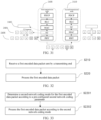
- FIG. 3 is a flowchart of a data processing method according to an embodiment of the present disclosure.
- the data processing method may include, but not limited to, the following steps S110 to S130.
- a first network coding mode for the at least one source data packet is determined according to a pre-configured first network coding parameter.
- the execution entity of the data processing method in this embodiment may be, but not limited to, the transmitting end 110 in the embodiment shown in FIG. 1 or FIG. 2 , or those having ordinary skills in the art may set the corresponding execution entity according to actual application scenarios, which is not limited in this embodiment.
- the following related embodiments are described with the transmitting end as the execution entity of the data processing method, which should not be construed as a limitation to the embodiments of the present disclosure.
- the transmitting end determines the first network coding mode for the source data packet according to the pre-configured first network coding parameter, so as to perform network coding on the source data packet based on the first network coding mode to generate encoded data in subsequent steps.
- the source data packet includes at least one of:
- the source data packet may also be set according to specific application scenarios, which is not limited in this embodiment. Methods for acquiring the source data packet are well known to those having ordinary skills in the art, so the details will not be described herein.
- the source data packet is acquired from a Radio Interface Protocol stack.
- the source data packets in any two of the Radio Interface Protocol stacks correspond to different first network coding modes.
- first network coding modes corresponding to source data packets in different Radio Interface Protocol stacks can be distinguished, so this characteristic can be used as a determination criterion to detect the source of a source data packet in the network space.
- the Radio Interface Protocol stack to which the source data packet belongs can be further determined according to the source of the source data packet, which is not limited herein.
- the first network coding mode includes, but not limited to, at least one of:
- the first network coding mode may also be set according to specific application scenarios, which is not limited herein. Specific application principle of the above network coding modes will be described respectively in the following embodiments and will not be described in detail here.
- the first network coding parameter includes, but not limited to, at least one of:
- a specific configuration content of the first network coding parameter may be:
- a specific first network coding mode may have a mapping relationship with one or more first network coding parameters.
- the mapping relationship includes, but not limited to, a mapping formula, a mapping table, a mapping chart, and other expressions indicating a correspondence relationship. The mapping relationship will be described in the following embodiments.
- first network coding parameter may also be set according to specific application scenarios, which is not limited herein. Specific application principle of the above first network coding parameter will be described in the following embodiments and will not be described in detail here.
- steps prior to S110 are further described, and prior to S110, the method further include at least one of:
- the pre-configured first network coding parameter may be sent through higher-layer signaling, or may be carried by the source data packet, for example, carried and sent by header information of the source data packet, so as to ensure that the pre-configured first network coding parameter can be obtained stably and reliably.
- the method for configuring the first network coding parameter may also be selected by those having ordinary skills in the art according to specific application scenarios, which is not limited herein.
- the at least one source data packet is encoded according to the first network coding mode to obtain a first encoded data packet.
- the source data packet may be encoded according to the first network coding mode to obtain a first encoded data packet, such that the obtained first encoded data packet can be sent to the first receiving end in subsequent steps, and the first receiving end can process the first encoded data packet.
- the source data packet may be encoded according to the first network coding mode by a variety of methods, which may be selected by those having ordinary skills in the art according to specific scenarios. Specific implementations will be described below.
- the first network coding parameter includes at least one of:
- the first random seed is determined by at least one of index information of the first encoded data packet, quantity information of the source data packet, or quantity information of the first encoded data packet.
- the second random seed is determined by at least one of index information of the first encoded data packet, quantity information of the source data packet, or quantity information of the first encoded data packet.
- the first random seed and the second random seed are determined by at least one of index information of the first encoded data packet, quantity information of the source data packet, or quantity information of the first encoded data packet.
- S120 when the first network coding parameter includes the first random seed, the second random seed, and the first degree distribution indication, S120 is further described, and S120 may include, but not limited to, the following steps S1200 to S1202.
- a degree of one of the first encoded data packets is randomly generated according to a first degree distribution and the first random seed, where the first degree distribution is determined according to the first degree distribution indication.
- a target quantity of source data packets is selected from the source data packets based on the second random seed, where the target quantity is the generated degree of the first encoded data packet.
- encoding computation is performed on the target quantity of source data packets and encoding matrices corresponding to the target quantity of source data packets to obtain a first encoded data packet.
- encoding computation can be performed on the target quantity of source data packets and encoding matrices corresponding to the target quantity of source data packets to obtain the first encoded data packet, such that the first encoded data packet can be further sent out in subsequent steps.
- first random seed, the second random seed, and the first degree distribution indication are well known to those having ordinary skills in the art and therefore will not be described in detail herein. Specific application scenarios of the first random seed, the second random seed, and the first degree distribution indication will be described in the following examples.
- a degree d of a j th encoded data packet R j is randomly generated according to a degree distribution and a first random seed, where j is a non-negative integer, d is a positive integer, and the degree distribution is determined according to the first degree distribution indication.
- d integers n 1 , n 2 , ⁇ nd are randomly and evenly selected from 0 to k-1 according to a second random seed.
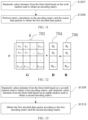
- k is equal to 5, i.e., the raw data is divided into five source data packets 202, where one of the encoded data packets 206 corresponds to a degree of 3, and this encoded data packet corresponds to 204 in the encoding matrix G.
- encoded data packet shall be construed as "first encoded data packet” shown in S120, i.e., the two have the same meanings, unless otherwise stated.
- the first network coding parameter includes at least one of:
- the third random seed is determined by at least one of index information of the first encoded data packet, quantity information of the source data packet, or quantity information of the first encoded data packet.
- the fourth random seed is determined by at least one of index information of the first encoded data packet, quantity information of the source data packet, or quantity information of the first encoded data packet.
- the third random seed and the fourth random seed are determined by at least one of index information of the first encoded data packet, quantity information of the source data packet, or quantity information of the first encoded data packet.
- S120 when the first network coding parameter includes the third random seed, the fourth random seed, the second degree distribution indication, and the third degree distribution indication, S120 is further described, and S120 may include, but not limited to, the following steps S1203 to S1204.
- the source data packets are pre-coded according to a second degree distribution and the third random seed to obtain intermediate encoded data packets, where the second degree distribution is determined according to the second degree distribution indication.
- the intermediate encoded data packet is encoded by LT coding according to a third degree distribution and the fourth random seed to obtain the first encoded data packet, where the third degree distribution is determined according to the third degree distribution indication.
- the intermediate encoded data packet can be encoded by LT coding to obtain the first encoded data packet, such that the first encoded data packet can be further sent out in subsequent steps.
- Raptor coding outperforms LT coding but has higher encoding and decoding complexity in the case of receiving the same number of redundant encoded data packets.
- the Raptor coding process includes precoding and LT coding.
- k source data packets 302 are pre-coded according to a degree distribution and a third random seed.
- the precoding includes, but not limited to, Low Density Parity Check Code (LDPC) coding.
- LDPC Low Density Parity Check Code
- a precoding matrix 308 has a size of n0 rows and k columns.
- the intermediate encoded data packets are encoded by LT coding according to a fourth random seed and a degree distribution. The degree distribution is determined according to a third degree distribution indication.
- An LT encoding matrix 310 has a size of n rows and n0 columns.
- the pre-encoding matrix and the encoding matrix are composed of elements ⁇ 0, 1 ⁇ .
- the first network coding parameter includes at least one of:
- the fifth random seed is determined by at least one of index information of the first encoded data packet, quantity information of the source data packet, or quantity information of the first encoded data packet.
- S120 when the first network coding parameter includes the fifth random seed and the fourth degree distribution indication, S120 is further described, and S120 may include, but not limited to, a following step S1205.
- the intermediate symbols are encoded by LT coding according to a fourth degree distribution and the fifth random seed to obtain the first encoded data packet, where the fourth degree distribution is determined according to the fourth degree distribution indication.
- the intermediate symbols corresponding to the source data packets are determined, and the intermediate symbols are encoded by LT coding based on the combination of the fifth random seed and the fourth degree distribution to obtain the first encoded data packet, such that the first encoded data packet can be sent out in subsequent steps.
- Raptor Q coding is a further development of Raptor coding. It outperforms Raptor coding but has higher encoding and decoding complexity.
- 402 represents a construction matrix G of Raptor Q, which is composed of multiple submatrices.
- G LDPC1 and G LDPC2 each represent a low-density parity-check matrix composed of elements ⁇ 0, 1 ⁇ in a finite field.
- G HDPC represents a high-density parity-check matrix in a finite field.
- I S and I H respectively represent identity matrices with orders S and H.
- G LT represents an LT encoding matrix.
- S, H, B, U, and K' respectively represent the sizes of corresponding submatrices, and are all positive integers. In an embodiment, S, H, B, U, and K' are determined by the value of k.
- 404 represents an intermediate symbol I with a size of L, where L is determined by the value of k.
- the construction matrix G is invertible, the intermediate symbol I corresponding to D' can be obtained.
- the encoded data packet R [R 0 ;R 1 ; ⁇ ;R n-1 ]; can be obtained by LT encoding the intermediate symbol I.
- Raptor Q coding of the intermediate symbol I is provided, where a matrix operation is performed on an encoding matrix 502 and an intermediate symbol 504 in a finite field to obtain data 506.
- G LT_r represents an LT encoding matrix for generating redundant encoding symbols.
- G LT_r is obtained according to a degree distribution and a fifth random seed. The degree distribution is determined according to a fourth degree distribution indication.
- Raptor Q coding supports a maximum of 56403 source data packets and a maximum encoded data packet size of 2 24 bytes, while Raptor coding supports a maximum of 8192 source data packets and a maximum encoded data packet size of 2 16 bytes.
- S120 when the first network coding mode includes RS coding, S120 is further described, and S120 may include, but not limited to, a following step S1206.
- the first encoded data packet can be obtained by performing matrix calculation on the encoding matrix and the source data packets in a finite field, such that the first encoded data packet can be sent out in subsequent steps.
- RS coding is a finite field-based coding algorithm. In the case of the same finite field and receiving the same quantity of redundant encoded data packets, RS coding has higher performance and decoding complexity than Raptor Q coding.
- FIG. 10 shows an implementation process of RS coding. As shown in FIG. 10 ,
- an encoding matrix G is determined.
- the lower part 602B may be a Vandermonde Matrix (VM) as shown below, where a i j represents a j th power of an element a i in the finite field, and j is a non-negative integer.
- VM a 0 0 a 1 0 a 2 0 ⁇ a k ⁇ 1 0 a 0 1 a 1 1 a 2 1 ⁇ a k ⁇ 1 1 a 0 2 a 1 2 a 2 2 ⁇ a k ⁇ 1 2 ⁇ ⁇ ⁇ ⁇ 0 m ⁇ 1 a 1 m ⁇ 1 a 2 m ⁇ 1 ⁇ k ⁇ 1 m ⁇ 1
- the lower part 602B may be a Cauchy Matrix (CM) as shown below, where a i and b i represent elements in the finite field.
- CM Cauchy Matrix
- a i and b i represent elements in the finite field.
- CM 1 a 0 + b 0 1 a 0 + b 1 1 a 0 + b 2 ⁇ 1 a 0 + b k ⁇ 1 1 a 1 + b 0 1 a 1 + b 1 1 a 1 + b 2 ⁇ 1 a 1 + b k ⁇ 1 1 a 2 + b 0 1 a 2 + b 1 1 a 2 + b 2 ⁇ 1 a 2 + b 2 ⁇ 1 a 2 + b k ⁇ 1 ⁇ ⁇ ⁇ 1 + b 0 1 a m ⁇ 1 + b 0 1 a m ⁇ 1 + b 1 1 1 a m ⁇ 1 + b 2
- the first network coding parameter includes a sixth random seed.
- the sixth random seed is determined by at least one of index information of the first encoded data packet, quantity information of the source data packet, or quantity information of the first encoded data packet.
- S120 when the first network coding parameter includes the sixth random seed, S120 is further described, and S120 may include, but not limited to, the following steps S1207 to S1208.
- elements are randomly selected from the finite field based on the sixth random seed to obtain an encoding matrix.
- matrix calculation is performed on the encoding matrix and the source data packets to obtain the first encoded data packet.
- the first encoded data packet can be obtained by selecting the encoding matrix according to the sixth random seed and performing matrix calculation on the encoding matrix and the source data packets in a finite field, such that the first encoded data packet can be sent out in subsequent steps.
- RLNC is a coding method that can be defined over a finite field. An encoding matrix is randomly selected in the finite field. According to the encoding matrix, input source data packets are linearly combined in the coding process. In an example, the finite field of RLNC is GF (2). In the case of receiving the same quantity of redundant encoded data packets, RLNC has lower performance than Raptor Q coding and RS coding, but has higher flexibility.
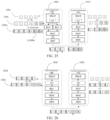
- FIG. 12 shows an example based on RLNC, where dimensions of an encoding matrix G 702 are n rows and k columns.
- the encoding matrix G is obtained by randomly selecting elements from the finite field according to a sixth random seed.
- k is an integer greater than
- n is an integer greater than k.
- an i th [ g i- 1,0 ,g i- 1 , 1 , ⁇ ,g i -1 , k- 1 ] row of the encoding matrix G in FIG. 10 is determined according to the sixth random seed Seed i , where i is an integer greater than 0 and less than or equal to n, and the sixth random seed Seed i is an integer greater than 0 and less than 2 32 . Any two random seeds are different. Elements are randomly selected from the finite field according to the sixth random seed Seed i
- the encoding matrix G in FIG. 12 is generated according to one sixth random seed Seed1, which is an integer greater than 0 and less than 2 32 . Elements are randomly selected from the finite field according to the random seed Seed1 to obtain the encoding matrix G.
- the first network coding parameter includes at least one of:
- the seventh random seed is determined by at least one of index information of the first encoded data packet, quantity information of the source data packet, or quantity information of the first encoded data packet.
- the eighth random seed is determined by at least one of index information of the first encoded data packet, quantity information of the source data packet, or quantity information of the first encoded data packet.
- the seventh random seed and the eighth random seed are determined by at least one of index information of the first encoded data packet, quantity information of the source data packet, or quantity information of the first encoded data packet.
- S120 when the first network coding parameter includes the seventh random seed and the eighth random seed, S120 is further described, and S120 may include, but not limited to, the following steps S1209 to S1210.
- elements are randomly selected from the finite field based on a seventh random seed to obtain a first encoding matrix, and elements are randomly selected from the finite field based on an eighth random seed to obtain a second encoding matrix.
- the first encoded data packet is obtained according to the first encoding matrix and the second encoding matrix.
- the corresponding encoding matrices are respectively selected according to the seventh random seed and the eighth random seed, and the first encoded data packet can be obtained according to the corresponding encoding matrices, such that the first encoded data packet can be sent out in subsequent steps.
- FNC is an extension of RLNC, with its outer encoding being RLNC in a finite field and its inner encoding being RLNC in a binary field.
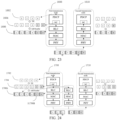
- FIG. 14 shows an example of FNC, where systematic coding is used as outer encoding and non-systematic coding is used as inner encoding.
- Dimensions of an outer encoding coefficient matrix G1 802 are k+m rows and k columns.
- G1 includes an upper part 802A which is an identity matrix, and a lower part 802B. Any element g i , j ′ of the lower part 802B is randomly selected from a finite field according to a seventh random seed.
- k encoded data packets D [D 0 ;D 1 ; ⁇ ;D k-1 ] 804 are input, and encoded to obtain outer encoded data packets O 806.
- Elements in an inner encoding coefficient matrix G2 808 are randomly selected from finite field elements ⁇ 0, 1 ⁇ according to an eighth random seed.
- FNC has increased encoding and decoding complexity, but has a higher decoding success rate.
- a q th g q ⁇ 1 , 0 g q ⁇ 1 , 1 ⁇ g q ⁇ 1 , n ⁇ 1 row of the inner encoding matrix G2 in FIG. 14 is determined according to an eighth random seed Seed3q, where q is an integer greater than 0 and less than or equal to n, and the eighth random seed Seed3q is an integer greater than 0 and less than 2 32 . Any two random seeds are different. Elements are randomly selected from finite field elements ⁇ 0, 1 ⁇ according to the eighth random seed Seed3q.
- the lower part 802A of the outer encoding matrix G1 in FIG. 14 is determined according to one seventh random seed Seed4, which is an integer greater than 0 and less than 2 32 . Elements are randomly selected from the finite field according to the random seed Seed4 to obtain the encoding matrix G1.
- the inner encoding matrix G2 in FIG. 8 is determined according to one eighth random seed Seed5, which is an integer greater than 0 and less than 2 32 . Elements are randomly selected from finite field elements ⁇ 0, 1 ⁇ according to the random seed Seed5 to obtain the encoding matrix G2.
- an order of the finite field elements described in the above embodiments may be one of: 256, 65536, 16, 32, 64, 1024, or 4096.
- the coding mode indication information includes at least one of:
- the coding mode indication information may be configured as a multi-dimensional indication to achieve a satisfactory and reliable coding mode indication effect.
- the coding mode indication information includes at least one of:
- p is an integer greater than 0, and the p bits indicate a maximum of 2 p coding modes.
- p bits are used to indicate whether to use a network coding mode and indicate which network coding mode is to be used.
- p is an integer greater than 0, and the p bits indicate a maximum of 2 p -1 network coding modes.
- One of combinations of the p bits indicates that network coding is not used.
- Table 2 shows that when p is equal to 2, three coding modes can be selected, where "00" represents that network coding is not used, "01” represents RS coding, "10” represents Raptor Q coding, and "11” represents FNC. It can be understood that in this example, the network coding modes are not limited to RS coding, Raptor Q coding, and FNC, and other network coding modes may also be used.
- S110 when the first network coding parameter includes the transmission direction of the source data packet, S110 is further described, and S110 may include, but not limited to, at least one of:
- the transmission direction of the source data packet is determined, and the corresponding matching network coding mode can be selected according to the determined transmission direction of the source data packet.
- Uplink data transmission at least includes: a UE sending data to a base station or a UE sending data to a relay.
- Downlink data transmission at least includes: the base station sending data to the UE or the relay sending data to the UE.
- the network coding modes include Raptor Q coding and RS coding, and a network coding mode is determined according to the data transmission direction. For example, if the data transmission direction is uplink data transmission, the network coding mode is RS coding; if the data transmission direction is downlink data transmission, the network coding mode is Raptor Q coding.
- Raptor Q coding is more suitable for downlink data transmission, and RS coding should be used for uplink data transmission.
- the network coding modes in this example are not limited to Raptor Q coding and RS coding, but may include, but not limited to, at least two of: LT coding, Raptor coding, Raptor Q coding, RS coding, LNC, RLNC, and FNC.
- S110 when the first network coding parameter includes the application scenario, S110 is further described, and S110 may include, but not limited to, at least one of:
- the application scenarios include URLLC, eMBB, and mMTC.
- at least two of the application scenarios correspond to different network coding modes.
- the network coding modes include FNC, Raptor Q coding, and RS coding, and a network coding mode is determined according to the application scenario.
- the network coding mode is RS coding, which has higher reliability.
- the network coding mode is Raptor Q coding, which supports more encoded data packets and can meet high data rate requirements.
- the network coding mode is FNC, which has a flexible coding mode and can satisfy the encoding of massive terminal device data.
- the network coding modes in this example are not limited to RS coding, Raptor Q coding, and FNC, but may include, but not limited to, at least three of: LT coding, Raptor coding, Raptor Q coding, RS coding, LNC, RLNC, and FNC.
- S110 when the first network coding parameter includes the network frequency range, S110 is further described, and S110 may include, but not limited to, at least one of: when the network frequency range includes a first network frequency range and a second network frequency range, determining RS coding as the first network coding mode within the first network frequency range and determining Raptor Q coding as the first network coding mode within the second network frequency range, where frequencies in the first network frequency range are lower than frequencies in the second network frequency range; or
- the network frequency range includes a first network frequency range and a second network frequency range, determining RS coding as the first network coding mode within the first network frequency range and determining FNC as the first network coding mode within the second network frequency range, where frequencies in the first network frequency range are lower than frequencies in the second network frequency range.
- the specific network frequency range is determined, and the corresponding matching network coding mode can be selected according to the determined specific network frequency range.
- specific values of the first network frequency range and the second network frequency range are not limited. That is to say, the values of the first network frequency range and the second network frequency range may be set by those having ordinary skills in the art according to actual application scenarios, which is not limited herein.
- the network frequency ranges include FR1 and FR2.
- a network coding mode corresponding to FR1 is different from that corresponding to FR2.
- the network coding mode corresponding to FR1 is RS coding
- the network coding mode corresponding to FR2 is Raptor Q coding
- the network coding mode corresponding to FR1 is RS coding
- the network coding mode corresponding to FR2 is FNC.
- FR1 a frequency range below 6 GHz
- FR2 a frequency range in the millimeter wave band
- FR1 a frequency range from 450 MHz to 6000 MHz
- FR2 a frequency range from 24250 MHz to 52600 MHz
- the network coding modes in this example are not limited to RS coding, Raptor Q coding, and FNC, but may include, but not limited to, at least two of: LT coding, Raptor coding, Raptor Q coding, RS coding, LNC, RLNC, and FNC.
- S110 when the first network coding parameter includes the UE capability information, S110 is further described, and S110 may include, but not limited to, at least one of:
- the specific UE capability information is determined, and the corresponding matching network coding mode can be selected according to a threshold range within which the determined specific UE capability information falls.
- specific values of the first threshold, the second threshold, and the third threshold are not limited. That is to say, the values of the first threshold, the second threshold, and the third threshold may be set by those having ordinary skills in the art according to actual application scenarios, which is not limited herein.
- Raptor Q coding is used; otherwise, RS coding is used.
- w1 is equal to one of: 4, 6, 8, 12, or 16.
- w2 is equal to one of: 4, 6, 8, or 10.
- w3 is equal to one of: 500 Mbps, 1 Gbps, or 10 Gbps.
- the network coding modes in this example are not limited to RS coding and Raptor Q coding, but may include, but not limited to, at least two of: LT coding, Raptor coding, Raptor Q coding, RS coding, LNC, RLNC, and FNC.
- S110 when the first network coding parameter includes the network bandwidth, S110 is further described, and S110 may include, but not limited to, at least one of:
- the specific network bandwidth is determined, and the corresponding matching network coding mode can be selected according to the determined specific network bandwidth.
- specific values of the first network bandwidth, the second network bandwidth, the third network bandwidth, and the fourth network bandwidth are not limited. That is to say, the values of the first network bandwidth, the second network bandwidth, the third network bandwidth, and the fourth network bandwidth may be set by those having ordinary skills in the art according to actual application scenarios, which is not limited herein. For example, a relationship between the values of the bandwidths may be set.
- one UE can configure a maximum of four BWPs (denoted as BWP 0, BWP 1, BWP 2, and BWP 3), only one of which is active at a certain moment.
- the network coding modes include LT coding, Raptor Q coding, RS coding, and FNC, and a network coding mode is determined according to the BWP.
- the network coding mode is LT coding; when the BWP is configured to be BWP 1, the network coding mode is Raptor Q coding; when the BWP is configured to be BWP 2, the network coding mode is RS coding; and when the BWP is configured to be BWP 3, the network coding mode is FNC.
- the network coding modes in this example are not limited to LT coding, Raptor Q coding, RS coding, and FNC, but may include, but not limited to, at least four of: LT coding, Raptor coding, Raptor Q coding, RS coding, LNC, RLNC, and FNC.
- S110 when the first network coding parameter includes the quantity information of the source data packet, S110 is further described, and S110 may include, but not limited to, a following step S1101.
- the first network coding mode is selected from the preset network coding modes according to the quantity information of the source data packet and the first mapping relationship.
- the first mapping relationship is used to characterize a quantity of the source data packets supported by each of the preset network coding modes.
- the first mapping relationship between the preset network coding modes and the quantity information of the source data packet is determined, and the first network coding mode can be selected from the preset network coding modes according to the quantity information of the source data packet and the first mapping relationship. In this way, the obtained first network coding mode can be well associated with the quantity information of the source data packet, providing high accuracy.
- the multiple value ranges include at least two value ranges.
- the network coding mode is determined according to the value of the quantity k of source data packets, i.e., a mapping relationship g : k ⁇ Method exists between the network coding mode and k.
- the quantity of source data packets supported by the network coding mode is defined as k1.
- the quantity of source data packets supported by the network coding mode is defined as k2.
- the network coding mode is RS coding
- the quantity of source data packets supported by the network coding mode is defined as k3.
- the network coding mode is Raptor Q coding
- the quantity of source data packets supported by the network coding mode is defined as k4.
- k1 is less than k2. In an example, k2 is less than k3. In an example, k3 is less than k4. In an example, k1 is less than k2, and k2 is less than k3. In an example, k1 is less than k2, k2 is less than k3, and k3 is less than k4. In an example, a maximum value of k1 is equal to an integer from 12 to 20, a maximum value of k2 is equal to an integer from 56 to 72, and a maximum value of k3 is equal to an integer from 240 to 270.
- the maximum value of k1 is equal to 16
- the maximum value of k2 is equal to 64
- the maximum value of k3 is equal to 256.
- a value range 902 of k corresponding to RLNC is greater than 0 and less than or equal to 16. In this range, RLNC has higher coding and decoding throughput, and the reliability requirement can be met by adding redundant encoded data packets.
- a value range 904 of k corresponding to FNC is greater than 16 and less than or equal to 64. In this range, FNC has higher reliability than RLNC and has lower coding and decoding complexity than RS coding.
- a value range 906 of k corresponding to RS coding is greater than 64 and less than or equal to 256. In this range, RS coding has higher reliability.
- a value range 908 of k corresponding to Raptor Q coding is greater than 256. In this range, Raptor Q coding supports more source data packets.
- the network coding modes in this example are not limited to RLNC, FNC, RS coding, and Raptor Q coding, but may include, but not limited to, at least two of: LT coding, Raptor coding, Raptor Q coding, RS coding, LNC, RLNC, and FNC.
- S110 when the first network coding parameter includes the size information of the source data packet, S110 is further described, and S110 may include, but not limited to, a following step S1102.
- the first network coding mode is selected from the preset network coding modes according to the size information of the source data packet and the second mapping relationship.
- the second mapping relationship is used to characterize a size of the source data packet supported by each of the preset network coding modes.
- the second mapping relationship between the preset network coding modes and the size information of the source data packet is determined, and the first network coding mode can be selected from the preset network coding modes according to the size information of the source data packet and the second mapping relationship. In this way, the obtained first network coding mode can be well associated with the size information of the source data packet, providing high accuracy.
- the network coding mode is determined according to the value of the source data packet size T, i.e., a mapping relationship g : T ⁇ Method exists between the network coding mode and T.
- the network coding mode is FNC
- the source data packet size supported by the network coding mode is defined as k5.
- the network coding mode is RS coding
- the source data packet size supported by the network coding mode is defined as k6.
- the network coding mode is Raptor Q coding
- the source data packet size supported by the network coding mode is defined as k7.
- k5 is less than k6. In an example, k6 is less than k7. In an example, k5 is less than k6, and k6 is less than k7. In an example, a maximum value of k5 is equal to an integer from 12 to 20, and a maximum value of k6 is equal to an integer from 240 to 270.
- the network coding modes include FNC, RS coding, and Raptor Q coding
- the maximum value of k5 is equal to 16
- the maximum value of k6 is equal to 256.
- a value range of T corresponding to FNC is greater than 0 and less than or equal to 16. In this range, FNC has lower coding and decoding complexity.
- a value range of T corresponding to RS coding is greater than 16 and less than or equal to 256. In this range, RS coding has higher reliability.
- a value range of T corresponding to Raptor Q coding is greater than 256. In this range, Raptor Q coding supports a larger encoded data packet size.
- the multiple value ranges are not limited to the values described above, and may also be equal to other values.
- the network coding modes in this example are not limited to FNC, RS coding, and Raptor Q coding, but may include, but not limited to, at least two of: LT coding, Raptor coding, Raptor Q coding, RS coding, LNC, RLNC, and FNC.
- S110 when the first network coding parameter includes the quantity information of the first encoded data packet, S110 is further described, and S110 may include, but not limited to, a following step S1103.
- the first network coding mode is selected from the preset network coding modes according to the quantity information of the first encoded data packet and the third mapping relationship.
- the third mapping relationship is used to characterize a quantity of first encoded data packets supported by each of the preset network coding modes.
- the third mapping relationship between the preset network coding modes and the quantity information of the first encoded data packet is determined, and the first network coding mode can be selected from the preset network coding modes according to the quantity information of the first encoded data packet and the third mapping relationship. In this way, the obtained first network coding mode can be well associated with the quantity information of the first encoded data packet, providing high accuracy.
- the network coding mode is determined according to the value of the quantity n of first encoded data packets, i.e., a mapping relationship g : n ⁇ Method exists between the network coding mode and n.
- the network coding mode is RLNC
- the quantity of first encoded data packets supported by the network coding mode is defined as k8.
- the network coding mode is RS coding
- the quantity of first encoded data packets supported by the network coding mode is defined as k9.
- the network coding mode is Raptor Q coding
- the quantity of first encoded data packets supported by the network coding mode is defined as k10.
- k8 is less than k9. In an example, k9 is less than k10. In an example, k8 is less than k9, and k9 is less than k10. In an example, a maximum value of k8 is equal to an integer from 24 to 40, and a maximum value of k9 is equal to an integer from 240 to 270.
- the network coding modes include RLNC, RS coding, and Raptor Q coding
- the maximum value of k8 is equal to 32
- the maximum value of k9 is equal to 256.
- a value range of n corresponding to RLNC is greater than 0 and less than or equal to 32. In this range, RLNC has higher coding and decoding throughput.
- a value range of n corresponding to RS coding is greater than 32 and less than or equal to 256. In this range, RS coding has higher reliability.
- a value range of n corresponding to Raptor Q coding is greater than 256. In this range, Raptor Q coding supports more encoded data packets.
- the multiple value ranges are not limited to the values described above, and may also be equal to other values.
- the network coding modes in this example are not limited to RLNC, RS coding, and Raptor Q coding, but may include, but not limited to, at least two of: LT coding, Raptor coding, Raptor Q coding, RS coding, LNC, RLNC, and FNC.
- S110 when the first network coding parameter includes the quantity information of the redundant data packet, S110 is further described, and S110 may include, but not limited to, a following step S1104.
- the first network coding mode is selected from the preset network coding modes according to the quantity information of the redundant data packet and the fourth mapping relationship, where the fourth mapping relationship is used to characterize a quantity of redundant data packets supported by each of the preset network coding modes.
- the fourth mapping relationship is used to characterize a quantity of redundant data packets supported by each of the preset network coding modes.
- the fourth mapping relationship between the preset network coding modes and the quantity information of the redundant data packet is determined, and the first network coding mode can be selected from the preset network coding modes according to the quantity information of the redundant data packet and the fourth mapping relationship. In this way, the obtained first network coding mode can be well associated with the quantity information of the redundant data packet, providing high accuracy.
- the network coding mode is determined according to the value of the quantity r of redundant data packets, i.e., a mapping relationship g : r ⁇ Method exists between the network coding mode and r.
- the network coding mode is Raptor Q coding
- the quantity of redundant data packets supported by the network coding mode is defined as k11.
- the network coding mode is FNC
- the quantity of redundant data packets supported by the network coding mode is defined as k12.
- k11 is less than k12.
- a maximum value of k11 is equal to an integer from 16 to 48.
- the network coding modes include Raptor Q coding and FNC, and the maximum value of k11 is equal to 32.
- Raptor Q coding can meet the reliability requirement by receiving fewer redundant data packets as compared with FNC.
- a value range of r corresponding to Raptor Q coding is greater than 0 and less than or equal to 32.
- a value range of r corresponding to FNC is greater than 32. The multiple value ranges are not limited to the values described above, and may also be equal to other values.
- the network coding modes in this example are not limited to Raptor Q coding and FNC, but may include, but not limited to, at least two of: LT coding, Raptor coding, Raptor Q coding, RS coding, LNC, RLNC, and FNC.
- S110 when the first network coding parameter includes the code rate, S110 is further described, and S110 may include, but not limited to, a following step S1105.
- the first network coding mode is selected from the preset network coding modes according to the code rate and the fifth mapping relationship.
- the fifth mapping relationship is used to characterize the code rate supported by each of the preset network coding modes.
- the fifth mapping relationship between the preset network coding modes and the code rate is determined, and the first network coding mode can be selected from the preset network coding modes according to the code rate and the fifth mapping relationship. In this way, the obtained first network coding mode can be well associated with the code rate, providing high accuracy.
- the code rate R is a real number greater than 0 and less than 1.
- the code rate is an element in a code rate set CoderateSet.
- the code rate set CoderateSet includes A1 code rates Coderate i , where i is an integer from 0 to A1-1, and A1 is an integer greater than 0.
- the network coding mode is determined according to the value of the code rate, i.e., a mapping relationship g : R ⁇ Method exists between the network coding mode and the code rate R.
- the code rate supported by the network coding mode is defined as k13.
- the code rate supported by the network coding mode is defined as k14.
- the network coding mode is Raptor Q coding
- the code rate supported by the network coding mode is defined as k15.
- the network coding mode is RS coding
- the code rate supported by the network coding mode is defined as k16. In an example, k13 is less than k14.
- k14 is less than k15. In an example, k15 is less than k16. In an example, k13 is less than k14, and k14 is less than k15. In an example, k13 is less than k14, k14 is less than k15, and k15 is less than k16. In an example, a maximum value of k13 is equal to a real number from 3/16 to 5/16, a maximum value of k14 is equal to a real number from 7/16 to 9/16, and a maximum value of k15 is equal to a real number from 11/16 to 13/16.
- the network coding modes include RLNC, FNC, Raptor Q coding, and RS coding
- the maximum value of k13 is equal to 1/4
- the maximum value of k14 is equal to 1/2
- the maximum value of k15 is equal to 3/4.
- a code rate range 1002 corresponding to RLNC is greater than 0 and less than or equal to 1/4. In this range, RLNC has the characteristics of low code rate and a large quantity of redundant encoded data packets, ensuring that the reliability requirement is met.
- a code rate range 1004 corresponding to FNC is greater than 1/4 and less than or equal to 1/2. In this range, compared with RLNC, FNC can meet the reliability requirement by receiving fewer redundant data packets.
- a code rate range 1006 corresponding to Raptor Q coding is greater than 1/2 and less than or equal to 3/4. In this range, Raptor Q coding can meet the reliability requirement by receiving fewer redundant data packets as compared with FNC. Therefore, the code rate range corresponding to Raptor Q coding is higher than that corresponding to FNC.
- a code rate range 1008 corresponding to RS coding is greater than 3/4. In this range, RS coding can meet the reliability requirement by receiving fewer redundant data packets as compared with Raptor Q coding. Therefore, the code rate range corresponding to RS coding is higher than that corresponding to Raptor Q coding.
- the multiple value ranges are not limited to the values described above, and may also be equal to other values.
- the network coding modes in this example are not limited to RLNC, FNC, Raptor Q coding, and RS coding, but may include, but not limited to, at least two of: LT coding, Raptor coding, Raptor Q coding, RS coding, LNC, RLNC, and FNC.
- S110 when the first network coding parameter includes the code rate and the quantity information of the source data packet, S110 is further described, and S110 may include, but not limited to, at least one of:
- the sixth mapping relationship between the preset network coding modes and the code rate or the seventh mapping relationship between the network coding modes, the code rate, and the quantity information of the source data packet is determined, and the first network coding mode can be selected from the preset network coding modes according to the corresponding mapping relationship. In this way, the obtained first network coding mode can be well associated with the code rate and the quantity information of the source data packet, providing high accuracy.
- the code rate and the quantity information of the source data packet there are multiple two-dimensional value spaces. There is no intersection between any two of the value spaces.
- the network coding modes used by any two of the value spaces are different.
- the multiple value spaces include at least two value spaces.
- the code rate R is a real number greater than 0 and less than 1, and k is a positive integer.
- the network coding mode is determined according to the value of the quantity k of source data packets and the value of the code rate R, i.e., a mapping relationship g : ( k,R ) ⁇ Method exists between the network coding mode, k, and R.
- the code rate R is a real number greater than 0 and less than 1, and k is a positive integer.
- the code rate range is greater than 0 and less than or equal to 1/2, it corresponds to a network coding mode subset ⁇ RLNC, FNC ⁇ .
- the code rate range is greater than 1/2 and less than 1, it corresponds to a network coding mode subset ⁇ Raptor Q, RS ⁇ .
- the network coding mode is determined from the subset according to the quantity k of source data packets.
- An area 1102 corresponds to FNC
- an area 1104 corresponds to RLNC
- an area 1106 corresponds to Raptor Q coding
- an area 1108 corresponds to RS coding.
- the reliability requirement is ensured by sending fewer redundant encoded data packets, thereby striking a balance between the reliability, the throughput, and the complexity.
- the multiple value ranges are not limited to the values described above, and may also be equal to other values.
- the network coding modes include FNC, RS coding, and Raptor Q coding.
- FNC corresponds to a two-dimensional value space 1202 where the code rate is greater than 0 and less than or equal to 1/4 and the quantity of source data packets is greater than 0 and less than or equal to 32. In this range, FNC has the characteristics of low code rate and a large quantity of redundant encoded data packets, ensuring that the reliability requirement is met.
- RS coding corresponds to a two-dimensional value space 1204 where "the code rate is greater than 1/4 or the quantity of source data packets is greater than 32" and "the code rate is less than or equal to 3/4 or the quantity of source data packets is less than or equal to 256".
- Raptor Q corresponds to a two-dimensional value space 1206 where the code rate is greater than 3/4 and less than 1 or the quantity of source data packets is greater than 256. In this range, Raptor Q coding supports more source data packets, and the code rate greater than 3/4 allows for the generation of more encoded data packets, thereby improving the reliability.
- the multiple value ranges are not limited to the values described above, and may also be equal to other values.
- the network coding modes in this example are not limited to RLNC, FNC, Raptor Q coding, and RS coding, but may include, but not limited to, at least two of: LT coding, Raptor coding, Raptor Q coding, RS coding, LNC, RLNC, and FNC.
- S110 when the first network coding parameter includes the throughput, S110 is further described, and S110 may include, but not limited to, a following step S1106.
- the first network coding mode is selected from the preset network coding modes according to the throughput and the eighth mapping relationship.
- the eighth mapping relationship is used to characterize the throughput supported by each of the preset network coding modes.
- the eighth mapping relationship between the preset network coding modes and the throughput is determined, and the first network coding mode can be selected from the preset network coding modes according to the throughput and the eighth mapping relationship. In this way, the obtained first network coding mode can be well associated with the throughput, providing high accuracy.
- the network coding mode is determined according to the range within which the value of a throughput requirement TP falls, i.e., a mapping relationship g : TP ⁇ Method exists between the network coding mode and the throughput requirement.
- a mapping relationship g : TP ⁇ Method exists between the network coding mode and the throughput requirement.
- the network coding mode is RS coding
- the throughput requirement supported by the network coding mode is defined as k17.
- the network coding mode is Raptor Q coding
- the throughput requirement supported by the network coding mode is defined as k18.
- the throughput requirement supported by the network coding mode is defined as k19.
- k17 is less than k18.
- k18 is less than k19.
- k17 is less than k18, and k18 is less than k19.
- a maximum value of k17 is equal to a real number from 500 Mbps to 2 Gbps, and a maximum value of k18 is equal to a real number from 5 Gbps to 20 Gbps.
- the network coding modes include RS coding, Raptor Q coding, and RLNC, the maximum value of k17 is equal to 1 Gbps, and the maximum value of k18 is equal to 10 Gbps.
- a value range of TP corresponding to RS coding is greater than 0 and less than or equal to 1 Gbps.
- a value range of TP corresponding to Raptor Q coding is greater than 1 Gbps and less than or equal to 10 Gbps.
- RLNC has low encoding and decoding complexity, and can meet higher throughput requirements.
- a value range of TP corresponding to RLNC is greater than 10 Gbps.
- the multiple value ranges are not limited to the values described above, and may also be equal to other values.
- the network coding modes in this example are not limited to RS coding, Raptor Q coding, and RLNC, but may include, but not limited to, at least two of: LT coding, Raptor coding, Raptor Q coding, RS coding, LNC, RLNC, and FNC.
- S110 when the first network coding parameter includes the reliability requirement, S110 is further described, and S110 may include, but not limited to, a following step S1107.
- the first network coding mode is selected from the preset network coding modes according to the reliability requirement and the ninth mapping relationship.
- the ninth mapping relationship is used to characterize the reliability requirement supported by each of the preset network coding modes.
- the ninth mapping relationship between the preset network coding modes and the reliability requirement is determined, and the first network coding mode can be selected from the preset network coding modes according to the reliability requirement and the ninth mapping relationship. In this way, the obtained first network coding mode can be well associated with the reliability requirement, providing high accuracy.
- the network coding mode is determined according to the range within which the value of the reliability requirement falls, i.e., a mapping relationship g : Pr ⁇ Method exists between the network coding mode and the reliability requirement Pr.
- a mapping relationship g : Pr ⁇ Method exists between the network coding mode and the reliability requirement Pr.
- the network coding mode is RLNC
- the reliability requirement supported by the network coding mode is defined as k20.
- the network coding mode is Raptor Q coding
- the reliability requirement supported by the network coding mode is defined as k21.
- the reliability requirement supported by the network coding mode is defined as k22.
- k20 is less than k21.
- k21 is less than k22.
- k20 is less than k21, and k21 is less than k22.
- a maximum value of k20 is equal to a real number from 0.9 to 0.995, and a maximum value of k21 is equal to a real number from 0.999 to 0.99995.
- the network coding modes include RLNC, Raptor Q coding, and RS coding
- the maximum value of k20 is equal to 0.99
- the maximum value of k21 is equal to 0.9999.
- RS coding has the highest decoding success probability and RLNC has the lowest decoding success probability.
- a value range of Pr corresponding to RLNC is greater than 0 and less than or equal to 0.99
- a value range of Pr corresponding to Raptor Q coding is greater than 0.99 and less than or equal to 0.9999
- a value range of Pr corresponding to RS coding is greater than 0.9999.
- the multiple value ranges are not limited to the values described above, and may also be equal to other values.
- the network coding modes in this example are not limited to RLNC, Raptor Q coding, and RS coding, but may include, but not limited to, at least two of: LT coding, Raptor coding, Raptor Q coding, RS coding, LNC, RLNC, and FNC.
- S110 when the first network coding parameter includes the erasure rate, S110 is further described, and S110 may include, but not limited to, a following step S1108.
- the first network coding mode is selected from the preset network coding modes according to the erasure rate and the tenth mapping relationship.
- the tenth mapping relationship is used to characterize the erasure rate supported by each of the preset network coding modes.
- the tenth mapping relationship between the preset network coding modes and the erasure rate is determined, and the first network coding mode can be selected from the preset network coding modes according to the erasure rate and the tenth mapping relationship. In this way, the obtained first network coding mode can be well associated with the erasure rate, providing high accuracy.
- the network coding mode is determined according to the range within which the value of the erasure rate falls, i.e., a mapping relationship g : Pe ⁇ Method exists between the network coding mode and the erasure rate Pe.
- a mapping relationship g Pe ⁇ Method exists between the network coding mode and the erasure rate Pe.
- the network coding mode is RS coding
- the erasure rate supported by the network coding mode is defined as k23.
- the network coding mode is FNC
- the erasure rate supported by the network coding mode is defined as k24.
- the erasure rate supported by the network coding mode is defined as k25.
- the erasure rate supported by the network coding mode is defined as k26.
- k23 is less than k24.
- k24 is less than k25.
- k25 is less than k26.
- k23 is less than k24, and k24 is less than k25.
- k23 is less than k24, k24 is less than k25, and k25 is less than k26.
- a maximum value of k23 is equal to a real number from 0.005 to 0.02
- a maximum value of k24 is equal to a real number from 0.05 to 0.2
- a maximum value of k25 is equal to a real number from 0.3 to 0.5.
- the network coding modes include RS coding, FNC, Raptor coding, and Raptor Q coding
- the maximum value of k23 is equal to 0.01
- the maximum value of k24 is equal to 0.1
- the maximum value of k25 is equal to 0.4.
- a value range 1302 of Pe corresponding to RS coding is greater than 0 and less than or equal to 0.01
- a value range 1304 of Pe corresponding to FNC is greater than 0.01 and less than or equal to 0.1
- a value range 1306 of Pe corresponding to Raptor coding is greater than 0.1 and less than or equal to 0.4
- a value range 1308 of Pe corresponding to Raptor Q coding is greater than 0.4 and less than 1.
- the multiple value ranges are not limited to the values described above, and may also be equal to other values.
- the network coding modes in this example are not limited to RS coding, FNC, Raptor coding, and Raptor Q coding, but may include, but not limited to, at least two of: LT coding, Raptor coding, Raptor Q coding, RS coding, LNC, RLNC, and FNC.
- S110 when the first network coding parameter includes the size information of the source data packet and the quantity information of the source data packet, S110 is further described, and S110 may include, but not limited to, a following step S1109.
- the first network coding mode is selected from the preset network coding modes according to the size information of the source data packet, the quantity information of the source data packet, and the eleventh mapping relationship.
- the eleventh mapping relationship is used to characterize a range of a size of the source data packet and a range of a quantity of source data packets that are supported by each of the preset network coding modes.
- the eleventh mapping relationship between the preset network coding modes, the size information of the source data packet, and the quantity information of the source data packet is determined, and the first network coding mode can be selected from the preset network coding modes according to the size information of the source data packet, the quantity information of the source data packet, and the eleventh mapping relationship.
- the obtained first network coding mode can be well associated with the size information of the source data packet and the quantity information of the source data packet, providing high accuracy.
- the network coding mode is determined according to the value of the quantity k of source data packets and the value of the source data packet size T, i.e., a mapping relationship g : ( k,T ) ⁇ Method exists between the network coding mode, k, and T.
- the network coding modes include FNC, RS coding, and Raptor Q coding.
- FNC corresponds to a two-dimensional value space 1402 where "the source data packet size is greater than 0 and less than or equal to 16" and "the quantity of source data packets is greater than 0 and less than or equal to 32".
- RS coding corresponds to a two-dimensional value space 1404 where "the source data packet size is greater than 16 or the quantity of source data packets is greater than 32" and "the source data packet size is less than or equal to 256 or the quantity of source data packets is less than or equal to 256".
- Raptor Q coding corresponds to a two-dimensional value space 1406 where "the source data packet size is greater than 256" and "the quantity of source data packets is greater than 256".
- the network coding modes in this example are not limited to FNC, RS coding, and Raptor Q coding, but may include, but not limited to, at least two of: LT coding, Raptor coding, Raptor Q coding, RS coding, LNC, RLNC, and FNC.
- S110 when the first network coding parameter includes the quantity information of the redundant data packet and the reliability requirement, S110 is further described, and S110 may include, but not limited to, a following step S1110.
- the first network coding mode is selected from the preset network coding modes according to the quantity information of the redundant data packet, the reliability requirement, and the twelfth mapping relationship.
- the twelfth mapping relationship is used to characterize a quantity of redundant data packets and the reliability requirement that are supported by each of the preset network coding modes.
- the twelfth mapping relationship between the preset network coding modes, the quantity information of the redundant data packet, and the reliability requirement is determined, and the first network coding mode can be selected from the preset network coding modes according to the quantity information of the redundant data packet, the reliability requirement, and the twelfth mapping relationship.
- the obtained first network coding mode can be well associated with the quantity information of the redundant data packet and the reliability requirement, providing high accuracy.
- the network coding modes used by any two of the value spaces are different.
- the multiple value spaces include at least two value spaces.
- the network coding mode is determined according to the value of the quantity r of redundant data packets and the value of the reliability Pr, i.e., a mapping relationship g : ( r, Pr) ⁇ Method exists between the network coding mode, r, and Pr.
- the network coding modes include RS coding, Raptor Q coding, and FNC.
- RS coding corresponds to a two-dimensional value space 1502 (i.e., a two-dimensional value space above Line 1)
- Raptor Q coding corresponds to a two-dimensional value space 1504 (i.e., a two-dimensional value space between Line 1 and Line 2)
- FNC corresponds to a two-dimensional value space 1506 (i.e., a two-dimensional value space below Line 2).
- the network coding modes in this example are not limited to RS coding, Raptor Q coding, and FNC, but may include, but not limited to, at least two of: LT coding, Raptor coding, Raptor Q coding, RS coding, LNC, RLNC, and FNC.
- S110 when the first network coding parameter includes the code rate, the quantity information of the source data packet, and the reliability requirement, S110 is further described, and S110 may include, but not limited to, the following steps S1111 to S1112.
- a target network coding mode subset is selected from the network coding mode subsets according to the code rate and the sixth mapping relationship, where the sixth mapping relationship is used to characterize a range of the code rate supported by each of the network coding mode subsets, and each of the network coding mode subsets includes a plurality of preset network coding modes.
- a preset network coding mode is selected from the target network coding mode subset as the first network coding mode according to the quantity information of the source data packet and the reliability requirement.
- the target network coding mode subset can be selected according to the determined sixth mapping relationship between the preset network coding mode subsets and the code rate, and a preset network coding mode can be selected from the target network coding mode subset as the first network coding mode according to the quantity information of the source data packet and the reliability requirement.
- the obtained first network coding mode can be well associated with the code rate, the quantity information of the source data packet, and the reliability requirement, providing high accuracy.
- the code rate when the code rate is greater than 0 and less than or equal to 1/2, it corresponds to network coding modes of FNC and RLNC, and when the code rate is greater than 1/2 and less than 1, it corresponds to network coding modes of RS coding and Raptor Q coding.
- the network coding mode is determined according to the values of Pr and k.
- the network coding modes in this example are not limited to FNC, RLNC, RS coding, and Raptor coding, but may include, but not limited to, at least two of: LT coding, Raptor coding, Raptor Q coding, RS coding, LNC, RLNC, and FNC.
- Table 3 Example table of mapping relationship between coding modes and combinations of the code rate R, the quantity k of source data packets, and the reliability Pr - 0 ⁇ k ⁇ 2 8 k >2 8 0 ⁇ R ⁇ 1/2 Pr ⁇ 10 -6 FNC FNC 10 -6 ⁇ Pr ⁇ 10 -3 FNC RLNC 10 -3 ⁇ Pr ⁇ 1 RLNC RLNC 1/2 ⁇ R ⁇ 1 Pr ⁇ 10 -6 RS Raptor Q 10 -6 ⁇ Pr ⁇ 10 -3 RS Raptor Q 10 -3 ⁇ Pr ⁇ 1 RS Raptor Q
- S110 when the first network coding parameter includes the channel state information, S110 is further described, and S110 may include, but not limited to, at least one of:
- the specific channel state information is determined, and the corresponding matching network coding mode can be selected according to the determined specific channel state information.
- the network coding method is determined according to a channel quality indication.
- the corresponding network coding modes include RS coding, Raptor Q coding, and RLNC.
- a network coding mode to be used is determined by the channel quality indication. For example, when an index value of the channel quality indication is an integer of 1 to 5, the network coding mode is RS coding; when the index value of the channel quality indication is an integer of 6 to 10, the network coding mode is Raptor Q coding; and when the index value of the channel quality indication is an integer of 11 to 15, the network coding mode is RLNC. In this way, when the channel quality is unsatisfactory, RS coding with higher performance is used to improve reliability; while when the channel quality is satisfactory, RLNC with low encoding and decoding complexity is used to improve throughput.
- the network coding method is determined according to a rank indication.
- the corresponding network coding modes include RS coding, Raptor Q coding, and RLNC.
- a network coding mode to be used is determined by the rank indication. For example, when the rank indication is equal to 1 or 2, the network coding mode is RS coding; when the rank indication is equal to 3, the network coding mode is Raptor Q coding; and when the rank indication is equal to 4, the network coding mode is RLNC. In this way, when the value of the rank indication is small, RS coding with higher performance is used to improve reliability; while when the value of the rank indication is large, RLNC is used to improve throughput.
- the network coding method is determined according to a precoding matrix indication.
- the corresponding network coding modes include RS coding, Raptor Q coding, and RLNC.
- a network coding mode to be used is determined by the precoding matrix indication. For example, for a single-layer transmission using four antenna ports with transform precoding enabled, the network coding mode is RS coding when an index value of a Transmit Precoding Matrix Indication (TPMI) is an integer of 0 to 7, is Raptor Q coding when the index value of the TPMI is an integer of 8 to 15, and is RLNC when the index value of the TPMI is an integer of 16 to 27.
- TPMI Transmit Precoding Matrix Indication
- the network coding modes in this example are not limited to RS coding, Raptor Q coding, and RLNC, but may include, but not limited to, at least two of: LT coding, Raptor coding, Raptor Q coding, RS coding, LNC, RLNC, and FNC.
- the source data packets may be data packets of one of the following sublayers in a Radio Interface Protocol stack: a PDCP layer, an RLC layer, a MAC layer, or a physical layer, where a first transmission node serves as a transmitting end, and a second transmission node serves as a first receiving end.
- the network coding mode is at least a functional module of one of the following sublayers in a Radio Interface Protocol stack: a PDCP layer, an RLC layer, a MAC layer, or a physical layer.
- a Radio Interface Protocol stack any two of the sublayers in the Radio Interface Protocol stack such as the PDCP layer, the RLC layer, the MAC layer, and the physical layer correspond to different network coding modes.
- Raptor Q coding is used in the PDCP layer
- RS coding is used in the MAC layer
- Raptor Q coding is used in the PDCP layer
- RS coding is used in the MAC layer
- Raptor Q coding is used in the PDCP layer
- RS coding is used in the MAC layer
- RS coding is performed in the MAC layer is controlled through higher-layer signaling.
- the source packets are SDU data packets of the PDCP layer.
- network coding is used to encode the SDU data packets.
- network coding is used to encode PDCP SDUs 1602.
- a PDCP header is added to the encoded data packets to obtain PDCP PDUs 1606, which are transmitted to an RLC layer of the first transmission node via an RLC channel.
- a second transmission node 1610 receives data packets 1, 3, 4, and 6.
- Data packets 2 and 5 are erased during transmission.
- the second transmission node removes the PDCP header from the received data packets at a PDCP layer thereof, and performs decoding to restore the source data packets.
- White boxes in 1602 represent the source data packets.
- Gray parts of boxes in 1606 represent data packet headers.
- Slashed parts of boxes in 1604 and 1606 represent redundant data packets.
- network coding is used to encode PDCP SDUs 1702.
- a PDCP header is added to the encoded data packets to obtain PDCP PDUs 1706A and 1706B.
- the encoded PDCP PDUs are split according to Channel State Information-Reference Signal (CSI-RS), Downlink Control Information (DCI), and other channel state information, and a cell with satisfactory channel quality or an idle cell carry more data packets.
- CSI-RS Channel State Information-Reference Signal
- DCI Downlink Control Information
- four PDCP SDUs 1702 are network-coded to obtain six encoded data packets 1704.
- a PDCP header is added to the encoded data packets to obtain six PDCP PDUs.
- Three PDCP PDUs 1706A are transmitted through a primary cell, and three PDCP PDUs 1706B are transmitted through a secondary cell.
- a second transmission node receives the data packet 1 transmitted through the primary cell and the data packets 4, 5, and 6 transmitted through the secondary cell, removes the PDCP header from the received data packets at a PDCP layer of the second transmission node, and performs decoding to restore the source data packets.
- network coding is used to encode PDCP SDUs.
- a PDCP header is added to the encoded data packets to obtain PDCP PDUs.
- each cell transmits the PDCP PDUs after PDCP repetition.
- four PDCP SDUs are network-coded to obtain six encoded data packets, and a PDCP header is added to the encoded data packets to obtain six PDCP PDUs.
- six PDCP PDUs are transmitted through a primary cell, and six PDCP PDUs identical to those transmitted through the primary cell are transmitted through a secondary cell.
- network coding is used to encode PDCP SDUs 1802.
- a PDCP header is added to the encoded data packets to obtain PDCP PDUs 1806A and 1806B.
- the encoded PDCP PDUs are split according to CSI-RS, DCI, and other channel state information, and are sent through different carriers.
- four PDCP SDUs 1802 are network-coded to obtain six encoded data packets 1804, and then a PDCP header is added to the encoded data packets to obtain six PDCP PDUs.
- Three PDCP PDUs 1806A are transmitted through a first carrier, and three PDCP PDUs 1806B are transmitted through a second carrier.
- the first carrier and the second carrier are merely used for distinguishing different carriers, and do not indicate any particular sequence.
- a second transmission node receives the data packet 1 transmitted through the first carrier and the data packets 4, 5, and 6 transmitted through the second carrier, removes the PDCP header from the received data packets at a PDCP layer of the second transmission node, and performs decoding to restore the source data packets.
- network coding is used to encode PDCP SDUs.
- a PDCP header is added to the encoded data packets to obtain PDCP PDUs.
- each carrier transmits PDCP PDU data after PDCP repetition.
- four PDCP SDUs are network-coded to obtain six encoded data packets, and a PDCP header is added to the encoded data packets to obtain six PDCP PDUs.
- six PDCP PDUs are transmitted through a first carrier, and six PDCP PDUs identical to those transmitted through the first carrier are transmitted through a second carrier.
- the source data packets are PDU data packets of the PDCP layer.
- network coding is used to encode PDCP PDUs 1902.
- a second transmission node 1908 receives data packets 1, 3, 4, and 6. Data packets 2 and 5 are erased during transmission. The second transmission node performs decoding at an NC sublayer thereof to restore the source data packets.
- the source packets are SDU data packets of the RLC layer.
- network coding is used to encode the SDU data packets.
- network coding is used to encode RLC SDUs 2002.
- an RLC header is added to the encoded data packets to obtain RLC PDUs 2006.
- a second transmission node 2010 receives data packets 1, 3, 4, and 6. Data packets 2 and 5 are erased during transmission. The second transmission node removes the RLC header from the received data packets at an RLC layer thereof and performs decoding to restore the source data packets.
- a second transmission node 2112 receives data packets a, c, and d. A data packet b is erased during transmission. The second transmission node removes the RLC header from the received data packets at an RLC layer thereof and performs decoding to restore the source data packets.
- the source data packets are PDU data packets of the RLC layer.
- network coding is used to encode RLC PDUs 2202.
- a second transmission node 2208 receives data packets 1, 3, 4, and 6. Data packets 2 and 5 are erased during transmission. The second transmission node performs decoding at an NC sublayer thereof to restore the source data packets.
- the source data packets are SDU data packets of the MAC layer.
- network coding is used to encode MAC SDUs 2302.
- a MAC header is added to the encoded data packets to obtain MAC PDUs 2306.
- a second transmission node 2310 receives data packets 1, 3, 4, and 6. Data packets 2 and 5 are erased during transmission. The second transmission node removes the MAC header from the received data packets at a MAC layer thereof, and performs decoding to restore the source data packets.
- the source data packets are PDU data of the MAC layer.
- a second transmission node 2410 receives encoded data packets 1, 3, 4, and 6. Encoded data packets 2 and 5 are erased during transmission. The second transmission node performs decoding at an NC sublayer thereof to restore the source data packets.
- indices of first encoded data packets in the first network coding parameter are characterized by: being non-negative integers incrementing from i, where i is an integer greater than or equal to 0, and encoding index numbers of n first encoded data packets obtained by encoding k source data packets are ⁇ i, i +1,..., i+ k-1, i +k, i +k+1,..., i +n-1 ⁇ in sequence.
- the size of the source data packet in the first network coding parameter is characterized by: being determined by a non-negative integer quantity of Data Units (DUs) and/or a part of one DU.
- a in the source data packet 2104 includes a part of data packet 1 and a part of data packet 2 in 2102.
- the DU includes one of: a PDCP SDU, a PDCP PDU, an RLC SDU, an RLC PDU, a MAC SDU, or a MAC PDU.
- the encoding matrix G in the first network coding parameter may be determined according to, for example, but not limited to, the network coding mode, the quantity k of source data packets, and the quantity n of first encoded data packets, and the header information of the source data packet does not include the encoding matrix.
- the network coding mode is RS coding based on a Cauchy matrix, as shown in the following formula.
- the encoding matrix includes an upper part I k which is an identity matrix of k*k and a lower part which is a Cauchy matrix of (n-k)*k.
- the encoding matrix can be determined at the first transmission node and the second transmission node according to the values of k and n.
- the encoding matrix G is determined according to the network coding mode and a random seed, and the header information of the source data packet does not include the encoding matrix.
- the network coding mode is RLNC
- each row or column of the coding matrix is determined according to a random seed, and any two random seeds are not equal.
- the random seed is determined by at least one of the following parameters: an index of the encoded data packet, the quantity of source data packets, and the quantity of encoded data packets.
- the first transmission node and the second transmission node determine the encoding matrix by using the same random seed.
- the first encoded data packet is sent to a first receiving end, such that the first receiving end processes the first encoded data packet.
- a transmitting end determines a first network coding mode for a source data packet according to a pre-configured first network coding parameter, performs network coding on the source data packet based on the determined first network coding mode to generate encoded data, and transmits the encoded data to a first receiving end, such that the first receiving end receives sufficient encoded data for processing. That is to say, the transmitting end only needs to send the corresponding encoded data to the first receiving end, and the first receiving end can effectively complete the decoding. Therefore, the delay caused by repeated sending of data packets can be avoided, and the reliability and throughput of data transmission can be improved while reducing physical resource overheads, thereby filling in the technical gap in related methods.
- the processing of the first encoded data packet by the first receiving end includes, but not limited to, decoding, sending, encoding and other operations on the first encoded data packet.
- decoding e.g., arithmetic and arithmetic coding
- sending e.g., arithmetic and arithmetic coding
- encoding e.g., arithmetic coding
- FIG. 32 is a flowchart of a data processing method according to another embodiment of the present disclosure.
- the data processing method may include, but not limited to, the following steps S210 to S220.
- a first encoded data packet sent by a transmitting end is received.
- the first encoded data packet is processed.
- the first encoded data packet is obtained by the transmitting end by encoding acquired at least one source data packet according to a first network coding mode for the source data packet.
- the first network coding mode is determined by the transmitting end according to a pre-configured first network coding parameter.
- the execution entity of the data processing method in this embodiment may be, but not limited to, the first receiving end 120 in the embodiment shown in FIG. 1 or FIG. 2 , or those having ordinary skills in the art may be set the corresponding execution entity according to actual application scenarios, which is not limited in this embodiment.
- the following related embodiments are described with the first receiving end as the execution entity of the data processing method, but should not be construed as a limitation to the embodiments of the present disclosure.
- a first receiving end receives a first network coding mode determined for a source data packet by a transmitting end according to a pre-configured first network coding parameter, and processes the first encoded data packet based on the determined first network coding mode. That is to say, the transmitting end only needs to send the corresponding encoded data to the first receiving end, and the first receiving end can effectively complete the decoding. Therefore, the delay caused by repeated sending of data packets can be avoided, and the reliability and throughput of data transmission can be improved while reducing physical resource overheads, thereby filling in the technical gap in related methods.
- the type of the source data packet, the type of the first network coding mode, the type of the first network coding parameter, and the like have been described in detail in the above embodiments, and the difference between the above embodiments and this embodiment lies only in the execution entity, i.e., the above embodiments are executed by the transmitting end and this embodiment is executed by the first receiving end, related implementation in this embodiment correspond to those in the above embodiments.
- the type of the source data packet, the type of the first network coding mode, the type of the first network coding parameter, and the like will not be described in detail again.
- the source data packets in any two of the Radio Interface Protocol stacks correspond to different first network coding modes.
- first network coding modes corresponding to source data packets in different Radio Interface Protocol stacks can be distinguished, so this characteristic can be used as a determination criterion to detect the source of a source data packet in the network space.
- the Radio Interface Protocol stack to which the source data packet belongs can be further determined according to the source of the source data packet, which is not limited herein.
- S220 is further described, and S220 may include, but not limited to, the following steps S2201 to S2202.
- a second network coding mode for the first encoded data packet is determined according to a pre-configured second network coding parameter.
- the first encoded data packet is processed according to the second network coding mode.
- the second network coding mode for the first encoded data packet is determined according to the pre-configured second network coding parameter, and the received first encoded data packet can be processed according to the second network coding mode, such that the first encoded data packet can be further used for data processing. This helps improve the reliability and throughput of data transmission.
- S2202 is further described, and S2202 may include, but not limited to, at least one of:
- the first encoded data packet is sent to the second receiving end according to the second network coding mode, forwarding of the first encoded data packet can be realized. That is to say, the first encoded data packet output from the transmitting end can be forwarded on a per-link basis as required, such that the first encoded data packet can be utilized. If the first encoded data packet is decoded according to the second network coding mode to obtain the source data packet, the decoding and restoration of the source data packet can be realized. If the first encoded data packet is encoded according to the second network coding mode to obtain the second encoded data packet and the second encoded data packet is sent to the second receiving end, second encoding can be realized.
- the decoding and restoration of the source data packet can be realized, and second encoding can be performed based on the restored source data packet. This reflects the diversity of data encoding.
- the second network coding mode includes, but not limited to, at least one of:
- the second network coding parameter includes, but not limited to, at least one of:
- implementations of the second network coding mode are similar to those of the first network coding mode, and implementations of the second network coding parameter are similar to those of the first network coding parameter, so reference can be made to the related descriptions in the above embodiments and the details will not be repeated here.
- the data processing method may further include, but not limited to, the following steps S2100 to S2300.
- a first network coding mode for the at least one source data packet is determined from a network coding mode set according to a pre-configured first network coding parameter.
- the at least one source data packet is encoded according to the first network coding mode to obtain a first encoded data packet.
- the first encoded data packet is sent to a first receiving end, such that the first receiving end processes the first encoded data packet.
- the manner in which the at least one source data packet is encoded according to the first network coding mode to obtain the first encoded data packet in S2200 is the same as that in S220.
- S210, S220, and related steps have been described in detail in the above embodiments, and the difference between the above embodiments and this embodiment lies only in the network coding mode set in S2100, i.e., the network coding mode set in S2100 includes at least two of LT coding, Raptor coding, Raptor Q coding, RS coding, LNC, RLNC, and FNC. Therefore, related implementations in this embodiment correspond to those in the above embodiments. To avoid redundancy, specific implementations of S2100, S2200, and S2300 will not be described in detail again. In addition, as shown in FIG.
- an embodiment of the present disclosure discloses an electronic device 200, including: at least one processor 210; and at least one memory 220, configured for storing at least one program, where the at least one program, when executed by the at least one processor 210, causes the at least one processor 210 to implement the data processing method according to any one of the above embodiments.
- an embodiment of the present disclosure provides a computer-readable storage medium, storing computer-executable instructions which, when executed by a processor, causes the processor to implement the data processing method according to any of the above embodiments.
- an embodiment of the present disclosure provides a computer program product, including a computer program or computer instructions stored in a computer-readable storage medium, where the computer program or the computer instructions, when read from the computer-readable storage medium and executed by a processor of a computer device, causes the computer device to implement the data processing method according to any of the above embodiments.
- the term "computer storage medium” includes volatile and nonvolatile, removable and non-removable media implemented in any method or technology for storage of information (such as computer-readable instructions, data structures, program modules, or other data).
- the computer storage medium includes, but not limited to, a Random Access Memory (RAM), a Read-Only Memory (ROM), an Electrically Erasable Programmable Read-Only Memory (EEPROM), a flash memory or other memory technology, a Compact Disc Read-Only Memory (CD-ROM), a Digital Versatile Disc (DVD) or other optical storage, a cassette, a magnetic tape, a magnetic disk storage or other magnetic storage device, or any other medium which can be used to store the desired information and can be accessed by a computer.
- the communication medium typically includes computer-readable instructions, data structures, program modules, or other data in a modulated data signal such as a carrier or other transport mechanism, and can include any information delivery medium.
Landscapes
- Engineering & Computer Science (AREA)
- Computer Networks & Wireless Communication (AREA)
- Signal Processing (AREA)
- Quality & Reliability (AREA)
- Physics & Mathematics (AREA)
- Probability & Statistics with Applications (AREA)
- Theoretical Computer Science (AREA)
- Mobile Radio Communication Systems (AREA)
Applications Claiming Priority (2)
| Application Number | Priority Date | Filing Date | Title |
|---|---|---|---|
| CN202210550053.5A CN117134859A (zh) | 2022-05-20 | 2022-05-20 | 数据处理方法及电子设备、计算机可读存储介质 |
| PCT/CN2023/089309 WO2023221725A1 (zh) | 2022-05-20 | 2023-04-19 | 数据处理方法及电子设备、计算机可读存储介质 |
Publications (1)
| Publication Number | Publication Date |
|---|---|
| EP4529057A1 true EP4529057A1 (de) | 2025-03-26 |
Family
ID=88834593
Family Applications (1)
| Application Number | Title | Priority Date | Filing Date |
|---|---|---|---|
| EP23806678.1A Pending EP4529057A1 (de) | 2022-05-20 | 2023-04-19 | Datenverarbeitungsverfahren, elektronische vorrichtung und computerlesbares speichermedium |
Country Status (6)
| Country | Link |
|---|---|
| US (1) | US20250158743A1 (de) |
| EP (1) | EP4529057A1 (de) |
| JP (1) | JP2024540388A (de) |
| KR (1) | KR20240157069A (de) |
| CN (1) | CN117134859A (de) |
| WO (1) | WO2023221725A1 (de) |
Families Citing this family (1)
| Publication number | Priority date | Publication date | Assignee | Title |
|---|---|---|---|---|
| CN120979605B (zh) * | 2025-08-04 | 2026-04-10 | 芜湖辛巴网络科技有限公司 | 一种面向流媒体数据传输的二维rs码编译码方法 |
Family Cites Families (8)
| Publication number | Priority date | Publication date | Assignee | Title |
|---|---|---|---|---|
| CN103582014A (zh) * | 2012-07-18 | 2014-02-12 | 株式会社Ntt都科摩 | 一种数据传输方法 |
| US9232433B2 (en) * | 2013-12-20 | 2016-01-05 | Cisco Technology, Inc. | Dynamic coding for network traffic by fog computing node |
| CN112243265B (zh) * | 2019-07-19 | 2024-10-15 | 华为技术有限公司 | 数据单元的发送方法、接收方法及装置 |
| CN113472480B (zh) * | 2020-03-31 | 2022-09-27 | 维沃移动通信有限公司 | 一种传输处理方法及设备 |
| CN113746592B (zh) * | 2020-05-27 | 2025-10-03 | 华为技术有限公司 | 数据传输方法及装置 |
| WO2022000230A1 (en) * | 2020-06-30 | 2022-01-06 | Qualcomm Incorporated | Adaptive coded packet determination for network coding |
| CN113973341B (zh) * | 2020-07-22 | 2025-09-05 | 华为技术有限公司 | 通信方法及装置 |
| CN114598333A (zh) * | 2020-12-03 | 2022-06-07 | 华为技术有限公司 | 信道编译码方法及相关装置 |
-
2022
- 2022-05-20 CN CN202210550053.5A patent/CN117134859A/zh active Pending
-
2023
- 2023-04-19 EP EP23806678.1A patent/EP4529057A1/de active Pending
- 2023-04-19 KR KR1020247032667A patent/KR20240157069A/ko active Pending
- 2023-04-19 US US18/838,570 patent/US20250158743A1/en active Pending
- 2023-04-19 WO PCT/CN2023/089309 patent/WO2023221725A1/zh not_active Ceased
- 2023-04-19 JP JP2024526932A patent/JP2024540388A/ja active Pending
Also Published As
| Publication number | Publication date |
|---|---|
| CN117134859A (zh) | 2023-11-28 |
| KR20240157069A (ko) | 2024-10-31 |
| WO2023221725A1 (zh) | 2023-11-23 |
| US20250158743A1 (en) | 2025-05-15 |
| JP2024540388A (ja) | 2024-10-31 |
Similar Documents
| Publication | Publication Date | Title |
|---|---|---|
| US12028159B2 (en) | Polar coding systems, procedures, and signaling | |
| US10868567B2 (en) | Methods and systems for encoding and decoding for LDPC codes | |
| US11394400B2 (en) | Wireless communication data processing method and apparatus for reducing bit error rate | |
| US20240259132A1 (en) | Code block segmentation for new radio | |
| US12483274B2 (en) | Polar code encoding and rate-matched sequence outputting method and apparatus | |
| EP4351028A1 (de) | Datenverarbeitungsverfahren und -vorrichtung | |
| JP7258882B2 (ja) | 方法及び装置 | |
| EP4451586A1 (de) | Codierungsverfahren, decodierungsverfahren und kommunikationsvorrichtung | |
| US11705926B2 (en) | Reduced complexity polar encoding and decoding | |
| CN115334663B (zh) | 信息发送的方法和装置 | |
| US20210281279A1 (en) | Device and method for encoding and decoding using polar code in wireless communication system | |
| CN109150378B (zh) | 一种数据处理方法及数据处理装置 | |
| EP4529057A1 (de) | Datenverarbeitungsverfahren, elektronische vorrichtung und computerlesbares speichermedium | |
| US11190213B2 (en) | Coding method, wireless device, and chip | |
| EP3562046B1 (de) | Datenverarbeitungsverfahren und -vorrichtung | |
| CN113812105B (zh) | 一种上行控制信息的传输方法、装置及存储介质 | |
| WO2025118429A1 (en) | Method, apparatus, and system for blockwise channel interleaving for error correction coding | |
| US20250070909A1 (en) | Apparatus, system, and method of forward error correction (fec) coding | |
| KR20230112279A (ko) | 신뢰도 기반의 복호를 위한 전처리 방법 |
Legal Events
| Date | Code | Title | Description |
|---|---|---|---|
| STAA | Information on the status of an ep patent application or granted ep patent |
Free format text: STATUS: THE INTERNATIONAL PUBLICATION HAS BEEN MADE |
|
| PUAI | Public reference made under article 153(3) epc to a published international application that has entered the european phase |
Free format text: ORIGINAL CODE: 0009012 |
|
| STAA | Information on the status of an ep patent application or granted ep patent |
Free format text: STATUS: REQUEST FOR EXAMINATION WAS MADE |
|
| 17P | Request for examination filed |
Effective date: 20241001 |
|
| AK | Designated contracting states |
Kind code of ref document: A1 Designated state(s): AL AT BE BG CH CY CZ DE DK EE ES FI FR GB GR HR HU IE IS IT LI LT LU LV MC ME MK MT NL NO PL PT RO RS SE SI SK SM TR |
|
| DAV | Request for validation of the european patent (deleted) | ||
| DAX | Request for extension of the european patent (deleted) |