EP4529078A1 - Système de génération de nombres aléatoires quantiques pour la génération d'auto-test de chaînes de bits réellement aléatoires et procédé de génération de chaîne de nombres aléatoires quantiques - Google Patents
Système de génération de nombres aléatoires quantiques pour la génération d'auto-test de chaînes de bits réellement aléatoires et procédé de génération de chaîne de nombres aléatoires quantiques Download PDFInfo
- Publication number
- EP4529078A1 EP4529078A1 EP23199255.3A EP23199255A EP4529078A1 EP 4529078 A1 EP4529078 A1 EP 4529078A1 EP 23199255 A EP23199255 A EP 23199255A EP 4529078 A1 EP4529078 A1 EP 4529078A1
- Authority
- EP
- European Patent Office
- Prior art keywords
- generation
- quantum
- detectors
- random
- setting
- Prior art date
- Legal status (The legal status is an assumption and is not a legal conclusion. Google has not performed a legal analysis and makes no representation as to the accuracy of the status listed.)
- Pending
Links
Images


Classifications
-
- H—ELECTRICITY
- H04—ELECTRIC COMMUNICATION TECHNIQUE
- H04L—TRANSMISSION OF DIGITAL INFORMATION, e.g. TELEGRAPHIC COMMUNICATION
- H04L9/00—Cryptographic mechanisms or cryptographic arrangements for secret or secure communications; Network security protocols
- H04L9/08—Key distribution or management, e.g. generation, sharing or updating, of cryptographic keys or passwords
- H04L9/0816—Key establishment, i.e. cryptographic processes or cryptographic protocols whereby a shared secret becomes available to two or more parties, for subsequent use
- H04L9/0852—Quantum cryptography
Definitions
- the invention refers to self-testing quantum devices allowing generation of truly random bit strings and method for generation of string of quantum random numbers using the system.
- This system - device and the protocol of creation of random numbers can be used in e.g for application in communication, cryptography, computer Monte Carlo simulations, password generation, banking encryption, lotteries and casinos, videocomputer games, randomized controlled trials testing hypotheses, or samples of products. Pseudo random numbers used for task listed above pose the danger of hacking the procedures.
- Random number generation is a crucial aspect of various fields of study, including cryptography, statistical analysis, and simulations. Random numbers are used to generate cryptographic keys, to simulate stochastic events, and to ensure the fairness of games and lotteries, among other applications. However, generating truly random numbers is a challenging task. Most computer-based random number generators rely on algorithms that are deterministic and thus in practice predictable, and thus produce only pseudo-random numbers.
- PRNGs pseudorandom number generators
- PRNGs generate sequences of numbers that appear random but are generated using deterministic algorithms. These algorithms use a seed value to generate a sequence of numbers that has a statistical randomness property, making it difficult to predict future numbers in the sequence.
- an attacker knows the seed value, they can reproduce the sequence of numbers, which compromises the security of applications that rely on those sequence of random numbers, [ Barker E., Kelsey J., Recommendation for Random Number Generation Using Deterministic Random Bit Generators, NIST SP800-90A, January 2012 ].
- QRNGs quantum random number generators
- PRNGs quantum random number generators
- DIQRNGs device-independent quantum random number generators
- Such devices cannot be indisputably classified as quantum random number generators as coherent states are the most classical states of light for which a direct violation of classicality is impossible. They do not have even the anti-bunching property which is the most elementary feature of a non-classical light.
- Quantum randomness is rather assumed based on the construction of the device.
- our device operates in an event ready mode (heralding) by default, the two above need re-arrangement to entanglement - swapping configuration to operate in event-ready mode. This would require detection in heralding station of pairs of photons in coincidence, and therefore would lead to a much sharper reduction of generated random bits in the case of non-perfectly efficient detection.
- QRNG uses homodyne detection to obtain continuous variable based random numbers:
- QRNG devices which perform additional self-testing to enhance the randomness of obtained bits:
- the random bits are obtained via detection events in detectors observing two exit beams of a balanced two input -two output port beamsplitter which is fed with a heralded single photon via one defined input port.
- the most important characteristics of the invention is the interferometric configuration which allows to test the quantumness of the optical state (i.e. that the source indeed produces heralded single photons). Additionally, the interferometric configuration is switched off during the random bit generation runs. Thus possible imperfections related with tuning of the interferometer do not affect the generation.
- the system also known as a device can be realized using a suitable combination of commercial grade quantum optical and electronic equipment.
- the system-invention-device uses hybrid weak homodyne photon counting detection scheme to verify the non-classicality of a single photon and therefore of the true fundamental randomness of the results. What is more, based on the obtained violation of a Bell inequality, the device performs a self-test to verify the quality of the randomness to allow for extracting fully random bit strings from the obtained results.
- the performed Bell test does not have to be a loophole-free Bell one, as the existence of Bell non-classicality of quantum systems was established in many previous experiments, and violation of Bell inequality in QRNGs takes the role of verification of the correct operation of the quantum device.
- the invention-device also produces two independent sequences of quantum-pseudo-random numbers between quantum random number generation runs (generation runs are only those in the case of which the heralding detector fires) which are used by the device in Bell test to determine the local settings.
- generation runs are only those in the case of which the heralding detector fires
- Such a combination of features is not present in any current stateof-the-art device.
- the invention-device is based on a specific interferometric configuration monitored and operationally manipulated by a control unit.
- the control unit collects information on the response of the detectors monitoring the exit beams of the interferometer, and out of that forms a random-bit string and in randomly chosen moments it is responsible for performing a self-testing of the quality of quantum quantumness of the input state of the device, and therefore of the quality of obtained randomness. This is performed by conducting a specific Bell inequality test and in the next step calculating a lower bound on min-entropy which quantifies the fraction of fully random bits in the generated bit string.
- the invention is a system based on the elements described below with its configuration and connections presented in Figure 1 .
- a detection of a single photon in the idler mode acts as trigger which heralds the presence of a single photon in the signal mode. If one uses a deterministic source of signal photons, their presence is heralded by the activation act of the source. Information about successful generation of single photon in the signal mode is encoded as a classical information (electronic signal) and passed to the control unit.
- Control unit CU formed of a coincidence unit and a computer or a chip-system analyzing the data and controlling the shutters in the interferometer.
- Control unit is characterized by the following :
- LASER One Laser, which produces a pulsed coherent beam of light. The beam is transmitted into the beamsplitter BS 1 . Work of LASER can be controlled by control unit CU CU.
- F Filter, which transmits light with a strictly defined frequency profile (at least 3 in the system).
- BS 1/2/A/B/C Beamsplitters, namely an optical two-input-two-output port device of various transmittivity/reflectivity relation. Out of that BS C and BS 2 are preferably 50-50, and BS A and BS B are tunable, or if the system is very stable of reflectivity/transmittivity relation which is optimal for the test runs.
- BS C creates and feeds into beamsplitters BS A and BS B the quantum superposition of the single heralded photon of being either in the beam heading to station A or in the beam heading to station B.
- Attenuator potentially with controllable transmissivity (in some circumstances not necessary if BS 1 can be put to have transmissivity close enough to 1 otherwise at least one in the device).
- FD One frequency doubling unit, which generates the second harmonics of the light from BS 1 passing through it.
- the light source is the pulsed LASER.
- the resulting pulsed beam of double frequency is fed into the PDC crystal.
- PDC Nonlinear medium which allows for the process of spontaneous parametric down conversion. This process results in two beams with light characterized by half of the frequency of the impinged beam. This process causes with a small probability per pulse of the source spontaneous emission of pairs of directionally and frequency correlated photons one into the signal beam (optical mode) and one to the idler beam. The idler photons end up in detector D t while signal photons enter BS C.
- D A1/B1 , D A2/B2 , D t Detectors, which effectively detect single photons of frequency profiles specified by the filters F.
- the output of the Detectors is connected to the control system for coincidence analysis.
- X y/z throughout the document is to generally mean X_ x and X_ y .
- Shutter (two), which allows blocking of the optical path. Shutters are controlled by a CU.
- P Phase shifter, which shifts the phase of the beam in a controllable and stable way. (at least 1)
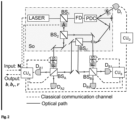
- CU general control unit refers to control system involving coincidence/control/monitoring system, formed of a coincidence unit and a computer or a chip-system analyzing the data and reacting on them. It can be divided into three independent sub-control units CU A , CU B , CU D which control respectively the following sub-systems of the device (outlined schematically in the Figure 3a ):
- CU can be realized as a single unit without such subdivision taking the role of all sub-control units CU A , CU B , CU D .
- CU D Control unit monitoring the detector D t , which sends information about detection event at the detector to control units CU A , CU B for analysis by coincidence circuit.
- CU B Control unit, which steers the shutter S and the phase shifter P, and records the outcomes from detectors D B1 and D B2 .
- the outputs of detectors are shared with CU A for coincidence analysis. It randomly closes and opens the shutter based on pseudorandom numbers or quantum pseudo random numbers. It can also process information from other control units. It can export data to control unit CU A .
- Control unit which steers the shutter S and the phase shifter P, and records the outcomes from detectors D A1 , D A2 . It randomly closes and opens the shutter based on pseudorandom numbers (like above). It can also control LASER, and attenuator A. It can also process information from other control units and perform bitrate calculations upon this information. Processing of information includes coincidence analysis through coincidence circuit. It can export data. User can input information to this control unit about the parameters of the randomness generation like number of required fully random bits N.
- Classical communication channel Any information channel which could transmit classical information between control units CU A/B/D and which allows for steering and controlling devices S, P, D A1/a2 , D b1/B2 , D t and BS. This can be implemented by electrical connection cables (wiring).
- Optical path Physical medium through which the beam propagates. It can be realized by optical fibers or by propagating beams in the air and changing their directions with suitably placed mirrors.
- the following elements (outlined in the Figure 2 ): LASER, BS 1 , BS 2 , BS C , FD, PDC, A, and one of the filters F contribute as a source So of heralded single photon and reference coherent state. Detection of the photon in trigger D t signalizes the success of the generation of heralded single photon by the source So.
- Source in general could be realized in different manner, but has to be characterized by production of heralded single photon of a strictly defined frequency profile further beam-splitted into two optical paths and simultaneous production of two beams of photons in reference coherent states which are able to interfere with generated single photon.
- the quantum random number generation process starts with a generation of a pulse of coherent beam by the LASER. Afterward, the beam impinges onto beamsplitter ( BS 1 ) of regulated transmissivity with two output ports.
- the beam of the reflection output port of BS 2 passes via an attenuator A which allows further weakening of the intensity.
- the beam impinges into the input port of the second beamsplitter ( BS 2 ), which should be symmetric, unbiased.
- Output ports distribute beam of coherent light to two measurement stations A and B controlled by CU A and CU B respectively. In both stations the intensity of the beam is defined by the reflectivity of the beamsplitter BS 1 and the attenuator A and can be blocked by the shutter ( S ). It should be very low.
- the beam can be phase shifted by phase shifter ( P ), for calibration purposes only. The phase shift is kept fixed, which is important in the Bell test runs.
- the beams are also locally filtered by filters ( F ).
- the beams enter one of two entry ports of the local beamsplitters ( BS A/B ). They play the role of local oscillators in (weak) homodyne measurements.
- the transmission exit port of BS 1 is connected with the frequency doubling unit, which creates generates second harmonic of the incident
- Output light enters a nonlinear medium in which the spontaneous parametric down conversion of type II can occur, namely a pair of entangled photons is created in idler and signal modes out of the second harmonics light.
- the pulse after passing the non-linear medium plays further no role and is blocked.
- the idler mode passes through the filter F, behind the filter the detector D t is placed. If detector D t registers a photon this heralds that in signal mode there is a photon which has the frequency profile determined by filter ( F ).
- Such filtering at a distance is one of the properties of parametric down conversion. This is necessary for later interference effects in homodyne measurements.
- the detection event of D t is registered in control unit CU D and information on that sent to the coincidence circuit via a classical communication channel. Transfer of the information about detection in detector D t is responsible for the "event-ready" aspect of the following measurement as it ensures that photon is present in signal mode and marks the time gate for random bit generation.
- Measurement stations controlled by control units CU A and CU B choose their local settings based on possibly biased pseudorandom or quantum-pseudo-random numbers (which will be defined further on) by either closing ("off” setting) or opening ("on” setting) shutter ( S ) in the local oscillator beams and save the chosen setting into their memory together with the time stamp. The choice of settings is repeated with some average frequency and it is independent from the detections in detector D t ,
- Signal beam (carrying the heralded single photon to induce the required entanglement in the state of exit modes of BS C ) is directed onto the balanced beamsplitter (BS C ), the output ports of which are connected with the input ports of beamsplitters in local measurement stations controlled by CU A and CU B into which the local oscillator fields are not fed in.
- the signal beam interferes with local oscillators in both local measurement stations at beamsplitters BS A/B .
- the exit beams of the beamsplitters are monitored by detectors D A1 , D A2 and D B1 , D B2 by detectors which can effectively detect if there was at least a single photon in the monitored beam.
- Control units CU A and CU B save the results for each run in the memory. This finalizes the run.
- the control units accept as useful runs for bit generation of the raw key, or test of Bell inequality only the events which are in coincidence with time gate of the order of 1/ ⁇ f with detection at D t , where ⁇ f is the frequency band of the filter F.
- Results which do not coincide with detection at D t and when the shutters are open can be utilized for generations of biased quantum-pseudo-random numbers (i.e. not certified) based on photon counts originating from the local weak coherent state and can be utilized for the local setting choice as an alternative for pseudo-random numbers.
- Optical paths of the signal photon and local oscillator beams are tuned to be equal.
- steps 6 and 7 of the protocol of random bits generation the verification of the quality of the obtained randomness is performed.
- the preferred method for this device is estimation of the quality of the input state and imperfections of the measurement device based on Bell (CH) inequality violation.
- y )) of obtaining the result a ( b ) in station A (B) upon chosen measurement setting x ( y ) are estimated.
- CH P 00
- the results are fundamentally random as they have a quantum nature. What is more, local results for "off-off" scenarios in the almost ideal case, if one excludes the cases of two identical results on side A and side B, which are due to imperfections, allow generation of random bits 0 and 1 with the same probability.
- the maximal value of CH expression obtainable for this device can be calculated using quantum mechanics giving value CH max ⁇ 0.1086. This is not a minute violation as it seems, as the Tsirelson bound for CH inequality is ⁇ 0.204. Any imperfections of the device, and any fluctuations in its parameters induced internally or by environment will result in decreasing the value of obtained experimentally value CH exp ⁇ CH max . This is because such imperfections result in effectively adding a noise to the assumed single-photon state.
- calculating control unit CU A checks if length of the bitstring b (denoted by b ) times r fulfills relation b ⁇ r ⁇ N and based upon that, either calls for the continuation of generation of bits, or outputs the raw bitstring b and bitrate r to the user or postprocesses the bitstring b using one of the well-known randomness extraction algorithms which generates using r and b the string of fully random bits b r and then outputs b r to the user. This procedure effectively compensates for imperfections of the device.
- p det corresponds to the optimal guessing strategy of the bit by the third parties. This allows for device-independent method of accessing the maximal probability of guessing bit p guess as this method is based solely on obtained probabilities and not on the specific construction of the setup. Bound on p guess can be calculated as: p guess ⁇ p det + 1 ⁇ p det / 2 .
- control unit CU A starts the step 8 of the algorithm.
- This method gives lower estimates of r than the method described in the previous section as it optimizes also upon post-quantum realizations of the system resulting in more secure randomness.
- the method needs longer time for generation of specific number of random bits N as this method results in lower values of r . But this is safer.
- Control unit is implemented as a one control unit CU presented on Figure 3b based on a computer (PC) with connected necessary devices described in the following.
- the control unit possess the following features: input, output coincidence circuit with clock (CC), memory (M), computing capabilities coming from the processor of the PC (CPU), pseudo number generator (PRNG) and hardware drivers for the control over the other steerable devices in the device described below (LASER, shutters S ) and for receiving the input from them (detectors D A1/B1 , D A2/B2 , D t ). All active elements (LASER, shutters S, detectors D A1/B1 , D A2/B2 , D t , CU ) are powered by power supply PSU.
- All beamsplitters are chosen as beamsplitters with set transmissivity, in particular: BS A , BS B with transmissivity 0.025, BS 2 , BSc with transmissivity 0.5 and BS 1 with transmissivity 0.99.
- the shutters S in front of the beamsplitters BS A , BS B are mechanical shutters which block the beam completely when closed and transmit the beam completely when open. Shutters are connected to CU.
- Single pulsed quasi-monochromatic LASER is chosen to work with central frequency f (frequency is tuned to match the frequency for which detectors work with the highest efficiency), pulse time length t, and power p.
- Attenuator A is chosen to attenuate the beam in such a way that the average photon number in the beam is 20 .
- Phase shifter P in station A and B performs phase shift 0 .
- the Frequency doubler is chosen to work in the range of frequencies containing f and with efficiency higher than 15% .
- the BBO nonlinear crystal is chosen which generates from the beam coming from frequency doubler two beams of light frequency f (idler and signal beams). The transmitted beams of light frequency f and its second harmonic are blocked. All three filters F have the same characteristics and filter the frequencies around f within the frequency band.
- All five detectors D A1/B1 , D A2/B2 , D t are chosen to be superconducting nanowire single-photon detectors which are able to detect single photon in range around f with high efficiency 98% and the dead time lower than time between the laser pulses.
- the optical paths are realized using the optical fibers, and classical communication channels using electric connection wires.
- the total optical path from LASER to the detectors of all beams in the system is set to be equal within the same tolerance.
- the output of the LASER is connected to the input port of beamsplitter BS 1 .
- the first output port (reflected beam) of BS 1 is connected to Attenuator A and then to BS 2 .
- the first output port of BS 2 is connected to shutter S of the measurement station A and then to phase shifter P followed by filter F which is connected to the input port of BS A .
- the second output port of BS 2 is connected to shutter S of the measurement station B and then to phase shifter P followed by filter F which is connected to the input port of BS B .
- the second output port (transmitted beam) of BS 1 is connected to frequency doubler FD and then to BBO crystal from which the idler beam is propagated towards detector D t and the signal beam towards beamsplitter BS C .
- the detector D t is connected to CU in particular to the coincidence circuit CC.
- the first output port of BS C is connected to the second input port of BS A
- the second output port of BS C is connected to the second input port of BS B .
- the output ports of BS A are connected to the detectors D A1 , D A2 as in Figure 3a .
- the output ports of BS B are connected to the detectors D B1 , D B2 as in Figure 3a .
- the detectors D A1/B1 , D A2/B2 are connected to CC.
- the device that is shown on Figure 3a, and 3b starts with the input from the user of the number of required random bits N.
- CU initiates LASER.
- Single pulsed near monochromatic LASER is chosen to work with central frequency f (frequency is tuned to match the frequency for which detectors work with the highest efficiency), pulse time length t, and power p.
- Control unit CU chooses pseudo-random settings of the shutters with ratio 9:1 of "off" to "on” settings. This is done for each shutter separately.
- the change of the settings is simultaneous in both measurement stations and occurs with constant frequency f s .
- the particular settings are stored in the memory as a sequence (S A , S B ) with time stamps.
- the CC registers outputs from detectors D A1/B1 , D A2/B2 , D t saving the outcomes coinciding with detection in D t up to time gate 1/ ⁇ f to memory in sequence (R A , R B ) with a timestamp that marks the corresponding setting choice.
- the sequence (R A , R B ) is prepared using on the following key:
- the control unit CU keeps LASER on (producing new pulses) repeating the procedure until number of detections in the detector D t reaches 10*N or at least 1000.
- the string of bits b is prepared by CU from R A by selecting results only corresponding to the ("off" ,”off") settings combination.
- CU can treat events with results 1 at station A and 1 at station B for the ("off" ,”off") settings as unsuccessful bit generation runs (as this combination can appear only from imperfections) and not include them in b, however, those events are still used in further evaluation of bitrate r.
- CU evaluates bitrate r corresponding to obtained raw bit string b with first or second randomness verification algorithm and stores it in the memory (bitrate calculations on particular examples of bit generations is presented below).
- Further CU checks the number of obtained random bits b ⁇ r where b is the number of results corresponding to setting configuration ("off" ,”off") and decides whether to continue the generation procedure (switching on the LASER for next 10 ⁇ ( N - b ⁇ r ) detections of idler photons) or to extract random bit string b r followed by saving it into the memory. After a random bit string b r is generated CU outputs it to the user.
- the beam of the coherent light is produced by the LASER.
- This beam after passing through BS 1 , A, BS 2 , FD, PDC the state of the relevant optical modes is given approximately by: 1 ⁇ p
- the beam after passing through BSc is given by:
- the state can be modified. If shutter in station A is closed i.e. "off" setting we have
- the first randomness verification algorithm (bitrate calculation):
- n xA n yB N r The specific values of the P ( a,b
- y ) are evaluated as: P A a
- x n xA N r , P B b
- y n yB N r .
Landscapes
- Engineering & Computer Science (AREA)
- Physics & Mathematics (AREA)
- Electromagnetism (AREA)
- Theoretical Computer Science (AREA)
- Computer Security & Cryptography (AREA)
- Computer Networks & Wireless Communication (AREA)
- Signal Processing (AREA)
- Optical Modulation, Optical Deflection, Nonlinear Optics, Optical Demodulation, Optical Logic Elements (AREA)
Priority Applications (1)
| Application Number | Priority Date | Filing Date | Title |
|---|---|---|---|
| EP23199255.3A EP4529078A1 (fr) | 2023-09-23 | 2023-09-23 | Système de génération de nombres aléatoires quantiques pour la génération d'auto-test de chaînes de bits réellement aléatoires et procédé de génération de chaîne de nombres aléatoires quantiques |
Applications Claiming Priority (1)
| Application Number | Priority Date | Filing Date | Title |
|---|---|---|---|
| EP23199255.3A EP4529078A1 (fr) | 2023-09-23 | 2023-09-23 | Système de génération de nombres aléatoires quantiques pour la génération d'auto-test de chaînes de bits réellement aléatoires et procédé de génération de chaîne de nombres aléatoires quantiques |
Publications (1)
| Publication Number | Publication Date |
|---|---|
| EP4529078A1 true EP4529078A1 (fr) | 2025-03-26 |
Family
ID=88192203
Family Applications (1)
| Application Number | Title | Priority Date | Filing Date |
|---|---|---|---|
| EP23199255.3A Pending EP4529078A1 (fr) | 2023-09-23 | 2023-09-23 | Système de génération de nombres aléatoires quantiques pour la génération d'auto-test de chaînes de bits réellement aléatoires et procédé de génération de chaîne de nombres aléatoires quantiques |
Country Status (1)
| Country | Link |
|---|---|
| EP (1) | EP4529078A1 (fr) |
Citations (7)
| Publication number | Priority date | Publication date | Assignee | Title |
|---|---|---|---|---|
| EP1447740A1 (fr) | 2003-02-11 | 2004-08-18 | IP-First LLC | Microprocesseur avec générateur de nombres aléatoires, dont la disponibilité dépend du résultat d'un autotest |
| WO2006133650A1 (fr) | 2005-06-16 | 2006-12-21 | The Chinese University Of Hong Kong | Générateurs de nombres aléatoires quantiques |
| US20150227343A1 (en) | 2014-02-12 | 2015-08-13 | Ut-Battelle, Llc | Self-correcting random number generator |
| CN206209694U (zh) | 2016-10-17 | 2017-05-31 | 清华大学 | 一种量子随机数发生器 |
| WO2020257124A1 (fr) * | 2019-06-19 | 2020-12-24 | Cambridge Quantum Computing Limited | Amplification, génération ou certification de caractère aléatoire |
| EP3674885B1 (fr) | 2018-12-28 | 2021-10-06 | Samsung Electronics Co., Ltd. | Générateur de nombres aléatoires |
| WO2021215941A1 (fr) | 2020-04-24 | 2021-10-28 | Uniwersytet Gdanski | Procédé de génération quantique de nombres aléatoires notamment dans des loteries et des jeux vidéo et dispositif de génération quantique de nombres aléatoires |
-
2023
- 2023-09-23 EP EP23199255.3A patent/EP4529078A1/fr active Pending
Patent Citations (7)
| Publication number | Priority date | Publication date | Assignee | Title |
|---|---|---|---|---|
| EP1447740A1 (fr) | 2003-02-11 | 2004-08-18 | IP-First LLC | Microprocesseur avec générateur de nombres aléatoires, dont la disponibilité dépend du résultat d'un autotest |
| WO2006133650A1 (fr) | 2005-06-16 | 2006-12-21 | The Chinese University Of Hong Kong | Générateurs de nombres aléatoires quantiques |
| US20150227343A1 (en) | 2014-02-12 | 2015-08-13 | Ut-Battelle, Llc | Self-correcting random number generator |
| CN206209694U (zh) | 2016-10-17 | 2017-05-31 | 清华大学 | 一种量子随机数发生器 |
| EP3674885B1 (fr) | 2018-12-28 | 2021-10-06 | Samsung Electronics Co., Ltd. | Générateur de nombres aléatoires |
| WO2020257124A1 (fr) * | 2019-06-19 | 2020-12-24 | Cambridge Quantum Computing Limited | Amplification, génération ou certification de caractère aléatoire |
| WO2021215941A1 (fr) | 2020-04-24 | 2021-10-28 | Uniwersytet Gdanski | Procédé de génération quantique de nombres aléatoires notamment dans des loteries et des jeux vidéo et dispositif de génération quantique de nombres aléatoires |
Non-Patent Citations (19)
| Title |
|---|
| BARKER E.KELSEY J.: "Recommendation for Random Number Generation Using Deterministic Random Bit Generators", NIST SP800-90A, January 2012 (2012-01-01) |
| CHRISTOPHER C. GERRYRICHARD J. BIRRITTELLAPAUL M. ALSINGAMR HOSSAMELDINMILLER EATONOLIVIER PFISTER: "Proposal for a quantum random number generator using coherent light and a non-classical observable", J. OPT. SOC. AM. B, vol. 39, 2022, pages 1068 - 1074 |
| DAVIDE RUSCATHOMAS VAN HIMBEECKANTHONY MARTINJONATAN BOHR BRASKWEIXU SHISTEFANO PIRONIONICOLAS BRUNNERHUGO ZBINDEN: "Practical self-testing quantum random number generator based on an energy bound", ARXIV, 2019 |
| G. DONATIT. BARTLEYX-M. JINM-D. VIDRIGHINA. DATTABARBIERI M.I. A. WALMSLEY: "Observing optical coherence across Fock layers with weak-field homodyne detectors", NAT. COMMUN., vol. 5, 2014, pages 5584 |
| HERRERO-COLLANTES MIGUEL ET AL: "Quantum random number generators", REVIEWS OF MODERN PHYSICS, vol. 89, no. 1, 21 October 2016 (2016-10-21), XP055822716, ISSN: 0034-6861, Retrieved from the Internet <URL:https://arxiv.org/pdf/1604.03304.pdf> [retrieved on 20240206], DOI: 10.1103/RevModPhys.89.015004 * |
| KAUSHIK JOARDER ET AL: "Loophole free interferometric test of macrorealism using heralded single photons", ARXIV.ORG, CORNELL UNIVERSITY LIBRARY, 201 OLIN LIBRARY CORNELL UNIVERSITY ITHACA, NY 14853, 25 December 2021 (2021-12-25), XP091109489, DOI: 10.1103/PRXQUANTUM.3.010307 * |
| L. HARDY: "Nonlocality of a single photon revisited", PHYS. REV. LETT., vol. 73, 1994, pages 2279 - 2283 |
| LIU, Y.ZHAO, Q.LI, MH. ET AL.: "Device-independent quantum random-number generation", NATURE, vol. 562, 2018, pages 548 - 551, XP036900234, DOI: 10.1038/s41586-018-0559-3 |
| P. R. SMITHD. G. MARANGONM. LUCAMARINIZ. L. YUANA. J. SHIELDS: "Simple source device-independent continuous-variable quantum random number generator", PHYS. REV., vol. A 99, 2019, pages 062326 |
| PIRONIO, S.ACIN, A.MASSAR, S. ET AL.: "Random numbers certified by Bell's theorem", NATURE, vol. 464, 2010, pages 1021 - 1024 |
| S. M. TAND. F. WALLSM. J. COLLETT: "Nonlocality of a single photon", PHYS. REV. LETT., vol. 66, 1991, pages 252 - 255 |
| SHAFT, K. M., CHAWLA, P., HEGDE, A. S., GAYATRI, R. S., PADHYE, A., CHANDRASHEKAR, C. M.: "Multi-bit quantum random number generator from path-entangled single photons", ARXIV:2202.10933, 2022 |
| T. DASM. KARCZEWSKIA. MANDARINOM. MARKIEWICZB. WOLONCEWICZM. ZUKOWSKI: "Can single photon excitation of two spatially separated modes lead to a violation of Bell inequality via weak-field homodyne measurements?", NEW JOURNAL OF PHYSICS, vol. 23, no. 7, 2021, pages 073042 |
| T. DASM. KARCZEWSKIA. MANDARINOM. MARKIEWICZB. WOLONCEWICZM. ZUKOWSKI: "Comment on `Single particle nonlocality with completely independent reference states", NEW JOURNAL OF PHYSICS, vol. 24, no. 3, 2022, pages 038001 |
| T. DASM. KARCZEWSKIA. MANDARINOM. MARKIEWICZB. WOLONCEWICZM. ZUKOWSKI: "Remarks about Bell-nonclassicality of a single photon", PHYSICS LETTERS A, vol. 435, 2022, pages 128031 |
| T. DASM. KARCZEWSKIA. MANDARINOM. MARKIEWICZB. WOLONCEWICZM. ZUKOWSKI: "Wave-particle complementarity: detecting violation of local realism with photon-number resolving weak-field homodyne measurements", NEW JOURNAL OF PHYSICS, vol. 24, no. 3, 2022, pages 033017 |
| T. DASM. KARCZEWSKIA. MANDARINOM. MARKIEWICZM. ZUKOWSKI: "Optimal Interferometry for Bell Nonclassicality Induced by a Vacuum-One-Photon Qubit", PHYS. REV. APPLIED, vol. 18, 2022, pages 034074 |
| T. FERREIRA DA SILVAG. B. XAVIERG. C. AMARALG. P. TEMPORAOJ. P. VON DER WEID: "Quantum random number generation enhanced by weak-coherent states interference", OPT. EXPRESS, vol. 24, 2016, pages 19574 - 19580 |
| WEINAN HUANG, YICHEN ZHANG, ZIYONG ZHENG, YANG LI, BINGJIE XU, SONG YU: "Practical security analysis of a continuous-variable quantum random-number generator with a noisy local oscillator", PHYS. REV., vol. A 102, 2020, pages 012422 |
Similar Documents
| Publication | Publication Date | Title |
|---|---|---|
| Tittel et al. | Long-distance Bell-type tests using energy-time entangled photons | |
| Di Giuseppe et al. | Quantum interference and indistinguishability with femtosecond pulses | |
| US7844649B2 (en) | Optical-based, self-authenticating quantum random number generators | |
| US6609139B1 (en) | Method for generating a random number on a quantum-mechanical basis and random number generator | |
| Tittel et al. | Violation of Bell inequalities by photons more than 10 km apart | |
| Hensen et al. | Experimental loophole-free violation of a Bell inequality using entangled electron spins separated by 1.3 km | |
| Foletto et al. | Experimental test of sequential weak measurements for certified quantum randomness extraction | |
| Kwiat et al. | High-visibility interference in a Bell-inequality experiment for energy and time | |
| Borghi et al. | Reconfigurable silicon photonic chip for the generation of frequency-bin-entangled qudits | |
| Um et al. | Randomness expansion secured by quantum contextuality | |
| WO2020257124A1 (fr) | Amplification, génération ou certification de caractère aléatoire | |
| Yard et al. | On-chip quantum information processing with distinguishable photons | |
| Wen et al. | Nonclassical light generation via a four-level inverted-Y system | |
| Zeitler et al. | Entanglement verification of hyperentangled photon pairs | |
| Brewster et al. | Quantum analysis of polarization entanglement degradation induced by multiple-photon-pair generation | |
| EP4139789B1 (fr) | Procédé de génération quantique de nombres aléatoires notamment dans des loteries et des jeux vidéo et dispositif de génération quantique de nombres aléatoires | |
| JP2005250714A (ja) | 光子乱数発生器 | |
| D’Angelo et al. | Tomographic test of Bell’s inequality for a time-delocalized single photon | |
| EP4529078A1 (fr) | Système de génération de nombres aléatoires quantiques pour la génération d'auto-test de chaînes de bits réellement aléatoires et procédé de génération de chaîne de nombres aléatoires quantiques | |
| Hu et al. | Experimental sharing of nonlocality among multiple observers with one entangled pair via optimal weak measurements | |
| Neves et al. | Experimentally Certified Transmission of a Quantum Message through an Untrusted and Lossy Quantum Channel via Bell’s Theorem | |
| Piveteau et al. | Weak entanglement improves quantum communication using only product measurements | |
| Yan et al. | Narrowband polarization entangled paired photons with controllable temporal length | |
| Dong et al. | Interplay of quantum resources in nonlocality tests | |
| Trávníček et al. | Experimental characterization of photon-number noise in Rarity-Tapster-Loudon-type interferometers |
Legal Events
| Date | Code | Title | Description |
|---|---|---|---|
| PUAI | Public reference made under article 153(3) epc to a published international application that has entered the european phase |
Free format text: ORIGINAL CODE: 0009012 |
|
| STAA | Information on the status of an ep patent application or granted ep patent |
Free format text: STATUS: REQUEST FOR EXAMINATION WAS MADE |
|
| 17P | Request for examination filed |
Effective date: 20231013 |
|
| AK | Designated contracting states |
Kind code of ref document: A1 Designated state(s): AL AT BE BG CH CY CZ DE DK EE ES FI FR GB GR HR HU IE IS IT LI LT LU LV MC ME MK MT NL NO PL PT RO RS SE SI SK SM TR |