EP4529089A1 - Verteilungsverfahren für verschlüsselte informationen und zugehörige vorrichtung - Google Patents
Verteilungsverfahren für verschlüsselte informationen und zugehörige vorrichtung Download PDFInfo
- Publication number
- EP4529089A1 EP4529089A1 EP23830001.6A EP23830001A EP4529089A1 EP 4529089 A1 EP4529089 A1 EP 4529089A1 EP 23830001 A EP23830001 A EP 23830001A EP 4529089 A1 EP4529089 A1 EP 4529089A1
- Authority
- EP
- European Patent Office
- Prior art keywords
- network device
- encryption
- network
- route advertisement
- advertisement packet
- Prior art date
- Legal status (The legal status is an assumption and is not a legal conclusion. Google has not performed a legal analysis and makes no representation as to the accuracy of the status listed.)
- Granted
Links
Images



Classifications
-
- H—ELECTRICITY
- H04—ELECTRIC COMMUNICATION TECHNIQUE
- H04L—TRANSMISSION OF DIGITAL INFORMATION, e.g. TELEGRAPHIC COMMUNICATION
- H04L63/00—Network architectures or network communication protocols for network security
- H04L63/04—Network architectures or network communication protocols for network security for providing a confidential data exchange among entities communicating through data packet networks
- H04L63/0428—Network architectures or network communication protocols for network security for providing a confidential data exchange among entities communicating through data packet networks wherein the data content is protected, e.g. by encrypting or encapsulating the payload
- H04L63/0485—Networking architectures for enhanced packet encryption processing, e.g. offloading of IPsec packet processing or efficient security association look-up
-
- H—ELECTRICITY
- H04—ELECTRIC COMMUNICATION TECHNIQUE
- H04L—TRANSMISSION OF DIGITAL INFORMATION, e.g. TELEGRAPHIC COMMUNICATION
- H04L45/00—Routing or path finding of packets in data switching networks
- H04L45/02—Topology update or discovery
-
- H—ELECTRICITY
- H04—ELECTRIC COMMUNICATION TECHNIQUE
- H04L—TRANSMISSION OF DIGITAL INFORMATION, e.g. TELEGRAPHIC COMMUNICATION
- H04L45/00—Routing or path finding of packets in data switching networks
- H04L45/02—Topology update or discovery
- H04L45/04—Interdomain routing, e.g. hierarchical routing
-
- H—ELECTRICITY
- H04—ELECTRIC COMMUNICATION TECHNIQUE
- H04L—TRANSMISSION OF DIGITAL INFORMATION, e.g. TELEGRAPHIC COMMUNICATION
- H04L45/00—Routing or path finding of packets in data switching networks
- H04L45/74—Address processing for routing
- H04L45/745—Address table lookup; Address filtering
- H04L45/748—Address table lookup; Address filtering using longest matching prefix
-
- H—ELECTRICITY
- H04—ELECTRIC COMMUNICATION TECHNIQUE
- H04L—TRANSMISSION OF DIGITAL INFORMATION, e.g. TELEGRAPHIC COMMUNICATION
- H04L63/00—Network architectures or network communication protocols for network security
- H04L63/04—Network architectures or network communication protocols for network security for providing a confidential data exchange among entities communicating through data packet networks
- H04L63/0428—Network architectures or network communication protocols for network security for providing a confidential data exchange among entities communicating through data packet networks wherein the data content is protected, e.g. by encrypting or encapsulating the payload
-
- H—ELECTRICITY
- H04—ELECTRIC COMMUNICATION TECHNIQUE
- H04L—TRANSMISSION OF DIGITAL INFORMATION, e.g. TELEGRAPHIC COMMUNICATION
- H04L9/00—Cryptographic mechanisms or cryptographic arrangements for secret or secure communications; Network security protocols
- H04L9/08—Key distribution or management, e.g. generation, sharing or updating, of cryptographic keys or passwords
- H04L9/0861—Generation of secret information including derivation or calculation of cryptographic keys or passwords
-
- H—ELECTRICITY
- H04—ELECTRIC COMMUNICATION TECHNIQUE
- H04L—TRANSMISSION OF DIGITAL INFORMATION, e.g. TELEGRAPHIC COMMUNICATION
- H04L9/00—Cryptographic mechanisms or cryptographic arrangements for secret or secure communications; Network security protocols
- H04L9/40—Network security protocols
Definitions
- This application relates to the field of internet technologies, and in particular, to a method for distributing encryption information and a related apparatus.
- Security services for traffic at the IP layer are a set of protocols used to provide high-quality and encryption-based security services.
- the security services provided by the IPSec are provided at the IP layer and protect the IP layer and all protocols at the IP layer. Therefore, any path between a pair of hosts, between a pair of security gateways, or between a security gateway and a host can be protected by using the IPSec.
- IPSec-based traffic encryption process a dedicated encryption tunnel first needs to be created between two encryption parties. Then, the two encryption parties exchange, through the encryption tunnel, information needed for encryption, to generate a key for data encryption or decryption. Finally, either of the two encryption parties routes to-be-encrypted traffic to the encryption tunnel when obtaining the traffic destined for the other party, so that the traffic is encrypted and forwarded to the other party through the encryption tunnel.
- This application provides a method for distributing encryption information, so that encrypted transmission of data between two encryption parties can be implemented without establishing a dedicated encryption tunnel between the two encryption parties, to effectively reduce network deployment complexity.
- a first aspect of this application provides a method for distributing encryption information, including: A first network device receives a first route advertisement packet.
- the first route advertisement packet includes a routing prefix and first encryption extended information related to the routing prefix, and the first encryption extended information includes a first parameter for key generation.
- the first network device generates at least one key based on the first encryption extended information.
- the at least one key is used to encrypt a data packet from the first network device to a network indicated by the routing prefix and/or decrypt a data packet from the network indicated by the routing prefix to the first network device.
- the first network device generates a routing entry based on the first route advertisement packet.
- the routing entry includes the routing prefix, and the routing entry indicates an outbound interface on the first network device to the network indicated by the routing prefix and indicates to encrypt, before a data packet whose destination address belongs to the network indicated by the routing prefix is forwarded, the data packet by using the at least one key.
- the first network device generates the routing entry with an encryption attribute based on the first route advertisement packet.
- encryption extended information is carried in a route advertisement packet to indicate a routing prefix and the encryption extended information related to the routing prefix.
- a network device when receiving the route advertisement packet, a network device can generate a key based on the encryption extended information in the route advertisement packet, and generate a routing entry with an encryption attribute.
- the routing entry can indicate the network device to encrypt a data packet by using the key, and then send an encrypted data packet to a network indicated by the routing prefix.
- transfer of encryption information between a plurality of network devices is implemented based on the route advertisement packet, and the network device is guided to generate the routing entry with the encryption attribute, so as to ensure that the network device can implement encrypted transmission of a data packet based on the routing entry, without establishing a dedicated encryption tunnel between the network devices. This effectively reduces network deployment complexity.
- the first encryption extended information is carried in a first type length value (type length value, TLV) field in the first route advertisement packet, and the first TLV field includes the first parameter for key generation.
- TLV type length value
- the first encryption extended information further includes information indicating a first encryption network topology, and the information about the first encryption network topology indicates a plurality of network devices forming the first encryption network topology and indicates that the plurality of network devices are allowed to establish an encrypted connection.
- the first encryption extended information is further carried in a second TLV field in the first route advertisement packet, and the second TLV field indicates the information about the first encryption network topology.
- a TLV field is newly added to the route advertisement packet, so that changes to an existing routing protocol can be reduced as much as possible while the encryption extended information is carried, to reduce actual deployment difficulty.
- the first route advertisement packet is a border gateway protocol (Border Gateway Protocol, BGP) message or an interior gateway protocol (Interior Gateway Protocol, IGP) message.
- BGP Border Gateway Protocol
- IGP Interior Gateway Protocol
- the first route advertisement packet is a BGP update message.
- the first TLV field and the second TLV field are carried in an extended path attribute field in the BGP update message.
- the first route advertisement packet is an open shortest path first OSPF message.
- the first TLV field and the second TLV field are carried in a link state advertisement (Link State Advertisement, LSA) sub-TLV field in the OSPF message.
- LSA Link State Advertisement
- the first network device when the first network device obtains a target packet, if a destination address of the target packet matches the routing prefix in the routing entry, the first network device encrypts the target packet by using the at least one key based on an indication of the routing entry.
- the first network device sends an encrypted target packet through the created tunnel.
- the second network device is a border device in the network indicated by the routing prefix. If there is no created tunnel between the first network device and the second network device, the first network device newly creates a tunnel with the second network device, and sends an encrypted target packet through the newly created tunnel.
- the first encryption extended information further includes an internet protocol IP address of the second network device.
- the first network device creates an IPinIP tunnel with the second network device based on the IP address of the second network device and an IP address of the first network device.
- the first TLV field includes an identifier of one or more network devices
- the one or more network devices are devices that need to establish an encrypted connection to the second network device in an encryption network topology
- the second network device is the border device in the network indicated by the routing prefix.
- the second TLV field indicates the first encryption network topology to which one or more network devices belong and an identifier of the one or more network devices in the first encryption network topology
- the one or more network devices are devices that need to establish an encrypted connection to the second network device in the first encryption network topology
- the second network device is the border device in the network indicated by the routing prefix.
- the second TLV field includes a plurality of bits, one of the plurality of bits indicates at least one network device in the first encryption network topology, and the one or more network devices correspond to one or more bits with preset set states in the plurality of bits.
- the first TLV field includes a router identifier of the second network device
- the second network device is the border device in the network indicated by the routing prefix.
- the first network device generates the at least one key based on the router identifier of the second network device and a router identifier of the first network device. Both the router identifier of the second network device and the router identifier of the first network device are unique identifiers.
- a key is generated based on a router identifier of the network device, so that uniqueness of the key can be ensured, and security of data transmission can be improved.
- the first network device generates a first security parameter index based on the first TLV field and a local parameter.
- the first security parameter index indicates an encrypted connection between the first network device and the second network device
- the local parameter includes a random number and/or an identifier of the first network device
- the second network device is the border device in the network indicated by the routing prefix. If the first security parameter index is the same as another security parameter index that has been generated on the first network device, the first network device updates the local parameter and generates a second security parameter index based on the first TLV field and an updated local parameter.
- the first network device sends the updated local parameter to the second network device.
- the first TLV field further includes a quantum key parameter.
- the first network device generates second encryption extended information.
- the second encryption extended information includes a second parameter for key generation and information about a second encryption network topology, and the information about the second encryption network topology indicates a plurality of network devices forming the second encryption network topology and indicates that the plurality of network devices in the second encryption network topology are allowed to establish an encrypted connection.
- the first network device replaces the first encryption extended information in the first route advertisement packet with the second encryption extended information, to obtain a second route advertisement packet.
- the first network device sends the second route advertisement packet to a neighbor device.
- the network device after receiving the route advertisement packet, the network device changes the encryption extended information in the route advertisement packet, so that the network device can establish an encrypted connection to another network device based on an actual requirement, to flexibly manage an encryption network topology.
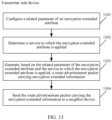
- a second aspect of this application provides a method for distributing encryption information, including: A second network device obtains encryption information related to a service.
- the encryption information indicates an object to which service encryption is applied.
- the second network device generates a route advertisement packet based on the encryption information.
- the route advertisement packet includes a routing prefix and encryption extended information related to the routing prefix, and the encryption extended information includes a parameter for key generation.
- the second network device sends the route advertisement packet to a neighbor device.
- the object to which the service encryption is applied indicates an address family or a virtual private network VPN instance for which an encrypted connection needs to be established.
- the second network device generates the route advertisement packet based on a case that the routing prefix belongs to a network prefix in the address family or the VPN instance.
- the second network device is a border device in a network indicated by the routing prefix.
- the object to which the service encryption is applied includes a routing policy
- the routing policy indicates a network device for which an encrypted connection needs to be established.
- the second network device generates the route advertisement packet based on a case that the second network device belongs to the network device indicated in the routing policy.
- a third aspect of this application provides a network device, including: a receiving unit, configured to receive a first route advertisement packet, where the first route advertisement packet includes a routing prefix and first encryption extended information related to the routing prefix, and the first encryption extended information includes a first parameter for key generation; and a generation unit, configured to generate at least one key based on the first encryption extended information, where the at least one key is used to encrypt a data packet from the network device to a network indicated by the routing prefix and/or decrypt a data packet from the network indicated by the routing prefix to the network device, where the generation unit is further configured to generate a routing entry based on the first route advertisement packet, where the routing entry includes the routing prefix, and the routing entry indicates an outbound interface on the network device to the network indicated by the routing prefix and indicates to encrypt, before a data packet whose destination address belongs to the network indicated by the routing prefix is forwarded, the data packet by using the at least one key.
- the first encryption extended information is carried in a first TLV field in the first route advertisement packet, and the first TLV field includes the first parameter for key generation.
- the first encryption extended information further includes information indicating a first encryption network topology, and the information about the first encryption network topology indicates a plurality of network devices forming the first encryption network topology and indicates that the plurality of network devices are allowed to establish an encrypted connection.
- the first encryption extended information is further carried in a second TLV field in the first route advertisement packet, and the second TLV field indicates the information about the first encryption network topology.
- the first route advertisement packet is a BGP message or an IGP message.
- the first route advertisement packet is a BGP update message.
- the first TLV field and the second TLV field are carried in an extended path attribute field in the BGP update message.
- the first route advertisement packet is an open shortest path first OSPF message.
- the first TLV field and the second TLV field are carried in a link state advertisement sub-TLV field in the OSPF message.
- the generation unit is further configured to: when obtaining a target packet, if a destination address of the target packet matches the routing prefix in the routing entry, encrypt the target packet by using the at least one key based on an indication of the routing entry.
- the network device further includes a sending unit.
- the sending unit is configured to send an encrypted target packet through the created tunnel.
- the second network device is a border device in the network indicated by the routing prefix.
- the generation unit is configured to newly create a tunnel with the second network device, and the sending unit is configured to send an encrypted target packet through the newly created tunnel.
- the first encryption extended information further includes an IP address of the second network device.
- the generation unit is configured to create an IPinIP tunnel with the second network device based on the IP address of the second network device and an IP address of a first network device.
- the first TLV field includes an identifier of one or more network devices
- the one or more network devices are devices that need to establish an encrypted connection to the second network device in an encryption network topology
- the second network device is the border device in the network indicated by the routing prefix.
- the second TLV field indicates the first encryption network topology to which one or more network devices belong and an identifier of the one or more network devices in the first encryption network topology
- the one or more network devices are devices that need to establish an encrypted connection to the second network device in the first encryption network topology
- the second network device is the border device in the network indicated by the routing prefix.
- the second TLV field includes a plurality of bits, one of the plurality of bits indicates at least one network device in the first encryption network topology, and the one or more network devices correspond to one or more bits with preset set states in the plurality of bits.
- the first TLV field includes a router identifier of the second network device
- the second network device is the border device in the network indicated by the routing prefix.
- the generation unit is further configured to generate the at least one key based on the router identifier of the second network device and a router identifier of the first network device. Both the router identifier of the second network device and the router identifier of the first network device are unique identifiers.
- the generation unit is further configured to: generate a first security parameter index based on the first TLV field and a local parameter, where the first security parameter index indicates an encrypted connection between the network device and the second network device, the local parameter includes a random number and/or an identifier of the first network device, and the second network device is the border device in the network indicated by the routing prefix; and if the first security parameter index is the same as another security parameter index that has been generated in the network device, update the local parameter and generate a second security parameter index based on the first TLV field and an updated local parameter.
- the sending unit is further configured to send the updated local parameter to the second network device.
- the first TLV field further includes a quantum key parameter.
- the generation unit is further configured to generate second encryption extended information, where the second encryption extended information includes a second parameter for key generation and information about a second encryption network topology, and the information about the second encryption network topology indicates a plurality of network devices forming the second encryption network topology and indicates that the plurality of network devices in the second encryption network topology are allowed to establish an encrypted connection; and replace, for the first network device, the first encryption extended information in the first route advertisement packet with the second encryption extended information, to obtain a second route advertisement packet.
- the sending unit is further configured to send, for the first network device, the second route advertisement packet to a neighbor device.
- a fourth aspect of this application provides a network device, including: an obtaining unit, configured to obtain encryption information related to a service, where the encryption information indicates an object to which service encryption is applied; a generation unit, configured to generate a route advertisement packet based on the encryption information, where the route advertisement packet includes a routing prefix and encryption extended information related to the routing prefix, and the encryption extended information includes a parameter for key generation; and a sending unit, configured to send the route advertisement packet to a neighbor device.
- the object to which the service encryption is applied indicates an address family or a VPN instance for which an encrypted connection needs to be established.
- the generation unit is further configured to generate the route advertisement packet based on a case that the routing prefix belongs to a network prefix in the address family or the VPN instance.
- the network device is a border device in a network indicated by the routing prefix.
- the object to which the service encryption is applied includes a routing policy
- the routing policy indicates a network device for which an encrypted connection needs to be established.
- the generation unit is further configured to generate the route advertisement packet based on a case that the network device belongs to the network device indicated in the routing policy.
- a fifth aspect of this application provides a network device, including a processor and a memory.
- the memory is configured to store program code
- the processor is configured to invoke the program code in the memory, so that the network device performs the method according to any implementation of the first aspect or the second aspect.
- a sixth aspect of this application provides a network system, including the network device according to any implementation of the third aspect and the network device according to any implementation of the fourth aspect.
- a seventh aspect of this application provides a computer-readable storage medium, storing instructions. When the instructions are run on a computer, the computer is enabled to perform the method according to any implementation of the first aspect.
- An eighth aspect of this application provides a computer program product.
- the computer program product When the computer program product is run on a computer, the computer is enabled to perform the method according to any implementation of the first aspect.
- a ninth aspect of this application provides a chip, including one or more processors. Some or all of the processors are configured to read and execute computer instructions stored in a memory, to perform the method in any possible implementation of any one of the foregoing aspects.
- the chip further includes the memory.
- the chip further includes a communication interface, and the processor is connected to the communication interface.
- the communication interface is configured to receive data and/or information that needs to be processed.
- the processor obtains the data and/or the information from the communication interface, processes the data and/or the information, and outputs a processing result through the communication interface.
- the communication interface is an input/output interface or a bus interface.
- the method provided in this application is implemented by one chip, or is implemented by a plurality of chips in cooperation.
- example herein means “used as an example, an embodiment, or an illustration”. Any embodiment described as “an example” herein is not necessarily explained as being superior or better than other embodiments.
- the route advertisement packet is a packet used to advertise a route. Specifically, to implement transmission of a packet between network devices, the network devices need to send route advertisement packets used to advertise routes to each other. For example, a network device A sends, to a network device B, a route advertisement packet carrying routing information of the network device A. After receiving the route advertisement packet from the network device A, the network device B may generate a corresponding route based on the routing information in the route advertisement packet, and transmit a packet to the network device A based on the route.
- the routing prefix is a network number that uniquely identifies a network connected to the Internet.
- Border gateway protocol Border Gateway Protocol, BGP
- the BGP is a routing protocol that is of an autonomous system (autonomous system, AS) and that is run on a transmission control protocol (Transmission Control Protocol, TCP).
- the BGP is used to exchange routing information between different autonomous systems.
- each AS needs to specify a node that runs the BGP to exchange the routing information with the other AS on behalf of the AS.
- the node in the two ASs that exchanges the information by using the BGP is also referred to as a border gateway (Border Gateway) or a border router (Border Router).
- IGP Interior Gateway Protocol
- the IGP is a protocol for exchanging routing information between network devices (for example, gateways or routers) in an autonomous system.
- the IGP protocol includes a routing information protocol (Routing Information Protocol, RIP), an open shortest path first (Open Shortest Path First, OSPF), an intermediate system-to-intermediate system (Intermediate System-to-Intermediate System, IS-IS) routing protocol, an interior gateway routing protocol (Interior Gateway Routing Protocol), an enhanced interior gateway routing protocol (Enhanced Interior Gateway Routing Protocol, EIGRP), and the like
- Virtual private network instance (Virtual Private Network instance, VPN instance)
- the VPN instance is also referred to as a virtual routing forwarding (Virtual Routing Forwarding, VRF) instance. Route isolation between different VPNs is implemented by using the VPN instance.
- the VPN instance is a dedicated entity established and maintained by a provider edge (Provider Edge, PE) device for a directly connected site. Each site has its own independent VPN instance on the PE device. Each VPN instance on the PE device has an independent route table and a label forwarding information base (Label Forwarding Information Base, LFIB), to ensure independence and security of VPN data.
- PE Provide Edge
- LFIB Label Forwarding Information Base
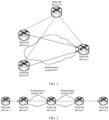
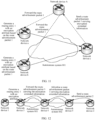
- FIG. 1 is a diagram of a network scenario of an encryption service in a same autonomous system according to an embodiment of this application.
- the network scenario includes a plurality of network devices in the same autonomous system (namely, an autonomous system 001).
- the plurality of network devices specifically include a network device a, a network device b, a network device c, and a network device A.
- the network device a and the network device b establish neighbor relationships with the network device c through the network device A.
- the network device a directly establishes a neighbor relationship with the network device c
- the network device b directly establishes a neighbor relationship with the network device c.
- the network device a, the network device b, and the network device c are, for example, PE devices
- the network device A is a route reflector (Route Reflector, RR).
- data packets from the network device a and the network device b to the network device c need to be encrypted for transmission, to ensure data transmission security. That is, in the scenario shown in FIG. 1 , service data transmitted between the network devices in the same autonomous system needs to be encrypted.
- FIG. 2 is a diagram of a network scenario of an encryption service across autonomous systems according to an embodiment of this application.
- the network scenario includes a plurality of network devices located in different autonomous systems.
- the plurality of network devices specifically include a network device 1 to a network device 5.
- a connection is established between the network device 1 and a network device 2 through a network device 3, a network device 4, and the network device 5, that is, a data packet sent from the network device 1 to the network device 2 needs to pass through the network device 3, the network device 4, and the network device 5.
- a data packet between the network device 3 and the network device 4 is transmitted across an autonomous system 001
- a data packet between the network device 4 and the network device 5 is transmitted across an autonomous system 002.
- the network device 1 and the network device 2 are, for example, customer edge (Customer Edge, CE) devices
- the network device 3, the network device 4, and the network device 5 are PE devices.
- both the data packet from the network device 3 to the network device 4 and the data packet from the network device 4 to the network device 5 need to be encrypted for transmission, to ensure data transmission security. That is, in the scenario shown in FIG. 2 , service data transmitted between the network devices across the autonomous systems needs to be encrypted.
- Encrypted data transmitted between the network devices in different scenarios is described above by using the scenario of transmitting data in the same autonomous system and the scenario of transmitting data across the autonomous systems in FIG. 1 and FIG. 2 as examples.
- data may also need to be encrypted for transmission between network devices in another scenario, and a specific scenario is not limited in this embodiment.
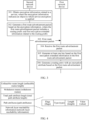
- FIG. 3 is a schematic flowchart of a method for distributing encryption information according to an embodiment of this application.
- the method shown in FIG. 3 is applicable to any two path-reachable network devices in a data communication network, to distribute encryption information between the network devices, so as to ensure that encrypted transmission of service data can be implemented between the network devices.
- the method for distributing encryption information is applied to a first network device and a second network device.
- the second network device is configured to: generate a route advertisement packet carrying encryption extended information, and send the route advertisement packet to the first network device.
- the first network device is configured to: receive the route advertisement packet from the second network device, and generate a routing entry based on a routing prefix and the encryption extended information in the route advertisement packet, so that the first network device can encrypt, based on an indication of the routing entry, a to-be-sent data packet before sending the data packet to the second network device and send an encrypted data packet to the second network device.
- the first network device and the second network device are, for example, physical devices such as routers, switches, or gateways, or virtual devices that support packet forwarding. Specific implementation forms of the first network device and the second network device are not limited in this embodiment.
- the method for distributing encryption information shown in FIG. 3 includes the following steps 301 to 305.
- Step 301 The second network device obtains encryption information related to a service, where the encryption information indicates an object to which service encryption is applied.
- the encryption information obtained by the second network device indicates objects to which service encryption is applied, that is, indicates objects on which service encryption needs to be performed. Based on the obtained encryption information, the second network device can determine whether a currently executed service needs to be encrypted.
- the object to which the service encryption is applied includes an address family or a VPN instance for which an encrypted connection needs to be established.
- the second network device Before advertising a route advertisement packet, the second network device advertises and determines whether a routing prefix in the to-be-advertised route advertisement packet belongs to a network prefix in the address family or the VPN instance, to determine whether a service related to the routing prefix needs to be encrypted.
- the object to which the service encryption is applied includes a routing policy.
- the routing policy indicates a network device for which an encrypted connection needs to be established.
- the routing policy indicates an identifier or an address of the network device for which the encrypted connection needs to be established. In this way, the second network device may determine, by determining whether an identifier or an address of the device belongs to the identifier or the address of the network device indicated in the routing policy, whether the service currently executed by the second network device needs to be encrypted.
- the encryption information in the second network device is preconfigured through a controller or is transferred by another network device in a network system to the second network device.
- the encryption information in the second network device is manually configured on the second network device by management personnel.
- a specific manner of obtaining the encryption information by the second network device is not limited in this embodiment.
- Step 302 The second network device generates a first route advertisement packet based on the encryption information, where the first route advertisement packet includes a routing prefix and first encryption extended information related to the routing prefix, and the first encryption extended information includes a first parameter for key generation.
- the second network device When the second network device determines, based on the encryption information, that the service executed by the second network device needs to be encrypted, the second network device generates the first route advertisement packet carrying the first encryption extended information.
- the first encryption extended information carried in the first route advertisement packet is related to the routing prefix in the first route advertisement packet, that is, a packet to the routing prefix needs to be encrypted for transmission based on content indicated by the first encryption extended information.
- the second network device is a border device in a network indicated by the routing prefix in the first route advertisement packet, and is configured to be responsible for packet forwarding between the network indicated by the routing prefix and another network.
- the second network device when the object to which the service encryption is applied includes an address family or a VPN instance for which an encrypted connection needs to be established, the second network device generates the first route advertisement packet based on a case that the routing prefix belongs to a network prefix in the address family or the VPN instance.
- the object to which the service encryption is applied includes a routing policy, and the routing policy indicates a network device for which an encrypted connection needs to be established, the second network device generates the first route advertisement packet based on a case that the second network device is the network device indicated in the routing policy.
- Step 303 The second network device sends the first route advertisement packet to a neighbor device.
- the second network device After generating the first route advertisement packet, the second network device sends the first route advertisement packet to a connected neighbor device. In addition, after receiving the first route advertisement packet, optionally, the neighbor device of the second network device further continues to forward the first route advertisement packet to another neighbor device, to propagate the first route advertisement packet in the entire data communication network.
- Step 304 The first network device receives the first route advertisement packet.
- the first network device is, for example, a neighbor device of the second network device, that is, the first network device receives the first route advertisement packet from the second network device.
- the first network device may alternatively not be a neighbor device of the second network device, that is, another network device is further connected between the first network device and the second network device. The first network device receives, from a neighbor device of the first network device, the first route advertisement packet from the second network device.
- Step 305 The first network device generates at least one key based on the first encryption extended information in the first route advertisement packet.
- the first network device can generate the at least one key based on the first parameter in the first encryption extended information.
- the at least one key generated by the first network device is used to encrypt a data packet from the first network device to the network indicated by the routing prefix in the first route advertisement packet.
- the at least one key is used to decrypt a data packet from the network indicated by the routing prefix to the first network device.
- the at least one key generated by the first network device can be used to encrypt a data packet from the first network device to the network indicated by the routing prefix and can also be used to decrypt a data packet from the network indicated by the routing prefix to the first network device.
- the first parameter for key generation includes one or more of the following parameters: a random number used to calculate the key, an identifier of the second network device, a security protocol type, a packet encapsulation mode, a verification algorithm, and an encryption algorithm.
- the first network device can generate the at least one key by using the encryption algorithm and an encryption parameter that are specified in the first parameter.
- Step 306 The first network device generates a routing entry based on the first route advertisement packet, where the routing entry includes the routing prefix in the first route advertisement packet, and the routing entry indicates an outbound interface on the first network device to the network indicated by the routing prefix and indicates to encrypt, before a data packet whose destination address belongs to the network indicated by the routing prefix is forwarded, the data packet by using the at least one key.
- the first network device Because the first route advertisement packet includes both the routing prefix and the first encryption extended information related to the routing prefix, the first network device generates the routing entry with an encryption attribute based on the first route advertisement packet.
- the routing entry with the encryption attribute not only indicates how the first network device forwards the data packet to the network indicated by the routing prefix, but also indicates that the first network device needs to encrypt, by using the at least one key, the data packet to the network indicated by the routing prefix.
- the foregoing steps 301 to 306 describe a case that the second network device sends a route advertisement packet to the first network device, so that the first network device generates a routing entry with an encryption attribute, to ensure that the first network device can send an encrypted data packet to the second network device.
- the first network device may alternatively send, to the second network device, a route advertisement packet carrying encryption extended information, so that the second network device can also send an encrypted data packet to the first network device.
- a specific process in which the first network device sends a route advertisement packet carrying encryption extended information to the second network device, and the second network device generates, based on the received route advertisement packet, a routing entry with an encryption attribute is similar to the foregoing steps 301 to 306. Details are not described again in this embodiment.
- a route advertisement packet carries both a routing prefix and encryption extended information related to the routing prefix, so that a network device that receives the route advertisement packet can generate a key based on the encryption extended information in the route advertisement packet and generate a routing entry with an encryption attribute.
- the routing entry can indicate the network device to encrypt data by using the key and then send encrypted data to a network indicated by the routing prefix, to implement encrypted transmission of data between network devices.
- transfer of encryption information between a plurality of network devices is implemented based on the route advertisement packet, and the network device is guided to generate the routing entry with the encryption attribute, so as to ensure that the network device can implement encrypted transmission of a data packet based on the routing entry, without establishing a dedicated encryption tunnel between the network devices.
- the foregoing describes a process in which the second network device includes the first encryption extended information in the first route advertisement packet, so that the first network device can generate the routing entry with the encryption attribute based on the first encryption extended information after receiving the first route advertisement packet.
- the following describes in detail how to include the first encryption extended information in the first route advertisement packet.
- the first encryption extended information in addition to the foregoing first parameter for key generation, further includes information about a first encryption network topology.
- the information about the first encryption network topology indicates a plurality of network devices forming the first encryption network topology and indicates that the plurality of network devices are allowed to establish an encrypted connection.
- a data communication network in which the first network device and the second network device are located may include a large quantity of network devices.
- an encrypted connection usually needs to be established between only some network devices in the data communication network.
- some network devices that expect to establish an encrypted connection with each other are grouped into an encryption network topology, and a plurality of network devices in a same encryption network topology are allowed to establish an encrypted connection.
- the information about the first encryption network topology is indicated in the first encryption extended information, so that the first encryption network topology in which the second network device is located can be indicated, and another network device in the first encryption network topology is allowed to establish an encrypted connection to the second network device.
- the following describes a specific implementation in which the first encryption extended information carries the first parameter for key generation and indicates the information about the first encryption network topology.
- the first encryption extended information is carried in a first type length value (type length value, TLV) field in the first route advertisement packet.
- TLV type length value
- the first TLV field includes the first parameter for key generation and the information about the first encryption network topology.
- the first TLV field includes an identifier of one or more network devices.
- the one or more network devices are devices that need to establish an encrypted connection to the second network device in the first encryption network topology. That is, in the implementation 1, an identifier of a network device is carried in the first TLV field, to specify a device that needs to establish an encrypted connection to the second network device. In this way, when any network device receives the first route advertisement packet from the second network device, the network device only needs to determine whether an identifier of the device is in one or more identifiers indicated by the first TLV field, and may determine whether an encrypted connection needs to be established to the second network device.
- the identifier of the one or more network devices included in the first TLV field is, for example, a BGP router identifier of the network device.
- the identifier of the one or more network devices included in the first TLV field may alternatively be an identifier of another type. This is not specifically limited herein.
- Implementation 2 The first encryption extended information is carried in a first TLV field and a second TLV field in the first route advertisement packet.
- the first TLV field includes the first parameter for key generation, and the second TLV field indicates the information about the first encryption network topology.
- the first TLV field in the first route advertisement packet is used to transfer a parameter for generating a key
- the second TLV field is used to manage an encryption network topology.
- the second TLV field indicates the first encryption network topology to which one or more network devices belong and an identifier of the one or more network devices in the first encryption network topology. That is, the second TLV field indicates that the one or more network devices belong to the first encryption network topology and also indicates the identifier of the one or more network devices in the first encryption network topology.
- the one or more network devices indicated by the second TLV field are devices that need to establish an encrypted connection to the second network device in the first encryption network topology.
- the second TLV field includes a plurality of bits, and one of the plurality of bits indicates at least one network device in the first encryption network topology.
- the one or more network devices in the first encryption network topology indicated by the second TLV field correspond to one or more bits with preset set states in the plurality of bits.
- the preset set state may mean that a bit is set (that is, a value of the bit is 1), that is, a network device corresponding to a set bit in the plurality of bits is a network device that needs to establish an encrypted connection to the second network device in the first encryption network topology.
- the preset set state may mean that a bit is not set (that is, a value of the bit is 0), that is, a network device corresponding to an unset bit in the plurality of bits is a network device that needs to establish an encrypted connection to the second network device in the first encryption network topology.
- the preset set state is not specifically limited in this embodiment.
- a bit in the second TLV field may indicate at least one network device.
- some bits in the second TLV field may alternatively not indicate the network device.
- the second TLV field includes six bits. If the first encryption network topology includes six network devices, and all the six network devices need to establish an encrypted connection to the second network device, each bit in the second TLV field indicates one network device, and the six bits each are set to 1.
- the second TLV field includes six bits. If the first encryption network topology includes 12 network devices, and all the 12 network devices need to establish an encrypted connection to the second network device, each bit in the second TLV field indicates two network devices, and the six bits each are set to 1. For still another example, it is assumed that the second TLV field includes six bits. If the first encryption network topology includes three network devices that need to establish an encrypted connection relationship with the second network device, each of the first three bits in the second TLV field may indicate one network device, and the first three bits in the second TLV field each are set to 1.
- the first TLV field includes the first parameter for key generation, and the first parameter specifically includes a router identifier of the second network device.
- the first network device In a process in which the first network device generates the at least one key based on the first encryption extended information, the first network device generates the at least one key based on the router identifier of the second network device and a router identifier of the first network device. Both the router identifier of the second network device and the router identifier of the first network device are unique identifiers.
- both the router identifiers of the first network device and the second network device are unique identifiers in the data communication network, generating the key based on the router identifiers of the two network devices can ensure uniqueness of the generated key, so as to ensure security of encrypted transmission.
- the first network device may further generate the at least one key based on another parameter.
- the first network device generates the at least one key based on the random number in the first TLV field, a random number generated by the first network device, the router identifier of the first network device, and the router identifier of the second network device.
- a manner of generating the key by the first network device is not specifically limited in this embodiment.
- the first TLV field further includes a quantum key parameter, for example, a quantum key distribution (quantum key distribution, QKD) key identifier.
- a quantum key parameter for example, a quantum key distribution (quantum key distribution, QKD) key identifier.
- QKD quantum key distribution
- the first network device and the second network device after establishing an encrypted connection, usually further need to generate security parameter indexes (security parameter indexes, SPIs), to indicate the encrypted connection between the first network device and the second network device.
- security parameter indexes security parameter indexes, SPIs
- the security parameter index generated by the first network device is generated based on content in the first TLV field and a local parameter of the first network device.
- this embodiment provides a manner of resolving an SPI conflict.
- the first network device After the first network device receives the first route advertisement packet, the first network device generates a first security parameter index based on the first TLV field and a local parameter of the first network device.
- the first security parameter index indicates an encrypted connection between the first network device and the second network device.
- the local parameter includes a random number and/or an identifier of the first network device.
- the first network device updates the local parameter, and generates a second security parameter index based on the first TLV field and an updated local parameter.
- the second security parameter index indicates the encrypted connection between the first network device and the second network device, and the second security parameter index is different from another security parameter index that has been generated in the first network device.
- the first network device sends the updated local parameter to the second network device, so that the second network device can also regenerate a corresponding security parameter index.
- the foregoing describes a case that the first encryption extended information is carried in the first TLV field and the second TLV field in the first route advertisement packet.
- the following describes the first route advertisement packet in detail with reference to a specific application scenario.
- the first route advertisement packet sent by the second network device is, for example, a BGP message or an IGP message.
- the first route advertisement packet is a BGP update message.
- the first TLV field and the second TLV field are carried in an extended path attribute field in the BGP update message.
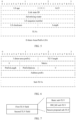
- FIG. 4 is a diagram of a format of a BGP update message according to an embodiment of this application.
- the BGP update message includes a plurality of fields: an unfeasible routes length (unfeasible routes length) field, a withdrawn routes (withdrawn routes) field, a total path attribute length (total path attribute length) field, a path attributes (path attributes) field, and a network layer reachability information (network layer reachability information, NLRI) field.
- the unfeasible routes length field indicates a length of the withdrawn routes field.
- the withdrawn routes field indicates an unreachable route, including a network prefix of a to-be-withdrawn unreachable route.
- the path attribute length field indicates a length of the path attributes field.
- the path attributes field indicates an attribute list of a path related to the NLRI field. Generally, the path attributes field fills all attributes of the path related to the NLRI field in a sequence of type numbers of various attributes.
- the NLRI field indicates network layer reachability information, including a to-be-advertised routing prefix.
- the path attributes field is extended, so that the first TLV field and the second TLV field are carried in the extended path attribute field in the BGP update message.
- the extended path attribute field includes a flags (flags) field, a type (type) field, a length (length) field, and a value (value) field.
- the first TLV field and the second TLV field each include a type (type) field, a length (length) field, and a value (value) field.
- the first route advertisement packet is an OSPF message.
- the first TLV field and the second TLV field are carried in a link state advertisement (Link State Advertisement, LSA) sub-TLV field in the OSPF message.
- FIG. 5 is a diagram of a format of an OSPF internal area prefix link state advertisement (E-Inter-Area-Prefix-LSA) packet according to an embodiment of this application.
- the OSPF message includes a plurality of fields: an LSA age (LS Age) field, a link state id (link state id) field, an advertising router (advertising router) field, a sequence number (LS sequence number) field, an LSA checksum (LS checksum) field, a length field, and a TLV field.
- FIG. 6 is a diagram of a format of a TLV field in an OSPF E-Inter-Area-Prefix-LSA packet according to an embodiment of this application.
- the TLV field in the OSPF E-Inter-Area-Prefix-LSA packet further specifically includes the following fields: an inter-area prefix (inter-area prefix) field, a TLV length field, a metric (metric) field, a prefix length (prefix length) field, a prefix options (prefix options) field, an address prefix (address prefix) field, and a sub-TLVs (sub-TLVs) field.
- the sub-TLVs field of the TLV field in the OSPF E-Inter-Area-Prefix-LSA packet is extended, and the first TLV field and the second TLV field are carried in the sub-TLVs field, so that the sub-TLVs field is extended to carry the first TLV field and the second TLV field in the OSPF message.
- the encryption extended information carried in the first TLV field and the second TLV field has an optional (Optional) attribute and a transit (Transit) attribute, that is, the second network device can choose whether to add the encryption extended information to the route advertisement packet.
- the first network device can choose to transparently transmit the route advertisement packet carrying the encryption extended information.
- FIG. 7 is a diagram of formats of a first TLV field and a second TLV field according to an embodiment of this application.
- the first TLV field is used to transfer an encryption-related parameter.
- the first TLV field includes a basic sub-TLV (basic sub-TLV), a key exchange algorithm-key exchange sub-TLV (Diffie-Hellman Key exchange sub-TLV, DH_KE sub-TLV), and a secure proposal sub-TLV (secure proposal sub-TLV).
- the second TLV field is used to manage an encryption network topology, so as to adapt to any encryption topology in a data communication network, and improve network deployment flexibility.
- the basic sub-TLV includes or carries, for example, a random number and identification information related to a network device that are used to calculate a key.
- the identification information related to the network device includes but is not limited to the following plurality of types of identifiers: an IP address of the second network device, a router identifier of the second network device, a QKD key identifier used for quantum encryption, and a count used to identify key update (rekey).
- the DH_KE sub-TLV includes: a key exchange algorithm group identifier and exchange data of a key exchange algorithm.
- the secure proposal sub-TLV includes: a security protocol type, a packet encapsulation mode, a verification algorithm, and an encryption algorithm.
- the second TLV field includes: a topology group identifier (that is, the identifier of the first encryption network topology), a topology group type, and a topology group attribute value.
- a topology group identifier that is, the identifier of the first encryption network topology
- a topology group type that is, the identifier of the first encryption network topology
- a topology group attribute value that is, the encryption network topology
- FIG. 8 is a diagram of a format of a second TLV field according to an embodiment of this application.
- the topology group identifier indicates an encryption network topology in which a network device that needs to establish an encrypted connection to the second network device is located.
- Type shown in FIG. 8 is a topology group type, and the topology group type indicates a type of the encryption network topology. For example, when the topology group type is 0, it indicates that the type of the encryption network topology is no sub-attribution (no sub-attribution). For another example, when the topology group type is 1, it indicates that the type of the encryption network topology is hub-spoke sub-attribution (hub-spoke sub-attribution). For still another example, when the topology group type is 2, it indicates that the type of the encryption network topology is bitmap sub-attribution (bitmap sub-attribution).
- the topology group attribute value shown in FIG. 8 is the topology group type, and a topology group attribute value indicates specific attribute information in the encryption network topology.
- the topology group attribute value indicates an affinity-group (affinity-group) attribute (that is, an AFFINITY-GROUP value shown in FIG. 8 ) in the encryption network topology
- the affinity-group attribute indicates a network device that needs an encrypted connection in a same encryption network topology.
- the affinity-group attribute may alternatively have a corresponding sub-attribute (that is, a SUB-ATTRIBUTION value shown in FIG. 8 ), and the sub-attribute of the affinity-group attribute indicates a specific network device that needs an encrypted connection.
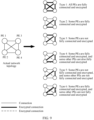
- FIG. 9 is a schematic of structures of a plurality of different encryption network topologies according to an embodiment of this application.
- a PE 1, a PE 2, a PE 3, and a PE 4 are connected to each other.
- the PE 1, the PE 2, the PE 3, and the PE 4 can form different encryption network topologies based on different service requirements.
- a type 1 to a type 6 in FIG. 9 represent different encryption network topologies.
- the PE 1, the PE 2, the PE 3, and the PE 4 form an encryption network topology, and the PE 1, the PE 2, the PE 3, and the PE 4 are fully connected and encrypted, that is, any PE is in an encrypted connection to all other PEs.
- the PE 2, the PE 3, and the PE 4 form an encryption network topology, and the PE 2, the PE 3, and the PE 4 are fully connected and encrypted, that is, any PE of the PE 2, the PE 3, and the PE 4 is in an encrypted connection to all other PEs.
- a topology group attribute value in a second TLV field indicates an affinity-group attribute, and the PE 2, the PE 3, and the PE 4 carry a same affinity-group value.
- the PE 1, the PE 2, the PE 3, and the PE 4 form an encryption network topology, and the PE 1, the PE 2, and the PE 4 each are in an encrypted connection to the PE3.
- a topology group attribute value in a second TLV field indicates an affinity-group attribute, and the affinity-group attribute further has a sub-attribute.
- the PE 1, the PE 2, the PE 3, and the PE 4 carry a same affinity-group value.
- the sub-attribute of the affinity-group attribute in the second TLV field is 111, indicating that the PE 3 needs to be in an encrypted connection to the PE 1, the PE 2, and the PE 4.
- the sub-attribute of the affinity-group attribute in the second TLV field is 001, indicating that the PE 1 needs to be in an encrypted connection to the PE 3.
- the sub-attribute of the affinity-group attribute in the second TLV field is 010, indicating that the PE 2 needs to be in an encrypted connection to the PE 3.
- the sub-attribute of the affinity-group attribute in the second TLV field is 100, indicating that the PE 4 needs to be in an encrypted connection to the PE 3.
- the PE 1, the PE 2, the PE 3, and the PE 4 carry a same affinity-group value.
- the sub-attribute of the affinity-group attribute in the second TLV field is hub, indicating that the PE 3 is a backbone node.
- the sub-attribute of the affinity-group attribute in the second TLV field is spoke, indicating that the PE 1, the PE 2, and the PE 4 are branch nodes.
- the PE 1, the PE 2, and the PE 4 form an encryption network topology A, and the PE 1, the PE 2, and the PE 4 are fully connected and encrypted.
- the PE 2, the PE 3, and the PE 4 form an encryption network topology B, and the PE 2, the PE 3, and the PE 4 are fully connected and encrypted.
- a topology group attribute value in a second TLV field indicates an affinity-group attribute.
- an affinity-group value is A.
- an affinity-group value is B.
- the PE 1, the PE 2, and the PE 4 form an encryption network topology A, and the PE 1 is in an encrypted connection to both the PE 2 and the PE 4.
- the PE 2, the PE 3, and the PE 4 form an encryption network topology B, and the PE 3 is in an encrypted connection to both the PE 2 and the PE 4.
- an affinity-group value in a second TLV field is A
- a sub-attribute of an affinity-group attribute is 11, indicating that the PE 1 needs to be in an encrypted connection to the PE 2 and the PE 4.
- an affinity-group value in a second TLV field is A
- a sub-attribute of an affinity-group attribute is 01, indicating that the PE 2 needs to be in an encrypted connection to the PE 1.
- an affinity-group value in a second TLV field is A
- a sub-attribute of an affinity-group attribute is 10, indicating that the PE 4 needs to be in an encrypted connection to the PE 1.
- an affinity-group value in a second TLV field is B, and a sub-attribute of an affinity-group attribute is 11, indicating that the PE 3 needs to be in an encrypted connection to the PE 2 and the PE 4.
- an affinity-group value in a second TLV field is B, and a sub-attribute of an affinity-group attribute is 01, indicating that the PE 2 needs to be in an encrypted connection to the PE 3.
- an affinity-group value in a second TLV field is B, and a sub-attribute of an affinity-group attribute is 10, indicating that the PE 4 needs to be in an encrypted connection to the PE 3.
- the PE 2, the PE 3, and the PE 4 form an encryption network topology A on a service A, and the PE 2, the PE 3, and the PE 4 are fully connected and encrypted.
- the PE 2, the PE 3, and the PE 4 form an encryption network topology B on a service B, and the PE 3 is in an encrypted connection to both the PE 2 and the PE 4.
- an affinity-group value in a second TLV field is A.
- a route advertisement packet sent by the PE 3 to a network device in the encryption network topology B is B, and a sub-attribute of an affinity-group attribute is 11, indicating that the PE 3 needs to be in an encrypted connection to the PE 2 and the PE 4.
- an affinity-group value in a second TLV field is B, and a sub-attribute of an affinity-group attribute is 01, indicating that the PE 2 needs to be in an encrypted connection to the PE 3.
- an affinity-group value in a second TLV field is B, and a sub-attribute of an affinity-group attribute is 10, indicating that the PE 4 needs to be in an encrypted connection to the PE 3.
- the foregoing describes how to include the first encryption extended information in the first route advertisement packet.
- the following describes in detail how the first network device sends an encrypted packet to the second network device when obtaining a packet to the second network device.
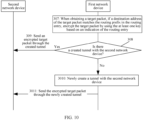
- FIG. 10 is another schematic flowchart of a method for distributing encryption information according to an embodiment of this application.
- the first network device after the first network device generates the routing entry based on the first route advertisement packet, the first network device further performs the following steps 307 to 3011.
- Step 307 When the first network device obtains a target packet, if a destination address of the target packet matches the routing prefix in the routing entry, the first network device encrypts the target packet by using the at least one key based on an indication of the routing entry.
- the target packet is a to-be-forwarded packet received by the first network device.
- the first network device encrypts the target packet by using the at least one pre-generated key based on the indication of the routing entry.
- Step 308 Determine whether there is a created tunnel between the first network device and the second network device.
- the first network device needs to determine whether the first network device already has a tunnel to the second network device, for example, a VPN tunnel.
- Step 309 If there is the created tunnel between the first network device and the second network device, the first network device sends an encrypted target packet through the created tunnel.
- the packet transmitted by the first network device to the second network device has been encrypted by using the pre-generated key, security of data transmission between the first network device and the second network device can be ensured.
- the first network device sends the encrypted target packet to the second network device through the created tunnel, without creating a dedicated encryption tunnel.
- Step 3010 If there is no created tunnel between the first network device and the second network device, the first network device newly creates a tunnel with the second network device.
- Step 3011 The first network device sends an encrypted target packet through the newly created tunnel.
- the first encryption extended information further includes an internet protocol IP address of the second network device.
- the first network device creates an IPinIP tunnel with the second network device based on the IP address of the second network device and an IP address of the first network device, that is, the newly created tunnel is the IPinIP tunnel.
- the IPinIP tunnel is a three-layer tunnel, and an original IP packet is encapsulated into a new IP packet to create a tunnel for transmission.
- the first network device continues to forward the first route advertisement packet to another network device, so that the first route advertisement packet is continuously transferred in the data communication network.
- the first network device determines whether the first route advertisement packet needs to be changed. If the first network device needs to establish a new encrypted connection to another network device, the first network device needs to change the first encryption extended information in the first route advertisement packet, so that the another network device can establish an encrypted connection to the first network device. If the first network device does not need to establish a new encrypted connection to another network device, the first network device does not need to change the first encryption extended information in the first route advertisement packet, but forwards the first route advertisement packet to the another network device, so that the another network device can establish an encrypted connection to the second network device.
- the first network device If the first network device needs to change the first encryption extended information in the first route advertisement packet, the first network device generates second encryption extended information.
- the second encryption extended information includes a second parameter for key generation and information about a second encryption network topology.
- the information about the second encryption network topology indicates a plurality of network devices forming the second encryption network topology and indicates that the plurality of network devices in the second encryption network topology are allowed to establish an encrypted connection.
- the first network device replaces the first encryption extended information in the first route advertisement packet with the second encryption extended information to obtain a second route advertisement packet, and then the first network device sends the second route advertisement packet to the neighbor device.
- the first network device forwards the received first route advertisement packet to the neighbor device of the first network device, without changing the first encryption extended information in the first route advertisement packet.
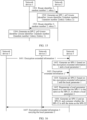
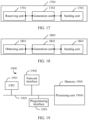
- FIG. 11 is a diagram of distributing encryption information in a same autonomous system according to an embodiment of this application.
- data packets from a network device a and a network device b to a network device c need to be encrypted for transmission, to ensure data transmission security.
- attributes of encryption network topologies are configured on the network device a, the network device b, and the network device c.
- the attribute of the encryption network topology of the network device a and the network device b is a spoke attribute, that is, the network device a and the network device b are branch nodes.
- the attribute of the encryption network topology of the network device c is a hub attribute, that is, the network device c is a backbone node.
- the network device c sends a route advertisement packet 1 carrying encryption extended information to a network device A.
- the route advertisement packet 1 further carries a routing prefix related to the encryption extended information, and the network device c is a border device in a network indicated by the routing prefix 1.
- the network device A After receiving the route advertisement packet 1 sent by the network device c, the network device A identifies that the route advertisement packet 1 has a transit attribute. Therefore, the network device A forwards the route advertisement packet 1 to the network device a and the network device b.
- the network device a After receiving the route advertisement packet 1, the network device a generates a key and a routing entry based on the routing prefix and the encryption extended information in the route advertisement packet 1.
- the routing entry generated by the network device a indicates an outbound interface to the network device c and indicates that a packet needs to be encrypted by using the key before the packet to the network device c is forwarded.
- the network device b After receiving the route advertisement packet 1, the network device b generates a key and a routing entry based on the routing prefix and the encryption extended information in the route advertisement packet 1.
- the routing entry generated by the network device b indicates an outbound interface to the network device c and indicates that a packet needs to be encrypted by using the key before the packet to the network device c is forwarded.
- FIG. 12 is a diagram of distributing encryption information between different autonomous systems according to an embodiment of this application.
- data communication is performed between a network device 1 and a network device 2, and a data packet from a network device 3 to a network device 5 needs to be encrypted for transmission.
- the network device 2 sends a route advertisement packet 2 to the network device 5.
- the route advertisement packet 2 carries a routing prefix, and the network device 2 is a border device of the routing prefix.
- the network device 5 generates, based on the route advertisement packet 2 received from the network device 2, a route advertisement packet 3 carrying encryption extended information, and sends the route advertisement packet 3 to the network device 4.
- a routing prefix carried in the route advertisement packet 3 is the same as the routing prefix in the route advertisement packet 2.
- the encryption extended information in the route advertisement packet 3 indicates that a network device that needs to establish an encrypted connection to the network device 5 is the network device 3.
- the network device 4 After receiving the route advertisement packet 3 sent by the network device 5, the network device 4 identifies that the route advertisement packet 3 has a transit attribute. Therefore, the network device 4 forwards the route advertisement packet 3 to the network device 3.
- the network device 3 After receiving the route advertisement packet 3, the network device 3 generates a key and a routing entry 3 based on the routing prefix and the encryption extended information in the route advertisement packet 3.
- the routing entry 3 indicates an outbound interface to the network device 2 and indicates that a packet needs to be encrypted by using the key before the packet to the network device 2 is forwarded.
- the network device 3 when the network device 3 receives, from the network device 1, a data packet to the network device 2, the network device 3 encrypts the data packet based on an indication of the routing entry 3, and then sends an encrypted data packet to the network device 4. After receiving the encrypted data packet from the network device 4, the network device 5 decrypts the encrypted data packet, and sends the decrypted data packet to the network device 2.
- the following describes a process of distributing encryption information in detail from the perspective of a network device (referred to as a transmitter side device for short) that advertises a route advertisement packet carrying encryption extended information, and a network device (referred to as a receiver side device for short) that receives the route advertisement packet carrying the encryption extended information.
- the transmitter side device is, for example, the second network device in the foregoing embodiments
- the receiver side device is, for example, the first network device in the foregoing embodiments.
- FIG. 13 is a schematic flowchart in which a transmitter side device advertises a route advertisement packet carrying encryption extended information according to an embodiment of this application. As shown in FIG. 13 , a procedure in which the transmitter side device advertises the route advertisement packet carrying the encryption extended information includes the following steps 1301 to 1304.
- Step 1301 The transmitter side device configures a related parameter of an encryption extended attribute.
- a manner in which the transmitter side device configures the related parameter of the encryption extended attribute is that, for example, a controller delivers the related parameter of the encryption extended attribute to the transmitter side device, or management personnel manually configures the related parameter of the encryption extended attribute on the transmitter side device.
- the related parameter of the encryption extended attribute includes but is not limited to the following parameters: an IP address of the transmitter side device, a router identifier of the transmitter side device, a QKD key identifier for quantum encryption, a count used to identify key update, a key exchange algorithm group identifier, exchange data of a key exchange algorithm, a security protocol type, a packet encapsulation mode, a verification algorithm, an encryption algorithm, and information about a network device that needs to establish an encrypted connection to the transmitter side device.
- Step 1302 The transmitter side device determines a service to which the encryption extended attribute is applied.
- the transmitter side device determines, based on a preconfigured address family, VPN instance, or routing policy, the service to which the encryption extended attribute is applied, that is, determines which network prefixes on the transmitter side device are related to the encryption extended attribute.
- Step 1303 The transmitter side device generates, based on the related parameter of the encryption extended attribute and the service to which the encryption extended attribute is applied, a route advertisement packet carrying encryption extended information.
- the transmitter side device can generate the encryption extended information based on the related parameter of the encryption extended attribute.
- the route advertisement packet carries a routing prefix and the encryption extended information of the routing prefix.
- the routing prefix is related to the service to which the encryption extended attribute is applied.
- Step 1304 The transmitter side device sends the route advertisement packet carrying the encryption extended information to a neighbor device.
- identity authentication on both the transmitter side device and another network device that the route advertisement packet can reach in the data communication network has passed, to ensure that encryption and decryption parties establish a relationship under legal identities, and prevent malicious spoofers from establishing a relationship to obtain sensitive data information.
- an authentication relationship is established between the transmitter side device and another network device by using a transport layer security (Transport Layer Security, TLS) identity authentication mechanism.
- TLS Transport Layer Security
- an authentication relationship is established between the transmitter side device and another network device by using a preset identity key.
- the transmitter side device indicates, by using a bit flag in the route advertisement packet, whether the encryption extended information in the route advertisement packet is encrypted and integrity protected.
- the transmitter side device encrypts the encryption extended information in the route advertisement packet by using the preset identity key, performs integrity calculation on content obtained by encrypting the encryption extended information by using the preset identity key, and fills the route advertisement packet with a calculation result.
- the receiver side device after receiving the route advertisement packet, performs integrity verification on corresponding content in the route advertisement packet by using the preset identity key, and parses the content in the route advertisement packet by using the preset identity key after the verification succeeds, to obtain the encryption extended information.
- FIG. 14 is a schematic flowchart in which a receiver side device receives and processes a route advertisement packet carrying encryption extended information according to an embodiment of this application.
- a procedure in which the receiver side device receives and processes the route advertisement packet carrying the encryption extended information includes the following steps 1401 to 1414.
- the receiver side device is the first network device in the foregoing embodiments.
- Step 1401 Receive a route advertisement packet carrying encryption extended information.
- the receiver side device may receive the route advertisement packet carrying the encryption extended information from a neighbor device or directly from the transmitter side device.
- Step 1402 Determine whether this device supports an encryption extension capability.
- Step 1403 If this device does not support the encryption extension capability, transparently transmit the route advertisement packet.
- the receiver side device transparently transmits the route advertisement packet without processing the route advertisement packet Alternatively, the receiver side device generates a corresponding routing entry based on only a routing prefix in the route advertisement packet, and the routing entry generated by the receiver side device does not have an encryption attribute.
- Step 1404 If this device supports the encryption extension capability, parse the route advertisement packet, to obtain the encryption extended information.
- Step 1405 Determine whether the encryption extended information is related to this device.
- the receiver side device may determine, based on information about an encryption network topology indicated in the encryption extended information, whether the encryption extended information is related to this device.
- Step 1406 If the encryption extended information is not related to the device, transparently transmit the route advertisement packet.
- Step 1407 If the encryption extended information is related to this device, generate at least one key and a routing entry with an encryption attribute.
- Step 1408 Determine whether the encryption extended information in the route advertisement packet needs to be changed.
- the receiver side device needs to additionally establish an encrypted connection to another network device, the receiver side device needs to change the encryption extended information in the route advertisement packet. If the receiver side device does not need to additionally establish the encrypted connection to the another network device, the receiver side device does not need to change the encryption extended information in the route advertisement packet.
- Step 1409 If the encryption extended information in the route advertisement packet needs to be changed, regenerate encryption extended information based on a local parameter, and forward a new route advertisement packet.
- the new route advertisement packet carries the regenerated encryption extended information.
- Step 1410 If the encryption extended information in the route advertisement packet does not need to be changed, forward the route advertisement packet.
- the receiver side device forwards the received route advertisement packet to the neighbor device without changing the encryption extended information in the route advertisement packet.
- Step 1411 Determine whether there is an available tunnel with a transmitter side device.
- Step 1412 If there is the available tunnel with the transmitter side device, encrypt and forward, through the available tunnel, a packet to the transmitter side device.
- Step 1413 If there is no available tunnel with the transmitter side device, create an IPinIP tunnel based on an IP address of the transmitter side device and an IP address of the receiver side device.
- Step 1414 Encrypt and forward, through the newly created IPinIP tunnel, the packet to the transmitter side device.
- the receiver side device after the receiver side device receives the route advertisement packet sent by the transmitter side device, the receiver side device further generates a security parameter index based on the encryption extended information in the route advertisement packet and a local parameter, to identify an encrypted connection between the receiver side device and the transmitter side device.
- FIG. 15 is a schematic flowchart of generating a security parameter index between network devices according to an embodiment of this application. As shown in FIG. 15 , a procedure of generating the security parameter index between the network devices includes the following steps 1501 to 1504.
- Step 1501 A network device 1 sends a router identifier 1, a random number 1, and a rekey 1 to a network device 2.
- the router identifier 1, the random number 1, and the rekey 1 are carried in encryption extended information.
- the network device 1 sends the router identifier 1, the random number 1, and the rekey 1 by sending a route advertisement packet including the encryption extended information to the network device 2.
- the router identifier 1 is a router identifier of the network device 1, and both the random number 1 and the rekey 1 are generated by the network device 1.
- Step 1502 The network device 2 generates an SPI 1.
- the network device 2 generates the SPI 1 by using a pseudorandom function prf+().
- the SPI 1 is prf+(router identifier 1
- the router identifier 2 is an identifier of the network device 2, and both the random number 2 and the rekey 2 are generated by the network device 1.
- the SPI 1 identifies an encrypted connection from the network device 1 to the network device 2.
- the network device 2 may further generate an SPI 3 identifying an encrypted connection from the network device 2 to the network device 1.
- a parameter used to generate the SPI 3 is the same as a parameter used to generate the SPI 1.
- the SPI 3 is prf+(router identifier 2
- Step 1503 The network device 2 sends a router identifier 2, a random number 2, and a rekey 2 to the network device 1.
- the network device 2 sends the router identifier 2, the random number 2, and the rekey 2 by sending a route advertisement packet including encryption extended information to the network device 1.
- Step 1504 The network device 1 generates an SPI 2.
- the network device 2 generates the SPI 2 by using a pseudorandom function prf+().
- the SPI 2 is prf+(router identifier 2
- the SPI is generated based on a unique router identifier between two encryption parties, so that uniqueness of the SPI can be effectively ensured.
- FIG. 16 is a schematic flowchart of performing renegotiation when a conflict occurs between SPIs according to an embodiment of this application. As shown in FIG. 16 , when a conflict occurs between SPIs generated by network devices, the network devices perform the following negotiation procedure.
- Step 1601 A network device 1 sends encryption extended information 1 to a network device 3.
- the encryption extended information 1 is carried in a route advertisement packet sent by the network device 1 to the network device 3.
- Step 1602 The network device 3 generates an SPI-11 based on the encryption extended information 1 and a local parameter 1.
- step 1502 For a specific manner in which the network device 3 generates the SPI-11 based on the encryption extended information 1 and the local parameter 1, refer to step 1502 in the embodiment corresponding to FIG. 15 . Details are not described herein again.
- Step 1603 A network device 2 sends encryption extended information 2 to the network device 3.
- the encryption extended information 2 is carried in a route advertisement packet sent by the network device 2 to the network device 3.
- Step 1604 The network device 3 generates an SPI-21 based on the encryption extended information 2 and the local parameter 1.
- Step 1605 The network device 3 updates the local parameter based on a case that the SPI-11 is the same as the SPI-21, to obtain a local parameter 2.
- the network device 3 After the network device 3 generates a new SPI each time, the network device 3 compares whether the new SPI is the same as the generated SPI. If the SPI-11 is the same as the SPI-21, the network device 3 updates the local parameter, to obtain the local parameter 2.
- Step 1606 The network device 3 generates an SPI-12 based on the encryption extended information 1 and the local parameter 2, generates an SPI-22 based on the encryption extended information 2 and the local parameter 2, and compares whether the SPI-12 is still the same as the SPI-22.
- Step 1607 When the SPI-12 is different from the SPI-22, the network device 3 sends encryption extended information 3 to the network device 1 and the network device 2, where the encryption extended information 3 carries the local parameter 2.
- the network device 3 continues to update the local parameter until no conflict occurs on SPIs.
- FIG. 17 is a diagram of a structure of a network device 1700 according to an embodiment of this application.
- the network device 1700 shown in FIG. 17 is, for example, the first network device in the embodiments corresponding to FIG. 3 and FIG. 10 , or the receiver side device in the embodiment corresponding to FIG. 14 .
- the network device 1700 includes: a receiving unit 1701, configured to receive a first route advertisement packet, where the first route advertisement packet includes a routing prefix and first encryption extended information related to the routing prefix, and the first encryption extended information includes a first parameter for key generation; and a generation unit 1702, configured to generate at least one key based on the first encryption extended information, where the at least one key is used to encrypt a data packet from the network device to a network indicated by the routing prefix and/or decrypt a data packet from the network indicated by the routing prefix to the network device, where the generation unit 1702 is further configured to generate a routing entry based on the first route advertisement packet, where the routing entry includes the routing prefix, and the routing entry indicates an outbound interface on the network device to the network indicated by the routing prefix and indicates to encrypt, before a data packet whose destination address belongs to the network indicated by the routing prefix is forwarded, the data packet by using the at least one key.
- a receiving unit 1701 configured to receive a first route advertisement packet
- the first encryption extended information is carried in a first TLV field in the first route advertisement packet, and the first TLV field includes the first parameter for key generation.
- the first encryption extended information further includes information indicating a first encryption network topology, and the information about the first encryption network topology indicates a plurality of network devices forming the first encryption network topology and indicates that the plurality of network devices are allowed to establish an encrypted connection.
- the first encryption extended information is further carried in a second TLV field in the first route advertisement packet, and the second TLV field indicates the information about the first encryption network topology.
- the first route advertisement packet is a BGP message or an IGP message.
- the first route advertisement packet is a BGP update message.
- the first TLV field and the second TLV field are carried in an extended path attribute field in the BGP update message.
- the first route advertisement packet is an open shortest path first OSPF message.
- the first TLV field and the second TLV field are carried in a link state advertisement sub-TLV field in the OSPF message.
- the generation unit 1702 is further configured to: when obtaining a target packet, if a destination address of the target packet matches the routing prefix in the routing entry, encrypt the target packet by using the at least one key based on an indication of the routing entry.
- the network device further includes a sending unit 1703.
- the sending unit 1703 is configured to send an encrypted target packet through the created tunnel.
- the second network device is a border device in the network indicated by the routing prefix.
- the generation unit 1702 is configured to newly create a tunnel with the second network device, and the sending unit 1703 is configured to send an encrypted target packet through the newly created tunnel.
- the first encryption extended information further includes an IP address of the second network device.
- the generation unit 1702 is configured to create an IPinIP tunnel with the second network device based on the IP address of the second network device and an IP address of a first network device.
- the first TLV field includes an identifier of one or more network devices
- the one or more network devices are devices that need to establish an encrypted connection to the second network device in an encryption network topology
- the second network device is the border device in the network indicated by the routing prefix.
- the second TLV field indicates the first encryption network topology to which one or more network devices belong and an identifier of the one or more network devices in the first encryption network topology
- the one or more network devices are devices that need to establish an encrypted connection to the second network device in the first encryption network topology
- the second network device is the border device in the network indicated by the routing prefix.
- the second TLV field includes a plurality of bits, one of the plurality of bits indicates at least one network device in the first encryption network topology, and the one or more network devices correspond to one or more bits with preset set states in the plurality of bits.
- the first TLV field includes a router identifier of the second network device
- the second network device is the border device in the network indicated by the routing prefix.
- the generation unit 1702 is further configured to generate at least one key based on the router identifier of the second network device and a router identifier of the first network device. Both the router identifier of the second network device and the router identifier of the first network device are unique identifiers.
- the generation unit 1702 is further configured to: generate a first security parameter index based on the first TLV field and a local parameter, where the first security parameter index indicates an encrypted connection between the network device and the second network device, the local parameter includes a random number and/or an identifier of the first network device, and the second network device is the border device in the network indicated by the routing prefix; and if the first security parameter index is the same as another security parameter index that has been generated in the network device, update the local parameter and generate a second security parameter index based on the first TLV field and an updated local parameter.
- the sending unit 1703 is further configured to send the updated local parameter to the second network device.
- the first TLV field further includes a quantum key parameter.
- the generation unit 1702 is further configured to generate second encryption extended information, where the second encryption extended information includes a second parameter for key generation and information about a second encryption network topology, and the information about the second encryption network topology indicates a plurality of network devices forming the second encryption network topology and indicates that the plurality of network devices in the second encryption network topology are allowed to establish an encrypted connection; and replace, for the first network device, the first encryption extended information in the first route advertisement packet with the second encryption extended information, to obtain a second route advertisement packet.
- the sending unit 1703 is further configured to send, for the first network device, the second route advertisement packet to a neighbor device.
- FIG. 18 is a diagram of a structure of a network device 1800 according to an embodiment of this application.
- the network device 1800 shown in FIG. 18 is, for example, the second network device in the embodiments corresponding to FIG. 3 and FIG. 10 , or the transmitter side device in the embodiment corresponding to FIG. 13 .
- the network device 1800 includes: an obtaining unit 1801, configured to obtain encryption information related to a service, where the encryption information indicates an object to which service encryption is applied; a generation unit 1802, configured to generate a route advertisement packet based on the encryption information, where the route advertisement packet includes a routing prefix and encryption extended information related to the routing prefix, and the encryption extended information includes a parameter for key generation; and a sending unit 1803, configured to send the route advertisement packet to a neighbor device.
- the object to which the service encryption is applied includes an address family or a VPN instance for which an encrypted connection needs to be established.
- the generation unit 1802 is further configured to generate the route advertisement packet based on a case that the routing prefix belongs to a network prefix in the address family or the VPN instance.
- the network device is a border device in a network indicated by the routing prefix.
- the object to which the service encryption is applied includes a routing policy
- the routing policy indicates a network device for which an encrypted connection needs to be established.
- the generation unit 1802 is further configured to generate the route advertisement packet based on a case that the network device belongs to the network device indicated in the routing policy.
- FIG. 19 is a diagram of a structure of a network device 1900 according to an embodiment of this application.
- the network device 1900 shown in FIG. 19 may be configured to perform steps performed by any device of the first network device, the second network device, the transmitter side device, or the receiver side device in the foregoing embodiments.
- the network device 1900 shown in FIG. 19 shows some specific features, a person skilled in the art is aware from embodiments of this application that, for brevity, FIG. 19 does not show various other features, to avoid confusing more related aspects of the implementations disclosed in embodiments of this application.
- the network device 1900 includes one or more processors (for example, CPUs) 1901, a network interface 1902, a programming interface 1903, a memory 1904, and one or more communication buses 1905 that are configured to interconnect various components.
- processors for example, CPUs
- the network interface 1902 includes one or more network interface 1902, a programming interface 1903, a memory 1904, and one or more communication buses 1905 that are configured to interconnect various components.
- some functional components or units may be omitted or added to the network device 1900 based on the foregoing examples.
- the network interface 1902 is configured to connect to one or more other network devices/servers in a network system.
- the communication bus 1905 includes a circuit that interconnects and controls communication between system components.
- the memory 1904 may include a non-volatile memory, for example, a read-only memory (read-only memory, ROM), a programmable read-only memory (programmable ROM, PROM), an erasable programmable read-only memory (erasable PROM, EPROM), an electrically erasable programmable read-only memory (electrically EPROM, EEPROM), or a flash memory.
- the memory 1904 may include a volatile memory.
- the volatile memory may be a random access memory (random access memory, RAM), used as an external cache.
- a non-transitory computer-readable storage medium of the memory 1904 stores the following programs, modules, and data structures, or a subset thereof, for example, includes an obtaining unit (not shown in the figure), a sending unit (not shown in the figure), and a processing unit 19041.
- the network device 1900 may have any function of the network device in the method embodiment corresponding to FIG. 3 .
- the network device 1900 corresponds to the first network device in the method embodiment.
- the modules and the foregoing other operations and/or functions in the network device 1900 are separately configured to implement various steps and methods implemented by the first network device in the method embodiment. For specific details, refer to the method embodiment corresponding to FIG. 3 . For brevity, details are not described herein again.
- the network interface 1902 on the network device 1900 may complete data receiving and sending operations, or the processor may invoke program code in the memory, and implement a function of a transceiver unit in cooperation with the network interface 1902 when needed.
- the network device 1900 is configured to perform the method for distributing encryption information provided in embodiments of this application, for example, perform the method for distributing encryption information corresponding to the embodiment shown in FIG. 3 .
- FIG. 20 A specific structure of the network device described in FIG. 19 in this application may be shown in FIG. 20 .
- the main control board 2020 is also referred to as a main processing unit (main processing unit, MPU) or a route processor (route processor).
- the main control board 2020 is configured to control and manage components in the network device 2000, including route calculation, device management, device maintenance, and protocol processing functions.
- the main control board 2020 includes a central processing unit 2011 and a memory 2012.
- the central processing unit 2031 on the interface board 2030 is configured to control and manage the interface board 2030, and communicate with the central processing unit 2011 on the main control board 2020.
- the network processor 2032 is configured to implement packet forwarding processing.
- a form of the network processor 2032 may be a forwarding chip.
- the physical interface card 2033 is configured to implement a physical layer interconnection function. Original traffic enters the interface board 2030, and a processed packet is sent out from the physical interface card 2033.
- the physical interface card 2033 includes at least one physical interface.
- the physical interface is also referred to as a physical port, and the physical interface may be a flexible Ethernet (Flexible Ethernet, FlexE) physical interface.
- the central processing unit 2031 on the interface board 2030 may alternatively perform a function of the network processor 2032, for example, implement software forwarding based on a general-purpose CPU. In this way, the interface board 2030 does not need the network processor 2032.
- the network device 2000 includes a plurality of interface boards.
- the network device 2000 further includes an interface board 2040.
- the interface board 2040 includes a central processing unit 2041, a network processor 2042, a physical interface card 2043, and a forwarding entry memory 2044.
- the network device 2000 further includes a switching board 2020.
- the switching board 2020 may also be referred to as a switch fabric unit (switch fabric unit, SFU).
- switch fabric unit switch fabric unit
- the switching board 2020 is configured to complete data exchange between the interface boards.
- the interface board 2030 and the interface board 2040 may communicate with each other through the switching board 2020.
- the main control board 2020 is coupled to the interface board.
- the main control board 2020, the interface board 2030 and the interface board 2040, and the switching board 2020 are connected via a system bus and/or a system backplane to implement interworking.
- an inter-process communication (inter-process communication, IPC) protocol channel is established between the main control board 2020 and the interface board 2030, and the main control board 2020 and the interface board 2030 communicate with each other through the IPC channel.
- IPC inter-process communication
- the network device 2000 includes a control plane and a forwarding plane.
- the control plane includes the main control board 2020 and the central processing unit 2031.
- the forwarding plane includes components used for forwarding, for example, the forwarding entry memory 2034, the physical interface card 2033, and the network processor 2032.
- the control plane performs functions such as advertising a route, generating a forwarding table, processing signaling and a protocol packet, and configuring and maintaining a status of a device.
- the control plane delivers the generated forwarding table to the forwarding plane.
- the network processor 2032 looks up and forwards a packet received by the physical interface card 2033 based on the forwarding table delivered by the control plane.
- the forwarding table delivered by the control plane may be stored in the forwarding entry memory 2034. In some embodiments, the control plane and the forwarding plane may be completely separated, and are not on a same device.
- an operation on the interface board 2040 is consistent with an operation on the interface board 2030.
- the network device 2000 in this embodiment may correspond to the first network device in the foregoing method embodiments.
- the main control board 2020, the interface board 2030, and/or the interface board 2040 in the network device 2000 may implement functions and/or various steps implemented by the first network device in the foregoing method embodiments. For brevity, details are not described herein again.
- main control boards including an active main control board and a standby main control board.
- interface boards There may be one or more interface boards.
- a network device with a stronger data processing capability provides a larger quantity of interface boards.
- load balancing and redundancy backup may be implemented together.
- a network device may not need a switching board, and an interface board performs a function of processing service data of an entire system.
- a network device may have at least one switching board, and implements data exchange between a plurality of interface boards by using the switching board, to provide a large-capacity data exchange and processing capability.
- the form of the network device may also be that there is only one card.
- there is no switching board and functions of the interface board and the main control board are integrated on the one card.
- a central processing unit on the interface board and a central processing unit on the main control board may be combined into one central processing unit on the one card, to perform a function of the two superimposed. Which architecture is specifically used depends on a specific networking deployment scenario, and is not uniquely limited herein.
- network devices in the foregoing product forms separately have any function of the first network device and the second network device in the foregoing method embodiments, and details are not described herein.
- an embodiment of this application further provides a computer program product.
- the computer program product is run on a network device, the network device is enabled to perform the method performed by any network device in the method embodiment corresponding to FIG. 3 .
- An embodiment of this application further provides a chip system, including a processor and an interface circuit.
- the interface circuit is configured to receive instructions and transmit the instructions to the processor.
- the processor is configured to implement the method in any one of the foregoing method embodiments.
- the chip system further includes a memory, and there may be one or more processors in the chip system.
- the processor may be implemented by using hardware, or may be implemented by using software.
- the processor may be a logic circuit, an integrated circuit, or the like.
- the processor may be a general-purpose processor, and the method in any one of the foregoing method embodiments is implemented by reading software code stored in the memory.
- the memory may be integrated with the processor, or may be disposed separately from the processor.
- the memory may be a non-transitory memory, for example, a read-only memory ROM.
- the memory and the processor may be integrated into a same chip, or may be separately disposed on different chips.
- a type of the memory and a manner of disposing the memory and the processor are not specifically limited in this application.
- Steps in the methods in embodiments of this application may be sequentially scheduled, combined, or deleted according to an actual requirement.
- Modules in the apparatus in embodiments of this application may be divided, combined, or deleted according to an actual requirement.
- B corresponding to A indicates that B is associated with A, and B may be determined based on A.
- determining B based on A does not mean that B is determined based on only A.
- B may alternatively be determined based on A and/or other information.
- the disclosed system, apparatus, and method may be implemented in other manners.
- the above described apparatus embodiment is merely an example.
- division into the units is merely logical function division and may be other division during actual implementation.
- a plurality of units or components may be combined or integrated into another system, or some features may be ignored or not performed.
- the displayed or discussed mutual couplings or direct couplings or communication connections may be implemented by using some interfaces.
- the indirect couplings or communication connections between the apparatuses or units may be implemented in electronic, mechanical, or other forms.
- the units described as separate parts may or may not be physically separate, and parts displayed as units may or may not be physical units, in other words, may be located in one position, or may be distributed on a plurality of network units. Some or all of the units may be selected based on actual requirements to achieve the objectives of the solutions of embodiments.
- functional units in embodiments of this application may be integrated into one processing unit, each of the units may exist alone physically, or two or more units are integrated into one unit.
- the integrated unit may be implemented in a form of hardware, or may be implemented in a form of a software functional unit.
Landscapes
- Engineering & Computer Science (AREA)
- Computer Security & Cryptography (AREA)
- Computer Networks & Wireless Communication (AREA)
- Signal Processing (AREA)
- Computing Systems (AREA)
- Computer Hardware Design (AREA)
- General Engineering & Computer Science (AREA)
- Data Exchanges In Wide-Area Networks (AREA)
Applications Claiming Priority (2)
| Application Number | Priority Date | Filing Date | Title |
|---|---|---|---|
| CN202210736737.4A CN117336001A (zh) | 2022-06-27 | 2022-06-27 | 一种加密信息的分发方法及相关装置 |
| PCT/CN2023/100655 WO2024001821A1 (zh) | 2022-06-27 | 2023-06-16 | 一种加密信息的分发方法及相关装置 |
Publications (3)
| Publication Number | Publication Date |
|---|---|
| EP4529089A1 true EP4529089A1 (de) | 2025-03-26 |
| EP4529089A4 EP4529089A4 (de) | 2025-08-20 |
| EP4529089B1 EP4529089B1 (de) | 2026-02-25 |
Family
ID=89277913
Family Applications (1)
| Application Number | Title | Priority Date | Filing Date |
|---|---|---|---|
| EP23830001.6A Active EP4529089B1 (de) | 2022-06-27 | 2023-06-16 | Verteilungsverfahren für verschlüsselte informationen und zugehörige vorrichtung |
Country Status (4)
| Country | Link |
|---|---|
| US (1) | US20250132906A1 (de) |
| EP (1) | EP4529089B1 (de) |
| CN (1) | CN117336001A (de) |
| WO (1) | WO2024001821A1 (de) |
Families Citing this family (2)
| Publication number | Priority date | Publication date | Assignee | Title |
|---|---|---|---|---|
| JP2024141420A (ja) * | 2023-03-29 | 2024-10-10 | 富士フイルムビジネスイノベーション株式会社 | 通信システムおよびプログラム |
| CN119848952B (zh) * | 2025-03-18 | 2025-10-10 | 北京捷科智诚科技有限公司 | 一种一体化测试服务平台的数据安全保护方法及平台 |
Family Cites Families (10)
| Publication number | Priority date | Publication date | Assignee | Title |
|---|---|---|---|---|
| US7620975B2 (en) * | 2005-02-17 | 2009-11-17 | Cisco Technology, Inc. | Internal routing protocol support for distributing encryption information |
| CN101022418B (zh) * | 2007-03-14 | 2010-05-26 | 华为技术有限公司 | Hmip认证方法、设备及系统 |
| CN107493185B (zh) * | 2016-06-13 | 2022-03-25 | 中兴通讯股份有限公司 | 一种接口扩展设备的配置信息通告方法及其装置 |
| CN109412952B (zh) * | 2018-12-13 | 2019-09-06 | 北京华三通信技术有限公司 | 路由信息发布方法及装置 |
| CN112448918B (zh) * | 2019-08-29 | 2023-06-09 | 华为技术有限公司 | 报文传输方法及装置、计算机存储介质 |
| US11212265B2 (en) * | 2020-01-09 | 2021-12-28 | Cisco Technology, Inc. | Perfect forward secrecy (PFS) protected media access control security (MACSEC) key distribution |
| CN113300998A (zh) * | 2020-02-21 | 2021-08-24 | 华为技术有限公司 | 实现数据加密传输的方法及装置、通信系统 |
| CN114024888A (zh) * | 2020-07-17 | 2022-02-08 | 华为技术有限公司 | 一种路由通告方法及相关设备 |
| CN112437007A (zh) * | 2020-11-20 | 2021-03-02 | 深圳前海微众银行股份有限公司 | 报文认证方法、装置、设备和存储介质 |
| CN114567544A (zh) * | 2020-11-27 | 2022-05-31 | 华为技术有限公司 | 一种路由通告方法、装置及系统 |
-
2022
- 2022-06-27 CN CN202210736737.4A patent/CN117336001A/zh active Pending
-
2023
- 2023-06-16 WO PCT/CN2023/100655 patent/WO2024001821A1/zh not_active Ceased
- 2023-06-16 EP EP23830001.6A patent/EP4529089B1/de active Active
-
2024
- 2024-12-26 US US19/001,904 patent/US20250132906A1/en active Pending
Also Published As
| Publication number | Publication date |
|---|---|
| US20250132906A1 (en) | 2025-04-24 |
| EP4529089A4 (de) | 2025-08-20 |
| CN117336001A (zh) | 2024-01-02 |
| EP4529089B1 (de) | 2026-02-25 |
| WO2024001821A1 (zh) | 2024-01-04 |
Similar Documents
| Publication | Publication Date | Title |
|---|---|---|
| US20250132906A1 (en) | Method for Distributing Encryption Information and Related Apparatus | |
| US9258282B2 (en) | Simplified mechanism for multi-tenant encrypted virtual networks | |
| US7373660B1 (en) | Methods and apparatus to distribute policy information | |
| US8284943B2 (en) | IP encryption over resilient BGP/MPLS IP VPN | |
| US20140192808A1 (en) | Tunnel sub-interface using ip header field | |
| CN113726795B (zh) | 报文转发方法、装置、电子设备及可读存储介质 | |
| EP4038824B1 (de) | Sicherheitsassoziation für mehrfachverbindungen | |
| EP4175223B1 (de) | Inline-sicherheitsschlüsselwechsel | |
| CN103259724A (zh) | 一种mpls vpn的实现方法、系统及客户边缘设备 | |
| EP1444806A2 (de) | Skalierbarer router | |
| CN114095423A (zh) | 基于mpls的电力通信骨干网数据安全防护方法及系统 | |
| EP4480153A1 (de) | Entdeckung von unterlagerungspfaden für ein weitbereichsnetzwerk | |
| EP4294080A1 (de) | Routenverarbeitungsverfahren und netzwerkvorrichtung | |
| US9338080B2 (en) | Performing offline BGP prefix origin and path validation at route reflectors | |
| JP6453154B2 (ja) | ネットワーク管理システム及びネットワーク管理方法 | |
| WO2018167539A1 (en) | Ipsec bypass in sdn network | |
| CN115473641B (zh) | 可自动组网的量子加密通信方法和系统 | |
| US8074270B1 (en) | Automatic configuration of network tunnels | |
| EP3713185B1 (de) | Authentifizierungsverfahren, -vorrichtung und -system | |
| CN118368342A (zh) | 参数通告方法、装置、设备及系统 | |
| CN113300998A (zh) | 实现数据加密传输的方法及装置、通信系统 | |
| WO2025122541A1 (en) | End-to-end encryption with per-hop path-selection based on unique edge identities for sd-wan and multi-hop networks | |
| US12574214B2 (en) | Distribution and use of encryption keys to direct communications | |
| Zhang et al. | Application research of MPLS VPN all-in-one campus card network based on IPSec | |
| US12381718B2 (en) | Secure EVPN with MKA over BGP |
Legal Events
| Date | Code | Title | Description |
|---|---|---|---|
| STAA | Information on the status of an ep patent application or granted ep patent |
Free format text: STATUS: THE INTERNATIONAL PUBLICATION HAS BEEN MADE |
|
| PUAI | Public reference made under article 153(3) epc to a published international application that has entered the european phase |
Free format text: ORIGINAL CODE: 0009012 |
|
| STAA | Information on the status of an ep patent application or granted ep patent |
Free format text: STATUS: REQUEST FOR EXAMINATION WAS MADE |
|
| 17P | Request for examination filed |
Effective date: 20241219 |
|
| AK | Designated contracting states |
Kind code of ref document: A1 Designated state(s): AL AT BE BG CH CY CZ DE DK EE ES FI FR GB GR HR HU IE IS IT LI LT LU LV MC ME MK MT NL NO PL PT RO RS SE SI SK SM TR |
|
| A4 | Supplementary search report drawn up and despatched |
Effective date: 20250718 |
|
| RIC1 | Information provided on ipc code assigned before grant |
Ipc: H04L 9/40 20220101AFI20250714BHEP |
|
| DAV | Request for validation of the european patent (deleted) | ||
| DAX | Request for extension of the european patent (deleted) | ||
| GRAP | Despatch of communication of intention to grant a patent |
Free format text: ORIGINAL CODE: EPIDOSNIGR1 |
|
| STAA | Information on the status of an ep patent application or granted ep patent |
Free format text: STATUS: GRANT OF PATENT IS INTENDED |
|
| INTG | Intention to grant announced |
Effective date: 20251020 |
|
| GRAS | Grant fee paid |
Free format text: ORIGINAL CODE: EPIDOSNIGR3 |
|
| GRAA | (expected) grant |
Free format text: ORIGINAL CODE: 0009210 |
|
| STAA | Information on the status of an ep patent application or granted ep patent |
Free format text: STATUS: THE PATENT HAS BEEN GRANTED |
|
| AK | Designated contracting states |
Kind code of ref document: B1 Designated state(s): AL AT BE BG CH CY CZ DE DK EE ES FI FR GB GR HR HU IE IS IT LI LT LU LV MC ME MK MT NL NO PL PT RO RS SE SI SK SM TR |
|
| REG | Reference to a national code |
Ref country code: CH Ref legal event code: F10 Free format text: ST27 STATUS EVENT CODE: U-0-0-F10-F00 (AS PROVIDED BY THE NATIONAL OFFICE) Effective date: 20260225 Ref country code: GB Ref legal event code: FG4D |
|
| REG | Reference to a national code |
Ref country code: DE Ref legal event code: R096 Ref document number: 602023012754 Country of ref document: DE |
|
| REG | Reference to a national code |
Ref country code: IE Ref legal event code: FG4D |