EP4529109A1 - Procédé de transmission de données dans des systèmes de communication ofdm à modulation par indice - Google Patents
Procédé de transmission de données dans des systèmes de communication ofdm à modulation par indice Download PDFInfo
- Publication number
- EP4529109A1 EP4529109A1 EP23382966.2A EP23382966A EP4529109A1 EP 4529109 A1 EP4529109 A1 EP 4529109A1 EP 23382966 A EP23382966 A EP 23382966A EP 4529109 A1 EP4529109 A1 EP 4529109A1
- Authority
- EP
- European Patent Office
- Prior art keywords
- ofdm
- modulation
- vector
- transmit
- proposed
- Prior art date
- Legal status (The legal status is an assumption and is not a legal conclusion. Google has not performed a legal analysis and makes no representation as to the accuracy of the status listed.)
- Pending
Links
Images





Classifications
-
- H—ELECTRICITY
- H04—ELECTRIC COMMUNICATION TECHNIQUE
- H04L—TRANSMISSION OF DIGITAL INFORMATION, e.g. TELEGRAPHIC COMMUNICATION
- H04L27/00—Modulated-carrier systems
- H04L27/26—Systems using multi-frequency codes
- H04L27/2601—Multicarrier modulation systems
- H04L27/2626—Arrangements specific to the transmitter only
- H04L27/2627—Modulators
- H04L27/2634—Inverse fast Fourier transform [IFFT] or inverse discrete Fourier transform [IDFT] modulators in combination with other circuits for modulation
-
- H—ELECTRICITY
- H04—ELECTRIC COMMUNICATION TECHNIQUE
- H04L—TRANSMISSION OF DIGITAL INFORMATION, e.g. TELEGRAPHIC COMMUNICATION
- H04L27/00—Modulated-carrier systems
- H04L27/26—Systems using multi-frequency codes
- H04L27/2601—Multicarrier modulation systems
- H04L27/2626—Arrangements specific to the transmitter only
- H04L27/2627—Modulators
-
- H—ELECTRICITY
- H04—ELECTRIC COMMUNICATION TECHNIQUE
- H04L—TRANSMISSION OF DIGITAL INFORMATION, e.g. TELEGRAPHIC COMMUNICATION
- H04L27/00—Modulated-carrier systems
- H04L27/26—Systems using multi-frequency codes
- H04L27/2601—Multicarrier modulation systems
- H04L27/2697—Multicarrier modulation systems in combination with other modulation techniques
-
- H—ELECTRICITY
- H04—ELECTRIC COMMUNICATION TECHNIQUE
- H04L—TRANSMISSION OF DIGITAL INFORMATION, e.g. TELEGRAPHIC COMMUNICATION
- H04L27/00—Modulated-carrier systems
- H04L27/26—Systems using multi-frequency codes
- H04L27/30—Systems using multi-frequency codes wherein each code element is represented by a combination of frequencies
Definitions
- the invention is referred to the field of digital data transmission, in particular, the invention is related to a data transmission method for orthogonal frequency-division multiplexing (OFDM) based communications.
- OFDM orthogonal frequency-division multiplexing
- the object of the invention is a method and a system for data transmission in OFDM-based communication systems.
- the proposed method allows increasing the total number of transmit data bits via a given set of sub-carriers, and significantly reduces the total energy consumption with respect to the equivalent standard methods.
- Digital transmission systems are becoming fundamental pillars for various services and applications that assist and facilitate every day's life.
- the revolutionary expansion of smart communication devices, and mobile networks are expediting and are playing a crucial role in providing the first mile connectivity to massive internet of things (IoT), where a huge number of devices can be deployed and managed in a large area with a heterogeneous environment.
- IoT internet of things
- GHG greenhouse gas
- IM index modulation
- SD-IM Spatial Domain Index Modulation
- inter-channel interference can be easily avoided, as only one antenna can be activated at the same time.
- ICI inter-channel interference
- MIMO multiple-input and multiple-output
- SD-IM is able to offer highspeed and reliable data transmissions with a significantly reduced hardware-and-software complexity implementation.
- CD-IM Channel Domain Index Modulation
- different independent multipath channel realizations can be produced, by using various techniques, e.g., placing radio frequency mirrors or electronic switches, near to the transmit antenna to vary the propagation scattering environment.
- the transmitter and the receiver can be synchronized to convey extra information bits related to the index of the produced/used channel state.
- Time Domain Index Modulation is originally based on a pulse position modulation (PPM) scheme.
- PPM pulse position modulation
- This modulation has been widely deployed in optical communications. It consists in dividing each transmit symbol duration into a number of time slots, e.g., Np, where only one slot is used to transmit a pulse. In this case, the position of the pulse, which is corresponding to the used time slot, is able to convey log 2 ( Np ) information bits, while significantly reducing the required transmission energy to that of the activated time slots only.
- Np log 2
- SC-FDE single-carrier frequency domain equalization
- each transmit frame should be divided into a number of time slots, where only some of them are used for data transmission. And hence, the index of the activated time slots can convey additional information bits, without energy consumption.
- FD-IM Frequency Domain Index Modulation
- IM-OFDM Frequency Domain Index Modulation
- the IM-OFDM schemes are classified into single-mode and multi-mode classes.
- the main idea of this technique consists in partitioning the data stream into two parts, where the first one, named on-off keying (OOK) vector, is used to select the subcarriers that should be activated to carry the data of the second part.
- OOK on-off keying
- an enhanced SIM-OFDM (ESIM-OFDM) technique which consists of encoding/modifying the OOK vector.
- each bit can be encoded in the states of two consecutive subcarriers. For instance, if the first bit of a given OOK vector is equal to 1, then the first subcarrier of the corresponding OFDM symbol will be activated, and the second one will be deactivated. However, if the first bit of a given OOK vector is equal to 0, then the first subcarrier of the corresponding OFDM symbol will be deactivated, and the second one will be activated.
- the total subcarriers of a given OFDM symbol should be divided into pairs. For each pair, only one subcarrier is activated, while the other one should remain silent/deactivated, with respect to the used OOK vector bits. In this case, the index of the activated subcarrier can convey one extra information bit.
- an enhanced GSIM-OFDM (EGSIM-OFDM) technique has been proposed, by performing the same principle of GSIM-OFDM on the in-phase and quadrature (I/O) components separately.
- the GSIM-OFDM and MIMO techniques have been combined to introduce and evaluate a new technique (MSIM-OFDM) that is able to offer higher performances than that of the conventional MIMO-OFDM.
- SIM-OFDM concept which consists of taking advantage of the subcarrier power, as a third dimension, to convey extra information bits.
- SIM-OFDM technique has been proposed based on conveying additional information bits, by changing both the number and the index of active subcarriers within each OFDM sub-block.
- Multi-Mode Class Different from the single-mode techniques, the multi-mode schemes have been proposed to exploit all the frequency resources, without a direct focus on the energy efficiency.
- DM-OFDM dual-mode IM-based OFDM
- the subcarriers should be partitioned into different sub-blocks of length L , where all the subcarriers are activated to transmit the modulated symbols.
- the corresponding subcarriers should be divided into two parts, to carry two different types of modulated symbols, using two distinguished mappers, e.g., A and B.
- k bits of the input data stream are used as index bits that indicates the subcarriers that should carry the modulated symbols of the mapper A and that of B.
- GDM-OFDM generalized DM-OFDM
- ZTM-OFDM zero-padded tri-mode IM-aided OFDM
- MM-OFDM multiple-mode IM-aided OFDM
- the present invention discloses a new spectral-energy-efficient transmission scheme for OFDM-based communication systems.
- the proposed solution uses a new general digital modulation that increases the total number of transmit data bits via a given set of sub-carriers, and significantly reduces the total energy consumption with respect to the equivalent standard modulation.
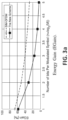
- the proposed solution can offer an energy gain of 58% and a transmit bit gain of 59%, with respect to the standard BPSK modulation.
- the proposed method consists of a new IM-OFDM technique that can be deployed within a general OFDM-based communication systems.
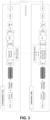
- the method can be applied to any OFDM-based communication scheme, by modifying the corresponding digital modulation/demodulation, and the relevant signal processes, as presented in Figure 1 .
- Data real data
- the following signal processing steps are needed:
- the present invention also relates to a computer program adapted to perform the steps of the method defined and a computer readable storage medium comprising said computer program.
- the invention relates to a novel method for data transmission using OFDM-based communication systems.
- the new method includes a digital modulation that enhances the spectral efficiency, by increasing the total number of transmit bits via a given set of subcarriers, when compared to the equivalent standard modulation. In addition, it enhances the energy efficiency by forcing some subcarriers to be silent (with a null value), during the OFDM modulation, according to the corresponding transmit message.
- BPSK binary phase-shift keying
- the binary vector B is converted from base 2 to base 3 to get a base 3 vector T of size L.
- N the N bits can be sent via L ( L ⁇ N ) subcarriers, wherein the L subcarriers include the digits in base 3.
- N / L the gain of N / L (in terms of total number of transmit bits per subcarrier) can be obtained.
- N SC log 2 ( M ) bits per one OFDM symbol can be transmitted, using all the defined subcarriers.
- the introduced technique is able to enhance the data transmission's spectral efficiency.
- a significant gain in terms of total number of transmit bits can be observed in this case.
- EGain NM 1 ⁇ M M + 1 1 + bGain NM 100 100 % .
- Table I the inputs of the simulator are presented in Table I, where the Typical Urban 6 path channel (TU6) has been used as a popular multipath channel model for different wireless telecommunications [40], and the same number of transmit bits has been considered for the different techniques for fair performance comparisons.
- Table I The simulation parameter values Parameter Value Number of transmit bits 1024 Megabit Number of Subcarriers 1024 Number of FFT Points 1024 Number of Cyclic Prefix 32 Carrier Frequency 500 MHz Signal Sampling Frequency 1 GHz SNR 0 : 5 : 30 dB Modulation Type BPSK Multi-path Channel Type TU6 [40] Channel Estimation Method Spline Interpolation
- the transmitted symbols should be estimated/detected from the corresponding received samples that are affected by channel estimation error and additive noise, which results in a potential BER higher than that of the conventional BPSK, when the same SNR is used.
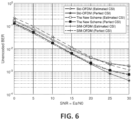
- Figures 5 and 6 show the unencoded BERs variations vs. SNR, with and without energy saving, respectively. Thus, the BER variations of the considered schemes versus different SNR values are obtained.
- the saved energy due to the use of only fraction of the total OFDM subcarriers has been not used by or shared with the active subcarriers to increase the transmit power, and hence to improve the SNR.
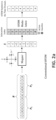
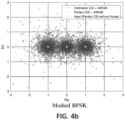
- the proposed method offers an acceptable BER, with respect to that of the standard one that has the lowest BER for the different SNR values. This is due to the fact that the standard BPSK demodulation is dealing with only two decisions, [-1 or 1], as presented in Figure 4A .
- the new modulation has 3 possible decisions: [-1, 0, and 1], which increases the decision errors, and hence increases the BER.
- [-1, 0, and 1] which increases the decision errors, and hence increases the BER.
- the proposed modulation is able to transmit more bits than the standard one, e.g., with a gain of 1.58 for the BPSK modulation, where some of the gained bits can be used within a given channel coding to significantly reduce the BER.
- the saved energy was shared with the active subcarriers to increase the corresponding received SNRs.
- the proposed method and the SIM-OFDM scheme outperforms the standard OFDM scheme, with slightly better performance for the original SIM-OFDM scheme, when the same original SNR is used.
- the BER decision is directly related to the number of decisions, which is 2 for the original OFDM scheme, and 3 for the IM-based scheme.
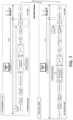
- FIG. 7 shows a preferred embodiment of a testbed setup configured according to the method of the invention.
- a testbed is used, which consists of two nodes: a radio transmitter ( Tx ) and a radio receiver ( Rx ).
- Each node has a host PC that is connected, by a Gigabit Ethernet (GbE) cable, to a USRPx310 device.
- GbE Gigabit Ethernet
- a generic OFDM-based transmitter has been implemented, using a flexible and adjustable Matlab software script, where the different considered modulations can be implemented to generate OFDM signals that convey random data/message.
- This testbed has been implemented at a laboratory environment, to evaluate the considered schemes, with real radio channels, using the following hardware and software configuration parameters.
- the used SW configuration parameters are listed in Table II. Except for the number of transmit bits per frame, the same presented parameters were used to test the performances of the different schemes. As shown in this table, there are two possible numbers of transmit bits per one frame. This is due to the fact that the proposed technique has the advantage of transmitting more bits than the other ones. In fact, with regard to the presented software configuration parameters, the proposed scheme is able to transmit 274.01 kbits per one frame. However, the two other schemes can transmit 174 kbits only per one frame. Table II.
- the software configuration parameters Parameter Value Number of transmit bits 1024 Megabit Number of OFDM Symbols per Frame 870 Number of Transmit bits per Frame 174/274.01 kbits Number of Subcarriers 200 Number of Zero Padding 56 Number of FFT Points 256 Number of Cyclic Prefix 16 Preamble Length 5 10 4 Samples Frame Length 35 10 4 Samples Modulation Type BPSK Pilot Subcarrier Spacing 4 Pilot Symbol Spacing 2 Channel Estimation Method Spline Interpolation Table III.
- the hardware configuration parameters Parameter Value Centre Frequency 2.4 Ghz Sampling Frequency 5 Ghz
- Table III the considered HW configuration parameters are presented, where different values of the Tx antenna's gain were used to evaluate the BER of the different schemes, in various scenarios, with different transmit powers, and hence with different received SNRs.
- FIGS 8A and 8B show an example of a transmitted frame, and its received version, in time domain, with a Tx antenna's gain equals to 20 dBi, and a Rx antenna's gain equals to 30 dBi. These figures show the impact of the channel attenuation as well as the additive noise on the transmitted signal.
- Table IV and Figure 9 present the average and the variance of uncoded-BER vs. the transmit antenna's gain for the different considered schemes, with and without energy saving.
- Table IV. Average uncoded-BER vs. the transmit antenna's gain for the different considered schemes Number of Transmit bits/Frafme bit Gain [%] Energy Gain [%] Unencoded BER Tx Antenaa's Gain [dBi] 5 10 20 30 ⁇ ⁇ 2 ⁇ ⁇ 2 ⁇ ⁇ 2 ⁇ ⁇ 2 Std - OFDM 174kb 0 0 2.61 10 -2 8.49 10 -5 9.64 10 -4 7.32 10 -7 7.19 10 -4 2.30 10 -3 2.30 10 -4 1.83 10 -3 SIM - OFDM 174kb 0 0 1.54 10 -2 1.87 10 -5 6.05 10 -4 3.16 10 -7 4.76 10 -4 1.54 10 -3 2.59 10 -4 1.22 10 -3 NIM - OFDM 274.01
- the proposed method and the SIM-OFDM scheme outperform the standard OFDM scheme, with slightly better performance for the original SIM-OFDM scheme.
- the proposed method and the SIM-OFDM scheme offer acceptable BERs, with respect to that of the standard one.
- the proposed technique is able to enhance both the energy and the spectral efficiency, while offering a good BER, when compared to relevant techniques in the literature.
- the proposed scheme has the power to increase the transmit data rate by up to 59%, with respect to the relevant presented schemes.
- the proposed scheme needs 27.63 ms to transmit a real data with a size of 2 MB.
- the standard and SIM-OFDM schemes need 43.52 ms to transmit the same data.
- the proposed scheme is able to transmit 72.35 MB, during 1 s, while the other scheme can transmit only 45.95 MB, during the same period.
Landscapes
- Engineering & Computer Science (AREA)
- Computer Networks & Wireless Communication (AREA)
- Signal Processing (AREA)
- Physics & Mathematics (AREA)
- Discrete Mathematics (AREA)
- General Physics & Mathematics (AREA)
- Mathematical Physics (AREA)
- Digital Transmission Methods That Use Modulated Carrier Waves (AREA)
Priority Applications (2)
| Application Number | Priority Date | Filing Date | Title |
|---|---|---|---|
| EP23382966.2A EP4529109A1 (fr) | 2023-09-22 | 2023-09-22 | Procédé de transmission de données dans des systèmes de communication ofdm à modulation par indice |
| US18/892,981 US20250106087A1 (en) | 2023-09-22 | 2024-09-23 | Method for data transmission in ofdm-based communication systems |
Applications Claiming Priority (1)
| Application Number | Priority Date | Filing Date | Title |
|---|---|---|---|
| EP23382966.2A EP4529109A1 (fr) | 2023-09-22 | 2023-09-22 | Procédé de transmission de données dans des systèmes de communication ofdm à modulation par indice |
Publications (1)
| Publication Number | Publication Date |
|---|---|
| EP4529109A1 true EP4529109A1 (fr) | 2025-03-26 |
Family
ID=88237375
Family Applications (1)
| Application Number | Title | Priority Date | Filing Date |
|---|---|---|---|
| EP23382966.2A Pending EP4529109A1 (fr) | 2023-09-22 | 2023-09-22 | Procédé de transmission de données dans des systèmes de communication ofdm à modulation par indice |
Country Status (2)
| Country | Link |
|---|---|
| US (1) | US20250106087A1 (fr) |
| EP (1) | EP4529109A1 (fr) |
Citations (1)
| Publication number | Priority date | Publication date | Assignee | Title |
|---|---|---|---|---|
| EP3172853B1 (fr) * | 2014-08-15 | 2022-01-26 | Huawei Technologies Co., Ltd. | Système et procédé de production de livres de codes avec de petites projections par dimension complexe et utilisation de ceux-ci |
Family Cites Families (3)
| Publication number | Priority date | Publication date | Assignee | Title |
|---|---|---|---|---|
| BRPI0519470A2 (pt) * | 2004-12-27 | 2009-01-27 | Matsushita Electric Industrial Co Ltd | aparelho de radiotransmissço, aparelho de radiorrecepÇço, mÉtodo de radiotransmissço e mÉtodo de radiorrecepÇço |
| US9730198B2 (en) * | 2011-05-23 | 2017-08-08 | Lg Electronics Inc. | Method and apparatus for transmitting control information in a wireless communication system |
| WO2023174505A1 (fr) * | 2022-03-14 | 2023-09-21 | Vestel Elektronik Sanayi ve Ticaret A. S. | Modulation d'appariement |
-
2023
- 2023-09-22 EP EP23382966.2A patent/EP4529109A1/fr active Pending
-
2024
- 2024-09-23 US US18/892,981 patent/US20250106087A1/en active Pending
Patent Citations (1)
| Publication number | Priority date | Publication date | Assignee | Title |
|---|---|---|---|---|
| EP3172853B1 (fr) * | 2014-08-15 | 2022-01-26 | Huawei Technologies Co., Ltd. | Système et procédé de production de livres de codes avec de petites projections par dimension complexe et utilisation de ceux-ci |
Non-Patent Citations (1)
| Title |
|---|
| STEPHEN MCCANN (BLACKBERRY): "Multi-Carrier OOK with Bipolar Modulation", vol. 802.11ba, 3 May 2017 (2017-05-03), pages 1 - 14, XP068115922, Retrieved from the Internet <URL:https://mentor.ieee.org/802.11/dcn/17/11-17-0704-00-00ba-multi-carrier-ook-with-bipolar-modulation.pptx> [retrieved on 20170503] * |
Also Published As
| Publication number | Publication date |
|---|---|
| US20250106087A1 (en) | 2025-03-27 |
Similar Documents
| Publication | Publication Date | Title |
|---|---|---|
| JP5497002B2 (ja) | 符号化された伝送のための多次元コンステレーション | |
| US20050220200A1 (en) | Bandwidth and power efficient multicarrier multiple access | |
| Yuan et al. | NOMA study in 3GPP for 5G | |
| Chen et al. | Index modulation pattern design for non-orthogonal multicarrier signal waveforms | |
| Hama et al. | Time-frequency domain non-orthogonal multiple access for power efficient communications | |
| WO2023174505A1 (fr) | Modulation d'appariement | |
| US8548081B2 (en) | Methods and apparatus for diversity combining of repeated signals in OFDMA systems | |
| Aldirmaz-Colak et al. | Pulse index modulation | |
| Abbas et al. | A multi-layer grant-free NOMA scheme for short packet transmissions | |
| WO2020052554A1 (fr) | Procédé de communication et appareil de communication | |
| US20250106087A1 (en) | Method for data transmission in ofdm-based communication systems | |
| CN109167748B (zh) | 一种基于能量排序的部分最大似然检测方法 | |
| Liu et al. | Multiple-symbol decision-feedback space-time differential decoding in fading channels | |
| Berceanu et al. | Performance analysis of an uplink Massive MU-MIMO OFDM-based system | |
| Watanabe et al. | Performance of polar codes with MIMO-OFDM under frequency selective fading channel | |
| Zhu et al. | Uplink transceiver for subcarrier index modulation OFDM in massive MIMO systems with imperfect channel state information | |
| KR20120007028A (ko) | Wimax 시스템들에서 이동국들을 그룹화함으로써 고속 전력 제어 메시지 오버헤드를 감소시키기 위한 방법들 및 시스템들 | |
| Rajpoot et al. | Performance Analysis of Supply Index Based OTFS Modulation System | |
| Fadhel et al. | Performance analysis of coded MIMO OFDM with subcarrier power modulation | |
| CN114338326B (zh) | 一种无线通信处理方法及装置 | |
| Jolania et al. | Joint 5G NR polar code-convolutional code design for massive MIMO-UFMC system | |
| Abdullahi | Index modulation based multicarrier systems for future wireless networks | |
| US8094735B2 (en) | Methods and apparatus for maximum ratio combining for duplicated signals in OFDMA systems | |
| Arteaga et al. | Index Coding and Signal Detection in Precoded MIMO-OFDM Systems | |
| Ichikawa et al. | Highly efficient OFDM applying symbol-edges truncating transmission technique |
Legal Events
| Date | Code | Title | Description |
|---|---|---|---|
| PUAI | Public reference made under article 153(3) epc to a published international application that has entered the european phase |
Free format text: ORIGINAL CODE: 0009012 |
|
| STAA | Information on the status of an ep patent application or granted ep patent |
Free format text: STATUS: THE APPLICATION HAS BEEN PUBLISHED |
|
| AK | Designated contracting states |
Kind code of ref document: A1 Designated state(s): AL AT BE BG CH CY CZ DE DK EE ES FI FR GB GR HR HU IE IS IT LI LT LU LV MC ME MK MT NL NO PL PT RO RS SE SI SK SM TR |
|
| STAA | Information on the status of an ep patent application or granted ep patent |
Free format text: STATUS: REQUEST FOR EXAMINATION WAS MADE |
|
| 17P | Request for examination filed |
Effective date: 20250926 |