EP4529155A1 - Dispositif d'aide à la recherche, système d'aide à la recherche, procédé d'aide à la recherche et programme - Google Patents
Dispositif d'aide à la recherche, système d'aide à la recherche, procédé d'aide à la recherche et programme Download PDFInfo
- Publication number
- EP4529155A1 EP4529155A1 EP22967230.8A EP22967230A EP4529155A1 EP 4529155 A1 EP4529155 A1 EP 4529155A1 EP 22967230 A EP22967230 A EP 22967230A EP 4529155 A1 EP4529155 A1 EP 4529155A1
- Authority
- EP
- European Patent Office
- Prior art keywords
- search
- search target
- image
- video
- captured video
- Prior art date
- Legal status (The legal status is an assumption and is not a legal conclusion. Google has not performed a legal analysis and makes no representation as to the accuracy of the status listed.)
- Granted
Links
Images








Classifications
-
- G—PHYSICS
- G06—COMPUTING OR CALCULATING; COUNTING
- G06V—IMAGE OR VIDEO RECOGNITION OR UNDERSTANDING
- G06V20/00—Scenes; Scene-specific elements
- G06V20/50—Context or environment of the image
- G06V20/52—Surveillance or monitoring of activities, e.g. for recognising suspicious objects
-
- H—ELECTRICITY
- H04—ELECTRIC COMMUNICATION TECHNIQUE
- H04N—PICTORIAL COMMUNICATION, e.g. TELEVISION
- H04N7/00—Television systems
- H04N7/18—Closed-circuit television [CCTV] systems, i.e. systems in which the video signal is not broadcast
- H04N7/181—Closed-circuit television [CCTV] systems, i.e. systems in which the video signal is not broadcast for receiving images from a plurality of remote sources
-
- G—PHYSICS
- G06—COMPUTING OR CALCULATING; COUNTING
- G06T—IMAGE DATA PROCESSING OR GENERATION, IN GENERAL
- G06T11/00—Two-dimensional [2D] image generation
-
- G—PHYSICS
- G06—COMPUTING OR CALCULATING; COUNTING
- G06T—IMAGE DATA PROCESSING OR GENERATION, IN GENERAL
- G06T3/00—Geometric image transformations in the plane of the image
-
- G—PHYSICS
- G06—COMPUTING OR CALCULATING; COUNTING
- G06V—IMAGE OR VIDEO RECOGNITION OR UNDERSTANDING
- G06V10/00—Arrangements for image or video recognition or understanding
- G06V10/20—Image preprocessing
- G06V10/25—Determination of region of interest [ROI] or a volume of interest [VOI]
-
- G—PHYSICS
- G06—COMPUTING OR CALCULATING; COUNTING
- G06V—IMAGE OR VIDEO RECOGNITION OR UNDERSTANDING
- G06V10/00—Arrangements for image or video recognition or understanding
- G06V10/20—Image preprocessing
- G06V10/26—Segmentation of patterns in the image field; Cutting or merging of image elements to establish the pattern region, e.g. clustering-based techniques; Detection of occlusion
-
- G—PHYSICS
- G06—COMPUTING OR CALCULATING; COUNTING
- G06V—IMAGE OR VIDEO RECOGNITION OR UNDERSTANDING
- G06V10/00—Arrangements for image or video recognition or understanding
- G06V10/70—Arrangements for image or video recognition or understanding using pattern recognition or machine learning
- G06V10/74—Image or video pattern matching; Proximity measures in feature spaces
-
- G—PHYSICS
- G06—COMPUTING OR CALCULATING; COUNTING
- G06V—IMAGE OR VIDEO RECOGNITION OR UNDERSTANDING
- G06V10/00—Arrangements for image or video recognition or understanding
- G06V10/70—Arrangements for image or video recognition or understanding using pattern recognition or machine learning
- G06V10/74—Image or video pattern matching; Proximity measures in feature spaces
- G06V10/75—Organisation of the matching processes, e.g. simultaneous or sequential comparisons of image or video features; Coarse-fine approaches, e.g. multi-scale approaches; using context analysis; Selection of dictionaries
-
- H—ELECTRICITY
- H04—ELECTRIC COMMUNICATION TECHNIQUE
- H04N—PICTORIAL COMMUNICATION, e.g. TELEVISION
- H04N7/00—Television systems
- H04N7/18—Closed-circuit television [CCTV] systems, i.e. systems in which the video signal is not broadcast
-
- G—PHYSICS
- G06—COMPUTING OR CALCULATING; COUNTING
- G06V—IMAGE OR VIDEO RECOGNITION OR UNDERSTANDING
- G06V2201/00—Indexing scheme relating to image or video recognition or understanding
- G06V2201/07—Target detection
-
- G—PHYSICS
- G06—COMPUTING OR CALCULATING; COUNTING
- G06V—IMAGE OR VIDEO RECOGNITION OR UNDERSTANDING
- G06V2201/00—Indexing scheme relating to image or video recognition or understanding
- G06V2201/10—Recognition assisted with metadata
Definitions
- the present disclosure relates to a search assistance device, a search assistance system, a search assistance method, and a program.
- Patent Document 1 discloses a technology for imaging a subject using a multi-lens camera and applying a vector median filter to remove unwanted objects from an image in which characters are partially obstructed.
- Patent Document 2 discloses a technology for extracting a target person from an image and using images taken at a plurality of points to specify the person even in a case where part of the person's image is missing due to an obstacle.
- Non Patent Document 1 discloses a technology for improving the visibility of a target object by integrating images from a visible light camera and an invisible light camera.
- Non Patent Document 1 NEC Corporation, Tokyo Institute of Technology, "NEC and Tokyo Institute of Technology jointly develop "multi-modal image fusion technology” that uses AI to dramatically improve visibility under poor conditions - automatic combining of visible and invisible light images", [online], June 5, 2017, [Retrieved on June 20, 2022], Internet ⁇ URL: https://www.titech.ac.jp/news/pdf/webtokyotechpr20170605_okutomi.pdf>
- the above-mentioned technologies use images captured by a multi-lens camera, images taken at a plurality of points, or a plurality of types of images to search for target objects in remote locations, but there are cases where only images captured in specific directions can be acquired due to limitations on the number of cameras and the like in remote locations. In a case where a search target object is hidden by a peripheral object in an image captured in a specific direction, there is a likelihood that the search target object cannot be detected.
- the present disclosure has been made to solve the above-mentioned problems, and an object of the present disclosure is to provide a search assistance device, a search assistance system, a search assistance method, and a program that are capable of detecting a search target object with a high probability even if the search target object is hidden by a peripheral object.
- a search assistance device including: a captured video acquisition unit configured to acquire a captured video; an object information acquisition unit configured to acquire object information indicating an object included in the captured video; a setting unit configured to set a search target image including a search target object; a determination unit configured to determine whether or not part of a search target candidate is hidden by a peripheral object using the search target image or the object information; and a video creation unit configured to create a comparison video to be compared to search for the search target object using an image that shows the peripheral object in the captured video in a case where the determination unit determines that part of the search target candidate is hidden by the peripheral object.
- a search assistance method including: a step of setting a search target image including a search target object; a step of acquiring a captured video and object information indicating an object included in the captured video; a step of determining whether or not part of a search target candidate is hidden by a peripheral object using the search target image or the object information; and a step of creating a comparison video to be compared to search for the search target object using an image that shows the peripheral object in the captured video in a case where it is determined that part of the search target candidate is hidden by the peripheral object.
- a program causing a computer mounted on a search assistance device to execute: a step of setting a search target image including a search target object; a step of acquiring a captured video and object information indicating an object included in the captured video; a step of determining whether or not part of a search target candidate is hidden by a peripheral object using the search target image or the object information; and a step of creating a comparison video to be compared to search for the search target object using an image that shows the peripheral object in the captured video in a case where it is determined that part of the search target candidate is hidden by the peripheral object.
- a search assistance system including: an imaging device configured to generate a captured video; an object information generation device configured to generate object information indicating an object included in the captured video; and a search assistance device including a setting unit configured to set a search target image including a search target object, a determination unit configured to determine whether or not part of a search target candidate is hidden by a peripheral object using the search target image or the object information, and a video creation unit configured to create a comparison video to be compared to search for the search target object using an image that shows the peripheral object in the captured video in a case where the determination unit determines that part of the search target candidate is hidden by the peripheral object.
- a search target object can be detected with a high probability even if the search target object is hidden by a peripheral object.
- FIG. 1 is a block diagram showing an example of a search assistance system according to a first embodiment.
- the search assistance system includes, for example, a search assistance device 100, a camera system 200, and a searcher's terminal device 300.
- the search assistance device 100 and the searcher's terminal device 300 are installed, for example, in a management room that manages search targets such as lost items in a search area.
- the camera system 200 is disposed in a search area at a remote location away from the search assistance device 100 and the searcher's terminal device 300.
- the search assistance device 100 and the camera system 200 are connected via, for example, a network NW such as the Internet.
- NW such as the Internet
- the search assistance device 100, the camera system 200, and the searcher's terminal device 300 are shown as separate devices, but the present disclosure is not limited thereto.
- a single information processing device may have the functions of the search assistance device 100 and the functions of the searcher's terminal device 300, and the camera system 200 may have the functions of the search assistance device 100.
- the search assistance device 100 performs processing to assist the search of a search target object.
- the search assistance device 100 may be configured, for example, to be connected to a plurality of camera systems 200 and a plurality of searcher's terminal devices 300 and to provide a cloud service that assists the search of a search target object.
- the search target object may be, for example, an item lost in a store, but the present disclosure is not limited thereto and the search target object may be a person such as a lost child.
- the searcher's terminal device 300 is an information processing device such as a personal computer or a smartphone that is operated by a searcher who searches for a search target object.
- the searcher's terminal device 300 includes an operation interface that receives operations by the searcher, a display interface that presents various types of information to the searcher, a storage device, and a control unit such as a central processing unit (CPU) that performs various processes.
- CPU central processing unit
- the camera system 200 is provided in the search area.
- the search area is, for example, a store such as a shopping mall or a restaurant, but the present disclosure is not limited thereto.
- the camera system 200 includes a plurality of camera devices 210, an object information generation device 216, and a control unit 220.
- the object information generation device 216 is, for example, an infrared camera device 212 and a radar device 214.
- the camera device 210 generates a captured video of the search area.
- the camera device 210 generates a captured video by emitting visible light.
- one or more camera devices 210 are installed in one search area. Each of the camera devices 210 generates a captured video of the search area viewed from each installation location.
- the camera device 210 generates a video that is temporally continuous, but the present disclosure is not limited thereto, and the camera device 210 may generate images that are not temporally continuous.
- the object information generation device 216 includes the infrared camera device 212 and the radar device 214 but is not limited thereto and may have another configuration as long as it is capable of generating object information as described below.
- the object information generation device 216 acquires object information indicating an object included in the captured video.
- the infrared camera device 212 generates an infrared video as object information by emitting infrared light.
- the radar device 214 irradiates a search area with pulses of laser light and measures the reflected light to measure distance information to an object as object information.
- the object information is information indicating a two-dimensional or three-dimensional shape of the search target object.
- the object information is information indicating a two-dimensional or three-dimensional shape of the search target object or a peripheral object group including one peripheral object or a plurality of peripheral objects that hide part of the search target object.
- the object information generation device 216 is an infrared camera device 212
- the object information is information indicating a two-dimensional shape.
- the object information generation device 216 is a radar device 214
- the object information is information indicating a three-dimensional shape acquired by, for example, swinging the transmission direction of a radar transmission signal vertically and horizontally.
- an object information acquisition unit 108 of the search assistance device 100 to be described later acquires object information of a search target by distinguishing between the search target and peripheral objects that hide the search target from a perspective image.
- the object information acquisition unit 108 of the search assistance device 100 to be described later acquires object information of a search target by distinguishing between the search target and peripheral objects that hide the search target based on differences in distance information.
- the control unit 220 controls the camera device 210, the infrared camera device 212, and the radar device 214.
- the control unit 220 operates the camera device 210, the infrared camera device 212, and the radar device 214 in time synchronization. Accordingly, the control unit 220 acquires a captured video and object information that are synchronized in time.
- the control unit 220 transmits the captured video and object information synchronized in time to the search assistance device 100.
- the control unit 220 may perform camera control such as changing an imaging direction and zooming an imaging range of the camera device 210, the infrared camera device 212, or the radar device 214 based on the operation of the searcher, for example.
- FIG. 2 is a block diagram showing an example of a functional configuration of the search assistance device 100 according to the first embodiment.
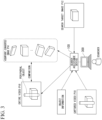
- FIG. 3 is a diagram for describing a process performed by the search assistance device 100 according to the first embodiment.
- the search assistance device 100 includes, for example, a search area side communication unit 102, a terminal side communication unit 104, a captured video acquisition unit 106, an object information acquisition unit 108, a setting unit 110, a conversion unit 112, a determination unit 114, a video creation unit 116, and a search unit 118.
- the search area side communication unit 102 is a communication interface such as a network interface card (NIC) or a wireless communication module for connecting to the network NW.
- the terminal side communication unit 104 is a communication interface that performs communication via, for example, a LAN line.
- Each unit such as the captured video acquisition unit 106, the object information acquisition unit 108, the setting unit 110, the conversion unit 112, the determination unit 114, the video creation unit 116, and the search unit 118, is realized by a computer, such as a CPU mounted on the search assistance device 100, executing a program stored in a program memory.
- the captured video acquisition unit 106 acquires a captured video P10.
- the captured video P10 is supplied via the search area side communication unit 102.
- the captured video acquisition unit 106 stores, for example, search area information indicating the search area, camera information that uniquely specifies the camera device 210, and a captured video in a storage device (not shown) in association with each other.
- the object information acquisition unit 108 acquires object information indicating an object included in the captured video P10.
- the object information is supplied via the search area side communication unit 102.
- the object information includes object information of the search target and object information of peripheral objects.
- the object information acquisition unit 108 stores, for example, search area information indicating the search area, device information that uniquely specifies the infrared camera device 212 or the radar device 214, and object information in a storage device (not shown) in association with each other.
- the object information acquisition unit 108 may store the acquired object information in association with the search area information or the device information.
- the setting unit 110 sets a search target image P12 including a search target object input via the terminal side communication unit 104.
- the search target image P12 is, for example, a still image viewed from a specific viewpoint and provided by a person (search requester) requesting a search for a search target, such as an image of a lost item or an image of the face of a lost child.
- the setting unit 110 may acquire, as the search target image P12, an image uploaded to the search assistance device 100 from another device, such as a smartphone of a search requester, for example.
- the conversion unit 112 converts the search target image P12 set by the setting unit 110 into viewpoint converted images P14 viewed from optional viewpoints.
- the conversion unit 112 may generate one viewpoint converted image P14 from the search target image P12 or may generate a plurality of viewpoint converted images P14.
- the conversion unit 112 may, for example, cut out an area including the search target included in the search target image P12 and perform image processing such as angle correction, rotation, and size change on the area including the search target to create a viewpoint converted image P14 in which the viewpoint of the search target is converted.
- the conversion unit 112 may, for example, predict a portion of the search target image P12 where the search target does not appear and create a viewpoint converted image P14 in which the viewpoint of the search target is converted by combining the predicted portion with an area including the search target included in the search target image P12.
- the conversion unit 112 may predict the shape or the like of the search target by searching a search site or the like for objects similar to the search target based on the product name information of the search target, for example.
- the determination unit 114 determines whether or not part of a search target candidate is hidden by a peripheral object by using the search target image P12 or the object information.
- the search target candidate may be any object included in the captured video P10.
- the determination unit 114 may compare the viewpoint converted image P14 obtained by converting the search target image P12 with an object included in the captured video P10, thereby detecting an object included in the captured video P10 that matches one of the viewpoint converted images P14 as a search target candidate and determine whether or not part of the detected search target candidate is hidden by a peripheral object.
- the determination unit 114 may determine whether or not the search target candidates overlap based on the object information, thereby determining whether or not part of an object included in the captured video P10 is hidden by a peripheral object.
- the determination unit 114 may determine whether or not part of the object information is missing, thereby determining whether or not part of an object included in the captured video P10 is hidden by a peripheral object.
- the search target candidate is, for example, an object included in the captured video P10 that matches at least one of the search target image P12 and one or more viewpoint converted images P14.
- the video creation unit 116 creates a comparison video to be compared in order to search for the search target object using an image showing the peripheral object in the captured video P10.
- the video creation unit 116 creates, for example, an entire video P16 representing the entirety of the search target candidate as a comparison video.
- the video creation unit 116 interpolates the portions hidden by peripheral objects by, for example, viewing through the peripheral objects using infrared images acquired by the infrared camera device 212.
- the video creation unit 116 uses the distance image acquired by the radar device 214 to specify portions of peripheral objects and interpolates the portions of the peripheral objects. Accordingly, the video creation unit 116 creates the entire video P16.
- the search unit 118 searches for the search target object by comparing the entire video P16 created by the video creation unit 116 with the viewpoint converted image P14 converted by the conversion unit 112.
- the search unit 118 transmits the search results to the searcher's terminal device 300 via the terminal side communication unit 104.
- the search unit 118 may transmit the captured video P10 including the search target candidate, position information of the search target candidate, and the like as search results. Accordingly, the searcher can visually recognize the search target by displaying the captured video P10 and by checking the video from the camera device 210 which captures the position of the search target candidate, thereby enabling the searcher to search for the search target.
- FIG. 4 is a flowchart showing an example of a processing procedure in the search assistance device 100 according to the first embodiment.
- the terminal side communication unit 104 acquires the search target image P12 from the searcher's terminal device 300, and the setting unit 110 sets the search target image P12 (step S100).
- the conversion unit 112 creates a viewpoint converted image P14 from the search target image P12 (step S102).
- the captured video acquisition unit 106 acquires the captured video P10 of the search area from the camera system 200, and the object information acquisition unit 108 acquires object information (step S104).
- the determination unit 114 determines whether or not an object (search target candidate) that matches the viewpoint converted image P14 has been detected among objects included in the captured video P10 (step S106).
- the determination unit 114 may determine that a search target candidate matching the viewpoint converted image P14 has been detected in a case where the search target candidate matches the viewpoint converted image P14 with a degree of match greater than or equal to a predetermined reference value. That is, the determination unit 114 is not limited to determining whether or not all the images match but may determine whether or not only parts of the images match.
- the reference value is desirably a value making it possible to, for example, recognize that an object included in the captured video P10 and the viewpoint converted image P14 are the same target object, but may be a value that is appropriately changed by the searcher. In a case where the determination unit 114 does not detect an object that matches the viewpoint converted image P14 (step S106: NO), it returns the process to step S104 and the search continues.
- the determination unit 114 determines whether or not part of the search target candidate is hidden by a peripheral object (step S108). In a case where the determination unit 114 determines that part of the search target candidate is not hidden by a peripheral object (step S108: NO), the determination unit 114 provides a notification of the search result (step S116).
- the video creation unit 116 cuts out and extracts an image including an image showing the peripheral object (peripheral object image) (step S110) and creates an entire video P16 in which the entire search target candidate can be checked using the peripheral object image (step S112).
- the video creation unit 116 recognizes portions of the image showing the search target candidate that are hidden by the peripheral objects based on the peripheral object images and interpolates the portions of the image showing the search target candidate that are hidden by the peripheral objects using object information.
- the search unit 118 determines whether or not the viewpoint converted image P14 matches the entire video P16 (step S114). In a case where the search unit 118 does not detect the viewpoint converted image P14 that matches the entire video P16 (step S114: NO), it returns the process to step S104. In a case where the search unit 118 has detected the viewpoint converted image P14 that matches the entire video P16 (step S114: YES), the search unit 118 provides a notification of the search result (step S116). In step S116, the search unit 118 transmits, for example, an image showing the search target candidate that was the source of the entire video P16, position information of the search target candidate, and the like, to the searcher's terminal device 300 as the search result.
- the captured video P10 and object information are acquired, and it is determined whether or not part of the search target candidate is hidden by a peripheral object.
- the entire video P16 representing the entirety of the search target candidate can be created using the object information.
- a search target candidate is hidden by a peripheral object, it is highly possible that the true search target cannot be searched for with a high probability.
- the number of camera devices 210 is limited, it is highly possible that the true search target cannot be searched for.
- the search assistance device 100 in a case where a search target candidate detected based on a comparison between the captured video P10 and the viewpoint converted image P14 is hidden by a peripheral object, the entire video P16 can be created using the object information. Accordingly, the search assistance device 100 can transmit, for example, the entire video P16 to the searcher's terminal device 300 to show the entire video P16 to the searcher, and thus, the searcher can search whether the search target candidate is the true search target. As a result, with the search assistance device 100 according to the first embodiment, the search target object can be detected with a high probability even if the search target object is hidden by a peripheral object.
- the search assistance system includes the infrared camera device 212 or the radar device 214 to acquire object information and can create an entire video P16 using the object information acquired by the infrared camera device 212 or the radar device 214. Accordingly, the search assistance system and the search assistance device 100 can create an entire video P16 by performing processing such as interpolating portions of the search target candidates that are hidden by peripheral objects.
- the search assistance device 100 may convert the search target image P12 into viewpoint converted images P14 viewed from optional viewpoints and compare the viewpoint converted images P14 with the object included in the captured video P10, thereby detecting an object included in the captured video P10 that matches one of the viewpoint converted images P14 as a search target candidate.
- the search unit 118 that searches for a search target object by comparing the entire video P16 with the viewpoint converted image P14 is provided. Therefore, the search target object can be searched for even if the search target object is hidden by peripheral objects.
- FIG. 5 is a block diagram showing an example of a functional configuration of a search assistance device 100B according to the second embodiment.
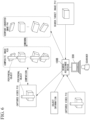
- FIG. 6 is a diagram for describing a process performed by the search assistance device 100B according to the second embodiment.
- the search assistance device 100B according to the second embodiment differs from the first embodiment in that the search assistance device 100B creates a composite image P20 by combining an image of a peripheral object that is hiding part of the search target candidate with the viewpoint converted image P14 and searches for the search target object by comparing the created composite image P20 with an object included in the captured video P10.
- the following description will focus on the differences.
- the video creation unit 116 includes a combining unit 120 that creates, as a comparison video, a composite image by combining an image showing a peripheral object that is hiding part of a search target candidate with a converted image.
- the composite image in the second embodiment corresponds to the comparison video to be compared in order to search for the search target object in the first embodiment.
- the search assistance device 100B according to the second embodiment includes a search unit 122 that searches for target candidates by comparing an object included in the captured video with the composite image created by the combining unit 120.
- the combining unit 120 creates a plurality of viewpoint converted images P14 from the search target image P12, creates a plurality of composite images P20 by combining peripheral object images with each of the created viewpoint converted images P14, and uses these as a comparison video.
- the composite image P20 may be an image or a video, for example, a still image, or a video including a plurality of images that are temporally continuous.
- the combining unit 120 cuts out and extracts an image including a peripheral object image from the captured video P10 using object information of the peripheral objects and creates a composite image P20 by superimposing the extracted peripheral object image on the viewpoint converted image P14.
- the search unit 118 compares the composite image P20 with the captured video P10. Accordingly, the search unit 122 can detect a search target candidate in a case where at least one of the composite images P20 matches a search target candidate included in the captured video P10.
- FIG. 7 is a flowchart showing an example of a processing procedure in the search assistance device 100B according to the second embodiment.
- the terminal side communication unit 104 and the setting unit 110 acquire the search target image P12 from the searcher's terminal device 300 (step S200).
- the conversion unit 112 creates a viewpoint converted image P14 from the search target image P12 (step S202).
- the search area side communication unit 102 and the object information acquisition unit 108 acquire the captured video P10 of the search area from the camera system 200 and acquire object information (step S204).
- the determination unit 114 determines whether or not an object that matches the viewpoint converted image P14 has been detected among objects included in the captured video P10 (step S206). In a case where the determination unit 114 does not detect an object that matches the viewpoint converted image P14 (step S206: NO), it returns the process to step S204 and the search continues.
- the determination unit 114 determines whether or not the search target candidate is hidden by a peripheral object (step S208). In a case where the search target candidate is not hidden by a peripheral object (step S208: NO), the determination unit 114 provides a notification of the search result (step S216). In a case where the search target candidate is hidden by a peripheral object (step S208: YES), the combining unit 120 cuts out and extracts an image including an image showing the peripheral object (peripheral object image) (step S210) and creates a composite video P20 by combining the peripheral object image with the viewpoint converted image P14 (step S212).
- the search unit 122 determines whether or not the composite image P20 matches the captured video P10 (step S214). In a case where the composite image P20 does not match the captured video P10 (step S214: NO), the search unit 122 returns the process to step S204. In a case where the composite image P20 matches the captured video P10 (step S214: YES), the search unit 122 provides a notification of the search result (step S216). The search unit 122 transmits, for example, an image showing the search target candidate that matches the composite image P20, position information of the search target candidate, and the like, to the searcher's terminal device 300 as the search result.
- the search assistance device 100B includes the combining unit 120 that creates a composite image P20 by combining an image of a peripheral object that is hiding part of the search target candidate with the viewpoint converted image P14 and the search unit 122 that searches for the search target object by comparing an object included in the captured video P10 with the composite image P20 created by the combining unit 120. Accordingly, with the search assistance device 100B, the search target object can be detected with a high probability even if the search target object is hidden by a peripheral object.
- FIG. 8 is a block diagram showing an example of a functional configuration of a search assistance device 100C according to the third embodiment.
- FIG. 9 is a diagram for describing a process performed by the search assistance device 100C according to the third embodiment.
- the search assistance device 100C according to the third embodiment performs both a process of comparing the entire video P16 with the viewpoint converted image P14 as in the first embodiment and a process of comparing the composite image P20 with the captured video P10 as in the second embodiment. Accordingly, the search assistance device 100C according to the third embodiment can detect the search target object with an even higher probability.
- the video creation unit 130 creates an entire video P16 from the captured video P10 and the object information, in which the entire search target candidate can be checked, and further creates a composite image P20a by combining an image of a peripheral object included in the captured video P10 with the viewpoint converted image P14.
- the search unit 132 compares the entire video P16 with the viewpoint converted image P14 as in the first embodiment and also compares the composite image P20a with the captured video P10 as in the second embodiment.
- the search unit 132 searches for a search target object based on a comparison result between the entire video P20a and the viewpoint converted image P14 and a comparison result between the composite image P20a and the captured video P10.
- the search unit 132 may determine that the search target object has been found, for example, in a case where both a similarity between the entire video P20 and the viewpoint converted image P14 and a similarity between the composite image P20a and the captured video P10 are greater than or equal to a reference.
- the search unit 132 may provide a notification indicating that the search target object may have been found, for example, in a case where one of the similarity between the entire video P20 and the viewpoint converted image P14 and the similarity between the composite image P20a and the captured video P10 is greater than or equal to a reference. Accordingly, the search assistance device 100C can search for a search target object with higher accuracy.
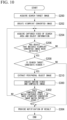
- FIG. 10 is a flowchart showing an example of a processing procedure in the search assistance device 100C according to the third embodiment.
- the search assistance device 100C performs step S200 to step S206 as described above.
- the determination unit 114 determines whether or not the search target candidate is hidden by a peripheral object (step S208). In a case where the search target candidate is not hidden by a peripheral object (step S208: NO), the determination unit 114 provides a notification of the search result (step S216).
- the video creation unit 130 cuts out and extracts an image including an image showing the peripheral object (peripheral object image) (step S210), creates a composite video P20 by combining the peripheral object image with the viewpoint converted image P14, and creates the entire video P16 using the peripheral object image (step S300).
- the search unit 132 determines whether or not the composite image P20 matches the captured image P10 and determines whether or not the viewpoint converted image P14 matches the entire video P16 (step S302). In a case where the composite image P20 does not match the captured image P10 and the viewpoint converted image P14 does not match the entire video P16 (step S302: NO), the search unit 132 returns the process to step S204. In a case where the composite image P20 matches the captured image P10 or the viewpoint converted image P14 matches the entire video P16 (step S302: YES), the search unit 122 provides a notification of the search result (step S304).
- the search unit 132 transmits an image showing the search target candidate, position information of the search target candidate, and the like, to the searcher's terminal device 300 as the search result.
- the search unit 132 transmits an image showing the search target candidate that was the source of the entire video P16, position information of the search target candidate, and the like, to the searcher's terminal device 300 as the search result.
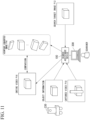
- FIG. 11 is a diagram for describing a modification example of the search assistance system.
- the camera system 200 of the search assistance system in the modification example may include a mobile robot 230 having a camera device.
- the mobile robot 230 moves based on, for example, control information from the search assistance device 100 or the operation of the searcher's terminal device 300.
- the mobile robot 230 moves through the search area, acquires a captured video, and transmits the captured video to the search assistance device 100.
- the search assistance device 100 acquires the captured video received from the mobile robot 230 as object information.
- the search assistance device 100 uses the object information received from the mobile robot 230 to create an entire video P16 of the search target candidate included in the captured video received from the camera device 210. Accordingly, the search assistance device 100 can create the entire video P16 using a captured video captured in an imaging direction different from the imaging direction of the camera device 210, for example.
- the mobile robot 230 may move based on the operation of the searcher and transmit the captured video P10 acquired while moving to the search assistance device 100. Accordingly, the mobile robot 230 can provide the captured video P10 to the search assistance device 100 instead of the camera device 210. As a result, the mobile robot 230 can assist in searching for the search target even in a location where a camera device such as the camera device 210 or the infrared camera device 212 is not installed.
- the search assistance device 100 may acquire the captured video P10 by controlling the movement of the mobile robot 230 in order to create, for example, a 360-degree free viewpoint video.
- the search assistance device 100 detects a search target candidate using a fixed camera device 210, and in a case where it is desired to check the captured video P10 of the search target candidate in more detail, the search assistance device 100 transmits control information to the mobile robot 230 to move the mobile robot 230 to the location where the search target candidate has been found.
- the search assistance device 100 can acquire a video for creating a free viewpoint video by controlling the zoom and the imaging direction of the mobile robot 230.
- a search assistance device 100D according to the fourth embodiment differs from the above-described embodiments in that a search target is searched for based on an object designated by a searcher in a captured video P10.
- FIG. 12 is a block diagram showing an example of the search assistance device 100D according to the fourth embodiment.
- FIG. 13 is a diagram for describing a process performed by the search assistance device 100D according to the fourth embodiment.
- a setting unit 110# of the search assistance device 100D according to the fourth embodiment includes a target image acquisition unit 110a that acquires, as a search target image, an object image P30 designated based on the operation of the searcher from among the object images included in the captured video P10.
- the setting unit 110# sets the object image P30 acquired by the target image acquisition unit 110a as a search target image including the search target object.
- FIG. 14 is a flowchart showing an example of a processing procedure in the search assistance device 100D according to the fourth embodiment.
- the search assistance device 100D transmits the captured video P10 received from the camera system 200 by the search area side communication unit 102 to the searcher's terminal device 300 via a terminal side communication unit 104# (step S400). Accordingly, the searcher's terminal device 300 presents the captured video P10 to the searcher.
- the searcher's terminal device 300 transmits, to the search assistance device 100D, designation information indicating that an object included in the captured video P10 is designated by an operation of the searcher.
- the terminal side communication unit 104# of the search assistance device 100D receives the designation information (step S402).
- the target image acquisition unit 110a acquires the object image P30 designated by the searcher based on the designation information as a search target image (step S404).
- a conversion unit 112# creates a viewpoint converted image P32 by performing viewpoint conversion on the object image P30 acquired by the target image acquisition unit 110a as the search target image (step S406).
- the captured video acquisition unit 106 acquires the captured video P10, and the object information acquisition unit 108 acquires object information (step S408).
- a determination unit 114# compares viewpoint converted images P32 with objects included in the captured video P10 to detect an object included in the captured video P10 that matches one of the viewpoint converted images P32 as a search target candidate.
- step S412 determines whether or not the search target candidate is hidden by a peripheral object (step S414). In a case where the determination unit 114# does not detect an object that matches the viewpoint converted image P32 (step S412: NO), it returns the process to step S408.
- an entire video creation unit 116# cuts out and extracts an image including a peripheral object image (step S418) and creates an entire video P34 in which the entire search target candidate can be checked from the viewpoint converted image P32 using the peripheral object image (step S420).
- the terminal side communication unit 104# transmits the entire video P34 to the searcher's terminal device 300 (step S422).
- the search assistance device 100D transmits the viewpoint converted image P32 that matches the object image P30 to the searcher's terminal device 300 via the terminal side communication unit 104# (step S316). Accordingly, the search assistance device 100D can search for a search target based on an object designated by the searcher in the captured video P10.
- FIG. 15 is a diagram for describing a modification example of the fourth embodiment.
- the camera system 200 of the search assistance system in the modification example includes a mobile robot 240 having a camera device.
- the mobile robot 240 moves based on, for example, control information from the search assistance device 100D or the operation of the searcher's terminal device 300.
- the mobile robot 240 moves through a search area based on, for example, the operation of the searcher, acquires a captured video P10, and transmits the captured video P10 to the search assistance device 100D.
- the search assistance device 100D acquires the captured video P10 received from the mobile robot 240.
- the searcher can search for the search target by moving the mobile robot 240.
- the mobile robot 240 can assist in searching for the search target even in a location where a camera device such as the camera device 210 or the infrared camera device 212 is not installed.
- the search assistance device 100D may acquire the captured video P10 from the camera device 210 and acquire a captured video acquired from the mobile robot 240 as object information.
- the search assistance device 100D uses the captured video received from the mobile robot 240 to create an entire video of the search target candidate included in the captured video P10 received from the camera device 210. Accordingly, the search assistance device 100D can create the entire video using a captured video captured in an imaging direction different from the imaging direction of the camera device 210, for example.
- the search assistance device 100D may acquire the captured video by controlling the movement of the mobile robot 240 in order to create, for example, a 360-degree free viewpoint video.
- the search assistance device 100D detects a search target candidate using a fixed camera device 210, and in a case where it is desired to check the captured video of the search target candidate in more detail, the search assistance device 100D transmits control information to the mobile robot 240 to move the mobile robot 240 to the location where the search target candidate has been found.
- the search assistance device 100D can acquire a video for creating a free viewpoint video by controlling the zoom and the imaging direction of the mobile robot 240.
- the searcher's terminal device 300 may have a goggle-type display device (not shown) that is worn on the searcher's head and may display the captured video P10 on the goggle-type display device. It is desirable that the captured video P10 to be displayed on the goggle-type display device is a 360-degree free viewpoint video so that the searcher can freely change the viewpoint.
- the captured video P10 may be a captured video P10 captured by controlling the imaging direction and the imaging range of the camera system 200 in accordance with the viewpoint of the searcher, may be the captured video P10 captured by controlling the movement of the mobile robot 240 in accordance with the viewpoint of the searcher, or may be a virtual reality video in which a video of the search range is virtually created.
- the searcher's terminal device 300 includes a detection device that detects the searcher's gestures, detects finger movements as the searcher's gestures, generates designation information, and transmits the designation information to the search assistance device 100D.
- the terminal side communication unit 104# of the search assistance device 100D receives the designation information, and the target image acquisition unit 110a acquires the object image P30 designated by the searcher based on the designation information as a search target image.
- the conversion unit 112# creates a viewpoint converted image P32 by performing viewpoint conversion on the object image P30 designated by the searcher.
- the determination unit 114# has detected a search target candidate by comparing the viewpoint converted image P32 with the captured video P10 and determines whether or not the search target candidate is hidden by a peripheral object.
- the entire video creation unit 116# creates an entire video P34 from the viewpoint converted image P32 using object information of the search target object and object information of the peripheral objects.
- the entire video creation unit 116# transmits the entire video P34 to the searcher's terminal device 300 via the terminal side communication unit 104#.
- the search assistance device 100D transmits the viewpoint converted image P32 that matches the object image P30 to the searcher's terminal device 300 via the terminal side communication unit 104#. Accordingly, the search assistance device 100D can search for the search target using the entire video P34 or the viewpoint converted image P32.
- the search assistance device 100D allows a searcher to wear a goggle-type display device, giving the searcher the feeling as if he or she were actually searching at the site.
Landscapes
- Engineering & Computer Science (AREA)
- Theoretical Computer Science (AREA)
- Physics & Mathematics (AREA)
- General Physics & Mathematics (AREA)
- Multimedia (AREA)
- Computer Vision & Pattern Recognition (AREA)
- Signal Processing (AREA)
- Computing Systems (AREA)
- Artificial Intelligence (AREA)
- Databases & Information Systems (AREA)
- Evolutionary Computation (AREA)
- General Health & Medical Sciences (AREA)
- Medical Informatics (AREA)
- Software Systems (AREA)
- Health & Medical Sciences (AREA)
- Closed-Circuit Television Systems (AREA)
- Alarm Systems (AREA)
- Processing Or Creating Images (AREA)
Applications Claiming Priority (1)
| Application Number | Priority Date | Filing Date | Title |
|---|---|---|---|
| PCT/JP2022/044520 WO2024116400A1 (fr) | 2022-12-02 | 2022-12-02 | Dispositif d'aide à la recherche, système d'aide à la recherche, procédé d'aide à la recherche et programme |
Publications (3)
| Publication Number | Publication Date |
|---|---|
| EP4529155A1 true EP4529155A1 (fr) | 2025-03-26 |
| EP4529155A4 EP4529155A4 (fr) | 2025-08-13 |
| EP4529155B1 EP4529155B1 (fr) | 2026-04-22 |
Family
ID=91323168
Family Applications (1)
| Application Number | Title | Priority Date | Filing Date |
|---|---|---|---|
| EP22967230.8A Active EP4529155B1 (fr) | 2022-12-02 | 2022-12-02 | Dispositif d'aide à la recherche, système d'aide à la recherche, procédé d'aide à la recherche et programme |
Country Status (6)
| Country | Link |
|---|---|
| US (1) | US20250157177A1 (fr) |
| EP (1) | EP4529155B1 (fr) |
| JP (1) | JP7675945B2 (fr) |
| KR (1) | KR102901590B1 (fr) |
| CN (1) | CN120226342A (fr) |
| WO (1) | WO2024116400A1 (fr) |
Families Citing this family (1)
| Publication number | Priority date | Publication date | Assignee | Title |
|---|---|---|---|---|
| CN113014799B (zh) * | 2021-01-28 | 2023-01-31 | 维沃移动通信有限公司 | 图像显示方法、装置和电子设备 |
Family Cites Families (11)
| Publication number | Priority date | Publication date | Assignee | Title |
|---|---|---|---|---|
| JP4769943B2 (ja) * | 2006-03-30 | 2011-09-07 | 国立大学法人電気通信大学 | 物体追跡装置、異常状態検知装置及び物体追跡方法 |
| JP4770960B2 (ja) * | 2009-03-30 | 2011-09-14 | カシオ計算機株式会社 | 画像検索システム及び画像検索方法 |
| JP5113867B2 (ja) * | 2010-03-26 | 2013-01-09 | 本田技研工業株式会社 | 車両周辺監視装置 |
| JP5218861B2 (ja) * | 2010-09-30 | 2013-06-26 | 株式会社Jvcケンウッド | 目標追跡装置、目標追跡方法 |
| JP6622886B2 (ja) * | 2013-07-09 | 2019-12-18 | キヤノン株式会社 | 情報処理装置、情報処理方法およびプログラム |
| US9805274B2 (en) | 2016-02-03 | 2017-10-31 | Honda Motor Co., Ltd. | Partially occluded object detection using context and depth ordering |
| JP6528723B2 (ja) * | 2016-05-25 | 2019-06-12 | トヨタ自動車株式会社 | 物体認識装置、物体認識方法及びプログラム |
| JP6844230B2 (ja) | 2016-12-06 | 2021-03-17 | 富士通株式会社 | 画像処理プログラム、画像処理装置および画像処理方法 |
| JP6558387B2 (ja) | 2017-03-14 | 2019-08-14 | オムロン株式会社 | 画像解析装置、画像解析方法、及び画像解析プログラム |
| EP3608873B1 (fr) * | 2017-12-14 | 2021-06-09 | Canon Kabushiki Kaisha | Dispositif de génération, et procédé de génération et programme de modèle tridimensionnel |
| JP7723638B2 (ja) * | 2022-05-09 | 2025-08-14 | Astemo株式会社 | 異常診断装置 |
-
2022
- 2022-12-02 EP EP22967230.8A patent/EP4529155B1/fr active Active
- 2022-12-02 CN CN202280097856.8A patent/CN120226342A/zh active Pending
- 2022-12-02 JP JP2024557081A patent/JP7675945B2/ja active Active
- 2022-12-02 KR KR1020247042908A patent/KR102901590B1/ko active Active
- 2022-12-02 WO PCT/JP2022/044520 patent/WO2024116400A1/fr not_active Ceased
-
2025
- 2025-01-15 US US19/021,643 patent/US20250157177A1/en active Pending
Also Published As
| Publication number | Publication date |
|---|---|
| EP4529155B1 (fr) | 2026-04-22 |
| WO2024116400A1 (fr) | 2024-06-06 |
| US20250157177A1 (en) | 2025-05-15 |
| CN120226342A (zh) | 2025-06-27 |
| EP4529155A4 (fr) | 2025-08-13 |
| JP7675945B2 (ja) | 2025-05-13 |
| KR102901590B1 (ko) | 2025-12-17 |
| KR20250004946A (ko) | 2025-01-08 |
| JPWO2024116400A1 (fr) | 2024-06-06 |
Similar Documents
| Publication | Publication Date | Title |
|---|---|---|
| US10757373B2 (en) | Method and system for providing at least one image captured by a scene camera of a vehicle | |
| US9495068B2 (en) | Three-dimensional user interface apparatus and three-dimensional operation method | |
| US9541997B2 (en) | Three-dimensional user interface apparatus and three-dimensional operation method | |
| KR101303948B1 (ko) | 비가시 객체에 대한 증강 현실 정보 제공 장치 및 방법 | |
| US10264207B2 (en) | Method and system for creating virtual message onto a moving object and searching the same | |
| EP2851880B1 (fr) | Procédé, système et support de stockage pour commander un dispositif de capture d'image, en particulier d'un poste de porte | |
| US20150213649A1 (en) | Three-dimensional environment sharing system and three-dimensional environment sharing method | |
| JP2023502972A (ja) | 物品識別および追跡システム | |
| JP5554726B2 (ja) | データ関連付けのための方法と装置 | |
| WO2010044186A1 (fr) | Système de production de conduite d’écoulement, dispositif de production de conduite d’écoulement, et dispositif d’affichage tridimensionnel de conduite d’écoulement | |
| WO2014162554A1 (fr) | Système et programme de traitement d'image | |
| WO2021250808A1 (fr) | Dispositif de traitement d'image, procédé de traitement d'image, et programme | |
| US20250157177A1 (en) | Search assistance device, search assistance system, search assistance method, and recording medium | |
| CN104182747A (zh) | 基于多个立体相机的对象检测跟踪方法及装置 | |
| JP2000148381A (ja) | 入力画像処理方法、入力画像処理装置、及び入力画像処理プログラムを記録した記録媒体 | |
| KR101568741B1 (ko) | 모바일 증강현실 기반의 정보 제공 시스템 | |
| JP6993282B2 (ja) | 情報端末装置、プログラム及び方法 | |
| JP2005184624A (ja) | 商品販売・管理方法、商品販売・管理システムおよびサーバ | |
| JP7723754B2 (ja) | 情報処理装置 | |
| WO2022003854A1 (fr) | Dispositif et procédé de traitement d'image, et programme | |
| WO2021255846A1 (fr) | Dispositif de traitement d'image, procédé de traitement d'image et programme | |
| JP5158162B2 (ja) | 拡張現実表示システム、拡張現実表示方法および拡張現実表示プログラム | |
| JP7739831B2 (ja) | 情報処理装置、情報処理システム、及び情報処理プログラム | |
| KR20160109828A (ko) | 증강 현실 시스템 | |
| JP2006244272A (ja) | 手位置追跡方法、装置、およびプログラム |
Legal Events
| Date | Code | Title | Description |
|---|---|---|---|
| STAA | Information on the status of an ep patent application or granted ep patent |
Free format text: STATUS: THE INTERNATIONAL PUBLICATION HAS BEEN MADE |
|
| PUAI | Public reference made under article 153(3) epc to a published international application that has entered the european phase |
Free format text: ORIGINAL CODE: 0009012 |
|
| STAA | Information on the status of an ep patent application or granted ep patent |
Free format text: STATUS: REQUEST FOR EXAMINATION WAS MADE |
|
| 17P | Request for examination filed |
Effective date: 20241217 |
|
| AK | Designated contracting states |
Kind code of ref document: A1 Designated state(s): AL AT BE BG CH CY CZ DE DK EE ES FI FR GB GR HR HU IE IS IT LI LT LU LV MC ME MK MT NL NO PL PT RO RS SE SI SK SM TR |
|
| A4 | Supplementary search report drawn up and despatched |
Effective date: 20250715 |
|
| RIC1 | Information provided on ipc code assigned before grant |
Ipc: H04N 7/18 20060101AFI20250709BHEP Ipc: G06V 10/26 20220101ALI20250709BHEP Ipc: G06V 10/75 20220101ALI20250709BHEP |
|
| GRAP | Despatch of communication of intention to grant a patent |
Free format text: ORIGINAL CODE: EPIDOSNIGR1 |
|
| STAA | Information on the status of an ep patent application or granted ep patent |
Free format text: STATUS: GRANT OF PATENT IS INTENDED |
|
| DAV | Request for validation of the european patent (deleted) | ||
| DAX | Request for extension of the european patent (deleted) | ||
| INTG | Intention to grant announced |
Effective date: 20251118 |
|
| GRAS | Grant fee paid |
Free format text: ORIGINAL CODE: EPIDOSNIGR3 |
|
| GRAA | (expected) grant |
Free format text: ORIGINAL CODE: 0009210 |
|
| STAA | Information on the status of an ep patent application or granted ep patent |
Free format text: STATUS: THE PATENT HAS BEEN GRANTED |
|
| AK | Designated contracting states |
Kind code of ref document: B1 Designated state(s): AL AT BE BG CH CY CZ DE DK EE ES FI FR GB GR HR HU IE IS IT LI LT LU LV MC ME MK MT NL NO PL PT RO RS SE SI SK SM TR |
|
| REG | Reference to a national code |
Ref country code: CH Ref legal event code: F10 Free format text: ST27 STATUS EVENT CODE: U-0-0-F10-F00 (AS PROVIDED BY THE NATIONAL OFFICE) Effective date: 20260422 Ref country code: GB Ref legal event code: FG4D |