EP4529193A2 - Dispositif d'affichage, dispositif de terminal d'utilisateur, procédé de commande de dispositif d'affichage et procédé de commande de dispositif de terminal d'utilisateur - Google Patents
Dispositif d'affichage, dispositif de terminal d'utilisateur, procédé de commande de dispositif d'affichage et procédé de commande de dispositif de terminal d'utilisateur Download PDFInfo
- Publication number
- EP4529193A2 EP4529193A2 EP25155822.7A EP25155822A EP4529193A2 EP 4529193 A2 EP4529193 A2 EP 4529193A2 EP 25155822 A EP25155822 A EP 25155822A EP 4529193 A2 EP4529193 A2 EP 4529193A2
- Authority
- EP
- European Patent Office
- Prior art keywords
- user terminal
- terminal device
- display device
- content
- display
- Prior art date
- Legal status (The legal status is an assumption and is not a legal conclusion. Google has not performed a legal analysis and makes no representation as to the accuracy of the status listed.)
- Granted
Links
Images






Classifications
-
- G—PHYSICS
- G06—COMPUTING OR CALCULATING; COUNTING
- G06F—ELECTRIC DIGITAL DATA PROCESSING
- G06F3/00—Input arrangements for transferring data to be processed into a form capable of being handled by the computer; Output arrangements for transferring data from processing unit to output unit, e.g. interface arrangements
- G06F3/14—Digital output to display device ; Cooperation and interconnection of the display device with other functional units
- G06F3/1454—Digital output to display device ; Cooperation and interconnection of the display device with other functional units involving copying of the display data of a local workstation or window to a remote workstation or window so that an actual copy of the data is displayed simultaneously on two or more displays, e.g. teledisplay
-
- G—PHYSICS
- G06—COMPUTING OR CALCULATING; COUNTING
- G06F—ELECTRIC DIGITAL DATA PROCESSING
- G06F3/00—Input arrangements for transferring data to be processed into a form capable of being handled by the computer; Output arrangements for transferring data from processing unit to output unit, e.g. interface arrangements
- G06F3/14—Digital output to display device ; Cooperation and interconnection of the display device with other functional units
- G06F3/1423—Digital output to display device ; Cooperation and interconnection of the display device with other functional units controlling a plurality of local displays, e.g. CRT and flat panel display
-
- G—PHYSICS
- G06—COMPUTING OR CALCULATING; COUNTING
- G06F—ELECTRIC DIGITAL DATA PROCESSING
- G06F3/00—Input arrangements for transferring data to be processed into a form capable of being handled by the computer; Output arrangements for transferring data from processing unit to output unit, e.g. interface arrangements
- G06F3/16—Sound input; Sound output
- G06F3/162—Interface to dedicated audio devices, e.g. audio drivers, interface to CODECs
-
- G—PHYSICS
- G06—COMPUTING OR CALCULATING; COUNTING
- G06F—ELECTRIC DIGITAL DATA PROCESSING
- G06F3/00—Input arrangements for transferring data to be processed into a form capable of being handled by the computer; Output arrangements for transferring data from processing unit to output unit, e.g. interface arrangements
- G06F3/16—Sound input; Sound output
- G06F3/165—Management of the audio stream, e.g. setting of volume, audio stream path
-
- G—PHYSICS
- G11—INFORMATION STORAGE
- G11B—INFORMATION STORAGE BASED ON RELATIVE MOVEMENT BETWEEN RECORD CARRIER AND TRANSDUCER
- G11B27/00—Editing; Indexing; Addressing; Timing or synchronising; Monitoring; Measuring tape travel
- G11B27/10—Indexing; Addressing; Timing or synchronising; Measuring tape travel
- G11B27/34—Indicating arrangements
-
- H—ELECTRICITY
- H04—ELECTRIC COMMUNICATION TECHNIQUE
- H04N—PICTORIAL COMMUNICATION, e.g. TELEVISION
- H04N21/00—Selective content distribution, e.g. interactive television or video on demand [VOD]
- H04N21/40—Client devices specifically adapted for the reception of or interaction with content, e.g. set-top-box [STB]; Operations thereof
- H04N21/41—Structure of client; Structure of client peripherals
- H04N21/4104—Peripherals receiving signals from specially adapted client devices
- H04N21/4122—Peripherals receiving signals from specially adapted client devices additional display device, e.g. video projector
-
- H—ELECTRICITY
- H04—ELECTRIC COMMUNICATION TECHNIQUE
- H04N—PICTORIAL COMMUNICATION, e.g. TELEVISION
- H04N21/00—Selective content distribution, e.g. interactive television or video on demand [VOD]
- H04N21/40—Client devices specifically adapted for the reception of or interaction with content, e.g. set-top-box [STB]; Operations thereof
- H04N21/43—Processing of content or additional data, e.g. demultiplexing additional data from a digital video stream; Elementary client operations, e.g. monitoring of home network or synchronising decoder's clock; Client middleware
- H04N21/431—Generation of visual interfaces for content selection or interaction; Content or additional data rendering
-
- H—ELECTRICITY
- H04—ELECTRIC COMMUNICATION TECHNIQUE
- H04N—PICTORIAL COMMUNICATION, e.g. TELEVISION
- H04N21/00—Selective content distribution, e.g. interactive television or video on demand [VOD]
- H04N21/40—Client devices specifically adapted for the reception of or interaction with content, e.g. set-top-box [STB]; Operations thereof
- H04N21/43—Processing of content or additional data, e.g. demultiplexing additional data from a digital video stream; Elementary client operations, e.g. monitoring of home network or synchronising decoder's clock; Client middleware
- H04N21/435—Processing of additional data, e.g. decrypting of additional data, reconstructing software from modules extracted from the transport stream
-
- H—ELECTRICITY
- H04—ELECTRIC COMMUNICATION TECHNIQUE
- H04N—PICTORIAL COMMUNICATION, e.g. TELEVISION
- H04N21/00—Selective content distribution, e.g. interactive television or video on demand [VOD]
- H04N21/40—Client devices specifically adapted for the reception of or interaction with content, e.g. set-top-box [STB]; Operations thereof
- H04N21/43—Processing of content or additional data, e.g. demultiplexing additional data from a digital video stream; Elementary client operations, e.g. monitoring of home network or synchronising decoder's clock; Client middleware
- H04N21/436—Interfacing a local distribution network, e.g. communicating with another STB or one or more peripheral devices inside the home
- H04N21/4363—Adapting the video stream to a specific local network, e.g. a Bluetooth® network
- H04N21/43637—Adapting the video stream to a specific local network, e.g. a Bluetooth® network involving a wireless protocol, e.g. Bluetooth®, RF or wireless LAN [IEEE 802.11]
-
- G—PHYSICS
- G09—EDUCATION; CRYPTOGRAPHY; DISPLAY; ADVERTISING; SEALS
- G09G—ARRANGEMENTS OR CIRCUITS FOR CONTROL OF INDICATING DEVICES USING STATIC MEANS TO PRESENT VARIABLE INFORMATION
- G09G2370/00—Aspects of data communication
- G09G2370/22—Detection of presence or absence of input display information or of connection or disconnection of a corresponding information source
Definitions
- Apparatuses and methods consistent with the disclosure relate to a display device, a user terminal device, a method for controlling a display device, and a method for controlling a user terminal device, and more particularly, to a method in which a display device outputs content that is being output via a user terminal device.
- a sound mirroring or screen mirroring technology is a technology of transmitting audio or image content output via a source device to a sync device.
- Mirroring technology has been used primarily to output content of a device having a relatively smaller screen size, such as a smartphone, to a device having a relatively larger screen size, such as a television (TV), and has been used for various purposes such as meetings and for everyday use.
- an approval process between the source device and the sync device might be required each time that mirroring is requested in order to establish a connection between the sync device and the source device to permit mirroring between the devices.
- a user might be required to directly select a particular transmission scheme, or the sync device may output content having a predetermined and limited function, because the sync device may not be capable of outputting the content based on a context of the content that is being output via the source device.
- Embodiments of the disclosure overcome the above disadvantages and other disadvantages not described above. Also, the disclosure is not required to overcome the disadvantages described above, and an embodiment of the disclosure may not overcome any of the problems described above.
- the disclosure provides a method in which a display device outputs content that is being output via a user terminal device based on an occurrence of an event requesting the content that is being output via the user terminal device being detected by the display device.
- a display device includes a communication interface configured to communicate with a user terminal device; a display; a memory configured to store at least one instruction; and a processor configured to execute the at least one instruction to: in response to detecting of a content request event associated with a request for the display device to output information associated with content that is being output via the user terminal device, receive the information associated with the content from the user terminal device via the communication interface; based on the content that is being output via the user terminal device being video content, control the display to display the video content based on information associated with the video content that is received from the user terminal device; and based on the content that is being output via the user terminal device being audio content, control the display to display an audio user interface (Ul) that is different than a Ul that is concurrently being displayed via the user terminal device, and control the display device to output the audio content, based on information associated with the audio content that is received from the user terminal device.
- Ul audio user interface
- the display device includes a near field communication (NFC) interface having an NFC tag that stores information associated with the display device and connection information, wherein the content request event is an event in which the user terminal device is brought within communicative proximity of the NFC tag of the display device, and the connection information includes information associated with a connection method by which the information associated with the content that is output via the user terminal device is receivable.
- NFC near field communication
- the processor may receive a wake-up signal via the NFC interface and enter a standby mode in which a predetermined standby screen is displayed via the display, based on the user terminal device being brought within communicative proximity of the display device while the display device is in a powered-off state; and control the display to display the audio Ul via the standby screen based on the audio content being received from the user terminal device.
- the processor may control the display to display an indicator indicating that the user terminal device is within communicative proximity of the display device, on a region corresponding to a position where the user terminal device is within communicative proximity of the display device, based on entering the standby mode.
- the processor may, based on the content that is being output via the user terminal device being video content, switch a mode of the display device from the standby mode to a normal mode; and control the display to display the video content and an indicator indicating that the information associated with the video content is received from the user terminal device.
- the processor may based on the content that is being output via the user terminal device being video content received from an external server, receive, from the external server via the communication interface, a portion of the video content that corresponds to a current playback point of the video content that is being output via the user terminal device; and control the display to display the portion of the video content based on the information associated with the video content that includes information identifying a title of the video content, and the current playback point of the video content that is being output via the user terminal device.
- the content request event may be an event in which the user terminal device is brought within communicative proximity an external device connected to the display device.
- a user terminal device includes a display; a communication interface configured to communicate with a display device; a memory configured to store at least one instruction; and a processor configured to execute the at least one instruction to: receive a signal that requests information associated with content that is being output via the user terminal device from a display device, identify a type of the content that is being output via the user terminal device; and control the communication interface to transmit, to the display device, the information associated with the content that is being output via the user terminal device by using a first communication method based on the content being video content, and by using a second communication method based on the content being audio content.
- the processor may, based on the content being the audio content, control the communication interface to transmit information associated with the audio content by using the second communication method of Bluetooth communication; and based on the content being the video content, control the communicator to transmit information associated with the video content by using the first communication method of peer-to-peer (P2P) communication.
- P2P peer-to-peer
- the processor may, based on receiving, from the display device, the signal that requests the information associated with the content that is being output via the user terminal device, control the display to display a user interface (Ul) for selecting information associated with content to be transmitted to the display device; and based on the information associated with the content being selected via the Ul, control the communication interface to transmit the selected information associated with the content to the display device.
- a user interface User
- a method for controlling a display device may include receiving, in response to detecting a content request event associated with a request for the display device to output information associated with content that is being output via a user terminal device, the information associated with the content from the user terminal device; displaying, based on the content that is being output via the user terminal device being video content, the video content based on information associated with the video content that is received from the user terminal device; and displaying, based on the content that is being output via the user terminal device being audio content, an audio user interface (Ul) that is different than a Ul that is concurrently being displayed via the user terminal device, and outputting the audio content, based on information associated with the audio content that is received from the user terminal device.
- Ul audio user interface
- the content request event may be an event in which the user terminal device is brought within communicative proximity of a near field communication (NFC) tag of the display device.
- NFC near field communication
- the displaying of the audio Ul may include receiving a wake-up signal and entering a standby mode in which a predetermined standby screen is provided, based on the user terminal device being brought within communicative proximity of the display device while the display device is in a powered-off state; and displaying the audio Ul via the standby screen based on the audio content being received from the user terminal device.
- the displaying of the video content may include, based on the information associated with the video content being received from the user terminal device, switching a mode of the display device from the standby mode to a normal mode; and displaying the video content and an indicator indicating that the information associated with the video content is received from the user terminal device.
- the displaying of the video content may include receiving, based on the content that is being output via the user terminal device being video content received from an external server, a portion of the video content corresponding to a current playback point of the video content that is being output via the user terminal device, from the external server based on information associated with the video content including information identifying a title of the video content, and the current playback point of the video content that is being output via the user terminal device.
- the content request event may be an event in which the user terminal device is brought within communicative proximity of an external device connected to the display device.
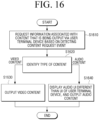
- a method for controlling a user terminal device may include identifying a type of content that is being output via the user terminal device, based on receiving a signal that requests information associated with the content that is being output via the user terminal device from a display device; and transmitting, to the display device, the information associated with the content that is being output via the user terminal device using a first communication method based on the content being video content, and using a second communication method based on the content being audio content.
- the transmitting may include transmitting, based on the content being the audio content, information associated with the audio content by using the second communication method of Bluetooth communication; and transmitting, based on the content being the video content, information associated with the video content by using the first communication method of peer-to-peer (P2P) communication.
- P2P peer-to-peer
- the transmitting may include displaying a user interface (Ul) for selecting information associated with content to be transmitted to the display device, based on receiving the signal that requests information associated with the content that is being output via the user terminal device from the display device; and transmitting, based on the information associated with the content being selected via the Ul, the selected information associated with the content to the display device.
- Ul user interface
- the display device once the display device receives the content request event, the display device outputs the content that is being concurrently output via the user terminal device, such that the user may efficiently utilize the mirroring function.
- expressions such as “have,” “may have,” “include,” “may include,” or the like may indicate the existence of a corresponding feature (e.g., a numerical value, a function, an operation, or a component such as a part), and might not exclude the existence of an additional feature.
- expressions such as “A or B,” “at least one of A and/or B,” “one or more of A and/or B,” or the like may include all possible combinations of items enumerated together.
- “A or B,” “at least one of A and B,” or “at least one of A or B,” may include all of: 1) a case in which at least one A is included, 2) a case in which at least one B is included, or 3) a case in which both of at least one A and at least one B are included.
- Expressions such as “first,” “second,” or the like, used in the disclosure may indicate various components regardless of a sequence and/or importance of the components, and may be used in order to distinguish one component from the other components, and might not limit the corresponding components.
- module or a "[function]er/or” may be configured to perform at least one function or operation, and may be implemented in hardware or software or be implemented in a combination of hardware and software.
- a plurality of “modules” or a plurality of “[function]ers/ors” may be integrated in at least one module and be implemented by at least one processor (not illustrated) except for a "module” or a "[function]er/or” that is implemented by specific hardware.
- the user terminal device 200 may include at least one of, for example, a smartphone, a tablet personal computer (PC), a video phone, a desktop PC, a laptop PC, a netbook computer, a personal digital assistant (PDA), a portable multimedia player (PMP), an MP3 player, a mobile medical device, a wearable device, or the like.
- a smartphone a tablet personal computer (PC)
- PC personal computer
- PDA personal digital assistant
- PMP portable multimedia player
- MP3 player MP3 player
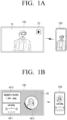
- FIGS. 1A and 1B illustrate a smartphone as an example of the user terminal device 200, the disclosure is not limited thereto.
- the display device 100 may transmit, to the user terminal device 200, information (e.g., a media access control (MAC) address of the display device 100) associated with the display device 100, and connection information.
- the connection information may include information associated with a communication method for receiving the information associated with content that is being output via the user terminal device 200.
- the connection information may include information associated with a communication method by which the display device 100 may receive the information associated with content that is being output via the user terminal device 200, such as a Bluetooth MAC address or a peer-to-peer (P2P) device address. Therefore, the user terminal device 200 may connect to the display device 100 to transmit information associated with content, based on the received connection information.
- the content request event may be an event in which the user terminal device 200 transmits, to the display device 100, a signal indicating that the information associated with content that is being output via the user terminal device 200 is to be transmitted.
- the content request event may be an event in which the user terminal device 200 transmits a signal indicating that the information associated with content that is currently being output via the user terminal device 200 is to be transmitted to the display device 100 to permit the display device to output the content while the connection is established.
- the content request event may be an event in which an external device connected to the display device 100 transmits, to the user terminal device 200 that may be connected to the display device 100, a signal for requesting transmission of the information associated with content that is currently being output via the user terminal device 200. Therefore, based on receiving the signal that requests the transmission of the information associated with content from the external device, the display device 100 may transmit, to the user terminal device 200 that may be connected to the display device 100, a signal that requests the information associated with content that is currently being output via the user terminal device 200.
- the display device 100 may transmit, to the user terminal device 200, a signal that requests the information associated with content that is being o the user terminal device 200.
- the user terminal device 200 may receive the signal that requests the information associated with content that is being output via the user terminal device 200 from the display device 100, while outputting the content, and the user terminal device 200 may identify a type of content that is currently being output. Further, the user terminal device 200 may transmit the information associated with content that is being output via the user terminal device 200 to the display device 100 by using various and/or different communication methods according to the identified type of content. The user terminal device 200 may utilize connection information received from the display device 100 when transmitting information associated with the identified type of content by using various and/or different communication methods.
- the user terminal device 200 may transmit information associated with the video content to the display device 100 by using P2P communication (e.g., Wireless Fidelity (Wi-Fi) Direct communication) by utilizing the connection information such as a P2P device MAC address.
- P2P communication e.g., Wireless Fidelity (Wi-Fi) Direct communication
- the user terminal device 200 may transmit information associated with the audio content to the display device 100 by using Bluetooth communication and utilizing the connection information such as a Bluetooth MAC address.
- the display device 100 may receive a wake-up signal from the user terminal device 200 and enter a standby mode in which a predetermined standby screen 30 is provided.
- the display device 100 may display an indicator indicating that the user terminal device 200 is within communicative proximity of the display device 100 on a region of the standby screen 30, and the region may correspond to a position where the user terminal device 200 is within communicative proximity. A detailed description thereof will be provided below in more detail with reference to FIG. 5B .
- the display device 100 may be switched from the standby mode to a normal mode, and display the video content and an indicator 20 indicating that information associated with video content is received, based on the information (e.g., orientation information of the video content, a title of the video content, information associated with a current playback point of the video content that is being output via the user terminal device, and a connection method for receiving the video content) associated with the video content.
- the indicator 20 indicating that information associated with video content is received is shown as a play button in FIG. 1A .
- the indicator 20 may be variously implemented in a form such as a thumbnail icon of the video content, or the like.
- the display device 100 may display audio user interfaces (Uls) 40-1, 40-2, and 40-3 that are different than a Ul that is concurrently being displayed via the user terminal device 200, while outputting the received audio content.
- the display device 100 may receive information (e.g., an audio data packet, a title of the audio content, a playlist, a playback point, and the like) associated with audio content from the user terminal device 200.
- the display device 100 may output the audio content based on the received audio data packet.
- the display device 100 may display the audio Ul 40-1, the audio Ul 40-2, and the audio Ul 40-3 on the standby screen 30.
- the audio Ul 40-1 may be generated based on the title of the audio content, the playback point, and the like, the audio Ul 40-2 may be generated based on an image (e.g., an album image of audio data) relevant to the audio content that is being played, the playback point, and the like, and the audio Ul 40-3 may be generated based on a play history of recently played audio content.
- the display device 100 may output the audio content while displaying, on the standby screen 30, the audio Uls 40-1, 40-2, and 40-3 that are different than the Ul that is concurrently displayed on the user terminal device 200.
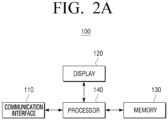
- FIG. 2A is a block diagram schematically illustrating a configuration of the display device 100 according to an embodiment.
- the communication interface 110 may be configured to communicate with the user terminal device 200 by various methods.
- the communication between the communication interface 110 and the user terminal device 200 may be facilitated via a connection via a third device (e.g., a relay, a hub, an access point, a server, a gateway, or the like).
- a third device e.g., a relay, a hub, an access point, a server, a gateway, or the like.
- the display 120 may display various information based on a control by the processor 140. Specifically, based on a wake-up signal being received via the communication interface 110, the display 120 may display a predetermined standby screen based on the control by the processor 140. Further, the display 120 may display, on a region of the standby screen, an indicator indicating that the user terminal device 200 is within communicative proximity of the display device 100, and the region may correspond to a position where the user terminal device 200 is within communicative proximity, according to a control by the processor 140.
- the display 120 may display video content received from the user terminal device 200 based on a control by the processor 140. Further, the display 120 may display an audio Ul that is different than a Ul that is concurrently being displayed via the user terminal device 200 based on a control by the processor 140.
- the display 120 may be implemented by a touch screen in combination with a touch panel, or may be implemented in various forms.
- a panel of the display 120 may be implemented by various display technologies such as a liquid crystal display (LCD) technology, an organic light emitting diode (OLED) technology, an active-matrix organic light emitting diode (AM-OLED) technology, a liquid crystal on silicon (LcoS) technology, a quantum dot light emitting diode (QLED) technology, and a digital light processing (DLP) technology.
- the display 120 may be in a form of a flexible display and may be connected in at least one of a front surface region, a side surface region, or a back surface region of the display device 100.
- the memory 130 may store instructions or data that may be utilized by at least another component of the display device 100.
- the memory 130 may be implemented by a nonvolatile memory, a volatile memory, a flash memory, a hard disk drive (HDD), a solid state drive (SDD), or the like.
- the memory 130 is accessed by the processor 140, and various operations such as readout, recording, correction, deletion, update, and the like, of data in the memory 130 may be performed by the processor 140.
- the memory 130 may store information associated with the user terminal device 200, and information associated with content that is received from the user terminal device 200.
- the memory 130 may store information associated with the user terminal device 200, such as an Internet protocol (IP) address of the user terminal device 200, a network environment, security settings, and connection history.
- IP Internet protocol
- the memory 130 may store a title, a type, a history, and the like, of the content received form the user terminal device 200.
- the processor 140 may be electrically connected to the memory 130 to control the overall operation and function of the display device 100. In particular, based on detecting the content request event, the processor 140 may control the communication interface 110 to transmit, to the user terminal device 200, a signal that requests the information associated with content that is being output via the user terminal device 200. According to an embodiment, and in a case where the content request event is an event in which the user terminal device 200 is brought within communicative proximity of the NFC tag of the display device 100, the processor 140 may receive the wake-up signal via an NFC communication interface 150 and enter the standby mode in which the predetermined standby screen is provided.
- the processor 140 may switch a mode of the display device 100 from the standby mode to the normal mode. Then, the processor 140 may control the display 120 to display the video content and the indicator indicating that the information associated with the video content was received, based on the information associated with the video content that is received from the user terminal device 200, in the normal mode.
- the indicator indicating that the information regarding the video content was received may be an indicator having a play button shape as shown in FIG. 1A . Alternatively, the indicator indicating that the information regarding the video content was received may also be a thumbnail icon of the received video content.
- the processor 140 may control an audio output component 170 to output the audio content based on the information associated with the audio content, and may control the display 120 to display, on the standby screen, an audio Ul that is different from a Ul that is concurrently being displayed on the user terminal device 200.
- the processor 140 may identify an audio Ul based on information (e.g., a title of the audio content, a playback point, a playlist, or the like) associated with audio content that is received from the user terminal device 200, and control the display 120 to display the identified audio Ul.
- the processor 140 may store information (e.g., an IP address of the user terminal device 200, a network environment, security settings, and user information of the user terminal device 200) associated with the user terminal device 200 that is received from the user terminal device 200, a type and a history of content received from the user terminal device 200, in the memory 130. Further, the processor 140 may control the display 120 to display the indicator indicating that the user terminal device 200 is within communicative proximity, based on the stored information associated with the user terminal device 200. Further, the processor 140 may control the display 120 to display a Ul including the stored type and history of content received from the user terminal device 200 on the standby screen or a screen in the normal mode.
- information e.g., an IP address of the user terminal device 200, a network environment, security settings, and user information of the user terminal device 200
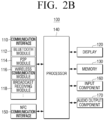
- the communication interface 110 may include various modules configured to connect to the user terminal device 200 or the external server 700.
- the communication interface 110 may include a Bluetooth module 112, a P2P module 114, a wireless communication module 116, and a broadcast receiving module 118.
- the Bluetooth module 112 may be a module that is configured to connect to the user terminal device 200 using a Bluetooth low energy (BLE) protocol.
- Bluetooth is a wireless communication method using an industrial, scientific, and medical (ISM) frequency range (e.g., 2402 to 2480 MHz).
- ISM industrial, scientific, and medical
- the Bluetooth module 112 may receive, from the user terminal device 200, information associated with audio content output via the user terminal device 200 by using Bluetooth communication .
- the P2P module 114 may be a module that is configured to connect to the user terminal device 200 by using P2P communication. According to an embodiment, the P2P module 114 may connect to the user terminal device 200 by utilizing Wi-Fi Direct, which is a Wi-Fi-based P2P standard, without requiring access to separate equipment such as an access point (AP) or a router. Further, the P2P module 114 may receive, form the user terminal device 200, information associated with video content that is being output via the user terminal device 200.
- Wi-Fi Direct is a Wi-Fi-based P2P standard
- the wireless communication module 116 may include a cellular communication module using at least one of long-term evolution (LTE), LTE Advanced (LTE-A), code division multiple access (CDMA), wideband CDMA (WCDMA), universal mobile telecommunications system (UMTS), Wireless Broadband (WiBro), or Global System for Mobile Communications (GSM).
- LTE long-term evolution
- LTE-A LTE Advanced
- CDMA code division multiple access
- WCDMA wideband CDMA
- UMTS universal mobile telecommunications system
- WiBro Wireless Broadband
- GSM Global System for Mobile Communications
- the wireless communication module may include, for example, at least one of Zigbee, magnetic secure transmission, radio frequency (RF), or a body area network (BAN).
- RF radio frequency
- BAN body area network
- the broadcasting receiving module 118 may include a terrestrial broadcasting receiving module (not illustrated) including an antenna, a demodulator, an equalizer, and the like, for receiving a terrestrial broadcasting signal, a digital multimedia broadcasting (DMB) module for receiving and processing a DMB broadcasting signal, or the like.
- a terrestrial broadcasting receiving module (not illustrated) including an antenna, a demodulator, an equalizer, and the like, for receiving a terrestrial broadcasting signal
- DMB digital multimedia broadcasting
- the NFC communication interface 150 may include an NFC tag in which information (e.g., a MAC address of the display device 100) associated with the display device 100, and connection information (e.g., a Bluetooth MAC address, a P2P device MAC address, and the like) are stored.
- the NFC tag may include an integrated circuit (IC) and an antenna coil.
- a current may be induced based on the electromagnetic wave emitted from the NFC reader.
- the induced current may be charged to a capacitor included in the NFC tag.
- the antenna coil in the NFC tag may be formed by a conductor wound multiple times in a rectangular or circular form.
- the IC may be driven by the current charged to the capacitor to modulate and encode information recorded in a memory in the IC to generate the RF signal.
- the NFC communication interface 150 may receive the wake-up signal from the user terminal device 200.
- the wake-up signal may be a signal for inducing the display device 100 to enter the standby mode in which the predetermined standby screen is provided, even in a state in which the display device 100 is powered off.
- the input component 160 may receive a user input for controlling the display device 100.
- the input component 160 may include, for example, a touch panel for receiving a touch gesture, a stylus pen, or the like, and a button for receiving a manipulation by the user.
- the input component 160 may be implemented by another input device (e.g., a remote controller 800, a virtual keyboard, a mouse, a motion input component, or the like).
- the audio output component 170 may be a component configured to output various alarms or audio messages as well as various audio data on which various processes such as decoding, amplification, noise filtering, and the like, are performed by an audio processor (not illustrated). Particularly, the audio output component 170 may output a response to user speech as an audio message in a form of a natural language.
- the audio output component 170 may be implemented by a speaker, or by an output terminal that may output audio data.
- the audio output component 170 may output audio content received from the user terminal device 200 based on a control by the processor 140.
- the processor 140 may include one or more of a central processing unit (CPU) configured to process a digital signal, a microcontroller unit (MCU), a micro processing unit (MPU), a controller, an application processor (AP), a communication processor (CP), an ARM processor, or the like.
- the processor 140 may be implemented by a system-on-chip (SoC) or a large scale integration (LSI) in which a processing algorithm is embedded, or may be implemented in a field programmable gate array (FPGA) form.
- SoC system-on-chip
- LSI large scale integration
- FPGA field programmable gate array
- the processor 140 may perform various functions by executing computer executable instructions stored in the memory 130.
- the processor 140 may include at least one of a graphics processing unit (GPU), a neural processing unit (NPU), or a visual processing unit (VPU) as a separate artificial intelligence (Al) dedicated processor configured to perform an Al function.
- GPU graphics processing unit
- NPU neural processing unit
- VPU visual
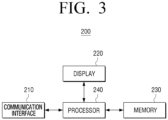
- FIG. 3 is a block diagram schematically illustrating a configuration of the user terminal device 200 according to an embodiment of the disclosure.
- the communication interface 210 may be configured to communicate with the display device 100, and the external device 800 connected with the display device 100.
- the communication interface 210 may include an NFC module, and the NFC module may be implemented by an NFC reader.
- an electromagnetic wave may be emitted from the NFC reader.
- the NFC tag of the display device 100 is driven by the emitted electromagnetic wave and may transmit an RF signal including the information regarding the display device 100 to the NFC reader.
- the communication interface 210 may receive the information associated with the display device 100 and connection information from the display device 100.
- the connection information may include information associated with a communication method by which the display device 100 may receive the information associated with the content that is being output via the user terminal device 200, such as a Bluetooth MAC address or a peer-to-peer (P2P) device address.
- P2P peer-to-peer
- the communication interface 210 may include at least one of a Wi-Fi chip, a Bluetooth chip, a P2P chip, or a wireless communication chip.
- the Wi-Fi chip, the Bluetooth chip, and the P2P chip may perform Wi-Fi communication, Bluetooth communication, and P2P communication, respectively.
- the wireless communication chip may be a chip configured to perform communication according to various communication protocols such as Institute of Electrical and Electronics Engineers (IEEE), Zigbee, 3rd generation (3G), 3rd generation partnership project (3GPP), long term evolution (LTE), 5th generation (5G), and the like.
- IEEE Institute of Electrical and Electronics Engineers
- the communication interface 210 may transmit information associated with audio content to the display device 100 by using Bluetooth communication, and transmit information associated with video content to the display device 100 by using P2P communication.
- the communication interface 210 may transmit content by using various communication methods.
- the display 220 may display various information based on a control by the processor 240. Specifically, based on receiving a signal for requesting information associated with content that is currently being output via the user terminal device 200 from the display device 100, the display 220 may display a Ul for selecting information associated with content to be transmitted to the display device 100 according to a control by the processor 240.
- the memory 230 may include at least one instruction related to the user terminal device 200.
- the memory 230 may include a semiconductor memory such as a flash memory, or a magnetic storage medium such as a hard disk, or the like. Further, the memory 230 may store various kinds of information such as various kinds of data input, set, or generated during execution of the programs or the applications therein.
- the memory 230 may include various software modules for operating the user terminal device 200 according to various embodiments, and the processor 240 may execute the various software modules stored in the memory 230 to perform an operation of the user terminal device 200 according to various embodiments.
- the memory 230 may store the information associated with the display device 100 and connection information.
- the processor 240 may identify a type of the content that is currently being output via the user terminal device 200. Specifically, the processor 240 may analyze metadata of content that is being output, or the like to identify the type of content. Further, the processor 240 may control the communication interface 210 to transmit information associated with the content that is being output via the user terminal device 200 to the display device 100 by using different communication methods according to the identified type of content.
- the processor 240 may control the communication interface 210 to transmit, to the display device 100, information associated with the audio content that is being output by using Bluetooth communication. Further, in a case where the content that is being currently output is identified as video content, the processor 240 may control the communication interface 210 to transmit, to the display device 100, information associated with the video content that is being output by using P2P communication.
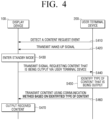
- FIG. 4 is a sequence diagram illustrating a process in which the display device outputs content that is being output via the user terminal device, according to an embodiment.
- the display device 100 may detect a content request event associated with a request for the display device 100 to output information associated with content that is being output via the user terminal device 200 (S410).
- the content request event may be an event in which the user terminal device 200 is brought within communicative proximity of the NFC tag including information (e.g., a MAC address of the display device) and connection information.
- the user terminal device 200 may receive the information associated with the display device 100 that is stored in the NFC tag, and transmit the wake-up signal to the display device 100 (S420).
- the display device 100 may enter the standby mode in which the predetermined standby screen is provided, even when the display device 100 is powered off (S430). Specifically, based on entering the standby mode, the display device 100 may display, on a region corresponding to a position where the user terminal device 200 is within communicative proximity, the indicator indicating that the user terminal device is within communicative proximity.
- the display device 100 may transmit, to the user terminal device 200, the signal for requesting information associated with content that is being output via the user terminal device 200 (S440). Based on receiving the signal for requesting information associated with content that is being output via the user terminal device 200, the user terminal device 200 may identify a type of the content that is being output (S450). Specifically, the user terminal device 200 may analyze metadata of the content that is being output to identify whether the type of content is audio data or video data.
- the display device 100 may output the content in a manner according to the type of content, based on the received information regarding the content (S470). Specifically, in a case where the content that is being output via the user terminal device 200 is audio content, the display device 100 may display an audio Ul that is different than a Ul that is concurrently being displayed on the user terminal device 200 while outputting the audio content, based on received information associated with the audio content, alternatively, and in a case where the content that is being output via the user terminal device 200 is video content, the display device 100 may be switched from the standby mode to the normal mode, and display the video content and the indicator indicating that information associated with the video content is received, based on the received information associated with the video content.
- FIGS. 5A to 5C are views for describing a process in which the display device 100 receives information associated with video content from the user terminal device 200, and outputs content based on the received information according to an embodiment.
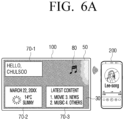
- the display device 100 may receive the wake-up signal from the user terminal device 200 and enter the standby mode in which the predetermined standby screen 30 is provided.
- the display device 100 may display, on a region of the standby screen 30, indicators 50 and 60 indicating that the user terminal device 200 is within communicative proximity of the display device 100.
- the region may correspond to a position where the user terminal device 200 is within communicative proximity.
- the display device 100 may display the indicator 50 indicating that the user terminal device 200 is within communicative proximity, on a right-upper side region of the display 120.
- the display device 100 may receive information (e.g., an IP address, received content history, user information, security settings, a network environment, and the like, of the user terminal device 200) associated with the user terminal device 200. Therefore, the display device 100 may display, on the standby screen 30, a Ul 70-1 indicating that the user terminal device 200 is within communicative proximity, based on the received information.
- information e.g., an IP address, received content history, user information, security settings, a network environment, and the like
- the display device 100 may display, on the standby screen 30, the Ul 70-1 that displays a phrase "Hello, Chulsoo.” Further, the display device 100 may display, on the standby screen 30, a Ul 70-2 that displays weather and calendar information or a Ul 70-3 that displays latest content information, but this is merely an embodiment, and the display device 100 may display a Ul displaying various types of information.
- the display device 100 may transmit, to the user terminal device 200, a signal that requests the user terminal device 200 for information associated with content.
- the user terminal device 200 may identify that video content is being output, and transmit information associated with the video content to the display device 100 by using P2P communication.
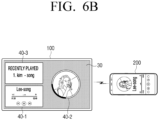
- FIGS. 6A and 6B are views for describing a process in which the display device 100 receives information associated with audio content from the user terminal device 200, and outputs the audio content based on the received information associated with the audio content, according to an embodiment.
- FIGS. 6A and 6B illustrate a similar situation as that shown in FIGS. 5A to 5C except that audio content is output instead of video content.
- the user terminal device 200 may identify that audio content is being output, and transmit information associated with the audio content to the display device 100 by using Bluetooth communication.
- the display device 100 may display, on the standby screen 30, the audio Uls 40-1, 40-2, and 40-3 that are different than a Ul that is being concurrently displayed via the user terminal device 200, and output the audio content based on the received information associated with the audio content. Further, the display device 100 may display, on the standby screen 30, the audio Uls 40-1, 40-2, and 40-3 that are generated based on the received information (e.g., a title of the audio content, image information related to the audio content, a play history, a playback point, and a playlist) associated with the audio content that is received from the user terminal device 200.
- the received information e.g., a title of the audio content, image information related to the audio content, a play history, a playback point, and a playlist
- the display device 100 may display the audio Ul 40-1, the audio Ul 40-2, and the audio Ul 40-3 on the standby screen 30.
- the audio Ul 40-1 may be generated based on information associated with the title of the audio content and the playback point
- the audio Ul 40-2 may be generated based on information regarding an image relevant to the received audio content
- the playback point and the audio Ul 40-3 may be generated based on received information associated with the play history.
- this is merely an embodiment, and the display device 100 may display, on the standby screen 30, various Uls generated based on information regarding an audio content.
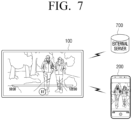
- FIG. 7 is a view for describing a process in which the display device 100 receives information associated with content from the external server 700 and the user terminal device 200 according to an embodiment.
- the display device 100 may receive, from the external server 700 from which the user terminal device 200 also receives the video content, a portion of the video content that corresponds to the current playback point of the video content that is being output via the user terminal device 200, based on the received information.
- the display device 100 may receive, from the external server 700, video content titled "hiking" after the playback point of 59 minutes. Therefore, the display device 100 may receive and display the video content that corresponds to the current playback point of the video content that is received from the external server 700 and is being output via the user terminal device 200.
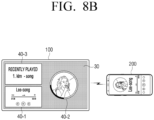
- FIGS. 8A and 8B are views for describing a process in which the user terminal device 200 is brought within communicative proximity of the external device 800 connected to the display device 100, according to an embodiment.
- the external device 800 is implemented by a remote controller, but this is merely an embodiment, and the external device 800 may be implemented by various devices such as an Al speaker.
- the external device 800 may include an NFC tag in which information (e.g., a MAC address of the display device 100) associated with the display device 100 and connection information are stored.
- the user terminal device 200 or the external device 800 may transmit the wake-up signal to the display device 100.
- the display device 100 may enter the standby mode in which the predetermined standby screen 30 is provided.
- the display device 100 may display, on the standby screen 30, the indicator 80 indicating that the user terminal device 200 is within communicative proximity of the external device 800, the Ul 70-1 including information associated with the user terminal device 200 that is received from the user terminal device 200, and the Uls 70-2 and 70-3 indicating weather and calendar information and latest content, respectively.
- the display device 100 may display a Ul including various types of information, on the standby screen 30.
- the display device 100 may transmit, to the user terminal device 200, the signal that requests information associated with content that is being output via the user terminal device 200. That is, as similar to the case where the user terminal device 200 is directly brought within communicative proximity of the display device 100, the display device 100 may transmit the signal that requests information associated with content that is being output via the user terminal device 200 even in a case where the user terminal device 200 is within communicative proximity of the external device 800 connected to the display device 100.
- the user terminal device 200 outputs audio content, and thus the user terminal device 200 may transmit information associated with the audio content to the display device 100 by using Bluetooth communication.
- a subsequent process has been described above with reference to FIG. 6B , and thus a redundant description may be omitted.
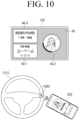
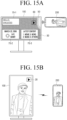
- FIGS. 9 through 11 are views for describing a process in which the user terminal device 200 is brought within communicative proximity of an NFC tag external to the display device 100, according to an embodiment.
- the NFC tag including information (e.g., a MAC address of the display device 100) associated with the display device 100, and connection information (e.g., a Bluetooth MAC address and a P2P device MAC address) may be external to the display device 100. That is, the NFC tag may be disposed externally to the display device 100, and the embodiments shown in FIGS. 9 through 11 are merely embodiments.
- an NFC tag 920 may be disposed on a table 910 as shown in FIG. 9 . Based on the user terminal device 200 being brought within communicative proximity of the NFC tag 920, the user terminal device 200 may receive, from the NFC tag 920, information associated with the display device 100 and connection information via NFC with the NFC tag 920. Further, the user terminal device 200 may connect to the display device 100 based on the received information.
- the display device 100 may transmit, to the user terminal device 200, the signal that requests information associated with content that is currently being output via the user terminal device 200. Based on receiving the signal that requests the information associated with content, the user terminal device 200 may identify a type of the content that is currently being output, and transmit, to the display device 100, information associated with the content that is being output by using different communication methods according to the identified type of content. Referring to FIG. 9 , based on video content being output via the user terminal device 200, the user terminal device 200 may transmit, to the display device 100, information associated with the video content by using P2P communication. Further, the display device 100 may display the video content and the indicator indicating that the video content is received, based on the received information associated with the video content. A detailed description of the screen on which the video content is output has been provided above with reference to FIGS. 5B and 5C , and thus redundant description may be omitted.
- an NFC tag 1020 may be disposed on a vehicle handle 1010 as shown in FIG. 10 .
- the user terminal device 200 may receive, from the NFC tag 1020, information associated with the display device 100 and connection information via NFC with the NFC tag 1020. Further, the user terminal device 200 may connect to the display device 100 based on the received information.
- the display device 100 may transmit, to the user terminal device 200, the signal that requests transmission of information associated with content that is being output via the user terminal device 200.
- the user terminal device 200 may identify a type of the content that is currently being output, and transmit, to the display device 100, information associated with the content that is being output by using different communication methods according to the identified type of content. Referring to FIG.
- the user terminal device 200 may transmit, to the display device 100, information associated with the audio content by using Bluetooth communication. Then, the display device 100 may output the audio content based on the received information associated with the audio content and display, on the standby screen 30, the audio Uls 40-1, 40-2, and 40-3 that are different than the Ul that is concurrently displayed via the user terminal device 200.
- a detailed description of the standby screen 30 and the audio Uls 40-1, 40-2, and 40-3 has been provided above with reference to FIGS. 6A and 6B , and thus redundant description may be omitted.
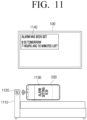
- an NFC tag 1120 may be disposed on a bed 1110 as shown in FIG. 11 .
- the NFC tag 1120 may include a control instruction for executing a specific application, in addition to information associated with the display device 100 and connection information. Specifically, based on the user terminal device 200 being brought within communicative proximity of the NFC tag 1120, the user terminal device 200 may receive, from the NFC tag 1120, information associated with the display device 100, connection information, and a control instruction for executing an alarm application. The user terminal device 200 may connect to the display device 100 based on the information received from the NFC tag 1120 via NFC, and execute an alarm application 1130.
- the user terminal device 200 may transmit a signal including the input instruction to the display device 100. Further, the display device 100 may display a notification Ul 1140 that is generated based on the received signal and set alarm.
- a user instruction e.g., an instruction to set an alarm for 8:30 as shown in FIG. 11
- the user terminal device 200 may transmit a signal including the input instruction to the display device 100. Further, the display device 100 may display a notification Ul 1140 that is generated based on the received signal and set alarm.
- FIG. 11 illustrates a case where the NFC tag 1120 includes the control instruction for executing the alarm application, but this is merely an embodiment, and the NFC tag 1120 may include various control instructions.
- FIG. 12 is a view for describing a case where the display device 100 is implemented by an Al speaker 1210, according to an embodiment.
- An NFC tag 1220 illustrated in FIG. 12 may include information (e.g., a MAC address of the Al speaker) associated with the Al speaker 1210, and connection information (e.g., a Bluetooth MAC address and a P2P device MAC address).
- the NFC tag 1220 may be embedded in the Al speaker 1210 or disposed on an outer portion of the Al speaker 1210.
- the user terminal device 200 may receive, from the NFC tag 1220, information associated with the Al speaker 1210 and connection information via NFC.
- the Al speaker 1210 may transmit, to the user terminal device 200, the signal that requests information associated with content that is currently being output via the user terminal device 200.
- the user terminal device 200 may identify a type of the content that is being output, and transmit, to the Al speaker 1210, information associated with the content by using different communication methods according to the identified type of content.
- the user terminal device 200 may transmit information associated with the audio content to the Al speaker 1210 by using Bluetooth communication.
- the Al speaker 1210 may output the audio content based on the received information associated with the audio content.
- the user terminal device 200 may transmit the wake-up signal to the Al speaker 1210. Based on receiving the wake-up signal, the Al speaker 1210 may be powered on to output the received content.
- the Al speaker 1210 may not include the NFC tag 1220.
- the Al speaker 1210 may transmit, to the user terminal device 200, the signal that requests transmission of information associated with content that is currently being output via the user terminal device 200.
- the content request event may be an event in which the user terminal device 200 transmits, to the Al speaker 1210, a signal that induces transmission of the signal that requests information associated with content that is currently being output.
- FIG. 12 illustrates a case where the display device 100 is implemented by an Al speaker 1210, but this is merely an embodiment, and the display device 100 may be implemented by various electronic devices such as a PC.
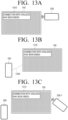
- FIGS. 13A through 13C are views for describing processes in which a connection between the display device 100 and the user terminal device 200 is terminated according to an embodiment.
- the connection between the display device 100 and the user terminal device 200 may be ended. That is, based on the user terminal device 200 being brought within communicative proximity of the NFC tag of the display device 100 in a state in which the connection between the display device 100 and the user terminal device 200 is established, the connection may be ended. Put another way, the user of the user terminal device 200 may perform a first NFC tap to establish the connection, and perform a second NFC tap to end the connection.
- the display device 100 may display a Ul 1310 indicating that the connection is ended.
- the Ul 1310 indicating that communicative connection is ended may be a Ul including a message "connection with Chulsoo has been ended" as shown in FIG. 13A , but this is merely an embodiment, and the Ul 1310 may be implemented in various forms.
- the connection may be ended. Specifically, based on a distance between the user terminal device 200 and the display device 100 exceeding the threshold distance, the user terminal device 200 may transmit, to the display device 100, a signal that ends the connection. Based on receiving the signal that ends the connection, the display device 100 may end the connection with the user terminal device 200, and display the Ul 1310 indicating that connection is ended.
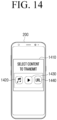
- FIG. 14 is a view for describing a Ul 1410 for selecting information associated with content to be transmitted from the user terminal device 200 to the display device 100 according to an embodiment.
- the user terminal device 200 may transmit the selected information associated with content to the display device 100. Particularly, the user terminal device 200 may transmit the information associated with content to the display device 100 by using different communication methods according to a type of selected information associated with content. Further, the user terminal device 200 may utilize connection information (e.g., a Bluetooth MAC address and a P2P device MAC address) received from the display device 100 to transmit the information associated with content to the display device 100 by using different communication methods according to the type of selected content. According to an embodiment, based on the selected content being audio content, the user terminal device 200 may transmit information associated with the audio content to the display device 100 by using Bluetooth communication. Further, based on the selected content being video content, the user terminal device 200 may transmit information associated with the video content to the display device 100 by using P2P communication.
- connection information e.g., a Bluetooth MAC address and a P2P device MAC address
- the display device 100 may receive the wake-up signal from the user terminal device 200, and enter the standby mode in which the predetermined standby screen 30 is provided.
- a description of entering the standby mode has been provided above with reference to FIG. 5B , and thus a redundant description may be omitted.
- Various embodiments of the disclosure may be implemented by software including instructions stored in a machine-readable storage medium (e.g., a non-transitory computer-readable medium).
- a machine may be a device that invokes the stored instruction from the storage medium and may be operated depending on the invoked instruction, and may include an electronic device (e.g., the display device 100) according to the disclosed embodiments.
- the processor may directly perform a function corresponding to the instruction or other components may perform the function corresponding to the instruction under a control of the processor.
- the instruction may include code created or executed by a compiler or an interpreter.
- the machine-readable storage medium may be provided in a form of a non-transitory storage medium.
- the term "non-transitory" may mean that the storage medium is tangible, and might not distinguish whether data is semi-permanently or temporarily stored on the storage medium.
- the methods according to the embodiments may be included and provided in a computer program product.
- the computer program product may be traded as a product between a seller and a purchaser.
- the computer program product may be distributed in a form of a storage medium (e.g., a compact disc read only memory (CD-ROM)) that may be read by the machine or online through an application store (e.g., PlayStoreTM).
- an application store e.g., PlayStoreTM
- at least portions of the computer program product may be at least temporarily stored in a storage medium such as a memory of a server of a manufacturer, a server of an application store, or a relay server or be temporarily created.
- each of components may include a single entity or a plurality of entities, and some of the corresponding sub-components described above may be omitted or other sub-components may be further included in the embodiments.
- some of the components e.g., the modules or the programs
- Operations performed by the modules, the programs, or other components according to the embodiments may be executed in a sequential manner, a parallel manner, an iterative manner, or a heuristic manner, at least some of the operations may be performed in a different order or be omitted, or other operations may be added.
- the invention might include, relate to, and/or be defined by, the following aspects:
Landscapes
- Engineering & Computer Science (AREA)
- Theoretical Computer Science (AREA)
- Multimedia (AREA)
- General Physics & Mathematics (AREA)
- Human Computer Interaction (AREA)
- Physics & Mathematics (AREA)
- General Engineering & Computer Science (AREA)
- Signal Processing (AREA)
- General Health & Medical Sciences (AREA)
- Audiology, Speech & Language Pathology (AREA)
- Health & Medical Sciences (AREA)
- Computer Networks & Wireless Communication (AREA)
- Two-Way Televisions, Distribution Of Moving Picture Or The Like (AREA)
- Controls And Circuits For Display Device (AREA)
- Telephone Function (AREA)
- Selective Calling Equipment (AREA)
- User Interface Of Digital Computer (AREA)
Applications Claiming Priority (3)
| Application Number | Priority Date | Filing Date | Title |
|---|---|---|---|
| KR20190045703 | 2019-04-18 | ||
| KR1020190111452A KR102339367B1 (ko) | 2019-04-18 | 2019-09-09 | 디스플레이 장치, 사용자 단말 장치 및 디스플레이 장치와 사용자 단말 장치 의 제어 방법 |
| EP19200575.9A EP3726367B1 (fr) | 2019-04-18 | 2019-09-30 | Dispositif d'affichage, dispositif de terminal d'utilisateur, procédé de commande de dispositif d'affichage et procédé de commande de dispositif de terminal d'utilisateur |
Related Parent Applications (1)
| Application Number | Title | Priority Date | Filing Date |
|---|---|---|---|
| EP19200575.9A Division EP3726367B1 (fr) | 2019-04-18 | 2019-09-30 | Dispositif d'affichage, dispositif de terminal d'utilisateur, procédé de commande de dispositif d'affichage et procédé de commande de dispositif de terminal d'utilisateur |
Publications (4)
| Publication Number | Publication Date |
|---|---|
| EP4529193A2 true EP4529193A2 (fr) | 2025-03-26 |
| EP4529193A3 EP4529193A3 (fr) | 2025-04-16 |
| EP4529193B1 EP4529193B1 (fr) | 2026-04-29 |
| EP4529193C0 EP4529193C0 (fr) | 2026-04-29 |
Family
ID=68104512
Family Applications (2)
| Application Number | Title | Priority Date | Filing Date |
|---|---|---|---|
| EP25155822.7A Active EP4529193B1 (fr) | 2019-04-18 | 2019-09-30 | Dispositif d'affichage, dispositif de terminal d'utilisateur, procédé de commande de dispositif d'affichage et procédé de commande de dispositif de terminal d'utilisateur |
| EP19200575.9A Active EP3726367B1 (fr) | 2019-04-18 | 2019-09-30 | Dispositif d'affichage, dispositif de terminal d'utilisateur, procédé de commande de dispositif d'affichage et procédé de commande de dispositif de terminal d'utilisateur |
Family Applications After (1)
| Application Number | Title | Priority Date | Filing Date |
|---|---|---|---|
| EP19200575.9A Active EP3726367B1 (fr) | 2019-04-18 | 2019-09-30 | Dispositif d'affichage, dispositif de terminal d'utilisateur, procédé de commande de dispositif d'affichage et procédé de commande de dispositif de terminal d'utilisateur |
Country Status (4)
| Country | Link |
|---|---|
| US (2) | US11321040B2 (fr) |
| EP (2) | EP4529193B1 (fr) |
| CN (1) | CN111831243A (fr) |
| WO (1) | WO2020213795A1 (fr) |
Families Citing this family (5)
| Publication number | Priority date | Publication date | Assignee | Title |
|---|---|---|---|---|
| WO2021180216A1 (fr) * | 2020-03-13 | 2021-09-16 | 海信视像科技股份有限公司 | Dispositif d'affichage et procédé de démarrage |
| KR20230034064A (ko) * | 2021-09-02 | 2023-03-09 | 삼성전자주식회사 | 디스플레이 장치 및 그의 동작 방법 |
| US12032872B2 (en) * | 2021-09-30 | 2024-07-09 | Sonos, Inc. | Intelligent user interfaces for playback devices |
| US20240095313A1 (en) * | 2022-03-18 | 2024-03-21 | Blackdove, Inc. | User-Controllable AV-Artwork Steaming Data Structure with Conjunctive Configurable NFTs and Landscape-Portrait Coding |
| US20250077711A1 (en) * | 2023-09-01 | 2025-03-06 | Motorola Mobility Llc | Lock state based on a trigger condition |
Family Cites Families (46)
| Publication number | Priority date | Publication date | Assignee | Title |
|---|---|---|---|---|
| KR100414427B1 (ko) * | 2001-08-01 | 2004-01-07 | 시코드 주식회사 | 블루투스 통신에 있어서의 핸드오버 |
| US7769345B2 (en) * | 2006-09-29 | 2010-08-03 | Sony Ericsson Mobile Communications Ab | Device and method for guiding a user to a communication position |
| US8155588B2 (en) * | 2007-12-27 | 2012-04-10 | Lenovo (Singapore) Pte. Ltd. | Seamless hand-off of bluetooth pairings |
| KR101702132B1 (ko) * | 2010-08-24 | 2017-02-13 | 엘지전자 주식회사 | 컨텐츠 공유 제어 방법, 그를 이용한 휴대용 단말기, 컨텐츠 재생 장치 및 시스템 |
| EP2611143A4 (fr) | 2010-08-24 | 2014-04-16 | Lg Electronics Inc | Procédé pour commander un partage de fichiers, et terminal portable et système de partage de contenus associés |
| US9569003B2 (en) * | 2010-09-30 | 2017-02-14 | Broadcom Corporation | Portable computing device including a three-dimensional touch screen |
| KR101281384B1 (ko) | 2011-02-15 | 2013-07-02 | 엘지전자 주식회사 | 데이터 송수신 방법, 그를 이용한 디스플레이 장치 및 휴대용 단말기 |
| US8775850B2 (en) | 2011-06-28 | 2014-07-08 | Amazon Technologies, Inc. | Transferring state information between electronic devices |
| US9479723B2 (en) * | 2011-12-28 | 2016-10-25 | Sony Corporation | Display device, display control method, and program |
| US9338517B2 (en) | 2012-04-07 | 2016-05-10 | Samsung Electronics Co., Ltd. | Method and system for reproducing contents, and computer-readable recording medium thereof |
| JP6218418B2 (ja) * | 2012-04-07 | 2017-10-25 | 三星電子株式会社Samsung Electronics Co.,Ltd. | コンテンツ提供方法、携帯デバイス及び記録媒体 |
| US8682248B2 (en) | 2012-04-07 | 2014-03-25 | Samsung Electronics Co., Ltd. | Method and system for reproducing contents, and computer-readable recording medium thereof |
| KR101870996B1 (ko) | 2012-04-09 | 2018-06-25 | 엘지전자 주식회사 | 디스플레이 장치 및 그 제어 방법 |
| US9736764B2 (en) * | 2012-07-11 | 2017-08-15 | Continental Automotive Systems, Inc. | Bluetooth phone reconnection strategy |
| KR101974820B1 (ko) | 2012-09-10 | 2019-08-23 | 삼성전자주식회사 | 기기 제어 방법 및 이를 수행하는 기기 |
| KR20140052232A (ko) | 2012-10-23 | 2014-05-07 | (주)텔레컨스 | 단말 간의 자동 무선 연결 설정 장치 및 방법 |
| KR101423846B1 (ko) | 2012-12-31 | 2014-07-25 | 한국과학기술원 | 스마트 기기를 통한 미디어 재생정보 전송 장치 및 방법 |
| US9137723B2 (en) * | 2013-03-15 | 2015-09-15 | Facebook, Inc. | Portable platform for networked computing |
| EP2981020B1 (fr) * | 2013-03-26 | 2021-02-03 | Sony Corporation | Dispositif de traitement d'informations, système de communication, procédé de traitement d'informations, et programme |
| US10021180B2 (en) * | 2013-06-04 | 2018-07-10 | Kingston Digital, Inc. | Universal environment extender |
| KR102084633B1 (ko) * | 2013-09-17 | 2020-03-04 | 삼성전자주식회사 | 화면 미러링 방법 및 그에 따른 소스 기기 |
| KR101388148B1 (ko) | 2013-11-27 | 2014-04-23 | 주식회사 엘지유플러스 | Nfc 태그를 이용한 페어링 시스템 및 방법 |
| DE102014217422B4 (de) * | 2013-12-04 | 2024-12-24 | Hyundai Motor Company | Verfahren zum Steuern eines Datenflusses eines Spiegel-Verbindungsabschnittsystems |
| US9584871B2 (en) * | 2013-12-19 | 2017-02-28 | Echostar Technologies L.L.C. | Smartphone bluetooth headset receiver |
| KR20150072987A (ko) * | 2013-12-20 | 2015-06-30 | 삼성전자주식회사 | 오디오 출력 환경에서의 노이즈 저감 방법 및 이를 지원하는 전자 장치 |
| KR102267871B1 (ko) * | 2014-09-03 | 2021-06-23 | 삼성전자주식회사 | 디스플레이 장치 및 그 제어 방법 |
| KR102352764B1 (ko) | 2014-11-04 | 2022-01-19 | 삼성전자주식회사 | 사용자 단말 장치, 사용자 단말 장치와 연계되는 디스플레이 장치, 연계 시스템 및 그 제어 방법 |
| US9535647B2 (en) * | 2014-12-24 | 2017-01-03 | Intel Corporation | Apparatus, system and method of channel switching |
| KR102118053B1 (ko) * | 2015-02-09 | 2020-06-02 | 엘지전자 주식회사 | 이동 단말기 및 그 제어 방법 |
| JP6037354B1 (ja) | 2015-06-03 | 2016-12-07 | 独立行政法人日本スポーツ振興センター | 動画伝送サーバ |
| US9948980B2 (en) * | 2015-07-20 | 2018-04-17 | Google Llc | Synchronizing audio content to audio and video devices |
| KR102485166B1 (ko) * | 2015-09-22 | 2023-01-06 | 엘지전자 주식회사 | 디스플레이 장치 및 그의 동작 방법 |
| US10282052B2 (en) * | 2015-10-15 | 2019-05-07 | At&T Intellectual Property I, L.P. | Apparatus and method for presenting information associated with icons on a display screen |
| KR102459590B1 (ko) * | 2015-12-24 | 2022-10-26 | 엘지전자 주식회사 | 영상표시장치 |
| KR102418003B1 (ko) | 2016-01-04 | 2022-07-07 | 삼성전자주식회사 | 복수의 디스플레이 장치들을 이용한 콘텐츠의 디스플레이 |
| KR102471230B1 (ko) * | 2016-01-28 | 2022-11-28 | 엘지전자 주식회사 | 이동 단말기 및 그의 동작 방법 |
| KR102483832B1 (ko) * | 2016-02-19 | 2023-01-03 | 삼성전자주식회사 | 생체 정보 기반 인증을 이용한 전자 장치들 간 연결 방법 및 장치 |
| US10620786B2 (en) * | 2016-03-07 | 2020-04-14 | Intel Corporation | Technologies for event notification interface management |
| CN105812906B (zh) * | 2016-03-22 | 2018-11-20 | 广东欧珀移动通信有限公司 | 一种播放设备的通信控制方法和装置 |
| KR102570379B1 (ko) * | 2016-04-22 | 2023-08-25 | 엘지전자 주식회사 | 스크린 미러링 기능을 제공하는 디스플레이 장치 및 그의 동작 방법 |
| KR20180028249A (ko) * | 2016-09-08 | 2018-03-16 | 삼성전자주식회사 | 사용자 단말 장치 및 그 제어 방법 |
| KR102734807B1 (ko) * | 2016-10-14 | 2024-11-27 | 삼성전자주식회사 | 전자 장치들 간 연결 방법 및 장치 |
| US10306323B2 (en) | 2016-12-07 | 2019-05-28 | Google Llc | Fast television channel change initiated from a second screen device |
| KR102350933B1 (ko) * | 2017-06-20 | 2022-01-12 | 엘지전자 주식회사 | 영상표시장치 |
| CN111095935A (zh) * | 2017-09-19 | 2020-05-01 | Lg电子株式会社 | 显示装置及用于控制显示装置的终端 |
| KR102394190B1 (ko) * | 2017-11-13 | 2022-05-09 | 엘지전자 주식회사 | 유기 발광 다이오드 디스플레이 장치 및 그의 동작 방법 |
-
2019
- 2019-09-11 CN CN201910859920.1A patent/CN111831243A/zh active Pending
- 2019-09-30 EP EP25155822.7A patent/EP4529193B1/fr active Active
- 2019-09-30 EP EP19200575.9A patent/EP3726367B1/fr active Active
- 2019-09-30 WO PCT/KR2019/012680 patent/WO2020213795A1/fr not_active Ceased
- 2019-09-30 US US16/588,078 patent/US11321040B2/en active Active
-
2022
- 2022-03-18 US US17/698,647 patent/US11726735B2/en active Active
Also Published As
| Publication number | Publication date |
|---|---|
| WO2020213795A1 (fr) | 2020-10-22 |
| EP4529193A3 (fr) | 2025-04-16 |
| EP4529193B1 (fr) | 2026-04-29 |
| EP4529193C0 (fr) | 2026-04-29 |
| EP3726367A1 (fr) | 2020-10-21 |
| US20220214848A1 (en) | 2022-07-07 |
| CN111831243A (zh) | 2020-10-27 |
| EP3726367B1 (fr) | 2025-02-05 |
| EP3726367C0 (fr) | 2025-02-05 |
| US11726735B2 (en) | 2023-08-15 |
| US11321040B2 (en) | 2022-05-03 |
| US20200333995A1 (en) | 2020-10-22 |
Similar Documents
| Publication | Publication Date | Title |
|---|---|---|
| US11726735B2 (en) | Display device, user terminal device, method for controlling display device, and method for controlling user terminal device | |
| US20200351764A1 (en) | Method for transmitting and receiving signals in proximity network and electronic device thereof | |
| US8594649B2 (en) | Method and system for acquiring application in mobile device | |
| JP6076501B2 (ja) | 無線ネットワークのオン・オフを制御するための方法、装置、設備、システム、プログラム及び記録媒体 | |
| US20170237930A1 (en) | Method of controlling the sharing of videos and electronic device adapted thereto | |
| US20160306511A1 (en) | Apparatus and method for providing information via portion of display | |
| CN104239332A (zh) | 网页内容处理方法、装置及浏览器客户端 | |
| KR20160041147A (ko) | 제어 방법 및 그 방법을 처리하는 전자장치 | |
| KR20150106233A (ko) | 복수의 전자 장치에서 기능을 수행하는 방법 및 전자 장치 | |
| CN103313139A (zh) | 播放历史显示方法、装置及电子设备 | |
| KR101876394B1 (ko) | 단말기에 미디어 데이터를 재생하는 방법 및 장치 | |
| KR102475230B1 (ko) | 통신망 연결 제어 방법, 저장 매체 및 이를 위한 전자 장치 | |
| KR20140096580A (ko) | Nfc 통신 모듈이 없는 전자 기기의 nfc 서비스 제공 방법 및 시스템 | |
| KR20160052281A (ko) | 네트워크 상태를 판단하는 장치 및 방법 | |
| KR20160052105A (ko) | 전자 장치의 데이터 송수신 방법 및 이를 사용하는 전자 장치 | |
| CN104199596B (zh) | 场景界面切换方法及装置 | |
| KR20150135911A (ko) | Ui 효과 디스플레이 방법 및 전자 장치 | |
| CN104965642A (zh) | 下拉列表生成方法及装置 | |
| CN103607431A (zh) | 移动终端资源处理方法、装置和设备 | |
| CN105187944A (zh) | 一种显示状态栏的方法和装置 | |
| CN103544457A (zh) | 一种近场通信标签的识别方法、装置、和移动终端 | |
| CN103491421A (zh) | 内容展示方法、装置及智能电视 | |
| KR20160045441A (ko) | 동영상 재생 방법 및 장치 | |
| KR102218553B1 (ko) | 화면 제어를 위한 방법 및 전자장치 | |
| KR20150084192A (ko) | 사운드 제공 방법 및 이를 구현하는 전자 장치 |
Legal Events
| Date | Code | Title | Description |
|---|---|---|---|
| PUAI | Public reference made under article 153(3) epc to a published international application that has entered the european phase |
Free format text: ORIGINAL CODE: 0009012 |
|
| STAA | Information on the status of an ep patent application or granted ep patent |
Free format text: STATUS: THE APPLICATION HAS BEEN PUBLISHED |
|
| REG | Reference to a national code |
Ref country code: DE Ref legal event code: R079 Free format text: PREVIOUS MAIN CLASS: H04N0021436300 Ipc: G06F0003140000 Ref document number: 602019084442 Country of ref document: DE |
|
| PUAL | Search report despatched |
Free format text: ORIGINAL CODE: 0009013 |
|
| AC | Divisional application: reference to earlier application |
Ref document number: 3726367 Country of ref document: EP Kind code of ref document: P |
|
| AK | Designated contracting states |
Kind code of ref document: A2 Designated state(s): AL AT BE BG CH CY CZ DE DK EE ES FI FR GB GR HR HU IE IS IT LI LT LU LV MC MK MT NL NO PL PT RO RS SE SI SK SM TR |
|
| AK | Designated contracting states |
Kind code of ref document: A3 Designated state(s): AL AT BE BG CH CY CZ DE DK EE ES FI FR GB GR HR HU IE IS IT LI LT LU LV MC MK MT NL NO PL PT RO RS SE SI SK SM TR |
|
| RIC1 | Information provided on ipc code assigned before grant |
Ipc: H04N 21/4363 20110101ALI20250307BHEP Ipc: H04N 21/435 20110101ALI20250307BHEP Ipc: H04N 21/431 20110101ALI20250307BHEP Ipc: H04N 21/41 20110101ALI20250307BHEP Ipc: G06F 3/14 20060101AFI20250307BHEP |
|
| STAA | Information on the status of an ep patent application or granted ep patent |
Free format text: STATUS: REQUEST FOR EXAMINATION WAS MADE |
|
| GRAP | Despatch of communication of intention to grant a patent |
Free format text: ORIGINAL CODE: EPIDOSNIGR1 |
|
| STAA | Information on the status of an ep patent application or granted ep patent |
Free format text: STATUS: GRANT OF PATENT IS INTENDED |
|
| 17P | Request for examination filed |
Effective date: 20250714 |
|
| INTG | Intention to grant announced |
Effective date: 20250819 |
|
| GRAJ | Information related to disapproval of communication of intention to grant by the applicant or resumption of examination proceedings by the epo deleted |
Free format text: ORIGINAL CODE: EPIDOSDIGR1 |
|
| STAA | Information on the status of an ep patent application or granted ep patent |
Free format text: STATUS: REQUEST FOR EXAMINATION WAS MADE |
|
| GRAP | Despatch of communication of intention to grant a patent |
Free format text: ORIGINAL CODE: EPIDOSNIGR1 |
|
| STAA | Information on the status of an ep patent application or granted ep patent |
Free format text: STATUS: GRANT OF PATENT IS INTENDED |
|
| INTC | Intention to grant announced (deleted) | ||
| INTG | Intention to grant announced |
Effective date: 20251209 |
|
| GRAS | Grant fee paid |
Free format text: ORIGINAL CODE: EPIDOSNIGR3 |
|
| GRAA | (expected) grant |
Free format text: ORIGINAL CODE: 0009210 |
|
| STAA | Information on the status of an ep patent application or granted ep patent |
Free format text: STATUS: THE PATENT HAS BEEN GRANTED |
|
| AC | Divisional application: reference to earlier application |
Ref document number: 3726367 Country of ref document: EP Kind code of ref document: P |
|
| AK | Designated contracting states |
Kind code of ref document: B1 Designated state(s): AL AT BE BG CH CY CZ DE DK EE ES FI FR GB GR HR HU IE IS IT LI LT LU LV MC MK MT NL NO PL PT RO RS SE SI SK SM TR |
|
| REG | Reference to a national code |
Ref country code: CH Ref legal event code: F10 Free format text: ST27 STATUS EVENT CODE: U-0-0-F10-F00 (AS PROVIDED BY THE NATIONAL OFFICE) Effective date: 20260429 Ref country code: GB Ref legal event code: FG4D |
|
| REG | Reference to a national code |
Ref country code: DE Ref legal event code: R096 Ref document number: 602019084442 Country of ref document: DE |
|
| REG | Reference to a national code |
Ref country code: IE Ref legal event code: FG4D |
|
| U01 | Request for unitary effect filed |
Effective date: 20260512 |
|
| U07 | Unitary effect registered |
Designated state(s): AT BE BG DE DK EE FI FR IT LT LU LV MT NL PT RO SE SI Effective date: 20260520 |