EP4529236A1 - Procédé et dispositif de communication, et système - Google Patents
Procédé et dispositif de communication, et système Download PDFInfo
- Publication number
- EP4529236A1 EP4529236A1 EP23834698.5A EP23834698A EP4529236A1 EP 4529236 A1 EP4529236 A1 EP 4529236A1 EP 23834698 A EP23834698 A EP 23834698A EP 4529236 A1 EP4529236 A1 EP 4529236A1
- Authority
- EP
- European Patent Office
- Prior art keywords
- receiving devices
- identifier
- receiving
- sending device
- application
- Prior art date
- Legal status (The legal status is an assumption and is not a legal conclusion. Google has not performed a legal analysis and makes no representation as to the accuracy of the status listed.)
- Pending
Links
Images


Classifications
-
- H—ELECTRICITY
- H04—ELECTRIC COMMUNICATION TECHNIQUE
- H04W—WIRELESS COMMUNICATION NETWORKS
- H04W76/00—Connection management
- H04W76/10—Connection setup
- H04W76/11—Allocation or use of connection identifiers
-
- H—ELECTRICITY
- H04—ELECTRIC COMMUNICATION TECHNIQUE
- H04W—WIRELESS COMMUNICATION NETWORKS
- H04W76/00—Connection management
- H04W76/10—Connection setup
- H04W76/15—Setup of multiple wireless link connections
-
- H—ELECTRICITY
- H04—ELECTRIC COMMUNICATION TECHNIQUE
- H04B—TRANSMISSION
- H04B7/00—Radio transmission systems, i.e. using radiation field
- H04B7/02—Diversity systems; Multi-antenna system, i.e. transmission or reception using multiple antennas
- H04B7/04—Diversity systems; Multi-antenna system, i.e. transmission or reception using multiple antennas using two or more spaced independent antennas
- H04B7/0413—MIMO systems
- H04B7/0452—Multi-user MIMO systems
-
- H—ELECTRICITY
- H04—ELECTRIC COMMUNICATION TECHNIQUE
- H04L—TRANSMISSION OF DIGITAL INFORMATION, e.g. TELEGRAPHIC COMMUNICATION
- H04L5/00—Arrangements affording multiple use of the transmission path
-
- H—ELECTRICITY
- H04—ELECTRIC COMMUNICATION TECHNIQUE
- H04W—WIRELESS COMMUNICATION NETWORKS
- H04W12/00—Security arrangements; Authentication; Protecting privacy or anonymity
- H04W12/06—Authentication
-
- H—ELECTRICITY
- H04—ELECTRIC COMMUNICATION TECHNIQUE
- H04W—WIRELESS COMMUNICATION NETWORKS
- H04W4/00—Services specially adapted for wireless communication networks; Facilities therefor
- H04W4/06—Selective distribution of broadcast services, e.g. multimedia broadcast multicast service [MBMS]; Services to user groups; One-way selective calling services
-
- H—ELECTRICITY
- H04—ELECTRIC COMMUNICATION TECHNIQUE
- H04W—WIRELESS COMMUNICATION NETWORKS
- H04W60/00—Affiliation to network, e.g. registration; Terminating affiliation with the network, e.g. de-registration
- H04W60/04—Affiliation to network, e.g. registration; Terminating affiliation with the network, e.g. de-registration using triggered events
-
- H—ELECTRICITY
- H04—ELECTRIC COMMUNICATION TECHNIQUE
- H04W—WIRELESS COMMUNICATION NETWORKS
- H04W74/00—Wireless channel access
- H04W74/002—Transmission of channel access control information
- H04W74/004—Transmission of channel access control information in the uplink, i.e. towards network
-
- H—ELECTRICITY
- H04—ELECTRIC COMMUNICATION TECHNIQUE
- H04W—WIRELESS COMMUNICATION NETWORKS
- H04W74/00—Wireless channel access
- H04W74/002—Transmission of channel access control information
- H04W74/006—Transmission of channel access control information in the downlink, i.e. towards the terminal
-
- H—ELECTRICITY
- H04—ELECTRIC COMMUNICATION TECHNIQUE
- H04W—WIRELESS COMMUNICATION NETWORKS
- H04W8/00—Network data management
- H04W8/26—Network addressing or numbering for mobility support
-
- H—ELECTRICITY
- H04—ELECTRIC COMMUNICATION TECHNIQUE
- H04L—TRANSMISSION OF DIGITAL INFORMATION, e.g. TELEGRAPHIC COMMUNICATION
- H04L5/00—Arrangements affording multiple use of the transmission path
- H04L5/0001—Arrangements for dividing the transmission path
- H04L5/0003—Two-dimensional division
- H04L5/0005—Time-frequency
- H04L5/0007—Time-frequency the frequencies being orthogonal, e.g. OFDM(A) or DMT
-
- H—ELECTRICITY
- H04—ELECTRIC COMMUNICATION TECHNIQUE
- H04W—WIRELESS COMMUNICATION NETWORKS
- H04W76/00—Connection management
- H04W76/40—Connection management for selective distribution or broadcast
Definitions
- This application relates to the wireless communication field, and more specifically, to a communication method and system, and a device.
- a current wireless networking solution for a Wi-Fi system is a repeater (repeater) mode, and uses a dual-entity solution of a virtual access point (soft access point, SoftAP).
- One repeater has two physical entities: terminal (station, STA) and SoftAP.
- a media access control (media access control, MAC) address of the STA is different from a MAC address of the SoftAP.
- the repeater When the repeater serves as the STA, the repeater can receive only data of an upper-level route, and a single user (single user, SU) frame or a trigger based (trigger based, TB) frame is used for backhaul.
- the repeater When the repeater serves as the AP, the repeater can transmit data only with a lower-level STA or SoftAP. The two entities cannot work together when the two entities work in a same frequency and on a same channel.
- Such a networking structure needs to occupy an air interface twice, reducing a capacity of an entire network.
- the repeater needs to create the two physical entities, increasing an area of a chip and power consumption of the chip.
- This application provides a communication method and system, and a device. According to the communication method and system, and the device in this application, a network capacity and transmission efficiency of Wi-Fi networking can be significantly improved, an area and power consumption of a chip during networking can be reduced, and a network structure can be simplified.
- an embodiment of this application provides a communication method.
- the method may be performed by a sending device or a component (such as a chip or a chip system) in a sending device. This is not limited in this application.
- the method includes: A sending device sends M first identifiers to M receiving devices in N receiving devices, where the M first identifiers one-to-one correspond to the M receiving devices, the M first identifiers identify the M receiving devices, the N receiving devices include the M receiving devices, N is an integer greater than or equal to 1, and M is a positive integer less than or equal to N; and the sending device transmits, through a data frame, data to the M receiving devices corresponding to the M first identifiers, where the sending device is communicatively connected to the N receiving devices, and the N receiving devices are not communicatively connected to each other.
- that the sending device is communicatively connected to the N receiving devices may be that data transmission may be performed between the sending device and the N receiving devices in a wireless or another communication manner, that is, there are communication links between the sending device and the N receiving devices.
- That the N receiving devices are not communicatively connected to each other may be that the N receiving devices cannot perform data transmission with each other in a wireless manner or another communication manner, that is, there is no communication link between the N receiving devices.
- a communication manner between the sending device and the N receiving devices is not limited in this application.
- the sending device sends the first identifiers to the receiving devices, so that when sending device communicates with the receiving devices, the sending device can perform, through the data frame, bidirectional communication based on the first identifiers.
- a network capacity can be improved through bidirectional communication.
- the first identifier is an association identifier AID code.
- a device that receives the AID code does not need to parse physical layer data, thereby improving data transmission efficiency.
- the data frame is a frequency division multiplexing data frame.
- a frame format of the data frame includes an orthogonal frequency division multiple access OFDMA frame format and a frame format combining OFDMA and multi-user multiple-input multiple-output MUMIMO.
- the frequency division multiplexing data frame is used, so that bidirectional communication between the receiving devices and the sending device is implemented, an area and power consumption of a chip during networking are further reduced, and a network structure is simplified.
- the method further includes: The sending device allocates, to each of the M receiving devices, the first identifier corresponding to the receiving device.
- the sending device allocates the first identifiers to the receiving devices. This can avoid a conflict caused by identifier repetition because a plurality of receiving devices autonomously and randomly generate first identifiers, and improve system performance.
- the sending device is a routing device or an access point AP device.
- a router or an AP allocates a first identifier to a lower-level receiving device connected to the router or the AP. This can implement layer-by-layer allocation, and improve transmission efficiency. Further, allocation of first identifiers can be distributed to each layer for implementation through layer-by-layer allocation, thereby improving system transmission reliability.
- the method further includes: The sending device sends a second identifier to the M receiving devices, where the second identifier is an identifier corresponding to the sending device.
- the sending device sends the identifier of the sending device to the receiving devices, so that the receiving devices can send uplink data to the sending device based on the second identifier, thereby improving transmission performance of a system.
- an embodiment of this application provides a communication method.
- the method may be performed by a receiving device or a component (such as a chip or a chip system) in a receiving device. This is not limited in this application.
- the method includes: The receiving device receives a first identifier from a sending device, where the first identifier corresponds to the receiving device, and the first identifier identifies the receiving device; and the receiving device transmits data to the sending device through a data frame.
- the first identifier is an association identifier AID code.
- the data frame is a frequency division multiplexing data frame.
- a frame format of the data frame includes an orthogonal frequency division multiple access OFDMA frame format and a frame format combining OFDMA and multi-user multiple-input multiple-output MUMIMO.
- the first identifier is allocated by the sending device to the receiving device.
- the receiving device is an access point AP device or a terminal STA device.
- the method further includes: The receiving device receives a second identifier from the sending device, where the second identifier is an identifier corresponding to the sending device.
- an embodiment of this application provides a communication system.
- the communication system includes a plurality of receiving devices.
- the plurality of receiving devices are communicatively connected to a sending device, and the plurality of receiving devices are not communicatively connected to each other.
- the plurality of receiving devices are configured to perform the method provided in any one of the second aspect and the implementations of the second aspect.
- an embodiment of this application provides a communication apparatus.
- the apparatus is configured to perform the method provided in the first aspect.
- the communication apparatus may include a unit and/or a module configured to perform the method provided in any one of the first aspect or the foregoing implementations of the first aspect, for example, a processing unit and an obtaining unit.
- the communication apparatus is a sending device.
- the obtaining unit may be a transceiver or an input/output interface
- the processing unit may be at least one processor.
- the transceiver may be a transceiver circuit.
- the input/output interface may be an input/output circuit.
- the communication apparatus is a chip, a chip system, or a circuit in a sending device.
- the obtaining unit may be an input/output interface, an interface circuit, an output circuit, an input circuit, a pin, a related circuit, or the like in the chip, the chip system, or the circuit; and the processing unit may be at least one processor, a processing circuit, a logic circuit, or the like.
- an embodiment of this application provides a communication apparatus.
- the apparatus is configured to perform the method provided in the second aspect.
- the communication apparatus may include a unit and/or a module configured to perform the method provided in any one of the second aspect or the foregoing implementations of the second aspect, for example, a processing unit and an obtaining unit.
- the communication apparatus is a receiving device.
- the obtaining unit may be a transceiver or an input/output interface
- the processing unit may be at least one processor.
- the transceiver may be a transceiver circuit.
- the input/output interface may be an input/output circuit.
- the communication apparatus is a chip, a chip system, or a circuit in a receiving device.
- the obtaining unit may be an input/output interface, an interface circuit, an output circuit, an input circuit, a pin, a related circuit, or the like in the chip, the chip system, or the circuit; and the processing unit may be at least one processor, a processing circuit, a logic circuit, or the like.
- an embodiment of this application provides a processor, configured to perform the methods provided in the foregoing aspects.
- Operations such as sending and obtaining/receiving related to the processor may be understood as operations such as output and receiving or input of the processor, or operations such as sending and receiving performed by a radio frequency circuit and an antenna, unless otherwise specified, or provided that the operations do not contradict actual functions or internal logic of the operations in related descriptions. This is not limited in this application.
- an embodiment of this application provides a computer-readable storage medium.
- the computer-readable storage medium stores program code executed by a device, and the program code is used to perform the method provided in any one of the first aspect or the second aspect and the implementations of the first aspect or the second aspect.
- an embodiment of this application provides a computer program product including instructions.
- the computer program product runs on a computer, the computer is enabled to perform the method provided in any one of the first aspect or the second aspect and the implementations of the first aspect or the second aspect.
- an embodiment of this application provides a chip.
- the chip includes a processor and a communication interface.
- the processor reads, through the communication interface, instructions stored in a memory, to perform the method provided in any one of the first aspect or the second aspect and the implementations of the first aspect or the second aspect.
- the chip further includes the memory.
- the memory stores a computer program or instructions.
- the processor is configured to execute the computer program or the instructions stored in the memory.
- the processor is configured to perform the method provided in any one of the first aspect or the second aspect and the implementations of the first aspect or the second aspect.
- an embodiment of this application provides a communication system, including the communication apparatus according to the fourth aspect and the data transmission apparatus according to the fifth aspect.
- an embodiment of this application provides a communication method.
- the method may be performed by a first device, and the first device is a sending device.
- the method may be performed by a chip or a circuit configured in the first device. This is not limited in this application.
- the method includes: The first device sends at least one first identifier to at least one second device, where each of the at least one first identifier identifies that the first device is connected to the at least one second device, the at least one first identifier one-to-one corresponds to the at least one second device, the first device is connected to the at least one second device, and there is no connection relationship between the at least one second device; and the first device sends, based on the first identifier, data to the second device corresponding to the first identifier.
- the first identifier is an association identifier AID code.
- the method further includes: The first device allocates, to each of the at least one second device, the first identifier corresponding to the second device.
- the first device is a routing device or an access point AP device.
- the method further includes: The first device sends a second identifier to the at least one second device, where the second identifier is a unique identifier used when the first device is connected to the at least one second device.
- an embodiment of this application provides a communication device.
- the device includes a transceiver module.
- the transceiver module is configured to send at least one first identifier to at least one second device, where each of the at least one first identifier identifies that the device is connected to the at least one second device, the at least one first identifier one-to-one corresponds to the at least one second device, the device is connected to the at least one second device, and there is no connection relationship between the at least one second device.
- the transceiver module is further configured to send, based on the first identifier, data to the second device corresponding to the first identifier.
- the first identifier is an association identifier AID code.
- the device further includes a processing module.
- the processing module is configured to allocate, to each of the at least one second device, the first identifier corresponding to the second device.
- the device is a routing device or an access point AP device.
- the transceiver module is further configured to send a second identifier to the at least one second device, where the second identifier is a unique identifier used when the device is connected to the at least one second device.
- Embodiments of this application may be applied to a wireless local area network (wireless local area network, WLAN).
- WLAN wireless local area network
- the WLAN may include a plurality of basic service sets (basic service set, BSS), and network nodes in the BSS include a STA and an AP.
- BSS basic service set
- Each BSS may include one AP and a plurality of STAs associated with the AP.
- An AP in embodiments of this application may also be referred to as a wireless access point, a hotspot, or the like.
- the AP is an access point through which a mobile user accesses a wired network, and is mainly deployed in a home, inside a building, and in a campus, with a typical coverage radius of tens of meters to hundreds of meters.
- the AP may alternatively be deployed outdoors.
- the AP is equivalent to a bridge that connects a wired network and a wireless network, and a main function of the AP is to connect wireless network clients together, and then connect the wireless network to the Ethernet.
- the AP may be a terminal device or a network device with a wireless fidelity (wireless fidelity, Wi-Fi) chip.
- the AP may be a device that supports a plurality of WLAN standards such as 802.11a/b/g, 802.11n, 802.11ac, 802.11ax, and 802.11be or a later version that is currently being discussed.
- WLAN standards such as 802.11a/b/g, 802.11n, 802.11ac, 802.11ax, and 802.11be or a later version that is currently being discussed.
- the access point in this application may be a high efficient (high efficient, HE) STA, an extremely high throughput (extremely high throughput, EHT) STA, or a STA applicable to a future generation Wi-Fi standard.
- HE high efficient
- EHT extremely high throughput
- STA STA applicable to a future generation Wi-Fi standard.
- the access point and the station may be devices used in an internet of vehicles, internet of things nodes and sensors in an internet of things (IoT, internet of things), or the like, may be smart cameras, smart remote controls, or smart water/electricity meters in a smart home, or may be sensors in a smart city.
- IoT internet of things
- the access point and the station may be devices used in an internet of vehicles, internet of things nodes and sensors in an internet of things (IoT, internet of things), or the like, may be smart cameras, smart remote controls, or smart water/electricity meters in a smart home, or may be sensors in a smart city.
- a STA in embodiments of this application may be a wireless communication chip, a wireless sensor, or a wireless communication terminal, for example, a mobile phone, a tablet computer, a set-top box, a smart television, a smart wearable device, a vehicle-mounted communication device, or a computer that supports a Wi-Fi communication function.
- the STA may support the 802.11ax standard.
- the STA supports a plurality of WLAN standards such as 802.11ac, 802.11n, 802.11g, 802.11b, and 802.11a, or a later version.
- the STA or the AP includes a hardware layer, an operating system layer that runs on the hardware layer, and an application layer that runs on the operating system layer.
- the hardware layer includes hardware such as a central processing unit (central processing unit, CPU), a memory management unit (memory management unit, MMU), and a memory (also referred to as a main memory).
- the operating system may be any one or more types of computer operating systems that implement service processing through a process (process), for example, a Linux operating system, a Unix operating system, an Android operating system, an iOS operating system, or a Windows operating system.
- the application layer includes applications such as a browser, an address book, word processing software, and instant messaging software.
- a specific structure of an execution entity of the method provided in embodiments of this application is not particularly limited in embodiments of this application, provided that a program that records code of the method provided in embodiments of this application can be run to perform communication according to the method provided in embodiments of this application.
- the method provided in embodiments of this application may be performed by a STA, an AP, or a functional module that is in a STA or an AP and that can invoke and execute the program.
- the computer-readable medium may include but is not limited to a magnetic storage component (for example, a hard disk, a floppy disk, or a magnetic tape), an optical disc (for example, a compact disc (compact disc, CD) or a digital versatile disc (digital versatile disc, DVD)), a smart card, and a flash memory component (for example, an erasable programmable read-only memory (erasable programmable read-only memory, EPROM), a card, a stick, or a key drive).
- various storage media described in this specification may represent one or more devices and/or other machine-readable media that are configured to store information.
- the term "machine-readable medium" may include but is not limited to a radio channel, and various other media that can store, include, and/or carry instructions and/or data.
- a current wireless networking solution for a Wi-Fi system is a repeater mode, and uses a dual-entity solution of a SoftAP.
- One repeater has two physical entities: STA and SoftAP.
- AMAC address of the STA is different from a MAC address of the SoftAP.
- Such a networking structure needs to occupy an air interface twice, reducing a capacity of an entire network.
- the repeater needs to create the two physical entities, increasing an area of a chip and power consumption of the chip.
- this application provides a new single-entity networking solution.
- each entity needs only one MAC address, a role of the entity can be freely switched, and a parent node allocates an association identifier (association identifier, AID) code to a child node, to ensure that AIDs does not conflict with each other.
- a single-entity AP may receive an orthogonal frequency division multiple access (orthogonal frequency division multiple access, OFDMA) frame or a hybrid frame of OFDMA and multi-user multiple-input multiple-output (multi-user multiple-input multiple-output, MUMIMO). This improves a throughput and forwarding efficiency of a network, and further improves a system capacity.
- OFDMA orthogonal frequency division multiple access
- MUMIMO multi-user multiple-input multiple-output
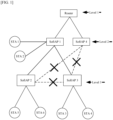
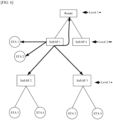
- an entire wireless mesh (Mesh) network may form a tree-structure network by using this limitation.
- the router belongs to the level 1 (level 1)
- the AP 1 belongs to the level 2 (level 2)
- the AP 2 and the AP 3 belong to the level 3 (level 3).
- FIG. 1 is merely an example, and does not constitute a limitation on a network architecture of a wireless local area network applicable to this application.
- the network architecture may further include more routers, each router is downlink associated with more SoftAPs, and each SoftAP is downlink associated with more STAs; or some network architectures may alternatively not include a STA or the like. This is not limited in embodiments of this application.
- S201 The sending device sends M first identifiers to M receiving devices in N receiving devices.
- the sending device is connected to the N receiving devices, and there is no connection relationship between the N receiving devices.
- the sending device sends, to the M receiving devices, the first identifiers corresponding to the M receiving devices.
- M is an integer less than or equal to N.
- the first identifier is a unique identifier used when the sending device performs data transmission with the receiving device.
- the first identifier is an association identifier (association identifier, AID) code.
- association identifier association identifier, AID
- Demodulation is not required at a physical layer by using the AID code, thereby improving data transmission efficiency.
- the sending device performs data transmission with the M receiving devices through a data frame.
- the sending device when the sending device performs downlink data transmission with the M receiving devices, the sending device sends, through the data frame, downlink data to the M receiving devices; or when the sending device performs uplink data transmission with the M receiving devices, the sending device receives, through the data frame, uplink data sent by the M receiving devices.
- the data frame is a frequency division multiplexing data frame.
- a frame format of the data frame in this embodiment of this application includes but is not limited to an orthogonal frequency division multiple access OFDMA frame format and a frame format combining OFDMA and multi-user multiple-input multiple-output MUMIMO.
- a network throughput can be improved through the data frame in the frequency division multiplexing frame format.
- the sending device allocates the first identifiers to the receiving devices. This can ensure that the first identifiers of all devices in a system do not conflict with each other.
- devices are single-entity nodes, each device corresponds to only one identifier used for data transmission, and a plurality of sets of MAC addresses and transceivers are not required, thereby improving forwarding efficiency.
- bidirectional data transmission from the sending device to the receiving devices can be implemented based on the data frame. Therefore, the network throughput and a system capacity can be improved.
- the method further includes an access process and an identity authentication process that are of the M receiving devices, and specifically includes the following plurality of steps.
- S203 The sending device sends a second identifier to the M receiving devices.
- the second identifier is an identifier corresponding to the sending device. That is, when sending uplink data to the receiving device, the M receiving devices determine the sending device based on the second identifier. After receiving the second identifier corresponding to the sending device, the M receiving devices may determine a connected sending device based on the second identifier.
- the second identifier is sent by the sending device by sending a beacon (beacon) broadcast management frame, that is, the beacon broadcast management frame sent by the sending device includes the second identifier.
- S204 The M receiving devices send an access request to the sending device.
- the M receiving devices send a probe request frame to the sending device, to send the access request.
- S205 The sending device sends an access response to the M receiving devices.
- the sending device sends the access response to the M receiving devices, to respond to the access request of the M receiving devices.
- S206 The sending device sends an authentication request to the M receiving devices.
- the sending device requests to perform identity authentication (authentication) on the M receiving devices.
- S207 The M receiving devices send an authentication acknowledgment to the sending device.
- the M receiving devices respond to an identity authentication request of the sending device.
- S208 The M receiving devices send a first identifier allocation request to the sending device.
- the M receiving devices each send the first identifier allocation request to the sending device, where M first identifier allocation requests are used to separately request the first identifiers corresponding to the receiving devices from the sending device.
- the sending device allocates the M first identifiers to the M receiving devices.
- the sending device may randomly generate M different first identifiers, for example, AID codes, and send M AID codes to the receiving devices.
- the sending device sends a correspondence between the M receiving devices and the M identifiers to each of the M receiving devices.
- the correspondence may be in a form of, for example, a table. This is not limited in this application.
- the sending device sends the M identifiers to the receiving devices, and sends a correspondence between a receiving device and a first identifier corresponding to the receiving device.
- S203 to S207 are merely used as possible manners for brief description. For specific detailed descriptions, refer to a Wi-Fi authentication process in a related protocol. Details are not described herein.
- S210 The M receiving devices report M MAC addresses to the sending device.
- FIG. 3 is a first diagram of network association according to an embodiment of this application.
- a router performs data transmission with an AP 1, the router needs to allocate an AID to the AP 1, and when data is to be sent, the AID is used for user matching.
- a sending device is the router
- a receiving device is the AP 1.
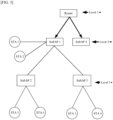
- FIG. 4 is a second diagram of network association according to an embodiment of this application.
- an AP 1 is associated with an AP 2 and an AP 3, and is also associated with a STA 1 and a STA 2.
- the AP 1 may send an AID code of the AP 1 to at least one of the AP 2, the AP 3, the STA 1, and the STA 2 through a beacon management frame, and allocate an AID code to at least one of the AP 2, the AP 3, the STA 1, and the STA 2.
- the AID code When obtaining the AID code, at least one of the AP 2, the AP 3, the STA 1, and the STA 2 may communicate with the AP 1 based on the obtained corresponding AID code.
- AID codes of the AP 2, the AP 3, the STA 1, and the STA 2 are allocated by the AP 1. Therefore, a case in which the AIDs of the STA 1, the STA 2, the AP 2, and the AP 3 conflict with each other does not occur.
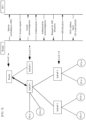
- FIG. 5 is a first diagram of a structure of data communication according to an embodiment of this application.
- an AP in a mesh network may send an orthogonal frequency division multiple access frame, and may also receive an OFDMA frame. That is, as shown in FIG. 5 , when a router needs to send data to an AP 1 and an AP 4, the router may send the data to both the AP 1 and the AP 4 through an OFDMA frame.
- FIG. 6 is a second diagram of a structure of data communication according to an embodiment of this application.
- the AP 1 may simultaneously send the data to an upper-level AP (namely, a router), a STA (including at least one of a STA 1 and a STA 2) associated with the AP 1, and a lower-level AP (namely, at least one of an AP 2 and an AP 3) through an OFDMA frame.
- the AP 1 may backhaul the buffered data that is to be sent to the router through the OFDMA frame.
- the AP 1 may forward, to the STA 1 and/or the STA 2, data that is to be sent to the STA 1 and/or the STA 2 by the router. Similarly, the AP 1 may forward, to the AP 2 and/or the AP 3, data that is to be sent to the AP 2 and/or the AP 3 by the router at the same time.
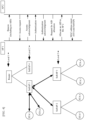
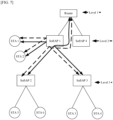
- FIG. 7 is a third diagram of a structure of data communication according to an embodiment of this application.
- the AP 1 may not be limited to a case in which a single transmission frequency is used shown in FIG. 6 , and may use a multi-connection technology, for example, send data through an OFDMA frame in both a 2.4 GHz band and a 5 GHz band. Data on the two frequencies may be associated or independent. If the data is independent data, data concatenation may be implemented at a higher layer by a receive end, to implement the multi-connection technology and improve data reliability and a throughput.
- FIG. 8 is a block diagram of a communication apparatus 1000 according to this application.
- the communication apparatus 1000 includes a receiving unit 1100, a processing unit 1200, and a sending unit 1300.
- the receiving unit 1100, the processing unit 1200, and the sending unit 1300 may also be respectively referred to as a receiving module 1100, a processing module 1200, and a sending module 1300.
- the units/modules in the communication apparatus are configured to perform corresponding steps in the method in the method embodiments of this application.
- a function of the processing unit 1200 may be implemented by using hardware, or may be implemented by executing corresponding software by hardware.
- the processing unit may include a memory and a processor.
- the memory is configured to store a computer program, and the processor reads and executes the computer program stored in the memory, to enable the communication apparatus 1000 to perform operations and/or processing performed by the sending device in the method embodiments.
- the processing apparatus may include only the processor, and the memory configured to store the computer program is located outside the processing apparatus.
- the processor is connected to the memory via a circuit/wire, to read and execute the computer program stored in the memory.
- the processing apparatus may be a chip or an integrated circuit.
- the sending unit 1300 and the receiving unit 1100 each may be a communication interface or an interface circuit.
- the sending unit 1300 is an output interface or an output circuit
- the receiving unit 1100 is an input interface or an input circuit.
- the processing unit 1200 may be a processor or a microprocessor integrated on the chip or the integrated circuit. This is not limited herein.
- the apparatus 1000 may be configured to perform actions performed by the sending device or the receiving device in the foregoing method embodiments.
- the apparatus 1000 may be a component of the sending device or the receiving device
- the receiving unit 1100 is configured to perform receiving-related operations of the sending device or the receiving device in the foregoing method embodiments
- the processing unit 1200 is configured to perform processing-related operations of the sending device or the receiving device in the foregoing method embodiments
- the sending unit 1300 is configured to perform sending-related operations of the sending device or the receiving device in the foregoing method embodiments.
- the apparatus 1000 is configured to perform actions performed by any device in the foregoing method embodiments.
- the communication apparatus may be configured to perform operations of the sending device in FIG. 2 .
- An example is as follows:
- the sending unit 1300 is configured to send M first identifiers to M receiving devices in N receiving devices, where the M first identifiers one-to-one correspond to the M receiving devices, the M first identifiers identify the M receiving devices, the N receiving devices include the M receiving devices, N is an integer greater than or equal to 1, and M is a positive integer less than or equal to N, and the sending unit 1300 is further configured to: when the apparatus 1000 transmits downlink data to the M receiving devices, send the downlink data to the M receiving devices.
- the receiving unit 1100 is configured to: when the apparatus 1000 transmits uplink data to the M receiving devices, receive the uplink data sent by the M receiving devices.
- the processing module 1200 is configured to allocate, to each of the M receiving devices, the first identifier corresponding to the receiving device.
- the receiving unit 1100, the processing unit 1200, and the sending unit 1300 in the communication apparatus 1000 may further implement other operations or functions of the sending device in the foregoing method. Details are not described herein again.
- the communication apparatus 1000 may be configured to perform operations of the receiving device in FIG. 2 .
- An example is as follows:
- the receiving module 1100 is configured to receive a first identifier from a sending device, where the first identifier corresponds to the communication apparatus 1000, and the first identifier identifies the communication apparatus 1000, and the receiving module 1100 is further configured to: when the apparatus 1000 transmits downlink data to the sending device, receive the downlink data sent by the sending device.
- the sending unit 1300 is further configured to: when the apparatus 1000 transmits uplink data to the sending device, send the uplink data to the sending device.
- the receiving unit 1100, the processing unit 1200, and the sending unit 1300 in the data transmission apparatus may further implement other operations or functions of the network device in the foregoing method. Details are not described herein again.
- FIG. 9 is a diagram of a structure of a communication apparatus 10 according to this application.
- the apparatus 10 includes a processor 11, the processor 11 is coupled to a memory 12, the memory 12 is configured to store a computer program or instructions and/or data, and the processor 11 is configured to: execute the computer program or the instructions stored in the memory 12, or read the data stored in the memory 12, to perform the method in the foregoing method embodiments.
- processors 11 there are one or more processors 11.
- the memory 12 and the processor 11 are integrated together or separately disposed.
- the apparatus 10 further includes a transceiver 13, and the transceiver 13 is configured to receive and/or send a signal.
- the processor 11 is configured to control the transceiver 13 to receive and/or send the signal.
- this application further provides a computer-readable storage medium.
- the computer-readable storage medium stores computer instructions. When the computer instructions are run on a computer, the method in the method embodiments of this application is performed.
- the application further provides a computer program product.
- the computer program product includes computer program code or instructions. When the computer program code or the instructions are run on a computer, the method in the method embodiments of this application is performed.
- the chip may further include a communication interface.
- the communication interface may be an input/output interface, an interface circuit, or the like.
- the chip may further include the memory.
- the general-purpose processor may be a microprocessor, or the processor may be any conventional processor or the like.
- the steps of the method disclosed in embodiments of this application may be directly presented as being performed and completed by a hardware encoding processor, or performed and completed by a combination of hardware and a software module in an encoding processor.
- the software module may be located in a mature storage medium in the art, such as a random access memory, a flash memory, a read-only memory, a programmable read-only memory, an electrically erasable programmable memory, or a register.
- the storage medium is located in the memory, and the processor reads information in the memory and completes the steps in the foregoing method in combination with hardware of the processor.
- RAMs in many forms may be used, for example, a static random access memory (static RAM, SRAM), a dynamic random access memory (dynamic RAM, DRAM), a synchronous dynamic random access memory (synchronous DRAM, SDRAM), a double data rate synchronous dynamic random access memory (double data rate SDRAM, DDR SDRAM), an enhanced synchronous dynamic random access memory (enhanced SDRAM, ESDRAM), a synchlink dynamic random access memory (synchlink DRAM, SLDRAM), and a direct rambus random access memory (direct rambus RAM, DRRAM).
- static random access memory static random access memory
- DRAM dynamic random access memory
- DRAM dynamic random access memory
- SDRAM synchronous dynamic random access memory
- double data rate SDRAM double data rate SDRAM
- DDR SDRAM double data rate SDRAM
- ESDRAM enhanced synchronous dynamic random access memory
- synchlink dynamic random access memory synchlink dynamic random access memory
- direct rambus RAM direct rambus RAM
- the processor is a general-purpose processor, a DSP, an ASIC, an FPGA or another programmable logic device, a discrete gate or a transistor logic device, or a discrete hardware component
- the memory storage module
- the disclosed system, apparatus, and method may be implemented in other manners.
- the described apparatus embodiment is merely an example.
- division into the units is merely logical function division and may be other division in actual implementation.
- a plurality of units or components may be combined or integrated into another system, or some features may be ignored or not performed.
- the displayed or discussed mutual couplings or direct couplings or communication connections may be implemented by using some interfaces.
- the indirect couplings or communication connections between the apparatuses or units may be implemented in electronic, mechanical, or other forms.
- the units described as separate parts may or may not be physically separate, and parts displayed as units may or may not be physical units, may be located in one location, or may be distributed on a plurality of network units. Some or all of the units may be selected based on actual requirements to achieve the objectives of the solutions of embodiments.
- the functions When the functions are implemented in the form of a software functional unit and sold or used as an independent product, the functions may be stored in a computer-readable storage medium. Based on such an understanding, the technical solutions of this application essentially, or the part contributing to the conventional technology, or some of the technical solutions may be implemented in a form of a software product.
- the computer software product is stored in a storage medium, and includes several instructions for instructing a computer device (which may be a personal computer, a server, or a network device) to perform all or some of the steps of the method described in embodiments of this application.
- the foregoing storage medium includes any medium that can store program code, such as a USB flash drive, a removable hard disk, a ROM, a RAM, a magnetic disk, or an optical disc.
Landscapes
- Engineering & Computer Science (AREA)
- Signal Processing (AREA)
- Computer Networks & Wireless Communication (AREA)
- Computer Security & Cryptography (AREA)
- Multimedia (AREA)
- Databases & Information Systems (AREA)
- Mobile Radio Communication Systems (AREA)
Applications Claiming Priority (3)
| Application Number | Priority Date | Filing Date | Title |
|---|---|---|---|
| CN202210799533 | 2022-07-08 | ||
| CN202211186639.4A CN117376845A (zh) | 2022-07-08 | 2022-09-27 | 一种通信的方法、设备和系统 |
| PCT/CN2023/103600 WO2024007930A1 (fr) | 2022-07-08 | 2023-06-29 | Procédé et dispositif de communication, et système |
Publications (2)
| Publication Number | Publication Date |
|---|---|
| EP4529236A1 true EP4529236A1 (fr) | 2025-03-26 |
| EP4529236A4 EP4529236A4 (fr) | 2025-09-10 |
Family
ID=89389879
Family Applications (1)
| Application Number | Title | Priority Date | Filing Date |
|---|---|---|---|
| EP23834698.5A Pending EP4529236A4 (fr) | 2022-07-08 | 2023-06-29 | Procédé et dispositif de communication, et système |
Country Status (4)
| Country | Link |
|---|---|
| US (1) | US20250159746A1 (fr) |
| EP (1) | EP4529236A4 (fr) |
| CN (1) | CN117376845A (fr) |
| WO (1) | WO2024007930A1 (fr) |
Family Cites Families (8)
| Publication number | Priority date | Publication date | Assignee | Title |
|---|---|---|---|---|
| CN113452493A (zh) * | 2015-05-15 | 2021-09-28 | 韦勒斯标准与技术协会公司 | 用于多用户上行链路传输的无线通信终端和无线通信方法 |
| US10091778B2 (en) * | 2016-04-14 | 2018-10-02 | Qualcomm Incorporated | Random access resource unit allocation for a multiple BSSID network |
| GB2561616A (en) * | 2017-04-21 | 2018-10-24 | Canon Kk | Resource units for non-associated stations in a multi-user downlink transmission of a 802.11AX network |
| CN108810879B (zh) * | 2017-04-28 | 2023-04-07 | 中兴通讯股份有限公司 | 一种无线帧传输的方法及装置 |
| US10641887B1 (en) * | 2017-05-23 | 2020-05-05 | Nxp Usa, Inc. | Null data packet (NDP) ranging with unassociated stations |
| CN118612877A (zh) * | 2018-05-23 | 2024-09-06 | 华为技术有限公司 | 基于多接入点ap协作的空间复用的方法和装置 |
| DE102020134928A1 (de) * | 2020-03-05 | 2021-09-09 | Danny Alexander | Kompatibilität der blockquittierung von multistations-geräten |
| CN111741459B (zh) * | 2020-08-03 | 2020-12-01 | 成都极米科技股份有限公司 | 多链路终端及其地址分配的方法、网络接入设备及介质 |
-
2022
- 2022-09-27 CN CN202211186639.4A patent/CN117376845A/zh active Pending
-
2023
- 2023-06-29 WO PCT/CN2023/103600 patent/WO2024007930A1/fr not_active Ceased
- 2023-06-29 EP EP23834698.5A patent/EP4529236A4/fr active Pending
-
2025
- 2025-01-07 US US19/011,998 patent/US20250159746A1/en active Pending
Also Published As
| Publication number | Publication date |
|---|---|
| WO2024007930A1 (fr) | 2024-01-11 |
| EP4529236A4 (fr) | 2025-09-10 |
| US20250159746A1 (en) | 2025-05-15 |
| CN117376845A (zh) | 2024-01-09 |
Similar Documents
| Publication | Publication Date | Title |
|---|---|---|
| US11510264B2 (en) | System and method for network access using a relay | |
| US11824626B2 (en) | Method for separating physical layer functions in wireless communication system | |
| WO2023134678A1 (fr) | Procédé de communication et appareil de communication | |
| CN113508639B (zh) | 一种用于中继通信的方法和装置 | |
| US12256391B2 (en) | Communication method and apparatus | |
| JP7713073B2 (ja) | データ送信方法、通信装置、コンピュータ可読記憶媒体、およびチップ | |
| US12464396B2 (en) | Channel sounding method and communication apparatus | |
| CN115484133A (zh) | 一种指示解调参考信号的方法和装置 | |
| WO2023090820A1 (fr) | Procédé et appareil d'authentification d'ue pour mise à disposition à distance | |
| WO2023124718A1 (fr) | Procédé et appareil de communication | |
| CN106879070A (zh) | 一种无线局域网中触发帧的传输方法及装置 | |
| WO2023051711A1 (fr) | Procédé d'envoi de préambule d'accès aléatoire, procédé de réception de préambule d'accès aléatoire, et appareil de communication | |
| US12414090B2 (en) | Resource indication method, resource determining method, and related apparatus | |
| CN114980074B (zh) | 基于虚拟局域网的数据通信方法、装置、设备及介质 | |
| US20250159746A1 (en) | Communication method and system, and device | |
| WO2022234665A1 (fr) | Terminal, système de communication et procédé de commande | |
| WO2022104689A1 (fr) | Procédé de transfert intercellulaire de bande passante de domaine fréquentiel cellulaire, appareil associé, et dispositif | |
| JP7842270B2 (ja) | 端末 | |
| US20260025800A1 (en) | Information transmitting method, information receiving method, repeater and network device | |
| WO2025148711A1 (fr) | Procédé de communication et appareil associé | |
| WO2024165073A1 (fr) | Procédé de communication et appareil de communication | |
| WO2025208940A1 (fr) | Procédé et appareil de communication | |
| WO2025227974A1 (fr) | Procédé et appareil de communication | |
| WO2025185403A1 (fr) | Procédé de communication et appareil associé | |
| WO2026086558A1 (fr) | Procédé et appareil de communication, support de stockage lisible par ordinateur, et produit programme |
Legal Events
| Date | Code | Title | Description |
|---|---|---|---|
| STAA | Information on the status of an ep patent application or granted ep patent |
Free format text: STATUS: THE INTERNATIONAL PUBLICATION HAS BEEN MADE |
|
| PUAI | Public reference made under article 153(3) epc to a published international application that has entered the european phase |
Free format text: ORIGINAL CODE: 0009012 |
|
| STAA | Information on the status of an ep patent application or granted ep patent |
Free format text: STATUS: REQUEST FOR EXAMINATION WAS MADE |
|
| 17P | Request for examination filed |
Effective date: 20241219 |
|
| AK | Designated contracting states |
Kind code of ref document: A1 Designated state(s): AL AT BE BG CH CY CZ DE DK EE ES FI FR GB GR HR HU IE IS IT LI LT LU LV MC ME MK MT NL NO PL PT RO RS SE SI SK SM TR |
|
| REG | Reference to a national code |
Ref country code: DE Ref legal event code: R079 Free format text: PREVIOUS MAIN CLASS: H04W0004060000 Ipc: H04W0008260000 |
|
| A4 | Supplementary search report drawn up and despatched |
Effective date: 20250811 |
|
| RIC1 | Information provided on ipc code assigned before grant |
Ipc: H04W 8/26 20090101AFI20250806BHEP Ipc: H04W 76/15 20180101ALN20250806BHEP Ipc: H04W 76/40 20180101ALN20250806BHEP Ipc: H04L 5/00 20060101ALN20250806BHEP Ipc: H04W 74/00 20090101ALN20250806BHEP Ipc: H04W 76/11 20180101ALN20250806BHEP |
|
| DAV | Request for validation of the european patent (deleted) | ||
| DAX | Request for extension of the european patent (deleted) |