EP4529266A1 - Wlan-kommunikationsverfahren, client, computervorrichtung und speichermedium - Google Patents
Wlan-kommunikationsverfahren, client, computervorrichtung und speichermedium Download PDFInfo
- Publication number
- EP4529266A1 EP4529266A1 EP22948243.5A EP22948243A EP4529266A1 EP 4529266 A1 EP4529266 A1 EP 4529266A1 EP 22948243 A EP22948243 A EP 22948243A EP 4529266 A1 EP4529266 A1 EP 4529266A1
- Authority
- EP
- European Patent Office
- Prior art keywords
- client
- time window
- function
- polling
- nav
- Prior art date
- Legal status (The legal status is an assumption and is not a legal conclusion. Google has not performed a legal analysis and makes no representation as to the accuracy of the status listed.)
- Pending
Links
Images


Classifications
-
- H—ELECTRICITY
- H04—ELECTRIC COMMUNICATION TECHNIQUE
- H04W—WIRELESS COMMUNICATION NETWORKS
- H04W84/00—Network topologies
- H04W84/02—Hierarchically pre-organised networks, e.g. paging networks, cellular networks, WLAN [Wireless Local Area Network] or WLL [Wireless Local Loop]
- H04W84/10—Small scale networks; Flat hierarchical networks
- H04W84/12—WLAN [Wireless Local Area Networks]
-
- H—ELECTRICITY
- H04—ELECTRIC COMMUNICATION TECHNIQUE
- H04W—WIRELESS COMMUNICATION NETWORKS
- H04W72/00—Local resource management
- H04W72/04—Wireless resource allocation
- H04W72/044—Wireless resource allocation based on the type of the allocated resource
- H04W72/0446—Resources in time domain, e.g. slots or frames
-
- H—ELECTRICITY
- H04—ELECTRIC COMMUNICATION TECHNIQUE
- H04W—WIRELESS COMMUNICATION NETWORKS
- H04W74/00—Wireless channel access
- H04W74/04—Scheduled access
- H04W74/06—Scheduled access using polling
Definitions
- the present disclosure generally relates to the technical field of wireless communication, in particular to a WLAN communication method, a client, a computing device and a storage medium.
- WLAN technology is essentially unsuitable for time-sensitive industrial applications, for example, random channel access of a CSMA/CA (carrier-sense multiple access with collision avoidance) mechanism.
- a WLAN device cannot send data before successfully contending for the right to channel access.
- a large number of WLAN devices present on the same channel will increase the channel access contention time, and means enormous differences in channel access latency.
- This type of random access means that WLAN technology cannot provide deterministic communication in a typically implemented form thereof.
- a present challenge is how to use and expand mainstream WLAN functions defined in the IEEE802.11 family of standards, so that industrial latency/jitter requirements are satisfied without requiring custom hardware at the chip level and/or breaking related standards.
- the 802.11 standards specify an operating mode called "PCF" (point coordination function), wherein channel access is deterministically scheduled by an access point (AP).
- PCF point coordination function
- AP access point
- this mode has not been widely adopted, and therefore cannot be supported by any relevant WLAN chipsets.
- the contention-based DCF (distributed coordination function) mode and evolved variants thereof are widely used.
- iPCF industrial point coordination function
- the scheduling mechanism of iPCF is specifically as follows:
- the present disclosure provides a WLAN communication method, and, on the basis of an existing iPCF scheduling scheme, uses an enhanced mechanism to solve the problems in the prior art.
- a WLAN communication method comprising:
- the client can execute a function during the function execution time window without missing a polling request from the access point, thereby reducing a probability of failure of data exchange between the AP and client due to other functions being executed.
- the method further comprises: after the function execution time window ends, the client entering the retention time window, and, when a moment for executing a function is reached in the retention time window, the client checking whether a priority level for the function to be executed is higher than a priority level for receiving data of the access point, and if so, then the client switching to execute the function, and if not, then delaying execution of the function to a next function execution time window.
- a Duration/ID subfield in a MAC header in the polling request message is set as a first predetermined value.
- a computer program product being tangibly stored on a computer-readable medium and comprising a computer-executable instruction, and when the computer-executable instruction is executed, it causing at least one processor to execute the above method.
- the term “comprises” and variants thereof denote open terms, meaning “including but not limited to”.
- the term “based on” means “at least partly based on”.
- the terms “one embodiment” and “an embodiment” mean “at least one embodiment”.
- the term “another embodiment” means “at least one additional embodiment”.
- the terms “first”, “second”, etc. may denote different or identical objects. Other definitions may be included below, either explicit or implicit. Unless clearly indicated in the context, the definition of a term is the same throughout the specification.
- the present disclosure provides a WLAN communication method, and, on the basis of the iPCF scheduling scheme described above, uses an enhanced mechanism to solve the above problems.
- Clear channel assessment is a mechanism for determining whether a medium (that is, a radio channel) is clear.
- CCA comprises carrier sense (CS) and energy measurement.
- the carrier sense (CS) mechanism comprises physical CS and virtual CS.
- the physical CS is provided by PHY (a physical layer), and is a direct measurement of received signal strength of a valid 802.11 symbol; if it is higher than a certain level, the medium is considered busy.
- Virtual CS is provided by MAC, and uses a network allocation vector (NAV); a Duration field is used to reserve a usage time of the medium, and the NAV is set to the reserved usage time of the medium; as long as the value of the NAV is not zero, it indicates that the medium is in a busy state, and therefore if the NAV of a client is not zero, then even if the physical CS indicates a clear medium, the client still cannot send data.
- the NAV is a symbol that indicates when a medium will become clear and stays fully updated by means of a duration value in a frame. When a client receives and does not send its own 802.11 frame, if the duration value (expressed in the Duration/ID subfield in a MAC header) is greater than the current NAV value, the NAV is updated.
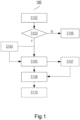
- Fig. 1 is a flowchart of an exemplary process of a WLAN communication method 100 according to an embodiment of the present disclosure.
- step S103 the client checks whether the client itself is a polled client.
- step S105 is executed; the client sends a polling response message to the access point.
- the client may determine whether it is a polled client by means of checking whether its own MAC address is the same as a receiving address in the polling request message, whereas for uplink trigger-based multi-user OFDMA transmission in 802.11ax, it is insufficient to only check the MAC address.
- the specific method for the client determining whether the client itself is a polled client is not limited to this.
- step S108 the client enters a function execution time window, and, when a moment for executing a certain function is reached in the function execution time window, this function is executed.
- the client periodically executes certain functions; in the method according to an embodiment of the present disclosure, to solve a problem of the client possibly being unable to receive a polling request from the access point or unable to send a polling response while executing these functions, three time windows are defined. Below, these three time windows are detailed with reference to Fig. 2 .
- Fig. 2 shows an access point AP, with 3 clients C1, C2 and C3 polled in succession, and the clients C1, C2 and C3 respectively send respective polling responses R1, R2 and R3.
- PC represents one polling cycle.
- Function execution time window T1 This time window immediately starts after the client sends the polling response message and continues until before a retention time window T2 starts.
- Retention time window T2 A retention time window T2 starts from a starting point of a safety time window T3 and continues until a moment after when it is expected that this client will next send a polling response message; during the retention time window T2, the client is prepared to be polled by the access point or to send a polling response message, and therefore should not execute non-time-urgent functions.
- Safety time window T3 is equivalent to an execution time of a function that is about to be executed; the purpose thereof is to ensure that there is sufficient time to complete execution of the function without missing a polling request from the access point, and therefore the safety time window T3 is defined as a period that is before a next polling cycle begins and is not less than an execution time of a function that is about to be executed. That is, the size of the safety time window T3 cannot be less than the execution time of a function that is about to be executed, and only when execution of the function starts before the safety time window can it be ensured that the executed function is completed before the next polling cycle begins.
- the method 100 further comprises: step S110, after a function execution time window ends, a client entering a retention time window, and, when a moment for executing a certain function is reached in the retention time window, the client checking whether a priority level for the function to be executed is higher than a priority level for receiving data of an access point, and if so, the client switching to execute the function; if not, then delaying execution of this function to a next execution time window, that is, this client executes the function in an execution time window of the next polling cycle.
- a function to be executed by the client may be background channel scanning or noise baseline calibration, etc.
- the functions involved in the method according to embodiments of the present disclosure can be any functions that the client needs to execute during WLAN communication, and are not limited to the two types mentioned above.
- the function executed by the client in step S110 and the function executed in step S108 may be the same, and also may be different, depending on the execution intervals and execution times, etc. for the various functions that the client needs to execute; the present method mainly solves a problem of timing of function execution, without being concerned with which type of functions are involved, which are therefore collectively called "functions" without making distinctions.
- a probability is reduced of failure of data exchange between the access point and a client due to other functions being executed.
- a Duration/ID subfield in a MAC data header in a polling request message sent by the access point is set as a first predetermined value, and this first predetermined value must be sufficiently large, for example, greater than a maximum waiting time Tmax in a polling request process or greater than a polling cycle. In this way, an uplink sending time period is "retained” for the polled client. All clients that can correctly receive a polling request and support virtual CS must respect this "retained” time period.
- the method 100 may further comprise step S104 before executing step S105: this client sets its own NAV to 0.
- the NAV is a flag bit stored locally by the client, and only when the value of the NAV is 0 can the client send a message to the access point. That is, when the client is polled, its own NAV is set to 0, hence this client can send a polling response message.
- the polled client can reduce the waiting time thereof for channel access.
- the polled client can further reconfigure a parameter of a CCA contention window thereof, so as to respond quickly.
- the polled client may perform feedback using a polling response carrying uplink data (if there is any). After another client receives this polling response message, it can also update its own NAV according to a value of the Duration/ID subfield in the polling response data.
- the polled client C3 updates its NAV to 0, and the other clients C1 and C2 update their own NAVs according to a value set in the Duration/ID subfield in the polling request message P3.
- the polling request receiving unit 402 is configured to receive a polling request message from an access point.
- the judgment unit 403 is configured to check whether the client is a polled client.
- the polling response sending unit 405 is configured to send a polling response message to the access point.
- the function execution time window starts from after the client sends the polling response message and ends before a retention time window starts,
- the functions comprise at least one of the following: background channel scanning and noise baseline calibration.
- the Duration/ID subfield in the MAC header in the polling request message is set as a first predetermined value.
- the client 400 further comprises: a NAV zeroing unit 404, which is configured to set the NAV of the client itself to 0.
- the client 400 further comprises: a NAV reset unit 407, which is configured to reset the NAV of the client itself to a second predetermined value.
- the client 400 further comprises: a NAV update unit 406, which is configured to check whether the NAV of the client itself is less than the first predetermined value, and if so, then update its own NAV according to the first predetermined value.
- a NAV update unit 406 which is configured to check whether the NAV of the client itself is less than the first predetermined value, and if so, then update its own NAV according to the first predetermined value.
- the steps of the WLAN communication method described above and the constituent modules and/or units of the clients described above may be implemented as software, firmware, hardware or a combination thereof.
- a program constituting the software for implementing the above method may be installed from a storage medium or network on a computing device that has a dedicated hardware structure, and, when installed with various programs, this computing device can execute the various functions, etc.
- Details of the operations and functions of the parts of the client 400 may be, for example, the same as or similar to the relevant parts of embodiments of the WLAN communication method of the present disclosure described with reference to Figs. 1 - 4 , and are not detailed unnecessarily here.
- a technical solution according to the present disclosure on the basis of an existing iPCF scheduling scheme, proposes a WLAN communication method.
- the technical solution of the present disclosure at least has one or more of the following technical advantages:
- the present invention is compatible with the latest WLAN standards at present (such as 802.11ax), and also does not rely on any new functions, and is therefore suitable for deployment in a conventional device or for running in a conventional mode.
- inventions of the WLAN communication method and client are further described.
- the units of the client described above may be implemented with hardware, and also may be implemented with software, or a combination of hardware and software.
- Fig. 5 shows a block diagram of a computing device 500 for implementing the WLAN communication method according to an embodiment of the present disclosure.
- the computing device 500 may comprise at least one processor 502, and the processor 502 executes at least one computer-readable instruction (that is, an element realized in the form of software described above) that is stored or encoded in a computer-readable storage medium (that is, a memory 504).
- a computer-readable storage medium that is, a memory 504
- a computer-executable instruction is stored in a memory 504, and, when executed, this computer-executable instruction enables at least one processor 502 to complete an operation executed by a data relay apparatus.
- the memory 504 may also store a computer-executable instruction that enables the processor 502 to complete an operation that is executed by a container management apparatus.
- the computer-executable instruction stored in the memory 504 causes at least one processor 502 to perform the various operations and functions described above in conjunction with Figs. 1 - 4 in the embodiments of the present disclosure.
- a non-transitory machine-readable medium may be provided with a machine-readable instruction (that is, an element realized in the form of software described above), and, when this instruction is executed by a machine, it causes the machine to execute the various operations and functions described above in conjunction with Figs. 1 - 4 in the embodiments of the present disclosure.
- a machine-readable instruction that is, an element realized in the form of software described above
- a computer program comprising a computer-executable instruction, and, when the computer-executable instruction is executed, it causes at least one processor to execute the various operations and functions described above in conjunction with Figs. 1 - 4 in the embodiments of the present disclosure.
- a computer program product comprising a computer-executable instruction, and, when the computer-executable instruction is executed, it causes at least one processor to execute the various operations and functions described above in conjunction with Figs. 1 - 6 in the embodiments of the present disclosure.
Landscapes
- Engineering & Computer Science (AREA)
- Computer Networks & Wireless Communication (AREA)
- Signal Processing (AREA)
- Mobile Radio Communication Systems (AREA)
- Small-Scale Networks (AREA)
Applications Claiming Priority (1)
| Application Number | Priority Date | Filing Date | Title |
|---|---|---|---|
| PCT/CN2022/101660 WO2024000119A1 (zh) | 2022-06-27 | 2022-06-27 | Wlan通信方法、客户端、计算设备和存储介质 |
Publications (2)
| Publication Number | Publication Date |
|---|---|
| EP4529266A1 true EP4529266A1 (de) | 2025-03-26 |
| EP4529266A4 EP4529266A4 (de) | 2025-12-03 |
Family
ID=89383663
Family Applications (1)
| Application Number | Title | Priority Date | Filing Date |
|---|---|---|---|
| EP22948243.5A Pending EP4529266A4 (de) | 2022-06-27 | 2022-06-27 | Wlan-kommunikationsverfahren, client, computervorrichtung und speichermedium |
Country Status (4)
| Country | Link |
|---|---|
| US (1) | US12382492B2 (de) |
| EP (1) | EP4529266A4 (de) |
| CN (1) | CN119343952A (de) |
| WO (1) | WO2024000119A1 (de) |
Family Cites Families (10)
| Publication number | Priority date | Publication date | Assignee | Title |
|---|---|---|---|---|
| CN1462524A (zh) * | 2001-05-15 | 2003-12-17 | 皇家菲利浦电子有限公司 | 用于避免工作在混合协调功能下的ieee802.00无线局域网中冲突的重叠网络分配矢量 |
| CN101843015B (zh) | 2007-08-31 | 2017-05-17 | 汤姆森特许公司 | 以多种模式进行通信的方法及装置 |
| CN102484607B (zh) * | 2009-09-29 | 2014-10-29 | 西门子公司 | 一种profinet通信系统中的通信方法 |
| CN102427588B (zh) | 2011-11-14 | 2014-05-28 | 工业和信息化部电信传输研究所 | 一种避免802.11轮询式数据传输过程中网络拥塞的方法 |
| AU2012337487B2 (en) * | 2011-11-17 | 2015-09-03 | Lg Electronics Inc. | Methods of transmitting and receiving frame by station operating in power save mode in wireless LAN system and apparatus for supporting same |
| CN108632108B (zh) | 2018-01-11 | 2020-07-28 | 西门子电力自动化有限公司 | 基于轮询协议的监控方法、装置与及可读存储介质 |
| US11632797B2 (en) * | 2018-07-26 | 2023-04-18 | Lg Electronics Inc. | Method and apparatus for receiving UL data in wireless LAN system |
| WO2020192908A1 (de) | 2019-03-27 | 2020-10-01 | Siemens Aktiengesellschaft | Datenkommunikationsverfahren in einem industriellen netzwerk sowie zugangspunkt und zugangspunkt-client |
| JP7327785B2 (ja) * | 2019-07-11 | 2023-08-16 | 国立大学法人九州工業大学 | 通信システム、遠隔制御機械システム及び通信方法 |
| CN111669838B (zh) | 2020-05-27 | 2022-07-29 | 西安空间无线电技术研究所 | 一种适用于星地wi-fi网络的pcf接入方法及装置 |
-
2022
- 2022-06-27 EP EP22948243.5A patent/EP4529266A4/de active Pending
- 2022-06-27 US US18/879,120 patent/US12382492B2/en active Active
- 2022-06-27 WO PCT/CN2022/101660 patent/WO2024000119A1/zh not_active Ceased
- 2022-06-27 CN CN202280096991.0A patent/CN119343952A/zh active Pending
Also Published As
| Publication number | Publication date |
|---|---|
| US12382492B2 (en) | 2025-08-05 |
| WO2024000119A1 (zh) | 2024-01-04 |
| US20250168873A1 (en) | 2025-05-22 |
| CN119343952A (zh) | 2025-01-21 |
| EP4529266A4 (de) | 2025-12-03 |
Similar Documents
| Publication | Publication Date | Title |
|---|---|---|
| AU2021323751B2 (en) | Channel access method and communication device | |
| JP7532648B2 (ja) | チャネル競合方法及び関連機器 | |
| US11317439B2 (en) | Access method and apparatus | |
| US10506637B2 (en) | Method and apparatus for setting network allocation vector of multi-user transmission | |
| US10028306B2 (en) | Method and device for data communication in a network | |
| EP2961218A1 (de) | Verfahren und vorrichtung zur ressourcenreservierung | |
| US20110058493A1 (en) | Differentiating wireless uplink bandwidth request by connection priority | |
| EP3089541A1 (de) | Kanalressourcenzuweisungsverfahren und kommunikationsvorrichtung | |
| EP3316631B1 (de) | Verfahren und vorrichtung für kompetitive übertragung | |
| Costa et al. | Limitations of the IEEE 802.11 DCF, PCF, EDCA and HCCA to handle real-time traffic | |
| EP4586681A1 (de) | Datenübertragungsverfahren und -vorrichtung | |
| GB2555143A (en) | QoS management for multi-user EDCA transmission mode in wireless networks | |
| EP3079432B1 (de) | Kanalreservierungsverfahren und kommunikationsvorrichtung | |
| EP4529266A1 (de) | Wlan-kommunikationsverfahren, client, computervorrichtung und speichermedium | |
| WO2024055852A1 (zh) | 一种数据传输方法和装置 | |
| Cena et al. | A fixed-priority access scheme for industrial Wi-Fi networks | |
| US20260122670A1 (en) | Controlling access to a radio network | |
| KR100799584B1 (ko) | 무선랜 환경에서의 매체접속 방법 | |
| BR122024015430A2 (pt) | Método de acesso ao canal, aparelho de comunicação, chip e meio de armazenamento legível por computador | |
| CN117202393A (zh) | 处理实时数据传输的装置及方法 | |
| GB2508835A (en) | Implementing appropriate management method for wireless nodes based on comparison of predetermined time of received message with actual time | |
| CN111182642A (zh) | 一种非周期间断性业务的调度方法、装置及设备 |
Legal Events
| Date | Code | Title | Description |
|---|---|---|---|
| STAA | Information on the status of an ep patent application or granted ep patent |
Free format text: STATUS: THE INTERNATIONAL PUBLICATION HAS BEEN MADE |
|
| PUAI | Public reference made under article 153(3) epc to a published international application that has entered the european phase |
Free format text: ORIGINAL CODE: 0009012 |
|
| STAA | Information on the status of an ep patent application or granted ep patent |
Free format text: STATUS: REQUEST FOR EXAMINATION WAS MADE |
|
| 17P | Request for examination filed |
Effective date: 20241220 |
|
| AK | Designated contracting states |
Kind code of ref document: A1 Designated state(s): AL AT BE BG CH CY CZ DE DK EE ES FI FR GB GR HR HU IE IS IT LI LT LU LV MC MK MT NL NO PL PT RO RS SE SI SK SM TR |
|
| DAV | Request for validation of the european patent (deleted) | ||
| DAX | Request for extension of the european patent (deleted) | ||
| A4 | Supplementary search report drawn up and despatched |
Effective date: 20251030 |
|
| RIC1 | Information provided on ipc code assigned before grant |
Ipc: H04W 28/08 20230101AFI20251024BHEP Ipc: H04J 3/00 20060101ALI20251024BHEP |