EP4529331A1 - Procédé et système de suppression d'interférence, et terminal et station de base - Google Patents
Procédé et système de suppression d'interférence, et terminal et station de base Download PDFInfo
- Publication number
- EP4529331A1 EP4529331A1 EP23856161.7A EP23856161A EP4529331A1 EP 4529331 A1 EP4529331 A1 EP 4529331A1 EP 23856161 A EP23856161 A EP 23856161A EP 4529331 A1 EP4529331 A1 EP 4529331A1
- Authority
- EP
- European Patent Office
- Prior art keywords
- crs
- mode
- information
- interference mitigation
- cell
- Prior art date
- Legal status (The legal status is an assumption and is not a legal conclusion. Google has not performed a legal analysis and makes no representation as to the accuracy of the status listed.)
- Pending
Links
Images


Classifications
-
- H—ELECTRICITY
- H04—ELECTRIC COMMUNICATION TECHNIQUE
- H04W—WIRELESS COMMUNICATION NETWORKS
- H04W72/00—Local resource management
- H04W72/50—Allocation or scheduling criteria for wireless resources
- H04W72/54—Allocation or scheduling criteria for wireless resources based on quality criteria
- H04W72/541—Allocation or scheduling criteria for wireless resources based on quality criteria using the level of interference
-
- H—ELECTRICITY
- H04—ELECTRIC COMMUNICATION TECHNIQUE
- H04J—MULTIPLEX COMMUNICATION
- H04J11/00—Orthogonal multiplex systems, e.g. using WALSH codes
- H04J11/0023—Interference mitigation or co-ordination
- H04J11/005—Interference mitigation or co-ordination of intercell interference
-
- H—ELECTRICITY
- H04—ELECTRIC COMMUNICATION TECHNIQUE
- H04L—TRANSMISSION OF DIGITAL INFORMATION, e.g. TELEGRAPHIC COMMUNICATION
- H04L5/00—Arrangements affording multiple use of the transmission path
- H04L5/003—Arrangements for allocating sub-channels of the transmission path
- H04L5/0048—Allocation of pilot signals, i.e. of signals known to the receiver
-
- H—ELECTRICITY
- H04—ELECTRIC COMMUNICATION TECHNIQUE
- H04L—TRANSMISSION OF DIGITAL INFORMATION, e.g. TELEGRAPHIC COMMUNICATION
- H04L5/00—Arrangements affording multiple use of the transmission path
- H04L5/003—Arrangements for allocating sub-channels of the transmission path
- H04L5/0058—Allocation criteria
- H04L5/0073—Allocation arrangements that take into account other cell interferences
-
- H—ELECTRICITY
- H04—ELECTRIC COMMUNICATION TECHNIQUE
- H04W—WIRELESS COMMUNICATION NETWORKS
- H04W72/00—Local resource management
- H04W72/04—Wireless resource allocation
- H04W72/044—Wireless resource allocation based on the type of the allocated resource
- H04W72/0453—Resources in frequency domain, e.g. a carrier in FDMA
-
- H—ELECTRICITY
- H04—ELECTRIC COMMUNICATION TECHNIQUE
- H04W—WIRELESS COMMUNICATION NETWORKS
- H04W72/00—Local resource management
- H04W72/30—Resource management for broadcast services
-
- H—ELECTRICITY
- H04—ELECTRIC COMMUNICATION TECHNIQUE
- H04W—WIRELESS COMMUNICATION NETWORKS
- H04W72/00—Local resource management
- H04W72/50—Allocation or scheduling criteria for wireless resources
- H04W72/51—Allocation or scheduling criteria for wireless resources based on terminal or device properties
-
- H—ELECTRICITY
- H04—ELECTRIC COMMUNICATION TECHNIQUE
- H04W—WIRELESS COMMUNICATION NETWORKS
- H04W76/00—Connection management
- H04W76/20—Manipulation of established connections
Definitions
- the present disclosure relates to a technical field of communication technology, and in particular to an interference mitigation method and system, and a terminal, and a base station.
- DSS Dynamic Spectrum Sharing
- an interference mitigation method which is executed by a terminal, and comprises: reporting capability information of Cell-specific Reference Signal (CRS) interference mitigation to a base station, wherein the capability information of the CRS interference mitigation is used to indicate whether the terminal in a cell of a first mode supports the CRS interference mitigation of a neighbor cell of a second mode in a scenario with overlapping spectrum for the first mode and the second mode; receiving neighbor cell CRS assist information sent from the base station, wherein the neighbor cell CRS assist information comprises CRS related information of one or more neighbor cells of the second mode; and performing interference mitigation according to the neighbor cell CRS assist information.
- CRS Cell-specific Reference Signal
- the CRS related information of each of the one or more neighbor cells of the second mode comprises at least one of first indication information or a frequency domain deviation value
- the first indication information is used to indicate whether overlapped spectrums of the each of the one or more neighbor cells of the second mode and the cell of the first mode are aligned in frequency domain
- the frequency domain deviation value is the frequency domain deviation value of the overlapped spectrums of the each of the one or more neighbor cells of the second mode and the cell of the first mode.
- the CRS related information of each of the multiple neighbor cells of the second mode comprises a physical cell identifier of the each of the multiple neighbor cells of the second mode.
- the method further comprises: receiving second mode CRS pattern information sent from the base station, wherein the second mode CRS pattern information comprises configuration information of one or more CRSs corresponding to one or more cells of the second mode.
- the CRS related information of each of the one or more neighbor cells of the second mode comprises third indication information, used to indicate whether the CRS related information of the each of the one or more neighbor cells of the second mode meets default network configuration information; or the neighbor cell CRS assist information further comprises fourth indication information, used to indicate whether the CRS related information of the one or more neighbor cells of the second mode meets the default configuration information configured by the network.
- the third indication information indicates that the CRS related information of the each of the one or more neighbor cells of the second mode does not meet the default configuration information configured by the network
- the fourth indication information indicates that the CRS related information of the one or more neighbor cells of the second mode does not meet the default configuration information configured by the network
- the third indication information or the fourth indication information is also used to implicitly indicate the terminal to disable interference mitigation operation to the CRS of the one or more neighbor cells of the second mode.
- the performing interference mitigation according to the neighbor cell CRS assist information comprises: the terminal enables interference mitigation operation to the CRS of the one or more neighbor cells of the second mode according to the neighbor cell CRS assist information to perform interference detection and interference mitigation, wherein the neighbor cell CRS assist information or a CRS rate match signaling of the second mode implicitly indicates the terminal to enable the interference mitigation operation to the CRS of the one or more neighbor cells of the second mode.
- the method further comprises: receiving fifth indication information sent from the base station, wherein the fifth indication information is used to indicate the terminal to enable the interference mitigation operation to the CRS of the one or more neighbor cells of the second mode.
- e indication information is carried by a radio resource control (RRC) signaling.
- RRC radio resource control
- the method further comprises: receiving release information of the neighbor cell CRS assist information sent from the base station; and deleting the stored neighbor cell CRS assist information according to the release information of the neighbor cell CRS assist information.
- the neighbor cell CRS assist information is carried by a radio resource control (RRC) signaling.
- RRC radio resource control
- the CRS related information of each of the multiple neighbor cells of the second mode comprises: a physical cell identifier or a remainder of the physical cell identifier modulo 6 of the each of the multiple neighbor cells of the second mode.
- an interference mitigation method is provided, which is executed by a base station, and comprises: receiving capability information of Cell-specific Reference Signal (CRS) interference mitigation reported by a terminal, wherein the capability information of the CRS interference mitigation is used to indicate whether the terminal in a cell of a first mode supports the CRS interference mitigation of a neighbor cell of a second mode in a scenario with overlapping spectrum for the first mode and the second mode; and sending neighbor cell CRS assist information to the terminal, wherein the neighbor cell CRS assist information comprises CRS related information of one or more neighbor cells of the second mode, for assisting the terminal to perform interference mitigation on a CRS(s) of the one or more neighbor cells of the second mode.
- CRS Cell-specific Reference Signal
- the CRS related information of each of the one or more neighbor cells of the second mode comprises at least one of first indication information or a frequency domain deviation value
- the first indication information is used to indicate whether overlapped spectrums of the each of the one or more neighbor cells of the second mode and the cell of the first mode are aligned in frequency domain
- the frequency domain deviation value is the frequency domain deviation value of the overlapped spectrums of the each of the one or more neighbor cells of the second mode and the cell of the first mode.
- the method further comprises: sending second mode CRS pattern information to the terminal, wherein the second mode CRS pattern information comprises configuration information of one or more CRSs corresponding to one or more cells of the second mode.
- configuration information of a CRS corresponding to each cell of the second mode comprises a downlink carrier frequency, a downlink carrier bandwidth, a number of CRS ports and a remainder of a physical cell identifier modulo 6 of the each cell of the second mode
- configuration information of a CRS corresponding to each cell of the second mode comprises a downlink carrier frequency, a downlink carrier bandwidth, a multicast broadcast single frequency network (MBSFN) subframe configuration, a number of CRS ports and a remainder of a physical cell identifier modulo 6 of the each cell of the second mode
- the CRS related information of each of the one or more neighbor cells of the second mode comprises third indication information, used to indicate whether a group of related information of the CRS of the each of the one or more neighbor cells of the second mode meets default network configuration information; or the neighbor cell CRS assist information further comprises fourth indication information, used to indicate whether one or more groups of related information of the CRS(s) of the one or more neighbor cells of the second mode meets the default configuration information configured by the network.
- the third indication information indicates that a group of related information of the CRS of the each of the one or more neighbor cells of the second mode does not meet the default configuration information configured by the network, or the fourth indication information indicates that one or more groups of related information of the CRS(s) of the one or more neighbor cells of the second mode does not meet the default configuration information configured by the network
- the third indication information or the fourth indication information is also used to implicitly indicate the terminal to disable interference mitigation operation to the CRS of the one or more neighbor cells of the second mode.
- the method further comprises: sending fifth indication information sent from the base station, wherein the fifth indication information is used to indicate the terminal to enable the interference mitigation operation to the CRS of the one or more neighbor cells of the second mode.
- a terminal which comprises: a sending module configured to report capability information of Cell-specific Reference Signal (CRS) interference mitigation to a base station, wherein the capability information of the CRS interference mitigation is used to indicate whether the terminal in a cell of a first mode supports the CRS interference mitigation of a neighbor cell of a second mode in a scenario with overlapping spectrum for the first mode and the second mode; a receiving module configured to receive neighbor cell CRS assist information sent from the base station, wherein the neighbor cell CRS assist information comprises CRS related information of one or more neighbor cells of the second mode; and an interference mitigation module configured to perform interference mitigation according to the neighbor cell CRS assist information.
- CRS Cell-specific Reference Signal
- a base station comprising: a receiving module configured to receive capability information of Cell-specific Reference Signal (CRS) interference mitigation reported by a terminal, wherein the capability information of the CRS interference mitigation is used to indicate whether the terminal in a cell of a first mode supports the CRS interference mitigation of a neighbor cell of a second mode in a scenario with overlapping spectrum for the first mode and the second mode; and a sending module configured to send neighbor cell CRS assist information to the terminal, wherein the neighbor cell CRS assist information comprises CRS related information of one or more neighbor cells of the second mode, for assisting the terminal to perform interference mitigation on a CRS(s) of the one or more neighbor cells of the second mode.
- CRS Cell-specific Reference Signal
- an interference mitigation system comprising: a terminal of any of the aforesaid embodiments and a base station of any of the aforesaid embodiments.
- a communication device comprising: a processor; and a memory coupled to the processor, for storing instructions which, when executed by the processor, cause the processor to perform the interference mitigation method according to any of the aforesaid embodiments.
- a non-transitory computer-readable storage medium on which a computer program is stored, wherein the program, when executed by a processor, cause the processor to execute the interference mitigation method of any of the aforesaid embodiments.
- CRSs Cell-specific Reference Signals
- a technical problem to be solved by the present disclosure is how to improve reliability and accuracy of terminal reception in NR cells in the DSS scenario.
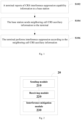
- the present disclosure provides an interference mitigation method, which will be described below with reference to Fig. 1 .
- Fig. 1 is a flowchart of the interference mitigation in some embodiments of the present disclosure. As shown in Fig. 1 , the method of the embodiments comprises: steps S102 ⁇ S106.
- step S102 a terminal reports capability information of CRS interference mitigation to a base station, and correspondingly, the base station receives the capability information of the CRS interference mitigation sent from the terminal.
- the terminal also called UE
- the base station is a base station which the cell of the first mode belongs to.
- the first mode is NR
- the second mode is LTE.
- the method of the present disclosure can also be applied to a scenario with overlapping spectrum for the first mode and the second mode which are other modes.
- the capability information of the CRS interference mitigation is used to indicate whether the terminal in a cell of a first mode supports the CRS interference mitigation of a neighbor cell of a second mode in a scenario with overlapping spectrum for the first mode and the second mode.
- the capability information of the CRS interference mitigation is supportedCRS-InterMitigation-r17, which indicates whether the terminal supports the CRS interference mitigation in a DSS scenario and a non-DSS scenario with overlapping spectrum for LTE and NR.
- the capability information of the CRS interference mitigation comprises crs-IM-DSS-15k Hz SCS-r17, which is used to indicate whether the terminal supports the CRS-IM of neighbor LTE cell in the DSS scenario of NR 15kHz SCS (Subercarrier Space).
- the base station sends capability query information to the terminal, and the terminal reports the capability information of the CRS interference mitigation to the base station.
- step S104 the base station sends neighbor cell CRS assist information to the terminal, and correspondingly, the terminal receives the neighbor cell CRS assist information sent from the base station.
- the base station can send the neighbor cell CRS assist information to the terminal in a case where the terminal supports the CRS interference mitigation of the neighbor cell of the second mode, or can send the neighbor cell CRS assist information regardless of whether the terminal supports the CRS interference mitigation of the neighbor cell of the second mode.
- the neighbor cell CRS assist information can be carried by a RRC (Radio Resource Control) signaling.
- the neighbor cell CRS assist information is used to assist the terminal to perform the CRS interference mitigation of the neighbor cell of the second mode.
- the neighbor cell CRS assist information comprises: CRS related information of one or more neighbor cells of the second mode.
- the neighbor cell CRS assist information is, for example, LTE-NeighCellsCRS-AssistInfoList IE (Information Element), which is used to provide configuration information of the LTE neighbor cell, and assist the terminal to perform interference mitigation in the scenario with overlapping spectrum for LET and NR.
- the neighbor cell CRS assist information may be a List (list) containing at most N arrays, and each array in the List indicates CRS related information of one neighbor cell which is known by the network side which may overlap in spectrum with the cell of the first mode where the terminal is located.
- the CRS related information of each of the one or more neighbor cells of the second mode comprises at least one of first indication information or a frequency domain deviation value
- the first indication information is used to indicate whether overlapped spectrums of the each of the one or more neighbor cells of the second mode and the cell of the first mode are aligned in frequency domain
- the frequency domain deviation value is the frequency domain deviation value of the overlapped spectrums of the each of the one or more neighbor cells of the second mode and the cell of the first mode.
- the first indication information is used to indicate whether frequency bands shared by NR and LTE are aligned in frequency domain and/or a frequency domain deviation value.
- the CRS related information of each of the multiple neighbor cells of the second mode comprises a physical cell identifier (PCI) of the each of the multiple neighbor cells of the second mode.
- PCI physical cell identifier
- the neighbor cell CRS assist information only comprises the CRS related information of one neighbor cell of the second mode, it may also comprise the physical cell identifier of the neighbor cell of the second mode.
- the physical cell identifier is mandatory to be comprised in the CRS related information of the each of the multiple neighbor cells of the second mode, so as to avoid that when parameters in the CRS related information of different neighbor cells of the second mode are different, it is difficult for the terminal to determine corresponding relationships between the parameters and the neighbor cells of the second mode, resulting in a failure of a interference cancellation algorithm.
- the CRS related information of the each of the multiple neighbor cells of the second mode further comprises at least one of a physical cell identifier, a remainder of the physical cell identifier modulo 6, a slot number, a duplex mode indication information, a uplink/downlink subframe ratio, a cyclic prefix type indication information, a downlink carrier frequency, a downlink carrier bandwidth, a MBSFN (multicast broadcast single frequency network) subframe configuration, a number of CRS ports, or a CRS muting indication information of the each of the one or more neighbor cells of the second mode.
- the neighbor cell CRS assist information is LTE-NeighCellsCRS-AssistInfoList, and all items of information (each of which is optional) comprised in the CRS related information of the each of the one or more neighbor cells of the second mode are described as follows:
- the base station sends second mode CRS pattern information to the terminal, and correspondingly, the terminal also receives the second mode CRS pattern information sent from the base station, wherein the second mode CRS pattern information comprises configuration information of one or more CRSs corresponding to one or more cells of the second mode.
- This step and step S104 may be in no particular order.
- the second mode CRS pattern information is, for example, RateMatchPatternLTE-CRS (LTE-CRS Rate Match Pattern), which can be sent via a R16 DSS signaling (an existing signaling of the protocol LTE-CRS-PatternList-r16 ), can be sent from the serving cell.
- RateMatchPatternLTE-CRS LTE-CRS Rate Match Pattern
- the configuration information of the CRS corresponding to the each of the one or more cells of the second mode comprises: a downlink carrier frequency, a downlink carrier bandwidth, a number of CRS ports and a remainder of physical cell identifier modulo 6 of the each of the one or more cells of the second mode; or, the configuration information of the CRS corresponding to the each of the one or more cells of the second mode comprises: a downlink carrier frequency, a downlink carrier bandwidth, a MBSFN subframe configuration, a number of CRS ports and a remainder of physical cell identifier modulo 6 of the each of the one or more cells of the second mode.
- the second mode is LTE
- all items of information comprised in the configuration information of the CRS corresponding to the each of the one or more cells of the second mode are described as follows:
- Some information in the neighbor cell CRS assist information and the second mode CRS pattern information is similar.
- one or more items of information in the CRS related information of the each of the one or more neighbor cells of the second mode can be missing, and the missing item or items of information can be determined according to the second mode CRS pattern information.
- the terminal applies a value in the downlink carrier bandwidth (which can be called carrierBandwidthDL) in the second mode CRS pattern information (for example, being RateMatchPatternLTE-CRS);
- the terminal may adopt a default network configuration for the each of the one or more neighbor cells of the second mode.
- the number of CRS ports of the each of the one or more neighbor cells of the second mode is same as the number of CRS ports (which can be called nrofCRS-Ports) in the second mode CRS pattern information (for example, being RateMatchPatternL TE-CRS); for scenario 2, the number of CRS ports of the each of the one or more neighbor cells of the second mode is 4.
- the channel bandwidth (downlink carrier bandwidth, which can be called neighCarrierBandwidthDL-r17) and the center frequency (downlink carrier frequency, which can be called neighCarrierFreqDL-r17) of the each of the one or more neighbor cells of the second mode are consistent with the downlink carrier bandwidth and the downlink carrier frequency in the second mode CRS pattern information (for example, being RateMatchPatternLTE-CRS).
- the MBSFN subframe configuration the each of the one or more neighbor cells of the second mode is consistent with the MBSFN subframe configuration in the second mode CRS pattern information (for example, being RateMatchPatternLTE-CRS), and for scenario 2, the MBSFN is not configured.
- a network-based CRS interference mitigation is not enabled in Scenario 1 and Scenario 2.
- the above scenario 1 is a DSS scenario, and the serving cell will send the second mode CRS pattern information (for example, being RateMatchPatternL TE-CRS) to the terminal, while the scenario 2 is a nonDSS scenario, and the serving cell will not send the second mode CRS pattern information (for example, being RateMatchPatternL TE-CRS) to the terminal.
- the second mode CRS pattern information for example, being RateMatchPatternL TE-CRS
- the serving cell will not send the second mode CRS pattern information (for example, being RateMatchPatternL TE-CRS) to the terminal.
- the relevant content that the one or more items of information missing from the CRS related information of the each of the one or more neighbor cells of the second mode can be determined according to the second mode CRS pattern information, and the relevant content that the terminal can adopt default network configuration for the each of the one or more neighbor cells of the second mode, both belong to the default configuration information configured by the network.
- the CRS related information of the each of the one or more neighbor cells of the second mode comprises: an index, used to identify the configuration information of a CRS corresponding to a CRS of the each of the one or more neighbor cells of the second mode; the index corresponds to an index order of configuration information of each of the multiple CRSs.
- the second mode CRS pattern information comprises configuration information of two CRSs
- the neighbor cell CRS assist information comprises the CRS related information of four neighbor cells of the second mode, so it is necessary to indicate which CRSs of the neighbor cells of the second mode correspond to the configuration information of the first CRS and which CRSs of the neighbor cells of the second mode correspond to the configuration information of the second CRS.
- the configuration information of the CRS corresponding to the each of the one or more cells of the second mode comprises: a downlink carrier frequency, a downlink carrier bandwidth, a MBSFN subframe configuration, a number of CRS ports and a remainder of physical cell identifier modulo 6 of the each of the one or more cells of the second mode
- the CRS related information of the each of the one or more neighbor cells of the second mode comprises: a downlink carrier frequency, a downlink carrier bandwidth, a MBSFN subframe configuration, a number of CRS ports and a remainder of physical cell identifier module 6 of the each of the one or more neighbor cells of the second mode.
- the CRS related information of each of the one or more neighbor cells of the second mode comprises third indication information, used to indicate whether the CRS related information of the each of the one or more neighbor cells of the second mode meets default network configuration information; or the neighbor cell CRS assist information further comprises fourth indication information, used to indicate whether the CRS related information of the one or more neighbor cells of the second mode meets the default configuration information configured by the network.
- the fourth indication information is, lte-NeighCellsCRS-Assumptions field. If this field is not configured, the default network configuration is valid for all LTE neighbor cells.
- LTE-neightcellscrs-AssistInfoList-r17 If this field is configured (that is, false) and LTE-neightcellscrs-AssistInfoList-r17 is configured, the configuration provided in LTE-neightcellscrs-AssistInfoList-r17 will overwrite the default network configuration.
- the third indication information indicates that the CRS related information of the each of the one or more neighbor cells of the second mode does not meet the default configuration information configured by the network
- the fourth indication information indicates that the CRS related information of the one or more neighbor cells of the second mode does not meet the default configuration information configured by the network
- the third indication information or the fourth indication information is also used to implicitly indicate the terminal to disable interference mitigation operation to the CRS of the one or more neighbor cells of the second mode.
- the terminal can be implicitly instructed to disable the interference mitigation operation to the CRS for neighbor cells, so as to avoid performance degradation caused by wrong assumption of the terminal (the function may also not be disabled, and the terminal will detect information of a CRS of a neighbor cell of a second mode by itself when not disabling the function).
- step S106 the terminal performs interference mitigation according to the neighbor cell CRS assist information.
- the terminal enables the interference mitigation operation to the CRS of the one or more neighbor cells of the second mode according to the neighbor cell CRS assist information, to perform interference detection and interference mitigation.
- the neighbor cell CRS assist information can implicitly instruct the terminal to enable the interference mitigation operation to the CRS of the one or more neighbor cells of the second mode, or, the CRS rate match (LTE-CRS-ToMatchAround) signaling of the second mode implicitly indicates the terminal to enable the interference mitigation operation to the CRS of the one or more neighbor cells of the second mode, or, the base station sends the fifth indication information to the terminal, and correspondingly, the terminal receives the fifth indication information sent from the base station, wherein the fifth indication information is used to indicate the terminal to enable the interference mitigation operation to the CRS of the one or more neighbor cells of the second mode.
- the CRS rate match LTE-CRS-ToMatchAround
- the fifth indication information is carried by a radio resource control (RRC) signaling.
- RRC radio resource control
- the base station can instruct the terminal to enable the CRS interference mitigation of the one or more neighbor cells of the second mode in the above manner.
- the base station can also instruct the terminal to disable the CRS interference mitigation of the one or more neighbor cells of the second mode through the fifth indication information.
- the base station also sends release information of the neighbor cell CRS assist information to the terminal, and correspondingly, the terminal receives the release information of the neighbor cell CRS assist information sent from the base station; the terminal deletes the stored neighbor cell CRS assist information according to the release information of the neighbor cell CRS assist information.
- the first mode and the second mode can be NR and LTE respectively, which are suitable for the DSS scenario, that is, the first mode and the second mode spectrums overlap.
- the terminal located within the cell of the first mode, reports to the base station whether to support the CRS interference mitigation of the one or more neighbor cells of the second mode or not, and the neighbor cell CRS assist information sent from the base station and received by the terminal comprises the CRS related information of the one or more neighbor cells of the second mode, and then the terminal performs the interference mitigation according to the neighbor cell CRS assist information, which can reduce energy consumption of the terminal in interference detection on the CRS(s) of the one or more neighbor cells of the second mode, and can improve reliability and accuracy of downlink reception or the terminal through the interference mitigation.
- the base station determines whether it is necessary to configure relevant RRC indication signaling for the terminal according to the capability of "whether to support the CRS interference mitigation of the one or more neighbor cells of the second mode" reported by the terminal and according to a deployment situation of the one or more neighbor cells of the second mode.
- the RRC indication signaling can make the terminal to enable the interference mitigation operation to the CRS of the one or more neighbor cells of the second mode when the terminal receives downlink data.
- the base station can also additionally send the neighbor cell CRS configuration information to the terminal through RRC signaling (neighbor cell CRS assist information) to assist it to perform the interference detection of the one or more neighbor cells of the second mode at a corresponding position, and then to perform interference mitigation.
- the frequency domain deviation value is sent to assist in interference cancellation.
- the present disclosure also provides a terminal, which is described below with reference to Fig. 2 .
- Fig. 2 is a structural diagram of some embodiments of a terminal of the present disclosure.
- the terminal 20 of the embodiments comprises: a sending module 210, a receiving module 220 and an interference mitigation module 230.
- the sending module 210 is configured to report capability information of Cell-specific Reference Signal (CRS) interference mitigation to a base station, wherein the capability information of the CRS interference mitigation is configured to indicate whether the terminal in a cell of a first mode supports the CRS interference mitigation of a neighbor cell of a second mode in a scenario with overlapping spectrum for the first mode and the second mode.
- CRS Cell-specific Reference Signal
- the sending module can be realized by adopting a transmitter of the terminal.
- the receiving module 220 is configured to receive neighbor cell CRS assist information sent from the base station, wherein the neighbor cell CRS assist information comprises CRS related information of one or more neighbor cells of the second mode.
- the receiving module can be realized by adopting a receiver of the terminal.
- the interference mitigation module 230 is configured to perform interference mitigation according to the neighbor cell CRS assist information.
- the interference mitigation module can be realized by adopting a controller of the terminal.
- the interference mitigation module 230 is configured to enable interference mitigation operation to the CRS of the one or more neighbor cells of the second mode according to the neighbor cell CRS assist information, and perform interference detection and interference mitigation.
- the receiving module 220 is also configured to second mode CRS pattern information sent from the base station, wherein the second mode CRS pattern information comprises configuration information of one or more CRSs corresponding to one or more cells of the second mode.
- the receiving module 220 is also configured to receive fifth indication information sent from the base station, wherein the fifth indication information is configured to indicate the terminal to enable the interference mitigation operation to the CRS of the one or more neighbor cells of the second mode.
- the receiving module 220 is also configured to receive release information of the neighbor cell CRS assist information sent from the base station; the terminal 20 further comprises a deleting module configured to delete the stored neighbor cell CRS assist information according to the release information of the neighbor cell CRS assist information.
- the present disclosure also provides a base station, which is described below with reference to Fig. 3 .
- Fig. 3 is a structural diagram of some embodiments of the base station of the present disclosure. As shown in Fig. 3 , the base station 30 of this embodiment comprises a receiving module 310 and a sending module 320.
- the receiving module 310 is configured to receive capability information of Cell-specific Reference Signal (CRS) interference mitigation reported by a terminal, wherein the capability information of the CRS interference mitigation is configured to indicate whether the terminal in a cell of a first mode supports the CRS interference mitigation of a neighbor cell of a second mode in a scenario with overlapping spectrum for the first mode and the second mode.
- CRS Cell-specific Reference Signal
- the receiving module can be realized by adopting a receiver of the base station.
- the sending module 320 is configured to send neighbor cell CRS assist information to the terminal, wherein the neighbor cell CRS assist information comprises CRS related information of one or more neighbor cells of the second mode, for assisting the terminal to perform interference mitigation on a CRS(s) of the one or more neighbor cells of the second mode.
- the sending module can be realized by adopting a transmitter of the base station.
- the sending module 320 is also configured to send second mode CRS pattern information to the terminal, wherein the second mode CRS pattern information comprises configuration information of one or more CRSs corresponding to one or more cells of the second mode.
- the sending module 320 is also configured to send fifth indication information sent from the base station, wherein the fifth indication information is configured to indicate the terminal to enable the interference mitigation operation to the CRS of the one or more neighbor cells of the second mode.
- a communication device in the embodiments of the present disclosure can be realized by various computing apparatuses or computer systems, which are described below with reference to Figs. 4 and 5 .
- Fig. 4 is a structural diagram of some embodiments of the communication device of the present disclosure.
- the device 40 of the embodiments comprises: a memory 410 and a processor 420 coupled to the memory 410, and the processor 420 is configured to execute the interference mitigation method in any embodiment of the present disclosure based on instructions stored in the memory 410.
- the memory 410 may comprise, for example, a system memory, a fixed nonvolatile storage medium, and the like.
- the system memory stores, for example, an operating system, application programs, a Boot Loader, a database and other programs, etc.
- Fig. 5 is a structural diagram of other embodiments of the communication device of the present disclosure.
- the device 50 of the embodiments comprises: a memory 510 and a processor 520, which are similar to the memory 410 and the processor 420 respectively.
- Input/output interface 530, network interface 540, storage interface 550, and the like may also be included. These interfaces 530, 540, 550 and the memory 510 and the processor 520 can be connected, for example, by a bus 560.
- the input/output interface 530 provides a connection interface for input/output apparatuses such as a displayer, a mouse, a keyboard and a touch screen.
- the network interface 540 provides a connection interface for various networked apparatuses, for example, which can be connected to a database server or a cloud storage server, or the like.
- the storage interface 550 provides a connection interface for external storage apparatuses such as SD cards, USB flash drives and the like.
- the present disclosure also provides an interference mitigation system, which is described below with reference to Fig. 6 .
- Fig. 6 is a structural diagram of some embodiments of the interference mitigation system of the present disclosure. As shown in Fig. 6 , the system of the embodiments comprises: the terminal 20 of any aforementioned embodiment and the terminal 30 of any aforementioned embodiment.
- the embodiments of the present disclosure can be provided as a method, a system, or a computer program product. Therefore, the present disclosure can take the form of an entirely hardware embodiment, an entirely software embodiment, or an embodiment combining software and hardware aspects. Furthermore, the present disclosure may take the form of a computer program product embodied on one or more computer-usable non-transitory storage media (including but not limited to disk storage, CD-ROM, optical storage, etc.) in which computer-usable program codes are included.
- computer-usable non-transitory storage media including but not limited to disk storage, CD-ROM, optical storage, etc.
- These computer program instructions may also be stored in a computer-readable memory that can direct a computer or other programmable data processing apparatuses to function in a particular manner, such that the instructions stored in the computer-readable memory produce a manufactured product including instruction device that implements functions specified in the flow or flows of the flowcharts and/or block or blocks of the block diagrams.
Landscapes
- Engineering & Computer Science (AREA)
- Signal Processing (AREA)
- Computer Networks & Wireless Communication (AREA)
- Quality & Reliability (AREA)
- Mobile Radio Communication Systems (AREA)
Applications Claiming Priority (2)
| Application Number | Priority Date | Filing Date | Title |
|---|---|---|---|
| CN202211019904.XA CN116261222B (zh) | 2022-08-24 | 2022-08-24 | 干扰抑制方法、系统以及终端、基站 |
| PCT/CN2023/097043 WO2024041069A1 (fr) | 2022-08-24 | 2023-05-30 | Procédé et système de suppression d'interférence, et terminal et station de base |
Publications (2)
| Publication Number | Publication Date |
|---|---|
| EP4529331A1 true EP4529331A1 (fr) | 2025-03-26 |
| EP4529331A4 EP4529331A4 (fr) | 2025-10-08 |
Family
ID=86679825
Family Applications (1)
| Application Number | Title | Priority Date | Filing Date |
|---|---|---|---|
| EP23856161.7A Pending EP4529331A4 (fr) | 2022-08-24 | 2023-05-30 | Procédé et système de suppression d'interférence, et terminal et station de base |
Country Status (5)
| Country | Link |
|---|---|
| US (1) | US20250365752A1 (fr) |
| EP (1) | EP4529331A4 (fr) |
| JP (1) | JP2025526980A (fr) |
| CN (1) | CN116261222B (fr) |
| WO (1) | WO2024041069A1 (fr) |
Family Cites Families (6)
| Publication number | Priority date | Publication date | Assignee | Title |
|---|---|---|---|---|
| US9838906B2 (en) * | 2013-01-18 | 2017-12-05 | Lg Electronics Inc. | Method for performing measurement through eliminating interference and terminal |
| CN104811946B (zh) * | 2014-01-29 | 2020-03-20 | 北京三星通信技术研究有限公司 | 处理干扰信号的方法及设备 |
| WO2020034250A1 (fr) * | 2018-08-27 | 2020-02-20 | Zte Corporation | Procédé et appareil d'obtention d'informations en provenance de cellules voisines |
| US12512934B2 (en) * | 2020-09-04 | 2025-12-30 | Qualcomm Incorporated | Handling CRS interference in dynamic spectrum sharing |
| EP4009551A1 (fr) * | 2020-12-04 | 2022-06-08 | Samsung Electronics Co., Ltd. | Dispositif électronique permettant d'effectuer une annulation d'interférence et son procédé de fonctionnement |
| CN114599049B (zh) * | 2020-12-07 | 2024-12-10 | 中国电信股份有限公司 | 同频干扰的消除方法、装置、系统、新空口基站和终端 |
-
2022
- 2022-08-24 CN CN202211019904.XA patent/CN116261222B/zh active Active
-
2023
- 2023-05-30 EP EP23856161.7A patent/EP4529331A4/fr active Pending
- 2023-05-30 WO PCT/CN2023/097043 patent/WO2024041069A1/fr not_active Ceased
- 2023-05-30 JP JP2025511485A patent/JP2025526980A/ja active Pending
- 2023-05-30 US US18/873,989 patent/US20250365752A1/en active Pending
Also Published As
| Publication number | Publication date |
|---|---|
| US20250365752A1 (en) | 2025-11-27 |
| JP2025526980A (ja) | 2025-08-15 |
| CN116261222A (zh) | 2023-06-13 |
| WO2024041069A1 (fr) | 2024-02-29 |
| CN116261222B (zh) | 2024-03-19 |
| EP4529331A4 (fr) | 2025-10-08 |
Similar Documents
| Publication | Publication Date | Title |
|---|---|---|
| CN111200853B (zh) | 一种上行链路切换的方法、通信装置和通信系统 | |
| CN102215534B (zh) | 一种tdd小区间子帧配置协调方法及其装置 | |
| EP4199590B1 (fr) | Procédé de commutation d'émetteur et dispositifs associés | |
| US20240196388A1 (en) | Transmission processing method and apparatus, and device | |
| EP3684092B1 (fr) | Modèle tdm pour éviter les interférences intra-ue | |
| CN111970726A (zh) | 数据传输方法、装置、相关设备及存储介质 | |
| US20210127405A1 (en) | Method, device, and apparatus for reducing interference from coexistence of multiple radio technologies | |
| EP3952504A1 (fr) | Dispositif utilisateur et dispositif de station de base | |
| KR102833766B1 (ko) | 보조 정보 전송 방법, 단말 장비 및 네트워크 장비 | |
| US20210160899A1 (en) | Resource Use Status Reporting Method and Communications Apparatus | |
| JP2021502027A (ja) | 通信方法および装置 | |
| WO2020168575A1 (fr) | Procédé de communication sans fil, dispositif terminal et dispositif réseau | |
| KR20170043574A (ko) | 기기 간 통신 방법 및 장치 | |
| US20260075614A1 (en) | Information indication method and apparatus, device and storage medium | |
| WO2020200001A1 (fr) | Procédé de mise en correspondance de taux, dispositif et support d'enregistrement | |
| US12464427B2 (en) | Cell measurement method and related apparatus | |
| EP4529331A1 (fr) | Procédé et système de suppression d'interférence, et terminal et station de base | |
| US11533754B2 (en) | Control channel transmission method and device, and storage medium | |
| KR20240065308A (ko) | 가용 슬롯의 결정 방법, 장치 및 단말 | |
| EP4518431A1 (fr) | Procédé de détermination d'état d'émetteur de terminal, système, station de base et terminal | |
| CN104125603B (zh) | 一种基站向通信终端发送指示消息的方法、设备及系统 | |
| CN103248466B (zh) | 基于动态tdd的自动混合重传方法及系统 | |
| EP4462703A1 (fr) | Procédé de rapport d'informations d'assistance aux interférences, terminal et dispositif côté réseau | |
| CN113098670B (zh) | 载波配置方法、装置、基站及计算机可读存储介质 | |
| CN113365325B (zh) | 数据传输方法、装置、存储介质及电子设备 |
Legal Events
| Date | Code | Title | Description |
|---|---|---|---|
| STAA | Information on the status of an ep patent application or granted ep patent |
Free format text: STATUS: THE INTERNATIONAL PUBLICATION HAS BEEN MADE |
|
| PUAI | Public reference made under article 153(3) epc to a published international application that has entered the european phase |
Free format text: ORIGINAL CODE: 0009012 |
|
| STAA | Information on the status of an ep patent application or granted ep patent |
Free format text: STATUS: REQUEST FOR EXAMINATION WAS MADE |
|
| 17P | Request for examination filed |
Effective date: 20241219 |
|
| AK | Designated contracting states |
Kind code of ref document: A1 Designated state(s): AL AT BE BG CH CY CZ DE DK EE ES FI FR GB GR HR HU IE IS IT LI LT LU LV MC ME MK MT NL NO PL PT RO RS SE SI SK SM TR |
|
| A4 | Supplementary search report drawn up and despatched |
Effective date: 20250904 |
|
| RIC1 | Information provided on ipc code assigned before grant |
Ipc: H04W 72/21 20230101AFI20250829BHEP Ipc: H04W 72/0453 20230101ALI20250829BHEP Ipc: H04J 11/00 20060101ALI20250829BHEP Ipc: H04L 5/00 20060101ALI20250829BHEP |
|
| DAV | Request for validation of the european patent (deleted) | ||
| DAX | Request for extension of the european patent (deleted) |