EP4530236A1 - Drucksubstratstapelhandhabungsmodul zum stapeln und/oder trennen von substraten - Google Patents
Drucksubstratstapelhandhabungsmodul zum stapeln und/oder trennen von substraten Download PDFInfo
- Publication number
- EP4530236A1 EP4530236A1 EP23200536.3A EP23200536A EP4530236A1 EP 4530236 A1 EP4530236 A1 EP 4530236A1 EP 23200536 A EP23200536 A EP 23200536A EP 4530236 A1 EP4530236 A1 EP 4530236A1
- Authority
- EP
- European Patent Office
- Prior art keywords
- stack
- stack support
- support
- releasable
- liftable
- Prior art date
- Legal status (The legal status is an assumption and is not a legal conclusion. Google has not performed a legal analysis and makes no representation as to the accuracy of the status listed.)
- Pending
Links
Images





Classifications
-
- B—PERFORMING OPERATIONS; TRANSPORTING
- B65—CONVEYING; PACKING; STORING; HANDLING THIN OR FILAMENTARY MATERIAL
- B65H—HANDLING THIN OR FILAMENTARY MATERIAL, e.g. SHEETS, WEBS, CABLES
- B65H1/00—Supports or magazines for piles from which articles are to be separated
- B65H1/26—Supports or magazines for piles from which articles are to be separated with auxiliary supports to facilitate introduction or renewal of the pile
-
- B—PERFORMING OPERATIONS; TRANSPORTING
- B65—CONVEYING; PACKING; STORING; HANDLING THIN OR FILAMENTARY MATERIAL
- B65H—HANDLING THIN OR FILAMENTARY MATERIAL, e.g. SHEETS, WEBS, CABLES
- B65H1/00—Supports or magazines for piles from which articles are to be separated
- B65H1/08—Supports or magazines for piles from which articles are to be separated with means for advancing the articles to present the articles to the separating device
- B65H1/14—Supports or magazines for piles from which articles are to be separated with means for advancing the articles to present the articles to the separating device comprising positively-acting mechanical devices
-
- B—PERFORMING OPERATIONS; TRANSPORTING
- B65—CONVEYING; PACKING; STORING; HANDLING THIN OR FILAMENTARY MATERIAL
- B65H—HANDLING THIN OR FILAMENTARY MATERIAL, e.g. SHEETS, WEBS, CABLES
- B65H1/00—Supports or magazines for piles from which articles are to be separated
- B65H1/26—Supports or magazines for piles from which articles are to be separated with auxiliary supports to facilitate introduction or renewal of the pile
- B65H1/266—Support fully or partially removable from the handling machine, e.g. cassette, drawer
-
- B—PERFORMING OPERATIONS; TRANSPORTING
- B65—CONVEYING; PACKING; STORING; HANDLING THIN OR FILAMENTARY MATERIAL
- B65H—HANDLING THIN OR FILAMENTARY MATERIAL, e.g. SHEETS, WEBS, CABLES
- B65H1/00—Supports or magazines for piles from which articles are to be separated
- B65H1/30—Supports or magazines for piles from which articles are to be separated with means for replenishing the pile during continuous separation of articles therefrom
-
- B—PERFORMING OPERATIONS; TRANSPORTING
- B65—CONVEYING; PACKING; STORING; HANDLING THIN OR FILAMENTARY MATERIAL
- B65H—HANDLING THIN OR FILAMENTARY MATERIAL, e.g. SHEETS, WEBS, CABLES
- B65H3/00—Separating articles from piles
- B65H3/44—Simultaneously, alternately, or selectively separating articles from two or more piles
-
- B—PERFORMING OPERATIONS; TRANSPORTING
- B65—CONVEYING; PACKING; STORING; HANDLING THIN OR FILAMENTARY MATERIAL
- B65H—HANDLING THIN OR FILAMENTARY MATERIAL, e.g. SHEETS, WEBS, CABLES
- B65H2301/00—Handling processes for sheets or webs
- B65H2301/40—Type of handling process
- B65H2301/42—Piling, depiling, handling piles
- B65H2301/422—Handling piles, sets or stacks of articles
- B65H2301/4225—Handling piles, sets or stacks of articles in or on special supports
- B65H2301/42256—Pallets; Skids; Platforms with feet, i.e. handled together with the stack
-
- B—PERFORMING OPERATIONS; TRANSPORTING
- B65—CONVEYING; PACKING; STORING; HANDLING THIN OR FILAMENTARY MATERIAL
- B65H—HANDLING THIN OR FILAMENTARY MATERIAL, e.g. SHEETS, WEBS, CABLES
- B65H2405/00—Parts for holding the handled material
- B65H2405/30—Other features of supports for sheets
- B65H2405/32—Supports for sheets partially insertable - extractable, e.g. upon sliding movement, drawer
- B65H2405/323—Cantilever finger member, e.g. reciprocating in parallel to plane of handled material
-
- B—PERFORMING OPERATIONS; TRANSPORTING
- B65—CONVEYING; PACKING; STORING; HANDLING THIN OR FILAMENTARY MATERIAL
- B65H—HANDLING THIN OR FILAMENTARY MATERIAL, e.g. SHEETS, WEBS, CABLES
- B65H2405/00—Parts for holding the handled material
- B65H2405/30—Other features of supports for sheets
- B65H2405/32—Supports for sheets partially insertable - extractable, e.g. upon sliding movement, drawer
- B65H2405/324—Supports for sheets partially insertable - extractable, e.g. upon sliding movement, drawer between operative position and non operative position
-
- B—PERFORMING OPERATIONS; TRANSPORTING
- B65—CONVEYING; PACKING; STORING; HANDLING THIN OR FILAMENTARY MATERIAL
- B65H—HANDLING THIN OR FILAMENTARY MATERIAL, e.g. SHEETS, WEBS, CABLES
- B65H2405/00—Parts for holding the handled material
- B65H2405/30—Other features of supports for sheets
- B65H2405/33—Compartmented support
- B65H2405/331—Juxtaposed compartments
- B65H2405/3311—Juxtaposed compartments for storing articles horizontally or slightly inclined
-
- B—PERFORMING OPERATIONS; TRANSPORTING
- B65—CONVEYING; PACKING; STORING; HANDLING THIN OR FILAMENTARY MATERIAL
- B65H—HANDLING THIN OR FILAMENTARY MATERIAL, e.g. SHEETS, WEBS, CABLES
- B65H2405/00—Parts for holding the handled material
- B65H2405/30—Other features of supports for sheets
- B65H2405/33—Compartmented support
- B65H2405/332—Superposed compartments
-
- B—PERFORMING OPERATIONS; TRANSPORTING
- B65—CONVEYING; PACKING; STORING; HANDLING THIN OR FILAMENTARY MATERIAL
- B65H—HANDLING THIN OR FILAMENTARY MATERIAL, e.g. SHEETS, WEBS, CABLES
- B65H2405/00—Parts for holding the handled material
- B65H2405/30—Other features of supports for sheets
- B65H2405/35—Means for moving support
-
- B—PERFORMING OPERATIONS; TRANSPORTING
- B65—CONVEYING; PACKING; STORING; HANDLING THIN OR FILAMENTARY MATERIAL
- B65H—HANDLING THIN OR FILAMENTARY MATERIAL, e.g. SHEETS, WEBS, CABLES
- B65H2405/00—Parts for holding the handled material
- B65H2405/30—Other features of supports for sheets
- B65H2405/36—Multiple support
- B65H2405/361—Movable from storage of support, e.g. stack of empty support
-
- B—PERFORMING OPERATIONS; TRANSPORTING
- B65—CONVEYING; PACKING; STORING; HANDLING THIN OR FILAMENTARY MATERIAL
- B65H—HANDLING THIN OR FILAMENTARY MATERIAL, e.g. SHEETS, WEBS, CABLES
- B65H2801/00—Application field
- B65H2801/03—Image reproduction devices
- B65H2801/21—Industrial-size printers, e.g. rotary printing press
Definitions
- the invention relates to a method of printing, a print substrate stack handling module, and a printer comprising such a module.
- WO21021086 A1 discloses a print substrate stack handling module, wherein substrates from a printer are handled into a stack.
- the media may be supplied in stack form on a pallet.
- the pallet with the stack is placed in the stack handling module.
- the stack handling module comprises a single substrate engager, which separates a single substrate from the stack and feeds it onto a transport path to a printing assembly for forming an image on the substrate.
- such a stack handling module may be provided at the output side of the printer for stacking printed substrates on a pallet.
- the stack is positioned on a liftable stack support, which is raised or lowered to maintain the top of the stack in a working range of the single substrate engager.
- the liftable stack support move further be horizontally translatable between a (un)loading position and a working position below the single substrate engager.
- a method of printing according to claim 1, a print substrate stack handling module according to claim 9, and a printer according to claim 15 are provided.
- the method comprises the steps of:
- the liftable stack support is lifted with the releasable stack support on it.
- the releasable stack support is supported by the stack on the liftable stack support.
- the releasable stack support is raised and lowered by a drive that moves the liftable stack support. No additional drive for lifting is required.
- a controller determines a height of a stack on the liftable stack support and a height of a stack in the respective drawers. Said heights are applied to position the top substrate in the working range of the single substrate engager. Since the stack heights change during operation, the controller tracks each stack height, for example by counting a number of substrates handled and/or by sensors for detecting the stack height.
- the method further comprises the step of moving a substrate between the first stack on the liftable stack support and the transport path by means of the single substrate engager.
- the single substrate engager may be configured to perform as a substrate feeder, which separates individual substrates from the stack on the first liftable stack support and supplies these to a transport path of the printer.
- the single substrate engager may also be configured to perform as a stacker, which receives individual substrates from the transport path and forms these into a single stack on the first liftable stack support. Only a one single substrate engager is required to handle substrates from all the drawers and the liftable stack support, resulting in a compact, low-costs device.
- the method further comprises the steps of:
- the releasable stack support when released, is supported only by the first stack on the liftable stack support.
- the releasable stack support is supported entirely by the stack on the liftable stack support. This allows the releasable stack support and any stack on it to move unhindered with the liftable stack support.
- the step of releasing comprises raising the liftable stack support, so that it is free of guide beams.
- the drawer comprises guide beams which support the releasable stack support in the buffer position as well as during insertion and retraction.
- the releasable stack support is raised above the guide beams, so that it is free of the guide beams, while being supported by the first stack on the liftable stack support.
- the guide beams are to the sides of the first stacks in a width direction perpendicular to the insertion direction of the drawer.
- the method further comprises the step of selecting the drawer to be inserted from a plurality of drawers.
- Multiple drawers preferably at least two or three, are provided to provide versatility and allow the operator to prepare for multiple print jobs in advance.
- the plurality of drawers when not inserted, overlap one another when viewed in a lifting direction of the liftable stack support.
- the drawers In the buffer position, the drawers preferably the same position, when viewed in the lifting direction, to ensure a small footprint of the module.
- a drawer is selected based upon the media type which it currently holds.
- the media type for a drawer is set by an operator in the memory of the controller. By comparing the medias type requirements of a print job to the stored media types for each drawer, the controller can determined whether a drawer can be applied to handle a certain print job.
- the drawer is inserted in an insertion direction perpendicular to a lifting direction of the liftable stack support, which insertion direction is preferably parallel to a transport direction of the transport path.
- the single substrate engager substantially moves substrates between the transport path and a position over the liftable stack support in the transport direction of said transport path.
- the single substrate engager may further move in a limited manner in the lifting direction for the substrate stacking or separation, though said movement range is smaller than its range in the transport direction. This allows the liftable stack support to be movable in the width direction perpendicular to the transport direction and the lifting direction for rapidly loading and unloading stacks from the liftable stack support.
- Two liftable stack supports may be provided together on a sliding frame, so that when one liftable stack support is moved below the single substrate engager, the other is to the side of it and accessible for loading or unloading a pallet.
- the method further comprises the steps of:
- the present invention further relates to a print substrate stack handling module comprising:
- the different drawers can hold or receive stacks of substrates of a different media type from that of the first stack on the liftable stack support.
- the corresponding drawer is inserted over any stack present on the liftable stack support.
- the top substrate of the first stack on the liftable stack support can then be brought into contact with the releasable stack support, so that the releasable stack support is transferred from the respective drawer to the liftable stack support.
- the height position of the releasable stack support can then be controlled by moving the liftable stack support.
- the respective drawer is then preferably withdrawn to its buffer position besides the liftable stack support to allow the liftable stack support to move unhindered.
- the liftable stack support can then be moved to position the releasable stack support and any stack on it in the working range of the single substrate engager, so that substrates can be stacked onto or separated from the releasable stack support.
- the releasable stack support can be returned to the drawer, so that printing from the first stack on the liftable stack support may continue. Having a plurality of such drawers allows the stack handling module to handle different print jobs in absence of an operator.
- each drawer comprises guide rails, support beams, and an actuator, which support beams are configured to releasably support the releasable stack support and wherein the support beams are mounted movably onto the guide rails, such that the actuator can move the drawer between buffer position and the active position.
- the actuator is arranged to slide the support beams and the releasable stack support along the guide beams back and forth between the active position over the liftable stack support and the buffer position.
- the sliding direction is preferably perpendicular to the lifting direction.
- the releasable stack support is releasably supported on the guide beams.
- the releasable stack support lies freely on the guide beams, so that it can be released by moving it vertically away from the guide beams during operation against the direction of gravity.
- the guide beams may comprise holders to restrict displacement of the releasable stack support in the horizontal directions.
- the support beams are arranged to support only a bottom side of the releasable stack support at opposing edges of the releasable stack support extending in an insertion direction of the drawer. Lifting the liftable stack support then releases the releasable stack support from the guide beams in a simple and compact manner.
- the releasable stack support after having been released, is free of the remainder of the drawer, so that the liftable stack support is able to freely move the releasable stack support towards the single substrate engager.
- the guide beams of the respective drawer After release, are retracted to the buffer position out of the path of the liftable stack support.
- the drawers are arranged to move perpendicularly to the lifting direction of the liftable stack support, such that the releasable stack supports in their buffer positions do not overlap with the liftable stack support.
- the drawers in their buffer positions are to a side of the liftable stack support when viewed in the lifting direction.
- the drawers in their buffer positions are on an opposite side of the liftable stack support with respect to the transport path of the printer.
- the drawers in their buffer positions overlap with one another when viewed in the lifting direction of the liftable stack support.
- the drawers are configured the same or similarly having for example the same structure and/or dimensions.
- the present invention further relates to a printer comprising the print substrate stack handling module as described above.
- the printer is preferably an inkjet printer capable of handling large substrates, such as B3 or B2 media in the form of cardboard, rigid sheets, panels, etc.
- the printer specifically the print substrate stack handling module, is configured to load and/or unload stacks of such substrates on a pallet into and/or out of the print substrate stack handling module.
- Fig. 1 schematically illustrates a print substrate stack handling module 1 for supplying and/or receiving substrates to and/or from a printer (not shown) via a transport path 30.
- the transport path 30 is in Fig. 1 illustrated as a transport device 31 comprising an endless transport belt 32.
- the transport device 31 is configured to move a substrate in the transport direction X between the printer and the stack handling module 1.
- the substrate may move either towards the stack handling module 1 to be stacked or away from the stack handling module 1 to be printed on.
- the stack handling module 1 comprises lifting device 10, which a liftable stack support 13.
- a drive 14 is provided to move the liftable stack support 13 in the liftable direction Z with respect to the frame 15 of the stack handling module 1.
- the drive 14 may e.g. comprise a motor connected to a cable, spindle, or rack and pinion system to raise and lower the liftable stack support 13 while it remains horizontal.
- the liftable stack support 13 is configured as a pallet support, which is dimensioned to hold at least one entire pallet 12.
- the liftable stack support has a pallet support surface of at least 1200x800 mm.
- the pallet 12 is supported on the liftable stack support 13 and holds a stack of substrates 11. It will be appreciated that during operation the liftable stack support 13 may be temporarily empty for example, at the start of a print job or during (un)loading operations.
- the drive 14 is configured to move and maintain the top of the stack 11 in a working range of a single substrate engager 20.
- the single substrate engager 20 is configured to engage and hold a single substrate and transfer it between the transport path 30 and the liftable stack support 13.
- the single substrate engager 20 comprises a holding device 21 in the form of suction cups or other temporary holding means, such as clamps.
- the holding device 21 can hold a single substrate.
- the holding device 21 is provided on a support 22, which is movably mounted on the guide beam 23.
- the support 22 can move along the beam 23 in the transport direction X, so that the holding device 21 while holding a substrate can move between the transport path 30 and the liftable stack support 13. At either of the lateral location, the holding device 21 may release or pick up an individual substrate.
- the holding device 21 is preferably further movable in the lifting direction Z within a limited working range to separate an individual substate from a stack 11 or the belt 32.
- the drive 14 can be operated to temporarily lower the stack.
- the single substrate engager comprises a blower for blowing an air flow against a side of the stack, thereby at least partially releasing the top substrate from the rest of the stack.
- Limiters such as plates or stops, may be provided at edges of the stack to prevent the top substrate from becoming mispositioned, as it at least partially floats over the stack.
- a blower is known from e.g. US 2012/0086163 A1 , which is incorporated herein by reference.
- one or more transport belts may be provided to move a substrate from the stack in the transport direction.
- a suction unit may further be provided to draw the top substrate against the one or more transport belts, for example as disclosed in US 2011/0272S77 A1 , which is incorporated herein by reference.
- the single substrate engager can be part of a stacker, for example one with parallel transport belts which transport the substrate over a stack.
- the multiple, parallel belts may temporarily deform the substrate , so that it comprises a profile to increase its rigidity, such as a wavey or sinusoidal profile. Additional stacking aids, such as a blower and/or a side edge jogger may be provided additionally.
- Each drawer 40, 40', 40" is configured similarly.
- the drawers 40, 40', 40" in Fig. 1 are positioned in their buffer positions P0, wherein the drawers 40, 40', 40" have the same position in the horizontal X and Y directions, so that these overlap when viewed in the lifting direction Z.
- the lifting direction Z during operation is the vertical direction, while the X, Y directions are in the horizontal plane.
- Each drawer 40, 40', 40" comprises a releasable stack support 42 configured to hold a stack of substrates 41.
- the releasable stack support 42 is supported on supports beams 43, which support beams 43 are slidably mounted on the guide rails 44, so that the releasable stack support 42 can translate in the transport direction X by sliding the support beams 43 over the guide rails 44.
- Fig. 2 illustrates the stack handling module 1 in a step of supplying a substrate from the first stack 11 on the liftable stack support 13 of the lifting device 10.
- the drawers 40 are all in their buffer positions P0, so that the first stack 41 is accessible to the single substrate engager 20.
- the drive 14 is controlled to maintain the top of the first stack 41 at the first position P1 in the working range of the single substrate engager 20, so that the top substrate is near the holding device 21.
- the holding device 21 is then lowered to engage and hold the top substrate. Consequently the holding device 21 is raised while holding the top substrate, so that the top substrate is separated from the stack 41.
- Fig. 2 illustrates the stack handling module 1 in a step of supplying a substrate from the first stack 11 on the liftable stack support 13 of the lifting device 10.
- the drawers 40 are all in their buffer positions P0, so that the first stack 41 is accessible to the single substrate engager 20.
- the drive 14 is controlled to maintain the top of the first stack 41 at the first position P1 in the working
- the holding device 21 with the substate 16 is then moved in the transport direction X towards the belt 32 forming the transport path 30 by sliding the support 22 along the guide beam 23. There, the holding device 21 releases the substrate 16, so that is positioned on the belt 32.
- the belt 32 then carries the substrate 16 towards a printing assembly (not shown) of the printer for printing an image on the substate 16.
- the holding device 21 is then returned to its position in Fig. 2 over the liftable stack support 13 for engaging another substrate from the fist stack 11. These steps may be repeated for performing one or more print jobs, which require substrates 16 of the media type provided on the liftable stack support 13.
- the first stack 11 depletes during operation.
- the stack handling module 1 is configured to operate as a supply device to separate individual substrates from a stack 11 into a printer, but it will be appreciated the stack handling module 1 may be configured as a stacker as well, wherein substrates are received from the printer and stacked on top of one another.
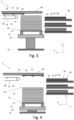
- Fig. 4 illustrates the step of lowering the liftable stack support 13 to create an insertion space for a drawer 40. It has been determined that for an upcoming print job a different media type than the one currently loaded on the liftable stack support 13 is required. The required media type is available on the releasable stack support 42 as the stack 41. At the moment the controller of the printer determines that the different media type of the stack 41 is required, the liftable stack support 13 is moved, so that it and any stack 11 on it do not overlap with the respective drawer 40 when viewed in the transport direction X. The controller during operation constantly determines the height of the stack 11 on the liftable stack support 13, e.g. by sensors and/or counting the number of substrates added or removed. This allows the controller to ensure that the top of the stack 11 on the liftable stack support 13 can be positioned in a position P2 below the drawer 40 in its buffer position P0, as in Fig. 4 at any time.
- the drawer 40 in Fig. 5 is actuated to move in the transport direction X.
- a motor (not shown) pushes the guide beams 43 along the guide rails 44, so that the releasable stack support 42 is positioned over the liftable stack support 13.
- the releasable stack support 42 with the second stack 41 of the different media type thus slides above the liftable stack support 13 until it is positioned within the working range of the single substrate engager 20, at least in the transport direction X, so that the releasable stack support 42 is in its operative position P4.
- a stop element may be provided on the frame 15 to ensure that the releasable stack support 42 stops in the operative position P4.
- the drive 14 is controlled to drive the liftable stack support 13, so that the top of the first stack 11 reaches the fifth position P5, wherein it contacts the bottom side of the releasable stack support 42 in the operative position P4.
- the releasable stack support 42 can be raised some distance above the support beams 43, so that the releasable stack support 42 is released from the drawer 40.
- the motor of the drawer 40 is then controlled to withdraw the guide beams 43 back to the buffer position P0. Since the guide beams 43 no longer contact the releasable stack support 42, the guide beams 43 move in the transport direction X, while the releasable stack support 42 remains stationary on the first stack 11.
- the guide beams 43 are retracted to the buffer position P0, so that these do not obstruct the movement of the stack 11, 41 on the liftable stack support 13, resulting in the situation shown in Fig. 7 .
- the drive 14 is controlled to raise the top of the second stack 41, which is on the first stack 11, into the working range of the single substrate engager 20.
- the releasable stack support 42 is supported entirely on the first stack 11, so that by moving the liftable stack support 13 both stacks 11, 41 move together in the lifting direction Z.
- the drive 14 stops the liftable stack support 13 in the sixth position P6 when the top substrate of the second stack 41 is in reach of the holding device 21.
- Individual substrates 46 of the different media type can now be fed into the printer via the holding device 21, as shown in Fig. 9 . Thus a print job requiring this different media type can be performed without changing the main stack 11 on the liftable stack support 13.
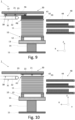
- Fig. 10 the print job requiring the different media type has been completed.
- the second stack 41 has been entirely depleted, so the liftable stack support 13 has reached its seventh position P7.
- the controller determines the completion of the latter print job and determines that a further print job requiring substrates from the first stack 11 is scheduled next.
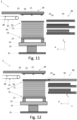
- Fig. 11 illustrates the optional step of lowering the liftable stack support to the fifth position P5, so that the releasable stack support 42 is slightly below the guide beams 43.
- the guide beams 43 are then again inserted from its buffer position P0 to its operative position P4.
- the insertion can be performed while the releasable stack support 42 is (slightly) above the guide beams 43, for example in the fifth position P5.
- the drive 14 may during the insertion already be actuated to lower the releasable stack support 42 while keeping it slightly above the guide beams 43.
- the drive 14 lowers the liftable stack support 13 to the eight position P8 until the releasable stack support 42 contacts and rests on the guide beams 43. Thereby, the releasable stack support 42 is released from the first stack 11.
- the eight position P8 is lower than the fifth position P5, as in the eight position P8 the releasable stack support 42 contacts the guide beams 43, while in the fifth position P5, the releasable stack support 42 is raised above the guide beams 43, so that these are free to be retracted or inserted below the releasable stack support 42. Since the guide beams 43 in the eight position P8 contact the releasable stack support 42, the releasable stack support 42 may be retracted to the buffer position P0 by sliding the guide beams 43 along the guide rails 44, as shown in Fig. 14 . Preferably after reaching the eight position P8, the liftable stack support 13 is lowered further, so that there is no direct contact between the releasable stack support 42 and the first stack 11.
- Feeding substrates from the first stack 11 may then continue by raising the liftable stack support 13 back to the first position P1.
- an operator may handle different print jobs for different print media in an efficient manner.
- the drawers 40, 40', 40" may be loaded and unloaded, while the stack handling module 1 continues to handle substrates from or to the first stack on the liftable stack support 13. Additionally, the insertion of a drawer 40, 40', 40" may be performed without direct operator interference, allowing for the substantially unattended printing of such print jobs.
- the operator may also load and unload the different drawers 40, 40', 40" at the same time, allowing for a productive planning of print jobs.
- the stack handling module 1 may also be configured to stacks substrates from the transport path onto the stack supports 13, 42. Additionally, while utilizing a drawer 40, 40', 40", the operator may also load or unload substrates from the liftable stack support 13. A drawer 40, 40', 40" may even hold the same media type as the liftable stack support 13, so that it can be used as a temporary buffer when the operator re-supplies the liftable stack support 13. Thus, printing can be performed productively with a minimum interruption.
- Fig. 15 illustrates the drawer in the eight position P8.
- the releasable stack support 42 is supported on the support beams 43, which in turn are supported by the guide rails 44.
- the releasable stack support 42 has a width larger than the maximum substrate support area of the releasable stack support 42 and that of the liftable stack support 13. This allows the first stack 11 to be insert in between the guide beams 43, when raising the liftable stack support 13 to be fifth position P5 to lift the releasable stack support 42 from the guide beams 43, as illustrated in Fig. 16 .
- the drawers 40 may hold substrates with dimensions larger than those fitting onto the liftable stack support 13.
- the distance between the support beams 43 in the width direction Y is wider than the width of the first stack 11. This allows the first stack 11 to be raised into contact with the releasable stack support 42 as shown in Fig. 16 .
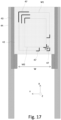
- Fig. 17 illustrates a top view of a drawer 40.
- the releasable stack support 42 as well as the liftable stack support 13 may be provided with alignment elements 47 positioned and dimensioned to a variety of commonly used media sizes, for example A0-A5, B0-B5, letter, etc.
- the alignment elements 47 are formed as stops, such as protrusions in the lifting direction Z which limit movement of a substrate in the X, Y directions. Additionally and/or alternatively, the position of a substrate in X, Y directions may be correct by sensing its position and according moving the holding device 21 while holding the substrate in the X, Y directions.
Landscapes
- Engineering & Computer Science (AREA)
- Mechanical Engineering (AREA)
- Pile Receivers (AREA)
Priority Applications (1)
| Application Number | Priority Date | Filing Date | Title |
|---|---|---|---|
| EP23200536.3A EP4530236A1 (de) | 2023-09-28 | 2023-09-28 | Drucksubstratstapelhandhabungsmodul zum stapeln und/oder trennen von substraten |
Applications Claiming Priority (1)
| Application Number | Priority Date | Filing Date | Title |
|---|---|---|---|
| EP23200536.3A EP4530236A1 (de) | 2023-09-28 | 2023-09-28 | Drucksubstratstapelhandhabungsmodul zum stapeln und/oder trennen von substraten |
Publications (1)
| Publication Number | Publication Date |
|---|---|
| EP4530236A1 true EP4530236A1 (de) | 2025-04-02 |
Family
ID=88236742
Family Applications (1)
| Application Number | Title | Priority Date | Filing Date |
|---|---|---|---|
| EP23200536.3A Pending EP4530236A1 (de) | 2023-09-28 | 2023-09-28 | Drucksubstratstapelhandhabungsmodul zum stapeln und/oder trennen von substraten |
Country Status (1)
| Country | Link |
|---|---|
| EP (1) | EP4530236A1 (de) |
Citations (5)
| Publication number | Priority date | Publication date | Assignee | Title |
|---|---|---|---|---|
| US20070169655A1 (en) * | 2005-02-22 | 2007-07-26 | Cummings Calvin D | Plate handling system |
| US20100116162A1 (en) * | 2008-11-13 | 2010-05-13 | Pavel Korolik | Apparatus for cassette loading via a pallet loader |
| US20110272577A1 (en) | 2010-05-07 | 2011-11-10 | ICT Integrated Circuit Testing Gesellschaft fuer Halbleiterprueftechnik GmbH | Electron beam device with dispersion compensation, and method of operating same |
| US20120086163A1 (en) | 2010-10-07 | 2012-04-12 | Bdt Ag | Stack feeding aeration device and method |
| WO2021021086A1 (en) | 2019-07-26 | 2021-02-04 | Hewlett-Packard Development Company, L.P. | Apparatus and method for pallet transfer |
-
2023
- 2023-09-28 EP EP23200536.3A patent/EP4530236A1/de active Pending
Patent Citations (5)
| Publication number | Priority date | Publication date | Assignee | Title |
|---|---|---|---|---|
| US20070169655A1 (en) * | 2005-02-22 | 2007-07-26 | Cummings Calvin D | Plate handling system |
| US20100116162A1 (en) * | 2008-11-13 | 2010-05-13 | Pavel Korolik | Apparatus for cassette loading via a pallet loader |
| US20110272577A1 (en) | 2010-05-07 | 2011-11-10 | ICT Integrated Circuit Testing Gesellschaft fuer Halbleiterprueftechnik GmbH | Electron beam device with dispersion compensation, and method of operating same |
| US20120086163A1 (en) | 2010-10-07 | 2012-04-12 | Bdt Ag | Stack feeding aeration device and method |
| WO2021021086A1 (en) | 2019-07-26 | 2021-02-04 | Hewlett-Packard Development Company, L.P. | Apparatus and method for pallet transfer |
Similar Documents
| Publication | Publication Date | Title |
|---|---|---|
| EP1055621B1 (de) | Automatisches Tafelzuführungssystem | |
| CN101426704B (zh) | 具有可在托盘的堆积区之下与提升装置一起移动的传输模块的托盘供给模块 | |
| CN217920360U (zh) | 一种托盘上料装置及打码设备 | |
| US20030017035A1 (en) | Automatic printing plate feeding system | |
| CN222312150U (zh) | 一种上料装置及叠片设备 | |
| KR101184569B1 (ko) | 부품 배치 장치, 부품 공급 장치 및 방법 | |
| CN114275543A (zh) | 搬运系统 | |
| CN101003330A (zh) | 托盘搬送系统 | |
| CN115818242A (zh) | 芯片收集装置 | |
| JP2010098134A (ja) | 電子部品供給方法及び装置 | |
| CN213864410U (zh) | 拆堆垛装置 | |
| KR100637397B1 (ko) | 철판 적재장치 | |
| JP2008156040A (ja) | トレイ受け渡し装置 | |
| US12252369B2 (en) | Sheet stacker module | |
| CN119894787A (zh) | 分类装置 | |
| JP2577768Y2 (ja) | 物品供給装置 | |
| JP3946318B2 (ja) | 板材の集積装置 | |
| CN116175121A (zh) | 电容安装装置 | |
| JP7419743B2 (ja) | 排紙装置、処理装置及び記録システム | |
| CN102202888B (zh) | 构造成将印版从印版堆叠或暗盒装载到印刷版成像装置中的印刷版装载设备 | |
| JP5009602B2 (ja) | リードフレーム供給装置 | |
| CN223704469U (zh) | 吸塑盘取料堆垛装置 | |
| JP7738622B2 (ja) | プリンタ用のシートスタッカおよび/またはシートフィーダを備えるシートスタックハンドラ | |
| JPH0733255A (ja) | トレイ供給装置およびこれを用いた電子部品の分類装置 | |
| CN222740640U (zh) | 太阳能电池片串焊机的电池片供应装置 |
Legal Events
| Date | Code | Title | Description |
|---|---|---|---|
| PUAI | Public reference made under article 153(3) epc to a published international application that has entered the european phase |
Free format text: ORIGINAL CODE: 0009012 |
|
| STAA | Information on the status of an ep patent application or granted ep patent |
Free format text: STATUS: THE APPLICATION HAS BEEN PUBLISHED |
|
| AK | Designated contracting states |
Kind code of ref document: A1 Designated state(s): AL AT BE BG CH CY CZ DE DK EE ES FI FR GB GR HR HU IE IS IT LI LT LU LV MC ME MK MT NL NO PL PT RO RS SE SI SK SM TR |
|
| STAA | Information on the status of an ep patent application or granted ep patent |
Free format text: STATUS: REQUEST FOR EXAMINATION WAS MADE |
|
| 17P | Request for examination filed |
Effective date: 20251002 |