EP4530306A1 - Masterbatch-herstellungsverfahren - Google Patents
Masterbatch-herstellungsverfahren Download PDFInfo
- Publication number
- EP4530306A1 EP4530306A1 EP24202260.6A EP24202260A EP4530306A1 EP 4530306 A1 EP4530306 A1 EP 4530306A1 EP 24202260 A EP24202260 A EP 24202260A EP 4530306 A1 EP4530306 A1 EP 4530306A1
- Authority
- EP
- European Patent Office
- Prior art keywords
- latex
- salt
- composition
- elastomer
- coagulation chamber
- Prior art date
- Legal status (The legal status is an assumption and is not a legal conclusion. Google has not performed a legal analysis and makes no representation as to the accuracy of the status listed.)
- Pending
Links
Images




Classifications
-
- C—CHEMISTRY; METALLURGY
- C08—ORGANIC MACROMOLECULAR COMPOUNDS; THEIR PREPARATION OR CHEMICAL WORKING-UP; COMPOSITIONS BASED THEREON
- C08J—WORKING-UP; GENERAL PROCESSES OF COMPOUNDING; AFTER-TREATMENT NOT COVERED BY SUBCLASSES C08B, C08C, C08F, C08G or C08H
- C08J3/00—Processes of treating or compounding macromolecular substances
- C08J3/20—Compounding polymers with additives, e.g. colouring
- C08J3/22—Compounding polymers with additives, e.g. colouring using masterbatch techniques
- C08J3/226—Compounding polymers with additives, e.g. colouring using masterbatch techniques using a polymer as a carrier
-
- C—CHEMISTRY; METALLURGY
- C08—ORGANIC MACROMOLECULAR COMPOUNDS; THEIR PREPARATION OR CHEMICAL WORKING-UP; COMPOSITIONS BASED THEREON
- C08C—TREATMENT OR CHEMICAL MODIFICATION OF RUBBERS
- C08C1/00—Treatment of rubber latex
- C08C1/14—Coagulation
- C08C1/15—Coagulation characterised by the coagulants used
-
- C—CHEMISTRY; METALLURGY
- C08—ORGANIC MACROMOLECULAR COMPOUNDS; THEIR PREPARATION OR CHEMICAL WORKING-UP; COMPOSITIONS BASED THEREON
- C08C—TREATMENT OR CHEMICAL MODIFICATION OF RUBBERS
- C08C1/00—Treatment of rubber latex
- C08C1/14—Coagulation
- C08C1/16—Coagulation in floc form
-
- C—CHEMISTRY; METALLURGY
- C08—ORGANIC MACROMOLECULAR COMPOUNDS; THEIR PREPARATION OR CHEMICAL WORKING-UP; COMPOSITIONS BASED THEREON
- C08J—WORKING-UP; GENERAL PROCESSES OF COMPOUNDING; AFTER-TREATMENT NOT COVERED BY SUBCLASSES C08B, C08C, C08F, C08G or C08H
- C08J3/00—Processes of treating or compounding macromolecular substances
- C08J3/20—Compounding polymers with additives, e.g. colouring
- C08J3/203—Solid polymers with solid and/or liquid additives
-
- C—CHEMISTRY; METALLURGY
- C08—ORGANIC MACROMOLECULAR COMPOUNDS; THEIR PREPARATION OR CHEMICAL WORKING-UP; COMPOSITIONS BASED THEREON
- C08J—WORKING-UP; GENERAL PROCESSES OF COMPOUNDING; AFTER-TREATMENT NOT COVERED BY SUBCLASSES C08B, C08C, C08F, C08G or C08H
- C08J3/00—Processes of treating or compounding macromolecular substances
- C08J3/20—Compounding polymers with additives, e.g. colouring
- C08J3/205—Compounding polymers with additives, e.g. colouring in the presence of a continuous liquid phase
- C08J3/21—Compounding polymers with additives, e.g. colouring in the presence of a continuous liquid phase the polymer being premixed with a liquid phase
- C08J3/215—Compounding polymers with additives, e.g. colouring in the presence of a continuous liquid phase the polymer being premixed with a liquid phase at least one additive being also premixed with a liquid phase
-
- C—CHEMISTRY; METALLURGY
- C08—ORGANIC MACROMOLECULAR COMPOUNDS; THEIR PREPARATION OR CHEMICAL WORKING-UP; COMPOSITIONS BASED THEREON
- C08K—Use of inorganic or non-macromolecular organic substances as compounding ingredients
- C08K3/00—Use of inorganic substances as compounding ingredients
- C08K3/02—Elements
- C08K3/04—Carbon
-
- C—CHEMISTRY; METALLURGY
- C08—ORGANIC MACROMOLECULAR COMPOUNDS; THEIR PREPARATION OR CHEMICAL WORKING-UP; COMPOSITIONS BASED THEREON
- C08L—COMPOSITIONS OF MACROMOLECULAR COMPOUNDS
- C08L7/00—Compositions of natural rubber
- C08L7/02—Latex
-
- C—CHEMISTRY; METALLURGY
- C08—ORGANIC MACROMOLECULAR COMPOUNDS; THEIR PREPARATION OR CHEMICAL WORKING-UP; COMPOSITIONS BASED THEREON
- C08J—WORKING-UP; GENERAL PROCESSES OF COMPOUNDING; AFTER-TREATMENT NOT COVERED BY SUBCLASSES C08B, C08C, C08F, C08G or C08H
- C08J2307/00—Characterised by the use of natural rubber
- C08J2307/02—Latex
-
- C—CHEMISTRY; METALLURGY
- C08—ORGANIC MACROMOLECULAR COMPOUNDS; THEIR PREPARATION OR CHEMICAL WORKING-UP; COMPOSITIONS BASED THEREON
- C08J—WORKING-UP; GENERAL PROCESSES OF COMPOUNDING; AFTER-TREATMENT NOT COVERED BY SUBCLASSES C08B, C08C, C08F, C08G or C08H
- C08J2321/00—Characterised by the use of unspecified rubbers
-
- C—CHEMISTRY; METALLURGY
- C08—ORGANIC MACROMOLECULAR COMPOUNDS; THEIR PREPARATION OR CHEMICAL WORKING-UP; COMPOSITIONS BASED THEREON
- C08L—COMPOSITIONS OF MACROMOLECULAR COMPOUNDS
- C08L2310/00—Masterbatches
Definitions
- the rate of coagulation of elastomer particles in an elastomeric latex is important.
- the invention relates to a method in accordance with claim 1 or 9, respectively, and to a masterbatch in accordance with claim 14.
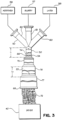
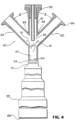
- a method for producing a masterbatch includes continuously feeding a first composition containing an elastomeric latex to a coagulation chamber; and continuously feeding a second composition containing a particulate filler and a salt to the coagulation chamber.
- the first composition and the second composition are mixed in the coagulation chamber to form the masterbatch.
- the particulate filler comprises carbon black.
- the elastomeric latex may include natural rubber.
- the second composition is fed to the coagulation chamber at a pressure of at least 2068 kPa (e.g., 3447 kPa to 34470 kPa).
- the second composition may be fed to the coagulation chamber at a velocity of at least 30.48 meter per second (e.g., 30.48 meter per second to 244 meter per second).
- An amount of the salt in the second composition may be fed so that a salt concentration in the coagulation chamber matches that necessary to bring a magnitude of a zeta potential of the latex to be within a range of 30 to 0, a range of 30 to 15, a range of 15 to 1, or a range of 1 to 0.
- a method for producing an elastomeric composite blend includes continuously feeding a first composition containing an elastomeric latex to a coagulation chamber; and continuously feeding a second composition containing a particulate filler and a salt to the coagulation chamber, wherein the first composition and the second composition are mixed in the coagulation chamber to form the masterbatch; and dry mixing the masterbatch with an additional elastomer to form the elastomer composite blend.
- the additional elastomer includes at least one material selected from natural rubber, chlorinated natural rubber, homopolymer, copolymer or terpolymer of 1,3-butadiene, styrene, isoprene, isobutylene, 2,3-dimethyl-1,3-butadiene, acrylonitrile, ethylene, and propylene.
- the particulate filler may include carbon black.
- the elastomeric latex includes natural rubber.
- the second composition may be fed to the coagulation chamber at a pressure of at least 2068 kPa; and/or at a velocity of at least 30.48 meter per second.
- an amount of the salt in the second composition is fed so that a salt concentration in the coagulation chamber matches that necessary to bring a magnitude of a zeta potential of the latex to be within a range of 30 to 0, a range of 30 to 15, a range of 15 to 1, or a range of 1 to 0.
- a masterbatch produced by a process which includes continuously feeding a first composition containing an elastomeric latex to a coagulation chamber; and continuously feeding a second composition containing a particulate filler and a salt to the coagulation chamber at a velocity of at least 30.48 meter per second.
- the first composition and the second composition are mixed in the coagulation chamber to form the masterbatch.
- an amount of the salt in the second composition is fed so that a salt concentration in the coagulation chamber matches that necessary to bring a magnitude of a zeta potential of the latex to be within a range of 30 to 0 (e.g., 30 to 15, 15 to 1, or 1 to 0).
- a method for producing a masterbatch which includes mixing an elastomeric latex, a particulate filler, and a salt in a coagulation chamber.
- the elastomeric latex may be provided in a first composition and the filler and salt may be provided in a second composition.
- the latex, filler, and salt are provided in different streams.
- the latex and salt may be provided in the same stream.
- the term “comprising” may include the embodiments “consisting of” and “consisting essentially of.”
- the terms “comprise(s),” “include(s),” “having,” “has,” “can,” “contain(s),” and variants thereof, as used herein, are intended to be open-ended transitional phrases that require the presence of the named ingredients/steps and permit the presence of other ingredients/steps.
- compositions, mixtures, or processes as “consisting of” and “consisting essentially of” the enumerated ingredients/steps, which allows the presence of only the named ingredients/steps, along with any impurities that might result therefrom, and excludes other ingredients/steps.
- each intervening number there between with the same degree of precision is explicitly contemplated.
- the numbers 7 and 8 are contemplated in addition to 6 and 9, and for the range 6.0-7.0, the number 6.0, 6.1, 6.2, 6.3, 6.4, 6.5, 6.6, 6.7, 6.8, 6.9, and 7.0 are explicitly contemplated.
- the present disclosure relates to a masterbatch produced by mixing an elastomeric latex (e.g., a natural rubber-containing latex) with a slurry containing filler particles (e.g., carbon black particles) and a salt.
- the slurry and latex are provided to a coagulation chamber and the slurry may be provided at a much higher velocity than the latex to facilitate high velocity collisions between filler particles and rubber particles.
- the inclusion of the salt increases the effective ionic concentration during turbulent mixing, which destabilizes the electrostatic repulsive forces of charged latex particles and promotes coagulation. This may be especially advantageous when working with well-stabilized latices, such as a centrifuged and ammoniated natural rubber latex, which may be more difficult to coagulate via mechanical destabilization alone.
- the latex may be a water-based latex.
- latices examples include emulsion-styrene butadiene rubber (ESBR), isoprene rubber, butyl rubber, nitrile butadiene rubber (NBR), chloroprene rubber, and natural rubber.
- ESBR emulsion-styrene butadiene rubber
- NBR nitrile butadiene rubber
- chloroprene rubber examples include Hevea, guayule, TKS (dandelion), milkweed, sunflower, and other naturally-derived latices.
- the salt may be a water-soluble salt.
- soluble salt refers to a salt that is soluble in an amount of at least 20 grams of salt per liter of solvent.
- the salt is selected to preferably raise the pH of the aqueous phase the least (neutral salt) as a typical latex is stabilized at a basic pH.
- Carbonates, bicarbonates, and phosphates may be utilized. However, in some embodiments, these materials are not preferred because they raise pH.
- the salt reduces the pH.
- examples include ammonium cations, calcium cations, and magnesium cations.
- the salt introduces bivalency into the system.
- the salt may introduce calcium, magnesium, or aluminum cations and sulfate, phosphate, or anions.
- the salt is selected from fluorides, chlorides, bromides, sulfates, and nitrates.
- the molar concentration of the salt may be increased until the magnitude of the zeta potential of the latex is between 30-15mV, 15 - 1mV, or 1-0mV.
- Zeta potential may be defined at a pH similar to the original latex.
- zeta potential measurements can be taken at a pH of 10, a temperature of 298K, and a water dielectric constant of 80.
- U E is the electrophoretic mobility
- z is the zeta potential
- ⁇ the dielectric constant (assume 80 for water)
- ⁇ is the viscosity
- f ( ka ) Henry's function (assumed to be 1.5 via the Smoluchowski approximation due to the polar nature of the water solvent)
- k is the Debye length
- a is the particle radius.
- the amount of salt added may be determined by:
- salt may be added to the CB stream so that the concentration of the mixture in the mixing chamber will be 0.20M ( ⁇ - 30mV ⁇ zeta potential), increasing up to 3M ( ⁇ 0mV ⁇ zeta potential) for maximum coagulation facilitation.
- Zeta potential may be measured, for example, using a ZetaPlus instrument by Brookhaven Instruments Corporation or a Malvern Autosizer 4700.
- the coagulation efficiency defined by the % of latex that is coagulated that was initially charged in the mixing chamber, may improve from an unacceptable level (e.g., ⁇ 99% coagulation efficiency) to an acceptable level (e.g., greater than or equal to 99% coagulation efficiency).
- a turbidity of a product wastewater may be decreased by a significant factor, for example, an order of magnitude, as measured by Nephelometric Turbidity Units (NTU).
- NTU Nephelometric Turbidity Units
- the turbidity is reduced from being within a range of 100 to 500 NTU to a range of 5 to 50 NTU.
- Additional salt can be added via one or more of the filler-containing streams, the latex-containing stream, and/or in an additional stream.
- a person having ordinary skill in the art is capable of optimally destabilizing the latex without introducing pre-coagulation before the mixing nozzle based on the guidance provided herein.
- a preferred range may not be how much it pushes the system to coagulate. Instead, the form of the material that is produced may be critical. Higher salt concentrations (lower zeta potential magnitudes) will produce masterbatch coagulum that is smaller. A person having ordinary skill in the art will understand how to balance coagulation rate/efficiency with the dewatering efficiency of their system.
- the salt may be selected based on the operating system so as to minimize long term corrosion. For example, in a stainless-steel system, sulfates or phosphates may be preferred over chlorides.
- elastomer composite blends can be produced, comprising (i) elastomer masterbatch produced in a continuous flow process involving mixture of elastomer latex and particulate filler fluids at turbulence levels and flow control conditions sufficient to achieve coagulation even without use of traditional coagulating agents, and (ii) additional elastomer added to such elastomer masterbatch in a dry mixing step.
- BR butadiene rubber
- carbon black filler primarily in the natural rubber phase of the elastomer composite blend.
- the carbon black can be mixed with the natural rubber using a dry mixing technique, followed by the addition and further dry mixing of BR.
- a disadvantageously large portion of the carbon black will migrate into the BR phase, due to its affinity for the BR phase and the less than desirable macro-dispersion of the carbon black in the natural rubber phase.
- improved performance properties of comparable elastomer composite blends prepared by the wet/dry mixing method disclosed here indicate that more of the carbon black is retained in the natural rubber phase when the carbon black is mixed with the natural rubber in the initial wet mixing step, followed by the addition of BR in a subsequent dry mixing step.
- feed rates of latex fluid and particulate filler fluid to the mixing zone of a coagulum reactor can be precisely metered to achieve high yield rates, with little free latex and little undispersed filler in the product crumb at the discharge end of the coagulum reactor.
- feed rates of latex fluid and particulate filler fluid to the mixing zone of a coagulum reactor can be precisely metered to achieve high yield rates, with little free latex and little undispersed filler in the product crumb at the discharge end of the coagulum reactor.
- the particulate filler fluid and elastomer latex may be fed continuously, meaning that an ongoing flow of coagulated masterbatch is established from the mixing zone to the discharged end of the coagulum reactor while an uninterrupted flow of the feed fluids is maintained.
- the uninterrupted flow of the feed fluids and simultaneous discharge of coagulated masterbatch are maintained for one or more hours, e.g., more than 24 hours, and ever perhaps for a week or more.
- methods for preparing elastomer masterbatch involve feeding simultaneously (a) a slurry of carbon black or other filler with a salt; and (b) a natural rubber latex fluid or other suitable elastomer fluid to a mixing zone of a coagulum reactor.
- a coagulum zone extends from the mixing zone, and may be of progressively increasing in cross-sectional area in the downstream direction from an entry end to a discharge end.
- the slurry may be fed to the mixing zone as a continuous, high velocity jet of injected fluid, while the natural rubber latex fluid is fed at relatively low velocity.
- the high velocity, flow rate and particulate concentration of the filler slurry are sufficient to cause mixture and high shear of the latex fluid, flow turbulence of the mixture within at least an upstream portion of the coagulum zone, and substantially completely coagulate the elastomer latex prior to the discharge end. Substantially complete coagulation can thus be achieved.
- the continuous flow method of producing the elastomer composites comprises the continuous and simultaneous feeding of the latex fluid and filler slurry to the mixing zone of the coagulum reactor, establishing a continuous, semi-confined flow of a mixture of the latex and filler slurry in the coagulum zone.
- Elastomer composite crumb in the form of "worms" or globules are discharged from the discharge end of the coagulum reactor as a substantially constant flow concurrently with the on-going feeding of the latex and carbon black slurry streams into the mixing zone of the coagulum reactor.
- the plug-type flow and atmospheric or near atmospheric pressure conditions at the discharge end of the coagulum reactor are highly advantageous in facilitating control and collection of the elastomer composite product, such as for immediate or subsequent further processing steps.
- Feed rates of the natural rubber latex fluid and carbon black slurry to the mixing zone of the coagulum reactor can be precisely metered to achieve high yield rates, with little free latex and little undispersed carbon black in the product crumb at the discharge end of the coagulum reactor.
- the masterbatch prepared by the above-described wet mixing technique and apparatus may be formed into an elastomer composite blend by subsequent dry mixing with additional elastomer.
- the present disclosure involves a wet/dry method.
- the dry mixing step of the wet/dry mixing method can be carried out with commercially available apparatus and techniques including, for example, Banbury mixers and the like.
- the additional elastomer added during the dry mixing step of the wet/dry mixing method disclosed here can be one or more elastomers which are the same as or different from the elastomer(s) employed to form the masterbatch.
- ingredients also may be added along with the additional elastomer during the dry mix step including, for example, extender oil, additional particulate filler, curatives, etc., in those embodiments wherein additional particulate filler is added during the dry mixing step such additional filler can be the same as or different from the filler(s) used in the masterbatch formed by the wet mixing step.
- a continuous flow wet mixing step for producing elastomer masterbatch employs a continuous, semi-confined flow of elastomer latex, for example, natural rubber latex (field latex or concentrate) mixed with a filler slurry with a salt, for example, an aqueous slurry of carbon black with calcium chloride, in a coagulum reactor forming an elongate coagulum zone which extends, with progressively increasing cross-sectional area, from an entry end to a discharge end.
- emi-confined flow refers to a highly advantageous feature.
- the term is intended to mean that the flow path followed by the mixed latex fluid and filler slurry within the coagulum reactor is closed or substantially closed upstream of the mixing zone and is open at the opposite, downstream end of the coagulum reactor (i.e., at the discharge end of the coagulum reactor). Turbulence conditions in the upstream portion of the coagulum zone are maintained in on-going, at least quasi-steady state fashion concurrently with substantially plug flow-type conditions at the open discharge end of the coagulum reactor.
- the discharge end is "open" at least in the sense that it permits discharge of coagulum, generally at or near atmospheric pressure and, typically, by simple gravity drop (optionally within a shrouded or screened flow path) into suitable collection means, such as the feed hopper of a de-watering extruder.
- suitable collection means such as the feed hopper of a de-watering extruder.
- the semi-confined flow results in a turbulence gradient extending axially or longitudinally within at least a portion of the coagulum reactor.
- the coagulum zone is significant in permitting high turbulence mixing and coagulation in an upstream portion of the coagulum reactor, together with substantially plug-type discharge flow of a solid product at the discharge end.
- Injection of the carbon black or other filler slurry as a continuous jet into the mixing zone occurs in on-going fashion simultaneously, with ease of collection of the elastomer masterbatch crumb discharged under substantially plug-type flow conditions and generally ambient pressure at the discharge end of the coagulum reactor.
- axial velocities of the slurry through the slurry nozzle into the mixing zone and, typically, at the upstream end of the coagulum zone are substantially higher than at the discharge end.
- the axial velocity of the resultant flow at the entry end of a coagulum reactor with expanding cross-sectional area in a typical application may be, for example, 1.52 to 6.1 meter per second, and more usually 2.1 to 4.6 meter per second .
- axial velocity of the masterbatch crumb product being discharged there will in a typical application be approximately 0.3 to 3 meter per second, and more generally 0.6 to 1.53 meter per second.
- the previously mentioned semi-confined turbulent flow achieves the highly significant advantage that natural rubber or other elastomer latex is coagulated by mixture with carbon black or other filler even in the absence of subsequent treatment in a stream or tank of acid, salt or other coagulant solution, with controlled, possibly quasi-molded product delivery from the coagulum reactor for subsequent processing.
- coagulum reactor as being "open" at the discharge end is not intended to mean that the discharge end is necessarily exposed to view or easily accessed by hand. It may instead be permanently or releasably attached to a collection device or subsequent processing device, such as a diverter (discussed further below), dryer, etc.
- the discharge end of the coagulum reactor is open in the important sense that the turbulent flow within the coagulum zone of the coagulum reactor, which is under high pressure and sealed against any significant rearward (i.e., upstream) travel at the mixing zone, is permitted to establish the aforesaid pressure and/or velocity gradient as it travels toward and exits from the discharge end.
- the turbulence of the flow lessens along the coagulum reactor toward the discharge end.
- the substantial plug flow of a solid product is achieved prior to the discharge end, dependent upon such factors as percent of capacity utilization, selection of materials and the like.
- Reference here to the flow being substantially plug flow at or before the discharge end of the coagulum reactor should be understood in light of the fact that the flow at the discharge end is composed primarily or entirely of masterbatch crumb, that is, globules or "worms" of coagulated elastomer masterbatch.
- the crumb is typically quasi-molded to the inside shape of the coagulum zone at the point along the coagulum zone at which flow became substantially plug flow.
- the ever-advancing mass of "worms" or globules advantageously have plug-type flow in the sense that they are traveling generally or primarily axially toward the discharge end and at any point in time in a given cross-section of the coagulum zone near the discharge end have a fairly uniform velocity, such that they are readily collected and controlled for further processing.
- the fluid phase mixing aspect disclosed here can advantageously be carried out at steady state or quasi-steady state conditions, resulting in high levels of product uniformity.
- FIG. 1 An embodiment of the wet mixing step of the method and apparatus disclosed here is illustrated schematically in FIG. 1 .
- the system illustrated in FIG. 1 is seen to include means for feeding natural rubber latex or other elastomer latex fluid at low pressure and low velocity continuously to a mixing zone of a coagulum reactor particularly, a latex pressure tank 10 is shown, to hold the feed supply of latex under pressure.
- a latex storage tank can be used, equipped with a peristaltic pump or series of pumps or other suitable feed means adapted to hold elastomer latex fluid to be fed via feed line 12 to a mixing zone of a coagulum reactor 14.
- Latex fluid in tank 10 may be held under air or nitrogen pressure or the like, such that the latex fluid is fed to the mixing zone at a line pressure (e.g., of less than 69 kPa, 13.8 kPa to 55.15 kPa, or 34.5 kPa).
- the latex feed pressure and the flow lines, connections, etc., of the latex feed means should be arranged to cause shear in the flowing latex fluid as low as reasonably possible.
- all flow lines are smooth, with only large radius turns, if any, and smooth or faired line-to-line interconnections.
- the pressure is selected to yield the desired flow velocity into the mixing zone.
- a non-limiting example of a useful flow velocity is no more than 3.66 meter per second.
- Suitable elastomer latex fluids include both natural and synthetic elastomer latices and latex blends.
- the latex must, of course, be suitable for coagulation by the selected particulate filler and must be suitable for the intended purpose or application of the final rubber product. It will be within the ability of those skilled in the art to select suitable elastomer latex or a suitable blend of elastomer latices for use in the methods and apparatus disclosed here, given the benefit of this disclosure.
- Exemplary elastomers include rubbers, polymers (e.g., homopolymers, copolymers and/or terpolymers) of 1,3-butadiene, styrene, isoprene, isobutylene, 2,3-dimethyl-1,3-butadiene, acrylonitrile, ethylene, and propylene and the like.
- the elastomer may have a glass transition temperature (T g ) as measured by differential scanning calorimetry (DSC) ranging from - 120°C. to 0°C.
- the latex may be in an aqueous carrier liquid.
- the liquid carrier may be a hydrocarbon solvent.
- the elastomer latex fluid must be suitable for controlled continuous feed at appropriate velocity, pressure, and concentration into the mixing zone.
- suitable synthetic rubbers include: copolymers of from 10 to 70 percent by weight of styrene and from 90 to 30 percent by weight of butadiene such as copolymer of 19 parts styrene and 81 parts butadiene, a copolymer of 30 parts styrene and 70 parts butadiene, a copolymer of 43 parts styrene and 57 parts butadiene and a copolymer of 50 parts styrene and 50 parts butadiene; polymers and copolymers of conjugated dienes such as polybutadiene, polyisoprene, polychloroprene, and copolymers of such conjugated dienes with an ethylenic group-containing monomer copolymerizable therewith such as styrene, methyl styrene, chlorostyrene, acrylonitrile, 2-vinyl-pyridine, 5-methyl-2-vinylpyridine, 5-ethyl-2
- the additional elastomer added during the dry mixing step of the wet/dry mixing method can employ any elastomer or mixture of elastomers suitable to the intended use or application, including those listed above for use in the wet mixing step.
- the elastomer latex employed in the wet mixing step is natural rubber latex and the additional elastomer employed in the dry mixing step is butadiene rubber (BR).
- BR butadiene rubber
- the butadiene rubber may form the minor phase or constituent of the elastomer composite blend, e.g., from 10% to 50% by weight of total elastomer in the elastomer composite blend.
- the elastomer latex employed in the wet mixing step is natural rubber latex and the additional elastomer employed in the dry mixing step is styrene-butadiene rubber (SBR).
- SBR styrene-butadiene rubber
- the SBR may form the major phase or constituent of the elastomer composite blend, e.g., from 50% to 90% by weight of total elastomer in the elastomer composite blend.
- the additional elastomer is natural rubber.
- the elastomer latex employed in the wet mixing step is butadiene rubber latex and the additional elastomer employed in the dry mixing step is SBR.
- the SBR may be from 10% to 90% by weight of total elastomer in the elastomer composite blend.
- the elastomer latex employed in the wet mixing step is butadiene rubber latex and the additional elastomer employed in the dry mixing step is natural rubber.
- the natural rubber may be the minor constituent or phase of the elastomer composite blend, e.g., from 10% to 50% by weight of total elastomer in the elastomer composite blend.
- the additional elastomer is additional butadiene rubber.
- the elastomer latex employed in the wet mixing step is SBR and the additional elastomer is butadiene rubber.
- the butadiene rubber may be from 10% to 90% by weight of total elastomer in the elastomer composite blend.
- the elastomer latex employed in the wet mixing step is SBR and the additional elastomer is natural rubber.
- the natural rubber may be the major constituent or phase, e.g., from 50% to 90% by weight of total elastomer in the elastomer composite blend.
- SBR is employed in both the wet mixing and dry mixing steps, thus being essentially 100% of the elastomer in the elastomer composite blend.
- the rubber compositions can contain, in addition to the elastomer and filler, curing agents, a coupling agent, and optionally, various processing aids, oil extenders and antidegradants.
- the elastomer composite blends disclosed here include vulcanized compositions (VR), thermoplastic vulcanizates (TPV), thermoplastic elastomers (TPE) and thermoplastic polyolefins (TPO).
- TPV, TPE, and TPO materials are further classified by their ability to be extruded and molded several times without substantial loss of performance characteristics.
- one or more curing agents such as, for example, sulfur, sulfur donors, activators, accelerators, peroxides, and other systems used to effect vulcanization of the elastomer composition may be used.
- the natural rubber latex employed in the wet mixing step comprises natural rubber latex
- the natural rubber latex can comprise field latex or latex concentrate (produced, for example, by evaporation, centrifugation, or creaming).
- the natural rubber latex must, of course, be suitable for coagulation by the carbon black.
- the latex is provided typically in an aqueous carrier liquid.
- the liquid carrier may be a hydrocarbon solvent.
- the natural rubber latex fluid must be suitable for controlled continuous feed at appropriate velocity, pressure, and concentration into the mixing zone.
- the well-known instability of natural rubber latex is advantageously accommodated, in that it is subjected to relatively low pressure and low shear throughout the system until it is entrained into the previously mentioned semi-confined turbulent flow upon encountering the extraordinarily high velocity and kinetic energy of the carbon black slurry in the mixing zone.
- the natural rubber is fed to the mixing zone at a pressure of 34.5 kPa, at a feed velocity in the range of 0.9 to 3.7 meter per second, e.g., 1.2 to 1.83 meter per second.
- Selection of a suitable latex or blend of latices will be well within the ability of those skilled in the art given the benefit of the present disclosure and the knowledge of selection criteria generally well recognized in the industry.
- the particulate filler fluid containing the salt for example, carbon black slurry with calcium chloride
- the slurry may comprise any suitable filler in a suitable carrier fluid. Selection of the carrier fluid will depend largely upon the choice of particulate filler and upon system parameters. Both aqueous and non-aqueous liquids may be used, with water being useful in many embodiments in view of its cost, availability, and suitability of use in the production of carbon black and certain other filler slurries.
- the slurry further includes any material which can be slurried and fed to the mixing zone in accordance with the principles disclosed here.
- Suitable additional particulate fillers include, for example, conductive fillers, reinforcing fillers, fillers comprising short fibers (typically having an LID aspect ratio less than 40), flakes, etc.
- exemplary particulate fillers which can be employed in producing elastomer masterbatch in accordance with the methods and apparatus disclosed here, are carbon black, fumed silica, precipitated silica, coated carbon black, chemically functionalized carbon blacks, such as those having attached organic groups, and silicon-treated carbon black, either alone or in combination with each other.
- Silicon-treated carbon black a silicon containing species such as an oxide or carbide of silicon, is distributed through at least a portion of the carbon black aggregate as an intrinsic part of the carbon black.
- Conventional carbon blacks exist in the form of aggregates, with each aggregate consisting of a single phase, which is carbon. This phase may exist in the form of a graphitic crystallite and/or amorphous carbon and is usually a mixture of the two forms.
- carbon black aggregates may be modified by depositing silicon-containing species, such as silica, on at least a portion of the surface of the carbon black aggregates.
- silicon-containing species such as silica
- the result may be described as silicon-coated carbon blacks.
- the materials described herein as silicon-treated carbon blacks are not carbon black aggregates which have been coated or otherwise modified, but actually represent a different kind of aggregate.
- the aggregates contain two phases. One phase is carbon, which will still be present as graphitic crystallite and/or amorphous carbon, while the second phase is silica (and possibly other silicon-containing species).
- the silicon-containing species phase of the silicon-treated carbon black is an intrinsic part of the aggregate; it is distributed throughout at least a portion of the aggregate.
- the multiphase aggregates are quite different from the silica-coated carbon blacks mentioned above, which consist of pre-formed, single phase carbon black aggregates having silicon-containing species deposited on their surface.
- Such carbon blacks may be surface-treated in order to place a silica functionality on the surface of the carbon black aggregate.
- an existing aggregate is treated so as to deposit or coat silica (as well as possibly other silicon-containing species) on at least a portion of the surface of the aggregate.
- an aqueous sodium silicate solution may be used to deposit amorphous silica on the surface of carbon black aggregates in an aqueous slurry at high pH, such as 6 or higher.
- carbon black may be dispersed in water to obtain an aqueous slurry consisting, for example, of 5% by weight carbon black and 95% by weight water.
- the slurry may be heated to above 70°C, such as to 85-95°C, and the pH adjusted to above 6, such as to a range of 10-11, with an alkali solution.
- a separate preparation is made of sodium silicate solution, containing the amount of silica which is desired to be deposited on the carbon black, and an acid solution to bring the sodium silicate solution to a neutral ph.
- the sodium silicate and acid solutions are added dropwise to the slurry, which is maintained at its starting pH value with acid or alkali solution as appropriate. The temperature of the solution is also maintained.
- a suggested rate for addition of the sodium silicate solution is to calibrate the dropwise addition to add 3 weight percent silicic acid, with respect to the total amount of carbon black, per hour.
- the slurry could be stirred during the addition, and after its completion for from several minutes (such as 30) to a few hours (i.e., 2-3).
- silicon-treated carbon blacks may be obtained by manufacturing carbon black in the presence of volatizable silicon-containing compounds.
- Such carbon blacks may be produced in a modular or "staged" furnace carbon black reactor having a combustion zone followed by a zone of converging diameter, a feed stock injection zone with restricted diameter, and a reaction zone. A quench zone is located downstream of the reaction zone.
- a quenching fluid generally water
- water is sprayed into the stream of newly formed carbon black particles flowing from the reaction zone.
- the aforesaid volatizable silicon-containing compound is introduced into the carbon black reactor at a point upstream of the quench zone.
- Useful compounds are volatizable compounds at carbon black reactor temperatures. Examples include, but are not limited to, silicates such as tetraethoxy orthosilicate (TEDS) and tetramethoxy orthosilicate, silanes such as tetrachloro silane, and trichloro methylsilane; and silicone polymers such as octamethylcyclotetrasiloxane (OMTS).
- silicates such as tetraethoxy orthosilicate (TEDS) and tetramethoxy orthosilicate
- silanes such as tetrachloro silane, and trichloro methylsilane
- silicone polymers such as octamethyl
- the flow rate of the volatilizable compound will determine the weight percent of silicon in the treated carbon black.
- the weight percent of silicon in the treated carbon black typically ranges from 0.1 percent to 25 percent, e.g., 0.5 percent to 10 percent, and 2 percent to 6 percent.
- the volatizable compound may be pre-mixed with the carbon black-forming feed stock and introduced with the feed stock into the reaction zone. Alternatively, the volatizable compound may be introduced to the reaction zone separately, either upstream or downstream from the feed stock injection point.
- additives may be used, and in this regard coupling agents useful for coupling silica or carbon black should be expected to be useful with the silicon-treated carbon blacks.
- Carbon blacks and numerous additional suitable particulate fillers are commercially available and are known to those skilled in the art.
- particulate filler can include any material which can be slurried and fed to the mixing zone in accordance with the principles disclosed here.
- suitable particulate fillers include, for example, conductive fillers, reinforcing fillers, fillers comprising short fibers (typically having an LID aspect ratio less than 40), flakes, etc.
- fillers can be formed of clay, glass, polymer, such as aramid fiber, etc.
- Agitated mixing tank 18 receives water, salt, and carbon black, e.g., optionally pelletized carbon to black, to prepare an initial mixture fluid.
- Such mixture fluid passes through discharge port 20 into fluid line 22 equipped with pumping means 24, such as a diaphragm pump or the like.
- Line 28 passes the mixture fluid to colloid mill 32, or alternatively a pipeline grinder or the like, through intake port 30.
- the carbon black is dispersed in the aqueous carrier liquid to form a dispersion fluid which is passed through outlet port 31 and fluid line 33 to a homogenizer 34.
- Pumping means 36 e.g., a progressing cavity pump or the like
- Homogenizer 34 more finely disperses the carbon black in the carrier liquid to form the carbon black slurry which is fed to the mixing zone of the coagulum reactor 14. It has an inlet port 37 in fluid communication with line 33 from the colloid mill 32.
- the slurry prepared in accordance with the above-described system will have at least 90% agglomerates less than 30 micrometer, e.g., at least 90% agglomerates less than 20 micrometer in size.
- the carbon black may be broken down to an average size of 5-15 micrometer, e.g., 9 micrometer.
- Exit port 38 passes the carbon black slurry from the homogenizer to the mixing zone through feed line 16.
- the slurry may reach 68950 kPa to 103420 kPa in the homogenizer step and exit the homogenizer at 4130 kPa or more.
- a high carbon black content may be used to reduce the task of removing excess water or other carrier. In some embodiments, 10 to 30 weight percent carbon black is utilized.
- the carbon black content (in weight percent) of the slurry and the slurry flow rate to the mixing zone should be coordinated with the natural rubber latex flow rate to the mixing zone to achieve a desired carbon black content (in phr) in the masterbatch.
- the carbon black content will be selected in accordance with known principles to achieve material characteristics and performance properties suited to the intended application of the product.
- carbon blacks of CTAB value 10 or more are used in sufficient amount to achieve carbon black content in the masterbatch of at least 30 phr.
- the slurry may be used in masterbatch production immediately upon being prepared.
- Fluid conduits carrying the slurry and any optional holding tanks and the like, should establish or maintain conditions which substantially preserve the dispersion of the carbon black in the slurry. That is, substantial reagglomeration or settling out of the particulate filler in the slurry should be prevented or reduced to the extent reasonably practical.
- all flow lines are smooth, with smooth line-to-line interconnections.
- an accumulator is used between the homogenizer and the mixing zone to reduce fluctuations in pressure or velocity of the slurry at the slurry nozzle tip in the mixing zone.
- Natural rubber latex fluid or other elastomer latex fluid passed to the mixing zone via feed line 12 and carbon black slurry fed to the mixing zone via feed line 16 under proper process parameters as discussed above, can produce a novel elastomer composite, specifically, elastomer masterbatch crumb.
- Means may also be provided for incorporating various additives into the elastomer masterbatch.
- An additive fluid comprising one or more additives may be fed to the mixing zone as a separate feed stream.
- One or more additives also may be pre-mixed, if suitable, with the carbon black slurry or, more typically, with the elastomer latex fluid. Additives also can be mixed into the masterbatch subsequently, i.e., during the dry mixing step.
- additives include, for example, antioxidants, antiozonants, plasticizers, processing aids (e.g., liquid polymers, oils, and the like), resins, flame-retardants, extender oils, lubricants, and a mixture of any of them.
- processing aids e.g., liquid polymers, oils, and the like
- resins e.g., flame-retardants, extender oils, lubricants, and a mixture of any of them.
- the elastomer masterbatch crumb is passed from the discharge end of coagulum reactor 14 to suitable drying apparatus.
- the masterbatch crumb undergoes multi-stage drying. It is passed first to a de-watering extruder 40 and then via conveyor or simple gravity drop or other suitable means 41 to a drying extruder 42.
- the de-watering/drying operation will typically reduce water content to 0 to 1 weight percent, e.g., 0.0 to 0.5 weight percent.
- Suitable dryers are well known and commercially available, including for example, extruder dryers, fluid bed dryers, hot air or other oven dryers, and the like.
- Dried masterbatch crumb from drying extruder 42 is carried by a cooling conveyor 44 to a baler 46.
- the baler is an optional, advantageous feature of the apparatus of FIG. 1 , wherein the dried masterbatch crumb is compressed within a chamber in to form-stable compressed blocks or the like.
- 11.3 kg to 34 kg quantities of the elastomer masterbatch are compressed into blocks or bales for transport, further processing, etc.
- the product is provided as pellets, for example, by chopping the crumb.
Landscapes
- Chemical & Material Sciences (AREA)
- Health & Medical Sciences (AREA)
- Chemical Kinetics & Catalysis (AREA)
- Medicinal Chemistry (AREA)
- Polymers & Plastics (AREA)
- Organic Chemistry (AREA)
- General Chemical & Material Sciences (AREA)
- Compositions Of Macromolecular Compounds (AREA)
- Processes Of Treating Macromolecular Substances (AREA)
- Processing And Handling Of Plastics And Other Materials For Molding In General (AREA)
Applications Claiming Priority (2)
| Application Number | Priority Date | Filing Date | Title |
|---|---|---|---|
| US202363585401P | 2023-09-26 | 2023-09-26 | |
| US18/756,547 US20250101190A1 (en) | 2023-09-26 | 2024-06-27 | Masterbatch production process |
Publications (1)
| Publication Number | Publication Date |
|---|---|
| EP4530306A1 true EP4530306A1 (de) | 2025-04-02 |
Family
ID=92899910
Family Applications (1)
| Application Number | Title | Priority Date | Filing Date |
|---|---|---|---|
| EP24202260.6A Pending EP4530306A1 (de) | 2023-09-26 | 2024-09-24 | Masterbatch-herstellungsverfahren |
Country Status (3)
| Country | Link |
|---|---|
| US (1) | US20250101190A1 (de) |
| EP (1) | EP4530306A1 (de) |
| CN (1) | CN119708550A (de) |
Citations (7)
| Publication number | Priority date | Publication date | Assignee | Title |
|---|---|---|---|---|
| WO1997036724A2 (en) * | 1996-04-01 | 1997-10-09 | Cabot Corporation | Novel elastomer composites, method and apparatus |
| US6075084A (en) | 1996-04-01 | 2000-06-13 | Cabot Corporation | Elastomer composite blends and methods - II |
| US20140249249A1 (en) * | 2011-10-11 | 2014-09-04 | Compagnie Generale Des Etablissements Michelin | Method for preparing a masterbatch of diene elastomer and silica |
| US20170306106A1 (en) * | 2015-07-15 | 2017-10-26 | Cabot Corporation | Methods of making an elastomer composite reinforced with silica and products containing same |
| US20170306107A1 (en) * | 2015-07-15 | 2017-10-26 | Cabot Corporation | Methods of making an elastomer composite reinforced with silica and products containing same |
| EP3315539A1 (de) * | 2016-11-01 | 2018-05-02 | Sumitomo Rubber Industries, Ltd. | Verfahren zur herstellung eines masterbatch |
| JP7307584B2 (ja) * | 2019-04-26 | 2023-07-12 | Tpr株式会社 | ウェットマスターバッチおよびこれを含む炭素繊維補強ゴム複合材 |
-
2024
- 2024-06-27 US US18/756,547 patent/US20250101190A1/en active Pending
- 2024-09-24 EP EP24202260.6A patent/EP4530306A1/de active Pending
- 2024-09-25 CN CN202411342871.1A patent/CN119708550A/zh active Pending
Patent Citations (7)
| Publication number | Priority date | Publication date | Assignee | Title |
|---|---|---|---|---|
| WO1997036724A2 (en) * | 1996-04-01 | 1997-10-09 | Cabot Corporation | Novel elastomer composites, method and apparatus |
| US6075084A (en) | 1996-04-01 | 2000-06-13 | Cabot Corporation | Elastomer composite blends and methods - II |
| US20140249249A1 (en) * | 2011-10-11 | 2014-09-04 | Compagnie Generale Des Etablissements Michelin | Method for preparing a masterbatch of diene elastomer and silica |
| US20170306106A1 (en) * | 2015-07-15 | 2017-10-26 | Cabot Corporation | Methods of making an elastomer composite reinforced with silica and products containing same |
| US20170306107A1 (en) * | 2015-07-15 | 2017-10-26 | Cabot Corporation | Methods of making an elastomer composite reinforced with silica and products containing same |
| EP3315539A1 (de) * | 2016-11-01 | 2018-05-02 | Sumitomo Rubber Industries, Ltd. | Verfahren zur herstellung eines masterbatch |
| JP7307584B2 (ja) * | 2019-04-26 | 2023-07-12 | Tpr株式会社 | ウェットマスターバッチおよびこれを含む炭素繊維補強ゴム複合材 |
Also Published As
| Publication number | Publication date |
|---|---|
| CN119708550A (zh) | 2025-03-28 |
| US20250101190A1 (en) | 2025-03-27 |
Similar Documents
| Publication | Publication Date | Title |
|---|---|---|
| US6372822B1 (en) | Methods and apparatus for producing and treating novel elastomer composites | |
| US6040364A (en) | Methods for producing elastomeric compositions | |
| US9156955B2 (en) | Formation of latex coagulum composite | |
| CA2992269C (en) | Methods of making an elastomer composite reinforced with silica and carbon black and products containing same | |
| EP1019228B1 (de) | Mischungen aus elastomeren verbundwerkstoffen und verfahren zu ihrer herstellung | |
| US7105595B2 (en) | Elastomer composite blends and methods-II | |
| EP0892705A2 (de) | Neue elastomere verbundwerkstoffe, verfahren und vorrichtung zur herstellung derselben | |
| US20250101190A1 (en) | Masterbatch production process | |
| EP4527582A1 (de) | System und verfahren zur masterbatch-herstellung | |
| MXPA00003102A (en) | Elastomer composite blends and methods for producing them |
Legal Events
| Date | Code | Title | Description |
|---|---|---|---|
| PUAI | Public reference made under article 153(3) epc to a published international application that has entered the european phase |
Free format text: ORIGINAL CODE: 0009012 |
|
| STAA | Information on the status of an ep patent application or granted ep patent |
Free format text: STATUS: THE APPLICATION HAS BEEN PUBLISHED |
|
| AK | Designated contracting states |
Kind code of ref document: A1 Designated state(s): AL AT BE BG CH CY CZ DE DK EE ES FI FR GB GR HR HU IE IS IT LI LT LU LV MC ME MK MT NL NO PL PT RO RS SE SI SK SM TR |
|
| STAA | Information on the status of an ep patent application or granted ep patent |
Free format text: STATUS: REQUEST FOR EXAMINATION WAS MADE |
|
| 17P | Request for examination filed |
Effective date: 20251002 |