EP4530540A1 - Appareil ménager comprenant un dispositif d'absorption du son - Google Patents
Appareil ménager comprenant un dispositif d'absorption du son Download PDFInfo
- Publication number
- EP4530540A1 EP4530540A1 EP24201818.2A EP24201818A EP4530540A1 EP 4530540 A1 EP4530540 A1 EP 4530540A1 EP 24201818 A EP24201818 A EP 24201818A EP 4530540 A1 EP4530540 A1 EP 4530540A1
- Authority
- EP
- European Patent Office
- Prior art keywords
- sound
- household appliance
- main surface
- chassis
- absorbing device
- Prior art date
- Legal status (The legal status is an assumption and is not a legal conclusion. Google has not performed a legal analysis and makes no representation as to the accuracy of the status listed.)
- Pending
Links
Images




Classifications
-
- F—MECHANICAL ENGINEERING; LIGHTING; HEATING; WEAPONS; BLASTING
- F24—HEATING; RANGES; VENTILATING
- F24C—DOMESTIC STOVES OR RANGES ; DETAILS OF DOMESTIC STOVES OR RANGES, OF GENERAL APPLICATION
- F24C15/00—Details
- F24C15/20—Removing cooking fumes
-
- F—MECHANICAL ENGINEERING; LIGHTING; HEATING; WEAPONS; BLASTING
- F24—HEATING; RANGES; VENTILATING
- F24F—AIR-CONDITIONING; AIR-HUMIDIFICATION; VENTILATION; USE OF AIR CURRENTS FOR SCREENING
- F24F13/00—Details common to, or for air-conditioning, air-humidification, ventilation or use of air currents for screening
- F24F13/24—Means for preventing or suppressing noise
Definitions
- the present invention relates to a household appliance comprising a sound-absorbing device, in accordance with the preamble of claim 1.
- the object of the present invention is used in the field of household appliances, in particular kitchen household appliances for extracting cooking fumes.
- sound-absorbing/sound-insulating panels are typically used, i.e. acoustic devices that can be integrated into household appliances and configured to dissipate the sound waves generated by the latter.
- the known panels comprise a pair of external walls which are spaced in a thickness direction from an interspace and connected to a frame around the perimeter.
- the external walls are oriented perpendicular to the thickness direction and delimit the interspace from above and below.
- the frame extends along the thickness direction, delimiting the cavity on the side.
- such known panels are installed in special compartments of household appliances, in the vicinity of noise sources such as, for example, the suction units of the hoods or the motor means of dishwashers or washing machines.
- the panels are applied to one or more walls of the compartments of the household appliances by adhering, totally or partially, one of the external surfaces.
- CN 209688947 U describes a sound-absorbing hood panel having a top wall connected to a perimeter wall to define an open-bottom cavity. To improve the acoustic performance of the panel, CN 209688947 U teaches filling the cavity with sound-absorbing material.
- known sound-absorbing materials - such as, for example, wood, cork, rock wool or glass - tend to degrade over time, especially when exposed to a humid current such as that of cooking fumes.
- the sound-absorbing panel described in CN 209688947 U requires periodic maintenance operations in which the sound-absorbing material must be replaced.
- the maintenance operations in addition to being inconvenient for the user, also have an environmental impact as they generate waste that cannot be recycled.
- the task of the skilled person underlying the present description is to provide a household appliance that is ecologically sustainable to produce and, at the same time, has low noise impact during its operation.
- the subject matter of the present disclosure is a household appliance comprising a chassis defining an internal volume delimited by at least one wall thereof, a source responsible for the emission of sound waves during operation of the household appliance, and a sound-absorbing device configured to dissipate at least some of the sound energy produced by the source.
- the sound-absorbing device is placed in the internal volume in contact with the wall, so as to be exposed to the sound waves emitted by the source during the operation of the household appliance.
- the sound-absorbing device comprises a counter portion arranged in contact with the chassis wall, a main surface opposite to the contact portion along a thickness direction, and a frame extending along the thickness direction from the main surface to the contact portion.
- the frame peripherally delimits the sound-absorbing device and defines a cavity with the main surface.
- said cavity is closed by the chassis wall along the thickness direction from the opposite side with respect to the main surface.
- the household appliance of the present disclosure also includes a partition member extending in the cavity along the thickness direction from the main surface to the contact portion so as to partition the cavity into a plurality of chambers. Each chamber is then delimited by opposite parts along the thickness direction from the main surface and the chassis wall.
- partition element is different from the sound-absorbing material of CN 209688947 U in that the latter fills the cavity but does not partition it into a plurality of chambers.
- chassis wall cooperates synergistically with the frame and the main surface of the sound-absorbing device to close the cavity and thus create a confined environment.
- the partition element allows the creation of a plurality of acoustic resonators capable of dissipating sound energy and that, unlike the sound-absorbing material of CN 209688947 U , it does not require periodic maintenance replacement operations.
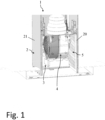
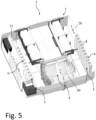
- a household appliance 1 such as, for example, a hood for the suction of cooking fumes ( Fig. 1-3 ), be it of the suction or filtering type, or a suction cooking hob ( Fig. 4 , 5 ).
- This household appliance 1 comprises a chassis 2, preferably box-like, defining an internal volume 3.
- internal volume 3 means a three-dimensional spatial region, internal to the household appliance 1, and at least partially confined by the chassis 2.
- internal volumes are the suction chambers or ducts of the cooking hoods or extractor hobs.
- the chassis 2 comprises at least one wall 20 delimiting the internal volume 3 partially or totally.
- the chassis 2 comprises four walls defining a duct with a quadrangular section, while in the embodiment of figures 4 and 5 it has a plurality of walls defining a substantially parallelepiped-shaped chamber.
- the household appliance 1 further comprises a source 4 connected to the chassis 2 and responsible for the emission of sound waves during operation of the household appliance 1.
- the source 4 is a suction unit configured to generate a depression in the internal volume 3 (duct/suction chamber) and, therefore, a suction flow of the cooking fumes.
- suction unit an apparatus comprising an impeller 40 driven in rotation by an electric motor 41 and configured to generate a suction air flow. It should be noted that, in use, the rotation of the impeller 40 generates mechanical vibrations and aerodynamic rustling that translate into noise and add to the sounds produced by the electric motor drive.
- the source 4 is arranged internally of the internal volume 3 defined by the chassis 2.
- the household appliance 1 further comprises a sound-absorbing device 5 configured to dissipate the sound waves generated by the source 4 during its operation.
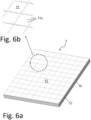
- the sound-absorbing device 5 is individually shown in figures 6-8 and is installed in the household appliance in figures 1-5 .
- the sound-absorbing device 5 is arranged in the internal volume 3 of the household appliance 1, in contact with the at least one wall of the 20 of the chassis 2, so as to be exposed to the sound waves emitted by the source 4.
- the sound-absorbing device 5 faces the source 4.
- the sound-absorbing device 5 can be placed in contact with two or more walls of the chassis 2 at the same time.
- the sound-absorbing device 5 comprises a contact portion 50 arranged in abutment against the wall of the chassis 2.
- the sound-absorbing device 5 comprises a main surface 51 which is opposite the contact portion along a thickness direction S-S.
- the contact portion 50 and the main surface 51 are oriented transversely to the thickness direction S-S.
- the thickness direction S-S is oriented transversely, preferably orthogonally, to the wall 20 of the chassis 2. Therefore, as shown in figure 9b , the sound-absorbing device 5 projects from the wall 20 along the thickness direction S-S.
- the main surface 51 can have both a flat conformation and partially or totally corrugated conformation.
- the sound-absorbing device 5 further comprises a frame 52 delimiting it peripherally, in particular along a direction of width X-X and length Y-Y. It should be specified that the width and length directions X-X, Y-Y make a Cartesian triad with the thickness direction Z-Z.
- the frame 52 extends along the thickness direction S-S from the main surface 51 to the contact portion 50.
- the frame 52 defines a perimeter edge B 1 of the contact portion 50.
- the sound-absorbing device 5 has a panel conformation in which the contact portion 50, the main surface 51, and the frame 52 respectively define the lower portion, the upper portion, and the side wall of the panel.
- the frame 52 extending along the thickness direction S-S projecting from the main surface 51, defines a cavity 6 with the latter.
- the cavity 6 is delimited by the frame 52 along the width and length direction X-X, Y-Y and by the main surface 51 along the thickness direction S-S.
- the cavity 6 is open along the thickness direction S-S from the opposite side with respect to the main surface 51.
- the sound-absorbing device 5 has an opening 53 opposite to the main surface 51 and at the contact surface 50.
- the sound-absorbing device 5 does not have a closing surface opposite to the main surface 51 along the thickness direction S-S, adapted to close the cavity 6.
- the wall 20 of the chassis 2 closes the cavity 6 from the opposite side to the main surface 51 along the thickness direction S-S.
- the wall 20 of the chassis 2 receiving in abutment the contact portion 50 of the sound-absorbing device 5 obstructs the cavity 6 from the opposite side with respect to the main surface 51.
- the main surface 51 of the sound-absorbing device 5 has a plurality of openings 51a (holes, micro-holes, cuts) passing through the main surface 51 along the thickness direction S-S. These openings 51a put the internal volume 3 of the chassis 2 in fluid (and sound) communication with the cavity 6 of the sound-absorbing device 5.
- the cavity-openings system constitutes what in acoustics is defined as acoustic resonator or Helmholtz resonator. It has long been known that acoustic resonators can be employed to generate sound dissipations in a specific frequency range. Such a range of dissipated frequencies varies depending on multiple parameters, including: material used to make the resonator (density, elastic modulus, damping), surface extension of the opening, geometric shape of the opening, volume of the resonance chamber.
- the frame 52 has a thickness - extension along the width or length direction X-X, Y-Y depending on the frame section 52 considered - between 0.5 and 5 mm.
- the plurality of openings 51a has a diameter in the range of 0.1-1.0 mm.
- P is the surface porosity value of the main surface 51
- N is the number of openings present on the main surface
- Aa,j is the surface extension of the j-th opening of the main surface
- Ap is the surface extension of the main surface.
- the frame 52 can be impervious (i.e. devoid of openings) or also have a plurality of openings (not shown in the figures).
- the sound-absorbing device 5 comprises a partitioning element 7 configured to partition the cavity 6, i.e. divide the volume of the cavity into a plurality of portions of smaller volumetric extension.
- the partition member 7 extends in the cavity 6 along the thickness direction S-S from the main surface 51 to the contacted portion 50 by partitioning the cavity into a plurality of chambers 8.
- Each chamber 8 is delimited by opposite parts along the thickness direction S-S from the main surface 51 and from the wall 20 of the chassis 2.
- the partition member 7 generates a plurality of acoustic resonators (Helmholtz resonators) in the sound-absorbing device 5.
- Helmholtz resonators acoustic resonators
- each chamber 8 has the same geometry, however, in alternative embodiments the chambers 8 may have different geometrical conformations both in section and in extension along the thickness direction S-S. For example, if the main surface 51 has a corrugated geometry, the chambers 8 will have a different extension along the thickness direction S-S. This allows acoustic resonators with different properties to be generated and, consequently, the range of absorbed frequencies to be expanded.
- the partition element 7 has an alveolar conformation.
- the partition member 7 defines a plurality of edges B2 of the contact portion 50.
- the partition element 7 is made in one piece with the frame 52. This facilitates the production process by minimizing the number of components to be made.
- the partition member 7 and the frame 52 may be made in a monolithic structure through a plastic injection molding process.
- the frame 52 and/or the partition member 7 are fixed to the main surface 51 by the heat-sealing or ultrasonic welding process.
- the sound-absorbing device 5 can be made of different types of materials and/or combination thereof such as, for example, metal, plastic or glass.
- the sound-absorbing device 5 is anchored to the wall 20 of the chassis, for example, by magnetic means 9 configured to interact magnetically with the metal material of the chassis 2.
- the magnetic means 9 are arranged at the contact portion 50.
- the partition element 7 has at least one cavity 70 adapted to receive the magnetic means 9.
- the chassis 2 comprises a pair of walls 20, 21 that delimit the internal volume 3 from opposite parts and the source 4 is at least partly interposed between said pair of walls 20, 21.
- the household appliance comprises a pair of sound-absorbing devices 5 and each mounted on a respective wall 20, 21 in accordance with the above.
- each sound-absorbing panel 5 is closed by a respective wall 20, 21 of the chassis 2 along the respective thickness direction S-S, as described above.
- the sound-absorbing devices 5 installed in the internal volume 3 of the chassis 2 may or may not have the same geometry depending on the cases, in particular depending on the geometric characteristics of the walls to which they are fixed.
Landscapes
- Engineering & Computer Science (AREA)
- Chemical & Material Sciences (AREA)
- Combustion & Propulsion (AREA)
- Mechanical Engineering (AREA)
- General Engineering & Computer Science (AREA)
- Soundproofing, Sound Blocking, And Sound Damping (AREA)
Applications Claiming Priority (1)
| Application Number | Priority Date | Filing Date | Title |
|---|---|---|---|
| IT102023000020220A IT202300020220A1 (it) | 2023-09-29 | 2023-09-29 | Elettrodomestico comprendente un dispositivo fonoassorbente |
Publications (1)
| Publication Number | Publication Date |
|---|---|
| EP4530540A1 true EP4530540A1 (fr) | 2025-04-02 |
Family
ID=89158115
Family Applications (1)
| Application Number | Title | Priority Date | Filing Date |
|---|---|---|---|
| EP24201818.2A Pending EP4530540A1 (fr) | 2023-09-29 | 2024-09-23 | Appareil ménager comprenant un dispositif d'absorption du son |
Country Status (2)
| Country | Link |
|---|---|
| EP (1) | EP4530540A1 (fr) |
| IT (1) | IT202300020220A1 (fr) |
Citations (9)
| Publication number | Priority date | Publication date | Assignee | Title |
|---|---|---|---|---|
| US5720274A (en) * | 1994-12-05 | 1998-02-24 | Gaggenau-Werke Haus-Und Lufttechnik Gmbh | Low-noise vapor exhaust hood |
| JP2013170807A (ja) * | 2012-02-23 | 2013-09-02 | Voc Direct:Kk | レンジフード |
| CN106123064A (zh) * | 2016-07-14 | 2016-11-16 | 广东美的厨房电器制造有限公司 | 吸油烟机 |
| CN110094774A (zh) * | 2018-01-31 | 2019-08-06 | 宁波方太厨具有限公司 | 一种降噪型吸油烟机 |
| CN110274271A (zh) * | 2018-03-13 | 2019-09-24 | 宁波方太厨具有限公司 | 一种降噪型吸油烟机 |
| CN209688947U (zh) | 2019-03-11 | 2019-11-26 | 迅达科技集团股份有限公司 | 带有吸音降噪装置的吸油烟机 |
| CN211650401U (zh) * | 2020-03-10 | 2020-10-09 | 嵊州市银宝电器有限公司 | 一种静音降噪排烟管 |
| CN111895474A (zh) * | 2020-09-11 | 2020-11-06 | 广东万家乐燃气具有限公司 | 一种降噪的吸油烟机 |
| CN112393299A (zh) * | 2020-11-27 | 2021-02-23 | 宜兴市泰宇汽车零部件有限公司 | 一种基于塑胶及吸音棉组合材料的框架式油烟机吸音装置 |
-
2023
- 2023-09-29 IT IT102023000020220A patent/IT202300020220A1/it unknown
-
2024
- 2024-09-23 EP EP24201818.2A patent/EP4530540A1/fr active Pending
Patent Citations (9)
| Publication number | Priority date | Publication date | Assignee | Title |
|---|---|---|---|---|
| US5720274A (en) * | 1994-12-05 | 1998-02-24 | Gaggenau-Werke Haus-Und Lufttechnik Gmbh | Low-noise vapor exhaust hood |
| JP2013170807A (ja) * | 2012-02-23 | 2013-09-02 | Voc Direct:Kk | レンジフード |
| CN106123064A (zh) * | 2016-07-14 | 2016-11-16 | 广东美的厨房电器制造有限公司 | 吸油烟机 |
| CN110094774A (zh) * | 2018-01-31 | 2019-08-06 | 宁波方太厨具有限公司 | 一种降噪型吸油烟机 |
| CN110274271A (zh) * | 2018-03-13 | 2019-09-24 | 宁波方太厨具有限公司 | 一种降噪型吸油烟机 |
| CN209688947U (zh) | 2019-03-11 | 2019-11-26 | 迅达科技集团股份有限公司 | 带有吸音降噪装置的吸油烟机 |
| CN211650401U (zh) * | 2020-03-10 | 2020-10-09 | 嵊州市银宝电器有限公司 | 一种静音降噪排烟管 |
| CN111895474A (zh) * | 2020-09-11 | 2020-11-06 | 广东万家乐燃气具有限公司 | 一种降噪的吸油烟机 |
| CN112393299A (zh) * | 2020-11-27 | 2021-02-23 | 宜兴市泰宇汽车零部件有限公司 | 一种基于塑胶及吸音棉组合材料的框架式油烟机吸音装置 |
Also Published As
| Publication number | Publication date |
|---|---|
| IT202300020220A1 (it) | 2025-03-29 |
Similar Documents
| Publication | Publication Date | Title |
|---|---|---|
| US4807718A (en) | Acoustic noise control for fans | |
| CN101460993A (zh) | 固体音降低构造 | |
| JP2020091481A (ja) | 音響メタ構造の振動低減装置 | |
| CN102132339A (zh) | 降噪设备和降噪方法 | |
| US6309176B1 (en) | Noise attenuating sound resonator for automotive cooling module shroud | |
| EP1980755A2 (fr) | Structure de réduction sonore dans un dispositif de ventilation | |
| CN106678083B (zh) | 共振腔体消声装置、消声蜗壳、离心风机和道路清洁装置 | |
| KR20220129275A (ko) | 진동 저감 장치 | |
| EP4530540A1 (fr) | Appareil ménager comprenant un dispositif d'absorption du son | |
| KR20050006170A (ko) | 소음 저감 장치 | |
| Tandon | Noise-reducing designs of machines and structures | |
| JP5499460B2 (ja) | ダクト及び車両構造体 | |
| CN220769780U (zh) | 一种离心风机及应用有该离心风机的吸油烟机 | |
| KR20190053667A (ko) | 진동 저감 장치 | |
| IT202300004011U1 (it) | Elettrodomestico comprendente un dispositivo fonoassorbente lavabile | |
| JP2005292183A (ja) | 空気調和機の外壁パネル | |
| CN210660728U (zh) | 一种带消声腔的低噪声轴流式叶轮结构 | |
| CN116005830A (zh) | 一种消声室声学屏障 | |
| CN108278846A (zh) | 一种冰箱 | |
| KR20220045401A (ko) | 송풍장치 | |
| JP2011112324A (ja) | 空気調和機の室外機 | |
| CN112761954A (zh) | 一种排气消音组件、压缩机和空调器 | |
| JPH10282965A (ja) | 吸音装置 | |
| CN215765315U (zh) | 机箱结构及抽油烟机 | |
| CN222760984U (zh) | 具有降噪功能的吸油烟机 |
Legal Events
| Date | Code | Title | Description |
|---|---|---|---|
| PUAI | Public reference made under article 153(3) epc to a published international application that has entered the european phase |
Free format text: ORIGINAL CODE: 0009012 |
|
| STAA | Information on the status of an ep patent application or granted ep patent |
Free format text: STATUS: THE APPLICATION HAS BEEN PUBLISHED |
|
| AK | Designated contracting states |
Kind code of ref document: A1 Designated state(s): AL AT BE BG CH CY CZ DE DK EE ES FI FR GB GR HR HU IE IS IT LI LT LU LV MC ME MK MT NL NO PL PT RO RS SE SI SK SM TR |
|
| STAA | Information on the status of an ep patent application or granted ep patent |
Free format text: STATUS: REQUEST FOR EXAMINATION WAS MADE |
|
| 17P | Request for examination filed |
Effective date: 20251001 |