EP4531048A1 - Système et procédé de détermination d'un régime thérapeutique probiotique personnalisé - Google Patents
Système et procédé de détermination d'un régime thérapeutique probiotique personnalisé Download PDFInfo
- Publication number
- EP4531048A1 EP4531048A1 EP24196335.4A EP24196335A EP4531048A1 EP 4531048 A1 EP4531048 A1 EP 4531048A1 EP 24196335 A EP24196335 A EP 24196335A EP 4531048 A1 EP4531048 A1 EP 4531048A1
- Authority
- EP
- European Patent Office
- Prior art keywords
- microbes
- organism
- metabolic
- gut microbiota
- subject
- Prior art date
- Legal status (The legal status is an assumption and is not a legal conclusion. Google has not performed a legal analysis and makes no representation as to the accuracy of the status listed.)
- Pending
Links
Images


Classifications
-
- G—PHYSICS
- G16—INFORMATION AND COMMUNICATION TECHNOLOGY [ICT] SPECIALLY ADAPTED FOR SPECIFIC APPLICATION FIELDS
- G16H—HEALTHCARE INFORMATICS, i.e. INFORMATION AND COMMUNICATION TECHNOLOGY [ICT] SPECIALLY ADAPTED FOR THE HANDLING OR PROCESSING OF MEDICAL OR HEALTHCARE DATA
- G16H50/00—ICT specially adapted for medical diagnosis, medical simulation or medical data mining; ICT specially adapted for detecting, monitoring or modelling epidemics or pandemics
- G16H50/50—ICT specially adapted for medical diagnosis, medical simulation or medical data mining; ICT specially adapted for detecting, monitoring or modelling epidemics or pandemics for simulation or modelling of medical disorders
-
- G—PHYSICS
- G16—INFORMATION AND COMMUNICATION TECHNOLOGY [ICT] SPECIALLY ADAPTED FOR SPECIFIC APPLICATION FIELDS
- G16H—HEALTHCARE INFORMATICS, i.e. INFORMATION AND COMMUNICATION TECHNOLOGY [ICT] SPECIALLY ADAPTED FOR THE HANDLING OR PROCESSING OF MEDICAL OR HEALTHCARE DATA
- G16H20/00—ICT specially adapted for therapies or health-improving plans, e.g. for handling prescriptions, for steering therapy or for monitoring patient compliance
- G16H20/60—ICT specially adapted for therapies or health-improving plans, e.g. for handling prescriptions, for steering therapy or for monitoring patient compliance relating to nutrition control, e.g. diets
-
- G—PHYSICS
- G16—INFORMATION AND COMMUNICATION TECHNOLOGY [ICT] SPECIALLY ADAPTED FOR SPECIFIC APPLICATION FIELDS
- G16B—BIOINFORMATICS, i.e. INFORMATION AND COMMUNICATION TECHNOLOGY [ICT] SPECIALLY ADAPTED FOR GENETIC OR PROTEIN-RELATED DATA PROCESSING IN COMPUTATIONAL MOLECULAR BIOLOGY
- G16B10/00—ICT specially adapted for evolutionary bioinformatics, e.g. phylogenetic tree construction or analysis
-
- G—PHYSICS
- G16—INFORMATION AND COMMUNICATION TECHNOLOGY [ICT] SPECIALLY ADAPTED FOR SPECIFIC APPLICATION FIELDS
- G16B—BIOINFORMATICS, i.e. INFORMATION AND COMMUNICATION TECHNOLOGY [ICT] SPECIALLY ADAPTED FOR GENETIC OR PROTEIN-RELATED DATA PROCESSING IN COMPUTATIONAL MOLECULAR BIOLOGY
- G16B5/00—ICT specially adapted for modelling or simulations in systems biology, e.g. gene-regulatory networks, protein interaction networks or metabolic networks
- G16B5/30—Dynamic-time models
-
- G—PHYSICS
- G16—INFORMATION AND COMMUNICATION TECHNOLOGY [ICT] SPECIALLY ADAPTED FOR SPECIFIC APPLICATION FIELDS
- G16H—HEALTHCARE INFORMATICS, i.e. INFORMATION AND COMMUNICATION TECHNOLOGY [ICT] SPECIALLY ADAPTED FOR THE HANDLING OR PROCESSING OF MEDICAL OR HEALTHCARE DATA
- G16H10/00—ICT specially adapted for the handling or processing of patient-related medical or healthcare data
- G16H10/40—ICT specially adapted for the handling or processing of patient-related medical or healthcare data for data related to laboratory analysis, e.g. patient specimen analysis
-
- Y—GENERAL TAGGING OF NEW TECHNOLOGICAL DEVELOPMENTS; GENERAL TAGGING OF CROSS-SECTIONAL TECHNOLOGIES SPANNING OVER SEVERAL SECTIONS OF THE IPC; TECHNICAL SUBJECTS COVERED BY FORMER USPC CROSS-REFERENCE ART COLLECTIONS [XRACs] AND DIGESTS
- Y02—TECHNOLOGIES OR APPLICATIONS FOR MITIGATION OR ADAPTATION AGAINST CLIMATE CHANGE
- Y02A—TECHNOLOGIES FOR ADAPTATION TO CLIMATE CHANGE
- Y02A90/00—Technologies having an indirect contribution to adaptation to climate change
- Y02A90/10—Information and communication technologies [ICT] supporting adaptation to climate change, e.g. for weather forecasting or climate simulation
Definitions
- the disclosure herein generally relates to the field of monitoring health of an individual, and, more particularly, to a system and method for determining a personalized probiotic therapeutic regimen.
- Gastro-intestinal tract is the major site of bacterial colonization, and it is well established that taxonomic constitution of gut microbiome influences gut health of the host.
- a microbiota residing within/on the human body is repeatedly being proven to be a significant modulator of health. While the bacteria harmful to gut represent the pathogens, the commensals represent beneficial gut bacteria.
- the human gut microbiota which comprise of trillions of microbial cells, has been linked to host health status in several recent studies. Given the established role of gut microbiota in digestion, energy harvesting, immunity, etc., this link between the host health status and gut microbiota composition is not surprising. It is, however, important to note that the gut microbiota composition tends to vary even among apparently healthy individuals. In an earlier seminal work introducing the concept of 'enterotypes' in 2011, it was reported that (healthy) humans may be stratified into distinct categories (enterotypes) based on the intestinal microbiota makeup.
- Probiotics are primarily bacteria or yeast strains that are used to restore/boost the beneficial functions of the gut microbiota, primarily through metabolic cooperation with the beneficial/ commensal inhabitants of the gut or by sensitizing the host immune repertoire. While large scale longitudinal in vivo experiments to investigate the effect of different probiotic interventions among individuals of different ethnicity, dietary preferences, etc. would be costly and might raise ethical concerns, in vitro experiments are also infeasible due to the challenges associated with culturing most gut microbes in the laboratory. Consequently, the effect of probiotics in the context of different gut microbiota compositions and/ or diet preferences has remained largely unexplored.
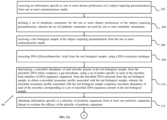
- a method for determining a personalized probiotic therapeutic regimen includes receiving, via one or more hardware processors, an information specific to one or more dietary preferences of a subject requiring personalization from one or more communication media; defining, via the one or more hardware processors, a set of metabolic constraints for the one or more dietary preferences of the subject requiring personalization, wherein the set of metabolic constraints are used for one or more metabolic simulations; receiving, via the one or more hardware processors, a test biological sample of the subject requiring personalization from the one or more communication media; extracting, via the one or more hardware processors, DNA (Deoxyribonucleic Acid) from the test biological sample, using a DNA extraction technique; determining, via the one or more hardware processors, a microbial abundance of each microbe present in the test biological sample, from the microbial DNA which comprises a gut
- a system for determining a personalized probiotic therapeutic regimen comprises: a memory storing instructions; one or more communication interfaces; and one or more hardware processors coupled to the memory via the one or more communication interfaces, wherein the one or more hardware processors are configured by the instructions to: receive an information specific to one or more dietary preferences of a subject requiring personalization from one or more communication media.
- the system further comprises; defining a set of metabolic constraints for the one or more dietary preferences of the subject requiring personalization, wherein the set of metabolic constraints are used as one or more metabolic simulations; receiving a test biological sample of the subject requiring personalization from the one or more communication media; extracting DNA (Deoxyribonucleic Acid) from the test biological sample, using a DNA extraction technique; determining a microbial abundance of each microbe present in the test biological sample, from the microbial DNA which comprises a gut microbiota, using a set of probes specific to each of the microbes from stretches of DNA sequences sequenced from the microbial DNA extracted from the test biological sample, to obtain a microbial taxonomic profile associated with the test biological sample, wherein the microbial taxonomic profile associated with the test biological sample comprises microbial abundance of each of the microbes corresponding to a set of microbial DNA sequences present in the test biological sample; obtaining an information specific to a plurality of probiotic organisms from at least one probiotic
- one or more non-transitory machine-readable information storage mediums comprising one or more instructions which when executed by one or more hardware processors cause receiving, via one or more hardware processors, information specific to one or more dietary preferences of a subject requiring personalization from one or more communication media; defining a set of metabolic constraints for the one or more dietary preferences of the subject requiring personalization, wherein the set of metabolic constraints are used as one or more metabolic simulations; receiving a test biological sample of the subject requiring personalization from the one or more communication media; extracting DNA (Deoxyribonucleic Acid) from the test biological sample, using a DNA extraction technique; determining a microbial abundance of each microbe present in the test biological sample, from the microbial DNA which comprises a gut microbiota, using a set of probes specific to each of the microbes from stretches of DNA sequences sequenced from the microbial DNA extracted from the test biological sample, to obtain a microbial taxonomic profile associated with the test biological sample, wherein
- Microbiota The collection of micro-organisms, such as, bacteria, archaea, protists, fungi, and virus, that inhabit a particular niche or geographical site.
- Microbiome The collection of genetic material of micro-organisms that reside in a particular geographical niche.
- Probiotics A micro-organism or a collection of micro-organisms introduced into the body for its beneficial qualities.
- Therapeutic regimen A pattern of regulating and integrating into daily living a program(s) for treatment of illness and its sequelae that is sufficient for meeting health-related goals and can be strengthened.
- FIG. 1 through FIG.3 where similar reference characters denote corresponding features consistently throughout the figures, there are shown preferred embodiments and these embodiments are described in the context of the following exemplary system and/or method.
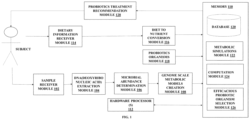
- FIG. 1 illustrates a block diagram of a system for determining a personalized probiotic therapeutic regimen in accordance with an embodiment of the disclosure.
- the system 100 comprises a sample receiver module 102, a DNA (Deoxyribonucleic Acid) extraction module 104, a microbial abundance determination module 106, a genome scale metabolic models creation module 108, a memory 110, one or more hardware processors 112, a dietary information receiver module 114, a diet to nutrient conversion module 116, a probiotics organisms module 118 and a probiotics treatment recommendation module 128 as shown in the block diagram of Fig. 1 .
- a database 120, a metabolic simulations module 122, a computation module 124 and an efficacious probiotic organism selection module 126 are stored in the memory 110.
- the one or more hardware processors 112 can be implemented as one or more microprocessors, microcomputers, microcontrollers, digital signal processors, central processing units, state machines, logic circuitries, and/or any devices that manipulate signals based on operational instructions.
- the one or more hardware processors 112 is configured to fetch and execute computer-readable instructions stored in the memory 110.
- the system 100 can be implemented in a variety of computing systems including laptop computers, notebooks, hand-held devices such as mobile phones, workstations, mainframe computers, servers, a network cloud and the like.
- the memory 110 may include any computer-readable medium known in the art including, for example, volatile memory, such as static random-access memory (SRAM) and dynamic random-access memory (DRAM), and/or non-volatile memory, such as read only memory (ROM), erasable programmable ROM, flash memories, hard disks, optical disks, and magnetic tapes.
- volatile memory such as static random-access memory (SRAM) and dynamic random-access memory (DRAM)
- DRAM dynamic random-access memory
- non-volatile memory such as read only memory (ROM), erasable programmable ROM, flash memories, hard disks, optical disks, and magnetic tapes.
- the memory 110 may include a database 120 configured to include information regarding all the available probiotic organisms that can be used for personalizing the therapeutic regimen for a subject.
- the database 120 is also configured to include information regarding (a) the typical (average) microbiota composition of an ethnic population, (b) the maximum and minimum possible abundance of each of the microbe in the microbiota of an ethnic population based on analysis of publicly available data, (c) the nutritional composition of the typical diet consumed by people from different ethnicities or following different life styles, such as vegetarian diet, western diet, diabetic diet, Mediterranean diet and the like (d) the genome scale metabolic models of microbes already available in the public domain as well as those created for simulation on earlier occasions, (e) The M-types (namely pathogen, commensal or probiotic bacteria) description of each of the microbes corresponding to each of the genome scale metabolic models obtained from public repositories or through literature curation/ survey.
- M-types namely pathogen, commensal or probiotic bacteria
- the memory 110 may comprise information pertaining to input(s)/output(s) of each step performed by the one or more hardware processors 112 of the system 100 and methods of the present disclosure.
- the database 120 may be external (not shown) to the system 100 and coupled to the system 100 via the I/O interfaces (not shown in FIG. 1 ).
- one or more data storage devices or the memory 110 operatively coupled to the one or more hardware processors 112.
- the system 100 with the one or more hardware processors 112 is configured to execute functions of one or more functional modules of the system 100.
- the system 100 supports various connectivity options such as BLUETOOTH ® , USB, ZigBee and other cellular services.
- the network environment enables connection of various components of the system 100 using any communication link including Internet, WAN, MAN, and so on.
- the system 100 is implemented to operate as a stand-alone device.
- the system 100 may be implemented to work as a loosely coupled device to a smart computing environment. The components and functionalities of the system 100 are described further in detail.
- the present disclosure provides a system and method for determining a personalized probiotic therapeutic regimen based on the monitoring.
- the present disclosure employs one or more metabolic simulations including a flux balance simulation (FBA) technique to simulate the effect of probiotic interventions on varying gut microbiota compositions and one or more dietary preferences.
- FBA flux balance simulation
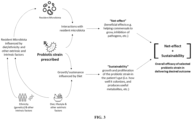
- the present disclosure introduces two metrics, namely 'net-effect' and 'sustainability' to quantify the efficacy (benefits) of probiotic supplementation.
- microbiota refers to the entire habitat of the body, including its microorganisms, genomes, and the surrounding environmental conditions.
- the terms "microbiota", “gut microbiota” and “probiotic organisms” are interchangeably used.
Landscapes
- Health & Medical Sciences (AREA)
- Engineering & Computer Science (AREA)
- Medical Informatics (AREA)
- General Health & Medical Sciences (AREA)
- Public Health (AREA)
- Life Sciences & Earth Sciences (AREA)
- Physics & Mathematics (AREA)
- Primary Health Care (AREA)
- Epidemiology (AREA)
- Bioinformatics & Cheminformatics (AREA)
- Evolutionary Biology (AREA)
- Biophysics (AREA)
- Spectroscopy & Molecular Physics (AREA)
- Theoretical Computer Science (AREA)
- Biotechnology (AREA)
- Bioinformatics & Computational Biology (AREA)
- Physiology (AREA)
- Animal Behavior & Ethology (AREA)
- Nutrition Science (AREA)
- Molecular Biology (AREA)
- Biomedical Technology (AREA)
- Data Mining & Analysis (AREA)
- Databases & Information Systems (AREA)
- Pathology (AREA)
- Measuring Or Testing Involving Enzymes Or Micro-Organisms (AREA)
Applications Claiming Priority (1)
| Application Number | Priority Date | Filing Date | Title |
|---|---|---|---|
| IN202321064646 | 2023-09-26 |
Publications (1)
| Publication Number | Publication Date |
|---|---|
| EP4531048A1 true EP4531048A1 (fr) | 2025-04-02 |
Family
ID=92543124
Family Applications (1)
| Application Number | Title | Priority Date | Filing Date |
|---|---|---|---|
| EP24196335.4A Pending EP4531048A1 (fr) | 2023-09-26 | 2024-08-26 | Système et procédé de détermination d'un régime thérapeutique probiotique personnalisé |
Country Status (2)
| Country | Link |
|---|---|
| US (1) | US20250104840A1 (fr) |
| EP (1) | EP4531048A1 (fr) |
Family Cites Families (1)
| Publication number | Priority date | Publication date | Assignee | Title |
|---|---|---|---|---|
| WO2020086413A1 (fr) * | 2018-10-26 | 2020-04-30 | Locus Oil Ip Company, Llc | Système personnalisé permettant de restaurer le micro-biome du tractus gastro-intestinal |
-
2024
- 2024-08-26 EP EP24196335.4A patent/EP4531048A1/fr active Pending
- 2024-08-27 US US18/815,981 patent/US20250104840A1/en active Pending
Non-Patent Citations (7)
| Title |
|---|
| CL?MENCE JOSEPH ET AL: "Predicting microbial interactions with approaches based on flux balance analysis: an evaluation", BMC BIOINFORMATICS, BIOMED CENTRAL LTD, LONDON, UK, vol. 25, no. 1, 23 January 2024 (2024-01-23), pages 1 - 24, XP021331009, DOI: 10.1186/S12859-024-05651-7 * |
| JANSMA JACK ET AL: "Understanding the host-microbe interactions using metabolic modeling", MICROBIOME, vol. 9, no. 1, 20 January 2021 (2021-01-20), London, UK, XP093248337, ISSN: 2049-2618, Retrieved from the Internet <URL:https://pmc.ncbi.nlm.nih.gov/articles/PMC7819158/pdf/40168_2020_Article_955.pdf> DOI: 10.1186/s40168-020-00955-1 * |
| KUMAR MANISH ET AL: "Modelling approaches for studying the microbiome", NATURE MICROBIOLOGY, NATURE PUBLISHING GROUP UK, LONDON, vol. 4, no. 8, 23 July 2019 (2019-07-23), pages 1253 - 1267, XP036842734, DOI: 10.1038/S41564-019-0491-9 * |
| MAGN?SD?TTIR STEFAN?A ET AL: "Generation of genome-scale metabolic reconstructions for 773 members of the human gut microbiota", NATURE BIOTECHNOLOGY, vol. 35, no. 1, 28 November 2016 (2016-11-28), New York, pages 81 - 89, XP093249180, ISSN: 1087-0156, Retrieved from the Internet <URL:http://www.nature.com/articles/nbt.3703> DOI: 10.1038/nbt.3703 * |
| NUCLEIC ACIDS RES, vol. 47, pages 614 - 624 |
| SINGH ROHAN ET AL: "A compendium of predicted growths and derived symbiotic relationships between 803 gut microbes in 13 different diets", CURRENT RESEARCH IN MICROBIAL SCIENCES, vol. 3, 1 January 2022 (2022-01-01), pages 100127, XP093248728, ISSN: 2666-5174, Retrieved from the Internet <URL:https://pdf.sciencedirectassets.com/777085/1-s2.0-S2666517421X00028/1-s2.0-S2666517422000244/main.pdf?hash=cd95b1e50726abda4627630c0e85fc67075bfabe48bcc9d70aebc43ee3184b75&host=68042c943591013ac2b2430a89b270f6af2c76d8dfd086a07176afe7c76c2c61&pii=S2666517422000244&tid=spdf-c6936074-1f49-43b6-bb6f-de6> DOI: 10.1016/j.crmicr.2022.100127 * |
| VIRTUAL METABOLIC HUMAN, 9 May 2022 (2022-05-09), Retrieved from the Internet <URL:https://www.vmh.life/.Retrieved> |
Also Published As
| Publication number | Publication date |
|---|---|
| US20250104840A1 (en) | 2025-03-27 |
Similar Documents
| Publication | Publication Date | Title |
|---|---|---|
| US12444318B2 (en) | Personalizing food recommendations to reduce glycemic response | |
| US11783726B2 (en) | Methods for and compositions for determining food item recommendations | |
| Day et al. | Probiotics: current landscape and future horizons | |
| Mei et al. | Dietary factors, gut microbiota, and serum trimethylamine-N-oxide associated with cardiovascular disease in the Hispanic Community Health Study/Study of Latinos | |
| Hornung et al. | Studying microbial functionality within the gut ecosystem by systems biology | |
| Bouchard et al. | Fundamentals of nutrigenetics and nutrigenomics | |
| Tomayko et al. | The human microbiome, diet, and health: workshop summary | |
| US20240079144A1 (en) | Systems and methods of promoting eubiosis in pregnant or breastfeeding women | |
| Jnana et al. | Prakriti phenotypes as a stratifier of gut microbiome: A new frontier in personalized medicine? | |
| JP2023093682A (ja) | Pmas方法を利用したパーソナライズ腸内環境改善物質スクリーニング方法 | |
| AU2022216551B2 (en) | Method and system for designing personalized therapeutics and diet based on functions of microbiome | |
| Orbe-Orihuela et al. | Association of gut microbiota with dietary-dependent childhood obesity | |
| Kedia et al. | Human gut microbiome: a primer for the clinician | |
| Li et al. | Relation between gut microbiota composition and traditional spontaneous fermented dairy foods among Kazakh Nomads in Xinjiang, China | |
| CN113631724A (zh) | 用于确定犬科动物的微生物组的年龄状态的监测工具和诊断方法 | |
| EP4531048A1 (fr) | Système et procédé de détermination d'un régime thérapeutique probiotique personnalisé | |
| JP7301220B2 (ja) | Pmas方法を利用したパーソナライズ腸内環境改善物質スクリーニング方法 | |
| Al-Nijir et al. | Metabolic modelling uncovers the complex interplay between fungal probiotics, poultry microbiomes, and diet | |
| Rueda‐De Torre et al. | Effect of the Consumption of Lean Red Meat from Beef (Pirenaica Breed) Versus Lean White Meat (Chicken) on the Gut Microbiota: A Randomized Cross‐Over Study in Healthy Young Adults | |
| De Filippo et al. | A Nutritional Anthropology of the Human Gut Microbiota | |
| EP4224486A1 (fr) | Procédé mis en uvre par ordinateur pour concevoir un régime alimentaire | |
| Zmora | Microbiome-based personalized interventions | |
| Abdulhasan | The Role of the Gut Microbiome in Diabetes: Physiological Implications and Therapeutic Potential. A Narrative Review | |
| Proffitt | A Bioinformatic and Systems Biology Approach to Modelling the Dysbiosis in the Gut Microbiome in Metabolic Disease and Bariatric Surgery | |
| De Filippo et al. | Impact of diet on gut microbiota in the globalized world |
Legal Events
| Date | Code | Title | Description |
|---|---|---|---|
| PUAI | Public reference made under article 153(3) epc to a published international application that has entered the european phase |
Free format text: ORIGINAL CODE: 0009012 |
|
| STAA | Information on the status of an ep patent application or granted ep patent |
Free format text: STATUS: THE APPLICATION HAS BEEN PUBLISHED |
|
| AK | Designated contracting states |
Kind code of ref document: A1 Designated state(s): AL AT BE BG CH CY CZ DE DK EE ES FI FR GB GR HR HU IE IS IT LI LT LU LV MC ME MK MT NL NO PL PT RO RS SE SI SK SM TR |
|
| STAA | Information on the status of an ep patent application or granted ep patent |
Free format text: STATUS: REQUEST FOR EXAMINATION WAS MADE |
|
| 17P | Request for examination filed |
Effective date: 20251001 |