EP4531123A1 - Procédé d'obtention d'une électrode métallisée - Google Patents
Procédé d'obtention d'une électrode métallisée Download PDFInfo
- Publication number
- EP4531123A1 EP4531123A1 EP23200378.0A EP23200378A EP4531123A1 EP 4531123 A1 EP4531123 A1 EP 4531123A1 EP 23200378 A EP23200378 A EP 23200378A EP 4531123 A1 EP4531123 A1 EP 4531123A1
- Authority
- EP
- European Patent Office
- Prior art keywords
- electrode
- metal
- agent
- metalated
- layer
- Prior art date
- Legal status (The legal status is an assumption and is not a legal conclusion. Google has not performed a legal analysis and makes no representation as to the accuracy of the status listed.)
- Withdrawn
Links
Images





Classifications
-
- H—ELECTRICITY
- H01—ELECTRIC ELEMENTS
- H01M—PROCESSES OR MEANS, e.g. BATTERIES, FOR THE DIRECT CONVERSION OF CHEMICAL ENERGY INTO ELECTRICAL ENERGY
- H01M4/00—Electrodes
- H01M4/02—Electrodes composed of, or comprising, active material
- H01M4/04—Processes of manufacture in general
- H01M4/0402—Methods of deposition of the material
- H01M4/0416—Methods of deposition of the material involving impregnation with a solution, dispersion, paste or dry powder
-
- H—ELECTRICITY
- H01—ELECTRIC ELEMENTS
- H01M—PROCESSES OR MEANS, e.g. BATTERIES, FOR THE DIRECT CONVERSION OF CHEMICAL ENERGY INTO ELECTRICAL ENERGY
- H01M4/00—Electrodes
- H01M4/02—Electrodes composed of, or comprising, active material
- H01M4/04—Processes of manufacture in general
- H01M4/0402—Methods of deposition of the material
- H01M4/0419—Methods of deposition of the material involving spraying
-
- H—ELECTRICITY
- H01—ELECTRIC ELEMENTS
- H01M—PROCESSES OR MEANS, e.g. BATTERIES, FOR THE DIRECT CONVERSION OF CHEMICAL ENERGY INTO ELECTRICAL ENERGY
- H01M4/00—Electrodes
- H01M4/02—Electrodes composed of, or comprising, active material
- H01M4/04—Processes of manufacture in general
- H01M4/0402—Methods of deposition of the material
- H01M4/0421—Methods of deposition of the material involving vapour deposition
- H01M4/0423—Physical vapour deposition
-
- H—ELECTRICITY
- H01—ELECTRIC ELEMENTS
- H01M—PROCESSES OR MEANS, e.g. BATTERIES, FOR THE DIRECT CONVERSION OF CHEMICAL ENERGY INTO ELECTRICAL ENERGY
- H01M4/00—Electrodes
- H01M4/02—Electrodes composed of, or comprising, active material
- H01M4/04—Processes of manufacture in general
- H01M4/043—Processes of manufacture in general involving compressing or compaction
- H01M4/0435—Rolling or calendering
-
- H—ELECTRICITY
- H01—ELECTRIC ELEMENTS
- H01M—PROCESSES OR MEANS, e.g. BATTERIES, FOR THE DIRECT CONVERSION OF CHEMICAL ENERGY INTO ELECTRICAL ENERGY
- H01M4/00—Electrodes
- H01M4/02—Electrodes composed of, or comprising, active material
- H01M4/13—Electrodes for accumulators with non-aqueous electrolyte, e.g. for lithium-accumulators; Processes of manufacture thereof
-
- H—ELECTRICITY
- H01—ELECTRIC ELEMENTS
- H01M—PROCESSES OR MEANS, e.g. BATTERIES, FOR THE DIRECT CONVERSION OF CHEMICAL ENERGY INTO ELECTRICAL ENERGY
- H01M4/00—Electrodes
- H01M4/02—Electrodes composed of, or comprising, active material
- H01M4/13—Electrodes for accumulators with non-aqueous electrolyte, e.g. for lithium-accumulators; Processes of manufacture thereof
- H01M4/139—Processes of manufacture
-
- H—ELECTRICITY
- H01—ELECTRIC ELEMENTS
- H01M—PROCESSES OR MEANS, e.g. BATTERIES, FOR THE DIRECT CONVERSION OF CHEMICAL ENERGY INTO ELECTRICAL ENERGY
- H01M4/00—Electrodes
- H01M4/02—Electrodes composed of, or comprising, active material
- H01M4/36—Selection of substances as active materials, active masses, active liquids
- H01M4/362—Composites
- H01M4/364—Composites as mixtures
-
- H—ELECTRICITY
- H01—ELECTRIC ELEMENTS
- H01M—PROCESSES OR MEANS, e.g. BATTERIES, FOR THE DIRECT CONVERSION OF CHEMICAL ENERGY INTO ELECTRICAL ENERGY
- H01M4/00—Electrodes
- H01M4/02—Electrodes composed of, or comprising, active material
- H01M4/36—Selection of substances as active materials, active masses, active liquids
- H01M4/38—Selection of substances as active materials, active masses, active liquids of elements or alloys
- H01M4/381—Alkaline or alkaline earth metals elements
- H01M4/382—Lithium
-
- H—ELECTRICITY
- H01—ELECTRIC ELEMENTS
- H01M—PROCESSES OR MEANS, e.g. BATTERIES, FOR THE DIRECT CONVERSION OF CHEMICAL ENERGY INTO ELECTRICAL ENERGY
- H01M4/00—Electrodes
- H01M4/02—Electrodes composed of, or comprising, active material
- H01M4/36—Selection of substances as active materials, active masses, active liquids
- H01M4/38—Selection of substances as active materials, active masses, active liquids of elements or alloys
- H01M4/386—Silicon or alloys based on silicon
-
- H—ELECTRICITY
- H01—ELECTRIC ELEMENTS
- H01M—PROCESSES OR MEANS, e.g. BATTERIES, FOR THE DIRECT CONVERSION OF CHEMICAL ENERGY INTO ELECTRICAL ENERGY
- H01M4/00—Electrodes
- H01M4/02—Electrodes composed of, or comprising, active material
- H01M4/36—Selection of substances as active materials, active masses, active liquids
- H01M4/58—Selection of substances as active materials, active masses, active liquids of inorganic compounds other than oxides or hydroxides, e.g. sulfides, selenides, tellurides, halogenides or LiCoFy; of polyanionic structures, e.g. phosphates, silicates or borates
- H01M4/583—Carbonaceous material, e.g. graphite-intercalation compounds or CFx
- H01M4/587—Carbonaceous material, e.g. graphite-intercalation compounds or CFx for inserting or intercalating light metals
-
- H—ELECTRICITY
- H01—ELECTRIC ELEMENTS
- H01M—PROCESSES OR MEANS, e.g. BATTERIES, FOR THE DIRECT CONVERSION OF CHEMICAL ENERGY INTO ELECTRICAL ENERGY
- H01M10/00—Secondary cells; Manufacture thereof
- H01M10/05—Accumulators with non-aqueous electrolyte
- H01M10/052—Li-accumulators
- H01M10/0525—Rocking-chair batteries, i.e. batteries with lithium insertion or intercalation in both electrodes; Lithium-ion batteries
-
- Y—GENERAL TAGGING OF NEW TECHNOLOGICAL DEVELOPMENTS; GENERAL TAGGING OF CROSS-SECTIONAL TECHNOLOGIES SPANNING OVER SEVERAL SECTIONS OF THE IPC; TECHNICAL SUBJECTS COVERED BY FORMER USPC CROSS-REFERENCE ART COLLECTIONS [XRACs] AND DIGESTS
- Y02—TECHNOLOGIES OR APPLICATIONS FOR MITIGATION OR ADAPTATION AGAINST CLIMATE CHANGE
- Y02E—REDUCTION OF GREENHOUSE GAS [GHG] EMISSIONS, RELATED TO ENERGY GENERATION, TRANSMISSION OR DISTRIBUTION
- Y02E60/00—Enabling technologies; Technologies with a potential or indirect contribution to GHG emissions mitigation
- Y02E60/10—Energy storage using batteries
Definitions
- the present disclosure relates to a method of obtaining a metalated electrode for an energy storage device.
- Rechargeable batteries also referred to as secondary batteries, are often preferred due to their reusability.
- Battery electrodes are conductive materials that serve as the positive and negative terminals in a battery.
- Secondary batteries are based on the principle of moving metal ions as charge carriers from a cathode to an anode and vice versa. These secondary batteries experience a loss of these ions in the first charging step of the formation often referred to as first cycle efficiency. If left uncompensated the loss of metal ions causes a lower gravimetric and volumetric energy density and therefore worsens key characteristics of the secondary battery cell.
- SEI solid electrolyte interface
- pre-metalation of the anodes has been proposed as a way to compensate for the consumption of metal ions in irreversible reactions during the formation of the solid electrolyte interface layer in the initial cycling.
- the consumption of the solid electrolyte interphase may be compensated, leading to improved battery performance.
- US11183683B2 is directed to a method for pre-lithiation of negative electrodes during lithium loaded electrode manufacturing for use in lithium-ion capacitors.
- a system and method of manufacture of LIC electrodes using thin lithium film having holes therein and in particular, to the process of manufacturing lithium loaded negative electrodes for lithium-ion capacitors by pre-lithiating electrodes with thin lithium metal films, wherein the thin lithium metal films include holes therein, and the lithium loaded negative electrodes are manufactured using a roll-to-roll lamination manufacturing, process.
- Further methods of electrode pre-lithiation are known from e.g. US11211205B2 , US11329312B2
- US20190393480A1 relates to a method of fabricating a pre-lithiated electrode.
- the method comprises disposing a lithium metal target comprising a layer of lithium metal adjacent to a surface of a prefabricated electrode.
- the method further comprises heating at least one of the lithium metal target and the prefabricated electrode to a temperature less than or equal to 180 degrees Celsius.
- the method further comprises compressing the lithium metal target and the prefabricated electrode together while applying ultrasound to the lithium metal target to transfer a quantity of lithium from the lithium metal target to the prefabricated electrode.
- the present disclosure relates to a method of obtaining a metalated electrode for an energy storage device.
- the method comprises providing an electrode.
- the electrode comprises a first material and metal particles.
- the first material is different from the metal.
- the method further comprises providing an agent.
- the agent comprises a solvent and metal ions dissociated in the solvent.
- the metal ions are metal ions of the metal comprised in the metal particles.
- the method further comprises obtaining the metalated electrode by exposing the electrode to the agent.
- the method further comprises removing the metalated electrode from the agent.
- the process of metalation of the electrode can be optimized for an energy storage device, e.g. a secondary battery or a metal ion capacitor.
- the metalation rate can be increased, as explained in the following description in more detail. Hence, the metalation process becomes faster and more reliable.
- metal ions e. g. Li + , Na + , K + , Mg 2+ , Ca 2+ , Al 3+
- metal ions e.g. Li + , Na + , K + , Mg 2+ , Ca 2+ , Al 3+
- Metalating the electrode before the first charge may also be referred to as pre-metalating.
- Metalating the electrode may comprise pre-metalating.
- the loss of these ions due to side reactions can be compensated for by introducing additional metal ions into the battery electrode (e. g. the anode) using e.g. a wet chemical process (i.e. by exposing the electrode to the agent) prior to cell assembly.
- additional metal ions into the battery electrode (e. g. the anode) using e.g. a wet chemical process (i.e. by exposing the electrode to the agent) prior to cell assembly.
- a reservoir of ions can be created that can be consumed over the life of the battery cell, improving the cycling stability of the battery cell.
- the method of the present disclosure provides the following further advantages in view of conventional methods.
- the agent e.g. an electrolyte significantly increases the metalation (e.g. lithiation) rate, since it provides an ion-conducting media to all of the electrode (e.g. anode) surfaces it comes into contact with. Therefore, a several-hours long reaction time required for the solid-state processes of the "dry” methods can be significantly shortened.
- the reaction in the agent e.g. electrolyte media
- the reaction is not limited only to the electrode contact surface (e.g. Li-anode), heat build-up from the exothermic metalation reaction is more evenly distributed.
- the agent e.g. liquid electrolyte
- evenly distributed reaction facilitates homogeneous pre-metalation (e.g. pre-lithiation). This helps to avoid inhomogeneous formations on the electrode (e.g. anode) surface, which is typically observed in the "dry” process.
- the metalated electrode since the metalated electrode is removed from the agent, it can go through a rinsing process. In such a rising process, unreacted metal (e.g. Li), passivation layer (e.g. Li 2 CO 3 ), and release layer metal oxides, as well as the products of side reactions (e.g. LiOH, L 2 O, etc.) can be removed from the electrode (e.g. anode) surface. This further improves the quality of the metalated (e.g. pre-lithiated) electrode and ensures that unwanted chemicals do not end up in the final energy storage device/final cell.
- unreacted metal e.g. Li
- passivation layer e.g. Li 2 CO 3
- release layer metal oxides e.g. LiOH, L 2 O, etc.
- the method of the present disclosure allows to apply the direct contact metalation (e.g. pre-lithiation) for composite electrodes (e.g. anodes).
- composite electrodes e.g. anodes
- a high-capacity material is supported in a low-capacity (or inactive) rigid material.
- the electrode-metal contact surface during contact pre-metalation is further decreased for composite electrodes and the high-capacity material cannot be efficiently pre-metalation using a dry metalation method (e.g., a calendering method).
- Using an agent e.g. an electrolyte media
- the present disclosure provides a roll-to-roll process for direct-contact metalation (e.g. pre-lithiation) of an electrode assisted by an agent (e.g., electrolyte media).
- agent e.g., electrolyte media.
- the agent facilitates the transfer of metal ions.
- the energy storage device may be a battery or a capacitor, e.g. a lithium-ion capacitor.
- the electrode may be an electrode foil.
- the electrode may comprise an electrode foil.
- foil may denote a sheet of material that can be wound and unwound.
- the term “foil” may denote any kind of material sheets or other thin structures like a thin film or a thin layer or a layer assembly.
- the term “foil” may denote foils having any thickness and shape.
- the term “foil” may denote, for example, foils having a round or a rectangular shape.
- the electrode/the metalated electrode may be or may be suitable to serve as an anode or a cathode of a battery cell.
- the electrode may be a sheet of material that is useable as one of the electrodes in a battery.
- the electrode may comprise any kind of material that may be suitable as battery electrode.
- the electrode may comprise a plurality of layers.
- the metalated electrode may be a sheet of material that is useable as one of the electrodes in a battery.
- the metalated electrode may comprise any kind of material that may be suitable as battery electrode.
- the metalated electrode may comprise a plurality of layers.
- the electrode may comprise an electrode metal layer.
- the electrode metal layer may comprise a second metal different from the first material and different from the metal.
- the electrode metal layer may be suitable to be used as a current collector.
- the electrode metal layer may be a foil.
- the electrode metal layer may be made from a conductive metal such as copper or aluminum to serve as a current collector for the electrode.
- a conductive metal such as copper or aluminum
- Other examples of materials that may be used in the electrode metal layer may include nickel-coated copper foil, aluminum-coated copper foil, stainless steel foil, copper-zinc alloy foil.
- the material of the electrode metal layer may be chosen to guarantee a good electrical conductivity, high thermal stability, and low resistance.
- the first material may be a foil material.
- the electrode may be/may comprise a foil comprising the first material.
- the first material may be a basic material.
- the first material may be porous.
- the first material and the metal particles of the electrode may be in direct contact.
- the first material may, for example, comprise silicon and/or carbon material, metal oxides or phosphates and/or other conversion or intercalation materials feasible for secondary batteries.
- the first material may comprise a silicon suboxide-carbon (SiO x /C, 1 ⁇ x ⁇ 2) composite.
- the silicon suboxide-carbon (SiO x /C, 1 ⁇ x ⁇ 2) composite is just one example of a material that may be used. Accordingly, an active material may be applied to one or both sides of the electrode metal layer, e.g. to form a layer of first material.
- Exemplary active materials may contain but are not limited to metal oxides (lithium cobalt oxide, lithium manganese oxide, lithium nickel manganese cobalt oxide(NMC), lithium vanadium oxide), phosphates (lithium iron phosphate, and/or lithium manganese iron oxide (LMFP)), Prussian blue and/or mixtures thereof on the cathode side (i. e. in case the battery electrode shall serve as a cathode), and/or carbon materials (e. g. graphite, hard carbon), silicon-based materials (silicon, silicon oxide, silicon carbide), titanates, sulfur-based compounds (sulfides, sulfur-polymer-gels), and/or mixtures thereof on the anode side (i. e. in case the battery electrode shall serve as an anode.
- metal oxides lithium cobalt oxide, lithium manganese oxide, lithium nickel manganese cobalt oxide(NMC), lithium vanadium oxide
- phosphates lithium iron phosphate, and/or lithium manganese iron oxide (
- an electrode comprising a composite first material may also be referred to as an electrode comprising a first material and a second material, the second material being different from the first material.
- Exposing the electrode to the agent may comprise immersing the electrode in the agent.
- Exposing the electrode to the agent may comprising conditioning the electrode.
- Conditioning the electrode may refer to adjusting its properties and/or performance and/or structure.
- Exposing the electrode to the agent may comprise metalating the electrode. Exposing the electrode to the agent/Metalating the electrode may comprise rearranging the electrode structure such that metal particles (e.g. metal ions) are transferred into the interior of the electrode, e.g. into the interior of the first material.
- metal particles e.g. metal ions
- Exposing the electrode to the agent/metalating the electrode may comprise causing a flow of metal ions into the electrode, e.g. into the first material.
- Exposing the electrode to the agent may comprise moving the electrode through a bath of agent.
- the electrode may pass/may be moved through the bath of agent with a controlled speed, the electrode may be exposed to the agent for a predetermined amount of time. Accordingly, the amount of metalation may also be controlled by the speed of the electrode and the path length within the bath.
- the agent may be an electrolyte.
- the agent may be referred to as electrolyte.
- Metalating the electrode may comprise pre-metalating the electrode.
- Providing the electrode may comprise forming the electrode by combining a first layer comprising the first material and a metal layer comprising the metal.
- Providing the electrode may comprise forming the electrode by combining a first layer, comprising the first material, and two metal layers on both sides of the first layer, each metal layer comprising the metal.
- the electrode may be a layer assembly comprising the first layer and the one or two metal layers.
- the electrode may be symmetrical.
- the one or two metal layers may have a thickness in a range of greater than or equal to about 10 nm to less than or equal to about 100 ⁇ m, optionally greater than or equal to about 30 nm to less than or equal to about 50 ⁇ m, and in certain variations, optionally greater than or equal to about 1 ⁇ m to less than or equal to about 10 ⁇ m.
- the electrode may also comprise a passivation layer between the first layer, which comprises the first material, and the metal layer, which comprises the metal.
- a passivated Li thin film can be stable under dry room conditions (-40°C DP) and should not cause safety issues during handling.
- the passivation layer which is typically e.g. Li 2 CO 3 , does not have to be removed from the Li film, and should not have effect on the pre-lithiation process disclosed in present disclosure.
- Combining the first layer and the one or two metal layers may comprise at least one of:
- Combining the first layer with the one or two metal layers may be performed in a roll process. Combining the first layer with the one or two metal layers may e.g. be performed by unwinding the first layer from a roll, unwinding the one or two metal layers from respective rolls, and combining the unwounded first layer with the unwounded one or two metal layers.
- the one or two metal layers also may be deposited to the first layer by thermal evaporation, physical vapor deposition or Stabilized Lithium Metal Powder (SLMP) spraying, and/or via a physical deposition method.
- SLMP Stabilized Lithium Metal Powder
- Providing the electrode may comprise combining the first material and the metal, e.g. by putting a layer of the metal onto the first material and/or by SLMP spraying onto the first material.
- Providing the electrode may comprise activating the reaction, e.g. in case of SLMP spraying or in case of a roll process.
- the electrode may be performed prior to exposing the electrode to the agent.
- the electrode may comprise the first material and metal particles before exposing the electrode to the agent.
- Providing the electrode may comprise applying a pressure to the electrode.
- the pressure may be a predetermined pressure.
- the (predetermined) pressure may be applied by deflecting the electrode by a pulley.
- the predetermined pressure may be generated by winding up the electrode.
- the predetermined pressure may be a predetermined tensile force.
- the pressure may activate a reaction between the metal and the first material.
- Activating a reaction between the metal and the first material may be especially beneficial in case of combining the first layer with the one or two metal layers by means of a roll process.
- Activating a reaction between the metal and the first material may also be beneficial in case the one or two metal layers are deposited by means of SLMP spraying.
- the electrode may be exposed to the agent without applying an external voltage to the electrode.
- external voltage may refer to a voltage that is not generated by the electrochemical reaction between the metal and the electrode.
- the first material and the metal of the electrode may be in direct contact. Hence, applying an external voltage to the electrode e.g. may not be necessary.
- An external voltage may be a voltage that is not generated by an electrochemical reaction between the agent and the electrode, e.g. between the agent and the metal of the electrode.
- the electrode may be exposed to the agent for a predetermined amount of time.
- the predetermined amount of time may be above 5 minutes.
- the predetermined amount of time may be below 30 minutes.
- the electrode may also be exposed to the agent for a predetermined wetting time, e.g. about 5 minutes, for wetting the electrode.
- the electrode may be exposed to the agent for a total time that may be above 10 minutes. The total time may be below 35 minutes.
- Exposing the electrode to the agent may comprise moving the electrode along a plurality of rolls through a bath comprising the agent.
- the rolls may be arranged such that the electrode is moved on parallel tracks, the tracks being tracks between individual rolls.
- the rolls may allow for a snake like assembly of the electrode in the bath.
- the rolls may allow for multiple passages of the electrode in the bath.
- the electrode may comprise the first material, a second material and an electrode metal layer.
- the electrode metal layer may comprise a second metal different from the metal and different from the first material and different from the second material.
- the first material, as compared to the second material may have a higher rigidity.
- the second material, as compared to the first material may have a higher capacity with respect to the metal.
- the first material may comprise graphite.
- the second material may comprise silicon.
- the second material may be an active material.
- the first material may be an inactive (e.g., supporting) material.
- the first material may be porous.
- the electrode metal layer may be a substrate.
- the electrode may be a composite electrode comprising the first material, the second material and an electrode metal layer.
- the electrode metal layer may be a current collector.
- the electrode metal layer may comprise copper and/or aluminum.
- the electrode metal layer may be nickel-coated copper foil, aluminum-coated copper foil, stainless steel foil, copper-zinc alloy foil.
- the material of the electrode metal layer may be chosen to guarantee a good electrical conductivity, high thermal stability, and low resistance.
- the solvent may be an anhydrous organic solvent.
- the metal may be at least one of lithium, sodium, potassium, magnesium, calcium and aluminium.
- the agent may comprise dissolved metal salt of the metal.
- the solvent may comprise at least one of: butylene carbonate, propylene carbonate, ethylene carbonate, vinylene carbonate, vinyl ethylene carbonate, dimethyl carbonate (DMC), diethyl carbonate, dipropyl carbonate, methyl ethyl carbonate, acetonitrile, gamma-butyrolactone, triglyme, tetraglyme, dimethylsulfoxide, dioxolane, sulfolane, room temperature ionic liquids.
- DMC dimethyl carbonate
- diethyl carbonate dipropyl carbonate
- methyl ethyl carbonate acetonitrile
- gamma-butyrolactone triglyme
- tetraglyme dimethylsulfoxide
- dioxolane dioxolane
- sulfolane room temperature ionic liquids.
- the metal salt may be a Li salt, e.g. selected from LiF, LiCl, LiBr, LiPF 6 , LiClO 4 , Organolithium salts and/or mixtures thereof.
- the agent may comprise LiClO 4 in acetonitrile.
- the agent may comprise LiClO 4 in dimethyl carbonate.
- the agent may comprise 1.5 M LiClO 4 in acetonitrile (CH 3 CN).
- the agent may comprise 1-2 M LiClO 4 in dimethyl carbonate.
- Both DMC and acetonitrile have advantages of being inexpensive, volatile, and only moderately toxic. Volatility improves the subsequent drying process, and the lower toxicity limits the health and environment hazards. LiClO 4 has sufficient solubility in CH 3 CN and DMC, and is stable towards water, which eliminates the need for anhydrous handling conditions for hazardous LiPF 6 .
- the method may further comprise, e.g. after removing the metalated electrode from the agent, exposing the metalated electrode to a rinsing solvent and/or drying the metalated electrode.
- the method may further comprise dividing the metalated electrode into electrode elements.
- the present disclosure further relates to a method of producing an energy storage device, such as a battery cell or a capacitor, e.g. a lithium-ion capacitor.
- the method may comprise obtaining a metalated electrode as described above.
- the present disclosure further relates to a metalated electrode obtained by a method of obtaining a metalated electrode as described above.
- the present disclosure may also relate to an energy storage device, e.g. a battery cell or capacitor, e.g. a lithium-ion capacitor, comprising a metalated electrode as described above.
- an energy storage device e.g. a battery cell or capacitor, e.g. a lithium-ion capacitor, comprising a metalated electrode as described above.
- the present disclosure further relates to a system for metalating an electrode.
- the system may comprise a bath of agent.
- the agent may comprise a solvent and metal ions dissociated in the solvent.
- the system may be configured to perform the method of obtaining a metalated electrode as described above.
- the technology provided by the present disclosure may be applied in various types of batteries such as lithium-ion secondary batteries.
- Other compatible examples of batteries may be sodium-ion batteries, potassium-ion batteries, magnesium-ion batteries, calcium-ion batteries or aluminum-ion batteries.
- the technology provided by the present disclosure may also be applied in various types of metal ion capacitors, such as lithium-ion capacitors.
- the electrode may be referred to as an anode and the first metal may be referred to as Lithium.
- the first metal may be referred to as Lithium.
- other options are possible, as described in the present disclosure.
- Fig. 1 shows a flowchart of a method 100 of obtaining a metalated electrode according to examples of the present disclosure.
- Figs. 2a-2d schematically show electrodes 200 usable in the method 100 of Fig. 1 .
- an electrode is provided.
- the electrode comprises a first material and metal particles.
- the first material is different from the metal of the metal particles.
- Fig. 2a shows a first example of an electrode 200.
- the electrode 200 comprises metal particles 201.
- the electrode 200 comprises a first material 203 being different from the metal of the metal particles 201.
- Fig. 2b shows a second example of an electrode 200.
- the electrode 200 comprises a metal layer comprising the metal 201, and a first layer comprising the first material 203.
- the electrode 200 is a layer assembly.
- Fig. 2c shows a third example of an electrode 200.
- the electrode 200 comprises two metal layers, each comprising the metal 201, and a first layer comprising the first material 203.
- Fig. 2d shows a fourth example of an electrode 200.
- the electrode 200 comprises two metal layers, each comprising the metal 201, two first layers, each comprising the first material 203, and one electrode metal layer 205.
- the electrode metal layer 205 comprises a second metal different from the metal 201 and different from the first material 203.
- the electrode 200 may also comprise one or two passivation layers, e.g. between the one or two metal layers, each comprising the metal 201, and the one or two first layers, each comprising the first material 203.
- the one or two passivation layers are not shown in Figs. 2a-2d .
- a passivated Li thin film can be stable under dry room conditions (-40°C DP) and should increase the safety of its handling.
- the passivation layer which is typically e.g. Li 2 CO 3 , does not have to be removed from the Li film, and should not have effect on the pre-lithiation process disclosed in present disclosure.
- the electrode 200 may be a layer assembly.
- the electrode 200 may be a foil.
- the metalated electrode 300 may be a foil.
- Providing the electrode may comprise forming the electrode by combining a first layer, comprising the first material 203, and a metal layer, comprising the metal 201.
- Providing the electrode may comprise forming the electrode by combining a first layer, comprising the first material 203, and two metal layers, each comprising the metal 201, on both sides of the first layer.
- the electrode may also comprise two first layers, on either side of an electrode metal layer.
- first layer/an electrode comprising one first layer.
- Corresponding passages equally apply to electrodes comprising two first layers/to two first layers, unless contradictory.
- Combining the first layer and the one or two metal layers may comprise calendering the one or two metal layers to the first layer.
- Combining the first layer and the one or two metal layers may comprise unwinding each layer (i.e. the first layer and the one or two metal layers).
- Combining the first layer and the one or two metal layers may comprise bringing the first layer and the one or two metal layers into contact.
- Combining the first layer and the one or two metal layers may comprise depositing the one or two metal layers to the first layer.
- the one or two metal layers may be deposited to the first layer by thermal evaporation, physical vapor deposition or Stabilized Lithium Metal Powder (SLMP) spraying, and/or via a physical deposition method.
- SLMP Stabilized Lithium Metal Powder
- Providing the electrode may comprise combining the first material and the metal, e.g. by putting a layer of the metal onto the first material and/or by SLMP spraying.
- Providing the electrode may comprise activating the reaction, e.g. in case of SLMP spraying or in case of a roll process.
- the electrode may be performed prior to exposing the electrode to the agent.
- the electrode may comprise the first material and metal particles before exposing the electrode to the agent.
- an agent is provided.
- the agent comprises a solvent and metal ions dissociated in the solvent.
- the metal ions are metal ions of the metal comprised in the metal particles.
- the solvent may be an anhydrous organic solvent.
- the metal may be at least one of Lithium, sodium, potassium, magnesium, calcium and aluminium.
- the agent may comprise dissolved metal salt of the metal.
- the solvent may comprise at least one of: butylene carbonate, propylene carbonate, ethylene carbonate, vinylene carbonate, vinyl ethylene carbonate, dimethyl carbonate, diethyl carbonate, dipropyl carbonate, methyl ethyl carbonate, acetonitrile, gamma-butyrolactone, triglyme, tetraglyme, dimethylsulfoxide, dioxolane, sulfolane, room temperature ionic liquids.
- the metal salt may be a Li salt selected from LiF, LiCl, LiBr, LiPF 6 , LiClO 4 , Organolithium salts and/or mixtures thereof.
- the agent may comprise LiClO 4 in acetonitrile.
- the agent may comprise LiClO 4 in dimethyl carbonate.
- the agent may comprise 1.5 M LiClO 4 in acetonitrile.
- the agent may comprise 1-2 M LiClO 4 in dimethyl carbonate.
- step S3 a metalated electrode is obtained by exposing the electrode to the agent.
- the electrode may be exposed to the agent for a predetermined amount of time.
- the predetermined amount of time may be above 5 minutes.
- the predetermined amount of time may be below 30 minutes.
- the electrode may also be exposed to the agent for a predetermined wetting time, e.g. about 5 minutes, for wetting the electrode.
- the electrode may be exposed to the agent for a total time that may be above 10 minutes. The total time may be below 35 minutes.
- step S4 the metalated electrode is removed from the agent, such that further optional steps can be performed, before the metalated electrode is further processed, e.g. in order to produce an energy storage device/a battery.
- the metalated electrode may be exposed to a rinsing solvent.
- the metalated electrode may be dried.
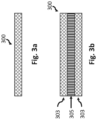
- Fig. 3a schematically shows a first example of a metalated electrode 300.
- the metalated electrode 300 comprises the first material 203 and the metal 201.
- the metalated electrode 300 may be a single layer. I.e., the metalated electrode may comprise no individual layer of the first material 203 and no individual layer of the metal 201.
- Fig. 3b schematically shows a second example of a metalated electrode 300.
- the metalated electrode 300 comprises an electrode metal layer 305 comprising a second metal different from the metal 201 and different from the first material 203.
- the electrode metal layer 305 may correspond/may be identical to the electrode metal layer 205 of the electrode 200 not (yet) being metalated. I.e., in some embodiments, the electrode metal layer 305 is not affected/not changed by metalating the electrode. I.e., in some embodiments, the electrode metal layer 305 is not metalated.
- the metalated electrode 300 comprises two metalated first layers, each comprising a metalated first material 303.
- Fig. 4 schematically shows a first exemplary manufacturing system 400 for obtaining a metalated electrode in the method 100 of Fig. 1 .
- a roll comprising a foil/a first layer comprising the first material 203 is unwound.
- This foil may also comprise the electrode metal layer 205.
- This foil may be a pristine electrode foil.
- Two rolls, each comprising a foil, each comprising the metal 201 and a substrate 207, are each unwound.
- the rolls, each comprising the foil, comprising the metal 201 and the substrate 207, may also comprise a passivation layer (not shown) on top of the metal 201.
- the metal 201 may be on top of the substrate 207.
- a passivated Li thin film can be stable under dry room conditions (-40°C DP) and should improve the safety during its handling.
- the passivation layer which is typically e.g. Li 2 CO 3 , does not have to be removed from the Li film, and should not have effect on the pre-lithiation process disclosed in present disclosure.
- the substrate 207 may be a conductive material, e.g., a metal.
- a conductive material e.g., a metal.
- metals that the substrate may be comprised of include aluminum (Al), copper (Cu), zinc (Zn), nickel (Ni), cobalt (Co), tin (Sn), silicon (Si), manganese (Mn), magnesium (Mg), alloys thereof, and combinations thereof.
- the system 400 may comprise a device for unwinding the respective rolls (not shown in Fig. 4 ).
- the unwounded foils, each comprising the metal 201 are aligned with the unwounded foil/first layer comprising the first material 203. Aligning is performed by means of pulleys (indicated by the black circles).
- the unwounded foils, each comprising the metal 201 are brought into contact with the unwounded foil/first layer comprising the first material 203. E.g., each of the two foils may be brought into contact with the foil/first layer, comprising the first material 203, on either side of the foil, i.e. from above and from below the foil/first layer comprising the first material 203.
- the electrode 200 is provided by calendering the two foils, each comprising the metal 201, onto the foil/first layer comprising the first material 203.
- Two bold black arrows indicate the pressure applied during calendering by the calendering rolls 220.
- the substrates 207 are removed from the electrode and rewound. Depending on the waste disposal regulations, the substrates 207 may be rinsed in a solvent bath (not shown in fig. 4 ) before being rewound.
- the electrode 200 is metalated by exposing the electrode 200 to the agent 230.
- a metalated electrode 300 is obtained by exposing the electrode 200 to the agent 230.
- the electrode 200 may be exposed to, e.g. immersed into, a bath of agent 230. Exposing the electrode to the agent comprises moving the electrode along a plurality of rolls (indicated by black circles) through the bath of agent 230.
- the electrode 200 may make several turns in the bath of agent to increase the path length and to provide sufficient time for reaction/metalation (cf. e.g. also Fig. 5 ).
- the bath of agent may be refreshed with fresh agent.
- the metalation/reaction can stop only when a Li particle has no direct contact to the anode.
- unreacted Li metal particles will simply detach from the electrode and float to the surface of the bath of agent (due to density difference), where the metal particles may be collected under inert atmosphere for disposal.
- the Li-electrode reaction is highly spontaneous and the preceding calendering process may ensure strong contact between Li and electrode, the amount of unreacted Li is expected to be minimal.
- a metalated electrode leaving the electrolyte bath will continuously remove some liquid from the bath, and fresh electrolyte may be added into the bath to compensate for the loss.
- the metalated electrode 300 may be exposed to a rinsing solvent 240. Accordingly, the metalated electrode 300 may be transferred into a bath of rinsing solvent 240, where a counter-currently flowing fresh solvent 240 may remove the metal salt and any unwanted chemicals (e.g., Li 2 CO 3 ) from the metalated electrode 300.
- the solvent 240 may be the same one used in the bath of agent 230, or any other solvent that can provide sufficient solubility of the chemical species mentioned in this disclosure.
- Rinsed solvent may be refreshed, e.g. using ion-exchange columns, and may e.g. be re-used for rinsing (cf. e.g. solvent entry in the bath of Fig. 4 ).
- the metalated electrode 300 may be dried in a dryer 250.
- the dryer 250 may be an in-line drying unit. In the dryer 250, volatile solvent may be removed.
- the metalated electrode 300 may be rewound for further use, e.g. in a cell assembly.
- an electrode cutting unit may be implemented into the system at this location.
- Fig. 5 schematically shows a second exemplary manufacturing system 500 for obtaining a metalated electrode in the method 100 of Fig. 1 .
- the electrode may be referred to as an anode and the first metal may be referred to as Lithium.
- the first metal may be referred to as Lithium.
- other options are possible, as described in the present disclosure.
- the example of fig. 5 may principally correspond to that one of fig. 4 , wherein the path length of the electrode in the bath of agent 230 has been increased by guiding it along several offset rolls.
- the electrode 200 comprises two metal layers, each comprising the metal 201, two first layers, each comprising the first material 203, and one electrode metal layer 205.
- the electrode metal layer 205 comprises a second metal different from the metal 201 and different from the first material 203.
- the agent 230 comprises a solvent and metal ions dissociated in the solvent.
- the metal ions are metal ions of the metal 201.
- the electrode 200 is exposed to the agent 230, and the metalated electrode 300 is obtained thereby.
- the metalated electrode 300 comprises an electrode metal layer 305 comprising a second metal different from the metal 201 and different from the first material 203.
- the electrode metal layer 305 corresponds to/is identical to the electrode metal layer 205 of the electrode 200 not (yet) being metalated.
- the metalated electrode 300 comprises two metalated first layers, each comprising a metalated first material 303.
- Exposing the electrode to the agent may comprise moving the electrode along a plurality of rolls through a bath comprising the agent.
- the rolls are arranged such that the electrode is moved on parallel tracks, the tracks being tracks between individual rolls.
- the rolls allow for a snake like assembly of the electrode in the bath.
- the rolls allow for multiple passages of the electrode in the bath.
- the bath dimensions can be significantly decreased to a few meters. Additional several minutes can be needed to provide sufficient time for wetting of the porous electrode and separator.
- Typical exposure times to the agent can be anywhere from 5 to 30 minutes.
- the exposure time can be 10 min to provide 30% of the degree of pre-lithiation.
- electrolyte bath dimensions can be limited to up to 2 m in length by increasing its height to 1 m. It may be necessary to provide additional 5 min needs to give sufficient time for wetting of the electrode 200, which may be porous.
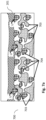
- Fig. 6 schematically shows the metalation process according to examples of the present disclosure.
- the electrode may be referred to as an anode and the first metal may be referred to as Lithium.
- the first metal may be referred to as Lithium.
- other options are possible, as described in the present disclosure.
- the present disclosure provides a method to pre-lithiate/metalate electrodes, e.g. Li-ion battery electrodes, in a roll-to-roll electrochemical process, e.g. using Li thin-films.
- the Li thin-films may comprise a passivation layer deposited onto a substrate.
- the process takes advantage of the spontaneity of the reaction between Li metal and Li-ion battery electrodes.
- the electrochemical process e.g. may not require any electricity input.
- the electrode 200 is exposed to the agent 230, i.e. to the bath of agent, by passing the electrode 200 through the bath of agent 230.
- Li atoms of the metal 201 oxidize (cf. solid arrows) and liberate Li + ions into the agent 230.
- Li + ions from the agent 230 reduce the first material 203 of the electrode (cf. solid arrows), and thereby metalate the electrode.
- the electrons of the two half-reactions are transferred by contact areas between the metallic Li and the first material 203 of the electrode (cf. dashed arrows).
- the reaction between Li and the electrode is spontaneous, and can proceed on its own.
- the electrode may be exposed to the agent without requiring an external voltage.
- a cell potential between Li and Si anodes is >0.25 V.
- the first material 203 may be porous and is hence schematically indicated by individual blobs in Fig. 6 . However, in reality, these blobs are connected to each other.
- Fig. 7a schematically shows a metalation process of a composite electrode without exposing the composite electrode to an agent.
- the composite electrode 700 comprises a first material 703 and a second material 704.
- the first material 703 is different from the metal 201.
- the first material 703 has a higher rigidity as compared to the second material 704.
- the second material 704 has a higher capacity with respect to the metal 201, as compared to the first material 703.
- the first material 703 may comprise graphite.
- the second material 704 may comprise silicon.
- the second material 704 may be an active material.
- Fig. 7b schematically shows a metalation process of a composite electrode according to examples of the present disclosure.
- Exposing the composite electrode 700 to the agent 230 allows to efficiently metalate also those portions of the second material 704 that are located deep within the first material 703.
- the composite electrode 700 may also comprise a second metal, e.g. a second metal layer, that may act as a current collector (not shown in Figs. 7a und 7b ).
- a second metal e.g. a second metal layer
- the metal may be referred to as Lithium.
- Lithium the metal may be referred to as Lithium.
- other options are possible, as described in the present disclosure.
Landscapes
- Chemical & Material Sciences (AREA)
- Chemical Kinetics & Catalysis (AREA)
- Electrochemistry (AREA)
- General Chemical & Material Sciences (AREA)
- Engineering & Computer Science (AREA)
- Manufacturing & Machinery (AREA)
- Materials Engineering (AREA)
- Composite Materials (AREA)
- Inorganic Chemistry (AREA)
- Dispersion Chemistry (AREA)
- Battery Electrode And Active Subsutance (AREA)
Priority Applications (1)
| Application Number | Priority Date | Filing Date | Title |
|---|---|---|---|
| EP23200378.0A EP4531123A1 (fr) | 2023-09-28 | 2023-09-28 | Procédé d'obtention d'une électrode métallisée |
Applications Claiming Priority (1)
| Application Number | Priority Date | Filing Date | Title |
|---|---|---|---|
| EP23200378.0A EP4531123A1 (fr) | 2023-09-28 | 2023-09-28 | Procédé d'obtention d'une électrode métallisée |
Publications (1)
| Publication Number | Publication Date |
|---|---|
| EP4531123A1 true EP4531123A1 (fr) | 2025-04-02 |
Family
ID=88236863
Family Applications (1)
| Application Number | Title | Priority Date | Filing Date |
|---|---|---|---|
| EP23200378.0A Withdrawn EP4531123A1 (fr) | 2023-09-28 | 2023-09-28 | Procédé d'obtention d'une électrode métallisée |
Country Status (1)
| Country | Link |
|---|---|
| EP (1) | EP4531123A1 (fr) |
Citations (9)
| Publication number | Priority date | Publication date | Assignee | Title |
|---|---|---|---|---|
| US20190393480A1 (en) | 2018-06-21 | 2019-12-26 | Applied Materials, Inc. | Pre-lithiation process for electrode by dry direct contact to lithium targets |
| EP3731312A1 (fr) * | 2018-03-07 | 2020-10-28 | Lg Chem, Ltd. | Procédé de fabrication d'une électrode négative |
| US11183683B2 (en) | 2017-08-10 | 2021-11-23 | Lg Chem, Ltd. | Pre-lithiation method of negative electrode for secondary battery |
| US11211205B2 (en) | 2016-04-18 | 2021-12-28 | The Florida State University Research Foundation, Inc. | Method of negative electrode pre-lithiation for lithium-ion capacitors |
| EP3958354A1 (fr) * | 2019-05-10 | 2022-02-23 | Lg Energy Solution, Ltd. | Procédé de fabrication d'anode |
| EP3958355A1 (fr) * | 2019-05-17 | 2022-02-23 | Lg Energy Solution, Ltd. | Dispositif de fabrication d'électrode négative et procédé de fabrication d'électrode négative |
| EP3972013A1 (fr) * | 2019-07-08 | 2022-03-23 | Lg Energy Solution, Ltd. | Procédé de fabrication d'anode |
| US11329312B2 (en) | 2017-04-03 | 2022-05-10 | Lg Energy Solution, Ltd. | Pre-lithiation apparatus, method of producing negative electrode unit and negative electrode unit |
| EP4084132A1 (fr) * | 2020-03-27 | 2022-11-02 | LG Energy Solution, Ltd. | Procédé de fabrication d'électrode négative |
-
2023
- 2023-09-28 EP EP23200378.0A patent/EP4531123A1/fr not_active Withdrawn
Patent Citations (9)
| Publication number | Priority date | Publication date | Assignee | Title |
|---|---|---|---|---|
| US11211205B2 (en) | 2016-04-18 | 2021-12-28 | The Florida State University Research Foundation, Inc. | Method of negative electrode pre-lithiation for lithium-ion capacitors |
| US11329312B2 (en) | 2017-04-03 | 2022-05-10 | Lg Energy Solution, Ltd. | Pre-lithiation apparatus, method of producing negative electrode unit and negative electrode unit |
| US11183683B2 (en) | 2017-08-10 | 2021-11-23 | Lg Chem, Ltd. | Pre-lithiation method of negative electrode for secondary battery |
| EP3731312A1 (fr) * | 2018-03-07 | 2020-10-28 | Lg Chem, Ltd. | Procédé de fabrication d'une électrode négative |
| US20190393480A1 (en) | 2018-06-21 | 2019-12-26 | Applied Materials, Inc. | Pre-lithiation process for electrode by dry direct contact to lithium targets |
| EP3958354A1 (fr) * | 2019-05-10 | 2022-02-23 | Lg Energy Solution, Ltd. | Procédé de fabrication d'anode |
| EP3958355A1 (fr) * | 2019-05-17 | 2022-02-23 | Lg Energy Solution, Ltd. | Dispositif de fabrication d'électrode négative et procédé de fabrication d'électrode négative |
| EP3972013A1 (fr) * | 2019-07-08 | 2022-03-23 | Lg Energy Solution, Ltd. | Procédé de fabrication d'anode |
| EP4084132A1 (fr) * | 2020-03-27 | 2022-11-02 | LG Energy Solution, Ltd. | Procédé de fabrication d'électrode négative |
Non-Patent Citations (1)
| Title |
|---|
| OVERHOFF ET AL.: "A Thorough Analysis of Two Different Pre-Lithiation Techniques for Silicon/Carbon Negative Electrodes in Lithium Ion Batteries", BATTERIES & SUPERCAPS, vol. 4, 2021, pages 1163 - 1174 |
Similar Documents
| Publication | Publication Date | Title |
|---|---|---|
| JP7383749B2 (ja) | リチウム金属アノードのための、カルコゲナイドを用いたエクスシトゥ固体電解質界面修飾 | |
| US10749206B2 (en) | Method for manufacturing all-solid-state thin-film batteries | |
| CN112542567B (zh) | 薄膜参考电极及其制造方法、包括该电极的电化学装置 | |
| CA3139843A1 (fr) | Pile rechargeable | |
| CN107919491B (zh) | 一种锂金属阳极表面石墨烯基保护层及相应锂硫电池 | |
| US20170309914A1 (en) | Pre-lithiated lithium ion battery cell | |
| KR102272871B1 (ko) | 낮은 용융 온도 금속 정제 및 증착 | |
| JP7314320B2 (ja) | Liイオンバッテリアノード用の保護インターフェース | |
| US20200212486A1 (en) | Electrolytes for wide-temperature range lithium ion batteries | |
| KR20190009844A (ko) | 개선된 리튬 금속 사이클링을 위한 상간 층 | |
| IL300513A (en) | Lithium metal anode and battery | |
| CA2791675A1 (fr) | Procede de fabrication d'un materiau precurseur d'electrode negative pour batterie, materiau precurseur d'electrode negative pour batterie et batterie | |
| JP2015526859A (ja) | リチウム電池用の持続可能な集電体 | |
| CN112952184A (zh) | 使用电解质锂化金属阳极的方法 | |
| JP2018531497A (ja) | ナトリウムイオン電池の製造方法 | |
| JP2018531497A6 (ja) | ナトリウムイオン電池の製造方法 | |
| EP4024503A1 (fr) | Batterie secondaire au lithium | |
| CN113314698B (zh) | 复合参比电极基材及其相关方法 | |
| CN110998916A (zh) | 用于在阳极上形成sei层的方法 | |
| KR101049826B1 (ko) | 리튬 이차 전지용 양극, 이의 제조 방법 및 이를 포함하는 리튬 이차 전지 | |
| EP4531123A1 (fr) | Procédé d'obtention d'une électrode métallisée | |
| US20250343271A1 (en) | Liquid Electrolytes Comprising Ionic Liquids for Lithium-Metal Battery Modules | |
| US20260106143A1 (en) | Alkali metal oxide and hydroxide reduction in the film by ex-situ surface passivated layer | |
| WO2024107062A1 (fr) | Procédé de relithiation d'une cathode lfp délithiée | |
| EP4531124A1 (fr) | Procédé d'obtention d'une électrode métallisée |
Legal Events
| Date | Code | Title | Description |
|---|---|---|---|
| PUAI | Public reference made under article 153(3) epc to a published international application that has entered the european phase |
Free format text: ORIGINAL CODE: 0009012 |
|
| STAA | Information on the status of an ep patent application or granted ep patent |
Free format text: STATUS: THE APPLICATION HAS BEEN PUBLISHED |
|
| AK | Designated contracting states |
Kind code of ref document: A1 Designated state(s): AL AT BE BG CH CY CZ DE DK EE ES FI FR GB GR HR HU IE IS IT LI LT LU LV MC ME MK MT NL NO PL PT RO RS SE SI SK SM TR |
|
| STAA | Information on the status of an ep patent application or granted ep patent |
Free format text: STATUS: THE APPLICATION IS DEEMED TO BE WITHDRAWN |
|
| 18D | Application deemed to be withdrawn |
Effective date: 20251003 |