EP4531138A1 - Matériau actif d'électrode positive pour batteries secondaires au lithium-ion entièrement solides, et son procédé de production - Google Patents
Matériau actif d'électrode positive pour batteries secondaires au lithium-ion entièrement solides, et son procédé de production Download PDFInfo
- Publication number
- EP4531138A1 EP4531138A1 EP23811830.1A EP23811830A EP4531138A1 EP 4531138 A1 EP4531138 A1 EP 4531138A1 EP 23811830 A EP23811830 A EP 23811830A EP 4531138 A1 EP4531138 A1 EP 4531138A1
- Authority
- EP
- European Patent Office
- Prior art keywords
- lithium
- nickel composite
- composite oxide
- positive electrode
- active material
- Prior art date
- Legal status (The legal status is an assumption and is not a legal conclusion. Google has not performed a legal analysis and makes no representation as to the accuracy of the status listed.)
- Pending
Links
Images
Classifications
-
- C—CHEMISTRY; METALLURGY
- C01—INORGANIC CHEMISTRY
- C01G—COMPOUNDS CONTAINING METALS NOT COVERED BY SUBCLASSES C01D OR C01F
- C01G53/00—Compounds of nickel
- C01G53/40—Complex oxides containing nickel and at least one other metal element
- C01G53/42—Complex oxides containing nickel and at least one other metal element containing alkali metals, e.g. LiNiO2
- C01G53/44—Complex oxides containing nickel and at least one other metal element containing alkali metals, e.g. LiNiO2 containing manganese
- C01G53/50—Complex oxides containing nickel and at least one other metal element containing alkali metals, e.g. LiNiO2 containing manganese of the type (MnO2)n-, e.g. Li(NixMn1-x)O2 or Li(MyNixMn1-x-y)O2
- C01G53/502—Complex oxides containing nickel and at least one other metal element containing alkali metals, e.g. LiNiO2 containing manganese of the type (MnO2)n-, e.g. Li(NixMn1-x)O2 or Li(MyNixMn1-x-y)O2 containing lithium and cobalt
- C01G53/504—Complex oxides containing nickel and at least one other metal element containing alkali metals, e.g. LiNiO2 containing manganese of the type (MnO2)n-, e.g. Li(NixMn1-x)O2 or Li(MyNixMn1-x-y)O2 containing lithium and cobalt with the molar ratio of nickel with respect to all the metals other than alkali metals higher than or equal to 0.5, e.g. Li(MzNixCoyMn1-x-y-z)O2 with x ≥ 0.5
-
- C—CHEMISTRY; METALLURGY
- C01—INORGANIC CHEMISTRY
- C01G—COMPOUNDS CONTAINING METALS NOT COVERED BY SUBCLASSES C01D OR C01F
- C01G53/00—Compounds of nickel
- C01G53/80—Compounds containing nickel, with or without oxygen or hydrogen, and containing one or more other elements
- C01G53/84—Hydroxides
-
- H—ELECTRICITY
- H01—ELECTRIC ELEMENTS
- H01M—PROCESSES OR MEANS, e.g. BATTERIES, FOR THE DIRECT CONVERSION OF CHEMICAL ENERGY INTO ELECTRICAL ENERGY
- H01M10/00—Secondary cells; Manufacture thereof
- H01M10/05—Accumulators with non-aqueous electrolyte
- H01M10/052—Li-accumulators
-
- H—ELECTRICITY
- H01—ELECTRIC ELEMENTS
- H01M—PROCESSES OR MEANS, e.g. BATTERIES, FOR THE DIRECT CONVERSION OF CHEMICAL ENERGY INTO ELECTRICAL ENERGY
- H01M10/00—Secondary cells; Manufacture thereof
- H01M10/05—Accumulators with non-aqueous electrolyte
- H01M10/052—Li-accumulators
- H01M10/0525—Rocking-chair batteries, i.e. batteries with lithium insertion or intercalation in both electrodes; Lithium-ion batteries
-
- H—ELECTRICITY
- H01—ELECTRIC ELEMENTS
- H01M—PROCESSES OR MEANS, e.g. BATTERIES, FOR THE DIRECT CONVERSION OF CHEMICAL ENERGY INTO ELECTRICAL ENERGY
- H01M10/00—Secondary cells; Manufacture thereof
- H01M10/05—Accumulators with non-aqueous electrolyte
- H01M10/056—Accumulators with non-aqueous electrolyte characterised by the materials used as electrolytes, e.g. mixed inorganic/organic electrolytes
- H01M10/0561—Accumulators with non-aqueous electrolyte characterised by the materials used as electrolytes, e.g. mixed inorganic/organic electrolytes the electrolyte being constituted of inorganic materials only
- H01M10/0562—Solid materials
-
- H—ELECTRICITY
- H01—ELECTRIC ELEMENTS
- H01M—PROCESSES OR MEANS, e.g. BATTERIES, FOR THE DIRECT CONVERSION OF CHEMICAL ENERGY INTO ELECTRICAL ENERGY
- H01M4/00—Electrodes
- H01M4/02—Electrodes composed of, or comprising, active material
- H01M4/36—Selection of substances as active materials, active masses, active liquids
- H01M4/362—Composites
- H01M4/366—Composites as layered products
-
- H—ELECTRICITY
- H01—ELECTRIC ELEMENTS
- H01M—PROCESSES OR MEANS, e.g. BATTERIES, FOR THE DIRECT CONVERSION OF CHEMICAL ENERGY INTO ELECTRICAL ENERGY
- H01M4/00—Electrodes
- H01M4/02—Electrodes composed of, or comprising, active material
- H01M4/36—Selection of substances as active materials, active masses, active liquids
- H01M4/48—Selection of substances as active materials, active masses, active liquids of inorganic oxides or hydroxides
- H01M4/50—Selection of substances as active materials, active masses, active liquids of inorganic oxides or hydroxides of manganese
- H01M4/505—Selection of substances as active materials, active masses, active liquids of inorganic oxides or hydroxides of manganese of mixed oxides or hydroxides containing manganese for inserting or intercalating light metals, e.g. LiMn2O4 or LiMn2OxFy
-
- H—ELECTRICITY
- H01—ELECTRIC ELEMENTS
- H01M—PROCESSES OR MEANS, e.g. BATTERIES, FOR THE DIRECT CONVERSION OF CHEMICAL ENERGY INTO ELECTRICAL ENERGY
- H01M4/00—Electrodes
- H01M4/02—Electrodes composed of, or comprising, active material
- H01M4/36—Selection of substances as active materials, active masses, active liquids
- H01M4/48—Selection of substances as active materials, active masses, active liquids of inorganic oxides or hydroxides
- H01M4/52—Selection of substances as active materials, active masses, active liquids of inorganic oxides or hydroxides of nickel, cobalt or iron
- H01M4/525—Selection of substances as active materials, active masses, active liquids of inorganic oxides or hydroxides of nickel, cobalt or iron of mixed oxides or hydroxides containing iron, cobalt or nickel for inserting or intercalating light metals, e.g. LiNiO2, LiCoO2 or LiCoOxFy
-
- C—CHEMISTRY; METALLURGY
- C01—INORGANIC CHEMISTRY
- C01P—INDEXING SCHEME RELATING TO STRUCTURAL AND PHYSICAL ASPECTS OF SOLID INORGANIC COMPOUNDS
- C01P2002/00—Crystal-structural characteristics
- C01P2002/50—Solid solutions
- C01P2002/52—Solid solutions containing elements as dopants
-
- C—CHEMISTRY; METALLURGY
- C01—INORGANIC CHEMISTRY
- C01P—INDEXING SCHEME RELATING TO STRUCTURAL AND PHYSICAL ASPECTS OF SOLID INORGANIC COMPOUNDS
- C01P2002/00—Crystal-structural characteristics
- C01P2002/50—Solid solutions
- C01P2002/52—Solid solutions containing elements as dopants
- C01P2002/54—Solid solutions containing elements as dopants one element only
-
- C—CHEMISTRY; METALLURGY
- C01—INORGANIC CHEMISTRY
- C01P—INDEXING SCHEME RELATING TO STRUCTURAL AND PHYSICAL ASPECTS OF SOLID INORGANIC COMPOUNDS
- C01P2002/00—Crystal-structural characteristics
- C01P2002/60—Compounds characterised by their crystallite size
-
- C—CHEMISTRY; METALLURGY
- C01—INORGANIC CHEMISTRY
- C01P—INDEXING SCHEME RELATING TO STRUCTURAL AND PHYSICAL ASPECTS OF SOLID INORGANIC COMPOUNDS
- C01P2002/00—Crystal-structural characteristics
- C01P2002/70—Crystal-structural characteristics defined by measured X-ray, neutron or electron diffraction data
- C01P2002/76—Crystal-structural characteristics defined by measured X-ray, neutron or electron diffraction data by a space-group or by other symmetry indications
-
- C—CHEMISTRY; METALLURGY
- C01—INORGANIC CHEMISTRY
- C01P—INDEXING SCHEME RELATING TO STRUCTURAL AND PHYSICAL ASPECTS OF SOLID INORGANIC COMPOUNDS
- C01P2004/00—Particle morphology
- C01P2004/30—Particle morphology extending in three dimensions
- C01P2004/45—Aggregated particles or particles with an intergrown morphology
-
- C—CHEMISTRY; METALLURGY
- C01—INORGANIC CHEMISTRY
- C01P—INDEXING SCHEME RELATING TO STRUCTURAL AND PHYSICAL ASPECTS OF SOLID INORGANIC COMPOUNDS
- C01P2004/00—Particle morphology
- C01P2004/51—Particles with a specific particle size distribution
-
- C—CHEMISTRY; METALLURGY
- C01—INORGANIC CHEMISTRY
- C01P—INDEXING SCHEME RELATING TO STRUCTURAL AND PHYSICAL ASPECTS OF SOLID INORGANIC COMPOUNDS
- C01P2004/00—Particle morphology
- C01P2004/60—Particles characterised by their size
- C01P2004/61—Micrometer sized, i.e. from 1-100 micrometer
-
- C—CHEMISTRY; METALLURGY
- C01—INORGANIC CHEMISTRY
- C01P—INDEXING SCHEME RELATING TO STRUCTURAL AND PHYSICAL ASPECTS OF SOLID INORGANIC COMPOUNDS
- C01P2006/00—Physical properties of inorganic compounds
- C01P2006/12—Surface area
-
- C—CHEMISTRY; METALLURGY
- C01—INORGANIC CHEMISTRY
- C01P—INDEXING SCHEME RELATING TO STRUCTURAL AND PHYSICAL ASPECTS OF SOLID INORGANIC COMPOUNDS
- C01P2006/00—Physical properties of inorganic compounds
- C01P2006/40—Electric properties
-
- H—ELECTRICITY
- H01—ELECTRIC ELEMENTS
- H01M—PROCESSES OR MEANS, e.g. BATTERIES, FOR THE DIRECT CONVERSION OF CHEMICAL ENERGY INTO ELECTRICAL ENERGY
- H01M4/00—Electrodes
- H01M4/02—Electrodes composed of, or comprising, active material
- H01M2004/021—Physical characteristics, e.g. porosity, surface area
-
- H—ELECTRICITY
- H01—ELECTRIC ELEMENTS
- H01M—PROCESSES OR MEANS, e.g. BATTERIES, FOR THE DIRECT CONVERSION OF CHEMICAL ENERGY INTO ELECTRICAL ENERGY
- H01M4/00—Electrodes
- H01M4/02—Electrodes composed of, or comprising, active material
- H01M2004/026—Electrodes composed of, or comprising, active material characterised by the polarity
- H01M2004/028—Positive electrodes
-
- H—ELECTRICITY
- H01—ELECTRIC ELEMENTS
- H01M—PROCESSES OR MEANS, e.g. BATTERIES, FOR THE DIRECT CONVERSION OF CHEMICAL ENERGY INTO ELECTRICAL ENERGY
- H01M2300/00—Electrolytes
- H01M2300/0017—Non-aqueous electrolytes
- H01M2300/0065—Solid electrolytes
- H01M2300/0068—Solid electrolytes inorganic
-
- Y—GENERAL TAGGING OF NEW TECHNOLOGICAL DEVELOPMENTS; GENERAL TAGGING OF CROSS-SECTIONAL TECHNOLOGIES SPANNING OVER SEVERAL SECTIONS OF THE IPC; TECHNICAL SUBJECTS COVERED BY FORMER USPC CROSS-REFERENCE ART COLLECTIONS [XRACs] AND DIGESTS
- Y02—TECHNOLOGIES OR APPLICATIONS FOR MITIGATION OR ADAPTATION AGAINST CLIMATE CHANGE
- Y02E—REDUCTION OF GREENHOUSE GAS [GHG] EMISSIONS, RELATED TO ENERGY GENERATION, TRANSMISSION OR DISTRIBUTION
- Y02E60/00—Enabling technologies; Technologies with a potential or indirect contribution to GHG emissions mitigation
- Y02E60/10—Energy storage using batteries
Definitions
- the present invention relates to a positive electrode active material for an all-solid-state lithium ion secondary battery and a method for manufacturing the positive electrode active material.
- a general lithium ion secondary battery uses a lithium-transition metal composite oxide such as LiCoO 2 , LiNiO 2 , or LiMn 2 O 4 as a positive electrode active material, and uses a lithium metal, a lithium alloy, a metal oxide, carbon, or the like as a negative electrode active material.
- a lithium-transition metal composite oxide such as LiCoO 2 , LiNiO 2 , or LiMn 2 O 4
- a non-aqueous electrolyte solution obtained by dissolving a Li salt such as LiClO 4 or LiPF 6 as a supporting salt in an organic solvent such as ethylene carbonate, dimethyl carbonate, or ethyl methyl carbonate is used.
- a non-aqueous electrolyte solution is a factor that limits battery performance such as highspeed charging, thermal stability, or life due to chemical characteristics such as heat resistance and potential window. Therefore, currently, research and development are actively performed on an all-solid-state lithium ion secondary battery (hereinafter, also referred to as "all-solid-state battery") in which the above battery performance is improved by using a solid electrolyte instead of the non-aqueous electrolyte solution.
- Patent Literature 1 describes that among solid electrolytes, a sulfide solid electrolyte has high lithium ion conductivity when charging and discharging and suitable for use in an all-solid-state battery.
- a reaction occurs at an interface between the solid electrolyte and the positive electrode active material during charge and discharge, and a high resistance phase is generated at the interface to inhibit operation of the all-solid-state battery.
- a space charge layer is formed due to a change in conductive ion concentration due to a difference in electrochemical potential at the contact interface. An ionic conductivity different from that of a bulk is obtained, and a resistance increases.
- Patent Literature 2 proposes a technique of forming a coating layer made of LiNbO 3 on a surface of a positive electrode active material (oxide) in order to prevent contact between a solid electrolyte and the positive electrode active material to suppress generation of a high resistance phase.
- Non Patent Literature 1 Narumi Ohta et al., "LiNbO3-coated LiCoO2 as cathode material for all solid-state lithium secondary batteries", Electrochemistry Communications 9 (2007) 1486-1490
- a positive electrode active material having a high average operating voltage examples include positive electrode active materials containing Mn and having a Ni ratio of 30% or more, such as LiNi 0.33 Co 0.33 Mn 0.33 O 2 and LiNi 0.6 CO 0.2 Mn 0.2 O 2 .
- the inventors studied the applicability of the positive electrode active material as described above to an all-solid-state lithium ion secondary battery. As a result, the present inventors have found that in the conventional positive electrode active material, there is a problem that when charging and discharging are repeated at a high voltage, the capacity after repeating the charging and discharging cycle is significantly reduced as compared with the capacity (initial capacity) before repeating the charging and discharging cycle.
- an object of the present invention is to provide a positive electrode active material having improved charging and discharging cycle characteristics as a positive electrode active material of an all-solid-state battery.
- the lithium-nickel composite oxide particles include a secondary particle formed by aggregation of a plurality of primary particles, have a porous structure having a plurality of voids in which no primary particle is present in the secondary particle, and have a specific surface area of 0.3 m 2 /g or more and 2.0 m 2 /g or less as measured by a nitrogen adsorption BET method.
- the coating layer preferably has an average thickness of 1 nm or more and 15 nm or less.
- a second aspect of the present invention provides a method for manufacturing the above positive electrode active material for an all-solid-state lithium ion secondary battery, the method including: a mixing step of mixing a nickel composite compound and a lithium compound to obtain a mixture; a firing step of firing the mixture to obtain lithium-nickel composite oxide particles; and a coating step of forming a coating layer by attaching a coating liquid containing at least one element selected from the group consisting of Al, Si, Ti, V, Ga, Ge, Zr, Nb, Mo, Ta, and W to surfaces of the lithium-nickel composite oxide particles.
- the nickel composite compound preferably contains a nickel composite oxide
- the method preferably includes an oxidation-roasting step of oxidation-roasting a nickel composite hydroxide prepared by a crystallization reaction to obtain the nickel composite oxide.
- the method preferably includes a heat treatment step of heat-treating the lithium-nickel composite oxide particles having the coating layers formed on surfaces thereof at 300°C or higher after the coating step.
- the positive electrode active material of the present invention When the positive electrode active material of the present invention is used as a positive electrode active material of an all-solid-state battery, charging and discharging cycle characteristics are improved.
- the manufacturing method of the present invention can manufacture the positive electrode active material with high productivity.
- positive electrode active material for an all-solid-state lithium ion secondary battery (hereinafter, also simply referred to as "positive electrode active material”) according to the present embodiment will be described.
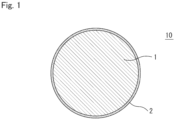
- Fig . 1 is a view schematically illustrating an example of a positive electrode active material according to the present embodiment.
- a positive electrode active material 10 includes a lithium-nickel composite oxide particle 1 and a coating layer 2 coating a surface of the particle 1.
- a coating layer 2 coating a surface of the particle 1.
- the lithium-nickel composite oxide particle 1 has a crystal structure belonging to a space group R-3 m, and is a composite oxide containing at least lithium (Li), nickel (Ni), manganese (Mn), and an element M.
- the above mole number ratio preferably satisfies 0.97 ⁇ a ⁇ 1.08, 0 ⁇ x ⁇ 0.3, 0 ⁇ y ⁇ 0.3, and 0 ⁇ x + y ⁇ 0.5.
- a indicating the content ratio of Li may be 0.95 ⁇ a ⁇ 1.10 and 0.97 ⁇ a ⁇ 1.08.
- a is less than 0.95, Li is deficient in the positive electrode active material, and a capacity as a battery material is likely to decrease.
- a is more than 1.10, the crystal structure of the lithium-nickel composite oxide particle 1 excessively grows, the primary particle is coarse, and the particle 1 is easily cracked. Therefore, durability is easily impaired.
- a may be 1.00 or more or may exceed 1.00.
- (1 - x - y) indicating the content ratio of Ni is 0.3 or more and less than 1.0, and preferably 0.5 or more and less than 1.0.
- a range including the lower limit of the content ratio of Ni is preferably 0.6 or more, and may be 0.7 or more.
- the upper limit of the content ratio of (1 - x - y) may be 0.9 or less or 0.85 or less from the viewpoint of suitably performing charge and discharge at a high voltage.
- (1 - x - y) is less than 0.3, the battery capacity decreases.
- x indicating the content ratio of Mn may be 0 ⁇ x ⁇ 0.5, 0 ⁇ x ⁇ 0.4 or less, or 0 ⁇ x ⁇ 0.3 or less.
- the lower limit of x indicating the content ratio of Mn may be, for example, 0.05 or more.
- the element M is preferably at least one selected from the group consisting of Co, Al, Zr, Si, Zn, Nb and Ti.
- the element M preferably contains at least one element selected from cobalt (Co) and aluminum (Al), may contain cobalt (Co) and aluminum (Al), and more preferably contains cobalt (Co).
- the element M can be appropriately selected according to an application of a secondary battery formed using the positive electrode active material 10 and required performance. Note that the element M may not contain Nb.
- y indicating the content ratio of the element M may satisfy 0 ⁇ y ⁇ 0.5, preferably 0 ⁇ y ⁇ 0.3, and 0 ⁇ y ⁇ 0.2.
- the battery has a high battery capacity and is more excellent in cycle characteristics.
- the range (x1) of Co may be, for example, 0 ⁇ y1 ⁇ 0.3 or 0 ⁇ y1 ⁇ 0.2.
- the range (y2) of Al may be, for example, 0 ⁇ y2 ⁇ 0.1 or 0 ⁇ y2 ⁇ 0.07.
- the lithium-nickel composite oxide particle 1 has a crystal structure belonging to a space group R-3 m.
- an increase in internal resistance can be suppressed in the secondary battery.
- the crystal structure of the lithium-nickel composite oxide particle 1 can be confirmed by powder X-ray diffraction (XRD) measurement. That is, a peak attributed to a layered rock salt type crystal structure of the "R-3m" structure (crystal structure belonging to the space group R-3m) is preferably detected from a diffraction pattern obtained when powder X-ray diffraction (XRD) measurement of the lithium-nickel composite oxide particle 1 is performed. In particular, only a peak attributed to the layered rock salt type crystal structure of the "R-3m” structure is more preferably detected from the above diffraction pattern.
- XRD powder X-ray diffraction
- the lithium-nickel composite oxide particle 1 may be formed of a lithium-nickel composite oxide single phase having the crystal structure of the "R-3m” structure, but does not have to be formed of a single phase.
- the lithium-nickel composite oxide particle 1 is not formed of a single layer but contains another compound (for example, impurities), preferably, the intensity of a heterophasic peak other than the layered rock salt type structure of the "R-3m” structure does not exceed the peak intensity attributed to the layered rock salt type structure of the "R-3m” structure.
- the Li site occupancy of the positive electrode active material is 90% or more and 98.5% or less, may be 90% or more and 98% or less, may be 92% or more and 98% or less, or may be 93% or more and 98% or less.
- the Li site occupancy indicates an existence ratio of lithium (Li) of the lithium-metal composite oxide in the lithium layer (Li site) having a layered structure.
- the positive electrode active material in which cation mixing occurs at a specific ratio when charge and discharge are performed at a high voltage it is considered that expansion and contraction of the volume are suppressed while having a high charge and discharge capacity, and the cycle capacity retention rate (durability) is improved.
- the lower limit of the Li site occupancy may be 90% or more, 92% or more, 93% or more, or 95% or more.
- the upper limit of the Li site occupancy may be 98.5% or less or 98% or less.
- the lithium-nickel composite oxide particle 1 by setting the Li site occupancy to a specific range to be described late in combination with setting the crystallite diameter and the eluted lithium amount to the range described above, it is possible to achieve both the battery capacity and the charging and discharging cycle capacity retention rate at a high level when charging and discharging at a high voltage.
- the method for evaluating the Li site occupancy is not particularly limited, and can be obtained, for example, by performing Rietveld analysis on a diffraction pattern obtained by an X-ray diffraction method (XRD).
- XRD X-ray diffractometer
- the Li site occupancy can be determined by performing Rietveld analysis on the diffraction pattern obtained by measuring the positive electrode active material using, for example, analysis programs such as High_Score_Plus (manufactured by Spectris Co. , Ltd.) and JADE_PRO (manufactured by Materials Data, Inc.) in addition to generally and widely used RIETAN-FP.
- the lithium-nickel composite oxide particle 1 has a crystallite diameter of preferably 140 nm or less, more preferably 70 nm or more and 140 nm or less. In addition, a range including the upper limit of the crystallite diameter may be 130 nm or less. Note that the crystallite diameter can be calculated by a Scherrer method using a peak attributed to (003) of the above XRD diffraction pattern. When the crystallite diameter of the lithium-nickel composite oxide particle 1 is more than 140 nm, an in-solid diffusion distance in the crystal may be long, and a battery capacity may decrease. In addition, when the crystallite diameter of the lithium-nickel composite oxide particle 1 is less than 70 nm, the crystal structure is unstable, and the battery capacity tends to decrease.
- the lower limit of the crystallite diameter may be 70 nm or more, 90 nm or more, or 100 nm or more.
- the upper limit of the crystallite diameter may be 140 nm or less, 130 nm or less, or 125 nm or less.
- an eluted lithium ion amount determined by neutralization titration is 0.05% by mass or more and 0.50% by mass or less, and preferably 0.05% by mass or more and 0.40% by mass or less with respect to the total amount of the particles 1.
- the eluted lithium ion amount can be determined by measuring a lithium ion amount eluted into water when the lithium-nickel composite oxide particle 1 is dispersed in water by a neutralization titration method using hydrochloric acid.
- a neutralization titration method a Warder method or a Winkler method can be used.
- the eluted lithium ion amount may be less than 0.30% by mass or 0.25% by mass or less. In addition, the eluted lithium ion amount may be 0.10% by mass or more.
- the battery can have a sufficient battery capacity.
- the eluted lithium ion amount of the lithium-nickel composite oxide particle 1 is less than 0.05% by mass, the battery capacity may decrease. Details of a reason for this are not clear.
- the lithium-nickel composite oxide particle 1 includes a secondary particle formed by aggregation of a plurality of primary particles.
- the lithium-nickel composite oxide particle 1 may contain a single primary particle, and may be a mixture of a single primary particle and a secondary particle.
- the average particle size of the secondary particles is preferably 8.0 ⁇ m or less, and preferably 3.0 ⁇ m or more and 8.0 ⁇ m or less when observed with a scanning electron microscope (SEM), a transmission electron microscope (TEM), or the like.
- the secondary particle is preferably formed by aggregation of a large number of primary particles each having a particle size of 0.1 ⁇ m or more and 2.0 ⁇ m or less.
- the primary particle when the lithium-nickel composite oxide particle 1 contains a single primary particle, the primary particle preferably has a particle size of 1.0 ⁇ m or more and 8.0 ⁇ m or less. Note that the average particle sizes of the primary particles and the secondary particles can be obtained, for example, by calculating an average of area circle equivalent diameters of 20 or more particles.
- the lithium-nickel composite oxide particle 1 has a particle size corresponding to an integrated volume ratio of 50% in an integrated volume distribution curve of particle size distribution (D50, hereinafter also referred to as "average particle size D50) of preferably 8 ⁇ m or less, more preferably 2 ⁇ m or more and 8 ⁇ m or less, more preferably 2 ⁇ m or more and 7 ⁇ m or less, still more preferably 3 ⁇ m or more and 7 ⁇ m or less.
- the average particle size (D50) means a particle size (D50) corresponding to an integrated volume ratio of 50% in an integrated volume distribution curve of a particle size distribution measured by a laser light diffraction scattering particle size distribution meter.
- the average particle size D50 of the lithium-nickel composite oxide particle 1 is in the range described above, in the secondary battery using the positive electrode active material 10 for the positive electrode, the capacity retention rate after cycle measurement at a high voltage can be improved, and excellent battery characteristics such as thermal stability and high output can be obtained. Note that when the average particle size D50 is 2 ⁇ m or less, the particles are likely to aggregate when the coating layer 2 is applied.
- [(d90 - d10)/volume average particle size Mv] which is an index indicating spread of particle size distribution of the lithium-nickel composite oxide particle 1, is not particularly limited, and may be 0.7 or less, 0.6 or less, or 0.55 or less from a viewpoint of making the particle sizes uniform.
- a lower limit of [(d90 - d10)/volume average particle size Mv] is not particularly limited, but is, for example, 0.3 or more.
- [(d90 - d10)/volume average particle size Mv] may be 0.7 or more from a viewpoint of filling property, and the surfaces of the lithium-nickel composite oxide particle 1 can be coated with the coating layer 2 relatively uniformly by using a method for manufacturing a positive electrode active material described later.
- d10 means a particle size at which the accumulated volume is 10% of the total volume of all particles when the number of particles in each particle size is accumulated from the smaller particle size side.
- d90 means a particle size at which the accumulated volume is 90% of the total volume of all particles when the number of particles in each particle size is accumulated from the smaller particle size side in the same manner.
- d10, d90, and the volume average particle size Mv can be determined from a volume integrated value measured using a laser light diffraction scattering type particle size analyzer in a similar manner to the average particle size D50.
- a specific surface area of the lithium-nickel composite oxide particle 1 is not particularly limited, and may be, for example, 0.3 m 2 /g or more and 2.0 m 2 /g or less, or 0.3 m 2 /g or more and 1.0 m 2 /g or less. When the specific surface area is within the above range, output characteristics are favorable. Note that the specific surface area can be measured by a nitrogen adsorption BET method. In addition, the lower limit of the specific surface area may be 0.35m 2 /g or more, or 0.40m 2 /g or more.
- the positive electrode active material 10 includes the coating layer 2 on a surface of the lithium-nickel composite oxide particle 1.
- the coating layer 2 on the surface of the particle 1 in a secondary battery including a positive electrode containing the positive electrode active material 10, an interaction between the positive electrode active material 10 and the solid electrolyte can be suppressed.
- the coating layer 2 is a composite oxide containing lithium (Li) and one or more elements selected from the group consisting of Al, Si, Ti, V, Ga, Ge, Zr, Nb, Mo, Ta, and W. Note that as a constituent element of the coating layer 2 excluding lithium (Li) and oxygen (O), one type of element or two or more types of elements may be included.
- the coating layer 2 may be, for example, a composite oxide formed of Li and Ti or a composite oxide formed of Li and Nb.
- a coating amount by the coating layer 2 is not particularly limited, but the coating amount can be adjusted according to the specific surface area (m 2 /g) of the lithium-nickel composite oxide particle 1 to be coated.
- the coating layer 2 contains a constituent element (excluding Li and O) of the coating layer 2 at a ratio of preferably 30 ⁇ mol or more and 600 ⁇ mol or less, more preferably 50 ⁇ mol or more and 400 ⁇ mol or less per m 2 of the surface area of the lithium-nickel composite oxide particle 1.
- the coating layer 2 can be uniformly disposed on the entire surfaces of the lithium-nickel composite oxide particle 1.
- the coating layer by forming the coating layer, a reaction between the lithium-nickel composite oxide particle 1 and the solid electrolyte can be suppressed, but at the same time, internal resistance of the secondary battery may increase.
- the content of the constituent element (excluding Li and O) of the coating layer 2 per m 2 of the surface area of the lithium-nickel composite oxide particle 1 is 600 ⁇ mol or less, the coating layer 2 can be suppressed from hindering a reaction of intercalation/deintercalation of lithium with respect to the lithium-nickel composite oxide particle 1, and the internal resistance can be reduced.
- a method for evaluating and calculating the content of the constituent element (excluding Li and O) of the coating layer 2 in the coating layer 2 is not particularly limited, but can be determined, for example, as follows.
- the content of the constituent element (excluding Li and O) of the coating layer 2 in 1 g of the positive electrode active material is measured by a method such as chemical analysis.
- a method such as chemical analysis.
- measurement is performed by inductively coupled plasma (ICP) emission spectroscopy or the like.
- the specific surface area of the lithium-nickel composite oxide particle 1 before the lithium-nickel composite oxide particle 1 is coated with the coating layer 2 is measured by a nitrogen adsorption BET method or the like.
- the content of the constituent element (excluding Li and O) of the coating layer 2 in 1 g of the positive electrode active material by dividing the content of the constituent element (excluding Li and O) of the coating layer 2 in 1 g of the positive electrode active material by the specific surface area (m 2 /g) of the lithium-nickel composite oxide particle 1, the content of the constituent element (excluding Li and O) of the coating layer 2 per m 2 of the surface area of the lithium-nickel composite oxide particle 1 can be determined.
- the lithium-nickel composite oxide particle 1 contains the constituent element (excluding Li and O) of the coating layer 2
- a difference in the content of the constituent element (excluding Li and O) of the coating layer 2 before and after coating can be used as the content of the constituent element (excluding Li and O) of the coating layer 2 used for coating.
- the coating layer has an average thickness of, for example, preferably 2 nm or more and 20 nm or less, more preferably 2 nm or more and 15 nm or less, still more preferably 5 nm or more and 15 nm or less.
- the average thickness of the coating layer 2 can be calculated by observing the coating layer 2 with a scanning electron microscope (SEM), a transmission electron microscope (TEM), or the like, or analyzing the coating layer 2 with a spectroscope such as an energy dispersive X-ray spectrometer (EDS) or an electron energy loss spectroscopy (EELS) attached thereto, and measuring a layer uniformly formed on a surface of the lithium-nickel composite oxide particle 1.
- a spectroscope such as an energy dispersive X-ray spectrometer (EDS) or an electron energy loss spectroscopy (EELS) attached thereto, and measuring a layer uniformly formed on a surface of the lithium-nickel composite oxide particle 1.
- EDS energy dispersive X-ray spectrometer
- EELS electron energy loss spectroscopy
- the coating layer 2 is preferably present adjacent to a surface of the lithium-nickel composite oxide particle 1. Whether or not the coating layer 2 is present adjacent to the surface of the particle 1 can be determined by whether or not a compound containing the constituent element of the coating layer 2 is present free from the surface of the lithium-nickel composite oxide particle 1. When the coating layer 2 is present free from the surface of the lithium-nickel composite oxide particle 1, the coating layer 2 does not electrochemically contribute to a battery capacity, which causes a decrease in battery capacity per weight.
- the coating layer 2 refers to a region where the constituent element (excluding Li and O) of the coating layer 2 is detected, and may include a region where both the constituent element (excluding Li and O) of the coating layer 2 and an element constituting the lithium-nickel composite oxide particle 1 are detected.
- the coating layer 2 refers to a region (site) on a surface side of a particle constituting the positive electrode active material 10, in which the concentration of the constituent element (excluding Li and O) of the coating layer 2 is higher than that of a center of the lithium-nickel composite oxide particle 1.
- the constituent element (excluding Li and O) of the coating layer 2 may be partially solid-solved from a surface to an inside of the lithium-nickel composite oxide particle.
- a heat treatment step (S40) is performed after a coating step (S30), and the coating layer constituent element of the coating layer can be diffused into the lithium-nickel composite oxide according to conditions at this time.
- the coating layer 2 when Ti and/or Nb is contained in the coating layer 2, Ti and/or Nb is solid-solved from a surface to an inside of the lithium-nickel composite oxide particle 1.
- the coating layer 2 not only prevents the solid electrolyte and the lithium-nickel composite oxide particle 1 from coming into direct contact with each other to reduce a chance of reaction, but also reduces reactivity between a surface layer of the lithium-nickel composite oxide particle 1 and the solid electrolyte.
- the degree of solid solution is preferably adjusted such that an effect of improving cycle characteristics can be sufficiently exhibited.
- the positive electrode active material 10 can be manufactured with high productivity.
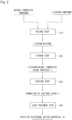
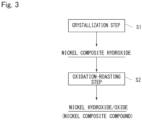
- Figs. 2 and 3 are each a diagram illustrating an example of the method for manufacturing a positive electrode active material according to the present embodiment.
- the method for manufacturing a positive electrode active material according to the present embodiment includes a mixing step (S10) of mixing a nickel composite compound, and a lithium compound to obtain a mixture, a firing step (S20) of firing the mixture to obtain lithium-nickel composite oxide particles, and a coating step (S30) of forming a coating layer by attaching a coating liquid to surfaces of the lithium-nickel composite oxide particles.
- the heat treatment step (S40) of heat-treating the lithium-nickel composite oxide particles having the coating layer formed on surfaces thereof at 300°C or higher may be included.
- the nickel composite compound may be a nickel composite oxide obtained by oxidation-roasting of a nickel composite hydroxide prepared by a crystallization reaction.
- the nickel composite compound can be manufactured by a method including a crystallization step (S1) and an oxidation-roasting step (S2).
- S1 crystallization step
- S2 oxidation-roasting step
- a nickel composite hydroxide as a precursor of the lithium-nickel composite oxide is prepared by a crystallization reaction.
- a raw material aqueous solution is prepared using water soluble compounds (metal compounds) of elements such that a mole number ratio among the elements is equal to a mole number ratio among elements contained in the target lithium-nickel composite oxide particle, and the prepared raw material aqueous solution, and an alkali metal aqueous solution and an ammonium ion supplier are supplied together to a reaction tank and subjected to a neutralization crystallization reaction to obtain a nickel composite hydroxide.
- metal compounds water soluble compounds
- raw materials of the elements may be simultaneously dissolved in water to manufacture a raw material aqueous solution as a mixed aqueous solution.
- an individual aqueous solution may be prepared for each of the raw materials of the elements to prepare an individual raw material aqueous solution.
- the liquid properties of the aqueous solutions of the raw materials are acidic and basic, it is preferable to prepare the individual raw material aqueous solution for each of the raw materials.
- the metal compound used as a raw material of each of the elements only needs to be water soluble, and a sulfate, a chloride, a nitrate, or the like can be used, but an inexpensive sulfate is preferable from a viewpoint of cost.
- the element M or the like may be added in the oxidation-roasting step (S2) or the mixing step (S10) described later without being added to the mixed aqueous solution of the raw materials.
- the alkali metal aqueous solution is not particularly limited, but one or more selected from the group consisting of sodium hydroxide, sodium carbonate, sodium hydrogen carbonate, potassium hydroxide, and potassium carbonate can be preferably used.
- the ammonium ion supplier is not particularly limited, but one or more selected from ammonia water, an ammonium carbonate aqueous solution, an ammonium chloride aqueous solution, and an ammonium sulfate aqueous solution can be preferably used.
- the shape of the reaction tank is not particularly limited, but the reaction tank is preferably a cylindrical container including a baffle plate therein and equipped with a stirrer and a temperature controller.
- the stirrer preferably includes a motor, a shaft, and a stirring blade.
- the temperature controller preferably circulates a heating medium outside the cylindrical container to heat or cool the cylindrical container.
- a pH and an ammonia concentration are preferably maintained at constant values.
- the pH of the aqueous solution in the reaction tank is preferably adjusted to 11.0 or more and 12.2 or less based on a liquid temperature of 25°C.
- impurities derived from anions constituting the metal compound contained in the raw material aqueous solution used may be mixed into the nickel composite hydroxide.
- a pH value of the initial aqueous solution (in the reaction tank) it is possible to suppress contamination of impurities derived from anions.
- the pH of the initial aqueous solution to 12.2 or less, it is possible to suppress micronization of the nickel composite hydroxide obtained and to obtain a composite hydroxide having a particle size suitable for a charge and discharge reaction.
- the nuclear generation step may be performed with the pH of the initial aqueous solution prepared in the reaction tank adjusted to 12.0 or more and 14.0 or less on the basis of a liquid temperature of 25°C, and then the crystallization reaction (particle growth step) may be performed at a pH lower than that in the previous step.
- the pH of the reaction aqueous solution may be adjusted to 12.0 or more and 14.0 or less on the basis of a liquid temperature of 25°C, and then the crystallization reaction may be terminated.
- the ammonia concentration of the aqueous solution in the reaction tank is preferably adjusted to 5 g/L or more and 20 g/L or less.
- the ammonia concentration is 5 g/L or more, Ni in the raw material aqueous solution (mixed aqueous solution) forms an ammonium complex, and a precipitation rate decreases from a liquid phase to a solid phase as a hydroxide. Therefore, the sphericity of a particle of the nickel composite hydroxide obtained increases.
- ammonia concentration is 20 g/L or less, it is possible to suppress an excessive increase in the solubility of nickel forming the ammonium complex and to more reliably set the mole number ratio of the nickel composite hydroxide obtained to the target mole number ratio. In addition, excessive consumption of ammonia can be suppressed, which is industrially preferable.
- the atmosphere in the reaction tank is preferably a non-oxidizing atmosphere, for example, an atmosphere having an oxygen concentration of 1% by volume or less.
- a non-oxidizing atmosphere oxidation of the raw material compound and the like can be suppressed. For example, it is possible to prevent oxidized cobalt and manganese from being precipitated as fine particles.
- the temperature in the reaction tank in the crystallization step (S1) is maintained preferably at 40°C or higher and 60°C or lower, more preferably at 45°C or higher, still more preferably at 55°C or lower.
- the lithium-nickel composite oxide particles are preferably particles having a narrow spread of particle size distribution and a uniform particle size. In order to prepare such particles, it is necessary to obtain particles having a uniform particle size in the nickel composite hydroxide as a precursor thereof. As a method for obtaining such particles, specifically, Patent Literature 3 and the like can be exemplified.
- the oxidation-roasting step (S2) may be performed.
- the nickel composite hydroxide obtained in the precursor crystallization step (S1) is oxidation-roasted to obtain a nickel composite oxide.
- heat treatment is performed in an oxygen-containing atmosphere, and then cooling is performed to room temperature, whereby the nickel composite oxide can be obtained.
- Roasting conditions in the oxidation-roasting step (S2) are not particularly limited, but for example, roasting is preferably performed at a temperature of 500°C or higher and 700°C or lower for one hour or more and 12 hours or less in an oxygen-containing atmosphere or in an air atmosphere.
- the roasting temperature is 500°C or higher
- the nickel composite hydroxide can be completely converted into the nickel composite oxide.
- the roasting temperature is set to 700°C or lower, it is possible to suppress an excessive decrease in the specific surface area of the nickel composite oxide, which is preferable.
- the roasting time is preferably 12 hours or less from a viewpoint of energy efficiency.
- the oxygen concentration in the oxygen-containing atmosphere during roasting is preferably equal to or more than the oxygen concentration in air, that is, the oxygen concentration is preferably 20% by volume or more. Since an oxygen atmosphere can be used, an upper limit of the oxygen concentration in the oxygen-containing atmosphere can be 100% by volume.
- the compound containing the element M when the compound containing the element M cannot be coprecipitated in the crystallization step (S1), for example, the compound containing the element M may be added to the nickel composite hydroxide to be subjected to the oxidation-roasting step S2 so as to have the same mole number ratio as the target mole number ratio, and firing may be performed.
- the compound containing the element M to be added is not particularly limited, and for example, an oxide, a hydroxide, a carbonate, or a mixture thereof can be used.
- a crushing treatment may be performed. Note that in the oxidation-roasting step (S2), at least a part of the nickel composite hydroxide only needs to be converted into the nickel composite oxide, and the entire nickel composite hydroxide does not have to be converted into the oxide.
- the mixing step (S10) is a step of mixing a nickel composite compound, and a lithium compound to obtain a lithium mixture.
- the nickel composite compound is preferably at least one of a nickel composite hydroxide and a nickel composite oxide, and more preferably a nickel composite oxide.
- the nickel composite compound is preferably obtained by a method including the crystallization step (S1) and the oxidation-roasting step (S2) described above.
- the lithium compound is not particularly limited, and for example, lithium hydroxide, lithium nitrate, lithium carbonate, or a mixture thereof can be used.
- lithium hydroxide is preferably used from a viewpoint of low melting point and high reactivity.
- the lithium compound may be mixed in an amount such that the content of lithium is 95% by atom or more and 110% by atom or less, or may be mixed in an amount of 97% by atom or more and 108% by atom or less with respect to the sum (Me) of Ni, Mn, and the element M.
- the firing step (S20) is a step of firing the obtained lithium mixture to obtain the lithium-nickel composite oxide particle 1.
- Firing conditions are not particularly limited, but for example, firing is preferably performed at a temperature of 700°C or higher and 1000°C or lower for one hour or more and 24 hours or less in an oxygen-containing atmosphere.
- cooling may be performed to room temperature to obtain the lithium-nickel composite oxide particle 1.
- the firing conditions such as a firing temperature, a firing time, and a firing atmosphere can be appropriately adjusted within the above ranges so as to obtain desired characteristics (Li site occupancy, crystallite diameter, eluted lithium ion amount, and the like).
- the firing temperature is 700°C or higher, the crystal structure of the lithium-nickel composite oxide particle 1 can be sufficiently grown.
- the firing temperature is 1000°C or lower, excessive mixing of Ni atoms into Li sites in the lithium-nickel composite oxide particle 1 to be obtained can be suppressed.
- the firing temperature may be 750°C or higher, 800°C or higher, or 820°C or higher.
- the firing time is preferably 24 hours or less from a viewpoint of energy efficiency, may be 12 hours or less, may be ten hours or less, or may be six hours or less.
- the oxygen-containing atmosphere is preferably an atmosphere containing 80% by volume or more of oxygen. This is preferable because the crystal structure of the lithium-nickel composite oxide particle 1 can be sufficiently grown by adjusting the oxygen concentration in the atmosphere to 80% by volume or more. Since an oxygen atmosphere can be used, an upper limit of the oxygen concentration in the oxygen-containing atmosphere can be 100% by volume.
- the coating step (S30) is a step of forming the coating layer 2 by attaching a coating liquid to surfaces of the obtained lithium-nickel composite oxide particle 1.
- the lithium-nickel composite oxide particle 1 and the coating liquid are mixed and dried to form the coating layer 2 on surfaces of the lithium-nickel composite oxide particle 1.
- the heat treatment step (S40) may be optionally performed in an oxygen-containing atmosphere.
- an example of the coating step (S30) will be described.
- a coating liquid is prepared in a predetermined amount (coating agent preparation step).
- the coating agent can be prepared according to the content of the constituent element (excluding Li and O) of the coating layer 2 per specific surface area (m 2 /g) of the lithium-nickel composite oxide particle 1 obtained in the firing step (S20).
- the coating liquid contains at least one element selected from the group consisting of Al, Si, Ti, V, Ga, Ge, Zr, Nb, Mo, Ta, and W.
- the coating liquid can be prepared by dissolving a raw material compound containing the target constituent element (excluding Li and O) of the coating layer 2 in a solvent.
- Examples of the raw material compound include one or more selected from the group consisting of alkoxides and chelates using a complex having a carbonyl group, a peroxy group, and the like.
- the coating liquid only needs to be liquid at the time of attaching the coating liquid to surfaces of the lithium-nickel composite oxide particle 1 from a viewpoint of uniform coating.
- the coating liquid may be prepared by dissolving a compound containing the constituent element of the coating layer 2 in a solvent such that the resulting solution is liquid at normal temperature, or may be a compound containing the constituent element of the coating layer 2 having a low melting point and dissolved by heat treatment at a low temperature.
- the coating liquid may contain Li, or does not have to contain Li.
- the coating liquid does not contain Li, in the coating step (S30) and/or the heat treatment step (S40), Li present in the lithium-nickel composite oxide particle 1 reacts with the above compound containing the constituent element in the coating liquid, whereby the coating layer 2 can be formed.
- the coating liquid is attached to surfaces of the lithium-nickel composite oxide particle 1.
- the attachment of the coating liquid may be performed, for example, by mixing the lithium-nickel composite oxide particle 1 and the coating liquid (mixture preparation step).
- a general mixer can be used for mixing.
- drying may be performed after mixing (drying step).
- the mixture preparation step and the drying step preferably proceed in parallel, and a rolling fluid coating apparatus is preferably used from a viewpoint of forming the coating layer 2 that is more uniform and has a specific thickness.
- the coating liquid shrinks by drying, a gap is formed in the coating layer 2 formed only by performing the mixture preparation step once and the drying step once, and a function of protecting contact between the lithium-nickel composite oxide particle 1 and the solid electrolyte cannot be sufficiently exhibited in some cases.
- the coating liquid is sprayed onto the lithium-nickel composite oxide particle 1 flowing by an air flow heated in the apparatus. Therefore, the mixture preparation step and the drying step are repeated in parallel, and a uniform coating layer having no gap is obtained, which is preferable.
- drying is preferably performed at a temperature at which a solvent and the like of the coating agent can be sufficiently removed.
- a temperature at which a solvent and the like of the coating agent can be sufficiently removed For example, when a rolling fluid coating apparatus is used, an air supply temperature may be set to 80°C or higher and lower than 300°C. After the coating treatment, additional drying may be performed by a stationary dryer separately.
- the atmosphere in the drying step is not particularly limited, but in order to prevent the lithium-nickel composite oxide particle 1 from reacting with moisture in the atmosphere, air supplied from a compressor equipped with a dryer, an inert atmosphere such as nitrogen or an argon gas, or the like is preferable.
- the heat treatment step (S40) of heat-treating the lithium-nickel composite oxide particle 1 having the coating layer 2 formed on surfaces thereof at 300°C or higher may be included as necessary. Bonding between the coating layer 2 and the lithium-nickel composite oxide particle 1 can be further strengthened by the heat treatment step (S40).
- Thermal treatment conditions in the heat treatment step (S40) are not particularly limited, but the heat treatment is preferably performed at a temperature of 300°C or higher and 600°C or lower for one hour or more and five hours or less in an oxygen-containing atmosphere.
- the oxygen-containing atmosphere may be, for example, an air atmosphere.
- the oxygen concentration in the oxygen-containing atmosphere in the heat treatment step (S40) is preferably equal to or higher than the oxygen concentration in the air atmosphere, that is, the oxygen concentration is preferably 20% by volume or higher.
- the oxygen-containing atmosphere may be an oxygen atmosphere, and an upper limit value of the oxygen concentration in the oxygen-containing atmosphere is 100% by volume.
- the heat treatment temperature is 300°C or higher, remaining of impurities contained in the coating liquid in the positive electrode active material 10 can be further suppressed.
- the heat treatment temperature is 600°C or lower, excessive diffusion of the components of the coating layer 2 can be suppressed, and the form of the coating layer 2 can be maintained.
- the thermal treatment time is one hour or more, remaining of impurities contained in the coating liquid in the positive electrode active material 10 can be further suppressed. In addition, even when the thermal treatment time is longer than five hours, no significant change is observed in the positive electrode active material 10 obtained. Therefore, the thermal treatment time is preferably five hours or less from a viewpoint of energy efficiency.
- step S40 After the heat treatment step (step S40), cooling is performed to room temperature to obtain, as a final product, a positive electrode active material containing the lithium-nickel composite oxide particle 1 and the coating layer 2 formed on surfaces of the lithium-nickel composite oxide particle 1.
- the heat treatment step (S40) does not have to be performed. That is, the steps up to the coating step (S30) may be performed to manufacture the positive electrode active material 10. This is because even when the heat treatment step (S40) is not performed, the coating layer can be uniformly and firmly formed on surfaces of the lithium-nickel composite oxide particles. Even when the heat treatment step is not performed, drying is preferably performed in order to reduce or remove a solvent, moisture, and the like of the coating agent as necessary.
- a crushing treatment may be further performed.
- the all-solid-state lithium ion secondary battery (hereinafter also referred to as "all-solid-state battery") according to the present embodiment includes a positive electrode, a negative electrode, and a solid electrolyte, and contains the above positive electrode active material in the positive electrode.
- all-solid-state battery according to the present embodiment will be described for each component.
- the embodiment described below is merely examples, and the all-solid-state battery can be implemented in various modified and improved forms based on knowledge of those skilled in the art including the following embodiment.
- an application of the all-solid-state battery is not particularly limited.
- the positive electrode can be formed by molding a positive electrode mixture. Note that the positive electrode is appropriately treated according to a battery to be used. For example, in order to increase the electrode density, a pressure compression treatment by pressing or the like can be performed.
- the above-described positive electrode mixture can be formed, for example, by mixing the above-described positive electrode active material in a powder state and a solid electrolyte.
- the solid electrolyte is added in order to impart appropriate ionic conductivity to the electrode.
- a material of the solid electrolyte is not particularly limited, but for example, a sulfide solid electrolyte such as Li 3 PS 4 , Li 7 P 3 S 11 , or Li 10 GeP 2 S 12 , an oxide-based solid electrolyte such as Li 7 La 3 Zr 2 O 12 or Li 0.34 La 0.51 TiO 2.94 , and a polymer-based electrolyte such as PEO can be used.
- a sulfide solid electrolyte such as Li 3 PS 4 , Li 7 P 3 S 11 , or Li 10 GeP 2 S 12
- an oxide-based solid electrolyte such as Li 7 La 3 Zr 2 O 12 or Li 0.34 La 0.51 TiO 2.94
- PEO polymer-based electrolyte
- a binding agent or a conductive auxiliary agent can also be added to the positive electrode mixture.
- the binding agent plays a role of binding the positive electrode active material.
- the binding agent used in such a positive electrode mixture is not particularly limited. However, for example, one or more selected from the group consisting of polyvinylidene fluoride (PVDF), polytetrafluoroethylene (PTFE), fluororubber, ethylene propylene diene rubber, styrene butadiene, a cellulose-based resin, polyacrylic acid, and the like can be used.
- the conductive material is added to impart appropriate conductivity to the electrode.
- the material of the conductive material is not particularly limited, but for example, graphite such as natural graphite, artificial graphite, and expanded graphite, and carbon black-based materials such as acetylene black and Ketjen black (registered trademark) can be used.
- a mixing ratio among the substances in the positive electrode mixture is not particularly limited.
- the content of the positive electrode active material in the positive electrode mixture can be 50 parts by mass or more and 90 parts by mass or less, and the content of the solid electrolyte can be 10 parts by mass or more and 50 parts by mass or less.
- a method for preparing the positive electrode is not limited to the above-described exemplified one, and another method may be adopted.
- the negative electrode can be formed by molding a negative electrode mixture.
- the negative electrode is formed by a substantially similar method to that of the positive electrode described above although components constituting the negative electrode mixture, blending thereof, and the like are different, and various treatments are performed as necessary in a similar manner to the positive electrode.
- the negative electrode mixture can be prepared by mixing a negative electrode active material and a solid electrolyte.
- a negative electrode active material for example, an occluding material capable of occluding and releasing lithium ions can be adopted.
- the occluding material is not particularly limited, but for example, one or more selected from the group consisting of natural graphite, artificial graphite, a fired product of an organic compound such as a phenol resin, and a powder of a carbon substance such as coke can be used.
- a sulfide electrolyte such as Li 3 PS 4 can be used as the solid electrolyte similarly to the positive electrode.
- the negative electrode active material for example, a sheet-shaped member made of a substance containing metal lithium or a metal to be alloyed with lithium, such as indium, can be used.
- the solid electrolyte is a solid having Li + ionic conductivity.
- the solid electrolyte one selected from the group consisting of a sulfide, an oxide, a polymer, and the like can be used singly or in combination of two or more types thereof.
- the sulfide solid electrolyte is not particularly limited, and any compound which contains sulfur (S) and exhibits lithium ion conductivity and electronic insulation property can be used.
- the sulfide solid electrolyte include Li 2 S-P 2 S 5 , Li 2 S-SiS 2 , LiI-Li 2 S-SiS 2 , LiI-Li 2 S-P 2 S 5 , LiI-Li 2 S-B 2 S 3 , Li 3 PO 4 -Li 2 S-Si 2 S, Li 3 PO 4 -Li 2 S-SiS 2 , LiPO 4 -Li 2 S-SiS, LiI-Li 2 S-P 2 O 5 , and LiI-Li 3 PO 4 -P 2 S 5 .
- the oxide-based solid electrolyte is not particularly limited, and any compound which contains oxygen (O) and exhibits lithium ion conductivity and electronic insulation property can be used.
- oxide-based solid electrolyte examples include lithium phosphate (Li 3 PO 4 ), Li 3 PO 4 NX, LiBO 2 NX, LiNbO 3 , LiTaO 3 , Li 2 SiO 3 , Li 4 SiO 4 -Li 3 PO 4 , Li 4 SiO 4 -Li 3 VO 4 , Li 2 O-B 2 O 3 -P 2 O 5 , Li 2 O-SiO 2 , Li 2 O-B 2 O 3 -ZnO, Li 1+X AlxTi 2-X (PO 4 ) 3 (0 ⁇ X ⁇ 1), Li 1+X Al X Ge 2-X (PO 4 ) 3 (0 ⁇ X ⁇ 1), LiTi 2 (PO 4 ) 3 , Li 3 XLa 2/3-X TiO 3 (0 ⁇ X ⁇ 2/3), Li 5 La 3 Ta 2 O 12 , Li 7 La 3 Zr 2 O 12 , Li 6 BaLa 2 Ta 2 O 12 , and Li 3.6 Si 0.6 P 0.4 O 4
- inorganic solid electrolyte ones other than the above-described inorganic solid electrolytes may be used, and for example, Li 3 N, LiI, Li 3 N-LiI-LiOH, and the like may be used.
- the polymer-based solid electrolyte is not particularly limited as long as it is a polymer compound that exhibits ionic conductivity, and for example, polyethylene oxide, polypropylene oxide, and copolymers of these can be used.
- the organic solid electrolyte may contain a supporting salt (lithium salt). Note that in the case of using a solid electrolyte, the solid electrolyte may also be mixed in the positive electrode material in order to secure the contact of the electrolyte with the positive electrode active material.
- the all-solid-state battery including the above positive electrode, negative electrode, and solid electrolyte can be formed into various shapes such as a coin shape and a stacked shape. In any shape, the positive electrode and the negative electrode can be stacked with the solid electrolyte interposed therebetween. Then, a positive electrode collector and a positive electrode terminal connected to the outside are connected to each other using a current collecting lead or the like, and a negative electrode collector and a negative electrode terminal connected to the outside are connected to each other using a current collecting lead or the like. The resulting product is sealed in a battery case to form an all-solid-state battery.
- the all-solid-state battery using the positive electrode active material according to the present embodiment has a high cycle capacity retention rate (durability), and can be suitably used particularly when charging and discharging at a high voltage (for example, the upper limit voltage is 4.5 V or more based on metal lithium).
- the cycle capacity retention rate discharge capacity after 100 cycles/initial discharge capacity (%)
- the cycle capacity retention rate is preferably 75% or more, more preferably 80% or more, and still more preferably 90% or more in a case where the battery was charged at a current density of 0.2 mA/cm 2 until the cutoff voltage reached 4.5 V(vs. Li), pausing for one hour, and then discharged to the cutoff voltage reached 2.5 V(vs. Li).
- the all-solid-state battery using the positive electrode active material according to the present embodiment can exhibit a high capacity.
- a test battery illustrated in Fig. 4 is formed using the positive electrode active material of the present embodiment for a positive electrode, and an initial discharge capacity is preferably 165 mAh/g or more, which is a discharge capacity in a case where the battery was charged at a current density of 0.2 mA/cm 2 until the cutoff voltage reached 4.5 V (vs. Li), pausing for one hour, and then discharged to the cutoff voltage reached 2.5 V (vs. Li).
- a lithium-nickel composite oxide was manufactured through the following steps.
- reaction tank having an internal volume of 60 L, 10 L of pure water was put, and the temperature in the tank was maintained at 50°C while the pure water was stirred.
- the inside of the reaction tank at this time was a nitrogen atmosphere having an oxygen concentration of 1% by volume or less.
- 5 L of a 0.37 mol/L aluminum sulfate aqueous solution was prepared.
- the entire amounts of the nickel-cobalt-manganese mixed aqueous solution and the aluminum sulfate aqueous solution were added dropwise, and then the pH of the reaction aqueous solution in the reaction tank was improved until the pH reached 13.0 based on a liquid temperature of 25°C.
- This operation is intended to precipitate nickel ions, which are ammonia-complexed and dissolved in the liquid phase, on the hydroxide to obtain a target chemical composition.
- reaction aqueous solution was subjected to solid-liquid separation by a Buechner funnel, a filtration can, and a vacuum pump vacuum filter. Furthermore, an operation of dispersing the obtained solid phase in 20 L of pure water at 40°C and performing solid-liquid separation was repeated two times to remove water soluble impurities such as sodium sulfate from the nickel composite hydroxide.
- the washed cake-like solid phase after the solid-liquid separation was dried using a stationary dryer at 120°C for 24 hours in an air atmosphere, and then sieved with a sieve having a mesh size of 100 ⁇ m to obtain a powdery nickel composite hydroxide.
- the prepared composite hydroxide was fired at 600°C for two hours in an air atmosphere having an oxygen concentration of 20% by volume using an atmosphere firing furnace (BM-50100M manufactured by Siliconit Co., Ltd. Corporation), and then cooled to room temperature to obtain a nickel composite oxide.
- an atmosphere firing furnace BM-50100M manufactured by Siliconit Co., Ltd. Corporation
- T2F Turbula shaker mixer
- the obtained lithium mixture was fired at 875°C for five hours in an oxygen-containing atmosphere having an oxygen concentration of 90% by volume or more using an atmosphere firing furnace (BM-50100M manufactured by Siliconit Co., Ltd.), and then cooled to room temperature. Lithium-nickel composite oxide particles were thereby obtained.
- the obtained lithium-nickel composite oxide was evaluated as follows.
- the crystal structure of the lithium-nickel composite oxide particle was measured using XRD (manufactured by PANalytical B.V., X'Pert, PROMRD), it was confirmed that the crystal structure was a layered rock salt type crystal structure in which a peak attributed to the R-3 m structure was detected in a diffraction pattern.
- the eluted lithium ion amount in the lithium-nickel composite oxide was determined by a titration method. 2.0 g of the lithium-nickel composite oxide was dispersed in 125 ml of pure water, and 2 mL of a 10% barium chloride solution was further added thereto. Neutralization titration was performed with 1 mol/L hydrochloric acid under stirring, and the amount of 1 mol/L hydrochloric acid required to reach an inflection point around pH 4 in the obtained titration curve was converted as the amount of Li derived from the eluted lithium ions. As a result, the eluted lithium ion amount in the lithium-nickel composite oxide was 0.17 wt%.
- the BET specific surface area of the lithium-nickel composite oxide was measured using a fully automatic BET specific surface area measuring apparatus (Macsorb manufactured by Mountech Co., Ltd.), and confirmed to be 0.56 m 2 /g.
- the particle size distribution of the lithium-nickel composite oxide was measured using a laser diffraction/scattering particle size distribution measuring apparatus (Microtrac HRA manufactured by Nikkiso Co., Ltd.). From the results, it was confirmed that the volume-based average particle size D50 was 4.9 ⁇ m, and a particle size distribution width ((D90 - D10)/MV) calculated from D10, D90, and MV was 0.43.
- the following coating step was performed on the obtained lithium-nickel composite oxide.
- coating treatment was performed on 500 g of the lithium-nickel composite oxide by a rolling fluid coating apparatus (MP-01, Powrex).
- 500 g of the lithium-nickel composite oxide was caused to flow into a chamber with air heated to 120°C and having a flow rate of 0.3 m 3 /h, and the coating liquid was sprayed onto the lithium-nickel composite oxide at 1.7 ml/min.
- the lithium-nickel composite oxide was collected from the inside of the chamber, and heat-treated at 400°C for five hours in an oxygen flow using an atmosphere firing furnace (BM-50100M manufactured by Siliconit Co., Ltd.). Thereafter, cooling was performed to room temperature to obtain lithium-nickel composite oxide particles (positive electrode active material) having a coating layer (containing Li and Ti).
- the coated lithium-nickel composite oxide contained 0.88 wt% of Ti, and the amount of Ti per unit area of a base material was 370 ⁇ mol/m 2 .
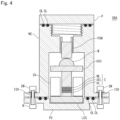
- test battery For evaluation of a capacity of the obtained positive electrode active material, a battery (hereinafter, referred to as "test battery") having a structure illustrated in Fig. 4 was used.
- a test battery SBA includes a case including a negative electrode can NC and a positive electrode can PC, and a green compact cell C housed in the case.
- the case includes the hollow negative electrode can NC having one open end, and the positive electrode can PC disposed in the opening of the negative electrode can NC.
- a space for housing the green compact cell C is formed between the positive electrode can PC and the negative electrode can NC.
- the positive electrode can PC is fixed to the negative electrode can NC with, for example, a thumbscrew SW.
- the negative electrode can NC includes a negative electrode terminal, and the positive electrode can PC includes a positive electrode terminal.
- the case has an insulating sleeve ISV.
- the negative electrode can NC and the positive electrode can PC are fixed by the insulating sleeve ISV so as to maintain a non-contact state.
- a pressure screw PSW is provided at one closed end of the negative electrode can NC. After the positive electrode can PC is fixed to the negative electrode can NC, the pressure screw PSW is tightened toward the housing space of the green compact cell C, thereby holding the green compact cell C in a pressurized state through a hemispherical washer W.
- a screw-type plug P is provided at one end of the negative electrode can NC where the pressure screw PSW is present.
- O-rings OL are provided between the negative electrode can NC and the positive electrode can PC, and between the negative electrode can NC and the plug P. The O-rings seal a gap between the negative electrode can NC and the positive electrode can PC, and maintain airtightness in the case.
- the green compact cell C is a pellet including a positive electrode layer PL, a solid electrolyte layer SEL, and a negative electrode layer NL laminated in this order.
- the positive electrode layer PL is in contact with an inner surface of the positive electrode can PC via a lower current collector LCC.
- the negative electrode layer NL is in contact with an inner surface of the negative electrode can NC via an upper current collector UCC, the hemispherical washer W, and the pressure screw PSW.
- the lower current collector LCC, the green compact cell C, and the upper current collector UCC are protected by sleeves SV so that the positive electrode layer PL and the negative electrode layer NL are not in electrical contact with each other.
- test battery SBA was prepared as follows.
- a lower current collector LCC, the pellet with the positive electrode layer PL disposed downward, an indium (In) foil (negative electrode layer NL), and an upper current collector UCC were stacked in this order from the bottom, and pressurized at 9 kN to form an electrode (green compact cell C).
- the electrode (green compact cell C) was sealed in a case, and a pressure screw was tightened at a torque of 6 to 7 N ⁇ m.
- the test battery SBA was prepared in a glove box in an Ar atmosphere with a dew point controlled at -80°C.
- a charge and discharge capacity indicating performance of the prepared test battery was evaluated as follows.
- An initial discharge capacity was evaluated by measuring a discharge capacity (initial discharge capacity) when a test battery using an indium foil as a negative electrode was manufactured, left standing for about 24 hours, and an open circuit voltage (OCV) was stabilized, and then the test battery was charged at a current density of 0.2 mA/cm 2 for the positive electrode until the cutoff voltage reached 4.5 V (vs. Li), pausing for one hour, and then discharged to the cutoff voltage reached 2.5 V (vs. Li).
- a measurement result was 168 mAh/g.
- the cycle capacity retention rate was evaluated by repeating 100 cycles of charging at a current density of 0.2 mA/cm 2 for the positive electrode until the cutoff voltage reached 4.5 V(vs. Li) and discharging to the cutoff voltage reached 2.5 V(vs. Li), and taking a ratio of a capacity after 100 cycles to an initial discharge capacity as a capacity retention rate.
- a coated lithium-nickel composite oxide was synthesized under the same conditions as in Example 1 except that the Li/M ratio in the lithium-nickel composite oxide synthesis step of Example 1 was 1.05. The results are presented in Table 1.
- a coated lithium-nickel composite oxide was synthesized under the same conditions as in Example 1 except that the ratio of Ni : Co : Mn : Al in the lithium-nickel composite oxide synthesis step of Example 1 was 0.75 : 0.05 : 0.17 : 0.03. The results are presented in Table 1.
- a coated lithium-nickel composite oxide was synthesized under the same conditions as in Example 1 except that the ratio of Ni : Co : Mn : Al in the lithium-nickel composite oxide synthesis step of Example 1 was 0.65 : 0.16 : 0.16 : 0.03. The results are presented in Table 1.
- a coated lithium-nickel composite oxide was synthesized under the same conditions as in Example 1 except that the ratio of Ni : Co : Mn : Al in the lithium-nickel composite oxide synthesis step of Example 1 was 0.65 : 0.08 : 0.24 : 0.03. The results are presented in Table 1.
- a coated lithium-nickel composite oxide was synthesized under the same conditions as in Example 1 except that the ratio of Ni : Co : Mn : Al in the lithium-nickel composite oxide synthesis step of Example 1 was 0.55 : 0.21 : 0.21 : 0.03. The results are presented in Table 1.
- a coated lithium-nickel composite oxide was synthesized under the same conditions as in Example 1 except that the ratio of Ni : Co : Mn : Al in the lithium-nickel composite oxide synthesis step of Example 1 was 0.55 : 0.10 : 0.32 : 0.03. The results are presented in Table 1.
- a coated lithium-nickel composite oxide was synthesized under the same conditions as in Example 1 except that the Li/M ratio in the lithium-nickel composite oxide synthesis step of Example 1 was 1.08. The results are presented in Table 1.
- a coated lithium-nickel composite oxide was synthesized under the same conditions as in Example 1 except that the average particle size D50 in the lithium-nickel composite oxide synthesis step of Example 1 was 11.3 ⁇ m. The results are presented in Table 1.
- a coated lithium-nickel composite oxide was synthesized under the same conditions as in Example 1 except that the lithium-nickel composite oxide particles in Example 1 were not coated.
- the results are presented in Table 1.
- Example 1 1.03 0.75 0.11 0.11 0.03 97.9 118.0 0.17 0.56 4.7 Presence 80
- Example 2 1.05 0.75 0.11 0.11 0.03 98.3 118.3 0.15 0.56 4.8 Presence 78
- Example 3 1.03 0.75 0.17 0.05 0.03 97.6 113.5 0.13 0.59 4.9 Presence 84
- Example 4 1.03 0.65 0.16 0.16 0.03 97.6 113.7 0.17 0.60 4.8 Presence 84
- Example 5 1.03 0.65 0.24 0.08 0.03 95.8 112.0 0.15 0.58 5.3 Presence 89
- Example 6 1.03 0.55 0.21 0.21 0.03 96.3 115.0 0.19 0.62 4.9 Presence 88
- Example 7 1.03 0.55 0.32 0.10 0.03 95.2 120.1 0.21 0.58 5.2
- Example 2 1.03 0.75 0.11 0.11 0.03 98.7 118.8 0.13 0.57 4.8 Presence 70 Comparative Example 2 1.03 0.75 0.11 0.11 0.03 97.9 118.0 0.17 0.
- the positive electrode active material of Examples had a high initial charge capacity, and the cycle capacity retention rate in the all-solid-state battery was remarkably improved as compared with the positive electrode active material of Comparative Example 1 (Li site occupancy exceeds 98.5%). In particular, in Examples 5 and 7 in which the Li site occupancy was low, the cycle capacity retention rate was remarkably improved.
- a positive electrode active material that can be suitably used for a positive electrode of an all-solid-state lithium ion secondary battery requiring a high battery capacity, and a method for manufacturing the positive electrode active material.
Landscapes
- Chemical & Material Sciences (AREA)
- Chemical Kinetics & Catalysis (AREA)
- Electrochemistry (AREA)
- General Chemical & Material Sciences (AREA)
- Inorganic Chemistry (AREA)
- Organic Chemistry (AREA)
- Engineering & Computer Science (AREA)
- Manufacturing & Machinery (AREA)
- Composite Materials (AREA)
- Condensed Matter Physics & Semiconductors (AREA)
- General Physics & Mathematics (AREA)
- Physics & Mathematics (AREA)
- Materials Engineering (AREA)
- Battery Electrode And Active Subsutance (AREA)
Applications Claiming Priority (3)
| Application Number | Priority Date | Filing Date | Title |
|---|---|---|---|
| JP2022084101 | 2022-05-23 | ||
| JP2022157076A JP2023172835A (ja) | 2022-05-23 | 2022-09-29 | 全固体リチウムイオン二次電池用正極活物質とその製造方法 |
| PCT/JP2023/019223 WO2023228958A1 (fr) | 2022-05-23 | 2023-05-23 | Matériau actif d'électrode positive pour batteries secondaires au lithium-ion entièrement solides, et son procédé de production |
Publications (1)
| Publication Number | Publication Date |
|---|---|
| EP4531138A1 true EP4531138A1 (fr) | 2025-04-02 |
Family
ID=88919335
Family Applications (1)
| Application Number | Title | Priority Date | Filing Date |
|---|---|---|---|
| EP23811830.1A Pending EP4531138A1 (fr) | 2022-05-23 | 2023-05-23 | Matériau actif d'électrode positive pour batteries secondaires au lithium-ion entièrement solides, et son procédé de production |
Country Status (4)
| Country | Link |
|---|---|
| EP (1) | EP4531138A1 (fr) |
| KR (1) | KR20250016205A (fr) |
| CN (1) | CN119301775A (fr) |
| WO (1) | WO2023228958A1 (fr) |
Families Citing this family (1)
| Publication number | Priority date | Publication date | Assignee | Title |
|---|---|---|---|---|
| CN119812289B (zh) * | 2025-03-13 | 2025-08-08 | 浙江大学 | 一种共掺杂层状氧化物正极材料与硫化物全固态电池 |
Family Cites Families (9)
| Publication number | Priority date | Publication date | Assignee | Title |
|---|---|---|---|---|
| JP2008153017A (ja) * | 2006-12-15 | 2008-07-03 | Ise Chemicals Corp | 非水電解液二次電池用正極活物質 |
| JP5277984B2 (ja) | 2009-01-20 | 2013-08-28 | トヨタ自動車株式会社 | 正極活物質材料 |
| JP5638232B2 (ja) | 2009-12-02 | 2014-12-10 | 住友金属鉱山株式会社 | 非水系電解質二次電池正極活物質用ニッケルコバルトマンガン複合水酸化物粒子とその製造方法、非水系電解質二次電池用正極活物質とその製造方法、および非水系電解質二次電池 |
| JP5971756B2 (ja) | 2012-09-11 | 2016-08-17 | トヨタ自動車株式会社 | 硫化物固体電解質 |
| CN114521300B (zh) * | 2019-09-19 | 2024-11-12 | 住友金属矿山株式会社 | 锂离子二次电池用正极活性物质以及锂离子二次电池 |
| JP2021051880A (ja) * | 2019-09-24 | 2021-04-01 | 住友金属鉱山株式会社 | リチウムイオン二次電池用正極活物質およびリチウムイオン二次電池 |
| US12119492B2 (en) * | 2020-07-30 | 2024-10-15 | Sumitomo Metal Mining Co., Ltd. | Positive electrode active material for all-solid-state lithium ion secondary battery and method for manufacturing the same |
| JP7598088B2 (ja) | 2020-11-26 | 2024-12-11 | 東芝ライテック株式会社 | 紫外線照射装置 |
| JP7666969B2 (ja) | 2021-03-31 | 2025-04-22 | セコム株式会社 | 管理システム、サーバ、出入管理装置及び作業ロボット |
-
2023
- 2023-05-23 KR KR1020247041976A patent/KR20250016205A/ko active Pending
- 2023-05-23 WO PCT/JP2023/019223 patent/WO2023228958A1/fr not_active Ceased
- 2023-05-23 EP EP23811830.1A patent/EP4531138A1/fr active Pending
- 2023-05-23 CN CN202380042284.8A patent/CN119301775A/zh active Pending
Also Published As
| Publication number | Publication date |
|---|---|
| WO2023228958A1 (fr) | 2023-11-30 |
| CN119301775A (zh) | 2025-01-10 |
| KR20250016205A (ko) | 2025-02-03 |
Similar Documents
| Publication | Publication Date | Title |
|---|---|---|
| US12531240B2 (en) | Positive electrode active material for all-solid-state lithium ion secondary battery and method for manufacturing the same | |
| EP3136479B1 (fr) | Matériau actif d'électrode positive pour des batteries secondaires à électrolyte non aqueux comprenant d'oxyde composite de métal de transition et batterie secondaire à électrolyte non aqueux utilisant un matériau actif d'électrode positive | |
| EP3690999B1 (fr) | Matériau actif d'électrode positive pour batterie secondaire au lithium-ion, procédé de fabrication de matériau actif d'électrode positive pour batterie secondaire au lithium-ion, et batterie secondaire au lithium-ion | |
| EP3514867A1 (fr) | Matériau actif d'électrode positive pour batterie secondaire à électrolyte non aqueux, son procédé de production et batterie secondaire à électrolyte non aqueux utilisant ce matériau actif d'électrode positive | |
| JP2012256435A (ja) | ニッケルマンガン複合水酸化物粒子とその製造方法、非水系電解質二次電池用正極活物質とその製造方法、ならびに非水系電解質二次電池 | |
| EP3832762B1 (fr) | Matériau actif d'électrode positive pour batterie secondaire au lithium-ion, procédé de production de matériau actif d'électrode positive pour batterie secondaire au lithium-ion et batterie secondaire au lithium-ion | |
| EP4163997A1 (fr) | Matériau actif d'électrode positive pour des batteries secondaires aux ions de lithium, procédé de production dudit matériau actif d'électrode positive et batterie secondaire aux ions de lithium | |
| CN107078294A (zh) | 非水系电解质二次电池用正极活性物质、其制造方法和使用其的非水系电解质二次电池 | |
| EP3998235A1 (fr) | Matériau actif d'électrode positive pour batteries rechargeables au lithium-ion et batterie rechargeable au lithium-ion | |
| JP7274125B2 (ja) | 全固体リチウムイオン二次電池用正極活物質および全固体リチウムイオン二次電池 | |
| EP4531138A1 (fr) | Matériau actif d'électrode positive pour batteries secondaires au lithium-ion entièrement solides, et son procédé de production | |
| EP4531136A1 (fr) | Matériau actif d'électrode positive pour batterie rechargeable au lithium-ion, et procédé de fabrication de matériau actif d'électrode positive pour batterie rechargeable au lithium-ion | |
| EP4531137A1 (fr) | Matériau actif d'électrode positive pour batterie secondaire au lithium-ion et son procédé de production | |
| JP7177395B2 (ja) | 全固体リチウムイオン二次電池用正極活物質および全固体リチウムイオン二次電池 | |
| EP4528854B1 (fr) | Matériau actif d'électrode positive pour batteries secondaires au lithium-ion et batterie secondaire au lithium-ion | |
| EP4531139A1 (fr) | Matériau actif d'électrode positive pour batterie secondaire au lithium-ion entièrement solide, et son procédé de production | |
| JP2023172836A (ja) | 全固体リチウムイオン二次電池用正極活物質とその製造方法 | |
| EP3951947A1 (fr) | Matériau actif d'électrode positive destiné à un accumulateur au lithium-ion et son procédé de fabrication, et accumulateur au lithium-ion | |
| JP2023172835A (ja) | 全固体リチウムイオン二次電池用正極活物質とその製造方法 |
Legal Events
| Date | Code | Title | Description |
|---|---|---|---|
| STAA | Information on the status of an ep patent application or granted ep patent |
Free format text: STATUS: THE INTERNATIONAL PUBLICATION HAS BEEN MADE |
|
| PUAI | Public reference made under article 153(3) epc to a published international application that has entered the european phase |
Free format text: ORIGINAL CODE: 0009012 |
|
| STAA | Information on the status of an ep patent application or granted ep patent |
Free format text: STATUS: REQUEST FOR EXAMINATION WAS MADE |
|
| 17P | Request for examination filed |
Effective date: 20241219 |
|
| AK | Designated contracting states |
Kind code of ref document: A1 Designated state(s): AL AT BE BG CH CY CZ DE DK EE ES FI FR GB GR HR HU IE IS IT LI LT LU LV MC ME MK MT NL NO PL PT RO RS SE SI SK SM TR |
|
| DAV | Request for validation of the european patent (deleted) | ||
| DAX | Request for extension of the european patent (deleted) |