EP4531337A1 - Système et procédé de service intelligent, dispositif électronique et support de stockage - Google Patents
Système et procédé de service intelligent, dispositif électronique et support de stockage Download PDFInfo
- Publication number
- EP4531337A1 EP4531337A1 EP24197358.5A EP24197358A EP4531337A1 EP 4531337 A1 EP4531337 A1 EP 4531337A1 EP 24197358 A EP24197358 A EP 24197358A EP 4531337 A1 EP4531337 A1 EP 4531337A1
- Authority
- EP
- European Patent Office
- Prior art keywords
- service
- server
- user
- proxy server
- request
- Prior art date
- Legal status (The legal status is an assumption and is not a legal conclusion. Google has not performed a legal analysis and makes no representation as to the accuracy of the status listed.)
- Pending
Links
Images


Classifications
-
- H—ELECTRICITY
- H04—ELECTRIC COMMUNICATION TECHNIQUE
- H04L—TRANSMISSION OF DIGITAL INFORMATION, e.g. TELEGRAPHIC COMMUNICATION
- H04L67/00—Network arrangements or protocols for supporting network services or applications
- H04L67/50—Network services
- H04L67/56—Provisioning of proxy services
-
- H—ELECTRICITY
- H04—ELECTRIC COMMUNICATION TECHNIQUE
- H04L—TRANSMISSION OF DIGITAL INFORMATION, e.g. TELEGRAPHIC COMMUNICATION
- H04L63/00—Network architectures or network communication protocols for network security
- H04L63/02—Network architectures or network communication protocols for network security for separating internal from external traffic, e.g. firewalls
- H04L63/0281—Proxies
-
- H—ELECTRICITY
- H04—ELECTRIC COMMUNICATION TECHNIQUE
- H04L—TRANSMISSION OF DIGITAL INFORMATION, e.g. TELEGRAPHIC COMMUNICATION
- H04L63/00—Network architectures or network communication protocols for network security
- H04L63/04—Network architectures or network communication protocols for network security for providing a confidential data exchange among entities communicating through data packet networks
- H04L63/0407—Network architectures or network communication protocols for network security for providing a confidential data exchange among entities communicating through data packet networks wherein the identity of one or more communicating identities is hidden
-
- H—ELECTRICITY
- H04—ELECTRIC COMMUNICATION TECHNIQUE
- H04L—TRANSMISSION OF DIGITAL INFORMATION, e.g. TELEGRAPHIC COMMUNICATION
- H04L63/00—Network architectures or network communication protocols for network security
- H04L63/08—Network architectures or network communication protocols for network security for authentication of entities
-
- H—ELECTRICITY
- H04—ELECTRIC COMMUNICATION TECHNIQUE
- H04L—TRANSMISSION OF DIGITAL INFORMATION, e.g. TELEGRAPHIC COMMUNICATION
- H04L63/00—Network architectures or network communication protocols for network security
- H04L63/08—Network architectures or network communication protocols for network security for authentication of entities
- H04L63/0884—Network architectures or network communication protocols for network security for authentication of entities by delegation of authentication, e.g. a proxy authenticates an entity to be authenticated on behalf of this entity vis-à-vis an authentication entity
-
- H—ELECTRICITY
- H04—ELECTRIC COMMUNICATION TECHNIQUE
- H04L—TRANSMISSION OF DIGITAL INFORMATION, e.g. TELEGRAPHIC COMMUNICATION
- H04L67/00—Network arrangements or protocols for supporting network services or applications
- H04L67/14—Session management
- H04L67/141—Setup of application sessions
-
- H—ELECTRICITY
- H04—ELECTRIC COMMUNICATION TECHNIQUE
- H04L—TRANSMISSION OF DIGITAL INFORMATION, e.g. TELEGRAPHIC COMMUNICATION
- H04L9/00—Cryptographic mechanisms or cryptographic arrangements for secret or secure communications; Network security protocols
- H04L9/40—Network security protocols
Definitions
- the present disclosure relates to the field of information security technology, and more specifically, the present disclosure relates to an intelligent service system and method, an electronic device, and a storage medium.
- AI artificial intelligence
- an intelligent service system sends a session identifier and request content to an AI server through a proxy server, so that the AI server is unable to obtain the user's identity information, and obfuscates and transmits the request content of different users in service session channels, so that the AI server is unable to analyze the user's private data based on data received, improving the security of the user's privacy.
- a first aspect of the present disclosure provides an intelligent service system, the system comprising: a proxy server;
- a second aspect of the present disclosure provides an intelligent service method, applied to a proxy server, the method comprising:
- a third aspect of the present disclosure provides an electronic device comprising a memory, a processor and a computer program stored on the memory and runnable on the processor, the processor running the computer program to implement a method as described in the second aspect of the present disclosure.
- a fourth aspect of the present disclosure provides a computer-readable storage medium having a computer program stored thereon, the computer program being executed by the processor to realize the steps of the method as described in the second aspect of the present disclosure.
- the proxy server transmits the session identifier and the corresponding request content to the AI server through any service session channel, so that even if a service session channel transmits data of the same user, the AI server is unable to associate the received data with the user's identity, and thus is unable to obtain the user's private information.
- the request contents of different users can also be transmitted through one service session channel, so that the data received by the AI server through the service session channel is confused with the data of different users, the received data will be more dispersed in terms of content, it is difficult to extract user data with prominent features from it, and it is also impossible to associate the received data with the user identity, further improving the security of the user's privacy.
- Generative AI is an artificial intelligence technique that enables the creation of new content similar to the original data by learning from large amounts of data.
- a number of products have emerged that provide generative AI services, which can be used by users to generate the information they need. For example, using generative AI services to generate essays, job summaries, student compositions, etc.
- generative AI services to generate essays, job summaries, student compositions, etc.
- users Before users use generative AI services to generate the information they need, they need to provide the generative AI services with their own demand information, which includes the user's personal information as well as some descriptive information about the information they need.
- the user needs to send his or her personal information, such as account number or IP address, and the description of the problem, such as "4th grade language essay on describing a spring trip" to the generative AI server.
- the generative AI server automatically generates a language essay on spring trip that meets the knowledge level of a 4th grade student and returns the language essay to the user based on the user's personal information such as account number or IP address.
- Generative AI services have brought great convenience to people's life, study and work. At the same time, it also brings some new problems to people, among which the possible leakage of user privacy is an important issue. Because in the process of using generative AI services, generative AI services are able to collect users' personal information, and by continuously collecting information such as descriptions of problems raised by users in the process of using them, generative AI service providers are able to analyze the user's privacy data such as his or her personality, occupation, feelings, views on events, and tendencies based on the obtained user data, and carve out a user portrait, thus making the user privacy leaked. Therefore, how to protect user privacy has become a technical issue of concern in the process of using generative AI services.
- embodiments of the present disclosure provide an intelligent service system, as shown in FIG. 1 , which includes: a proxy server.
- the proxy server is communicatively connected to an external AI server, and the proxy server is also used to be communicatively connected to a terminal of a user.
- the proxy server and the AI server may be two different hardware devices, or two sets of server clusters. Alternatively, it may be a different service program deployed on the same hardware device.
- one or more service session channel is established between the proxy server and the external AI server.
- a user session channel is established between the proxy server and the user requesting a service, and a session identifier is assigned to the user session channel.
- the proxy server is used to receive service requests from users through the user session channel; in response to a determination that the user authentication is successful, the proxy server sends the session identifier corresponding to the user and the request content in the service request to the AI server through any of the aforementioned one or more service session channel.
- the proxy server For each user requesting a service, only one user session channel is established between the user and the proxy server, and the proxy server assigns a unique session identifier to the user session channel.
- the user When a user needs to use the services of the AI server, the user establishes a user session channel with the proxy server by using a mobile phone, a computer, or other terminals of the user, and sends a service request to the proxy server through this user session channel.
- the service request carries at least the user's service credentials and request content.
- the request content is the descriptive information of the service that the user requires.
- Service credentials are obtained by the user upon registration with the registration and authentication server.
- the registration and authentication server, proxy server, and AI server can be different hardware devices, different server clusters, or different service programs deployed on the same hardware device.
- Service credentials include user identity information and service permission information.
- the user identity information uniquely identifies the user and can be a user account.
- Service permission information can include one or more of the traffic required for service use, the number of services that can be used, the duration of service use, and the content of services that can be accessed.
- the proxy server After receiving the service request, the proxy server parses the user's service credentials and request content from the service request, sends the service credentials to the registration and authentication server, which authenticates the user based on these credentials and returns the authentication result to the proxy server.
- the proxy server receives the authentication result. If the authentication result indicates that the user has failed the authentication, the proxy server discards the service request. If the authentication is successful, the proxy server sends the session identifier corresponding to the user and the request content to the AI server.
- registration and authentication of the user may also be performed by a proxy server.
- the user's service credentials are issued by the proxy server.
- the proxy server After receiving the service request, the proxy server authenticates the service credentials in the service request. If the authentication is successful, the proxy server sends the session identifier corresponding to the user and the request content to the AI server.
- the proxy server In response to a determination that there is only one service session channel between the proxy server and the AI server, the proxy server sends the session identifier and request content corresponding to the user to the AI server through this channel.
- information related to the user's identity is not sent to the AI server.
- session identifiers are used to distinguish the request content and a request result of each user, ensuring that the AI server cannot know which specific user the request content and request results belong to.
- all user requests and results are transmitted through the same channel. Even if the AI server analyzes user profiles based on the data transmitted through this channel, the resulting profiles will not match any specific user, thereby protecting user privacy and enhancing data security while providing generative AI services.
- the proxy server can randomly transmit the session identifier and request content corresponding to that service request through any one of the multiple service session channels to the AI server. In doing so, on the one hand, information related to user identities is not sent to the AI server, and session identifiers are used to distinguish between individual users, such that the AI server can know which specific user the request content and request results belong to.
- the data transmitted through each service session channel is a mixture of data from multiple different users. Even if the AI server analyzes user profiles based on the data transmitted through a service session channel, the resulting user profiles will not match any specific user, thereby protecting user privacy and enhancing data security while providing generative AI services.
- the proxy server in response to a determination that multiple service session channels are established between the proxy server and the AI server, can also be used to transmit the request contents of multiple service requests from the same user to the AI server through different service session channels respectively.
- the session identifier corresponding to the user is also transmitted synchronously, i.e., the session identifier is associated with the request content and sent to the AI server together.
- the AI server By distributing the request contents of multiple service requests from the same user through multiple service session channels for transmission in this manner, it avoids transmitting all service requests from the same user through a single service session channel, ensuring that each service session channel carries data mixed with data from different users. In this way, the AI server cannot analyze the personality, event opinions, or other privacy information of specific users based on the data transmitted through any single service session channel, thereby achieving the protection of user privacy.
- the proxy server is also used to classify the request contents in the received service requests; for each category, the request contents belonging to the category are sent to the AI server through different service session channels separately.
- the proxy server can classify the request content based on the semantics of the request content, which can include but is not limited to work, life, study, and other categories. Specifically, the proxy server can perform text processing on the request content to identify the category to which the request content belongs to.
- the proxy server can pre-configure a semantic feature library or a keyword feature library for each category.
- the proxy server identifies the semantic features of the request content through text processing, then matches these semantic features with those in the semantic feature libraries corresponding to various categories, and determines the category corresponding to the semantic feature library with the highest matching degree as the category to which the request content belongs.
- the proxy server performs word segmentation on the request content to obtain multiple words included in the request content. It then queries the number of words in the request content that are included in the keyword libraries corresponding to each category, and determines the category corresponding to the keyword library with the largest number of words as the category to which the request content belongs.
- the request content can also be classified based on the IP address of the source of the service request.
- the proxy server can analyze the location area of the source of the service request based on the IP address and classify the request content based on the location area. For example, the request content can be divided into those from City A, City B, or City C.
- the methods for classifying request content are not limited to the above two implementations, and any method that can divide request content into multiple categories falls within the scope of this disclosure.
- AI servers can create user personas for a group based on data from users within the group, which can lead to the leakage of important group information.
- each service session channel transmits a relatively even proportion of request contents from various categories, and no user identity-related information is transmitted to the AI server. Therefore, the AI server can determine the specific user corresponding to each request content. Even if the AI server analyzes data transmitted through the same service session channel, it cannot create a user persona that matches a specific user or group, thereby protecting both individual privacy and group/organization privacy, further enhancing the security of user data when using AI services.
- This disclosure refers to the method of transmitting request contents from the proxy server to the AI server in the above embodiments as adopting a confusion mechanism.
- the AI server can analyze the contextual connections between user requests based on the received content. Consequently, the AI server cannot extract personal information such as privacy, personality, occupation, emotions, event opinions, and tendencies. Similarly, it cannot extract sensitive information for corporate or group.
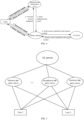
- the above-mentioned proxy server may include a plurality of levels of sequentially connected sub-proxy servers. As shown in FIG. 2 , the first-level, second-level, and Nth-level sub-proxy servers are schematically drawn, connected sequentially from the Nth-level sub-proxy server to the first-level sub-proxy server.
- the first-level sub-proxy server can directly register and purchase services from the AI server. It can then distribute these services through the registration and authentication server, offering content confusion mechanisms or algorithms as a value-added service to users.
- the second-level sub-proxy server purchases services from the first-level sub-proxy server via the registration and authentication server, again distributing these services while providing content confusion mechanisms or algorithms as a value-added service.
- This pattern can be extended to include third-level, fourth-level sub-proxy servers, each level of sub-proxy server independently adding content confusion services. End users can choose different levels of sub-proxy servers for content obfuscation services based on their own privacy protection needs.
- the proxy server includes a plurality of levels of sub-proxy servers connected in sequence, as shown in FIG. 2 .
- the current-level sub-proxy server sends the session identifier and corresponding request content from the previous-level node to the lower-level node through any session channel among the session channels between the current-level and next-level nodes;
- the previous-level node includes the user or the adjacent upper-level sub-proxy server of the current-level sub-proxy server;
- the next-level node includes the adjacent lower-level sub-proxy server of the current-level sub-proxy server or the AI server connected to the current-level sub-proxy server.
- the sending module 303 is also used for, in case of multiple service requests from the same user, sending the session identifier of the same user and the request content of each service request to the AI server through different service session channels between the AI server and the proxy server.
- the sending module 303 is further used for categorizing the request content in the service request; and for sending the request content of different service requests belonging to the same category to the AI server through different service session channels between the AI server and the proxy server.
- the device further includes: an authentication module for sending the user's service credential, which is carried in the service request, to the registration and authentication server; receiving the authentication result returned by the registration and authentication server based on the service credential; and determining whether the user has passed the authentication based on the authentication result.
- the receiving module 302 is also used for receiving the session identifier and corresponding request results returned by the AI server.
- the sending module 303 is also used for returning the request results to the user via the user session channel corresponding to the session identifier.
- the intelligent service device provided in the embodiments of the present disclosure is based on the same inventive concept as the intelligent service method provided in the embodiments of the present disclosure and has the same beneficial effects as the method being adopted, operated, or implemented.
- FIG. 9 illustrates a schematic diagram of an electronic device provided by some embodiments of the present disclosure.
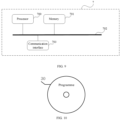
- the electronic device 7 comprises: a processor 700, a memory 701, a bus 707 and a communication interface 703, the processor 700, the communication interface 703 and the memory 701 being connected via the bus 707; the memory 701 having stored therein a computer program that can be run on the processor 700, and the processor 700 executing, when running the computer program, the present intelligent service method provided by any of the preceding embodiments of the disclosure.
- the memory 701 may comprise a high-speed random access memory (RAM: Random Access Memory) or may also comprise a non-volatile memory, such as at least one disk memory.
- RAM Random Access Memory
- a communication connection between this system network element and at least one other network element is achieved via at least one communication interface 703 (which may be wired or wireless), which may use the Internet, a wide area network (WAN), a local network (LAN), a metropolitan area network (MAN), and the like.
- WAN wide area network
- LAN local network
- MAN metropolitan area network
- the processor 700 may be an integrated circuit chip with signal processing capabilities. In the implementation, the steps of the method described above may be accomplished by integrated logic circuits of hardware in the processor 700 or by instructions in the form of software.
- the above-described processor 700 may be a general-purpose processor, including a central processing unit (Central Processing Unit, or CPU), a network processor (Network Processor, or NP), and the like; it may also be a digital signal processor (DSP), a special-purpose integrated circuit (ASIC), an off-the-shelf programmable gate array (FPGA) or other programmable logic devices, discrete gate or transistor logic devices, and discrete hardware components.
- DSP digital signal processor
- ASIC special-purpose integrated circuit
- FPGA off-the-shelf programmable gate array
- Various methods, steps, and logic block diagrams of the disclosure in embodiments of the present disclosure may be implemented or performed.
- the general purpose processor may be a microprocessor or the processor may also be any conventional processor, etc.
- the steps of the methods disclosed in conjunction with embodiments of the present disclosure may be directly embodied as being performed by a hardware decoding processor or performed with a combination of hardware and software modules in the decoding processor.
- the software module may be located in a random memory, flash memory, read-only memory, programmable read-only memory or electrically erasable programmable memory, registers, and other storage media well established in the art.
- the storage medium is located in the memory 701, and the processor 700 reads the information in the memory 701 and completes the steps of the above method in combination with its hardware.
- Embodiments of the present disclosure also provide a computer-readable storage medium corresponding to the intelligent service method provided by the preceding embodiments, referring to FIG. 10 , which illustrates a computer-readable storage medium as a compact disc 30 on which a computer program (i.e., a program product) is stored, the computer program, when run by a processor, executes the intelligent service method provided by any of the preceding embodiments.
- a computer program i.e., a program product
- examples of the computer-readable storage medium may also include, but are not limited to, phase change memory (PRAM), static random access memory (SRAM), dynamic random access memory (DRAM), other types of random access memory (RAM), read-only memory (ROM), electrically erasable programmable read-only memory (EEPROM), flash memory, or other optical magnetic storage media, which will not be described herein.
- PRAM phase change memory
- SRAM static random access memory
- DRAM dynamic random access memory
- RAM random access memory
- ROM read-only memory
- EEPROM electrically erasable programmable read-only memory
- flash memory or other optical magnetic storage media, which will not be described herein.
- the computer-readable storage media provided by the above embodiments of the present disclosure and the intelligent service method provided by the embodiments of the present disclosure are based on the same concept, and have the same beneficial effect as the method adopted, operated or implemented by the application stored therein.
- DSPs digital signal processors
- This disclosure can also be implemented as a device or apparatus program for executing part or all of the methods described herein.
- the program implementing this disclosure can be stored on a computer-readable medium or can be in the form of one or more signals. Such signals can be downloaded from an Internet website, provided on a carrier signal, or provided in any other form.
Landscapes
- Engineering & Computer Science (AREA)
- Computer Networks & Wireless Communication (AREA)
- Signal Processing (AREA)
- Computer Security & Cryptography (AREA)
- Computer Hardware Design (AREA)
- Computing Systems (AREA)
- General Engineering & Computer Science (AREA)
- Data Exchanges In Wide-Area Networks (AREA)
- Information Transfer Between Computers (AREA)
Applications Claiming Priority (1)
| Application Number | Priority Date | Filing Date | Title |
|---|---|---|---|
| CN202311270782.6A CN117319494A (zh) | 2023-09-27 | 2023-09-27 | 智能服务系统、方法、电子设备及存储介质 |
Publications (1)
| Publication Number | Publication Date |
|---|---|
| EP4531337A1 true EP4531337A1 (fr) | 2025-04-02 |
Family
ID=89296756
Family Applications (1)
| Application Number | Title | Priority Date | Filing Date |
|---|---|---|---|
| EP24197358.5A Pending EP4531337A1 (fr) | 2023-09-27 | 2024-08-29 | Système et procédé de service intelligent, dispositif électronique et support de stockage |
Country Status (3)
| Country | Link |
|---|---|
| US (1) | US20250106210A1 (fr) |
| EP (1) | EP4531337A1 (fr) |
| CN (1) | CN117319494A (fr) |
Citations (2)
| Publication number | Priority date | Publication date | Assignee | Title |
|---|---|---|---|---|
| EP0855659A1 (fr) * | 1997-01-22 | 1998-07-29 | Lucent Technologies Inc. | Système et méthode de browsage anonyme et personnalisé dans un réseau |
| US20220060390A1 (en) * | 2020-08-21 | 2022-02-24 | Huawei Technologies Co., Ltd. | System and methods for supporting artificial intelligence service in a network |
Family Cites Families (2)
| Publication number | Priority date | Publication date | Assignee | Title |
|---|---|---|---|---|
| US12229765B2 (en) * | 2022-05-23 | 2025-02-18 | Bank Of America Corporation | De-centralized authentication in a network system |
| US12425401B2 (en) * | 2023-06-27 | 2025-09-23 | International Business Machines Corporation | Accessing resources through a proxy module and edge system |
-
2023
- 2023-09-27 CN CN202311270782.6A patent/CN117319494A/zh active Pending
-
2024
- 2024-08-29 EP EP24197358.5A patent/EP4531337A1/fr active Pending
- 2024-08-30 US US18/822,033 patent/US20250106210A1/en active Pending
Patent Citations (2)
| Publication number | Priority date | Publication date | Assignee | Title |
|---|---|---|---|---|
| EP0855659A1 (fr) * | 1997-01-22 | 1998-07-29 | Lucent Technologies Inc. | Système et méthode de browsage anonyme et personnalisé dans un réseau |
| US20220060390A1 (en) * | 2020-08-21 | 2022-02-24 | Huawei Technologies Co., Ltd. | System and methods for supporting artificial intelligence service in a network |
Also Published As
| Publication number | Publication date |
|---|---|
| CN117319494A (zh) | 2023-12-29 |
| US20250106210A1 (en) | 2025-03-27 |
Similar Documents
| Publication | Publication Date | Title |
|---|---|---|
| US20250088556A1 (en) | Model training system and method, and storage medium | |
| EP3669282B1 (fr) | Procédé et appareil pour gérer une requête de service dans un réseau de chaîne de blocs | |
| EP3964994B1 (fr) | Synchronisation de commandes d'accès entre des dispositifs informatiques | |
| EP3889971B1 (fr) | Plate-forme de diagnostic en ligne, procédé de gestion d'autorisation et système de gestion d'autorisation pour plate-forme de diagnostic en ligne | |
| CN111062028B (zh) | 权限管理方法及装置、存储介质、电子设备 | |
| US20170019407A1 (en) | Method and server for providing image captcha | |
| Diamantopoulou et al. | An assessment of privacy preservation in crowdsourcing approaches: Towards GDPR compliance | |
| Singh et al. | Privacy-aware personal data storage (p-pds): Learning how to protect user privacy from external applications | |
| CN109088890A (zh) | 一种身份认证方法、相关装置及系统 | |
| JP7445685B2 (ja) | オープンインタフェースの管理方法、電子機器、及び記憶媒体 | |
| Bazarhanova et al. | Love and hate relationships in a platform ecosystem: a case of Finnish electronic identity management | |
| Khan et al. | BlockU: Extended usage control in and for Blockchain | |
| WO2005040998A1 (fr) | Procede et systeme pour l'authentification d'un utilisateur | |
| EP4531337A1 (fr) | Système et procédé de service intelligent, dispositif électronique et support de stockage | |
| CN104539748A (zh) | 一种物联网资源的统一寻址方法 | |
| CN116187414A (zh) | 一种神经网络模型加解密方法以及相关系统 | |
| Ansari et al. | Empowering decentralized identity systems for Web 3.0 in complex spherical fuzzy knowledge | |
| US7349904B2 (en) | Method and apparatus for managing access to set of converged entitlement resources | |
| TWI890001B (zh) | 用於判定對受限系統的基於網路的存取的方法、電腦程式產品及電腦伺服器 | |
| Wei et al. | An automatic test platform to verify the security functions for secure WIA-PA wireless sensor networks | |
| Sedek et al. | A hybrid architecture for one-stop e-government portal integration and interoperability | |
| US12614060B2 (en) | Method and system for evaluating evaluation target by various characteristics using mixture of expert | |
| CN110489608A (zh) | 一种电子证照目录管理系统及方法 | |
| Waziri et al. | Cyber Crimes Analysis Based on Open Source Digital Forensic Tools | |
| KR20200098770A (ko) | 컨텐츠 마켓플레이스 제공 방법 |
Legal Events
| Date | Code | Title | Description |
|---|---|---|---|
| PUAI | Public reference made under article 153(3) epc to a published international application that has entered the european phase |
Free format text: ORIGINAL CODE: 0009012 |
|
| STAA | Information on the status of an ep patent application or granted ep patent |
Free format text: STATUS: REQUEST FOR EXAMINATION WAS MADE |
|
| 17P | Request for examination filed |
Effective date: 20241220 |
|
| AK | Designated contracting states |
Kind code of ref document: A1 Designated state(s): AL AT BE BG CH CY CZ DE DK EE ES FI FR GB GR HR HU IE IS IT LI LT LU LV MC ME MK MT NL NO PL PT RO RS SE SI SK SM TR |