EP4531405A2 - Verfahren zur übertragung eines omnidirektionalen videos, verfahren zum empfang eines omnidirektionalen videos, vorrichtung zur übertragung eines omnidirektionalen videos und vorrichtung zum empfang eines omnidirektionalen videos - Google Patents
Verfahren zur übertragung eines omnidirektionalen videos, verfahren zum empfang eines omnidirektionalen videos, vorrichtung zur übertragung eines omnidirektionalen videos und vorrichtung zum empfang eines omnidirektionalen videos Download PDFInfo
- Publication number
- EP4531405A2 EP4531405A2 EP25158573.3A EP25158573A EP4531405A2 EP 4531405 A2 EP4531405 A2 EP 4531405A2 EP 25158573 A EP25158573 A EP 25158573A EP 4531405 A2 EP4531405 A2 EP 4531405A2
- Authority
- EP
- European Patent Office
- Prior art keywords
- video
- metadata
- information
- region
- image
- Prior art date
- Legal status (The legal status is an assumption and is not a legal conclusion. Google has not performed a legal analysis and makes no representation as to the accuracy of the status listed.)
- Pending
Links
Images















Classifications
-
- H—ELECTRICITY
- H04—ELECTRIC COMMUNICATION TECHNIQUE
- H04N—PICTORIAL COMMUNICATION, e.g. TELEVISION
- H04N13/00—Stereoscopic video systems; Multi-view video systems; Details thereof
- H04N13/10—Processing, recording or transmission of stereoscopic or multi-view image signals
- H04N13/194—Transmission of image signals
-
- G—PHYSICS
- G06—COMPUTING OR CALCULATING; COUNTING
- G06T—IMAGE DATA PROCESSING OR GENERATION, IN GENERAL
- G06T3/00—Geometric image transformations in the plane of the image
- G06T3/04—Context-preserving transformations, e.g. by using an importance map
- G06T3/047—Fisheye or wide-angle transformations
-
- G—PHYSICS
- G06—COMPUTING OR CALCULATING; COUNTING
- G06T—IMAGE DATA PROCESSING OR GENERATION, IN GENERAL
- G06T9/00—Image coding
-
- H—ELECTRICITY
- H04—ELECTRIC COMMUNICATION TECHNIQUE
- H04N—PICTORIAL COMMUNICATION, e.g. TELEVISION
- H04N13/00—Stereoscopic video systems; Multi-view video systems; Details thereof
- H04N13/10—Processing, recording or transmission of stereoscopic or multi-view image signals
- H04N13/106—Processing image signals
-
- H—ELECTRICITY
- H04—ELECTRIC COMMUNICATION TECHNIQUE
- H04N—PICTORIAL COMMUNICATION, e.g. TELEVISION
- H04N13/00—Stereoscopic video systems; Multi-view video systems; Details thereof
- H04N13/10—Processing, recording or transmission of stereoscopic or multi-view image signals
- H04N13/106—Processing image signals
- H04N13/172—Processing image signals image signals comprising non-image signal components, e.g. headers or format information
- H04N13/178—Metadata, e.g. disparity information
-
- H—ELECTRICITY
- H04—ELECTRIC COMMUNICATION TECHNIQUE
- H04N—PICTORIAL COMMUNICATION, e.g. TELEVISION
- H04N19/00—Methods or arrangements for coding, decoding, compressing or decompressing digital video signals
- H04N19/50—Methods or arrangements for coding, decoding, compressing or decompressing digital video signals using predictive coding
- H04N19/597—Methods or arrangements for coding, decoding, compressing or decompressing digital video signals using predictive coding specially adapted for multi-view video sequence encoding
-
- H—ELECTRICITY
- H04—ELECTRIC COMMUNICATION TECHNIQUE
- H04N—PICTORIAL COMMUNICATION, e.g. TELEVISION
- H04N21/00—Selective content distribution, e.g. interactive television or video on demand [VOD]
- H04N21/20—Servers specifically adapted for the distribution of content, e.g. VOD servers; Operations thereof
- H04N21/23—Processing of content or additional data; Elementary server operations; Server middleware
- H04N21/236—Assembling of a multiplex stream, e.g. transport stream, by combining a video stream with other content or additional data, e.g. inserting a URL [Uniform Resource Locator] into a video stream, multiplexing software data into a video stream; Remultiplexing of multiplex streams; Insertion of stuffing bits into the multiplex stream, e.g. to obtain a constant bit-rate; Assembling of a packetised elementary stream
- H04N21/23614—Multiplexing of additional data and video streams
-
- G—PHYSICS
- G06—COMPUTING OR CALCULATING; COUNTING
- G06T—IMAGE DATA PROCESSING OR GENERATION, IN GENERAL
- G06T15/00—Three-dimensional [3D] image rendering
- G06T15/04—Texture mapping
-
- G—PHYSICS
- G06—COMPUTING OR CALCULATING; COUNTING
- G06T—IMAGE DATA PROCESSING OR GENERATION, IN GENERAL
- G06T15/00—Three-dimensional [3D] image rendering
- G06T15/10—Geometric effects
- G06T15/20—Perspective computation
Definitions
- the present invention relates to methods and devices for transmitting and receiving omnidirectional media, and more particularly, to methods and devices for transmitting and receiving omnidirectional video and metadata related to the omnidirectional video.
- a digital broadcast signal is capable of containing a larger amount of video/audio data than an analog broadcast signal and further containing various types of additional data as well as video/audio data.
- a virtual reality (VR) system provides, to a user, the experience of being in an electronically projected environment.
- the VR system can be enhanced in order to provide images with higher definition and spatial sounds.
- the VR system can allow a user to interactively use VR content.
- the VR system needs to be enhanced in order to more efficiently provide VR environments to users. To this end, it is necessary to provide data transmission efficiency for transmission of a large amount of data such as VR content, robustness between transmission and reception networks, network flexibility considering a mobile receiver, efficient reproduction and a signaling method, etc.
- the present invention proposes methods for effectively providing omnidirectional video services by defining and delivering metadata about attributes of omnidirectional video when omnidirectional video content is provided.
- the specification discloses methods of defining, storing and signaling metadata related to omnidirectional video such that a user can view a view (point) or a region intended by a producer in reproduction of the omnidirectional video. Specific methods are as follows.
- a method of defining, storing and signaling metadata about region information in a 2D space is disclosed.
- a method of defining, storing and signaling metadata about viewpoint (point) information in a 2D space is disclosed.
- a method of defining, storing and signaling metadata about region information in a 3D space is disclosed.
- a method of defining, storing and signaling metadata about viewpoint (point) information in a 3D space is disclosed.
- a method of signaling a relationship between a metadata track regarding region information or viewpoint (point) information and an omnidirectional video track is disclosed.
- a method of transmitting and signaling metadata using DASH is disclosed.
- a method of transmitting and signaling metadata using MPEG-2 TS is disclosed.
- a method of transmitting and signaling metadata using a video coding layer (VCL) is disclosed.
- the specification discloses methods of defining, storing and signaling metadata about GPS information related to video in reproduction of omnidirectional video. Specific methods are as follows.
- a method of defining, storing and signaling metadata about GPS related information is disclosed.
- a method of signaling a relationship between a metadata track regarding GPS related information and an omnidirectional video track is described.
- the present invention can efficiently transmit omnidirectional content in an environment supporting future hybrid broadcast using terrestrial broadcast networks and the Internet.
- the present invention can propose methods for providing interactive experience in omnidirectional content consumption of users.
- the present invention can propose signaling methods for correctly reflecting intention of omnidirectional content producers in omnidirectional content consumption of users.
- the present invention can propose methods of efficiently increasing transmission capacity and delivering necessary information in omnidirectional content delivery.
- the present invention can propose methods for effectively providing omnidirectional video services by defining and delivering metadata about attributes of 360-degree video when omnidirectional video content is provided.
- FIG. 1 illustrates an architecture for providing 360-degree video according to the present invention.
- the present invention proposes a method for providing 360-degree content or omnidirectional media in order to provide VR (Virtual Reality) to users.
- VR refers to a technique or an environment for replicating an actual or virtual environment. VR artificially provides sensuous experiences to users and thus users can experience electronically projected environments.
- 360-degree content refers to convent for realizing and providing VR and may include 360-degree video and/or 360-degree audio.
- 360-degree video may refer to video or image content which is necessary to provide VR and is captured or reproduced in all directions (360 degrees).
- 360-degree video may refer to video or an image represented on 3D spaces in various forms according to 3D models.
- 360 video can be represented on a spherical plane.
- 360 audio is audio content for providing VR and may refer to spatial audio content which can be recognized as content having an audio generation source located on a specific space.
- 360 content may be generated, processed and transmitted to users, and users may consume VR experiences using the 360 content.
- 360 content/video/image/audio may be represented as 360 content/video/image/audio without a unit (degree) or VR content/video/image/audio. Further, 360 content/video/image/audio may be used interchangeably with omnidirectional content/video/image/audio.
- the present invention proposes a method for effectively providing 360degree video.
- 360 video may be captured using one or more cameras.
- the captured 360 video is transmitted through a series of processes, and a receiving side may process received data into the original 360 video and render the 360 video. Accordingly, the 360 video can be provided to a user.
- a procedure for providing 360 video may include a capture process, a preparation process, a transmission process, a processing process, a rendering process and/or a feedback process.
- the capture process may refer to a process of capturing images or videos for a plurality of viewpoints through one or more cameras.
- An image/video data t1010 shown in the figure can be generated through the capture process.
- Each plane of the shown image/video data t1010 may refer to an image/video for each viewpoint.
- the captured images/videos may be called raw data.
- metadata related to capture may be generated.
- a special camera for VR may be used.
- 360 video for a virtual space generated using a computer is provided according to an embodiment, capture using a camera may not be performed. In this case, the capture process may be replaced by a process of simply generating related data.
- the preparation process may be a process of processing the captured images/videos and metadata generated in the capture process.
- the captured images/videos may be subjected to stitching, projection, region-wise packing and/or encoding in the preparation process.
- the images/videos may pass through a stitching process.
- the stitching process may be a process of connecting the captured images/videos to create a single panorama image/video or a spherical image/video.
- the stitched images/videos may pass through a projection process.
- the stitched images/videos can be projected on a 2D image.
- This 2D image may be called a 2D image frame.
- Projection on a 2D image may be represented as mapping to the 2D image.
- the projected image/video data can have a form of a 2D image t1020 as shown in the figure.
- Region-wise packing may refer to a process of dividing the video data projected on the 2D image into regions and processing the regions.
- regions may refer to regions obtained by dividing a 2D image on which 360 video data is projected. Such regions may be obtained by dividing the 2D image equally or randomly according to an embodiment. Regions may be divided depending on a projection scheme according to an embodiment.
- the region-wise packing process is an optional process and thus may be omitted in the preparation process.
- this process may include a process of rotating the regions or rearranging the regions on the 2D image in order to increase video coding efficiency.
- the regions can be rotated such that specific sides of regions are positioned in proximity to each other to increase coding efficiency.
- this process may include a process of increasing or decreasing the resolution of a specific region in order to differentiate the resolution for regions of the 360 video. For example, the resolution of regions corresponding to a relatively important part of the 360 video can be increased to higher than other regions.
- the video data projected on the 2D image or the region-wise packed video data can pass through an encoding process using a video codec.
- the preparation process may additionally include an editing process.
- the editing process the image/video data before or after projection may be edited.
- metadata with respect to stitching/projection/encoding/editing may be generated.
- metadata with respect to the initial viewpoint or ROI (region of interest) of the video data projected on the 2D image may be generated.
- the transmission process may be a process of processing and transmitting the image/video data and metadata which have passed through the preparation process. For transmission, processing according to an arbitrary transmission protocol may be performed.
- the data that has been processed for transmission may be delivered over a broadcast network and/or broadband.
- the data may be delivered to a receiving side in an on-demand manner. The receiving side may receive the data through various paths.
- the processing process refers to a process of decoding the received data and re-projecting the projected image/video data on a 3D model.
- the image/video data projected on the 2D image may be re-projected on a 3D space.
- This process may be called mapping projection.
- the 3D space on which the data is mapped may have a form depending on a 3D model.
- 3D models may include a sphere, a cube, a cylinder and a pyramid.
- the processing process may further include an editing process, an up-scaling process, etc.
- the editing process the image/video data before or after re-projection can be edited.
- the size of the image/video data can be increased through up-scaling of samples in the up-scaling process. As necessary, the size may be decreased through down-scaling.
- the rendering process may refer to a process of rendering and displaying the image/video data re-projected on the 3D space.
- Re-projection and rendering may be collectively represented as rendering on a 3D model.
- the image/video re-projected (or rendered) on the 3D model may have a form t1030 as shown in the figure.
- the form t1030 corresponds to a case in which the image/video data is re-projected on a spherical 3D model.
- a user can view a region of the rendered image/video through a VR display or the like.
- the region viewed by the user may have a form t1040 shown in the figure.
- the feedback process may refer to a process of delivering various types of feedback information which can be acquired in the display process to a transmission side. Through the feedback process, interactivity in 360 video consumption can be provided. According to an embodiment, head orientation information, viewport information indicating a region currently viewed by a user, etc. can be delivered to the transmission side in the feedback process. According to an embodiment, the user may interact with content realized in a VR environment. In this case, information related to the interaction may be delivered to the transmission side or a service provider in the feedback process. According to an embodiment, the feedback process may not be performed.
- the head orientation information may refer to information about the position, angle and motion of a user's head. On the basis of this information, information about a region of 360 video currently viewed by the user, that is, viewport information can be calculated.
- the viewport information may be information about a region of 360 video currently viewed by a user. Gaze analysis may be performed using the viewport information to check a manner in which the user consumes 360 video, a region of the 360 video at which the user gazes, and how long the user gazes at the region. Gaze analysis may be performed by the receiving side and the analysis result may be delivered to the transmission side through a feedback channel.
- a device such as a VR display may extract a viewport region on the basis of the position/direction of a user's head, vertical or horizontal FOV supported by the device, etc.
- the aforementioned feedback information may be consumed at the receiving side as well as being delivered to the transmission side. That is, decoding, re-projection and rendering processes of the receiving side can be performed using the aforementioned feedback information. For example, only 360 video corresponding to the region currently viewed by the user can be preferentially decoded and rendered using the head orientation information and/or the viewport information.
- a viewport or a viewport region can refer to a region of 360 video currently viewed by a user.
- a viewpoint is a point in 360 video which is viewed by the user and may refer to a center point of a viewport region. That is, a viewport is a region based on a viewpoint, and the size and form of the region can be determined by FOV (field of view) which will be described below.
- FOV field of view
- 360 video data image/video data which is subjected to a series of capture/projection/encoding/transmission/ decoding/re-projection/rendering processes can be called 360 video data.
- 360 video data may be used as the concept including metadata or signaling information related to such image/video data.
- FIG. 2 illustrates a 360 video transmission device according to one aspect of the present invention.
- the present invention may relate to a 360 video transmission device.
- the 360 video transmission device according to the present invention may perform operations related to the above-described preparation process to the transmission process.
- the 360 video transmission device according to the present invention may include a data input unit, a stitcher, a projection processor, a region-wise packing processor (not shown), a metadata processor, a (transmission side) feedback processor, a data encoder, an encapsulation processor, a transmission processor and/or a transmitter as internal/external elements.
- the data input unit may receive captured images/videos for respective viewpoints.
- the images/videos for the viewpoints may be images/videos captured by one or more cameras.
- the data input unit may receive metadata generated in the capture process.
- the data input unit may deliver the received images/videos for the viewpoints to the stitcher and deliver the metadata generated in the capture process to a signaling processor.
- the stitcher may stitch the captured images/videos for the viewpoints.
- the stitcher may deliver the stitched 360 video data to the projection processor.
- the stitcher may receive necessary metadata from the metadata processor and use the metadata for stitching operation as necessary.
- the stitcher may deliver the metadata generated in the stitching process to the metadata processor.
- the metadata in the stitching process may include information indicating whether stitching has been performed, a stitching type, etc.
- the projection processor may project the stitched 360 video data on a 2D image.
- the projection processor may perform projection according to various schemes which will be described below.
- the projection processor may perform mapping in consideration of the depth of 360 video data for each viewpoint.
- the projection processor may receive metadata necessary for projection from the metadata processor and use the metadata for the projection operation as necessary.
- the projection processor may deliver metadata generated in the projection process to the metadata processor.
- the metadata of the projection process may include a projection scheme type.
- the region-wise packing processor may perform the aforementioned region-wise packing process. That is, the region-wise packing processor may perform a process of dividing the projected 360 video data into regions, rotating or rearranging the regions or changing the resolution of each region. As described above, the region-wise packing process is an optional process, and when region-wise packing is not performed, the region-wise packing processor can be omitted.
- the region-wise packing processor may receive metadata necessary for region-wise packing from the metadata processor and use the metadata for the region-wise packing operation as necessary.
- the metadata of the region-wise packing processor may include a degree to which each region is rotated, the size of each region, etc.
- the aforementioned stitcher, the projection processor and/or the region-wise packing processor may be realized by one hardware component according to an embodiment.
- the metadata processor may process metadata which can be generated in the capture process, the stitching process, the projection process, the region-wise packing process, the encoding process, the encapsulation process and/or the processing process for transmission.
- the metadata processor may generate 360 video related metadata using such metadata.
- the metadata processor may generate the 360 video related metadata in the form of a signaling table.
- the 360 video related metadata may be called metadata or 360 video related signaling information according to context.
- the metadata processor may deliver acquired or generated metadata to internal elements of the 360 video transmission device as necessary.
- the metadata processor may deliver the 360 video related metadata to the data encoder, the encapsulation processor and/or the transmission processor such that the metadata can be transmitted to the receiving side.
- the data encoder may encode the 360 video data projected on the 2D image and/or the region-wise packed 360 video data.
- the 360 video data may be encoded in various formats.
- the encapsulation processor may encapsulate the encoded 360 video data and/or 360 video related metadata into a file.
- the 360 video related metadata may be delivered from the metadata processor.
- the encapsulation processor may encapsulate the data in a file format such as ISOBMFF, CFF or the like or process the data into a DASH segment.
- the encapsulation processor may include the 360 video related metadata in a file format according to an embodiment.
- the 360 video related metadata can be included in boxes of various levels in an ISOBMFF file format or included as data in an additional track in a file.
- the encapsulation processor may encapsulate the 360 video related metadata into a file according to an embodiment.
- the transmission processor may perform processing for transmission on the 360 video data encapsulated in a file format.
- the transmission processor may process the 360 video data according to an arbitrary transmission protocol.
- the processing for transmission may include processing for delivery through a broadcast network and processing for delivery over a broadband.
- the transmission processor may receive 360 video related metadata from the metadata processor in addition to the 360 video data and perform processing for transmission on the 360 video related metadata.
- the transmission unit may transmit the processed 360 video data and/or the 360 video related metadata over a broadcast network and/or broadband.
- the transmission unit may include an element for transmission over a broadcast network and an element for transmission over a broadband.
- the 360 video transmission device may further include a data storage unit (not shown) as an internal/external element.
- the data storage unit may store the encoded 360 video data and/or 360 video related metadata before delivery to the transmission processor. Such data may be stored in a file format such as ISOBMFF.
- the data storage unit may not be used. However, 360 video is delivered on demand, in non-real time or over a broadband, encapsulated 360 data may be stored in the data storage unit for a predetermined period and then transmitted.
- the 360 video transmission device may further include a (transmission side) feedback processor and/or a network interface (not shown) as internal/external elements.
- the network interface may receive feedback information from a 360 video reception device according to the present invention and deliver the feedback information to the (transmission side) feedback processor.
- the feedback processor may deliver the feedback information to the stitcher, the projection processor, the region-wise packing processor, the data encoder, the encapsulation processor, the metadata processor and/or the transmission processor.
- the feedback information may be delivered to the metadata processor and then delivered to each internal element according to an embodiment.
- internal elements may reflect the feedback information in 360 video data processing.
- the region-wise packing processor may rotate regions and map the regions on a 2D image.
- the regions may be rotated in different directions at different angles and mapped on the 2D image.
- the regions may be rotated in consideration of neighboring parts and stitched parts of the 360 video data on the spherical plane before projection.
- Information about rotation of the regions, that is, rotation directions and angles may be signaled using 360 video related metadata.
- the data encoder may perform encoding differently on respective regions.
- the data encoder may encode a specific region with high quality and encode other regions with low quality.
- the feedback processor at the transmission side may deliver the feedback information received from the 360 video reception device to the data encoder such that the data encoder can use encoding methods differentiated for regions.
- the feedback processor can deliver viewport information received from the receiving side to the data encoder.
- the data encoder may encode regions including a region indicated by the viewport information with higher quality (UHD) than other regions.
- the transmission processor may perform processing for transmission differently on respective regions.
- the transmission processor may apply different transmission parameters (modulation orders, code rates, etc.) to regions such that data delivered for the regions have different robustnesses.
- the feedback processor may deliver the feedback information received from the 360 video reception device to the transmission processor such that the transmission processor can perform transmission processing differentiated for respective regions.
- the feedback processor can deliver viewport information received from the receiving side to the transmission processor.
- the transmission processor may perform transmission processing on regions including a region indicated by the viewport information such that the regions have higher robustness than other regions.
- the aforementioned internal/external elements of the 360 video transmission device may be hardware elements. According to an embodiment, the internal/external elements may be modified, omitted, replaced by other elements or integrated with other elements. According to an embodiment, additional elements may be added to the 360 video transmission device.
- FIG. 3 illustrates a 360 video reception device according to another aspect of the present invention.
- the present invention may relate to a 360 video reception device.
- the 360 video reception device according to the present invention may perform operations related to the above-described processing process and/or the rendering process.
- the 360 video reception device according to the present invention may include a reception unit, a reception processor, a decapsulation processor, a data decoder, a metadata parser, a (receiving side) feedback processor, a re-projection processor and/or a renderer as internal/external elements.
- the reception unit may receive 360 video data transmitted from the 360 video transmission device according to the present invention.
- the reception unit may receive the 360 video data through a broadcast network or a broadband depending on a transmission channel.
- the reception processor may perform processing according to a transmission protocol on the received 360 video data.
- the reception processor may perform a reverse of the process of the transmission processor.
- the reception processor may deliver the acquired 360 video data to the decapsulation processor and deliver acquired 360 video related metadata to the metadata parser.
- the 360 video related metadata acquired by the reception processor may have a form of a signaling table.
- the decapsulation processor may decapsulate the 360 video data in a file format received from the reception processor.
- the decapsulation processor may decapsulate files in ISOBMFF to acquire 360 video data and 360 video related metadata.
- the acquired 360 video data may be delivered to the data decoder and the acquired 360 video related metadata may be delivered to the metadata parser.
- the 360 video related metadata acquired by the decapsulation processor may have a form of box or track in a file format.
- the decapsulation processor may receive metadata necessary for decapsulation from the metadata parser as necessary.
- the data decoder may decode the 360 video data.
- the data decoder may receive metadata necessary for decoding from the metadata parser.
- the 360 video related metadata acquired in the data decoding process may be delivered to the metadata parser.
- the metadata parser may parse/decode the 360 video related metadata.
- the metadata parser may deliver the acquired metadata to the data decapsulation processor, the data decoder, the re-projection processor and/or the renderer.
- the re-projection processor may re-project the decoded 360 video data.
- the re-projection processor may re-project the 360 video data on a 3D space.
- the 3D space may have different forms depending on used 3D models.
- the re-projection processor may receive metadata necessary for re-projection from the metadata parser.
- the re-projection processor may receive information about the type of a used 3D model and detailed information thereof from the metadata parser.
- the re-projection processor may re-project only 360 video data corresponding to a specific region on the 3D space using the metadata necessary for re-projection.
- the renderer may render the re-projected 360 video data. This may be represented as rendering of the 360 video data on a 3D space as described above.
- the re-projection processor and the renderer may be integrated and the processes may be performed in the renderer.
- the renderer may render only a region viewed by the user according to view information of the user.
- the user may view part of the rendered 360 video through a VR display.
- the VR display is a device for reproducing 360 video and may be included in the 360 video reception device (tethered) or connected to the 360 video reception device as a separate device (un-tethered).
- the 360 video reception device may further include a (receiving side) feedback processor and/or a network interface (not shown) as internal/external elements.
- the feedback processor may acquire feedback information from the renderer, the re-projection processor, the data decoder, the decapsulation processor and/or the VR display and process the feedback information.
- the feedback information may include viewport information, head orientation information, gaze information, etc.
- the network interface may receive the feedback information from the feedback processor and transmit the same to the 360 video transmission device.
- the feedback information may be used by the receiving side in addition to being delivered to the transmission side.
- the receiving side feedback processor can deliver the acquired feedback information to internal elements of the 360 video reception device such that the feedback information is reflected in a rendering process.
- the receiving side feedback processor can deliver the feedback information to the renderer, the re-projection processor, the data decoder and/or the decapsulation processor.
- the renderer can preferentially render a region viewed by the user using the feedback information.
- the decapsulation processor and the data decoder can preferentially decapsulate and decode a region viewed by the user or a region to be viewed by the user.
- the internal/external elements of the 360 video reception device may be hardware elements. According to an embodiment, the internal/external elements may be modified, omitted, replaced by other elements or integrated with other elements. According to an embodiment, additional elements may be added to the 360 video reception device.
- Another aspect of the present invention may relate to a method of transmitting 360 video and a method of receiving 360 video.
- the methods of transmitting/receiving 360 video according to the present invention may be performed by the above-described 360 video transmission/reception devices or embodiments thereof.
- embodiments of the 360 video transmission/reception devices and embodiments of the internal/external elements thereof may be combined.
- embodiments of the projection processor and embodiments of the data encoder can be combined to create as many embodiments of the 360 video transmission device as the number of the embodiments.
- the combined embodiments are also included in the scope of the present invention.
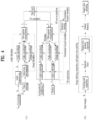
- FIG. 4 illustrates a 360 video transmission device/360 video reception device according to another embodiment of the present invention.
- 360 content may be provided according to the architecture shown in (a).
- the 360 content may be provided in the form of a file or in the form of a segment based download or streaming service such as DASH.
- the 360 content may be called VR content.
- 360 video data and/or 360 audio data may be acquired.
- the 360 audio data may be subjected to audio preprocessing and audio encoding. Through these processes, audio related metadata may be generated, and the encoded audio and audio related metadata may be subjected to processing for transmission (file/segment encapsulation).
- the 360 video data may pass through the aforementioned processes.
- the stitcher of the 360 video transmission device may stitch the 360 video data (visual stitching). This process may be omitted and performed at the receiving side according to an embodiment.
- the projection processor of the 360 video transmission device may project the 360 video data on a 2D image (projection and mapping (packing)).
- the stitching and projection processes are shown in (b) in detail.
- stitching and projection may be performed thereon.
- the projection process may be regarded as projecting the stitched 360 video data on a 3D space and arranging the projected 360 video data on a 2D image.
- this process may be represented as projecting the 360 video data on a 2D image.
- the 3D space may be a sphere or a cube.
- the 3D space may be identical to the 3D space used for re-projection at the receiving side.
- the 2D image may also be called a projected frame C.
- Region-wise packing may be optionally performed on the 2D image. When region-wise packing is performed, the positions, forms and sizes of regions may be indicated such that the regions on the 2D image can be mapped on a packed frame D. When region-wise packing is not performed, the projected frame may be identical to the packed frame. Regions will be described below.
- the projection process and the region-wise packing process may be represented as projecting regions of the 360 video data on a 2D image.
- the 360 video data may be directly converted into the packed frame without an intermediate process according to design.
- the projected 360 video data may be image-encoded or video-encoded. Since the same content may be present for different viewpoints, the same content may be encoded into different bit streams.
- the encoded 360 video data may be processed into a file format such as ISOBMFF according to the aforementioned encapsulation processor.
- the encapsulation processor may process the encoded 360 video data into segments. The segments may be included in an individual track for DASH based transmission.
- 360 video related metadata may be generated as described above.
- This metadata may be included in a video bitstream or a file format and delivered.
- the metadata may be used for encoding, file format encapsulation, processing for transmission, etc.
- the 360 audio/video data may pass through processing for transmission according to the transmission protocol and then be transmitted.
- the aforementioned 360 video reception device may receive the 360 audio/video data over a broadcast network or broadband.
- a VR service platform may correspond to an embodiment of the aforementioned 360 video reception device.
- loudspeakers/headphones, display and head/eye tracking components are performed by an external device or a VR application of the 360 video reception device.
- the 360 video reception device may include all of these components.
- the head/eye tracking components may correspond to the aforementioned receiving side feedback processor.
- the 360 video reception device may perform processing for reception (file/segment decapsulation) on the 360 audio/video data.
- the 360 audio data may be subjected to audio decoding and audio rendering and then provided to the user through a speaker/headphone.
- the 360 video data may be subjected to image decoding or video decoding and visual rendering and provided to the user through a display.
- the display may be a display supporting VR or a normal display.
- the rendering process may be regarded as a process of re-projecting 360 video data on a 3D space and rendering the re-projected 360 video data. This may be represented as rendering of the 360 video data on the 3D space.
- the head/eye tracking components may acquire and process head orientation information, gaze information and viewport information of a user. This has been described above.
- the receiving side may include a VR application which communicates with the aforementioned processes of the receiving side.
- FIG. 5 illustrates the concept of aircraft principal axes for describing a 3D space of the present invention.
- the concept of aircraft principal axes may be used to represent a specific point, position, direction, spacing and region in a 3D space.
- the concept of aircraft principal axes may be used to describe a 3D space before projection or after re-projection and to signal the same.
- a method using X, Y and Z axes or a spherical coordinate system may be used.
- Axes which form the three dimension are called pitch, yaw and roll axes. In the specification, these may be represented as pitch, yaw and roll or a pitch direction, a yaw direction and a roll direction.
- the pitch axis may refer to a reference axis of a direction in which the front end of the aircraft rotates up and down.
- the pitch axis can refer to an axis connected between wings of the aircraft.
- the yaw axis may refer to a reference axis of a direction in which the front end of the aircraft rotates to the left/right.
- the yaw axis can refer to an axis connected from the top to the bottom of the aircraft.
- the roll axis may refer to an axis connected from the front end to the tail of the aircraft in the shown concept of aircraft principal axes, and rotation in the roll direction can refer to rotation based on the roll axis.
- a 3D space in the present invention can be described using the concept of the pitch, yaw and roll.
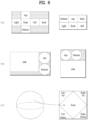
- FIG. 6 illustrates projection schemes according to an embodiment of the present invention.
- the projection processor may perform projection using a cubic projection scheme.
- stitched video data can be represented on a spherical plane.
- the projection processor may segment the 360 video data into faces of a cube and project the same on the 2D image.
- the 360 video data on the spherical plane may correspond to the faces of the cube and be projected on the 2D image as shown in (a).
- the projection processor may perform projection using a cylindrical projection scheme.
- the projection processor can segment the 360 video data into parts of a cylinder and project the same on the 2D image.
- the 360 video data on the spherical plane can correspond to the side, top and bottom of the cylinder and be projected on the 2D image as shown in (b).
- the projection processor may perform projection using a pyramid projection scheme.
- the projection processor can regard the 360 video data as a pyramid form, segment the 360 video data into faces of the pyramid and project the same on the 2D image.
- the 360 video data on the spherical plane can correspond to the front, left top, left bottom, right top and right bottom of the pyramid and be projected on the 2D image as shown in (c).
- the projection processor may perform projection using an equirectangular projection scheme and a panoramic projection scheme in addition to the aforementioned schemes.
- regions may refer to regions obtained by dividing a 2D image on which 360 video data is projected. Such regions need not correspond to respective faces of the 2D image projected according to a projection scheme. However, regions may be divided such that the faces of the projected 2D image correspond to the regions and region-wise packing may be performed according to an embodiment. Regions may be divided such that a plurality of faces may correspond to one region or one face may correspond to a plurality of regions according to an embodiment. In this case, the regions may depend on projection schemes. For example, the top, bottom, front, left, right and back sides of the cube can be respective regions in (a). The side, top and bottom of the cylinder can be respective regions in (b). The front, left top, left bottom, right top and right bottom sides of the pyramid can be respective regions in (c).
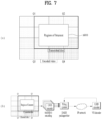
- FIG. 7 illustrates tiles according to an embodiment of the present invention.
- 360 video data projected on a 2D image or region-wise packed 360 video data may be divided into one or more tiles.
- (a) shows that one 2D image is divided into 16 tiles.
- the 2D image may be the aforementioned projected frame or packed frame.
- the data encoder may independently encode the tiles.
- ROI may refer to a region of interest of users, which is provided by a 360 content provider.
- the 360 content provider produces 360 video
- the 360 content provider can produce the 360 video in consideration of a specific region which is expected to be a region of interest of users.
- ROI may correspond to a region in which important content of the 360 video is reproduced.
- the receiving side feedback processor may extract and collect viewport information and deliver the same to the transmission side feedback processor.
- the viewport information can be delivered using network interfaces of both sides.
- a viewport t6010 is displayed.
- the viewport may be displayed over nine tiles of the 2D images.
- the 360 video transmission device may further include a tiling system.
- the tiling system may be located following the data encoder (b), may be included in the aforementioned data encoder or transmission processor, or may be included in the 360 video transmission device as a separate internal/external element.
- the tiling system may receive viewport information from the transmission side feedback processor.
- the tiling system may select only tiles included in a viewport region and transmit the same. In the 2D image shown in (a), only nine tiles including the viewport region t6010 among 16 tiles can be transmitted.
- the tiling system may transmit tiles in a unicast manner over a broadband because the viewport region is different for users.
- the transmission side feedback processor may deliver the viewport information to the data encoder.
- the data encoder may encode the tiles including the viewport region with higher quality than other tiles.
- the transmission side feedback processor may deliver the viewport information to the metadata processor.
- the metadata processor may deliver metadata related to the viewport region to each internal element of the 360 video transmission device or include the metadata in 360 video related metadata.
- the above-described embodiments related to the viewport region can be applied to specific regions other than the viewport region in a similar manner.
- the aforementioned processes performed on the viewport region can be performed on a region determined to be a region in which users are interested through the aforementioned gaze analysis, ROI, and a region (initial view, initial viewpoint) initially reproduced when a user views 360 video through a VR display.
- the transmission processor may perform processing for transmission differently on tiles.
- the transmission processor may apply different transmission parameters (modulation orders, code rates, etc.) to tiles such that data delivered for the tiles has different robustnesses.
- the transmission side feedback processor may deliver feedback information received from the 360 video reception device to the transmission processor such that the transmission processor can perform transmission processing differentiated for tiles.
- the transmission side feedback processor can deliver the viewport information received from the receiving side to the transmission processor.
- the transmission processor can perform transmission processing such that tiles including the corresponding viewport region have higher robustness than other tiles.
- FIG. 8 illustrates 360 video related metadata according to an embodiment of the present invention.
- the aforementioned 360 video related metadata may include various types of metadata related to 360 video.
- the 360 video related metadata may be called 360 video related signaling information according to context.
- the 360 video related metadata may be included in an additional signaling table and transmitted, included in a DASH MPD and transmitted, or included in a file format such as ISOBMFF in the form of box and delivered.
- the 360 video related metadata may be included in various levels such as a file, fragment, track, sample entry, sample, etc. and may include metadata about data of the corresponding level.
- part of the metadata may be configured in the form of a signaling table and delivered, and the remaining part may be included in a file format in the form of a box or a track.
- the 360 video related metadata may include basic metadata related to a projection scheme, stereoscopic related metadata, initial view/initial viewpoint related metadata, ROI related metadata, FOV (Field of View) related metadata and/or cropped region related metadata.
- the 360 video related metadata may include additional metadata in addition to the aforementioned metadata.
- Embodiments of the 360 video related metadata according to the present invention may include at least one of the aforementioned basic metadata, stereoscopic related metadata, initial view/initial viewpoint related metadata, ROI related metadata, FOV related metadata, cropped region related metadata and/or additional metadata.
- Embodiments of the 360 video related metadata according to the present invention may be configured in various manners depending on the number of cases of metadata included therein.
- the 360 video related metadata may further include additional metadata in addition to the aforementioned metadata.
- the basic metadata may include 3D model related information, projection scheme related information and the like.
- the basic metadata may include a vr_geometry field, a projection_scheme field, etc. According to an embodiment, the basic metadata may further include additional information.
- the vr_geometry field can indicate the type of a 3D model supported by the corresponding 360 video data.
- the 3D space may have a form according to a 3D model indicated by the vr_geometry field.
- a 3D model used for rendering may differ from the 3D model used for re-projection, indicated by the vr_geometry field.
- the basic metadata may further include a field which indicates the 3D model used for rendering. When the field has values of 0, 1, 2 and 3, the 3D space can conform to 3D models of a sphere, a cube, a cylinder and a pyramid.
- the 360 video related metadata may further include detailed information about the 3D model indicated by the field.
- the detailed information about the 3D model may refer to the radius of a sphere, the height of a cylinder, etc. for example. This field may be omitted.
- the projection_scheme field can indicate a projection scheme used when the 360 video data is projected on a 2D image.
- the field has values of 0, 1, 2, 3, 4, and 5
- the field indicates that the equirectangular projection scheme, cubic projection scheme, cylindrical projection scheme, tile-based projection scheme, pyramid projection scheme and panoramic projection scheme are used.
- the field has a value of 6
- the field indicates that the 360 video data is directly projected on the 2D image without stitching.
- the field has the remaining values, the field can be reserved for future use.
- the 360 video related metadata may further include detailed information about regions generated according to a projection scheme specified by the field.
- the detailed information about regions may refer to information indicating whether regions have been rotated, the radius of the top region of a cylinder, etc. for example.
- the stereoscopic related metadata may include information about 3D related attributes of the 360 video data.
- the stereoscopic related metadata may include an is_stereoscopic field and/or a stereo_mode field. According to an embodiment, the stereoscopic related metadata may further include additional information.
- the is_stereoscopic field can indicate whether the 360 video data supports 3D. When the field is 1, the 360 video data supports 3D. When the field is 0, the 360 video data does not support 3D. This field may be omitted.
- the stereo_mode field can indicate 3D layout supported by the corresponding 360 video. Whether the 360 video supports 3D can be indicated only using this field. In this case, the is_stereoscopic field can be omitted.
- the 360 video may be a mono mode. That is, the projected 2D image can include only one mono view. In this case, the 360 video may not support 3D.
- the 360 video can conform to left-right layout and top-bottom layout.
- the left-right layout and top-bottom layout may be called a side-by-side format and a top-bottom format.
- 2D images on which left image/right image are projected can be positioned at the left/right on an image frame.
- 2D images on which left image/right image are projected can be positioned at the top/bottom on an image frame.
- the initial view/initial viewpoint related metadata may include information about a view (initial view) which is viewed by a user when initially reproducing 360 video.
- the initial view/initial viewpoint related metadata may include an initial_view_yaw_degree field, an initial_view_pitch_degree field and/or an initial_view_roll_degree field.
- the initial view/initial viewpoint related metadata may further include additional information.
- the initial_view_yaw_degree field, initial_view_pitch_degree field and initial_view_roll_degree field can indicate an initial view when the 360 video is reproduced. That is, the center point of a viewport which is initially viewed when the 360 video is reproduced can be indicated by these three fields.
- the fields can indicate the center point using a direction (sign) and a degree (angle) of rotation on the basis of yaw, pitch and roll axes.
- the viewport which is initially viewed when the 360 video is reproduced according to FOV.
- the width and height of the initial viewport based on the indicated initial view may be determined through FOV. That is, the 360 video reception device can provide a specific region of the 360 video as an initial viewport to a user using the three fields and FOV information.
- the initial view indicated by the initial view/initial viewpoint related metadata may be changed per scene. That is, scenes of the 360 video change as 360 content proceeds with time.
- the initial view or initial viewport which is initially viewed by a user can change for each scene of the 360 video.
- the initial view/initial viewpoint related metadata can indicate the initial view per scene.
- the initial view/initial viewpoint related metadata may further include a scene identifier for identifying a scene to which the initial view is applied.
- the initial view/initial viewpoint related metadata may further include FOV information per scene which indicates FOV corresponding to the relative scene.
- the ROI related metadata may include information related to the aforementioned ROI.
- the ROI related metadata may include a 2d_roi_range_flag field and/or a 3d_roi_range_flag field. These two fields can indicate whether the ROI related metadata includes fields which represent ROI on the basis of a 2D image or fields which represent ROI on the basis of a 3D space.
- the ROI related metadata may further include additional information such as differentiate encoding information depending on ROI and differentiate transmission processing information depending on ROI.
- the ROI related metadata may include a min_top_left_x field, a max_top_left_x field, a min_top_left_y field, a max_top_left_y field, a min_width field, a max_width field, a min_height field, a max_height field, a min_x field, a max_x field, a min_y field and/or a max_y field.
- the min_top_left_x field, max_top_left_x field, min_top_left_y field, max_top_left_y field can represent minimum/maximum values of the coordinates of the left top end of the ROI. These fields can sequentially indicate a minimum x coordinate, a maximum x coordinate, a minimum y coordinate and a maximum y coordinate of the left top end.
- the min_width field, max _width field, min _height field and max_height field can indicate minimum/maximum values of the width and height of the ROI. These fields can sequentially indicate a minimum value and a maximum value of the width and a minimum value and a maximum value of the height.
- the min_x field, max_x field, min_y field and max_y field can indicate minimum and maximum values of coordinates in the ROI. These fields can sequentially indicate a minimum x coordinate, a maximum x coordinate, a minimum y coordinate and a maximum y coordinate of coordinates in the ROI. These fields can be omitted.
- the ROI related metadata may include a min_yaw field, a max_yaw field, a min_pitch field, a max_pitch field, a min_roll field, a max_roll field, a min_field_of_view field and/or a max_field_of_view field.
- the content_fov_flag field can indicate whether corresponding 360 video includes information about FOV intended when the 360 video is produced. When this field value is 1, a content_fov field can be present.
- Cropped region related metadata may include information about a region including 360 video data in an image frame.
- the image frame may include a 360 video data projected active video area and other areas.
- the active video area can be called a cropped region or a default display region.
- the active video area is viewed as 360 video on an actual VR display and the 360 video reception device or the VR display can process/display only the active video area. For example, when the aspect ratio of the image frame is 4:3, only an area of the image frame other than an upper part and a lower part of the image frame can include 360 video data. This area can be called the active video area.
- the cropped region related metadata can include an is_cropped_region field, a cr_region_left_top_x field, a cr_region_left_top_y field, a cr_region_width field and/or a cr_region_height field. According to an embodiment, the cropped region related metadata may further include additional information.
- the is _cropped_region field may be a flag which indicates whether the entire area of an image frame is used by the 360 video reception device or the VR display. That is, this field can indicate whether the entire image frame indicates an active video area. When only part of the image frame is an active video area, the following four fields may be added.
- a cr_region_left_top_x field, a cr_region_left_top_y field, a cr_region_width field and a cr_region_height field can indicate an active video area in an image frame. These fields can indicate the x coordinate of the left top, the y coordinate of the left top, the width and the height of the active video area. The width and the height can be represented in units of pixel.
- 360-degree video related signaling information or metadata can be included in an arbitrarily defined signaling table, included in the form of box in a file format such as ISOBMFF or common file format or included in a DASH MPD and transmitted.
- 360-degree media data may be included in such a file format or a DASH segment and transmitted.
- FIG. 9 illustrates a media file structure according to one embodiment of the present invention.
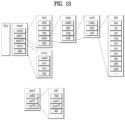
- FIG. 10 illustrates a hierarchical structure of boxes in ISOBMFF according to one embodiment of the present invention.
- a standardized media file format can be defined.
- a media file may have a file format based on ISO base media file format (ISOBMFF).
- ISO base media file format ISO base media file format
- a media file according to the present invention may include at least one box.
- a box may be a data block or an object including media data or metadata related to media data. Boxes may be arranged in a hierarchical structure, and thus data can be classified and a media file can take a form suitable for storage and/or transmission of media data.
- the media file may have a structure which facilitates accessing media information such as user moving to a specific point in media content.
- the media file according to the present invention can include an ftyp box, a moov box and/or an mdat box.
- the ftyp box (file type box) can provide information related to file type or compatibility of the corresponding media file.
- the ftyp box can include configuration version information about media data of the media file.
- a decoder can identify the corresponding media file with reference to the ftyp box.
- the moov box may include metadata about the media data of the media file.
- the moov box can serve as a container for all pieces of metadata.
- the moov box may be a box at the highest level among metadata related boxes. According to an embodiment, only one moov box may be included in the media file.
- the mdat box may contain actual media data of the corresponding media file.
- the media data can include audio samples and/or video samples and the mdat box can serve as a container for containing such media samples.
- the moov box may include an mvhd box, a trak box and/or an mvex box as lower boxes.
- the mvhd box can include media presentation related information of media data included in the corresponding media file. That is, the mvhd box can include information such as a media generation time, change time, time standard and period of corresponding media presentation.
- the trak box can provide information related to a track of corresponding media data.
- the trak box can include information such as stream related information about an audio track or a video track, presentation related information, and access related information.
- a plurality of trak boxes may be provided depending on the number of tracks.
- the mvex box (movie extend box) can indicate that the corresponding media file may include a moof box which will be described below. Moov boxes may need to be scanned to recognize all media samples of a specific track.
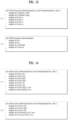
- FIG. 12(a) illustrate a configuration of a sample entry of a track storing the region information in the 2D space
- FIG. 12(b) illustrates a configuration of an individual sample for an individual region to be represented in the 2D space.
- the sample entry of the track storing the region information in the 2D space may include reference_width, reference_height, min_top_left_x, max_top_left_x, min top left_y, max_top_left_y, min _width, max _width, min _height and/or max_height.
- the reference _height indicates the vertical size of the 2D space.
- the vertical size of the 2D space may be represented in number of pixels.
- the min_top_left_x indicates a minimum value of the horizontal coordinate of the left top point of a region to be represented.
- the max_top_left_x indicates a maximum value of the horizontal coordinate of the left top point of the region to be represented.
- the min_top_left_y indicates a minimum value of the vertical coordinate of the left top point of the region to be represented.
- the max_top_left_y indicates a maximum value of the vertical coordinate of the left top point of the region to be represented.
- the min_width indicates a minimum value of the horizontal size of a region (region in the 2D space) to be represented.
- the minimum value of the horizontal size of the region to be represented may be represented in number of pixels.
- the max_width indicates a maximum value of the horizontal size of the region (region in the 2D space) to be represented.
- the maximum value of the horizontal size of the region to be represented may be represented in number of pixels.
- the min _height indicates a minimum value of the vertical size of a region (region in the 2D space) to be represented.
- the minimum value of the vertical size of the region to be represented may be represented in number of pixels.
- the max_height indicates a maximum value of the vertical size of a region (region in the 2D space) to be represented.
- the maximum value of the vertical size of the region to be represented may be represented in number of pixels.
- An individual sample for an individual region to be represented in the 2D space may include top_left_x, top_left_y, width, height and/or interpolate.
- the top_left_x indicates the horizontal coordinate of the left top point of a region to be represented.
- the top_left_y indicates the vertical coordinate of the left top point of the region to be represented.
- the height indicates the vertical size of the region to be represented.
- the vertical size of the region to be represented may be represented in number of pixels.
- the interpolate indicates whether values between a region represented by a previous sample and a region represented by a current sample are filled by linearly interpolated values. In an embodiment, when interpolate is 1, the values between the region represented by the previous sample and the region represented by the current sample can be filled by linearly interpolated values.
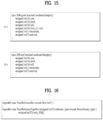
- FIG. 13 illustrates metadata about a viewpoint (point) in a 2D space according to one embodiment of the present invention.
- FIG. 13(a) illustrate a configuration of a sample entry of a track storing the viewpoint (point) information in the 2D space
- FIG. 13(b) illustrates a configuration of an individual sample for an individual viewpoint (point) to be represented in the 2D space.
- the sample entry of the track storing the point information in the 2D space may include reference_width, reference _height, min_x, max_x, min_y and/or max_y.
- the reference_width indicates the horizontal size of the 2D space.
- the horizontal size of the 2D space may be represented in number of pixels.
- the reference _height indicates the vertical size of the 2D space.
- the vertical size of the 2D space may be represented in number of pixels.
- the min_x indicates a minimum value of the horizontal coordinate of a point to be presented.
- the max_x indicates a maximum value of the horizontal coordinate of the point to be presented.
- the min_y indicates a minimum value of the vertical coordinate of the point to be presented.
- the max_y indicates a maximum value of the vertical coordinate of the point to be presented.
- An individual sample for an individual point to be represented in the 2D space may include x, y and/or interpolate.
- the x indicates the horizontal coordinate of a point to be represented.
- the y indicates the vertical coordinate of the point to be represented.
- the interpolate indicates whether values between a region represented by a previous sample and a region represented by a current sample are filled by linearly interpolated values. In an embodiment, when interpolate is 1, the values between the region represented by the previous sample and the region represented by the current sample can be filled by linearly interpolated values.
- Region and viewpoint information in a 3D space may be stored in a single track as timed metadata in ISOBMFF.
- Embodiments of metadata about region information in a 3D space and metadata about viewpoint (point) information in the 3D space will be sequentially described below.
- the 3D space may refer to a sphere and 360-degree video may be represented on the sphere.
- the aforementioned 2D space may refer to a 3D plane onto which the 3D space is projected/mapped.
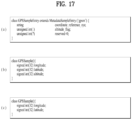
- FIG. 14 illustrates metadata about region information in a 3D space according to various embodiments of the present invention.
- FIG. 14(a) illustrate a configuration of a sample entry of a track storing the region information in the 3D space according to one embodiment of the present invention
- FIG. 14(b) illustrates a configuration of a sample entry of a track storing the region information in the 3D space according to another embodiment of the present invention.
- the individual sample for the individual region to be represented in the 3D space may include yaw, pitch, roll and/or interpolate.
- a "gpsd" track may be a reference type which correlates a metadata track delivering GPS information with a 360 video track.
- a track including the tref box having this reference_type may be a metadata track which delivers GPS information.
- track_IDs included in the tref box can reference the 360 video track.
- a track including the tref box having this reference_type may be a 360 video track.
- track_IDs included in the tref box can reference a metadata track which delivers GPS information.
- a file with respect to content supporting 360 video services is generated on the basis of a box based file format such as ISOBMFF, a DASH segment which can operate in MPEG DASH is generated or an MPU which can operate in an MPEG MMT is generated.
- a receiver including a DASH client or an MMT client may effectively decode and display the content on the basis of 360 video related metadata (flags, parameters, etc.).
- sample entries and/or samples for metadata about region information or viewpoint information and/or metadata about GPS information may be simultaneously present in a single ISOBMFF filed, a DASH segment or multiple boxes in an MMT MPU.
- values of 360 video related flags or 360 video metadata defined in a lower box may override values of metadata about region information or viewpoint information and/or GPS information defined in an upper box.
- an additional adaptation set for metadata transmission may be configured.
- signaling for indicating transmission of the metadata about region information or viewpoint information through the additional adaptation set needs to be included in an MPD.
- a role descriptor may be used as signaling for indicating transmission of the metadata about region information or viewpoint information through the additional adaptation set.
- a new schemeIdUri value may be allocated to discriminate a role scheme from the conventional role scheme in the MPD.
- a new schemeIdUri value such as "urn:mpeg:dash:role:201X” can be allocated for the role scheme.
- "dire” may be allocated to such a new scheme as a value for indicating the metadata about region information or viewpoint information.
- "dire” allocated as a value for indicating the metadata about region information or viewpoint information is exemplary and values other than "dire” may be allocated.
- "main" may be allocated to the value.
- Representation@associationId and associationType may be used.
- the representation for transmission of metadata about region information or viewpoint information may indicate id ("VR_video") of the representation for transmission of VR video to which the metadata will be applied using associationId, and "dire” may be allocated as associationType therein.
- "dire” may be newly defined as a value indicating the metadata about region information or viewpoint information.
- This method may be used to represent a relationship between tracks of the ISO BMFF (ISO Base Media File Format) in addition to DASH. That is, track_IDs of the "tref' box may be used instead of associationId and reference_type of the "tref' box may be used instead of associationType for the same purpose.
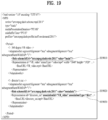
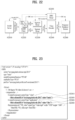
- FIG. 18 illustrates an MPD which signals transmission of metadata about region information or viewpoint information according to an embodiment of the present invention.
- the MPD includes signaling for indicating transmission of metadata about region information or viewpoint information through an additional adaptation set.
- a role descriptor is used as signaling for indicating transmission of metadata about region information or viewpoint information through an additional adaptation set.
- “urn:mpeg:dash:role:201X” is allocated to the role scheme and "dire” is allocated to the value in order to indicate transmission of the metadata about region information or viewpoint information through the additional adaptation set (H18020).
- “urn:mpeg:dash:role:2011” is allocated to the role scheme and “main” is allocated to the value (H18010).
- Representation@associationId and associationType are used in order to signal a relationship between a representation for VR video transmission and a representation for transmission of the metadata about region information or viewpoint information.
- a new role scheme may be defined in order to signal transmission of metadata about region information or viewpoint information.
- a method compatible with the conventional role scheme may be used in order to signal transmission of metadata about region information or viewpoint information.
- FIG. 19 illustrates an MPD which signals transmission of metadata about region information or viewpoint information according to another embodiment of the present invention.
- the MPD includes signaling for indicating transmission of metadata about region information or viewpoint information through an additional adaptation set.
- Representation@associationId and associationType are used in order to signal a relationship between a representation for VR video transmission and a representation for transmission of the metadata about region information or viewpoint information.
- receiver operation related to the methods of transmitting and signaling metadata about region information or viewpoint information through an additional adaptation set, described above with reference to FIGS. 18 and 19 .
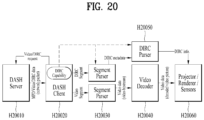
- FIG. 20 is a block diagram of a receiver according to an embodiment of the present invention.
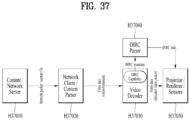
- the receiver may include a DASH client H20020, segment parsers H20030, a video decoder H20040, a DIRC parser H20050 and/or a projector/renderer/sensors H20060.
- An MPD, VR content and/or metadata about region information or viewpoint information may be provided by a DASH server H20010 and received by the DASH client H20020.
- the DASH client H20020 of the receiver may receive VR content, MPD and/or metadata about region information or viewpoint information in a data packet format from the DASH server H20010.
- the DASH client H20020 may request the MPD, VR content and/or metadata about region information or viewpoint information from the DASH server H20010.
- the DASH client H20020 may generate an MPD and a segment from a received packet.
- the DASH client H20020 may parse the received MPD to acquire information about content (VR content).
- the DASH client H20020 may recognize presence or absence of the metadata about region information or viewpoint information through signaling with respect to an adaptation set through which the metadata about region information or viewpoint information is transmitted, described above with reference to FIGS. 18 and 19 .
- the DASH client H20020 may activate the DIRC parser and the segment parser for DIRC depending on capabilities of the receiver and/or purpose of use of the content (refer to the dotted line of the figure).
- the adaptation set through which the metadata about region information or viewpoint information is transmitted may not be used (may be skipped).
- the segment may be delivered to the segment parser H20030.
- the segment parser H20030 may parse the received segment and respectively deliver a video bitstream and metadata (DIRC metadata) about region information or viewpoint information to the video decoder H20040 and the DIRC parser H20050.
- the segment parser H20030 may be functionally classified according to parsing target. That is, the segment parser H20030 may be classified into a segment parser for parsing a segment for video and a segment parser for metadata about region information or viewpoint information.
- the video decoder H20040 may decode the video bitstream and deliver the decoded video bitstream to the projector/renderer/sensors H20060.
- the DIRC parser H20050 may parse the DIRC metadata and deliver the parsed information (DIRC info) to the projector/renderer/sensors H20060.
- the projector/renderer/sensors H20060 may receive the video bitstream from the video decoder H20040 and receive the DIRC metadata from the DIRC parser H20050. In addition, the projector/renderer/sensors H20060 may provide video data to a user using the DIRC information.
- a method through which the projector/renderer/sensors H20060 provide VR content to the user using the DIRC information may depend on application. For example, a viewpoint intended by a producer and indicated by DIRC can be displayed to the user through auto navigation. As another example, VR content can be displayed depending on the viewpoint of the user with direction indication for guiding the viewpoint intended by the producer.
- FIG. 21 illustrates an MPD which signals transmission of metadata about region information or viewpoint information according to another embodiment of the present invention.
- VR video is composed of two or more spatial regions and is transmitted through two or more adaptation sets, distinguished from the embodiments of FIGS. 18 and 19 .
- the VR video is divided into a left spatial region and a right spatial region which respectively correspond to VR video tiles.
- the two VR video tiles correspond to two adaptation sets.
- the video decoder H22040 may decode the video bitstream and deliver the decoded video bitstream to the projector/renderer/sensors H22060.
- the DIRC parser H22050 may parse the DIRC metadata and deliver the parsed information (DIRC info) to the projector/renderer/sensors H22060.
- the DIRC parser H22050 may deliver the parsed information (DIRC info) to the DASH client H22010.
- the information (DIRC info) delivered to the DASH client H22010 may be used for the DASH client H22010 to select an adaptation set corresponding to a spatial region (tile) including the viewpoint or region intended by the producer.
- the projector/renderer/sensors H22060 may receive the video bitstream from the video decoder H22040 and receive the DIRC metadata from the DIRC parser H22050. In addition, the projector/renderer/sensors H22060 may provide video data to a user using the DIRC information.
- a method through which the projector/renderer/sensors H22060 provide VR content to the user using the DIRC information may depend on application. For example, a viewpoint intended by a producer and indicated by DIRC can be displayed to the user through auto navigation. As another example, VR content can be displayed depending on the user's gaze with direction indication for guiding the viewpoint intended by the producer.
- an adaptation set for transmitting and signaling VR video and an adaptation set for transmitting and signaling metadata are separately present.
- Metadata about viewpoint information or region information may be transmitted together with VR video in a single adaptation set, distinguished from the cases described with reference to FIGS. 18 to 22 .
- video data and metadata may be transmitted through a single file (segment or ISO BMFF).
- VR video and metadata may be configured as separate tracks in a single file or configured as a single video file including the metadata.
- VR video and metadata are configured as separate tracks in a single file and an embodiment in which a single video track including the metadata is configured will be sequentially described below.
- FIG. 23 illustrates an MPD which signals transmission of metadata about region information or viewpoint information according to another embodiment of the present invention.
- FIG. 23 corresponds to the embodiment in which VR video and the metadata about region information or viewpoint information are configured as separate tracks in a single file.
- the VR video and the metadata about region information or viewpoint information are configured as separate tracks in a single adaptation set and a single file and transmitted.
- the VR video track and the metadata track may be identified by ContentComponent which is a lower element of AdaptationSet in the MPD and may have contentType of "video" and "application” (H23010 and H23020).
- the ContentComponent may have Role as a lower element and the Role is used to indicate whether the VR video and/or the metadata (metadata about region information or viewpoint information) are transmitted through the aforementioned method of transmitting metadata through an additional adaptation set. That is, for VR video, "urn:mpeg:dash:role:2011" may be allocated to the role scheme and "main' may be allocated to the value.
- FIG. 24 illustrates an MPD which signals transmission of metadata about region information or viewpoint information according to another embodiment of the present invention.
- VR video and metadata about region information or viewpoint information are configured as a single track.
- the VR video and the metadata about region information or viewpoint information are configured as a single track in a single adaptation set and a single file.
- a single file may basically include a single video track.
- the metadata about region information or viewpoint information may be stored in the form of metadata attached to a track such as sample group description.
- the MPD may include a single adaptation set including video and metadata and two roles for respectively indicating whether the video and the metadata are transmitted. That is, "urn:mpeg:dash:role:2011" may be allocated to the role scheme and "main” may be allocated to the value in the case of the VR video.
- "urn:mpeg:dash:role:201x” may be allocated to the role scheme and "dire” may be allocated to the value or "urn:mpeg:dash:role:2011” may be allocated to the role scheme and "metadata” may be allocated to the value in the case of the metadata about region information or viewpoint information.
- ContentComponent for identifying the VR video and the metadata is not present as a lower element of the Adaptation Set, distinguished from the embodiment of FIG. 23 .
- receiver operation related to the method of transmitting and signaling metadata about region information or viewpoint information through a single adaptation set described above with reference to FIGS. 23 and 24 .
- FIG. 25 is a block diagram of a receiver according to another embodiment of the present invention.
- the DASH client H25020 may parse the received MPD to acquire information about content (VR content).
- the DASH client H25020 may recognize presence or absence of the metadata about region information or viewpoint information through signaling with respect to an adaptation set through which the metadata about region information or viewpoint information is transmitted, described above with reference to FIGS. 23 and 24 .
- the DASH client H25020 may activate the DIRC parser and the segment parser for DIRC depending on capabilities of the receiver and/or purpose of use of the content (refer to the dotted line of the figure).
- FIG. 34 a spherical vdci descriptor according to an embodiment of the present invention is shown.
- the metadata about the omnidirectional video may indicate information about a viewpoint intended by a producer of the omnidirectional video.
- the metadata about the omnidirectional video may be transmitted through the ISOBMFF, a DASH MPD/segment, a PES packet or an adaptation field of an MPEG-2 TS and/or an SEI message of VCL.
- the metadata about the omnidirectional video may be included in an adaptation set of DASH (Dynamic Adaptive Streaming over HTTP) and transmitted. This has been described above in detail with reference to FIGS. 18 to 25 .
- DASH Dynamic Adaptive Streaming over HTTP
- the metadata about the omnidirectional video may be included in a PES (Packetized Elementary Stream) packet or an adaptation field of an MPEG-2 TS and transmitted. This has been described above in detail with reference to FIGS. 26 to 36 .
- PES Packetized Elementary Stream
- the metadata about the omnidirectional video may be included in an SEI (Supplemental Enhancement Layer) message of a VCL (Video Coding layer). This has been described above in detail with reference to FIGS. 36 and 37 .
- SEI Supplemental Enhancement Layer
- VCL Video Coding layer
- Step SH40200 of parsing the metadata about the omnidirectional video may be a step of parsing the metadata about the omnidirectional video included in the data signal.
- the metadata about the omnidirectional video may be transmitted through ISOBMFF, a DASH MPD/segment, a PES packet or an adaptation field of an MPEG-2 TS and/or an SEI message of VCL and thus may be parsed at each level.
- Step SH40300 of decoding the image for the omnidirectional video may be a step of decoding an encoded image using a decoding scheme corresponding to the encoding scheme used for the encoded image.
- Step SH40300 of decoding the image for the omnidirectional video may correspond to the decoding process of FIG. 1 , the operation of the data decoder of FIG. 3 and the video decoding or image decoding process of FIG. 4 .
- step SH40300 of decoding the image for the omnidirectional video may be a step of decoding a packed image corresponding to each region.
- different decoding schemes may be used for packed images.
- the metadata about the omnidirectional video may be extracted in step SH40300.
- Step SH40400 of reproj ecting the image for the omnidirectional video onto a 3D model may be a step of reprojecting an image packed into a 2D frame onto a 3D model. Since the image for the omnidirectional video decoded through step SH40300 refers to an image packed into a 2D frame, step SH40400 may refer to a step of reprojecting the image packed into a 2D frame onto a 3D model.
- the 3D model may the same as the 3D projection structure in the method of transmitting omnidirectional video according to an embodiment of the present invention.
- Step SH40400 of reproj ecting the image for the omnidirectional video on the 3D model may correspond to the rendering process t1030 of FIG. 1 , the operation of the reprojection processor of FIG. 3 and the video rendering process of FIG. 4 .
- the method of receiving omnidirectional video according to an embodiment of the present invention may further include a feedback step.
- the feedback step is a step of outputting viewport information or rotation information of a user device. Data corresponding to a view region can be processed on the basis of the viewport information or rotation information of the user device.
- Feedback information including the viewport information or rotation information of the user device may be provided prior to the reprojection step, rendering step, image decoding step or a transmission file or segment decapsulation step. Further, the feedback information may be transmitted to a transmission side.
- the feedback step may correspond to the feedback process of FIG. 1 , the operation of the feedback processor of FIG. 3 and the tracking process of a VR application shown in FIG. 4 .
- a device for receiving omnidirectional video is provided.
- FIG. 41 is a block diagram of a device for receiving omnidirectional video according to an embodiment of the present invention.
- the device for receiving omnidirectional video may include a reception unit H41100 for receiving a data signal including an image for the omnidirectional video and metadata about the omnidirectional video, a metadata parser H41200 for parsing the metadata about the omnidirectional video, a decoder H41300 for decoding the image for the omnidirectional video, and a rendering unit H41400 for reprojecting the image for the omnidirectional video onto a 3D model.
- a reception unit H41100 for receiving a data signal including an image for the omnidirectional video and metadata about the omnidirectional video
- a metadata parser H41200 for parsing the metadata about the omnidirectional video
- a decoder H41300 for decoding the image for the omnidirectional video
- a rendering unit H41400 for reprojecting the image for the omnidirectional video onto a 3D model.
- the operation of the reception unit H41100 may correspond to step SH40100 of receiving a data signal including an image for the omnidirectional video and metadata about the omnidirectional video in the method of receiving omnidirectional video according to an embodiment of the present invention described above with reference to FIG. 40 and thus description of step SH40100 is applicable thereto.
- the operation of the metadata parser H41200 may correspond to step SH40200 of parsing the metadata about the omnidirectional video in the method of receiving omnidirectional video according to an embodiment of the present invention described above with reference to FIG. 40 and thus description of step SH40200 is applicable thereto.
- the operation of the decoder H41300 may correspond to step SH40300 of decoding the image for the omnidirectional video in the method of receiving omnidirectional video according to an embodiment of the present invention described above with reference to FIG. 40 and thus description of step SH40300 is applicable thereto.
- the operation of the rendering unit H41400 may correspond to step SH40400 of reprojecting the image for the omnidirectional video onto a 3D model in the method of receiving omnidirectional video according to an embodiment of the present invention described above with reference to FIG. 40 and thus description of step SH40400 is applicable thereto.
- the device for receiving omnidirectional video may further include a feedback processor (not shown).
- the feedback processor may generate and output viewport information and/or rotation information by tracking viewport and/or rotation of a user device.
- the metadata about the omnidirectional video may refer to information necessary for a reception device to process the omnidirectional video.
- the metadata about the omnidirectional video has been described above in the method of receiving omnidirectional video according to an embodiment of the present invention.
- the internal components of the above-described devices may be processors which execute consecutive procedures stored in memories or hardware components.
- the processors or hardware components may be provided to the inside/outside of the devices.
- the aforementioned modules may be omitted or replaced by other modules which perform similar/identical operations according to embodiments.
- Each of the aforementioned parts, modules or units may be a processor or a hardware part designed to execute a series of execution steps stored in a memory (or a storage unit). Each step described in the above-mentioned embodiments may be implemented by processors or hardware parts. Each module, each block, and/or each unit described in the above-mentioned embodiments may be realized by a processor/hardware. In addition, the above-mentioned methods of the present invention may be realized by code written in recoding media configured to be read by a processor so that the code may be read by the processor provided by the apparatus.
- the devices and methods according to the present invention may be non-limited by the configurations and methods of the embodiments mentioned in the foregoing description.
- the embodiments mentioned in the foregoing description may be configured in a manner of being selectively combined with one another entirely or in part to enable various modifications.
- a method according to the present invention may be implemented with processor-readable code in a processor-readable recording medium provided to a network device.
- the processor-readable medium may include all kinds of recording devices capable of storing data readable by a processor.
- the processor-readable medium may include one of ROM, RAM, CD-ROM, magnetic tapes, floppy disks, optical data storage devices, and the like and also include carrier-wave type implementation such as a transmission via Internet.
- processor-readable recording medium is distributed to a computer system connected via a network, processor-readable code may be saved and executed in a distributed manner.
- the present invention is available in a series of broadcast signal provision fields.
Landscapes
- Engineering & Computer Science (AREA)
- Multimedia (AREA)
- Signal Processing (AREA)
- Physics & Mathematics (AREA)
- General Physics & Mathematics (AREA)
- Theoretical Computer Science (AREA)
- Library & Information Science (AREA)
- Two-Way Televisions, Distribution Of Moving Picture Or The Like (AREA)
- Testing, Inspecting, Measuring Of Stereoscopic Televisions And Televisions (AREA)
Applications Claiming Priority (3)
| Application Number | Priority Date | Filing Date | Title |
|---|---|---|---|
| US201662379740P | 2016-08-25 | 2016-08-25 | |
| PCT/KR2017/009185 WO2018038520A1 (ko) | 2016-08-25 | 2017-08-23 | 전방향 비디오를 전송하는 방법, 전방향 비디오를 수신하는 방법, 전방향 비디오 전송 장치, 전방향 비디오 수신 장치 |
| EP17843940.2A EP3503546A4 (de) | 2016-08-25 | 2017-08-23 | Verfahren zum senden eines omnidirektionalen videos, verfahren zum empfangen eines omnidirektionalen videos, vorrichtung zum senden eines omnidirektionalen videos und vorrichtung zum empfangen eines omnidirektionalen videos |
Related Parent Applications (1)
| Application Number | Title | Priority Date | Filing Date |
|---|---|---|---|
| EP17843940.2A Division EP3503546A4 (de) | 2016-08-25 | 2017-08-23 | Verfahren zum senden eines omnidirektionalen videos, verfahren zum empfangen eines omnidirektionalen videos, vorrichtung zum senden eines omnidirektionalen videos und vorrichtung zum empfangen eines omnidirektionalen videos |
Publications (2)
| Publication Number | Publication Date |
|---|---|
| EP4531405A2 true EP4531405A2 (de) | 2025-04-02 |
| EP4531405A3 EP4531405A3 (de) | 2025-06-04 |
Family
ID=61244072
Family Applications (2)
| Application Number | Title | Priority Date | Filing Date |
|---|---|---|---|
| EP25158573.3A Pending EP4531405A3 (de) | 2016-08-25 | 2017-08-23 | Verfahren zur übertragung eines omnidirektionalen videos, verfahren zum empfang eines omnidirektionalen videos, vorrichtung zur übertragung eines omnidirektionalen videos und vorrichtung zum empfang eines omnidirektionalen videos |
| EP17843940.2A Ceased EP3503546A4 (de) | 2016-08-25 | 2017-08-23 | Verfahren zum senden eines omnidirektionalen videos, verfahren zum empfangen eines omnidirektionalen videos, vorrichtung zum senden eines omnidirektionalen videos und vorrichtung zum empfangen eines omnidirektionalen videos |
Family Applications After (1)
| Application Number | Title | Priority Date | Filing Date |
|---|---|---|---|
| EP17843940.2A Ceased EP3503546A4 (de) | 2016-08-25 | 2017-08-23 | Verfahren zum senden eines omnidirektionalen videos, verfahren zum empfangen eines omnidirektionalen videos, vorrichtung zum senden eines omnidirektionalen videos und vorrichtung zum empfangen eines omnidirektionalen videos |
Country Status (5)
| Country | Link |
|---|---|
| US (2) | US10687043B2 (de) |
| EP (2) | EP4531405A3 (de) |
| KR (1) | KR102264028B1 (de) |
| CN (1) | CN109644262A (de) |
| WO (1) | WO2018038520A1 (de) |
Families Citing this family (44)
| Publication number | Priority date | Publication date | Assignee | Title |
|---|---|---|---|---|
| KR102358757B1 (ko) * | 2016-08-25 | 2022-02-07 | 엘지전자 주식회사 | 전방향 비디오를 전송하는 방법, 전방향 비디오를 수신하는 방법, 전방향 비디오 전송 장치, 전방향 비디오 수신 장치 |
| US10404960B2 (en) * | 2016-10-10 | 2019-09-03 | Samsung Electronics Co., Ltd. | System and method to prevent boundary artifacts |
| US11197040B2 (en) * | 2016-10-17 | 2021-12-07 | Mediatek Inc. | Deriving and signaling a region or viewport in streaming media |
| US10999602B2 (en) | 2016-12-23 | 2021-05-04 | Apple Inc. | Sphere projected motion estimation/compensation and mode decision |
| WO2018131813A1 (en) * | 2017-01-10 | 2018-07-19 | Samsung Electronics Co., Ltd. | Method and apparatus for generating metadata for 3d images |
| US11259046B2 (en) | 2017-02-15 | 2022-02-22 | Apple Inc. | Processing of equirectangular object data to compensate for distortion by spherical projections |
| US10924747B2 (en) | 2017-02-27 | 2021-02-16 | Apple Inc. | Video coding techniques for multi-view video |
| CN108537721B (zh) * | 2017-03-02 | 2021-09-07 | 株式会社理光 | 全景图像的处理方法、装置及电子设备 |
| US11532128B2 (en) | 2017-03-23 | 2022-12-20 | Qualcomm Incorporated | Advanced signaling of regions of interest in omnidirectional visual media |
| US10979663B2 (en) * | 2017-03-30 | 2021-04-13 | Yerba Buena Vr, Inc. | Methods and apparatuses for image processing to optimize image resolution and for optimizing video streaming bandwidth for VR videos |
| US10506255B2 (en) * | 2017-04-01 | 2019-12-10 | Intel Corporation | MV/mode prediction, ROI-based transmit, metadata capture, and format detection for 360 video |
| US11394943B2 (en) * | 2017-05-30 | 2022-07-19 | Sony Corporation | Image processing apparatus and method, file generation apparatus and method, and program |
| US11093752B2 (en) | 2017-06-02 | 2021-08-17 | Apple Inc. | Object tracking in multi-view video |
| US10754242B2 (en) | 2017-06-30 | 2020-08-25 | Apple Inc. | Adaptive resolution and projection format in multi-direction video |
| US20190005709A1 (en) * | 2017-06-30 | 2019-01-03 | Apple Inc. | Techniques for Correction of Visual Artifacts in Multi-View Images |
| US10567734B2 (en) * | 2017-08-29 | 2020-02-18 | Qualcomm Incorporated | Processing omnidirectional media with dynamic region-wise packing |
| EP3496388A1 (de) * | 2017-12-05 | 2019-06-12 | Thomson Licensing | Verfahren und vorrichtung zur codierung einer punktwolke, die dreidimensionale objekte repräsentiert |
| CN109996069B (zh) * | 2018-01-03 | 2021-12-10 | 华为技术有限公司 | 视频图像编解码方法及设备 |
| US10939086B2 (en) | 2018-01-17 | 2021-03-02 | Mediatek Singapore Pte. Ltd. | Methods and apparatus for encoding and decoding virtual reality content |
| US11303826B2 (en) * | 2018-01-31 | 2022-04-12 | Lg Electronics Inc. | Method and device for transmitting/receiving metadata of image in wireless communication system |
| WO2019181493A1 (ja) * | 2018-03-19 | 2019-09-26 | ソニー株式会社 | 受信装置、受信方法、送信装置および送信方法 |
| EP3777136A4 (de) * | 2018-04-03 | 2021-05-19 | Huawei Technologies Co., Ltd. | Mediendatenverarbeitungsverfahren und -vorrichtung |
| EP3759924A1 (de) | 2018-04-03 | 2021-01-06 | Huawei Technologies Co., Ltd. | Bitstromsignalisierung von fehlerabschwächung bei bitstrombasierter ansichtsfensterabhängiger videocodierung in einem teilbild |
| US11343510B2 (en) * | 2018-04-03 | 2022-05-24 | Samsung Electronics Co., Ltd. | Methods and apparatus for determining rotation angle for spherical multimedia content |
| US10944977B2 (en) | 2018-04-03 | 2021-03-09 | Mediatek Singapore Pte. Ltd. | Methods and apparatus for encoding and decoding overlay compositions |
| JP7401453B2 (ja) * | 2018-04-05 | 2023-12-19 | ヴィド スケール インコーポレイテッド | 全方位ビデオに対する視点メタデータ |
| US10869016B2 (en) * | 2018-04-12 | 2020-12-15 | Mediatek Singapore Pte. Ltd. | Methods and apparatus for encoding and decoding virtual reality content |
| WO2019203456A1 (ko) * | 2018-04-15 | 2019-10-24 | 엘지전자 주식회사 | 복수의 뷰포인트들에 대한 메타데이터를 송수신하는 방법 및 장치 |
| CN112514398B (zh) | 2018-06-01 | 2023-07-14 | 诺基亚技术有限公司 | 用于针对全向内容而标记在覆盖物上的用户交互并将对背景的覆盖物分组的方法和装置 |
| WO2019245303A1 (en) * | 2018-06-22 | 2019-12-26 | Lg Electronics Inc. | Method for transmitting 360-degree video, method for receiving 360-degree video, apparatus for transmitting 360-degree video, and apparatus for receiving 360-degree video |
| KR102491939B1 (ko) * | 2018-08-24 | 2023-01-26 | 삼성전자주식회사 | 전방향 이미지를 프로세싱하기 위한 방법 및 장치 |
| CN110876051B (zh) * | 2018-08-29 | 2023-04-11 | 中兴通讯股份有限公司 | 视频数据的处理,传输方法及装置,视频数据的处理系统 |
| WO2020068935A1 (en) * | 2018-09-27 | 2020-04-02 | Futurewei Technologies, Inc. | Virtual reality viewpoint viewport center point correspondence signaling |
| WO2020071632A1 (ko) * | 2018-10-02 | 2020-04-09 | 엘지전자 주식회사 | 360 비디오 시스템에서 오버레이 처리 방법 및 그 장치 |
| JP7415936B2 (ja) * | 2018-10-02 | 2024-01-17 | ソニーグループ株式会社 | 情報処理装置および情報処理方法 |
| CN112148115A (zh) * | 2019-06-28 | 2020-12-29 | 中兴通讯股份有限公司 | 媒体处理方法、装置、系统和可读存储介质 |
| CN112423108B (zh) * | 2019-08-20 | 2023-06-30 | 中兴通讯股份有限公司 | 码流的处理方法、装置、第一终端、第二终端及存储介质 |
| WO2021127419A1 (en) | 2019-12-19 | 2021-06-24 | Interdigital Vc Holdings, Inc. | Methods and apparatuses for encoding, decoding and rendering 6dof content from 3dof+ composed elements |
| CN111083395A (zh) * | 2019-12-27 | 2020-04-28 | 卓望数码技术(深圳)有限公司 | 全景视频处理方法及系统 |
| KR102373833B1 (ko) * | 2020-01-09 | 2022-03-14 | 엘지전자 주식회사 | 포인트 클라우드 데이터 송신 장치, 포인트 클라우드 데이터 송신 방법, 포인트 클라우드 데이터 수신 장치 및 포인트 클라우드 데이터 수신 방법 |
| EP4092625A4 (de) * | 2020-04-08 | 2023-04-19 | LG Electronics, Inc. | Punktwolkendatenübertragungsvorrichtung, übertragungsverfahren, verarbeitungsvorrichtung und verarbeitungsverfahren |
| KR102406845B1 (ko) | 2020-04-13 | 2022-06-10 | 엘지전자 주식회사 | 포인트 클라우드 데이터 송신 장치, 포인트 클라우드 데이터 송신 방법, 포인트 클라우드 데이터 수신 장치 및 포인트 클라우드 데이터 수신 방법 |
| CN112055263B (zh) * | 2020-09-08 | 2021-08-13 | 西安交通大学 | 基于显著性检测的360°视频流传输系统 |
| US12294688B2 (en) * | 2021-05-19 | 2025-05-06 | Snap Inc. | Hardware encoder for stereo stitching |
Family Cites Families (17)
| Publication number | Priority date | Publication date | Assignee | Title |
|---|---|---|---|---|
| US7176960B1 (en) * | 1999-09-20 | 2007-02-13 | The Trustees Of Columbia University In The City Of New York | System and methods for generating spherical mosaic images |
| US8319825B1 (en) * | 2008-06-16 | 2012-11-27 | Julian Urbach | Re-utilization of render assets for video compression |
| EP2408196B1 (de) * | 2010-07-14 | 2017-01-11 | Alcatel Lucent | Verfahren, Server und Endgerät zur Erzeugung einer Verbundansicht von mehrfachen Inhaltselementen |
| JP5891388B2 (ja) * | 2011-03-31 | 2016-03-23 | パナソニックIpマネジメント株式会社 | 立体視画像の描画を行う画像描画装置、画像描画方法、画像描画プログラム |
| CN102971770B (zh) * | 2011-03-31 | 2016-02-10 | 松下电器产业株式会社 | 进行全周围立体图像的描绘的图像描绘装置、图像描绘方法 |
| EP2784954A4 (de) * | 2011-11-25 | 2015-05-27 | Humax Holdings Co Ltd | Verfahren zur verknüpfung von mmt-medien und dash-medien |
| US9908048B2 (en) | 2013-06-08 | 2018-03-06 | Sony Interactive Entertainment Inc. | Systems and methods for transitioning between transparent mode and non-transparent mode in a head mounted display |
| US9451162B2 (en) * | 2013-08-21 | 2016-09-20 | Jaunt Inc. | Camera array including camera modules |
| US9819945B2 (en) * | 2014-06-25 | 2017-11-14 | Qualcomm Incorporated | Multi-layer video coding |
| US10750153B2 (en) * | 2014-09-22 | 2020-08-18 | Samsung Electronics Company, Ltd. | Camera system for three-dimensional video |
| US10091418B2 (en) * | 2014-10-24 | 2018-10-02 | Bounce Imaging, Inc. | Imaging systems and methods |
| US10104361B2 (en) * | 2014-11-14 | 2018-10-16 | Samsung Electronics Co., Ltd. | Coding of 360 degree videos using region adaptive smoothing |
| CN104735464A (zh) * | 2015-03-31 | 2015-06-24 | 华为技术有限公司 | 一种全景视频交互传输方法、服务器和客户端 |
| EP3419295A4 (de) | 2016-02-17 | 2019-08-28 | LG Electronics Inc. | Verfahren zur übertragung von 360-videos, verfahren zum empfang von 360-videos, vorrichtung zur übertragung von 360-video und vorrichtung zum empfang von 360-videos |
| CN105898339A (zh) * | 2016-04-12 | 2016-08-24 | 乐视控股(北京)有限公司 | 一种全景视频转码的方法及装置 |
| CN105898254B (zh) * | 2016-05-17 | 2018-10-23 | 北京金字塔虚拟现实科技有限公司 | 节省带宽的vr全景视频布局方法、装置及展现方法、系统 |
| WO2017204491A1 (ko) | 2016-05-26 | 2017-11-30 | 엘지전자 주식회사 | 360 비디오를 전송하는 방법, 360 비디오를 수신하는 방법, 360 비디오 전송 장치, 360 비디오 수신 장치 |
-
2017
- 2017-08-23 EP EP25158573.3A patent/EP4531405A3/de active Pending
- 2017-08-23 CN CN201780051515.6A patent/CN109644262A/zh active Pending
- 2017-08-23 EP EP17843940.2A patent/EP3503546A4/de not_active Ceased
- 2017-08-23 WO PCT/KR2017/009185 patent/WO2018038520A1/ko not_active Ceased
- 2017-08-23 KR KR1020197000648A patent/KR102264028B1/ko active Active
- 2017-08-24 US US15/685,631 patent/US10687043B2/en active Active
-
2020
- 2020-05-18 US US16/877,248 patent/US11115641B2/en active Active
Also Published As
| Publication number | Publication date |
|---|---|
| EP3503546A1 (de) | 2019-06-26 |
| KR102264028B1 (ko) | 2021-06-11 |
| WO2018038520A1 (ko) | 2018-03-01 |
| CN109644262A (zh) | 2019-04-16 |
| US10687043B2 (en) | 2020-06-16 |
| KR20190075040A (ko) | 2019-06-28 |
| EP3503546A4 (de) | 2020-01-22 |
| EP4531405A3 (de) | 2025-06-04 |
| US11115641B2 (en) | 2021-09-07 |
| US20200280712A1 (en) | 2020-09-03 |
| US20180063505A1 (en) | 2018-03-01 |
Similar Documents
| Publication | Publication Date | Title |
|---|---|---|
| US11115641B2 (en) | Method of transmitting omnidirectional video, method of receiving omnidirectional video, device for transmitting omnidirectional video, and device for receiving omnidirectional video | |
| EP3503547B1 (de) | Verfahren zum senden eines omnidirektionalen videos, verfahren zum empfangen eines omnidirektionalen videos, vorrichtung zum senden eines omnidirektionalen videos und vorrichtung zum empfangen eines omnidirektionalen videos | |
| US11109013B2 (en) | Method of transmitting 360-degree video, method of receiving 360-degree video, device for transmitting 360-degree video, and device for receiving 360-degree video | |
| KR102157655B1 (ko) | 360 비디오를 전송하는 방법, 360 비디오를 수신하는 방법, 360 비디오 전송 장치, 360 비디오 수신 장치 | |
| US11206387B2 (en) | Method for transmitting 360 video, method for receiving 360 video, apparatus for transmitting 360 video, and apparatus for receiving 360 video | |
| CN109076255B (zh) | 发送、接收360度视频的方法及设备 | |
| KR102157659B1 (ko) | 360 비디오를 전송하는 방법, 360 비디오를 수신하는 방법, 360 비디오 전송 장치, 360 비디오 수신 장치 | |
| US20200389640A1 (en) | Method and device for transmitting 360-degree video by using metadata related to hotspot and roi | |
| US20200204785A1 (en) | Method for transmitting 360-degree video, method for receiving 360-degree video, device for transmitting 360-degree video, and device for receiving 360-degree video | |
| BR112019003605B1 (pt) | Método para transmitir vídeo omnidirecional, dispositivo para transmitir vídeo omnidirecional, método para receber vídeo omnidirecional, dispositivo para receber vídeo omnidirecional |
Legal Events
| Date | Code | Title | Description |
|---|---|---|---|
| PUAI | Public reference made under article 153(3) epc to a published international application that has entered the european phase |
Free format text: ORIGINAL CODE: 0009012 |
|
| STAA | Information on the status of an ep patent application or granted ep patent |
Free format text: STATUS: THE APPLICATION HAS BEEN PUBLISHED |
|
| AC | Divisional application: reference to earlier application |
Ref document number: 3503546 Country of ref document: EP Kind code of ref document: P |
|
| AK | Designated contracting states |
Kind code of ref document: A2 Designated state(s): AL AT BE BG CH CY CZ DE DK EE ES FI FR GB GR HR HU IE IS IT LI LT LU LV MC MK MT NL NO PL PT RO RS SE SI SK SM TR |
|
| REG | Reference to a national code |
Ref country code: DE Ref legal event code: R079 Free format text: PREVIOUS MAIN CLASS: H04N0021840000 Ipc: H04N0013000000 |
|
| PUAL | Search report despatched |
Free format text: ORIGINAL CODE: 0009013 |
|
| AK | Designated contracting states |
Kind code of ref document: A3 Designated state(s): AL AT BE BG CH CY CZ DE DK EE ES FI FR GB GR HR HU IE IS IT LI LT LU LV MC MK MT NL NO PL PT RO RS SE SI SK SM TR |
|
| RIC1 | Information provided on ipc code assigned before grant |
Ipc: H04N 21/84 20110101ALI20250430BHEP Ipc: H04N 21/81 20110101ALI20250430BHEP Ipc: H04N 19/167 20140101ALI20250430BHEP Ipc: H04N 13/194 20180101ALI20250430BHEP Ipc: H04N 13/178 20180101ALI20250430BHEP Ipc: H04N 13/10 20180101ALI20250430BHEP Ipc: G06T 3/00 20240101ALI20250430BHEP Ipc: H04N 21/235 20110101ALI20250430BHEP Ipc: H04N 21/2343 20110101ALI20250430BHEP Ipc: H04N 13/00 20180101AFI20250430BHEP |
|
| STAA | Information on the status of an ep patent application or granted ep patent |
Free format text: STATUS: REQUEST FOR EXAMINATION WAS MADE |
|
| 17P | Request for examination filed |
Effective date: 20251201 |