EP4531413A1 - Dispositif électronique comprenant une caméra et procédé associé - Google Patents
Dispositif électronique comprenant une caméra et procédé associé Download PDFInfo
- Publication number
- EP4531413A1 EP4531413A1 EP23831698.8A EP23831698A EP4531413A1 EP 4531413 A1 EP4531413 A1 EP 4531413A1 EP 23831698 A EP23831698 A EP 23831698A EP 4531413 A1 EP4531413 A1 EP 4531413A1
- Authority
- EP
- European Patent Office
- Prior art keywords
- frames
- exposure value
- processor
- image
- brightness
- Prior art date
- Legal status (The legal status is an assumption and is not a legal conclusion. Google has not performed a legal analysis and makes no representation as to the accuracy of the status listed.)
- Pending
Links
Images





Classifications
-
- H—ELECTRICITY
- H04—ELECTRIC COMMUNICATION TECHNIQUE
- H04N—PICTORIAL COMMUNICATION, e.g. TELEVISION
- H04N23/00—Cameras or camera modules comprising electronic image sensors; Control thereof
- H04N23/60—Control of cameras or camera modules
- H04N23/61—Control of cameras or camera modules based on recognised objects
-
- H—ELECTRICITY
- H04—ELECTRIC COMMUNICATION TECHNIQUE
- H04N—PICTORIAL COMMUNICATION, e.g. TELEVISION
- H04N23/00—Cameras or camera modules comprising electronic image sensors; Control thereof
- H04N23/60—Control of cameras or camera modules
- H04N23/63—Control of cameras or camera modules by using electronic viewfinders
-
- H—ELECTRICITY
- H04—ELECTRIC COMMUNICATION TECHNIQUE
- H04N—PICTORIAL COMMUNICATION, e.g. TELEVISION
- H04N23/00—Cameras or camera modules comprising electronic image sensors; Control thereof
- H04N23/60—Control of cameras or camera modules
- H04N23/63—Control of cameras or camera modules by using electronic viewfinders
- H04N23/631—Graphical user interfaces [GUI] specially adapted for controlling image capture or setting capture parameters
- H04N23/632—Graphical user interfaces [GUI] specially adapted for controlling image capture or setting capture parameters for displaying or modifying preview images prior to image capturing, e.g. variety of image resolutions or capturing parameters
-
- H—ELECTRICITY
- H04—ELECTRIC COMMUNICATION TECHNIQUE
- H04N—PICTORIAL COMMUNICATION, e.g. TELEVISION
- H04N23/00—Cameras or camera modules comprising electronic image sensors; Control thereof
- H04N23/60—Control of cameras or camera modules
- H04N23/65—Control of camera operation in relation to power supply
-
- H—ELECTRICITY
- H04—ELECTRIC COMMUNICATION TECHNIQUE
- H04N—PICTORIAL COMMUNICATION, e.g. TELEVISION
- H04N23/00—Cameras or camera modules comprising electronic image sensors; Control thereof
- H04N23/60—Control of cameras or camera modules
- H04N23/69—Control of means for changing angle of the field of view, e.g. optical zoom objectives or electronic zooming
-
- H—ELECTRICITY
- H04—ELECTRIC COMMUNICATION TECHNIQUE
- H04N—PICTORIAL COMMUNICATION, e.g. TELEVISION
- H04N23/00—Cameras or camera modules comprising electronic image sensors; Control thereof
- H04N23/70—Circuitry for compensating brightness variation in the scene
- H04N23/71—Circuitry for evaluating the brightness variation
-
- H—ELECTRICITY
- H04—ELECTRIC COMMUNICATION TECHNIQUE
- H04N—PICTORIAL COMMUNICATION, e.g. TELEVISION
- H04N23/00—Cameras or camera modules comprising electronic image sensors; Control thereof
- H04N23/70—Circuitry for compensating brightness variation in the scene
- H04N23/73—Circuitry for compensating brightness variation in the scene by influencing the exposure time
Definitions
- the following descriptions relate to an electronic device including a camera and a method therefor.
- An electronic device may adjust a camera exposure value to enhance image quality.
- an electronic device may comprise at least one processor, at least one camera, and memory.
- the at least one processor may be configured to identify an object region corresponding to a subject within a preview image.
- the at least one processor may be configured to, based on identifying that the object region corresponding to the subject corresponds to a predefined subject, identify brightness of a background region from which the object region corresponding to the subject is excluded within the preview image.
- the at least one processor may be configured to, in a case that the brightness of the background region is greater than or equal to a reference value, obtain one or more first frames through a first exposure value, based on receiving a user input.
- the at least one processor may be configured to, after obtaining the one or more first frames, obtain one or more second frames through a second exposure value greater than the first exposure value.
- the at least one processor may be configured to generate an output image based on the one or more first frames and the one or more second frames.
- the at least one processor may be configured to, in a case that the brightness of the background region is less than the reference value, obtain one or more frames through the first exposure value, based on receiving a user input.
- the at least one processor may be configured to generate an output image based on the one or more frames.
- a method performed by an electronic device may comprise identifying an object region within a preview image.
- the method may comprise, based on identifying that the object region corresponds to a predefined subject, identifying brightness of a background region from which the object region is excluded within the preview image.
- the method may comprise, in a case that the brightness of the background region is greater than or equal to a reference value, obtaining one or more first frames through a first exposure value, based on receiving a user input.
- the method may comprise, after obtaining the one or more first frames, obtaining one or more second frames through a second exposure value greater than the first exposure value.
- the method may comprise generating an output image based on the one or more first frames and the one or more second frames.
- the method may comprise, in a case that the brightness of the background region is less than the reference value, obtaining one or more frames through the first exposure value, based on receiving a user input.
- the method may comprise generating an output image based on the one or more frames.
- Terms referring to combination e.g., combining, merging, montaging
- terms referring to a part of the preview e.g., object region, background region
- terms referring to a part of the obtained image e.g., object image, background image
- terms referring to a specified value e.g., reference value, threshold value
- a term such as '...module', '...unit', '...member', and '...part', and the like used below may mean at least one shape structure or may mean a unit processing a function.
- expressions of 'greater than' or 'less than' may be used to determine whether a particular condition is satisfied or fulfilled, but this is only a description for expressing an example and does not exclude a description of 'greater than or equal to' or 'less than or equal to'.
- a condition written as 'greater than or equal to' may be replaced with 'greater than'
- a condition written as 'less than or equal to' may be replaced with 'less than'
- a condition written as 'greater than or equal to and less than' may be replaced with 'greater than and less than or equal to'.
- 'A' to 'B' refer to at least one of elements from A (including A) to B (including B).
- 'C' and/or 'D' refer to including at least one of 'C' or 'D', that is, ⁇ 'C', 'D', 'C' and 'D' ⁇ .
- An electronic device may obtain an image of a bright object (e.g., moon) through a camera.
- the electronic device may adjust an exposure value to obtain detailed information of the bright object. As the exposure value decreases, the image may be photographed darkly. Accordingly, even when a background (e.g., sky) including the object is not dark, it may be difficult to obtain a real image of the sky because the electronic device obtains an image in which a bright object (e.g., the moon in the sky) is included in a dark background.
- a background e.g., sky
- an image close to reality may be obtained by adjusting the exposure value based on brightness of a background region excluding the object.
- a preview image may be an image displayed on a display of the electronic device before photographing an image.
- a subject refers to an object to be photographed.
- a predetermined subject refers to a subject expected in the electronic device.
- An object region refers to a portion of an image occupied by a detected subject in the preview image.
- a background region refers to a portion of the image from which the object region is excluded in the preview image.
- An object image refers to a portion of the image occupied by a detected object within the obtained image.
- a background image refers to a portion of the image excluding the object image within the obtained image.
- An image obtained through image capture may be referred to as a frame.
- a combined image may refer to an image outputted by merging one or more frames. According to an embodiment, the combined image may be an image in which merging of a first frame and a second frame is completed.
- An output image may be a final image according to an embodiment.
- the output image may be a combined image or a result of performing an additional operation (e.g., a detail enhancement operation) on the combined image.
- FIG. 1 is a block diagram illustrating an electronic device 101 in a network environment 100 according to various embodiments.
- the electronic device 101 in the network environment 100 may communicate with an electronic device 102 via a first network 198 (e.g., a short-range wireless communication network), or at least one of an electronic device 104 or a server 108 via a second network 199 (e.g., a long-range wireless communication network).
- a first network 198 e.g., a short-range wireless communication network
- a second network 199 e.g., a long-range wireless communication network
- the electronic device 101 may communicate with the electronic device 104 via the server 108.
- the electronic device 101 may include a processor 120, memory 130, an input module 150, a sound output module 155, a display module 160, an audio module 170, a sensor module 176, an interface 177, a connecting terminal 178, a haptic module 179, a camera module 180, a power management module 188, a battery 189, a communication module 190, a subscriber identification module(SIM) 196, or an antenna module 197.
- at least one of the components e.g., the connecting terminal 178) may be omitted from the electronic device 101, or one or more other components may be added in the electronic device 101.
- some of the components e.g., the sensor module 176, the camera module 180, or the antenna module 197) may be implemented as a single component (e.g., the display module 160).
- the processor 120 may execute, for example, software (e.g., a program 140) to control at least one other component (e.g., a hardware or software component) of the electronic device 101 coupled with the processor 120, and may perform various data processing or computation.
- the processor 120 may store a command or data received from another component (e.g., the sensor module 176 or the communication module 190) in volatile memory 132, process the command or the data stored in the volatile memory 132, and store resulting data in non-volatile memory 134.
- the processor 120 may include a main processor 121 (e.g., a central processing unit (CPU) or an application processor (AP)), or an auxiliary processor 123 (e.g., a graphics processing unit (GPU), a neural processing unit (NPU), an image signal processor (ISP), a sensor hub processor, or a communication processor (CP)) that is operable independently from, or in conjunction with, the main processor 121.
- a main processor 121 e.g., a central processing unit (CPU) or an application processor (AP)
- auxiliary processor 123 e.g., a graphics processing unit (GPU), a neural processing unit (NPU), an image signal processor (ISP), a sensor hub processor, or a communication processor (CP)
- the main processor 121 may be adapted to consume less power than the main processor 121, or to be specific to a specified function.
- the auxiliary processor 123 may be implemented as separate from, or as part of the main processor 121.
- the auxiliary processor 123 may control at least some of functions or states related to at least one component (e.g., the display module 160, the sensor module 176, or the communication module 190) among the components of the electronic device 101, instead of the main processor 121 while the main processor 121 is in an inactive (e.g., sleep) state, or together with the main processor 121 while the main processor 121 is in an active state (e.g., executing an application).
- the auxiliary processor 123 e.g., an image signal processor or a communication processor
- the auxiliary processor 123 may include a hardware structure specified for artificial intelligence model processing.
- An artificial intelligence model may be generated by machine learning. Such learning may be performed, e.g., by the electronic device 101 where the artificial intelligence is performed or via a separate server (e.g., the server 108). Learning algorithms may include, but are not limited to, e.g., supervised learning, unsupervised learning, semisupervised learning, or reinforcement learning.
- the artificial intelligence model may include a plurality of artificial neural network layers.
- the artificial neural network may be a deep neural network (DNN), a convolutional neural network (CNN), a recurrent neural network (RNN), a restricted boltzmann machine (RBM), a deep belief network (DBN), a bidirectional recurrent deep neural network (BRDNN), deep Q-network or a combination of two or more thereof but is not limited thereto.
- the artificial intelligence model may, additionally or alternatively, include a software structure other than the hardware structure.
- the memory 130 may store various data used by at least one component (e.g., the processor 120 or the sensor module 176) of the electronic device 101.
- the various data may include, for example, software (e.g., the program 140) and input data or output data for a command related thereto.
- the memory 130 may include the volatile memory 132 or the non-volatile memory 134.
- the program 140 may be stored in the memory 130 as software, and may include, for example, an operating system (OS) 142, middleware 144, or an application 146.
- OS operating system
- middleware middleware
- application application
- the input module 150 may receive a command or data to be used by another component (e.g., the processor 120) of the electronic device 101, from the outside (e.g., a user) of the electronic device 101.
- the input module 150 may include, for example, a microphone, a mouse, a keyboard, a key (e.g., a button), or a digital pen (e.g., a stylus pen).
- the sound output module 155 may output sound signals to the outside of the electronic device 101.
- the sound output module 155 may include, for example, a speaker or a receiver.
- the speaker may be used for general purposes, such as playing multimedia or playing record.
- the receiver may be used for receiving incoming calls. According to an embodiment, the receiver may be implemented as separate from, or as part of the speaker.
- the display module 160 may visually provide information to the outside (e.g., a user) of the electronic device 101.
- the display module 160 may include, for example, a display, a hologram device, or a projector and control circuitry to control a corresponding one of the display, hologram device, and projector.
- the display module 160 may include a touch sensor adapted to detect a touch, or a pressure sensor adapted to measure the intensity of force incurred by the touch.
- the audio module 170 may convert a sound into an electrical signal and vice versa. According to an embodiment, the audio module 170 may obtain the sound via the input module 150, or output the sound via the sound output module 155 or a headphone of an external electronic device (e.g., an electronic device 102) directly (e.g., wiredly) or wirelessly coupled with the electronic device 101.
- an external electronic device e.g., an electronic device 102
- directly e.g., wiredly
- wirelessly e.g., wirelessly
- the sensor module 176 may detect an operational state (e.g., power or temperature) of the electronic device 101 or an environmental state (e.g., a state of a user) external to the electronic device 101, and then generate an electrical signal or data value corresponding to the detected state.
- the sensor module 176 may include, for example, a gesture sensor, a gyro sensor, an atmospheric pressure sensor, a magnetic sensor, an acceleration sensor, a grip sensor, a proximity sensor, a color sensor, an infrared (IR) sensor, a biometric sensor, a temperature sensor, a humidity sensor, or an illuminance sensor.
- the interface 177 may support one or more specified protocols to be used for the electronic device 101 to be coupled with the external electronic device (e.g., the electronic device 102) directly (e.g., wiredly) or wirelessly.
- the interface 177 may include, for example, a high definition multimedia interface (HDMI), a universal serial bus (USB) interface, a secure digital (SD) card interface, or an audio interface.
- HDMI high definition multimedia interface
- USB universal serial bus
- SD secure digital
- a connecting terminal 178 may include a connector via which the electronic device 101 may be physically connected with the external electronic device (e.g., the electronic device 102).
- the connecting terminal 178 may include, for example, an HDMI connector, a USB connector, a SD card connector, or an audio connector (e.g., a headphone connector).
- the haptic module 179 may convert an electrical signal into a mechanical stimulus (e.g., a vibration or a movement) or electrical stimulus which may be recognized by a user via his tactile sensation or kinesthetic sensation.
- the haptic module 179 may include, for example, a motor, a piezoelectric element, or an electric stimulator.
- the camera module 180 may capture a still image or moving images.
- the camera module 180 may include one or more lenses, image sensors, image signal processors, or flashes.
- the power management module 188 may manage power supplied to the electronic device 101.
- the power management module 188 may be implemented as at least part of, for example, a power management integrated circuit (PMIC).
- PMIC power management integrated circuit
- the battery 189 may supply power to at least one component of the electronic device 101.
- the battery 189 may include, for example, a primary cell which is not rechargeable, a secondary cell which is rechargeable, or a fuel cell.
- the communication module 190 may support establishing a direct (e.g., wired) communication channel or a wireless communication channel between the electronic device 101 and the external electronic device (e.g., the electronic device 102, the electronic device 104, or the server 108) and performing communication via the established communication channel.
- the communication module 190 may include one or more communication processors that are operable independently from the processor 120 (e.g., the application processor (AP)) and supports a direct (e.g., wired) communication or a wireless communication.
- AP application processor
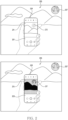
- FIG. 2 illustrates an example of image acquisition by using an exposure value adjustment.
- a preview image may be obtained by a camera of an electronic device before capturing an image and displayed on a display.
- an image corresponding to a subject within a preview image may be referred to as an object region corresponding to the subject, and an image corresponding to a background within the preview image may be referred to as a background region.
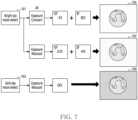
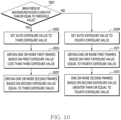
- the at least one processor 120 may control exposure of the preview image. For example, the at least one processor 120 may identify whether brightness of a background region is greater than or equal to a reference value. In a case that the brightness of the background region is greater than or equal to the reference value, the at least one processor may perform exposure control to generate an output image based on an exposure value by auto-exposure and an increased exposure value. Specific embodiments are described through FIGS. 7 to 10 . In a case that the brightness of the background region is less than the reference value, the at least one processor may perform exposure control to generate an output image based on an exposure value lowered by auto-exposure. A specific embodiment is described through FIG. 9 .
- the at least one processor 120 may obtain a plurality of second frames of the adjusted second exposure value after the plurality of first frames are secured.
- +Exposure value may mean that the exposure value is adjusted to the second exposure value exceeding the fourth exposure value.
- +EV may indicate that there is no additional compensation at a value set by auto-exposure.
- -EV may indicate that the exposure value is compensated by an increase at a value set by auto-exposure.
- the second frames for identifying a background image close to an actual background may be obtained based on the second exposure value exceeding the fourth exposure value.
- the first frames may be obtained prior to the second frames, in order to more clearly identify images of a subject (e.g., the moon).
- the at least one processor may be further configured to display, on a display, a third frame before receiving the user input, while obtaining the first frames or the second frames.
- the object region may correspond to a moon.
- the background region may correspond to at least a portion of a sky adjacent to the moon.
- the method may comprise determining the first exposure value and the second exposure value, based on brightness of the background region from which the object is excluded within the preview image.
- the method may further comprise performing a contrast adjustment of an object image within the output image based on artificial intelligence (AI).
- AI artificial intelligence
- the method may further comprise performing detail enhancement of an object image within the output image based on artificial intelligence (AI).
- AI artificial intelligence
- the method may further comprise, in a case that the brightness of the background region is greater than or equal to a threshold value, setting an exposure value to a third exposure value through auto-exposure.
- the method may further comprise, in a case that the brightness of the background region is less than the threshold value, setting the exposure value to a fourth exposure value through the auto-exposure.
- the third exposure value may be less than the fourth exposure value.
- the method may comprise, in order to generate an output image based on the first frames and the second frames, combining an image corresponding to the subject included in each of the one or more first frames and an image corresponding to a background included in each of the one or more second frames.
- the method may further comprise displaying, on a display, a third frame before receiving the user input, while obtaining the first frames or the second frames.
- each of such phrases as “A or B,” “at least one of A and B,” “at least one of A or B,” “A, B, or C,” “at least one of A, B, and C,” and “at least one of A, B, or C,” may include any one of or all possible combinations of the items enumerated together in a corresponding one of the phrases.
- such terms as “1st” and “2nd,” or “first” and “second” may be used to simply distinguish a corresponding component from another, and does not limit the components in other aspect (e.g., importance or order).
- module may include a unit implemented in hardware, software, or firmware, and may interchangeably be used with other terms, for example, “logic,” “logic block,” “part,” or “circuitry”.
- a module may be a single integral component, or a minimum unit or part thereof, adapted to perform one or more functions.
- the module may be implemented in a form of an application-specific integrated circuit (ASIC).
- ASIC application-specific integrated circuit
- Various embodiments as set forth herein may be implemented as software (e.g., the program 140) including one or more instructions that are stored in a storage medium (e.g., internal memory 136 or external memory 138) that is readable by a machine (e.g., the electronic device 101).
- a processor e.g., the processor 120
- the machine e.g., the electronic device 101
- the one or more instructions may include a code generated by a complier or a code executable by an interpreter.
- the machine-readable storage medium may be provided in the form of a non-transitory storage medium.
- non-transitory simply means that the storage medium is a tangible device, and does not include a signal (e.g., an electromagnetic wave), but this term does not differentiate between a case in which data is semi-permanently stored in the storage medium and a case in which the data is temporarily stored in the storage medium.
- a method may be included and provided in a computer program product.
- the computer program product may be traded as a product between a seller and a buyer.
- the computer program product may be distributed in the form of a machine-readable storage medium (e.g., compact disc read only memory (CD-ROM)), or be distributed (e.g., downloaded or uploaded) online via an application store (e.g., PlayStore TM ), or between two user devices (e.g., smart phones) directly. If distributed online, at least part of the computer program product may be temporarily generated or at least temporarily stored in the machine-readable storage medium, such as memory of the manufacturer's server, a server of the application store, or a relay server.
- CD-ROM compact disc read only memory
- an application store e.g., PlayStore TM
- two user devices e.g., smart phones
- each component e.g., a module or a program of the above-described components may include a single entity or multiple entities, and some of the multiple entities may be separately disposed in different components. According to various embodiments, one or more of the above-described components may be omitted, or one or more other components may be added. Alternatively or additionally, a plurality of components (e.g., modules or programs) may be integrated into a single component. In such a case, according to various embodiments, the integrated component may still perform one or more functions of each of the plurality of components in the same or similar manner as they are performed by a corresponding one of the plurality of components before the integration.
- operations performed by the module, the program, or another component may be carried out sequentially, in parallel, repeatedly, or heuristically, or one or more of the operations may be executed in a different order or omitted, or one or more other operations may be added.
Landscapes
- Engineering & Computer Science (AREA)
- Multimedia (AREA)
- Signal Processing (AREA)
- Human Computer Interaction (AREA)
- Studio Devices (AREA)
Applications Claiming Priority (3)
| Application Number | Priority Date | Filing Date | Title |
|---|---|---|---|
| KR20220080987 | 2022-06-30 | ||
| KR1020220101570A KR20240002871A (ko) | 2022-06-30 | 2022-08-12 | 카메라를 포함하는 전자 장치 및 방법 |
| PCT/KR2023/005833 WO2024005333A1 (fr) | 2022-06-30 | 2023-04-27 | Dispositif électronique comprenant une caméra et procédé associé |
Publications (2)
| Publication Number | Publication Date |
|---|---|
| EP4531413A1 true EP4531413A1 (fr) | 2025-04-02 |
| EP4531413A4 EP4531413A4 (fr) | 2025-07-23 |
Family
ID=89380894
Family Applications (1)
| Application Number | Title | Priority Date | Filing Date |
|---|---|---|---|
| EP23831698.8A Pending EP4531413A4 (fr) | 2022-06-30 | 2023-04-27 | Dispositif électronique comprenant une caméra et procédé associé |
Country Status (3)
| Country | Link |
|---|---|
| US (1) | US20250142197A1 (fr) |
| EP (1) | EP4531413A4 (fr) |
| WO (1) | WO2024005333A1 (fr) |
Cited By (1)
| Publication number | Priority date | Publication date | Assignee | Title |
|---|---|---|---|---|
| WO2026035502A1 (fr) * | 2024-08-06 | 2026-02-12 | Qualcomm Incorporated | Caméra pour générer une image hdr lors de la détection d'un objet comme la lune |
Families Citing this family (1)
| Publication number | Priority date | Publication date | Assignee | Title |
|---|---|---|---|---|
| CN120730168A (zh) * | 2024-03-29 | 2025-09-30 | 华为技术有限公司 | 一种图像拍摄方法与电子设备 |
Family Cites Families (7)
| Publication number | Priority date | Publication date | Assignee | Title |
|---|---|---|---|---|
| KR101812807B1 (ko) * | 2011-06-29 | 2017-12-27 | 엘지이노텍 주식회사 | 영역별 가중치를 기반으로 한 적응형 자동 노출 제어 방법 |
| KR102574649B1 (ko) * | 2018-11-29 | 2023-09-06 | 삼성전자주식회사 | 이미지 처리 방법 및 이를 지원하는 전자 장치 |
| CN111355896B (zh) * | 2018-12-20 | 2021-05-04 | 中国科学院国家天文台 | 获取全天相机的自动曝光参数的方法 |
| CN109951633B (zh) * | 2019-02-18 | 2022-01-11 | 华为技术有限公司 | 一种拍摄月亮的方法和电子设备 |
| CN111586280B (zh) * | 2019-02-18 | 2022-02-11 | 北京小米移动软件有限公司 | 拍摄方法、装置、终端及可读存储介质 |
| CN112532892B (zh) * | 2019-09-19 | 2022-04-12 | 华为技术有限公司 | 图像处理方法及电子装置 |
| KR20220017298A (ko) * | 2020-08-04 | 2022-02-11 | 삼성전자주식회사 | 프리뷰 이미지를 제어하는 전자 장치 및 방법 |
-
2023
- 2023-04-27 EP EP23831698.8A patent/EP4531413A4/fr active Pending
- 2023-04-27 WO PCT/KR2023/005833 patent/WO2024005333A1/fr not_active Ceased
-
2024
- 2024-12-30 US US19/005,257 patent/US20250142197A1/en active Pending
Cited By (1)
| Publication number | Priority date | Publication date | Assignee | Title |
|---|---|---|---|---|
| WO2026035502A1 (fr) * | 2024-08-06 | 2026-02-12 | Qualcomm Incorporated | Caméra pour générer une image hdr lors de la détection d'un objet comme la lune |
Also Published As
| Publication number | Publication date |
|---|---|
| US20250142197A1 (en) | 2025-05-01 |
| EP4531413A4 (fr) | 2025-07-23 |
| WO2024005333A1 (fr) | 2024-01-04 |
Similar Documents
| Publication | Publication Date | Title |
|---|---|---|
| US20250142197A1 (en) | Electronic device including camera and method therefor | |
| US20220417446A1 (en) | Electronic device for editing video using objects of interest and operating method thereof | |
| US20230262318A1 (en) | Method for taking photograph by using plurality of cameras, and device therefor | |
| EP4283979A1 (fr) | Dispositif électronique comprenant une pluralité de caméras et son procédé de fonctionnement | |
| US20220318971A1 (en) | Electronic device for supporting machine learning-based image processing | |
| US20230267702A1 (en) | Electronic device including camera module and method for operating electronic device | |
| EP4297394A1 (fr) | Dispositif électronique comprenant une caméra | |
| EP4734542A2 (fr) | Dispositif électronique comprenant une pluralité de caméras et son procédé de fonctionnement | |
| EP4319136A1 (fr) | Procédé de capture d'image pour un dispositif électronique et dispositif électronique associé | |
| EP4589974A1 (fr) | Dispositif électronique et procédé d'affichage d'image de prévisualisation | |
| US12489985B2 (en) | Image processing method and electronic device therefor | |
| EP4607937A1 (fr) | Dispositif électronique pour déterminer une zone de visualisation d'image, et son procédé de fonctionnement | |
| US20240080407A1 (en) | Electronic device providing image and method of operating the same | |
| EP4554205A1 (fr) | Dispositif électronique et procédé d'acquisition d'une carte de profondeur | |
| EP4336856A1 (fr) | Dispositif électronique d'application d'effet bokeh sur une image et son procédé de fonctionnement | |
| EP4340342A1 (fr) | Dispositif électronique réalisant une stabilisation d'image et son procédé de fonctionnement | |
| KR102814462B1 (ko) | 전자 장치 및 전자 장치의 동작 방법 | |
| US11843874B2 (en) | Electronic device including under display camera and operating method thereof | |
| EP4583523A1 (fr) | Dispositif électronique, procédé et support de stockage lisible par ordinateur non transitoire destinés au changement de réglage de caméra | |
| KR20240002871A (ko) | 카메라를 포함하는 전자 장치 및 방법 | |
| US20240292110A1 (en) | Electronic device for capturing high dynamic range images, and operating method thereof | |
| US20240184379A1 (en) | Electronic apparatus for detecting motion gesture, and operation method therefor | |
| EP4604568A1 (fr) | Dispositif électronique et procédé d'augmentation de la résolution d'une image de bokeh numérique | |
| EP4266670B1 (fr) | Dispositif électronique apte à régler un angle de vue et procédé de fonctionnement associé | |
| EP4694164A1 (fr) | Dispositif électronique et procédé pour améliorer les performances de zoom de caméra de celui-ci |
Legal Events
| Date | Code | Title | Description |
|---|---|---|---|
| STAA | Information on the status of an ep patent application or granted ep patent |
Free format text: STATUS: THE INTERNATIONAL PUBLICATION HAS BEEN MADE |
|
| PUAI | Public reference made under article 153(3) epc to a published international application that has entered the european phase |
Free format text: ORIGINAL CODE: 0009012 |
|
| STAA | Information on the status of an ep patent application or granted ep patent |
Free format text: STATUS: REQUEST FOR EXAMINATION WAS MADE |
|
| 17P | Request for examination filed |
Effective date: 20241227 |
|
| AK | Designated contracting states |
Kind code of ref document: A1 Designated state(s): AL AT BE BG CH CY CZ DE DK EE ES FI FR GB GR HR HU IE IS IT LI LT LU LV MC ME MK MT NL NO PL PT RO RS SE SI SK SM TR |
|
| REG | Reference to a national code |
Ref country code: DE Ref legal event code: R079 Free format text: PREVIOUS MAIN CLASS: H04N0023730000 Ipc: H04N0023710000 |
|
| A4 | Supplementary search report drawn up and despatched |
Effective date: 20250624 |
|
| RIC1 | Information provided on ipc code assigned before grant |
Ipc: H04N 23/71 20230101AFI20250617BHEP Ipc: H04N 23/73 20230101ALI20250617BHEP Ipc: H04N 23/61 20230101ALI20250617BHEP Ipc: H04N 23/63 20230101ALI20250617BHEP Ipc: H04N 23/65 20230101ALI20250617BHEP Ipc: H04N 23/69 20230101ALI20250617BHEP Ipc: G06T 5/50 20060101ALI20250617BHEP |
|
| DAV | Request for validation of the european patent (deleted) | ||
| DAX | Request for extension of the european patent (deleted) |