EP4531444A1 - Procédé de communication, support de stockage et dispositif électronique - Google Patents
Procédé de communication, support de stockage et dispositif électronique Download PDFInfo
- Publication number
- EP4531444A1 EP4531444A1 EP23925586.2A EP23925586A EP4531444A1 EP 4531444 A1 EP4531444 A1 EP 4531444A1 EP 23925586 A EP23925586 A EP 23925586A EP 4531444 A1 EP4531444 A1 EP 4531444A1
- Authority
- EP
- European Patent Office
- Prior art keywords
- electronic device
- hfp
- bluetooth headset
- connection
- bluetooth
- Prior art date
- Legal status (The legal status is an assumption and is not a legal conclusion. Google has not performed a legal analysis and makes no representation as to the accuracy of the status listed.)
- Granted
Links
Images


Classifications
-
- H—ELECTRICITY
- H04—ELECTRIC COMMUNICATION TECHNIQUE
- H04W—WIRELESS COMMUNICATION NETWORKS
- H04W4/00—Services specially adapted for wireless communication networks; Facilities therefor
- H04W4/16—Communication-related supplementary services, e.g. call-transfer or call-hold
-
- H—ELECTRICITY
- H04—ELECTRIC COMMUNICATION TECHNIQUE
- H04M—TELEPHONIC COMMUNICATION
- H04M1/00—Substation equipment, e.g. for use by subscribers
- H04M1/72—Mobile telephones; Cordless telephones, i.e. devices for establishing wireless links to base stations without route selection
- H04M1/724—User interfaces specially adapted for cordless or mobile telephones
- H04M1/72403—User interfaces specially adapted for cordless or mobile telephones with means for local support of applications that increase the functionality
- H04M1/72409—User interfaces specially adapted for cordless or mobile telephones with means for local support of applications that increase the functionality by interfacing with external accessories
- H04M1/72412—User interfaces specially adapted for cordless or mobile telephones with means for local support of applications that increase the functionality by interfacing with external accessories using two-way short-range wireless interfaces
-
- H—ELECTRICITY
- H04—ELECTRIC COMMUNICATION TECHNIQUE
- H04W—WIRELESS COMMUNICATION NETWORKS
- H04W4/00—Services specially adapted for wireless communication networks; Facilities therefor
- H04W4/80—Services using short range communication, e.g. near-field communication [NFC], radio-frequency identification [RFID] or low energy communication
-
- H—ELECTRICITY
- H04—ELECTRIC COMMUNICATION TECHNIQUE
- H04W—WIRELESS COMMUNICATION NETWORKS
- H04W60/00—Affiliation to network, e.g. registration; Terminating affiliation with the network, e.g. de-registration
- H04W60/005—Multiple registrations, e.g. multihoming
-
- H—ELECTRICITY
- H04—ELECTRIC COMMUNICATION TECHNIQUE
- H04W—WIRELESS COMMUNICATION NETWORKS
- H04W76/00—Connection management
- H04W76/10—Connection setup
- H04W76/14—Direct-mode setup
-
- H—ELECTRICITY
- H04—ELECTRIC COMMUNICATION TECHNIQUE
- H04W—WIRELESS COMMUNICATION NETWORKS
- H04W76/00—Connection management
- H04W76/40—Connection management for selective distribution or broadcast
-
- H—ELECTRICITY
- H04—ELECTRIC COMMUNICATION TECHNIQUE
- H04M—TELEPHONIC COMMUNICATION
- H04M1/00—Substation equipment, e.g. for use by subscribers
- H04M1/60—Substation equipment, e.g. for use by subscribers including speech amplifiers
- H04M1/6033—Substation equipment, e.g. for use by subscribers including speech amplifiers for providing handsfree use or a loudspeaker mode in telephone sets
- H04M1/6041—Portable telephones adapted for handsfree use
- H04M1/6058—Portable telephones adapted for handsfree use involving the use of a headset accessory device connected to the portable telephone
- H04M1/6066—Portable telephones adapted for handsfree use involving the use of a headset accessory device connected to the portable telephone including a wireless connection
-
- H—ELECTRICITY
- H04—ELECTRIC COMMUNICATION TECHNIQUE
- H04M—TELEPHONIC COMMUNICATION
- H04M2250/00—Details of telephonic subscriber devices
- H04M2250/02—Details of telephonic subscriber devices including a Bluetooth® interface
Definitions
- This application relates to the field of Bluetooth technologies, and in particular, to a communication method, a storage medium, and an electronic device.
- the advanced audio distribution profile (advanced audio distribution profile, A2DP) and the hands-free profile (hands-free profile, HFP) are two protocols for transmitting audio services in a first electronic device (described below taking a mobile phone as an example).
- A2DP advanced audio distribution profile
- HFP hands-free profile
- the A2DP features non-real-time audio transmission and is used to realize multimedia services such as playing music.
- the HFP features real-time audio transmission and is used to realize call services such as real-time voice.
- Bluetooth physical links include synchronous links (synchronous connection oriented, SCO) and asynchronous links (asynchronous connection less, ACL).
- the SCO links are used to transmit data with a high requirement on real time, for example, audio data of the call service.
- the ACL links are used to transmit data without a requirement on real time, for example, audio data of a music application. Therefore, to ensure call quality, in the call service of the mobile phone, the audio data needs to be transmitted on the SCO links through the HFP.
- the mobile phone if receiving incoming call information, the mobile phone plays an incoming call ring tone through the Bluetooth headset according to specifications of a Bluetooth protocol. Therefore, the mobile phone establishes a connection with the Bluetooth headset.
- the mobile phone if HFP and A2DP related to Bluetooth transmission are registered by using a getProfileProxy function, the mobile phone transmits the incoming call ring tone first through the A2DP and then switches to transmitting the incoming call ring tone through the HFP because the registering progress of the A2DP is faster than that of the HFP.
- the mobile phone suspends transmission of audio data of the incoming call ring tone, and consequently, a phenomenon of lag of the incoming call ring tone of the mobile phone occurs.
- this application provides a communication method, a storage medium, and an electronic device.
- this application provides a communication method, including: corresponding to satisfying a first condition by the first electronic device, the first electronic device completes registration of a hands-free profile (HFP) and an advanced audio distribution profile (A2DP); receiving, by the first electronic device, incoming call information, and detecting a second electronic device that is in Bluetooth pairing with the first electronic device and has not established a Bluetooth connection therebetween; and establishing, by the first electronic device, the Bluetooth connection with the second electronic device, and establishing, by the first electronic device, the hands-free profile (HFP) first to transmit audio data to the second electronic device through the hands-free profile (HFP), where the audio data includes an incoming call ring tone corresponding to the incoming call information, and the first electronic device establishes an advanced audio distribution profile (A2DP) connection after establishing the hands-free profile (HFP) connection.
- HFP hands-free profile
- A2DP advanced audio distribution profile
- the first electronic device mentioned in this application includes any electronic device (such as a mobile phone) that is capable of performing voice communication and has the Bluetooth function.
- the second electronic device mentioned in this application includes any electronic device (such as a Bluetooth headset) that has the Bluetooth function and has an audio data play function.
- the mobile phone completes registrations of the HFP and the A2DP.
- the mobile phone establishes the HFP connection with the Bluetooth headset first according to the type of the call service, and the incoming call ring tone of the mobile phone is played by the Bluetooth headset through the HFP.
- the mobile phone establishes the A2DP connection with the Bluetooth headset.
- the mobile phone no longer plays the incoming call ring tone through the A2DP. Therefore, a phenomenon of lag of the incoming call ring tone is avoided when playing of the incoming call ring tone of the mobile phone by the Bluetooth headset through the A2DP is switched to playing of the incoming call ring tone of the mobile phone by the Bluetooth headset through the HFP, and the call experience of a user is improved.
- the first condition includes at least one of the following: entering a startup phase, enabling the Bluetooth function, and detecting the electronic device that has been in Bluetooth pairing.
- the first condition mentioned in this application may be that the mobile phone is in an initialization phase.
- the initialization phase of the mobile phone includes, but is not limited to, entering a startup phase, enabling the Bluetooth function, and detecting the electronic device that has been in Bluetooth pairing.
- the first electronic device establishes the hands-free profile (HFP) connection in the following way: sending, by an audio manager application in the first electronic device, a message that the hands-free profile (HFP) connection is established with the second electronic device to a Bluetooth application, where the Bluetooth application establishes the hands-free profile (HFP) connection.
- HFP hands-free profile
- the step of transmitting audio data to the second electronic device through the hands-free profile (HFP) includes: receiving, by a telephone application in the first electronic device, information that the hands-free profile (HFP) is successfully established, and sending a sound-making device switching instruction to an audio framework; and selecting, by the audio framework, the second electronic device establishing the hands-free profile (HFP) connection with the first electronic device as the sound-making device, and sending the audio data to the second electronic device.
- the sound-making device may also be a speaker and an earpiece of the mobile phone or a device such as a sound device connected to the mobile phone, and the type of the sound-making device is not limited in this application.
- the step of establishing, by the first electronic device, the advanced audio distribution profile (A2DP) connection after establishing the hands-free profile (HFP) connection includes: sending, by the audio manager application in the first electronic device, a message that the advanced audio distribution profile (A2DP) connection is established with the second electronic device to the Bluetooth application after establishing, by the first electronic device, the hands-free profile (HFP) connection, where the Bluetooth application establishes the advanced audio distribution profile (A2DP) connection.
- the mobile phone needs to establish double connections of advanced audio distribution profile (A2DP) and hands-free profile (HFP) with the Bluetooth headset. After the mobile phone establishes the HFP connection with the Bluetooth headset, the mobile phone establishes the A2DP connection with the Bluetooth headset.
- A2DP advanced audio distribution profile
- HFP hands-free profile
- the communication method further includes: no longer reselecting, by the audio framework in the first electronic device, the sound-making device after establishing, by the first electronic device, the advanced audio distribution profile (A2DP) connection with the second electronic device.
- A2DP advanced audio distribution profile
- the call service is the audio data transmitted on the SCO link through the HFP, it features real-time audio transmission.
- the audio framework selects the Bluetooth headset that establishes the HFP connection with the mobile phone as the sound-making device and no longer reselects the sound-making device.
- the step of completing, by the first electronic device, registrations of the hands-free profile (HFP) and the advanced audio distribution profile (A2DP) includes: completing, by the first electronic device, registrations of the hands-free profile (HFP) and the advanced audio distribution profile (A2DP) by executing a first preset function.
- the first preset function includes a getProfileProxy function.
- the step of establishing, by the Bluetooth application, the hands-free profile (HFP) connection includes: establishing, by the Bluetooth application, the hands-free profile (HFP) connection with the second electronic device by calling a second preset function.
- the second preset function includes a ConnectHfp function in an onServiceConnected function.
- the step of establishing, by the Bluetooth application, the advanced audio distribution profile (A2DP) connection includes: establishing, by the first electronic device, the advanced audio distribution profile (A2DP) connection with the second electronic device by calling a third preset function.
- the third preset function includes a ConnectA2dp function in the onServiceConnected function.
- this application provides a computer-readable storage medium, where the computer-readable storage medium stores an instruction, and the instruction, when executed on the electronic device, enables the electronic device to implement the communication method according to the first aspect and any one of possible implementations in the first aspect.
- this application provides an electronic device, including: a memory, configured to store an instruction executed by one or more processors of the electronic device; and a processor, configured to execute the instruction stored in the memory to implement the communication method according to the first aspect and any one of possible implementations in the first aspect.
- Illustrative embodiments of this application include, but are not limited to, a communication method, a storage medium, and an electronic device.
- the first electronic device mentioned in this application may be any electronic device that is capable of performing voice communication and has the Bluetooth function, including, but not limited to, a mobile phone, a media player, a tablet computer, a notebook computer, an ultra-mobile personal computer (ultra-mobile personal computer, UMPC), or a personal digital assistant (personal digital assistant, PDA).
- a mobile phone a media player
- a tablet computer a notebook computer
- an ultra-mobile personal computer ultra-mobile personal computer
- UMPC ultra-mobile personal computer
- PDA personal digital assistant
- the first electronic device that is a mobile phone 20 is introduced as an example.
- the second electronic device mentioned in this application may be any electronic device that has the Bluetooth function and has an audio data play function, including, but not limited to, a device such as a wireless headset, a wireless speaker, a wireless wristband, a wireless in-vehicle device, wireless smart glasses, a wireless watch, or an augmented reality (augmented reality, AR)/virtual reality (virtual reality, VR) device.
- a specific form of the second electronic device is not specially limited in this application.
- the second electronic device that is the Bluetooth headset 10 and the tablet computer 30 is introduced.
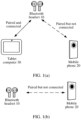
- FIG. 1(a) shows a schematic diagram of a scenario of an incoming call of a mobile phone 20.
- the Bluetooth headset 10 and the tablet computer 30 are in a state of being paired and connected, to be specific, the Bluetooth headset 10 and the tablet computer 30 have established a trusted relationship through authentication, and an output audio of the tablet computer 30 may be played through the Bluetooth headset 10.
- the mobile phone 20 has enabled the Bluetooth function, and has been paired with the Bluetooth headset 10 but is not connected thereto, i.e., the Bluetooth headset 10 and the mobile phone 20 have established the trusted relationship through authentication previously, an output audio of the mobile phone 20 may be played externally through a loudspeaker of the mobile phone rather than played through the Bluetooth headset 10.
- the mobile phone 20 occupies the Bluetooth headset 10 according to specifications of the Bluetooth protocol, i.e., the mobile phone 20 is connected to the Bluetooth headset 10.
- FIG. 1(b) shows a schematic diagram of another scenario of an incoming call of a mobile phone 20.
- the mobile phone 20 has enabled the Bluetooth function, and has been paired with the Bluetooth headset 10 but is not connected thereto, to be specific, the Bluetooth headset 10 and the mobile phone 20 have established the trusted relationship through authentication, but a user has manually interrupts the connection between the Bluetooth headset 10 and the mobile phone 20, the output audio of the mobile phone 20 may be played externally through the loudspeaker of the mobile phone rather than played through the Bluetooth headset 10.
- the mobile phone 20 receives the incoming call, the mobile phone 20 is connected to the Bluetooth headset 10 according to specifications of the Bluetooth protocol.
- the mobile phone 20 when the mobile phone 20 receives an incoming call message, to play an incoming call ring tone of the mobile phone 20 through the Bluetooth headset 10, the mobile phone 20 needs to establish HFP and A2DP connections. In the connection establishing process, a phenomenon of lag of the incoming call ring tone of the mobile phone occurs. Specifically, after receiving the incoming call message, the mobile phone 20 registers protocols for transmitting an audio service first, including HFP, a protocol for realizing a call service, and A2DP, a protocol for realizing a multimedia service, and then establishes the A2DP and HFP connections between the mobile phone 20 and the Bluetooth headset 10.
- protocols for transmitting an audio service including HFP, a protocol for realizing a call service, and A2DP, a protocol for realizing a multimedia service
- the mobile phone 20 may transmit audio data through Bluetooth, i.e., play the incoming call ring tone on the Bluetooth headset 10.
- the progresses of registering HFP and A2DP by the mobile phone 20 are parallel progresses, i.e., the mobile phone 20 registers HFP and A2DP simultaneously.
- the mobile phone 20 executes a getProfileProxy function, the speed of registering A2DP by the mobile phone 20 is higher, i.e., the mobile phone 20 completes registration of A2DP first.
- the mobile phone 20 Because the progress that the mobile phone 20 establishes the HFP and A2DP connections with the Bluetooth headset 10 is a serial progress, after the mobile phone 20 completes registration of A2DP, the mobile phone 20 establishes the A2DP connection with the Bluetooth headset 10 first. For example, the mobile phone 20 may establish the A2DP connection with the Bluetooth headset 10 first by executing a ConnectA2dp function in the onServiceConnected function, and play the incoming call ring tone on the Bluetooth headset 10 through A2DP.
- the mobile phone 20 needs to establish dual connections of A2DP and HFP with the Bluetooth headset 10. After the mobile phone 20 establishes the A2DP connection with the Bluetooth headset 10, the mobile phone 20 may complete registration of HFP in a period of time. The mobile phone 20 may establish the HFP connection with the Bluetooth headset 10 only when the mobile phone 20 completes registration of HFP. For example, the mobile phone 20 may establish the HFP connection with the Bluetooth headset 10 by executing a ConnectHfp function in the onServiceConnected function.
- the call service is audio data transmitted on an SCO link through HFP and features real-time audio transmission.
- the mobile phone 20 When the mobile phone 20 establishes the HFP connection with the Bluetooth headset 10, the mobile phone 20 will preferentially play the incoming call ring tone on the Bluetooth headset 10 through HFP, i.e., the mobile phone 20 will be switched from playing the incoming call ring tone on the Bluetooth headset 10 through A2DP to playing the incoming call ring tone on the Bluetooth headset 10 through HFP.
- the mobile phone 20 In the process of switching the incoming call ring tone by the mobile phone 20, because the mobile phone 20 suspends an audio flow of the incoming call ring tone, a phenomenon of lag of the incoming call ring tone of the mobile phone 20 occurs.
- this application provides a method for solving lag of the incoming call ring tone.
- the mobile phone may be controlled to complete registration of HFP and A2DP in advance. For example, when the mobile phone is turned on, the Bluetooth function is enabled, or the mobile phone detects a Bluetooth headset that has been paired previously but is not connected thereto, the mobile phone completes registration of HFP and A2DP through the getProfileProxy function. Then, if the mobile phone receives incoming call information, the mobile phone may establish the HFP connection with the Bluetooth headset first, and then establish the A2DP connection with the Bluetooth headset.
- the mobile phone establishes the HFP connection with the Bluetooth headset first by executing the ConnectHfp function in the onServiceConnected function; and then establishes the A2DP connection with the Bluetooth headset by executing the ConnectA2dp function in the onServiceConnected function.
- the incoming call ring tone of the mobile phone is played on the Bluetooth headset through HFP. Therefore, the phenomenon of lag of the incoming call ring tone is avoided when playing of the incoming call ring tone of the mobile phone on the Bluetooth headset through the A2DP is switched to playing of the incoming call ring tone of the mobile phone on the Bluetooth headset through the HFP, and call experience of the user is improved.
- FIG. 2 shows a schematic diagram of the software architecture of the mobile phone 20.
- the software architecture of the mobile phone 20 includes an application layer 101, a framework layer 102, an Android library 103, and a driver layer 104 from top to bottom.
- the application layer 101 may include applications such as a main interface, a telephone, Bluetooth, and an audio manager.
- the application layer 101 may further include other applications such as a payment application, a shopping application, a bank application, a chat application or a money management application, which is not limited in this application.
- the telephone application is configured to send a broadcast of the incoming call of the mobile phone 20 and to send the audio flow of the incoming call ring tone in the mobile phone 20 to the framework layer 102.
- the audio manager application is configured to register A2DP and HFP and to send the message of establishment of the HFP and A2DP connections with the Bluetooth headset 10 to the Bluetooth application.
- the Bluetooth application is configured to establish the HFP and A2DP connections with the Bluetooth headset 10 and to send the broadcast that the connections are successful to the framework layer 102.
- the framework layer 102 includes a telephone framework, a Bluetooth framework, an audio framework and the like.
- the framework layer 102 provides the application layer 101 with a multilingual framework, including an operational capability (which may include a CPU computing capability, a graphics processing unit (graphics processing unit, GPU) computing capability, an image signal processor (image signal processor, ISP) computing capability, and the like), a voice recognition capability (which may include a voice recognition capability of a microphone, a voice recognition capability and the like), a safety capability in the device safety protection aspect (which may include a trustable operating environment safety level and the like), a display capability (which may include a screen resolution, a screen size and the like), a play capability (which includes an amplifying capability, a stereo effect capability and the like, and a storage capability (which may include a memory capability, a random access memory (random access memory, RAM) capability of the device and the like)), which is not limited herein.
- the application of the application layer 101 may realize corresponding functions by calling functions corresponding to the capabilities provided
- the telephone frame is configured to provide a communication function of the mobile phone 20, for example, call status management (including connected and hang-up).
- the Bluetooth framework is configured to provide a Bluetooth service of the mobile phone 20.
- the audio framework receives audio services sent by the applications of the application layer 101 to identify the types of the audio services; and performs service arbitration and occupation.
- the audio framework is configured to select the Bluetooth headset 20 that establishes A2DP or HFP connection with the mobile phone 20 as the sound-making device and to receive the audio flow of the ring tone.
- the Android library 103 includes a surface manager, a media library, a three-dimensional graphics processing library, Android runtime and the like.
- the surface manager is configured to manage a display subsystem, and provide fusion of 2D and 3D layers for a plurality of applications.
- the media library supports playback and recording in a plurality of common audio and video formats, and also support static image files, and the like.
- the media library may support a plurality of audio and video encoding formats, such as MPEG4, H.264, MP3, AAC, AMR, JPG, and PNG.
- the three-dimensional graphics processing library (for example OpenGL ES) is configured to implement three-dimensional graphics drawing, image rendering, composition, layer processing, and the like.
- the Android runtime (Android runtime) includes a kernel library and a virtual machine. The Android runtime is responsible for scheduling and management of an Android system.
- the core library includes two parts: a performance function that the Java language needs to invoke, and a core library of Android.
- the application layer 101 and the framework layer 102 run in the virtual machine.
- the virtual machine executes Java files of the application layer 101 and the framework layer 102 as binary files.
- the virtual machine is configured to execute functions such as object lifecycle management, stack management, thread management, security and exception management, and garbage collection.
- the driver layer 104 may provide the mobile phone 20 with a uniform peripheral access capability and a management framework, including display driver, Bluetooth driver, audio driver and the like.
- the software architecture of the mobile phone 20 shown in FIG. 2 is only an example. In some other embodiments, the software architecture applicable to embodiments of this application may be more or fewer, may be split or merged parts, or may be other architectures, which is not limited herein.
- FIG. 3 shows a schematic diagram of a flow of interaction in a mobile phone 20. As shown in FIG. 3 , the flow of interaction includes the following steps:
- the Bluetooth application sends a Bluetooth enabling broadcast to the audio manager application.
- the Bluetooth application sends the Bluetooth enabling broadcast to the audio manager application.
- S102 The telephone application sends the audio flow of the ring tone to the audio framework.
- the telephone application sends the audio flow of the ring tone to the audio framework.
- S103 The telephone application sends an incoming call broadcast to the audio manager application.
- step S102 may be executed after step S103, i.e., the telephone application sends the incoming call broadcast of the mobile phone 20 to the audio manager application first and then sends the audio flow of the ring tone to the audio framework.
- the sequence of sending the audio flow of the ring tone and the incoming call broadcast by the telephone application is not limited in embodiments of this application.
- the incoming call broadcast may include a telephone number of the incoming call, operator information of the incoming call and the like.
- S104 The audio manager application registers HFP and A2DP.
- the audio manager application registers HFP and A2DP.
- the audio manager application may register HFP and A2DP by executing the getProfileProxy function.
- the specific implementation of registering HFP and A2DP by the audio manager application is not limited in this application.
- the progress of registering HFP and A2DP by the audio manager application is a parallel progress, i.e., the audio manager application registers HFP and A2DP simultaneously. If the mobile phone 20 executes the getProfileProxy function, the speed of registering A2DP by the audio manager application is higher, i.e., the audio manager application completes registration of A2DP first.
- the HFP features real-time audio transmission and is used to realize call services such as real-time voice.
- the A2DP features non-real-time audio transmission and is used to realize multimedia services such as playing music.
- the audio manager application sends the message of establishment of the A2DP connection with the Bluetooth headset 10 to the Bluetooth application.
- the progress that the mobile phone 20 establishes the HFP and A2DP connections with the Bluetooth headset 10 is a serial progress
- the audio manager application registers A2DP
- the audio manager application sends a message of establishment of the A2DP connection with the Bluetooth headset 10 to the Bluetooth application.
- the Bluetooth application then establishes the A2DP connection with the Bluetooth headset 10 by executing the ConnectA2dp function in the onServiceConnected function.
- S106 The Bluetooth application sends a broadcast that the connection is successful to the audio framework.
- the Bluetooth application sends the broadcast of establishment of the A2DP connection with the Bluetooth headset 10 to the audio framework.
- the Bluetooth application may send the broadcast that the connection is successful through a Context.sendBroadcast function.
- the audio framework selects a sound-making device.
- the audio framework selects the Bluetooth headset 10 that establishes A2DP connection with the mobile phone 20 as the sound-making device.
- the audio manager application sends the message of establishment of the HFP connection with the Bluetooth headset 10 to the Bluetooth application.
- the mobile phone 20 needs to establish double connections of A2DP and HFP with the Bluetooth headset 10. After the mobile phone 20 establishes the A2DP connection with the Bluetooth headset 10, the mobile phone 20 may complete registration of HFP in a period of time. When the mobile phone 20 completes registration of HFP, the audio manager application sends the message of establishment of the HFP connection with the Bluetooth headset 10 to the Bluetooth application.
- the Bluetooth application establishes the HFP connection with the Bluetooth headset 10 by executing the ConnectHfp function in the onServiceConnected function.
- S109 The Bluetooth application sends a broadcast that the connection is successful to the telephone application.
- the Bluetooth application sends the broadcast of establishment of the HFP connection with the Bluetooth headset 10 to the telephone application.
- S110 The telephone application sends a message of selecting the sound-making device to the audio framework.
- the telephone application After receiving the broadcast of establishment of the HFP connection with the Bluetooth headset 10, the telephone application sends the message of selecting the sound-making device to the audio framework.
- the audio framework selects a sound-making device.
- the call service is the audio data transmitted on the SCO link through the HFP, it features real-time audio transmission.
- the audio framework selects the Bluetooth headset 10 that establishes the HFP connection with the mobile phone 20 as the sound-making device.
- the mobile phone 20 In the process of switching from playing, by the mobile phone 20, the incoming call ring tone on the Bluetooth headset 10 through A2DP to playing the incoming call ring tone on the Bluetooth headset 10 through HFP, the mobile phone 20 will pause an audio flow of the incoming call ring tone, so that a phenomenon of lag of the incoming call ring tone of the mobile phone 20 will occur.
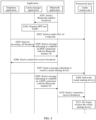
- FIG. 4 shows a schematic diagram of a flow of interaction in a mobile phone 20. As shown in FIG. 4 , the flow of interaction includes the following steps:
- the Bluetooth application sends a Bluetooth enabling broadcast to the audio manager application.
- the Bluetooth application sends the Bluetooth enabling broadcast to the audio manager application.
- S202 The audio manager application registers HFP and A2DP.
- the Bluetooth application In the initialization phase of the mobile phone 20, for example, when the mobile phone 20 is started, the Bluetooth application is enabled manually by the user, or the mobile phone 20 has detected the Bluetooth headset 10 that has been paired previously but is not connected thereto, the audio manager application registers HFP and A2DP.
- the audio manager application may register HFP and A2DP by executing the getProfileProxy function.
- the specific implementation of registering HFP and A2DP by the audio manager application is not limited in this application.
- an implementation logic of a registration service may be included in the getProfileProxy function.
- HFP is registered by executing the getProfileProxy (context, mBluetoothListener, BluetoothProfile.HEADSET) function.
- A2DP is registered by executing the getProfileProxy (context, mBluetoothListener, BluetoothProfile.A2DP).
- the HFP features real-time audio transmission and is used to realize call services such as real-time voice.
- the A2DP features non-real-time audio transmission and is used to realize multimedia services such as playing music.
- the progress of registering HFP and A2DP by the audio manager application is a parallel progress, i.e., the audio manager application will register HFP and A2DP simultaneously.
- S203 The telephone application sends the audio flow of the ring tone to the audio framework.
- the audio flow of the ring tone sent by the telephone application is of a type of a stream_ring function, and the type of the audio flow of the ring tone is not limited in this application.
- S204 The telephone application sends an incoming call broadcast to the audio manager application.
- the telephone application sends the incoming call broadcast to the audio manager application.
- step S203 may be executed after step S204, i.e., the telephone application sends the incoming call broadcast of the mobile phone 20 to the audio manager application first and then sends the audio flow of the ring tone to the audio framework.
- the sequence of sending the audio flow of the ring tone and the incoming call broadcast by the telephone application is not limited in embodiments of this application.
- the incoming call broadcast may include a telephone number of the incoming call, operator information of the incoming call and the like.
- S205 The audio manager application sends the message of establishment of the HFP connection with the Bluetooth headset 10 to the Bluetooth application.
- the audio manager application sends the message of establishment of the HFP connection with the Bluetooth headset 10 to the Bluetooth application according to the characteristic that the audio data of the call service is applicably transmitted through HFP, and the Bluetooth application may establish the HFP connection with the Bluetooth headset 10 first by calling the ConnectHfp function in the onServiceConnected function in executing the onServiceConnected function.
- the implementation logic to establish the HFP connection with the Bluetooth headset 10 may include enabling the Bluetooth application to establish the HFP connection with the Bluetooth headset 10 first through the connectHFP (bluetoothDevice) function by entering the onServiceConnected function after the mobile phone 20 registers HFP successfully.
- the connectHFP bluetoothDevice
- S206 The Bluetooth application sends a broadcast that the connection is successful to the telephone application.
- the Bluetooth application sends the broadcast of establishment of the HFP connection with the Bluetooth headset 10 to the telephone application.
- the Bluetooth application may send the broadcast that the connection is successful through a Context.sendBroadcast function.
- S207 The telephone application sends the message of switching the sound-making device to the audio framework.
- the telephone application After receiving the message of establishment the HFP connection with the Bluetooth headset 10, the telephone application sends the message of switching the sound-making device to the audio framework.
- the audio framework selects a sound-making device.
- the audio framework selects the Bluetooth headset 10 that establishes HFP connection with the mobile phone 20 as the sound-making device.
- the sound-making device may also be a speaker and an earpiece of the mobile phone 20 or a device such as a sound device connected to the mobile phone 20, and the type of the sound-making device is not limited in this application.
- the audio manager application sends the message of establishment of the A2DP connection with the Bluetooth headset 10 to the Bluetooth application.
- the mobile phone 20 needs to establish double connections of A2DP and HFP with the Bluetooth headset 10. After the mobile phone 20 establishes the HFP connection with the Bluetooth headset 10, the audio manager application sends the message of establishment of the A2DP connection with the Bluetooth headset 10 to the Bluetooth application.
- the Bluetooth application may establish the AD2P connection with the Bluetooth headset 10 by executing the onServiceConnected function, for example, the Bluetooth application establishes the A2DP connection with the Bluetooth headset 10 by calling the ConnectA2dp function in the onServiceConnected function.
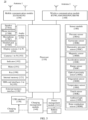
- the structure illustrated in embodiments of this application does not constitute a specific limitation on the mobile phone 20.
- the mobile phone 20 may include more or fewer components than those shown in the figure, or some components may be combined, or some components may be split, or components are arranged in different manners.
- the components shown in the figure may be implemented by hardware, software, or a combination of software and hardware.
- the processor 110 may include one or more processing units.
- the processor 110 may include an application processor (application processor, AP), a modem processor, a graphics processing unit (graphics processing unit, GPU), an image signal processor (image signal processor, ISP), a controller, a memory, a video codec, a digital signal processor (digital signal processor, DSP), a baseband processor, and/or a neural-network processing unit (neural-network processing unit, NPU).
- Different processing units may be separate devices, or may be integrated into one or more processors.
- the controller may be a nerve center and a command center of the mobile phone 20.
- the controller may generate an operation control signal according to instruction operation code and a time-sequence signal, and control obtaining and executing of instructions.
- the processor 110 may execute the communication method mentioned in this application.
- the charging management module 140 is configured to receive charging input from the charger.
- the power management module 141 is configured to be connected to the battery 142, the charging management module 140, and the processor 110.
- a wireless communication function of the mobile phone 20 may be implemented through the antenna 1, the antenna 2, the mobile communication module 150, the wireless communication module 160, the modem processor, the baseband processor, and the like.
- the mobile communication module 150 may provide a solution to wireless communication such as 2G/3G/4G/5G applied to the mobile phone 20.
- the wireless communication module 160 may provide a solution to wireless communication including a wireless local area network (wireless local area networks, WLAN) (for example, a wireless fidelity (wireless fidelity, Wi-Fi) network), Bluetooth (bluetooth, BT), a global navigation satellite system (global navigation satellite system, GNSS), frequency modulation (frequency modulation, FM), a near field communication (near field communication, NFC) technology, an infrared (infrared, IR) technology and the like applied to the mobile phone 20.
- WLAN wireless local area networks
- WLAN wireless local area networks
- Bluetooth blue-Fi
- BT global navigation satellite system
- GNSS global navigation satellite system
- FM global navigation satellite system
- FM global navigation satellite system
- NFC near field communication
- infrared infrared
- the mobile phone 20 implements a display function by using the GPU, the display screen 194, the application processor, and the like.
- the GPU is a microprocessor for image processing and connects the display screen 194 and the application processor.
- the GPU is configured to perform mathematical and geometric calculations for graphics rendering.
- the processor 110 may include one or more GPUs that execute a program instruction to generate or change display information.
- the display screen 194 is configured to display an image, a video, and the like.
- the mobile phone 20 may implement a photographing function by using the ISP, the camera 193, the video codec, the GPU, the display screen 194, the application processor, and the like.
- the mobile phone 20 may implement an audio function by using the audio module 170, the speaker 170A, the phone receiver 170B, the microphone 170C, the headset jack 170D, the application processor, and the like, for example, music playing, recording, and the like.
- the audio module 170 is configured to convert digital audio information into analog audio signal output, and is further configured to convert analog audio input into a digital audio signal.
- the audio module 170 may further be configured to encode and decode audio signals.
- the audio module 170 may be disposed in the processor 110, or some function modules in the audio module 170 are disposed in the processor 110.
- the incoming call ring tone of the mobile phone 20 may be outputted by converting the digital audio information into an analog signal by using the audio module 170.
- the phone receiver 170B also referred to as "earpiece" is configured to convert an electrical audio signal into a sound signal.
- the phone receiver 170B may be put close to a human ear to receive a voice.
- the headset jack 170D is configured to be connected to a wired headset.
- the headset jack 170D may be a USB interface 130, or may be a 3.5 mm open mobile terminal platform (open mobile terminal platform, OMTP) standard interface or a cellular telecommunications industry association of the USA (cellular telecommunications industry association of the USA, CTIA) standard interface.
- the hardware structure that may belong to the mobile phone 20 is introduced above. It may be understood that the structure illustrated in this embodiment of this application does not constitute a specific limitation on the mobile phone 20. In some other embodiments of this application, the mobile phone 20 may include more or fewer components than those shown in the figure, or some components may be combined, or some components may be split, or components are arranged in different manners. The components shown in the figure may be implemented by hardware, software, or a combination of software and hardware.
- This application provides a computer-readable storage medium, having an instruction stored therein, where the instruction, when executed on an electronic device, enables the electronic device to implement the communication method provided by this application.
- This application provides an electronic device, including: a memory, configured to store an instruction executed by one or more processors of the electronic device; and a processor, configured to execute the instruction stored in the memory to implement the communication method provided by this application.
- units/modules mentioned in the device embodiments of this application are logic units/modules. Physically, one logic unit/module may either be one physical unit/module or a part of one physical unit/module, or may alternatively be implemented by combining a plurality of physical units/modules. The physical implementations of the logic units/modules themselves are not the most important but combination of functions implemented by the logic units/modules is the key to solve the technical problem proposed in this application. In addition, in order to highlight an innovative portion of this application, units/modules that are not closely related to solving of the technical problems proposed by this application are not introduced in the device embodiments of this application, which does not mean that there are no other units/modules in the device embodiments.
Landscapes
- Engineering & Computer Science (AREA)
- Computer Networks & Wireless Communication (AREA)
- Signal Processing (AREA)
- Human Computer Interaction (AREA)
- Telephone Function (AREA)
- Mobile Radio Communication Systems (AREA)
Applications Claiming Priority (2)
| Application Number | Priority Date | Filing Date | Title |
|---|---|---|---|
| CN202311026635.4A CN116744244B (zh) | 2023-08-15 | 2023-08-15 | 一种通信方法、存储介质及电子设备 |
| PCT/CN2023/138227 WO2025035666A1 (fr) | 2023-08-15 | 2023-12-12 | Procédé de communication, support de stockage et dispositif électronique |
Publications (3)
| Publication Number | Publication Date |
|---|---|
| EP4531444A1 true EP4531444A1 (fr) | 2025-04-02 |
| EP4531444A4 EP4531444A4 (fr) | 2025-06-25 |
| EP4531444B1 EP4531444B1 (fr) | 2026-03-11 |
Family
ID=87906456
Family Applications (1)
| Application Number | Title | Priority Date | Filing Date |
|---|---|---|---|
| EP23925586.2A Active EP4531444B1 (fr) | 2023-08-15 | 2023-12-12 | Procédé de communication, système et dispositif électronique |
Country Status (3)
| Country | Link |
|---|---|
| EP (1) | EP4531444B1 (fr) |
| CN (2) | CN119497049B (fr) |
| WO (1) | WO2025035666A1 (fr) |
Families Citing this family (1)
| Publication number | Priority date | Publication date | Assignee | Title |
|---|---|---|---|---|
| CN119497049B (zh) * | 2023-08-15 | 2025-11-21 | 荣耀终端股份有限公司 | 一种通信方法、存储介质及电子设备 |
Family Cites Families (14)
| Publication number | Priority date | Publication date | Assignee | Title |
|---|---|---|---|---|
| JP4282721B2 (ja) * | 2007-01-31 | 2009-06-24 | 株式会社東芝 | 携帯端末装置 |
| JP4220575B1 (ja) * | 2008-09-12 | 2009-02-04 | 株式会社東芝 | 情報処理装置 |
| US10051460B2 (en) * | 2016-12-16 | 2018-08-14 | Plantronics, Inc. | Subscription-enabled audio device and subscription system |
| CN113923612A (zh) * | 2020-07-10 | 2022-01-11 | 华为技术有限公司 | 一种通话方法、装置和系统 |
| CN120343529A (zh) * | 2020-08-12 | 2025-07-18 | 华为技术有限公司 | 蓝牙通信方法、可穿戴设备及系统 |
| CN115696283A (zh) * | 2021-07-28 | 2023-02-03 | 华为技术有限公司 | 音频控制方法、电子设备、音频设备和存储介质 |
| CN114466099B (zh) * | 2021-08-31 | 2022-12-20 | 荣耀终端有限公司 | 蓝牙设备的控制方法、装置和存储介质 |
| CN115915037B (zh) * | 2021-09-24 | 2025-03-18 | Oppo广东移动通信有限公司 | 通话控制方法、装置、电子设备及计算机可读存储介质 |
| CN116419192B (zh) * | 2021-12-31 | 2025-11-04 | 上海博泰悦臻网络技术服务有限公司 | 音频管理方法及系统、车载终端及存储介质 |
| CN114422984B (zh) * | 2022-01-25 | 2025-03-18 | 斑马网络技术有限公司 | 车载通话方法和车载设备 |
| CN115002934B (zh) * | 2022-07-18 | 2023-06-13 | 荣耀终端有限公司 | 音频业务处理系统、电子设备及蓝牙耳机 |
| CN115442694A (zh) * | 2022-08-26 | 2022-12-06 | 深圳市和宏实业股份有限公司 | 一种解决tws无线蓝牙耳机音量自动增益的控制方法 |
| CN116074986B (zh) * | 2023-01-28 | 2023-08-29 | 荣耀终端有限公司 | 一种蓝牙连接方法、设备及系统 |
| CN119497049B (zh) * | 2023-08-15 | 2025-11-21 | 荣耀终端股份有限公司 | 一种通信方法、存储介质及电子设备 |
-
2023
- 2023-08-15 CN CN202311709735.7A patent/CN119497049B/zh active Active
- 2023-08-15 CN CN202311026635.4A patent/CN116744244B/zh active Active
- 2023-12-12 WO PCT/CN2023/138227 patent/WO2025035666A1/fr active Pending
- 2023-12-12 EP EP23925586.2A patent/EP4531444B1/fr active Active
Also Published As
| Publication number | Publication date |
|---|---|
| CN116744244B (zh) | 2023-10-31 |
| EP4531444B1 (fr) | 2026-03-11 |
| CN116744244A (zh) | 2023-09-12 |
| EP4531444A4 (fr) | 2025-06-25 |
| CN119497049B (zh) | 2025-11-21 |
| WO2025035666A1 (fr) | 2025-02-20 |
| CN119497049A (zh) | 2025-02-21 |
Similar Documents
| Publication | Publication Date | Title |
|---|---|---|
| US11683850B2 (en) | Bluetooth reconnection method and related apparatus | |
| US12494811B2 (en) | Bluetooth communication method, wearable device, and system | |
| CN113395685B (zh) | 蓝牙通信系统和无线通信系统 | |
| US12185426B2 (en) | Method for using remote SIM module and electronic device | |
| CN113411793A (zh) | 一种蓝牙通信的方法及终端 | |
| EP4258099A1 (fr) | Procédé de projection sur écran à double canal et dispositif électronique | |
| CN109327613B (zh) | 一种基于语音通话翻译能力的协商方法及电子设备 | |
| US20250343857A1 (en) | Method for responding to incoming call, corresponding terminal, and communication system | |
| CN115190197A (zh) | 基于蓝牙耳机的通话方法、装置及存储介质 | |
| EP4531444B1 (fr) | Procédé de communication, système et dispositif électronique | |
| CN116054870B (zh) | 无线通信电路、蓝牙通信切换方法和电子设备 | |
| US20250141884A1 (en) | Communication method, communication system, and electronic device | |
| CN115633340A (zh) | 一种文件传输方法、终端、电子设备及存储介质 | |
| WO2024082855A1 (fr) | Procédé de traitement de service audio, dispositif électronique, et support de stockage informatique | |
| CN117714854A (zh) | 摄像头调用方法、电子设备、可读存储介质和芯片 | |
| EP4366286B1 (fr) | Procédé et appareil d'appel basés sur un écouteur bluetooth, et support de stockage | |
| EP4723695A1 (fr) | Procédé de communication à courte portée, dispositif électronique et support de stockage d'ordinateur | |
| CN118075719B (zh) | 状态通知方法和装置 | |
| CN119497059A (zh) | 一种音频控制方法、电子设备及可读存储介质 | |
| WO2024239760A1 (fr) | Procédé de connexion de réseau de communication, dispositif, et support de stockage | |
| CN118677982A (zh) | 来电处理方法、装置、智能穿戴设备及存储介质 | |
| CN115988449A (zh) | 音频播放方法、车辆、存储介质及计算机程序 | |
| CN117812548A (zh) | 一种分布式通话方法及电子设备 | |
| CN120343699A (zh) | 注册方法及电子设备 | |
| CN118072732A (zh) | 一种语音输入方法、电子设备、可读存储介质和芯片 |
Legal Events
| Date | Code | Title | Description |
|---|---|---|---|
| STAA | Information on the status of an ep patent application or granted ep patent |
Free format text: STATUS: UNKNOWN |
|
| STAA | Information on the status of an ep patent application or granted ep patent |
Free format text: STATUS: THE INTERNATIONAL PUBLICATION HAS BEEN MADE |
|
| PUAI | Public reference made under article 153(3) epc to a published international application that has entered the european phase |
Free format text: ORIGINAL CODE: 0009012 |
|
| STAA | Information on the status of an ep patent application or granted ep patent |
Free format text: STATUS: REQUEST FOR EXAMINATION WAS MADE |
|
| 17P | Request for examination filed |
Effective date: 20240909 |
|
| AK | Designated contracting states |
Kind code of ref document: A1 Designated state(s): AL AT BE BG CH CY CZ DE DK EE ES FI FR GB GR HR HU IE IS IT LI LT LU LV MC ME MK MT NL NO PL PT RO RS SE SI SK SM TR |
|
| A4 | Supplementary search report drawn up and despatched |
Effective date: 20250522 |
|
| RIC1 | Information provided on ipc code assigned before grant |
Ipc: H04M 1/60 20060101ALN20250516BHEP Ipc: H04W 4/80 20180101ALI20250516BHEP Ipc: H04W 4/16 20090101AFI20250516BHEP |
|
| GRAP | Despatch of communication of intention to grant a patent |
Free format text: ORIGINAL CODE: EPIDOSNIGR1 |
|
| STAA | Information on the status of an ep patent application or granted ep patent |
Free format text: STATUS: GRANT OF PATENT IS INTENDED |
|
| RIC1 | Information provided on ipc code assigned before grant |
Ipc: H04W 4/16 20090101AFI20250922BHEP Ipc: H04W 4/80 20180101ALI20250922BHEP Ipc: H04M 1/72412 20210101ALI20250922BHEP Ipc: H04M 1/60 20060101ALN20250922BHEP |
|
| DAV | Request for validation of the european patent (deleted) | ||
| DAX | Request for extension of the european patent (deleted) | ||
| INTG | Intention to grant announced |
Effective date: 20251021 |
|
| GRAS | Grant fee paid |
Free format text: ORIGINAL CODE: EPIDOSNIGR3 |
|
| GRAA | (expected) grant |
Free format text: ORIGINAL CODE: 0009210 |
|
| STAA | Information on the status of an ep patent application or granted ep patent |
Free format text: STATUS: THE PATENT HAS BEEN GRANTED |
|
| AK | Designated contracting states |
Kind code of ref document: B1 Designated state(s): AL AT BE BG CH CY CZ DE DK EE ES FI FR GB GR HR HU IE IS IT LI LT LU LV MC ME MK MT NL NO PL PT RO RS SE SI SK SM TR |
|
| REG | Reference to a national code |
Ref country code: CH Ref legal event code: F10 Free format text: ST27 STATUS EVENT CODE: U-0-0-F10-F00 (AS PROVIDED BY THE NATIONAL OFFICE) Effective date: 20260311 Ref country code: GB Ref legal event code: FG4D |
|
| REG | Reference to a national code |
Ref country code: DE Ref legal event code: R096 Ref document number: 602023013549 Country of ref document: DE |
|
| REG | Reference to a national code |
Ref country code: IE Ref legal event code: FG4D |