EP4531446A1 - Clé transitoire à large paire de points d'accès à un domaine de mobilité - Google Patents
Clé transitoire à large paire de points d'accès à un domaine de mobilité Download PDFInfo
- Publication number
- EP4531446A1 EP4531446A1 EP24203193.8A EP24203193A EP4531446A1 EP 4531446 A1 EP4531446 A1 EP 4531446A1 EP 24203193 A EP24203193 A EP 24203193A EP 4531446 A1 EP4531446 A1 EP 4531446A1
- Authority
- EP
- European Patent Office
- Prior art keywords
- station
- link
- ptk
- mobility domain
- data
- Prior art date
- Legal status (The legal status is an assumption and is not a legal conclusion. Google has not performed a legal analysis and makes no representation as to the accuracy of the status listed.)
- Pending
Links
Images







Classifications
-
- H—ELECTRICITY
- H04—ELECTRIC COMMUNICATION TECHNIQUE
- H04W—WIRELESS COMMUNICATION NETWORKS
- H04W12/00—Security arrangements; Authentication; Protecting privacy or anonymity
- H04W12/03—Protecting confidentiality, e.g. by encryption
-
- H—ELECTRICITY
- H04—ELECTRIC COMMUNICATION TECHNIQUE
- H04W—WIRELESS COMMUNICATION NETWORKS
- H04W12/00—Security arrangements; Authentication; Protecting privacy or anonymity
- H04W12/04—Key management, e.g. using generic bootstrapping architecture [GBA]
-
- H—ELECTRICITY
- H04—ELECTRIC COMMUNICATION TECHNIQUE
- H04L—TRANSMISSION OF DIGITAL INFORMATION, e.g. TELEGRAPHIC COMMUNICATION
- H04L9/00—Cryptographic mechanisms or cryptographic arrangements for secret or secure communications; Network security protocols
- H04L9/12—Transmitting and receiving encryption devices synchronised or initially set up in a particular manner
-
- H—ELECTRICITY
- H04—ELECTRIC COMMUNICATION TECHNIQUE
- H04W—WIRELESS COMMUNICATION NETWORKS
- H04W76/00—Connection management
- H04W76/10—Connection setup
- H04W76/15—Setup of multiple wireless link connections
-
- H—ELECTRICITY
- H04—ELECTRIC COMMUNICATION TECHNIQUE
- H04L—TRANSMISSION OF DIGITAL INFORMATION, e.g. TELEGRAPHIC COMMUNICATION
- H04L2209/00—Additional information or applications relating to cryptographic mechanisms or cryptographic arrangements for secret or secure communication H04L9/00
- H04L2209/80—Wireless
Definitions
- WLANs wireless local area networks
- IEEE Institute of Electrical and Electronics Engineers
- Wi-Fi wireless local area networks
- a WLAN can include an access point (AP) that provides one or more stations (STAs) with access to another network, such as the Internet.
- AP access point
- STAs stations
- Wi-Fi 7 generations of the IEEE 802.11 standard, including 802.11ax (Wi-Fi 6) and 802.11be (Wi-Fi 7).
- the station can operate at a first mobility domain support level or at a second mobility domain support level.
- the station At the first mobility domain support level, there is no 802.11r operational support.
- the station authenticates every BSS separately, and there is no PMK sharing in the communication network.
- the network At the second mobility domain support level, the network supports Fast BSS Transition (FT), as defined in 802. 1 lr, operations.
- FT Fast BSS Transition
- the station authenticates and creates PMK with the network and the network forwards the PMK to one or more access points in the mobility domain, enabling fast transition of the BSS.
- the shared PMK in the second mobility domain support level enables the station to transition from state 2 directly to state 4, as previously described.
- the APs support the same authentication and key management (AKM) suite values and may use the same PMK.
- the mobility domain embodiments previously described enable fast BSS transition or pre-association security negotiation (PASN) key derivation from the PMK.
- PASN pre-association security negotiation
- PTK creation is authentication mechanism AKM suite specific. For example, pre-shared keys, WPA3 enterprise, and opportunistic wireless encryption (OWE) networks may generate PTKs differently from one another.
- AP MLDs in the mobility domain AP (MD AP) each support the same authentication mechanism and AKM, and the AP MLDs support the same signaling for all supported authentication schemes.
- a station can add one or more additional links, e.g., to one or more neighbor access points, in the same mobility domain.
- a station can add one or more communication links to one or more additional access points without requiring setup of one or more additional PTKs for those additional communication links.
- the station may need to generate a PTK only one time, e.g., when the station associates with a first AP MLD of the mobility domain AP, thereby reducing signaling overhead and simplifying use of keys.
- the station's privacy is protected by use of the mobility domain AP-wide PTK.
- the STA After the station has set up the PTK, the STA transmits using only encrypted management frames and may have one or more addresses that cannot be tracked when sent over the air. Transmissions by the station that include the scanning addresses can assist the receiving AP MLD in detecting the station and in applying the correct PTK. As one or more scanning addresses are known only to the network and the station, a station's privacy can be protected, e.g., from detection and/or tracking by unauthorized parties.
- a station generates a PTK once and subsequent signaling in the mobility domain is encrypted, e.g., in accordance with the PTK.
- the station can initialize communication links with multiple access point (AP) multi-link devices (MLDs) using a common association signaling sequence.
- AP access point
- MLDs multi-link devices
- a network can include a wireless local area network (WLAN) and a station can associate with multiple AP MLDs using a common association signaling process.
- the network can be a mesh network.
- the association signaling includes one or more scanning addresses for the associated station.
- the associated station transmits PTK-protected scanning messages (e.g., for probe requests) by setting the transmitter address to a scanning address.
- the associated station may request to add one or more links to an AP MLD of an access point in a mobility domain for which the station does not have established communication links.
- the station assists the receiving AP MLD to detect the station and apply a correct PTK by applying the scanning address as the transmitter address.
- the scanning addresses are known only to devices in the communication network and to the station. Accordingly, station privacy is protected from attackers and/or other unauthorized parties. For example, the station transmits one or more of the scanning addresses when the station transmits to an AP MLD that is not yet connected to the network.
- FIG. 1 illustrates a block diagram 100 of an example of electronic devices communicating wirelessly, according to some implementations.
- one or more electronic devices 110 such as a smartphone, a laptop computer, a notebook computer, a tablet, or another such electronic device
- access point 112 can communicate wirelessly in a WLAN using an IEEE 802.11 communication protocol.
- electronic devices 110 can be associated with or can have a connection with access point 112.
- electronic devices 110 and access point 112 can wirelessly communicate while: detecting one another by scanning wireless channels, transmitting and receiving beacons or beacon frames on wireless channels, establishing connections (e.g., by transmitting connect requests), and/or transmitting and receiving packets or frames (which can include the request and/or additional information, such as data, as payloads).
- the access point 112 can provide access to a network, such as the Internet, via an Ethernet protocol, and can be a physical access point or a virtual or "software" access point that is implemented on a computer or other electronic device that performs functions other than serving as an AP.
- electronic devices 110 are sometimes referred to as “recipient electronic devices” or “receiver stations.”
- FIG. 1 Although the environment shown in FIG. 1 is provided as an example, in alternative implementations, different numbers and/or types of electronic devices can be present. For example, some implementations can include more or fewer electronic devices. As another example, in some implementations, different electronic devices can be transmitting and/or receiving packets or frames. In some implementations, multiple links can be used during communication between electronic devices 110.
- electronic devices 110 and access point 112 can include subsystems, such as a networking subsystem, a memory subsystem, and a processor subsystem.
- electronic devices 110 and access point 112 can include radios 114 in the networking subsystems.
- electronic devices 110 and access point 112 can include (or can be included within) any electronic devices with networking subsystems that enable electronic devices 110 and access point 112, respectively, to wirelessly communicate with each other or with another electronic device. This can include transmitting beacons on wireless channels to enable the electronic devices to make initial contact or to detect each other, followed by exchanging subsequent data/management frames (such as connect requests) to establish a connection, configure security options, transmit and receive packets or frames via the connection, etc.
- wireless signals 116 are communicated by one or more radios 114-1 and 114-2 in electronic device 110-1 and access point 112, respectively.
- electronic device 110-1 and access point 112 can exchange packets or frames using a Wi-Fi communication protocol in a WLAN.
- one or more radios 114-1 can receive wireless signals 116 that are transmitted by one or more radios 114-2 via one or more links between electronic device 110-1 and access point 112.
- the one or more radios 114-1 can transmit wireless signals 116 that are received by the one or more radios 114-2.
- wireless signals 116 are communicated by one or more radios 114 in electronic devices 110 and access point 112, respectively.
- one or more radios 114-1 and 114-3 can receive wireless signals 116 that are transmitted by one or more radios 114-2 via one or more links between the electronic devices 110-1 and 110-2, and the access point 112.
- the access point 112 can group the electronic devices 110 into a target station set.
- the target station set concept comes from downlink multi-user transmission where the access point 112 can transmit to multiple stations simultaneously in one PPDU using Orthogonal Frequency Division Multiple Access (OFDMA) or multiuser (MU) Multiple Input Multiple Output (MU-MIMO).
- OFDMA Orthogonal Frequency Division Multiple Access
- MU-MIMO multiuser Multiple Input Multiple Output
- the target station set is a set of stations that can simultaneously be served by the access point 112. The stations in the set do not need to share the same PHY parameters, such as MCS, number of streams, etc.
- the access point 112 can simultaneously communicate with a plurality of electronic devices 110 using multiuser (MU) techniques, such as MU Multiple Input Multiple Output (MU-MIMO).
- MU multiuser
- the access point 112 communicates with the electronic devices 110 using frequency multiplexing such that the access point 112 allocates to each of the electronic devices a portion of the overall bandwidth. For example, to simultaneously communicate with four electronic devices over an 80 Megahertz (MHz) bandwidth, the access point 112 transmits a MU-PPDU over the 80 MHz bandwidth.
- the MU-PPDU includes a sub-PPDU for each of the four electronic devices, e.g., where each sub-PPDU (or sub-channel) is allocated 20 megahertz (MHz).
- the access point 112 can use the MU-PPDU to communicate with devices in the same target set, devices in different target sets, or a combination of both.
- access point 112 and one or more electronic devices can be compatible with an IEEE 802.11 standard that includes trigger-based channel access, e.g., IEEE 802.11ax.
- IEEE 802.11ax Orthogonal Frequency Division Multiple Access (OFDMA) is used to enable simultaneous communications between the access point 112 and multiple electronic devices.
- OFDMA divides the available physical spectrum into multiple orthogonal sub-channels, or resource units (RUs), which can be allocated to different electronic devices (users).
- the access point 112 coordinates multiuser OFDMA by broadcasting a trigger frame which, among other things, allocates a RU to each participating electronic device. Each electronic device responds to the trigger frame by transmitting a PPDU to the access point 112 using the allocated RU.
- the trigger frame can also include power control information.
- the access point 112 can instruct all electronic devices 110 when to start and stop transmitting. Note that access point 112 and the electronic devices 110 can communicate with one or more legacy electronic devices that are not compatible with the IEEE 802.11 standard (e.g., that do not use multi-user trigger-based channel access).
- processing a packet or frame in one of the electronic devices 110, access point 112, or a combination of both includes: receiving wireless signals 116 encoding a packet or a frame; decoding/extracting the packet or frame from received wireless signals 116 to acquire the packet or frame; and processing the acquired packet or frame to determine information conveyed by the packet or frame (such as data in the payload).
- access point 112 can transmit a PPDU that includes a preamble and a data field.
- access point 112 can be configured to use concatenated PPDUs (C-PPDUs), e.g., for low latency communications with receiver stations.
- C-PPDUs concatenated PPDUs
- a C-PPDU includes a plurality of component PPDUs, each of which can include a preamble and a data payload.
- the C-PPDU includes a plurality of component PPDUs.
- the first component PPDU is preceded by a first preamble called a "full preamble.”
- the remaining component PPDUs in the C-PPDU are preceded by respective preambles that can be shorter in length than the first preamble.
- the access point 112 might not perform contention or receive a block acknowledgement (BA) before the plurality of component PPDUs are transmitted.
- BA block acknowledgement
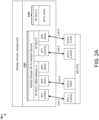
- FIG. 2A illustrates an example of an address hierarchy 700 for Wi-Fi.
- the address hierarchy is for a mobility domain in which there are multiple APs, including multiple AP MLDs.
- the APs of the address hierarchy 700 can support the same AKM values and can use the same PMK.
- Frames transmitted over the air have a link address in MAC header address fields.
- the PTK derivation uses the addresses of the station and the AP in the mobility domain.
- the mobility domain AP-wide PTK is derived by the station using the AP MAC address of the mobility domain AP, and the PTK is the same for the AP MLDs in the mobility domain.
- the mobility domain station's address is used to identify the station and the mobility domain AP's address is used to identify the AP during authentication and the 4-way handshake.
- the station may also have multiple MLD addresses.
- Device addresses of the AP, station, or both in the mobility domain can be used for authentication.
- the mobility domain AP's address and/or address of the station is used for authentication in the mobility domain (e.g., for Wi-Fi 8) and for a 4-way handshake (e.g., for Wi-Fi 8).
- a generated PTK can be common to all the APs in the mobility domain.
- FIG. 2B illustrates an example diagram showing a process 720 for data payload (frame) encryption.
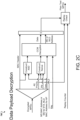
- FIG. 2C illustrates an example diagram showing a process 740 for data payload (frame) decryption.
- the additional authentication data is used as one or more input parameters for encryption and/or decryption of the data frame.
- the AAD field of earlier standard versions e.g., Wi-Fi 6 and earlier
- the station and the AP each have only one address.
- the AAD field can use the MLD address. Use of the MLD address ensures that encrypted packets may be transmitted on any link of the AP MLD as the encryption and/or decryption is not link-specific.
- Each of the processes 720, 740 is configured for at least two options.
- encryption and/or decryption is based on the mobility domain-level address of the AP and the mobility domain-level address of the station.
- a same encryption and/or decryption may be used for all AP MLDs of the mobility domain AP.
- the packet numbering (PN) is continuous for the APs. The continuous PN ensures that replay attacks are not possible for the network.
- the encryption and/or decryption is based on the station MLD address and MLD address of the AP.
- the encryption can be AP MLD specific.
- the PN for different AP MLDs may be different in each AP.
- the station mobility domain address may allow the station to skip the MLD layer and use a 2-level architecture, or 3-address architecture with an MLD address.
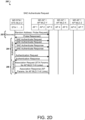
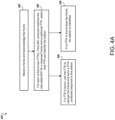
- FIG. 2D illustrates a flow diagram that shows an example process 200 for establishing communication links in a wireless network.
- the network includes a station, which includes a multi-device capability for wireless communication with a plurality of access points.
- the station includes five virtual stations numbered here as STA1, STA2, STA3, STA4 and STA5.
- the station can include any number of two or more virtual STAs.
- the mobility domain AP1 includes a first AP MLD Y, a second AP MLD X, and a third AP MLD Z.
- the first AP MLD Y includes three APs designated AP1, AP2, and AP3.
- the second AP MLD Y includes two APs designated AP4 and AP5.
- the third AP MLD Z includes two APs designated AP6 and AP7.
- the mobility domain AP can include any number of two or more AP MLDs, which respectively can include any number of two or more APs.
- the station is configured to connect to one or more of the APs in the process 200.
- the process 200 includes a discovery stage 202, an authentication stage 204, and an FT signaling stage 206.
- the process 200 includes mobility domain AP-wide generation of a PMK and a PTK.
- the station STA1 is configured to establish communication links with multiple AP MLDs in the mobility domain AP using the same association signaling to establish each link.
- the STA MD is authenticated on the mobility domain level with the mobility domain AP, which allows the same PTK to be used on all AP MLDs affiliated with the same MD AP.
- the created PTK is synchronized with all access points in the mobility domain AP.
- the station generates a PTK once for all AP MLDs in the mobility domain AP.
- the process 200 eliminates the need to perform four-way handshakes with each of the AP MLDs of each of the mobility domain access point devices, such as AP MLD Y, AP MLD X, and AP MLD Z.
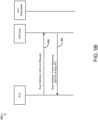
- the request specifies the identity of AP2 and the station over-the-air address.
- Associated AP1 MLD sends a response transmission 664, confirming that a non-data link can be established with AP2.
- Measurement and/or ranging may be performed over a data link and/or a non-data link.
- a station may have multiple measurements ongoing, simultaneously or concurrently, with multiple AP MLDs.
- the station transmits uplink and/or downlink data only with one AP MLD at a time. The uplink and/or downlink data transmissions are performed using only data links, not non-data links.
- FIG. 7 illustrates a flowchart of an example process 800, according to some implementations.
- process 800 can be performed by the stations and systems of FIGS. 1-6 .
- process 800 can be performed, for example, by any suitable system, environment, software, hardware, or a combination of systems, environments, software, and hardware, as appropriate.
- various operations of process 800 can be run in parallel, in combination, in loops, or in any order.
- the example process 800 shown in FIG. 7 can be modified or reconfigured to include additional, fewer, or different operations (not shown in FIG. 7 ), which can be performed in the order shown or in a different order.
- the station is configured to use the PTK for each of a plurality of APs in a mobility domain of the wireless communication network, the plurality of APs including the AP.
- the association data includes scanning addresses for the station, the scanning addresses including link requests to one or more AP multiple link devices (MLDs) in a mobility domain to which the station does not have an established link, the one or more AP MLDs including the AP.
- MLDs AP multiple link devices
- the process 800 includes receiving a response transmission from the AP, the response transmission being encrypted based on the PTK and indicating a confirmation of association between the AP and the station.
- the association data includes a request to establish a link and a measurement request for establishing the link with the AP, the association data being encrypted based on protected management frames (PMF).
- the process 800 includes receiving a response transmission from the AP, the response transmission being encrypted based on the PMF, the response transmission comprising a measurement response for the AP.
- the association data includes a request to establish a non-data link and a measurement request for establishing the non-data link with the AP, the association data being sent to an associated AP MLD that is different from the AP.
- the AP is a non-associated AP MLD for the station.
- the process 800 includes receiving an acknowledgement from the AP confirming receipt of the association data that is encrypted based on the PTK.
- the process 800 includes receiving, from the AP, a response encrypted using the PTK, the response based on the PTK being received at the AP from a network controller.
- the PTK is a MD AP-wide PTK for a plurality of APs in a mobility domain associated with the station.
- the association data transmitted by the station includes scanning addresses, the scanning addresses being known to a plurality of APs in a mobility domain associated with the station.
- the process 800 includes transmitting, based on the scanning addresses, PMF protected probe and access network query protocol (ANQP) frames to the AP in the mobility domain from the station.
- ANQP PMF protected probe and access network query protocol
- the process 800 includes transmitting, based on the scanning addresses, ranging or measurement requests to the AP from the station.
- the process 800 includes transmitting, to the AP, capabilities and operation parameters, the transmitting based on a roaming of the station.
- the process 800 includes buffering uplink or downlink data of an associated AP MLD for synchronizing with the AP.
- the wireless communication network is a Wi-Fi network.
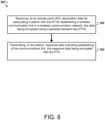
- FIG. 8 illustrates a flowchart of an example process 820, according to some implementations.
- process 820 can be performed by the APs and systems of FIGS. 1-7 . It will be understood that process 820 can be performed, for example, by any suitable system, environment, software, hardware, or a combination of systems, environments, software, and hardware, as appropriate. In some implementations, various operations of process 820 can be run in parallel, in combination, in loops, or in any order.
- the process 820 includes receiving (822), at an access point (AP), association data for associating a station with the AP for establishing a wireless communication link in a wireless communication network, the data being encrypted using a pairwise transient key (PTK).
- the process 820 includes transmitting (824), to the station, response data indicating establishing of the communications link, the response data being encrypted using the PTK.
- the example process 820 shown in FIG. 8 can be modified or reconfigured to include additional, fewer, or different operations (not shown in FIG. 8 ), which can be performed in the order shown or in a different order.
- the association data specifies a scanning address.
- the process 820 includes, responsive to receiving the association data, retrieving, from a network controller, data indicative of the PTK for a transmitter address associated with the station.
- the process 820 includes decrypting the association data using the PTK.
- the process 820 includes determining, based on the decrypting, that the scanning address specifies an address of the AP.
- the process 820 includes transmitting, based on determining, the response data.
- the association data includes scanning addresses for the station, the scanning addresses including a link request for the AP.
- the PTK is a MD AP-wide PTK for a mobility domain associated with the station, the mobility domain including the AP.
- the response data is encrypted based on the PTK and comprise a BIGTK for the AP.
- the response data comprises a measurement response for the AP.
- the process 820 includes receiving ranging or measurement requests from the station.
- the process 820 includes transmitting, based on the requests, ranging or measurement data encrypted with the PTK.
- the process 820 includes buffering uplink or downlink data for synchronizing with the station.
- the wireless communication network is a Wi-Fi network.
- FIG. 9 illustrates a block diagram of an electronic device 900, according to some implementations.
- the electronic device 900 can be a cellular telephone, a smartwatch, an access point, a wireless speaker, an Internet-of-Things (IoT) device, among other examples.
- the electronic device 900 includes hardware resources 902 that include one or more processors (or processor cores) 910, one or more memory/storage devices 920, and one or more communication resources 930, each of which can be communicatively coupled via a bus 940.
- the one or more processor(s) 910 include one or more devices configured to perform computational operations.
- the one or more processor(s) 910 can include one or more microprocessors, application-specific integrated circuits (ASICs), microcontrollers, graphics processing units (GPUs), programmable-logic devices, and/or one or more digital signal processors (DSPs).
- the processor(s) 910 can include, for example, a processor 912 and a processor 914.
- the processor(s) 910 can be, for example, a central processing unit (CPU), a reduced instruction set computing (RISC) processor, a complex instruction set computing (CISC) processor, a graphics processing unit (GPU), a DSP such as a baseband processor, an ASIC, an FPGA, a radio-frequency integrated circuit (RFIC), another processor (including those discussed herein), or any suitable combination thereof.
- CPU central processing unit
- RISC reduced instruction set computing
- CISC complex instruction set computing
- GPU graphics processing unit
- DSP such as a baseband processor, an ASIC, an FPGA, a radio-frequency integrated circuit (RFIC), another processor (including those discussed herein), or any suitable combination thereof.
- the memory/storage devices 920 can include main memory, disk storage, or any suitable combination thereof.
- the memory/storage devices 920 can include, but are not limited to, any type of volatile or nonvolatile memory such as dynamic random-access memory (DRAM), static random-access memory (SRAM), erasable programmable read-only memory (EPROM), electrically erasable programmable read-only memory (EEPROM), flash memory, solid-state storage, etc.
- the memory/storage devices 920 are coupled to one or more high-capacity mass-storage devices (not shown).
- memory/storage devices 920 can be coupled to a magnetic or optical drive, a solid-state drive, or another type of mass-storage device. In these examples, the memory/storage devices 920 can be used by electronic device 900 as fast-access storage for often-used data, while the mass-storage device is used to store less frequently used data.
- the communication resources 930 can include interconnection or network interface components or other suitable devices to communicate with one or more peripheral devices 904 or one or more databases 906 via a network 908.
- the communication resources 930 can include wired communication components (e.g., for coupling via USB), cellular communication components, NFC components, Bluetooth ® (or Bluetooth ® Low Energy) components, Wi-Fi ® components, and other communication components.
- the communication resources 930 includes one or more devices configured to couple to and communicate on a wired and/or wireless network (i.e., to perform network operations), such as: control logic, one or more interface circuits and a set of antennas (or antenna elements) in an adaptive array that can be selectively turned on and/or off by control logic to create a variety of optional antenna patterns or "beam patterns.”
- control logic i.e., to perform network operations
- electronic device 900 includes one or more nodes, e.g., a pad or a connector, which can be coupled to the set of antennas.
- electronic device 900 might or might not include the set of antennas.
- communication resources 930 can include a Bluetooth TM networking system, a cellular networking system (e.g., a 3G/4G/5G/6G network such as UMTS, LTE, etc.), a universal serial bus (USB) networking system, a networking system based on the standards described in IEEE 802.11 (e.g., a Wi-Fi ® networking system), an Ethernet networking system, and/or another networking system.
- a Bluetooth TM networking system e.g., a 3G/4G/5G/6G network such as UMTS, LTE, etc.
- a cellular networking system e.g., a 3G/4G/5G/6G network such as UMTS, LTE, etc.
- USB universal serial bus
- communication resources 930 includes one or more radios, such as a wake-up radio that is used to receive wake-up frames and wake-up beacons, and a main radio that is used to transmit and/or receive frames or packets during a normal operation mode.
- the wake-up radio and the main radio can be implemented separately (such as using discrete components or separate integrated circuits) or in a common integrated circuit.
- the communication resources 930 includes processors, controllers, radios/antennas, sockets/plugs, and/or other devices used for coupling to, communicating on, and handling data and events for each supported networking system. Note that mechanisms used for coupling to, communicating on, and handling data and events on the network for a network system are sometimes collectively referred to as a "network interface" for the network system.
- Instructions 950 can comprise of a software, a program, an application, an applet, an app, or other executable code for causing at least any of the processor(s) 910 to perform any one or more of the methodologies discussed herein.
- the instructions 950 can reside, completely or partially, within at least one of the processor(s) 910 (e.g., within the processor's cache memory), the memory/storage devices 920, or any suitable combination thereof.
- any portion of the instructions 950 can be transferred to the hardware resources 902 from any combination of the peripheral devices 904 or the databases 906. Accordingly, the memory of processor(s) 910, the memory/storage devices 920, the peripheral devices 904, and the databases 906 are examples of computer-readable and machine-readable media.
- the communication techniques can be used in a variety of network interfaces.
- the operations in the preceding implementations were implemented in hardware or software, in general the operations in the preceding implementations can be implemented in a wide variety of configurations and architectures. Therefore, some or all of the operations in the preceding implementations can be performed in hardware, in software or a combination of both.
- at least some of the operations in the communication techniques can be implemented using instructions 950, operating system (such as a driver for an interface circuit in communication resources 930) or in firmware in an interface circuit in communication resources 930.
- the operations in the communication techniques can be implemented in a physical layer, such as hardware in an interface circuit in communication resources 930.
- the communication techniques are implemented, at least in part, in a MAC layer and/or in a physical layer in an interface circuit in communication resources 930.
- electromagnetic signals in one or more different frequency bands are used to determine the range.
- these signals can be communicated in one or more bands of frequencies, including: a microwave frequency band, a radar frequency band, 900 MHz, 2.4 GHz, 5 GHz, 6 GHz, 60 GHz, and/or a band of frequencies used by a Citizens Broadband Radio Service, by LTE, 5G, or any other communication system.
- electronic device 900 can include one or more additional processing subsystems, memory subsystems, networking subsystems, and/or display subsystems. Additionally, one or more of the subsystems might not be present in electronic device 900. In some implementations, electronic device 900 can include one or more additional subsystems that are not shown in FIG. 9 . In some implementations, electronic device 900 can include an analysis subsystem that performs at least some of the operations in the communication techniques. Although separate subsystems are shown in FIG. 9 , in some implementations some or all of a given subsystem or component can be integrated into one or more of the other subsystems or component(s) in electronic device 900.
- At least one of the components set forth in one or more of the preceding figures may be configured to perform one or more operations, techniques, processes, or methods as set forth in the example section below.
- the baseband circuitry as described above in connection with one or more of the preceding figures may be configured to operate in accordance with one or more of the examples set forth below.
- circuitry associated with a UE, base station, network element, etc. as described above in connection with one or more of the preceding figures may be configured to operate in accordance with one or more of the examples set forth below in the example section.
- Example 1 includes encrypting association data, by a station in a mobility domain of a wireless communication network, wherein the encrypting is performed using a pairwise transient key (PTK); and transmitting the encrypted association data to an AP to establish a wireless communication link.
- PTK pairwise transient key
- Example 2 includes the features of example 1, wherein the station uses the PTK to encrypt data for transmission to a second AP of the mobility domain.
- Example 5 includes the features of any of examples 1-4, further including receiving a response from the AP, wherein the response is encrypted based on the PTK and comprises a beacon integrity key (BIGTK).
- BIGTK beacon integrity key
- Example 6 includes the features of any of examples 1-5, wherein the association data comprises a request to establish a link with the AP and a measurement request, the association data being encrypted based on at least one protected management frame (PMF).
- PMF protected management frame
- Example 7 includes the features of any of examples 1-6, further including receiving a measurement response from the AP, wherein the measurement response is encrypted based on the PMF.
- Example 8 includes the features of any of examples 1-7, wherein the association data includes a request to establish a non-data link and a measurement request for establishing the non-data link with the AP, the association data being sent to an associated AP MLD that is different from the AP.
- Example 9 includes the features of any of examples 1-8, wherein the station is not associated with the AP, the method further comprising: receiving an acknowledgement from the AP confirming receipt of the encrypted association data; and receiving, from the AP, a response encrypted using the PTK.
- Example 10 includes the features of any of examples 1-9, wherein the PTK is a MD AP-wide PTK for a plurality of APs in the mobility domain.
- Example 11 includes the features of any of examples 1-10, wherein the association data comprises one or more scanning addresses known to a plurality of APs in the mobility domain.
- Example 12 includes the features of any of examples 1-11, further including transmitting, based on the one or more scanning addresses, one or more PMF protected probe or access network query protocol (ANQP) frames to the AP.
- ANQP access network query protocol
- Example 13 includes the features of any of examples 1-12, further including transmitting, based on the one or more scanning addresses, a ranging or measurement request to the AP.
- Example 14 includes the features of any of examples 1-13, further including transmitting, to the AP, one or more capabilities or operating parameters.
- Example 15 includes the features of any of examples 1-14, further including buffering uplink or downlink data of an associated AP MLD for synchronizing with the AP.
- Example 19 includes the features of any of examples 17-18, wherein the association data includes scanning addresses for the station, the scanning addresses including a link request for the AP.
- Example 23 includes the features of any of examples 17-19, further including receiving, a ranging or measurement request from the station; and transmitting, based on the requests, ranging or measurement data encrypted with the PTK.
- Example 28 may include a method, technique, or process as described in or related to any of examples 1-25, or portions or parts thereof.
- Example 29 may include an apparatus including: one or more processors and one or more computer-readable media including instructions that, when executed by the one or more processors, cause the one or more processors to perform the method, techniques, or process as described in or related to any of examples 1-25, or portions thereof.
- Example 30 may include a signal as described in or related to any of examples 1-25, or portions or parts thereof.
- Example 31 may include a datagram, information element, packet, frame, segment, PDU, or message as described in or related to any of examples 1-25, or portions or parts thereof, or otherwise described in the present disclosure.
- Example 32 may include a signal encoded with data as described in or related to any of examples 1-25, or portions or parts thereof, or otherwise described in the present disclosure.
- Example 33 may include a signal encoded with a datagram, IE, packet, frame, segment, PDU, or message as described in or related to any of examples 1-25, or portions or parts thereof, or otherwise described in the present disclosure.
- Example 34 may include an electromagnetic signal carrying computer-readable instructions, wherein execution of the computer-readable instructions by one or more processors is to cause the one or more processors to perform the method, techniques, or process as described in or related to any of examples 1-25, or portions thereof.
- Example 35 may include a computer program including instructions, wherein execution of the program by a processing element is to cause the processing element to carry out the method, techniques, or process as described in or related to any of examples 1-25, or portions thereof.
- the operations or actions performed by the instructions executed by the processing element can include the methods of any one of examples 1-25.
- Example 36 may include a signal in a wireless network as shown and described herein.
- Example 37 may include a method of communicating in a wireless network as shown and described herein.
- Example 38 may include a system for providing wireless communication as shown and described herein.
- the operations or actions performed by the system can include the methods of any one of examples 1-25.
- Example 39 may include a device for providing wireless communication as shown and described herein.
- the operations or actions performed by the device can include the methods of any one of examples 1-25.
- the previously described examples 1-25 are implementable using a computer-implemented method; a non-transitory, computer-readable medium storing computer-readable instructions to perform the computer-implemented method; and a computer system including a computer memory interoperably coupled with a hardware processor configured to perform the computer-implemented method or the instructions stored on the non-transitory, computer-readable medium.
- a system can be configured to perform particular operations or actions by virtue of having software, firmware, hardware, or a combination of them installed on the system that in operation causes the system to perform the actions.
- One or more computer programs can be configured to perform particular operations or actions by virtue of including instructions that, when executed by the data processing apparatus, causes the apparatus to perform the actions.
- the operations or actions performed either by the system or by the instructions executed by the data processing apparatus can include the methods of any one of examples 1-25.
- personally identifiable information should follow privacy policies and practices that are generally recognized as meeting or exceeding industry or governmental requirements for maintaining the privacy of users.
- personally identifiable information data should be managed and handled so as to minimize risks of unintentional or unauthorized access or use, and the nature of authorized use should be clearly indicated to users.
Landscapes
- Engineering & Computer Science (AREA)
- Computer Networks & Wireless Communication (AREA)
- Signal Processing (AREA)
- Computer Security & Cryptography (AREA)
- Mobile Radio Communication Systems (AREA)
Applications Claiming Priority (2)
| Application Number | Priority Date | Filing Date | Title |
|---|---|---|---|
| US202363541579P | 2023-09-29 | 2023-09-29 | |
| US18/897,176 US20250113184A1 (en) | 2023-09-29 | 2024-09-26 | Mobility domain access point wide pairwise transient key |
Publications (1)
| Publication Number | Publication Date |
|---|---|
| EP4531446A1 true EP4531446A1 (fr) | 2025-04-02 |
Family
ID=92925875
Family Applications (1)
| Application Number | Title | Priority Date | Filing Date |
|---|---|---|---|
| EP24203193.8A Pending EP4531446A1 (fr) | 2023-09-29 | 2024-09-27 | Clé transitoire à large paire de points d'accès à un domaine de mobilité |
Country Status (3)
| Country | Link |
|---|---|
| US (1) | US20250113184A1 (fr) |
| EP (1) | EP4531446A1 (fr) |
| CN (1) | CN119743752A (fr) |
Citations (1)
| Publication number | Priority date | Publication date | Assignee | Title |
|---|---|---|---|---|
| US20230087387A1 (en) * | 2020-06-03 | 2023-03-23 | Canon Kabushiki Kaisha | Communication apparatus, communication method, and storage medium |
Family Cites Families (9)
| Publication number | Priority date | Publication date | Assignee | Title |
|---|---|---|---|---|
| US11093327B1 (en) * | 2012-06-25 | 2021-08-17 | Pure Storage, Inc. | Failure abatement approach for failed storage units common to multiple vaults |
| US10116539B1 (en) * | 2018-05-23 | 2018-10-30 | Tempered Networks, Inc. | Multi-link network gateway with monitoring and dynamic failover |
| US20200104813A1 (en) * | 2018-10-02 | 2020-04-02 | Thomas Purves | Real-time carbon offset determination |
| CA3022117A1 (fr) * | 2018-10-25 | 2020-04-25 | Nymi Inc. | Procede cryptographique pour les dispositifs portatifs, et systeme et procede d`autorisation de la presence et/ou de l`acces d`utilisateurs utilisant celui-ci |
| WO2020091722A1 (fr) * | 2018-10-29 | 2020-05-07 | Visa International Service Association | Système et procédé de communication authentique efficace |
| US11463466B2 (en) * | 2020-09-23 | 2022-10-04 | Extrahop Networks, Inc. | Monitoring encrypted network traffic |
| US12294645B2 (en) * | 2021-10-04 | 2025-05-06 | QDS Holdings Inc. | Systems and methods for securing a quantum-safe digital network environment |
| US11997482B2 (en) * | 2022-02-18 | 2024-05-28 | Qualcomm Incorporated | Association protection for wireless networks |
| US20250212275A1 (en) * | 2022-03-29 | 2025-06-26 | Mediatek Inc. | Eht multi-link operating channel validation in wireless communications |
-
2024
- 2024-09-26 US US18/897,176 patent/US20250113184A1/en active Pending
- 2024-09-27 EP EP24203193.8A patent/EP4531446A1/fr active Pending
- 2024-09-29 CN CN202411373497.1A patent/CN119743752A/zh active Pending
Patent Citations (1)
| Publication number | Priority date | Publication date | Assignee | Title |
|---|---|---|---|---|
| US20230087387A1 (en) * | 2020-06-03 | 2023-03-23 | Canon Kabushiki Kaisha | Communication apparatus, communication method, and storage medium |
Non-Patent Citations (3)
| Title |
|---|
| DUNCAN HO (QUALCOMM): "Association protection", vol. 802.11bi, 9 March 2022 (2022-03-09), pages 1 - 16, XP068189446, Retrieved from the Internet <URL:https://mentor.ieee.org/802.11/dcn/22/11-22-0463-00-00bi-association-protection.pptx> [retrieved on 20220309] * |
| GAURAV PATWARDHAN (HPE): "MLD security considerations", vol. 802.11 EHT; 802.11be, 9 November 2020 (2020-11-09), pages 1 - 21, XP068175051, Retrieved from the Internet <URL:https://mentor.ieee.org/802.11/dcn/20/11-20-1545-00-00be-mld-security-considerations.pptx> [retrieved on 20201109] * |
| PO-KAI HUANG (INTEL): "Multi-link security consideration", vol. 802.11 EHT; 802.11be, no. 2, 10 January 2020 (2020-01-10), pages 1 - 15, XP068165045, Retrieved from the Internet <URL:https://mentor.ieee.org/802.11/dcn/19/11-19-1822-02-00be-multi-link-security-consideration.pptx> [retrieved on 20200110] * |
Also Published As
| Publication number | Publication date |
|---|---|
| CN119743752A (zh) | 2025-04-01 |
| US20250113184A1 (en) | 2025-04-03 |
Similar Documents
| Publication | Publication Date | Title |
|---|---|---|
| CN114521010B (zh) | Mld私密性和操作增强 | |
| US12273841B2 (en) | Method for onboarding in multiple access point network and access point using same | |
| EP2830362B1 (fr) | Procédé et appareil pour le balayage basé sur le filtrage dans un système wlan | |
| US20180184428A1 (en) | Associating and securitizing distributed multi-band link aggregation devices | |
| KR101990715B1 (ko) | 네트워크 시그널링을 위한 고속 초기 링크 셋업(fils) 디스커버리 프레임을 포함하는 무선 통신 | |
| US20160366707A1 (en) | Apparatus, system and method of securing communications of a user equipment (ue) in a wireless local area network | |
| US11206576B2 (en) | Rapidly disseminated operational information for WLAN management | |
| JP2017538345A (ja) | 方法、装置およびシステム | |
| TWI820874B (zh) | 一種應用於通道直接鏈路建立的傳輸方法及裝置 | |
| US11722894B2 (en) | Methods and devices for multi-link device (MLD) address discovery in a wireless network | |
| US11310724B2 (en) | Key management for fast transitions | |
| CN113630774B (zh) | 在无线网络中的多链路设备(mld)地址发现的方法与装置 | |
| TW202312723A (zh) | 一種通信方法及通信裝置 | |
| US20250150814A1 (en) | Encryption and Protection of MAC headers and Control Frames | |
| US12563388B2 (en) | Systems and methods for security association enabling make-before-break-roaming (MBBR) | |
| US20240381077A1 (en) | Roaming between access points in the same ess using pre-derived ptks | |
| US12549337B2 (en) | System and method for generating a private group encryption key based on a unique group identifier | |
| EP4531446A1 (fr) | Clé transitoire à large paire de points d'accès à un domaine de mobilité | |
| US12598465B2 (en) | Wi-Fi deauthentication attack detection and prevention | |
| EP4489460B1 (fr) | Protection d'intégrité améliorée pour systèmes de réseau sans fil | |
| US20260128877A1 (en) | Security for coordinated access point (cap) communications | |
| CN121312172A (zh) | 使用预先导出的ptk在同一ess中的接入点之间漫游 | |
| WO2025049050A1 (fr) | Échange de clés accéléré dans un réseau sans fil | |
| CN121080010A (zh) | 用于实现先接后断漫游(mbbr)的安全关联的系统和方法 | |
| WO2026054899A1 (fr) | Techniques d'itinérance pour des points d'accès non établis dans un domaine de mobilité commun |
Legal Events
| Date | Code | Title | Description |
|---|---|---|---|
| PUAI | Public reference made under article 153(3) epc to a published international application that has entered the european phase |
Free format text: ORIGINAL CODE: 0009012 |
|
| STAA | Information on the status of an ep patent application or granted ep patent |
Free format text: STATUS: REQUEST FOR EXAMINATION WAS MADE |
|
| 17P | Request for examination filed |
Effective date: 20240927 |
|
| AK | Designated contracting states |
Kind code of ref document: A1 Designated state(s): AL AT BE BG CH CY CZ DE DK EE ES FI FR GB GR HR HU IE IS IT LI LT LU LV MC ME MK MT NL NO PL PT RO RS SE SI SK SM TR |