EP4534110A1 - Behandlung von medizinischem material mittels mikrowellen - Google Patents
Behandlung von medizinischem material mittels mikrowellen Download PDFInfo
- Publication number
- EP4534110A1 EP4534110A1 EP23202250.9A EP23202250A EP4534110A1 EP 4534110 A1 EP4534110 A1 EP 4534110A1 EP 23202250 A EP23202250 A EP 23202250A EP 4534110 A1 EP4534110 A1 EP 4534110A1
- Authority
- EP
- European Patent Office
- Prior art keywords
- container
- temperature
- sterilisation
- medical material
- pressure vessel
- Prior art date
- Legal status (The legal status is an assumption and is not a legal conclusion. Google has not performed a legal analysis and makes no representation as to the accuracy of the status listed.)
- Withdrawn
Links
Images


Classifications
-
- A—HUMAN NECESSITIES
- A61—MEDICAL OR VETERINARY SCIENCE; HYGIENE
- A61L—METHODS OR APPARATUS FOR STERILISING MATERIALS OR OBJECTS IN GENERAL; DISINFECTION, STERILISATION OR DEODORISATION OF AIR; CHEMICAL ASPECTS OF BANDAGES, DRESSINGS, ABSORBENT PADS OR SURGICAL ARTICLES; MATERIALS FOR BANDAGES, DRESSINGS, ABSORBENT PADS OR SURGICAL ARTICLES
- A61L2/00—Disinfection or sterilisation of materials or objects, in general; Accessories therefor
- A61L2/02—Disinfection or sterilisation of materials or objects, in general; Accessories therefor using physical processes
- A61L2/08—Radiation
- A61L2/12—Microwaves
-
- A—HUMAN NECESSITIES
- A61—MEDICAL OR VETERINARY SCIENCE; HYGIENE
- A61B—DIAGNOSIS; SURGERY; IDENTIFICATION
- A61B90/00—Instruments, implements or accessories specially adapted for surgery or diagnosis and not covered by any of the groups A61B1/00 - A61B50/00, e.g. for luxation treatment or for protecting wound edges
- A61B90/70—Cleaning devices specially adapted for surgical instruments
-
- A—HUMAN NECESSITIES
- A61—MEDICAL OR VETERINARY SCIENCE; HYGIENE
- A61L—METHODS OR APPARATUS FOR STERILISING MATERIALS OR OBJECTS IN GENERAL; DISINFECTION, STERILISATION OR DEODORISATION OF AIR; CHEMICAL ASPECTS OF BANDAGES, DRESSINGS, ABSORBENT PADS OR SURGICAL ARTICLES; MATERIALS FOR BANDAGES, DRESSINGS, ABSORBENT PADS OR SURGICAL ARTICLES
- A61L2/00—Disinfection or sterilisation of materials or objects, in general; Accessories therefor
- A61L2/02—Disinfection or sterilisation of materials or objects, in general; Accessories therefor using physical processes
- A61L2/04—Heat
-
- B—PERFORMING OPERATIONS; TRANSPORTING
- B65—CONVEYING; PACKING; STORING; HANDLING THIN OR FILAMENTARY MATERIAL
- B65B—MACHINES, APPARATUS OR DEVICES FOR, OR METHODS OF, PACKAGING ARTICLES OR MATERIALS; UNPACKING
- B65B55/00—Preserving, protecting or purifying packages or package contents in association with packaging
- B65B55/02—Sterilising, e.g. of complete packages
-
- H—ELECTRICITY
- H05—ELECTRIC TECHNIQUES NOT OTHERWISE PROVIDED FOR
- H05B—ELECTRIC HEATING; ELECTRIC LIGHT SOURCES NOT OTHERWISE PROVIDED FOR; CIRCUIT ARRANGEMENTS FOR ELECTRIC LIGHT SOURCES, IN GENERAL
- H05B6/00—Heating by electric, magnetic or electromagnetic fields
- H05B6/64—Heating using microwaves
- H05B6/6447—Method of operation or details of the microwave heating apparatus related to the use of detectors or sensors
- H05B6/645—Method of operation or details of the microwave heating apparatus related to the use of detectors or sensors using temperature sensors
- H05B6/6455—Method of operation or details of the microwave heating apparatus related to the use of detectors or sensors using temperature sensors the sensors being infrared detectors
-
- H—ELECTRICITY
- H05—ELECTRIC TECHNIQUES NOT OTHERWISE PROVIDED FOR
- H05B—ELECTRIC HEATING; ELECTRIC LIGHT SOURCES NOT OTHERWISE PROVIDED FOR; CIRCUIT ARRANGEMENTS FOR ELECTRIC LIGHT SOURCES, IN GENERAL
- H05B6/00—Heating by electric, magnetic or electromagnetic fields
- H05B6/64—Heating using microwaves
- H05B6/80—Apparatus for specific applications
- H05B6/806—Apparatus for specific applications for laboratory use
-
- A—HUMAN NECESSITIES
- A61—MEDICAL OR VETERINARY SCIENCE; HYGIENE
- A61L—METHODS OR APPARATUS FOR STERILISING MATERIALS OR OBJECTS IN GENERAL; DISINFECTION, STERILISATION OR DEODORISATION OF AIR; CHEMICAL ASPECTS OF BANDAGES, DRESSINGS, ABSORBENT PADS OR SURGICAL ARTICLES; MATERIALS FOR BANDAGES, DRESSINGS, ABSORBENT PADS OR SURGICAL ARTICLES
- A61L2103/00—Materials or objects being the target of disinfection or sterilisation
- A61L2103/05—Living organisms or biological materials
-
- A—HUMAN NECESSITIES
- A61—MEDICAL OR VETERINARY SCIENCE; HYGIENE
- A61L—METHODS OR APPARATUS FOR STERILISING MATERIALS OR OBJECTS IN GENERAL; DISINFECTION, STERILISATION OR DEODORISATION OF AIR; CHEMICAL ASPECTS OF BANDAGES, DRESSINGS, ABSORBENT PADS OR SURGICAL ARTICLES; MATERIALS FOR BANDAGES, DRESSINGS, ABSORBENT PADS OR SURGICAL ARTICLES
- A61L2103/00—Materials or objects being the target of disinfection or sterilisation
- A61L2103/15—Laboratory, medical or dentistry appliances, e.g. catheters or sharps
-
- A—HUMAN NECESSITIES
- A61—MEDICAL OR VETERINARY SCIENCE; HYGIENE
- A61L—METHODS OR APPARATUS FOR STERILISING MATERIALS OR OBJECTS IN GENERAL; DISINFECTION, STERILISATION OR DEODORISATION OF AIR; CHEMICAL ASPECTS OF BANDAGES, DRESSINGS, ABSORBENT PADS OR SURGICAL ARTICLES; MATERIALS FOR BANDAGES, DRESSINGS, ABSORBENT PADS OR SURGICAL ARTICLES
- A61L2202/00—Aspects relating to methods or apparatus for disinfecting or sterilising materials or objects
- A61L2202/10—Apparatus features
- A61L2202/12—Apparatus for isolating biocidal substances from the environment
- A61L2202/122—Chambers for sterilisation
-
- A—HUMAN NECESSITIES
- A61—MEDICAL OR VETERINARY SCIENCE; HYGIENE
- A61L—METHODS OR APPARATUS FOR STERILISING MATERIALS OR OBJECTS IN GENERAL; DISINFECTION, STERILISATION OR DEODORISATION OF AIR; CHEMICAL ASPECTS OF BANDAGES, DRESSINGS, ABSORBENT PADS OR SURGICAL ARTICLES; MATERIALS FOR BANDAGES, DRESSINGS, ABSORBENT PADS OR SURGICAL ARTICLES
- A61L2202/00—Aspects relating to methods or apparatus for disinfecting or sterilising materials or objects
- A61L2202/10—Apparatus features
- A61L2202/18—Aseptic storing means
- A61L2202/181—Flexible packaging means, e.g. permeable membranes, paper
Definitions
- the present disclosure relates to technology for treatment of medical material. More specifically, the present disclosure describes a method and system for sterilizing or decontaminating medical material by applying microwaves to the medical material.
- Sterilising or decontaminating medical material such as infectious, contaminated or hazardous material from a healthcare facility, clinic or laboratory is a critical process that must be done properly to ensure the public safety.
- the disposal of liquid material, the material being of a medical origin or other origin, in high volumes is more challenging to handle compared to solid medical material and the transport and decontamination of liquid medical material may thus drastically increase the cost and make such a disposal thereof highly expensive, compared to the disposal of solid medical material.
- the treatment of medical materials is performed inside a closed vessel, which often results in significant drawbacks. Specifically, this exposes the vessel walls to repeated cycles of high and low temperatures at a high moisture environment. These temperature cycles induce significant thermal stress on the vessel walls, leading to increased maintenance requirements. Consequently, downtime is necessary between each heating cycle to allow the vessel walls to cool down sufficiently for the safe handling of sterilized materials and preparation of the vessel for another batch, all while minimizing thermal stress. Therefore, another objective of the present invention is to improve the throughput of the sterilization process compared to existing systems.
- the present invention proposes a solution that achieves more localized heating of medical materials using microwaves (MW) generated within a pressurized vessel. Specifically, by placing the medical material in a container made of sterilization-resistant and non-microwave-absorbent material, heating efficiency can be improved, resulting in a faster and more energy-efficient sterilization protocol. Additionally, the locally heated air can enhance the heat distribution within the container, ensuring more uniform heating of the medical material. This is particularly important when dealing with stationary, non-moving targets, as microwave heating commonly leads to the formation of hot spots.
- microwaves microwaves
- the heating rate is controlled to maintain the temperature within the container below the boiling point of water during microwave sterilisation, preferably below 138.9°C at 2.5 bara.
- the overpressure is between at least 1 bara and at most 3 bara, preferably between 1.5 bara and 2.5 bara, more preferably about 2 bara (bar above atmospheric pressure).
- the method comprises the step of measuring the temperature within the container during microwave sterilisation, and controlling the strength of the electric/magnetic field and thus the power of the microwaves applied to the container based on the measured temperature to maintain a desired temperature or temperature range within the container.
- the method further comprises the step of placing the container in a transparent bag adapted to prevent water vapor generated during heating the medical material to escape the container.
- the microwaves are applied for a duration of between at least 10 minutes and at most 30 minutes, preferably between 15 minutes to 25 minutes.
- the medical material is a liquid medical material.
- Another aspect of the present disclosure relates to a system for treatment of medical material, including sterilising or decontaminating of the medical material, the sterilisation system comprising:
- the system comprising a temperature sensor configured for measuring the temperature in the container and is in communication with the controller, wherein the controller is configured to control the power of the microwaves applied to the container based on the measured temperature to maintain a desired temperature or temperature range within the container.
- the sight window of the system is adapted to prevent condensation , preferably with a heating means configured to warm the sight window.
- Another aspect of the present disclosure relates to the system adapted for performing the method for sterilising of medical material.
- sterilization refers to a process aimed at completely eliminating all forms of microbial life, including spores, bacteria, viruses, fungi, and bacterial spores, from a medical material.
- the end result of the sterilization process is a completely sterile medical material, where no viable microorganisms remain.
- Sterilization is relevant for medical materials where absolute microbial sterility is required, such as surgical instruments, pharmaceuticals, and certain laboratory equipment.
- decontamination refers to a process intended to reduce the microbial load to a safe and acceptable level, rather than achieving absolute sterility, from a medical material.
- the objective is to render a surface or object safe for handling or use without necessarily eliminating all microorganisms. Decontamination is relevant in general healthcare settings, such as cleaning and disinfecting common tools and utensils.
- sterilisation with MW under pressurised conditions is particularly advantageous since it allows for improved control of the heating parameters with faster response times if a temperature exceeds a specific threshold, as compared to difficult to control and slow to respond conventional sterilisation systems.
- the sterilisation process becomes more flexible and tailored to the specific type and volume of the medical material which needs sterilisation.
- This adaptability is for instance achieved by allowing the selection of different types and amounts of liquid to be added to the container holding the medical material.
- the choice of liquid depends on the characteristics of the solid material being sterilised. Different liquids require varying levels of microwave energy and pressure to achieve the high temperatures necessary for a successful sterilisation process.
- solid microwave absorbents can be added to the solid medical material. These solid microwave absorbents are designed to absorb and dissipate microwave radiation effectively and will transfer the generated microwave radiation to the surrounding solid material to heat the material at or above the sterilisation temperature.
- This is particularly beneficial for batchwise sterilising because it allows for the safely preparing and handling of contaminated material by placing them in a container with lid and optionally placing the container inside a sealable bag prior to the sterilisation procedure, specifically compared to sterilisation systems that use steam to reach a specific operating temperature and as a result need the container holding the contaminated product to remain open and accessible by the steam during sterilisation.
- a "zero risk bag in bag" procedure can be extremely beneficial.
- Multiple flexible bags can be placed inside one or more rigid containers to increase the efficiency of the sterilisation process.
- the present system may allow for improved monitoring of the sterilisation temperature and controlling of the sterilisation process such that it can be applied in a more efficient way, for example by allowing immediate termination when the threshold minimum sterilisation temperature of 121 °C is reached during a specific period of time, e.g. 30 minutes.
- a pressure control system having a pressure valve can be installed on the container.
- MW energy to heat the air inside the confinement of the container and monitoring of the sterilisation temperature within the container holding the contaminated material, allows for a more optimised heating and cooling rate process such that the throughput of the sterilisation process can be improved.
- the inventors have discovered that the utilisation of pressured air improves the efficiency of the sterilisation process. Pressurised air heated by MW energy improves the distribution of the heat, thus leading to a more uniform and homogeneous heating of the material compared to standard MW heating, where the material which needs heating is constantly turned around on a rotating platform to achieve a more evenly distribution of the heating and prevent the existence of cold and hot spots in the material when applying MW energy on the material.
- Using a container in a pressure vessel thus creating a smaller enclosure compared to the entire pressure vessel and applying MW energy to the pressurised air in the confined space of the container, to primarily heat the pressurised air inside the container only, can provide a homogeneous heating of the interior of the container and material contained in the container, while the temperature inside the pressure vessel can remain lower, thereby maintaining cooler vessel walls that reduces the thermal stress exerted on the pressure vessel.
- the reduction of the thermal stress on the walls of the pressure vessel can decrease maintenance requirements and provide for reduced down-time of the pressure vessel. Additionally, the throughput of the sterilisation process is increased since the waiting time for the vessel cooldown between batches is reduced.
- the improved energy efficiency can be combined with various "green" energy sources to achieve more an eco-friendlier sterilisation solution.
- the present system can be more easily integrated and synchronised into smaller electric grid, preferably smart grids providing energy obtained from solar and wind power.
- the sterilisation can be synchronised with the green energy generation, e.g., as soon as the environmental conditions allow for generation of wind and/or solar energy the drying can be initiated to operate during high energy peaks (low costs) and avoid low energy peak (high cost).
- moisture content refers to the amount of water contained in the product which is commonly expressed as a percentage of the weight of a product.
- a "liquid material” refers to a product to be sterilised, whereby the product is primarily in a liquid form.
- the liquid material product may have a moisture content of at least 50 %, preferably of at least 55 %, more preferably of at least 60 %, more preferably still of at least 65 %, more preferably still at least 80 %, more preferably still at least 90 %, more preferably still at least 95 %, more preferably still at least 99 % or more.
- the skilled person understands that the moisture content of a provided liquid material product depends on the type of material or product.
- a "decontaminated product” is a product, either solid or liquid, that has undergone a sterilisation process for a minimum time, for example, 30 minutes, at a minimum temperature, such as 121°C. This sterilisation process may effectively decontaminate the product, rendering it safe to be handled and transported without the risk of further contamination when in contact with the product.
- a minimum time for example, 30 minutes
- a minimum temperature such as 121°C.
- humidity refers to the concentration of water vapour present in the air, which is commonly expressed as a relative humidity based on temperature and water content.
- vapor present in the air when heating and sterilising is primarily contained inside the container.
- a container and lid whereby the lid has an opening to allow temperature measurement inside the container, it may be convenient to place the container and lid in a flexible bag adapted to prevent vapor from escaping the flexible bag and from entering inside the sterilisation chamber of the pressure vessel.
- a minimum humidity of 10%, preferably 20% with a maximum of 50% is desirable, while excessive humidity above 50% can be advantageously avoided, since this may increase the energy requirements to reach the temperature suitable for sterilisation. Additionally, high humidity may cause excessive condensation on the colder walls of the pressure vessel or on the see-through window of the pressure vessel. Nonetheless, the medical material can be drained prior to sterilization to reduce the humidity, provided that the liquid can be safely drained.
- a first heating cycle whereby the product temperature is raised as fast as possible above the minimum temperature, whereby, as soon as the minimum temperature is reached, a second heating cycle is operated such that the product temperature is maintained between the minimum sterilisation temperature and the maximum boiling temperature of the product which needs sterilisation.
- electric/magnetic field strength between 3kV/m and 7kV/m is used until the product temperature is above the minimum sterilisation temperature of e.g. 121°C at 2.5 bara and below the boiling temperature e.g. 138.9°C at 2.5 bara (i.e., 2.5 bar above atmospheric pressure), and preferably between 1kV/m and 3kV/m during a second heating cycle, where the product temperature is maintained around the preferred sterilisation temperature (e.g. 121°C) of the material or product.
- the preferred sterilisation temperature e.g. 121°C
- the person skilled in the art understands that various other electric/magnetic field strength can be employed and the herein described microwave sterilisation is not limited to a specific electric/magnetic field strength thereof or the use of one or more heating cycles.
- the "preferred sterilisation temperature” is the ideal temperature for a particular product set between the minimum sterilisation temperature of 121°C, which is required to kill any pathogens, and the boiling temperature of the particular product.
- An aspect of the present disclosure relates to a method for sterilising of medical material such as liquid material or solid material, said sterilisation method comprising the steps:
- the heating rate can be controlled to maintain a temperature within the container during microwave sterilisation that is suitable for sterilising the medical material, wherein the temperature is preferably at least 121 °C.
- the overpressure can be between at least 1 bara and at most 3 bara, preferably between 1.5 bara and 2.5 bara, more preferably about 2 bara.
- Applying overpressure to the container during the heating process has the advantage of preventing deformation of the container which can occur due to the heating of the material of the container itself above its deformation point or when the pressure and heat are not dissipated equally, and which can potentially compromise the sterilisation process.
- the specific pressure range may be determined based on factors such as the material and thickness of the container, the size and composition of the medical material being sterilised, and the heating and cooling rates used in the process. In general, the pressure range should be sufficient to prevent deformation of the container but not so high that it poses a safety risk or creates unnecessary complexity in the sterilisation system.
- a pressure range between 1 and 2 bara can be used for sterilisation of medical material.
- the material of the container can include, and preferably consist of, a non-microwave-absorbent material.
- a non-microwave-absorbent material can allow microwaves to pass through without significant absorption. It is advantageous for the material to be dielectrically inert, meaning it does not interact with microwave radiation. It is to be understood that, while it is advantageous, it is not required for the entire container to consist of a non-microwave-absorbent material.
- the material of the container can comprise plastic, glass, ceramic or a combination thereof.
- materials known in the art that are sterilisation-resistant and non-microwave absorbent to microwaves such that the medical material which is contained inside the container can be sterilised without having energy wasted on heating and sterilising the container itself.
- a pressure control system may be included, for example a valve installed on the container in case of a closed container, or installed within the closed bag in case of using a bag to seal the container, which is configured to (automatically) regulate the differences in pressure between the interior and exterior of the closed container.
- the valve can be a two-way valve configured to automatically regulate the variation in pressure.
- the method may comprise the step of measuring the temperature within the container during microwave sterilisation and controlling the power of the microwaves applied to the container based on the measured temperature to maintain a desired temperature or temperature range within the container. Since an overpressure is applied to the container during microwave sterilisation, it is preferred that the temperature measurements are performed through a window installed in a wall of the pressure vessel and whereby the temperature sensor is placed outside the pressure vessel and measuring through the window.
- overpressure within the interior of the pressure vessel. This measure significantly enhances the container's ability to retain its structural integrity when subjected to overpressure within the pressure vessel. It is important to note that minor deformations may occur naturally, particularly during repeated cycles or high applied pressure. Nevertheless, it remains advantageous for precise process control that the container maintains its form, minimizing the potential for harm to, or distortion of, the medical materials stored within the container. Additionally, the application of overpressure can result in an elevation of the temperature inside the container, which is placed within the pressure vessel. This increase in temperature can be advantageous for the sterilization process.
- the method may comprise the step of measuring the pressure within the container during microwave sterilisation, and controlling the overpressure applied to the container based on the measured pressure to maintain a desired pressure or pressure range within the container. Since the pressure is measured, an accurate control of the sterilisation process by using a control system is possible.
- the sterilisation process can be controlled by the control system on the basis of at least one of the following four parameters. The first parameter being the incident power, measured at the MW source, the second parameter being the absorbed power, which is calculated by the control system, thirdly, the actual temperature of the product inside the container which is measured e.g. by an IR temperature sensor through the sight window of the pressure vessel, and lastly, the applied pressure present inside the vessel, and thus also inside the container.
- the preferred operating temperature being a temperature between a minimum and maximum temperature
- the preferred operating temperature being a temperature between a minimum and maximum temperature
- the container can start to deform, which may permanently damage the container, and which may cause the contaminated product to spill from the container and leak inside the pressure vessel. Adjusting the pressure inside the pressure vessel can prevent such deformation.
- the method comprises the step of placing the container in a flexible bag adapted to hermetically seal the container within.
- the contents of the vessel may cease to maintain sterility, assuming the successful completion of the sterilization process. This can be due to the contamination introduced by the microbiological air environment. Therefore, the medical material can be advantageously hermetically sealed prior to treatment. This sealed external enclosure ensures that post-treatment, the sterilized materials remain protected from contamination.
- the medical material can be placed in a hermetically sealed flexible bag that is placed into the container.
- the method comprises the step of placing the container in a flexible bag adapted to prevent water condensation from occurring on the inside walls of the pressure vessel.
- the bag is transparent, allowing visibility of the materials on the inside. Placing the container inside such a transparent bag, e.g. a thin plastic bag consisting of LDPE, will have a number of advantages.
- a lid may be foreseen which is adapted to close of the container, the lid may not be airtight, and water vapor may still be able to evacuate from openings between the closed off container and lid.
- a sterilisation indicator means can be disposed in the container for monitoring the efficacy of the sterilisation process.
- the sterilisation indicator may comprise a bioindicator comprising a sterilisable biological medium and a pH indicator to visually indicate that the biological medium is effectively sterilised.
- sterilisation indicators such as Sterikon ® plus Bioindicators which are commonly used to control the sterilising process in autoclaves. These Sterikon ® plus Bioindicators are designed for sterilisation processes at 121°C.
- the method may include the step of preparing the container containing the medical material to be sterilised. If the medical material is a liquid, no further liquid such as water needs to be added to the medical material, since the medical material in itself will be able to heat due to the microwave energy which will be applied. However, depending on the type of liquid medical material, it may still be advisable to add water to the container in order to speed up the heating and thus sterilisation process. If water, or another liquid is added to the container, may be possible to add the water under the liquid medical material or to place it in a separate spacing dedicated for receiving such additional water. In case the medical material is a solid medical material, it may be necessary to add liquid to the solid material in order to saturate the solid material such as surgical cloths, or to dissolve the solid material such that the solid material becomes a semi or complete liquid material.
- the method may include placing the medical material inside the container.
- the container can be left open, or it can be closed by a lid to prevent easy access to the medical material during further handling and avoid spillage.
- the medical material which is contained within the container will be housed in a smaller environment, compared to when the container is left open and placed as is inside the pressure vessel or autoclave.
- the medical material inside the container can heat up much faster and reach the minimum temperature required for sterilisation, which is 121°C.
- the method may include the step to measure the temperature of the medical material inside the container.
- this step may comprise placing of a temperature sensor inside the container, or advantageously, inside the medical material contained inside the container.
- a temperature sensor is able to directly measure the core temperature of the medical material.
- the signal generated by the sensor can be send to a controller for evaluation and monitoring.
- a temperature sensor which is able to resist under pressure is to be preferred since the pressure vessel will be placed under pressure.
- the heating sequence 50 can start. Therefore, electric/magnetic field strength of about 4 kV/m is directed to the container holding the medical material until the product temperature is between 121°C and 138.9°C. Once this operating temperature is reached, the field strength can optionally be reduced to 1-3 kV/m to maintain the operating temperature at the desired level. Reducing the power can allow for a more energy friendly sterilisation process 10.
- the cooling sequence 90 entails the powering down of the applied electric/magnetic field strength to zero, and allowing the medical material inside the container to cool down. Once cooled down sufficiently, the overpressure is released from the pressure vessel.
- it is also possible to reduce the cooling down time by applying liquid gas inside the pressure vessel to more rapidly cool down the interior of the pressure vessel.
- liquid gas inside the pressure vessel When the container is placed inside the plastic bag, it is possible to spray cold water inside the interior of the pressure vessel and onto the plastic bag holding the container in order to cool down the temperature of the container and thus the content of the container.
- Another alternative could be the use of a heat exchanger in order to reduce the cooling time.
- An advantage of using such a heat exchanger is that the heat generated by the heat exchanger can be used for different purposes.
- the pressure vessel can be opened safely.
- three ampuls of Sterikon ® Plus bioindicators are placed at various locations in the medical material 120 and will undergo the same sterilisation cycle as the medical material. At least one incubated ampul is kept outside the pressure vessel 130 and can serve as a reference ampul when later checking the e.g. three ampuls which were inside the pressure vessel. After the sterilisation cycle 140, the three ampuls are compared 150 with the reference ampul. Evaluation of the sterilisation process is done by comparing the colours of the reference ampul with the sterilised ampuls 160. When only the reference ampul changes colour from pink to yellow, while the remaining three ampuls maintain their pink colour, the sterilisation cycle was successful. However, if all or some of the ampuls also change colour from pink to yellow, the sterilisation cycle was not successful and needs to be repeated for this particular batch of medical material in order to be certain that an appropriate level of sterilisation was accomplished.
- Sterikon ® Plus bioindicators are commonly used, different types of bioindicators may be better suited when a higher or lower sterilisation temperature is required.
- an automated read-out of a visual marker can be envisioned using a camera or another type of optical unit configured to automatically read the optical signal provided by the visual marker.
- a camera or another type of optical unit configured to automatically read the optical signal provided by the visual marker.
- an algorithm can be implemented to automatically detect the colour or range of colours of the visual marker and compare it to a baseline colour to categorize a sterilisation cycle as successful or failed.
- Other variations of this aspect can be implemented in accordance with the knowledge of those skilled in the art.”
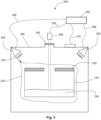
- FIG. 1 is a schematic illustration of the sterilisation system 200.
- Said sterilizing system 200 comprising:
- the container 210 is preferably comprised of a sterilisation-resistant and non-microwave absorbent polymer material such as polypropylene, glass, ceramic or a combination thereof.
- a sterilisation-resistant and non-microwave absorbent polymer material such as polypropylene, glass, ceramic or a combination thereof.
- the skilled person will understand that the material of the container 210 may comprise some amount of microwave absorbent materials but the general properties of the container need to be such that it allows microwaves to pass through without significant absorption in order to heat up the medical material 230 placed in the container.
- the container 210 may have a sufficiently large opening at the top of the container 210 which will allow the microwaves 255 to heat up the medical material 230 from the top only.
- a lid 210 may be foreseen which can be placed in the opening of the container 210, such that the container 210 can be closed to allow safe handling of the container 210 e.g. when placing inside the pressure vessel 240 before sterilisation.
- the pressure difference between the pressure inside the container 210 and the pressure inside the pressure vessel 240 can optionally be monitored by a controller 260 which can control the valve and to regulate the pressure inside the container 210, bag 225 or pressure vessel 240, such that both pressures are equal.
- a controller 260 which can control the valve and to regulate the pressure inside the container 210, bag 225 or pressure vessel 240, such that both pressures are equal.
- an automatic pressure valve is installed on the container 210 or transparent bag 225, which is able to constantly regulate the pressure inside the container 210 or bag 225 with the interior of the pressure vessel 240.
- the pressure vessel 240 can comprises a sight window 245, preferably formed in a wall of the pressure vessel 240, that allows visual inspection of the container 210; and an optical sensor 290 preferably infrared (IR) sensor 290 configured to measure the temperature of the container 210 through the sight window 245 during microwave sterilisation. Condensation may be present due to the heating of the medical material 230. As the medical material 230 is heated, steam may be generated which may escape out of the container 210.
- IR infrared
- the sight window 245 may therefore be adapted to prevent condensation, preferably with a heating means configured to warm the sight window 245.
- a heating means configured to warm the sight window 245.
- hot air may be directed to the sight window 245 of the pressure vessel 240.
- Such hot air stream can be applied to the inside of the sight window 245 when the pressure vessel 240 is still open and being prepared for the upcoming sterilisation process.
- means to provide a stream of hot air which is directed to the inside of the sight window 245 may be provided, which can provide a hot air stream when the pressure vessel 240 is already closed and in operation.
- Another alternative may be to provide electrical heating wirers inside the sight window 245 such that the sight window 245 may be heated up before or during the sterilisation cycle.
- the glass of the sight window 245 is heated up, the presence of condensation on this window can be reduced to a minimum, thus maintaining a clear view for the IR temperature sensor 290 on the medical material 230 inside the container 210. Further, it is possible to perform a temperature measurement prior to the sterilisation process to determine any deviation due to the glass surface of the sight window 245 and to check the accuracy of the IR temperature sensor 290 which can be used. Therefore, the temperature of a reference liquid is measured directly in the liquid inside the interior of the pressure vessel 240, e.g. by using a PT100 temperature sensor, and simultaneously through the glass of the sight window 245 using the IR temperature sensor 290.
- the controller 260 is able to receive data 295 from the IR temperature sensor 290 during the sterilisation process. Further, pressure data can be received 270 from the pressure vessel 240 and the controller 260 is further able to control the pressure vessel 240 based on the temperature reading of the IR temperature sensor 290. Likewise, the controller 260 is able to control 280 the one or more microwave sources 250 depending on the temperature reading of the IR temperature sensor 290 and/or of the received pressure data.
- the pressure vessel 240 is pressurized up to e.g. 2.5 bara and once this preset pressure was reached, a field strength of e.g. 4 kV/m is applied.
- the minimum temperature required for sterilisation is 121°C during a time period of 30 minutes according to industry guidelines and regulations.
- autoclaving is widely recognized as an effective method of sterilisation for medical material.
- the claims are ensuring that the sterilisation process is effective in killing all microorganisms, including bacteria, viruses, and fungi, that may be present in the medical material.
- the boiling temperature of the material will correspond to 138.9°C, which is the boiling temperature of water at 2.5 bara.
- a different minimum sterilisation temperature and/or maximum boiling temperature may be set by an operator prior to the start of the sterilisation process and stored in the controller 260.
- a different pressure may be set by the operator prior to the start of the sterilisation process. Consequently, these settings may vary depending on the properties of medical material 230, such as the quantity, the power consumption and speed, the overall time required for the sterilisation process, etc.
- the cooling of the interior of the pressure vessel 240 may be done in various manners and once the temperature of the material 230 reaches the set cooling temperature, the sterilisation process is finished and the pressure vessel 240 may be opened and the container holding the sterilised material may be removed from the pressure vessel.
- an isolation layer to reduce the heating of these walls may be applied to the interior of the pressure vessel 240.
- cooling time may be significantly reduced due to such an isolation layer.
- the cooling temperature of the material 230 is about 100°, but a different temperature may be selected by the operator.
- the described system 200 can be used to sterilise medical material comprising infectious or hazardous material from a medical facility, clinic and/or laboratory.
- Objects described herein as being "adjacent" to each other reflect a functional relationship between the described objects, that is, the term indicates the described objects must be adjacent in a way to perform a designated function which may be a direct ( i.e. physical) or indirect ( i.e. close to or near) contact, as appropriate for the context in which the phrase is used.
- 10 dm 3 tap water is placed inside a polypropylene box having a lid which is then heated by MW energy.
- a hole for monitoring the temperature of the liquid was foreseen such that an IR temperature sensor can constantly monitor the increase and/or decrease of the actual temperature of the liquid. Due to the fact that pressure is applied inside the sterilization system , the temperature measurement by the IR temperature sensor was performed through a glass window installed in the top of the microwave cavity of the sterilization system. To reduce the possibility of condensation onto this glass window which could potentially disturb the temperature measurements, the container was covered with a thin plastic bag made out of LDPE. Due to the fact that the temperature measurements are measured using an IR temperature sensor through the glass window and the transparent bag, an error will be present between the actual temperature of the liquid in the container, and the measured temperature by the IR temperature sensor.
- an error margin can be therefore input in the controller, taking into account this error in temperature measurement.
- the glass window is pre-heated with hot air before starting the magnetron.
- the temperature of the liquid is measured before and after the MW heating with a temperature sensor PT100 and compared with the monitored value by the IR temperature sensor.
- the error value can be entered in the controller such that the controller will correctly operate the sterilisation process.
- the error margin was an increase of 15 °C when the liquid was measured with the IR temperature sensor through the bag and glass window, compared to the direct measurement using the PT100 sensor.
- the efficiency of the sterilisation step is evaluated by using Sterikon ® Plus bioindicators (3 ampuls placed at various locations of the liquid).
- the required sterilization time at 121°C is 30 minutes.
- Sterikon ® Plus bioindicators are designed for sterilisation processes at 121°C.
- the indicators need to be incubated at 60°C for at least 24 hours. If the sterilisation has not been complete, the microbes in the liquid of the ampuls start to grow and cause a change in the colour so that the liquid turns from pink to yellow. If the sterilisation however was successful, no change in colour will be noticeable.
- the test batch of Sterikon ® Plus bioindicators contains an untreated (non-sterilised but incubated) ampul as a reference.
Landscapes
- Health & Medical Sciences (AREA)
- Life Sciences & Earth Sciences (AREA)
- General Health & Medical Sciences (AREA)
- Veterinary Medicine (AREA)
- Animal Behavior & Ethology (AREA)
- Public Health (AREA)
- Engineering & Computer Science (AREA)
- Physics & Mathematics (AREA)
- Electromagnetism (AREA)
- Surgery (AREA)
- Epidemiology (AREA)
- Oral & Maxillofacial Surgery (AREA)
- Nuclear Medicine, Radiotherapy & Molecular Imaging (AREA)
- Mechanical Engineering (AREA)
- Pathology (AREA)
- Clinical Laboratory Science (AREA)
- Biomedical Technology (AREA)
- Heart & Thoracic Surgery (AREA)
- Medical Informatics (AREA)
- Molecular Biology (AREA)
- Apparatus For Disinfection Or Sterilisation (AREA)
Priority Applications (2)
| Application Number | Priority Date | Filing Date | Title |
|---|---|---|---|
| EP23202250.9A EP4534110A1 (de) | 2023-10-06 | 2023-10-06 | Behandlung von medizinischem material mittels mikrowellen |
| PCT/EP2024/078039 WO2025073954A1 (en) | 2023-10-06 | 2024-10-04 | Treatment of sealed medical material by means of microwaves |
Applications Claiming Priority (1)
| Application Number | Priority Date | Filing Date | Title |
|---|---|---|---|
| EP23202250.9A EP4534110A1 (de) | 2023-10-06 | 2023-10-06 | Behandlung von medizinischem material mittels mikrowellen |
Publications (1)
| Publication Number | Publication Date |
|---|---|
| EP4534110A1 true EP4534110A1 (de) | 2025-04-09 |
Family
ID=88295682
Family Applications (1)
| Application Number | Title | Priority Date | Filing Date |
|---|---|---|---|
| EP23202250.9A Withdrawn EP4534110A1 (de) | 2023-10-06 | 2023-10-06 | Behandlung von medizinischem material mittels mikrowellen |
Country Status (2)
| Country | Link |
|---|---|
| EP (1) | EP4534110A1 (de) |
| WO (1) | WO2025073954A1 (de) |
Citations (4)
| Publication number | Priority date | Publication date | Assignee | Title |
|---|---|---|---|---|
| US5759486A (en) * | 1996-03-27 | 1998-06-02 | Bill F. McGraw, Trustee | Apparatus and method for sterilization of instruments |
| US6097015A (en) * | 1995-05-22 | 2000-08-01 | Healthbridge, Inc. | Microwave pressure vessel and method of sterilization |
| US20130243560A1 (en) * | 2012-03-14 | 2013-09-19 | Microwave Materials Technologies, Inc. | Locking gate device |
| RU2600836C1 (ru) * | 2015-06-18 | 2016-10-27 | ОБЩЕСТВО С ОГРАНИЧЕННОЙ ОТВЕТСТВЕННОСТЬЮ "ХимЛаб" | Устройство обеззараживания медицинских, биологически опасных и потенциально опасных отходов с помощью микроволнового излучения |
-
2023
- 2023-10-06 EP EP23202250.9A patent/EP4534110A1/de not_active Withdrawn
-
2024
- 2024-10-04 WO PCT/EP2024/078039 patent/WO2025073954A1/en active Pending
Patent Citations (4)
| Publication number | Priority date | Publication date | Assignee | Title |
|---|---|---|---|---|
| US6097015A (en) * | 1995-05-22 | 2000-08-01 | Healthbridge, Inc. | Microwave pressure vessel and method of sterilization |
| US5759486A (en) * | 1996-03-27 | 1998-06-02 | Bill F. McGraw, Trustee | Apparatus and method for sterilization of instruments |
| US20130243560A1 (en) * | 2012-03-14 | 2013-09-19 | Microwave Materials Technologies, Inc. | Locking gate device |
| RU2600836C1 (ru) * | 2015-06-18 | 2016-10-27 | ОБЩЕСТВО С ОГРАНИЧЕННОЙ ОТВЕТСТВЕННОСТЬЮ "ХимЛаб" | Устройство обеззараживания медицинских, биологически опасных и потенциально опасных отходов с помощью микроволнового излучения |
Also Published As
| Publication number | Publication date |
|---|---|
| WO2025073954A1 (en) | 2025-04-10 |
Similar Documents
| Publication | Publication Date | Title |
|---|---|---|
| US10456484B2 (en) | Sterilisation container, method of sterilisation and sterilisation apparatus | |
| KR970001492B1 (ko) | 뼈이식조직의 소독처리방법 및 그 장치 | |
| AU2015101253A4 (en) | Sterilisation services apparatus and method of sterilisation | |
| JP5789041B2 (ja) | 注射且つ/又は点滴のための医療機器の殺菌方法 | |
| Rogers | Steam and dry heat sterilization of biomaterials and medical devices | |
| EP2379119B1 (de) | Vorrichtung und verfahren zur sterilisation von flüssigem stickstoff mit uv-strahlung | |
| US9084835B2 (en) | Sterilization process design for a medical adhesive | |
| EP3357516B1 (de) | Verfahren zum nachweis von feuchtigkeit in einer vakuumkammer | |
| Aljamali et al. | Review on types of automatic sterilization systems in Hospitals | |
| WO1997035623A1 (en) | Apparatus and method for sterilization of instruments | |
| WO2025073954A1 (en) | Treatment of sealed medical material by means of microwaves | |
| Denyer et al. | 21 Sterilization procedures and sterility assurance | |
| AU2016288582B2 (en) | Systems, methods, and devices for sterilizing antiseptic solutions | |
| Wood | Fundamentals of thermal sterilization processes | |
| Dewhurst et al. | 11 Sterilization Methods | |
| CN220877312U (zh) | 对开门式消毒柜 | |
| Cardoso et al. | HMC Europe HG-80 autoclave qualification for its use with solid materials at the sancti spiritus (Cuba)-faculty of medicine vaccination center | |
| Ferraiuolo | The Management of Instruments and Technologies | |
| Milone | The Management of Instruments and Technologies | |
| KR20180018267A (ko) | 멸균 보관장 기능을 포함하는 멸균장치 | |
| Lowbury et al. | Sterilization and Physical Disinfection | |
| Bancroft | Sterility Assurance: Concepts, Methods and Problems | |
| Dondelinger | Sterilizers, part I: Heat sterilization | |
| Agarwal | MEDIA STERILIZATION FOR INDUSTRIAL FERMENTATION | |
| RODRIGUES et al. | STRATEGIES FOR THE VALIDATION OF STEAM STERILIZATION PROCESS IN AUTOCLAVES FROM THE PHARMACEUTICAL INDUSTRY |
Legal Events
| Date | Code | Title | Description |
|---|---|---|---|
| PUAI | Public reference made under article 153(3) epc to a published international application that has entered the european phase |
Free format text: ORIGINAL CODE: 0009012 |
|
| STAA | Information on the status of an ep patent application or granted ep patent |
Free format text: STATUS: THE APPLICATION HAS BEEN PUBLISHED |
|
| AK | Designated contracting states |
Kind code of ref document: A1 Designated state(s): AL AT BE BG CH CY CZ DE DK EE ES FI FR GB GR HR HU IE IS IT LI LT LU LV MC ME MK MT NL NO PL PT RO RS SE SI SK SM TR |
|
| STAA | Information on the status of an ep patent application or granted ep patent |
Free format text: STATUS: THE APPLICATION IS DEEMED TO BE WITHDRAWN |
|
| 18D | Application deemed to be withdrawn |
Effective date: 20251010 |